



Abstract
Through close analysis of interwar French representations of the pith helmet, both visual and textual, I trace the array of significations to which this single form of material culture was harnessed as it moved between France and Afrique Occidentale Française. Though born of a vulnerability specific to white, European bodies, this headwear's distinctive, recognizable form became an emblem of imperial power for those same bodies. This imperial connotation propelled the helmet into dress practices on the other side of the colonial divide, where West African consumers brought further layers of semantic complexity to this headwear's colonial connotations. A select few West Africans wore pith helmets to signify their status as adjuncts to the French administration, thus extending that power. Others took up the pith helmet in defiance of French sartorial norms, bringing its associations with elite status into their own dress systems. Wherever it appeared, the pith helmet alluded to an elsewhere. In France, the helmet conjured the steamy climate of the colonies; in the colonies this headwear invoked the metropole and its administration of colonial subjects. My analysis demonstrates the complex roles of this key element of colonial material culture, which moved between colony to metropole, both projecting European power and revealing the precarity of that power.
A 1931 French photograph introduces the headwear that is my subject: the canonically colonial pith helmet, in its “native” habitat (Figure 1). The photograph was taken in Kemeni, a small town in what was then the Soudan Français, today Mali, the largest of the colonies that together constituted Afrique Occidentale Française or French West Africa (A.O.F.). 1 Two white men stand in the foreground, their garments tailored, tucked, and fully buttoned. Behind them, two dark skinned men dressed in loose-fitting gowns are barely discernable, literally and figuratively on the margins. The white men are absorbed in a task, their gazes intent and their hands occupied, while the other figures in the frame appear to be focused on them. Dominating much of the image is an architectural structure whose small stature, organic lines, and craggy surface clearly distinguish it from European forms. In the French contexts where this image appeared, this scene would be read as clearly elsewhere, and as evidence of the expansiveness of France's interwar overseas empire. The photograph portrays the well-known French ethnographer Marcel Griaule at work, documenting, collecting, and classifying distant locales, their inhabitants, and their material cultures.
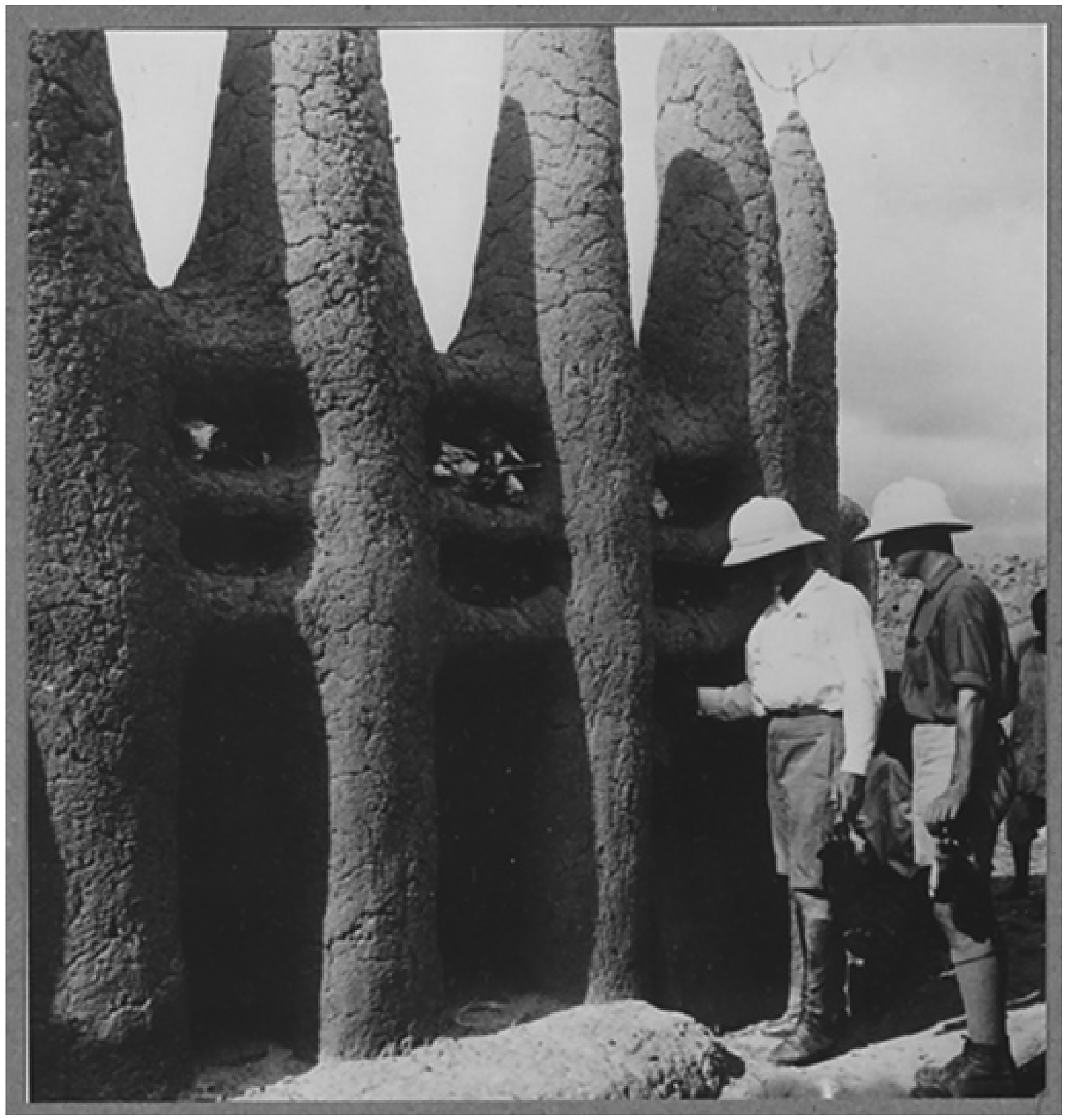
“‘Kono’ Shrine with Niches” Kemeni, Soudan Français. Photograph from the Mission Dakar-Djibouti, 1931. Musée du Quai Branly-Jacques Chirac, Iconothèque PP0031804.
The pith helmet, in French casque colonial or casque insolaire, punctuates this scene; its appearance on the heads of the two main figures is the clearest element of the photograph's colonial iconography. They are perfectly suited to an image that features all the elements of the quintessentially colonial: an “exotic” setting populated by white, European, male protagonists, with “native” inhabitants present but relegated to the background. This image and its context offer an ideal point of departure for my exploration of this headwear's interwar incarnations, demonstrating that its unadorned exterior belies the pith helmet's expressive potential, by turns defensive, aggressive, stylish, and subversive.
Clifford has described Marcel Griaule's interpretation of West African cultures as the creation of a “cultural master script” that the ethnographer found enacted in “virtually every domain of collective life”(1988: 85). Objects play key roles as bearers of this script in Griaule's analysis of West African, and specifically Dogon, culture, whether they are obviously loaded with ritual meaning or seemingly quotidian, functional forms. As I will describe, this photograph captures an emblematic instance of this object-based meaning production. In an overview of his research methodology, Griaule extolled the revelatory potential of objects as sources for ethnographic research: “Certainly all human activities are translated into objects, and theoretically it is possible to attain an understanding of a society by observing everything it makes or uses, surrounded by as much documentation as possible” (Griaule 1933: 7). In her review of two books by Griaule and his circle, renowned British anthropologist Mary Douglas vividly described this totalizing vision: “The same intricate harmony of images is drawn down and across from one level of experience to the next. Reading it is like gazing through a microscope at a flourishing form of life, confusingly alien and familiar” (Douglas 1967: 660).
Through my focus on the pith helmet, I propose to turn Douglas's metaphorical microscope around, directing it back onto France's colonial cultures. With this turn, I aim to decolonize Griaule's ethnographic practice, using a single object to expose the essence not of an “other” but of the ethnographer's own culture. In the 1920s and 30s, this emblem of colonial power traveled from colonial settings to the metropole, where its evocation of empire made it a sartorial ambassador for empire at a moment of national dependence on the military and economic contributions of France's colonies. The pith helmet also appeared on both sides of the colonial divide in French West Africa, incorporated into the dress practices of West Africans, including some who interacted with Griaule and his fellow ethnographers. Through the helmet's manifestations in these varied contexts, I explore this object as an index of both imperial power and of its limits. Unlike previous studies of dress and colonial power, through the casque colonial my analysis comprises both colony and metropole, from Kemeni to Dakar to Paris, worn on West African as well as French heads.
I aim to contribute to a body of scholarship that probes material culture to document African participation in and impact on networks of transcultural interactions in pre-colonial and colonial eras. 2 Elements of dress—cloth, clothing, jewelry, accessories—emerge as key participants in these historical global interchanges, their mobility enhanced by their portability, visibility, and value as signifiers of personal status. 3 A growing literature on deployments of textiles and dress (including headwear) in the transcultural networks created by colonial empires affirms Allman's observation that clothing has been “used both to constitute and to challenge power in Africa and its Diaspora” (2004: 1). Much of this work addresses the incorporation of elements of non-African (often Western) dress elements into African dress practices. 4 In the context of A.O.F., pith helmets vividly illustrate the circulations of material culture across populations and purposes, reflecting a range of positions in both metropole and colony. Unlike the other sartorial forms whose transcultural mobility is documented in this corpus of scholarship, however, the pith helmet's form remains essentially unchanged wherever it appears in these transcultural networks, even as it was interpreted variously as an embodiment and a disruption of imperial control.
In his seminal 1991 book Entangled Objects: Exchange, Material Culture, and Colonialism in the Pacific, Nicholas Thomas succinctly reminds us that the identities of objects are unstable: “Objects are not what they were made to be but what they have become.” 5 He explores the “creative recontextualization” of objects by Europeans and by Marquesans, Fijians, and Solomon Islanders. This instability is manifested in a simultaneity of meanings exemplified by the shifting significations of objects in transcultural settings, as things are contextualized and recontextualized: “The category to which a thing belongs, the emotion and judgment it prompts, and the narrative it recalls, are all historically refigured. What was English or French, in becoming Inuit, is reconstituted socially…similarly, what was Igbo or Javanese, in becoming American or Australian, now conveys something of our projects in foreign places and our aesthetics—something which effaces the intentions of the thing's producers.” 6 As it traveled, the pith helmet evoked narratives, emotions, and judgements—dramatically so, as I will describe. Like Thomas's objects, the pith helmet's colonial-era journeys between France and A.O.F. may entail effacement of “intentions of the thing's producers,” although its associations with those producers remained essential to its identity. In short, the pith helmet was emblematically entangled in this colonial network, illuminating what Thomas refers to as the “promiscuity of objects,” 7 a term that describes the array of “playful, powerful, politicized” interactions between things and people in the context of transcultural colonial empire.
The durability of the pith helmet's connotations also make it exceptional, extending its reach far beyond the demise of the imperial structures it invokes. Indeed, the pith helmet retains its ties to colonial cultures into the present. 8 Other elements of dress that frequently appeared in the wardrobes of Europeans working in or traveling to the colonies, such as khaki shorts, white shirts, and the like did not (and do not) have the associative power of the pith helmet. Garments from the other side of the colonial divide, such as the greatcoats and puttees worn by African soldiers in European armies, along with the conical chechia or fez hats worn by the iconic tirailleurs Sénégalais, 9 are also more generalized in their connotations. In France, the helmet conjured the hot sun of the colonies; in the colonies this headwear invoked the metropole and its administration of colonial subjects. The helmet was (and is) also exceptional for its transformation from evidence of white bodies’ vulnerability into an emblem of imperial power for those same bodies.
While its most prominent association is with the Europeans and Americans who administered, explored, missionized, traded, and visited the sunny—and, in their view, dangerous—climes of the colonies, the pith helmet's attachment to white bodies made this headwear a useful tool for West Africans who sought to partake in or subvert French power. I follow the white dome of the helmet as it moves between colony and metropole, from the heads of administrators and other French sojourners in the colonies, to their compatriots in France, and to their affiliates among colonial subjects where it served as an extension of French power. The same garment marked the limits of that power, as the pith helmet slipped from French control to become the subject of creative reimagining in the hands of West African consumers.
Through close analysis of interwar French representations of the pith helmet, both visual and textual, I trace the array of significations to which this single form of material culture was employed as it moved between France and A.O.F. This colonial federation makes for a fruitful setting for my sartorially-focused analysis. The region's climate made it prime territory for pith helmet wearers, encompassing humid forests to the south, semi-arid savannas beneath the arid Sahara Desert, which stretched from Mauretania to Sudan—the intensity of the sun, whether the climate was humid or dry, challenged European constitutions. The intersection of A.O.F. and France also has special salience for an exploration of colonial dress cultures, for one of the key motivations for French interest in A.O.F. was its potential to provide cotton for the metropolitan textile industry, as well as a market for that industry's products. 10 Thus, the dress practices of this region's residents had direct implications for the economic success of the colonies. 11
The pith helmet's purpose: Sunshine, panic, and power
From its earliest incarnations, this white-domed headwear has embodied a key paradox of modern empire and its aftermath: the simultaneity of dominance and dependence; authority and vulnerability. The casque colonial was initially developed as a form of protection for the heads of white Europeans against a threat they couldn’t hope to avoid and from which the Africans around them were believed to be immune: the sun of the colonies. Thus, the pith helmet was an acknowledgement of the weakness of white bodies. While heatstroke was and still is a serious threat in tropical climates, the protective powers attributed to the pith helmet far exceeded its capabilities; for French as well as other European sojourners in the colonies, this headwear became a talisman that invoked the power and security of the metropole when far from home. The garment's prominence as a symbol of colonial dominance has been traced to its omnipresence as an element of British attire in India (de Caro and Jordan 1984: 234) but it linked colonial worlds beginning in the late nineteenth century, worn in Spanish, Belgian, German, British, and French colonies in Africa and beyond (Charpy 2020: 209–210).
Pith helmets were (and are) made in a variety of styles, yet the basic form is recognizable across variations and geographies. The defining features of the headwear are its stiff, smooth dome that sits high on the head, the wide brim that extends around the crown, the white fabric that tightly covers the dome and brim, and the small holes at the top and/or sides of the helmet, providing ventilation. In his 1903 book Hygiène Coloniale: Hygièn des Colons, chief physician of the French colonial health service Gustave Reynaud described the pith helmet in minute detail: “The helmet, made of the pith of aloe or elderberry, 12 covered in a white fabric, perforated at the top with an opening topped by an indented cover, and by side openings that facilitate ventilation, is truly the headwear du jour in hot regions” (Reynaud 1903: 319). He describes the helmet's tapered edges, its light weight (about 400 grams), the space between the head and the top of the helmet that enabled air to circulate, and the colors that minimized heat absorption: white exterior, green under the brim (Reynaud: 319–320). A diagram of a pith helmet illustrates Reynaud's description, depicting details such as the small concave covering over the opening at the helmet's summit, the empty cavity between the exterior surface and the head, and the strap that passes beneath the wearer's chin (Figure 2).
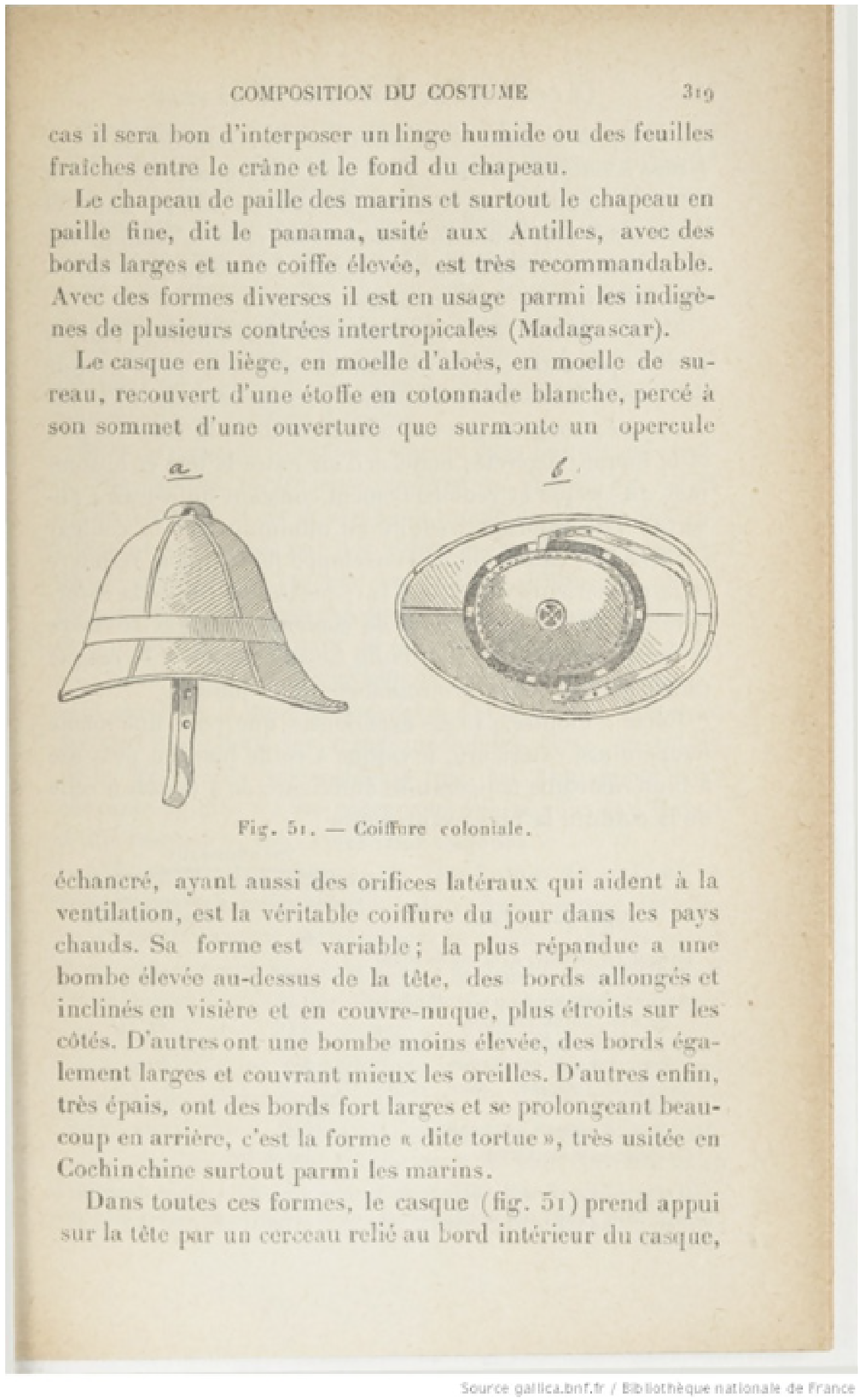
Illustration of a pith helmet [“coiffure coloniale”], Gustave Reynaud (1903) Hygiène Coloniale: Hygiène des Colons. Paris: Librairie J.-B. Baillière et Fils,: 319.
The design of this “headwear du jour” is a reflection of Europeans’ fear of the colonial sun in A.O.F. and other hot climates. In his study of French colonial medicine in late nineteenth to early twentieth century Senegal, Ngalamulume cites a 1901 article in Les Annales Coloniales that describes “tropical anemia,” a catch-all term for the afflictions and diseases that French—by implication, white—visitors could expect to suffer in the climate of the West African colonies: “Paleness of the skin, painful digestions, and vertigo associated with the defective functioning of the stomach and of the intestine, palpitations, breathlessness, (and) memory loss…appearing already within a few days or a few weeks” (2012: 3). The African sun was frequently cited as a chief source of the debilitating symptoms that constituted this “tropical anemia.”
A 1902 medical guide for Europeans in the colonies included a section on “Les Ennemis de l’Européen” [Enemies of the European], the first of which is the sun: “through its chemical rays, light, or heat causes serious and often fatal illnesses; heat stroke, sun stroke, tropical anemia, night-blindness, and sometimes troubling gastric disturbances” (Barot 1902: 336). Physician August Vallet, a medical officer in the French colonial forces, used dramatic language to describe the sun's dangers in a 1917 article whose impassive title— “Introduction to Tropical African Pathology”—belies the drama it contained. Vallet presented the colonies as a litany of threats to European bodies, chief among which was “the sun, king of the tropics, absolute master of his empire, who doesn’t want white people to come and defy him in his territory. He is a constant, implacable enemy for whom there are no seasons, there is no truce, no rest, from whom there is no escape” (1917: 45). Pressing his point further still, Vallet warns that this enemy is “vindictive, inexorable… omnipotent, tyrannical, [it] kills, burns the brain, without shame” (1917: 45). This sun was more than an element of the African climate; it was a foe on the battle field for control of these colonies.
With this description of the sun's evil character as preamble, Vallet turns to a series of five “articles,” each of which is an “essential rule for Europeans in the tropics.” Article 1 concerns the pith helmet: “The casque colonial must be worn at all times from sunrise to sunset, no matter where the sun appears in the sky” (1917: 45). While it must always be worn outdoors, he admonishes readers to be cautious even indoors: before removing the helmet the wearer must “ensure that the reverberations [of the sun's rays] have stopped or are at least rendered insignificant” (1917: 45). This portrayal of the sun as an enemy so implacable that it tracks its victims even into their houses is remarkably florid, yet its message about the pith helmet was a frequent one in administrative directives and in the popular press.
Like all colonial archives, records of the A.O.F.'s seventy years primarily preserves the words, perspectives, and imaginations of colonizing cultures—whether administrators or academics, merchants or tourists, French views abound. Yet, I find in the pith helmet a form of sartorial sub-archive, in which representations of and references to this canonically colonial form project European power, and they also reveal the precarity of that power. As Allman has observed, clothing has been “used both to constitute and to challenge power in Africa and its Diaspora.” (2004: 1) In her study of women's use of changing garment styles to navigate political change in British colonial Sudan, Brown identifies dress as a fulcrum point around which power turned: “If the body was a site on which government policies played out, it was also where imperial power reached its limit and colonized voices asserted themselves.” (2017: 7)
The pith helmet was unique among the sartorial signals of difference at this intersection of Africa and Europe, for it signified the colonies in Europe just as it signified Europe in the colonies. In short, wherever it appeared, the pith helmet alluded to an elsewhere. Its imperial connotation propelled the helmet into dress practices on the other side of the colonial divide, where West African consumers brought further layers of semantic complexity to this headwear's colonial connotations. These included a select few West Africans who wore pith helmets to signify their status as adjuncts to the French administration, thus extending that power. Others took up the pith helmet in defiance of French sartorial norms, drawing its associations with prestige and authority into local systems of meaning.
“Mr Helmet-wearer”: Wielding power through headwear
Before addressing this headwear's adoption into West African dress, I begin with the helmets in their most visible incarnations during the interwar period: as markers of participation in or proximity to the operations of empire. The helmets in the photograph taken at the shrine in Kemeni (Figure 1) exemplify this imperial aura, placing these men in a lineage of Europeans who served the overseas extensions of their nations.
The same garment also served Europeans in the metropole, where images of the helmet (such as this one) circulated in popular media. 13 Depictions of nattily dressed and helmeted French officials, soldiers, researchers like Griaule, and sundry other French travelers served the French government's pro-colonial propaganda, which aimed to “diffuse and anchor a specific vision of the colonies in the minds of the French populace,” a vision focused on the colonies as “exotic” yet integrated into national identity, with political and economic benefits for France (Lemaire 2014: 163).
Albert Sarraut, France's Minister of the Colonies from 1920 to 1924, described the many media by which the administration conveyed its message, garnering public support for the colonies: “It is absolutely essential that a methodical, serious, continuous propaganda through word and image, through newspapers, conferences, films, and expositions can have an impact throughout our country” (Sarraut 1920/2003: 138). The pith helmet appeared frequently in these many venues, projected to French audiences through popular culture as a signifier of the nation's colonial empire.
In the photograph at the shrine in Kemeni, the helmet's associations with colonial rule sit easily on Griaule's head, with his martial bearing and his approach to ethnographic fieldwork as a “perpetual struggle for control” (Clifford 1988: 67). These associations did not suit his colleague Michel Leiris, standing beside him, who would later publish an anguished account of the coercive methods Griaule employed in his “struggle” (Leiris 1934). Their two helmets almost appear to evoke the distinction between the men: Griaule's helmet is delineated prominently against the dark surface of the structure behind it, while Leiris’ blends into the white sky above. This contrast visually enacts a tension that illuminates the whole of France's colonial presence in A.O.F: even as the pith helmet proclaimed French authority, it also revealed the tenuousness of that authority.
While my reading of the helmets finds significance in accidents of light and composition, the historical context of the photograph makes these colonial tensions vividly and disturbingly real. This photograph centers on Griaule as the leader of the era's most famous ethnographic research expedition, the Mission Dakar-Djibouti (1931–1933), which brought a team of French social scientists to A.O.F., where they spent two months in Dogon communities before continuing across the continent for the next eighteen months (see Griaule, Leiris et al. 2015). 14 The scene depicts ethnographic research in action, a pursuit that was inherently colonial in interwar French West Africa. Sibeud succinctly describes how ethnography and colonial administration were intertwined in A.O.F.: “Ethnographic research in colonial contexts is an explicit manifestation of the civilizing mission which scientifically ‘discovers’ populations in order to subjugate them” (Sibeud 2002: 11).
These two realms did more than fuel each other intellectually; ethnography partook in the colonial exercise of power. The work of Griaule and his followers has been reexamined in recent decades, revealing the impact of the colonial structure within which the researchers interacted with Dogon communities. 15 As van Beek and others have noted, Griaule was unambiguous in his enactment of the tropes of colonial power: “In those days, inevitably, Griaule was part of a colonial presence, and the white man, endowed with power and prestige, ranked high in Dogon eyes. In contrast to many colonial anthropologists Griaule in no way tried to diminish this ascribed status but rather capitalized on it” (Van Beek 1991: 153). The pith helmet signaled that power; Apter's concise description of Griaule's persona recognizes headwear as a key element of his projection of power: “pith helmet, whites, and indomitable style” (2005: 99).
The photograph of Griaule and Leiris—or more important for my purposes, the photograph of the pith helmets worn by Griaule and Leiris—appeared in the French press soon after the Mission concluded. It was published in the Surrealist-oriented art/literature/ethnology journal Minotaure, in a 1933 special issue devoted to the Mission Dakar-Djibouti (Minotaure 2 #1 1933: 10) (Figure 3). In this extensive documentation of the expedition—approximately 150 photographs—this is the sole image that included any members of the research team. That a photograph in which pith helmets appeared so prominently was selected to represent French researchers reflects the headwear's close association with the colonies.
The Kemeni image also depicts the oppression and violence that were embedded in the structure of French colonial states. A passage in L’Afrique Fantôme, Leiris’ memoire of his experiences as part of the Mission, describes the moment captured by this photograph. We see Griaule and Leiris in the Bamana community of Kemeni, standing before a shrine that held a spiritually powerful, and for Griaule ethnographically valuable, mask. Griaule and his team collected more than 300 objects during their stay in the Soudan Français, all of which were deposited at the Musée d’ethnographie du Trocadéro. 16 Griaule used threats and bullying to pressure the community's leaders before finally stealing the mask with Leiris’ help. Leiris described the scene after the elders refused to give up the mask: “Griaule declared, tell the village chief…he must hand over the komo [mask] for 10 francs, or the police who were supposedly hidden in the truck would take him and other community leaders to San [a nearby town] to explain themselves to the colonial administration” (1934: 103–104). Griaule's elision of his authority with that of colonial administrators was facilitated by his pith helmet's association with French officialdom.
Dogon headwear: Caps and helmets
Although headwear was just one among a great many elements of Dogon material culture Griaule and his colleagues addressed in their exhaustive research, it figured prominently in the diffusion of their work. For example, the first article in the special issue of Minotaure—Griaule's “Introduction Méthodologique”—opens with a large photograph of a Dogon man's head and shoulders, placed above the title at the page's center, and starkly delineated on a white ground (Figure 4). The caption identifies the man as Tabyon, one of the team's informants. Facing away from the viewer, Tabyon is presented in a three quarter view. This perspective foregrounds his white cap, which dominates the image: we see the cap of white cotton in contrast with Tabyon's dark skin, a flap pulled over his ear, with a small tassel at its tip. Dogon headwear also appeared in other popular press coverage of the Mission Dakar-Djibouti, such as in a 1933 issue of the newspaper L’Intransigeant. An article heralding the return of the expedition was illustrated with two portraits of (anonymous) Dogon men in profile, each wearing a distinctive hat (Figure 5). 17 The captions read: “A Dogon from Sanga wearing his cap” and, in a reference to the famed French fashion industry, “Another Dogon adopted a style of hat that could rival [French] women's hats of 1933” (L’Intransigeant 1933: 10). 18
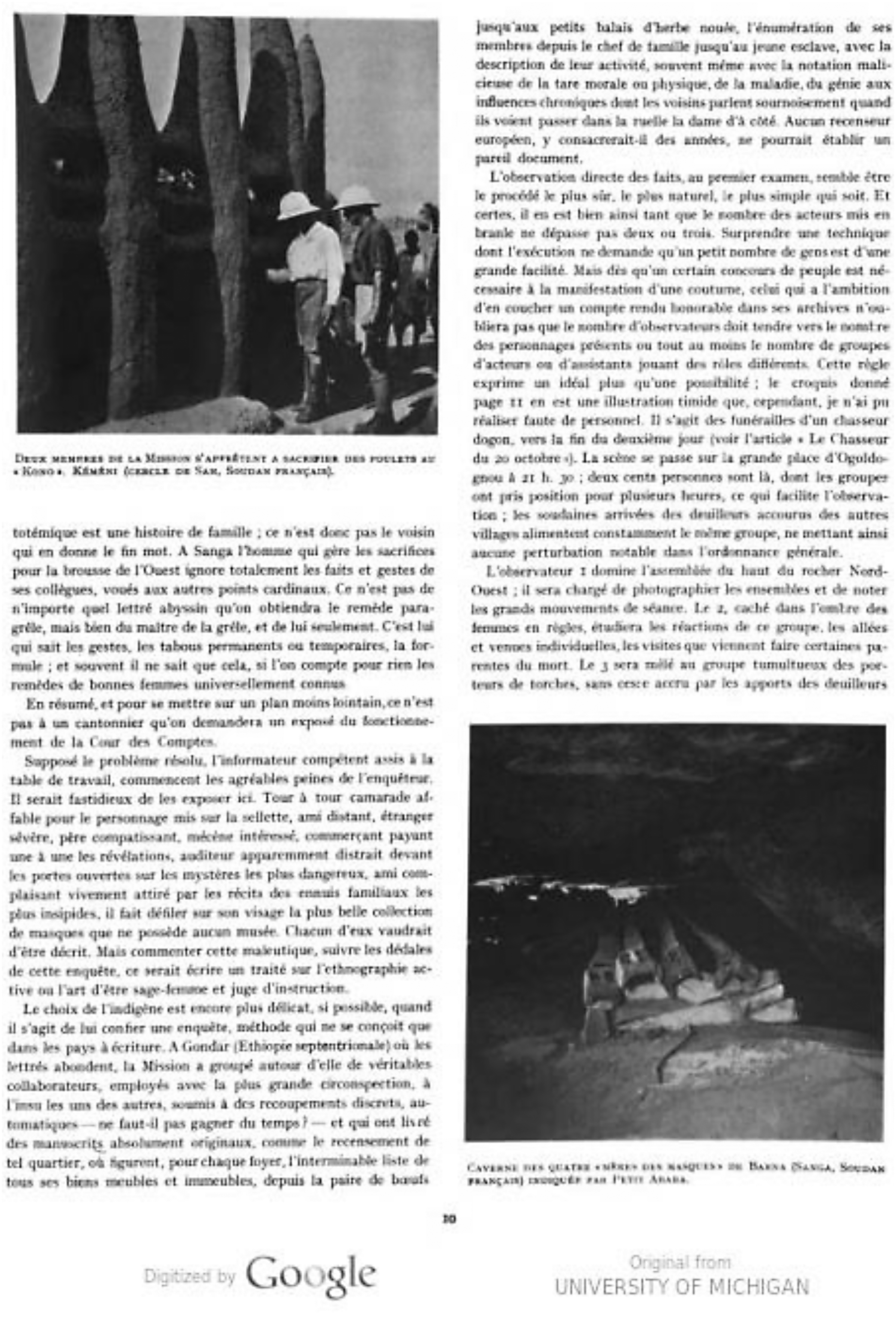
Kemeni shrine photograph in Marcel Griaule (1933) “Introduction Méthodologique” Minotaure 2: 10.
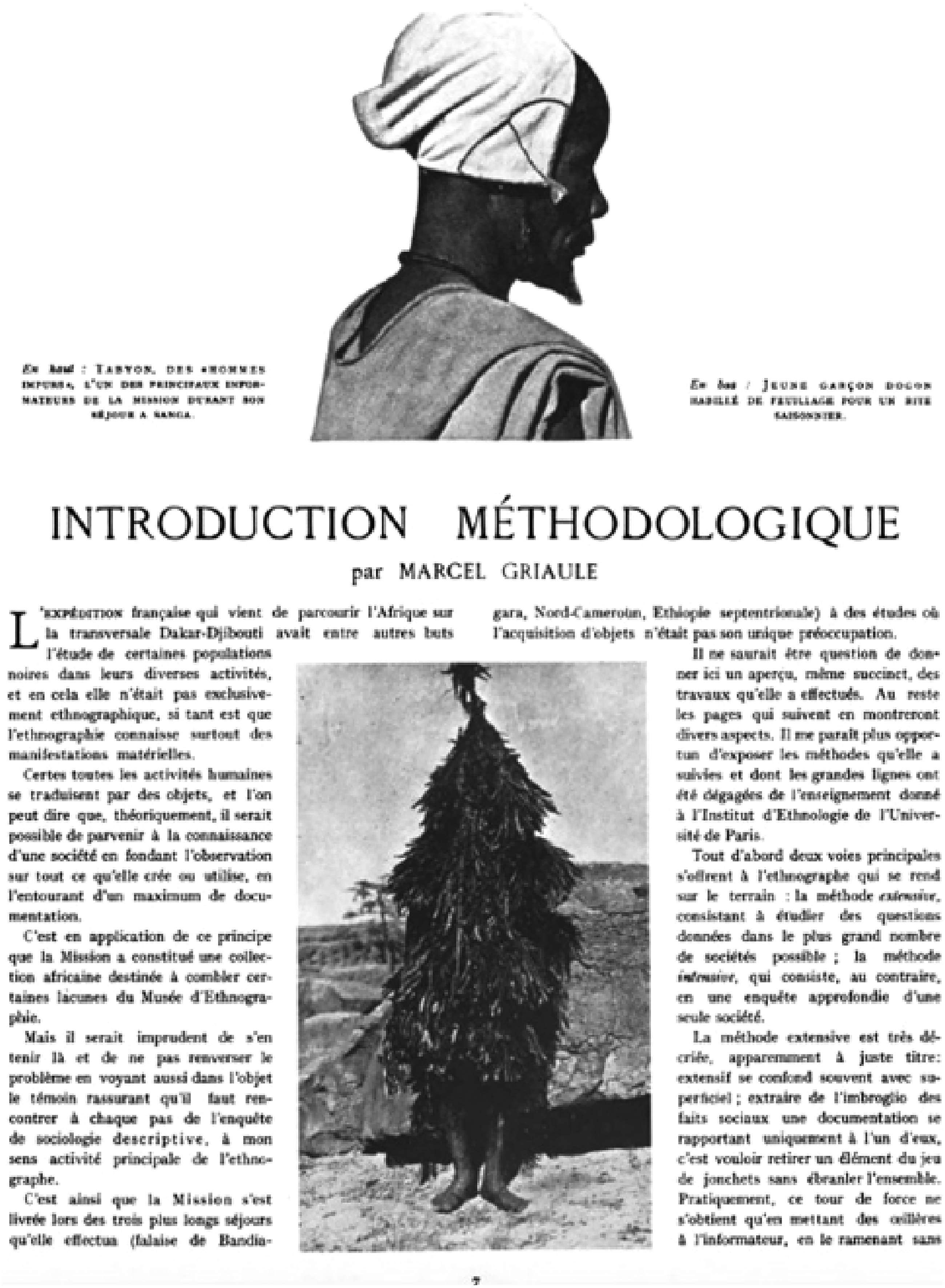
Marcel Griaule (1933) “Introduction Méthodologique” Minotaure 2: 7.
Dogon headwear appeared as a leitmotif in the Griaule team's academic publications. Dogon hats appear throughout Dieu d’Eau (Conversations with Ogotêmmeli), Griaule's best known publication, in the form of six small photographs of a Dogon man in profile, wearing a cotton cap in a variety of styles. 19 Most of these images serve as design elements rather than as illustrations, punctuating the pages visually and only in one case placed near text that refers to the headwear. These are the only such images in the sparsely illustrated book; the other diagrams and photographs directly illustrate the text. Griaule and his colleagues investigated virtually countless elements of Dogon material culture; headwear was not a special focus, but it did play a prominent role in the presentation of the team's work.
This attention to hats is significant for the absence of one notable and, for the team of researchers, familiar genre. Michel Leiris’ memoire L’Afrique Fantôme, his record of the Mission Dakar-Djibouti, provides rich descriptions of the pith helmet's incorporation into distinctly West African dress style. He was impressed by the attire of a district chief, who completed his elegant ensemble with a helmet: “Physically, very tall and very slender, with a handsome, dark complexion, an entirely indigenous outfit (a large, dark blue boubou [gown] and sandals, a little amulet wrapped in leather dangling on his chest) with the exception of a beige pith helmet, worn with great distinction” (Leiris [1934] 1981: 29–30). This description—respectful and admiring—incorporates the pith helmet into a portrayal of African elegance.
The pith helmet appeared again in Leiris’ description of Baba Kèyta (or Keita), a Malinke man who collaborated with the researchers in their work in the Dogon region. Leiris paints a vivid picture: “Baba Kèyta is coming: white espadrilles, impeccable white suit with an officer-style stand-up collar, a slightly too large pith helmet—which he fixed using strips of paper taken from an issue of La Dépeche Coloniale borrowed from me for this purpose—and perfecting his outfit, a belted European winter coat and a freshly shaved head” (Leiris [1934] 1981: 67). Kèyta's effort to resize his pith helmet, inserting sheets of newspaper (aptly, a colonial-themed newspaper) so that it would better fit his head, attests to the value he placed on this accessory. Importantly, the elements of his ensemble are more disparate than those of the district chief, whose “entirely indigenous” outfit incorporated just one non-indigenous element: the helmet he wore “with distinction.” Leiris’ portrayal of Kèyta, on the other hand, is inflected with bemusement at this African man's use of Western-style garments in combinations that defy French conventions: a white military-styled suit with white sandals, topped with a winter coat whose belt, we imagine, was cinched tight. The helmet is here quite literally ill-suited to its West African wearer, requiring a makeshift resizing with the assistance of a French benefactor.
The difference—if subtle—between the two descriptions of West African men whose dress practices incorporate the pith helmet illustrates the two distinct tactics that undergirded many aspects of French colonial policy: “Colonial administrators were unable to choose between asserting the assimilability of the colonial possessions and proclaiming their irreducible alterity because they needed to do both.” [My emphasis] (Ezra 2000: 6). The binary Ezra describes as “assimilability” and “alterity” was codified in administrative policy as “assimilation” and “association,” a distinction that has, as I will describe, direct implications for the fortunes of pith helmets in A.O.F. For French audiences, West African helmet-wearers may represent their nation's successful assimilation of colonial subjects; or the headwear provoke censure for blurring the all-important distinction between colonizer and colonized.
Such references to pith helmets in combination with West African attire, or with Western attire in unconventional (to French eyes) styles, did not appear in the “official” publications of the Griaule team. Instead, descriptions of West Africans who, like them, wore pith helmets were published in L’Afrique Fantôme, a highly personal, stylized work, wholly distinct from the scholarly and popular publications that appeared elsewhere. Leiris’ vivid portrayals of these men “working” their pith helmets (to use a contemporary and richly descriptive verb) is also an acknowledgement of the presence and the power of the colonial state—a presence not addressed in the work of these ethnographers, despite their reliance on the aura of state power. As Jolly describes, Griaule and his collaborators “erased the fact of colonialism” from their publications and presentations (Jolly 2019: 14). The pith helmets on their own heads projected the power accorded Europeans in this colonial setting; on the heads of West Africans the helmet posed a threat, or at least signaled a potential threat, to the very foundation of that setting. Before turning to the pith helmet's interwar presence in French West African wardrobes, I pause in Paris to address the headwear's deployment as an element of the propaganda that aimed to promote public support for the empire, firmly associating the headwear with imperial power.
Pith in Paris: Popular culture, propaganda, and the casque-fétiche
The distance between the pith helmet's origins in European vulnerability to the sun of the colonies and its prominence as a symbol of European authority in those same colonies is as great as that separating the Senegal River from the Seine. Yet, the pith helmet did make its way to the Seine, where it left behind its ostensible raison d’être as solar protection. Instead, it became a generalized symbol of France's status as a colonial power, a visual emblem of the nation's imperial reach that circulated widely in popular culture of the 1920s and 30 s. During this period, a new propaganda division of the Ministry of Culture, the Agence Générale des Colonies, was established in order to shift the nation from the era of conquest to an era of implanting the empire into French culture (Lemaire 2003: 138). The Agence was charged with the “colonial education” of the French population, to “inspire them to integrate the empire into their mindsets and into their daily lives” (Lemaire 2003: 139). The specificity of the pith helmet's connotations made it an ideal tool for the inculcation of imperial culture into French public consciousness, for rather than evoking the colonies themselves, the helmet was the visual icon of Europeans in the colonies. In addition, its white dome was highly visible, portable, and suited to all ages and genders.
This reinforcement of the imperial as national identity, a means of securing public support for the maintenance of colonies, gained urgency as the French economy was increasingly reliant on the colonies after 1900, and the nation's military dependence on colonial troops became evident with the nation's reliance on colonial troops—including the famed tirailleurs Sénégalais 20 —during the First World War. As Wilder notes of the post-World War I years: “France's colonial empire began to figure prominently in postwar national self-understanding… a broad spectrum of political opinion identified the empire as a crucial component of economic growth, national renewal, and international prestige” (Wilder 2005: 29). Chafer and Sackur describe the use of popular culture as propaganda in the decades after World War I: “Imperial propaganda conveyed a strong sense of French cultural, political and indeed ‘racial’ superiority, over both conquered peoples and, implicitly, over less successful colonial powers” (Chafer and Sackur 2002: 6). The pith helmet was an emblem of this imperial culture, sartorial shorthand for colonies so distant that a different sun illuminated their sky, yet that were still a part of France.
The pith helmet's prominence amid this imperial propaganda is evident in a richly illustrated volume on French popular media representations of the nation's colonial empire from the late nineteenth to mid-twentieth century, L’Illusion Coloniale (Deroo 2005). The collection offers a survey of visual representation from the mid-eighteenth to the late twentieth century, tracing the “progressive creation of this perception, this illusion [of the colonies]” (2005: 7). Pith helmets abound in the volume's chapter on the interwar period, appearing in advertisements, toys, journalism, comics, films, and recruitment materials for the colonial administration. These helmets are depicted on the heads of French administrators, explorers, tourists, teachers, doctors, even children.
The pith helmet played a supporting role in a legendary Parisian music hall performance, enhancing a dance number's vague narrative to lend it a colonial setting. The performer was the American Josephine Baker, who was famous for her iconically, and inaccurately, African persona. The performance was part of the musical revue “La Folie du Jour,” at the famous Folies Bergère. This event is remembered primarily for Baker's “banana skirt,” a costume that consisted of banana-like forms strung together, suspended around her waist and projecting outward around her pelvis in a manner that inevitably evoked phalluses. The banana skirt has no precedents in Africa; it was a wholly invented form that evoked Africa for non-African audiences (Rovine 2015: 96). The colonial context saturated Baker's performance, as Francis notes: “the mid-to-late 1920s and the 1930s audiences were able to enjoy Baker as a unique creature who was both a screen for the projection of colonialist fantasy and the bearer of black American modernist aesthetics” (2013: 133–134).
As important as the skirt in establishing the geographically vague yet specifically colonial setting of the dance, was the pith helmet worn by another character in this exotic fantasy: the white explorer: “The curtain opens onto a luxuriant jungle, palpitating to the rhythms of tam-tams played by natives in loin-cloths. A white explorer sleeps tranquilly under a mosquito net hung on the banks of a river. The explorer wakes up when Fatou, the native girl played by Baker, descends from a tree in a belt of bananas, a human prey and ultimate colonial fantasy” (Gordon 2004: 44). As Brown describes, Baker extended such primitivizing stage and screen performances into her off-stage public persona: “On the streets of Paris, with her beloved pet leopard Chiquita, or strolling through the exposition, Baker was a combination of the infinitely metropolitan and the timelessly savage, the colonial subject produced inside the metropole” [My emphasis] (2008: 254). The specificity of Baker's association with Africa as colony, not as continent, was reiterated by the presence of the pith helmet, a reliable signal of a vague, colonial setting. In addition to firmly (if imprecisely) projecting the setting, the pith helmeted character gave the French audience an avatar, who elicited but did not encourage the sensual yet innocent dance of this “timelessly savage” performer.
A photograph taken at the 1931 Exposition Coloniale Internationale illustrates one way the French public could come closer still to the experience of their compatriots in the colonies: through direct contact with the pith helmet (Figure 5). This press photograph depicts a vendor on a Paris street corner surrounded by several customers who are looking at and trying on the white, dome-shaped pith helmet. The three customers, all presumably French, attest to the broad appeal of empire: a man, a woman, and a child all wish to take up this emblem of their nation's overseas possessions. This protective headwear's popularity among the denizens of a not-so-sunny clime reflects the administration's promotion of imperial culture, as Lemaire describes: “The [French] public was encouraged to ‘explore’ their Empire from the comfort of their ‘homeland’” (Lemaire 2014: 258). How better to play the role of traveler to distant colonies than to wear the garment that both protected and projected European imperial power?
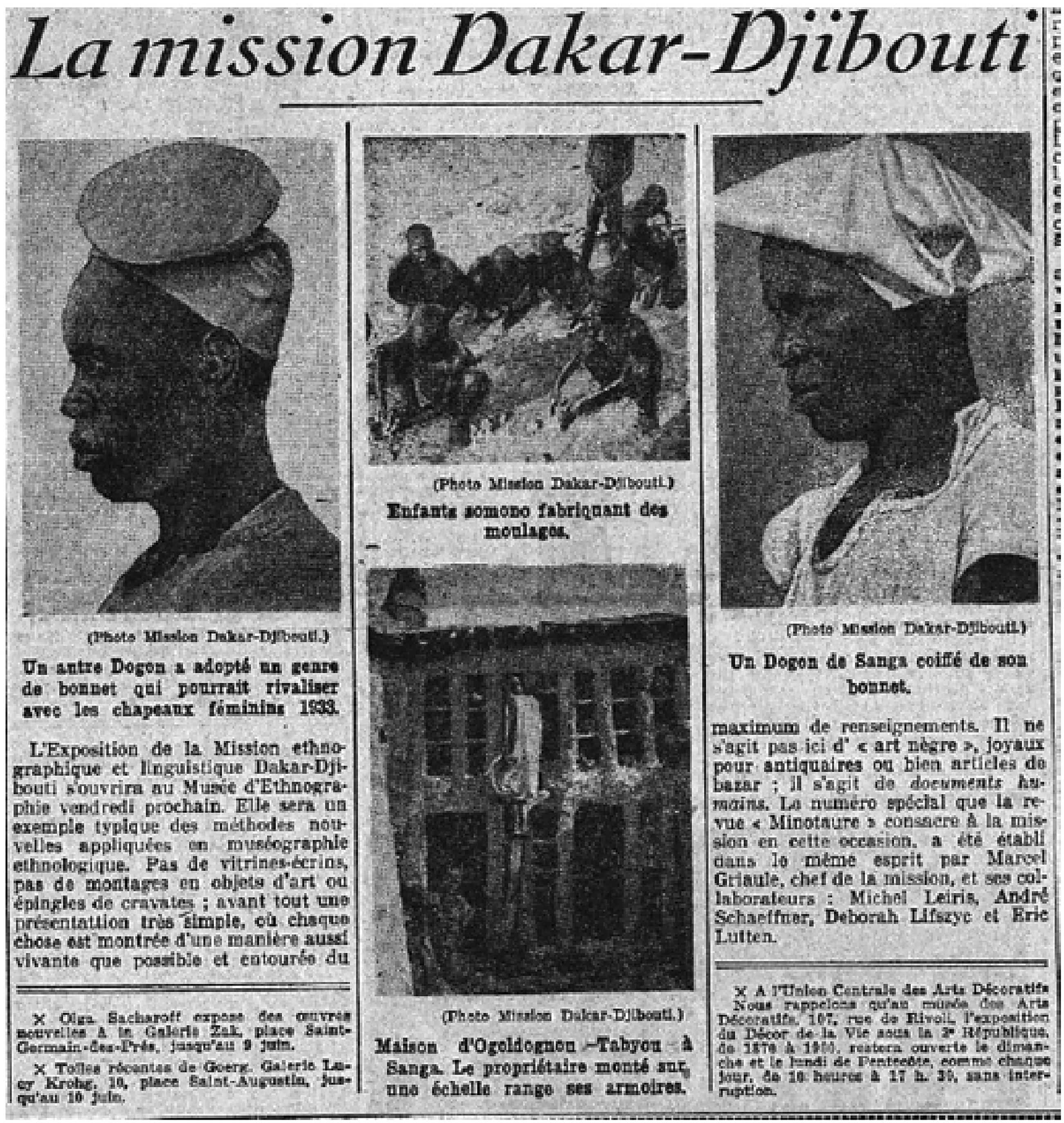
Rivière, G-H. (1933) “La Mission Dakar-Djibouti” L’Intransigeant 54 #19,572: 10.
Amid the voluminous popular press coverage during the seven-month run of the 1931 Exposition, references to the popularity of the pith helmet appear to provide a subtle means of expressing skepticism about the drive to instill imperial culture. If this impracticality was even more clear when worn on those streets at night, as one journalist observed in a colonial-themed periodical: “The Colonial Exposition is in full swing. The crowds flock, eager for exoticism. Some visitors, to take part a bit in the local color, wear pith helmets at ten o’clock at night” (Sasportas 1931: 1). Another commentary on the use of the pith helmet in France appeared in the popular newspaper Comœdia: The pith helmet is becoming fashionable. Our administrators aren’t the only ones sporting the colonial style helmet. The candied fruit and bonbon sellers in Montparnasse are starting to wear the white helmet. One might ask oneself why… Because, in reality, wearing a pith helmet and selling candy at night… But all the self-respecting visitors to the Exposition, it is said, must wear the pith helmet—it is selling literally like hotcakes! [ellipses in original] (Horatio 1931: 1).
Another observation from this intensely imperial moment more pointedly critiques the pith helmet's omnipresence in France. This commentary on the Exposition Coloniale creates an unflattering comparison between a helmet-wearing French man and a colonial subject who, one infers, would not have deigned to wear so inappropriate an accessory: The other day, in the avenue of the Colonies, across from the Somali Coast Pavilion, a brave man whose ears held up the pith helmet he had purchased for 15 francs, which is now in style, walked around a well-dressed black man, as if the latter were some sort of curious creature, finally exclaiming: ‘So, you happy come to Paris? Paris very pretty?’ Impassive, the black man replied: ‘I don’t understand you, sir. Please have the courtesy to express yourself properly. You are speaking to the Undersecretary of State for the Colonies’ (Maigret 1931: 146).
In the colonies, too, where the pith helmet's purpose was clear, its omnipresence made it an object of skepticism, even in colonial-themed press outlets. In 1931, an anonymous article on the history of the pith helmet appeared in the periodical Les Annales Coloniales (Annales 1931: 2). The author bemoans the pressure new colonial officials face as they are admonished to take up the helmet immediately on arrival, ignoring the long history of European trade and exploration in Africa before the invention of this ostensibly vital headwear. This history, the author notes, spans a millennium, from Ptolemy in the 1st century AD to French explorers and early administrators such as Louis Faidherbe, Governor of Senegal in the 1860s. Reminding the reader that none of these famous figures required the protection of the pith helmet, the author disdainfully refers to faith in the helmet's protective properties as a “superstition,” asserting that early twentieth century French sojourners in the colonies have created a “casque-fétiche” or a “helmet fetish.”
The choice of the term fétiche to describe the French wearers of the pith helmet is striking in this colonial African setting, for it recalls the European mischaracterization of African religions as forms of idolatry and superstition, attributing spiritual power to and even worshipping objects. Indeed, as Pietz notes, the term's origins can be traced to proto-colonialist interactions between Europe and Africa in “the cross-cultural spaces of the coast of West Africa during the sixteenth and seventeenth centuries” (1985: 5). Murray describes the trope of the fetish in European conceptions of non-European religions: “Fetishism was to be found in folk belief as well as in the belief of those groups who were the targets of conversion, but as it became systematized in the eighteenth and nineteenth centuries, it took its place as the lowest point in a hierarchy of beliefs, which were, of course, racialized” (2007: 10). The anonymous author of the commentary in Les Annales Coloniales used “fetish” to accuse his own compatriots of worshipping the pith helmet—a strong reproach, perhaps tinged with an implication that these helmet worshippers had “gone native” by imbuing the headwear with amulet-like protective powers.
Along with his condemnation of the French casque-fétiche, the author denounces Africans who wear the helmet. Turning to the use of the helmet by “natives” [“indigènes”], the author declares: “The lowest servant [“boy”], the lowest cook, the lowest driver has his helmet… And yet I still maintain that for a person in normal health—and certainly for a black person—heat stroke is not an issue” (2007: 10). For this commentator, if the helmet is a useless superstition for French people, for Africans it is an absurd affectation.
“Supreme ambition of the Urban Native”: Pith helmets in A.O.F.
Although expressed with humor or mild pique, these and other French reactions to the pith helmet's incorporation into West Africans’ attire reflect a concern that Stoler and Cooper identify as a “basic tension of empire”: the assertion of distinctions between colonizer and colonized in which “a grammar of difference was continuously and vigilantly crafted” by the colonial regime (Stoler and Cooper 1997: 3–4). Clothing was a clear, visual marker that was, along with skin color, key to this grammar of difference. In two guidebooks produced for the 1931 Exposition Coloniale Internationale, clothing encapsulates difference, distancing French audiences from colonial subjects and distinguishing among the “exotic” peoples of the colonial empire: We are soon plunged into Black Africa, in the Muslim city of Djenné, among the blue ‘guinea’ [cloth] of the Moors, the white burnous [cloaks] of the Senegalese, the raphia clothing of the natives of Dahomey and Côte d'Ivoire. Between the central tower and the lean-tos of the village fetishist—what a strange symphony of colors! (Guide Offert 1931: 4)
Two hundred indigenous people from the farthest provinces lent the whole of the Section a well-deserved note of exoticism which draws and holds the crowd. The white boubous [robes] of the Senegalese, the blue cloaks of the Moors, the black robes of the Fulani (Le Livre d'Or 1931: 85).
Zanardi and Klich describe such visual typologies of peoples as “sophisticated mechanisms of politics and power” in which “dress took on a heightened status in identifying a people” (2019: 1–2). While this sartorial shorthand can be traced to the Early Modern period in Europe, the conception of people-as-dress gained currency with the advent of the modern colonial era (2019: 1). We might expect deviations from the boundaries of these categories would draw the disapproval of French officials and other observers.
Numerous studies of African dress practices in the context of European colonial power have documented the use of Western styles of clothing to navigate cultural hierarchies. 22 In these and other analyses of African attire and colonial power, dress disapproval on the part of colonial officials and other observers was provoked by change on the part of their African subjects, and especially change in the direction of Western styles of dress. For colonial officials and their like-minded compatriots, the blurring of dress categories was a source of concern; their objections reaffirmed the importance of these classifications, whose “slippage” might signal the unsettling of hierarchies.
In interwar A.O.F., a 1936 report on the preservation of indigenous arts in A.O.F. by French journalist and author Edmond Tranin lamented the disappearance of past dress styles which had “such dignity in their wrappers and even in their naïve nudity” (Tranin 1936: 3). He placed the blame for the demise of these dress practices on the administration's “modesty and commercial interests,” as well as on missionaries and traders whose impact he described in bitter terms: “in villages in the bush and the forest, [they] introduced outdated formal clothing and uniforms, as well as used clothes that were the rejects of rag dealers in France. The natives even give up one or two months of salary to purchase a lion tamer's vest or a fireman's helmet!” (1936: 3). The enthusiasm for new dress styles was linked to profligate spending, moral weakness, and lack of taste, for what else could explain the appeal of a fireman's helmet? The archives of French rule in A.O.F. are replete with bureaucratic, journalistic, and academic condemnations of the changing dress of colonial subjects, nearly all of which concerned the adoption of Western dress styles.
The appearance of pith helmets on the heads of West Africans provoked particular comment and criticism, both subtle and direct. In 1912, a French journalist visiting A.O.F. described a street scene in Rufisque, a town near Dakar, using headwear to survey the city's inhabitants: “Some wear turbans of blue cotton, some wear the fez, some caps in faded velvet. Others, seduced by the beauties of civilization, wear heterogeneous styles, workman's caps, even pith helmets—the supreme ambition of the urban natives” (Sonolet 1912: 379). The pith helmet, thus, invoked the supposed impulsivity of consumers who covet the trappings of European “civilization.” French observers also complained that West Africans wore the headwear incorrectly, as in a 1928 description of the denizens of Dakar: “Let us point out some sartorial particularities: the shirt is usually worn over the pants, the shirt tails billowing. Pith helmets are never lost, and always wind up on the head of a native, who often feels the need to paint it. One of them had a periwinkle hue, another gave his a coat of black paint” (Perez 1928: 238). This last must have seemed the height of sartorial and scientific ignorance, for the black surface would draw in rather than repel the heat of the sun, thus countering the helmet's raison d’être.
The pith helmet was cited as evidence of the purported capriciousness and immaturity of West African consumers in a 1931 article entitled “The Native Consumer: His Tastes, His Needs” (J.M. 1931). The anonymous author offers advice to French merchants seeking to sell their wares in West Africa. 23 Describing the unpredictable, seemingly illogical demands of these consumers, J.M. uses racist characterizations (“they are still big children,” “they still live in very primitive conditions” 452), and reassures his compatriots that “we can succeed in creating and instilling needs” in these “simply and naïve populations” (451). This supposed childlike impulsivity, frustrating yet potentially advantageous for the French merchant, is exemplified by the pith helmet: “Because the native customer doesn’t always know what he is going to buy, in other words, what is, not so much his need but his desire or his whim? If he enters a store with the intention of buying a cooking pan, he will come out with a pith helmet even if he has hardly any clothing. But he buys the helmet because its form, color, and style please him and because he felt an immediate desire to become the owner of this object” (J.M. 1931: 452). In these anecdotes, the pith helmet embodies French disapproval of changing, creative dress styles in A.O.F.
The article includes a photograph of a street scene in Cameroon's capital Douala (Figure 6). Captioned “Douala: à l’Européenne” [Douala: European Style], the photograph captures three main figures, all walking on a crowded street bordered by a still more crowded embankment with a large building beyond. Two of the people at the image's center walk toward us: a woman in a tailored white dress with white stockings, a stylish small-brimmed hat on her head. Behind her walks a man in a sharply fitted suit jacket and bow tie, with a Trilby-style hat. The woman looks at the man walking past her, the third and largest figure in this frame. His back is to us as he strides away, wearing what appears to be a tight fitting riding jacket, jodhpurs, and puttees, carrying a cane in one hand, the other hand in his jacket pocket. He wears a large pith helmet, its color and shape unmistakable, its impact apparent in the woman's gaze in his direction. While we cannot see his face, the man's bearing—shoulders back, cane swinging—communicate his sense of importance. The caption (“Douala: à l’Européenne”) along with the description of the pith helmet's irresistibility, seem to connect the image to the narrative of the profligate “native,” encouraging the readers of Togo-Cameroun to see this elegantly dressed resident of Douala through the eyes of skeptical French observers.
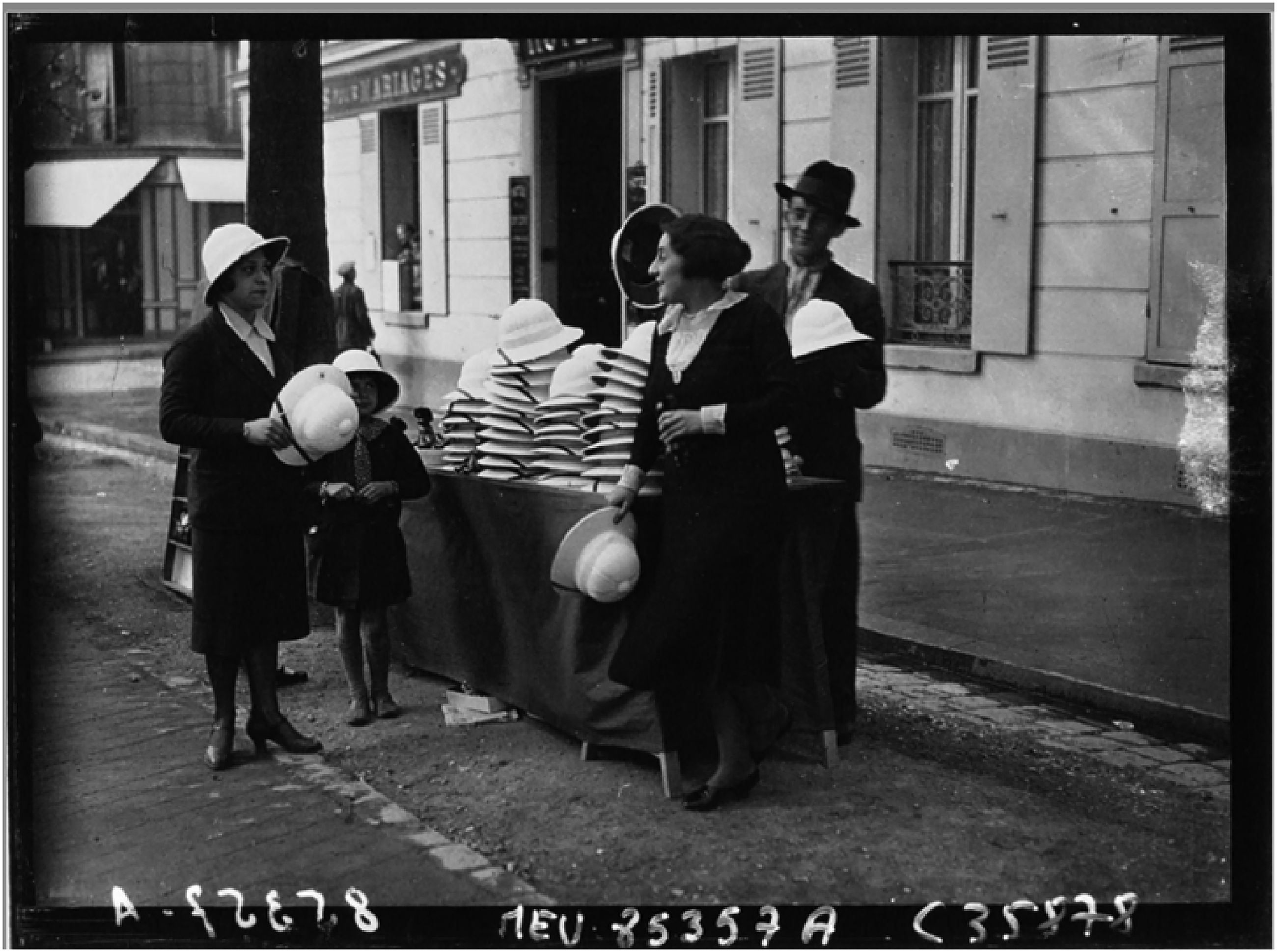
“Exposition Coloniale: la vente du casque colonial,” 1931. Paris: diff. par l’Agence Meurisse, 1931. Bibliothèque nationale de France.
West African use of the pith helmet also drew the disapproval of well-known colonial administrator and author Robert Delavignette, who spent much of his career in A.O.F. and in high ranking positions in the colonial administration in Paris. In a 1934 article in Le Petit Parisien, Delavignette distinguished between three African “types” in Senegal: the Tapalés, the Talibés, and the Badolos (Delavignette 1934: 6). Writing in this mass-market newspaper, Delavignette's article might have been read as tips for travelers to the region, enabling them to better assess the “natives” they would encounter. Clothing figures prominently in his description of the first category, the Tapalé: “a young man, elegantly dressed, partly in European style, partly in native style. He proudly wears the boubou—his national dress—and the pith helmet.” [My emphasis] (1934: 6) Delavignette dramatizes the Tapalé's obsession with appearance, describing his penchant for “dazzling shoes” and riding crops, which he carried tucked beneath his arm as he “strolls in front of the boutiques…in his glory.” These dandies spend their time in leisure, adding little to the success of the colony. The other two “types” are the Talibés, strict practitioners of Islam who need have little to do with the administration, and the Badolos, rural farmers who are underappreciated by the administration yet who make important contributions to the colony's economy through hard work in their fields. Of the three categories, Delavignette finds the Tapalés—the pith helmet- and riding crop-aficionados—the most problematic. He concludes the short article with an admonition that “the French should not be taken in by the lies of some Tapalés.” While he does not specify the nature of these lies, Delavignette's disapproval of Tapalé dress is specific, and it includes the pith helmet.
A famous ethnographic film offers another, exceptionally dramatic recontextualization of the pith helmet, removing this emblem of colonial power from French control. 24 Jean Rouch's 1956 documentary Les Maîtres Fous (“The Mad Masters”) was filmed in Ghana (then the Gold Coast) in 1953–54. It follows a group of Songhay men from Niger who worked menial jobs in Accra. They were practitioners of Hauka, an Islamicized possession religion from Niger. The film records the possessions of numerous group members in a single ceremony, each of whom is inhabited by the spirit of a specific member of a colonial administration (military officers, the wife of an administrator, the governor, etc). The film was controversial for its visceral depiction of African men frothing at the mouths, burning their bodies with torches, killing and consuming a dog—these colonial spirits are violent, impetuous, and powerful (Cooper 2002: 483).
The extremity of these performances transformed these characters into burlesque; as Stoller describes: “the Hauka cult was a movement of cultural resistance to French colonial authority” (Stoller 1989: 257). The pith helmet's centrality to this enactment—and parody—of colonial power is clear in the opening moments of this ritual. The event begins with the nomination of a new member: a man who explains to the attendees, several of whom wear pith helmets, that he has suffered illness for a month and sleeps in cemeteries. These were clear indications of his possession by a Hauka spirit. When the members admit him, he immediately bends to take one of the pith helmets for his own but is rebuffed. “He is not yet entitled to wear the pith helmet,” the voice over explains. “Perhaps in two or three months, he will be initiated” (Rouch 1956). For a colonial spirit being as for a colonial human, the helmet is the primary insignia of identity. Without an accurate enactment of this identity, the Hauka members cannot effectively harness or parody its power. These ritualized pith helmets, like those purportedly painted black, purchased profligately, and sported by Tapalés, are all detached from French control. The Hauka serves as a metaphor for this headwear's capability to evoke this control, partaking of colonial power, while evading that control.
Helmets within bounds in A.O.F.
Despite French disapproval of such recontextualized pith helmets, images of West Africans wearing the headwear occasionally served the interests of the French administration; this accessory could extend the reach of French power when worn with the tacit or explicit imprimatur of the administration. I conclude with this element of the pith helmet's interwar biography, in which the rare West African who attained a high governmental position might wear the helmet to signal that status. For example, in a photograph that appeared in a 1936 issue of Les Annales Coloniales, Senegalese journalist and politician Galandou Diouf stands beside the Minister of the Colonies (Marius Moutet) and the Governor-General of A.O.F. (Marcel de Coppet) (Monmarson 1936) (Figure 7). All three wear pith helmets, befitting their positions of power within the colonial administration: de Coppet and Moutet as the representatives of the French central government in the colonies; Diouf, elected to the French National Assembly in 1934, as the deputy to the Assembly from the four communes, towns in Senegal whose special status granted them this representation. This pith helmet conveys prestige, not impetuous consumption or dangerous elision of social and racial categories.
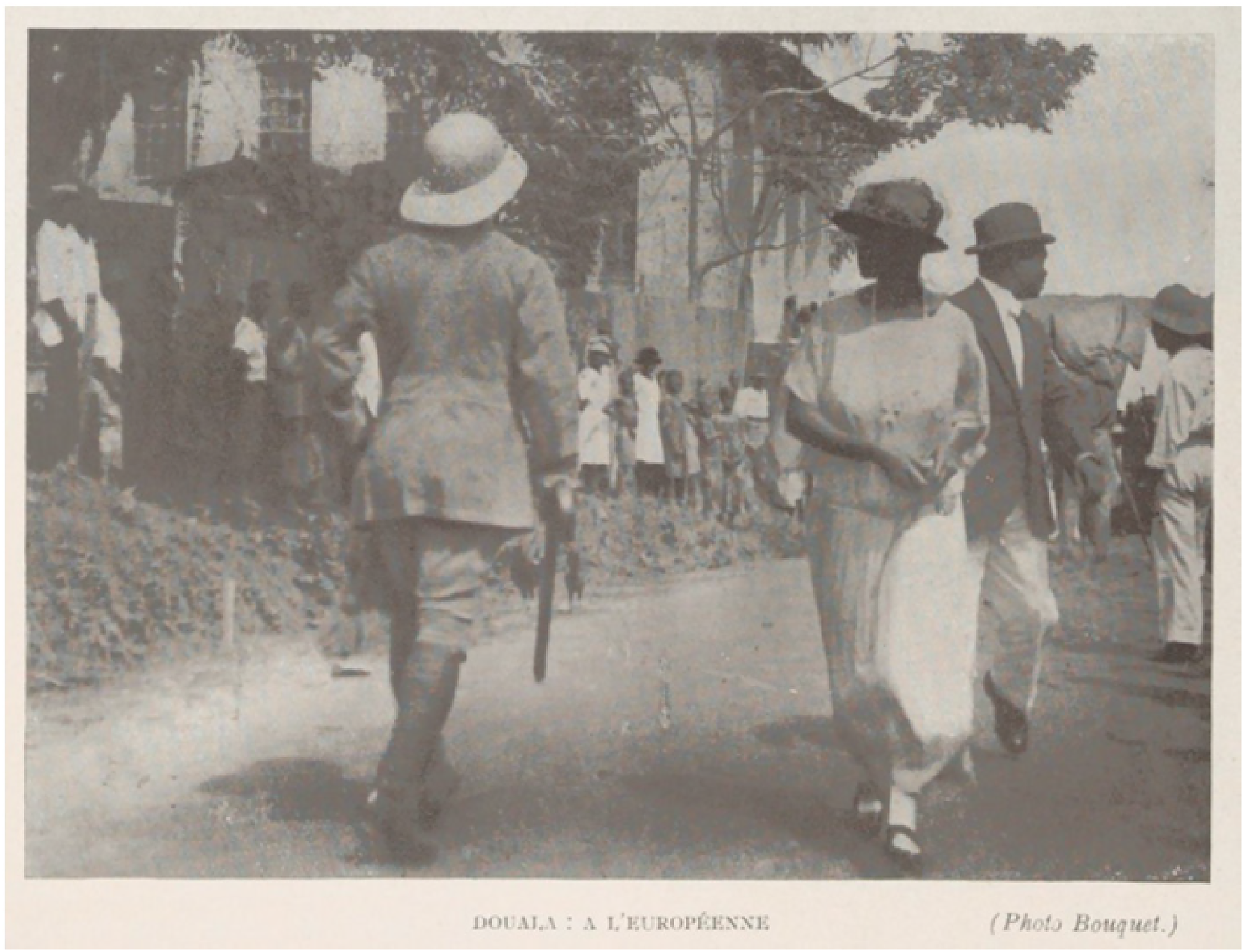
J.M. (1931), “L’Acheteur Indigène: Ses Gouts, Ses Exigences,” Togo-Cameroun: Magazine Mensuel, (Automne): 449−452. Page 450.
A group of tantalizing photographs taken at the inception of French rule in West Africa point the possibility that the pith helmet may have influenced a style of headwear that has a long and continuing history in the region. 25 This headwear, too, signaled affiliation with the French forces who were then gaining ground in West Africa. These photographs also remind us that sun protection In October 1898, French military forces captured Samoury Touré, a military, political, and religious leader who was among the last West African leaders to hold out against French efforts to bring the region under colonial rule. French officer Henri Gaden led a company of West African troops on a campaign against Samory in 1898, leading to his capture in what is today Guinea. An amateur photographer, Gaden documented his march, including images of the troops under his command. Among the images recently published in an extensive survey of his Gaden's African photography are three that depict the soldiers: on the march, at rest, and guarding their prisoner Samory (Dilley 2018: 189, 202, 206). Many of these African men wear hats in a distinctive style, reminiscent of the pith helmet in its shape, and of a genre of headwear most closely associated with the Fulani herdsmen who moved through the Sahel region. The hats in Gaden's photographs resemble these sunhats, called tengaade. They are made of basketry, like the tengaade, yet unlike the flaring form typical of the Fulani hats, these are more dome-like. They hint at the possibility of an adaptation, bringing together sun protective forms from two sources. The photographs indicate that the tengaade-like helmet was part of the uniform of these French colonial troops.
West Africans might take other routes to French regime-sanctioned pith helmet ownership. One such route is dramatized in the tale of Arafan, the featured character in a short film produced in 1937, entitled “Karamoko, le Maître d’École” [“Karamoko, the Schoolteacher”]. 26 The story of this fictional student from the Soudan Français is told through clothing, with the pith helmet playing a leading role. “Karamoko” exemplifies the colonial propaganda films of interwar France (Lemaire 2003). These included documentaries made in the colonies and shown in French classrooms and film festivals (De Pastre 2004). “Karamoko” was further distributed through print media, as the subject of a two-page spread in the monthly magazine Le Monde Colonial Illustré, illustrated with a dozen film stills. This film, along with two others by the same director, Georges Manue, were characterized as “excellent propaganda for our colonies” (Fraysse 1937: 18). Manue was among the filmmakers funded by the Agence Générale des Colonies, the agency charged with popularizing the colonies through propaganda (Lemaire 2003: 262). The film's clothing, including pith helmets, delivers a clear message, presenting a colonial ideal.
“Karamoko” begins with Arafan and his father arriving in Dakar, presumably coming from their home in rural Soudan Français. They walk through the portal of the train station and through the city's streets, passing by the governor's palace where their long boubous create a stark contrast with the sharply tailored French uniforms of the guards at the gates (Figure 8). Arafan boards the boat to Gorée Island, location of the prestigious École William Ponty. On his arrival, when he officially joins the student body, he changes his clothes. A still image of a young man wearing a black cap with a plain, white jacket, buttoned to the neck, is captioned: “Arafan changes the Soudanese ‘boubou’ for the uniform of student teachers” (Fraysse 1937: 18). Other stills indicate that the students wore black caps while their teachers were distinguished by their white pith helmets.
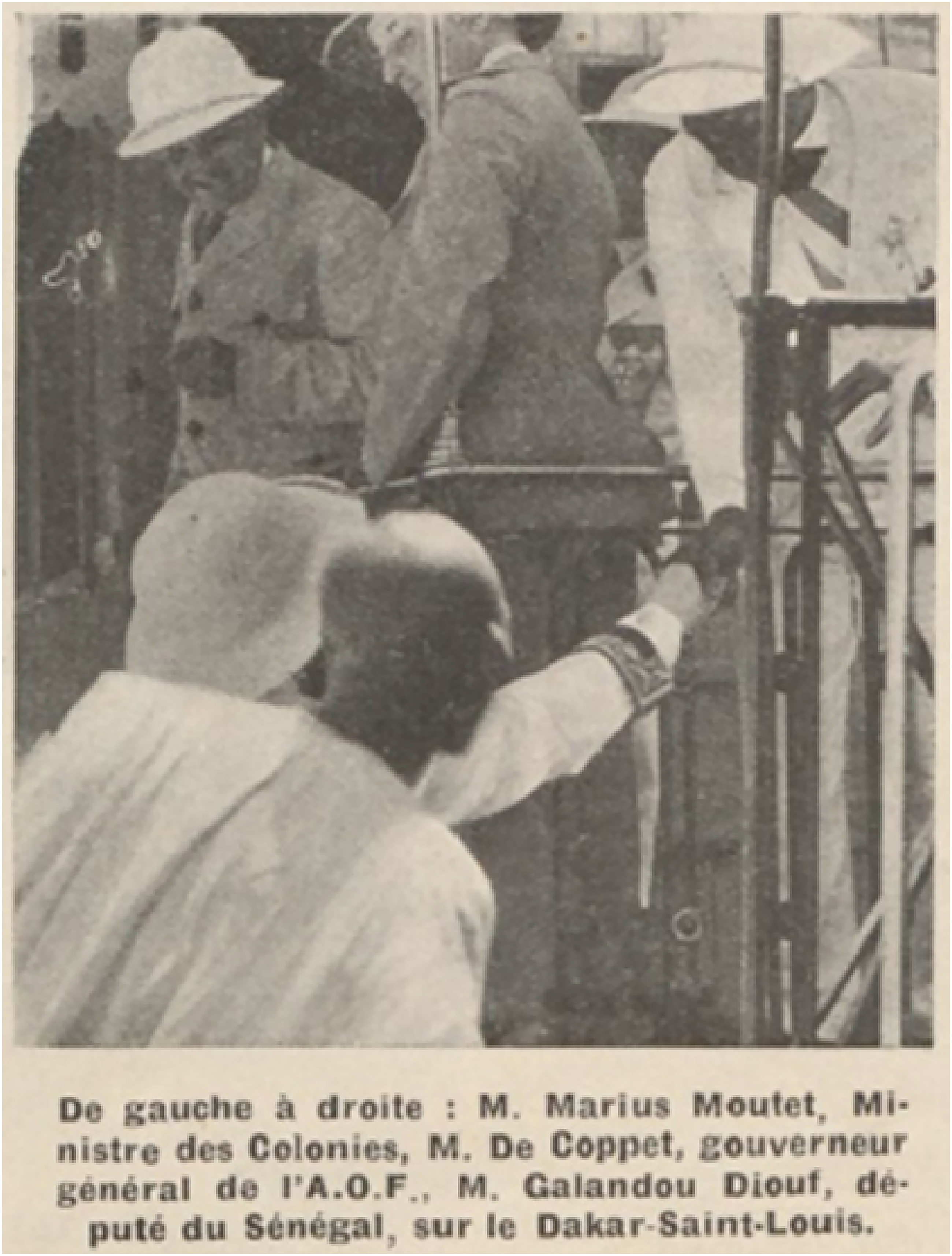
Raoul Monmarson (1936) “Inquiétudes” Les Annales Coloniales 36 #52: 10–11.
On completing his studies, Arafan was posted to a school in his home village of Sansanding to teach reading and writing in French, in addition to health, sanitation, gardening, and physical education. 27 En route to Sansanding, Arafan stops in Bamako, capital of the Soudan Français (and today capital of Mali), where he “orders a boubou for himself, the national dress” (Fraysse 1937: 19). The film follows Arafan to his new position, where we see him interacting with his students. Along with his new boubou, he wears a brilliantly white pith helmet, the insignia of his new status (Figure 9). His new standing as a product of French colonial education entitles Arafan to the pith helmet, but his African identity is equally prominent with his freshly commissioned boubou.
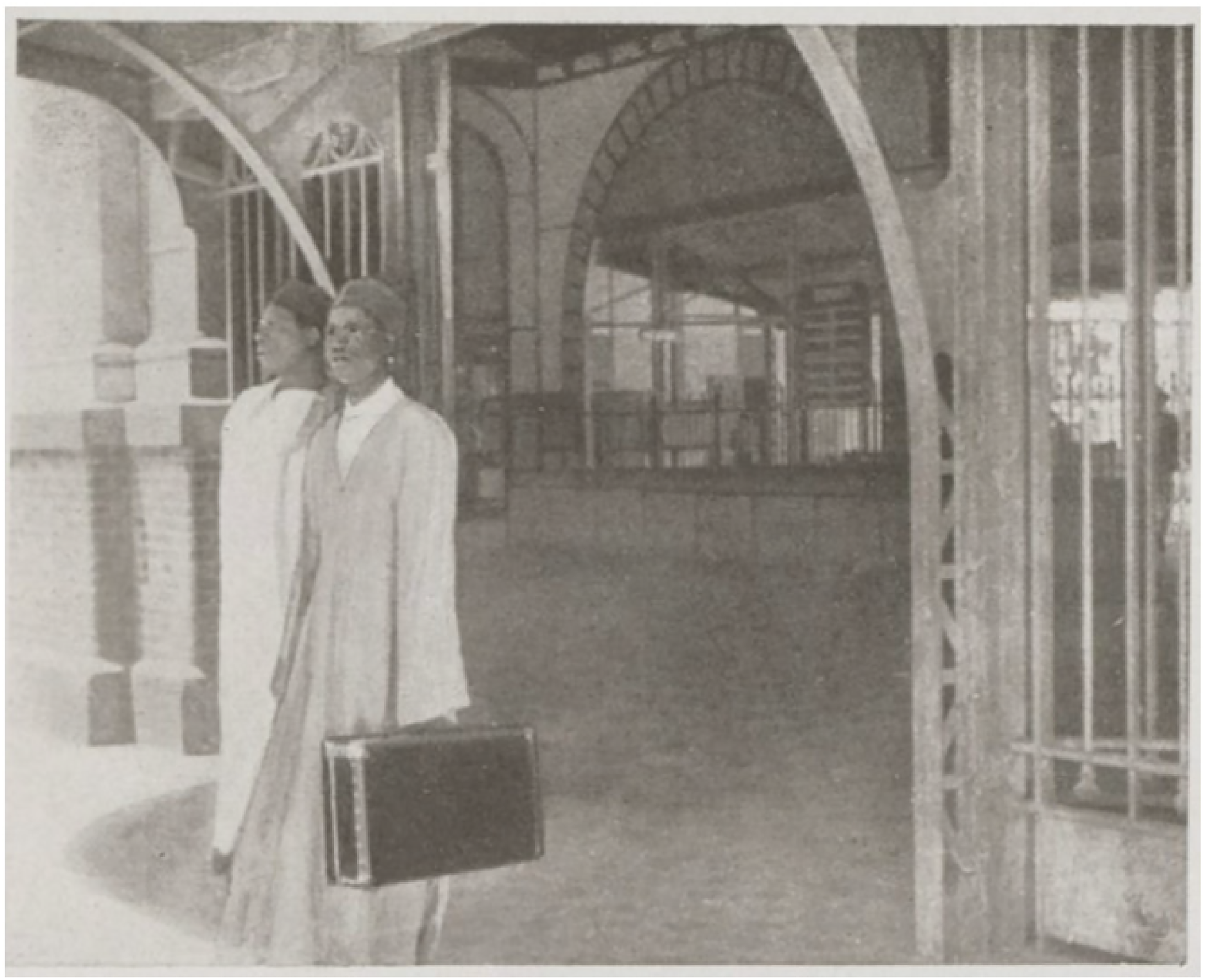
A. Fraysse “L’Heure Coloniale à l’École” Le Monde Colonial Illustré 15 #162 (1937): 18. Caption: “Arafan and his father arriving in Dakar.”
As an invented character, Arafan's changing attire was a complete representation of the French administration's ideal African fashion cycle. While the students’ caps, shirts, and trousers signal affiliation with French sartorial norms, they also reinforce difference and distance from French power—dramatized by the contrast between the white helmets of the French teachers with the black caps of the students. With the culmination of his education, Arafan embodied the balance that was the goal of French colonial policy in the interwar period: he returned to the boubou that is his heritage as an African, yet his enhanced status as the product of French education entitled him to don the pith helmet as well. The newly minted teacher's headwear, which he wore along with the boubou, projected the prestige of the French administration just as surely as it projected his own.
I conclude with another fictional account of a West African pith helmet wearer. This narrative, however, was not created as pro-colonial propaganda. Instead, it dramatizes the “tension of empire,” an embodiment of the complex significations of objects that circulate in global networks, their associations hard to control. In his 1973 novel L’Étrange destin de Wangrin [The Fortunes of Wangrin], Amadou Hampâté Bâ—born and raised in the Dogon region—tells the story of a West African interpreter in the service of the French colonial administration. Bâ, a renowned writer who had himself worked as an interpreter early in his career, describes Wangrin's determination to climb the ranks through his skills as an interpreter and a manipulator of people and bureaucracies, to the detriment of his competitors both French and African. The reader is introduced to Wangrin at the opening of chapter two, as he enters a town on horseback to take up a position as a teacher. His horse, the porters who accompanied him, his command of French, and his impervious manner all impressed the town's residents as they watched him ride to the home of the French district administrator. But most impressive of all was his pith helmet, which induced a strong reaction: “Whenever anyone appeared wearing real colonial helmet, even a misshapen old thing, one thought alone sprang to mind: chicken, eggs, butter, and milk must be fetched at once, and offered to the ‘helmeted gentleman,’ as an exorcism against the misfortunes that his presence was likely to cause” (Bâ 1999: 11).
This short scene—just a few sentences—contains a world of information about the pith helmet's promiscuity, returning to Thomas's term. A West African colonial subject has adopted a potent symbol of the administration's power, presumably with the authorization of his French superiors. His compatriots give him the deference the pith helmet commands, even as they undermine its power by marking its shabbiness and manipulating its wearer through strategic flattery. Still more complicated, this helmet does not reflect Wangrin's allegiance to the administration that employs him, but instead represents one strategy among several he uses to improve his own circumstances. Finally, Bâ's description of Wangrin reminds the reader that the pith helmet's authority is not dependent on the skin color of its wearer. This object has accumulated its own power, unstable as it may be.
From Marcel Griaule to Wangrin, the pith helmets that populated the A.O.F. were deployed as vehicles for imperial propaganda, used to make visible colonial structures of difference. The power of this headwear's association with specifically colonial forms of authority propelled it from regions of brilliant heat and sunshine in West Africa, to the relatively unsunny, temperate climes of Paris and elsewhere in France. This durable association also led to the pith helmet's incorporation into West African attire, both within and outside the bounds of the structures of difference by which the French administration sought to assert control over colonial subjects. Whether on French or West African heads, in Paris or in Sansanding, this headwear's associations with specific histories of European hegemony make it no mere accessory. The pith helmet evoked the steep barriers of racial hierarchies and political divides by which colony and metropole were structured, and it provided West Africans with a tool to traverse—or attempt to traverse—those divides.
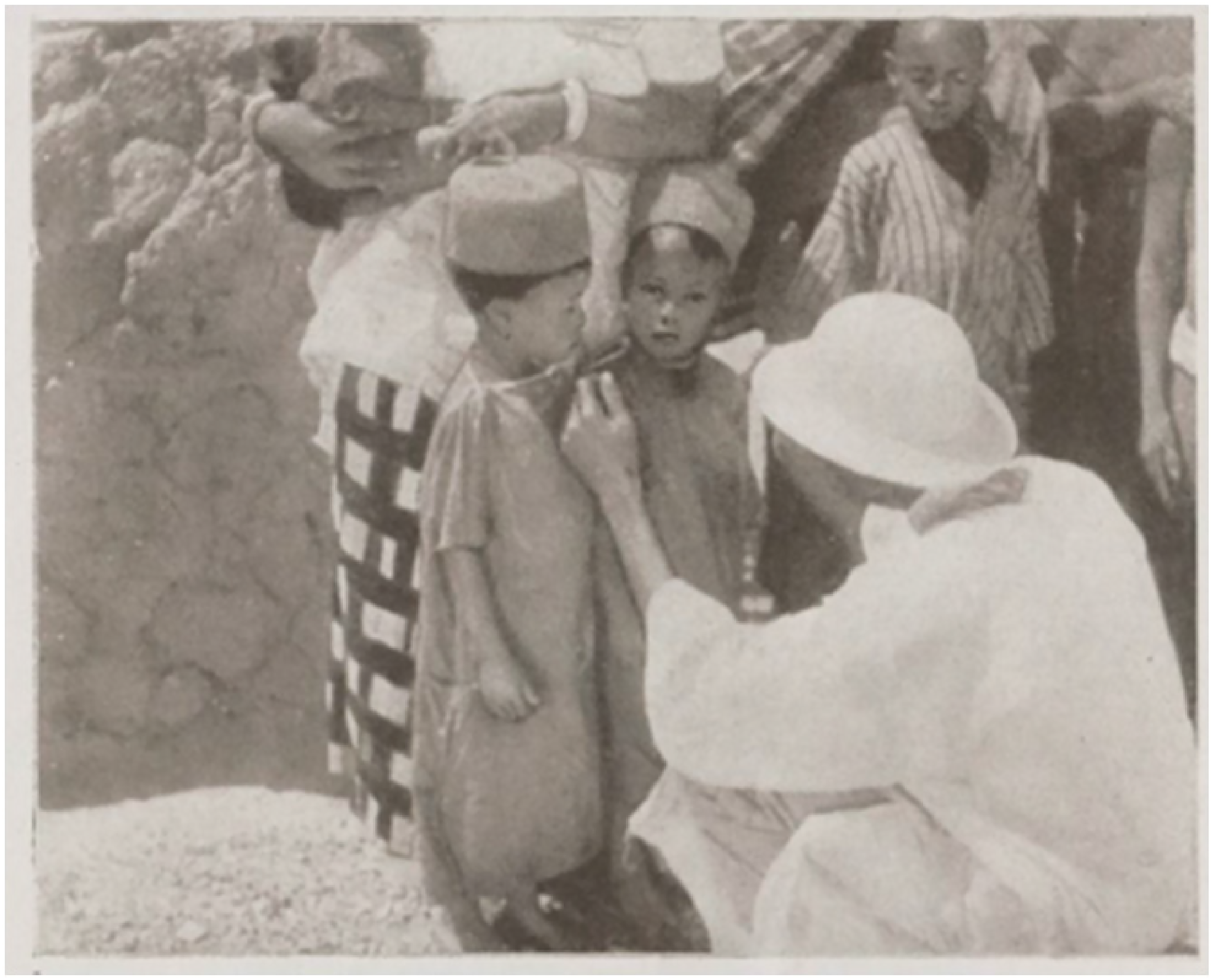
A. Fraysse, “L’Heure Coloniale à l’École” Le Monde Colonial Illustré 15 #162 (1937): 18. Caption: “Arafan, now a school teacher, meets his new students.”
Footnotes
Declaration of Conflicting Interests
The author(s) declared no potential conflicts of interest with respect to the research, authorship, and/or publication of this article.
Funding
The author(s) received no financial support for the research, authorship, and/or publication of this article.
