




Abstract
Lighting up darkness is a material practice shared across many cultures. Lighting up winter darkness is a particular concern in urban areas in order to make urban spaces feel safer and more welcoming. Temporary lights, often characterised as ‘Christmas’ or ‘Winter’ lights, are installed over the darkest period of the year (December in the northern hemisphere) in town and city centres to attract shoppers and tourists. This paper examines the lights displays installed over the Christmas/ New Year period in two British towns. In each case the lights are installed by volunteers, who also arrange a ‘switch on’ community celebration. The research argues that the architecture of the lights signifies and reinforces the identities of the communities involved. In particular, the paper examines: the importance of infrastructure for the ongoing creation of community; the creative potential of these temporary structures for community identity; and the essential materiality of community.
Introduction
Thursday evening, late November, 2019. At 5.30pm it is already dark along the north west coast of mainland Scotland. The ferry is about to leave for Stornoway, 50 miles away across the Minch on the Isle of Lewis. A well-wrapped crowd gathers at the end of West Shore Street by a stack of creels. A drone buzzes overhead. As the ferry begins to move it turns and backs up like a learner driver practising 3-point turns in a narrow road. Luckily the ferry captain is an expert and the ferry turns and backs up, turns and backs up, until its search light is shining onto the shore. Then the hooter sounds and a moment later the sea front is lit up: strings of white lights like bunting hanging from posts all along the front, waving the ferry off. And most magical of all, the stack of creels is transformed into a Christmas tree swathed in red, blue and green lights and topped, not with a star or an angel, but with a crab.
A year earlier in Hoole near Chester, in north west England, children and adults carrying homemade lanterns paraded from the Parish church to the lively high street. Crowds thronged the narrow pavements and spilled out of the pubs as the 19th anniversary lights were switched on by the Lord Mayor of Chester, resplendent in black and gold robes, a lace jabot at his neck and wearing a heavy gold chain of office. On stage, there were performances from a local teenage band and school choirs; and in the community centre Father Christmas was kept busy handing out gifts to excited children.
Two different communities in different parts of the UK both bringing people together by the seemingly simple act, in these places where a supply of electricity is taken for granted, of switching on some lights to brighten up the streets over the Christmas and New Year period. In both cases the lights are set up by volunteers and funded through donations and year-round community events.
The installation of lights over the Christmas / New Year period has been examined in a British context by Back (2015) and Edensor and Millington (2009; 2010). They focus on home displays and the intersections with social class. Although there are studies in other parts of the world (e.g. in Australia by Winchester and Rofe, 2005) there is a lack of research into seasonal public lighting that is installed and run by volunteer groups in the UK, despite the prevalence of this model outside of town or city centres. This paper, drawn from an ethnographic study of two community groups who create winter lights displays on a voluntary basis, shows how the presence of the lights in these places helps to reinforce the communities’ identities. In doing this, the role of both material and social infrastructure is shown to be vital to a sense of community and belonging in place. Community is a difficult word to define and its usefulness as a concept has long been in doubt (Stacey, 1969). It is therefore a somewhat ephemeral concept but it remains a term in constant use within both academic circles and society more widely. What this paper argues is that rather than being ephemeral, communities are firmly embedded within a material infrastructure. As with most infrastructure, this is often overlooked (Star, 1999). And all infrastructure needs to be maintained (Graham and Thrift, 2007).
Amin (2014) conceptualises infrastructure as a ‘sociotechnical assemblage’ which brings together humans and non-humans in the making of urban social spaces. In relation to community, the social has always been considered essential but the technical side of the assemblage tends to be overlooked, particularly in everyday talk of ‘community’ or ‘the social’. Heidegger (2001) describes how building a bridge across a river creates a social place. The bridge is an element of the architectural infrastructure. Lights can provide a similar function – for example in the Canning Town underpass (Laing Ebbensgaard and Edensor, 2021). Similar to Amin, Latham and Leyton (2019), drawing on Klinenberg (2018), highlight how there is often a lack of understanding or acknowledgment of the importance of the infrastructure of cities in promoting their social life. Larkin (2013) convincingly argues that infrastructure networks are ‘literally providing the undergirding of modern societies’ (p. 328). Lathom and Leyton (2019) concentrate on spaces for sport and social life in their arguments for the provision of social spaces in urban areas, whilst Klinenberg (2018) discusses, amongst other social venues, the varied functions of public libraries. In 2020 parks became more important than ever in providing outdoor, free spaces to socialise, but their cafés and bandstands have long given a focus for community gatherings. More mundane spaces which are visited regularly, even supermarkets and convenience stores, provide a setting for ‘place ballets’ (Seamon, 1980), whereby a sense of place, and belonging in place, is nurtured. These are all examples where some form of infrastructure –a football pitch, a park, a shopping centre – are central to the facilitation of social life and, ultimately, a sense of community. Amin (2014) and Star (1999) highlight, how the technical side of these sociotechnical assemblages is often noticed more in its absence. We don’t tend to notice the water, electricity, telecoms networks and roads that we use every day as long as they provide what we need. As social scientists looking at how people live together we need to go beyond social networks and dig down into the earth beneath our feet to understand the ‘texture’ of social life (de la Fuente, 2019; Latour and Hermant, 2006). As Schulte-Römer (2018) points out, STS studies can be helpful here in tracking the various relations of material elements to ‘real infrastructure’ (Star, 1999: 380) as it is used in practice. There are standardised scripts of socio-material relations, but these are also subverted by users and by ‘lively’ (Bennett, 2009) materials. Both script following, in terms of adherence to regulations, and script breaking in creative repurposing of materials are in evidence in the case studies presented here. Texture is never ‘just’ surface, but always incorporates what is underneath. Like the volunteers fixing the lights in Ullapool and Hoole, there is a need to get our hands dirty and pull things apart in order to understand how communities are maintained.
An overview of existing research on Christmas/Winter lights displays and the importance of lighting more widely is followed by an outline of this research and the two examples of community light displays. The paper then discusses three aspects of these particular displays: maintenance of the infrastructure; the creation of magic through technical infrastructure imagination and skill; and the role of the lights in community identity.
The material sociality of light
There is an increasing understanding of the importance of artificial lighting to many aspects of social life (e.g. Laing Ebensgaard and Edensor, 2021; Pink and Sumartojo, 2018). Lights in darkness provide a welcome to strangers, signalling human presence and sociality (Kumar, 2015). Bille and Sørensen (2007) document how light plays an important role in many social activities, shaping how the world is seen. What people see is determined by light, as well as how they see (Laing Ebensgaard, 2019). A lit shopfront will be noticed more than the boarded-up shop next door, for example. Well lit areas signal safety and belonging, for many people, particularly, but not only, in urban environments (Laing Ebensgaard, 2019; Kumar, 2015). Lighting goes beyond the visual though to create atmospheres (Bille et al., 2015; Edensor, 2015), and to shape the sociality of spaces (Entwistle and Slater, 2019). Bille et al. bring together ‘architecture, colours, lighting, humidity, sound, odour, the texture of things and their mutual juxtaposition’ (2015: 36) in order to understand atmosphere, to which Edensor adds the weather and interactions (2015: 332) Together these elements make up a social event and strongly evoke a sense of place (Edensor and Millington, 2013). This social quality of light and the prioritisation of the visual sense in many cultures make light festivals an obvious choice for extending the tourist season into the winter months (Lovell and Griffin, 2019). As Giordano and Ong (2017) highlight, outdoor lighting as a form of design or architecture can be an attraction encouraging visitors to stay overnight, in order to experience the lights fully, thereby actively contributing to local economies. Light festivals as tourist attractions tend to be publicly funded under the umbrella of arts and culture. In mainland European cities’ extravagant displays at Christmas put on by local authorities have become popular and attract huge crowds (Kunar, 2019). Light displays have spread across Europe and around the world, not as exact replicas of one another, rather as local adaptations of a universal concept – what Giordano and Ong (2017) call ‘local globalness’. One of the oldest of these festivals is Blackpool Illuminations which began in 1879. Rather than being seen as light ‘art’ or ‘architecture’ as the Lumière Festival in Durham is (Lovell and Griffin, 2019), Blackpool Illuminations are negatively stereotyped as ‘devoid of good taste’ (Edensor and Millington, 2013). Urban creativity is a political notion entangled with ideas of identity (Mould, 2019; Skelly and Edensor, 2020), enabling Edensor and Millington (2013) to argue that Blackpool's illuminations embody a ‘local, vernacular’ form of creativity. It is this localness, and community creativity, that is the basis of the light displays used as case studies here.
Places are assemblages of the social and material (Heidegger, 2001; Ingold, 2000). The material enables the social and the social necessitates and facilitates the creation of the material elements of place. A community emerges from the translation (Callon, 1986) of the various aspects of materiality (e.g. lighting) and sociality (e.g. the lit spaces where people gather) which develop an authorial voice in the identity of the place. Urban community spaces are significantly different spaces at night and during the day; they assemble in different ways depending on, for example, light/dark, open/closure of businesses, busy/quiet roads and pedestrian spaces. A key element of the night time assemblage is the visual aspect – the lighting (Laing Ebensgaard and Edensor, 2021; Shaw, 2014) because a sense of community implies to many a sense of safety created through lighting (Shaw, 2014). It is the material infrastructure that makes these lights possible (Klinenberg, 2018).
Lights displays are works of art (Edensor and Sumartojo, 2018), designed to be pleasing to look at, to promote joyfulness and potentially a sense of wonder (Back, 2015), or even magic (Hancock, 2019). Along with the community switch on festivals, Winter lights are, as with other community events and activities, aimed at promoting the identity of the community to itself and to visitors, creating a sense of belonging, sociality and particularity (Winchester and Rofe, 2005). The lights themselves become an embodied expression of community which, as Larkin says ‘are not just technical objects but also operate on the level of fantasy and desire’ (2013:333). Although the lights in this study, in both Hoole and Ullapool, provide a very real boost to the regular street lighting during the darkest months of the year, they are not just lights but also function as projections of community identity (Mould, 2019), drawing on local knowledge to create an annual space and time for community celebration (Appadurai, 1996). The darkest period of the year is a period in which darkness and light come together to heighten the senses and create memories of a time outside the mundane and quotidian in the liminal space between the end of one year and the start of the next (Turner, 1969). Bright lights, music and anticipation of celebratory food and drink for the festivals of Christmas and Hogmanay 1 help to forge shared memories for a community (Connerton, 1989). They embody a ‘gift’ from one year to the next, a symbol, perhaps, of the continuity of this community (Back, 2015).
There are a number of material components necessary to the building of light displays, both ‘hard’ and ‘soft’ infrastructures. Common across both examples here and likely more widely as well: electrical fixings (described as ‘boxes’ by respondents here); the lights themselves (strings of festoon lights, Christmas trees to fix outside shops, panels of lights to hang across the streets); people, some with the necessary skills and qualifications, to install the lights; electricity; funding to pay for specialists, repairs, insurance, amongst other things. The light displays are networks of relationships developed over time where various materials create relationships which endure, provided each component plays its part (Shaw, 2014). The skills, knowledge and time of the architects and builders of the lights are a significant component here (Schulte-Römer, 2013). The work is processual and often ‘looking backwards’ to the source of a problem: skilled craft work rather than routinised mechanical work (Ingold, 2006). Where one relationship, or part of the network, breaks down, so does the process, and the lights fail, a form of ‘resistance’ by the lights (Bennett, 2009). Each aspect of the assemblage has a relationship to the other components: if one fails, whether that is a lack of funding for insurance, a failure to meet statutory safety tests or lack of the necessary skills to perform repairs, the display will not go ahead. The different aspects that go into putting on the light displays can be broken down into the various components listed above (they could, of course, be broken down much further). At a particular time of year these components join together, assemble, momentarily, to create lights switch on ceremonies and light displays, and in so doing materialise the identities of these communities in a temporary architecture of light. The lights (surfaces) are brought together with the idea of Christmas (atmosphere), through the invisible work of the infrastructure, weaving together a social space, a community (de la Fuente, 2019).
The next section will explain the context of the research and methods of gathering and analysing data.
The research
The research took place over two consecutive years – 2018 and 2019 with the key focus on Hoole in 2018 and Ullapool in 2019 2 . Hoole, a suburb of Chester, was chosen serendipitously as being local to the author who had previously attended the switch on events which have been happening since 1999. Hoole is known for its independent shops and won a ‘Great British High Street’ award in 2016. Ullapool was chosen as a contrasting site due to its rural north west Scottish location, strong identity as a fishing community and the fact that here the light displays were a recent innovation. Both places have only had lights installed by volunteers and are (presumably) too small to merit local authority funded seasonal lighting.
In Hoole, the research involved participant observation, interviews and two questionnaires, for residents and for businesses. In 2018 a new community group was set up to run the lights. For most of the team this was their first year of organising the lights and the switch on event. The group was set up only 10 weeks before the switch on date. I went along to most of the committee meetings in the run-up to the switch on in 2018 and took part in the switch on event. I subsequently interviewed ten of the current and former committee members (all names used here are pseudonyms). I continue to volunteer with the group to the present.
The Ullapool lights began in 2016 and have been run by local people who also arrange a bonfire each November. I interviewed a member of the Fire and Lights group, which is a much smaller group than Hoole's, having only four members, and one other person who has regularly been involved in setting up the lights. I attended the Switch On ceremony and the lantern parade in November 2019, as well as visiting the Christmas market and skating rink which were set up that year due to winning a substantial People's Project award from the National Lottery.
Methodologically I am taking a ‘flat’ ontological approach using, loosely, an Actor Network Theory methodology. The real strength of the ANT approach is that it is an approach rather than a fixed method; as Nimmo (2011: 109) puts it: ‘ANT really is what ANT-influenced theorists and researchers do in their research’. To that extent I am not claiming to follow a specific method, but to use the general principles of looking at the lights as assemblages. At the centre of ANT and other ‘assemblage’ methods is the premise that the world is shaped by more than human actors. In the present example buildings, electricity, regulations, the annual calendar, volunteers, business owners and local residents are some of the actants crucial to the outcomes. ANT provides a flat surface on which to draw out the different themes of the story. None of the actors is privileged in telling their version but in any situation power will be unevenly distributed. The more ‘fixed’ something is though, the more it has to be worked around, and hence could be said to be influential (what Schulte-Römer (2018: 705) calls ‘field pressures’). In this study, for example, electrical regulations are ‘fixed’ in that they cannot be altered in the short term or by the groups involved in setting up the lights. The seasonal nature of fishing in Scotland is less fixed, but controlled by the weather, potentially causing issues for the Ullapool group.
Farías and Bender (2009) point out some of the reasons ANT-type approaches are useful in examining urban spaces. The first is what John Law called ‘messiness’. Urban spaces are different things at different times – perhaps the simplest example is the night life of Hoole when the pubs, bars, kebab and pizza shop come into their own, as opposed to the daytime ‘traditional’ high street stores of butcher, fishmonger, greengrocer and baker. As the space for a lights festival these identities are merged deliberately, but somewhat messily and to no-one's ultimate satisfaction. The translation of the various components of the lights switch on event is always unstable and incomplete (Callon, 1986). Taking an ‘assemblage’ or ANT perspective allows for emergent becomings and the disjointed and discontinuous nature of local urban spaces.
The next two sections look at the setting up of the lights in Hoole and Ullapool respectively. More information on the history of the lights displayed is included here.
Catenary wires and other electrical things
Simple things like the lights being plugged in, where they plug in and how they’re going to switch on … it was such a challenge, but we did pick up a lot of information from people who are still involved and that enabled us to do it
The key requirement of light displays is that they have a supply of electricity (Edensor & Millington, 2009; Giordano and Ong, 2017; Kumar, 2015). The supply of electricity is therefore at the centre of the Christmas lights assemblage in Hoole. In 2018 this caused numerous issues for the team of new volunteers setting up the lights for their first time, who had to discover the architecture of the lighting infrastructure and to contend with essential maintenance.
In the UK the uninterrupted supply of electricity is usually taken for granted. The cost of electricity features in Edensor and Millington’s (2009) and in Back’s (2015) study of Christmas lights displays and has been discussed in city based light displays in Malaga, for example (Kunar, 2019), but the continuation of supply is always assumed. It is not, however, always so simple. Heideggerian phenomenology shows how people often overlook the tools they use in focusing on the task at hand (Graham and Thrift, 2007). As I type this, I am looking at the results on the screen, rather than thinking about the hardware and software that transforms my pressing on the keys into words on a screen. In a similar way, the Christmas Lights group tended to focus on the switch on event as much as the apparent mundanity of actually lighting up the bulbs. Electricity is invisible per se, visible only in its effects. Nevertheless, the electricity demanded attention (Bennett, 2009; Graham and Thrift, 2007).
The lights in Hoole were first set up in 1999 by a local councillor and some business owners making 2018, the year I undertook this research, the nineteenth anniversary. Initially the start-up cost was enormous because they had to put in the electric boxes in five different places and then just all the strings of lights, that’s all we had initially
Gordon was a part of the original team who set up the lights in 1999 and I interviewed him in 2018. He explained that the initial funding for the lights was from a Millennium Awards for All grant. This was for about £9000 and went on the cost of the electrical fittings and components as well as strings of coloured lights hung along the front of the buildings along the two main shopping streets. Since the initial installation of the plugs and fuse boxes very little seemed to have been done to update the electrical work, or to maintain it to current electrical regulations. The coloured string lights, hung on the buildings, are left up all year round and have consequently suffered deterioration and weather damage, a hazard of light displays (Edensor and Millington, 2013). Gordon spoke about one year when his son and himself went ‘up and down ladders’ to replace bulbs and get the lights working. This was phrased to imply a DIY (do it yourself) type of know-how rather than technical knowledge or skill, indicating a lack of following procedure (Graham and Thrift, 2007). The following year he corralled a group of business owners to form a committee and enough money was raised to buy and install the cross-street lights that are there today. These spell out ‘Merry Christmas’ and ‘Welcome to Hoole’ (Figure 1).
In 2018 the new committee did include a couple of members who had some knowledge of electrical regulations and the standards that should be followed. Joe, one of the volunteers, explained how the electrical fittings were an unknown quantity ten weeks before the switch on: The legislation governing how everything is put together and how it’s held in the air has changed quite dramatically over the last few years. And some of that stuff’s 19 years old. It’s not designed to be there for 19 years, and we’re dealing with very old buildings, very old, not quite so old, equipment … And that for us makes it a bit of a challenge because we’re stood there going you can’t do that, I know you’ve done that for 19 years, or 18 years, whatever it was, but you can no longer do that. And because we haven’t had any information transferred from the previous committee, we had absolutely no idea what state anything was in when we started.
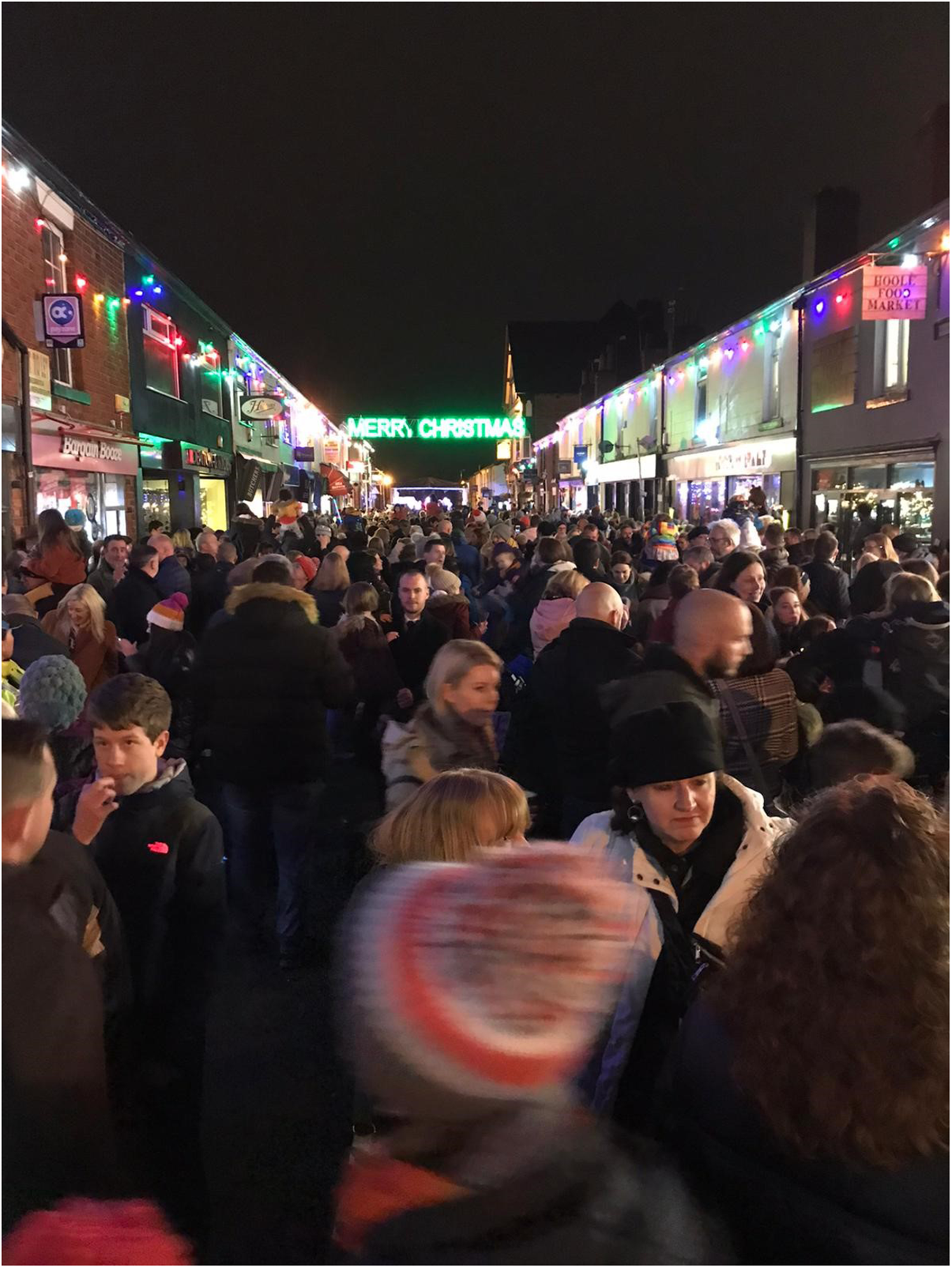
Crowds on Faulkner street at the switch on ceremony.
A considerable amount of time at committee meetings was spent discussing the technicalities of PAT testing and pull tests. Public light displays require appropriate electrical connections in order to conform to health and safety standards, which are continually being updated. The cross-street lights require specific insurance and ‘pull’ tests to ensure the catenary wires, that carry the electricity to the lights and support the lighting panels, can withstand the weight. These tests must be carried out by appropriately qualified people and cost the committee about £500. As the fixings for the wires are on the walls of the upper floors of the shops there were other access issues to overcome too. For example, where the fixings had to be strengthened to comply with current regulations the landlords needed to give permission. Jane, one of the committee members, told me that it had taken her three days to find and contact the landlords for the ten affected buildings. Once permission had been given work had to take place in the evenings and the early mornings (in November, in the dark!) in order to avoid disrupting traffic flow through the streets. Street closures are expensive and need forward planning so are rarely a practical solution. For the switch on event itself the two main streets are closed off causing some issues for food delivery drivers. The first floor of many of the shops are flats, meaning that work into the night risked disturbing the residents. The specific ‘socio-rhythmic’ (Shaw, 2017:2) spaces in this city suburb mean that there is no time when the space is freely available to maintenance workers. As Graham and Thrift (2007) show, this kind of mundane work often remains hidden or ‘black boxed’, in voluntary work especially so. In the UK, there is very little funding available for the maintenance of community infrastructure due to its invisibility (Klinenberg, 2018; Latham and Leyton, 2019; Star, 1999). The volunteers are also a key element of the maintenance assemblage with the relevant skills and professional contacts to source scaffolding and a cherry picker. This type of technical work requires the appropriate skill, knowledge and ability (Graham and Thrift, 2007). It is pivotal to the light displays and can be understood as craftmanship (Edensor and Millington, 2013; Ingold, 2000). As Amin (2014) puts it, these socio-technical assemblages are ‘lively’ and require a multitude of creative interventions, in a similar way to new, innovative displays (Schulte-Römer, 2013). The skilled volunteers carried out repairs in a ‘processional’ (Ingold, 2006) order: the next step could not be determined until the previous one had been successful. Where there was a failure of a bracket to support the catenary wires the testing had to stop until it could be replaced. The knowledge of electrical infrastructure and willingness of the volunteers to work in this way as skilled craftsmen rather than technicians ensured the success of the project.
Despite these difficulties the lights were installed and the switch on took place as planned. The lights make a huge difference to the lighting on these shopping streets as the street lighting is poor with lights attached to the buildings, presumably due to a lack of space on the pavement (Laing Ebensgaard, 2019). If you’re working all day come 4 o’clock in the afternoon when it goes dark without the lights it’s like doing the nightshift, it’s horrible.
As other researchers have shown (Bille and Sørensen, 2007; Bille et al., 2015; Kumar, 2015) lights provide a welcoming atmosphere. The affective dimension of lighting up the streets goes beyond the ability to see better and provides a space for sociality (Giordano and Ong, 2017, Laing Ebensgaard and Edensor, 2021). The switch on event itself attracts about 2000 people crowded into the shopping streets with a local celebrity to turn on the lights and an opportunity for local musicians to perform. Music, light, seasonal food and drink create a convivial atmosphere bringing the whole community together.
The electrical problems did not end with the switch on. Throughout the six-week period of the lights being on there were issues with fuses blowing and the strings of lights on one side of the street, and sometimes the cross lights too, would be out until the local electrician could find time to (temporarily) fix the problem. And as Gordon again pointed out, You don’t have people come to you and say ‘Oh, you’ve done a good job this year’, they come and say ‘the lights outside my shop are off again, what are you going to do about it’, so to speak.
Electricity is the essential component of the assemblage of the Hoole Christmas lights. Although the lights would not be switched on each year without the immense amount of work put in by the volunteers, the money donated by local people and local businesses, ultimately without the infrastructure of electricity to power the lights they could not be turned on. This mundane utility, which is largely taken for granted in the UK, plays the key role in this community event. As with many ‘tools’ that assemble to create ‘socio-culturally specific technologies’ (Entwistle and Slater, 2019), it is only when the supply is lost that it is noticed and brought to the attention of the organising committee (Graham and Thrift, 2007). Whilst always a necessary element of creating a light display, due to the struggles by this committee to locate, connect and keep it running, the electricity supply became a visible aspect of the event (Amin, 2014; Latour and Hermant, 2006).
Creels, fake trees and magical sailing boats
Ullapool's Winter lights tradition began in 2016, with a National Lottery Awards for All grant which paid for the basic electrical fittings, some strings of lights and trees to go above the shops. In 2019 they won a People's Project award of £37820. The focal points of the lights are the tree made of creels (lobster pots) on West Shore Street (Figure 2), strings of lights tied in place to make outlines of boats at the sailing club and the musical lighthouse on West Terrace.
3
We decided right from the outset that we weren’t going to do snowmen, Father Christmases, reindeer. We were only going to reference a sort of maritime history of the village. So that's why I think they’re quite unusual.
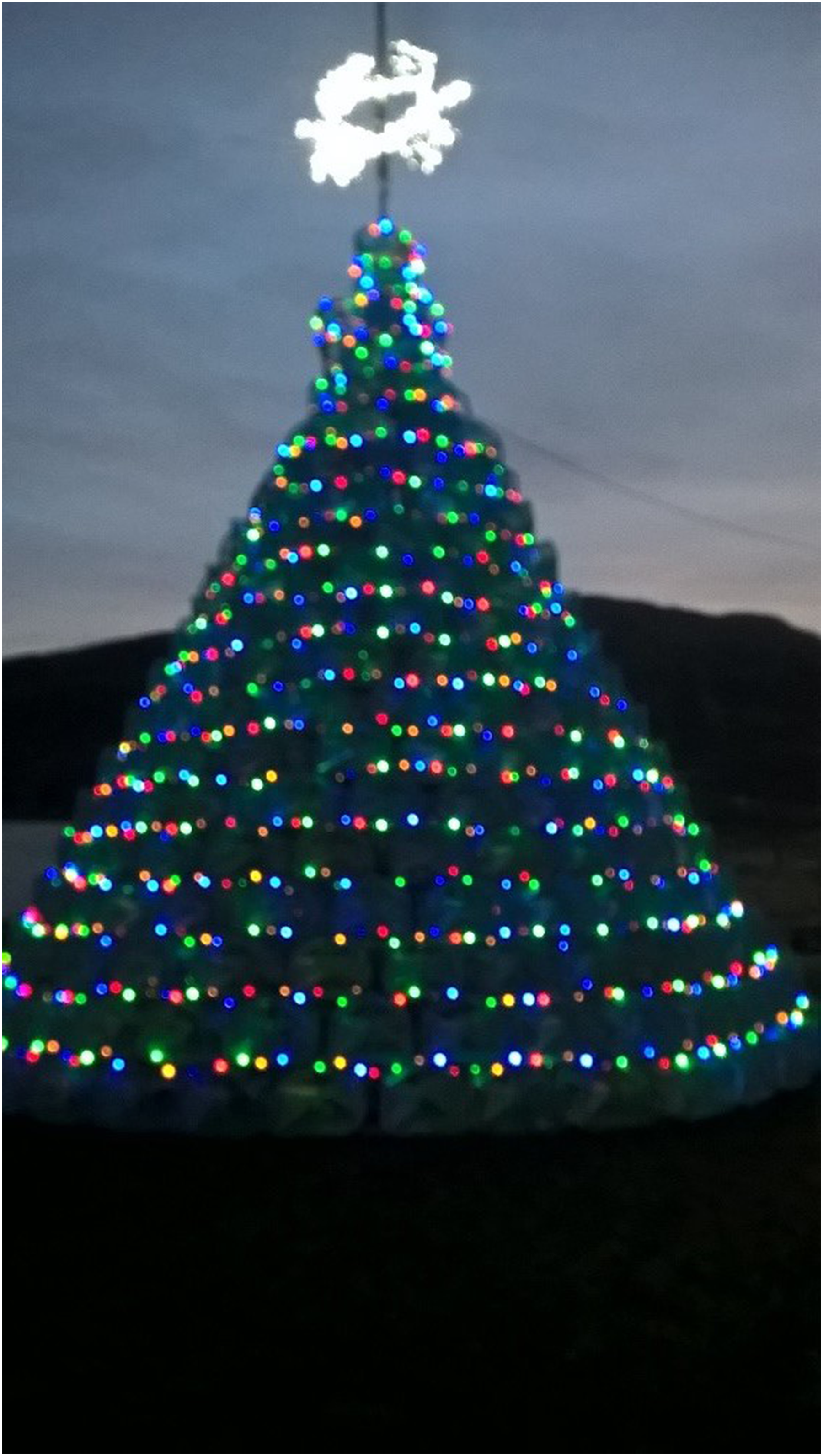
The creel tree with crab.
Alex, one of the volunteers, told me that the concept of the creel tree was taken from the lobster trap trees that have become popular on the north east coast of the USA. As a fishing village this idea tapped into the local identity of Ullapool (Edensor and Millington, 2013; Skelly and Edensor, 2020). In order to magically transform creels into a Christmas tree there must be a ‘shared consensus’ (Hancock, 2019: 2) or recognition (Schulte-Römer, 2013) which is achieved in Ullapool through the ineffable relationships between fishing, place and community. The creels are essential to the Winter lights assemblage in Ullapool (Latour and Hermant, 2006), a part of the basic infrastructure of the lights.
The People's Project award has enabled the Lights group to buy their own creels which enables easier planning of the building of the tree. The fishing season would not usually extend into December enabling the group to borrow the creels from fishermen, giving them complete authenticity as part of the industry of the village, but this is reliant upon the weather: It could just take a bit of change in climate, you know, all of a sudden they’re fishing because the weather’s good and they’ve not got creels! So the fact that we can buy our own is huge. We can plan our timing, normally we have to plan building the creel tree around when they’re available.
The tree itself is constructed around a wooden frame. The crab on the top of the tree was donated by a local company (Figure 2). As in Hoole, the skills brought to the network by the particular volunteers were crucial: an engineer was available to help with the design and joiners to build it. Local knowledge, craftmanship and creativity work together (Ingold, 2000; Skelly and Edensor, 2020). The result is an innovative form of bricolage (Schulte-Römer, 2013). The resultant network presents a powerful image of the village’s identity as more than a tourist destination, whilst also serving to attract tourism (Alex, volunteer).
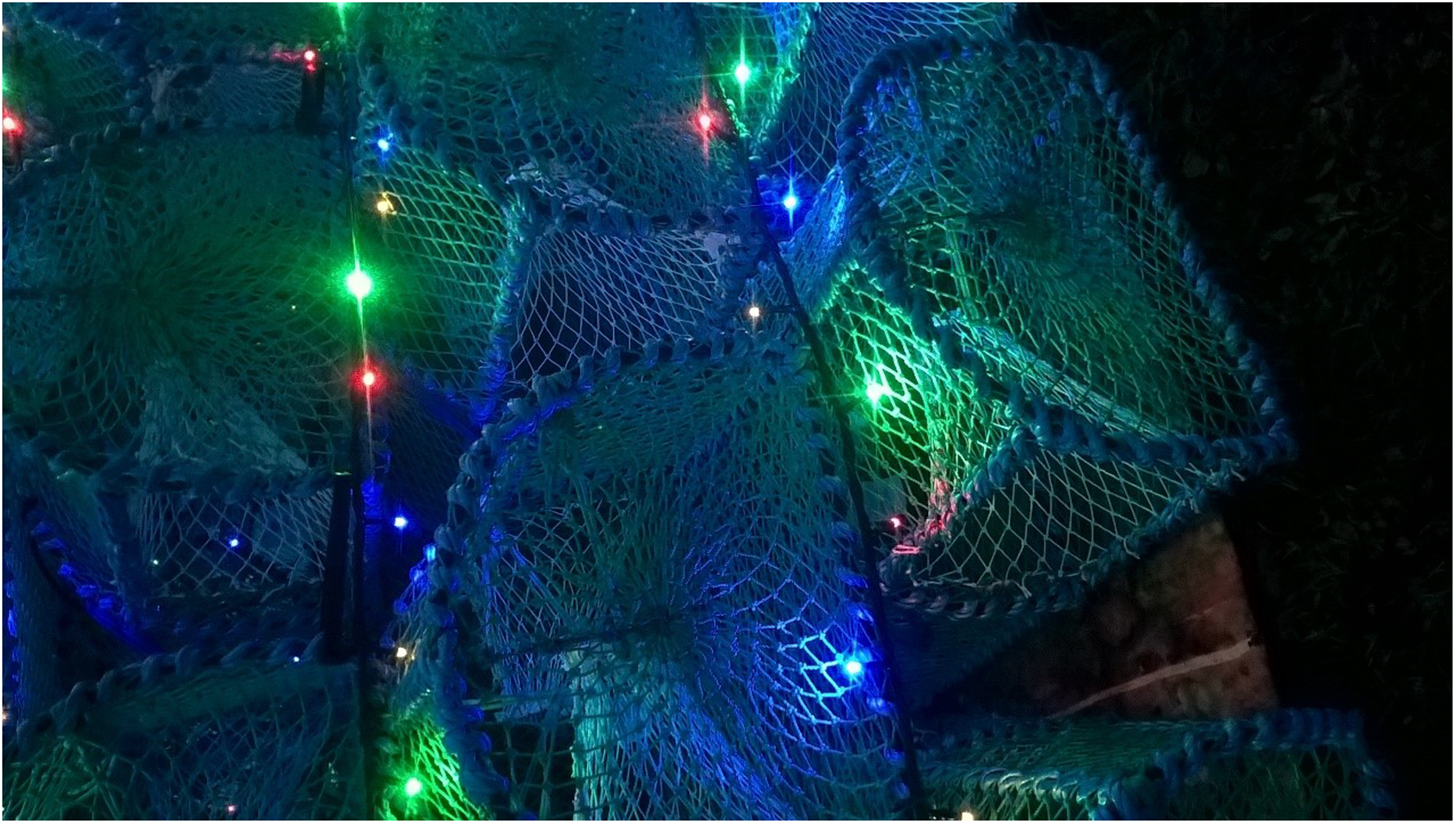
Creels on the wooden frame.
In keeping with the maritime theme there are silhouettes of sailing boats made from coloured lights at the sailing club. This is adjacent to the main road into Ullapool from Inverness or the south, what one respondent called a ‘gateway feature’. This feature has evolved and simplified over the period the lights have been on: So in the first year we actually put some dinghies in Am Pollan [park next to club] and tried to rig them so they looked like boats but realised it would be much easier to just use scaffold poles on the railings of the park and then just mark the outline. It is easier to do and much more effective … and then depending on what boats we have we will actually rig lights up masts too.
Here there is more magic and trickery on display: the illusion of sailing boats created from scaffold poles, park railings and coloured lights (Mould, 2019). The repetition of the process each year has led to improvements and simplification in its design. The imagination of the designers has enabled a decrease in the technical skills involved (Graham and Thrift, 2007). Again, the process is developmental, at walking pace rather than a mechanical step-by-step process (Ingold, 2006). Of course, anyone who wants to come close and inspect these ‘boats’ will soon discover the missing hull and sails, but we generally want to believe in the materiality of these illusions (Hancock, 2019) and they will pass this cognitive test (Schulte-Römer, 2013). This is again an assemblage of disparate elements brought together to create an illusion of an element of Ullapool's identity. The components are ‘translated’ (Callon, 1986) into a powerful ‘Welcome to Ullapool’ message, in the same spirit as the ‘Welcome to Hoole’ sign in Hoole. In both cases the lights as much as the words or signs are the message of welcome (Kumar, 2015).
The final element in the maritime themed trail through Ullapool is the lighthouse. This is a newer addition, first created in 2018. It is comprised of a net of lights over a scaffold frame to allow the wind to blow through. The lights are striped, red and white, with the topmost stripe flashing to give the impression of a light turning around, as in a lighthouse. As a piece of architecture this is impressive, and again owes much to the skills of the volunteers (Ingold, 2000). Three times a night music blares out (different tunes each time, none of them Christmas tunes) and the lights flash in time with the music. It is an amazing spectacle. The fact that this labour-intensive building process relies on voluntary craftsmen means that the costs of the structure are invested in the materials and the volunteers can experiment more freely with their creations (Schulte-Römer, 2013). This tongue-in-cheek nod to ‘bad taste’ (Edensor and Millington, 2013) is possible due to its clearly subversive intent, in contrast to the tasteful white lights along the harbour front, and is very much in the same vein of using fun and conviviality to create a sense of place as celebrity designer Laurence Llewellyn-Bowen's creations in Blackpool (Edensor and Millington, 2013: 153). The music, movement and performativity of this structure in particular adds an even stronger playful element to the texture of these light architectures (de la Fuente, 2019; Edensor and Millington, 2013).
Each of these constructions is both a material, architectural structure and an illusion (Kumar, 2015). The assemblage of the concept or idea, the identity of the place as a fishing village and the built structure (including the supply of electricity) together create the magic of a tree, boats and a musical lighthouse. Ullapool is (re)imagined through these lights structures, annually. Without all of these actants or aspects of the assemblage, including the ability of these materials, through the craftmanship of the volunteers, to transform themselves into more than the sum of their parts, the architecture of the lights would not add up to create a magical display (Hancock, 2019).
Conclusions: The (re)-construction of community at Christmas
It’s dark a lot of the time. And I think that’s been the biggest thing that there’s light, and people are going out in the evenings because it’s lit.
As a ‘community event’ the focus is on providing free entertainment, music, spectacle (Kunar, 2019). The benefits of the lights, according to the interviewees, are community cohesion and identity, tradition and local history (Back, 2015; Edensor and Millington, 2013; Edensor and Sumartojo, 2018; Skelly and Edensor, 2020). Having taken apart the lights into their separate components, I now want to return them to ‘black boxes’ and look at how ‘the lights’ are at the centre of an assemblage making up the identity of each of these place communities.
Bille and Sørensen (2007) end their ‘anthropology of luminosity’ by posing the question ‘how do people use light and what does light do?’ By taking a flat ontological, ANT-like perspective, small-scale, community-run winter lights displays have been shown here to embody a local sense of place and community identity. The skills of the volunteers in creating and maintaining these technical artefacts is fundamental to their continuing presence (Edensor and Millington, 2013; Schulte-Römer, 2013). Whilst the importance of material infrastructure in creating and maintaining communities is often overlooked here it is shown to be vital (Amin, 2014; Klinenberg, 2018; Latham and Leyton, 2019). Community is not ephemeral or composed solely of social relations. It is bricks and mortar, electrical fixings and stacks of creels, catenary wires and strings of lights waving form the shore, creating specific, local, curated places where people can gather together as a community: the culture of community is a culture of materiality.
Light is more than a visual sense: it creates specific affects (Bille et al., 2015; Edensor, 2015; Edensor and Millington, 2010; Lovell and Griffin, 2019) and contributes to a social environment (Bille & Sørensen, 2007), that is, placemaking. In each of the cases shown here, ‘community’ as a social good, was a central part of the rationale for setting up the lights (and gaining the funding).
Annual community traditions are a part of the rhythm of the year, which (re)create belonging in place, through embodied practice – here the visual sensation of the lights. These are liminal events (Turner, 1969) which help to demarcate the annual cycle and build shared community memories as Robyn (above) shows (Connerton, 1989). Appadurai (1996: 180) describes how local knowledge is constantly (re)produced through the ‘socialisation of space and time’. In its switch on event, Hoole engages further senses of sound and taste through music, people spilling out of the pubs, drinks in hand, and the fishmonger and greengrocer offering free samples. The music adds to the party atmosphere. The embeddedness of the switch on within the local calendar in Hoole means that attendance at the ceremony has become almost a rite of passage for Hooligans (Appadurai, 1996). Whilst not yet embedded into the annual cycle in Ullapool the lights have been deliberately staged as expressions of the maritime identity of the village, drawing on the history of the place. The sound of the ferry's horn sets off the celebrations and a Scottish pipe band accompanies the lantern parade (little traffic means official road closures are unnecessary). Further, the music of the lighthouse provides an on-going accompaniment to the lights display. Drawing on all the senses emphasises the embodiment in place of these events, in contrast to their apparent ephemerality and liminality (Turner, 1969). The magical quality of the lights transform these places from ordinary high streets into places of shared and, arguably, magical, memories where a ‘community’ can (re)create itself.
In Ullapool the publicity that the imaginative lighting displays have received has generated some tourism at a time of year which previously saw very few visitors to the village. As Alex explained ‘people come up for the night, see the lights, have a meal and stay overnight’ (Giordano and Ong, 2017). As in Hoole, although the switch on in Ullapool is a smaller event ‘it's a great buzz, there's no doubt about it … to like kick off thinking about Christmas and all the festivities … and all the shops open late so, in a small community, that's quite nice’ (Frankie, Ullapool Volunteer). They create an atmosphere of Christmas and community as Robyn (above) and Frankie point out (Edensor, 2015), something that is offered to the local communities by a disparate group of volunteers. Both communities mobilise nostalgia to some degree around their lights displays. Ullapool's harks back to a time when fishing was the main local industry and Hoole trades on its ‘traditional’ local shops. Christmas itself is often romanticised in a looking back to childhood and possibly a Victorian past (Winchester and Rofe, 2005). However, both are positive, future-facing nostalgias due to the generally positive associations with Christmas / New Year as an event. These displays exemplify the ethos of community building creating and maintaining both community infrastructure and atmosphere.
The textures of the places are brought to the fore through the lights’ combination of the material and the atmospheric (de la Fuente, 2019). They draw on history, tradition and existing stories of the local community identity as a fishing village and a ‘Great British High Street’ evoking a sense of nostalgia in a positive and creative, if sometimes subversive, sense (Mould, 2019). This is only possible through the assemblages of volunteers, skill, craftsmanship, electricity and funding (amongst other things). The real magic in these temporary annual architectures is in the mutable networks where communities coalesce to ensure the annual rhythms continue. Electricity, imagination and freely-given expertise combine to create light displays bringing sociality and conviviality to these communities at the darkest time of the year.
Footnotes
Acknowledgements
I would like to thank the volunteers in Hoole and in Ullapool for their time and the amazing work they do in putting up the lights each year.
Declaration of Conflicting Interests
The author(s) declared no potential conflicts of interest with respect to the research, authorship, and/or publication of this article.
Funding
The author(s) received no financial support for the research, authorship, and/or publication of this article.
