




Abstract
Shahab Ahmed’s What Is Islam? The Importance of Being Islamic (2016) challenges anthropologists, Islamic Studies scholars, art historians and museum practitioners to question the theological assumptions underlying conceptions of Islamic art and material culture. This article analyses three object types key to Ahmed’s analysis – Islamic figural painting, musical instruments and wine bowls – from the vantage point of the collection of the Dutch National Museum of World Cultures. Based on the author’s experience as Assistant Curator for West Asia and North Africa in 2015–2016 and on exhibition developments up until 2019, Ahmed’s framework is demonstrated as a guide for critical interpretations of exhibitions of Islamic art and material culture. This perspective lays bare a tension that contemporary museums struggle with in response to nationalist pressures to integrate Muslim citizens in Western Europe: between a diverse Islamic heritage, on the one hand, and orthodox desires to materially purify the very idea of Islam, on the other.
Introduction
The Islamic Studies scholar Shahab Ahmed’s widely debated and posthumous What Is Islam? The Importance of Being Islamic (2016) was published in the same year that I worked as Assistant Curator for West Asia and North Africa at the Dutch National Museum of World Cultures (NMVW: Nationaal Museum van Wereldculturen). I was charged with documenting objects of Islamic art and material culture from diverse periods and places. Documentation also required thinking about exhibition practices at the National Museum of Ethnology in Leiden and the Tropenmuseum in Amsterdam, which merged with the Africa Museum in Berg en Dal and the Worldmuseum Rotterdam into the NMVW in 2014. The merger fused the ethnographic collections holding Islamic objects, making it easier to organize new exhibitions drawing from the combined Dutch ethnographic collections consisting mostly of objects made since 1800. Although Ahmed’s tome focuses on the period of 1350–1850 CE and on a geography he dubbed the Balkan-to-Bengal complex, its polyglot analyses of Islamic texts and objects, and their meanings for interdisciplinary conversation about Islam offered me a useful methodology for contemporary exhibitions involving Islam in Western Europe. Ahmed’s legacy challenges a varied academic audience composed of anthropologists, art historians and museum practitioners to assess how our publications and exhibition practices deal with the question of what Islam is and to ask how exactly outsider or etic perspectives relate to insider or emic understandings of Islam. In this article, I analyse three object types key to Ahmed’s thinking – Islamic figural painting, musical instruments, and wine bowls – from the vantage point of the collection of the NMVW. 1 Based on my experience of working for the museum and on exhibition developments up until 2019, I argue that Ahmed’s perspective exposes a tension that museums struggle with in response to nationalist pressures to ‘integrate’ Muslim citizens: between a diverse Islamic heritage, on the one hand, and orthodox wishes to materially purify the very idea of Islam, on the other. With caution but firm conviction, I use the polarizing word ‘versus’ in the title of this article, but I do not intend to reproduce a Huntingtonian clash of civilizations or of the civilized vs. the barbarians. With Ahmed, I want to show deep contradictions within and surrounding Islam as a human and historical phenomenon, to which museums must inevitably relate in their respective diversity policies. Even as Ahmed argues that different domains of Islam, such as law, philosophy and poetry, can coexist and have done so for centuries, his diagnosis of our time is less favourable. Museum collections can tell myriad stories about these pasts, presents and inter- and intra-religious coexistence and tensions. The question, then, is whose Islam should be represented. What Is Islam? is an elaborate defence of the capacity to appreciate tensions, contradictions and paradoxes against the zeal that impedes mustering intellectual and somatic tolerance for a museum displaying objects that ‘speak Islamic’, i.e. objects whose meaning is tied to a world of Islamic references and which at the same time may contradict well-known Islamic prohibitions.
An analysis of selected objects and exhibition practices at the NMVW will show what is at stake, but first I situate Ahmed’s plea for open-mindedness in an international context of exhibiting Islamic art and material culture and in the Dutch political context in which Islam remains central in discussions around culture, nationalism and citizenship.
The international context of Shahab Ahmed’s What Is Islam?
Ahmed did not write about contemporary European nationalisms and anti-Muslim racism, but he developed his magnum opus in a post-9/11 global world in which museums in cities such as New York, London, Berlin, Paris, Copenhagen, Cairo, Istanbul, Doha and Kuala Lumpur mobilized existing collections, acquired new objects and renovated buildings to promote the art and material culture of Islamic civilizations. These museums did so, though, not only to combat prejudice against Muslims, but simultaneously also against puritan tendencies popularized in the age of the Internet. They did so by teaching visitors about the great caliphates and empires, and by unhinging stereotypical imagined geographies of Islam by showcasing the immensity of Islamic diversity in sub-Saharan Africa, for example, and the importance of an urban Islam in postcolonial nations such as Suriname and Indonesia, and in contemporary Europe. 2 The years in which Ahmed worked on his book were, in addition, formed by debates about the Danish cartoons affair, also at Harvard University, where he was based. 3 Political theory was thus thoroughly part of the conceptual explorations of what precisely constituted ‘Islamic art’ when, in 2011, the Metropolitan Museum of Art New York opened its new wing devoted to the high art of the Ottomans, Safavids and Mughals, inspiring Ahmed to keep pursuing the question. So, we must locate What Is Islam? in a still-evolving scholarship of the politics and aesthetics of religion in the museum and of Islam in particular (Buggeln et al., 2017; Flood, 2007; Fotouhi and Zeiny, 2018; Peter et al., 2014; Junod et al., 2013; Kamel and Gerbich, 2014; Paine, 2013; Reeve, 2010; Rico, 2017; Shaw, 2012, 2019; Winegar, 2008).
The clear benefit that Ahmed’s book provides to museum practitioners is its vast theoretical scope, engaging with Islamic and religious studies, anthropology, museology and art history, with which he gives the most comprehensive overview of what scholars in these various fields have understood Islam to be. Rather than accepting ‘secular’ concepts such as culture to describe a miniature painting or a wine bowl inscribed with Sufi poetry, Ahmed asks what the use of words like culture reveals about hidden theologies of what counts as Islamic in the first place. He thereby explicitly criticizes modern West and South Asian nationalisms that divide Islamic references into bordering Turkish, Iranian, or Indian art. However, Ahmed was equally dissatisfied with Marshall Hodgson’s (1977) notion ‘Islamicate’ because it retained a distinction between the properly, i.e. religiously, Islamic and the cultural Islamicate, which is de facto identical to the idea of an Asian and wine-celebrating ‘Persianate culture’ (Green, 2019) independent of Islam. Ahmed questioned whether this distinction can be made.
This Islamicate and Persianate heritage (Ahmed, 2016: 514) that Ahmed insists on conceptualizing as Islamic is employed in museums to promote ‘cosmopolitanism’ (cf. Dabashi, 2012). Ahmed, too, saw this cosmopolitanism as formed by past imperialisms and ideals of kingship, exemplified in works by Muslim philosophers, poets, physicians and artists. Without a philological analysis of their texts, he argues, it is impossible to produce accurate interpretations of the miniature paintings, musical practices and intoxicating drinking and dancing that was thought to bring believers closer to the divine Unseen. From a museological view, it is vital that many of the objects Ahmed discusses are either decorated with inscriptions, as in miniature painting and on wine cups, or are referenced in poetry, such as the hats that were worn in the Mughal Empire in a crooked fashion as a critique of the ways of the narrow-minded legalist straight hatters (kajkulāhi, see Ahmed, 2016: 202–2011). This approach thus consistently blurs lines between local polyphonic texts and artifacts, on the one hand, and extensive histories of ideas and embodied practices that Ahmed labels a ‘Sufi–philosophical–aesthetical’ amalgam, on the other (p. 44).
By showcasing the material (and textual) diversity of this Islamic heritage in museums, giving room to Muslim cosmopolitan pasts, many Islamic art and material culture exhibitions worldwide function as stealthy critics of past and present orthodoxies. Orthodoxy is meant here in the sense of Talal Asad, as a relation of power that is characterized by prescription of and instruction in the ‘correct’ beliefs and practices to be deemed Islamic, especially by authority figures to the less powerful (Ahmed, 2016: 271–274; Asad, 2009[1986]). At the least, museum displays enable critiques of identifying Islam’s essence either implicitly or explicitly with etic, anthropological and emic Islamic conceptions of authority, i.e. with the domain of orthodoxy. Academics like Ahmed theorize the objects – miniature paintings and wine bowls – in line with emic Islamic conceptions of provocation and humour. Ordinary citizens, too, know that emic standpoints are not automatically orthodox and can construct their understanding of Muslim open-mindedness with such objects and the catalogues that depict and describe the texts that often adorn them. Ahmed’s conception of cosmopolitanism, then, stresses that universalism becomes such only by recognizing and exploring human diversity. More important for this article, though, is the characterization of Islamic cosmopolitanism as flexible, a value that makes sense in contrast to others who regard it as restrictive (Ahmed, 2016: 145–147). These others whom Ahmed criticizes are typified by the orthodoxizing tendency in contemporary reformist Muslim movements, which frequently seeks to detach Islam from what is denigrated as secondary cultural baggage (Roy, 2010) and which view the same objects as mediators of forbidden and sinful practices, of idol worshipping or licentious dancing. In this polarized context, asking whether Ahmed’s definition of the Islamic is too capacious misses what is at stake. For what is vital is his worry about allowing a certain rigid understanding of Islam to be taken by academics and museums as what Islam ‘really’ amounts to or denying Muslims the concept of cosmopolitanism, because it is negatively associated with dividing the ‘good’ from the ‘bad’ Muslim in security policies (Titley et al., 2017). In sum, Ahmed (2016) warns, scholars’ and curators’ (working) definitions of Islam may be tainted with ‘an overriding concern to institute orthodoxy. Thus, authoritative, prescriptive and exclusivist discourse . . . becomes, by definition, (more) Islam/ic than is non-authoritative, non-prescriptive, and non-exclusivist discourse’ (p. 274). In this sense, Ahmed’s work is different from the ethnographies of the late Saba Mahmood and Samuli Schielke in the anthropology of Islam, who may disagree on the ambiguous realities of Muslims’ diverse everyday lives – on Islamic law and the actual lives of flesh-and-blood people – but exhibit a similar interpretation of Islam as revolving around piety (Mahmood, 2005, 2009; Schielke, 2009, 2015, 2016).
Moreover, even though Ahmed wrote about West and South Asia, and Mahmood and Schielke about Egypt, these debates are entangled. They influence museum curators like Mirjam Shatanawi in the Netherlands, who was responsible for the Islamic collection at the Tropenmuseum and the NMVW between 2001–2018 and who engaged in writing and curatorial efforts with such scholars in mind (Shatanawi, 2012a, 2012b, 2014, 2019). Different situations, however, obviously inform different readings of Ahmed’s book, also within one museum. As an Iranian–Dutch anthropologist of Islam myself, doing active fieldwork in the Netherlands for almost a decade (Beekers and Tamimi Arab, 2016; Tamimi Arab, 2016, 2017), I believe that Ahmed’s work can be used in critical conversation with the broader social science research on culture, nationalism and citizenship. Given the international context of knowledge production, it would be an ungenerous reading of his work to conclude that the past Muslim cosmopolitanism of the Balkan-to-Bengal complex is rendered something altogether different by the political context of competing nationalisms today. Being a result of and commentary on our time through the lens of Islam’s history, What Is Islam? is crucial for reflecting on the political aesthetics of representing Islam in contemporary exhibitions.
Islamic diversity and national integration
The diverse objects that are put on display or hidden from the public eye, like Ahmed’s book itself, are linked to their contested meanings in ongoing international ‘Islam debates’ that manifest in specific national contexts. Unsurprisingly, ideas that Ahmed analyses by revisiting past texts, objects and practices are frequently subjects of controversies in the Netherlands to which the NMVW relates.
In 2017, for example, two Dutch television programmes showed a Muslim organization in Belgium teaching adult students that music and drinking are forbidden, as well as a Dutch Muslim high school named after the philosopher and physician Avicenna (c. 980–1037), where the school’s white, atheist principal explained that there are no events including music there since it is an Islamic school. 4 Ahmed, in contrast, notes that Avicenna himself was a fan of dancers and musicians, as one of his students famously recorded, and that the philosophical masters or Shaykh al-Ra’īs loved to end their evenings with a drinking party (majlis al-sharāb, Ahmed, 2016: 61). Far from these considerations of a magnificent heritage, of which Hamad Dabashi (2013) writes that its ‘restoration’ would revitalize being a Muslim in the contemporary world, the dreary Dutch public debate about Islam is still centred on the endlessly criticized concept of ‘integration’, which stubbornly refuses Islam’s transcendence into a post-integration discourse. The idea is, simply, that whoever does not drink and does not listen to music cannot be well integrated into a modern, secular society like the Dutch – but also, by perverse implication, that drinking and music are un-Islamic.
This well-documented nationalist phenomenon, which quickly regresses into racism, has been analysed as the ‘culturalization of citizenship’ (e.g. cf. Bertossi and Duyvendak, 2019; Bowen, 2013; Duyvendak, 2011; Essed and Hoving, 2014; Geschiere, 2009; Mepschen et al., 2010; Van den Hemel, 2018; Van Es, 2019a; Verkaaik, 2009). To give another example, when a Moroccan–Dutch woman opened a wine bar in Rotterdam in 2014, she received the approval of those in favour of ‘integration’ and was criticized, harassed, and threatened by those who said she should not do so, being a Muslim. 5 In another Rotterdam-based case, in 2017, the municipality attempted (in vain) to compel a Turkish–Dutch owned restaurant to sell alcoholic drinks, after the owner had first promised to do so but reconsidered given his Muslim clientele (Van Es, 2019b). The contrast with strongly secularized minorities such as the Iranians (Maliepaard and Gijsberts, 2012; Roodsaz and Jansen, 2018), who are therefore often regarded as well integrated into Dutch society, is striking. In Persian restaurants, as the owners like to call them, cabinets are ostentatiously filled with whisky and ‘araq sagī’, whose literal translation would be doggy sweat, a stiff drink that became popular before the Islamic Revolution and is still produced in the diaspora and illegally in Iran.
Concerns about Muslim integration into a culturalized notion of being Dutch arose especially since the 1990s and have coincided with an overall dramatic diversification of Dutch cities’ demographics (De Jong, 2011; Jennissen et al., 2018; Scholten et al., 2019). The outcome, ever since the end of the Cold War, is that the diversity of the Islamic communities in the Netherlands has likewise expanded beyond the simple statistic of a native population and a handful of relatively large ethno-religious minorities. Postwar minorities such as Turks and Moroccans now inhabit ‘superdiverse’ cities composed of ever smaller groups and are differentiated along social and education levels, linguistic and religious backgrounds, residence status and transnational ties, and of course political differences.
Sometimes these old and new diversities become divisive, not only within but also across communities with a Muslim background. For example, a wine shop in The Hague called ‘the Philosopher’ (Wijnhandel de Filosoof) is run by an Afghan refugee who organizes poetry and philosophy events on Sufi poets like Ḥāfiẓ (1326–1390 CE), who dominate Ahmed’s analysis of the Islamic. After criticism from a journalist in Turkey and threats from Turkish–Dutch citizens in response to his ‘Rumi Vodka’ bottles, in 2019 the shop was forced to close temporarily. 6 Not just multiple ethno-religious identifications distinguish citizens from each other, mediated by practices such as drinking wine or not, but also at work are multiple territorialisms existing alongside and interacting with Dutch nationalist pressures, such as pan-Persianist aspirations, transnational Turkish nationalism and Islamically inspired ideals of a universally abstaining ummah.
Various public voices exploit such incidents ad nauseam to raise political concerns about Islam, diversity and Dutch national cohesion, which often revolve around whether migrants, refugees and their children have sufficiently adopted ‘progressive’ Dutch ways. Museum exhibitions, on the other hand, open possibilities for criticizing Islamic conservatism and prohibitions more implicitly, by using objects to demonstrate, to Muslims and to others, the diversity of global Islamic heritage. By doing so, Islamic art and material culture displays not only serve political aims of social cohesion, but also become embroiled in heated public discussions in the Netherlands about the role of national museums in relation to colonialism, racism and religious intolerance. 7
Finding the Prophet Muḥammad after Charlie Hebdo
In museum practice, the existing tension between Islamic artistic heritage and orthodox views today is most prominent in contestations over images, because of long-debunked but persistent stereotypes of Islam as essentially aniconic or uniquely iconoclastic (Arnold, 1928; Meyer and Stordalen, 2019; Okasha, 1981). Especially after the Danish cartoons affair, starting in 2005, the tensions led to an active search for a variety of Muslim-made images and Western depictions of the Prophet in a joint effort by art historians, Islamic Studies scholars, museum curators, art collectors and others (see Centilivres and Centilivres-Demont, 1997; Gruber, 2019; Higgs Strickland, 2003; Puin, 2008; Shalem, 2013). The NMVW, too, acquired new objects, scrutinized collections and redefined objects as images of the Prophet, which could be subsequently inserted into the wider public image debates. An example of the latter (see Figure 1) is a miniature painting on permanent display since 2001 (before 9/11) in the National Museum of Ethnology in Leiden in a room dedicated to the so-called world religions of Asia. 8
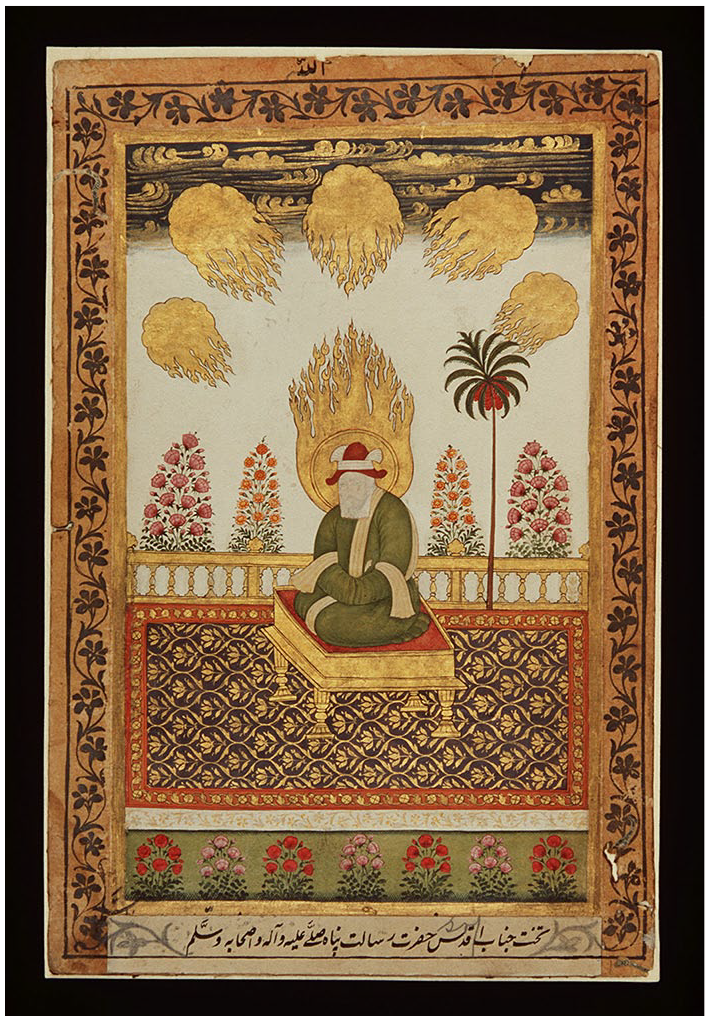
Miniature painting depicting the Prophet Muhammad enthroned, c. 1800, Kashmir, India. Reproduced courtesy of The Netherlands National Museum of World Cultures, RV-2871-4.
In 2015, months after the attacks on the satirical magazine Charlie Hebdo, I was asked to translate the Persian text at the bottom of the image, which until then had been described as ‘probably a prophet’, made in India circa 1800, while the inventory card suggested it is ‘the Prophet.’ 9 Indeed, the calligrapher’s text clarified that it was not just any prophet or sage depicted on a throne, as a learned man would be in the Mughal Empire. It was Muḥammad, reading in Persian ‘The Throne of His Excellency, His Highness the Protector of the Prophecy’, followed by an Arabic salutation that doubly confirms the Prophet’s identity, ‘may Allāh grant honor and peace on him, his family, and companions.’ 10 The Prophet is also recognizable by his flaming halo, veiled face and the date tree in the back, one of Muḥammad’s attributes. Above him float another five flaming halos, possibly a Shi’ite reference to the Ahl al-Bayt or people of the house, the family composed of the Prophet, ‘Ali, Fāṭimah, and their sons Ḥusayn and Ḥasan.
Since the image was rediscovered as a painting of Muḥammad, it gained slightly in prominence and was selected as one of the objects that museum teachers discuss on their tour of the permanent exhibition (when walking through the entire museum with teenage schoolchildren, for example). What made this painting additionally attractive for the teachers is that a careful look reveals Muḥammad’s face behind the veil. Was this because the paint had become translucent after two centuries? What about the Islamic Bilderverbot? Or, the museum teachers asked me in 2015, did the artist attempt to ‘test the limits of what was permissible?’ as if we were dealing with transgressive avant-garde art. These questions reveal the framing of the image, no longer merely an Islamic work of Mughal art, but a ‘devotional image’ of the Prophet, as the art historian Christiane Gruber (2019) describes these works. However, even adding the word ‘devotional’ is part of our contemporary political context, indicating that Muslims themselves can and have depicted the Prophet, and by extension, the adjective preempts orthodox criticism by clearly distinguishing such images from controversial non-Muslim images such as satirical cartoons. The word ‘devotional’ functions as a counterweight in a provocative balancing act to de-escalate, on the one hand, while stinging the all-too-pious or to surprise Islamophobic minds, on the other, by attaching the adjective to an image of the Prophet.
Along with showing the image as a devotional Muslim image, it was also included in the smartphone app Museum Explorer.
11
The strategy of countering stereotypes that portray Islam as essentially against image-making is buttressed theologically by the voice of former curator Mirjam Shatanawi: ‘Many believe that Islam does not allow the depiction of people. That is not at all a basic dogma in Islam. There is nothing in the Qur’an that forbids depicting people.’
12
Earlier, in 2015, Gruber, arguably the world’s leading expert on the topic, responded similarly: In the wake of the massacre that took place in the Paris offices of Charlie Hebdo, I have been called upon as a scholar specializing in Islamic paintings of the Prophet to explain whether images of Muhammad are banned in Islam. The short and simple answer is no. The Koran does not prohibit figural imagery (Gruber, 2015).
In this quote from the introduction to an article for a broad audience, Gruber positions herself as a specialist on the subject matter whose voice can get lost in the cacophony following the attacks against Charlie Hebdo just days before this piece was published. She adopts a strategic essentialism, as Shatanawi did to make a convincing statement in 38 seconds, by first citing the Qur’an, the ultimate arbiter of all things Islamic, and then describing the Hadith and Islamic Law, with the intent of showing that there, too, one cannot find a clear ban on image-making. In other words, she challenges the orthodox on their own turf. Similar strategies remain popular and are mediated by the various images that demonstrate the diversity of views existing in the history of Muslims. In 2018, for instance, my former colleague, the Islamic studies scholar Umar Ryad responded to a cartoon competition proposal by the Dutch anti-Islam Party For Freedom (Partij Voor de Vrijheid) by saying in a newspaper interview that the Qur’an does not prohibit satire directed against the Prophet, while the journalist asserted that cartoons are not inherently problematic because they represent the human form of the Prophet. To back this claim, she referred to the variety of devotional images of the Prophet and by publishing the Leiden miniature described in this section (‘Niet het beeld, maar de spot met God ligt gevoelig’, 2018).
It is understandable that a museum curator, an art historian and an Islamic Studies scholar would all refer to the Qur’an as the highest Islamic authority when the question of image-making is concerned, given its prominence among Muslim communities and in the globalized image of Islam. To reach the general public, however, by taking a revealed, foundational text as the final arbiter and by tempering the fierceness of the image-condemning Hadith, museums, universities and the press thus become involved in theologizing and risk reproducing a fundamentalist understanding of Islam. For this reason, rather than reducing Islam to the text, Ahmed (2016: 53–54) presents works such as the 16th-century Canon of Figural Representation (Qānūn-uṣ-Ṣuvar) that he believes are better suited for grasping the historically accumulated meanings of miniature paintings produced in the Balkan-to-Bengal complex. Likewise, in contrast to her short and simple answer, Gruber presents a long and complex answer in her book The Praiseworthy One (2019), citing a great variety of comparable texts to decipher images of the Prophet made throughout the centuries.
Meccan instruments and unmusical Dutch Muslims
The potential of Ahmed’s methodology to reflect on museum displays is further illustrated by another set of objects in Leiden’s Asia Room. Since 2011, several musical instruments have been part of the permanent exhibition. These precious objects – a rattling manjūr, drums and snare instruments, selected by Luitgard Mols (curator from 2012–2016) – were collected in Jiddah, near Mecca, in the late 19th century and later purchased following a request by orientalist Christiaan Snouck Hurgronje. 13 The head of exhibitions placed the label ‘ISLAM’ on this showcase (see Figure 2) to mark the section in the room that exhibits Islamic objects, setting it apart from Tibetan Buddhist objects, among others. 14 Although few visitors notice, the display can provoke Ahmed’s questions: does music, which Muslims often view as forbidden, belong to Islam? Or should we, as the anthropologist Samuli Schielke (2015) shows in his research on contemporary Egypt, see music as part of ‘everyday life’ (cf. Gazzah, 2008; Ter Laan, 2016)? What are the conceptual differences between ‘Islam’, ‘everyday Islam’, and ‘everyday life’, if we use these terms to expound on the musical instruments’ significance for their players and listeners? Which theological notion of Islam do we presuppose when categorizing instruments as ‘worldly’, ‘Islamic’, or ‘everyday’ in contrast to extraordinary occasions?
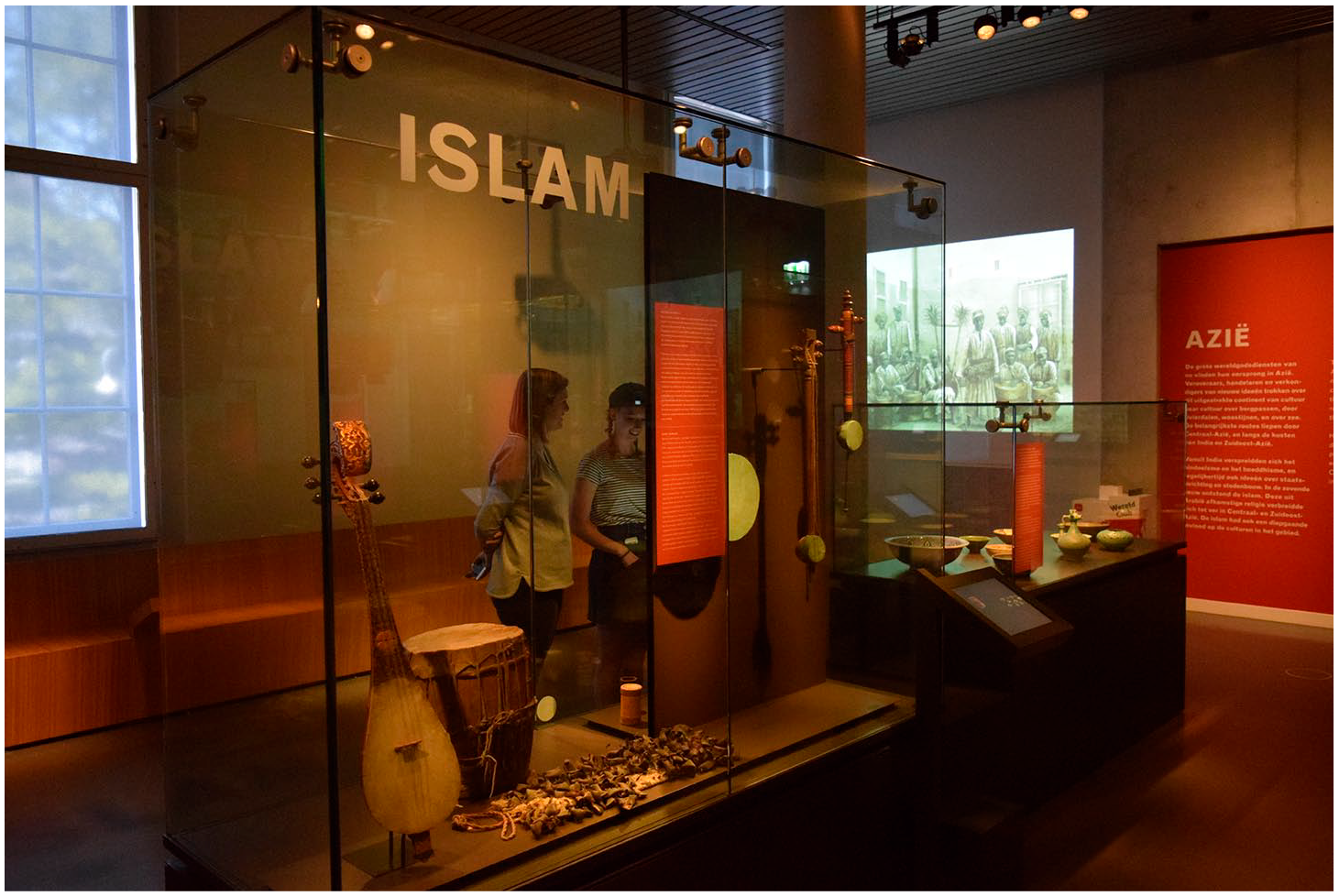
Asia Room displaying Meccan musical instruments. National Museum of Ethnology, Leiden. © Photograph: Pooyan Tamimi Arab.
Next to the instruments, visitors can observe several wax cylinders, which Hurgronje had ordered in absentia in 1908–1909 to record and document the music played in the streets of Jiddah and, based on his written accounts, in Mecca. 15 More than a century later, the instruments and (digitized) wax cylinders demonstrate that, in contrast to the current Saudi regime’s iconoclastic policies, music was part of Meccan public life. One of the wax cylinder recordings, not available to the public, is indeed of singing and playing on a Yemenite lute in the streets of Jiddah, which can be heard simultaneously with what is probably the oldest recording of an Islamic call to prayer in the Arabian peninsula prior to 20th-century electronic amplification.
A lithograph projected near the display shows the musicians forming a ṭanbūra orchestra, posing in the Dutch consulate in Jiddah (Figure 3). These musical groups were organized by African slaves who, according to Snouck Hurgronje, performed for their peers, also reportedly in Mecca. In the orientalist’s judgmental and racist descriptions, these Black, Muslim slaves’ ‘education is generally confined to learning the most indispensable ceremonial of Islam, and, though they are often very negligent even in this, the Mussulman disposition of these big children can be described as almost fanatical.’ Yet, after portraying these men as fanatical, in the same breath Snouck Hurgronje (2007[1889]: 15–16) notes that they listened to music and even consumed alcohol:
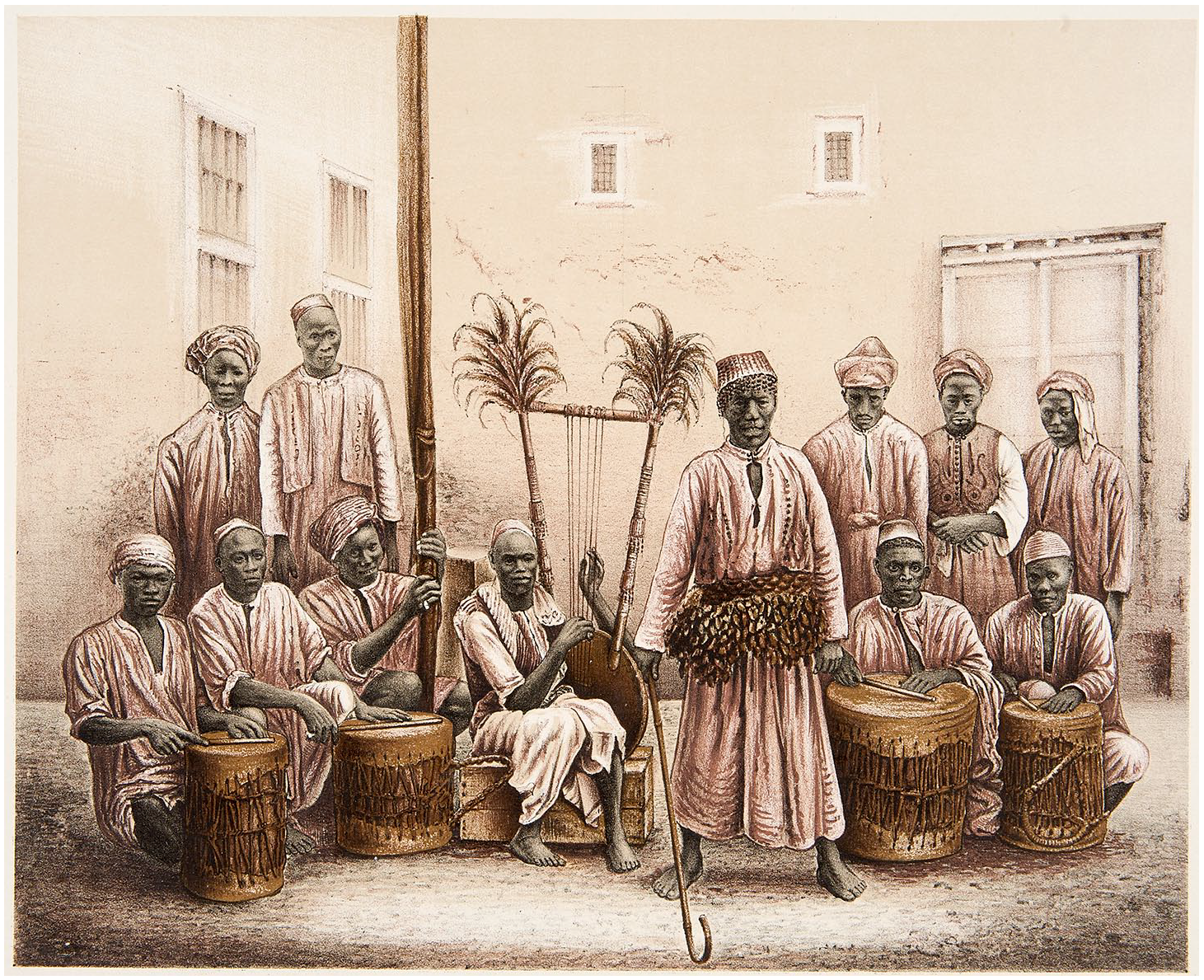
Lithograph depicting a ṭanbūra orchestra in the Dutch consulate in Jiddah, 1888. Reproduced courtesy of The Netherlands National Museum of World Cultures, TM-60057094.
From Thursday afternoon to Friday morning, they hold festival, regaling themselves with their national music, with song and dance . . . In the pauses one or another of those present takes an intoxicating drink called ‘būzah’ [barley beer], but even without this the concert of itself is enough to make like drunk the always somewhat exhilarated negroes.
Snouck Hurgronje’s racism is, however, not conveyed to the public. The first time I saw this display, Mols told me it was an opportunity to educate the public or, as she put it in hindsight, to show the ‘integration of music in the everyday life of late nineteenth-century Meccans.’ 16 The museum’s doing justice to musical heritage – with over 10 musical instruments that served diverse purposes – thus de facto confronts contemporary orthodox views in Saudi Arabia, though without a provocative intention, according to Mols. Indeed, the display counters Saudi and other conservative perspectives that may place enslaved Africans, Bedouins and others lower on the hierarchy of Arab–Muslim civilization and that in the 20th century have violently and stigmatizingly rejected music as ‘un-Islamic’ (cf. Freitag, 2020: 193–196, 200–202, 321–322; Khabeer, 2016; Urkevich, 2015: 7, 201).
Although heritage functions to suggest that images of the Prophet are allowed and that music is not absent from the holy centre of Islam, curators, museum teachers and academics also agreed with me that the museum should, now and in the future, avoid taking a theological stance. Former curator Mirjam Shatanawi said in 2016 that she thinks the museum’s central mission should be to inform visitors that there are images of the Prophet at all and that Meccans do listen to music, not just in the age of the Internet, but also in the past.
Such management of Islamic heritage in relation to orthodox viewpoints, as mentioned, is part of the broader Dutch public debate to which Muslims are prompted to respond. For example, one of the imams that the NMVW invited to the opening of the Tropenmuseum’s exhibit on Mecca in 2018 has shared his views on music on the Internet (Karrat, 2017). In a video, the Moroccan-Dutch imam Azzedine Karrat criticized the idea that unmusical Muslims could not be good Dutch citizens, but did partially go along with the integration frame, emphasizing all the good things Muslims should do to contribute to Dutch society. He stressed, however, that young Muslims should not obsess about ‘secondary subjects’ like music and drinking because these miss the ‘essence of the faith’ (de essentie van het geloof). They should not think that Islam is all about not listening to music because Islam is all about akhlāq, ethics, or an Islamically cultivated disposition to do good. But if we do ask the question of music, the imam said, the answer cannot be black and white – either ḥarām or ḥalāl – since there is ikhtilāf, disagreement, among Muslim scholars about the status of music. He remarked, for example, that singing is not forbidden in itself, and that there is no consensus about the status of musical instruments, which are not explicitly banned by the Qur’an. Many Islamic scholars, Karrat reasoned, are primarily worried about the combination of musical instruments with immoral texts. What is forbidden, he warned, is singing about women, sexuality, drugs, alcohol, inciting to violence, and in general the promotion of arrogance. That kind of music – according to the imam, 95 percent of everything on the market – does not teach ethics and is forbidden. Music is permitted, in his opinion, if the lyrics are ‘correct and purposeful’ (correct en doelgericht), which he elucidated as serving the purpose of contributing to Dutch society. The imam, in this way, combines strict adherence to Islamic principles with promoting chaste music for the social and political goals of integration and participation.
If we compare this with Ahmed’s (2016) view, Karrat’s explanation of music as inessential, even regarding potential contributions to society, is striking. The imam advised his Muslim audience to pursue more valuable careers – to be precise, ‘judges, lawyers, jurists, physicians, scholars, and imams . . . the Netherlands badly needs such Muslims.’ This list, as well as his explanations of the entanglements of Islamic ethics and law, are remarkable in that they prioritize law and authority, emphasizing ethics as a matter of correctness and positing essential versus inessential practices. It fits with the understanding of Islam, criticized by Ahmed, and is associated with Talal Asad’s thought, that if we want to understand what Islam is, we should start with the Qur’an and Hadith, and to see how orthodoxy – a relation of power – is formulated by competing authorities striving to establish the ‘correct’ way of living a Muslim life. 17 Alternatively, What Is Islam? presents its own list of Muslim career options, praising philosophers, physicians, poets and artists, but also musicians and dancers. In the miniatures Ahmed (2016: 492–505) analyses, even the figure of the Muslim judge or qāḍī is depicted as drinking wine and seducing young boys.
While Imam Karrat attempted to steer away from orthodoxizing too intensely, by minimizing the importance of music, from Ahmed’s perspective he operated within a limiting set of possible candidates for defining the Islamic. This effort by the imam further led him to sharply distinguish music from alcohol consumption. In contrast with music, he said, there can be no doubt that alcohol is absolutely ḥarām. But, as the case of the beer-drinking Meccan musicians already shows, the collection of the NMVW can be used to question such monolithic understandings of Islam in which painting, music and alcohol consumption are considered to constitute at best inessentials or everyday worldly matters disconnected from Islam itself.
An Afghan wine bowl in the Tropenmuseum
Imam Azzedine Karrat’s invocation of ethics, akhlāq, which resolutely excludes drinking alcohol, is amusingly challenged by Ahmed’s (2016) analyses of texts written by the homo universalis Naṣīr-ud-Dīn Tūṣī (1201–1274), the author of ‘the most influential – that is, most widely copied, read and reworked – book of political theory and “practical philosophy” (ḥikmat-i ʿamalī) in Islamic history until the modern period’ (p. 63). The Ethics or Akhlāq contains a special section on the ‘manners of drinking wine’ (ādāb-i sharāb-khwurdan), which, argues Ahmed, shows that Tūṣī, like Avicenna before him, was part of a context in which drinking was a normal and normatively praised practice, so much so that it required a text on the etiquette of intoxication. We can make sense of these Muslim drinkers if the central place of philosophy and poetry in the Balkan-to-Bengal complex is taken into account, for which ‘the Qur’an is of essence and nature and being not the highest (accessible) form of truth’ (p. 257). In Ahmed’s account, drinking is made an Islamic act through a pre-modern epistemological hierarchy (ch. 5). For those who could access Revelation by means beyond the Qur’an, physical and metaphorical drinking accompanied by Sufi poetry, which playfully builds on Islamic references, formed a bridge to the divine, or the Unseen. An undocumented metal bowl (Figure 4) I found in the Tropenmuseum collection allows me to briefly illustrate how Ahmed’s perspective is derived from the material expressions of this tradition and changes how we see their place (or absence) in exhibitions.
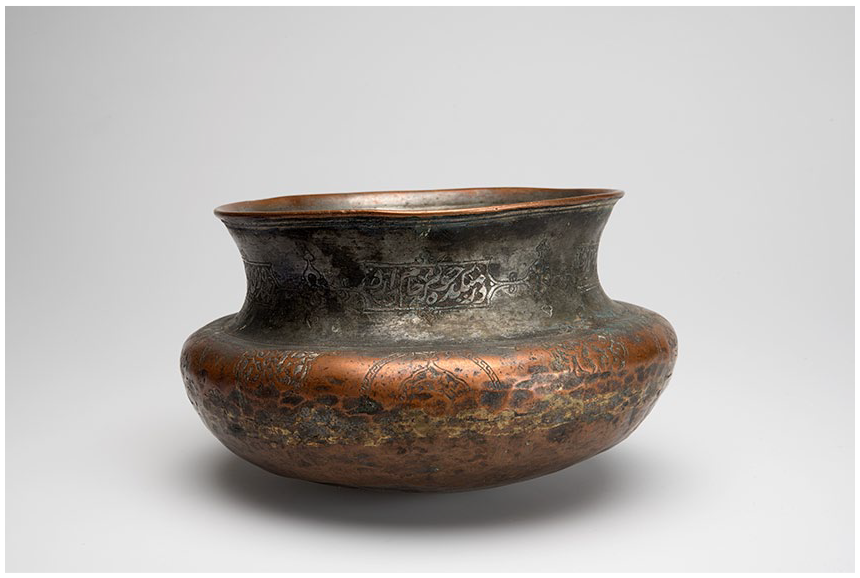
Wine bowl inscribed with verses of the poet Hafez, 19th century (disputed), Herat, Afghanistan. Reproduced courtesy of The Netherlands National Museum of World Cultures, TM-3964-8.
The particular metal bowl I want to highlight has never been exhibited, despite being in the collection for half a century. It was bought in Herat, Afghanistan, a city with a centuries-old history of producing Islamic metalwork of this type. The museum’s notes from the 1970s included the suggestion that it was possibly used as a water bowl and that shopkeepers there owned such objects. Perhaps water drinking could be related, it was thought, to one of the inscriptions on the bowl referring to its maker or owner. He is described as a mere slave of Zayn al-‘Ābidīn (‘abdih Zayn al-‘Ābidīn), i.e. the son of Imam Ḥusayn and the fourth of the twelve Shi’ite Imams. For Shi’ites, no doubt, water is a sacred symbol, referring to the thirst of Ḥusayn and his family during the Battle at Karbala.
Intrigued by the object, whose image on the museum’s software (TMS) did not make it possible to read the inscriptions, I decided to look at it in the depot. There, I learned that it was adorned with a 14th-century Persian poem by Ḥāfiẓ that had remained undocumented and that celebrates wine as the elixir of life and as the ‘water’ of kings. These inscriptions thus connected the Perso-Shi’ite user to a Ḥāfiẓian Sufi discourse. The poem refers to the mystery of the Fountain of Eternal Youth, which is supposed to have been uncovered by the prophet or sage al-Khiḍr (Khare, 2005: 170, 178). Ḥāfiẓ notes in his witty style that such sacred water can be best found in the tavern and that whoever holds the wine cup will forever live like a king: He that has the cup in hand forever holds Jam’s kingdom The water from which Khiḍr found life seek it in the tavern for the cup has it.
18
As Ahmed explains in detail, in Ḥāfiẓ the meaning of the cup is ambiguous, blurring the boundaries between earthly pleasure and esoteric divine inspiration, physical wine and metaphorical drunkenness and ecstatic union with God. In these lines, the wine bowl or cup (jām) is not just any vessel, but the mythical wine cup of the Persian king Jamshid celebrated in the epic Shahnameh, abbreviated to Jam. It is hence the Jām-i Jam, containing the elixir with which the peering king divined the ultimate truths of past and future existence.
The Tropenmuseum’s wine bowl is difficult to date, curators disagreeing whether it could have been made in the 17th century, in the Safavid period, or, based on similar objects and on the provenance notes, in the 19th century, echoing a more glorious past. Whatever the case, while Ahmed (2016: 67–71) discusses jade wine jugs and cups that actually belonged to a Timurid Sultan and a Mughal Emperor, this wine bowl’s reference to kingship is metaphorical: whoever drinks wine and is sufficiently learned in the ways of Ḥāfiẓ may transcend the Qur’anic prohibition and transcend his modest place in society, like the shopkeepers who were reported to possess such bowls in 20th-century Herat, becoming kinglike. The object assists the user, therefore, to connect with a far older tradition, materially, poetically and powerfully, while the signature simultaneously reminded its viewer of the humble position of its craftsman as a slave of one of the revered Imams.
These metal bowls inscribed with the poems of Ḥāfiẓ or Shi’ite references to the Twelve Imams belong to a tradition, qua form as well as metal craft, that goes back to the Timurid Empire of the 15th century and the Safavids of the 16th century; the city, Herat, where it was made fell under the governance of both. The themes of drinking wine, King Jamshid and the esoteric figure of al-Khiḍr were recurrent in this period, and on two Timurid bowls of the late 15th or early 16th century – held by the Freer Gallery of Art – we can read the same poem by Ḥāfiẓ (Atil et al., 1985: 186–189; Komaroff, 1992: 201). In contemporary Afghanistan and Iran, these poems are still among the best known, and users of such bowls would be able to recall or find the entire poem after reading one or two inscribed verses. If we indeed consider the poem in its entirety, the verses on the Tropenmuseum bowl go a step further than merely praising wine, juxtaposing wine drinking with orthodox piety. In other words, the ‘versus’ in the title of this article is both an etic as well as an emic concept, describing a tension in museum exhibition practices between Ahmed’s philosophical-Sufi amalgam and orthodoxizing tendencies that is inherent in Islam itself.
19
This can be observed in Ḥāfiẓ, who sharply separates the wine drinkers from the ascetics and the pious in his usual rhetorical style: Here we are with our wine and there the ascetics with their piety Let us see which one the Beloved shall have (Mā va may va zāhidān va taqvā tā yār sar-i kudām dārad).
Although these lines suggest a contradiction between the wine drinkers and the ascetics – to drink or not to drink – they are both turned toward God the Beloved and belong to the same family of Muslims, prompting Ahmed (2016: ch. 6) to describe Islam as a ‘coherent contradiction.’ Such a coherent contradiction could inhere even in a single individual who balances different domains in his psyche (p. 366), e.g. the wine-drinking judge, who may think of wine as legally forbidden in Islam, yet praise its value as a means to the divine, from a philosophical or mystical perspective that transcends law, thus contradicting others in his society (cf. pp. 492–505).
Throughout What Is Islam?, Ahmed defends wine drinking, therefore, not as a secondary or inessential matter, but as a central metaphor for understanding Islam as a human and historical phenomenon in cities such as Herat. Ahmed makes sense of this apparent impossibility by distinguishing text or Qur’an from pre-text, that which metaphysically precedes the Qur’an and Law and was believed to be accessed directly through the rationality of philosophers and the existential experience of Sufis. The con-text, in Ahmed’s terminology (cf. Gadamer’s Wirkungsgeschichte), formed the ‘bag and baggage’ (p. 357) of Islamic references accumulated through the centuries, which was necessary for hermeneutical engagement with both text and pre-text. The main protagonist of his criticisms of viewing Muslims as essentially bound by correctness and piety, as orthodoxizers who cannot see beyond the text, is arguably the poet Ḥāfiẓ. We read that the complete poems of Hafez formed in the period between the fifteenth and the late-nineteenth centuries, a pervasive poetical, conceptual and lexical presence in the discourse of educated Muslims in the vast geographical region extending from the Balkans through Anatolia, Iran and Central Asia down and across Afghanistan and North India to the Bay of Bengal that was home to the absolute demographic majority of Muslims on the planet (p. 32).
From there, after establishing Ḥāfiẓocentrism in Islamic history, Ahmed proceeds to extract concepts from the Sufi poet in the same way that I followed above by stressing that the term ‘versus’ captures both etic and emic perspectives. A key aspect of this strategy is Ahmed’s warning that Islam should not be reduced to the Qur’an and that the revealed text should not be seen as an endpoint, but rather a starting point, if we are to understand the wine bowl. To argue for such an explorative attitude, Ahmed refers to and draws from verses such as the following: Ḥāfiẓ; drink wine, live in nonconforming libertinage [rindī], be happy, but do not, Like others, make the Qur’ān a snare of deception (Ḥāfiẓā may khwur va rindī kun va khwush bāsh valī / dām-i tazvīr makun chun digarān Qur’ān rā).
After reading these lines, Ahmed performs a conceptual translation, by taking from Ḥāfiẓ the emic notion that the Qur’an can be made into a ‘snare of deception.’ In his challenge to anthropologists, art historians and museum curators, who may write in an etic style but all too readily assume the centrality of the Qur’an and Law, Ahmed can now analyse this as falling into a ‘legal-supremacist trap’ (pp. 120, 129, 168, 171, 255, 453), a Ḥāfiẓian guiding concept that he employs to assess conceptions of Islam across the emic–etic divide. From this methodological perspective, even a seemingly general anthropological concept like ‘religious authority’ is already part of specific contradictions within Islam and contested by poets like Ḥāfiẓ. To explain what Islam is in terms of authority would already be backing away from rindī, to ‘live in nonconforming libertinage.’ Consequently, we cannot completely avoid becoming part of emic struggles when attempting to analyse Islam from a distance. For museums, Ahmed’s approach entails practically that we ask whether the object types selected for an exhibition affirm a legal-supremacist image of Islam, which he thought ultimately constitutes an orientalist style – in the sense of the late Edward Said of – using material artifacts to portray Muslims as uniquely concerned with law, or with strictness and authority, that is, as monolithic and inflexible. Instead, the point is not to restore a shallow image of a wine-drinking oriental but, in Ahmed’s words, to do hermeneutical justice to a ‘Continent of Meaning’ (pp. 248–250).
Conclusion: Maintaining tensions
This article focused on how museums can or do become part of the tensions between a diverse Islamic heritage, on the one hand, and orthodoxizing trends among believers, on the other, the latter of which, in turn, interact with nationalist sentiments. That does not lead to the hasty conclusion that the Dutch National Museum of World Cultures can be viewed as generally opting for a provocative style of exhibiting Islamic art and material culture. The examples I presented remain subtle and easily overlooked in comparison with common stereotypes about Islam, which also prevail among Muslims themselves. Yet, they do inevitably become part of competing political–theological strategies. For the Dutch Minister of Social Affairs, Wouter Koolmees, who opened the exhibition Longing For Mecca at the Tropenmuseum (Verlangen Naar Mekka, 2018–2020), such museums function as a form of soft power, to both enlighten and integrate citizens, regardless of what curators may think of these motives. At this official opening, the NMVW’s general director, Stijn Schoonderwoerd, also clarified the ‘mission’ of the museum: to bring people together, defend open-minded thinking, and generate greater tolerance and mutual respect in the Netherlands. 20 But sadly, the complexity of the objects discussed in this article can hardly be conveyed to visitors in the mere 60 words allotted for object labels.
Furthermore, in response to such governmental pressures to make citizens ‘integrate’ and to the societal atmosphere pervaded by Dutch cultural nationalism, in the new permanent exhibition Things That Matter (2018), the Tropenmuseum opted for the safe topic of Islamic calligraphy and language as a form of art, to present visitors with a beautiful image of the Arabic script. To account for diverse forms of textual expression, a wine bowl with inscriptions in Urdu and Arabic, as well as an Iranian calligraphic image of the Prophet Muḥammad with Qur’anic verses, were also selected.
21
The bowl currently on display is described as having held water as well as real wine, but in contrast to the object I analysed in this article, visitors read that the inscriptions ‘cannot be deciphered’, thus missing the opportunity for further explication. Moreover, at the time of writing, the image of the Prophet – which I had helped document to do justice to a diverse visual heritage – was prematurely removed after complaints by a (non-Iranian and Sunni) employee of the museum, who sharply rejected any figural representation of the Prophet. According to former curator Mirjam Shatanwi, the complaint made the museum anxious about images of the Prophet in the exhibition Longing for Mecca. In response, she de-selected a large Shi’ite carpet showing the Prophet and ‘Ali, a move that the curator described as a concession to conservative views, which she opposed intellectually but accepted because she could imagine that groups of predominantly Sunni Muslim visitors would not want to be confronted with a large Shi’ite depiction of the Prophet. She did retain and insist on a Shi’ite-Mughal miniature painting, made in Kashmir circa 1800 CE, however, that depicted the Prophet and his cousin ‘Ali. She worried that the exhibition was too Sunni-dominated and thought that curators should not privilege minorities (and minorities within minorities) over each other.
22
She opined that the museum’s desire to promote harmonious living together could work against the diversity of perspectives within Islamic cultures. Already in 2009, she warned the Dutch public: One ‘Muslim’ is secular and does not want [the museum] to give attention to religion at all. The other will want the exhibition to reflect orthodox Islamic ways of thinking; so, no images. Others hope for more attention to the Kurdish culture or Berber heritage as a counterweight to the dominance [also in the Netherlands] of Turkish and Arabic culture. A new initiative that seeks to be socially relevant must start by uncovering these contradictions (blootleggen van deze tegenstellingen), not by smoothing them out under a singular and thus problematic denominator (Shatanawi, 2009).
Shahab Ahmed’s methodology is a fruitful attempt to respond to the curator’s warning, in the sense that it allows the retention of Islam as a shared vehicle for communication and knowing, while acknowledging and valuing differences. No doubt What Is Islam? will continue to be scrutinized for its politics and views of orthodoxy (Ghazi, 2019; Steinmetz-Jenkins, 2020; Sulaiman, 2018), its application in museum settings to other religions (Sullivan, 2020), or, for instance, its way of dealing with questions about gender in Islam (Zaman, 2020). Critiques notwithstanding, the book’s value lies in the way it casts doubt on the concept of Islam as monolithic and Qur’an- and law-centric, exposing pitfalls that museums can avoid, even if full disclosure of objects’ meanings to the average visitor does not succeed entirely. This is a much-needed corrective. After curator Shatanawi left the NMVW, the choice was made to place the Mughal miniature painting of an already translucently veiled prophet behind a black screen so as not to offend. 23 But the strategy of setting the image apart backfired, exciting a few dozen visitors to send the museum complaints about displaying the small painting at all. No doubt Shahab Ahmed would have protested these curatorial strategies, which reduce the wine bowl and the figural paintings to problematic exceptions to a sober, aniconic, Islamic rule. Rather than trying to resolve the tensions by veiling objects, he defended the meaningful coexistence of different perspectives as Islam (Ahmed, 2016: 397), by ‘maintaining the tension’ (p. 392). Museums, in sum, must balance tensions within Islam and simultaneously respond to nationalist and global anti-Muslim sentiments. If they wish to achieve a modus vivendi between the various perspectives, a step that cannot be skipped when striving for meaningful conviviality, this can occur only by displaying differences that refuse to be effaced.
Footnotes
Acknowledgements
I am grateful to my former colleagues at the National Museum of World Cultures, in particular Mirjam Shatanawi and Wayne Modest, colleagues in the Religious Matters project, the four anonymous reviewers of this article, and language editor Mitch Cohen.
Declaration of Conflicting Interests
The authors declared no potential conflicts of interest with respect to the research, authorship, and/or publication of this article.
Funding
The authors disclosed receipt of the following financial support for the research, authorship, and/or publication of this article: Time for research and writing of this article was made possible by the Dutch Spinoza-KNAW-funded project Religious Matters in an Entangled World ( ) and by a Netherlands Organisation for Scientific Research Veni-grant (016.Veni.195.226/6830). There is no conflict of interest.