



Abstract
This article analyses how Han buyers’ perception of and desire for the qualia—sensuous qualities—of Pu’er tea affects how ethnic minority producers perceive and make the tea. As a defining aspect of the consumers' experiences with ancient Pu’er tea, these qualia were invented and emphasised as part of the elite Chinese tea culture by Han traders and consumers. While the Bulang people's traditional way of making and using Pu’er tea related more to its economic and symbolic values than to its perceived effects on the body, in response to China's rapid marketisation they had to learn to sense the qualia rooted in a Han lexicon and philosophy and then acquire new skills to produce them. The paper argues that sensorial experience as a cultural dimension of tea has created new layers within Bulang people's encounters with the modern market.
Introduction
More than a century ago, when Mrs. Leslie Milne did fieldwork in 1911 in the State of Tawngpeng in what is now northern Myanmar, she observed: In the Palaung hills more tea is pickled than dried.… Pickled tea may be eaten after it has been one month in the pit, but when it has been kept for several months, it is considered to be of much better quality and it fetches a higher price. (Milne, 2004 [1924]: 234, 236)
This depiction of how the Palaung made and treasured their pickled tea resonates with the oral history of the Bulang, who share a common heritage with the Palaung. Tea is deeply rooted in Bulang tradition. It is the most valuable inheritance of the Bulang communities along the Sino-Myanmar border. The highly valued and widely circulated pickled tea depicted by Milne has not stood the test of time. “Nowadays, only a very few old ladies make pickled tea”, Xiang, 1 a Bulang man in his late 50 s, explained when he showed me some extremely rare pickled tea (mian mu) (see Figure 1) in August 2015 during my fieldwork on Bulang Mountain, the area with the most Bulang settlements in China, in Yunnan's southern Xishuangbanna (Sipsongpanna) Dai Autonomous Prefecture. “Nobody wants to buy it. We Bulang don't like it, because it tastes too bitter and too sour. Young people even express their disgust over its taste. They prefer drinking the tea we make nowadays.” Although pickled tea is indeed fairly acidic and bitter, the reason behind the preference for the tea “we make nowadays” is that Bulang people have developed a taste in conformity with that of tea buyers.
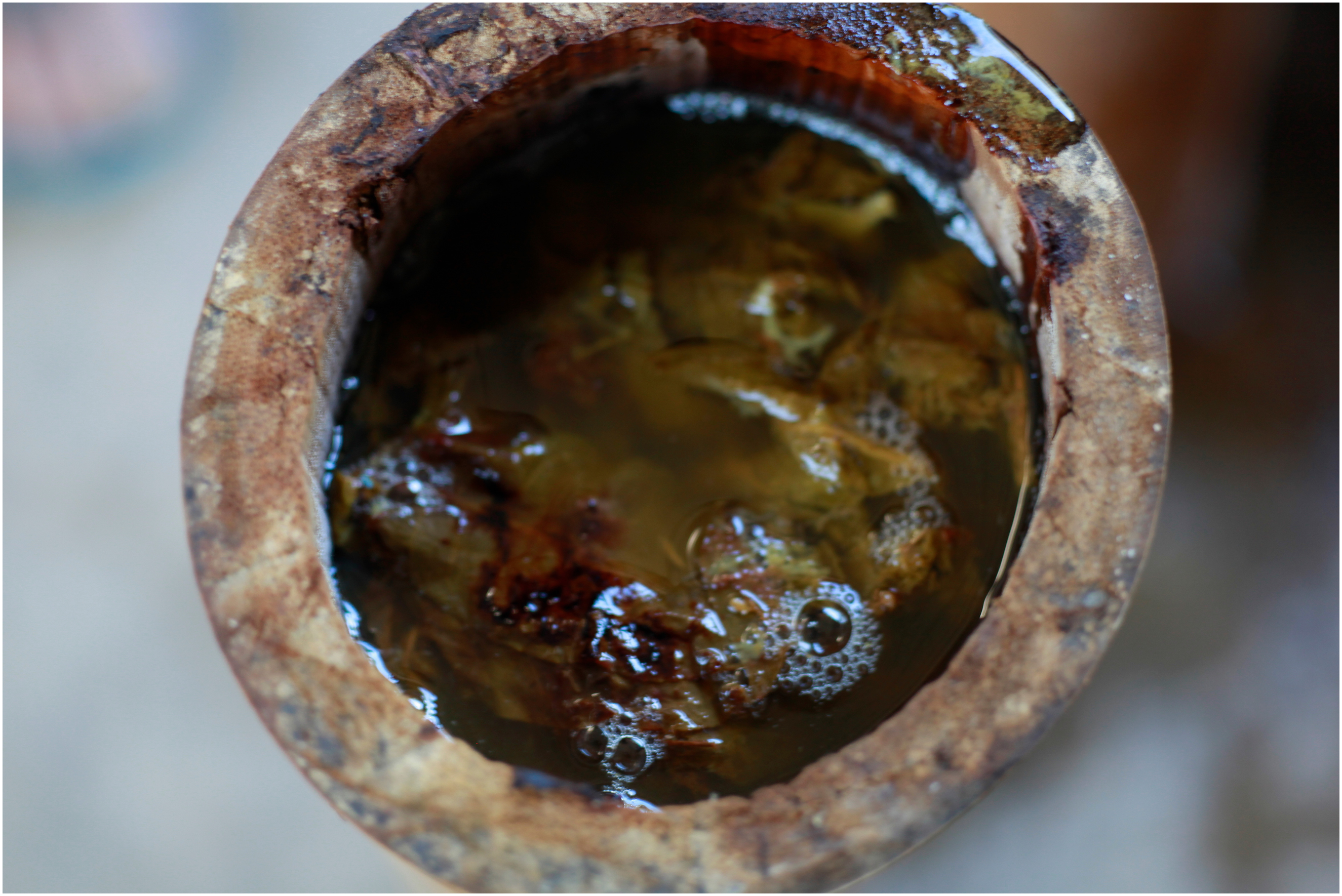
Pickled tea (mian mu) in a bamboo tube, Man village, Bulang Mountain.
Xiang's explanation reflects the fast-changing culture of making, trading and consuming tea in the market-driven Bulang communities. They have two kinds of tea: dried and pickled, respectively called la and mian mu in the Bulang language. La is a common term for “tea” among many ethnic groups in southwest China, such as the Bulang (Blang or Palaung), Dai, De’ang (Ang or Palaung), Hani (Ahka), Jinuo, Lahu and Wa. It refers to tea trees, fresh tea leaves, treated loose tea leaves and the beverage of brewed tea. Pickled tea, however, is called mian mu in Bulang and Dai communities. For a long time, the juxtaposition of la and mian mu was significant in Bulang society. Both were sold as commodities and consumed by Bulang people themselves: la was drunk as a beverage, while mian mu was ate, chewed and used as a special gift, a symbol of invitation and an offering to spirits. Mian mu's symbolic value had a role in many aspects of Bulang society. In today's Bulang communities, however, virtually all tea is roasted, rubbed and desiccated.
The tea cultivated by the Bulang and many other ethnic groups, such as the Dai, Hani, Jinuo and Lahu, is the renowned Pu’er tea (Pu’er cha). 2 It was named after Pu'er town,3 a small town which was the centre of the tea's distribution and taxation from the middle of the Qing dynasty (1644–1911) to the early years of the Republican era (1911–1949). In China, Pu’er refers exclusively to products made from the leaves of large-leaf tea trees (Camellia sinensis var. assamica) that grow in Yunnan along the upper Mekong. With more than a thousand years of cultivation, the rareness of the ancient (also called forest or arbour) tea trees and the tea's glorious record as a tribute from Yunnan to the Qing court have endowed Pu’er with an aura of organicness, antiquity, nostalgia and exoticism (Fang, 2001; Hung, 2015; Li, 2011; Lin, 2008; Ma, 2018; Yu, 2016a, 2016b; Zhang, 2014).
Pu’er tea—or, more accurately, ancient Pu’er tea—has been one of the most valuable teas on the Chinese market and beyond since the early 2000s. As a beverage, it is particularly prised for its splendid taste and other sensations it produces when drunk (Ma, 2018). These sensations are closely linked to the tea's place of origin. To personally imbibe all of its authenticity, traders collect the tea directly from the ethnic villages where it is cultivated and processed. However, there was a discrepancy between supply and demand: in the early encounters between these two groups, the ethnic tea farmers did not recognise and thus could not provide the sensuous qualities that the buyers desired in ancient Pu’er tea. As it made its way onto the market as a luxury, producing the “right” taste and other sensations, became one of the tea farmers’ most pressing needs. Therefore, learning to perceive the tea with the senses in a new way and to give it the desired particular qualities have reshaped the bodily perceptions of many ethnic groups who have been brought into the market economy. These processes have shaped their novel encounter with a market of new consumers who have precise demands. It is worth noting that Pu’er shares some qualia with, for example, oolong, black tea, green tea and other teas drunk in China. However, the modern market appreciates and promotes Pu’er tea's multi-layered taste more than any other.
Based on in-depth fieldwork that began in April 2012, 4 this article investigates how sensation as a culture dimension has shaped and will continue to shape Bulang people's experience of marketisation. Bulang people's encounter with the modern market has happened not only in societal, ethnic and economic domains, as I have shown elsewhere (Ma, 2018, 2021), but also at the very minute level of bodily perceptions. This article aims to shed light on how distinct sensorial experiences come to constitute an exceptional encounter with marketisation, as encounters between cultures can manifest in transformations of embodiment. It demonstrates that the Bulang people's evaluation of Pu’er tea, which historically had little to do with bodily perceptions, shifted in response to the assessment of the beverage's qualia by Han traders and elite consumers. This article also analyses hierarchical relations in the Chinese tea market through the concept of the “sensescape.” Ethnic minority tea farmers, such as the Bulang, must learn how to identify and constantly adjust their way of processing ancient Pu’er tea to produce the subtle qualia emphasised and coveted by Han tea traders and elite consumers, who use the powerful discourse of taste and other bodily sensations to legitimize and reinforce their dominant role in the market. I argue that the status difference between the privileged Han and the marginalised Bulang is embedded not only in their social and political positions but also in gustatory and other sensorial aesthetics involving subtle bodily experience.
Inspired by Appadurai's “dimensions of global culture flows” (Appadurai, 1996: 33–43), Harkness's “pragmatics of qualia” (Harkness, 2015) and anthropological studies on senses, I shall define the “sensescape” as the theoretical framework of this article in the first section. Then I will explain what the qualia of ancient Pu’er tea are and how Han tea merchants and consumers use them to understand and directly experience the tea's quality. The Bulang's tea traditions are delineated in the third section. By describing how tea buyers’ focus on taste in tea making and trading defines their interactions with the Bulang, the last section demonstrates how the marketisation of Pu’er propels the Bulang's particular encounter with modernity through sensorial knowledge and nuanced embodiments. Finally, I conclude with a proposition complementing Appadurai's theory of cultural flows by arguing that the sensescape in food and beverage consumption has become another way of conceptualising the world.
The sensescape as a cultural dimension
In Modernity at Large, Appadurai (1996: 33) defines five distinct scapes through which to trace the effects of global cultural flows: ethnoscapes, mediascapes, technoscapes, financescapes and ideoscapes. These are useful for analysing the flux of global connections and disjunctures through cultural and economic domains yet inadequate for comprehending sensorial flows, because none includes the role of the body. Appadurai (1996: 67) recognises the body as an object that requires discipline in consumption and argues that it is “an ideal site for the inscription of social disciplines”. However, it is more than a “site”, because of a simple yet frequently ignored fact: the body is the corporeal form through which all humans directly perceive, especially when interacting with food, beverages and other types of body-focal consumption. The idea of “sensescape” proves useful in understanding senses related cultural flows. Sensescape was defined by Howes (2005b: 143): “It is the idea that the experience of the environment, and of the other persons and things which inhabit that environment, is produced by the particular mode of distinguishing, valuing and combining the senses in the culture under study.” Drawing from Howes's definition, I take sensescape in this article as the field of people's entire range of bodily perceptions of space/place, textures, food, beverages, music, expressions and other tangible and intangible things.
Sensescape are culturally attuned, for example, Howes (2005a: 4) argued that although senses could only be experienced by individual bodies, they are not private, internal, ahistorical, or apolitical, but are deeply connected to cultural aspects of human beings’ lives. Senses are shared social experiences and knowledge. Senses and social connotations are synergistic. A striking illustration of this synergism is among the Tzotzil, descendants of the Maya living in the Chiapas highlands of Mexico. The Tzotzil perceive the sense of heat in relation to time cycles, ritual, birth, death, sickness, individuals’ social position, social order of their community, and ultimately cosmology (Classen, 2005: 149–152). Sensescape has been demonstrated to be highly culturally important, for example, in Classen and Howes’s (2006: 199–222) analysis of the museum sensescapes. This echoes with Appadurai (1996: 33) accounts of the “five-scapes” which are “deeply perspectival constructs, inflected by the historical, linguistic and political situatedness of different sorts of actors.” The sensescape and its changes are very fluid within the process of globalisation, as people, capital and media move around constantly. It shapes our bodily engagement with and understandings of the world.
Increasingly, however, the studies of senses press for a clear focus on the body perceptions per se rather than its social connotations, and that mission is often addressed in a pragmatic framework. In this vein of analysis, ethnographical concern of practise shifted from communication to embodiment (Harkness, 2015: 573), and body is understood as an assemblage of embodied perceptions and experiences instead of a medium of symbolic meanings (Asad, 1993: 75). Nancy Munn’s (1992) work on value construction on Gawa Island (in Papua New Guinea's Massim region) first analysed the bodily qualities from which a value system has been generated through an expansive take on Peirce's idea of qualisign. Munn (1992: 74) argued that value transformation involving food on Gawa are conveyed in qualisigns such as bodily feelings of heaviness, slowness and lightness. Chumley and Harkness (2013) developed qualia as a useful tool in pursuing questions of the sensuous dimensions of social life from communication to embodiment, without major ontological ruptures among these different categories. Harkness (2015: 573) defines qualia as “pragmatic signals (indexes) that materialise phenomenally in human activity as sensuous qualities.” He employs qualia to analyse how the perceived sensation of South Korean soju, which has moved from strongness to softness, has conceptualised the changing relationship between the liquor and women (Harkness, 2013).
Qualia can serve as signs of practical knowledge of the world (Harkness, 2015: 579), used to evaluate objects’ sensorial qualities. For example, as Calvão (2013) showed in Angola, the qualia of visibility and hiddenness in the world of diamonds are experienced directly and differently by actors such as miners, traders, smugglers and agitators. He further demonstrated that the embodied knowledge of these qualia organises the diamond business's social framework (Calvão, 2013: 120). The quale (singular of qualia) of clarity, for instance, reflects a diamond's value and relates to how swiftly traders can transport it across highly risky borders (Calvão, 2013: 132). However, qualia linked with “radical subjectivity, individual consciousness, interiority, introspection and ineffability (Harkness, 2017: S22-S23), thus are hard to analyse. To “demonstrate how qualia can be mobilised for empirical semiotic research” (Harkness, 2017: S23), Harkness (2017: S23) developed the term of qualisign and treats qualia and qualisign as semiotically linked. Qualia are “facts of firstness” or “the qualities”, the “thingness of things,” while qualisigns are the “predicable feelings” (Harkness, 2017: S23). Qualisigns function as genuine signs of qualities (Harkness, 2017: S23). For example, Harkness showed that the qualia of “openness” in signing can be felt and learned in the form of conventional qualisigns of the value of the “openness” (Harkness, 2017).
Qualisigns thus become navigational guides to assimilating the “facts of firstness”5 into reflexive modes of experience (Harkness, 2017: S33). They can be evaluated as indicators of not only quality but also personality, under certain circumstances. Chumley (2013) shows that after students qualify for admission to a Chinese art school through an anonymous quantitative examination, their learning practises are organised around face-to-face interaction with their teachers, who judge their artistic ability based on qualia thought to reflect the students’ personalities. Ralph (2013), writing about terrifying police violence in Westwood, Chicago, argues that the victims forged a new mode of historical consciousness in their community by speaking out about the qualia of their pain. The shared qualisign, namely the feeling of the empathic pain and its memory were transformed into social narratives and thus shaped historical consciousness. The importance of Munn's and her followers’ work lies in their serious consideration of sensations in human activities. The concept of qualia illuminates how abstract qualities, such as atmosphere or textures in food and drink, are directly felt and experienced and, conversely, how the felt and experienced qualities affect body-focal consumption and society in general.
Tea drinking in China ranges from quotidian consuming to sophisticated tasting involving refined cultural and artistic traditions. The qualia of tea play crucial roles, from field to factory to cup. Xiao (2017) explains that since premodern times, tea from Wuyi Mountain, in China's southeastern Fujian Province, has been judged by its sensuous qualities, such as aroma, taste and yun (see the next section), produced by the differences in the local geography and embodied tea-making skills. Today, taste is the dominant discourse in tea processing. Shu (2010: 188) demonstrates that although farmers in the village of Tiancun in southern Fujian play indispensable roles in processing and trading tea, they are absent from the construction of its standard taste. Instead, they had to learn to apprehend their tea's sensorial qualities and adjust their ways of making it to meet the demands of the market and the state (Shu, 2010: 93–122). The same qualia of tea, specifically in Shu’s (2010) case the taste of tea, are not subjective properties but rather intersubjective products (Harkness, 2020: 1). As a cash crop which flows from its place of production to its place of consumption which are more often than not separated, the flow of tea goes hand in hand with the flow of interpretations of the qualia of tea. Sensecapes of tea thus entail cultural encounters since “different cultures understand same senses distinctly” (Classen, 2005: 152).
The importance of sensory experience in tea drinking can be seen most clearly in the process of promoting Pu’er tea through reinventing and circulating knowledge of its sensorial qualities. Yu (2016b) shows that Taiwan's rich tea-tasting culture facilitated Pu’er tea's rise from local custom to global fad. Taste and other qualia of the tea have become the principal means of differentiating ancient from terrace tea, as well as tea from different places (Ma, 2018; Zhang, 2014). Via feedback from consumers and businesspeople, bodily perceptions indirectly help Pu’er tea producers to maintain the biological and methodological diversity associated with tea production (Ahmed et al., 2010: 176–177). The value of Pu’er has therefore been constructed to a great extent by its qualia, which affect tea production and even producers. Qualia are thus of significance for understanding both the bodily experiences of tea drinking and its social and cultural consequences. Actors from diverse backgrounds encounter one another through the spread, learning and pursuit of Pu’er's qualia. If Appadurai’s (1996: 33) “five scapes” concern the complex cultural flows of the global world, the sensescape may provide us with a better understanding of the cross-cultural consumption of food and drink, along with other body-focal activities that involve direct perceptions of intensive sensory information.
Sensorial spectrum and the value of Pu’er tea
From the mid-1990s, Taiwanese tea masters and merchants established and promoted a taste for aged Pu’er tea (Yu, 2016b: 312), saying that “the longer it's stored, the better it tastes” (yue chen yue xiang) (Deng, 2004: 49). The “taste of aging” then became the “new standard of value in evaluating the tea” (Yu, 2016b: 312), whose price is therefore closely associated with bodily sensations.
Since the early 2000s, amid waves of mass marketisation and cultural renaissance, tea traders and consumers in mainland China have welcomed and emulated the Taiwanese way of assessing Pu’er tea, which is considered part of a well-organised and legitimate system that represents well-preserved fine Chinese culture. However, in Yunnan, the inventory of aged Pu’er is limited and the tea trade overwhelmingly based on raw materials and freshly made Pu’er products. To imitate the Taiwanese model, traders and drinkers in mainland China have therefore developed and promoted their own sensorial preferences for young Pu’er tea. Their system is employed especially in tasting Pu’er harvested from ancient tea trees, because only ancient tea is considered authentic Pu’er and has the potential to be transformed into high-quality aged Pu’er through long-term storage. Although the discourse of ancient Pu’er tea's sensations is recent among the Han as well, it has been firmly established through the articulation of a sophisticated sensorial spectrum during drinking.
Sensing the taste of Pu’er tea is a process constructed within the long-held practise of tea drinking which forms a special system of lexicon for describing the qualia of the tea. This system of the rich lexicon reflects not only the sensescape of ancient Pu’er tea, but also how the qualia of the tea have been shaped particularly in the Han Chinese tea drinking culture. Through describing each quale in a sequence of tea tasting, I will show below how the senses of ancient Pu’er tea have been “scaped.”
Once the tea is brewed, one should first observe its colour. The tea should look transparent or, even better, glossy (you liang, “oily bright”). The first brew is used to wash the teacups and should be thrown out, not only for reasons of hygiene but also so the aromas that remain at the bottom of the cup can be smelled. If the tea is good, it should smell strongly of flower, fruit or honey. If it comes from hundred-year-old or older trees, it should smell of orchid. The second brew is for drinking, which must be done properly to capture the tea's qualia. First, smell the tea, whose fragrances can be sensed immediately on infusion with hot water. Next, drink the tea. Freshly made ancient Pu’er has a complex taste of bitterness, astringency and sweetness. It is said that the best-tasting Pu’er is neither too bitter, too astringent nor too sweet, but a scrumptious mixture of the three. When the tea hits the throat, one should sense its smoothness. Fine tea feels as smooth as silk.
As tea goes down the throat, one should feel first its shui lu and then its yun. Shui lu, literally “water road”, is the feeling of tea moving from the mouth to the throat. Yun is one of the most abstract tea-drinking sensations developed in China. Hinsch (2016: 78) argues that it was in the pursuit of individualism that the elites of the Song dynasty (960–1279) elaborated tea connoisseurship to a stage of abstraction that allowed them to express their superior taste and erudition in high culture: the appreciation of tea was integrated with literature, painting, calligraphy and so on. Yun, perhaps a legacy of Song connoisseurship, initially referred to the aesthetics of sound or music. It explicitly means the concord of well-tuned sounds. Because music and poetry were related in premodern China, the term was deployed to denote the harmonious rhyme of traditional Chinese poetry, and then literati ardently embraced it to describe the taste of tea and finally taste in general. Yun wei, “the taste of rhythm,” is ubiquitously applied in Chinese society to describe refined and elegantly beautiful people and things. Yun wei's synaesthesia brought a broader spectrum of sensations into tea drinking. But under the strong influence of Chinese philosophy, yun is the most celebrated senses in tea drinking. This resonates with Classen’s (2005) account of certain cultures privileging some senses over others. The sense of yun in Pu’er drinking is often deemed by tea connoisseurs and experienced tea businesspeople to be a spiritual experience. Many tea masters and businesspeople told me some versions of “although it is nuanced and hard to capture, you feel an unspeakable sense of openness and happiness when you feel the yun of Pu’er tea.”
After the tea reaches the stomach, one senses its gan in the mouth. Gan means “sweetness,” tian in Chinese. Although these terms can be used interchangeably, they are subtly different: gan is the taste of endured hardship and experience, while tian is childishly sugar-sweet (Ma, 2018: 323). In discussions of tea, gan always appears with hui. Hui means “return,” so huigan is the return of the sweetness. It is a metaphor for life: gan comes back only after one has tasted bitterness. Practically, sensing Pu’er tea's gan is more complicated than just tasting it: one should note which part of the tongue captures the hui gan, whether the front, middle, back or sides, which tells whether it will last or not. Usually, the farther back on the tongue, the longer the hui gan will last and the higher the tea's quality it denotes.
After drinking several cups, it is time to sense the tea's qi. Meaning “air” or “energy,” qi comes from Chinese cosmology. Only certain parts of the body can sense a tea's qi—namely, the back, the palms and the chest. Strong qi in tea manifests as a palpable sense of bodily warmth or heat. Although many sensations are evaluated to assess a cup of tea, the most important are qi, yun, hui gan and fragrances since they have been highest ranked in the hierarchical sensescape of tea in Han culture. One can also feel sheng jin if the tea is good. Shen jin means “producing saliva.” Fine ancient Pu’er tea makes one's mouth produce saliva in a pleasant way. It is said that the hui gan and shen jin of very fine ancient Pu’er tea can last to the next day.
The above demonstrated spectrum of the sensescape of Pu’er is the exclusive and dominant form of tasting Pu’er tea today. It is expressed in the tea market as connoisseurship. Although abstruse, it is of great significance in contemporary Pu’er tea business and consumption. Among other things, it is the most important way to differentiate ancient Pu'er tea from terrace Pu’er tea6 (see Table 1).
The distinct qualia of ancient Pu’er tea and terrace Pu’er tea. (Sources: 60 interviews with traders, connoisseurs and consumers in tea factories, wholesale shops and tea houses in Xishaungbanna's Menghai Town and Jinghun City, plus other big Chinese cities such as Kunming, Beijing and Shanghai.).
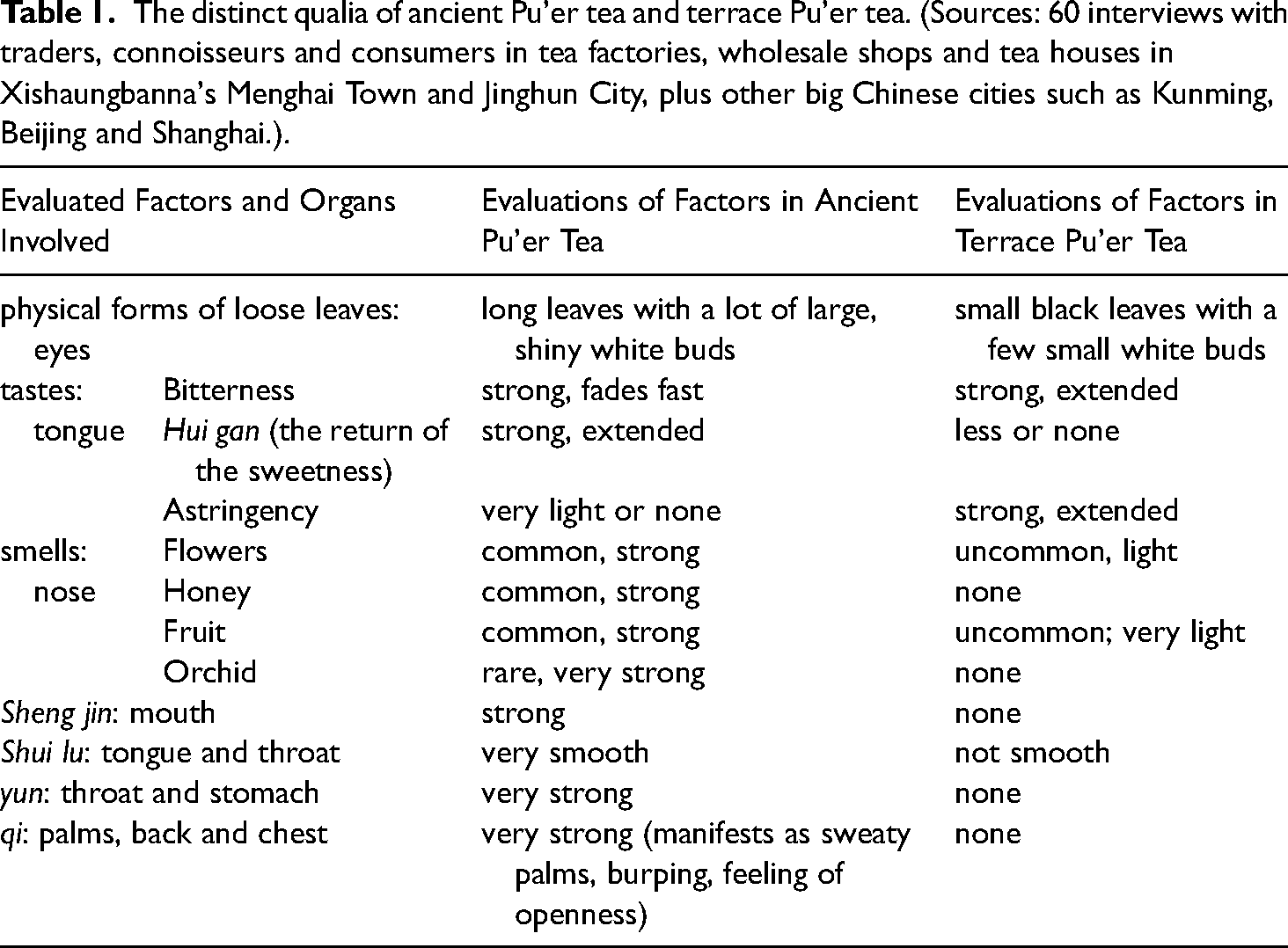
Pu’er tea's qualia expressly reveal its materiality and quality. The qi, yun, hui gan and other sensorial manifestations ultimately define its value by distinguishing between ancient and terrace Pu’er. I am not arguing that the tea's cultural and symbolic values are not important among Han traders and consumers. Rather, I emphasise that Pu’er's qualia play a crucial role in drinking and talking about tea and especially in shaping the encounters between buyers and farmers. However, these sensations were alien to Bulang tea farmers until the early 2010s. Their classification of tea taste was based on a much straightforward binary, ranging from diao, sweet, to shuang, bitter. These terms are also employed to differentiate the tastes of tea between entire tea gardens and the trees in a single tea garden. The Bulang language has two more words about the taste of tea: the very positive huan, “fragrant”, and the negative enm ba, “the taste of numbness.” More important, Bulang people's tea tradition rests largely on the symbolic and cultural values of Pu’er tea and is mostly disconnected from bodily perceptions.
Mian mu and la: Tea in the Bulang tradition
The Bulang dwell primarily along the Sino-Myanmar border. Although the Chinese state classified the Bulang as an independent ethnic nationality (shao shu min zu) (Mullaney, 2011: 123–124), the consensus among Chinese historians and ethnologists is that they share a forbear with the officially recognised De’ang and Wa (Li, 1986: 1). The Bulang have been largely neglected by Chinese scholars, given their small population and negligible role in both regional and national political and economic spheres. Numerous English-language works discuss the social and cultural transformations of many Chinese ethnic minorities since the early 1980s, but only a scant few consider the Bulang. This has changed only recently, because of the fast-growing Pu’er tea economy. The most important such study is by Po-Yi Hung (2015), which uses the production and trade of Pu’er tea in a Bulang community as a window onto the making and remaking of the landscape at China's most southwesterly frontier.
More than 60% of the Bulang in China live on Bulang Mountain, in Menghai County in Xishuangbanna Dai Autonomous Prefecture. As this is one of the most renowned Pu’er mountains in Yunnan, these Bulang communities are endowed with a rich tea tradition. Historians believe that the Pu, the ancestors of the Bulang, the Wa and the De’ang, were one of the peoples that first cultivated tea, over a thousand years ago (Editing Team of the Ancient History of Yunnan, 1977: 3; Zhao, 2000). In addition to Bulang folklore and oral history, continuous discoveries of ancient tea trees in their settlements support this hypothesis.
There is no doubt that tea has played an important economic role in traditional upland societies: historically, Bulang and other upland peoples have used income from its production to buy salt, clothes, steel tools and other goods from the lowland Dai (Takahiro and Bedenoch, 2013). However, my fieldwork demonstrates that tea is deeply embedded in Bulang tradition not merely because of its economic value but also because of its symbolic significance, particularly that of mian mu. For the Bulang, tea is especially important in constructing and maintaining social relations on the one hand and bridging the living and the dead in ritual practises on the other. Furthermore, they consume la and mian mu as a beverage and a food, respectively.
Until roughly the late 1980s, mian mu circulated in Bulang society as a valuable gift. Li (2011: 123–138) has shown that tea is used as a gift in De’ang society as well, such as when laypeople invite monks to chant during rituals or those who are younger pay respect to elders. It regulates social relations among the De’ang and the relationships between the De’ang and other groups. “In the past, it was essential for us to send mian mu,” Kan, a Bulang woman in her late 40 s, explained. “Mian mu, tobacco and a pair of beeswax candles were packed in a plantain leaf as a set of gifts on many occasions.” These gifts were indispensable in matchmaking: when a boy's family wished to negotiate his marriage with a certain girl, they would ask a trusted person to act as mediator and visit the girl's family with these gifts, which the girl's family took to show their acceptance of the proposal or, conversely, rejected to decline it. The combination of mian mu, tobacco and candles was thus itself a mediator. “When the girl's family saw this set of gifts, they would already understand the mission of the person who carried it,” Bu, a Bulang man, said. Historians and ethnologists have documented tea's utility as a special gift in China. Chang (2006: 336) explains that because various ethnic groups in Yunnan consider tea to be clean and auspicious, it is a core component of their marriage gifts. For example, in Bai and Lahu societies, tea is an indispensable part of the bride-price.
As elders in Bulang communities recall, the set of gifts described above was also sent to solicit people's participation in important events, inviting monks to chant in Buddhist rituals or relatives to attend weddings, funerals and other ceremonies, for example. In this sense, the combination of pickled tea, tobacco and beeswax candles functioned as a medium specifically to extend an invitation. Li (2011: 123–138) emphasises that the flow of tea as a gift on ritual occasions demonstrates the hierarchical relationship between Buddhist monks and laypeople in De’ang society. In Bulang communities, a gift of mian mu carries the giver's sincerity. It is ga na ke se gai, meaning “nothing is more important than this,” as Bu explained, continuing, “In the past, if you wanted to invite important people, mian mu was definitely needed. If you ever accepted a set of mian mu, tobacco and beeswax candles, you had to attend the ritual. Otherwise, the giver would feel insulted.”
Together with tobacco and beeswax candles, mian mu formed bonds among members of Bulang society. However, it was not only significant in constructing and maintaining social relations but also indispensable in bridging this world and the next as an offering. In Southeast Asian Theravada Buddhist societies, for example in Laos, caring for the dead is one of the laity's most important focuses, expressed in their daily practise of offering food to monks and in special festivals (Ladwig, 2012: 119–120). During Buddhist festivals and ceremonies in Bulang communities, one household is the ritual's main sponsor, most importantly so as to offer sacrifices to their deceased family members and other ghosts, both benevolent and malevolent. Along with cooked rice and pickled bamboo shoots, mian mu is obligatory. It is significant that the rice, as the most important food for the Bulang, is on the bottom, the pickled bamboo shoots in the middle and the mian mu on top (see Figures 2 to 4). A pile of these three items is built at each corner of a bamboo lattice. Depending on how big or important the ritual is, more things may be added (see Figure 5). Bulang people explained that rice represents staple foods, pickled bamboo shoots represent vegetables and tea represents something that their ancestors and ghosts can use and eat. Tea is not “life” support but something more important.
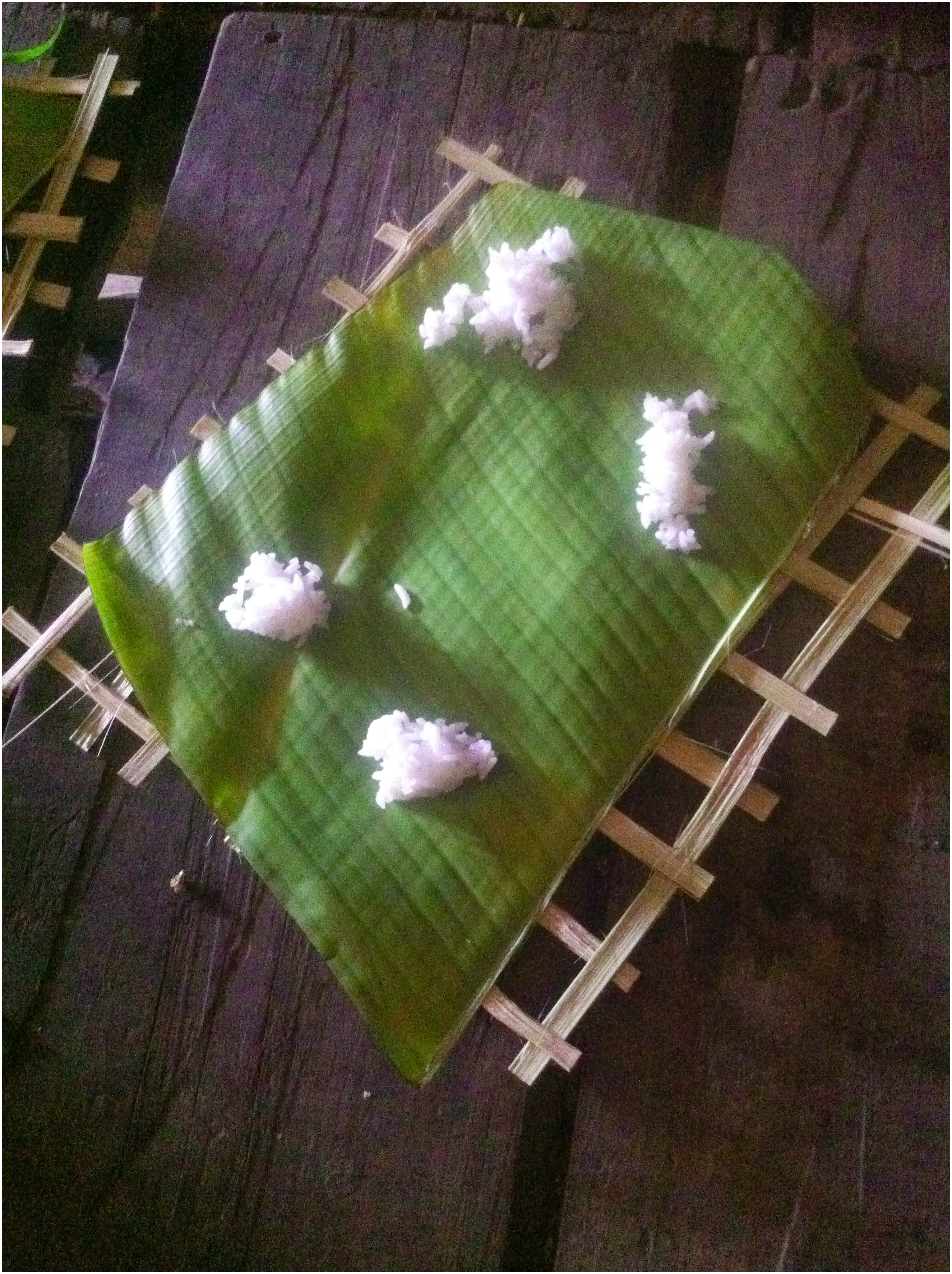
Rice.
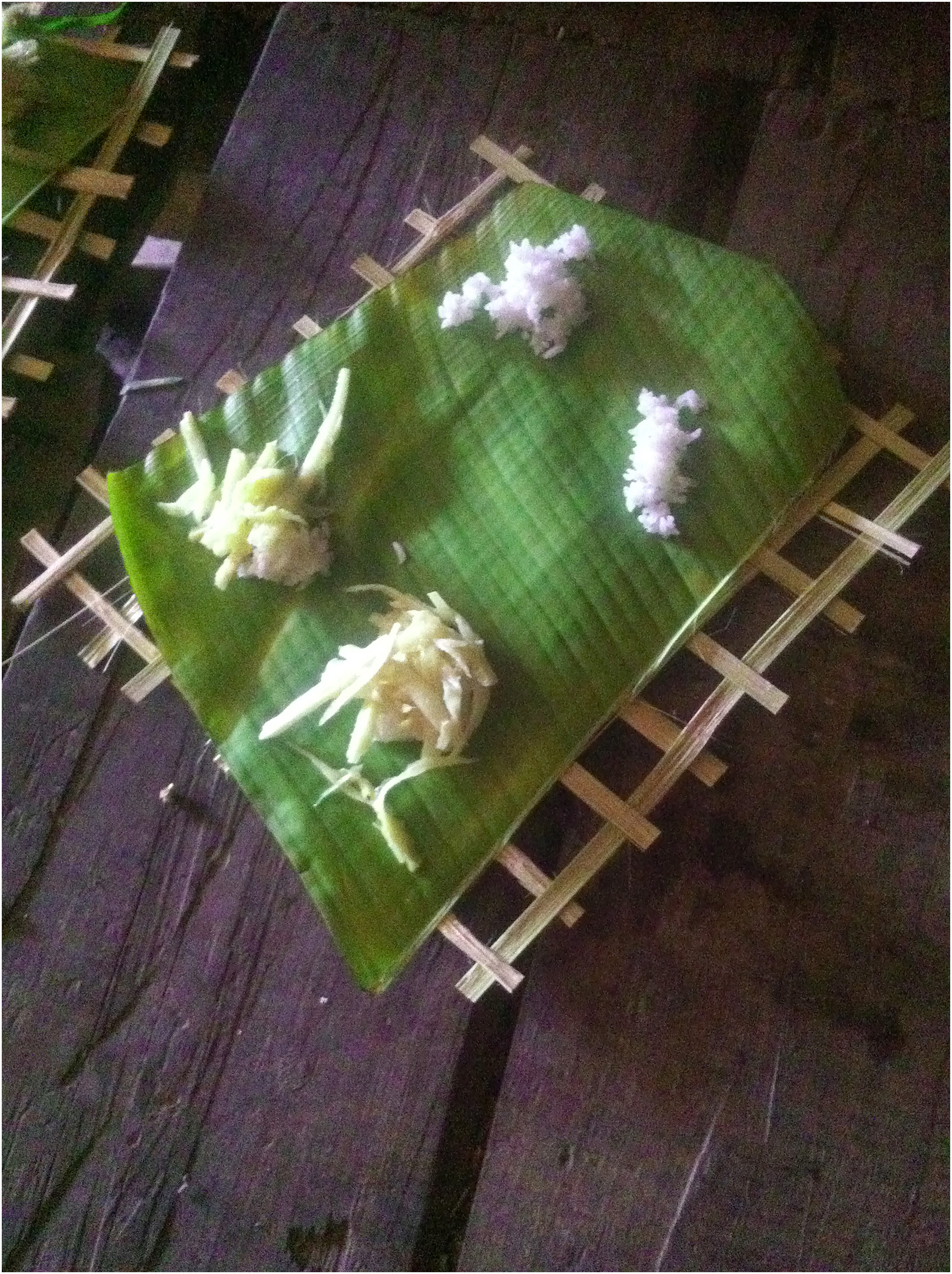
Pickled bamboo shoots on the rice.
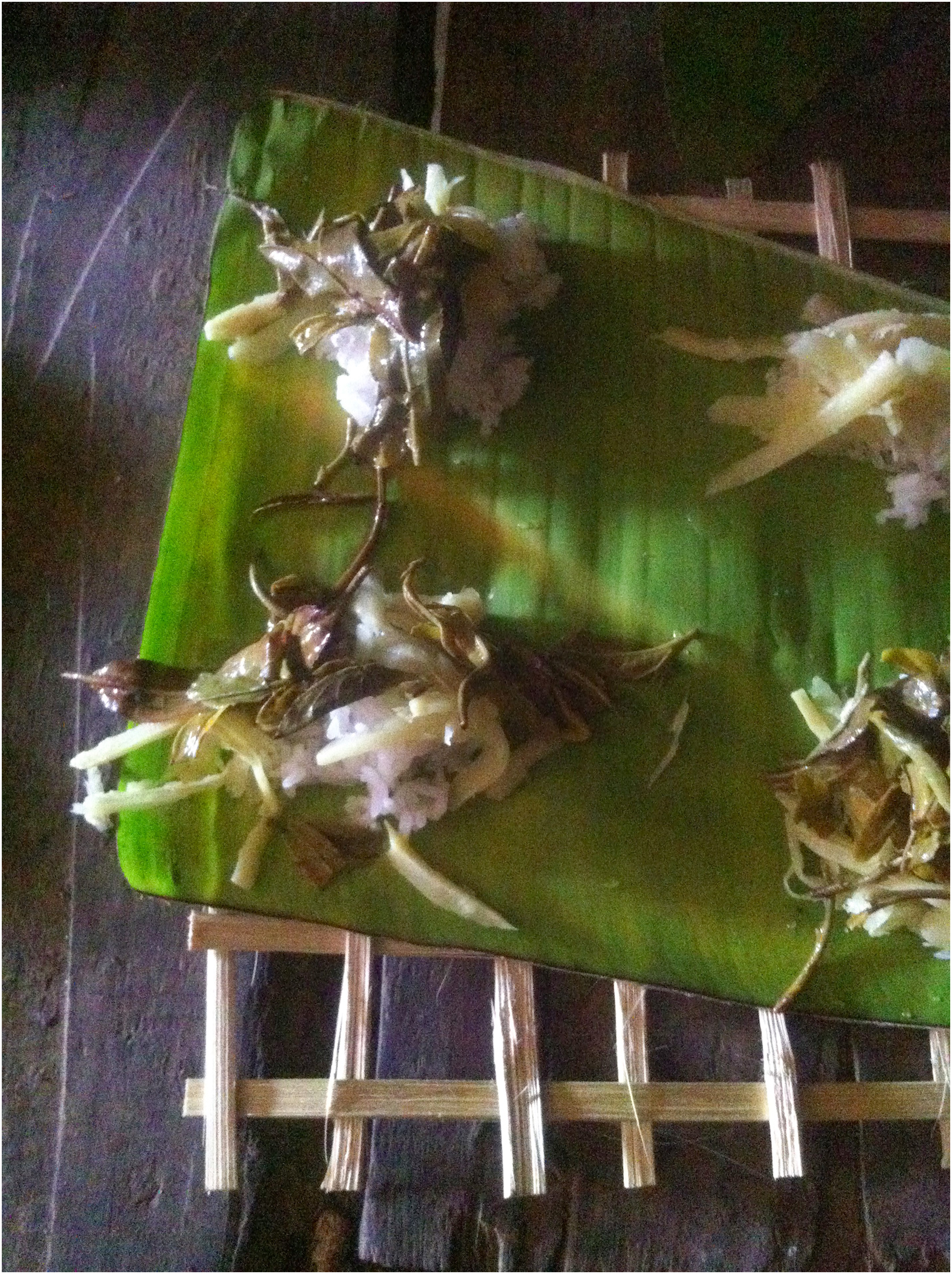
Tea leaves on the pickled bamboo shoots and rice.
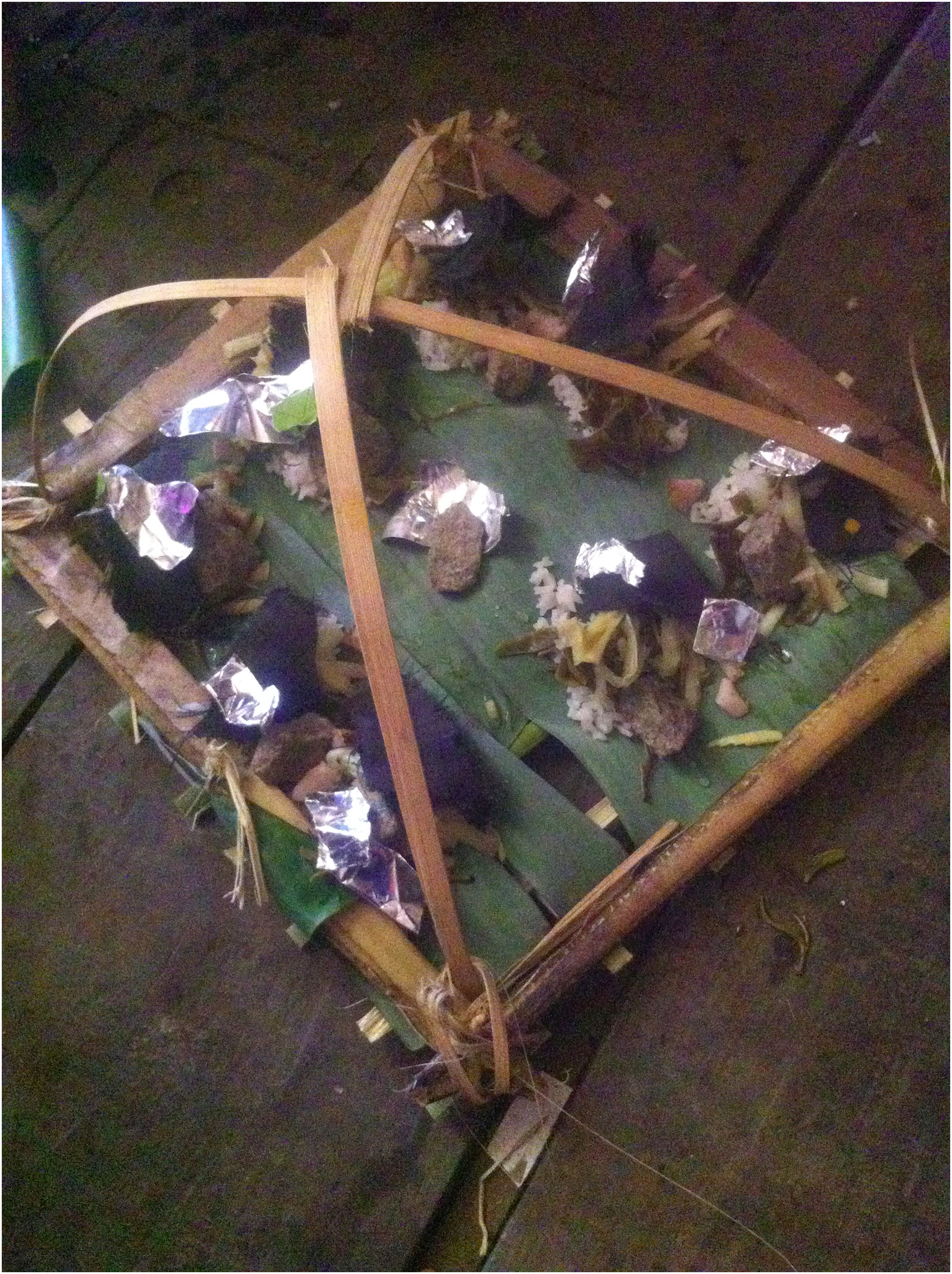
A larger bamboo structure with a collection of offerings.
Nowadays, the tradition of making, circulating and using mian mu has lost its cultural relevance. Various commodities have replaced its role as a special gift. Yet Bulang people's economic conditions and everyday lives are perhaps more determined by Pu’er tea now than ever before. However, neither the selling of dried tea nor the circulating of pickled tea was associated with the bodily perceptions of tea traders or consumers before the mass marketisation of Pu’er in the early 2000s. It is unclear when and why Bulang people started to make mian mu, yet it is inarguable that they treasured its particular taste of sour and bitter—respectively nam and shuang in the Bulang language—which are both extremely unwelcome in today's Pu’er tea market. “Women were particularly fond of this taste of mixed strong sourness and bitterness,” according to Xiang. “In the past, lots of women smoked bamboo pipes. In addition to tobacco, they put the ashes from the fire pit into their pipes. Women liked to chew mian mu when they smoked because the tart mian mu neutralises the alkaline ashes.”
“The sensory order is not just something one sees and hears about, it is something one lives” (Howes, 2005a: 3). The Bulang's perceptions of tea are deeply rooted in their long-standing tea consumption and were not related to the perceptions constructed in Han culture. The Bulang were unfamiliar with the sensations of ancient Pu’er coveted by consumers and traders, as well as the jargon employed to describe them, until the mid-2010s. As the market penetrated their communities, Bulang people had to learn first to apprehend these subtle sensations and then to make tea that produces them. Thus, Pu’er trade has changed not only the Bulang's financial status but also their bodily perception of the tea that they have grown for generations. Bulang people's sensescape on their tea has been “re-scaped.”
Making “Senses”: Producing Pu’er's qualia
As the preceding section showed, Chinese academic writing—and even popular culture—portrays the Bulang as Pu’er tea's first cultivators. Ironically, the businesspeople who purchase tea directly from them consider their tea flawed. Many told me that farmers including the Bulang don't know how to make tea “properly,” using bad processing methods from picking to the ultimate step of desiccating. For instance, they sometimes pick one bud and three leaves instead of following the standard of “one bud and two leaves.” According to Mr Chen, a tea businessman based in Kunming, “If one picks three leaves, there will be too many old leaves, which will turn yellow after processing. These yellow leaves [huang pian] don't look good, and they negatively affect the tea's taste.” Tea marketers also said that farmers don't treat leaves properly after picking. As one put it, “They usually use plastic bags to carry fresh tea leaves back home. Lots of fresh leaves are compressed inside plastic bags for several hours. Tea leaves are slightly fermented because of the heat. These leaves turn red after roasting, creating not only an inferior red colour but also a highly unwelcome sour taste.”
All these problems are relatively trivial, but more serious problems are caused during subsequent processing steps, first in roasting and then in desiccating. According to Mr Huang, a tea businessman based in Nanning City, “The wok that farmers use for roasting tea is heated unevenly. If they don't stir the tea leaves quickly enough, those on the bottom of the wok get burned, while the rest remain raw.” Ms Ma, a tea businesswoman based in Kunming, said, “It took me several years to figure out the cause of the unpleasant smell of smoke. In the past, tea farmers did not wash the wok after every roasting, giving the tea roasted in the second run and after a taste of burning and a smell of smoke.” According to many other buyers, the drying process can also produce this smell. As Mr Ai, a Dai tea middleman, explained, “Usually the tea has to be desiccated naturally. However, during the rainy season, this process takes much longer, so tea farmers take the tea inside their houses and put it near their fire pits. The smoke of their fire pits is absorbed by the tea.”
The smell of smoke and the taste of acid are considered unpleasant and are therefore unwanted by urban tea drinkers and buyers. It is always associated by Han merchants with “low” techniques of ethnic minorities in tea making. This perception of an unpleasant smell has more to do with social status than the way of making tea since sensations deemed relatively unpleasant is linked to unpleasant social groups (Howes, 2005a: 10). To make their products more desirable and fetch a higher price, tea businesspeople take a keen interest in the specifics of processing and ardently want to teach ethnic farmers “the proper” methods, strongly believing that every aspect of production must be refined if ancient Pu’er tea is to reach its full potential in taste, aroma and other bodily perceptions. For tea farmers like the Bulang, therefore, encountering the modern market has meant changing generations-old practises to meet a new standard.
The Han-dominant marketisation of Pu’er tea became one way of re-scaping the Bulang's sensescape. This did not come naturally to the Bulang people working in the tea market. After serving for two years as an assigned purveyor of the Yu Tea Group, one of Yunnan's largest Pu’er companies, Pa, a Bulang man in his 30 s, helped it to set up a chu zhi suo (preparatory facility) in his village. Construction was completed in late February 2015, and the company sent two Han and one Dai employees to live in Pa's home throughout the tea-harvesting season that year, from early March to early May. Their mission was to supervise the workshop's production. Pa hired three Bulang villagers to roast the tea. However, disagreements with the overseers soon sprang up. “They always wanted to teach us how to roast tea, but we have been roasting tea since we were kids. We usually let fresh leaves wither overnight, but they insist that fresh tea leaves should be roasted on the same day after harvesting, otherwise the tea won't taste as good as expected,” Pa explained. Zai, one of his workers, said, “We have to work until 2 or 3 a.m. every night to be able to roast all the fresh leaves.” “We don't think it will affect the taste of the tea as much as they said,” Bing, another of Pa's workers, emphasised.
From the overseers’ point of view, Pa's workers failed to make the tea reach its full potential, especially in taste. As one told me, “The tea's flavour was not stimulated enough in the last several minutes of roasting.” The tension increased when the Han overseers asked Pa's workers to move the roasted tea out from under a transparent plastic awning and put it into the sunlight. The roasters felt this burdensome assignment was unnecessary, merely an excuse to make them work more. One of them explained, “they said tea should get as much direct sunshine as possible, to be endowed with the taste of sunshine. I’ve never heard of the taste of sunshine! They exaggerate many things only to make more troubles for us.”
To the Bulang, the semiotics of the Pu’er tea qualia articulated by the overseers are uncanny. Like his workers, Pa expressed confusion: “They keep telling us we should make better tea. But we cannot tell whether the tea we make tastes good or not.” Such reactions are not unique. The subtle flavours, aromas and other sensations of Pu’er tea can be perceived only through trained connoisseurship. For most Bulang, these complex and nuanced qualities are enigmas even after years of learning.
Zhang, a Bulang tea middleman, had tasted tea with many buyers but was still rather confused by the language they used to describe Pu’er's tastes and other sensations. In late May 2015, I accompanied him as he delivered tea from his village to a businessman named Li who was running a factory in Menghai. This town, which the local government has dubbed “the World's Tea Hometown,” is the nearest one to Zhang's village. Li wanted to try some of Zhang's tea before deciding whether to buy it or not and, more important, at what price. While Li's wife infused some of the tea from one of the bags that Zhang had brought, Li grasped a handful of leaves and observed them carefully. Then he remarked, “This tea contains more white sprouts [bai hao] than the tea you delivered last time.” “The tea trees are sprouting very well these days,” Zhang responded, trying to explain that the white sprouts were dried buds.
After Li's wife passed a cup to each of them, Li and Zhang both consumed their tea. But while Zhang drank it immediately and all at once, Li first smelled it carefully and then, after taking some into his mouth, kept it there for several seconds before swallowing, as if he were gargling. “This tea has a very obvious flowery aroma,” Li said then.
“Indeed, it smells very good,” Zhang replied.
“What do you think about the tea, Zhang?” Li asked.
Zhang drank another cup, again served by Li's wife, and said, “It tastes very good, I think.” “This tea's ku di [bitterness] is strong, as well as its qi,” Li said.
“But this tea tastes slightly smoky,” Li's wife added.
“The ku di, the hui gan and the aroma of this tea are all excellent,” Li argued, “after years of storing, it will surprise you!”
“Yes, the feeling of astringency is mild if you consider that this tea is newly made,” Li's wife replied.
“What do you think, Zhang?” Li asked again.
Zhang remained silent for a while, then said, “Yes, but I can sense only the sweetness—that is what the tea in our village is famous for.”
Li accepted all of Zhang's tea, and at a price higher than what had been discussed. Zhang was happy to make more money than expected. However, on the way back home, he explained that “in our village, we use only two words to describe the taste of tea, which are diao (sweetness) and Shuang (bitterness). But tea bosses use so many complicated and sometimes even iffy words to describe the taste of tea. It is hard to understand these words and to translate them into our own language. Even if you did translate them into our language, they would lose their initial meanings. It makes doing business so hard for us.” Indeed, one of the biggest difficulties for people like Zhang, who negotiate prices with tea bosses based on taste, was how to sense the tastiness of a cup of Pu’er tea. However, “tea tasting is a social practise that emphasises shared sensory experience wellbeing and alertness” (Ahmed et al., 2010: 176), and this shared sensory experience is often conveyed through the language of a certain culture. For the Han tea businesspeople, the most common tool to express the qualia of the tea is lexicalisation, a linguistic channel for generating and stabilising the qualisign constructed by them. However, this qualia-qualisign-lexicon connection could only be established when considerable translatability is possible. What Zhang is struggling with is exactly the untranslatability or semi-translatability of the Han qualisign of Pu’er articulated by Mr Li into his own language.
Learning how to properly produce the tea's desired qualities became a community affair in many Bulang villages. In early October 2014, Man’s village committee decided that all of its inhabitants would acquire tea-roasting skills and invited San, a tea middleman from the village of Xin Ban Zhang, to teach them. The families who founded Xin Ban Zhang (New Ban Zhang) came from what is now Lao Ban Zhang (Old Ban Zhang), which produces the most valuable Pu’er tea: its price has reached as high as ¥15,000 (£1709) per kilogram. “We wanted to learn how to make our village's tea as tasty as the tea produced in Lao Ban Zhang,” Bin, a Bulang man who was then the committee's head, told me. “I always hear tea businesspeople say, ‘Your village's tea is actually very good. But you don't roast it well.’” The committee publicised the teaching event and asked every household to send at least one person. Over two hours, San presented some basic yet fundamental information on tea roasting. For example, woks can roast no more than 6 kilograms of leaves at once and should take from 30 to 40 min to completely dry the stalks of the leaves, with no more liquid to squeeze out of them; a wok should be washed after each roast; tea leaves should be stirred by hand instead of by metal or wooden tool; roasted tea should be kneaded by hand, one wok's worth at a time, for no less than 10 min. Unlike Pa's workers, who resisted the methods brought into their village by the Yu Tea Group's overseers, the Man village event attendees were eager to learn how to make tea “properly” from San. However, many also found some of his techniques excessive, done merely to prove his superiority and with no evidence of being better than their method. For example, San emphasised that roasted leaves should be left in a heap for 5 to 10 min and then kneaded after their temperature has declined, while Man's villagers prefer to knead immediately after roasting, which they believe makes the tea's aroma stronger.
The event of learning how to roast tea was a self-promoted process for engaging with the spread of the Han sensescape of the tea. It is also an attempt by the Bulang tea producers to change their mode of being in the world—from subsistence farmers to players in the market economy—through re-scaping their senses towards the tea. In the Pu’er business, although marketing and personal connections are essential, as Zhang wisely pointed out, “all that counts is a cup of tasty tea.” Unfortunately for the Bulang, it is almost impossible to translate the ancient Pu’er tea's qualia coveted by tea traders into their language. This situation embodies what Appadurai (1996: 36) calls problems “of both a semantic and pragmatic nature” in the flow of the ideoscape. The components of the sensescape may be even more difficult to articulate as they flow across boundaries, yet the sensescape profoundly impacts cross-cultural interactions, such as those between the businesspeople and producers involved in the Pu’er trade. Without a common lexicon with Han buyers and consumers, both cultural-semiotic translation and sensorial renderings in tea tasting are difficult for Zhang and other Bulang people in their early encounter with the market. Pu’er tea's marketisation nonetheless requires them to sense and produce these qualia. In this sense, the sensescape also shapes how Bulang see themselves.
Conclusion
The differences in tea-making standards between Han traders and Bulang farmers epitomise their different positions with respect to both knowledge of and ability to perceive specific qualia and the overall Pu’er market. When merchants and consumers in mainland China embraced, promoted and renovated Taiwanese ways of tasting tea, connoisseurship became a source of authenticity in the business and a site of power dynamics: tea buyers have the cultural authority to criticise the minutest flaws in the tea-making process of Bulang producers, who have very limited status in the trade's high end business activities, which includes logistics, sales and marketing. When tea bosses criticise the methods of Bulang producers and many other ethnic minority groups, they are opposing a professional to a family-business viewpoint. The taken-for-granted rhetoric of the tea's taste represents capital, knowledge and social connections at the centre of the Chinese tea market. Consciously or unconsciously, merchants and connoisseurs have taken the qualia of the Pu’er made by generations of Bulang people for their own use, within their own culture, as evidence of the Bulang's inferior ability in modern tea processing. For Bulang tea producers, developing and modernising thus means changing not only how they make their tea but also their bodily relationship to it. That is to say, the process of marketisation entails transforming the Bulang's bodies and senses into sensorial bodies modelled on those of high-status Pu’er consumers and traders. Making Pu’er tea that produces certain sensations has become part of the Bulang's embodied experience of marketisation.
Although their methods clash with the Han traders’ ideas about modernising practises and creating uniform sensations, it is Bulang people themselves, both individually and communally, who actively seek to acquire the knowledge of the desired qualia of ancient Pu’er. When the committee of Man village initiated the lecture on tea roasting for all the villagers, it was not only an endeavour to improve its tea's perceived “quality” but also a way to find a niche for the village in the competitive market. This was necessary because, precisely as Chumley (2013: 169) pointed out, “social actors evaluate qualia, and qualia are in turn used to evaluate social actors.” Outside merchants use not only the qualia of Bulang-produced Pu’er but also ideas about Bulang people themselves in their evaluations of the tea. As the qualia of Pu’er tea made by Bulang people have increased and diversified, many buyers have expressed their satisfaction with the enhanced “quality” of the producers. As one told me, “Tea farmers are changing. If one wanted to set up a chu zhi suo in a village ten years ago, one had to train the villagers for at least two harvest seasons to make tea properly. Nowadays you don't have to teach them anymore. They already pay enough attention to the taste of the tea they make. Tea farmers are smart and have a much higher quality than ten years ago.” Producing tea for their customers has clearly transformed Bulang people.
Because exposure to the market has changed the Bulang and other ethnic minority tea producers, their perceptions of Pu’er's qualia are multifaceted, based on multiple ways of drinking tea. Almost all Bulang families have adopted the gong fu tea ceremony (see d’Abbs 2019), which requires a massive tea table and a set of tea-making utensils as “necessary” parts of a house. This is not to say that there is no confusion or disagreements over the qualia of the tea between producers and buyers. Bulang producers are able to discern some of the new qualisigns that Han traders have introduced, for example, they learn to generate and assimilate qualia to those diffuse qualities acting as signs of the value of the tea, but not the more “exaggerated” lexicon of tea connoisseurship. Most Bulang people find articulations of the qi, the yun and many other bodily sensations too abstract or pretentious. By choice or necessity, they ignore these qualia in their tea making and leave their evaluation to middlemen and traders. This is to a large extent a result of the limitations of language and the untranslatability of descriptions of sensations.
The case in this article certainly raises questions of how to study and write about qualia in cross-cultural settings. Qi, yun and other tea-tasting perceptions are untranslatable from Chinese not only to Bulang but also to many other languages, including English. Setting up an ethnographic method to study and discuss these qualia is a disciplinary challenge. Silverstein (2006) offered a “multicomponential lexicography” for investigating the whole field of “wine talk,” which covers everything from production and distribution to consumption and especially connoisseurship. Since a lexicon of tea qualia which includes the languages of all the peoples who are part of the empire of tea seems impossible, the flow of its sensescape and the social processes surrounding it will always involve (mis)communication and adjustments in translingual and transcultural settings.
Footnotes
Acknowledgements
I thank Zhang Jinghong, Peter van der Veer, and Raviv Litman, who read an early version of this article, for their perceptive comments. I am grateful to the two anonymous reviewers from the Journal of Material Culture for their time in reading through my article and providing positive and engaging comments which helped fine-tuned this article. I have taken their advice seriously in the revision process. Whatever mistakes remain are my own. Special thanks go to my host Yu Kang Kan and her family, for accepting me and for nine years of care and love. I also acknowledge many Bulang people in many villages of Bulang Mountain and numerous tea businesspeople in Yunnan and beyond for generously spending their time to answer my questions.
Declaration of Conflicting Interests
The author(s) declared no potential conflicts of interest with respect to the research, authorship, and/or publication of this article.
Funding
The author(s) received financial support from the Max Planck Institute for the Study of Religious and Ethnic Diversity for a follow-up fieldwork in 2018 and for making this article open access.
