



Abstract
If the politics of aspirational construction appeal to the enchantment of infrastructure, reconstruction usually takes as given an environment of post-conflict, natural disaster, or the degradation of systems of preservation or resource management. If construction and conservation are taken as markers of continuity and political stability what does the urge to build again say about those who exert these ideas in advancement of a set of common goals? Shaped through multi-sited ethnography in Pakistan and the United Arab Emirates, this essay explores the mediation of mood and its material speculations. Concepts borrowed from both the preservation of the moving image and digital forms of heritage restoration provide ways of rethinking the place of reconstruction and coming to a new understanding of its sensual and atmospheric terrain.
Spoiler (or introduction as hermeneutic circle)
Once attempts at conservation, of buildings, environments, or resources have been exhausted and a certain threshold has been passed, one response to ruination or depletion is the possibility of simply building again. Reconstruction faces difficult obstacles, particularly if the object in question achieved its status as an asset due to its possession of a unique atmosphere or aura that is not commonly understood to be able to survive reproduction. In 2017, construction work on the new Orange Line Metro Train in the Pakistani city of Lahore was briefly halted over claims that it threatened adjacent heritage sites such as the shrine of Mauj Darya; the mausoleum of a Muslim saint, the UNESCO-listed Shalimar Gardens, and the Mughal-era gateway, the Chauburji (Figures 1 and 2). When the legal challenge failed and work recommenced, a year-old satirical news article began to circulate widely. It joked that the chief minister of Punjab had placated international heritage bodies with the promise of building “new heritage” sites in place of those at risk of destruction. Influential stakeholders involved in legal challenges to stop the Orange Line seized upon the article as it travelled between their WhatsApp groups and, in some cases, relayed the story as if it were fact, even situating themselves as first-hand witnesses. While in this instance a figure of caricature, the practices which gave the joke weight in verisimilitude have become increasingly common. Across the world the construction of simulated heritage areas designed for shopping and public leisure often take place alongside the destruction or ruination of actual historic sites.
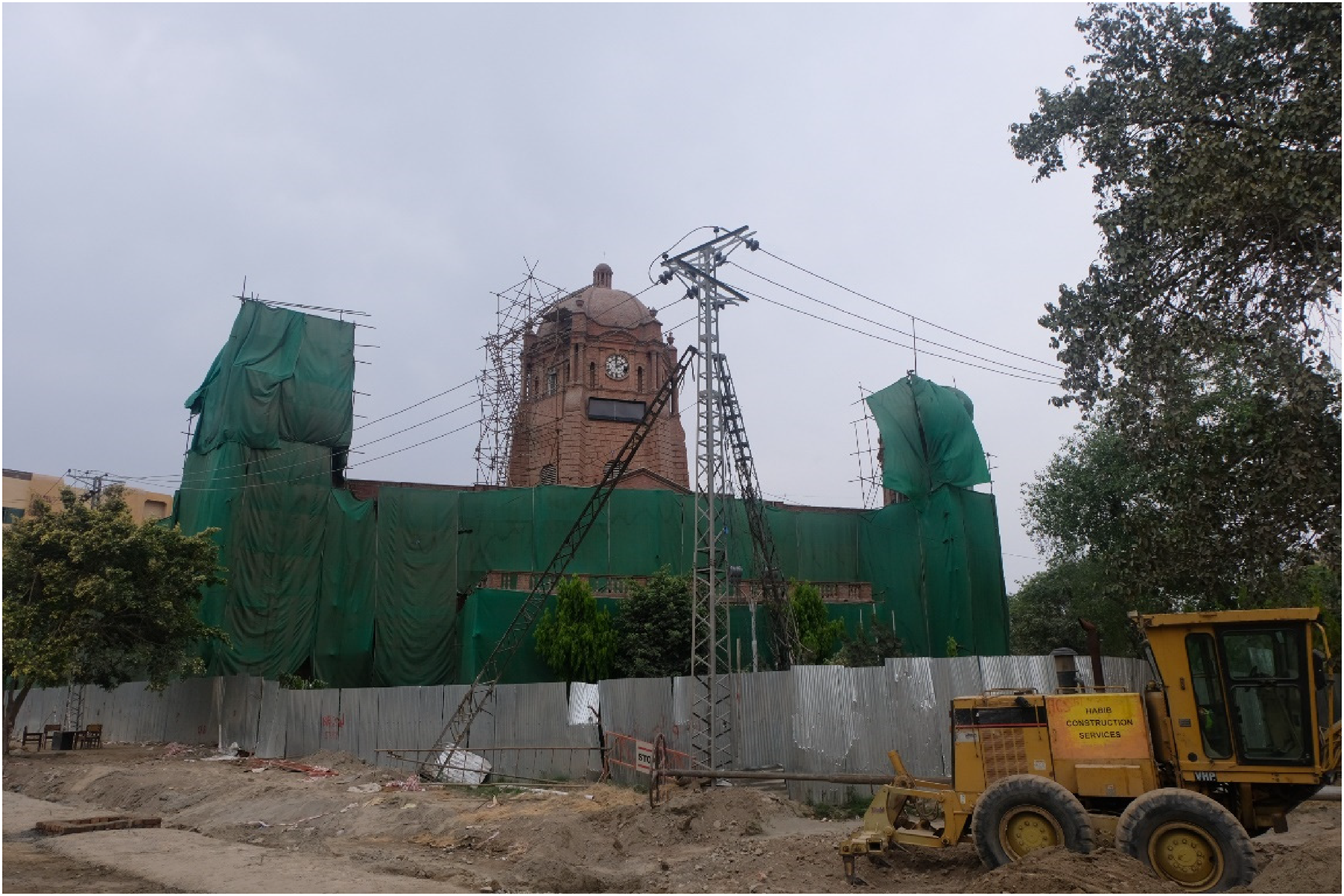
The colonial-era general post office shrouded in a green protective tarpaulin while streets are unearthed, holes are bored, and building work continues on the central station of the Orange Line Metro Train. (author's photograph. April 2018).
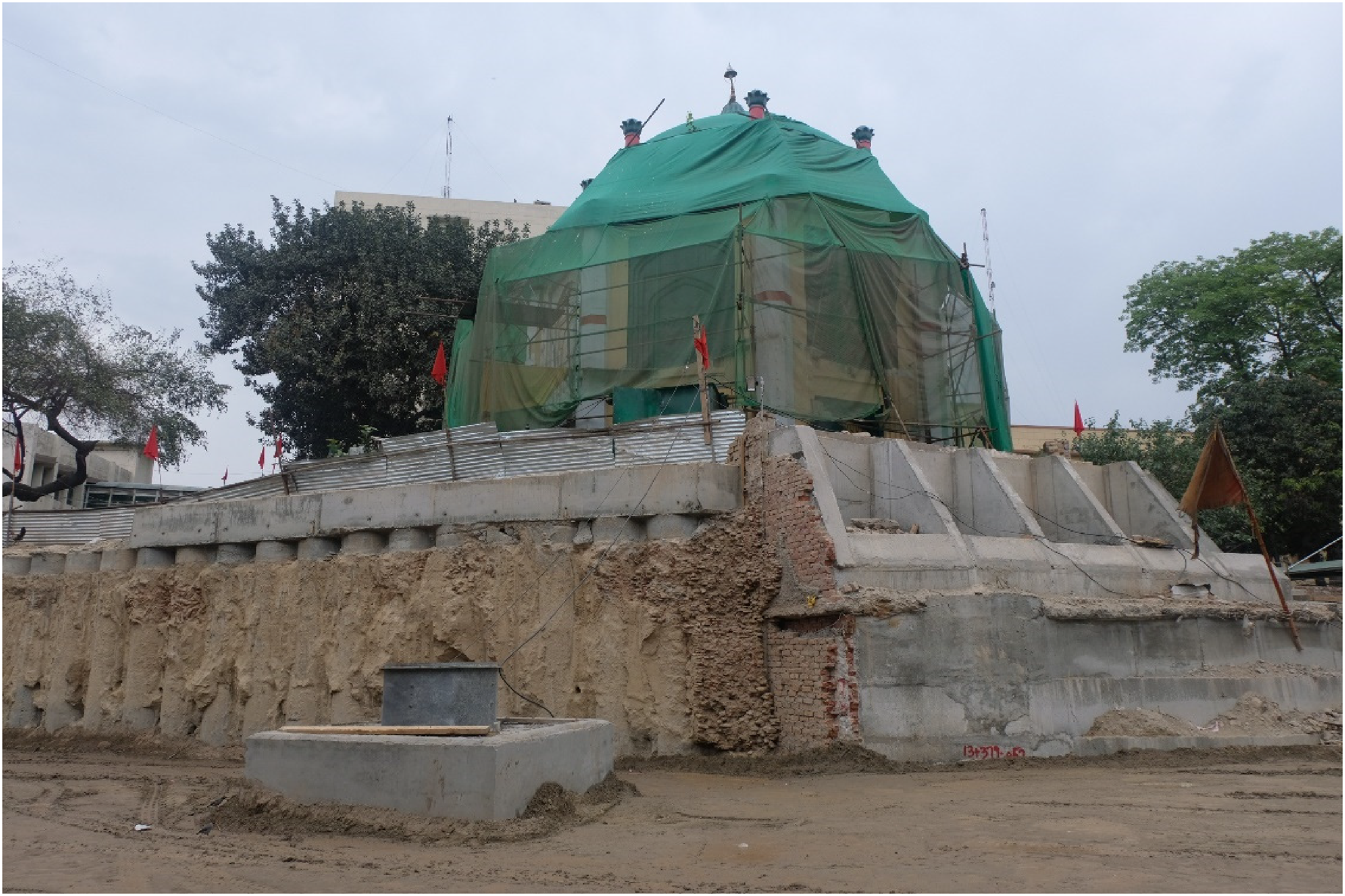
The shrine of Mauj Darya, one of the structures perceived to be most at risk of the construction works, similarly shrouded in a green protective cover. (author's photograph. April 2018).
Importantly, the possibility of rebuilding architectural heritage is not only a state concern but can be a subversive expression of disagreement. In neighbourhoods associated with the minority Shi’i branch of Islam in Lahore, Iranian-imported construction kits allow users to (re)build the mausoleums of Jannat-ul-Baqi, the graveyard in the holy city of Medina in Saudi Arabia that was demolished in 1926. Produced in large quantities with the aid of 3D scanning, printing, and laser-guided cutting technology, reconstruction as a figure of possibility becomes both a tool for enculturation and an expression of disagreement. When contestations over the built heritage of holy sites are materialized by mass-produced commodities, the aspirational and satirical idea deftly expressed in caricature as “new heritage” becomes a playful way of re-producing political and religious morality. While much is to be gained by rebuilding or simulating the old, particularly in the absence of sympathetic heritage regimes, on what terms can “new heritage” be taken seriously as an object of desire, anxiety, or aspiration built with mood as its medium?
By engaging ethnographically with the speculative moods that accompany desires to build again, this article aims to make theoretical interventions into debates over the politics, promises, and dangers of rebuilding material culture. Through what I term “material speculation”, objects are marshalled to construct and reorient existing relationships with dominant systems that manage material culture. When expressed as possibility or as an object-lesson, reconstruction is something one learns by doing or by experiencing as a mood that might become a medium with which to assemble heritage futures. In this way, the potential to build again can serve as a material manifesto for overturning heritage regimes and challenging historical narratives.
Figure and mood
The examples that follow are informed by data gathered during a year-long period of ethnographic research spent following the marketplace circulation of Pakistani film in Lahore and in the Emirate of Sharjah in the United Arab Emirates (hereafter, UAE). In the absence of a national film archive Pakistanis at home and in the diaspora distribute rough copies of classic films untethered to a base version. Traders build from an already existing yet distributed repertoire, copy from one another, and appropriate already circulating material to build new trajectories out of the migration of media onto new formats. While conducting this research I noticed a broader tendency towards playfully and informally questioning how age and provenance are marshalled in service of political claims-making. In the marketplace circulation of Pakistani film, the absence of formal systems for heritage management and the concomitant necessity for informal strategies of mediation to bring about conservation, imbues objects relating to the past with the power and agency of contemporary actants. Contrary to other kinds of material culture conservation, the idea of restoration and reconstruction is integral to the management of film heritage (Fossati, 2011). This is particularly true in the digital present, where intricate restoration technology breathes new life into the twenty-four frames of film that make up a single second of celluloid screen time. In his writings Paolo Cherchi Usai has long argued for ways of preserving film in ways that retain the sensuous contours of its experience: the smell of nitrate, the optical flicker of torn frames, and images patinated by age and exhibition. Usai considers the making and presenting of “pristine reproductions of our visual heritage” (2001: 1) as the production of entirely new, “fictive artefacts” (ibid: 101). Since Usai's landmark text, the typically Eurocentric practices of film preservation preoccupied with “saving” global film heritage have been forced to accept the important role that carriers rather than originals play. This has been driven both by exposure to archival and conservation practices in the global South and the growth of video-sharing websites that show the possibilities of preservation through mass-reproduction (Frick, 2011: 153). If built heritage relies more than film artifacts do upon claims and attachments that are ultimately imagined, does the material construction of new “fictive artefacts” make them any less efficacious?
Unlike film heritage, the ruination of the built environment is often understood to be a linear, one-way process, the effect of which is an indictment of established processes of heritage conservation. Broadly defined, heritage conservation is the enactment of measures designed to minimize destructive change and safeguard the status of an asset deemed significant to persons, place-making, or the embodiment of a social-historic identity. Conservation is a generative intervention in the material histories of objects, an intervention which can occur both within and outside of formal procedure. Compared with the assumptions of film conservation whose means and ends do not smoothly map onto other kinds of heritage or ecological conservation, I propose a fresh conceptualization of the place of reconstruction and a revised understanding of its sensual and ambient terrain. In English, the word ambience has been used to describe a mental or moral environment since the late eighteenth century and, along with the term atmosphere, appears to have been widely adopted in response to the need to describe the kind of tonal and textural effects emerging in Romantic poetry and art. By the twentieth century the idea that something, particularly a work of art or object of great value, could possess an “aura” was established enough that Walter Benjamin famously claimed that it was the only thing that mechanical reproduction could not replicate ([1936] 2008). This loss of aura gave a sensuous vocabulary to a much older debate on the difference between originals and copies. The aura as the felt presence of a work of art, or the durable mood of an object, also authorises the regimes of power or transcendence associated with its efficacy; for Benjamin, the destruction of the power of the original also showed the way to a revolutionary politics. It was also the perceived lack of an artistic aura that led to widespread disinterest in preserving film in the early days of its use (Usai, 2010: 251). With its contemporaries viewing it an art of reproduction, later preservationists had to work hard to convince others of film's value as a historic artefact.
Recent scholarship has come to focus explicitly on forms of atmospheric presence understood to emanate from objects (Bille et al., 2015). For philosopher Gernot Böhme objects can radiate and resonate beyond themselves, removing “the homogeneity of the surrounding space and [filling] it with tensions and suggestions of movement” (1993: 121). There is a programmatic element to Böhme's work; he calls his “new aesthetics” the study of the “production of atmospheres” (1993: 116). While this notion is useful for understanding how “new heritage” as reproduction might manufacture its own aura, focusing on the “production” of atmosphere risks becoming indistinguishable from “old” aesthetic characteristics such as agency and intention. Instead, the kind of qualities that assemble the figural, satirical, and geopolitical possibilities of “new heritage” have been recently theorised by C. Jason Throop as “moods” that emerge from the “intermediary” types of experience that do not fit neatly into a subject-object dichotomy (2009). When expressing moral sentiments, moods are temporally complex and subjunctive; they might express a palpable kind of nostalgia that gazes at the past but one that also attempts to animate the future. As Throop explains, “moods… reveal moral concerns in flux” (2014: 70). In the case of “new heritage”, these are ethics built from destruction, as ethics so often are.
Mood can therefore become an aesthetic building block that assembles an aura untethered from age and authenticity. What I am talking about here is the kind of active identification and application of ambiguity that Victor Turner termed, “the subjunctive mood of culture, the mood of maybe…” (1986: 42). Like Turner, whose life-long work on liminality emerged from an interest in events that sit outside of, or are disruptive to, social orthodoxy, the moods I find re-tooled into building blocks emerge from the dust of atmospheric disturbance. As Butt (2017) has argued, in Lahore waste and debris left in the wake of infrastructural development ensures that the residual sensation of destruction is entangled in the aspirational horizons of construction. Butt describes a cityscape in which continual churning manufactures the new out of the destruction of the old. It is in these cases that an aesthetic toolkit for understanding atmospheres as a threshold zone between materiality and immateriality would be most beneficial. What is most theoretically troubling, and potentially illuminating for ethnographic enquiry, is how atmospheres rely on the response of a subjective interlocutor, troubling the extent to which their transduction becomes merely the experience of their mediation (Sørensen, 2015: 64). If atmospheres can survive mediation or reproduction, it brings architectural heritage closer to what Christopher Tilley describes as, “space as a medium rather than as a container for action” (1994: 10). In his influential body of work, Tilley takes landscape, like material culture, to be a frame that constitutes the ways in which people objectify the world by identifying themselves as separate from it. A greater understanding of the intersections between environment and materiality, and between ambience and agency, can also help generate shared concepts between material culture and ecological anthropology, which often speak about similar conceptions of persons, non-human actants, and constitutive relationships between things and their environments.
The aesthetics of (re)construction
My research in Lahore centred on Hall Road, the largest electronics market in Pakistan and once the centre of media piracy in South Asia, when its distribution networks connected London-based video distributors to film traders in the Gulf and beyond. Asking questions about the safekeeping of old films prompted many of my interlocutors to recall other activities and circulatory ephemera that once passed through their hands and through their lives; materializations of routines that they wished they had collected and kept if only they knew how quickly the routines contingent on them would disappear. From videocassettes of now untraceable Pakistani films to discontinued paper currency, one fondly remembered habit was the sending of greeting cards marking the Islamic celebration of Eid al-Fitr at the end of the Ramadan fast. Most of Lahore's publishing houses have stopped printing Eid cards, their customers now using WhatsApp to send and forward picture messages to mark the celebration. Yet on the second floor of an old legal bookshop at the corner of Hall Road, paper Eid cards can still be found, featuring nostalgic, Impressionistic paintings of “old Lahore”, reproduced and printed by Ajaz Anwar, a notable artist and cartoonist. The half-imagined cityscapes – featuring grand Havelis, colonial-era architecture, and market scenes - that decorate the covers are elaborated upon on the back of the card with details of their construction, history, and often – in a postscript - the date of their destruction. One had even been captioned in a recent reprint with the words, “Bengali Building – destroyed in 2016 for Orange Line Train” (Figures 3 and 4).
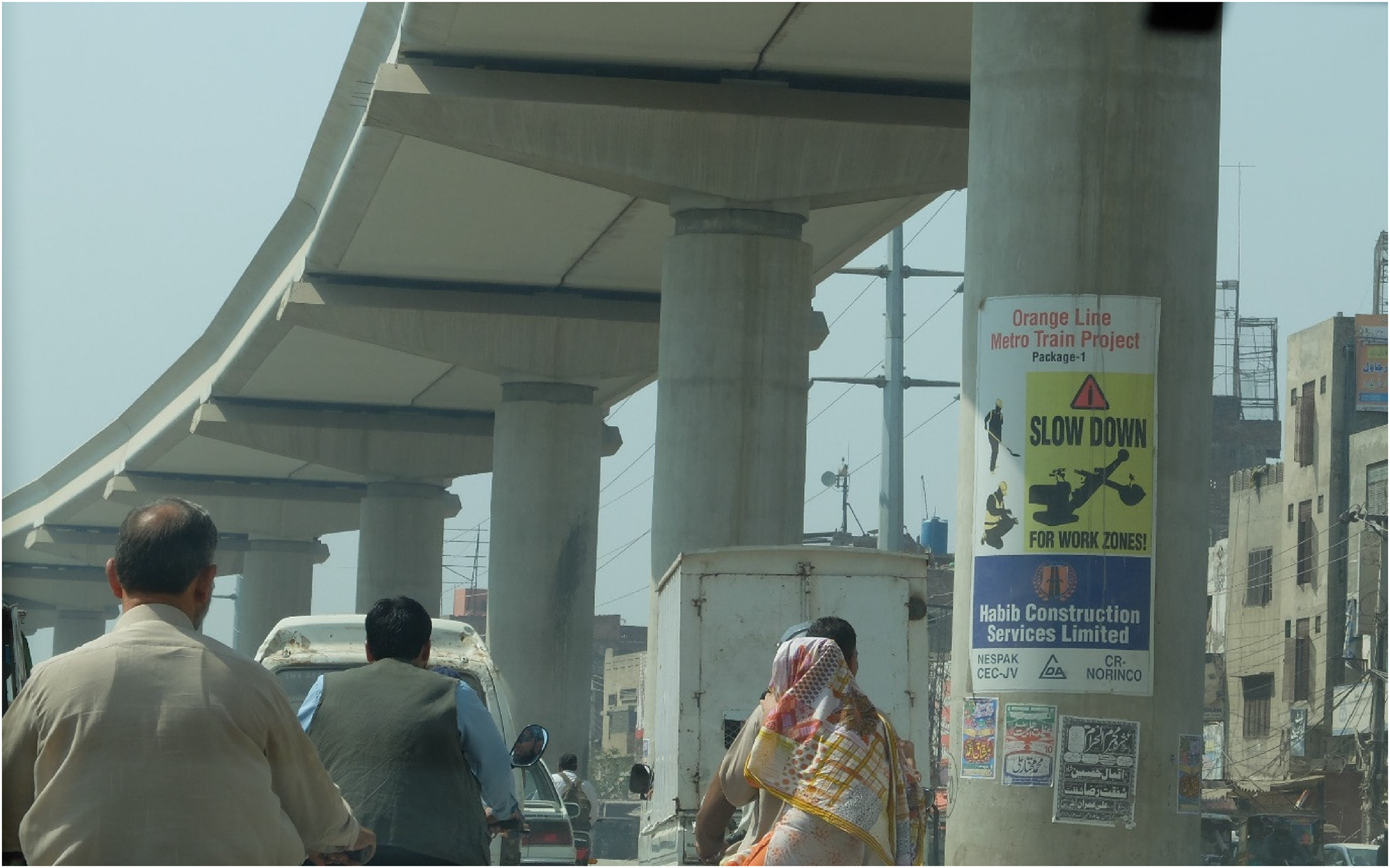
The unfinished Orange Line Metro Train in Lahore. (author's photograph. October 2017).
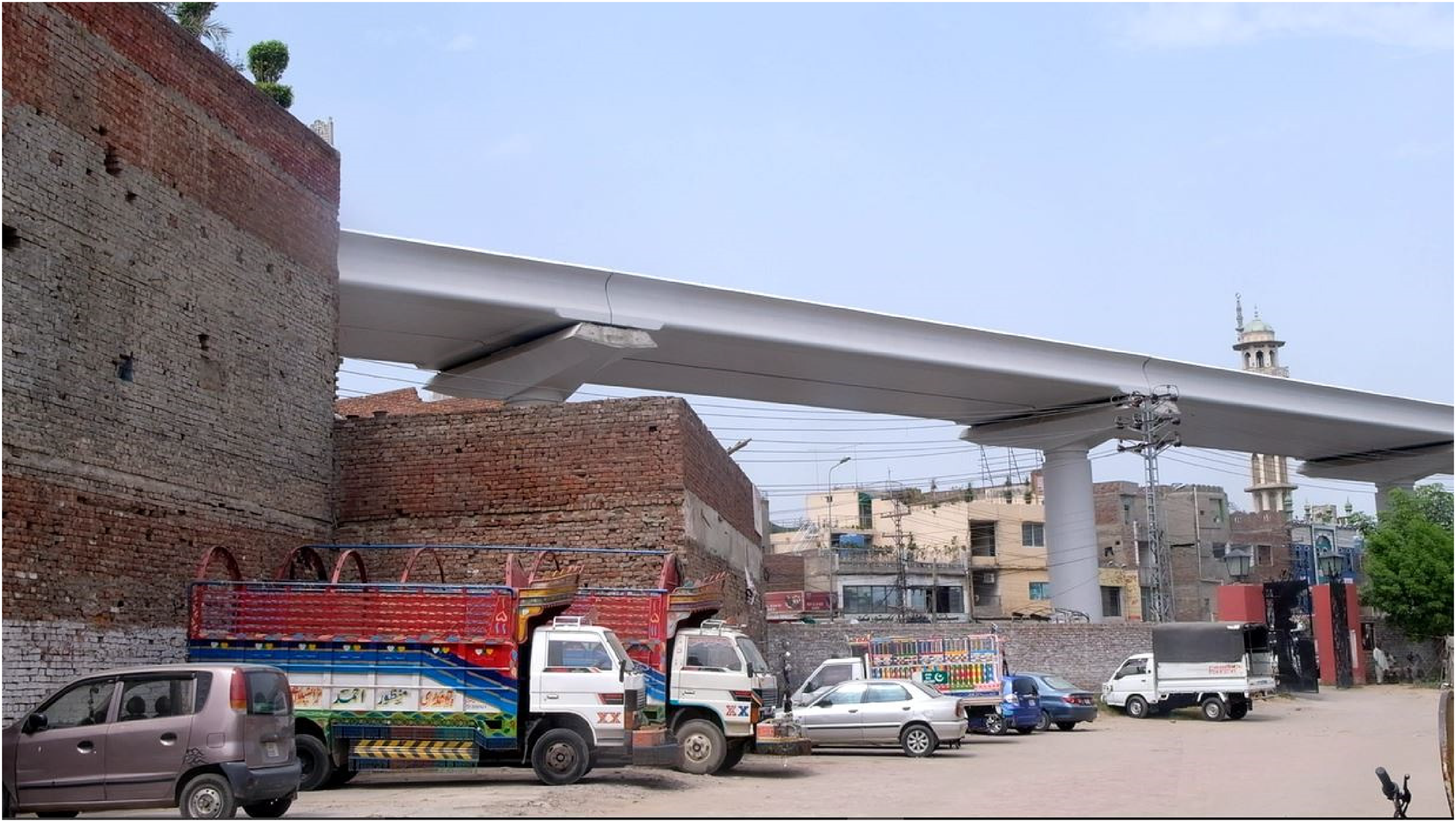
A partially-completed section of the Orange Line Metro Train on Multan Road in Lahore. Taken from Lahore's last functioning film studio, the pre-Partition Evernew Studio, the photograph shows how the elevated track now disturbs low-angle shots on film sets which have been used and remained unchanged since the 1950s. (author's photograph. October 2018).
Pakistan continues to be transformed by the China-Pakistan Economic Corridor (CPEC); a series of vast infrastructure projects agreed during the government of the then-incumbent PML-N party. While not strictly part of the CPEC portfolio of projects, the Orange Line is the product of close collaboration between Chinese and Pakistani engineers, suppliers, and manufacturers. At 27 kilometres in length, the mostly elevated track cuts through the city from south-west to north-east like a punctuating slash. When I arrived in Lahore the Orange Line had been halted by a stay order following a campaign by a pressure group led by a number of cultural stakeholders; its looming concrete flyovers interrupted and frozen in time. Researching the copying and retrieval of Pakistani films on Hall Road, a street that lays a short distance from the planned Central Station, I would spend my days flicking through and talking over racks of Video Compact Discs (VCDs) of films made during the golden age of Lahore's era of film production. With three or four films poorly compressed and squeezed into the capacious confines of one disc, the content would often glitch, introducing an inoperable error in encoding and playback. The half-finished flyovers of the Orange Line reminded me of these persistent glitches, an external interruption to the signal, pointing to both the absence of resources for its continuation, or of an overload of data confined within too small a space.
Despite these disturbances many who formed the support base of the then-ruling PML-N party felt that to engage in such megaprojects – infrastructure sold to the public by its sublime characteristics - is to engage properly in the act of governance. Hydropower, transport, and energy infrastructure are all passionate subjects, allied as they are with the prosperity of the country. The Mohmand and Diamer-Bhasha Dams, for example, continue to be crowdfunded in part by the charitable contributions of Pakistanis at home and abroad. Projects such as those centred on the southern seaport of Gwadar have also provoked disquiet, neatly surmised as, “the anticipation of arrival, the anxiety of what that arrival would entail, and the insecurity of not getting there” (Jamali, 2013: 8). As Brian Larkin has shown, infrastructures are both material entities that facilitate the interaction, distribution, and cohabitation of object-forms and generators of ambient environments (2013: 328). Infrastructures also become efficacious within regimes of possibility. Addressed to the future, they grasp at the fabrication of a national mood of liminality and transformation. The aesthetics of unfinished infrastructure work by rearranging hierarchies of function so that the phenomenological dimension rather than the technical dimension of infrastructure remains dominant, while the sensual may remain residual, later to be co-opted or worked upon by other actants once their unforeseen effects manifest.
As I sat down to sign and address some of the Eid cards, unwrapping one from its neat plastic cover I noticed, partially enfolded in the accompanying envelope, another image on the usually blank space opposite the message wishing the recipient “Eid Mubarak”. Seeming to echo the inserted addendum about the building's destruction, and contrasting the idyllic image on the cover, a satirical single-box cartoon by the same artist had been printed on the side initially hidden from the buyer. The image featured an artist at his easel working on a tourist poster, while an onlooker recoiled in surprise. In the painting the chhatri of a Mughal-style building crumbles into ruin and is captioned with the slogan, “Visit Pakistan: See Falling Historical Monuments” (Figure 5). Sentimental and subversive, Anwar's own interventions on his Eid cards – themselves threatened with obsolescence - capture anger over the state's ambivalence towards the city's antiquarian sites. For this artist and cartoonist, the aspirational ambience of infrastructure and the aura of built heritage cannot co-exist.
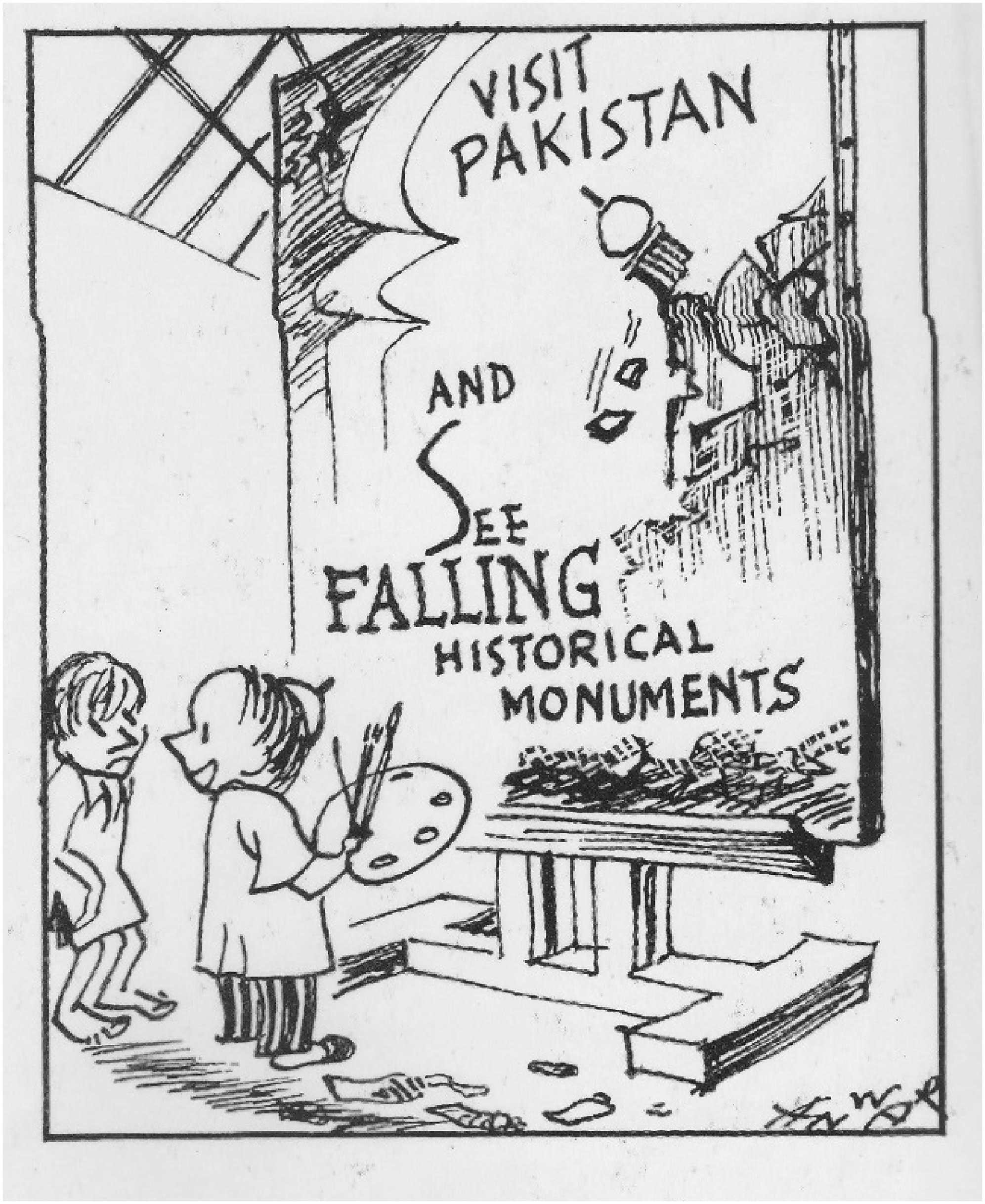
A satirical cartoon by Ajaz Anwar hidden inside an Eid greeting card. (Collection of the author).
“New” heritage
It was late 2017 and, after a report concluded in the government's favour, work had restarted on the Orange Line. I arrived outside a whitewashed, nineteenth-century building of four stories, starkly contrasting with its surroundings, to meet one of the organisers of the movement to halt its construction. I squinted at a faded, hand-painted sign; Cheema Sons, bookbinders and booksellers since the mid-nineteenth century. Striding down the stairs, the Cheema family's urbane and articulate eldest son Usman recalled an old friend who was the first to run a small radio shop on the street, now long demolished to make space for the shopping plazas that the electronics trade opened up. They still mourn the Hindu temple next door that was illegally demolished in a rapacious spate of informal construction, a temple which itself sat beside the ruins of a disappeared Sikh gurdwara. Their street lay at the heart of a spate of illegal construction to which the government turned a blind eye to please its support base among the urban merchant middle-class. For Cheema Sons the chaos of urban encroachment did not begin with the radio, video, or electronics shops whose flimsy shopping plazas now teetered dangerously over their family home and business. For them, it originated in the extent to which their street had been left practically vacant and given out either as Evacuee Property to Muslim refugees from India or occupied by internal migrants in the new state of Pakistan.
Usman Cheema considered himself neither part of the awaam [Urdu: the public or masses] nor the elite. He identified as “old Lahore”, a category of embodied heritage that finds closer allies in buildings and the departed multi-religiosity of pre-Partition Lahore than anything offered by the present. He felt great allegiance and nostalgia for the colonial era, particularly the materiality of the grid-line roads of the Cantonment – “so effective at stopping uprisings”, he said - and the brickwork and hidden mortar of early colonial buildings. He sent me to go and look at one nearby example, threatened by the ongoing construction of the Orange Line taking place less than a hundred metres from their building. He complained that what he called the “colonial goodness” of the area and the buildings made by Hindus and Sikhs preceding Partition, had been given to “refugees”. Using the English word rather than the Urdu term muhajir used to describe Partition migrants to Pakistan, he was making a connection to reports he had heard of the so-called “refugee crisis” in Europe. By suffusing the term with negative connotations, he proceeded to express his view of socially inferior people who he felt had become dominant in the governing elite. This kind of nativist self-identification forged in opposition to “refugees”, manifests anxieties over rural to urban migration, and an aspirational mercantile middle-class composed of returnees from the Gulf or driven by remittances from the diaspora.
Describing to me a governing elite made up of construction magnates and robber barons, he told me, “Those buildings were not made by them. Those buildings were owned by Hindus and Sikhs at that time, those were the affluent people of those times. They were not the present class who have hijacked the system.” He added, for good measure, “No, we are not a refugee family over here. This is our landed area, our ancestral property.” For Usman, even Lahore's traffic was “indigenous” and “refugee”, when he recalled how quiet public holidays like Eid-al-Fitr, Eid-al-Azha, and the eighth to the tenth of the Islamic month of Muharram are, when so many people return to their ancestral villages. By siding with minorities and with long-departed adherents of other faiths, Usman felt he was speaking truth to power, giving an ambiguous tinge to his disparaging views of the “refugees” he suggested had become dominant in the ruling class. Over tea, Usman Cheema quietly seethed over the issue and recalled his involvement in the contestations over the Orange Line,
“I was sitting in that meeting with the world heritage people and there was a discussion going on because somebody had filed a petition, and they wanted the route to be changed. You have the chief minister [of Punjab, then Shahbaz Sharif] sitting there and he's being asked questions by those people, and he's questioned very sanely that these colonial buildings are not concrete or cement or reinforced structures, they are brick laid on brick structures and they are vulnerable to damage if they are exposed to constant vibration. Once that starts, we will not be able to put the clock back. So, the chief minister stands up pointing his fingers, and he says “No, I will build them new heritage sites”. Quote unquote.”
It was not the first time I had heard this story; a number of other people involved in the enquiries had reported sitting in the same meeting (Moffat, 2021: 545). Other accounts circulating on WhatsApp reported that the terms of CPEC even had Chinese funds earmarked for the creation of “new heritage” sites. Conspiracy theories of all shades and varieties are commonly voiced in Pakistan, the predominance of which Akhtar and Ahmad (2015) take to be constitutive of an alternative theory of political discourse. Humeira Iqtidar has similarly called for conspiracy theories to be taken seriously as the conjuring of a political imaginary that speculates upon the transnational alliances and hostilities that the population at large is allowed little insight (2016). Yet an often-overlooked dimension of such conspiracies is that they are often self-consciously playful, not in the sense of being ludic but rather as active speculations on where the boundaries of both possibility and verisimilitude may lie. As evinced by those like Usman, believable untruths are also just as widespread among the economic elite, whose tales rely on the perniciousness of the mass rather than the workings of a small, international cabal.
As mentioned earlier, I soon learned that my interlocutors were placing themselves as protagonists in a satirical news item from Pakistan's short-lived Khabaristan Times. It's origin, an article titled “Shahbaz vows to construct new heritage sites along OLMT route,” written by an unknown author, was a masterpiece of prescient social commentary. It's source, an online satirical newspaper whose pieces were also regularly published in The Daily Times, was blocked by the Pakistan Telecommunication Authority in February 2017 and ceased to exist in any form shortly after. I felt that the devotion with which the story was regaled, with narrators placing themselves within the story, erected it to the status of a short-lived myth, having circulated widely enough through WhatsApp groups to have become detached from its satirical origin (Figure 6). While the truth was bitter enough, the myth of “new heritage” is an act of satirical reciprocity, as all “fake news” is entangled in a wager of verisimilitude. In this case, the caricature functions on the figural production of others capable of believing that the aura of originals can survive reproduction. 1 The disquiet of those who feel threatened by these changes form figural images: believable lies, such as the short-lived myth of “new heritage” in Lahore, to express anxiety over the power and ability of others - subaltern to the Cheema's self-identification as “old Lahore” - not just to develop and build, but to build again. Usman's appropriation of the myth of “new heritage” did this by projecting onto the antagonist the notion of what Svetlana Boym (2008) called “restorative nostalgia.” For this is what “new heritage” would be if not a satirical fiction; a reconstructive rather than a longing action, one which creates myths and finesse symbols, rather than a reflective history that engages with passed time and patina.
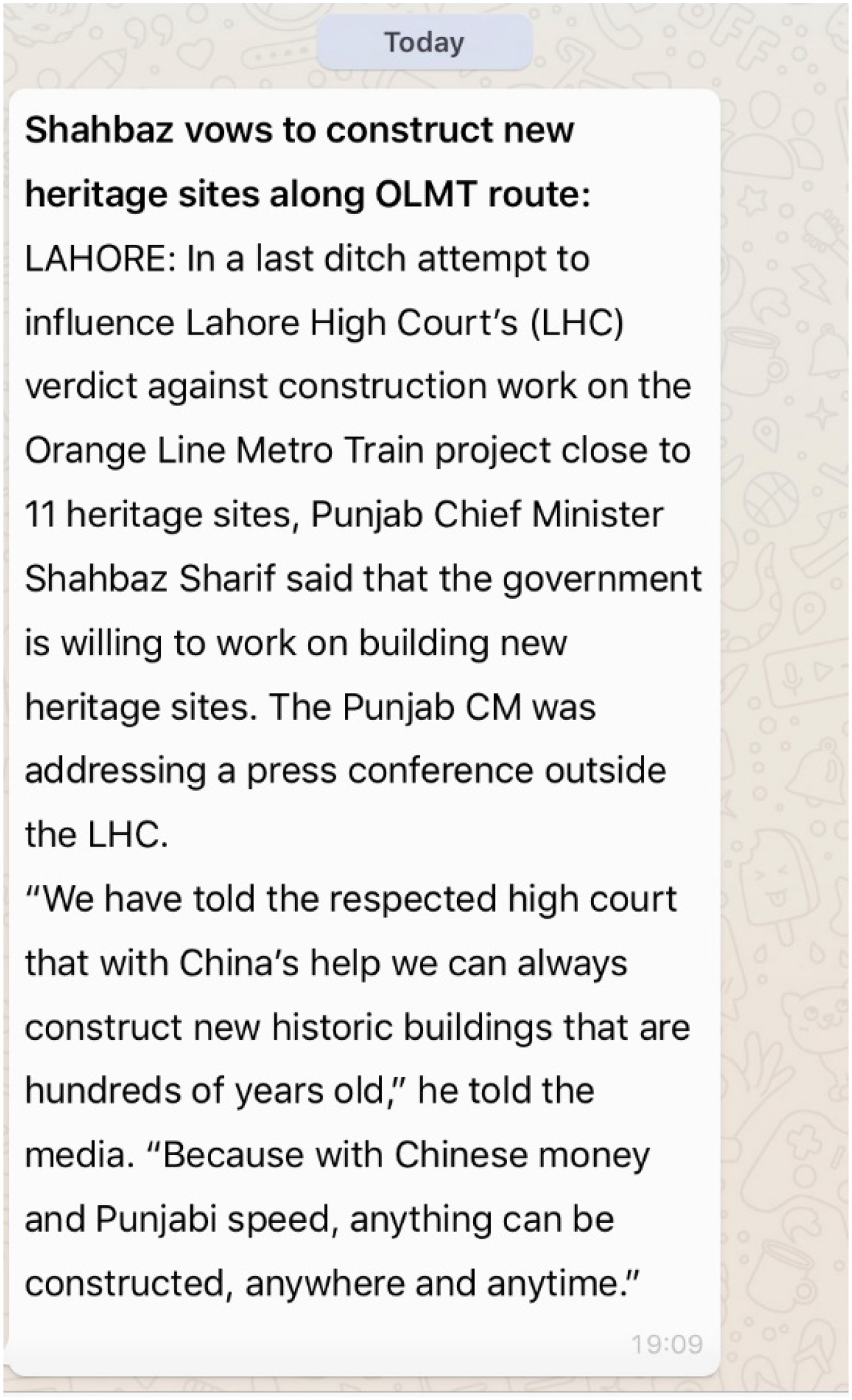
A “forward as received” WhatsApp message describing the creation of “new heritage” sites. The message had circulated widely enough to have become untethered from its origins in a satirical newspaper. (author's photograph. December 2017).
The issue of “new heritage” was one of the few assertions I encountered during fieldwork in which the label of inauthenticity was ascribed to a body of others. Magdalena Crăciun reminds us that people engage with inauthenticity within the climate of its classification (2012: 857). Similarly, Gwyneira Isaac (2011) argues that the reproduction of knowledge, and the concomitant bifurcation of original and copy should be explored with sensitivity towards local ontologies. The assertion that “new heritage” is believable for inauthentic persons translates the identification of fake-ness in things to people. In this instance, “new heritage” is an imagined inauthenticity where its conception does not otherwise exist, thereby translating the collective friction of urban form into clear binaries of right and wrong, real and fake, old and new, and authentic and inauthentic, within an infrastructural sphere in which they can be understood. Caricature therefore mediates, but also amplifies the contested feelings that comprise this as an act of attunement, of becoming accustomed to the offence to sentiments that follow from the attack on an artistic or architectural aura.
The power to build again
Secondary to attempts to understand the impact on informal film conservation on Hall Road, I explored these same traders’ experience of expatriate labour in Gulf, particularly the UAE, where a large and fluctuating Pakistani expatriate population has long resided. The reputation that many traders in Pakistani film cultivated in the Gulf was not based on legality or legitimacy but of quality and provenance, particularly the ability to create reproductions that could be trusted not only to be fit for consumption but also as templates from which to create copies. I spent much of my time in the UAE at Jalalabad Music House, a store established by Badar Khan in the Emirate of Sharjah after serving in the 1980s Afghan-Soviet war and the internecine warfare that followed. Due to the personal archive of master-copies he held and from which he duplicated content, he soon found that his own reproductions were more reliable than those of the same films available in the market in Pakistan, which were often copies of other copies and thus marked by significant data loss.
In the UAE, the rapid transformation of cities from mercantile sea-facing souks to global transport, shopping, and transport hubs has led to the destruction of the built environment at it existed before the influx of oil wealth. Sharjah, the third largest of the UAE's seven constitute Emirates, had long been an area wealthy in pearls and the trade coming across the Persian Gulf, until oil wealth and proximity to the emergent tourist and transport hub of Dubai made it a prime location for expatriate workers. One day while walking to Badar's shop, I noticed towards the waters of the Persian Gulf, the Sharjah Heritage Area was being re-built after a fire. Like the caricature on the rare and disappearing Eid card in Lahore, I found thinking about heritage a useful way of understanding a wider logic of exchange that informed how objects relating to the past are brought into the present. Above polystyrene stone dwellings, faux-brick wells, and date frond-roofed huts studded with bright white power sockets, an entrance sign advertised “heritage” in English and in Arabic “Mantqat Al-Turath” [also: legacy, tradition, patrimony]. Some precedent for this “new heritage” can be found in the bombast of the structural relocation of buildings in Ceausescu-era Romania, the movement and reassembling of Tudor manor houses from England to USA, and the replicas of buildings, bazaars, and “native” environments at colonial World's Fairs and Expositions. More recent comparisons include simulated environments in theme parks such as Dubai's “Global Village”, the Tianducheng housing estate in Hangzhou, China, built to resemble the urban highlights of Paris, and living-history museums such as Colonial Williamsburg in the USA. The growing popularity of such environments signal how permeable “heritage” has become as a category of material culture in its entanglement with tourism. The ethnonationalist claims of political authorities also find in the idea of simulated heritage the combined opportunity to destroy minority assets, ethnically or socially cleanse areas, and regenerate them for commercial or tourism purposes. 2
In Sharjah, “heritage” as a category has come to mean something akin to “material culture”, including the fields of conservation – ecological and material – and folkloric ways of being and performing (Figures 7 and 8). Indeed, such heritage districts are more aligned with UNESCO's description of intangible cultural heritage, if one could imagine them materialized through built structures rather than through performative traditions. While intangible heritage arguably denies the morphology of change essential to culture (Kirshenblatt-Gimblett, 2014: 169), re-materialized heritage often hinges on commercial interests rather than sacredness or profanity (Alivizatou, 2016). As so many of Pakistan's ruling business and political elite made their wealth or spent periods in political exile in the Gulf, I started to believe that “new heritage” was actually a cohesive practice rather than an object of satire gone viral. Yet architects Mona El Mousfy and Sharmeen Syed contest the notion that Sharjah's “constructed heritage” (2015: 30) is a symbol of artifice, suggesting rather an architectural environment that aptly reflects the city's cultural fluidity and mercantile origins. El Mousfy and Syed argue that the shells of many buildings of a certain antiquity are used to house “permanent ‘heritage’ installations… intended to sensitise young Emiratis to the life of their ancestors” (Ibid). While the influx of oil money in the 1980s saw the construction of gleaming marble mosques and tower blocks to accommodate the large expatriate labour population, in the 1990s the Sharjah Biennial and the building of the Sharjah Art Museum provided a platform to rethink the temporality and linearity of heritage value. In this fusion of contemporary art, oil wealth, and commercial capital, Sharjah began to experiment with the question of how to accommodate the profitability of infrastructural development and heritage experiences alongside one another.
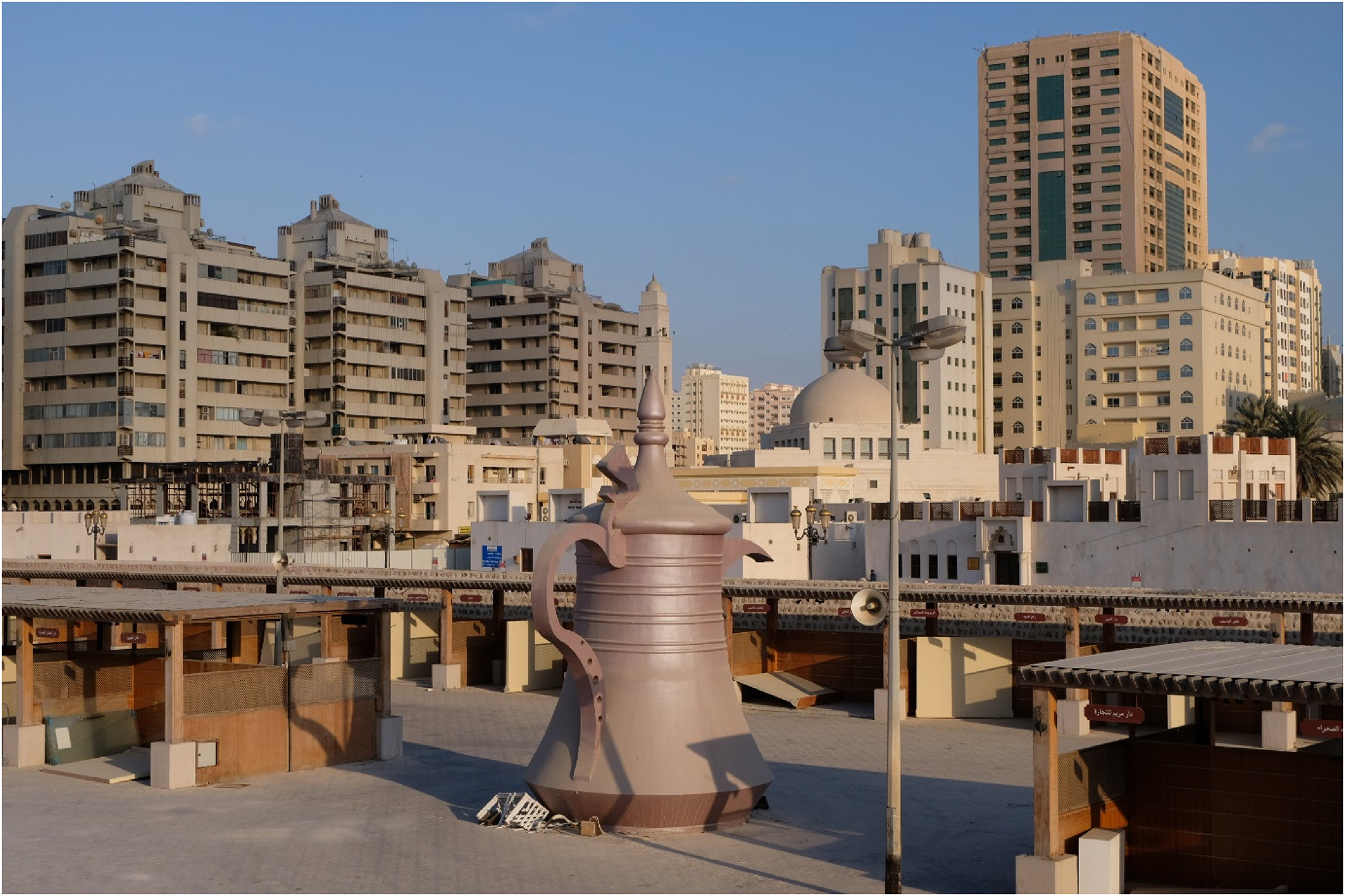
The Sharjah heritage area, empty following a small fire. (author's photograph, December 2017).
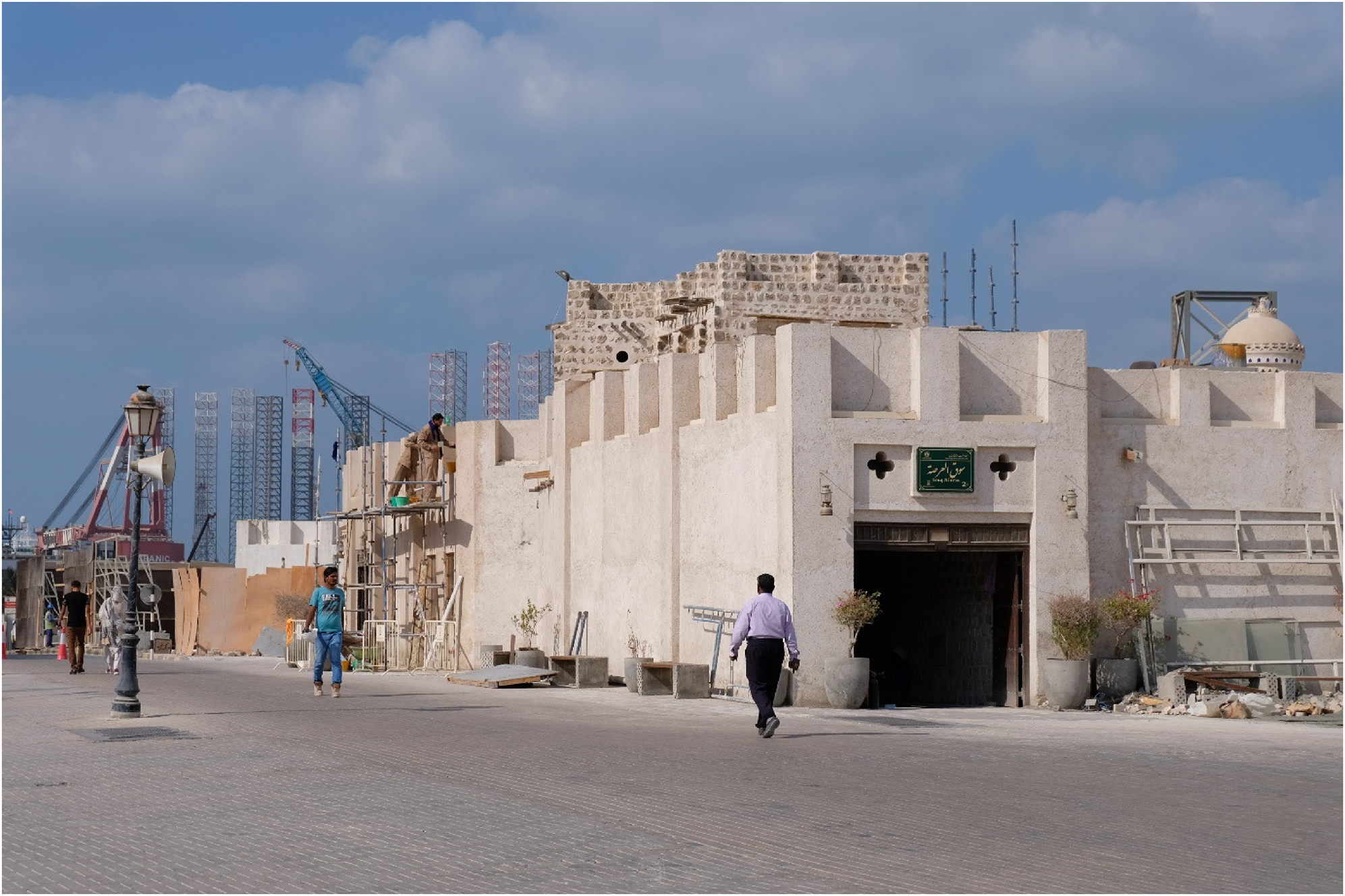
Building a new addition to the Sharjah heritage area. (author's photograph. December 2017).
The exhibits in the Sharjah Museum of Islamic Civilisation neatly exemplify these new epistemologies of heritage reconstruction. Take, for instance, a balance clock for weighing minutes described by the twelfth-century (CE) astronomer Abu al-Fath Abd al-Rahman Mansur al-Khazin reproduced as a museum exhibit. In the museum, it appears old enough in its battered bronze form. Yet the accompanying description label gives so much clear and concise information about the device, its workings, and the origins and ingenuity behind its invention, that it takes a while to realise that no mention is made of the age or provenance of the artefact. It soon becomes apparent that this holds true for the entire museum, which houses reproductions of technological descriptions rather than antique artefacts, privileging the invention rather than the artefactual linearity of the object. This is explained by the frequently used terminology in the display labels: “…shows a model of…”, or, “…as described by…” . This pertains not to a past, but to the act of animating the past in the present through the lens of such canonical texts as Ismail al-Jazari's “Book of Knowledge of Ingenious Mechanical Devices.” In another instance, a world map commissioned by Abu al-Abbas Abdallah ibn Harun al-Rashid (Al-Ma’mun) in the ninth-century (CE) - originally a two-dimensional map- had been manifested in the museum as a globe to emphasize Al-Ma’mun's influence on the development of cartography in Europe (Figure 9). Neither promoting nor apologising for its lack of antiquity, the museum quantifies heritage time differently, privileging the ownership and transmission of the idea rather than its authenticity. More prized than being the latest in a documented chain of ownership is the ability to build again. Unlike the negative picture that “new heritage” paints of those supposedly foolish enough to be persuaded by the anachronism, the Sharjah Museum of Islamic Civilisation correlates with the future-facing practices of film restoration, where carriers of knowledge play as important a didactic role as originals.
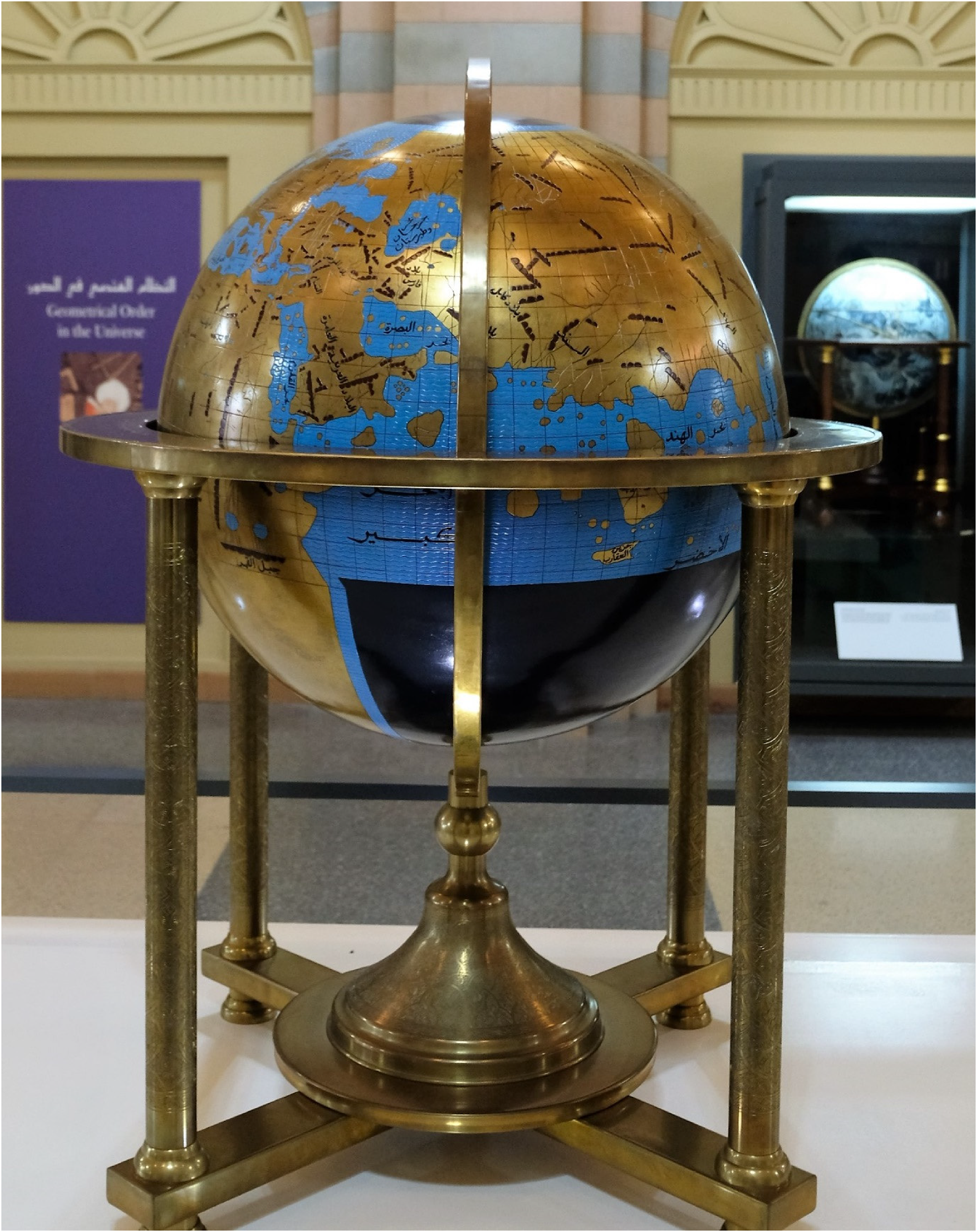
In the Sharjah Museum of Islamic Civilisation, a world map commissioned by Abu Al-Abbas Abdallah Ibn Harun Al-rashid (Al-Ma’mun) in the ninth century (CE) - originally a two-dimensional map-, had been manifested in the museum as a globe to emphasize Al-Ma’mun's influence on the development of European cartography. (author's photograph. December 2017).
Aspiration as atmosphere
Back in Lahore, once building work began again on the Orange Line, the movement to protect heritage sites threatened by the developments were busy looking for new ways to push back against a governing elite they perceived to be gullible enough to propose replacing cultural assets with Chinese-funded “new heritage.” For many film traders on Hall Road, the constructions taking place a few hundred meters away did not bother them. Working day-on-day in the very plazas that had become a byword for heritage destruction, they were more preoccupied with navigating the difficult relationship between secular entertainment and public piety that characterized their trade. So as to account for the distinct affinities and aversions to moving images that the dynamics of belief in Pakistan provokes, I balanced immersive research among marketplace film traders in Pakistan and the UAE with participant observation among religious media traders pertaining to the minority Shi’i branch of Islam. The personal archives of historic recordings held by small, long-established stores situated beside shrines and along Shi’i procession routes are an important source of self-recognition for this embattled religious minority. Custodianship and guardianship over moving image heritage also confer on the guardian ability to define what is and is not permissible, and what is and is not visible in religious uses of popular media.
In one Shi’a-majority area punctured by a new looming concrete flyover carrying a stretch of the Orange Line, a similar demonstration was taking place over the destruction of the built environment, similarly couched in the language of international heritage discourse. A prominent local trader, Ali Abulfazl, notable among the community for funding religious gatherings, had organised a mourning gathering to mark the eighth day of the Islamic month of Shawwal, commemorated across the world by Shi’a communities as the Yaum-e-Gham [Day of Sorrow] or Yaum-e-Hadm [Day of Demolition] (Figure 10). The day marks the destruction of Jannat-ul-Baqi, the oldest Muslim graveyard, situated a short distance from the Prophet Muhammad's mosque in Medina in modern Saudi Arabia, and the final resting place of many of the Prophet's companions and family members. It was demolished by Wahhabi forces under Ibn Saud in 1926 3 . Before their demolition, the tombs at Jannat-ul-Baqi were important pilgrimage sites for Shi’i Muslims due to the fact that four of the twelve Shi’i Imams are buried in the cemetery. Before demolition a large mausoleum housed the remains of members of the ahl-e-bayt, family members of the Prophet, possibly including the grave of his daughter Fatima al-Zahra, wife of Imam Ali, and mother of Imam Hussain and Imam Hasan. Those who support the historic destruction of the mausolea commonly oppose the practice of seeking intercession through pilgrimages to grave-sites. Belief in such mediators is widespread in Pakistan, where some of the largest Muslim denominations rely on the powers of saints and the contagious blessings that can be received through visitation to their tombs.
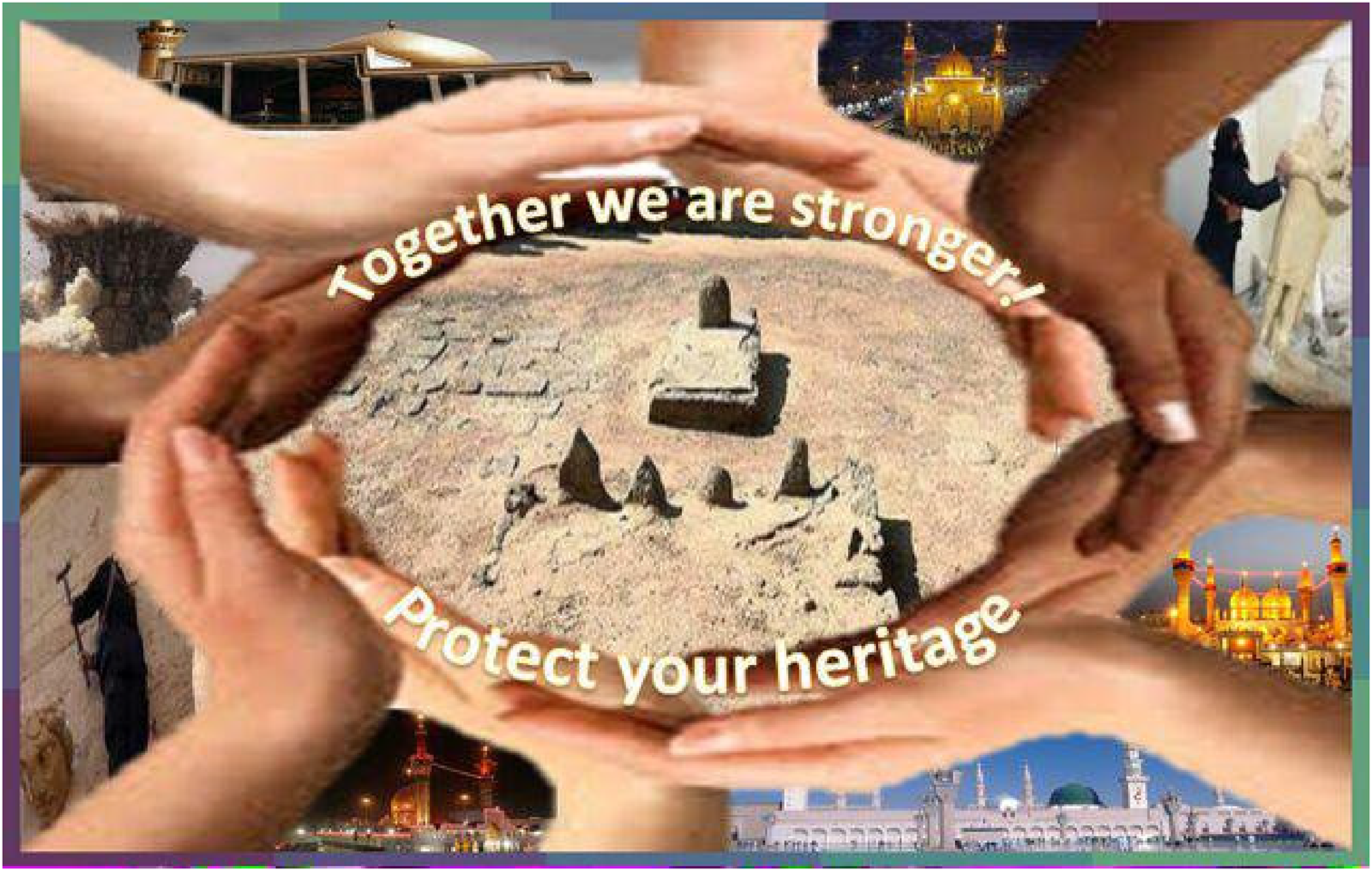
A composite image from a pressure group campaigning for the rebuilding of Jannat-ul-Baqi. In the centre of the image the unadorned grave markers of the ahl-e-bayt as they have existed since the destruction of the mausoleum that housed them, accompanied by images of important mausolea and images of the Daesh destruction of built and sculptural heritage in Iraq and Syria. (work reproduced from the public domain).
Ali Abulfazl had risen to prominence in the community as a trader in devotional objects and a renowned artisan, producing elaborate decorative fabrics that adorn the religious processions that take place in his neighbourhood. Ali had organised a noteable reciter to participate in the mourning gathering later that day and deliver a sermon that would bring the assembled audience to tears over the destruction of Jannat-ul-Baqi. To better impart the lessons of the destruction and the strengthening of the veneration of sites relating to the ahl-e-bayt that their detractors call idolatry, Ali Abulfazl also ordered something special from his suppliers in Iran who usually stock his store with bottle-green shawls and prayer beads. In a small pile on a table at which his nephew sold prayer commodities outside the gathering were construction sets of the destroyed shrine of the ahl-e-bayt in Jannat-ul-Baqi (Figures 11 and 12). Although designed for young learners, with the sets priced the same as a hand-embroidered flag they were beyond the budget for most.
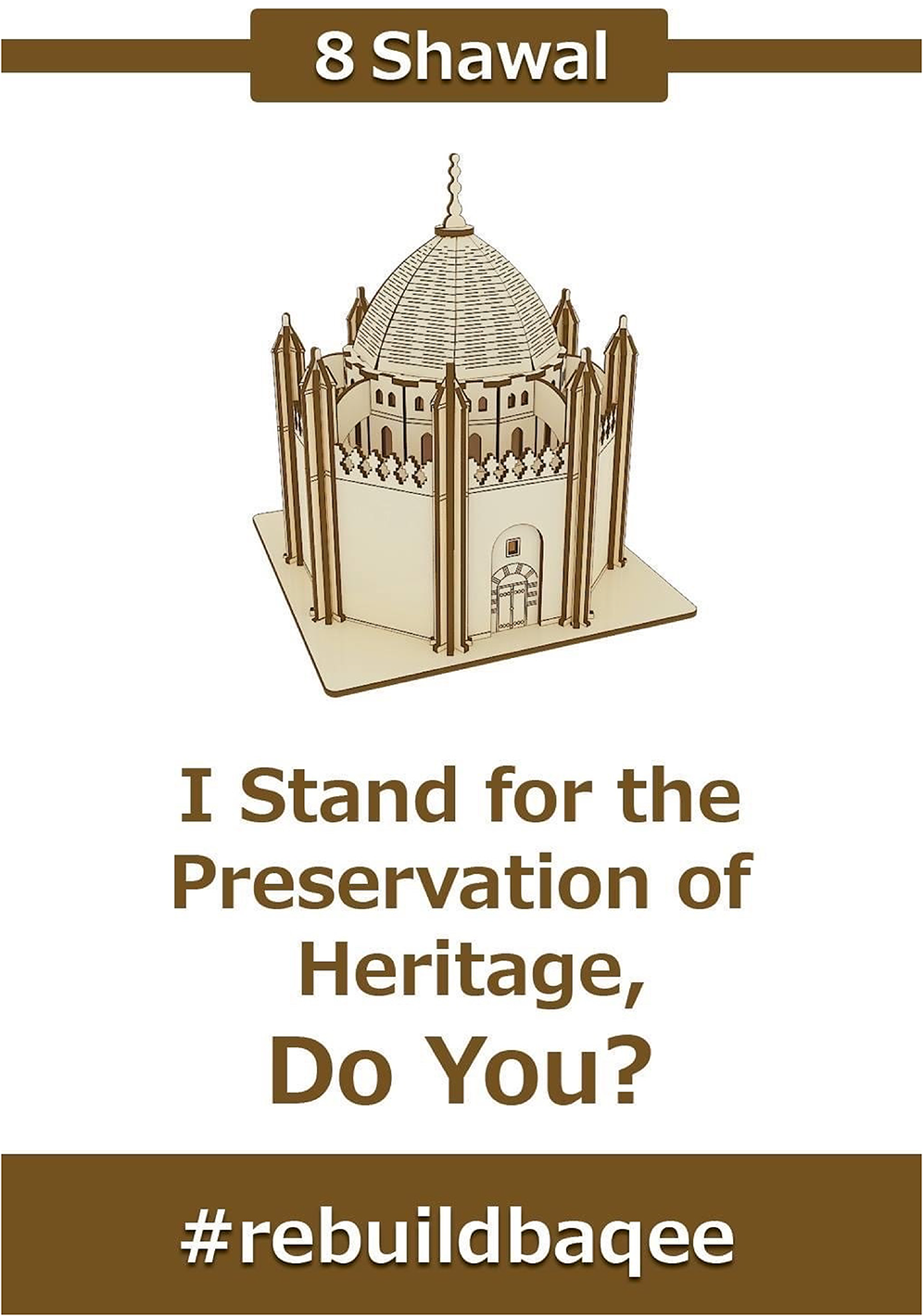
An image of the model mausoleum used as an image to be shared among Shi’i Facebook groups. (work reproduced from the public domain).
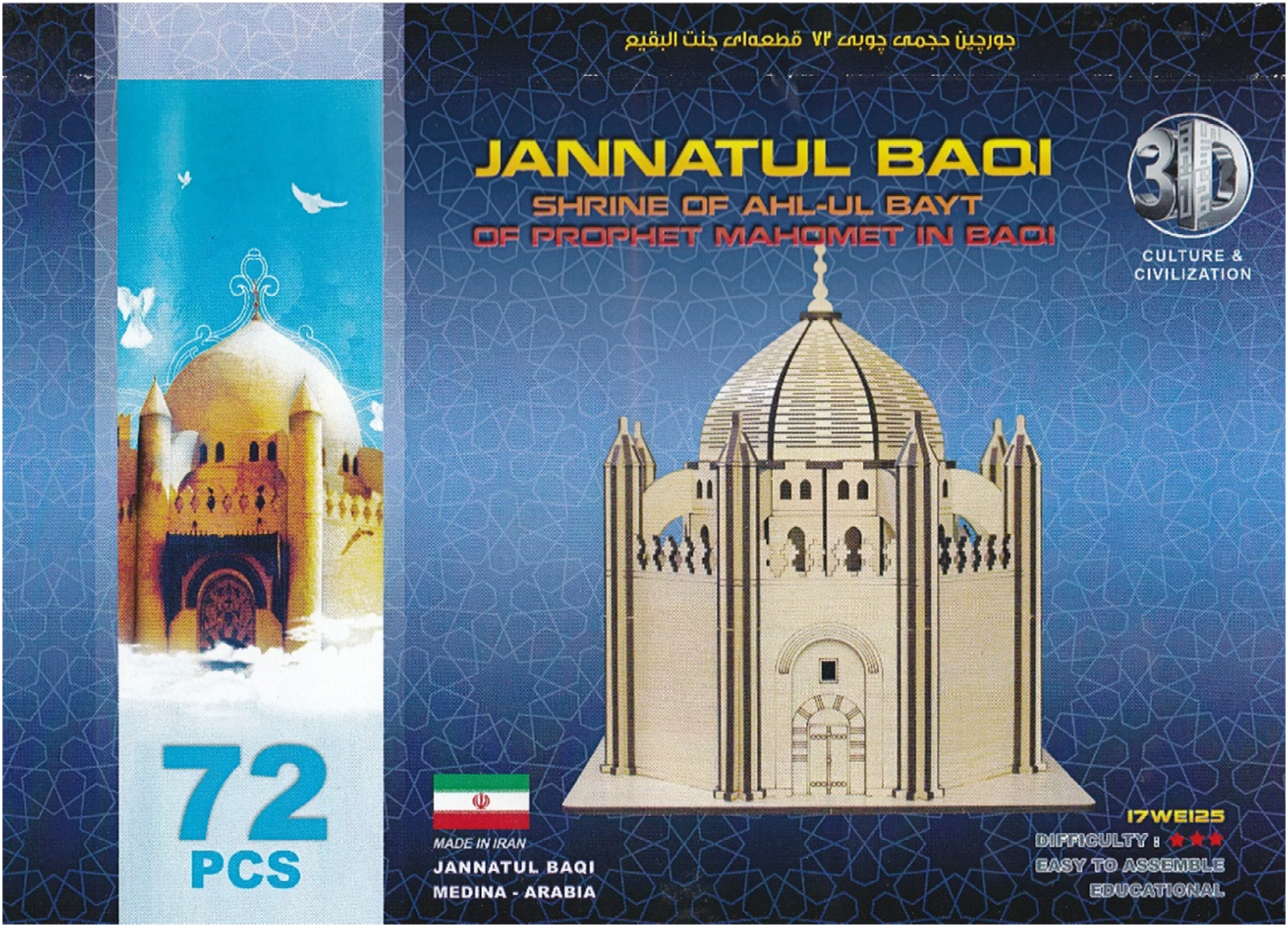
The cover of the Jannat-ul-Baqi construction kit. (author's scan).
The Jannat-ul-Baqi construction set comes from a series of tombs and mausolea produced by an Iranian company. It is the only model that users build in reconstruction. That is, in the absence of the continued existence of the prototype. The cover of the Jannat-ul-Baqi set imported by Ali Abulfazl features the most recognisable image of the graveyard as it looked before 1925–1926. The pieces that comprise the construction kit, and that pop out separately from six slats of wood, are increasingly easily manufactured with computer-aided design software which guides the laser cutting of templates quickly and efficiently with the possibility of mass production. While the 72-piece is, perhaps for import-purposes, listed as educational in category it resonates with geopolitical anger. An explanation on the reverse details its significance as the final resting place of the earliest members of the Muslim community, its veneration by Shi’i Muslims, and ends with a brief reference to the Wahhabi destruction of the tombs. Illustrations on the packaging show the model constructed in four stages, with eight foundational pillars affixed to the base giving way to a central spire that later supports the wooden dome (Figure 13). This process of building again – and the embodied techniques of its re-enaction by young learners – serves as a material manifesto for seismic geopolitical change, one which would see the ideology that destroyed Jannat-ul-Baqi overturned. In Museum Object Lessons for the Digital Age (2018) Haidy Geismar situates digital museum objects and digital components of museum collections in a broader trajectory of object-centred knowledge; of object lessons as instructional, didactic arguments manifested in things. She argues that the reproduction of lost heritage through digital imaging and modelling is, “a kind of mimetic excess in which the technical practices of mimesis constitute not just a version of objectivity but a form of politics itself” (2018: 111) Likewise, in the Jannat-ul-Baqi set, embedded in the exercise is a belief that the act of building imparts an object lesson about the severity of its loss. These concepts have become firmly established in contemporary creative practice, most notably in the work of artist Morehshin Allahyari, who uses 3D-printing technology to give new life to destroyed artefacts. Her 2016 project “Material Speculation: ISIS,” for example, involved the compilation of data and small-scale reproduction of artefacts that had been destroyed in the Daesh occupation of Iraq.
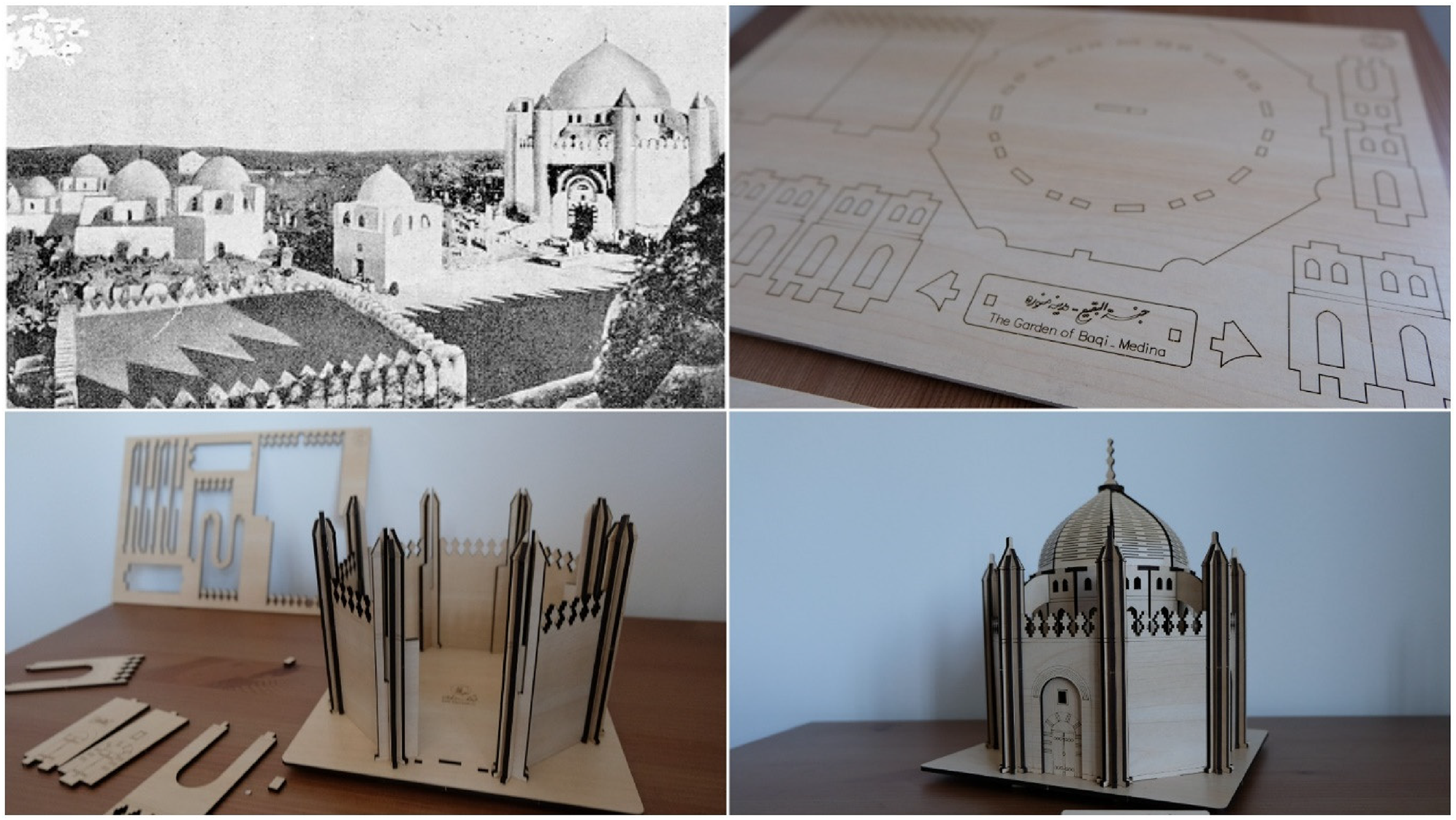
Clockwise from left: An image from the inset of the construction kit of the shrine of the ahl-e-bayt in Jannat-ul-Baqi as it looked before 1925 and the Jannat-ul-Baqi construction kit in various stages of completion. (author's photograph).
In these instances of “material speculation,” persons are not just constructing selves out of relations with things; these things are doing conceptual labour in constructing and reorienting relationships with dominant systems that manage material culture. Through the use of reconstruction as an instructional technique, activist groups around the world such as “Rebuild Jannat ul Baqee” frequently cite the need for “heritage recognition” in explicating the sacred aura of the site. This act of citing a secular order through which to authorize and intervene upon the materialization of faith, takes as given that the moods and intangible ambiance of Jannat-ul-Baqi's mausolea can be made perceptible to others. Similarly, recourse to international heritage discourse appeals to an established way of fixing and authorizing the legitimacy of aura or atmosphere that is more than material and less than sacred. Such activist groups who campaign for the rebuilding of Jannat-ul-Baqi propagate a sacred aura that would survive reproduction, as funerary monuments commonly do, being that they mark the remembrance of an individual or a collective rather than harbouring an atmosphere propagated by their materiality. Perhaps this is the appeal of reconstruction; making malleable a received notion of heritage into one that combines the developmental attraction for infrastructure and aspirational construction with the singularity of originals. In this alchemy, the atmospheres of the built environment might survive reproduction and allow for their mediation.
Speculating and becoming
I want to end by emphasizing that the Jannat-ul-Baqi model is actually a puzzle. Its instructions are illustrative and do not provide a step-by-step process. Like a jigsaw, one actually has to work out how the pieces fit together. In the exhilaration of figuring this out and seeing it rise up out of its base, one comes to consider the mindset behind its demolition, thereby contrasting the didactic, collaborative process of building with the anger of destruction. There are moments of elation, when the ingenuity of supporting pillars seemingly finished are appended with something that supports another part of the structure. It is more than the aspirational construction of infrastructure, which in its ambition quickly gives over to the atmospheric disturbances of waste, dust, and smog. Both this and the caricature of “new heritage” are figural images rather than discursive arguments, which labour to construct the mindset of an unethical other so as to reproduce fidelity to its opposition. Yet, unlike the negative speculations of the short-lived myth of “new heritage”, when the moods mediated by the promises of reconstruction come to shape community ethics as they do with the Jannat-ul-Baqi model, these aspirations delineate certain possibilities of shared and collective action.
Posing this chain of speculative, rather than tangential, connections has been an attempt to reflect on the methodological benefits of thinking within and between different domains of material heritage as means of interrogating the production of atmosphere, aura, ambience, and mood. I have enquired whether “new heritage” can be taken seriously on its own terms, in both the anxious discourse of satire-turned-fact, and in practices that situate pathways to power not only in the ability to develop and build, but to build again. Like Naveeda Khan's work on the materiality of Muslim self-knowledge in Pakistan, I traced the ways in which moods of self-making are objectified in built form, in which aspirational construction take shape as an “image of becoming” (2012: 386) which requires the affective agitation of the individual in whom the feeling is aroused. When reconstruction becomes instruction, it challenges the notion that the atmospheres of architectural heritage are so radically subjective that they cannot survive mediation. “New heritage” in Lahore became a believable figure in the absence of sympathetic heritage regimes; in Sharjah and in other instances “constructed heritage” is a tool of political will that banks on the future being more profitable than the past; and in an Iranian-imported construction toy, the (im)possibility of building again becomes a radical challenge to geopolitical order.
In order to come to grips with some of the networked pathways that centre around aspirational construction, the preservation of the moving image was first taken as a means to interrogate the possibility of “new heritage”. Through this frame I argued that it is possible to see that assigning heritage value to an artefact whose essence is viewed as inseparable from its reproducibility does not require the suspension of disbelief. How heritage as a system of knowledge that is essentially constructed becomes persuasive or unconvincing is the subject of Birgit Meyer and Mattijs van de Port's edited collection of essays Sense and essence: heritage and the cultural production of the real (2018). Contrary to arguments that find that this construction a mark of inauthenticity, Meyer and van de Port call for a greater understanding of why such assemblies can be experienced as active and efficacious (ibid: 3). The criteria that allow for a site to be listed for conservation often relies as much upon its recursive aura as its material vulnerability. Yet the social reception of this aura is subject to differing means of social evaluation. This allows “new heritage” to elide the other of heritage, those unstirred by the narratives that guide its designation, by speculating upon a future where the forces of disagreement are all but absent. Such material speculations built with mood as its medium are not only experimental and tentative but are also generative of ethical sensibilities towards heritage futures.
Footnotes
Acknowledgements
My immense gratitude goes to my interlocutors in Lahore and Sharjah, whose intellectual generosity and patience has always gone beyond the bounds of what should reasonably be expected. This article was developed through the organization of two panels and the presentation of the material therein. The first, “Ferality and fidelity: conservation as a space of social reproduction” I co-convened with Adam Runacres at the Association of Social Anthropologists of the UK’s 2019 conference. The second, “the Aesthetics and Atmospheres of Construction in Pakistan” I co-convened with Chris Moffat at the Annual Conference on South Asia in Madison. At both these events and beyond I gathered insightful feedback from my co-convenors, as well as Rebeca Suarez Ferreira, Valentina Torelli, Marie-Annick Moreau, Kirsty Wissing, Nishat Awan, Yaminay Chaudhri, Ammara Maqsood, Christopher Pinney, and Abeera Arif-Bashir. I would like to thank the editors at the Journal of Material Culture and the anonymous reviewers for their intellectual generosity and support. My gratitude goes to the UK Arts and Humanities Research Council, grant number AH/ L503873/1 and the UK Economic and Social Research Council, grant number ES/V011669/1 for supporting the research and writing of this article. The research was completed while a PhD student at the Department of Anthropology at University College London. The writing of the article was completed while a Research Fellow the Department of Social Anthropology in the University of Cambridge, a Research Associate at the Max-Planck-Cambridge Centre for Ethics, Economy, and Social Change, and a College Research Associate at King’s College, Cambridge.
Declaration of conflicting interests
The author(s) declared no potential conflicts of interest with respect to the research, authorship, and/or publication of this article.
Funding
The author(s) disclosed receipt of the following financial support for the research, authorship, and/or publication of this article: This work was supported by the AHRC (grant number AH/ L503873/1, ES/V011669/1).
