



Abstract
This article is about an everyday paper object: an envelope. However, as opposed to most other flat paper containers, the enveloppe Soleau can only be bought from L’Institut national de la propriété industrielle (INPI) in Paris. At the cost of €15 you get a perforated, double-compartment envelope allowing you to constitute proof of creation and assign a precise date to your idea or project. But the enveloppe Soleau is something much more than just a simple and cheap way by which you can prove priority in any creative domain. It is a material footprint anchored to centuries of practices associated with disclosure and secrecy, a gateway into the infrastructure of the intellectual property system and its complicated relationship to the forms of knowledge it purports to hold. The purpose of this article is to consider the making of the enveloppe Soleau as a bureaucratic document, a material device performing a particular kind of legal paperwork. In four different vignettes, the article tracks the material becoming of the enveloppe Soleau as an evidentiary receptacle, beginning by going back to early modern practices of secrecy and priority, continuing with its consolidation in two patents (from 1910 and 1911) to the inventor Eugène Soleau (1852–1929), and ending up, in 2016, dematerialized in the e-Soleau. As a bureaucratic document, the enveloppe Soleau shows just how much work a mundane paper object can perform, navigating a particular materiality (a patented double envelope); formalized processes of proof (where perforations have legal significance); the practices of double archiving (in an institution and with the individual) and strict temporal limitations (a decade). Ultimately, the enveloppe Soleau travels between the material and immaterial, between private and public, between secrecy and disclosure, but also between what we perceive of as the outside and inside of the intellectual property system.
Technologies of paper and time
A ‘flat paper container with a sealable flap, used to enclose a letter or document’. The form and function of an envelope is instantly recognizable. So, what do we find inside the sealable flap of the Oxford English Dictionary’s nondescript object? A love letter, an eviction notice, an anonymous threat, or the name of the lucky individual to whom a gold-plated Oscar® was just awarded – endless possibilities that all have in common a container which is simultaneously necessary and superfluous. The envelope is necessary for transporting the good and/or bad news temporarily hidden from sight, but superfluous at its destination. In this article, though, it is the outside that counts. This article is about a flat paper container which looks just like any other, apart from the fact that the enveloppe Soleau is designed not to be opened at all.
Before teasing out the bigger story of the artifact in question – which includes the reasons why it can and perhaps even must be opened – some critical data about this less than ordinary envelope are important to consider. It can only be bought from L’Institut national de la propriété industrielle (INPI) in Paris: €15 will buy you ‘simple and cheap evidence that allows you to constitute proof of creation and assign a precise date to your idea or project’ (INPI, 2014: 3). Endowed with much stronger properties than the unassuming exterior suggests, its probative value rests on a two-compartment design, allowing the sender to place exact duplicates of the ‘idea or project’ in each partition. After having ensured that the total thickness of these enclosed documents do not exceed 5mm, the enveloppe Soleau is dispatched to INPI. On arrival, INPI laser stamps – once, old-school manually perforated – the whole envelope with the crucial date of arrival, separates the two now identically marked compartments, keeps one in its archives and returns the other to the sender. The entire process is designed to make any secret attempt ‘with a view to modifying the enclosed document . . . detectable without difficulty’ (Poulantzas, 1975: 277). Renewable once after the initial 5-year period has expired, INPI destroys the envelope after 10 years. One copy with the sender, one at INPI: at a total cost of €30 you have now bought yourself a decade of ‘intentional concealment’, Sissela Bok’s (2001) well-known definition of secrecy. Only at such a time, should it arise, when the sender – for whatever reason – needs to prove their priority can they have the INPI copy opened, thus deploying an insurance policy they would have preferred never to have used in the first place (Biagioli, 2012: 227, n 49).
Sold by INPI, registered and archived by INPI and eventually destroyed by INPI: the enveloppe Soleau is only an enveloppe in France and by virtue of its authorization from the French Institut national de la propriété industrielle. Yet, and this is another crucial caveat, despite its assimilation into the French intellectual property system, it offers no intellectual property protection. None. What the enveloppe Soleau does offer is proof of creation. Or, in other terms, proof of priority, the significance of which we tend to associate with the high-stakes game of scientific discovery and credit (Biagioli, 2012; Csiszar, 2018; Merton, 1957). But the belief in precedent as a value, value that somehow must be attached to materiality, materiality that in turn carries evidentiary weight, resonates across a broad spectrum of creative domains. Enter the enveloppe Soleau: proving the precise date of an idea, a pattern, a design, a business method, once even the ‘fixative medium’ of IKB, the famous monochromatic colour known as the International Klein Blue. However, this article is not about the reasons why Yves Klein sent his chemical formula to INPI on 19 May 1960 in ‘Enveloppe Soleau no. 63 471’, a preference variously, and erroneously, described as depositing a patent (Moureau and Sagot-Duvauroux, 2001: 20) or having trademarked (How, 2017) his formula. Nor is it about what motivates individuals or corporations today to seal the flap for a five or ten-year period. It is not even about the legal clout of the enveloppe to enforce the right of prior possession (le droit de possession personnelle antérieure).
While these concerns will return in the following sections, they are nonetheless tangential to the article’s main objective, which is to trace the logic of the enveloppe in the infrastructure of a particular universe of documents, that of intellectual property. To understand the place this modest paper container has made for itself in that system ultimately brings to light the multiple dynamics by which regimes or protocols of knowledge are materially constituted. By individuals and institutions. Significantly though, the enveloppe Soleau is not only a technology of paper, but a technology of time. First, by the capacity to secure and date an investment – once by tiny holes, now by laser – and have that gesture recognized legally. Second, and perhaps even more importantly, by the capacity to buy time, to elongate or extend the intellectual property system from the outside, carving out a temporal hiatus before protection by ‘real’ intellectual property rights (possibly) sets in.
My approach owes a great debt to the way Mario Biagioli (2012) has shown the range of options that exist vis-à-vis why, when and how something is revealed or not, exposing both the temporality and legality of priority-making. Secrecy and disclosure may be cornerstone categories of the intellectual property system but, as such, they are less like monoliths and more like entryways. As ‘manifestations of proprietary attitudes toward knowledge’ (Long, 2001: 89), traditional outlets such as publications and patenting have continually co-existed with features of non-disclosure, be it the shape of sealed notes, trade secrets (Bambauer, 2016) or know-how (O’Reagan, 2017). Further inspiration comes from understanding these manifestations as dependent on documents and paper materialities in bureaucracies, administrative work that tends to be obscured or even rendered invisible. Cornelia Vismann (2008: 1) argues that it is virtually impossible to conceive of a legal culture without files or a state ‘off the record’, an observation Bruno Latour’s (2004) ethnographic immersion among the files and documents of the Conseil d’État also bears out. Yet, scholarship on intellectual property has not engaged consistently with the body of research Ben Kafka (2009) refers to as ‘paperwork’, the many gestures by which files, records and paper are mobilized to govern, oversee and control the basic infrastructures of information, knowledge and media (Gitelman, 2014; Riles, 2006). In my exploration of the enveloppe Soleau I hope to show the productiveness of paperwork perspectives in the context of intellectual property, adding to studies that have looked at the bureaucratic poetics of trademarks (Bellido and Kang, 2016); the expertise of patent examiners (Pretel, 2018; Swanson, 2009); the classification of patents (Kang, 2012); or the Patent Office as a centre of documentation (Hemmungs Wirtén, 2019). Suzanne Briet’s (1951: 7) classic definition of a document as ‘any source of information, in material form, capable of being used for reference or study or as an authority’ can in the case of the enveloppe be further qualified to mean the mediating qualities of a ‘bureaucratic document’ (Hull, 2012: 253), one that is made by the office but is also of the office.
Next, four narrative vignettes explore four material instantiations in the chronological becoming of the enveloppe Soleau. From early modern practices to the digital present, from materialization – and later dematerialization – into the bureaucracy of intellectual property, from national to – albeit under a different name – global proof. But before there was such a thing as an enveloppe Soleau, there were precursor envelopes that were called upon to keep things secret and act as proof.
1889: On the difficulties of fitting bronze ornaments in envelopes
It all begins with bronze, not paper, with our eponymous inventor Eugène Soleau (1852–1929) being secretary of the Bureau de la Réunion des Fabricants de Bronzes (Voillot, 2014) under the auspices of which he in 1889 publishes Étude sur la propriété des modèles d’art appliqués a l’industrie, a study largely revolving around the ‘great plague that tends to invade all industries related to art’ (Soleau, 1889: 1), i.e. counterfeiting. Unauthorized copying was a very real challenge to the prominent French bronze industry, an industry which saw itself as both artistical and technical. Although a more extended treatment of the legal particularities vis-à-vis design and industrial models (see Emptoz and Marchal, 2002; Teilmann-Lock, 2016) lies beyond the scope of this present article, it is difficult to gauge the later appeal of the enveloppe Soleau without understanding something of its genesis in practices situated in-between art and industry.
Soleau had one particular event in mind when he wrote his report: the upcoming 1889 Exposition Universelle, the fourth to be hosted by Paris. The spectacular showcasing of national industrial achievement, new innovations and decorative objects had met with unparalleled success. But the displays as well as looking at the displays (Purbrick, 1997) were a legal quagmire in terms of intellectual property protection, and ultimately paved the way for the 1883 Paris Convention for the Protection of Industrial Property (Plasseraud and Sauvignon, 1983; Ricketson, 2015). Three years later, with the 1886 Berne Convention for the Protection of Literary and Artistical Works, the international infrastructure for intellectual property was set in place: industrial property (patents, trademarks) on the one hand, and literary and artistical works (copyright) on the other.
In 1889, these conventions were still in their infancy and counterfeiting was still rampant, abroad, but also on French soil, where – or so Eugène Soleau felt – French law did not know what foot to stand on. While the protection of the artist and the work appeared covered by the 1793 Law relating to the ownership of literary and artistic works (Loi et décret des 19 et 24 juillet 1793 relatifs á la propriété des œuvres littéraires et artistiques), the second part of the equation, the design/industry part, was a more complicated matter. Enacted by Napoléon on 18 March 1806, Loi portant établissement d’un Conseil de Prud’hommes à Lyon was not a new patent law, nor a new copyright (droit d’auteur), but established a Labour council (conseils de prud’hommes), a sort of arbitration tribunal for the powerful Lyonnaise textile industry. Soleau’s judgment on the 1806 law? Unequivocally ‘not made for us’ (Soleau, 1889: 17), that is, for his own industry.
Consisting of nine members, five manufacturers and four weavers, the 1806 law had two major objectives: to self-discipline the industry and to regulate competition between manufacturers (Kieffer, 1987: 10). These practices are symptomatic of a pre-modern regulation of artisanal knowledge (Long, 2001) that slowly will transition from privileges and guilds to systems of rights (Biagioli, 2006). But the mandate of the tribunal went beyond arbitration. The reason why Soleau and the Bureau de la Réunion des Fabricants de Bronzes would concern themselves with a law for the textile industry was the conseil de prud’hommes’ right to determine counterfeits and pass these cases onto relevant courts. Article 15 of the 1806 law stipulated that anyone who wanted to rely on the conseil de prud’hommes in matters regarding priority disputes and counterfeits would have to deposit a sample ‘folded in an envelope bearing its stamps and signature, on which will also be affixed the stamp of the industrial tribunal’. When registered, the sample received a number, a certificate which was returned to the sender. In case of dispute between two or more manufacturers, the conseil would open the packages and determine priority. Protection was either 1, 3 or 5 years at a price of 1 franc per year, or perpetuity for the sum total of 10 francs. Samples of silk or other textiles were easily folded and transported, but the process was slightly more complicated for ‘reproductions of sculpture . . . editions made in bronze, iron, zinc or silver’ (Soleau, 1889: 18). Obviously, the idea that you could fold a bronze sculpture or a cast in an envelope bordered on the absurd and the formality of the deposit required by the 1806 law was a major problem for the bronze industry.
The principle of using sealed notes or deposits in order to prove priority was not limited to trade or business. L’Académie des Sciences had accepted and archived secret information inside envelopes since 1735. Anyone could submit a sealed, dated and signed note or pli cachetés to the Académie and expect the institution to keep it archived until the author in question asked for it to be opened and its contents revealed. A method, an idea, or an invention: the note could cover anything the author or originator considered worthy of preservation or proof in case priority had to be invoked. Even the deposit of objects, such as vials, was accepted (Berthon, 1986; Carosella and Buser, 2013: 77).
Ultimately, what Soleau wanted was a new law, one that once and for all would do away with the legal problems caused by the underlying misconception that ‘art ends where industry begins’ (Soleau, 1889: 17). Realistically, this would involve long-term lobbying and our protagonist needed a quicker solution. As the more immediate objective of the 1889 report was to ‘perfect the weapon we want to use’, to give plaintiffs a tool by which they could survive and even conquer the injustice of the law (p. 68), he needed to find a way of fitting the three-dimensional object of, say, a brass chandelier or a sculpture into another form of evidence. Soleau needed paper, because in this form he could actually translate and transport his three-dimensional objects into an unassailable property title convincing judges that the claimant was authorized to take a counterfeiter to court (p. 70).
A simple receipt might be one such possibility, but the problem with such receipts – the most common proof in his own business – was that they were not really standardized. Any ordinary piece of paper would not do; it did not sufficiently describe or act as a referent to the object in question. Soleau did not just need any proof, he needed to find a standardized proof, a format to eclipse all other ad hoc formats. Which is why he offered his readers a version ‘which has already been admitted without dispute by the courts’ (p. 70), i.e. his own (see Figure 1). The document contained space to insert the information one would expect from such a note: the name of the artist, the buyer, a number associated with the object, a line on which one could sign in case the information was printed, and a stamp. As Beatrice Fraenkel (1992) so convincingly has shown, the importance of the signature as a legal guarantee and proof of identity was imperative, but the power of the handwritten personal name was that it did not look exactly the same when reproduced. A too-perfect reproduction of a written signature smells forgery, not authentication. On the advice of noted legal authority Eugène Pouillet (1884), Soleau added another feature intended to strengthen the chain of evidence even further (Soleau, 1889: 70, n 1): room for a photograph or drawing. Eugène Soleau is on his way to the enveloppe, but he is not quite there yet.
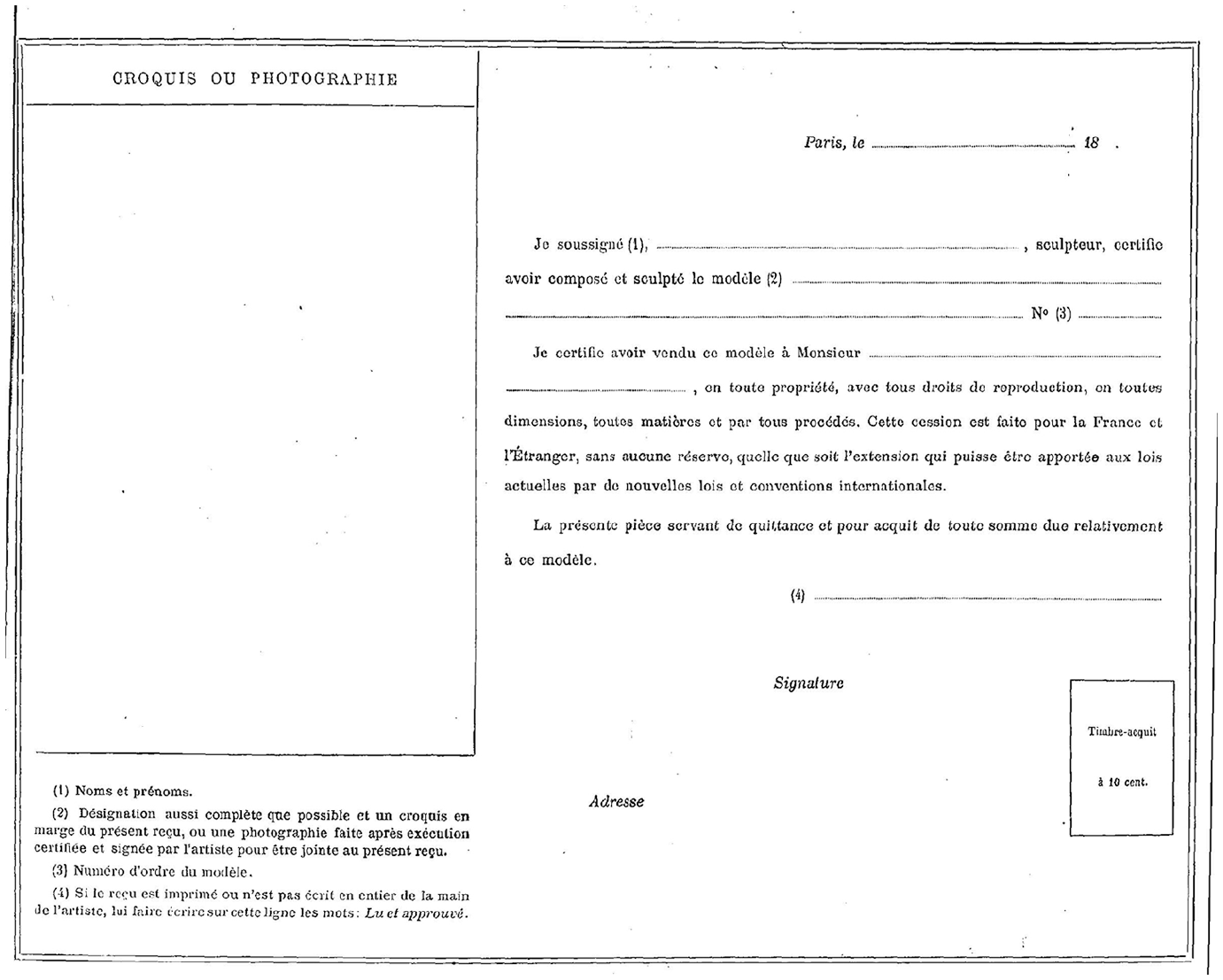
Eugene Soleau's ‘standardized’ receipt from Étude sur la propriété des modèles d’art appliqués a l’industrie (1889). Source: Gallica (https://gallica.bnf.fr/)
1910: Patenting perforations
Soleau made his first stop on 30 October 1910, with his ‘method for the protection and date stamping of documents, drawings, etc., to be kept secret’ (Mode de protection et de timbrage à date des documents, dessins, etc., tenus secrets). First appearing in class 18, ‘articles for the office, education, and popular press (Articles de bureau, enseignement, vulgarization), Soleau’s innovation then found a home in subsection 3, ‘advertising, post, communication by carrier pigeon’ (Publicité, postes, communications par pigeons voyageurs). Patent 443.541 does not deviate in any significant way from how most patent specifications looked at the time, regardless of where they were filed (see Figure 2). Recall from the previous section how Soleau’s (1889) receipt mediated the object as it exchanged hands from seller to buyer. No institutional middleman is present, just a commodity, manufactured, displayed and sold. As the enveloppe arrives at the Patent Office in the shape of Soleau’s specification, it begins to circulate as a document of another calibre. It is standardized, registered, classified and subjected to all those additional ordering practices which will make the patent easier to find and identify, that will enable it to continue moving.
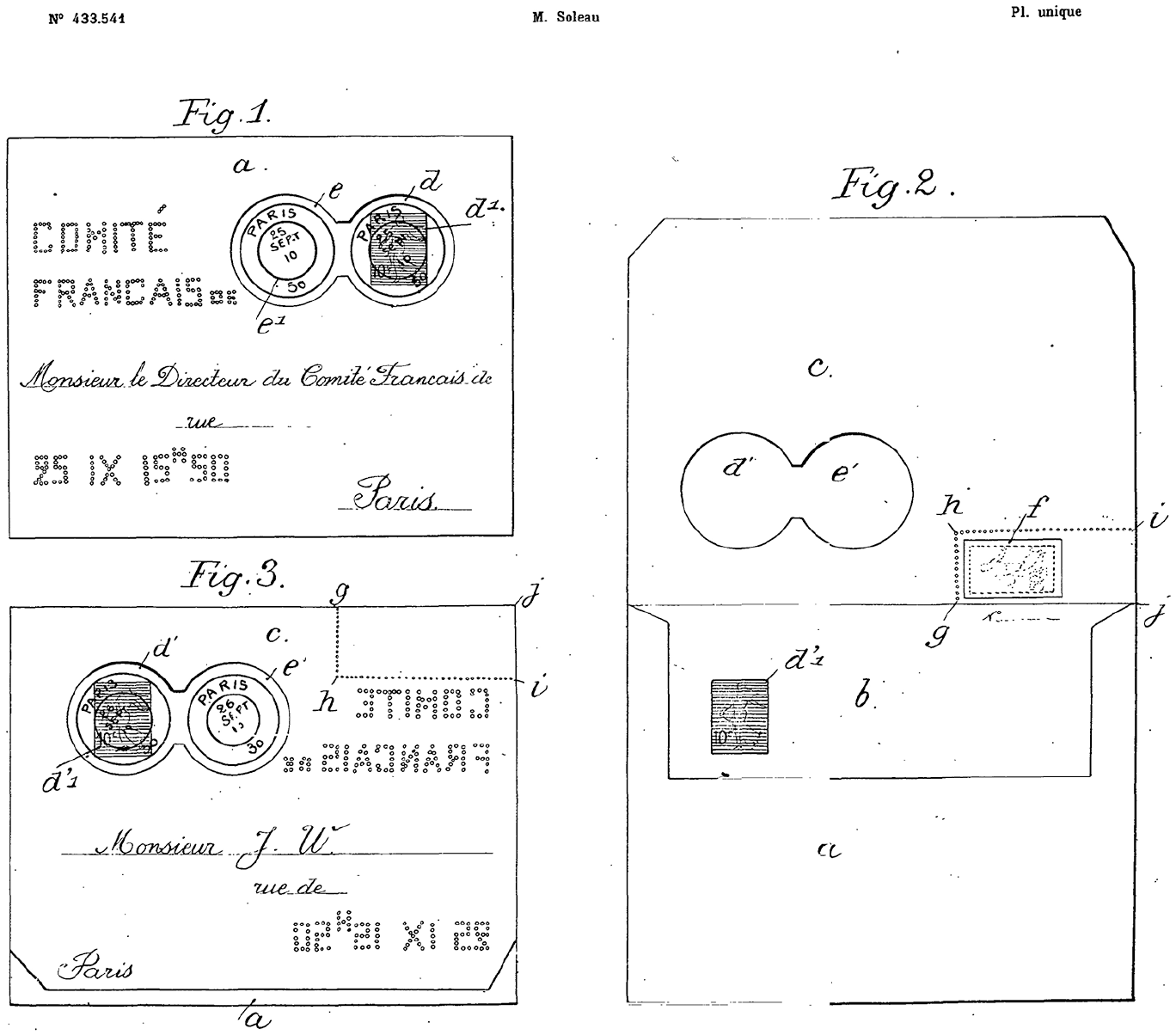
Eugene Soleau's first patent from 1910 (Brevet 443.541). Source: ESPACENET (https://worldwide.espacenet.com/patent/)
But exactly what sort of institution is the Office national de la proprieté industrielle (ONPI)? Like any other signatory to the 1883 Paris Convention for the Protection of Industrial Property, France had agreed to live up to the requirement of article 12 and provide a ‘special industrial property service and a central office for the communication to the public of patents, utility models, industrial designs, and trademarks’. 1 Service on the one hand, communication on the other. Easily confounded and hardly possible to separate definitively, one way to think about the ‘generic’ patent office in terms of a bureaucracy of paper and documents is in terms of the difference between patent systems that implemented pre-examination of patents and those that were based on registration only. As opposed to the US, Germany and many other countries at the time, France belonged in the second category. Even though forms of examination of inventions had existed, mainly through scientific institutions (Baudry, 2019) until 1968, French patents were simply issued without any governmental guarantee, or the famous caveat ‘S.G.D.G’ (Sans Garantie de Gouvernement), which left any dispute a matter for the courts. Whereas the examination system traditionally has been taken to mean a stronger and more robust patent, it also led to a much more protracted patenting process, one which in effect operated as a paper-generating machinery. The need for expertise, control, verification and determination of novelty drives the accumulation of documents. The examination system produces beneficial conditions for the study of expertise and paperwork inside the walls of the patent office (Swanson, 2009), but also in the shape of intermediaries or go-betweens such as patent agents operating both outside and inside that office (Andersson and Tell, 2016). But patent 443.541 has not been subjected to any so-called novelty search by a patent examiner, it is simply registered and then entrusted to the public. Formally, and perhaps fortuitously, Soleau does not need to prove that his envelope is a new invention.
Whereas models had once been required to accompany the specification (Biagioli, 2006; Pottage, 2001), by 1910, the patent specification was understood as a combination of textual and visual elements truthfully representing the innovation (Pottage and Sherman, 2010: 107). Given that, in a patent drawing the ‘multiplication of [visual] detail is commensurate with the complexity of the device’ (Rankin, 2011: 58), the simplicity of the enveloppe reassures; perhaps deceptively so, given the slightly vertiginous feeling that comes from looking at a document representing a document containing documents, an enfolding inscription device, one whose purpose is to transform the material object into a figure or diagram (Latour and Woolgar, 1986: 51). Visual and textual clues of the ‘highly conservative genre system’ (Foscarini, 2019: 62) that is the patent specification guide us to the reasons why we are now in the presence of a very special enveloppe. We know this for certain because of what is not there, because of the tiny perforations marking the date of arrival at the ONPI. The holes are the whole thing, because they are what turns the enveloppe into a device of authentication and paper security (Amicelle et al., 2015; Kaminska, 2020: 8). The perforating device fixing the dates is simply described as a punching machine of a well-known type (appareil emporte-pièces connu) another every-day and familiar object requiring no introduction.
So, while patent 443.541 guarantees nothing about the invention of which it is a representation, the perforated enveloppe is all about guarantees. The main objective of the invention is to protect documents that ‘if not immediately, at least later, could offer a considerable interest’ (Soleau, 1910: lines 6–7). We are looking at an invention of potential, of maybe. The documents you place inside may not be of interest right now, but they can be. In the future. Which is why it is necessary to fix, in as precise a manner as possible, the date of the creation, that certain investment you might have to defend later in court. Time is in fact so central to the intellectual property system that we tend not to see it at all. Time comes in the shape of limits on protection: copyright is 70 years after the death of the creator, for instance. And if priority is regulated by the before, legal mechanisms such as droit de suite, introduced in Belgium and in France in the 1920s (Hauser, 1959–1960) to ensure artists a certain percentage on the profits made on the resale of a painting regulate the after. Time comes in the shape of doing things in the proper order: publishing before patenting is impossible since that would make the invention an antecedent art and therefore unpatentable. In certain jurisdictions there are grace periods of 6 or 12 months before the filing of the patent which allows for precise disclosures not invalidating the novelty requirement. And trademark law, however, operates along the lines of eternity. The legal time regime is perhaps the most obvious way in which intellectual property controls the circulation of knowledge and operates differently in copyright, patent law and trademark law.
But the enveloppe has another function, too. It protects the interest inside from any alteration and keeps it secret. The capacity to make the dating hold and to act as proof stems from the power vested in the institution that stores and protects this secret something. Here, the text gives very little guidance, speaking only of the envelope’s recipient as an office, committee, society, etc. 2 A double problem of dating and secrecy/storage solved by a double enveloppe.
1911: The branded enveloppe
What we have so far is an enveloppe, but it is not the enveloppe Soleau. Not until Eugene Soleau files for an improvement of his patent on 19 October 1911 do we actually meet the enveloppe Soleau for the first time. Since its 1791 origins, French patent law allowed the inventor to deposit an improvement or addition to the original patent for ‘a new kind of perfection’ (Galvez-Behar, 2019: 35). The principal idea, the perforations, the use of standard commercial formats for the paper destined to go inside the envelope all looked the same as before. But Soleau now introduced two new and important features. First, at the very top of the face of the envelope, a new line of text on the drawing that did not feature on patent 443.541: the name Soleau attached to the function of registration by perforated control (Enveloppe
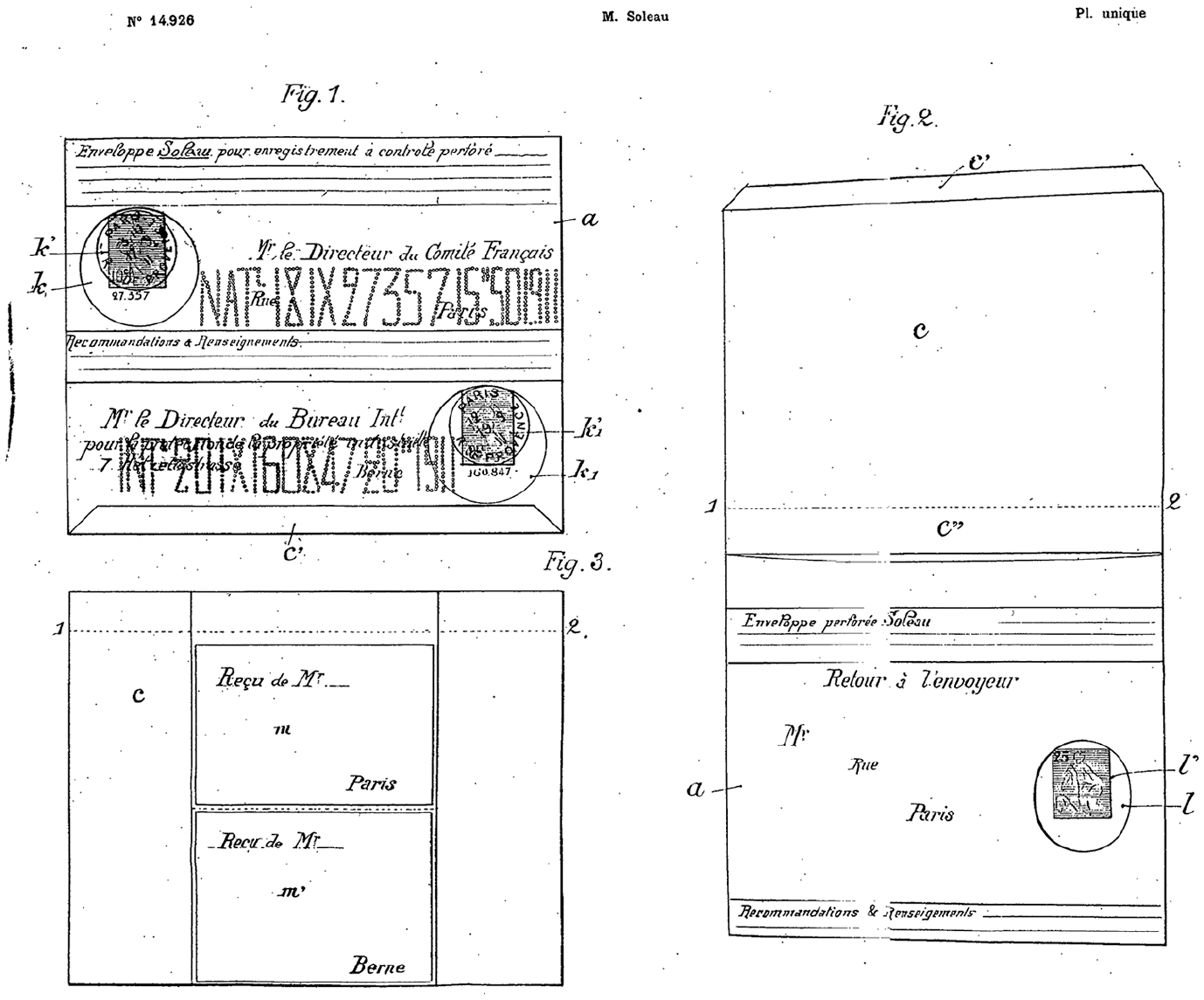
Eugene Soleau's improvement from 1911(1ère Addition au Brevet d’Invention 443.541. No 14.926). Source: ESPACENET (https://worldwide.espacenet.com/patent/)
Based on this genealogy and his own career, what sort of compounded knowledge does Soleau channel into his patent? First, perhaps, a general understanding of priority disputes being ‘a defining characteristic of the institutional culture of French science’ (Csiszar, 2018: 165). Even the French patent system, which was a system of registration and not pre-examination, pivoted on contention and courts. Then, his many years on the inside of influential organizations such as the Bureau de la Réunion des Fabricants de Bronzes. Already in his 1889 report, he had stressed the importance of accumulating proof in anticipation of possible disputes (Soleau, 1889: 71). Taking all the hard lessons learned from years of investment in the decorative arts, all his knowledge of sealed envelopes and priority via secrecy, including the abhorred 1806 loi, Soleau fuses it all in this improvement.
The other noteworthy addition is that he adds space on the envelope to include a second addressee, particularly interesting, he explains, ‘when it’s a matter of registering a document, design, etc., held secret, in two different countries, by one national bureau and one international, for instance’. As in the original patent, the French addressee is the same unidentifiable M le Directeur du Comité Français de . . . But there is nothing vague or generic about the second addressee, which is clearly spelled out as Bureaux Internationaux Réunis pour la Protection de la Propriété Intellectuelle (BIRPI), since 1896 the combined administrative seat of the Paris and Berne Conventions. Adding the two addresses, one in Paris and the other in Berne, invites and accommodates subsequent sanctioning from two administrative seats. Soleau has taken us from the receipt, via the perforated enveloppe, to the enveloppe Soleau. He has strengthened the probative value of the system/idea by his name as brand and by the direct insertion of BIRPI as addressee. What remains now is to see if the idea will take.
And only 3 years later, it would. With the décret of 10 March and arrêté from 14 March 1914, the conditions for proving the ‘priority of use of a design or model’, now allowed by the Law of 14 July 1909 on designs and models (Loi du 14 juillet 1909 sur les dessins et modèles), was set out in detail (La Propriété Industrielle, 1914: 82–83). In addition to the formalities and costs described and the designation of the ONPI as the central custodian of these documents, there is no direct reference to the enveloppe Soleau. Not until a ministerial circular (circulaire ministérielle) from 30 April of the same year, when Minister of Commerce, Industry, Post, and Telegraphs (Ministre du Commerce, de l’Industrie, des Postes et des Télégraphes), Raoul Péret, explicitly references the use of a ‘special double envelope’, designed by M Soleau for the purpose, envelopes that would be made available to interested parties a few days before the official launch of the service on 1 June 1914 (La Propriété Industrielle, 1915a: 17–19), a direct sanctioning of the branded enveloppe. BIRPI followed suit only a year later and accepted the subsequent deposit and registration of the enveloppe Soleau (La Propriété Industrielle, 1915b: 97–98), implementing more or less wholesale the French format of registration, perforation and return to sender. ONPI agreed to pay BIRPI 1 franc for each envelope the bureau had received in the preceding month. But the most important aspect of the new service offered by the bureau was that, in article 7, it extended the same provision to all countries in the Paris Union who might wish to make use of it. ONPI could terminate the agreement at any time, BIRPI with a 6-month notice, in case ‘inconveniences arose, especially, if the income for this service did not suffice to cover the costs’ (La Propriété Industrielle, 1915b: 98). Even if the enveloppe is handled by an institution, it is still clearly addressed to a person, making the body of authority both institutional and individual at the same time. With patent 443.541 and now the addition of improvement 14.926, the enveloppe is stronger and its weaknesses further offset by the combined institutional power of ONPI and BIRPI. To recapitulate: at this stage the enveloppe has not only been patented, it has become a document and service offered by the same bureaucracy. Two authorities, two recipients, two archives are now added to the patent of improvement. This makes the enveloppe stronger and more stable, but even this combined institutional backing could not offset the effects of the Great War. By 1919, only 24 enveloppes Soleau had been deposited with BIRPI (Coppieters, 1919: 54, n 1) and Soleau’s invention led a very quiet existence. Indirectly, however, the same war was also the reason why the enveloppe reappeared on the international stage a few years later, this time in the context of the controversial Report on Scientific Property, prepared by the Italian senator and Turin Law Professor Francesco Ruffini (Miller, 2008) in 1923. Later known simply as the Ruffini Report, the study had been commissioned by the International Committee on Intellectual Co-operation (ICIC), the 12-person elite corps of scholars, scientists and diplomats who since 1922 served in an advisory capacity to the newly formed League of Nations (Grandjean, 2018; Renoliet, 1999). Trying to come up with a solution to the many challenges faced by scientists in the ruins of postwar Europe, one of the major rationales of the report was how to connect priority and reward under the controversial label of scientific property. Among traditional choices like publishing or patenting, Soleau’s enveloppe appeared on Ruffini’s radar because he is willing to consider all alternatives, even the simple and unexpected. Especially the simple and unexpected. Ruffini readily admitted his initial scepticism when learning of the enveloppe: We should put our readers on their guard against an impression which we ourselves shared when this system was first explained to us. We felt that the idea was of a purely mechanical and almost childlike nature, scarcely in keeping with the seriousness of the subject. This impression, however, proved incorrect and the idea deserves careful consideration. (International Committee on Intellectual Co-operation, 1923: 22)
As opposed to the original French text, where Ruffini explicitly describes his reaction to an object, a thing, there is no mention here of a paper-artifact at all, but rather of an abstracted idea, a system. During the next few years, Ruffini would fight hard for this ‘almost childlike’ thing and idea, situating it on a par with patents and publications in terms of claiming priority. He would even insert the enveloppe Soleau in the draft Union and Convention for scientific property, where article 8 stipulated that the author of a discovery or invention may establish the object and the priority of his discovery or of his invention by sending to the international Bureau at Berne a perforated envelope of the ‘Soleau’ type, according to the procedure established in 1915 for industrial models and designs.
So, did this mean that enveloppe Soleau was about to become a very real international alternative in the international intellectual property system?
Maybe, if the quest for scientific property had been successful, which we know it was not. There was never a Convention and Union for Scientific Property to occupy the legal space in-between the Paris and Berne Conventions. The International Committee on Intellectual Co-operation folded in 1930 and, that same year, BIRPI ceased to receive and archive the perforated envelope, making the final tally 871 deposited enveloppes Soleau (La Propriété Industrielle, 1930: 244, 251). The ideological programme for scientific property seemed to have been rejected by the international community in the beginning of the 1930s, along with the material embodiment of the ideas Ruffini promoted and believed in: the enveloppe Soleau. But scientific property had not disappeared completely from the international scene. When it reappeared again it was following another devastating war and appropriately in the context of the CIC’s successor, United Nations Educational, Scientific and Cultural Organization (UNESCO). And UNESCO (1954: 54) would also reanimate the enveloppe, this time in respect to the concept of ‘scientists’ rights’.
Present day: From e-Soleau to WIPO proof
After its brief appearances on the international intergovernmental scene in the 1920s and 1950s, the enveloppe returned home, to France. Statistics are not easily come by but, in 1983, INPI reported that after 1975 they had noted a marked increase in the popularity of their service and that the total number of archived enveloppes Soleau at that time stood at 74,000 (La Propriété Industrielle, 1983: 198). Other data suggest that between 1995 and 2002 the number of enveloppes Soleau deposited with the INPI increased 33 percent, from 23,000 to 31,000 (Penin, 2008; 85). And then, in 2016, the INPI launched the e-Soleau (INPI, 2016). No need to worry about document thickness now, but rather file size. Sound and video could be submitted, access to your document was possible 24/7, the space of archiving now almost endless and the cost still modest, €15 for 10MB with €10 for each additional 10MB. Everything was different, yet familiar at the same time. Proof was still established, not by perforations, but by a stamp issued in the electronic archiving system of the INPI (Système d’Archivage Electronique de l’INPI), and an e-mail generated receipt. The enveloppe Soleau had become the e-Soleau. All the gestures of folding paper, filing and dating, of perforations, the elements of paperwork that helped institutions and individuals to secure the place of the enveloppe Soleau as proof now take place via the screen. There are still devices, but now in the shape of algorithms, security devices inside laptops, the amalgamation of hardware and software. Servers rather than filing cabinets, digital locks rather than perforations, folders rather than files. And yet, the same function, practically the same cost, and definitely the same guardian (see Figure 4). Only two years later, in 2018, the European Union Intellectual Property Office (EUIPO) published a feasibility study which considered the possible benefits of an EU Digital Deposit System, looking at the enveloppe Soleau as a benchmark example for such a pan-European system.
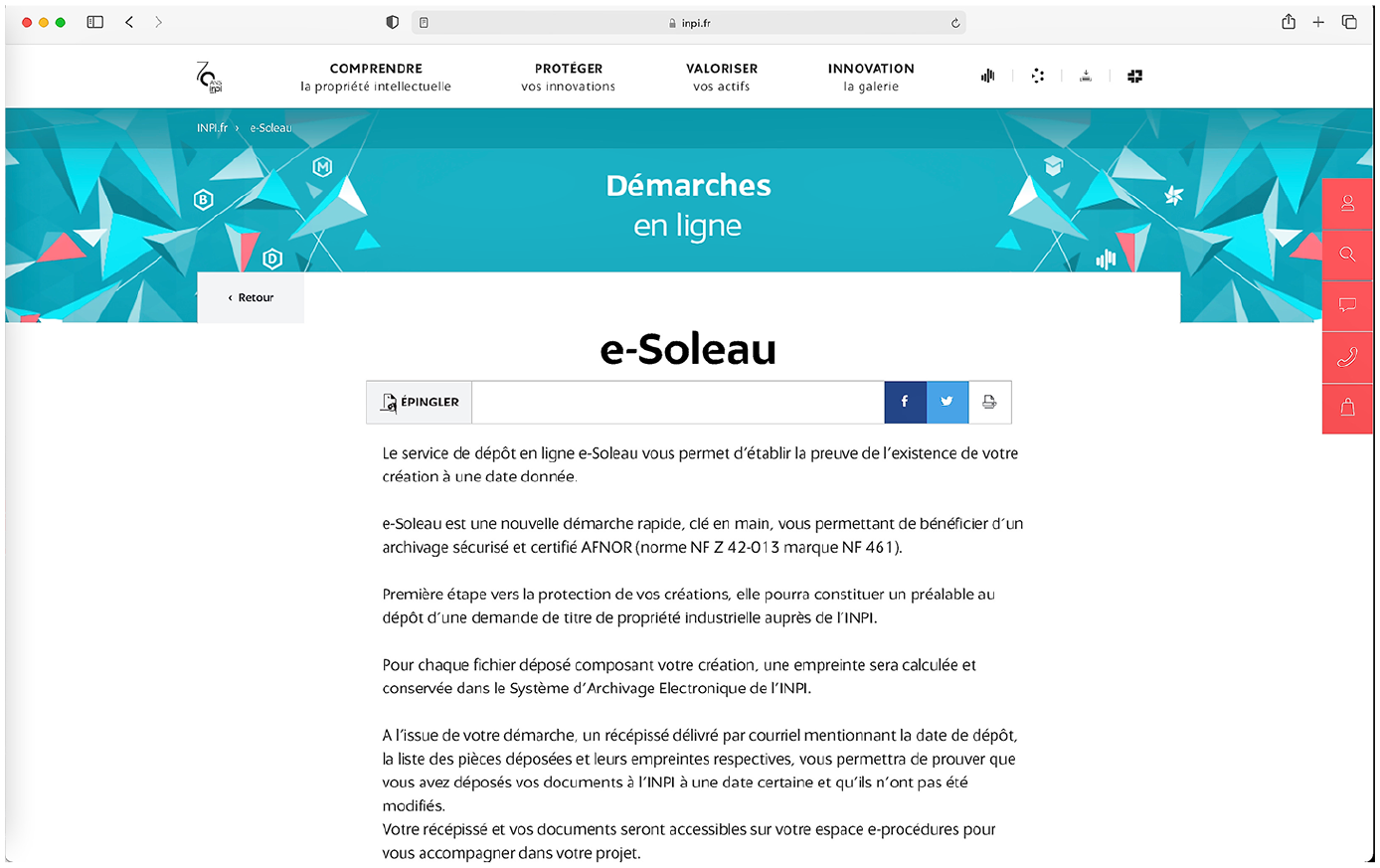
Screenshot of the e-Soleau service on the INPI website (https://www.inpi.fr/fr) (accessed 4 June 2021).
From receipt in 1889, to perforated enveloppe in 1910, to the branded enveloppe Soleau in 1911, the e-Soleau in 2016 and as a possible best-practice template for a pan-European digital deposit system two years later, what do we know about this bureaucratic document in its various materializations? We know that it offers no intellectual property protection, that it is valid only for ten years, and only in France. We know that it lives on, not only in a traditional paper version, but also in megabytes. Furthermore, we know that almost everything about the enveloppe Soleau seems to place it outside the intellectual property system. But how can you be outside a system that you are in effect an intrinsic part of? The enveloppe Soleau is a service sanctioned by, indeed only offered by, the INPI.
In the introduction, I argue that the enveloppe was not only a technology of paper but of time. First because it can be used to establish what in article L.613-7 of Code de la propriété intellectuelle français is called le droit de possession personnelle antérieure, or ‘right of prior possession’. This right of the ‘before’ – most frequently secured by enveloppe Soleau but also enforceable through certain other documents – allows you to continue to manufacture and commercialize an invention that you have kept secret (inside an envelope, for instance), even if the same invention is later patented by someone else. It is something like a ‘use-right’, carved out because of the particularities of a first-to-file system, where the patent is awarded to the person/corporation/institution who files the patent, not the inventor (Penin, 2008). This ‘use-right’ is a major reason why the enveloppe Soleau is profoundly embedded in the intellectual property system, yet apart from it at the same time.
The second role of the enveloppe Soleau is to buy time. In his 1923 report on scientific property, Francesco Ruffini argued that, while the enveloppe really was a one-size-fits-all kind of solution, it was especially suited for a ‘preliminary conception which is maturing’ (International Committee on Intellectual Co-operation, 1923: 22). The EUIPO feasibility study from 2018 echoes this particular function: ‘that it could be a significant first step in the innovation process, that is, in the preliminary phase of an application for a design or a patent’ (EUIPO, 2018: 4). Here, the enveloppe Soleau is a first step into rather than out of the intellectual property system. Time is money, and the intellectual property system as a whole, certainly patents, is not only a time-consuming activity but one that requires deep pockets. In the buyer-of-time role, our enveloppe, regardless of form, becomes further assimilated into, not further distanced from, the patent system and the logic of intellectual property.
We also know that the function performed by the enveloppe Soleau does not begin with Eugène Soleau, his writings or patents, but goes back centuries, to early modern practices where sending secret information to some sort of trusted safekeeping rested on established traditions in science as well as in craft and manufacturing. The need to have a method, idea, or innovation resting as information inside an envelope with the potential of disclosure varying from days, months, to simply a century, remain intact and has travelled across knowledge regimes, materialities and historical periods. A professional organization like Ingénieurs et Scientifiques de France (IESF) have their own system of sealed notes, with specific regulations in terms of archiving and destruction. Even journals have offered themselves as repositories of sealed notes (Scientific American, 1933). L’Académie des Sciences in Paris continues to receive and archive sealed envelopes (plis cachetés) to this day. Costs vary from zero (Académie) to 99€ (IESF) even when both institutions offer the same century-long protection. In 1969, the United States Trademark and Patent Office (USTPO) introduced ‘The Disclosure Document Program’, offering a two-year protection at the cost of $10. Similar in logic to the enveloppe (Kupferschmid, 1993: 244) but with much less probative value, the service was discontinued in 2007 following the introduction of the ‘provisional patent application’ in 1995, which permitted filing ‘without a formal patent claim, oath or declaration, or any information disclosure (prior art) statement’ (USTPO, 2021). The increasing formalization of a print-based patent and publication-system of disclosure did not make sealed notes obsolete. As a response to ‘unavoidable risks inherent in the process of publication and priority claiming’ (Biagioli, 2012: 213), the enveloppe Soleau does what it claims to do. In an extremely complex and expensive intellectual property system, it offers simple and cheap evidence offsetting unavoidable risk and enabling protection of valuable knowledge, continuing to do so in a digital arena where the need to establish priority and buying time has lost nothing of its attractiveness.
The French National Institute of Industrial Property has obviously been central in this narrative. But the most recent version of this service of secrecy comes not from INPI but from the second major institution that prefigured so prominently in the formation of the enveloppe, Bureaux Internationaux Réunis pour la Protection de la Propriété Intellectuelle (BIRPI). We first saw BIRPI alongside ONPI when Soleau affixed both institutions as recipients of the enveloppe on his (1911) patent of improvement. We met BIRPI again when it entered into an agreement with the ONPI to archive the enveloppe Soleau between 1915–1930. At the height of the heated discussions on the pros and cons of scientific property (of which there were decidedly more negative than positive voices), BIRPI was certainly not convinced that scientific property deserved either Union or Convention. BIRPI was even – despite its then alliance with ONPI – torn about the virtues of the enveloppe. Which is why BIRPI Director Ernst Röthlisberger’s concession in 1923 that ‘from now on, one might investigate if the enveloppe Soleau could not help in fixing the priority of all manifestations of the mind, in all creations of a literary or artistic order’ (Röthlisberger, 1923: 23), is worth keeping in mind.
Today, BIRPI is known as The World Intellectual Property Organization (WIPO), the self-funding United Nations agency responsible for all things intellectual property, at present consisting of 193 member states. And, in 2020, 90 years after BIRPI ceased to receive and archive the enveloppe Soleau, WIPO launched WIPO Proof (WIPO, 2020b). But the last instantiation of the enveloppe in this article comes without any trace either of Soleau, nor of the ‘flat paper container’, that carries his last name. Yet, WIPO Proof does not materialize from nothing. In fact, it is difficult to look at the new service to protect what is now framed as ‘intellectual assets’, without recalling the material and institutional history of the enveloppe. From the Lyonnaise textile industry and the prud’hommes tribunals, over to the institutional backing by ONPI and BIRPI, through the controversies of the association with scientific property, over to the e-Soleau, it is a route with many forks in it, but a route, nonetheless.
What WIPO Proof sets out to protect is not far removed from Röthlisberger’s (1923) ‘all manifestations of the mind’, including ‘trade secrets to scripts, musical scores and other creative works, to research results, large data sets, artificial intelligence algorithms, or any business record’ (WIPO, 2020a). A one-stop priority shop for all fields, secured now by a token, ‘a unique fingerprint of your digital file, dated and timestamped the second it is created. You receive your token and another copy is stored securely on WIPO servers in Switzerland.’ A service of secrecy at a bargain price, proof, archiving, storage, but with one major difference to its French predecessor. WIPO Proof is offered, not by a national Patent Office, but by the major international intellectual property body with enough clout to make it function as international proof.
All in all, we know quite a lot about how this bureaucratic document came to be and what it does. But there are many things we do not know or are prevented from knowing. We do not know what is inside. Because its rationale is secrecy and destruction waits at the end of the 10-year storage, we know very little about who has used or continues to make use of the service. We need to open the enveloppe to learn in what sectors and for what interests it was and is used, be it for a blue colour or a business method. But as Julien Penin (2008: 98) has noted, any systematic empirical investigation into the enveloppe Soleau is severely curtailed. We know about Yves Klein’s enveloppe because it still exists as a document inserted among other documents in the archive of the artist. That we only have the sender himself to thank for its survival is not because the INPI accidentally destroyed (IDEELART, 2018) their copy, but because destruction was the whole point from the start.
In that sense, ‘what is being kept secret is not even relevant for studying the dynamics of secrecy’ (Vermeir and Margocsy, 2012: 160). Sealed or not, we can still trace the enveloppe in the infrastructure of intellectual property. There is no doubt that patent specifications represent crucial empirical sources in the study of the history of technology (Durack, 2001; Israel and Rosenberg, 1991; Reingold, 1960). Increasingly digitized and located via databases such as the European Patent Office’s ESPACENET and the rabbit hole that is Google Patents, patent records like Soleau’s two patents from 1910 and 1911 are easy to find. But, while there is an abundance of documents of innovations, designs, models that can now be accessed thanks to digitization, other records are obscured in that process. This includes enveloppe Soleau records that remain – for obvious reasons – excluded from INPI digitization initiatives (Darnand and Tinoco, 2016: 80). Yet, I had still expected that, in addition to the four different materializations of the enveloppe which I have traced in this article, there would have been minutes, reports, correspondence from within the institution which provides this object and service: within the INPI but certainly between the INPI and BIRPI. These documents have proven elusive to identify and even more elusive to access. 3 The proliferation of records at one end, and the absence of them at another is perhaps what Peter Drahos had in mind when he stated that, ‘we know much more about the history of the patent law than we do about the history of its administration’ (Drahos, 2010: 91). But, if we agree with David Pretel (2018: 11) that ‘patent institutions are not only systems granting monopolies but – as standardised repositories that recorded appropriated technological knowledge – information systems’, then any further commitment to a study of this particular information system as one of ‘paperwork’, must also include the records of the institution itself, the traces of its internal bureaucracy, and not just the patents themselves.
Almost a text-book example of Bruno Latour’s (1986: 7) ‘immutable mobile’, our enveloppe undoubtedly proved to be transportable, but also ‘presentable, readable and combinable’, within this repertoire of options, mobilizing constellations of networks of objects and institutions on its behalf. As the enveloppe Soleau circulated, it was sent between worlds, transported on the liminal border between what we think of as the outside and inside of the intellectual property system. We have passed through a number of material and institutional movements in the history of the enveloppe Soleau which showed its many guises; a confluence of a particular materiality (the patented double envelope); a formalized process of proof (where perforations take on legal significance); the authority of the office as an archiving institution (from ONPI in 1910 to WIPO in 2021); and the mediator of temporality (a decade, a potential, something that can become valuable). Powerful and durable strengths that, when you think of it, are not too bad for an object that Francesco Ruffini in his ICIC Report in 1923 (see Miller, 2008) admitted to having wrongly and much too quickly dismissed as merely ‘mechanical and almost childlike’.
Footnotes
Acknowledgements
Previous versions of this text were presented at the 2019 ISHTIP (International Society for the History and Theory of Intellectual Property) workshop ‘Intellectual Property and the Visual’, University of Technology, Sydney, 4–6 July 2019 and at the conference ‘The Dialectic of Private and Public Knowledge in Early Modern Europe’, organized by Patricia Ahmed, Rebecca Jean Emigh and Dylan Riley at the Williams Andrew Clarke Memorial Library, Los Angeles, 12 April 2019. The author wishes to thank José Bellido, Johanna Dahlin, Martin Fredriksson, Björn Hammarfelt, Gabriel Galvez-Behar, Hyo Yoon Kang, Mattis Karlsson, Gustav Källstrand, Johan Larson Lindal, Annika Olsson, Nofar Sheffi, Isabelle Strömstedt, Per Wirtén and the two anonymous Journal of Material Culture reviewers for their valuable comments and input.
Declaration of Conflicting Interests
The author declared no potential conflicts of interest with respect to the research, authorship and publication of this article.
Funding
The author disclosed receipt of the following financial support for the research, authorship, and/or publication of this article: This research was funded by a grant from the European Research Council (ERC) under the European Union’s Horizon 2020 research and innovation programme (Grant Agreement No. 741095-PASSIM-ERC-2016-AdG).
Notes
Author biography
 , this essay was written as part of her 2016 ERC Advanced Investigator Grant for the project “Patents as Scientific Information, 1895–2020” (PASSIM). Her most recent book, Making Marie Curie: Intellectual Property and Celebrity Culture in an Age of Information was published by University of Chicago Press in 2015.