




Abstract
The German and Allied bombing of Rotterdam in the Second World War caused thousands of dead and hundreds of missing, and severely damaged the Dutch port city. The joint destruction of people and their built environment made the ruins and rubble stand metonymically for the dead when they could not be mentioned in the censored press. The contiguity of ruins, rubble, corpses and human remains was not only semantic but also material because of the intermingling and even amalgamation of organic and inorganic remains into anthropomineral debris. The hybrid matter was dumped in rivers and canals to create broad avenues and a modern city centre. This article argues that Rotterdam’s semantic and material metonyms of destruction were generated by the contiguity, entanglement, and post-mortem and post-ruination agencies of the dead and the destroyed city centre. This analysis provides insight into the interaction and co-constitution of human and material remains in war.
Ossip Zadkine’s sculpture The Destroyed City has become an icon of the German bombardment of Rotterdam on 14 May 1940. Unveiled in 1953 on an empty plain at an inland harbour, the 6-metre high male figure (see Figure 1) has a prominent hole where the heart once was. Zadkine recalled in 1951 his impression of Rotterdam during a brief visit in 1946: An immense wasteland that extended from the railway station as far as the eye could see. Pools of dirty, putrid and greenish water alternated with flatlands where evil nameless weeds were twisting in the wind . . . A blackened torn open church arose there, like a molar tooth of a prehistoric animal spat out by a volcano. (Het Vrije Volk, 1951)
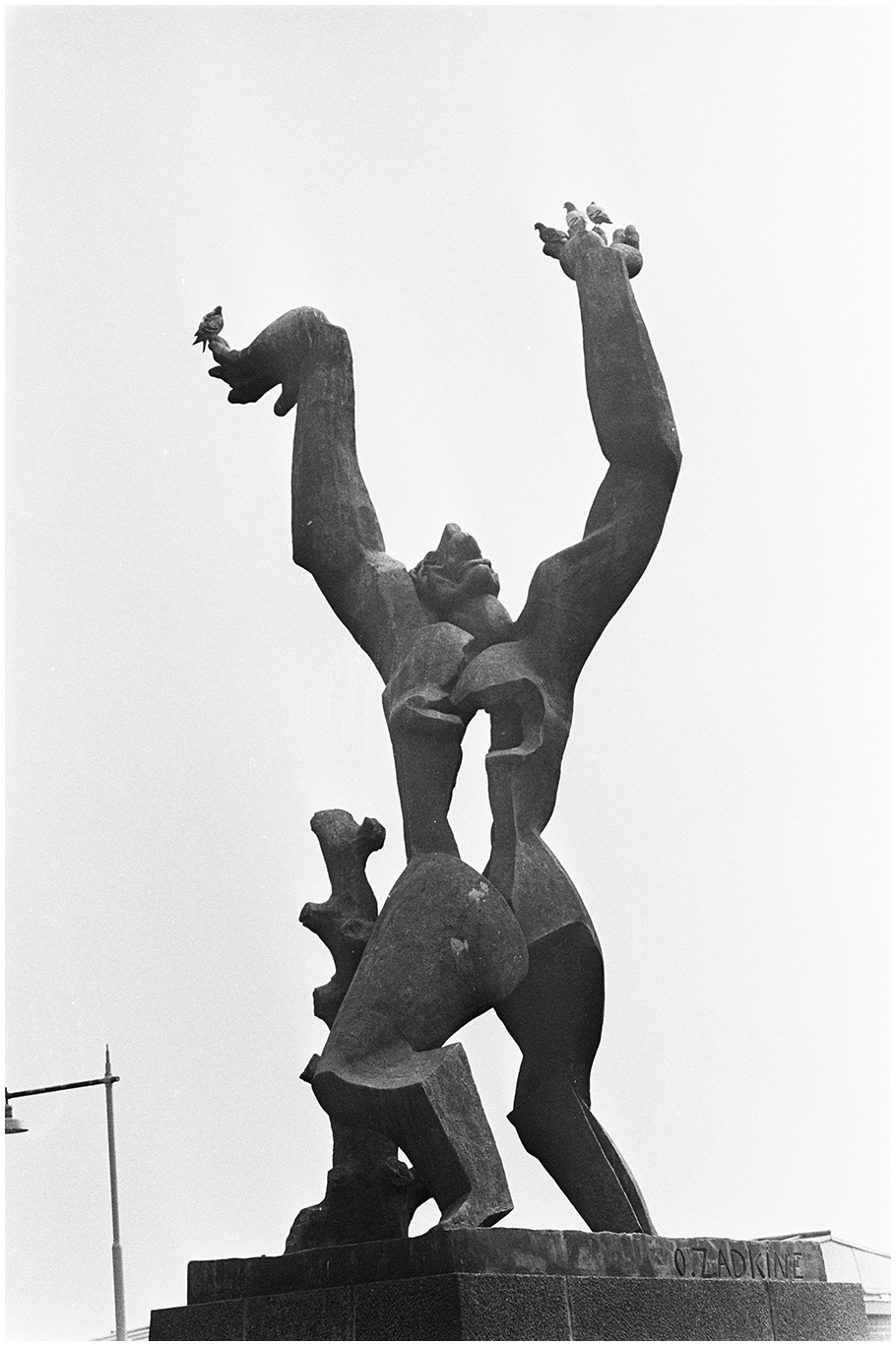
Ossip Zadkine, The Destroyed City. © Photo: Ron Kroon (Wikimedia Commons file 920-7142).
The hole in the figure’s trunk has been commonly understood as a metaphor for Rotterdam’s destroyed city centre, as the artist intended, and the raised arms suggest both hope and despair (Bleij and Halbertsma, 1994: 70; Strupp, 2009: 32; Van Ginkel, 2011: 668–671). These meanings gave the bronze sculpture its iconic status and show that material objects can serve as metaphors for death and destruction that mediate the experience and remembrance of painful losses. Such objects may be sculptures, photos and, of course, ruins (see Arnold, 2011; Crew, 2017; Hallam and Hockey, 2001; Sebald, 2004). Ruins have served, inter alia, as metaphors for the destructive forces of nature (Hetzler, 1988; Simmel, 1959), temporality and the forces of history (Dawdy, 2016; Huyssen, 2006; Woodward, 2001) and the crises, contradictions and affects of capitalism, communism and (post)colonialism (Gordillo, 2014; Hell and Schönle, 2010; Navaro-Yashin, 2012; Stoller, 2008).
This article argues that ruins can also stand metonymically for death. For example, one Dutch newspaper wrote on the day after the German bombardment and Rotterdam’s surrender: ‘Rotterdam is a pile of rubble. Its great traffic artery has been cut. The Coolsingel, which was to become a proud avenue where life and amusement would reign, is dead’ (Delftsche Courant, 1940): the reporter described the avenue with a metaphor (‘great artery’) and used a metonym (‘the Coolsingel . . . is dead’) to convey that its residents had also perished. He did not refer directly to the dead because of German censorship. Instead, Alex Pieter Iburg (1940–1941) mentioned the dead explicitly in his diary: The corpses are just loaded in stacks on trucks. They are also transported with the garbage truck. There are still many under the rubble. The weather is warm, and the city is very hot because of the fires. The smell of corpses is quickly becoming terrible.
The reporter’s description of the Coolsingel as a dead avenue is metonymic because a metonym is a figure of speech in which the name of a thing (the dead) is substituted for the name of a related thing (the avenue), such as ‘a glass’ for the beer it contains or ‘a city’ for its inhabitants. The closely related term ‘metaphor’ is a figure of speech that draws an analogy between two terms by transferring the meaning of one word to another, as in calling a camel ‘the ship of the desert’ or as in ‘the war correspondent bombarded the captain with questions.’ A metaphor creates meaning by connecting two separate conceptual domains. ‘By contrast with metaphor, metonymy only involves one conceptual domain, so metonymic mapping occurs within a single domain rather than across domains’ (Tilley, 1999: 5; see also Lakoff and Johnson, 2003: 265). Put another way, ‘metaphor is based on a relationship of similarity while metonymy is based on a relationship of contiguity’ (Knappett, 2005: 100).
Relationships of contiguity and similarity between ruins and the dead are not exclusively semantic but may also be material. Dawdy (2016: 153–155) has shown how inhabitants of New Orleans noticed that some decaying houses became haunted by ghosts after Hurricane Katrina hit the city in 2005, and thus established a contiguous relationship between these ruins and their dead residents. Moshenka has perceived a relationship of similarity between ruins and people’s memories of German cities bombed during the Second World War. A preserved ruin is a heritage site that serves as ‘a potent physical metaphor for memory’ (Moshenka, 2009: 50). Just as Zadkine’s sculpture The Destroyed City is a material metaphor because one object (the sculpture) refers to another (the city centre in ruins), so bombardments can give rise to material metonyms through the violent interaction of buildings and people. An understanding of these material metonyms can be enriched by the semiotic approach to forensic evidence developed by Crossland. Crossland (2009: 71–74, 2018: 626–631) demonstrates how an assassination is revealed in physical traces interpreted as forensic evidence, such as the corpse, finger prints and crime scene photos. These traces are indexical signs of the violent act. As indexical signs, they are not immutable pieces of evidence but they have agency by way of their metonymic meanings and relations: The dead body . . . is endowed with force and potential to act. The indexicality of the dead body always brings it into relation with something else, whether its own past and identity or a history of violence enacted on it. (Crossland, 2009: 76)
The bombardment of Rotterdam brought the dead into violent association with the built environment and thus created material metonyms that consisted of entangled organic and inorganic remains. Ruins, rubble, corpses and shattered human remains indexed the devastating bombardment and manifested their indexical relations through the constituent post-mortem and post-ruination agencies. 1
The agency of things has been conceptualized by many scholars who, nevertheless, disagree about whether or not things have intentionality, namely the capacity of purposeful action (see Gell, 1998; Hodder, 2012; Knappett, 2005; Latour, 1999; Malafouris, 2013; Miller, 2005). For example, Knappett and Malafouris are scholarly collaborators who agree that things have agency, but Knappett (2005: 22) argues that ‘intentionality is a human trait’, whereas Malafouris (2013: 149) states that, ‘Agency and intentionality may not be innate properties of things, but they are not innate properties of humans either.’ Malafouris, and also Hodder (2012), argue that agency and intentionality emerge processually from the engagement of people and things. My position in this debate is that people and things have agency, but that only humans have intentionality. The reason for this is that human beings have a consciousness and can decide to exercise particular actions, even though the choices of action may be constrained by others and subject to material limitations. Of course, things and objects are not static. 2 They may undergo changes without human interference, but these transformations are dependent on their material properties and the contextual circumstances in which they exist. Instead of intentionality, things have affordances or potentialities that can be used by people for their actions, as Knappett (2005: 44) has stated succinctly: ‘Cognition and perception are geared toward tracking possibilities for action in the world, and objects in that world are recognized and perceived in terms of the possible actions they might afford.’
The death of people and the destruction of buildings negatively affect intentionalities and affordances but do not eliminate their agencies altogether. The agency of people turns into the post-mortem agency of corpses and human remains because the lifeless body belonged to ‘a sentient being who had strong emotional and social ties to other people and objects’ (Tung, 2014: 449; see also Fontein, 2010; Hallam and Hockey, 2001; Harper, 2010). Corpses do not just have post-mortem agencies because they have spiritual afterlives and influence the lives of the bereaved, but corpses also interact with the material world around them. Likewise, destruction does not finish the agency of buildings. Ruins and rubble seldom end up permanently as waste on a dumping ground because material agencies transform into post-ruination agencies that ensue new affordances and meanings. Through human intervention, these affordances may enable the production of objects that again have material agency. For example, ruins are restored back into functioning buildings or become museums and performance centres, while rubble can be used as construction material, preserved as a memorial site or re-assembled into the ruin it once was but which now carries other meanings. Gordillo (2014) has shown precisely this resurgence of material agency in his analysis of the remnants of colonial, postcolonial and capitalist exploits in Argentina’s Andean foothills. The ruins of frontier towns, forts and churches became inhabited by the spirits of slaughtered natives and were cursed with negative energies that produced all sorts of disasters and became places where local people gather to share memories and venerate saints. Also, ruins were turned to rubble that was used as construction material. The relevance of Gordillo’s work here is that he shows how local people mediated the post-ruination agencies of ruins and rubble to create new meanings, material agencies and affordances. In the case of Rotterdam, the contiguity, intermingling and post-mortem and post-ruination agencies of material and human organic remains generated semantic and material metonyms of destruction that indexed the aerial attacks. These metonyms revealed the violence done to Rotterdam’s population and the built environment during the Second World War, and how organic and inorganic remains were co-constituted and resignified.
The analysis of post-Katrina ruins by Dawdy (2016) demonstrates the consequences of post-mortem and post-ruination agencies for intentionalities and affordances. The agency of unstable ruins became manifested in haunted houses and the indexical traces of slavery and French colonialism. The ruins also evoked memories and affects about Hurricane Katrina and revealed the socioeconomic inequalities among the inhabitants of New Orleans. Post-ruination agency made affordances visible whose realization depended on human intentionality. Damaged historical buildings in the French Quarter were restored by the tourist industry, but ruins in prosperous neighbourhoods were demolished to build new homes for their wealthy owners. These residents erased not only the damaged houses but with them the painful reminders of Hurricane Katrina. Finally, ruined homes in poorer neighbourhoods slowly decayed for lack of federal aid, enabling the ghosts of dead residents to repossess them. These dilapidated houses indexed the ongoing tragedy, trauma and poverty of the destitute survivors.
This article starts with a description of the German bombardment of Rotterdam on 14 May 1940 and shows how the demolition of damaged buildings, and the sorting and removal of rubble, created multiple affordances. The following section demonstrates how the semantic metonyms emerged in the news media after the German bombardment and changed when Allied bombers began to attack the port of Rotterdam. The final section analyses the material metonyms of entangled organic and inorganic remains, and the uncanniness of amalgamated matter. I conclude that semantic and material metonyms of destruction reveal the contiguity of the bombing victims and their destroyed environment, and suggest that this approach to the study of bombed cities and populations can be extended to research on urban destruction in other wars and armed conflicts. The article is based on diaries, oral accounts, local newspapers and official documents, but in the awareness that these were produced under military occupation and German censorship.
Rotterdam in ruins and rubble
The bombardment of 14 May 1940 took only 13 minutes, but the loss was extensive. Around 850 people died, 80,000 became homeless and 11,000 buildings were destroyed or damaged (Gemeente Rotterdam, 1941: appendix 13). The survivors fled the city en masse. The local authorities immediately organized search crews to find the bombing victims. The dead were taken to Crooswijk General Cemetery or temporarily stored at corpse collection posts (Robben, 2019: 78). The city administration was less decisive about the ruined centre, according to Willem Valderpoort, head of Rotterdam’s Building Inspection: So on the morning of the 15th of May we stood before the question: What to do now? It was obvious that the city had to be cleaned up, and that the rubble on the streets should be cleared to enable the flow of traffic again.
3
The decision was taken by Lieutenant-Colonel Dietrich von Choltitz, who had become Rotterdam’s military commander after the city’s unconditional surrender only hours after the bombardment. He ordered Mayor Oud to clear the main streets and create two large East–West and North-South corridors for the passage of German troops. He also issued the order that the taking of photographs of ruins was strictly forbidden (Roelofsz, 1989: 16).
The rubble on the streets was removed first and then a large work force was mobilized for the extensive clearance of the ruined city centre. Within three days of the bombardment, 36,000 unemployed men were registered under the penalty of not receiving social benefits. One week later, 25,000 men were employed as rubble workers because many unemployed were unsuited for the job. The number declined to 18,000 by June 1940 and fell progressively to 4,000 workers on 4 November when the rubble clearing ended officially. The remaining work force would now dig out the foundations of the demolished buildings. 4
City officials disagreed in May 1940 about what to do with the damaged historical buildings: leave them untouched for later restoration, preserve the façades or save only the architectural ornaments for their future display in a museum. In late May, the Building Inspection compiled a list of 144 buildings suitable for restoration (Van der Pauw, 2006: 180–182). Several citizens also volunteered suggestions. One building constructor proposed levelling the ruins and building a new city on top. The raised plateau would prevent the city below sea level from ever flooding again. Someone else wanted to create a rubble mound as a memorial site. 5 Nothing came of these plans because the Dutch government’s commissioner for reconstruction, Johannes Ringers, took the decision to raze the entire city centre (Van der Pauw, 2006: 181). On 21 May, a government official wrote to the city administration: ‘it is a hopeless task to try to preserve a few privately-owned buildings in the affected area. A new city has to be constructed and one shouldn’t tie the incoming urban planner down to any existing buildings’ (Roelofsz, 1989: 18). However, the problem was that Dutch and German city planners had different ideas about the city’s future.
Rotterdam’s port had expanded considerably during the interbellum and this was causing growing traffic congestion. Several small circulation problems were solved but a more far-reaching plan, which included the demolition of historical buildings to make way for broad traffic lanes, was successfully opposed in the 1930s by the city council and a committee of concerned citizens. The bombardment of 14 May 1940 seemed to give city planners the opportunity to implement their comprehensive urban plan and dismantle many old buildings (pp. 18–20). Furthermore, Rotterdam was regarded as a blue-collar town that lacked the cultural finesse and architectural allure of a city like Amsterdam. Hitler approved the Dutch redevelopment plan provisionally in January 1941, but urged Dutch planners to show more ambition. He wanted to turn Rotterdam into a strategic port of the Greater Germanic Reich after its victory over Great Britain (Roelofsz, 1989: 128; Van der Pauw, 2006: 263–264).
The importance of an existing pre-war plan for the redevelopment of Rotterdam becomes clear through a comparison with London. The Blitz of 1940–1941 caused extensive damage to London and, as in Rotterdam, clearance operations were undertaken energetically. The difference between the two cities existed in the rubble’s destination. Valuable materials, especially steel, were salvaged in London but much rubble was transported to dumping grounds or sunk thoughtlessly in the London Docks, which later had to be dredged again (Woolven, 2013: 67). In Rotterdam, instead, the clearance operations were integrated into the redevelopment plans which prevented the improvised disposal of rubble that occurred in London.
All damaged buildings were expropriated on 24 May 1940. Only City Hall, the Central Post Office, the New Stock Exchange, the St Lawrence Church (see Figure 2), the Schielandshuis Museum and an art nouveau building, known as the White House, were saved from demolition because of their historical value (La Rivière, 2012). Other restorable buildings were sacrificed to an ambitious urban plan that mobilized a large work force that had become available after the German bombardment of factories and harbours.
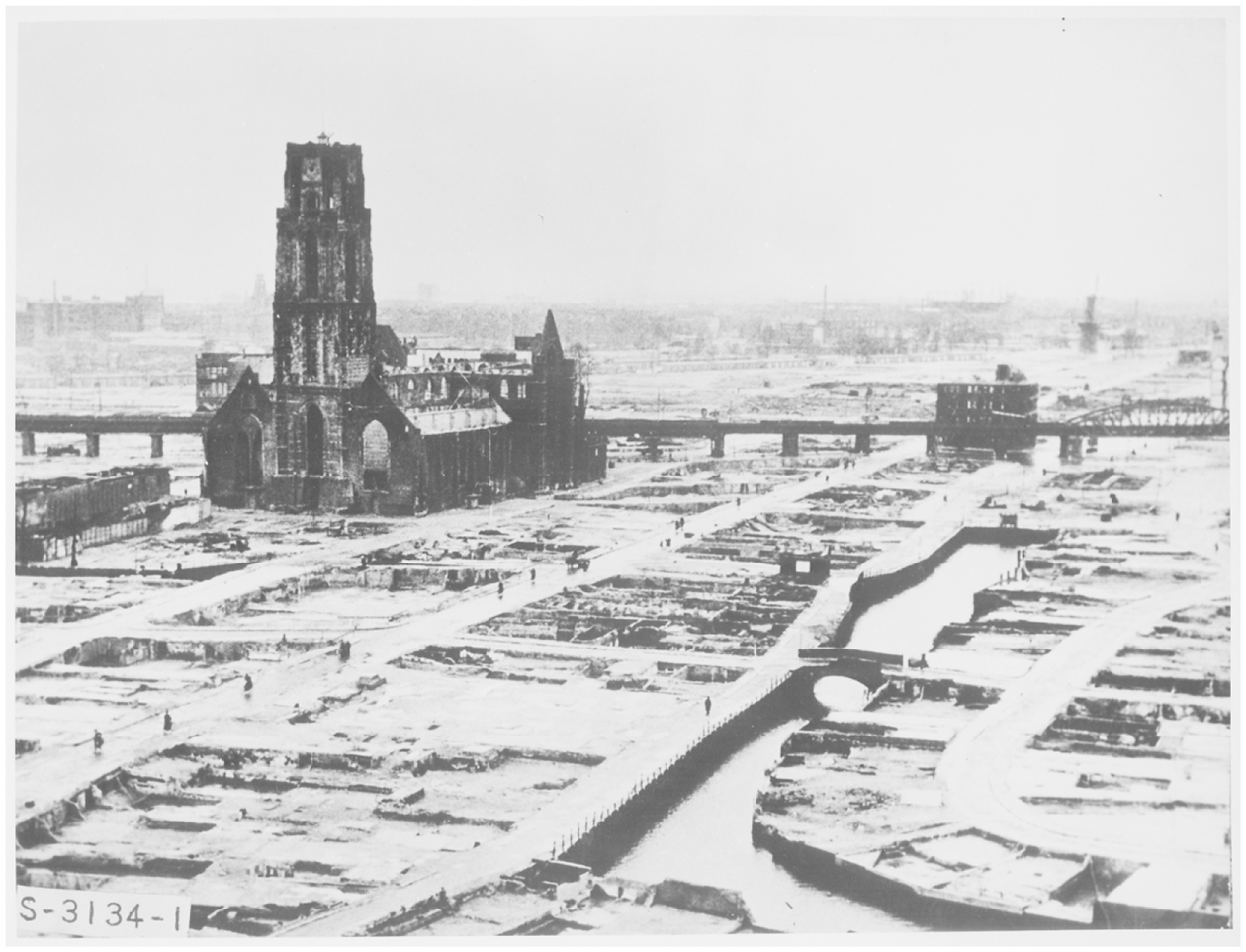
St Lawrence Church in Rotterdam’s cleared city centre. Photo: Unknown (Wikimedia Commons).
The interaction of matter, tools and labour revealed that Rotterdam’s destroyed centre was a complex collection of materials. The material properties of ruins, rubble and foundations were reflected in the tools used for their removal. Steel cables and winches were needed to pull down walls. Sledge hammers, wrecking bars and pick-axes broke large chunks of concrete into small pieces. Spades and pitch forks loaded the wheelbarrows with rubble and more than one thousand motorized vehicles transported everything to various locations. 6 Once most ruins had been demolished and the rubble cleared, pneumatic hammers, cutting torches and dynamite were required to remove the foundations. Finally, 162,000 driven timber piles were pulled from Rotterdam’s weak soil (Roelofsz, 1989: 200). These activities brought unexpected archaeological remains to light. A special crew was formed in mid-October 1940 to recover ceramic tiles dating from the 16th and 17th centuries. 7
Rubble was deposited along Rotterdam’s river front and especially in several city canals and the Schie River to construct avenues that would solve the pre-war traffic congestion (Roelofsz, 1989: 24). There were also buyers for the five million cubic metres of rubble. It was sold to the Ministry of Water Management for the reinforcement of dikes and to construction companies that paved roads and built runways for the Luftwaffe at Schiphol and Leeuwarden airports. Soon, these buyers were dissatisfied with the bulk offered. They wanted particular types of rubble. Their specific demands revealed the affordances of Rotterdam’s pile of rubble. 8
The generic term ‘rubble’ was subdivided into stone, wood and metal rubble. Most rubble fell in the first category and was sorted into coarse rubble, clean rubble, clinker rubble, reusable bricks and natural stone, such as marble and granite. Wood rubble was left unsorted. Metal rubble consisted of usable, reusable and scrap metal. The 62,000 tons of iron were sorted into iron beams, short irons, and short and long rebars. The non-ferrous metals were zinc, lead, red and yellow copper, tin and aluminium. Remarkably, the word ‘rubble’ continued to be applied to these materials that had been transformed from unsorted rubble into particular construction materials. Finally, stoves, heaters, radiators, gas, water and electricity meters, and water and gas pipes, were also collected (Van der Pauw, 2006: 193). 9
The materiality and fate of an entire city became visible through the clearance operations. The ruins and rubble indexed the massive bombardment, while the demolition of damaged buildings and the sorting of rubble revealed the post-ruination agencies and affordances. The tearing down of standing walls deprived Rotterdam’s ruins of their affordance as renovated buildings, turning them into heaps of rubble that enabled new affordances as reusable resources. The sorting exposed also the post-mortem agencies of the dead. For months, carbonized and skeletal remains were found, as Mrs Van Ouwerkerk-Boerlage observed on 27 July 1940: I saw a tin pan being taken out of the rubble with in it a tangle of white scorched bones. These were the human remains of people who had lost their lives on the 14th of May in that hell of fire. I asked one of the rubble clearers: ‘Of how many people do you think this is? Oh, 20 to 25, it’s impossible to determine, it’s sometimes already on our wagon before we know it.’
10
Mrs Van Ouwerkerk-Boerlage saw how the men halted their activities, took off their caps and stood to attention when the contents of the tin pan were tipped into a wooden box, after which the human remains were taken to a mass grave at Crooswijk General Cemetery. Why did they show so much respect for these skeletal remains? Laqueur (2015: 5–17) has tried to find an answer to why people care for dead bodies. He argues that this care is an acknowledgment of the deceased’s social life and an expression of the meaning that the dead have for the bereaved. This care also raises people above nature and turns them and the dead into cultural beings. Mortuary rituals humanize the dead by transforming cadavers into corpses; corpses that are treated with the proper religious and moral concerns for the deceased. Laqueur adds that the corpse is a representation of death and allows people to imagine and contribute to the deceased’s spiritual afterlife (pp. 80–84). Rotterdam’s rubble workers were thus carrying out a necessary and essential cultural work on human remains that indexed a violent death, as Crossland (2009) would say, and gave the bereaved the assurance and emotional comfort that even unidentified bones were cared for properly.
This analysis of Rotterdam’s clearance operations, as well as the sorting and recycling of the rubble, has shown how people’s intentionalities uncovered the affordances of ruins and rubble, and how the presence of skeletal fragments affected their conduct. The agencies, meanings and contiguities of the intermingled dead and collapsed buildings gave rise to a metonymic understanding of the destruction that was expressed in the news reports about the bombing of Rotterdam during the Second World War.
Semantic metonyms in the censored press
News reports written right after the massive 14 May 1940 bombardment read like travel accounts. Reporters described how they approached Rotterdam from the north and moved through the city’s unscathed outskirts until reaching the damaged centre. They experienced a sensory shock: the smell of streets on fire; the feel of the heat; the sight of collapsed buildings and heaps of rubble; the billowing smoke; and the ashes settling on their faces. In a typical account, two reporters from the city of Delft narrated how they travelled to Rotterdam on the morning after the bombardment and soon ran into an interminable flow of cars and bicycles. A thick smoke was hanging over the city and an acrid smell was blowing towards them. They continued on foot when arriving at the Coolsingel Avenue: ‘everything has been destroyed. There is not one street standing in this neighbourhood. Nothing but heaps of rubble. It is as if a giant steamroller has driven over a large part of Rotterdam and flattened everything’ (Delftsche Courant, 1940). The quote is full of hyperbole: everything was destroyed; not one street was intact; only mounds of rubble were visible; and the city of 620,000 inhabitants seemed crushed by a monstrous machine, as if acting by itself, because no mention was made of the German bombers that caused the havoc. The dead were also missing from the news report. They were incorporated metonymically into the reporters’ eyewitness account of the destroyed city centre.
News reports made only indirect references to the dead, implying a semantic contiguity between death and destruction. The refugees looked sombre because many ‘fear the worst’ about ‘a father, mother, brother, sister, uncle or aunt in Rotterdam’. The destroyed streets evoked thoughts about the dead that were subtly concealed in the narrative: ‘One sees only heaps of rubble and more heaps of rubble. We felt our worries rising. What has happened to all those families who had been living there?’ 11 The absence of the dead from the news reports may have been out of respect, but most likely because of preventive and German censorship during the first days of the occupation (De Jong, 1972: 612). The omission could not deceive the readers into believing that there were no deaths to mourn after such a devastating bombardment, but instead encouraged speculations about staggering numbers of victims. People gave more credence to an English radio broadcast that spoke of 30,000 dead than to the censored newspapers. 12 The detailed descriptions of the burning streets and ruins represented metonymically what could easily be imagined but not written.
Rotterdam’s destroyed centre between May and October 1940 was most often described as ‘heaps of rubble’ or ‘reduced to rubble’ and sometimes as ‘the rubble’. There is no indication that the word ‘ruin’ was forbidden by the German censors, but it appeared only rarely in the newspapers, even though many damaged buildings had remained standing. This seems to confirm Puff’s (2010: 254) understanding of ruins as evoking a past full of significance and rubble as meaningless waste fit for removal. Perhaps the word ‘ruin’ was avoided because it suggested architectural structures in natural decay or relics of a glorious past (Huyssen, 2006; Simmel, 1959). Whatever the reason, this choice of words helped devalue hundreds of salvageable buildings. Clearly, as Gordillo (2014: 10–11) has argued, the semantic boundary between ruins and rubble is permeable because both influence human practice or, as I prefer to say, because both have post-ruination agencies.
News reports began to change their tone in October 1940 when the Allied bombing of shipyards and industries working for the German Navy were causing damage to nearby residential neighbourhoods. Two days after a British bombardment on 5 October 1940, one newspaper wrote: From the fact that the bombs were scattered over a large area, it becomes very clear that these were not destined for military objects. It was a senseless throwing of projectiles sowing death and destruction, only intended to intimidate the civilian population . . . The planes also harassed fleeing civilians with machine guns at which one man was killed and several persons were wounded. Five persons in total were killed here . . . (Algemeen Handelsblad, 1940)
The article had been written by the Dutch news service ANP (General Netherlands Press Agency), which was under German supervision. It obliged Dutch newspapers to publish its press releases (De Jong, 1972: 614). The accusation that British pilots were machine-gunning civilians was false, but not the reported deaths (Baart and Oudheusden, 2018: 96). The article specified whether the victims were injured in the head or another part of the body and detailed how small incendiary bombs had fallen into people’s homes. The semantic metonymy of collapsed buildings and killed residents had disappeared by October 1940. Both had regained their semantic autonomy because the material destruction and civilian deaths could each be exploited in the German propaganda against the British forces. Rotterdam’s inhabitants understood the military rationale of the bombardments on the port and the German installations but were growing embittered about the lack of precision that caused the civilian deaths.
In 1941, the news reports continued to describe the material and human losses in disjointed ways, albeit with increased emotional intensity after Nazi Germany had invaded the Soviet Union in June 1941 and the RAF began pounding German cities to slow down the German offensive on the Eastern front (Overy, 2013: 265–269). On 3 October 1941, 32 Wellington bombers dropped 244 fragmentation bombs, 3,660 small and 9 large incendiary bombs on harbours nestled among residential neighbourhoods in Rotterdam, killing 24 Germans and 128 Dutch civilians (Baart and Oudheusden, 2018: 188–193). One newspaper reported: With clear visibility, the English machines flew systematically to militarily low-priority residential neighbourhoods that were harassed with fragmentation and incendiary bombs. As usual, hospitals, churches, and museums exerted their special attraction to the British pilots . . . An old people’s home was turned to rubble by a direct hit . . . Six residents died instantly and two were wounded so severely that they later died in the hospital. (Dagblad van het Oosten, 1941)
The article framed the bombardment as a deliberate attack on the city’s cultural institutions and its most vulnerable inhabitants, implying that nothing was sacred for the British forces in their quest for victory.
On 31 March 1943, two American bomb groups dropped 198 fragmentation bombs of 1000 lbs on Rotterdam under poor weather conditions. Although intended for a shipyard, most bombs of the first group fell on farmland and several houses, killing 10 civilians. The second bomb group released its load at an altitude of 7,500 metres. The bombs drifted under a gale force of 8–10 Beaufort to the working-class neighbourhoods of Bospolder and Tussendijken, and the adjoining Marconi, Taanders and Mathenesser Squares, killing 417 civilians (Baart and Oudheusden, 2018: 270–273). The erupting fires spread rapidly in the strong winds and around 2,600 houses were destroyed. 13
Here, a new semantic metonym of destruction appeared that reversed the metonymy common between May and October 1940. The dead, wounded and suffering civilians were described in great detail but the extensive material destruction was referred to only implicitly. Most attention went to Rotterdam’s civilian victims in personalized narratives. The suffering of the most vulnerable was meted out extensively: . . . a young girl with sagging socks, a torn skirt, red-teared eyes, and a bloody nose that had been bandaged hastily with a piece of gauze, rescued her little brother’s or sister’s doll, teddy bear, and picture book from the rubble of her destroyed house . . . Maybe this childlike act of love was senseless by then. Maybe her brother or sister was somewhere buried under the rubble. (Arnhemsche Courant, 1943)
It was not the post-ruination agency of collapsed buildings that was narrated but the emotions and suffering emerging from people’s interaction with the destroyed built environment. Furthermore, the human agency of the survivors received more attention than the post-mortem agency of the dead: ‘The desperation of their gaze, the suffering on the red-teared faces, and the disorderly tangle of pitiful wagons and carts with the remains of beds and poor possessions are a grave cry of accusation’ (De Telegraaf, 1943).
Another change in the news reporting after the 31 March 1943 bombardment was the interchangeable use of the words ‘rubble’ and ‘ruins’. Here is an example: ‘The rubble is removed carefully, because there must still be victims lying under the ruins . . . Here, five human beings are still lying under the rubble. Over there, there are two. The terrible event makes a deep impression’ (Twentsch Nieuwsblad, 1943). The semantic equation of rubble and ruins seems to confirm Gordillo’s (2014: 10) observation that in fact ruins are rubble because both are manifestations of material destruction. Yet, the absence of the word ‘ruin’ in newspapers before March 1943 seems to support Puff’s (2010: 254) conceptual distinction between ruins as meaningful matter and rubble as meaningless waste. By treating ruins and rubble as synonyms, the meaning of ruins was grafted onto rubble rather than the other way around because of the inference that some victims might still be alive in the bombed houses. Rubble and ruins both signified a destroyed built environment instead of amorphous waste and damaged buildings.
The bombing of Rotterdam all but ceased between July 1943 and September 1944 because Allied command had decided to divert the attention from shipyards and naval installations to the bombardment of aircraft factories, the Ruhr–Rhineland industrial region and major German cities. In addition, there was a greater reluctance to bomb Rotterdam because the Dutch government in exile had complained that the civilian casualties were affecting the population’s morale and support for the Allied war effort (Baart and Oudheusden, 2018: 307; Overy, 2013: 596–598). The bombardments on Rotterdam resumed in October 1944 and continued intermittently until March 1945, but the reporting was concise because the size of Dutch newspapers was limited to two pages since 1944, due to paper shortages (De Jong, 1973: 297).
This section has shown that semantic metonyms of destruction are dynamic figures of speech that carried different meanings and agencies during the length of the German occupation. Victims of Allied bombardments were not represented in the same way as victims of German bombardments and the same goes for the destruction of the built environment. The dynamic contiguity of ruins, rubble, corpses and human remains was not only semantic but also material as they entangled during their joint destruction.
Material metonyms of rubble and human remains
When the inhabitants of Rotterdam saw the impact of the 14 May 1940 German bombardment, they stopped talking about the ‘inner city,’ and instead called it ‘de puin’. 14 ‘Puin’ means ‘rubble’ in English, but in grammatically correct Dutch it should be called ‘het puin’ and not ‘de puin’. ‘De puin’ was a colloquial term that did not appear in newspapers or official reports. What does this change of article mean? The Dutch language has two definite articles: ‘het’ for neutral nouns and ‘de’ for male and female nouns. Giving the word ‘puin’ a gendered instead of a neutral noun hints at the post-mortem and post-ruination agencies of rubble and human remains, and suggests the joining of materiality and subjectivity. The intermingling of ruins, rubble, corpses and bodily fragments created a material metonym of destruction that designated Rotterdam’s bombed city centre as ‘de puin’. Significantly, the term ‘de puin’ was also used for the two neighbourhoods Bospolder and Tussendijken that were bombed during an Allied attack on 31 March 1943 (Wehrmeijer, 1993: 83). ‘De puin’ was thus not a place-specific name but described a hybrid matter of organic and inorganic remains.
Material metonyms were generated by the co-constitution of people and the built environment after their joint destruction, which entangled their material properties and cultural meanings. They were intermingled dynamically because of their indeterminacy and different temporality. ‘Humans and things have their different temporalities. Within all the entanglements, within all the complex flows and dependences, there are transformations of things that can suddenly burst out’ (Hodder, 2012: 101). The bombardments of Rotterdam revealed the different temporalities of material and human remains through four forms of entanglement: intermixing, commingling, decomposition and amalgamation.
Intermixing
Rotterdam’s dead were taken quickly from their place of death by search teams to preserve their corporeal autonomy and human identity before decay would make the separation of organic and inorganic matter impossible. 15 The intermixing of human remains and rubble is emotionally and culturally disturbing, as was shown in the aftermath of 9/11. Bereaved relatives wanted to recover as many body fragments as possible from the collapsed World Trade Center before the sifted rubble would be deposited as landfill or used for road construction. The emotional need to recover all fragments and the post-mortem agency of the dead were expressed as follows by one family member: ‘the families and other supporters are but a vehicle for the screams of the 9/11 dead. They scream from their grave for proper recovery and memorial’ (Aronson, 2016: 222). The discovery of bone splinters in two manholes in the vicinity of twin towers made families demand a new search for human remains in the landfills, sewers and newly built streets leading to Ground Zero (pp. 210–226).
Commingling
The commingling of skeletal and bodily remains from different victims in Rotterdam destroyed identities and prevented relatives from burying the dead individually because DNA identification was of course not available then. ‘What is lost is not merely the anatomical order and organization of the body but also, critically and specifically, the wholeness and separateness of the individual’ (Wagner, 2015: 121). Furthermore, recovered commingled remains raised doubts among the bereaved about what had been left behind, as Sarah Wagner has shown for exhumations in Bosnia and North Korea. This was also the case in Rotterdam. Survivors returned again and again to their demolished homes in search of the remains of their deceased loved ones, and tried to be present when the rubble was carted away. For example, one month after the May 1940 bombardment, a woman discovered that little recognizable was left of her seven relatives and a neighbour. She was only able to bury eight unidentifiable pairs of feet in one coffin (Baarda, 1990: 76).
Decomposition
Buildings and residents that received direct hits were destroyed together. Human remains were recovered only partially. Large unidentifiable body parts were deposited in a mass grave at Crooswijk General Cemetery, but bone splinters and fragments of human tissue were shovelled together with the rubble on wheelbarrows and trucks. The organic fragments continued to decompose and leach into the rubble used for land and water fills. The canals, rivers, runways, roads and dikes where the rubble had been deposited became unacknowledged mass graves through their incorporation of human remains.
Amalgamation
Even more disturbingly, rubble and human tissue could fuse under intense heat and pressure into what I call ‘anthropomineral debris’. I am using this neologism to describe the organic–inorganic composite which emerges from the amalgamation of human tissue and bones with rock, clay and cement, which are largely composed of minerals. It is the most concrete expression of the co-constitution of post-mortem and post-ruination agency. In Rotterdam, material and human remains could become an amorphous mass at the bottom of a bomb crater or under a pile of rubble. Sometimes, indexical signs of the disintegrated bombing victims were found in the presence of a shoe or a piece of clothing, but at other times there was nothing left. In one case, family members took turns at a bomb crater for three months as the rubble was being removed, but there was no trace of their bombed relatives (Korthals Altes, 1984: 165–166). They were neither dead nor alive because their death could not be confirmed and there were no remains to bury. This ambivalent status made these missing personify the uncanny, as Domanska (2005: 402–425, 2006: 343–346) has remarked in another context, and this uncanniness extended to the anthropomineral debris. The composites of amalgamated rubble and human remains were uncanny material metonyms because of their status as neither objects nor subjects. This amalgamation of materiality and subjectivity can be difficult to bear. I did not find any evidence of an emotional reaction to such composites in Rotterdam, but some understanding can be derived from the treatment of similar hybrid matter after 9/11. New York’s authorities were discouraged from openly displaying the composites of compressed floors from Twin Towers at the September 11 Memorial, but stored them for years in a hangar at Kennedy Airport (Torres, 2015: 148). These composites contained pieces of paper that indexed a possible human presence. One bereaved relative stated that they were tombs that should be buried instead of exhibited. After forensic experts did not find any human remains, the composites were finally placed inconspicuously in an alcove of the Memorial’s museum (Aronson, 2016: 232–234).
The four forms of entanglement in Rotterdam brought out different temporalities of human and material remains through the interaction of post-mortem and post-ruination agencies. This interaction influenced which material properties became manifest and which stayed dormant. The destruction, incineration, decomposition, decay, putrefaction, mummification, ossification or preservation of corpses depended on the material circumstances under which people came to their end, and how their remains were treated over time. Their diverse materializations resulted in other post-mortem agencies, as is evident from the contrasting afterlives of corpses and bone splinters.
Material remains also went through temporal transformations brought about either by their material properties, such as the rusting of iron and the rotting of timber, or by human action, such as the conservation of age-old tiles or the resignification of ruins. How post-ruination agencies and human action constitute these afterlives can be illustrated by three material remnants from the Second World War that were given new meanings after the defeat of the Axis powers. Bartolini (2015) has demonstrated how the material agency of Mussolini’s bunker in Rome was not autonomous but became manifest in interaction with the artists, artworks and visitors of an art exhibition held in that subterranean space. This interaction was made possible by the bunker’s particular location in Rome, its post-war resignification, and the emotions and social meanings taken there by artists and visitors. Yet, these diverse meanings did not inevitably depend on the bunker’s material existence, according to Bennett (2019). He studied the afterlife of Hitler’s demolished underground bunker in Berlin and concluded that ruins are subject to a semantic decay that releases new meanings even after the matter has disintegrated. Rotterdam’s iconic sculpture The Destroyed City adds another twist to these post-war lives and meanings of remnants from the Second World War. In late 1942 or early 1943, large blocks of Norwegian granite arrived in Rotterdam. Local stonecutters were ordered to craft them into stones for the pedestal of a colossal statue of Adolf Hitler to be erected after the Third Reich’s final victory. The stones never left Rotterdam. After Nazi Germany’s defeat, they were confiscated by the Dutch government as war booty and sold to a stonemasonry. In 1953, the owner donated a number of stones to Rotterdam for the base of Zadkine’s sculpture (Beranová and Postma, 1985: 78; Het Vrije Volk, 1953). Instead of materializing Hitler’s glorification in Berlin, these stones contributed to the memorialization of his war crimes in Rotterdam.
Conclusion
The joint destruction of people and their built environment during the German and Allied bombardments on Rotterdam in the Second World War created contiguous relationships among ruins, rubble, corpses and bodily fragments that became manifest in semantic and material metonyms. Newspapers reported only on the material damage after the German bombardment on 14 May 1940 because of German censorship, even though the dead had been there for everyone to see. The human losses were included metonymically in the extensive descriptions of collapsed buildings and streets on fire. The news reporting underwent several changes as Rotterdam endured more than 300 Allied bombardments between 1940 and 1945. The semantic metonyms of destruction disappeared between October 1940 and March 1943 when material and human losses were described separately, but re-emerged in a reverse form in April 1943 when newspaper accounts of human suffering referred metonymically to the material destruction. The aerial attacks on Rotterdam resulted also in material metonyms through the entanglement of human and inorganic remains. My interpretation of this contiguous relationship draws on recent insights about the agency and interaction of people and things (Crossland, 2009, 2018; Dawdy, 2016; Gordillo, 2014; Hodder, 2012; Knappett, 2005). The death and destruction of people and buildings did not end their agency because ruins and rubble have post-ruination and the dead post-mortem agencies. The disentanglement of this hybrid matter produced the materialities, subjectivities, affordances and temporalities of the constituent components, whereas the amalgamation of rubble and human tissue resulted in uncanny anthropomineral debris that was both human and nonhuman.
My analysis of semantic and material metonyms of destruction provided a causeway into the agencies, meanings and co-constitution of Rotterdam’s dead and the damaged buildings. This approach can enhance the understanding of the joint destruction of people and cities in other wars and armed conflicts, and will thus achieve a balanced analysis of their human and material costs. Wars are commonly examined from the perspective of the living and the suffering of the dead, while their relationships to the material losses have been understudied for understandable reasons. After all, people’s deaths are irreversible and profoundly affect the survivors but destroyed buildings can be reconstructed or built anew. A research focus on material destruction will not remedy the problem because it will still fail to address the semantic and material contiguity of the dead and their damaged environment. The Soviet author Vasily Grossman (2019: 526) sensed this semantic contiguity when he wrote about the German siege of Stalingrad: The bombs reached the ground and plunged into the city. Buildings began to die, just as people die. Tall, thin houses toppled to one side, killed on the spot; stockier, sturdier houses trembled and swayed, their chests and bellies gashed open . . .
A sustained study of the joint demise of people and buildings will yield a more comprehensive understanding of this contiguity and their co-constitution after death and destruction, when the survivors mourn their losses and reconstruct their lives and cities.
Footnotes
Acknowledgements
Earlier versions of this article were presented at the conferences The Sociopolitical Life of the Dead held in Nijmegen in November 2018 and Aftermaths of War in Barcelona in June 2019. Many thanks to the two audiences and the two anonymous reviewers for their helpful comments. I also want to thank the front desk staff at the Rotterdam City Archive for their assistance during the archival research.
Declaration of conflicting interests
The author declared no potential conflicts of interest with respect to the research, authorship and publication of this article.
Funding
The author disclosed receipt of the following financial support for the research, authorship,and/or publication of this article: The archival research for this article was supported by the Department of Cultural Anthropology of Utrecht University in The Netherlands.
