




Abstract
This article analyses the role of material culture in the enforcing of a colonial order in early modern Sápmi (Land of the Sámi, the indigenous people in northern Norway, Sweden, Finland and the Kola Peninsula in Russia). In addition, the article focuses on the unequal power relations created through the collecting and cultural appropriation of Sámi objects. The 17th century saw a rapid growth of interest in the Sámi and their material culture. Clothing, sledges, ceremonial drums and other objects were collected for royal and noble courts of Europe, as well as for scholars and other collectors. This Eurocentric process of constructing Sáminess was concurrent with colonial attitudes towards non-European peoples. Empirically, the article explores the collecting of Sámi objects, clothes and religious/sacred material culture such as ceremonial drums and sieidis, as well as models and mannequins, and their role in the colonial rule and imperial representations of Sápmi.
In the spring and early summer of 1694, King Charles XI of Sweden (1655–1697) travelled from the capital of Stockholm northwards to the town of Torneå/Tornio in the innermost part of the Gulf of Bothnia (located in today’s Finland). The main purpose of the king’s journey was to examine the defences of the northern part of the vast territory of the early modern Swedish kingdom, but the journey also had propagandistic purposes. During the visit to the north, the king wished to see the midnight sun. In the propaganda of the time, Charles XI and his royal line, the Pfalz/Holstein-Gottorp family, presented themselves as the kings of sol inoccidus, the never-setting sun (Broberg, 1987: 19–20).
On the journey, the king was presented with a gift by the county governor, Gustaf Douglas. It was a life-size Sámi equipage consisting of a stuffed reindeer, a geres (a sleigh for personal transport), a life-size model of a Sámi driver dressed in Sámi clothes and with a gievrie (a ceremonial drum) on his knee (see Figure 1). The equipage is a unique medium, a kind of three-dimensional trompe l’oeil or perhaps a ‘living’ still life.
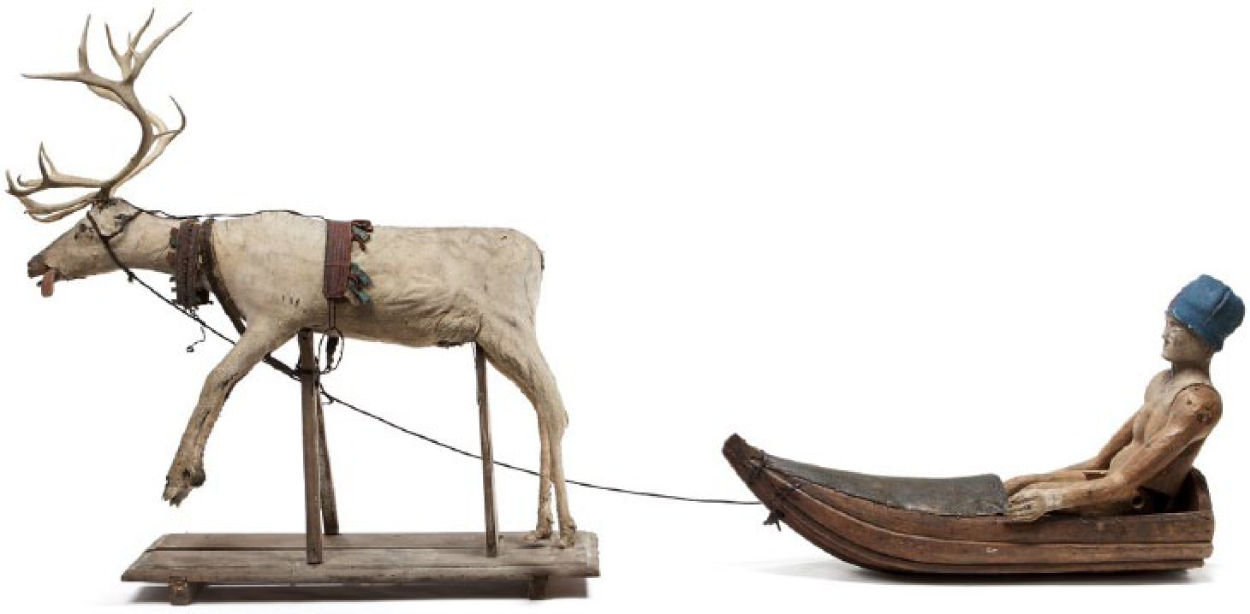
Sámi equipage (Inv. No. 1696) presented to King Charles XI in 1694. Photo reproduced courtesy of the Royal Armoury, Stockholm.
The equipage was brought to Stockholm where it was displayed at the Royal Palace and used in what can be labelled an ongoing imperial masquerade. This use of Sámi material culture was a kind of cultural appropriation serving the purpose of strengthening the king’s and the empire’s position at the expense of the culture that was being appropriated (see Schneider, 2003). The collected Sámi objects not only connected the centre of the empire of Sweden to its borderlands in the north, but they also played an active role in constructing a dominant Western view of the Sámi.
The equipage, along with other Sámi objects, were adopted into a material regime and a materialized logistics, in the sense of Chandra Mukerji (1997, 2010). Not only did the collecting and appropriation of Sámi material culture in Denmark-Norway and Sweden serve as local variants of the colonial collection of Western Europe, but also as part of the making of empires. By bringing Sámi objects and Sámi people to Copenhagen and Stockholm, but also to England, Italy and France, the imperial ambitions of the northern kingdoms were materialized in a European context.
Symbols of Sámi identity were displayed and staged along with other material objects and symbols. Living reindeer were kept along with stuffed ones, and horses dressed as reindeer were displayed along with elephants and ostriches in places such as Versailles (Berg, 1954: 238; Mukerji, 1997: 178). Sámi people were displayed along with mannequins.
The purpose of this article is to examine what role the Sámi material culture played in the shaping of colonial relations between the Scandinavian kingdoms, individual agents and the Sámi during the 17th century. The case study presented here is from Sweden, but we want to emphasize the general European relevance. Similar processes to those described here took place in Denmark-Norway and in England, France and the Netherlands, as well as in Central Europe. One starting point of the article is that the constructions of images of the Sámi people, as well as the collecting and displaying of Sámi material culture, need to be discussed in relation to a larger globalized colonial context of the 17th century. In order to understand present-day conflicts over the representations of and control over Sámi cultural heritage, the early modern colonial history of collecting, constructing and connecting needs to be examined. Colonial policies in the 17th century and the contested self-determination of the heritage of the Sámi people cannot be separated. The collecting of Sámi objects, the making of models of Sámi people and the act of dressing up as Sámi formed part of early modern power relations, which are still today played out in conflicts over land and cultural rights in the Sámi areas (see Ojala, 2009, 2017; Ojala and Nordin, 2015).
Material culture, colonialism and the Sámi as the ‘Other’
The Sámi are the indigenous people of Norway, Sweden, Finland and the Kola Peninsula in north-western Russia. Sápmi, the land of the Sámi, stretches over the vast northern Arctic and sub-Arctic zone of Europe. 1 In general, there are thought to be 10 2 different languages or variations of languages that are spoken today among the Sámi (see Lehtola, 2004: 11). The relationships between the present-day Finnish, Norwegian, Russian and Swedish majority societies and Sámi minorities in Sápmi are an important part of the shared history – a history that is partly characterized by abuse and discrimination by the different states – but also by interaction, exchange and cooperation.
Since the medieval period, the Swedish kingdom had competed with the kingdom of Norway (later kingdom of Denmark-Norway) and the Novgorod Republic (later Muscovy) for influence over the North Calotte in order to control the lucrative fur trade (see Hansen and Olsen, 2014: 143–166; Ylimaunu et al., 2014). From the 17th century onwards, the Sámi nation, which in itself consists of a multitude of traditions, was described, categorized and exoticized, and their indigenous religion persecuted, their material culture destroyed, but also collected and displayed. Sámi objects were collected in similar ways to the collecting of indigenous African, American or Inuit things and displayed together with these in the curiosity cabinets in the metropolises of Europe; in fact, the practices of appropriation, collecting and displaying showed many similarities.
The European colonial expansion and colonialism in Africa, America and the Arctic were shared by the Nordic kingdoms of Denmark-Norway and Sweden who pursued a similar colonial policy (Naum and Nordin, 2013). Danish and Swedish expansion in the 17th century can be viewed as a local version of the formation of the Atlantic world, with obvious similarities and relations to the West as well as dissimilarities and local features indicating the formation of a local and even deviating kind of modernity differing from that of other colonial agents (see Nordin and Ojala, 2017).
In order to further investigate why the King of Sweden was presented with a life-size model of a Sámi equipage with objects such as the sacred drum attached to it, this article will look more thoroughly at the role of Sámi material culture in a colonial context. We argue that the early modern globalized world created a colonial gaze and collecting that included the appropriation of Sámi material culture. The curiosity about the Sámi, leading to the collecting of material things, strengthened the construction of a colonial gaze on the Sámi (see Pratt, 1992). The Nordic kingdoms could use the Sámi as a way of constructing a more comprehensive colonial world view. In a similar manner as, for instance, England and France had used indigenous peoples of North America as ways of displaying power, Sweden and Denmark-Norway could elaborate their own colonial roles. The process became self-generating.
This history of the role of the Sámi in the early colonial world and how it took material form is still little examined. The Danish-Norwegian, Russian and Swedish colonial projects vis-à-vis Sámi and Sápmi during the early modern period are still an understudied field of research (see, however, Fur, 2006; Lindmark and Sundström, 2016; Snickare, 2014); moreover, the role of material culture in this process is little studied.
In European museums we find a substantial amount of historic Sámi material culture, an important constituent of Sámi cultural heritage from the 17th to the 20th centuries. Most of the objects in the museum collections are there as a result of unequal power relations where Sámi people had to hand over a great deal of their collective heritage to the dominant powers. The material evidence of this process is powerful. Thousands of objects and human remains from Sápmi are stored in museums all over Europe (Edbom, 2005; Harlin, 2008; see also Manker, 1938, 1950). At the same time, the Sámi people are today deprived of rights and access to a substantial part of their heritage. Concurrently, there is a contemporary struggle over rights to land and water in Sápmi, a conflict that has its roots in the colonial history and relations in the 17th century (see Ojala and Nordin, 2015).
The appropriation of the material culture of indigenous non-European peoples played an important role in the construction of a Eurocentric global colonial order (see, e.g., Bleichmar and Mancall, 2011; Schmidt, 2015). In this context, the Sámi were often regarded as non-Europeans or a kind of ‘non-European Europeans’ (Ahlström, 1966: 13–25). In 1681, the French traveller Jean François Regnard inscribed the following words on a wooden board in Jukkasjärvi/Čohkkiras Church by the Torne River, near present-day Kiruna/Giron: Gallia nos genivit, vidit nos Africa, Gangem havsimus … – approximately: ‘Gaul gave us birth/brought us up, we have seen Africa, the water of Ganges we have drunk…’ (Regnard, 1877, inscription in Jukkasjärvi/Čohkkiras Church; see Uddholm, 1985: 212, also Figure 2). In mentioning Sápmi in the same context as Africa and Asia, Regnard stated not only that he was widely travelled but that Jukkasjärvi/Čohkkiras was in fact the northern frontier of the world.
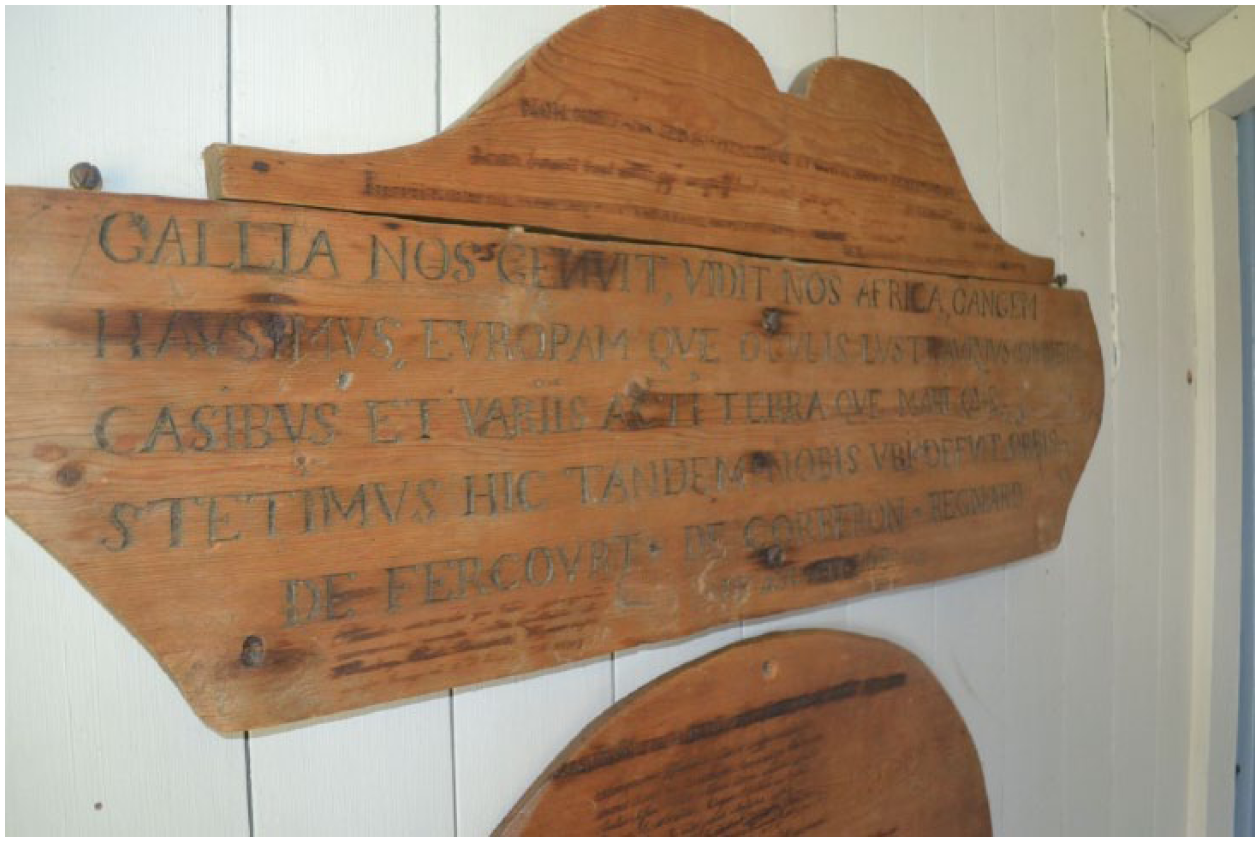
Photo of the wooden board inscribed by Jean François Regnard when visiting the Church of Jukkasjärvi/Čohkkiras in 1681. © Photograph: Jonas M Nordin.
Sámi in the early modern global and material world
Already during the Renaissance, Sámi people and Sámi identity were surrounded by a curiosity, expressed for example by scholars such as Damião de Góis in Deploratio Lappianae Gentis (‘Lamentation of the People of Lapland’) in 1540 and Olaus Magnus in the description of Sápmi in Historia de gentibus septentrionalibus (‘History of the Northern Peoples’) in 1555, or Christopher Marlowe in Faustus, first published in 1604 (see Andersson Burnett, 2010; Balzamo, 2015; Broberg, 1982, 1987; Lindin and Svanberg, 1990; Nordin and Ojala, 2015). The escalating globalization, especially through the growing contacts between America and Europe and the drastically increased inflow of overseas goods, also affected interest in the Sámi and Sápmi.
The Sámi and Sápmi were increasingly compared with America and its indigenous peoples (Löw, 1956: 13; see also Regnard mentioned above). Sápmi and Lapland were regularly referred to as a Swedish America (Ahlström, 1966: 13–14). In 1635, the member of the Swedish council of the realm, Count Carl Bonde, for instance, expressed the expectation that Lapland should be as prosperous an asset as the West Indies, i.e. as the Americas had proven to be for the Spanish king (Oxenstierna bref och skrivelser II:11: 84; Nordin, 2012: 150–151).
On a material level, this was also expressed through the collecting and displaying of things. Wampum beads, clothes, jewellery and weapons were among the indigenous American things coveted by the Europeans and collected in their cabinets of curiosity or museums (Bleichmar and Mancall, 2011). Swedish colonists in the New Sweden colony (1638–1655), in Lenaphoking (the area centred on the present-day state of Delaware), collected native American objects such as clubs and tomahawks. The third governor of New Sweden Johan Printz used Indian clothes and a wampum baldric, probably when negotiating with the Lenape (Nordin, 2013a: 217–218). Several colonists brought material tokens back from the colony and most of the objects were displayed and used in one way or another (Nordin, 2013a, 2013b).
The frequently cited parallels between Sámi and Sápmi and various non-European peoples, as well as European minorities such as the Scots or Picts, led to a growing interest among the kings and queens of Sweden in examining the issue of Sámi origins (Andersson Burnett, 2010; Fur, 2006). Early modern Sápmi was, alongside Africa and America, turned into an imagined geography in Edward Said’s sense, an exotic constructed space used as a mirror of the conceited centre (Said, 1978: 101–102).
This imaginative space was not entirely fixed but flexible, movable and changeable. In contrast to the European nations, the Sámi, for instance, as well as, to some degree, the indigenous Americans, were considered to have come from somewhere else (Schefferus, 1956[1673]: 37–43; see also Wolf, 1982). Since the Renaissance, this question had been of importance to the Swedish and Danish crown, their officials and scientists, and theories of Sámi roots and ethnogenesis were constructed and augmented rapidly during the 17th century (Ojala, 2009, forthcoming). The common European interest or curiosity concerning the history of other peoples was expressed in the production of numerous books on the origins of American indigenous peoples (see papers in Kupperman, 1995). The growing political importance of Sweden through the Thirty Years’ War led to an increasing interest in Sweden in many European countries, as well as a boost of propaganda directed against Sweden (Andersson Burnett, 2010; Rydving, 2006).
Johannes Schefferus and his museum in Uppsala
The first modern researcher to conduct thorough research about the Sámi was Johannes Schefferus (1621–1679), a professor at Uppsala University. He was one of several well-educated scholars recruited to the expanding state of Sweden during the mid-17th century. He worked in several fields of research, such as law, rhetoric, history, archaeology and ethnography (Ellenius, 1957; Scheffer, 1918). As a result of the widespread curiosity about the Sámi, Schefferus was commissioned to conduct a detailed examination of the history and current situation of the Sámi area and its inhabitants by the chancellor of Uppsala University and councillor of the realm Magnus Gabriel de la Gardie (Löw, 1956).
The results were published under the title Lapponia in 1673, 3 and quickly achieved widespread academic and popular interest, being translated into English in 1674, German in 1675, French in 1678, Dutch in 1682, but not into Swedish until as late as 1956 (Schefferus, 1956[1673]; see Figure 3; also Bergesen, 2015). The book increased the already considerable international interest in the Sámi and their material culture. Questions about ethnogenesis were strongly expressed by Schefferus (1956[1673]: 79–91; see also Hansen and Olsen, 2014; Ojala, 2009). Unlike other ethnic groups such as the Swedes or Danes, Schefferus expected that this group, which he in many respects described as deviating from normative Europeanness, had come from somewhere else (Schefferus, 1956[1673]: 41). The Sámi were believed to be newcomers to this part of Europe, originating somewhere in the east, a notion providing the Swedish realm with the possibility of claiming all the land and natural resources of Swedish and Finnish Lapland. It also enforced the Swedish claim of sovereignty over all inhabitants of Sápmi.
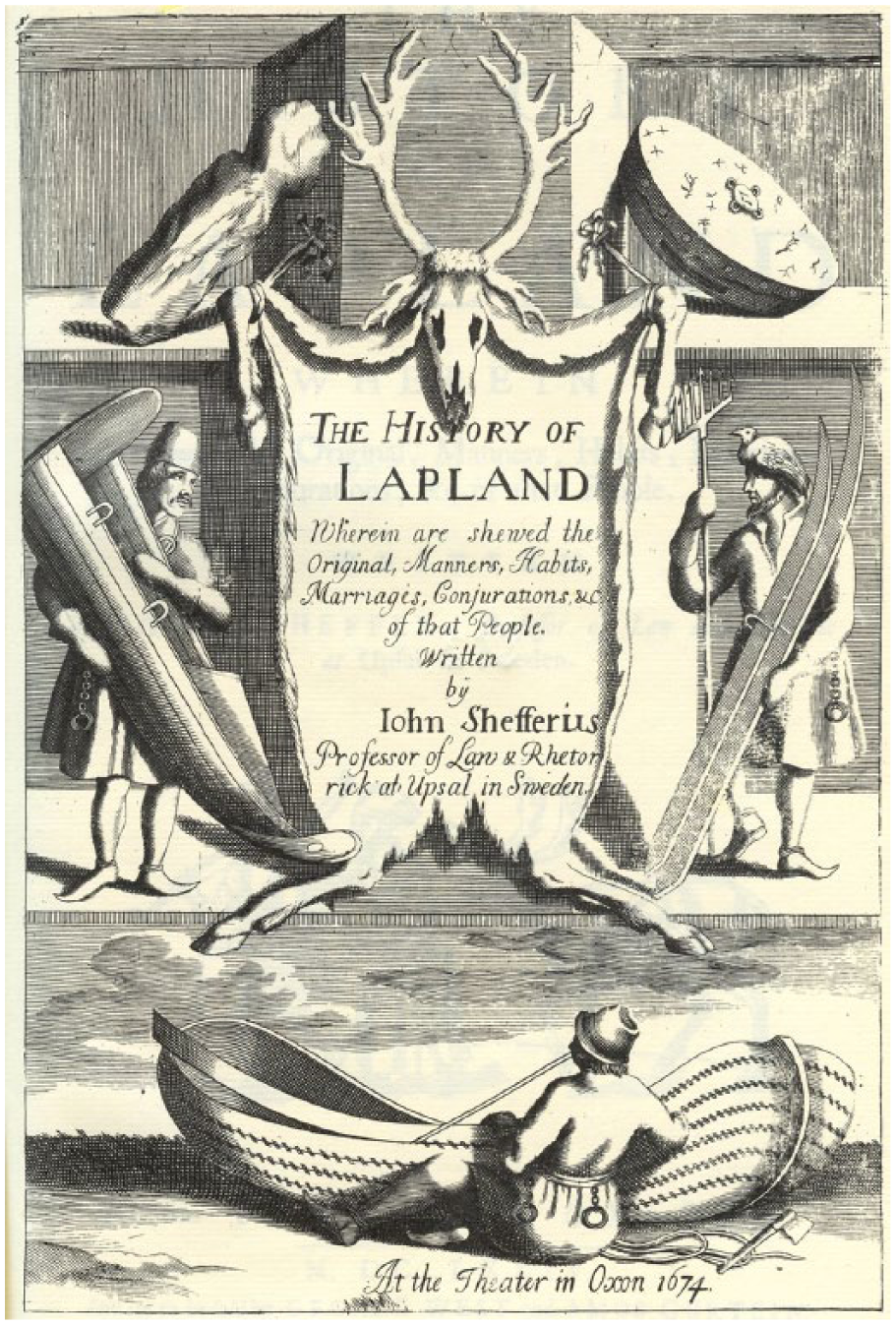
Frontispiece of the English edition of Johannes Schefferus’ Lapponia, The History of Lapland, published in 1674.
Schefferus’ work has intrigued many scholars, from his own contemporaries to the present day. The work is surprisingly ‘modern’ and coloured by analytical scientific prose. Although the descriptions of the Sámi are based on generalizations and simplifications, it is not a simple racist description. His recognition of the Sámi can first and foremost be viewed as imperial. The author himself never ventured to northern Sweden or to Sápmi. However, he met Sámi students at Uppsala University (Berättelser om samer i 1600-talets Sverige, 1983; Rydving, 2010). Schefferus would also have met Sámi at many other places in Uppsala and Stockholm, where it was not unusual for the aristocratic or bourgeois households to have Sámi boys and girls as pages or servants, often under coerced servitude (Den franske kammartjänarens resa, 2013: 192; Nordin, 2017a, 2017b). Furthermore, the Sámi population were much more widespread in southern and central Sweden during the early modern period than is generally acknowledged (see Berg, 1954; Svanberg, 1999).
The illustrations in Lapponia came to have a paramount importance for the general notion of Sáminess (Bergesen, 2015; Lindin and Svanberg, 1990). The emblematic motif, the Sámi with the ackja or geres and the reindeer, was already widely spread through the works of Olaus Magnus, but through Schefferus’ work it was turned into a symbol, such as the naked Indian on the Armadillo (Mignolo, 1995; Nordin, 2013b; see Figure 4). The Reindeer, the Armadillo and the Elephant became singularized and in part disconnected from their native lands. The depictions of the material things in the book were partly based on Schefferus’ own collection of Sámi material culture, including drums, sieidi-stones and geres.
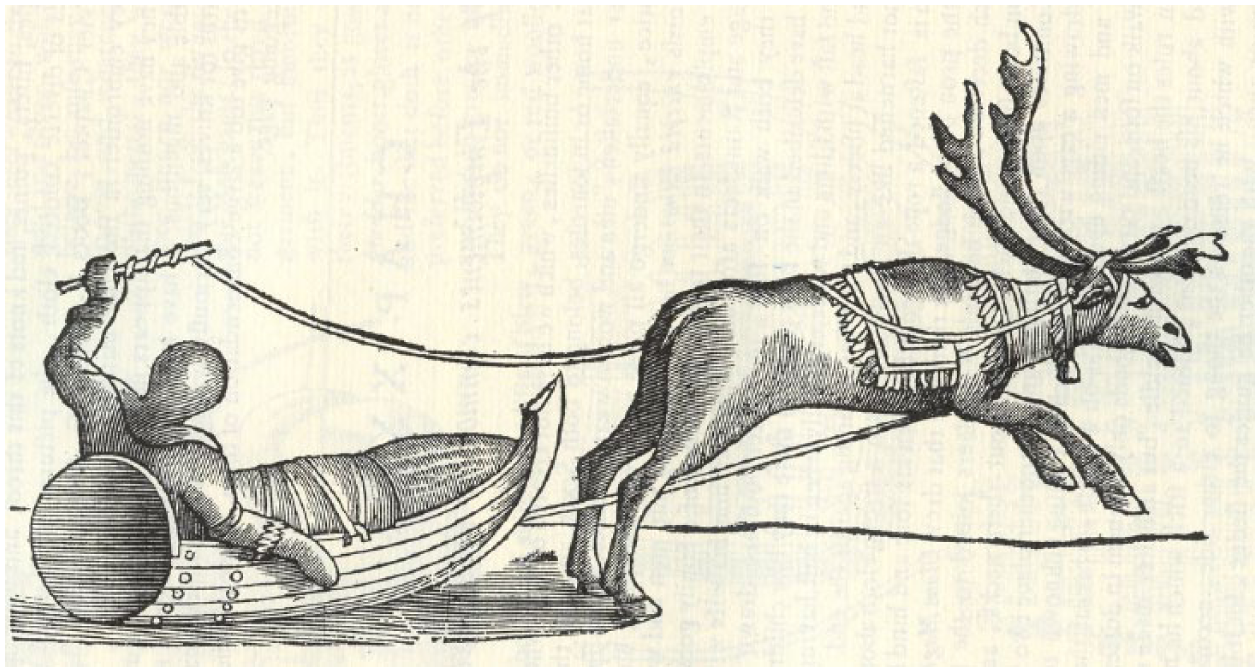
The Sámi equipage as depicted in Johannes Schefferus’ The History of Lapland (1971[1674]: 106).
To host his collection of Sámi objects, but also of minerals from Sápmi and elsewhere, along with prehistoric objects from central Sweden, Johannes Schefferus built a museum, which is still standing near the Cathedral in central Uppsala (see Figure 5). Here he received visitors and displayed his Sámi objects (Snickare, 2014). Most of his collections were later transferred to the royal collections, but a sieidi-stone is still kept today in the building. The inventory of his collections is not complete and includes only finds of minerals from Sápmi, which were kept in his museum in Uppsala (Löw, 1956; Manker, 1960; Nordin and Ojala, 2017).
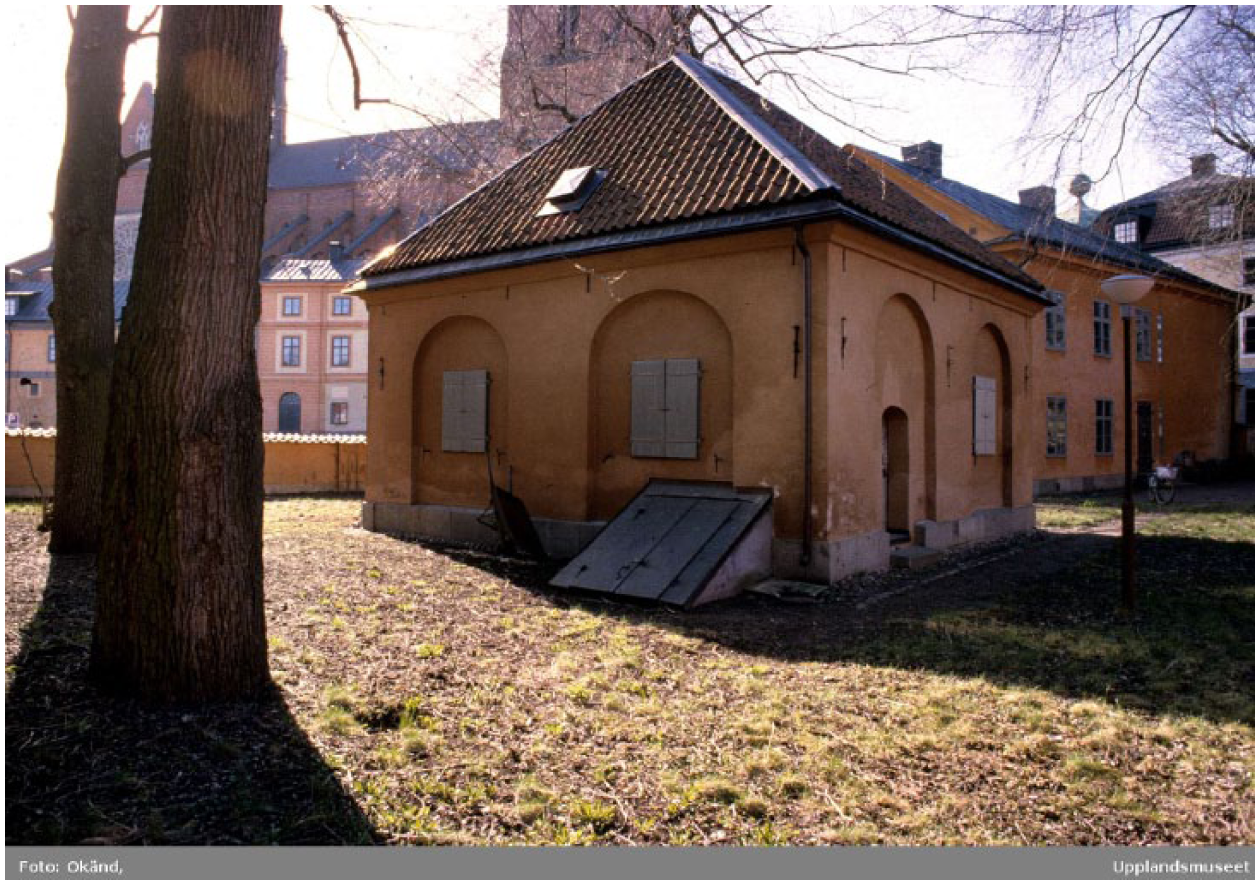
Johannes Schefferus’ museum in Uppsala today. Photograph reproduced courtesy of Uppland County Museum, Uppsala.
Already in the 1640s, before the publication of Lapponia, there is evidence that collectors in Denmark-Norway and Sweden coveted Sámi objects, mostly ceremonial drums as part of an ‘exotic’ collecting drive (Edbom, 2005; Manker, 1938, 1950). Schefferus’ precursor Ole Worm (1588–1654) created a substantial collection of artificialia and naturalia in his kunstkammer (cabinet of curiosities) – Museum Wormianum – in Copenhagen. Here he displayed, along with the Inuit kayak, the South American armadillo and reindeer antlers, what can be interpreted, as suggested by Silje Opdahl Mathisen, as a Sámi dress (Mathisen, 2014: 206–208; see Figure 6).
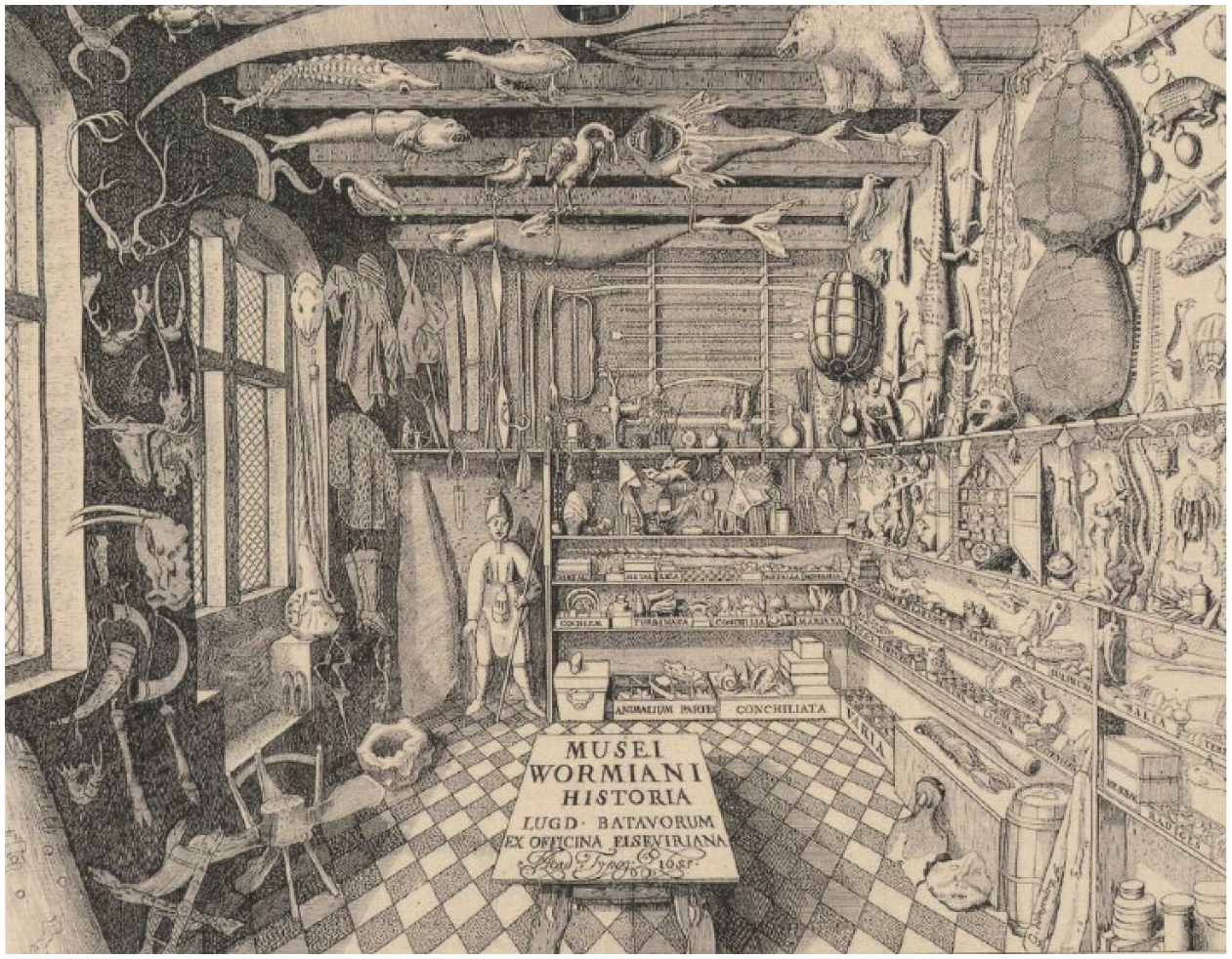
Frontispiece of Ole Worms’ Museum Wormianum 1655. Photo reproduced courtesy of the Royal Danish Library, Copenhagen.Note the mannequin with ski stick in the left corner.
The dress was put on a mannequin and seems to have included a typical cap of wool, a jacket, a pouch and a ski stick. A pair of skis was displayed just adjacent to the mannequin. In his published catalogue, Ole Worm does not mention the dress and the mannequin, and the connection to Sápmi is tentative, as the dress also shows similarities with the contemporary Inuit dress (see Mordhorst, 2009; Schepelern, 1971), but it is clear that he possessed a Sámi ceremonial drum (Worms, 1655: 386; Wiklund, 1930: 96). Collectors in Denmark also showed great interest in Kalaallit Nunaat/Greenland and the Inuit population. As acknowledged by Alden T Vaughan (2006: 1–11), Inuits of Greenland and North America were among the first peoples to be kidnapped and brought to northern Europe for display. Along with them were brought kayaks, harpoons and other things (Dam-Mikkelsen and Lundbæk, 1980; Nordin, 2017a). The collecting of Musaeum Tradescantianum in London, later part of the Ashmolean Museum in Oxford, bears obvious similarities. John Tradescant’s collection had, not surprisingly, more focus on the Americas but Tradescant himself conducted a trip to Arctic Russia and through that included the Arctic in his collected world (Leith-Ross, 1984: 67–68).
In 1679, Johannes Schefferus died and, as in the case of the collection of Ole Worm in Denmark, the royal court bought most of the collections. The College of Antiquities (in Swedish Antikvitetskollegium) became the new owner of much of Schefferus’ collection. In the oldest inventory of the College of Antiquities from 1693, Sámi objects had a prominent position, along with war booty of the Thirty Years’ War, and prehistoric artefacts. At least seven ceremonial drums, two sieidis and an ackja or a geres were part of the earliest collection (Arne, 1931: 85–88). Other parts of Schefferus’ collection as well as Sámi material culture in general were spread further afield, for instance to the collection of Hans Sloane in England, which came to lay the foundation of the British Museum, while other ceremonial drums today can be found in Berlin, Dresden, Madrid, Rome and Paris (Edbom, 2005; Manker, 1938).
Destroying and collecting drums
Perhaps the most emblematic early modern Sámi object was the Sámi drum, which attracted a lot of attention from missionaries and clergymen, as well as from early modern scholars and writers interested in Sámi culture and religion. Early modern European relations to the Sámi drums were characterized by ambivalent feelings. On the one hand were feelings of desire, interest and attraction, on the other hand were feelings of repulsion and a will to destroy and eradicate (see Snickare, 2014). In many ways, the Sámi drums were at the centre of the colonial and religious encounters and conflicts in Sápmi in the 17th and 18th centuries. Still today, the Sámi drums are powerful objects, connecting past and present, and they remain central to debates on Sámi cultural heritage and Sámi self-determination in the field of heritage management. As mentioned above, a majority of the sacred Sámi objects are today found in collections and museums outside Sápmi and outside the control of Sámi organizations (see Edbom, 2005; Harlin, 2008; Ojala, 2009; Westman, 2002).
Although there had been Sámi contacts with Christianity and Christian groups throughout the Middle Ages, systematic Christian missionary activities were launched in the Sámi areas only from the 17th century onwards, when campaigns against Sámi non-Christian religious beliefs and practices were initiated by the Swedish Crown and the Swedish Church (similar developments took place in the Sámi areas in present-day Norway). It was seen as highly embarrassing for the Swedish kingdom, which was an aspiring northern European Protestant great power, as shown in the identification with the never-setting sun, to have ‘heathens’ living within its own realm (Rydving, 2006).
The use of the drums, which were important sacred objects in the Sámi indigenous religious beliefs and ritual practices, was forbidden, with the threat of serious punishment, even the death penalty. Several Sámi were condemned to death for using their drums, and at least one person was executed in Sweden for this offence. The 60-year-old Sámi man Lars Nilsson in Pite Lappmark was sentenced to death and executed in Arjeplog/Árjepluovve in 1693 because he had used his drum in an attempt to save his grandson who had drowned. In the court records, Lars Nilsson, who had good knowledge about the Christian faith, explained that he considered the old Sámi gods to be more helpful than the Christian God (Awebro, 1986: 26–31; see also Christoffersson, 2016; Rydving, 1995).
In this context, the Sámi drums could also be seen as symbols of Sámi resistance against the forced Christianization and assaults on the Sámi indigenous religion, as a way of exerting Sáminess and connections with Sámi indigenous religious and cultural traditions during a time of great transformation and change (Lindmark, 2013; Rydving, 1995). For the colonial authorities and missionaries, however, the drums were upsetting symbols, and tools, of Sámi sorcery and worship of evil forces. A large number of drums were confiscated by agents of the Swedish Crown and the Swedish Church at different times in various parts of the Sámi areas, for instance in Kemi Lappmark in 1671 and in Åsele/Sjeltie in 1725 (Christoffersson, 2016). Many drums were destroyed, along with Sámi sacred sites, sieidi-stones (sacred stones) and sacred wooden objects, by clergymen, missionaries and other opponents of the indigenous Sámi religion. In parallel with this, drums were also confiscated by missionaries and clergymen in Norway (Rydving, 1995: 65). The missionary Thomas von Westen, one of the central figures in the Danish-Norwegian mission, collected a large number of drums (probably more than 100) in Norway, which were brought to Copenhagen, where many of them were destroyed by fire in the 1720s (Steen, 1954: 39–40).
However, at the same time, Sámi drums attracted a lot of interest and curiosity and were coveted by scholars and collectors around Europe, as exotic and magical objects, and some of the confiscated drums from the Sámi areas ended up in collections in different parts of Europe (Manker, 1938, 1950; Wiklund, 1930). The Sámi drums, as coveted objects and as depictions and descriptions for instance in Schefferus’ Lapponia, came to play a paramount role in the constructions of images of Sáminess in early modern Europe and in the centuries to follow (Schefferus, 1956[1673]: 151–185; see Figure 7).
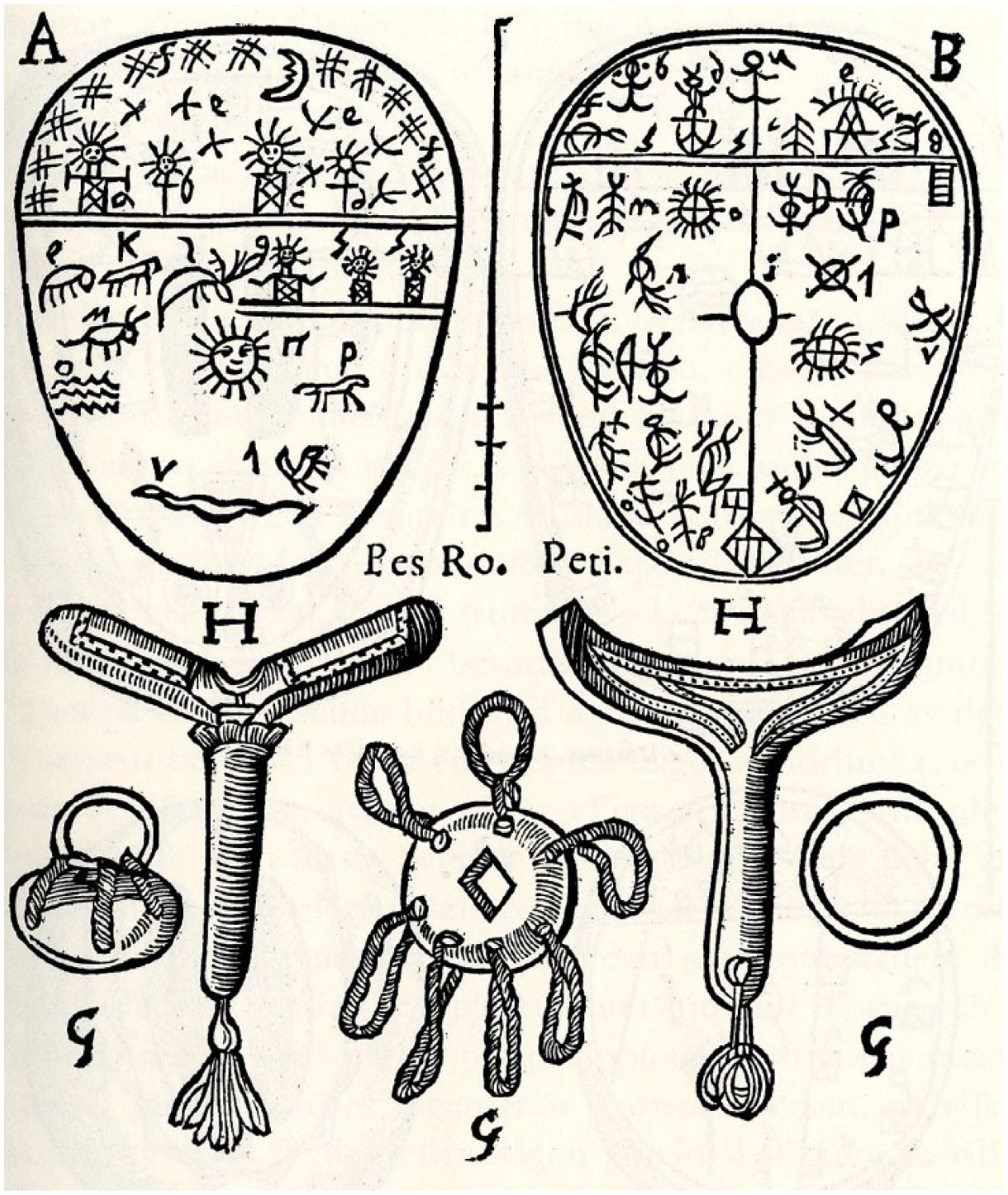
Johannes Schefferus’ drums. From Lapponia 1956[1673]: 157.
The early descriptions and collecting of drums are also connected with the colonial endeavours of the Swedish Crown to locate and exploit natural resources in the Sámi areas, which was one of the strongest driving forces for the early modern colonial expansion of the Swedish kingdom towards the north. For instance, one of the earliest descriptions of a Sámi drum comes from the silver works at Silbojokk/Silbbajåhkå in 1642 (see Manker, 1935), where ore from the Nasafjäll/Násavarre silver mine was refined. When silver had been discovered in Nasafjäll in the 1630s, the expectations of great new riches were high among the Swedish elites, and the Sámi areas, as mentioned above, were seen as a potential future America for the Swedish kingdom (see Bromé, 1923: 64; Nordin, 2012: 150–151, 2015: 258–262).
Earlier scholars have primarily studied the Sámi drums with the aim of classifying and defining types, or with the aim of interpreting the symbols painted on the drum skin as sources for Sámi religious beliefs (see, e.g., Christoffersson, 2010, 2016; Manker, 1938, 1950; Wiklund, 1930). Much less research has been devoted to understanding the histories of confiscation and collecting of the drums, and the connections with colonial ideologies and practices in the Scandinavian and other European early modern colonial expansions and encounters. However, the biographies of some individual drums have attracted special attention (cf. also Appadurai, 1986; Thomas, 1991). One of the most discussed Sámi drums is the one that belonged for a while to the renowned Swedish naturalist Carl Linnaeus (1707–1778), which is depicted on the famous portrait of Linnaeus in Sámi dress by Martin Hoffman in 1737 (Figure 8; see also further below), and which for some time was part of the collections of the Trocadéro Museum in Paris, but today is kept at the Linnaeus Museum in Uppsala (see, e.g., Kuoljok, 2006; Reuterskiöld and Wiklund, 1912; for discussions on the life histories of other drums, see, e.g., Kroik, 2007; Kuoljok and Westman Kuhmunen, 2014). However, this enactment or staging of Sáminess conducted by Linnaeus in the 18th century also had an older prehistory.
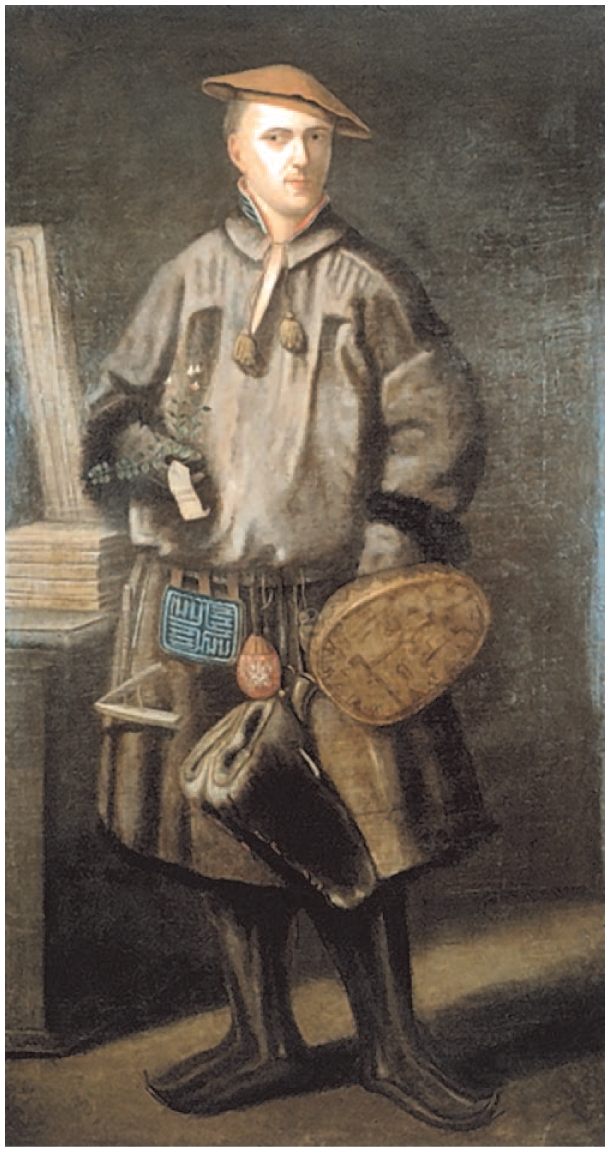
Painting by Martin Hoffman, 1737: The Swedish naturalist Carl Linnaeus in Sámi dress. Photograph reproduced courtesy of the Linnaeus Museum, Uppsala.
Displaying and staging Sámi
From the second half of the 16th century, there is evidence of domestic Scandinavian display of Sámi people, as for instance in the case of the coronation of Ericus XIV in 1561, when reindeer as well as Sámi girls were displayed (Berg, 1954: 226). An anonymous valet serving a Swedish master in the 1660s writes in his diary about the habit amongst the aristocracy and bourgeoisie of Stockholm of having Sámi servants as prestige markers. The anonymous valet compares the habit to the use of black servants (moors) in France (Den franske …, 2013: 192; Nordin, 2017b).
In 1659–1660 the Swedish Catholic 4 Johan Ferdinand Körningh conducted a covert reconnaissance missionary journey to northern Sápmi and the Torne River Valley, a trip that was described in his diary. On his way back to Prague, Körningh collected clothes, medicines and minerals, but he also brought a Sámi boy, Petrus, with him (Körningh, 1956: 62–63). The plan was to educate Petrus, but according to Körningh’s diary he was thought of as very exotic, almost non-human (p. 63).
Another example stems from 1706 when the Grand Duke of Tuscany offered the Swedish architect Nicodemus Tessin (the younger) the opportunity to obtain a coveted book in exchange for a Sámi drum. When the drum was delivered, the Grand Duke expressed the wish to have a Sámi boy to play on it (Pentikäinen, 1987; Snickare, 2014: 65).
As Catherine Baglo (2011) has pointed out, this habit of displaying Sámi was not all about asymmetrical power relations. There are examples of Sámi who could benefit from the situation and see this ‘market’ as a way to earn a living and gain new experiences. There were Sámi who were abducted and held in servitude, as mentioned above, but there were also others who could navigate to prosperous positions within the framework of the dominant power (Rydving, 2010; for a general discussion on servitude and slavery, see also Kopytoff, 1982).
Recent research has shown that objects collected from distant parts of the world were often used in social displays in their new context. Indian dresses, for instance, were not just put in showcases but were activated and used in various ways (Fur et al., 2016; Yaya, 2008), as mentioned in the example of Governor Printz in New Sweden. American Indians were also forcibly brought to Europe as living exotica (Vaughn, 2006). In several places in Europe, physical representations of the Sámi and physical manifestations of European ideas of Sáminess are attested, although not as substantial and well preserved as the one presented to Charles XI. Sámi, or people acting as Sámi, brought (coerced or freely) reindeer for display at different courts. If reindeer were not available, other animals could be ‘dressed up’ as reindeer. In Versailles in 1776, horses were covered with reindeer skin and antlers to perform the part of the northern animal (Berg, 1954: 238). The quasi reindeer at Versailles should be understood in the grander imperial context of performing territorial ambitions taking place on several levels in the heart of France. Moreover, they should be understood in a context of exercising power and practising imperial ambitions (Mukerji, 1997: 297–299).
The making of models of reindeer and dolls to look like Sámi during the 17th and 18th centuries is also known in other cases: for instance, Countess Theresia von Nositz, who was married to the imperial ambassador to Sweden 1685–1690, received as a gift from her husband a ‘doll in Sámi dress’ (Berg, 1954: 234). This was possibly a mannequin similar to the one in Ole Worm’s collection and the driver of the Stockholm equipage.
Another material example of this practice is the miniature Sámi ceremonial drum in the British Museum (Inv. No. Eu+ 4344; Manker No. 73) that measures 15 x 9 x 3.2 cm and probably came to the British Isles already in the late 17th or early 18th century (Figure 9). This extraordinary object is most probably made within a Sámi tradition but with a different purpose from an ‘ordinary’ drum. The mere size indicates it might have been made for display and as a souvenir rather than as a sacred ritual artefact.
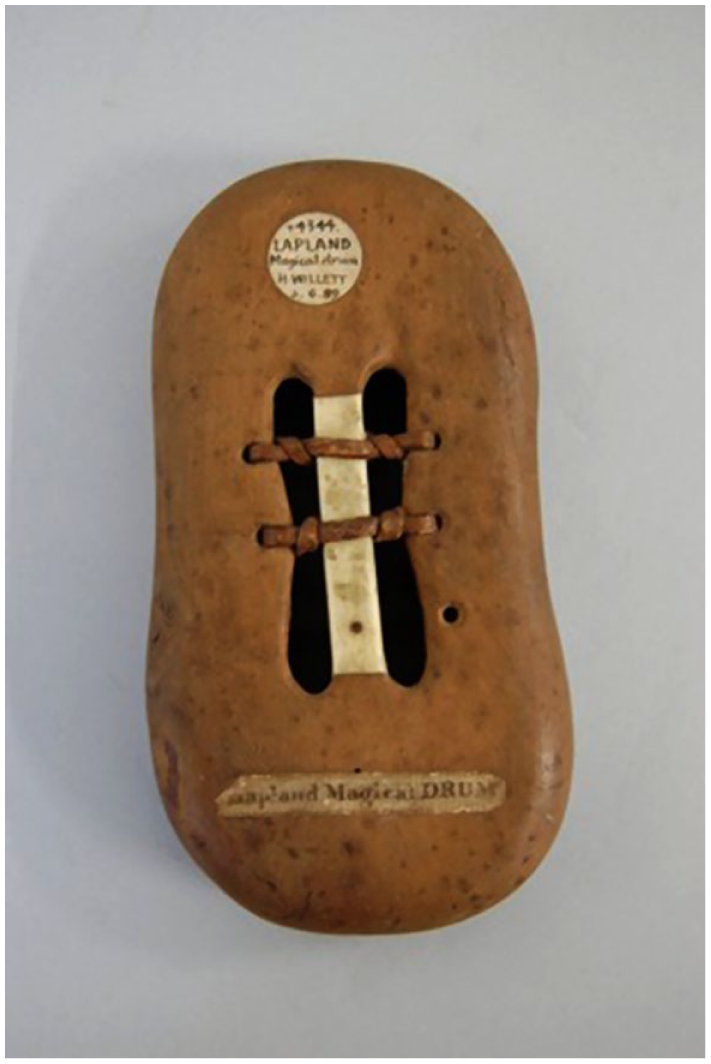
Miniature drum, British Museum inv. no Eu+4344. Photograph reproduced courtesy of the British Museum, London.
The practice of using Sámi things, such as the geres, and the collecting and use of Sámi clothes, as with Johan Ferdinand Körningh or the unknown French valet (Den franske …, 2013: 189; Körningh, 1956: 57), can be compared with the Linnaeus portrait (see Kuoljok, 2006, also Figure 8). On the one hand, Linnaeus appears in a Sámi dress and becomes Sámi – on the other hand, Linnaeus who at this time was already internationally renowned as a naturalist, could never be anything other than a Western European Latin-speaking university professor (Tara, 2003: 25–28). The cross-dressing could be seen as a cultural appropriation in the sense of borrowing, stealing and taking over another group’s identity through the use of their material culture (Schneider, 2003: 217).
The Sámi equipage in the Royal Armoury in Stockholm
The equipage presented to Charles XI in 1694 is a material blend of what has been discussed so far, i.e. ceremonial drums, clothes, sleighs, reindeer and Sámi people. Connecting different elements central to the colonial understanding of Sáminess, it forms a kind of almost modern media – an early modern predecessor of the wax figures, emblematic of the 19th century. The making of a model of a Sámi, expressing essentials of Sámi life, can be understood as part of a material regime with the aim to strengthen imperial authority over the North and the Sámi, but also to enhance control over other people within the empire and to express power in competition with other empires (see Mukerji, 2010: 409–411). The details and overall impression of the equipage suggest that it could have been taken for authentic in the sense that both the driver and the reindeer could have been thought to have been ‘alive’.
The equipage was delivered to the Royal Armoury on 20 November the same year and was recorded as:
A Lapp [Sámi] with a jacket, woollen shirt, a belt with tin beads, a pouch and an engraved antler spoon, and a tobacco pipe of gypsum in it, moreover [a] hat of blue cloth lined with black leather, sitting in an ackja with a Lapp drum and its stick in his knee and by himself driving a stuffed reindeer with its harness and a bell around its neck and with antler on its head, a Lapp and a reindeer presented by Right Honourable Count Douglas.
5
(Royal Armoury inventory of 1696: 538–539)
This description shows how consistently this physical representation of Sámi life was made; the equipment of the tame reindeer and the geres and the driver with his almost complete dress, not neglecting the globally used clay pipe, show curiosity and commitment. Several European travellers wondered about the Sámi use of tobacco and the smoking Sámi soon became a stereotype (see Körningh, 1956: 54; La Martinière, 1674: 31; Schefferus, 1956[1673]: 251). The equipage as a whole was probably commissioned by the county governor Count Douglas and the model made locally. The geres, the gievrie (the drum) with its stick and the dress all seem to have come from the central Sámi area, perhaps Lycksele/Liksjoe (Nodermann-Hedqvist and Manker, 1972: 209–210).
The driver is in natural or almost natural size, 153 cm tall, made of pinewood. The features of the driver show an aspiration for naturalistic representation. The limbs of the body are articulated, the forehead is depicted with a frown and the face and hands are painted in several layers (a pale foundation and a light pink colour resembling skin; see Figure 10). The eyes are also painted in several colours, including red – as if to emphasize that the driver was exhausted and to suggest speed. Dark paint on the chin indicates that the face was bearded, and the existence of several tiny holes on the chin suggests that a now lost beard was attached. Beards were at the time regarded as primitive and peasant-like (in the 1690s, there are examples of forced shaving of farmers in central Sweden; see Eriksson, 1993: 316–317).
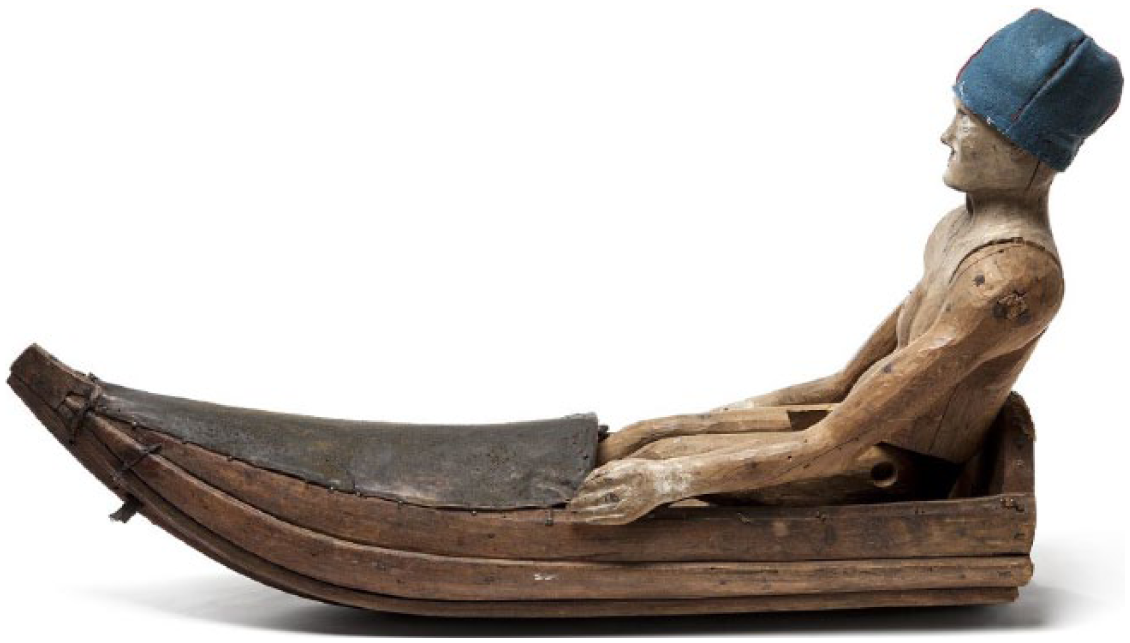
Detail of the driver, part of the Sámi equipage (Inv. No. 1696). Photo reproduced courtesy of the Royal Armoury, Stockholm.
Traces of colour on the neck suggest that the driver did not have any clothes under the jacket, which has a traditional open standing collar. The collar and some other fragments are the only pieces surviving of the kolt, the jacket. The limbs are jointed to the trunk but they could not be moved in any direction. There is a hole between the lips. The tobacco pipe could switch places between the pouch, as stated in the inventory above, and the mouth.
The ceremonial drum is a gievrie, a frame drum of South Sámi type, probably from the area around Lycksele (Manker, 1938; Nodermann-Hedqvist and Manker, 1972: 209). It is noteworthy that the equipage included such vernacular objects as a smoking pipe and an antler spoon. Engraved reindeer antler spoons are a rather common find of the late medieval and early modern market places and coastal towns of the Gulf of Bothnia as well as in 17th-century Stockholm (Dunfjeld and Zachrisson, 2002; Immonen, 2006; Nordin, 2017b; Nurmi, 2009). The spoons indicate intense contact and transmittance of ideas and identity between the various groups of people in Northern Fennoscandia during the 17th century. The spoon, when occurring together with the equipage, was probably well known to most domestic viewers as a self-evident feature of Sámi presence.
The geres – a sleigh for personal transportation – is made of pinewood and half of it is covered with red cloth. The reindeer is made of wood covered with authentic reindeer skin and with antlers attached to it (see Figure 11). The whiteness of the reindeer is, however, unusual and the skin comes from a white reindeer, a type believed to have special power and meaning among the Sámi. The reindeer is fixed as in a swift gallop, standing on its rear legs. The animal is mounted on a white-painted wooden cart/construction. The red tongue hanging out of the reindeer’s mouth is made of wood. The exposing of the tongue shows the fascination with the reindeer’s ability to eat snow while running. This fascination is for instance expressed by Körningh (1956: 28), who mentions the spectacular scene of reindeer eating snow at a speedy gallop.
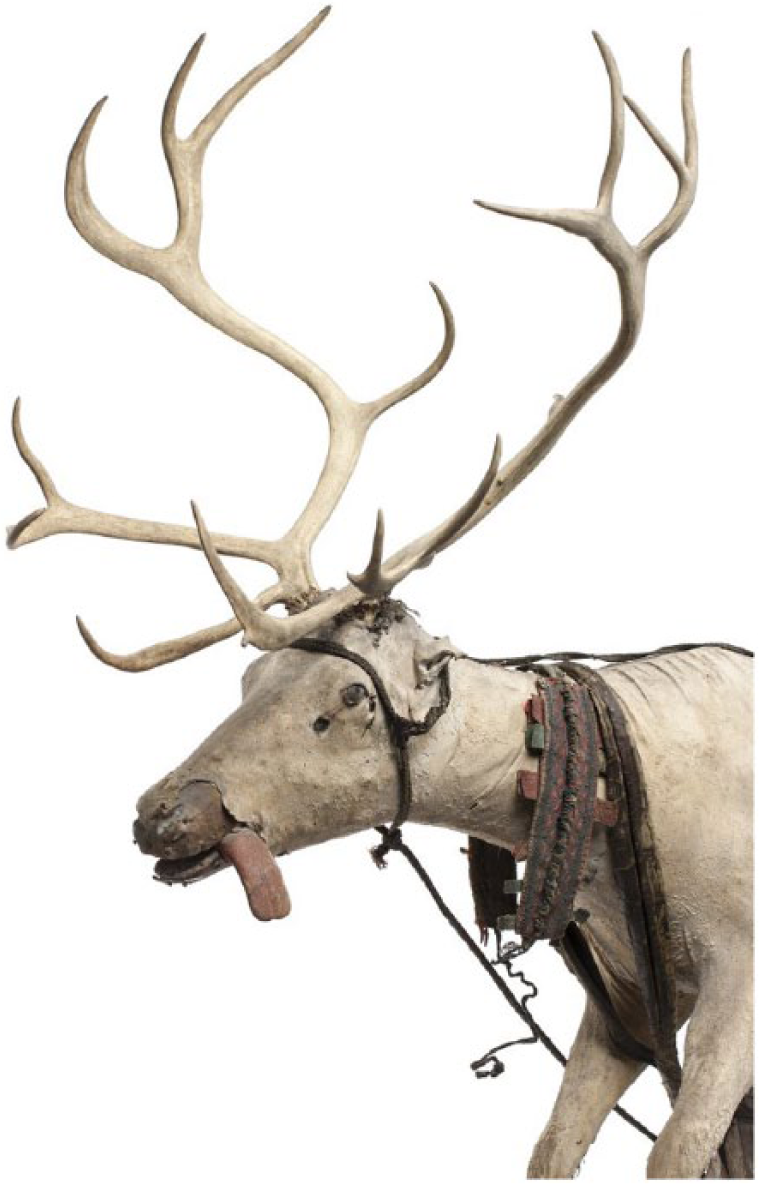
Detail of the stuffed reindeer of the equipage (Inv. No. 1696). Photo reproduced courtesy of the Royal Armoury, Stockholm.
On the bottom of the geres and on the platform of the reindeer, many traces of moving and dragging are visible. These traces suggest that the equipage was used, pushed or dragged around. In the royal deer park, Charles XI had reindeer, with Sámi herders taking care of the reindeer. The royal family went on tours with reindeer and sledges during wintertime in the 1690s (Berg, 1954: 232). The geres in the Royal Armoury might have been used during these trips and it is possible that the traces of use might have come from these activities.
As earlier acknowledged by Berg (1954), Lindin and Svanberg (1990), Nodermann-Hedqvist and Manker (1972), and Mathisen (2014), the Sámi equipage became an emblematic motif of Sámi and Sámi life early on. Schefferus’ Lapponia played a pivotal role in spreading the motif. A predecessor of Schefferus was the Swedish court painter David Klöcker Ehrenstrahl (1628–1698), who painted a reindeer equipage in 1670. Except for the tobacco pipe and the drum, the painting is a mirror of Charles XI’s equipage, even including the tongue hanging out of the reindeer (see Figure 12). Ehrenstrahl’s painting was copied many times during the 18th century. An original painting was placed in the royal castle of Drottningholm, close to Stockholm (Rapp, 1951: 95–98). 6 Together, the painting, the equipage, the royal collection of ceremonial drums and sieidi-stones, and the Sámi gamekeepers in the royal hunting grounds were part of a rather constant presence of Sámi people and Sámi images at the Swedish court.
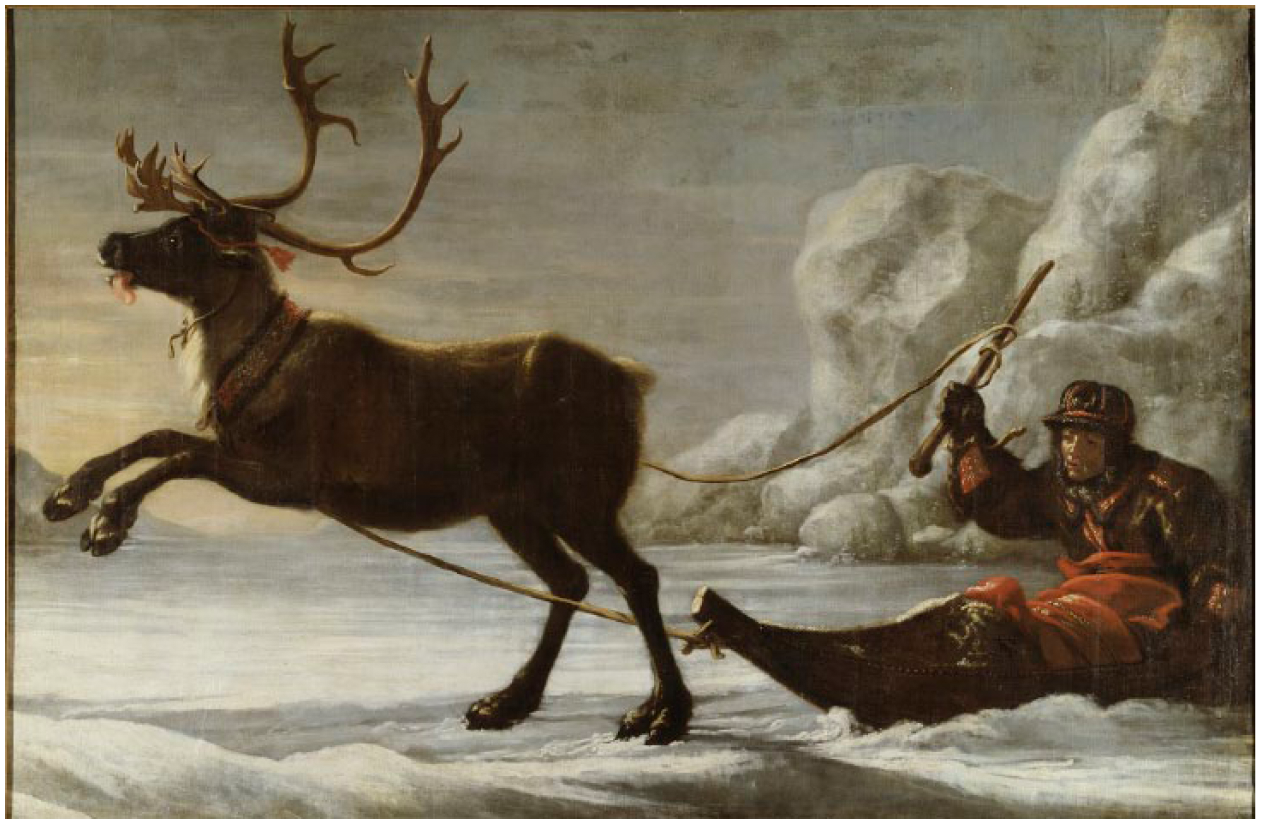
Reindeer with sleigh (ackja), painted by David Klöcker Ehrenstrahl, 1670. Photo reproduced courtesy of the Nationalmuseum, Stockholm.
Conclusion: Colonizing and commodifying Sámi material culture
Swedish, Danish-Norwegian and other European collecting, describing and constructing of a Sámi cultural heritage have often been de-coupled from the Western discourse on ‘the Other’, e.g. the American Indian or the African. In this article, we aimed to point to how Western intellectuals’ perceptions of the Sámi, from Olaus Magnus and Marlowe to Schefferus and Linnaeus, can be understood in the light of contemporary perceptions of Africans and American Indians, and how these Eurocentric perceptions show obvious ideological kinship.
The naturalistic mannequin in Charles XI’s equipage can be understood in the context of a baroque relational perception of statues as living entities, acting and performing in gardens, churches, halls or assembly rooms (see Herva and Nordin, 2013). The statues were displayed in order to create action in the micro-spaces where they were placed, and thereby influenced the shaping of the room. The many traces of usage on the geres and the reindeer of Charles XI’s equipage suggest that it was moved, displayed and made to take part in social activities at the court.
Chandra Mukerji (1997, 2010) has shown in her studies of the gardens of Versailles, but also the making of the Canal du Midi, how territorial and imperial claims of power could be materialized and spatialized through a wide set of practices of the early modern period. In this larger European context, the construction of ideas of ‘Sáminess’ played perhaps a minor, but not insignificant, role as a model of the North and the non-Europeans in Europe.
The Sámi objects, like any other material culture, were part of different networks, being more or less active. The networks consisted of human agents, but also of non-human agents, actants, in Latour’s (2005: 63–86) words. As examples of actants in focus here are the ceremonial drums collected by clergymen and missionaries, as well as collectors such as Johannes Schefferus; but also Charles XI’s model of a Sámi equipage. The Sámi who were brought to the continent, such as the boy Petrus who was taken to Prague by Körningh or the Sámi families taking care of the king’s reindeer, were more or less forced into an international chain of commodity exchange including people, animals and things. The material things moving into collections and being enrolled into different networks, in the past as well as in the present, have rarely been analysed in depth. This is the case also with Sámi material culture (see, however, Mathisen, 2014; Silvén, 2011, 2012), and the role of Sámi material objects in the formation of material regimes of colonial collecting and control.
The period of forced conversion and interference in the religious life of Sámi groups in the 17th and 18th centuries, with the destruction, confiscation and collecting of, among other things, the sacred Sámi drums, must be recognized as a serious assault on the Sámi people and Sámi indigenous religion. It was part of strategies and practices of colonial rule in the Sámi lands, in which material culture played an important role and objects such as the sacred drums were turned into instruments of colonial governance and domination. This history of appropriation, commodification and colonial rule should in turn be of relevance for future discussions of Sámi self-determination, governance and authority in heritage issues. In this article, we have also argued that it is important to situate the Sámi history in a wider international perspective of colonial collecting and governance (see also Batty, 2014; Bennett et al., 2014, for further examples, from Australia and elsewhere, of the relationships between material culture and the formation of colonial rule in later times). Today, the collected early modern drums have become powerful elements in the Sámi struggle for cultural revitalization and greater self-determination. These demands for greater Sámi self-determination form part of the international indigenous rights movement, which also serves as a source of inspiration and empowerment for Sámi groups (for more general discussions on indigeneity, heritage and colonial histories, see, e.g., Fforde et al., 2002; Hillerdal et al., 2017; Smith, 2012).
The recurrent de-coupling between Northern Europe and the rest of the world has succeeded in isolating Sámi history and colonial Sámi – Swedish (as well as Sámi – Danish/Norwegian and Sámi – Russian) relations from the larger context of early modern European colonial ideologies and practices. In order to better understand the early modern history of collecting Sámi material culture and the importance of the collected objects today, this de-coupling needs to be addressed. Furthermore, the power relations involved in the early modern collecting, connecting and constructing of Sámi material culture need to be explored further – as well as the power relations in today’s management of Sámi cultural heritage in the Nordic countries.
Footnotes
Abbreviations
SaN. = North Sámi
SaL. = Lule Sámi
SaS. = South Sámi
Funding
This article was written as part of the research project ‘Collecting Sápmi: Early Modern Globalization of Sámi Material Culture and Sámi Cultural Heritage Today’, funded by the Swedish Research Council (421-2013-1917). There is no conflict of interest.
Notes
Author biographies
Address: Swedish History Museum, Box 5428, S-114 84 Stockholm Sweden. [email:
Address: Department of Archaeology and Ancient History, Uppsala University, Box 626, S-751 26 Uppsala, Sweden. [email: