




Abstract
By drawing on field research, this article suggests that the impact of an aluminum mine on its neighboring quilombola communities can be analyzed from at least two interconnected technopolitical scales. The first relates to the anatomo-political discipline that the mine imposes over the body of its workers as well as to its inhibiting effect on the traditional body techniques of the populations that surround it. The second stresses a mine’s ecological governmentality that naturalizes the Amazonian environment and downplays quilombola sociotechnical infrastructures. The term technopolitics is proposed as a critical reading on biopolitics that ethnographically highlights the connection between the individual body and the environment as example of the entanglement of the bios (political, qualified life) and a technologically affected zoe, or “bare life”.
Despite the naturalizing narratives that have prevailed since the European incursion into the Americas, the Amazon region has always been a vibrant social context. Its social agents have not only been the indigenous societies that dwelled in the rainforest for centuries, but also the diverse range of actors involved in the colonial system and in the later imbrication of the Amazonian economies in the global market. The following analysis addresses the intertwining of two social agents that have gained international visibility since the 1990s: the aluminum extractive industry and the quilombolas (i.e. Brazilian maroons). More specifically, the analysis focuses upon the socio-environmental conflict that takes place between Mineração Rio do Norte (MRN), a mine that exploits the plateaus of the Trombetas basin in order to extract bauxite (i.e. the main aluminum ore), and the quilombola community of Boa Vista, whose territorial limits collide with parts of the mine’s operative zone.
MRN is the leading bauxite extractor in Brazil and since 1979 has intensively exploited the Western Amazonian region of the Pará State. The current volume of bauxite extracted is estimated at over 80 million tonnes per year, thus placing the mine among the world’s most important bauxite exporters. ‘Porto Trombetas’ is the harbor where the bauxite is loaded up in cargo-ships and is also the name of the company town where the majority of mine workers reside. 1 The wide and deep channel of the Trombetas River allows excellent accessibility to big ships that navigate less than 900 km downstream before reaching the ocean at the Amazon estuary. The mining activity takes place within the National Forest Saracá-Taquera, a federal conservation unit for ‘sustainable use’ surrounded by the Trombetas Biological Reserve and the Mapuera-Nhamundá Indigenous Lands. 2
In addition, a number of quilombola communities have populated the river Trombetas since the 19th century. Many of these quilombolas are descendants of African slaves who escaped from the cotton, cocoa, rice and tobacco plantations spread along the lower Amazon (Andrade, 2011; De la Torre, 2012; Ruiz-Peinado, 2002). Nowadays, the territorial limits of some of these communities, as in the case of Boa Vista, coincide and even overlap with the limits of the mine operative area (see Figure 1). Boa Vista in particular has a central significance in Brazilian history, for it was the first quilombola community to obtain recognition of its legal territory in 1995. As the third section of this article will argue, it is not a paradox that a territorially threatened community came to lead the political claims of Brazilian quilombolas.
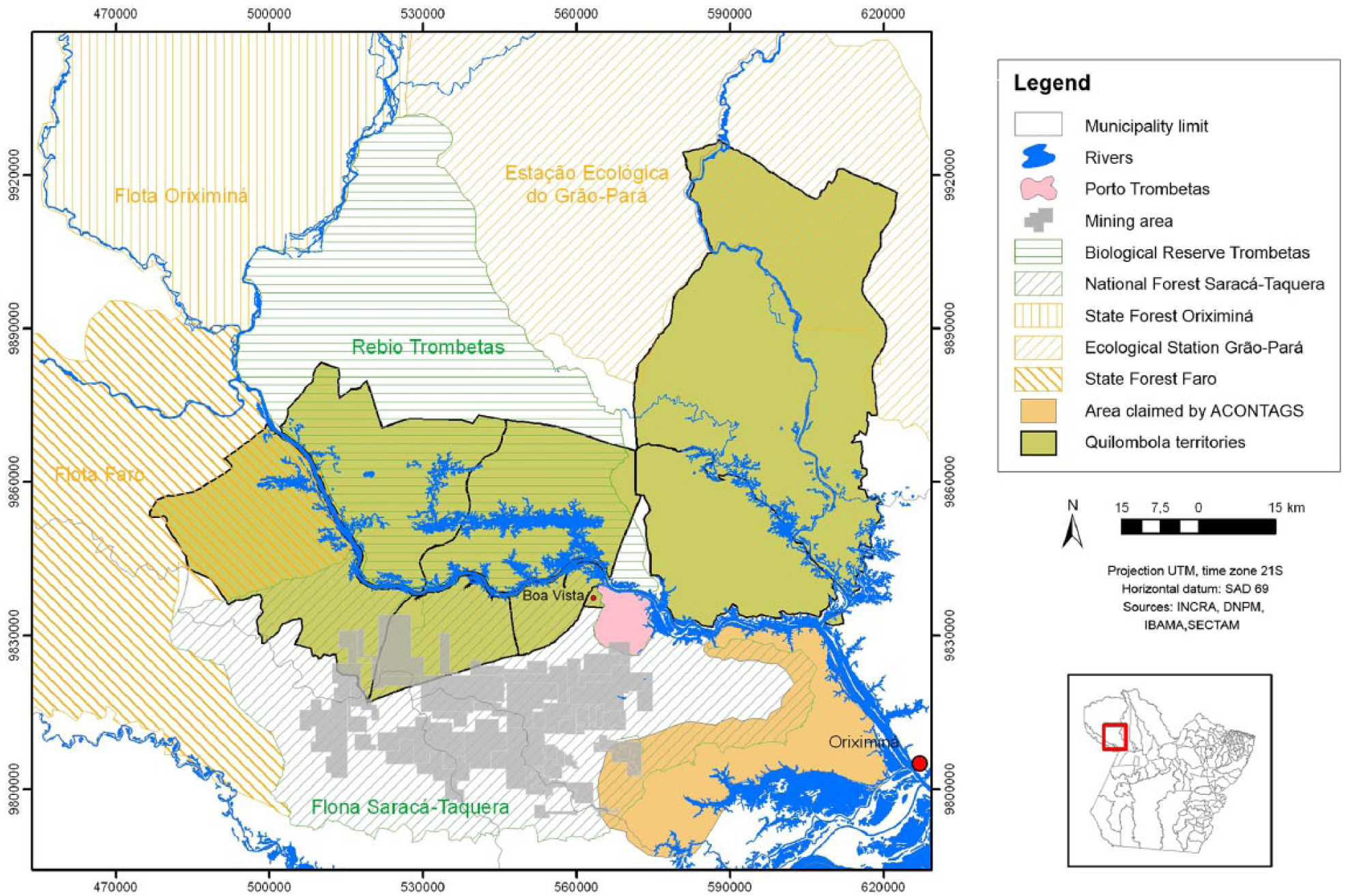
Territorial overlapping on the Trombetas Basin (Wanderley, 2009: 483). 3 Reproduced with permission.
The Boa Vista community is situated just over two km away from MRN’s harbor, upstream the Trombetas River. There are 140 families (around 750 quilombolas) living in the area of a community consisting of dispersed wooden palafites near the shore and some brick houses on the top of the plateau. Until the 1970s, the economic strategies of these river-dwellers were not substantially different from those employed by other rural communities in the region, i.e. a combination of subsistence agriculture and traditional forest extractivism with a ‘low’ (but locally significant) trade volume of forest products, mainly Brazilian nuts (Flanagan and Whiteman, 2005: 225). Quilombolas’ engagement in the environment and forms of land occupation were considered ‘traditional’ inasmuch as they adhered to the traditional Amazonian river-dwelling patterns and a mode of production mainly based in family units (see Almeida, 2009). In the last 40 years, however, the life of Boa Vista’s people has been transformed in a way that cannot be understood without looking at the huge, neighboring mining industry. If the classificatory criteria of ‘tradition’ are always arguable, in the case of Boa Vista the mine introduced without doubt a radical discontinuity between their current forms of social organization and their sociotechnical past.
The present article envisages such transformation by employing the analytical scope of what has been broadly termed ‘technopolitics’. The purpose is to provide a theoretic tool that critically re-interprets some biopolitical readings on the articulations of power and technology by placing them in an alien context to their scholarly tradition. Before becoming an inflationary concept in the social sciences and humanities, biopolitics addressed the historical and politico-economical aspects that since the late 18th century have given way to capitalism and the emerging forms of bio-governance related to European liberalism, i.e. the modern, scientific rationales oriented to control human life and the behavior of populations (Foucault, 2008). Classic biopolitical analyses, however, tend to overlook the contexts of the extraction of raw materials that enabled capitalism and industrialization. In this regard, global ecological approaches to the advent of the modern era and Western political economies seem to provide a more compelling, de-fetishizing description of the technological mechanisms through which the use of natural resources is optimized on one side of the planet at the expense of the natural and social resources consumed within other parts of the world system (Hornborg, 2001, 2011). The Amazonian extraction of aluminum ores represents, in this regard, a good example of how the production and commodification of many modern technologies and infrastructures only became possible after harmful intrusions into far-off natures and societies (see Barham et al., 1994). 4
The relation between modes of extraction and modes of production provides perhaps a more complete picture of how globalization is reproducing on a world-system scale the socio-economical and ecological inequalities entailed in the West’s own neo-liberal agenda (Bunker, 1984). But extractive economies are for many disciplines the neglected part of the way in which Foucault’s ‘power over life’ has come to be materialized in Western history. For this reason, a critical approach to biopolitics seems necessary in order to disclose the connections between Western political economies and the material flows that spawned modern forms of managing human life and natural resources. With that aim, this article suggests the alternative term of technopolitics as a way of re-reading some biopolitical issues from the particular methodological and analytical perspective of social anthropology. In the first instance, therefore, it aims at underpinning the politico-economical and politico-ecological issues at stake with an ethnographic foundation. By looking at the specific case of the quilombolas and their socio-environmental conflict with MRN, the reflection seeks to approach certain aspects of biopolitics with the methodological features of social anthropology and, most of all, to articulate the emerging conceptual constellation with the specificity of fieldwork data.
On a theoretical level, the article aims to outline a continuous logic where the body and the environment reveal their inseparability within a politically and technologically affected bios (political, qualified life). Agamben readings on biopolitics returned to Aristotle’s distinction between zoé (bare life) and bios in order to assess how the sovereign power of the state includes and excludes living beings from these two reigns, which therefore become constitutive parts of the political control over the human population (Agamben, 1998). As some critics have noted, however, important continuities and staggered zones between ‘bare’ and ‘political’ life tend to be neglected in Agamben’s accounts (e.g. Lemke, 2005; Ojakangas, 2005). Accordingly, the following reflection focuses on technology as a transversal element affecting the human body, the natural environment and its co-constitutive relation, so that both levels might be regarded as interconnected, entangled forms of the political life.
Such questions will be considered by ethnographically linking the disciplinary politics of the body or ‘anatomo-politics’ of the bauxite mine and its environmental governmentality (Foucault, 1975: 79). Fieldwork data reveal that the mine affects not only the bodies of its workers (some of them quilombola) but also, by collaborating with state agencies in the management of the conservation units, it constrains the traditional forms of extractivism and therefore the enactment of the traditional ‘body techniques’ of the populations that surround it (Mauss, 1968). 5 The mine’s politics of nature thus targets the environment as a place in which to exert control over quilombola and riverine communities. The last part of the article will show how traditional infrastructures such as the socioeconomically central slash-and-burn gardens are erased by the legal apparatus that naturalizes the forest and subjugates quilombola ways of life to Brazilian environmental law. In order to illustrate this process, the ethnography will highlight the difficulty of considering quilombola bodies and body techniques as something independent from their infrastructural environment, and vice-versa (see Figure 2). Instead, both levels will be approached as different yet interconnected scales on which the mine exerts its power in order to control the Trombetas ecosystem and the lives of the humans dwelling within it.
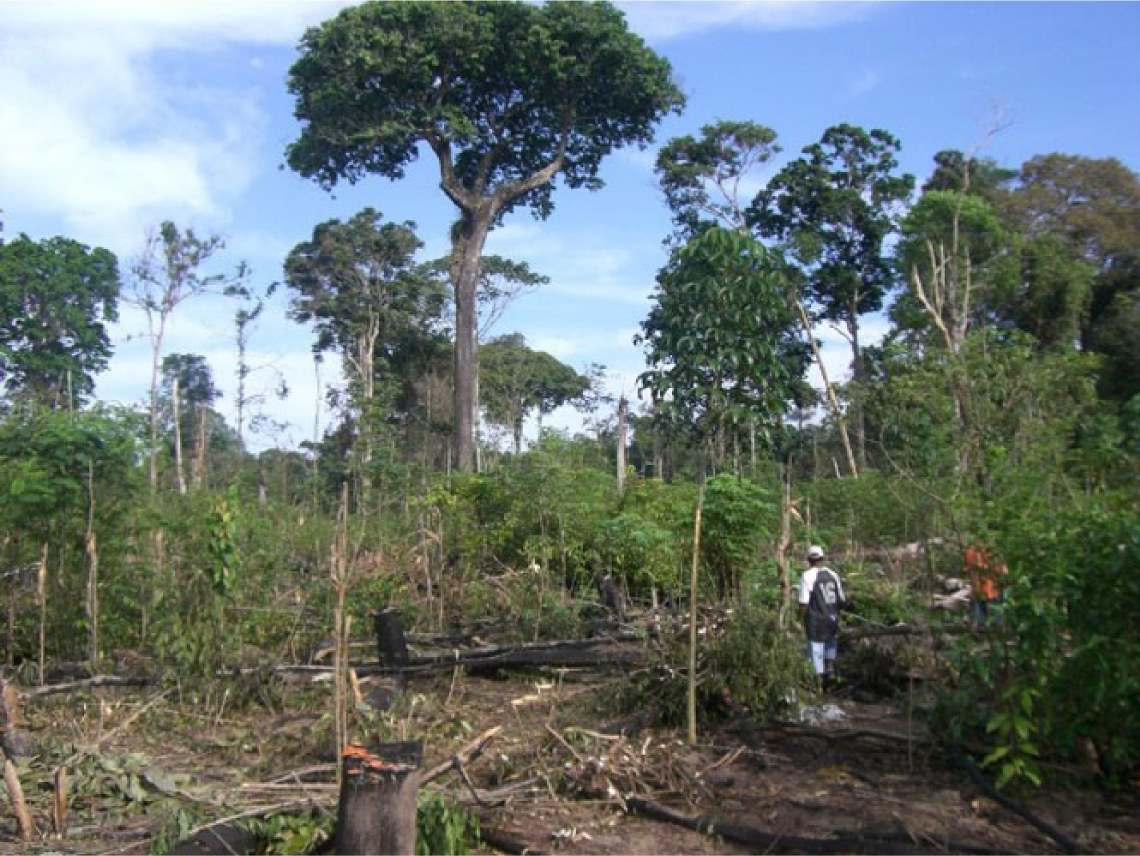
Roçado or slash-and-burn garden. © Photograph: Aníbal Arregui.
This analytical angle has been in part inspired by a theoretical debate related to renewed readings on biopolitics that touch upon the question of considering ‘nature’ itself as a being over which the political ‘power over life’ may be exerted. It is worth noting that Foucault’s thinking addressed different scales of social life and, accordingly, the link between the political body and the body of populations acquired clear expression in his works from the late 1970s (e.g. Foucault, 1979, 2008[1978: 79]). Notwithstanding, it is only in the wake of a ‘post-Foucauldian’ reformulation of biopolitics that the bios seriously addresses the environment as a living-political being (e.g. Agrawal, 2005a; Darier, 1999; Rutherford, 1999). The so-called ‘ecological-governmentality’ seeks an intertwinement of the problematics of population and the problematics of nature, thus overcoming the bio-economic understandings of world systems ecology (Rutherford, 1999: 37–38). Such rethinking of biopolitics confronts the anthropocentric privilege of mankind in Foucault’s work by highlighting the intermingling between ‘human’ and ‘non-human’ modes of existence (see Latour, 1991, 2013; Lemke, 2005). This article will therefore draw on these recent interpretations that resituate ‘nature’ or the environment within the realm of human life and politics.
In the last instance, and before entering into the ethnography, it is worth underlining the theoretical distance adopted towards typically Foucauldian rhetorical gestures concerning the idea of technology. ‘Technopolitics’ here refers not to a ‘political technology of the body’ nor to a ‘technology of government’ (e.g. Foucault, 1975, 2008), but rather to a ‘politics of technology’, wherein technology is approached as something inseparable from a specific form of human-affected materiality (Dobres and Hoffman, 1999: 211; Lemonnier, 2002: 544). Foucault’s usages of the term ‘technology’ encompassed ‘any operation over the soul or thought’ (Foucault, 1994). Such use was synonymous with methodology or technique while emphasizing a more institutionalized or even technocratic version of them. Important discussions have been raised concerning the pertinence of placing the ‘immaterial’, the ‘ideal’ or the ‘subject’ within the arena of techniques and technology (e.g. Ellul, 1977; Latour, 2007; Naji and Douny, 2009; Warnier, 2009). However, for the sake of conciseness, this article will only provide an account of the interplay between power and technology as it materializes in specific physical relations between human bodies and their environment. The idea of technopolitics, then, will be closer to a politics of technology that matches an ‘anti-essentialist’ politics of nature, where the line between human and non-human materialities blurs if one contemplates the environment as an historical product of diverse, sometimes conflicting forms of social agency (e.g. Escobar, 1999; Latour, 2004; Raffles, 2002).
Social subjects and materialitites are the source that informs this article. The following sections will address from an ethnographical perspective the environmental conflict between the quilombolas and the aluminum industry by focusing on its socio-material tensions, giving special attention to the changes related to quilombola bodies and the infrastructural environment as the inseparable parts of a disappearing sociotechnical tradition. The analysis can be understood as a result of my observations of the daily practices in the field and, most of all, as a reconstruction of the way quilombolas explained to me the socio-economical momentum they were experiencing. Informants were of all ages, some of them working at the mine, others students at the mine’s school, others not directly related to MRN. Many quilombolas were the object of my inquiries, but the central figures for the investigation were people with whom I lived: a 60-year-old woman and a young machine operator from Boa Vista, and a woman from the Erepecurú river who spent several years on the Trombetas, working for the mine as part of their housekeeping staff. The majority of data were gathered between the years 2007 and 2009, while I conducted fieldwork in the region. More recent bibliography, official reports and personal communications confirm that the socio-environmental frictions described here are still a current issue for the mine, the state and the quilombolas.
Quilombolas and the anatomo-politics of bauxite extraction
Oriximiná, a Western municipality of the Pará State, is a region where an important part of the quilombola history has taken place. The waterfalls at the top of Amazon tributaries such as the Trombetas River or the Erepecurú were a refuge for many slaves of African origin who escaped in the mid 19th century from the plantations and mills near harbor cities such as Óbidos and Santarém. The so-called ‘quilombos’, i.e. the rural communities where the descendants of these maroons settled, spread down along the rivers after the abolition of slavery in 1888. However, it was only a hundred years later, with the advent of the post-dictatorship Brazilian constitution of 1988, that the territorial and cultural rights of afro-Brazilian peoples were officially recognized (Boaventura Leite, 2008; Larrea and Ruiz-Peinado, 2004).
During the process of settlement within the Amazonian context, quilombolas mixed with indigenous peoples, Luso-Brazilian colonists and other riverine populations. This fact made the official identification of the quilombola ‘lifeblood’ of many Amazonian communities difficult. Since the new constitution recognized the quilombolas’ rights, many riverine populations have claimed to be maroon descendants, thus generating in the 1990s a process of ‘ethnic emergence’ that could not be solved with consistent anthropological or historical criteria (Arruti, 2002). As an ad hoc solution, the ‘self-application’ process, as a form of self-identification as a quilombola community issued by its own stakeholders, turns out to be the main legal instrument to be applied (Andrade, 1998: 112).
This blurred, multidimensional history that complicated the identification of quilombolas in the 1990s has its correlate on an anthropological level. In the case of the lower Amazon quilombola communities, the ‘historical discontinuities, social fractures and geographical displacements’ have resulted in a ‘scarce cultural contrast’ between quilombolas and other rural groups, with which they share a religious base as well as similar forms of social organization (Price, 2000). Yet it is from a sociotechnical perspective that the common ground of quilombolas and other Amazonian populations acquires its clearest expression. Their traditional forms of extractivism, focused on fishing, hunting and slash-and-burn-horticulture, consist of a barely mechanized exploitation of the environment that places the embodied techniques at the very core of the socio-technical logic. Amazonian anthropological literature has prolifically analyzed the centrality of the body not only in technological terms, but also as an essential part of indigenous cosmological narratives (e.g. Karadimas, 2005; Overing, 2006; Surrallés, 2003; Velthem, 2005; Viveiros de Castro et al., 2006). Despite their sociocultural diversity, there is common ground for the majority of Amazonian groups wherein corporality, though in different ways, remains at the core of the traditional sociotechnical systems and therefore plays an important part in defining group identities. Quilombolas are not an exception, but, as will be argued, not all Amazonian quilombolas are immersed in the same socio-technical circumstances.
In 2009, on the occasion of a visit of some people from the neighboring river Erepecurú, a 60-year-old woman from Boa Vista welcomed the group by providing regional juices and Brazilian nuts. In front of a quilombola from the Erepecurú, the woman placed a wooden base and several tools with which he could crack the hard, woody capsule that contained the edible seeds of the fruit. Instead of employing the wooden base, the hammer and knives provided by the woman, the Erepecurú quilombola held a machete with one hand and the nuts with the other. He vigorously brandished the machete in the air and struck several times, with precision, the 10 cm diameter capsule that barely covered his palm. The capsule opened up and he proceeded to skillfully peel each seed with the same machete he had just employed as an axe. In a few minutes every one was eating the peeled nuts, while the Boa Vista people expressed their admiration for the strength and dexterity of the man from the Erepecurú. In particular, the hosting woman declared to not have seen for many years a quilombola cracking nut capsules on the hand. 6 That comment rapidly gave rise to a sort of nostalgic mood and provided the event with a resigned, bitter meaning. Less than three decades ago, Trombetas quilombolas were proud of having the same body skills as their friends, and in many cases relatives, from the Erepecurú River. They likewise depended on forests shadowed by Brazil nut trees (bertholletia excelsa), on whose ground they gathered once a year tonnes of nut capsules both for subsistence and for sale. 7
The onset of the bauxite mining in the 1980s not only interrupted the nut harvest carried out by the Boa Vista quilombolas but also dismantled their articulated set of traditional extractivist techniques. Many quilombolas started a new life by working in the company town with temporary contracts as gardeners, janitors, housekeeping staff or offering fluvial transport services. By the start of the millennium, only five of them worked in the mine with fixed-term contracts as machine operators, while the majority of them were still dependent on the rolling contracts that managed the recently created ‘service cooperatives’, sponsored by the mine (Duque, 2009: 147). 8 They received a salary that was enough to purchase food and basic products at the mine facilities. They started to visit every week the mine’s supermarket. Quilombolas had no more need for hunting, fishing or raising farm animals around their palafites. They even abandoned the roçados, the classic slash-and-burn plantations where they used to grow pineapple, sweet potatoes, bananas and above all the manioc’s tubercles that contributed the main caloric source of their diet. An elderly local who had followed the settlement of MRN from the beginning told me that quilombolas’ local knowledge was used by the mine pioneers in order to map the area and thus identify the best places to build the company town and start the excavations. Quilombola body skills, strength and endurance were also required in the first phase to clear the area, excavate the first pits on the nearby plateaus, and to erect the company town infrastructures.
Native bodies thus contributed to the settlement of the mine on Porto Trombetas (Trombetas Harbour). Later, in return, the body skills and environmental local knowledge of those quilombolas who worked within the mining complex were no longer an asset, but rather a nuisance that MRN had to domesticate. Industrial extraction of bauxite involved a new, rigid set of behavioral rules to which quilombolas, like any other worker, had to adjust. The mine ‘microphysics of power’ imposed a discipline of the body to which quilombolas were not accustomed (Foucault, 1975): clothing, surveillance cameras, rigid behavioral rules and health controls inserted them in a completely new dimension of restrictions and obligations. Every action on the environment was regulated according to the three principles of classifying, systematizing and cleaning, and in addition everything had to follow the mine’s security standards. Machine operators had to wear jumpsuits, helmets, boots, gloves, protective glasses and sometimes soldering masks.
The normative power of the mine was recalled at every corner of the company town, with signals indicating some code of conduct or warning of a danger. No spaces were left without regulative limitation. The whole mining complex functioned as a big machine. A quilombola machine operator from Boa Vista declared there was no room for improvisation or for skipping any part of the protocol since everything was under camera surveillance. He established an analogy between the mine and Big Brother, more likely in reference to the popular reality show than to George Orwell’s dystopia, but at any rate explicitly evoking the burden that the surveillance system of the mine represented for the workers. The man recognized that he had accepted such intrusive politics of control due to the ‘attractive’ salary MRN offered him. However, he did not hide a negative astonishment that conferred a sort of recursive, technophobic turn to the idea of a panoptic: in his own words, the mine was crowded by men who surveyed machines and machines that surveyed those men who surveyed machines.
The anatomo-politics of MRN materialized also on a medical level. According to the quilombolas, the mine required them to take medical tests every three to six months. Blood, urine, faeces, hearing, sight and breath were examined periodically. Micro-particles polluted the air during the processing of bauxite and, in some zones of the mine, the workers had to bear noise over 90 decibels. Many factors endangered the health of the miners and appropriately the mine carried out many medical controls. 9 Paradoxically, however, the quilombola often complained about how difficult it was to get medical leave from the mine’s doctor.
Before MRN’s arrival, medical attention was something for which quilombolas had to descend to the urban hub of Oriximiná, which entailed a long and expensive trip by ship. In some communities there were still traditional healers, called sakakas, whose formerly important role was slowly being supplanted by modern medicine techniques. In this regard, and despite its reticence to give medical leave and its tiresome examinations, having a doctor nearby was seen as great progress for the wellbeing of quilombolas. Along with the doctor, a school for the quilombola children was provided inside the company town and another school for children under 10 years old was built in the community. Boa Vista was still placed within the forest, or more specifically on a floodplain of the Trombetas shore, but the quilombola people had turned their back on this milieu and steered every morning towards the school, the supermarket, the doctor or the workplace. The mine and the company town installations concentered many functions of the modern capitalist states, thus allowing MRN to establish new ties with the surrounding populations that were not only based on wage work, but also on nutritional, medical and educational dependency.
Not everybody in the Trombetas River could benefit from the mine services. The settlement of MRN brought a new register where different kinds of dwellers were sorted out. Often simplified ethnical factors such as being quilombola or ribeirinho (mestizo river-dwellers) and geographic criteria, such as the place or community where one lives, were used to produce differentiated ‘identity cards’ that regulated the access to Puerto Trombetas and the individual rights related to the dwelling in different types of conservation units. The inhabitants of the Biological Reserve, for instance, were not allowed to work in the mine (see Duque, 2009). Likewise, only a few quilombolas whose registers showed they were living close to MRN had the right to use the mine’s facilities, including the school. The register also identified the conservation unit to which every quilombola ‘belonged’, thus restricting free circulation along and from one side to the other side of the river, which was the usual mobility pattern before the extractive industry settled on the region. The mine’s own security staff, in collaboration with functionaries of state environmental agencies and the Federal Police, introduced control posts and thus established a regime of control whose influence reached far beyond the mine’s extractive territory. 10
As the next section will show, MRN’s partnership with state agencies for the delimitation of the conservation units was part of a well-orchestrated governmental strategy for seeking control over the environment and its populations. In this regard, the biomechanical shift experienced by the quilombolas living around the mine could be seen as the most micro, anatomo-political materialization of such politics of nature. The prohibition of many extractive activities in the Biological Reserve and in many parts of the National Forest, along with the wage labor, became a pervasively inhibiting factor for the quilombola in terms of continuing with their traditional activities of hunting, fishing, gathering or cultivating fruits and manioc. Older quilombolas complained about the repressive means employed in the beginning, when state prosecutors and federal police agents interrupted the daily life of the communities in order to prevent people from undertaking ‘illegal’ extractivist activities. Later, police surveillance gave way to the more intangible but no less effective monitoring undertaken by state agencies in charge of environmental protection and conservation. 11
The effects on the embodied sociotechnical systems in Boa Vista were at any rate dramatic. In 2006, 74 per cent of Boa Vista income came from salaries that depended on MRN through wage work as machine operators (27%), employment in the cooperative associated to the mine (20%), or informal services such as cooking, gardening, ironing and general domestic labour (27%). In return, the total average of rent coming from salaried work for the 16 quilombola communities of the Trombetas was 15 per cent. As for the non-salaried work, while in Boa Vista only 8 per cent of the income depended on agricultural products and 2 per cent on traditional extractivism, the percentages soared up in the total quilombola average to 42 per cent for agriculture and 22 per cent for extractivism (see Figure 3). Regarded from the perspective of each traditional activity, both in fishing and hunting and in the management of forest vegetable products the frequency and quantity rates of Boa Vista (in kilograms, units and number of days in which an activity is undertaken) were always strikingly below the average of the rest of communities.
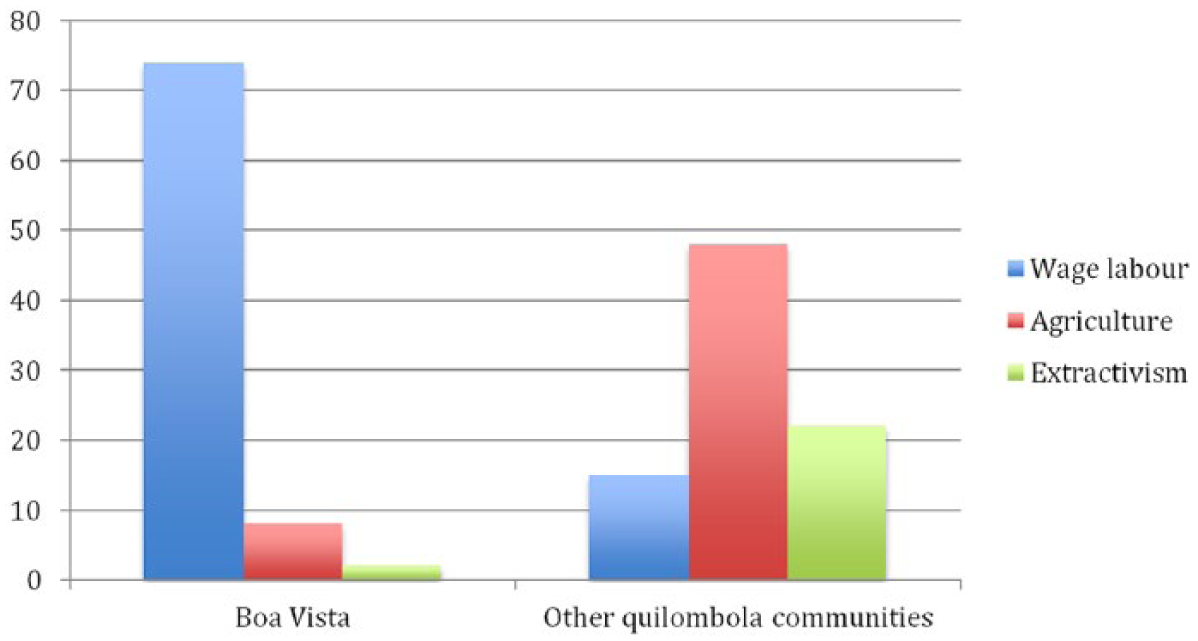
Sources of income comparing Boa Vista and the average of the rest of quilombola communities on the Trombetas (adapted from MMA et al., 2006: 227–246).
The close presence of the mine led Boa Vista inhabitants to lose a significant part of their socio-technical tradition and therefore the body skills and habits that somehow defined the ‘quilombola identity’. Some of them declared, with sarcasm and auto-critical intent, that hunting and fishing is a matter of quiombolas, but not of [the mine’s] employees. Many people experienced a reconceptualization of the role of their body within their society that originated from the anatomo-political fallout of the bauxite extractivism. From body techniques to taste, everything seemed to have radically changed in a few years: while older quilombolas regretted that the younger ones barely knew how to row properly and were not even able to get along in the forest, the younger people preferred supermarket chicken to the ones that freely perambulated around their palafites. The new generation of Boa Vista quilombolas showed admiration of a comrade from the neighboring river who skillfully cracked nut capsules with a machete, and this man, in turn, listened amazed to two Boa Vista quilombolas speaking of kilowatts, levels of electric risk, subextensions and transmission lines. The quilombolas themselves were mindful of the transformation they were experiencing. They realized the deep sociotechnical, cultural change, and expressed their embodied anxieties associated to the possible depletion of the bauxite available to be extracted in the area. What will happen to us when the mine goes away? A mine-worker interrupted a conversation: this is as if you pull someone’s leg out, you put instead a mechanical one, and then you leave this person alone, without explaining how this new leg works!
Naturalized infrastructures and environmental governmentality
Not everybody had a negative perception of MRN. Some Boa Vista quilombolas were glad that the industry had liberated them from the constrictions of nature. The initial conflict of the mid 1970s was later dissipated due to the positive fact of MRN generating wage labor and providing commercial infrastructures as well as educational and health services from which quilombolas could profit (Azevedo, 2004: 5). The narratives of modernity became quickly interiorized by many of them. However, by 2009, even those who supported the mining of bauxite agreed on one point with the opponents to MRN: a rift had been created in the community of Boa Vista. Some expressions recurred as a leitmotif (a complaint repeated by quilombolas of all ages in almost every conversation with non-local people) that marked the disappointed mood: Boa Vista should have been the nicest community; we are disorganized; the mine divides us; there is no more collaboration between us; etc. Many factors have contributed to this self-perceived social disarticulation, and the presence of MRN is perhaps the most decisive issue in this regard. This section addresses the Boa Vista social rift from the view of how the mine altered the quilombola collaborative sociotechnical systems and infrastructures.
Not just quilombola bodies were at the core of the sociotechnical transformation. A broader level of life, namely the environment, was likewise targeted by MRN. As previously mentioned, there are reasons to consider the links between the anatomo-politics and the broader camp of environmental governmentality. In this particular context, it applies to the continuities existing between the mine’s anatomo-politics and its ambition to control the Trombetas ecosystem. In what follows, these continuities will be illustrated by highlighting the ethnographical difficulty of approaching the quilombola biomechanics and the infrastructures embedded in the environment as though they were independent dimensions. Rather, both levels of life, the individual body of quilombolas and their environment, constitute the inseparable fields where the mining industry disarticulates the local social fabric and consolidates its power by imposing a new management of nature, technology and populations.
Some issues concerning the most recent geopolitical history of the region must be outlined in order to understand the implementation of the mine’s environmental governmentality. In 1979, shortly after the beginning of the excavations, the Brazilian Institute of Forest Development (IBDF) demarcated the Trombetas Biological Reserve, a plot of land of 385000 ha situated on the left side of the Trombetas River, in front of the mine harbor. According to article 36-Law 9985/00 of the federal constitution, MRN had to support the Biological Reserve as part of the ‘environmental compensation’ agreement between the mine and state agencies (MMA and IBAMA, 2004: 3.166). Within this legal framework, in 1993, the so-called ‘emergency action plan of the Trombetas Biological Reserve-1993’ was generated, which among other actions endeavored the ‘control of the anthropic pressure through supervision, land-tenure regularization, expulsion [desocupação da area] as well as the development of other economic activities that foster alternative ways of subsistence for the populations of the area’ (4.2–4.3).
MRN boasts still today that it intervened in the process of the reserve’s demarcation and that it remains the guarantor for the preservation of its natural beauties. Specifically, MRN claims to ‘assist the Institute in the surveillance and development of environmental education activities in the communities that inhabit the reserve’. 12 Among the activities that needed to be re-educated for the sake of the environment was the exploitation of the Tracajá turtle, from which many quilombolas gained part of their means of subsistence. The mine and state institutions’ vigilant and at the same time didactic intent contrasts, paradoxically, with the main discourse of the ‘empty land’ that legitimized the demarcation of the Biological Reserve (Azevedo and Castro, 1998: 221). According to the Conservation Units’ legislation, a Biological Reserve is a conservation unit of ‘integral protection’, which means that no human intervention over the environment takes place on it. The integral protection therefore also means that no commercial exploitation of the forest resources is allowed, even if this exploitation is conducted through traditional extractivist techniques (see SNUC, 2000). Yet, despite the official ban to local populations to stay and work in the Biological Reserve, diverse quilombola communities were settled there many decades before the mine’s arrival. Two elderly men from Boa Vista stressed in conversation the fact that even quilombolas living on the other side of the Trombetas used to cross the river in order to carry out in the Reserve part of their extractivist activities. State agencies and MRN employed a two-fold naturalizing logic: on the one hand, the reserve was defined as a non-humanized territory. On the other hand, the human presence in this territory was institutionally almost invisible and, in the best case, human activities connected to this territory were prohibited by the legal apparatus of Environmental law. 13
MRN gained geopolitical power in the region by associating itself with public institutions. After the refusal of the INCRA to concede 87.258 ha to MRN in 1977, the mine opted for actively contributing to the creation of ‘blockage zones’ which would become the Biological Reserve and later the National Forest (Wanderley, 2009: 482). Such blockage aimed at preventing other companies from exploring the area, avoided the spontaneous formation of communities of people looking for jobs (beiradões), and involved an important ‘reserve of value’ for the mining capital (p. 486). In addition, the official involvement of the mine in the ‘conservation’ of the Trombetas ecosystem allowed MRN to put in the foreground its environmentalist discourse, presenting itself as an agent that protected the natural milieu against the unsustainable presence of its former dwellers. 14
A naturalizing narrative that dates back from colonial times depicted the forest as though no human footprints were to be found in the area. Such a representation of the Amazon context has been strongly contested by historical ecology and environmental anthropology, where a number of agronomic and geographic data as well as diverse cosmological accounts of the environment show that an important part of the forest is an anthropogenic, socialized milieu (e.g. Balée, 1989, 1998; Descola, 1986; Erickson, 2008; Raffles, 2002). In the case of the Boa Vista context, the preservation governmentality of MRN naturalized many of the typical sociotechnical infrastructures in order to restrict traditional extractivism and thus to control quilombola populations. This naturalization took place mainly through a politics of nature that downplayed the human agency embedded in traditional infrastructures: riverine arrangements (wooden ports, canals, reservoirs, etc.), hunting spots, traps or slash and burn gardens suddenly seemed to have disappeared from the local topographies. The new legal frame imposed an externally restricted and monitored form of relation with nature that recast both quilombola bodies and their environment.
A later geopolitical move of MRN illustrates in a more specific manner the entanglement of quilombola biomechanics and infrastructures and its tensions with the mine politics of nature. In 1989, another conservation unit was demarcated in the area: the National Forest Saracá-Taquera. The initial 429.000 ha, on the right side of the Trombetas, received the status of ‘conservation unit for sustainable use’ (see SNUC, 2000). In the first phase, more than 150.000 ha of the National Forest were appropriated by MRN (Azevedo, 2004). With this conservation unit, the mine ensured its hegemony on the region, preventing other companies from prospecting in a land that promptly became the de facto property of MRN (Azevedo and Castro, 1998; Duque, 2009; Wanderley 2009). Until today, the plateaus of Saracá-Taquera have provided the mine with a rich bauxite soil and suitably the open pit mining has rapidly taken the place of vast areas of forest. Notwithstanding, in order to avoid social alarm and to adjust to Brazilian environmental law, MRN highlights its sustainable management of resources through different ecological initiatives and a celebrated program of re-vegetation of the so-called ‘original’ forest. 15 The juridical and socio-environmental problem entailed in these re-vegetation programs is that, far from being an unaltered forest, the Saracá-Taquera is the place where many quilombola communities such as Boa Vista have been settled for hundreds of years.
An example is that the recent geopolitical history of Boa Vista has been drastically affected by the development of the industrial venture. As previously mentioned, in 1995 Boa Vista was the first Brazilian quilombola community to gain official recognition of its territory and its cultural tradition. The presence of the mine certainly accelerated the entitlement process. For adjusting the recent, post-dictatorship constitutional framework (1988), the legislation concerning conservation units and the status and imbrication of native populations became an urgent issue to be solved in order to ensure the legality of those companies operating in the Amazon rainforest. However, many quilombolas today still display skepticism toward the good, ethnologically committed intentions of MRN in enabling such legal recognition. According to the older generation of quilombolas, the main source of conflict in the 1990s was that MRN closely supervised the demarcation process carried out by the National Institute for Colonization and Agrarian Reform (INCRA). Quilombolas uneasily note that great pressure was put on them to accept the square-ruled division of their land into plots of about 50 to 100 ha to be managed by familial units. That was the typical format of land tenure fostered by a Brazilian agrarian reform that aimed at transforming peasant communities into economically independent and geographically dispersed households. This fact resulted in a conflictive negotiation process between the INCRA and the quilombolas, whose territorial tradition was related to a collective use of land. Some Boa Vista quilombolas suspected that MRN was behind the attempt to concede small-scale plots, so that every family could become a potential land seller for the future mine’s expansion. They already had a precedent of 400 ha of a family plot being sold to MRN in 1977. But in the 1990s the political circumstances were quite different, and diverse national and regional institutions were supporting the quilombola cause and struggling to find a legal way to preserve their traditional management of land. 16 In order to avoid the family-unit plot division, Boa Vista quilombolas and their supporters started a parallel demarcation and celebrated diverse political events that resulted in the concession of the 1.125 ha of collective land that prevails today.
Yet the relative success of quilombola claims for collective territory did not prevent the mine from succeeding with its disrupting program. The construction of the company town and the first excavations in the National Forest Saracá Taquera resulted in the expulsion of many families and the devastation of the plateaus Saracá and Papagaio, where the Boa Vista quilombolas had part of their plantations, hunting areas and abundant Brazilian nut trees (Azevedo, 2004; Duque, 2009; Farias Junior, 2008; Wanderley, 2009). In addition, MRN from the beginning used the Agua Fria stream and the Batata Lake to throw out the bauxite waste. The reddish mud left after the crushing and washing of the mineral rapidly contaminated the water and therefore decimated the fish that guaranteed the protein content of quilombola nutrition. 17
Along with the ecological impact of the mine, many restrictions were imposed to traditional extractivism both in the Biological Reserve and the National Forest. Under the flag of natural preservation, the Brazilian Institute of Environment and Renewable Resources (IBAMA) became a surveyor of the river dwellers. An old quilombola woman expressed her feeling of having been ‘captured’, as their predecessors slaves [sic], in a conservation unit where no more fish, no more animals, no more nuts were to be found. State surveillance, restrictions on extractivism and ecological change led the quilombolas to realize the difficulty of continuing with their traditional forms of sociotechnical production. In a short period of time, Boa Vista peoples had to adjust to the new politico-ecological settings, which in a sense impelled many of them to become cheap wage labor for MRN.
This change destabilized the central role of the body techniques and consequently some quilombola forms of social organization. One of the most lamented losses in this regard is work on the roçados, i.e. the classic Amazonian slash-and-burn plantations. Quilombola roçados are horticultural infrastructures of about 2 ha usually located on collective land areas where manioc is cultivated in combination with other tubercles and fruits (see Figure 2). As with the majority of Amazonian technologies, the roçados are ephemeral infrastructures inasmuch as they are abandoned after the second or third harvest (generally, no less than two years after the first one). Afterwards, other areas are burned, cleared up, planted and transformed in new roçados. With the manioc extracted from the roçados, the quilombola elaborate a variety of culinary products that encompass sweet cakes, spicy sauces and even alcoholic drinks. The most important product, however, is the manioc flour, which is elaborated in another quilombola infrastructure, the so-called casa da farinha (flour’s house), where the manioc tubers are peeled, crushed into small grains and roasted on big wood stoves (see Figures 4 and 5). Manioc provides the main contribution to the quilombolas’ diet and, since it can be cultivated year round, also represents certain nutritional stability in the face of the external market relations (Ross, 1978: 217–218). To express the importance of manioc in their way of life, quilombolas used to call themselves filhos da farinha (sons of the flour).
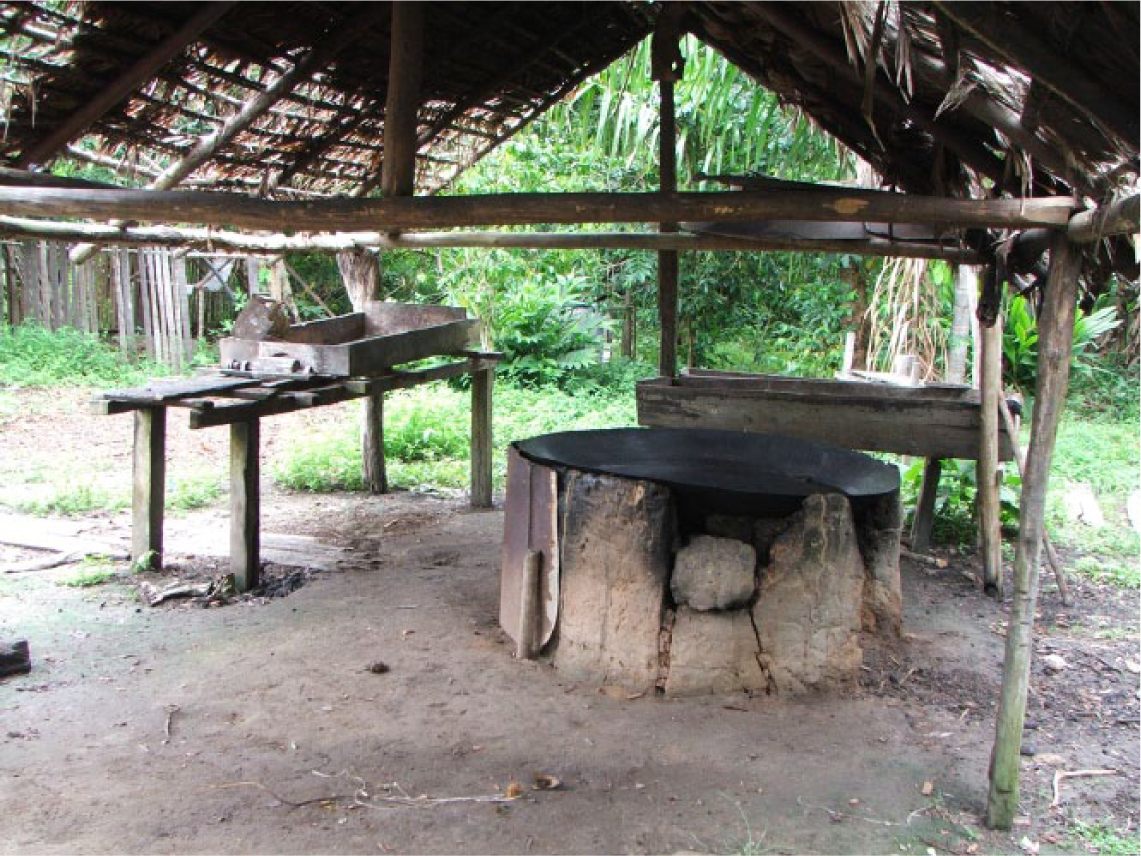
Casa da Farinha. © Photograph: Ignasi Gámez Couso. Reproduced with permission.
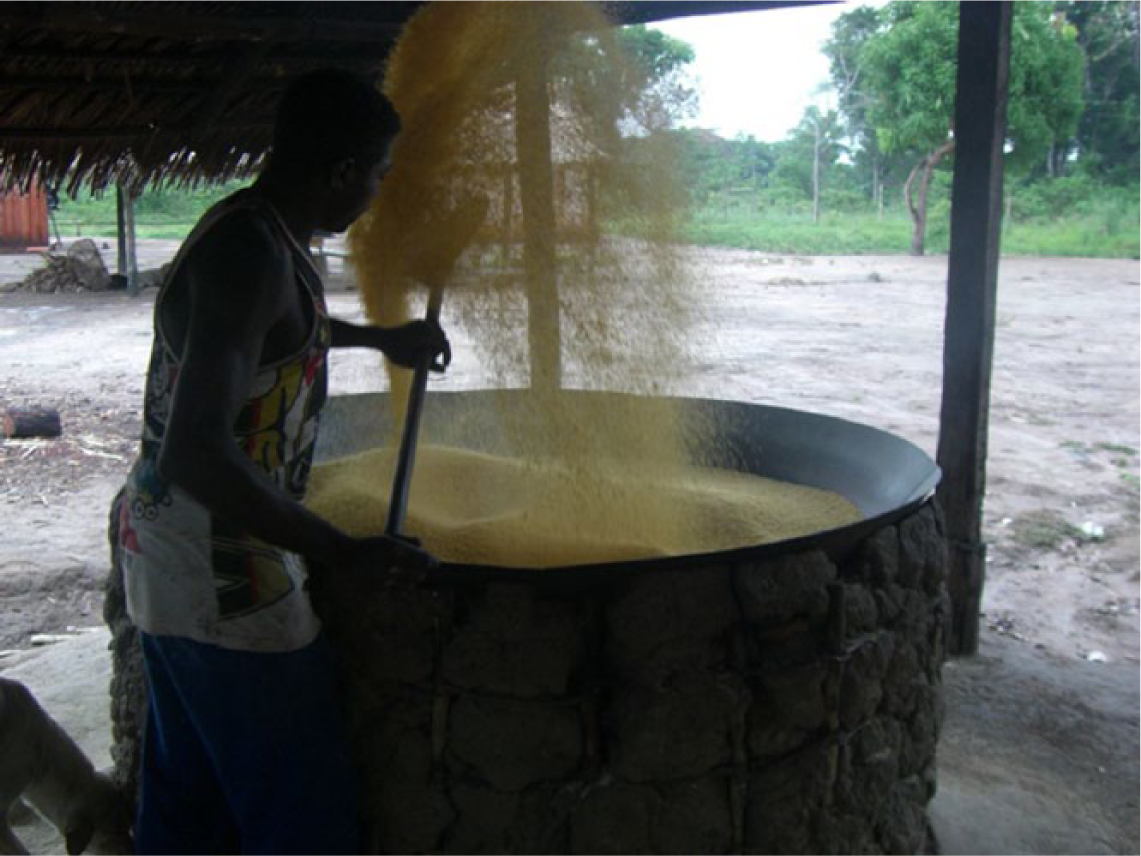
Roasting the manioc flour. © Photograph: Aníbal Arregui.
For some stages (mostly during the manioc harvest and the elaboration of its flour) the quilombola work on the roçado and in the casa da farinha by employing a traditional form of cooperative work called mutirão, which consists of an inter-familial or inter-communitarian system of collaboration (Caldeira, 1956). 18 Such strategy requires a high degree of coordination and planning, involving a complex set of body techniques and environmental knowledge. The Brazilian concept of jeito (skill, body technique) is often employed referring to the specific set body techniques and skills required on the roçado or the casa da farinha. 19 The mutirão is thought of as a time of hard work but also as an opportunity to spend pleasant time with acquaintances. In order to foster the positive mood, the hosts provide the most cherished regional food and drinks. Surely, the mutirão pattern of cooperation increases the ‘productive force, because with the workforce of the collective increases the physical and psychological energy’ (Azevedo and Castro, 2004: 50). But beyond its technological efficiency, the mutirão works as a mechanism that fosters social cohesion and economical reciprocity: each family or community has its own roçado. When quilombolas from other communities come to the mutirão summoned by one of their neighbors, they know they are not just going to offer their proficient, strong bodies; they are also gaining a long-term cooperation in their own roçados and, above all, they are reinforcing social ties.
Looking at the importance of the slash-and-burn gardens in quilombola corporality and forms of social organization, it is easy to figure out the magnitude of the social changes resulting from the destruction of these infrastructures. The older quilombolas noted that many roçados and casas da farinha were destroyed because of the mine excavations and the construction of the company town. As for those located beyond MRN’s territorial limits, they were likewise steadily abandoned as the quilombolas became engaged in the mining activity. These ones just disappeared as undifferentiated parts of a natural space whose physical exploitation was legitimized by the Brazilian environmental law. The others, already unattended in the middle of the forest, were probably swallowed by the dynamics of nature that superimposes its materiality over the traces of human history. Roçados and casas da farinha are embedded in the Amazonian environment, and at the same time are constitutive infrastructures of quilombola society. Yet, these kind of social issues were and are today not a significant concern of MRN politics of nature.
In the beginning, MRN celebrated and flogged its initiatives of reforestation. And when the voices of quilombola people rose up to claim that the forest of Saracá Taquera was also an infrastructural part of their society, the mine offered a sort of cultural restitution. With their MRN budget, quilombolas built up a casa da farinha at the very center of Boa Vista (see MMA and IBAMA, 2004: 2.58–2.59). A number of journalists turned up in the community in order to immortalize the first moments in which the inhabitants of Boa Vista retook their ancestral traditions. Some quilombolas even produced for the record a small quantity of manioc flour. According to those who were present at the event, the foreigners did not notice the clumsiness of those men and women who had lost their jeito. Since the late 1980s, almost everyone in Boa Vista had been buying the farinha in the mine’s supermarket. And in 2009, the work on the roçado was rarely undertaken, the collective summon of a mutirão was not even a current question, and the biomechanics of quilombolas had adjusted to the rules of industrial extractivism. MRN thought that providing the means to construct a casa da farinha could be a fair, logical restitution to the people of Boa Vista. But this gesture came too late and was blinded by a sort of materialist reductionism. That casa da farinha, at the centre of Boa Vista, was only the structure of an infrastructure, a set of human-shaped materials already dislocated from the environmental conditions and the biomechanical dispositions that, some years ago, enabled the quilombolas to use it in order to produce their own technopolitical versions of nature.
Conclusions
This article has addressed the way that quilombolas’ bodies and their infrastructural environment conflict with a mine politics of nature. Such conflict is illustrative of the hegemonizing effects of globalization, wherein different perspectives on nature and politics struggle to prevail. It is worth emphasizing, then, that localized clashes such as the one described in this study embody narratives and sociotechnical strategies that are part of the dynamic, conflicting reconfiguration of the world-system ecological and economical structure. In this regard, the term ‘technopolitics’ is suggested as a theoretical tool to critically approach classic biopolitical analyses and make them more sensitive toward the global articulations of modernity. The context of extraction of an important raw material such as bauxite must therefore be considered in relation to the shaping of ‘Western’, far-off societies that strongly depend on aluminum as an omnipresent material in the modern capitalist way of life.
Such a relation has here been addressed by raising some questions that draw on Amazonian ethnographic examples but that point towards a more general reflection on the way that social sciences have commonly coped with biopolitics. It has been suggested that, despite what the majority of Foucauldian accounts of modern governmentalities would lead us to infer, there are explicit (i.e. ethnographically detectable) continuities between human bodies and (natural) environments that make both levels of life interdependent and politically malleable, and that such malleability is in part due to these bodies and environments being technologically infiltrated. Such infiltration has here been exemplified and analyzed in the context of the articulation of the relationship between quilombola traditional body-techniques and sociotechnical infrastructures such as the roça or the casa da farinha. It has been shown how both sociotechnical instances (body techniques and infrastructures) are being transformed or are even disappearing under the influence of an aluminum mine that, along with state agencies, naturalizes the Amazonian environment, downplays human presence in the forest and inhibits quilombola ways of using their bodies for conducting their traditional forms of forest extractivism. Far from being regarded as an intentional attack of the state and the mine on ‘quilombola culture’ or quilombolas themselves, this process of transformation has been addressed as the consequence of the mine and the state’s seeking to ensure their social, economical and environmental control on the region.
This approach implies the adoption of a significant distance in relation to the idea of the ‘technologies of the subject’ as it turns up in many biopolitical analyses. Last decade’s debate on biopolitics and the environment centered on the idea of ‘environmentality’ as a form of ‘intimate government’ or a ‘politics of the subject’ that is constitutive of the ways humans develop biopolitically mediated attitudes towards the management of nature (Agrawal, 2005b). Some critics have noted that this logic of the formation of ‘environmental subjects’ does not hold for the Amazonian context, where ‘subjects’ are neither as passive as in the (mainstream) Foucauldian picture of modern governmentalities (Cepek, 2011), nor can they be encompassed under a single, non-contextualized and anthropologically undifferentiated category of political ‘subjects’ (Hecht, 2011). While the domain of Amazonian subjectivities (not to mention the current ‘pan Amazonian’ debate on multiple ontologies) is far too complex an arena onto which to simply superimpose a biopolitical reading, the present analysis has utilized a less subject-oriented focus on the political: namely the fact of a neoliberal governmentality acting directly on the environment as a way of conducting the conduct (Foucault, 2008: 268–271). More specifically, the relationship has been stressed between such environmental operations of politics with what may be understood as a neoliberalization of nature that has the power to canalize the behavior of human populations (see Fletcher, 2010).
The ‘intimate government’ of MRN has not needed to practice an insidious pedagogy in order to transform quilombola bodies, technologies and subjectivities; it has been sufficient to agree with state agencies in defining and demarcating certain conservation units and then to collaborate with the state in stewarding its bureaucratic notion of environmental protection. Quilombola bodies and infrastructures have merely reacted, leaving aside their traditions, to these environmental definitions. This is of course a mechanistic depiction of a socio-environmental conflict where different perspectives are still actively contending. However, it is worth looking at the way social agencies and even governmentalities get concealed under the technification of the problem. The concept of technopolitics has been employed to introduce an anthropological shift into the technification of the socioenvironmental conflict between quilombolas and MRN. Such a move on the analytical prism should have aided in evoking the relation between quilombola bodies and environment as technologically entangled levels of their bios, what in more general terms has aimed at calling into question the possibility of any part of nature being exempt from ethnographical examination and, in the end, of political critique.
Footnotes
Acknowledgements
I am very grateful to all quilombolas from the Trombetas and Erepecurú Rivers that I met during the fieldwork stage. Several scholars of the graduate school ‘Kulturkontakt und Wissenschaftsdiskurs’ (University of Rostock) and two anonymous reviewers of the Journal of Material Culture provided intelligent and helpful insights into earlier versions of the paper. To all of them, my sincerest thanks.
Funding
This work was supported by a PhD grant FI of the AGAUR- Generalitat de Catalunya, associated to the University of Barcelona, and a postdoctoral contract with the DFG-GK ‘Kulturkontakt und Wissenschaftsdiskurs’, University of Rostock.