




Abstract
‘Trainers’ represent a form of footwear that has attracted academic attention, particularly in relation to the historical development of footwear since the 19th century, addressing various aspects, from the industrial application of rubber to the technologies of shoe manufacture. This article contributes to a literature on the intersection between trainers and the individuals who have ‘made’ them. However, it asks a parallel question: how do trainers ‘make’ the individual, that is to say: it addresses the embodied processes of everyday life and the contribution of technology to the body and its techniques. We argue that the diversification of the trainer parallels the unfolding of particular lives, offering a valuable, if under-utilised resource for making sense of everyday and life course processes of embodied identification.
Introduction
This article stems from a contribution made to the exhibition/seminar ‘From Sport to Street: The History of the Training Shoe’ at the UK’s Northampton Shoe Museum in 2011. The event marked the curators’ recognition of the diachronic and synchronic diversification of a single shoe type. Particular individuals, whether manufacturers or sportspeople, are often cited as key to these processes (Tenner, 2004). However, we argue that the notion of a one-way relationship that prioritises the capacity of particular individuals to shape and make an object is problematic. From a material culture perspective, we instead explore the shoe’s agentic capacity, as a body prosthetic (Gonzalez, cited in Lupton, 1998: 144), to contribute to individuals’ everyday embodied processes of social differentiation and identification. Using trainer-related data gathered during a broad 3-year ESRC-funded project on footwear, identity and transition the article shows how social divisions grounded in gender, sexuality and social class are both reproduced and resisted; the practices through which tensions between family-based and individual identities are resolved; the enmeshment of trainers within the ambiguities of ageing; and the reciprocal relationship between trainer wearing and affect. In sum, differentiation within the single category ‘training shoe’ has much to contribute to an understanding of broader processes of social differentiation and identification. As Miller and Woodward (2007: 343) argue with respect to the diversity of relationships people have with their clothes in different parts of the world, ‘in studying patterns of selecting and wearing clothes, we are studying the constitution and not simply the representation of persons’.
As this article acknowledges and describes, trainer branding itself mobilises forms of identification, certain shoes conferring status and authenticity upon individuals with aspirations tied to particular sport and leisure activities, music and fashion. Here, however, we draw on Kopytoff’s (1986) work on informal singularisation, the generation of private rather than commoditised meanings. As he argues, ‘the economies of complex and highly monetized societies exhibit a two-sided valuating system: on one side is the homogenous area of commodities’ – and here we can locate niche identities promoted in trainer marketing, ‘on the other side is the extremely variegated area of private valuation’ (p. 88). Importantly, as Kopytoff makes plain, these two systems of meaning must be understood to intersect with one another, neither remaining stable over time. Moreover, as Miller and Woodward (2007, 2012) demonstrate with respect to denim jeans, private valuation or individuated identities are often sought alongside a parallel desire to ‘fit in’, to achieve social comfort. Specifically with respect to fashion, Simmel (1957: 543) similarly argues that it enables a combining of ‘the tendency towards social equalization with the desire for individual differentiation and change’. Moreover, as our own data show, singularisation is not necessarily a process of meaning-making that is private to the individual. It may inhere in local cultures – perhaps as local as a family, and, importantly, occur in relation to more generalised, potentially commoditised, meanings.
How such ambiguities and mobilities of meaning are generated, shaped and constrained is not, however, well understood. This article’s footwear-based exploration therefore asks how an object such as a shoe not only shifts in meaning from a commoditised to a local or private sphere, but, in so doing, contributes to the always unfinished, multi-layered process of embodied social identification (Jenkins, 2004). In this respect, the article resonates with a social practice theory approach where, for example, the development and sustainability of an everyday practice such as taking a shower, is examined in terms of the technological affordances of electricity and plumbing, cultural beliefs about the body, and the (temporal) structuring of everyday life (Hand et al., 2005). As the data presented here indicate, we similarly need to consider how the technology of the trainer intersects with both shared cultural beliefs such as those associated with gender or age regimes, and the requirements of bodily activities such as running, skateboarding and visiting the gym. In this way, a nuanced, practice-based understanding of embodied identification becomes possible.
Trainers, bodies and identities
Sneakers, kicks, trainers, training shoes, athletic shoes: these terms describe a form of footwear that has attracted academic attention, particularly in relation to its historical development since the 19th century (see, for example, Boydell, 1996; Gill, 2006b; Tenner, 2004; Turner, 2013; Vanderbilt, 1998). Certain individuals surface within these accounts, their biographies enmeshed within the trainers’ history. In 1892, for example, Joseph William Foster made himself a pair of spiked running pumps which contributed to the later emergence of Reebok athletic shoe company; in the 1930s, Vitale Bramani, an Italian mountaineer, developed vibram, a sole material that combined grip with strength; and in 1968, Tommie Smith and John Carlos sprinted to victory in the Mexico City Olympics in Pumas running shoes (Tenner, 2004). These individuals were key to the historical development of trainers, along with the first industrial use of the sap of the Hevea tree to produce rubber, plus techniques that bonded it with canvas, and the introduction of ethylene vinyl acetate into running shoes’ midsole and heel wedge. Through the activities of running and climbing, Foster, Bramani, Smith and Carlos became intimately connected with the materiality of the trainer.
While this article contributes to a literature on the intersection between trainers and the individuals who have ‘made’ them, it does so by asking a parallel but neglected question: how do trainers ‘make’ the individual? If, like any footwear, the trainer can be seen as a kind of body prosthetic (Gonzalez, cited in Lupton, 1998: 144), which may bear autobiographical traces of its wearer, how then might it shape the embodied processes of everyday life for that person? Boydell (1996) describes an increasingly segmented trainer market; trainers are purchased by many different people, for varying purposes and worn in diverse contexts. As such, they now represent a category of footwear, rather than a single type of shoe. When Tenner (2004) explored the contribution of technology to the body and its techniques, he cited the story of the trainer as an example of how ‘new techniques of motion interact with new materials and processes to create endless variations on a classic theme’ (p. 77). As a result, we argue, the diversification of the trainer parallels processes of social differentiation, the unfolding of particular lives, so providing a valuable, if under-utilised resource for making sense of embodied identification within everyday life and across the life course.
This perspective allows us to consider what the notion of identity as a process means in practice (Hockey and James, 2003; Jenkins, 2004; Lawler, 2008). On the one hand, we may see it as an adaptive process where superficially malleable human beings ‘fit in’ as the occasion requires, yet such a view neglects the fluidity and self-reinvention that constitute identity’s core characteristics. Using the trainer to address these questions, we refer to Kopytoff’s (1986) concept of the biography of things, a resource he offered for understanding how objects and entities acquire value within social life. He concludes his argument by noting ‘an analogy between the way societies construct individuals and the way they construct things’ (p. 89). Although his distinctive contribution was the notion that things, like people, have biographies – something his editor, Appadurai, called a justifiable ‘conceit’ (p. 3), Kopytoff saw the object-based process he was investigating as profoundly embedded within the social lives of people. Hoskins (1998) agrees when describing her stalled attempts to collect life histories among the Kodi people of the East Indonesian island, Sumba. It was only when she enquired about exchange objects that people were able to articulate the life history material she wanted, demonstrating to her that ‘people and the things they valued were so complexly intertwined they could not be disentangled’ (p. 2). Shoes are indeed things; taken off, they stand apart from their owner; unlike other clothing they retain their form when emptied of the foot. Yet when worn, the shoe merges with the body, no longer a commodity, instead becoming personalized through embodied use. As Ingold (2004) says of people who volunteer for gait analysis: ‘incorporated into their very bodies [is] the experience of architecture, dress, footwear and baggage’ (p. 335, emphasis added).
Worn shoes
By the 1970s, in the rhetoric of trainer companies, trainers had become ‘essential equipment for contemporary living’ (Gill, 2006a: 374). Compared with high heels, they can be worn by both women and men, of all ages, and from a variety of backgrounds. Since 2005, only the flipflop has sold more (The Seattle Times, 18 June 2009). Reporting on a trainer exhibition at London’s Covent Garden Piazza, The Observer newspaper headlined an article with ‘Trainers: The humble shoes that fashioned the footsteps of history. Worn by everyone from royalty to the man in the street, the trainer is the world’s great egalitarian footwear’ (7 October 2012). Vanderbilt (1998) notes a similar claim that trainers dismantle barriers of race, class and gender; yet he queries their status, positing the opposite effect. Data from the project we present here reveal a diversity of perceptions and experiences of the trainer that suggest its entanglement with multiple forms of embodied, materially-grounded social differentiation and inequality. As an ubiquitous yet highly differentiated category of footwear, then, trainers can help map the scope but also the boundaries of particular identities, the aesthetics and the pleasures as well as the anxieties and fears through which these identities are constituted. In the data below, for example, a series of worries and exclusions are evident; participants often prioritise ‘what not to wear’ in their discussions of trainers, a finding that parallels Miller and Woodward’s (2012) account of the anxieties experienced by their London informants when choosing denim jeans, whether from a shop or their own wardrobe. In addition, however, as some of our examples reveal, wearing the ‘wrong’ trainers can become a source of transgressive power.
In sum, rather than tracing the trainer’s history as an object or commodity, this article addresses its agency within processes of identification. Gill (2006a: 373) suggests that the language used in its promotion and design has been ‘significant in constructing new notions of wearing’; the trainer thus has agentic qualities that produce as well as reflect forms of embodied social differentiation. Using a distributed notion of agency (see Gell, 1998), then, we consider not only the trainer, plus the materials, technologies and personnel that constitute its make-up, but also the embodied purchaser/wearer and his or her social and material environment. Without a particular kind of trainer, races cannot be won, tennis balls aced or basket balls dunked; even the recently revived 1990s classic, the Nike Air Max, contributes significantly to the current experiences of people who dance all night to that era’s deep house sound (The Guardian, 15 June 2013a).
In that those who purchase and wear Nike Air Max 90 have helped enable its revival, their subsequently enhanced deep house experience testifies to an intimate, highly reciprocal relationship. Indeed they may be trainer collectors – or ‘sneakerheads’ – a term which melds shoe and body within a single identity. While the data presented here primarily reflect the everyday wearer’s experience, the public relationship between sports personalities and their trainers, as mediated through celebrity endorsement, underscores the scope for reciprocity that binds trainer to wearer. For example, when Blue Ribbon Sports, later Nike, developed the Waffle Trainer, its success was amplified by Jimmy Connors who wore a pair whilst winning the Wimbledon men’s final in 1978. This fortuitous event encouraged a more deliberate fostering of celebrity endorsement. As Nike lost its commercial edge in the 1980s, becoming known as a manufacturer of ‘white men’s jogging shoes’ (Design Museum, 2009), the company targeted African-American basketball player, Michael Jordan, who for a reputed fee of $2.5 million, wore what became the ‘Air Jordan’ training shoe. The elision of Air Jordan, the shoe, with Michael Jordan, the sportsman, is evident in the ‘Jumpman’ logo which depicts Jordan in silhouette, leaping up to the basket. Somewhere on every shoe the logo is visible, typically on the heel or sole.
A material culture perspective
If trainers constitute agents within a dynamic of embodied identification, how their wear impacts on the wearer, what they look and feel like, what ideas and values they connote, requires attention. This material culture perspective has been developed through the work of authors such as Stallybrass (1998), Pointon (1999), Woodward (2007), Miller (2010) and Miller and Woodward (2012). In the case of shoes, then, we can consider them not simply as inert objects that human beings produce, and then shape through wear. Instead, they undermine a hierarchy of materialities that attends to the ‘stuff’ of what we wear on our bodies but neglects the flesh that we not only ‘have’ but ‘are’ (Turner, 1992: 57). As Pels (1998: 101) argued: ‘not only are humans as material as the material they mould, but humans are moulded, through their sensuousness, by the “dead” matter with which they are surrounded.’ This article therefore incorporates the functional and symbolic potency of that which surrounds and indeed extends the body, recognising its co-constitutive dynamic. While shoes may mould us, effecting a change or transition, we also mould our shoes. Rather than ‘dead’, the shoe shares the biography of its wearer. Steele, for example, cites sneaker aficionado, Stephan Talty’s belief that the best sneakers ‘have rich histories and distinct personalities’; for him the dismissal of a sports star from an advertising campaign because he or she lacked credibility provided proof that ‘you can’t fake a sneaker’s soul’ (Talty, cited in Steele, 1998: 182–183).
Working across the materiality of both the shoe and its wearer, then, we aim to enhance understanding of identity as the process through which individuals inhabit and move between roles, activities and life course categories. Following Jenkins (2004: 46), we emphasise the embodied nature of this process, one which ‘always begins – literally or figuratively – from the body. There is nowhere else to begin’ (emphasis in original). This is not to say that identity is bounded by the body. Instead, the materiality of the environment, from the stuff that clothes us to the immediacies of the ‘natural’ and built environment, calls for an account of the relationship between body and context. Indeed, it undermines notions of the individual as separate from their environment and that which constitutes it (Ingold, 2000). Instead, as Ingold (2010: 12) says, the concept of creative entanglements better expresses ‘the fluid character of the life process, wherein boundaries are sustained only thanks to the flow of materials across them’.
From this perspective, footwear can help extend our work on the mobilities of identity – whether in terms of age (Hockey and James, 2003), heterosexuality (Hockey et al., 2007), health (James and Hockey, 2007), or masculinity (Robinson, 2008; Robinson and Hockey, 2011). Shoes, we argue, are central to many people’s bodily engagement with the world, something Csordas (1994) describes as the existential ground of culture and self. Tenner (2004: 103) similarly says that ‘footwear can promote not only biomechanical performance but the body techniques by which we relate to the earth.’ Our theoretical position thus encompasses the dynamic nature of things in themselves, along with the shifting materialities of the human body and its surroundings.
Meanings, mobilities and transition
Within anthropology, the way individuals become persons – and how they enter society, adulthood, marriage, parent or ancestorhood – was initially understood via Van Gennep’s rites of passage schema (Van Gennep, 1960[1909]). His focus was transition, the movement between one identity and another, as enabled through ritual practices. Subsequent anthropologists, such as Turner (1974), Seremetakis (1991) and Cohen (1994), developed more fluid models of transition, but human beings’ capacity to shift between identities remains core to work on identity and personhood. To understand ‘being’ means attending to ‘becoming’. If we turn to the fairy tales and folklore of contemporary Europeans, we find transition permeating the stories of Cinderella, a kitchen girl who marries a prince, and Puss-in-Boots, a cat who deludes a king to elevate himself to the peerage. In both cases, footwear enables characters to step from one identity to another. In American popular culture, Dorothy’s ruby slippers similarly affect her homecoming to Kansas in The Wizard of Oz.
This relationship, between changing one’s shoes and shifting one’s identity, is core to the project from which we present data; for example, stepping from day-time school sandals into a night-time’s high heels – and back again the following morning. In her work on the rhetoric of sneakers, Gill (2006a: 374) refers to ‘the belief that choosing the right pair of shoes is the first step in committing to a program of exercise’, an observation borne out by 27-year-old Claire,
1
one of our participants (see Figure 1). Single, she worked in outdoor pursuits and lived in a village in one of the UK’s national parks. She said: My running shoes predate my running … I felt that I needed to do some running, so I bought some running shoes, on the basis that the expenditure would thus motivate me to go running and it did, I’ve run quite a bit since I’ve had them.
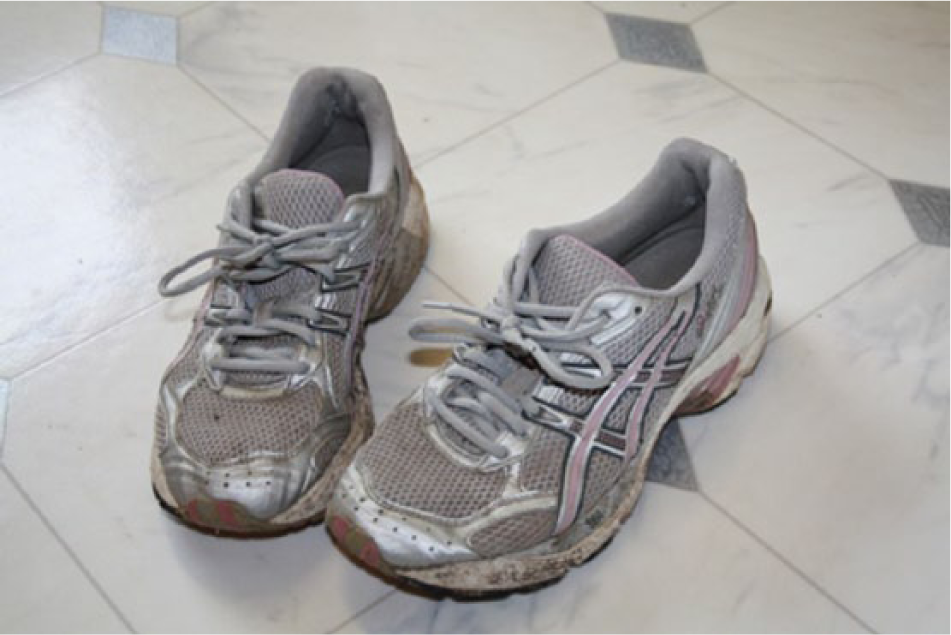
Claire’s running shoes. © Photograph: Rachel Dilley.
When Tenner (2004: 77) aligns the ‘athletic shoe’ with ‘speed, dynamism, ambition’, he too evokes the notion of transition by expanding his list to include ‘the search for a technological advantage’ (emphasis added). In these examples, then, both shoe and wearer are oriented towards what is to come. This aspect of footwear, its contribution to rites of passage based on age or on sporting performance, was also noted by Belk (2003) in his study of people aged between 16 and 74 years in Salt Lake City, Utah.
However, as our data show, putting on trainers and becoming more athletic or more fashionable is but one dimension of trainers’ connection with transition. When Gill (2006a: 373) cites ‘the communicative rhetoric of the trainer – its powerful hold on cultural meaning’, she is referring to marketing messages. As Vanderbilt (1988: 4) says: ‘sneaker companies have gone from being manufacturing companies to marketing-driven companies.’ However, while trainers may be promoted by Michael Jordan, they are worn by people from a diversity of backgrounds. Exposed in the media and seen on the street, they acquire additional, if implicit, associations with mobility; a capacity as objects to shift between and embody different meanings, so, giving insights into lived processes of social differentiation. Vanderbilt (1998), Tenner (2004) and Gill (2006b) all describe the development of trainers from a late 19th-century athletic shoe through to a form of footwear designed specifically for different activities. How then did such shoes become generic footwear for so many people? In Gill’s (2006a) view, their claim to enhance sporting capacity acquired symbolic as well as functional dimensions in the cultural environment of the 1970s where ‘the rhetoric of bettering the self, physically and psychologically’ prevailed; ‘health and fitness became synonymous with enhanced attractiveness and success’ (p. 374), she argues. Moreover, as aesthetics and image, rather than functionality alone, became more important features of sports equipment generally, their reach into wider fashion trends was established. It is this merger of particular physical activities with wider aestheticised notions of fashionable attractiveness that secured trainers’ place as generic footwear of choice.
The study
As noted, the data presented here are derived from a 3-year ESRC-funded project that used footwear as a lens through which to explore the process of identification. We sought access to a range of beliefs, values and experiences associated with shoes, along with greater depth of insight into the everyday embodied experience of shoe wear. All 85 of our research participants lived in or near a large post-industrial city in the north of England and work began with 12 focus groups. These included people of different ages and from a diversity of backgrounds, including parents responsible for buying their children’s shoes, people with health problems that compromised footwear choice, self-defined ‘shoe lovers’, and bereaved people faced with someone’s residual belongings. Focus groups engendered themes such as the mixed experience of shoe shopping, the effects of ageing upon shoe choice, the pleasures and pains of going barefoot, and the tension between fitting in and standing out socially.
From among focus group members, we invited a similar mix of 15 people to become case study participants. With some additional recruitment, these individuals began a year-long series of activities that included: listing their footwear, keeping a three-week log of whenever they changed their shoes that explained why each change was made, choosing a pair of shoes and an activity that typified them and allowing us to film them, taking us along on a shoe shopping trip, compiling a scrapbook about some aspect of their shoe lives, and participating in three interviews where the outcomes of these activities were discussed.
To address the research question of how footwear contributed to everyday and life course identification, we analysed these data by drawing out broad themes such as: desired and ‘best’ shoes; shoe shopping, maintenance, gifting, sharing and disposal; and memorable shoes. Others, that were particularly although not exclusively evident in trainer-related data, included: the ‘right’ and ‘wrong’ shoes; health issues; work and leisure; and transitions of all kinds.
This programme of work generated considerable textual and visual material. Here we present focus group and case study data that refer specifically to trainers, a form of footwear worn by many of the men and women of every age who participated in the study. The data set as a whole, however, contextualises this material and informs our analysis of it. While participants were familiar with the term ‘trainer’, its meaning and role within their lives varied enormously.
Classification and re-classification
When explaining how objects acquire biographies, Kopytoff (1986) emphasised their scope for cultural re-classification, an approach that resonates with the context where this article had its beginnings, as noted: a symposium/exhibition at the Northampton Shoe Museum in the UK. Entitled ‘Sport to Street: The History of the Training Shoe’, it invited the public to ‘follow the lifespan of the training shoe, from its early beginnings as a soft-soled tennis shoe worn by Henry VIII to the iconic footwear of choice that it has become today’. Thus, curators recognised that a category of footwear of which they held many examples had diversified, or been re-classified, in commercially successful ways.
What interested Kopytoff (1986), however, was the difference between commodities, that is, objects reduced to their exchange value, and the private meanings and values that individuals attribute to them. He saw these meanings diversifying in a process he called ‘informal singularisation’ (p. 80), one he then compared with commoditisation. Objects can, however, occupy parallel positions within both systems, their respective locations potentially segueing into one another. Thus, when economic pressure hit a globalised trainer industry in the 1990s, it responded by marketing the classic models of the 1900s that consumers had begun to single out – or re-classify – as vintage collectibles: Converse All Stars and Keds. All Stars then became ‘the second eventual mainstay of the American sneaker market’ (Gill, 2006a: 377), a hugely valuable commodity. Describing a more fleeting cycle of re-commoditisation, Sarah Raphael, editor of i-D magazine, said of the current revival of Air Max 90s, already referred to, ‘it’s the rule of the 20-year cycle. The 00s relived the 80s with Dr Martens; the 10s are reliving the 90s and sportswear is back’ (The Guardian, 15 June 2013a).
However generic the trainer had become, then, its success rests upon the relationships between its multiple materialisations and their associated cultural rhetoric. These reflect and reinforce huge social dichotomies among trainer wearers, as argued above. The notion of a leisure class whose status was marked out partly through clothing that prohibited labour was posited by Veblen (1975[1899]) over a century ago. Moreover, as Corrigan (2008) argues, status displays are often at the cost of comfort. Yet the enabling of activity and comfort is precisely the pitch used to sell millions of pairs of trainers. Distinction achieved through trainers is a matter of cost, rather than discomfort. Vanderbilt (1998: 158) highlights ‘indignant editorials’ that excoriate those who pay prices for sneakers that far outweigh their production costs, criticism rarely expressed in relation to high-end clothing or alcohol. It is not, however, simply a matter of knee-jerk expenditure. Rather, the cultural capital expressed through knowledge of different trainer types is key to status and distinction, as we explain below.
Here Kopytoff’s (1986) understanding of how things acquire and re-acquire value is relevant. He argued that ‘a culturally informed economic biography of an object would look at it as a culturally constructed entity, endowed with culturally specific meanings, and classified and reclassified into culturally constituted categories’ (p. 68). Classification – and re-classification – have permeated anthropological thinking since Primitive Classification (1970) was published by Durkheim and Mauss in 1903. However, treating classification as a cognitive activity has recently been challenged. Like most 20th-century anthropologists, Kopytoff (1986) believed that ‘the human mind has an inherent capacity to impose order upon the chaos of its environment by classifying its contents, and without this classification knowledge of the world and adjustment to it would not be possible’ (p. 70, emphasis added). For him, everyday experience was therefore the outcome of classification. However, this causal sequence has since been reversed and classification is more commonly understood as the outcome of experience (Ingold, 2000).
This more recent theoretical position informs our current work. What the histories of trainer typologies (Boydell, 1996; Gill, 2006b; Tenner, 2004; Turner, 2013; Vanderbilt, 1998) document is the outcome of processes of experience-based classification – from the development of new materials to the growth of different forms of production and marketing. Such processes, we argue, are profoundly entangled with wearers’ embodied needs and experiences – running, getting to work on time, dancing, dressing for an occasion, skate-boarding, popping out for a pint, dressing to impress. It is this entanglement of the individual and their footwear that renders the trainer – or any shoe – a valuable resource for exploring processes of identification.
Kopytoff’s (1986) enthusiasm for re-classification also reminds us that the communicative rhetoric surrounding the trainer and its relationship with the biographies of high status individuals are simply precursors to more informal processes of re-classification, or informal singularisation, that occur among women and men from different backgrounds. Tenner (2004: 90) cites Stephen Talty’s statement that ‘black New York teenagers … are to sneakers what the Academie Francaise is to the French language’, a case of primary re-classification, filtered through criteria that are particular to these teenagers’ ethnic and geographical location. We cannot, however, stop here. Re-classification remains a nuanced, cultural process, as our data indicate. Steele (1998) cites Richard Wharton, expert on the cultural significance of sports shoes, whose hierarchical typology of trainer wearers begins with Soho Trendies who ‘live and die in a pair’ (p. 163); Designer Bofs who wear the latest style without any brand allegiance; Football Lads in comfortable classic brands; Sheep, the uninformed followers of mainstream fashion; and thirty- and forty-somethings who favour low-tech, old-school classics. Ways of classifying – and re-classifying, the ‘fashionable’ trainer thus reflect the knowledge and the demands of people of varying ages and different backgrounds. Below we consider other sets of embodied practices and repertoires of knowledge that entangle to inform the singularisation of a commodity known generically as the trainer. These undermine macro-level models of gender and age-based divisions, instead revealing more nuanced distinctions, the embodied processes of identification that occur within the context of specific social interchanges. As noted above, within our trainer-related data, what not to wear is a prominent focus for discussion.
1. Femininity, masculinity and ‘degrees of trainers’
While this article derives from the Northampton Shoe Museum event, it was when Lucy, a 19-year-old student and member of our young women’s focus group, said ‘there’s not just trainers or non-trainers, there’s like degrees of trainers’, that we began to consider subtler processes of informal singularisation. Describing the ‘random rule’ used by bouncers to exclude young men from a night club on the grounds that their footwear or clothing intimates violence – when in reality a bouncer wants to restore a gender balance inside the club – Nicola, 18, another student member of the focus group, reported a bouncer saying: ‘you’re not coming in mate … you’re wearing white trainers.’ Linda, a 19-year-old student added an example, saying: My friend [who] was wearing Lacoste, proper Lacoste, so expensive stuff … and they were like, no you can’t come in, you’re a chav. But he was like, but this is like expensive, chavs couldn’t afford. You can’t come in. It’s like, what?
Singularisation may thus be contested, even within small groups. For these young women, stereotypical notions of masculinity, femininity and class-based identity informed the way trainers were appraised, both by themselves and other people – such as bouncers. Two ideas – that young men were prone to violence and entitled to access to a sufficient number of young women – framed a contested re-classification of an expensive trainer.
In addition, a trainer might become more than a gendered signifier of potential behaviour; as a prosthetic of the self (Gonzalez, cited in Lupton, 1998: 144), the shoe itself could be a sign, containing the female foot in ways which disrupt its feminine status. Thus, when members of the young women’s focus group were asked if they wore trainers, Lucy replied: ‘I don’t own a pair of trainers’; Michelle, another 19-year-old student said ‘I wear trainers if I go to the gym but that’s it’, and Elisabeth, an 18-year-old student, added ‘because I do badminton, I tend to only wear trainers like when I’m doing sport because I just think they’re quite like casual and I just prefer to feel more like dressed up.’ Michelle also said: ‘I just find them quite ugly like’, to which Linda added ‘and they make your feet look big’.
These aesthetic judgements were not abstract cognitions imposed upon an object body (Turner, 1992). Instead, as Ingold’s (2011: 12) ‘inhabiting’ perspective suggests, they derived from the embodied experience of looking down at one’s feet in trainers and comparing them with the tilted foot that protrudes far less when high heels are worn. The wearing of shoes and the inhabiting of a particular gendered body thus contributes to ideas and knowledge about the ideal female – and male – physique. Even in the gym, trainers could evoke size-based disdain, as evidenced by members of the young women’s focus group. Nicola said: ‘I think that’s probably one of the reasons I don’t wear them because I’ve got size seven feet, so they’re huge and trainers just aren’t flattering’ and Linda responded by saying: Yeah, like my gym trainers, like they fit me perfectly and I only have like a size five and a half feet but no matter what I’ll look down and be like how have my feet got so big?
But why did size matter? When Rachel Dilley, the project’s research associate and facilitator, asked the young women, Linda said that big feet were ‘quite manly … it’s really unfeminine to have big ugly feet’, a point of view to which other members of the group assented.
Confining trainers to the gym therefore reinforced oppositional notions of masculinity and femininity, ones that underpin traditional or hegemonic heterosexuality. However, as our previous research showed (Hockey et al., 2007), individuals might struggle to explain the concept of ‘heterosexuality’, both as an institution and a practice. As we noted, ‘what could be articulated … was how individuals might transgress, or digress from its boundaries.’ Thus ‘interviewees revealed the nature of heterosexuality by virtue of what it was not, or not meant to be’ (p. 10). Attending to distinctions between men (Spector-Mersel, 2006) was one way in which women particularly might identify such transgressions – and the type and nature of a man’s trainers could resource this process. Michelle, from the young women’s focus group said: ‘I hate it if a guy’s made such an effort and he looks so nice and you look down at his shoes and he’s got some like dirty old pair of trainers which are like too big for him.’
These are the contexts and social interactions through which objects not only acquire culturally-specific meanings, but are also caught up in trajectories of classification and re-classification. One object – a pair of trainers – thus figures as a commodity within a wider spectrum of similar commodities within which it will share meanings. However, it may also be subject to processes of differentiation or singularisation. Not only bouncers and trainer collectors, but young women themselves might engage in such categorisation when judging the aesthetics of a young man’s appearance; as Michelle said, ‘even within trainers there’s a whole range of whether they’re nice trainers or horrible.’
2. Gender, sexuality and class resisted
The young women described above made themselves accountable to, or assessed themselves and others in relation to, hegemonic or conventional gender, class and sexuality-based social locations (West and Zimmerman, cited in VanEvery, 1995: 46). In the complex and nuanced processes of singularisation that surround the trainer, however, all three of these intersecting locations may be resisted.
For example, when worn by women in contexts beyond the gym, trainers’ participation in conventional gender regimes can be subverted. When US senator, Wendy Davis, delivered an 11-hour filibuster speech at the Texas Senate to block anti-abortion legislation, she wore ‘hot pink’ Mizuno Wave Rider 16 trainers. Their sales then peaked on Amazon and the company’s website attracted comments including one from a woman who wrote: I’m hoping that when I lace these babies up and step out, every male troglodyte who sees my feet will recognize these red shoes and know that I am dead serious about controlling my own body and making my own reproductive choices. (The Guardian, 28 June 2013b)
Among our male participants, hegemonic heterosexuality could also be deliberately utilised in subversive strategies that were simultaneously playful and self-protective. Shaun, 23, worked in the service industry in the city centre (see Figure 2). He was openly gay and had experienced homophobic violence. He reported saying to an assistant in JB Sports shop: ‘Excuse me I quite like these trainers, do you have them for midget people feet?’ And she said ‘what size?’ I said ‘a seven’. She went ‘oh yeah, you do have small feet, I’ll just go and have a look, what colour do you want?’ And I said ‘which do you think’s the most butch?’ And she went ‘I don’t know. I like the red ones, it’s fine, if you’ve got the red ones.’ Oh I, I think it’s starting to become an in joke that I find hysterical, finding butch trainers or whatever but I don’t think other people really get it.
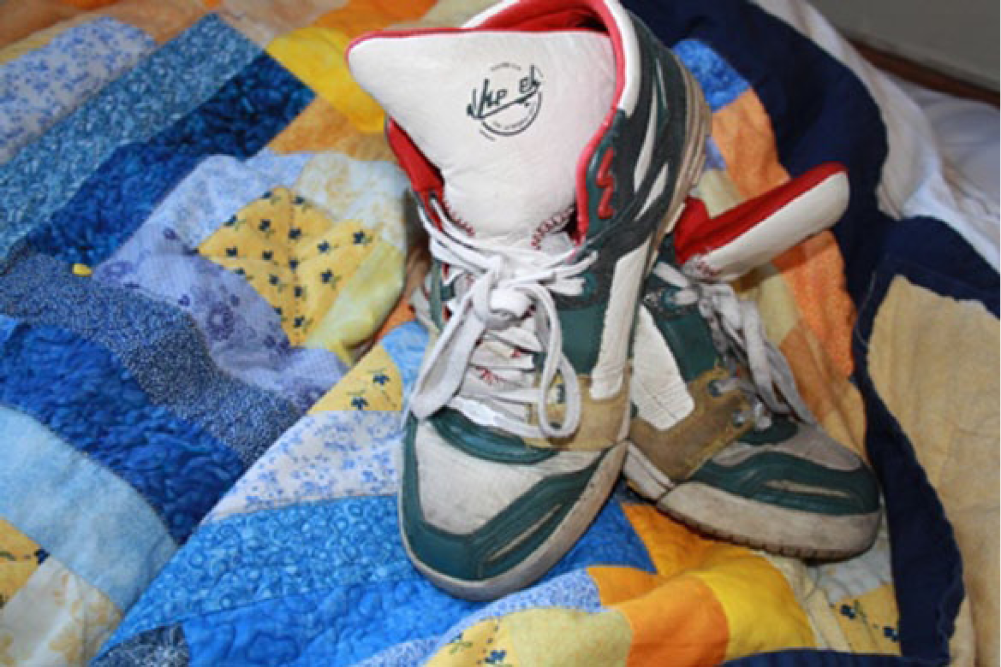
Shaun’s trainers. © Photograph: Rachel Dilley.
In Rapport’s (2009) ethnographic account of how porters at a Scottish hospital achieved wellness, he describes their ‘lowly and liminal position’ within a class and skills-based institutional hierarchy. Yet, as he notes, ‘when personality met institution, when rhetorical skill and interactional strategy met status differential, when supply and demand of particular services met ostensible hierarchy of skills – the status outcome was far from clear’ (p. 7). For porters, trainers were forbidden workwear, yet in a story told to Rapport by Arthur, a porter, they became pivotal to a particular ‘status outcome’. Arthur described a higher ranking theatre auxiliary entering the porters’ lodge, or buckie, to challenge another porter, Dwayne: ‘Well’, Arthur continues with a grin on his face, ‘she came into the buckie yesterday … and complained about Dwayne Bruce’s trainers – ya know how they are [worn and dirty] …’ Arthur carries on: ‘She sticks her finger right in Dwayne’s face … and said he wasn’t to come into Theatre again with them trainers on! And Dwayne replies: ‘If she was a chargehand or theatre supervisor she could say that to him; but seeing as how she’s a mere theatre ‘go-fer’ she could fuck-off!’ Arthur grins at the memory. (Rapport, 2009: 5–6)
Following this altercation, a sense of pleasurable empowerment had pervaded the crowded buckie, the outcome of Dwayne’s rebuttal of an attempt to curb his flouting of footwear conventions in Theatre.
Within the broader landscape of the 2011 English riots, trainers were again pivotal to resistance to class-based inequalities. Thus the immaculate, aspirational trainers stocked by the sports shoe company, Footlocker, were prioritised for ‘looting’ in the company’s Brixton, Dalston, Manchester and Birmingham branches. Beckett (2012) describes the consumerism represented by this company, and by trainer culture more broadly, as increasingly in tension with economic realities. Six months after the riots, the Brixton branch remained boarded up, the premises up for let.
3. A family man
Having argued that forms of differentiation grounded in gender, class and sexuality can be both reinforced and subverted through the singularisation of a commodity – trainers – we now consider how masculinity might intersect with other dimensions of identity, in this case familial identity, particularly that of younger brother. Mark, 23, also worked in customer services in the city centre. He had two older brothers and football trainers were intrinsic to their membership of the same Middlesbrough family, as well as their masculine identity: I remember one year that we all got … Middlesbrough football kits, like the full kits and we all got a pair of, they were called Puma Kings, they were just black and they had a big Puma white thing and they had a big full leather tongue … I remember this photo of us all one Christmas morning, all dressed up kind of thing.
However, for Mark, independence mattered, along with local/familial identity. Just as femininity might be characterised by its difference from masculinity, and any association with big feet, so indicators of difference between himself and other men in his family contributed to the process of identification for Mark. Here skateboarding, as opposed to football, offered an identity he could inhabit through his trainers: I remember being really impressed with myself the first pair I got … they were called Etnies Low Cut and I still see them now, I think they’re really cool … and like big chunky thing … I remember … I specifically liked kind of skateboarding shoes just because it was, it was the kind of first … independent activity that I had … that was the thing that I did that they didn’t, so … I was quite insistent on making sure that I was reflecting that in what I was wearing as well.
Although an aspect of Mark’s transition towards a more autonomous relationship with the men in his family, Mark’s skateboarding trainers were also entangled with membership of another social group: local skateboarders. As he developed skateboarding skills, so his trainers were subjected to a series of re-classifications etched into the materiality of the shoes themselves: … started skateboarding when I was about thirteen … my shoes used to get really worn, like the left foot … I remember duct taping them quite a lot, so they’d be like big slabs of black tape wrapped round them and stuff and just to make them last a bit longer … it was … just the nature of doing or trying to do [laughs] skateboarding tricks it would use only one foot more than the other so I’d end up with, yeah, it was always the left, left shoe towards like the, where the little, where your little toe is, down that side would always be like really broken and not roughed up.
Here Mark describes not just a functional pattern of wear, but also changes wrought within the shoes’ fabric as he practised tricks and so enhanced his embodied skills. As such, these changes strengthened his connection to the local skateboarding community and reveal the entanglement of embodied practices and the materialities of footwear. As we note, Pels (1998: 101) argued that ‘humans are moulded, through their sensuousness, by the “dead” matter with which they are surrounded.’
Mark explains: … so when you’re doing certain tricks, like a kick flip it sort of rips your shoe … every time you do it, slightly more and more and eventually you get a hole, it’s always in the same spot, on like your left foot, so you can tell if somebody’s been skateboarding because they’ve got a hole there or like a grazed area, so that’s why, erm, we used to have sort of glue over them with superglue just to try and reinforce them.
These markings might also indicate anticipated skills – and a yet-to-be earned identity: … yeah, some people used to superglue it sort of in apprehension of having like a hole in them.
As we move into particular areas of embodied practice, then, the entanglement of footwear within broad indicators of identity, such as gendered, familial and subcultural identity, becomes apparent. Identification, as a process, is thereby lived out on an everyday basis.
4. Forever young?
In the case of skateboarding trainers, a distinction often made between things and bodies dissolves in a shared materiality. We now extend this focus in an exploration of the dynamic nature of the human body as it grows up, perhaps developing ‘fitness’ linked with trainer wear, but also grows old, both visibly and functionally. If trainers are entangled with youthful ‘cool’, what happens when older feet inhabit them? Certainly discussion of the capacity of trainers to signify identity, to act semiotically, derives primarily from younger people’s practices where both shoe and wearer can arguably be ‘identified’ via the label on their trainers. Thus Steele (1998: 183) cites sneaker aficionado Talty who says ‘in the vast consumer culture, sneakers are one of the few things that signify more about you than your taste and income bracket.’ To view identity as the outcome of a label that simply signifies, that is, identity as nominal (Jenkins, 2004: 22), neglects the virtual or ‘what a nominal identification means experientially and practically over time, to its bearer’ (p. 77). Moreover, the entanglement of trainer wear with experiential and practical dimensions of identity across the life course reveals the shoe’s equal contribution to the body’s ageing during later life and the social transitions which make and mark the transition to ‘old age’.
The notion that trainers conduct semiotic ‘identity work’ among young people does however pervade popular culture. As noted, Richard Wharton claimed to recognise different trainer wearers’ level of fashion knowledge (Steele, 1998). Among our participants in mid or later life, a sense of exclusion from arcane and rarefied knowledge could be expressed. Ian, a 70-year-old semi-retired teacher who lived on the edge of the city, felt confused as to whether basketball shoes were trainers; his grandchildren wore them ‘as fashion, Converse, is that the one, Converse?’; 62-year-old Annie, also retired and living in a mixed residential area of the city told him: ‘it’s blurred a bit now.’ David, 59, a semi-retired management consultant, lived in a more affluent residential area of the city, He had no trainers. Drawing on popularised semiotic principles of signification, he said: As I get older I understand the semiotics of fashion less and less, so I don’t know what’s significant and how it’s significant, so actually sort of finding stuff that I’m comfortable about wearing that doesn’t send out old blokes’ signals, is quite important. So apart from Doctor Martens I tend to wear winkle pickers.
David thus felt excluded from younger people’s processes of singularisation and the values thereby attached to particular shoes. As Tenner notes, when older adults wear trainers, not only might their choice be unfashionable, but in choosing a pair, the shoes themselves become ‘not so cool if my parents are doing it’ (National Sporting Goods Association, cited in Tenner, 2004: 101). Here the external/internal dialectic of identity (Jenkins, 2004), occurs cross-generationally as older and younger people interact.
Such statements are not, however, generalisable. Although ageism and social and economic disadvantage pervade the experiences of older adults as a social category (Bytheway, 1995), as Gilleard and Higgs (2000: 1) point out, ‘ageing has ceased to be understandable in terms of any common or totalizing experience.’ Within our data, for example, the wearing of trainers could be entangled with processes of identification in complex ways. A woman in a focus group carried out in a luncheon club for fourth-age adults 2 said of them: ‘[They’re] the worse things they brought [out] because they are destroying people’s feet, sweating and horrible and they, and when they take them off they smell horrible.’ Her response echoes the medical advice and the rhetoric of competing shoe manufacturers in the 1950s when trainers first became popular. With more informal lifestyles after the Second World War, trainers’ market share increased, especially among children. At the time, both doctors and leather shoe manufacturers decried the dangers of rubber-soled canvas shoes, believed to cause flat feet, fat feet, swollen ankles and in-growing toenails. By the 1960s, however, medical opinion was changing; the so-called ‘dangers’ of the trainer to growing feet were dispelled and their comfort stressed when compared with formal shoes (Tenner, 2004: 88). It was then that Converse coined the term ‘limousines for the feet’ (Gill, 2006a: 337).
Age and exposure to different representations of trainers can thus produce different processes of singularisation, but the comfort of trainers was more generally agreed upon. As one older man in the focus group carried out in the luncheon club said: ‘Trainers are comfortable aren’t they. Comfortable to wear. I wear them for bowling you know.’
Indeed, in response to the assertion that trainers damage feet, another woman said: ‘Well my chiropodist told me to wear them [laughs]’, the distinctiveness of this singularisation providing the jolt that ends in laughter among focus group members. That said, the orthopaedic trainers she normally wore had undermined her sense of self: ‘I’ve got special ones, you know, where, to support my ankle. And I feel awful, you know … you can’t get dressed up or anything.’ Here then, footwear acted to initiate an unwelcome experience of transition into the social category of ‘old/unattractive’, one that can be compared with some men’s first purchase trainers at retirement because ‘it’s more relaxed.’
Along with transition, trainers might engender continuities between different periods of the life course: Steven, a 65-year-old retired professional man living in an affluent area of the city had been a runner for most of his life. He had recently bought new trainers (see Figure 3) as a commitment to remaining physically active as he moved into later life. His deliberation about this purchase was framed by images of old age as a time to ‘slow down’, whereas, as Tenner (2004) suggests, trainers represent our enthusiasm for speed in modern times. In addition, the man’s decision reflects a new constellation of identities, formed by a changing relationship between older and younger adults. As Gilleard and Higgs (2000) argue, prior to the 1960s, economic and cultural capital adhered to upper-middle class, middle-aged men, something ‘pop culture’ has since displaced. Members of that section of the older population that has retained its economic capital, one that reflects more pervasive class and gender hierarchies, are now ‘required at the very same time to continue to invest that capital within markets dominated by youth-oriented modes of consumption’ (p. 64). These include Levi jeans, media and social networking technologies, dishwashers, computers, cosmetics and hairdressing. Trainers undoubtedly feature here, for as Gilleard and Higgs argue, emphasis is placed on ‘resisting age rather than ageism’, in that this ‘greases more palms, oils more deals and turns more dollars’ (p. 71).
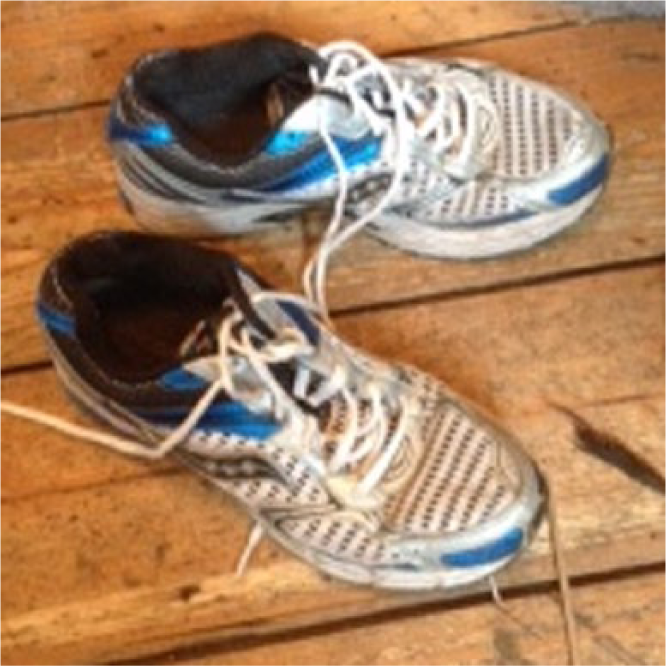
Steven’s new running shoes. © Photograph: Bob Hockey.
These examples demonstrate the entanglement of bodies and footwear. They show the fabric and construction of trainers merging with older bodies: protecting a foot with problems, enabling another to run, providing ease felt to be deserved once paid employment ceases (Oliver, 2008). From a cultural perspective, however, we also note specific singularisations: the trainer which cannot be combined with the clothing an older women feels attractive and feminine in confirms her marginalised, asexual identity (Hockey and James, 1993, 2003), the trainer which represents a commitment to running also acts to undermine the shift to an age-based category associated with diminished physical vitality, and the trainer that is easy to put on and maintain, that feels comfortable, confirms membership of a category associated with both a well-earned rest and access to new leisure opportunities, that of ‘retired’ (Oliver, 2008).
5. You wear them well – trainers and the affective body
As argued, later life ‘has ceased to be understandable in terms of any common or totalizing experience’ (Gilleard and Higgs, 2000: 1). Class and gender divisions fragment the monolithic category of ‘elderly’, but these too are crude macro-level distinctions. Apparent within our data were also examples of localised singularisations tied to qualities less straightforwardly associated with broad structural inequalities. Instead, they constituted dimensions of the affective body (Featherstone, 2010). For Featherstone, the concept of body image and the notion of an object body which is gazed upon, evaluated and indeed worked upon within the internal/external dialectic of identification (Jenkins, 2004), problematically excludes the body in (habitual) movement and its capacity to engage ‘the non-intentionality of emotion and affect’ (Featherstone, 2010: 209).
How trainers combine with other clothing, for example, was discussed in many focus groups. What emerged, paradoxically, was both uncertainty about dress codes, and a capacity to ‘know’ when combining trainers with more formal clothing ‘worked’ in the sense of creating or enhancing a desirable identity. Important here is the body in movement and the precarious boundary between failed and successful dress practices. As David, 59, cited above, said of attempts to combine trainers and suits: It’s, it depends how you do them, you know, and that’s partly, it’s a formative thing again if you do it with the right suit and carry it off with the right sort of swagger, you can pull it off, otherwise, you know, it’s, has a care in the community sort of feel to it.
Along with movement, Featherstone (2010: 210) identifies bodily attributes, such as the timbre of the voice, which produce an intensity of affect that can ‘undercut the sovereignty of the perceiving eye and the content of the spoken words’. This sense of interpretive confusion, of recognising yet not being able to confine the body to a single, rationally-determined ‘subject–object’, relates to what Featherstone describes as ‘the space of movement, of dislocated perspectives and transformation’ (p. 208). When Ukranian-born student, Aleks, 39, described how men teased one another if someone’s combination of shoes and clothing was deemed inappropriate, he then gave the counter example of his former lecturer whose incongruous combination of suit and trainers enhanced his status and identity: It’s linked to personality as well, I just recall, when I went in Soviet Union university we had a lecturer and who was actually very bright and very good lecturer and but then he wore a combination, which was impossible, it was bizarre, trainers and a suit [laughter]. But the person was so like charismatic and it was part of his culture actually a bit of, like extravagant … so it was accepted as normal, like despite it was if somebody, not his student would meet him on the street and say he was sort, you know, just crazy man but it was part of his, extension of himself and this, so.
The subtlety of this entanglement of context, footwear and the affective body reveals much about processes of identification and the place of singularisation – or re-classification – within them. Trainers may evoke ‘dressing down’, they may stigmatise through ‘care in the community’ associations; yet through dimensions of the affective body – swagger and charisma – they can, equally, help elevate an individual’s status.
Conclusion
Trainers, we argue, drawing on Kopytoff’s (1986) notion of a cultural biography, are a commodity that lends itself to multiple processes of singularisation. These, as we have shown, emerge within particular contexts and specific social interactions. A ubiquitous category of shoe – ‘the world’s great egalitarian footwear ( The Observer , 7 October 2012) – trainers today not only bear an extended cultural and historical biography, but, as the data presented here reveal, can be integral to the making, re-making and indeed subversion of gender, class, sexuality and age-based distinctions, as lived out on the peripheries of night clubs, within families, operating theatres and lecture halls. Ubiquitous as a commodity, the cost, materiality, wearer and social context of a trainer renders it a highly mobile object with affordances that enable multiple processes of singularisation. Indeed, as Ingold (2010: 4) argues, rather than the term ‘object’, the notion of a ‘thing’, that is ‘a place where several goings on become entwined’, better encompasses the processes through which trainers and the wearing of trainers can help ‘make’ the individual through their contribution to key dimensions of identification. With the body as the only site at which identification can begin (Jenkins, 2004: 46), our exploration of how trainers are perceived and experienced shows identity lived out through both the social process of ‘fitting in’ as well as human beings’ capacity for self-reinvention. The capacity of the trainer to merge with the body in transition is, we argue, crucial to both these aspects of identification.
Footnotes
Funding
We are grateful for the financial support of the Economic and Social Research Council in funding our project: ‘If the Shoe Fits: Footwear, Identification and Transition’.
Notes
Author biographies
Email:
Address: Department of Sociological Studies, University of Sheffield, Elmfield, Northumberland Road, Sheffield S10 2TU, UK.
Email:
Address: as Victoria Robinson.
Email: