



Abstract
This study investigates the association between locus of control, emotional intelligence, and psychological well-being, with insomnia as a mediating factor. Data was collected in Lebanon from 328 workers (60.7% women; mean age = 33.17) over a 6-month period in 2022. Regression-based mediation analyses revealed that internal locus of control was linked to lower insomnia and, in turn, greater psychological well-being. Emotional intelligence showed no significant effects. Exploratory analyses indicated that the “use of emotion” dimension of emotional intelligence was associated with increased insomnia and, indirectly, with lower psychological well-being. These findings underscore the nuanced role individual resources play in shaping health outcomes. More specifically, not all individual resources have uniformly positive effects. Given the potentially detrimental impact of the “use of emotion” dimension, interventions should prioritize strengthening internal locus of control and encouraging more constructive and balanced use of emotion strategies to reduce insomnia and enhance psychological well-being.
Keywords
Introduction
Insomnia has emerged as a growing public health concern, affecting not only the general population but also a wide range of working individuals (Brito et al., 2021; Lee et al., 2021; Reynolds et al., 2023). Approximately 10% of adults meet criteria for insomnia disorder, and an additional 20% report occasional symptoms, which can reduce psychological well-being and impose societal costs such as higher absenteeism and healthcare expenditures (Morin and Jarrin, 2022).
Among the main contributors to insomnia are daily stressors, that not only increase vulnerability to sleep problems but also hinder recovery (Yoo et al., 2023). In Lebanon, those pressures are particularly acute due to compounded and prolonged economic and political crises coinciding with the pandemic. Clinically, insomnia involves persistent difficulties with falling or staying asleep and is usually associated with impairments in daytime functioning, emotional regulation, and stress coping (Morin et al., 2015). Longitudinal evidence indicates that individuals without insomnia symptoms report lower fatigue, anxiety, and depression, as well as higher quality of life than those experiencing insomnia symptoms (Lucena et al., 2026). Similarly, poorer sleep quality has been found to predict higher pain intensity (Herrero Babiloni et al., 2026). The relationship between insomnia and psychological health is bidirectional; with stressors exacerbating sleep problems and in turn, insomnia reducing resilience (Alvaro et al., 2013). As such, insomnia should be viewed as a psychiatric condition that can influence psychological health (Khurshid, 2018), rather than a medical illness such as cancer, HIV, or diabetes.
Faced with prolonged adversity, individuals usually rely on individual resources to cope (Friedberg and Malefakis, 2022). Recent findings underscore how workers’ coping capacities (i.e. individual resources) play a decisive role in supporting their psychological health (Çakaloğlu et al., 2026). Among these resources, internal locus of control, or the belief that one can influence life outcomes through their personal actions, may buffer the harmful effects of stressors and favor an enhanced psychological well-being (Rotter, 1966). This mindset has been consistently associated with improved psychological well-being in both the general adult population (Shin and Lee, 2021; Sigurvinsdottir et al., 2020) and in workers (Parent-Lamarche and Marchand, 2019).
Another key resource is emotional intelligence. Emotional intelligence is defined as the ability to recognize, interpret, and manage emotions in oneself and others (Salovey and Mayer, 1990). Emotional intelligence encompasses four core dimensions: Self-Emotion Appraisal (understanding one’s own emotional states), Others-Emotion Appraisal (perceiving others’ emotions), Use of Emotion (applying emotional information to support motivation and achievement), and Regulation of Emotion (managing emotions to recover from stress and maintain equilibrium; Davies et al., 1998; Law et al., 2004).
Individuals with high Self-Emotion Appraisal are attuned to their own emotions, supporting communication and interpersonal functioning; Others-Emotion Appraisal enables understanding and responding to others’ emotions, fostering empathy, and social competence; Use of Emotion refers to channeling emotional energy toward constructive efforts, such as overcoming challenges and achieving goals; and Regulation of Emotion involves utilizing strategies to reduce distress and promote positive affect (Davies et al., 1998; Law et al., 2004; Salovey and Mayer, 1990).
Prior research has suggested a positive relationship between emotional intelligence and sleep quality, with higher emotional intelligence linked to better sleep outcomes (Bavafa et al., 2019) and better psychological health outcomes (Di Fabio and Kenny, 2016; Guerra-Bustamante et al., 2019; Moeller et al., 2020; Ordu et al., 2022).
Despite growing recognition of the benefits associated with those individual resources, their protective role in contexts of severe and prolonged adversity remains underexplored. Lebanese workers continue to face cumulative pressures stemming from political instability, economic collapse, and the global health crisis (Farran, 2021). In this context, examining whether internal locus of control and emotional intelligence are associated with reduced insomnia and enhanced psychological well-being is timely. As such, this study aims to inform interventions that support psychological health in high-stress environments. We hope the results obtained from this study will help foster individual resources, strengthen organizational practices and favor a sense of shared responsibility of employee well-being (Bauer and Jenny, 2017; Leiter and Cooper, 2017; Lowe, 2020).
Theoretical background and hypotheses development
The present study is grounded in the Conservation of Resources (COR) theory (Hobfoll, 1989), a well-established framework for understanding how individuals manage stressors and preserve psychological well-being in the face of adversity. As highlighted by van Woerkom et al. (2016), COR theory emphasizes the central role of individual resources in coping with environmental demands. Within this framework, individuals strive to acquire, retain, and protect valued resources. When these resources are threatened or depleted, psychological stress ensues.
In the context of Lebanon’s ongoing socio-economic crisis and the lingering psychological effects of the COVID-19 pandemic, individual resources become particularly vital. Our model focuses on two such resources: internal locus of control and emotional intelligence. Both are expected to play a critical role in supporting an individuals’ capacity to adapt and maintain psychological health under chronic stress.
Internal locus of control refers to the belief that one’s own actions, rather than external forces, determine life outcomes (Rotter, 1966). This belief fosters a proactive approach to problem-solving and is particularly beneficial in contexts where external conditions may appear overwhelming or unpredictable. Similarly, emotional intelligence refers to the ability to perceive, understand, and regulate emotions, skills that are especially important in emotionally taxing environments. It allows individuals to manage emotional reactions constructively and maintain goal-oriented behavior.
COR theory posits that such individual resources act as protective factors against psychological strain. Conversely, when resources are lacking or compromised, individuals become more vulnerable to stressors and are at greater risk of entering what Hobfoll (1989) describes as a “loss spiral,” a cycle where initial resource depletion leads to increased distress and further erosion of remaining resources. In line with this model, we view insomnia as a key psychological response to limited individual resources. As individuals struggle to meet ongoing demands with limited internal resources, sleep quality, which has been shown to be influenced by stressors (Schneider et al., 2022), can deteriorate. This decline can be associated with insomnia. Insomnia has been found to be associated with a higher likelihood of psychological health problems in women (Lucena et al., 2026), further undermining psychological well-being. On the contrary, when such resources are sufficiently available, they may prevent stress-related consequences such as insomnia and promote psychological well-being. In this vein, when individual resources are present and intact, they help interrupt this potential loss spiral (Hobfoll, 1989), preserving sleep quality, and supporting higher levels of psychological well-being.
Thus, drawing from the COR theory, we propose that the presence of key individual resources (internal locus of control and emotional intelligence) is associated with lower levels of insomnia, which serves as a proximal indicator of psychological strain. Furthermore, we suggest that insomnia mediates the relationship between individual resources and psychological well-being (Figure 1).
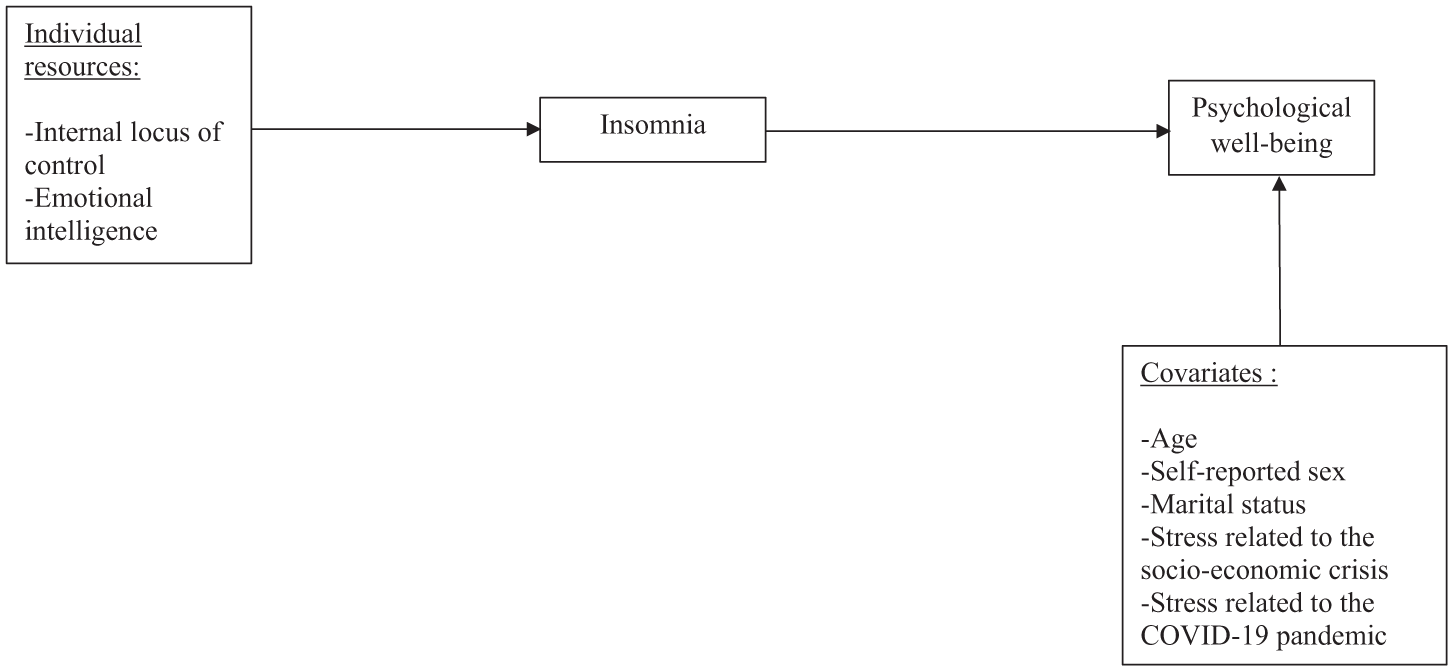
Conceptual model.
Based on this reasoning, we formulate the following hypotheses:
Methods
Participants and procedure
This study received ethical clearance from the Institutional Review Boards (IRBs) of the collaborating organizations, namely Université du Québec à Trois-Rivières and American University of Beirut. Data was collected over a 6-month period, from February to August 2022. This study aimed to include workers from the general community in Lebanon who were actively employed during data collection. Recruitment was conducted using a snowball sampling method rather than random selection. To enhance the external validity of our findings, recruitment efforts were designed to include a diverse cross-section of occupations and sectors across the country.
Eligibility criteria required participants to be between 18 and 64 years old and literate in either English or Arabic. To reduce barriers related to language proficiency, technological access, and electricity, participants were given the option to complete the survey either online or in paper format, and in their preferred language (Arabic or English). To ensure linguistic and conceptual accuracy across languages, all study materials were professionally translated into Arabic using the widely recommended translation and back-translation method described by Bracken and Barona (1991). An Arabic-language student from the American University of Beirut performed the initial translation from English to Arabic, and a second independent Arabic major, unfamiliar with the original content, conducted the back-translation. Discrepancies were reviewed collaboratively and resolved to preserve the semantic integrity of the instruments. Recruitment followed a snowball sampling approach and was conducted through a combination of online platforms (e.g. WhatsApp, Facebook) and face-to-face methods to reach a broad and inclusive sample. Confidentiality was emphasized throughout the data collection process. For in-person respondents, adequate privacy and time were provided to ensure a comfortable setting for completing the survey. As an incentive, participants were entered into a draw for one of two cash prizes of 400,000 Lebanese pounds (LBP). Informed consent was obtained from all participants prior to data collection. For in-person participants, a research team member reviewed the consent form in detail, while those completing the online version were required to indicate their understanding and agreement before proceeding. Participants were then asked to complete a series of questionnaires, which took approximately 30 minutes to complete. The final sample comprised 328 participants and was diverse in age, self-reported sex, relationship status, and employment type. The mean age was 33.12 years, with women representing 59.15% of the participants. Nearly half of the sample (46.95%) reported being in a romantic relationship. Participants were employed across 19 distinct sectors, including accommodation and food services, administrative and support services, agriculture, arts and entertainment, construction, finance and insurance, healthcare and social assistance, education, information and cultural industries, manufacturing, professional and technical services, real estate, retail trade, public administration, and transportation, among others. Occupational diversity was also considerable. The sample included professionals such as university professors, HR directors, lawyers, behavior analysts, and architects, as well as individuals working in roles like librarians, photographers, baristas, creative directors, hairdressers, curators, administrative assistants, auditors, receptionists, bankers, and business analysts. This breadth reflects the rich and varied employment landscape of the Lebanese workforce as captured by our data collection strategy.
Measures
Psychological well-being
Psychological well-being was assessed using the WHO-5 Well-Being Index developed by the World Health Organization (Heun et al., 2001; Topp et al., 2015). This brief five-item measure such as, “I have felt calm and relaxed” employs a six-point scale from 0 (At no time) to 5 (All the time), with higher scores indicating greater well-being (Cronbach’s α = 0.91). According to the scoring method outlined by Topp et al. (2015), a raw score ranging between 0 and 25 should be multiplied by 4 to produce a final score ranging between 0 (indicating the poorest possible well-being score) and 100 (indicating the best possible well-being score).
Insomnia
Insomnia was assessed using a six-item scale developed by Pallesen et al. (2008), featuring items such as, “During the past month, how many days a week have you awakened more than 30 minutes earlier than you wished without managing to fall asleep again?” Participants responded on a seven-point scale ranging from 0 to 7, with higher scores indicating more frequent occurrences. The scale demonstrated good internal consistency (Cronbach’s α = 0.84).
Emotional intelligence
Emotional intelligence (EI) was measured using the 16-item scale developed by Wong and Law (2002, which captures various dimensions of EI such as, “I have a good understanding of my own emotions”). Responses were rated on a seven-point Likert scale from 1 (Very strongly agree) to 7 (Do not at all agree), with the scale showing high internal consistency (Cronbach’s α = 0.92).
Internal locus of control
Internal locus of control was assessed using a seven-item, five-point Likert scale adapted from Rotter (1966), featuring items such as, “I can do just about anything I set my mind to.” Responses ranged from 1 (Strongly disagree) to 5 (Strongly agree), with higher scores indicating a stronger internal locus of control. The scale demonstrated good internal consistency (Cronbach’s α = 0.84).
Control variables
Drawing on previous research, we included several control variables to account for potential confounders and isolate the specific effects of our predictors on insomnia and psychological well-being. This approach helps ensure more accurate estimates of the relationships under study. Specifically, we considered a range of demographic and contextual stressors that have been consistently associated with psychological outcomes in the literature, including age, self-reported sex, marital status, life stressors, stress related to the socio-economic crisis, and stress related to the COVID-19 pandemic (Anastasiou and Belios, 2020; Hsu, 2018; Meng and Yang, 2024; Pereira et al., 2021; Wang et al., 2023). Inclusion of these factors helped ensure that the observed associations reflected the impact of our key variables rather than underlying demographic or situational differences among participants. Participants reported their age in years. Self-reported sex was coded as 0 (“Male”) and 1 (“Female”), while marital status was categorized as 0 (“Single”) or 1 (“In a relationship”). Life stressors were assessed using the Holmes-Rahe Stress Inventory (Noone, 2017), where participants indicated which major life events (e.g. “Major personal injury or illness,” “Being fired at work,” “Change to a different line of work”) they had experienced in the past year. Each endorsed event contributed to a cumulative stress score, reflecting the overall impact of life changes during that period. Stress related to the socio-economic crisis was measured by the question: “How has the socio-economic crisis affected your overall stress level?” with responses coded as 0 (“The socio-economic crisis decreased my stress level or did not change my stress level”) or 1 (“The socio-economic crisis increased my stress level”). Similarly, stress related to the COVID-19 pandemic was assessed by the question: “How has the COVID-19 crisis affected your overall stress level?” with responses coded in the same manner.
Analytical strategy
To investigate the proposed relationships, we conducted multiple regression analyses and tested indirect associations consistent with mediation, using the maximum likelihood (ML) estimator. We relied on MPlus version 8.8, with bootstrapped standard errors and confidence intervals based on 5000 draws (Muthén and Muthén, 2017). Although MPlus outputs all paths together, these mediation analyses were regression-based using observed variables. Indirect effects were computed as the product of coefficients. To address potential non-normality issues, we used 95% bias-corrected bootstrap confidence intervals without modeling latent variables or measurement error. Our analytical approach was informed by established mediation methodologies, including those outlined by Preacher and Hayes (2004). Given the cross-sectional nature of our data, our analyses examined regression-based indirect effects rather than implying causal mediation. All models were adjusted for potential confounding variables: Age, self-reported sex, marital status, life stressors, stress related to the socio-economic crisis, and stress related to the COVID-19 pandemic. Model fit was assessed using TLI, CFI, RMSEA (with 90% CI), and SRMR, with higher CFI/TLI and lower RMSEA/SRMR indicating better fit (Kline, 2023). In addition to evaluating direct effects, our primary model examined whether internal locus of control and emotional intelligence indirectly influenced psychological well-being via insomnia. An exploratory analysis of the four emotional intelligence dimensions was also conducted, as no specific hypotheses were formulated for these components. Those analyses provided us with a more nuanced understanding of the role emotional dimensions play.
Results
Descriptive and correlational analysis
Table 1 presents the descriptive statistics, including means, standard deviations, proportions, and bivariate correlations. Even though no official threshold has been established, the average psychological well-being score obtained in our study was 9.63, suggesting a relatively low level of psychological well-being (38.52%). The average insomnia score obtained in our study was 17.84. This score reflects a mild to moderate level of insomnia when compared to the theoretical midpoint of the scale (21 with a possible range from 0 to 42).
Descriptive and correlational statistics.
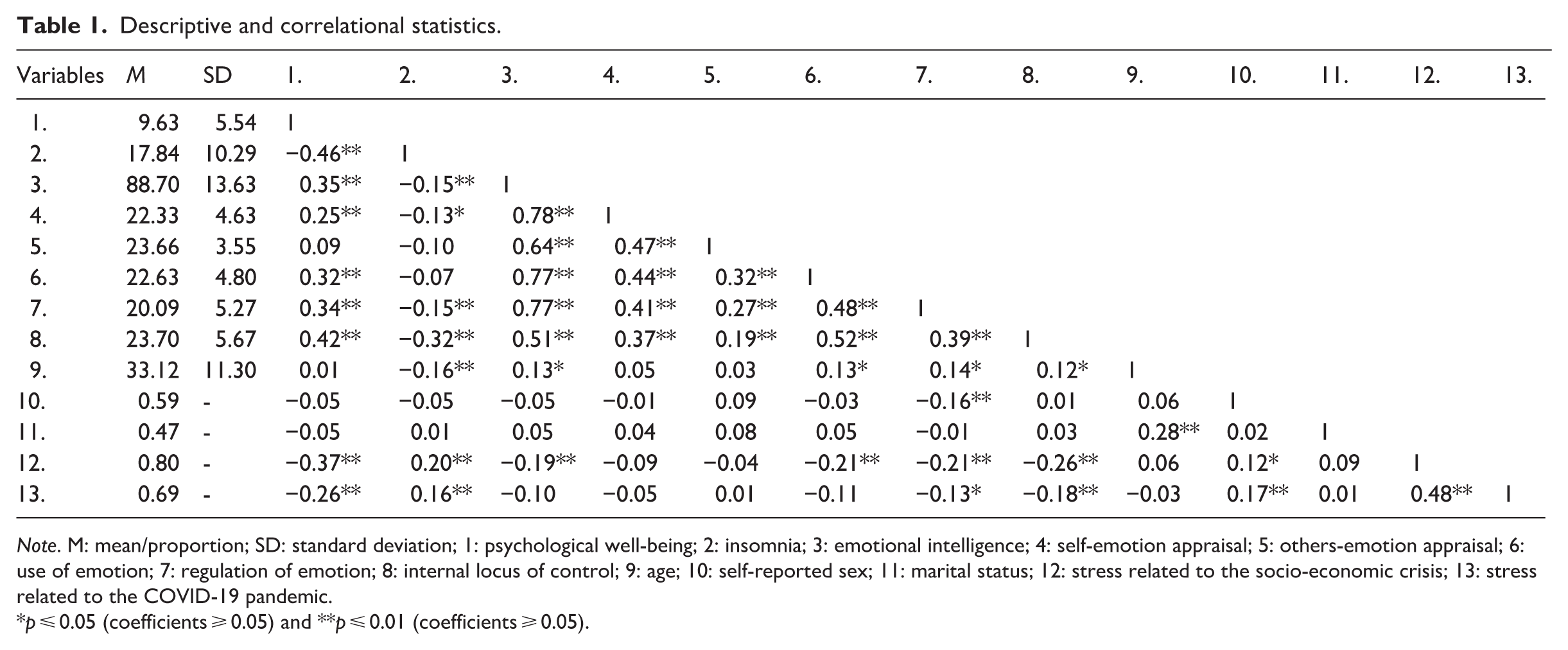
Note. M: mean/proportion; SD: standard deviation; 1: psychological well-being; 2: insomnia; 3: emotional intelligence; 4: self-emotion appraisal; 5: others-emotion appraisal; 6: use of emotion; 7: regulation of emotion; 8: internal locus of control; 9: age; 10: self-reported sex; 11: marital status; 12: stress related to the socio-economic crisis; 13: stress related to the COVID-19 pandemic.
p ⩽ 0.05 (coefficients ⩾ 0.05) and **p ⩽ 0.01 (coefficients ⩾ 0.05).
Multiple regression analysis
Table 2 presents the results of multiple regression analyses assessing the direct effects of internal locus of control and emotional intelligence on insomnia and psychological well-being. The findings show that a stronger internal locus of control is associated with lower levels of insomnia (β = −0.513, 95% CI [−0.733, −0.288]). In turn, higher insomnia is linked to lower psychological well-being (β = −0.184, 95% CI [−0.235, −0.132]). Both internal locus of control (β = 0.166, 95% CI [0.064, 0.270]) and emotional intelligence (β = 0.074, 95% CI [0.032, 0.115]) seem to be positively associated with psychological well-being. However, emotional intelligence was not significantly associated with insomnia (β = 0.025, 95% CI [−0.068, 0.111]). Exploratory analyses of the four distinct dimensions of emotional intelligence revealed that only the “use of emotion” dimension had a significant positive association with insomnia (β = 0.423, 95% CI [0.166, 0.676]), indicating that greater use of emotion is linked to higher levels of insomnia. Nonetheless, both the “use of emotion” (β = 0.143, 95% CI [0.021, 0.262]) and “regulation of emotion” (β = 0.141, 95% CI [0.033, 0.243]) dimensions were found to be positively associated with psychological well-being.
Direct effects of emotional intelligence and internal locus of control on insomnia and psychological well-being (bootstrap 95% CI).
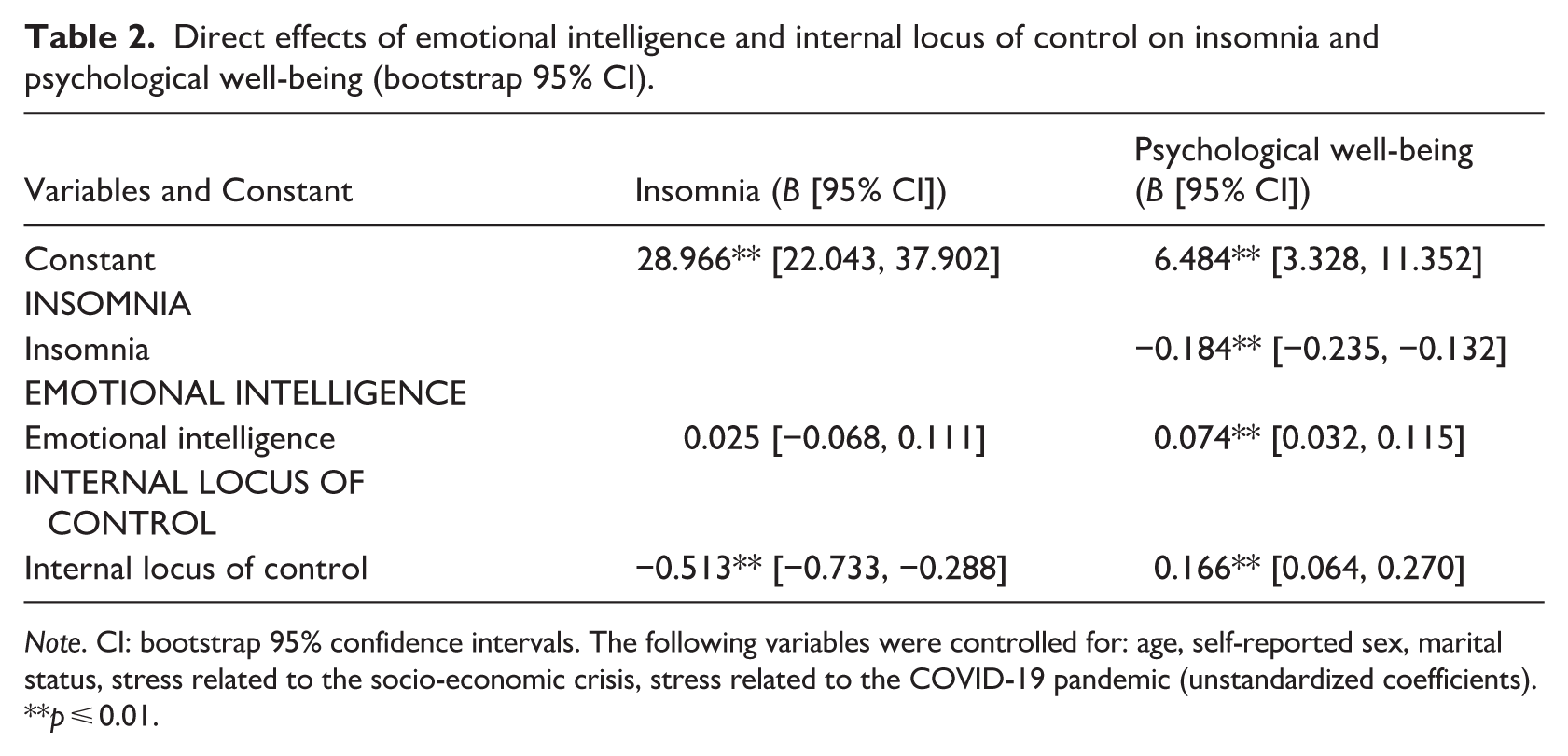
Note. CI: bootstrap 95% confidence intervals. The following variables were controlled for: age, self-reported sex, marital status, stress related to the socio-economic crisis, stress related to the COVID-19 pandemic (unstandardized coefficients).
p ⩽ 0.01.
Mediation analysis
Model fit was excellent, with CFI = 1.000, TLI = 1.000, RMSEA = 0.000 (90% CI: 0.000–0.000), and SRMR = 0.000, supporting the mediation model. Indirect effects consistent with a mediation model were estimated using 5000 bootstrap samples, providing robust confidence intervals. However, these fit indices should be interpreted with caution, as the model includes only observed variables without latent constructs, which limits the informativeness of standard fit indices. Table 3 presents the results of mediation analyses examining the indirect effects of internal locus of control and emotional intelligence on psychological well-being through insomnia. The results indicate that internal locus of control is indirectly associated with greater psychological well-being by contributing to lower levels of insomnia (b = 0.094, 95% CI [0.050, 0.149]). In contrast, emotional intelligence did not show a significant indirect effect on psychological well-being via insomnia (b = −0.005, 95% CI [−0.027, 0.012]). Further exploratory analyses of the specific dimensions of emotional intelligence revealed that the “use of emotion” dimension is indirectly associated with lower psychological well-being, due to its adverse effect on insomnia (b = −0.081, 95% CI [−0.136, −0.031]).
Indirect effects of emotional intelligence and insomnia on psychological well-being via insomnia (bootstrap 95% CI).
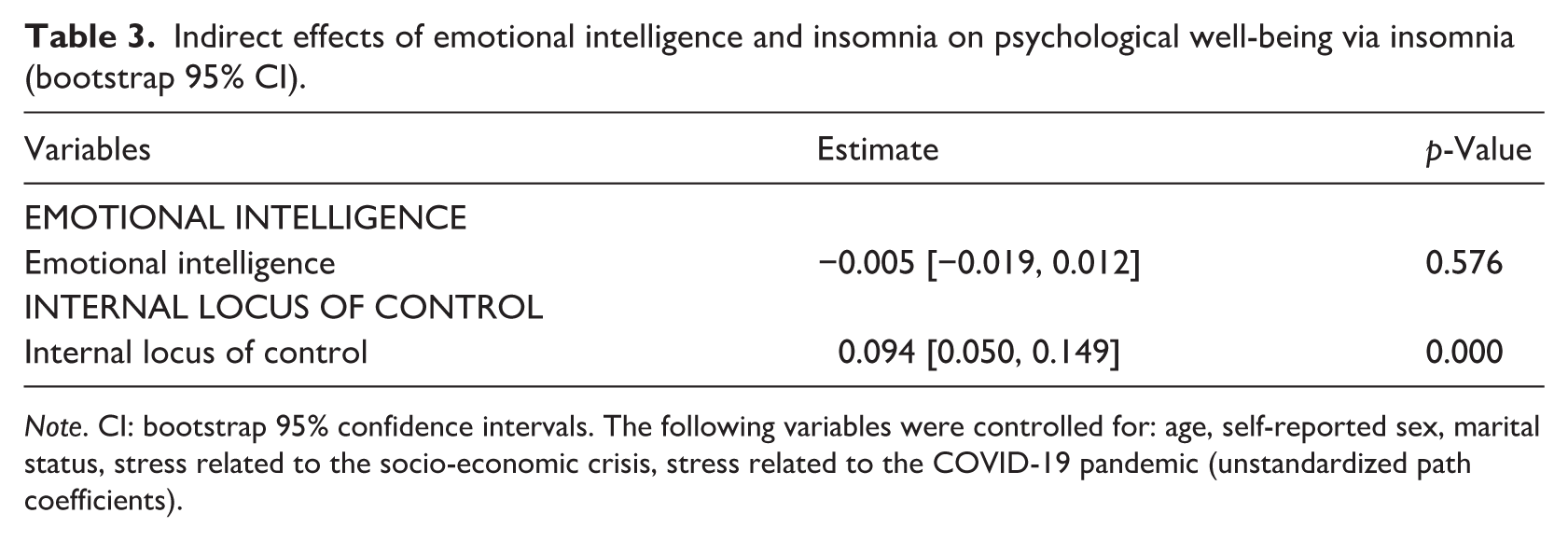
Note. CI: bootstrap 95% confidence intervals. The following variables were controlled for: age, self-reported sex, marital status, stress related to the socio-economic crisis, stress related to the COVID-19 pandemic (unstandardized path coefficients).
Discussion
In this study, we examined the association between internal locus of control, emotional intelligence, and psychological well-being, with insomnia as a potential mediator. Only internal locus of control was found to be significantly associated with lower insomnia. Emotional intelligence was directly related to greater psychological well-being but showed no significant association with insomnia. Inversely, the association between internal locus of control and psychological well-being aligns with the findings of previous studies (Parent-Lamarche and Marchand, 2019; Shin and Lee, 2021; Sigurvinsdottir et al., 2020).
Mediation analyses revealed that internal locus of control had a significant indirect effect on psychological well-being via insomnia, whereas emotional intelligence did not. Consistent with the Conservation of Resources theory (Hobfoll, 1989), having an internal locus of control may act as a protective resource, helping individuals regulate their emotional responses to stressors and reduce insomnia, thereby promoting psychological well-being. Conversely, having low personal resources may increase vulnerability to insomnia and its negative effects.
Overall, our findings partially support Hypothesis 1, showing that individual resources are negatively associated with insomnia, and Hypothesis 2, indicating that only internal locus of control indirectly enhances psychological well-being via reduced insomnia.
Due to the unexpected pattern of results regarding emotional intelligence, both direct and indirect effects, we conducted additional exploratory analyses at the dimensional level, examining its four components: self-emotion appraisal, others’ emotion appraisal, use of emotion, and regulation of emotion. Previous studies have emphasized the importance of analyzing these subcomponents separately, as each reflects distinct emotional competencies and may yield different outcomes (Guerra-Bustamante et al., 2019; Mayer et al., 2024; Parent-Lamarche, 2022; Park and Kim, 2021). It is plausible that the absence of an overall effect reflects opposing influences among the different dimensions.
Supplementary analyses showed that only the “use of emotion” dimension played a significant role. More specifically, the use of emotion was found to be directly and positively associated with insomnia. This emotional intelligence dimension was also found to indirectly reduce psychological well-being via insomnia. All other emotional intelligence dimensions showed no significant direct or indirect effect on insomnia. This finding is surprising as the use of emotion has typically being associated with constructive emotion regulation and enhanced motivation (Salovey and Mayer, 1990), and is often regarded as a useful individual resource. One possible explanation for our finding is that individuals scoring high on this dimension may be highly performance-oriented and experience elevated internal pressure, which could in turn, lead to greater stress and sleep disturbances. Although Fiori et al. (2024) did not specifically examine this dimension’s contribution to emotional sensitivity, it is plausible to assume that those who score high on the “use of emotion” dimension may also be more emotionally reactive. This heightened reactivity could increase their vulnerability to stressors and insomnia. Moreover, using emotions instrumentally to sustain performance may inadvertently contribute to perfectionistic tendencies. Perfectionism has been associated with higher levels of insomnia in student samples (Emert et al., 2017; Lindsay et al., 2022). In this context, individuals who are highly driven and perfectionist, and who mobilize their emotions to achieve ambitious goals, may experience increased insomnia and, as a result, lower psychological well-being.
An alternative explanation for our findings draws on perspectives suggesting that each emotional intelligence dimension may have a potential “dark side” (Kilduff et al., 2010). In the case of “use of emotion,” this dark aspect may lie in the strategic or instrumental use of emotions to achieve specific objectives. Authenticity is widely recognized as a key contributor to psychological well-being (Ménard and Brunet, 2011; Rivera et al., 2019; Sutton, 2020). When emotional expression is more calculated than authentic, this internal incongruence may generate psychological strain, contributing to sleep difficulties, and consequently lower psychological well-being.
Theoretical contribution
The theoretical contribution of this study lies in highlighting that not all individual resources are uniformly associated with insomnia and, consequently, with psychological well-being. These findings add important nuance to the Conservation of Resources (COR) theory (Hobfoll, 1989). Specifically, while emotional intelligence is often considered a valuable resource, our results showed that when examined as a global construct it did not significantly influence insomnia. However, a more detailed, exploratory analysis of its dimensions suggested that their associations may differ, although these findings should be interpreted cautiously and require replication in future studies. These findings suggest that it is not simply the accumulation of individual resources that matters, but rather the accumulation of appropriate or adaptive resources. From a theoretical perspective, these findings underscore the need to consider the potential “dark side” of individual resources and to acknowledge that their relationships with insomnia and, in turn, psychological well-being, may not be uniform.
Practical implications
The findings obtained from this study clearly underscore the beneficial role of internal locus of control. For organizations seeking to reduce insomnia and enhance the psychological well-being of their workforce, prioritizing the development of this individual resource is recommended. One practical approach would be to offer workshops led by psychologists to strengthen individuals’ sense of control over their life events. This is particularly promising given that internal locus of control can be nurtured through targeted interventions (Musyarofah et al., 2025). The objective would be to support individuals in shifting from an external to a more internal orientation, thereby leveraging the well-established benefits of this resource.
In parallel, organizations may consider promoting emotional intelligence among its employees, as it is another modifiable resource that can be cultivated across the lifespan (Gilar-Corbi et al., 2019). When doing so, it is essential to raise awareness about the potential downsides of using emotions in a purely instrumental way, especially since our results suggest that this specific dimension (i.e. use of emotion) may be linked to adverse outcomes such as increased insomnia. Tailored interventions that encourage balanced and adaptive emotional strategies may help mitigate such risks.
Limitations and future research directions
This study has several limitations that warrant consideration. First, the cross-sectional design used precludes us from drawing causal interpretations. Indirect effects should not be viewed as evidence of causal mediation. Although we examined the contributions of internal locus of control and emotional intelligence to insomnia and psychological well-being, the temporal dynamics of these relationships remain unclear. Future researchers should use longitudinal designs to better understand how these individual resources influence outcomes over time. This is particularly pertinent in contexts of ongoing adversity such as Lebanon.
Second, the use of snowball sampling, while practical under challenging circumstances, may limit the external validity of our findings. Future studies should consider probability-based sampling to improve generalizability of our findings to the broader population of Lebanese workers.
Third, the exclusive reliance on self-report instruments may introduce bias, as responses can be influenced by social desirability, mood, or limited self-awareness. Future studies could complement self-reports with evaluations from trained clinicians or multi-informant designs to improve the robustness and validity of their findings.
Fourth, the lack of contextual data on participants’ work environments limits result interpretation. Recent research has shown that job characteristics significantly influence workers’ insomnia profiles (Huang et al., 2025), highlighting the value of collecting information on organizational settings, job demands, and psychosocial conditions. Including such antecedents could enhance ecological validity and help identify strategies to promote well-being across diverse occupational settings.
Fifth, model fit indices should be interpreted with caution, as the model used only observed variables. Given the multidimensional nature of emotional intelligence, future studies should examine each dimension separately. In particular, the unexpected and exploratory findings regarding the “use of emotion” dimension highlight the need for longitudinal research to clarify its effects on insomnia and psychological well-being. Doing so could help identify which skills are most relevant for mitigating insomnia and promoting psychological health, particularly under acute stress. This could in turn help inform targeted interventions. Additionally, future studies should look into interventions that help enhance key resources such as internal locus of control and emotional intelligence. Those interventions could help build resilience in high-stress environments and inform workplace psychological health initiatives.
Finally, it is important to consider gender and/or self-reported sex in future analyses. Given well-established evidence that women are disproportionately affected by insomnia (Morin and Jarrin, 2022), gender-specific investigations may uncover important differences in how individual resources function or are accessed across groups. This would allow for more tailored and equitable approaches to psychological health promotion.
Footnotes
Acknowledgements
We would like to thank the students of the American University of Beirut for their help with data collection.

Ethical considerations
Ethical considerations: Before launching the study, ethical approval was obtained on December 14, 2021 from the American University of Beirut Institutional Review Board (AUB IRB) (Ethical approval number: SBS-2021–0262) and the Comité d’éthique de la recherche en protection des personnes de l’Université du Québec à Trois-Rivières (CERPPE-UQTR) (Ethical approval number: CERPPE-22-04-10.01). The study was conducted in accordance with the Declaration of Helsinki. Informed consent was obtained from all participants.
Consent to participate
Informed consent was obtained from all participants prior to data collection. For in-person participants, a research team member reviewed the consent form in detail, while those completing the online version were required to indicate their understanding and agreement before proceeding.
Consent for publication
Consent for publication is not applicable to this article as it does not contain any identifiable data.
Author contributions
Annick Parent-Lamarche conceived and designed the study, developed the research protocol, conducted the literature review, analyzed and interpreted the data, and drafted the manuscript. Sabine Saade conceived and designed the study, developed the research protocol, was responsible for the data collection, and provided critical feedback and edited the manuscript.
Funding
The authors received no financial support for the research, authorship, and/or publication of this article.
Declaration of conflicting interests
The authors declared no potential conflicts of interest with respect to the research, authorship, and/or publication of this article.
Data availability statement
The datasets generated during and/or analyzed during the current study are available from the corresponding author on request.