




Abstract
Although social support is related to better health, research is mixed regarding how social support relates to physiological systems including the parasympathetic nervous system. The present study assessed whether perceived parental and friend support were related to resting parasympathetic nervous system activity among young adults, and whether associations differed by stress. Young adults (N = 154; Mage = 20.5, SD = 3.0; 73.4% female) reported their perceived support from their parents and friends. Electrocardiogram data were collected while participants watched a 4-minute nature video to estimate resting respiratory sinus arrhythmia, an indicator of parasympathetic nervous system activity. Linear regression models indicated that young adults with higher perceived parental support tended to have higher respiratory sinus arrhythmia as hypothesized, but findings did not support associations for friend support or for stress-buffering models. Results suggested that aspects parenting may relate to long-term health through perceived support, in line with past evidence of the health benefits of family-based interventions.
Keywords
Introduction
Having social support is consistently related to better health including lower depression and mortality risk (Li et al., 2014; Shor et al., 2013), potentially by shaping physiological systems (Uchino, 2006). One candidate system is the parasympathetic nervous system (PNS), the branch of the autonomic nervous system that supports energy conservation and restorative processes (“rest-and-digest”), because higher PNS activity is consistently related to better health (Jarczok et al., 2022; Porges, 2007). Support may be particularly consequential for the physiology of young adult college students, who are transitioning to independence and face stressors in varied domains (e.g. social, academic; Conley et al., 2014). Stress and coping frameworks posit that social support may buffer the physiological consequences of stress specifically (Cohen and Wills, 1985), whereas positive psychological theories including Self-Determination Theory posit that close relationships and support directly benefit well-being to promote health, regardless of stressful contexts (Deci and Ryan, 2000). Research is mixed regarding whether social support is related to better PNS activity and can buffer associations between greater stress and lower PNS activity, with few studies among young adults. Attachment Theory further highlights the unique role of parental support (Simpson et al., 2021), although few studies have differentiated the source of social support when examining associations with PNS activity. Therefore, research is needed to test whether perceived social support from parents and friends relates to PNS activity directly versus by buffering stress among young adults.
Social Support and PNS Activity
Higher resting PNS activity is consequential for health and related to better emotional well-being (Jarczok et al., 2022). The neurovisceral integration model posits that greater PNS activity promotes the brain-body connection, including activation of the prefrontal cortex (Thayer and Lane, 2009), and thereby provides bodily resources that support social engagement and emotion regulation (Porges, 2007). For example, individuals with higher cardiac respiratory sinus arrythmia (RSA)—one measure of PNS activity—tend to use emotion regulatory strategies more effectively in daily life (Geisler et al., 2010). Indeed, because RSA often relates to greater emotion regulatory capacity, low RSA has been considered a transdiagnostic marker of psychopathology (Beauchaine, 2015). Individuals with higher resting RSA tend to be protected from the consequences of negative life events and harsh environments (Creavey et al., 2018; Hinnant et al., 2015), potentially because of this enhanced regulatory ability (Porges, 2007). Given the implications of RSA for better health, research would benefit from identifying psychosocial correlates that may underly RSA development.
Social support may be one intervenable target that is related to greater PNS activity at rest. The effects of acutely receiving social support on momentary PNS activity have been mixed (Goodyke et al., 2022), potentially due to differences in aspects of the social support (e.g. engagement, the provider). Longitudinal evidence suggests that increases in maternal warmth across adolescence were related to higher baseline RSA among adolescents (Her et al., 2025). Similarly, increases in relationship support across 10 years corresponded to increases in RSA among older adults (Donoho et al., 2015), although associations between parental and friend support and resting PNS activity in older adults differed by lifestyle factors and age (Bosle et al., 2022).
Social Support in Young Adulthood
College students face many stressors related to academics, social relationships, and personal development (Conley et al., 2014), and young adults who receive more support from parents and friends tend to have better health outcomes (Li et al., 2014). Early family support may enable development of the PNS that positions individuals for better emotion regulation (Alen et al., 2022). Aspects of parenting such as parental warmth are related to greater PNS activity in infancy (Zeegers et al., 2018), adolescence (Diamond and Cribbet, 2013; Graham et al., 2017), and midlife (Alen et al., 2020). Given age differences in previous associations (Bosle et al., 2022), further research is needed in young adult populations.
Although adolescents continue to seek support from family (Guan and Fuligni, 2016), they also becoming increasingly oriented toward peers and sensitive to peer interactions (Dahl, 2004). Friend support may displace the effects of parental support during the college years, when young adults become independent and spend much time on their college campus. College students often benefit more from receiving support from friends relative to parents and from providing emotional support to friends than to parents (Lee and Goldstein, 2016). Higher peer acceptance in adolescence and friendship quality in young adulthood prospectively predict higher resting RSA (Allen et al., 2022). Regarding peer support, individuals in the presence of a supportive friend show higher momentary RSA than those in the presence of an ambivalent friend (Holt-Lunstad et al., 2007). However, objective received support does not necessarily align with individuals’ perceptions of relationship support. Therefore, it remains unclear whether greater friend support is related to higher resting PNS activity in young adults.
It is also possible that social support specifically relates to PNS activity by reducing the deleterious effects of daily feelings of stress. In line with the stress-buffering hypothesis, one study found that supportive parenting buffered against the consequences of stressful life experiences for RSA in young adolescents (Fox et al., 2019). Another study found that associations between parenting and adolescents’ RSA trajectories differed by levels of family stress (Lisitsa et al., 2021). However, this stress-buffering pathway is underexplored with respect to PNS activity, and it remains unclear whether perceived support buffers associations between stress and PNS activity during young adulthood.
Present Study
The present study assessed whether perceived family and friend support cross-sectionally relate to resting PNS activity, as indicated by the biomarker cardiac RSA, among young adult college students. Data were collected in the 2021–2022 academic year, during in-person instruction. Because past studies have indicated that the source of social support can affect individuals’ well-being (Guan and Fuligni, 2016; Lee and Goldstein, 2016; Shor et al., 2013), we aimed to identify whether both parent and friend support relate to resting RSA. We hypothesized that both greater perceived family support and friend support would be related to greater resting RSA, in line with evidence that parenting interventions can alter RSA and that friendship quality is related to resting RSA (Alen et al., 2022; Allen et al., 2022). Because social support has been theorized to improve health by buffering the deleterious impacts of stress (Cohen and Wills, 1985), we additionally hypothesized that associations between greater perceived stress and lower RSA would be buffered by greater perceived parent and friend support.
Method
Participants and procedures
Young adult college students (N = 154; Mage = 20.5, SD = 3.0; 73.4% female; 76.0% heterosexual; 32.0% Asian, 28.8% white, 15.7% Latine, 15.0% multiracial, 8.5% different identities including Black or Middle Eastern) attending a public university in Southern California were recruited between October 2021 and May 2022. Students were from all class years (19.0% first-year, 18.3% second-year, 28.1% third-year, 34.6% fourth-year), and 60.5% reported that their parents had completed a 4-year degree or higher education. This sample size is in line with past studies of acute physiological reactivity (Quintana, 2017) and sufficiently powered for detecting an interaction term (i.e. three predictors: two main effects and one interaction term) with a moderate effect (β = 0.3). During the 1-hour laboratory session, participants provided informed consent and then had electrocardiogram (ECG) administered by placing electrodes on the upper right chest below the clavicle, bottom of the lower right rib, and middle of the lower left rib in a lead II configuration. They completed a brief survey and then watched a 4-minute neutral nature video while having their ECG recorded. They received 1 hour of course credit for compensation. Study procedures were approved by the University of California, Los Angeles Institutional Review Board (#21-001170).
Measures
Perceived parental and friend support
Participants completed the parental support subscale of the Inventory of Parent and Peer Attachment (Armsden and Greenberg, 1987), for which they rated nine items regarding how close and supported they felt by their parents over the past month using a 5-point scale (1 = Almost Never, 5 = Almost Always; e.g. “I trusted my parents,” “I could count on my parents when I needed to talk.”). They completed the same items about their friends. Items showed high inter-item reliability (α = 0.96 for parents, α = 0.92 for friends), and a mean was taken across items.
Respiratory sinus arrhythmia
We collected ECG data continuously using a BIOPAC physiological recording system. Data were converted to inter-beat intervals and double-edited for artifacts and biological improbable values by three research assistants, who were certified CardioEdit Reliable (Brain-Body Center, 2007) and showed excellent agreement (r = 0.97, p < 0.001). RSA was estimated from the software CardioBatch across high frequencies (0.12–0.40 Hz) using the Porges–Bohrer Method (Porges, 2007). An average was calculated across all 30-second epochs.
Perceived Stress Scale
Participants completed the 10-item Perceived Stress Scale (Cohen et al., 1983), for which they rated how often they felt stressed (e.g. “How often have you found that you could not cope with all the things that you had to do”) over the past month using a 5-point scale (1 = Never, 5 = Very Often). Items showed good inter-item reliability (α = 0.84). A mean was calculated after reverse-coding four negatively-worded items.
Covariates
Models were repeated adjusting for demographic factors, given health disparities in cardiovascular and PNS activity (Faulkner et al., 2003; Rosati et al., 2021). Participants reported gender and sexual orientation using short-response questions and reported race using a checklist. One participant did not report race, leaving 153 participants in analyses adjusted for covariates.
Results
Descriptive statistics and correlations are presented in Table 1. The outcome variable, RSA, was normally distributed (skewness = −0.25). Likewise, residuals were normally distributed (skewness = −0.22) and heteroskedastic. Participants reported generally high levels of perceived support, and a t-test indicated that participants perceived higher levels of friend support than parental support (t[153] = 5.87, p < 0.001, Cohen’s D = 0.65). Perceived parental support and friend support were not significantly correlated. Parental support was weakly positively correlated with resting RSA, whereas friend support was not. Perceived stress was not correlated with parent support, friend support, or resting RSA.
Correlations and descriptive statistics for study variables.
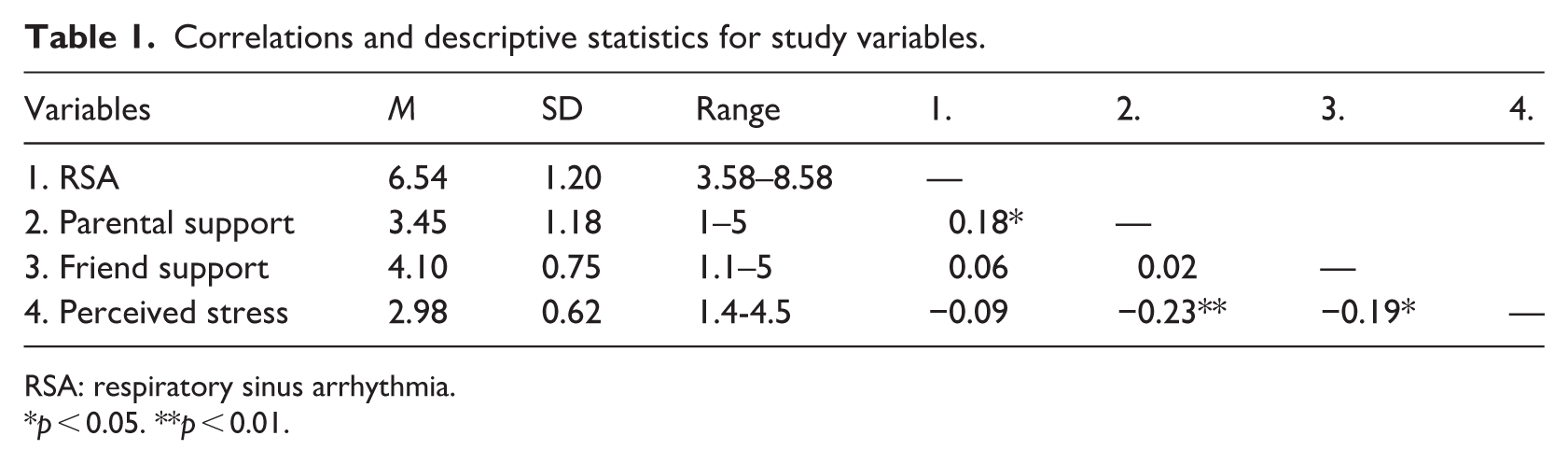
RSA: respiratory sinus arrhythmia.
p < 0.05. **p < 0.01.
Linear regression models then tested whether perceived parental support and friend support (mean-centered) simultaneously were associated with RSA. Results indicated that higher parental support was still associated with higher RSA (B = 0.17, SE = 0.08, p = 0.040, 95% CI [0.01, 0.33], β = 0.17), whereas friend support was not (B = 0.05, SE = 0.13, p = 0.672, 95% CI [−0.20, 0.31], β = 0.03). Models were repeating adjusting for sex (dummy-coded as 0 = non-female, 1 = female), sexual orientation (dummy-coded as 0 = non-heterosexual, 1 = heterosexual), and race (dummy-coded with Asian [the majority group]), which did not alter results (Figure 1 and Table 2).
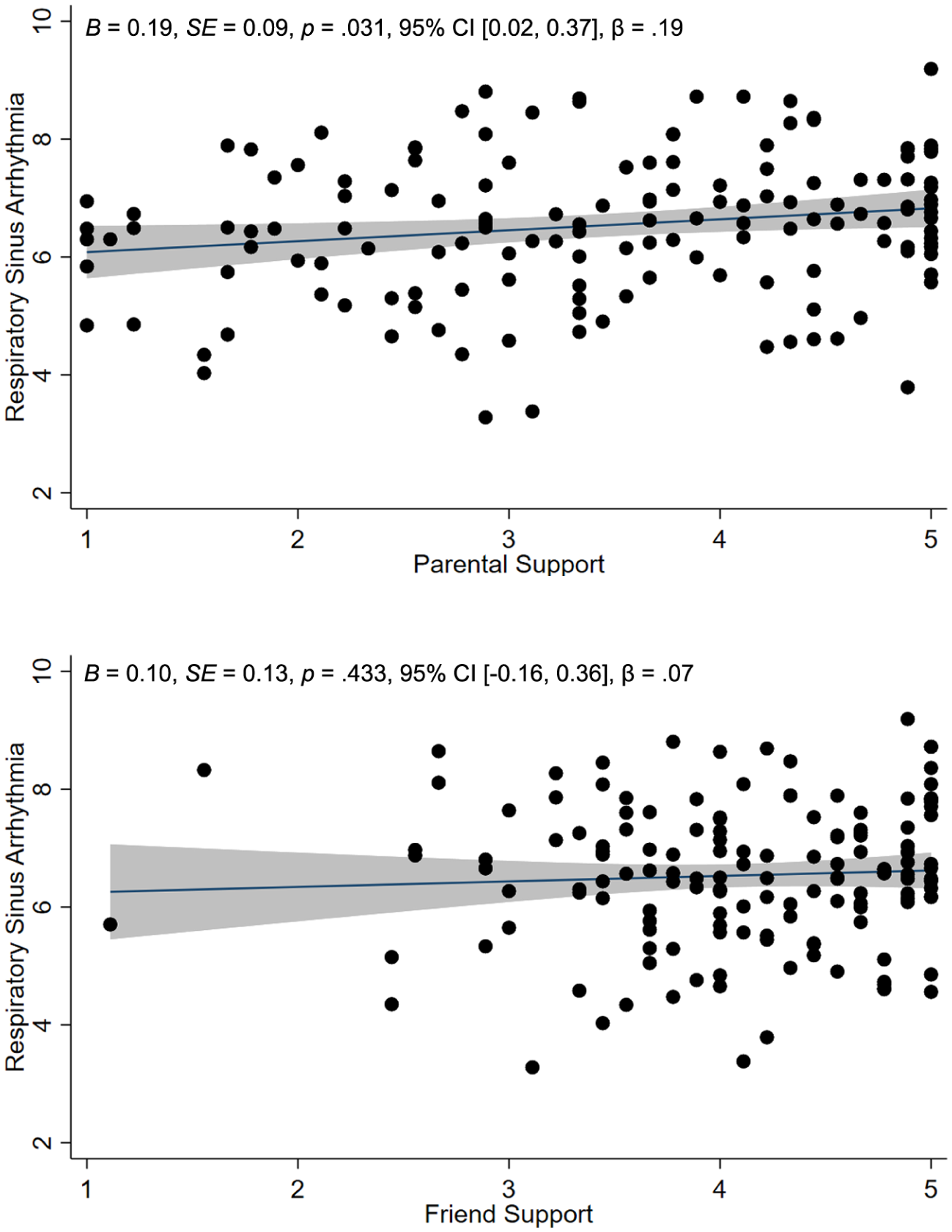
Scatterplot depicting respiratory sinus arrythmia as a function of parental support (above) and friend support (below).
Resting RSA as a function of parental support, friend support, and stress testing main effects and stress-buffering effects (Model 2 and Model 3).
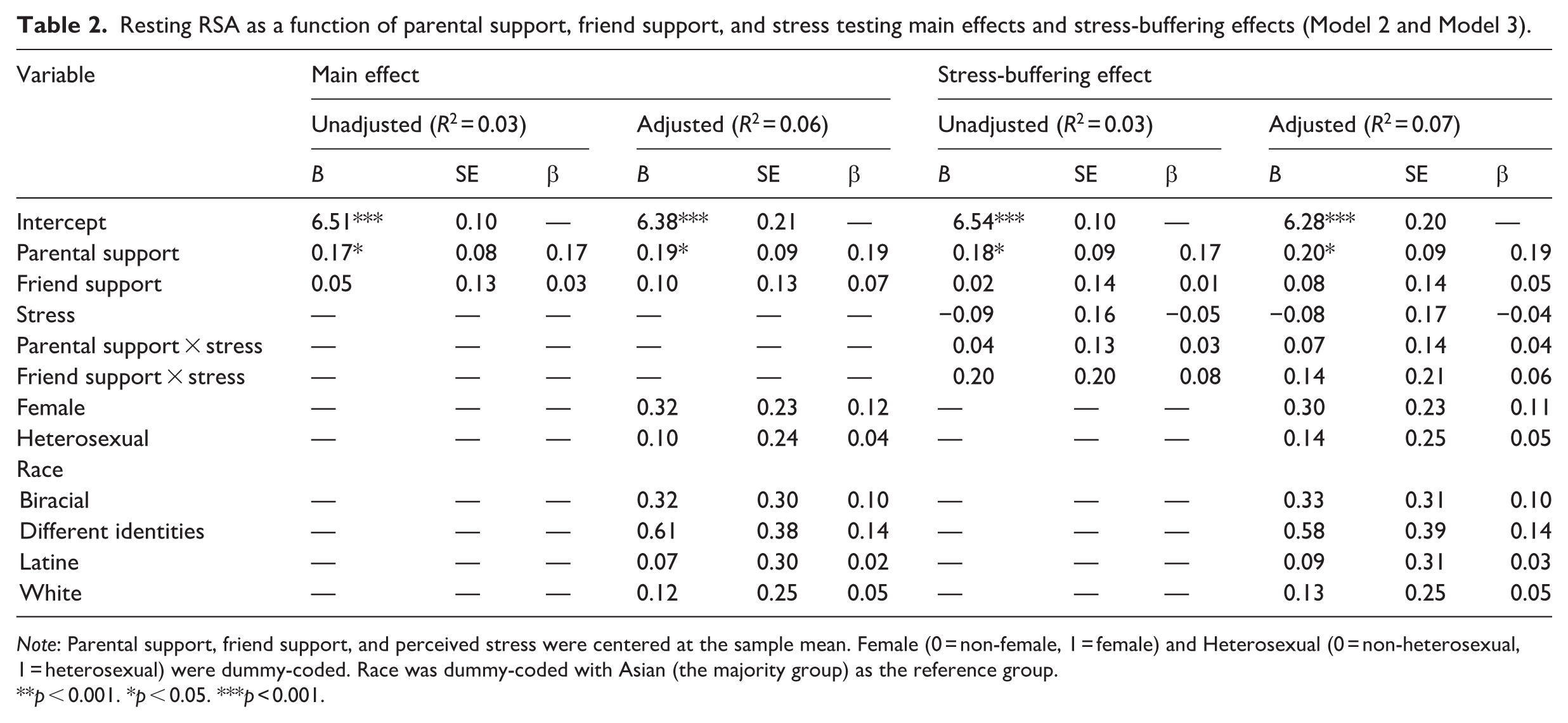
Note: Parental support, friend support, and perceived stress were centered at the sample mean. Female (0 = non-female, 1 = female) and Heterosexual (0 = non-heterosexual, 1 = heterosexual) were dummy-coded. Race was dummy-coded with Asian (the majority group) as the reference group.
p < 0.001. *p < 0.05. ***p < 0.001.
Finally, to test whether associations between perceived social support and RSA emerged in stressful contexts, models tested Perceived Support (centered) × Perceived Stress (centered) interactions. These interactions were nonsignificant for both parental and friend support in unadjusted and adjusted models (Table 2). Associations did not change when testing parental support and friend support in separate models (Supplemental Table S1).
Discussion
Because associations between perceived social support and PNS activity have been mixed across studies (Goodyke et al., 2022) and differ by age and lifestyle factors (Bosle et al., 2022), we examined how both perceived parental support and friend support cross-sectionally relate to RSA as a measure of PNS activity among young adult college students. As hypothesized, young adults who perceived greater parental support had greater resting cardiac RSA, although associations did not emerge between perceived friend support and RSA. However, there was no evidence for stress-buffering pathways, possibly due to measuring perceived stress rather than specific domains such as emotional stress that could be addressed by perceived support. Taken together, findings suggested that perceived support may be directly associated with greater PNS activity.
Our findings align with past evidence relating parenting interventions to greater RSA in children and relating parental warmth in childhood to greater RSA in midlife (Alen et al., 2020; Bosle et al., 2022; Lee and Goldstein, 2016; Li et al., 2014). Whereas Self-Determination Theory posits that social relationships broadly can benefit well-being, Attachment Theory suggests that parent-child relationships provide foundational resources for exploration that benefit long-term well-being (Simpson et al., 2021). This perceived support could confer benefits during college, when individuals explore a novel environment and establish independence. Indeed, some college students report increased support from their parents during this time (Guan and Fuligni, 2016). However, observed associations were cross-sectional and thus preclude assessment of causality.
Associations did not emerge for perceived friend support, in contrast with evidence relating close friendship quality to RSA (Allen et al., 2022). However, this finding is in line with evidence that stronger family ties are related to lower mortality and inflammation, with no associations for friendship ties (Shor et al., 2013; Uchino et al., 2015). Associations for friend support may depend on the number, quality, and stability of friendships. Because college students often move away from their home communities, friend support may fluctuate more year-to-year than parental support. Given changes in friendship during college, friend support earlier in childhood or from specific peer groups (e.g. childhood friends) may also better relate to RSA. Results may have differed because participants also had overall higher and less variable support from friends than parents, potentially because they can choose their friendships. Although they had resumed in-person instruction, parental support may be particularly tied to PNS activity following periods of sustained time together such as the safer-at-home order.
Our results did not support the stress-buffering hypothesis, as perceived support did not moderate associations between stress and RSA. Feeling supported may enable young adults to feel secure in day-to-day life (Beckes and Sbarra, 2022). Perceived support may motivate individuals to communicate and spend time with their family, which can affect PNS activity (Wiśniewska et al., 2025). It is possible that stress may modify associations between social support and other aspects of health including mental health. Stress was also measured subjectively and retrospectively over the past month, and associations may emerge using objective metrics, domains of stress (e.g. academic vs interpersonal), or a daily protocol to better characterize stress frequency.
Given that higher RSA is related to better health and emotion regulation (Jarczok et al., 2022), it is possible that maintaining positive family relationships during young adulthood may benefit health. Counseling services on college campuses can recommend parent-focused interventions and encourage students to leverage familial resources and multiple sources of support. However, many individuals lack parental support due to sociopolitical factors (e.g. parents disapproving of students’ identities; limited communication due to deportation). Longitudinal research is needed to assess mechanisms between social support and health, as well as to understand how differences in resting PNS activity may position underrepresented students for poorer health and to identify compensatory means of promoting RSA.
Findings must be interpreted in context of limitations regarding the sample and study design. Participants were primarily female college students, limiting generalizability to male students and young adults who pursue full-time employment. Participants did not report whether they commuted, and commuting students who live with their parents may perceive greater parental support or benefit to a greater extent from parental support. Relatedly, associations may differ for campuses with a lower proportion of in-state students. Participants also rated past-month support once using subjective reports rather than discrete actions, other individuals’ reports, or multiple time-points, all of which could improve measurement reliability. Most importantly, the study was cross-sectional, precluding conclusions regarding causality. For example, it is possible that higher resting RSA can promote children’s own behavioral warmth and thereby elicit support from parents (Diamond and Cribbet, 2013).
Conclusions
Young adults who perceived higher parental support tended to have higher resting RSA. Results did not support stress-buffering associations, suggesting that feeling supported may directly benefit PNS activity rather than weaken the consequences of stressful experiences. Findings may have implications for how social support relates to physical health, given that PNS activity has been related to greater emotion regulatory capacity and better health (Porges, 2007). Associations did not emerge for perceived friend support, potentially due to changing peer networks and individuals’ ability to select supportive friends. Results highlight the role of continued parental support and strong family bonds for PNS activity in young adulthood.
Supplemental Material
sj-docx-1-hpq-10.1177_13591053261430998 – Supplemental material for Perceived support and resting respiratory sinus arrhythmia among young adult college students
Supplemental material, sj-docx-1-hpq-10.1177_13591053261430998 for Perceived support and resting respiratory sinus arrhythmia among young adult college students by Danny Rahal in Journal of Health Psychology
Footnotes
Acknowledgements
The author would like to thank the participants for their time, Christine Xu for reviewing the manuscript, Violet Kwan and Zahara Cuevas-Kovanis for cleaning and editing the data, and Maura Eckard, Alyusuf Elnaggar, Brittany Maxwell, Armaan Singh, and Rainey Speer for collecting the data.

Ethical considerations
The study was approved by the University of California, Los Angeles (IRB #21-001170).
Consent to participate
All participants provided informed consent.
Consent for publication
Consent for publication is not applicable to this review article as no identifiable participant data are included.
Funding
The author received no financial support for the research, authorship, and/or publication of this article.
Declaration of conflicting interests
The author declared no potential conflicts of interest with respect to the research, authorship, and/or publication of this article.
Data availability statement
Supplemental material
Supplemental material for this article is available online.