



Abstract
Boys are known to take more risks than girls, which may lead them to suffer more injuries than girls when exploring their physical surroundings. The aims of this study are to verify whether the father-child activation relationship has a greater effect than the mother-child activation relationship on preschoolers’ risk-taking, and whether both of these relationships are a greater predictor of risk-taking in boys than in girls. Activation relationships were assessed using a standardized observation procedure at 15 and 45 months old with each parent. Both parents completed a questionnaire on their child’s injury-risk behaviors during the preschool years. Both predictions were supported. Moreover, this longitudinal study found that preschoolers’ risk-taking was predicted by mother-child overactivation in both infancy and preschool, whereas preschoolers’ risk-taking was predicted by father-child overactivation in preschool alone, after controlling for parent-child overactivation relationships during infancy.
Introduction
The high accident hospitalization rate of children aged 5 and under is mainly explained by risk-taking during children’s exploration of their physical environment (Hagan and Kuebli, 2007; Morrongiello et al., 2022). The child’s sex is the variable most systematically associated with risk-taking (Morrongiello and Dawber, 2000). Boys participate in the same activities as girls, but they do so at a faster pace (Morrongiello and Dawber, 1998) and in more hazardous ways (Rivara et al., 1982); they therefore exhibit greater risk-taking and suffer more injuries than girls when exploring their physical surroundings (Morrongiello et al., 2010; National Center for Injury Prevention and Control [NCIPC], 2025). About 20% of child deaths result from unintentional injuries, and death rates in the United States are consistently higher among boys than among girls between the ages of 0 and 5 years (Dellinger and Gilchrist, 2019). In 2023, the fatal injury rates in 0–4-year-old children per 100,000 population were 15.75 for boys and 11.89 for girls (NCIPC, 2025).
Researchers have used a variety of methods to explore the role of parenting practices in children’s physical risk-taking. Morrongiello and Dawber (1999) observed during a teaching task how parents taught their 3-year-old children to engage in injury-risk situations on a playground. They found that mothers and fathers verbally encouraged risk-taking in boys more than in girls, and were more likely to encourage girls to exercise caution. Using scenarios tasks (no injury vs injury outcome), Morrongiello et al. (2010) found that both parents reacted to boys’ risk-taking by meting out discipline and reacted to girls’ risk-taking by providing safety-related advice and education. In addition, mothers and fathers alike attributed boys’ risk-taking to personality attributes and girls’ risk-taking to situational factors. Finally, mothers expressed anger at boys and disappointment and surprise at girls. Fagot et al. (1985) showed photos of risky situations to parents. Although fathers and mothers assessed risks using the same criteria, and ratings for boys versus girls did not diverge, the researchers showed that fathers were less likely than mothers to intervene and stop their children from engaging in harmful behaviors, suggesting that fathers may be more accepting of their young children’s risk-taking than mothers are (Morrongiello et al., 2010). An observational study conducted by Hagan and Kuebli (2007) used a situation involving a real danger (obstacle course). The results showed that mothers supervised both boys and girls equally, while fathers monitored girls more closely than boys, suggesting that fathers are more accepting of boys’ risk-taking. Research by Wood et al. (2019), which compared single fathers and mothers of children aged 2–5 revealed that an authoritarian parenting style in mothers (low warmth, high discipline) predicted higher levels of risk-taking in boys and girls, while a permissive parenting style in fathers (high warmth, low discipline) predicted higher risk-taking in boys only. In a study by Galligan and Kuebli (2011) that used structured interviews, preschoolers viewed mothers as allowing boys and girls to engage in similar levels of risk, and fathers as permitting higher levels of risk for boys than for girls.
When it comes to studies on risk-taking in young children, there is another aspect of parenting that warrants closer attention: physical play. In Western industrialized societies, fathers are more likely than mothers to engage with their children in games involving physical contact without toys (Paquette et al., 2020), that is, games that could potentially result in child injury. Ahnert et al. (2017) found similarities between mothers’ and fathers’ risk-taking stimulation in play situations that involve physical and pretend play behaviors. Meanwhile, Ryan et al.’s (2024) questionnaire-based study found that mothers perceived greater risk in their children’s risky play activities than did fathers, regardless of the child’s sex.
The most common form of physical play activity is Rough-and-Tumble Play (RTP), which involves chasing and wrestling in a playful context (see Pellegrini and Smith, 1998) between the parent and the child. Fathers engage in RTP more often than mothers, and more often with boys than with girls, with activity peaking around the age of 4 (Paquette et al., 2023b; Paquette and StGeorge, 2023). During this type of play, fathers use a combination of stimulation and limit setting to challenge and provoke their child before helping them to regulate their emotions (Paquette et al., 2023b).
Some researchers have established associations between parental attachment and general risk-taking among adolescents, both assessed by questionnaires (see Boyer, 2006; Morsünbül, 2009), but few studies have addressed the role of parent-child relationships in predicting injury-risk behaviors in young children. The parent-child relationship is a dyadic characteristic that results from the dynamic transactional interaction between parent and child characteristics since birth. Two studies led by Schwebel team have explored the link between parent-child attachment and children’s unintentional injuries. In a clinic-referred sample of children with oppositional defiant disorder (ODD) or attention-deficit/hyperactivity disorder (ADHD), Schwebel et al. (2002) identified a positive link between injury rates in preschool-aged children and the insecure avoidant mother-child attachment score assessed by observation, however, this association was not observed in a control group. Using a self-report questionnaire adapted from existing teacher-child relationship scales (Pianta, 1994) that is used to assess parents’ impression of their relationship with their child—Schwebel and Brezausek’s (2010) study showed that children (especially boys) were protected from injury when their fathers reported a more positive relationship with them during middle childhood; there were no significant results concerning mothers. To our knowledge, Paquette et al.’s (2023a) study is the only one that has examined the association between mother-child and father-child attachment relationships assessed by observation and young children’s risk-taking. In a sample of 182 families, they found no significant association between parent-child attachment (as assessed with the observational Strange Situation Procedure (SSP) in infancy) and risk-taking in toddlers (as assessed by questionnaires answered by both parents). On the other hand, they showed that father-child and mother-child activation relationships during infancy are associated with risk-taking in toddlerhood. The activation relationship is the emotional bond that a child develops with an actively involved parent while exploring their social and physical environment — a bond that facilitates both risk-taking and protection (Paquette, 2004; Paquette et al., 2020). Children with an activated relationship to a parent are both confident and prudent in their exploration and obey when the parent sets a limit. On the contrary, children with an underactivated relationship to parent tend to engage in little exploration, behave passively, withdraw from novelty and stay close to the parent. Finally, children who have an overactivated relationship with a parent are reckless and non-compliant when the parent sets limits, resulting in more accidents due to their lack of prudence (Paquette and Bigras, 2010). Underactivation is related to parental overprotection, while overactivation is linked to a lack of parental discipline. According to Paquette (2004), RTP is a mechanism that facilitates the development of the activation relationship. Paquette and Dumont (2013) showed that the frequency of father-child RTP at age 3 has been positively associated with the activation score in boys alone.
According to Paquette et al.’s (2023a) results, children who were overactivated toward either parent took significantly more risks than activated or underactivated children. Moreover, when father-child and mother–child overactivation were both included in a multiple linear regression, only the father-child overactivation remained significant in predicting risk-taking. On the other hand, when the child’s sex was considered, the father-child overactivation was no longer significant, whereas the mother-child overactivation became significant: As the mother-child overactivation score increases, boys take more risks that may lead to injury. The hypothesis that fathers play a more important role with boys was not supported in toddlerhood. Rather, the results supported those of Morrongiello and Dawber (1998), who showed that mothers have greater difficulty controlling boys, as the latter are more non-compliant than girls when being directed away from hazards.
The objective of the present study is to carry out a longitudinal follow-up with the sample of Paquette et al. (2023a) to predict risk-taking at preschool age. Our study aims to verify two hypotheses. The first is that the father-child activation relationship will be more associated with children’s risk-taking at preschool than the mother-child activation relationship is when the activation relationship is assessed during preschool rather than during infancy. It is possible that fathers play a greater activating role than mothers with preschoolers’ risk-taking—especially with boys—at an age when fathers are more involved with their children, particularly in RTP. The second hypothesis is that father-child and mother-child activation relationships will be stronger predictors of risk-taking in boys more than that in girls.
Materials and methods
Participants
The Complementarity of Attachment Relationships (CAR) project included a total of 182 children (90 boys) and their French-speaking parents recruited from the general population in the Greater Montreal Area (Canada). The mothers’ mean age was 32.7 years (SD = 4.5; range 17–46) and the fathers’ was 34.6 years (SD = 4.7; range: 23–45). A total of 63.7% of the fathers and 45.9% of the mothers made an annual personal income of at least CAD$50,000. The average education of the mothers was 16.2 years (SD = 2.8; range: 9–27) while that of the fathers was 15.6 years (SD = 2.8; range: 6–23). The parents’ personal income and education levels were high compared to the general Quebec population. The average number of hours worked per week was 26.4 (SD = 16.5; range 0–60) for mothers and 38.5 (SD = 12.7; range 0–80) for fathers. Most of the fathers and mothers (77%) were born in Canada. Among the fathers born outside Canada, 55% were from France, 17.5% from South America, 17.5% from Africa, and 10% from other countries. Among the mothers born outside Canada, 51.3% were from France, 30.8% from Mexico or South America, and 17.9% from other countries. All the parents were biological parents with the exception of one stepfather. Finally, the average number of children per family was 2.02 (SD = 0.7; range: 1–4).
Procedure
The convenience sample was developed by recruiting parents from the Greater Montreal Area through advertisements in daycares and parenting magazines. Participants were assessed at two time points: T1 = infancy (11–20 months) and T2 = preschool (31–55 months). The activation relationship was assessed with observational procedures during two laboratory visits at the university: the first visit at T1 (infancy) with 180 mother-child dyads and 179 father-child dyads at T1 (infant), and the second at T2 (preschool) with 154 mother-child dyads and 157 father-child dyads. Following the observational procedure, the parent completed a sociodemographic questionnaire. The order of laboratory visits attended by father-infant dyads and mother-child dyads was counterbalanced at 1-month intervals. Thus, the infants were of similar age during the observational procedures with the mother (mean = 15.2 months, SD = 1.8; ranging from 11 to 20), and the observational procedures with the father (mean = 15.3 months, SD = 1.9; ranging from 12 to 23) are similar. The preschoolers were also of similar age during the observational procedures with the mother (mean = 44.7 months, SD = 2.9; ranging from 31 to 55) and the preschoolers’ age at the observational procedures with the father (mean = 44.5 months, SD = 3.1; ranging from 31 to 55) are also similar. The families were visited in their homes a few months later, while the child was still in preschool (51.5 months; SD = 4.2; ranging from 35 to 67 months), and both parents completed the questionnaire about their children’s risk-taking behaviors.
Instruments
Parent-child activation relationship
The Risky Situation (RS) is a standardized observational procedure used to evaluate the activation relationship. The RS was initially validated with parent-infant dyads (Paquette and Bigras, 2010), and subsequently with parent-preschooler dyads (Gaumon and Paquette, 2013). The procedure takes place in an unfamiliar room containing toys, a staircase or a stepladder (physical risk), and an intrusive stranger (social risk). The parent is given specific instructions to control their behavior in order to provide a dyadic measure of the relationship (not of the child’s characteristics). The RS is not as context-sensitive as a free play would be. The procedure is divided into six structured episodes of 3 minutes each. In the first episode, the parent sits in a chair with the child on the floor in front of them, with toys placed before the child. An assistant instructs the parent to read silently and avoid interacting with the child, except to provide comfort if the child is crying. The parent must not approach the child or encourage the child to investigate the stairs, when they are revealed later in the procedure. In the second episode, a male stranger enters the room and plays with the toys without looking at or interacting with the child (social risk). In the third episode, the stranger plays with the child for 1 minute before becoming increasingly intrusive by presenting the child with toys, tickling the child, and attempting to pick the child up and place them on his lap. In the fourth episode, all the toys are removed from the room and a sheet is pulled aside to reveal a five-step staircase (physical risk) with two toys attached to the top of the staircase. In the fifth episode, the parent asks the child to go up and down the stairs several times unassisted. In the sixth and final episode, the parent removes the child from the stairs and forbids them to go back up if the child shows an interest in doing so.
The RS procedure assigns children three scores, measuring their underactivation, activation, and overactivation. Children are placed into three categories: underactivated (obedient, but exploring their environment in a limited way and with a tendency to avoid risks), activated (obedient, exploring their environment while remaining cautious) or overactivated (disobedient, exploring while disregarding their own safety). The parent-child relationship is determined using 5 criteria:
1- The child retreats or exhibits fear indicators during episodes 2 and 3.
2- Level of child initiations and positive affects with the stranger in episode 3.
3- The child climbs or does not climb the stairs in episode 4.
4- The child exhibits a lack of caution at any time while on the stairs.
5- The child obeys instructions in episode 6.
These criteria are added together to produce three scales ranging from 0 to 5. A child’s classification is determined by the highest score among the three scales (underactivation, activation, overactivation). The scales are dependent in the sense that a high score on one scale necessarily entails a lower score on the other two.
After being trained by an expert on our team, two observers coded the RS in infancy (T1), reaching 81% interrater agreement for the categories (Kappa = 0.66: a substantial agreement when controlling for chance; Cohen, 1960). Intraclass correlations were 0.92 for the underactivation score, 0.83 for the activation score, and 0.91 for the overactivation score. The mean mother-child overactivation score was 2.16 (SD = 1.29, range: 0–5), and the mean father-child overactivation score was 1.86 (SD = 1.17, range: 0–5), with a significant difference in favor of the mothers (paired t-test: t(1, 178) = 3.07, p < 0.01). The mean mother-child underactivation score was 2.09 (SD = 1.34, range: 0–5), and the mean father-child underactivation score was 2.36 (SD = 1.18, range: 0–5), with a significant difference in favor of fathers (paired t-test: t(1, 178) = −2.64, p < 0.01). The distribution of the mother-infant dyads across the activation relationship categories was 20.9% (n = 38) for Underactivated, 58.8% (n = 107) for Activated, and 20.3% (n = 37) for Overactivated. The distribution of the father-infant dyads across the activation categories was 21.8% (n = 39) for Underactivated, 63.7% (n = 114) for Activated, and 14.5% (n = 26) for Overactivated.
Two other observers coded the RS in preschool (T2), obtaining 80% interrater agreement for the categories (Kappa = 0.57: a moderate agreement; Cohen, 1960). Intraclass correlations were 0.92 for the underactivation score, 0.83 for the activation score, and 0.81 for the overactivation score. The mean mother-child overactivation score was 1.24 (SD = 1.15, range: 0–5) and the mean father-child overactivation score, 1.15 (SD = 1.10, range: 0–4), without significant difference (paired t-test: t(1, 147) = 1.17, p = 0.24). The mean mother-child underactivation score was 2.16 (SD = 1.31, range: 0–5) and the mean father-child underactivation score, 2.29 (SD = 1.30, range: 0–5), without significant difference (paired t-test: t(1, 147) = −1.49, p = 0.14). The distribution of the mother-child dyads across the activation relationship categories was 34 for Underactivated, 101 for Activated, 12 for Overactivated, and 7 non-codifiable. The distribution of the father-child dyads across the activation categories was 34 for Underactivated, 104 for Activated, 11 for Overactivated, and 8 non-codifiable.
Risk-taking behavior
The Injury Behavior Checklist (IBC; Speltz et al., 1990) is a 24-item scale, in which parents report the frequency of behaviors likely to cause injury in preschool children over the previous 6 months (e.g. running into the street or climbing on furniture). The IBC has an acceptable level of reliability (internal consistency of 0.87 and test-retest correlation at 1 month of 0.81). For this study, Cronbach’s alpha was 0.87 when fathers and mothers were respondents.
Scores reported for the IBC by fathers (M = 26.60, SD = 11.44, range: 3–65) and by mothers (M = 26.40, SD = 11.30, range: 2–61) were also moderately correlated (Pearson correlation; r = 0.43, p < 0.001). Analyses were carried out using the average of the parents’ scores.
Planned analyses
The preliminary analyses will test whether the following seven socioeconomic variables are correlated with risk-taking in preschoolers: the number of children at home, the number of years of education of the mother and father, annual income of the mother and father, and the number of working hours per week of the mother and father. The variables that significantly correlated with risk-taking will then be controlled in ANCOVAs and multiple linear regressions.
To test our first hypothesis that the preschool father-child activation relationship has a larger effect size on preschoolers’ risk-taking than either the infancy father-child activation relationship or the preschool mother-child activation relationship, four ANCOVAs will be carried out. Two of the ANCOVAs will test whether preschool children’s risk-taking varies significantly depending on the mother-child and father-child activation categories during infancy. The other two ANCOVAs will test whether preschool children’s risk-taking varies significantly depending on the categories of mother-child and father-child activation during preschool. LSD post hoc tests will be used to test differences between categories.
Six multiple linear regressions will be carried out to verify the second hypothesis that the preschool father-child and mother-child activation relationships have a greater effect on boys than on girls. The first three multiple regressions will control for sociodemographic variables in a first block, mother-child and father-child overactivation scores at T1 in a second block, and mother-child and father-child overactivation scores at T2 in a third block (one block for all children, one for boys and one for girls) to predict preschool children’s risk-taking. Three other multiple regressions will control for sociodemographic variables in a first block, mother-child and father-child underactivation scores at T1 in a second block, and finally mother-child and father-child underactivation scores at T2 in a third block (one for all children, one for boys and one for girls) to predict preschool children’s risk-taking. All our analysis will use an alpha level of 0.05.
Results
Preliminary analyses
Given that no sociodemographic variables were found to be significantly associated with children’s risk-taking, ANOVAs were conducted instead of ANCOVAs.
Paired t-tests showed that mother-child overactivation scores (t(1, 151) = 8.23, p < 0.001) and father-child overactivation scores (t(1, 153) = 6.46, p < 0.001) decreased significantly between infancy and preschool, while the parent-child underactivation scores did not change over time.
The girls’ mean risk-taking score (25.32) did not differ significantly from that of the boys (27.61), (t-test: t(1, 160) = 1.51, p = 0.13).
Principal analyses
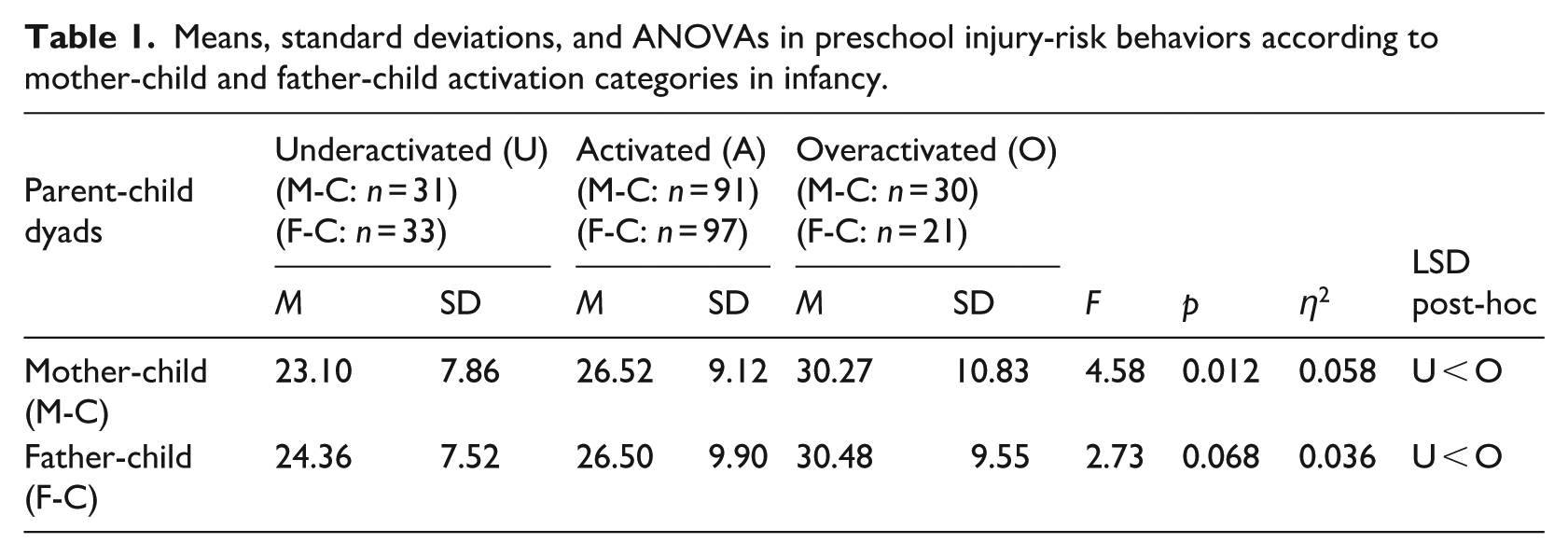
Risk-taking means varied significantly according to mother-child activation categories in infancy, and marginally for father-child activation categories (Table 1). Both had medium effect sizes (ƞ2: Cohen, 1992). LSD Post hoc tests (p < 0.05) showed that children overactivated with their parent in infancy had a higher mean preschool risk-taking score than underactivated children.
Means, standard deviations, and ANOVAs in preschool injury-risk behaviors according to mother-child and father-child activation categories in infancy.
Moreover, risk-taking means varied significantly according to preschool mother-child and father-child activation categories (Table 2). The effect size (ƞ2) was medium for the mother-child activation relationship and large for the father-child activation relationship (Cohen, 1992). LSD post hoc tests (p < 0.05) showed that children who were underactivated with their mother took fewer risks than those in the other two categories, but there was no difference between the activated and overactivated children. In addition, LSD post hoc tests (p < 0.05) showed that children who were underactivated with their fathers took significantly fewer risks than activated children, who, in turn, took fewer risks than overactivated children.
Means, standard deviations, and ANOVAs in preschool injury-risk behaviors according to mother-child and father-child activation categories in preschool age.
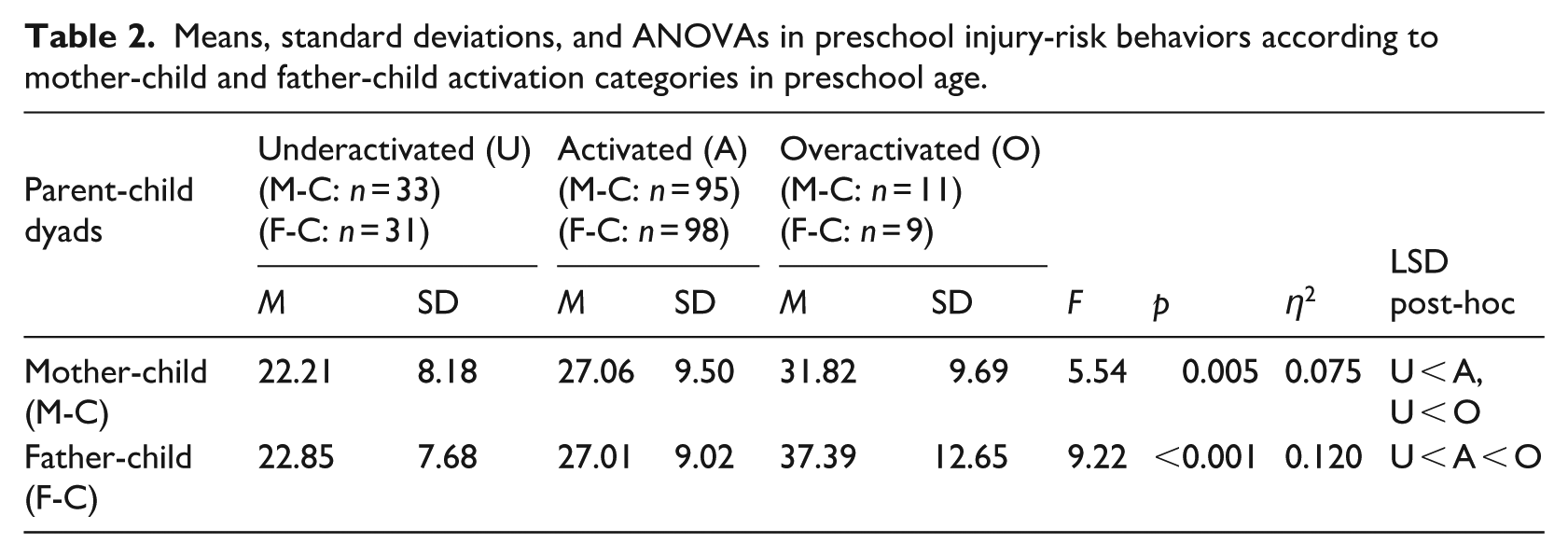
Table 3 presents the results of three linear regressions of father-child and mother-child overactivation to predict preschool children’s risk-taking: one for all children, one for boys and one for girls. Z-score variables were used in the regressions. By controlling for father-child and mother-child overactivation at T1, Step 2 shows that mother-child overactivation at T1 and father-child and mother-child overactivation at T2 predicted boys’ risk-taking, but not girls’ risk-taking. The model’s explained variance (adjusted r-square) is 20.8% for all children, 33.9% for boys, and 2.6% for girls. In summary, the preschool-aged boys engaged in more risk-taking when they had been overactivated with the mother since infancy, and when overactivated with both parents during preschool.
Multiple regressions of overactivation scores on the child’s injury-risk behaviors in preschool.
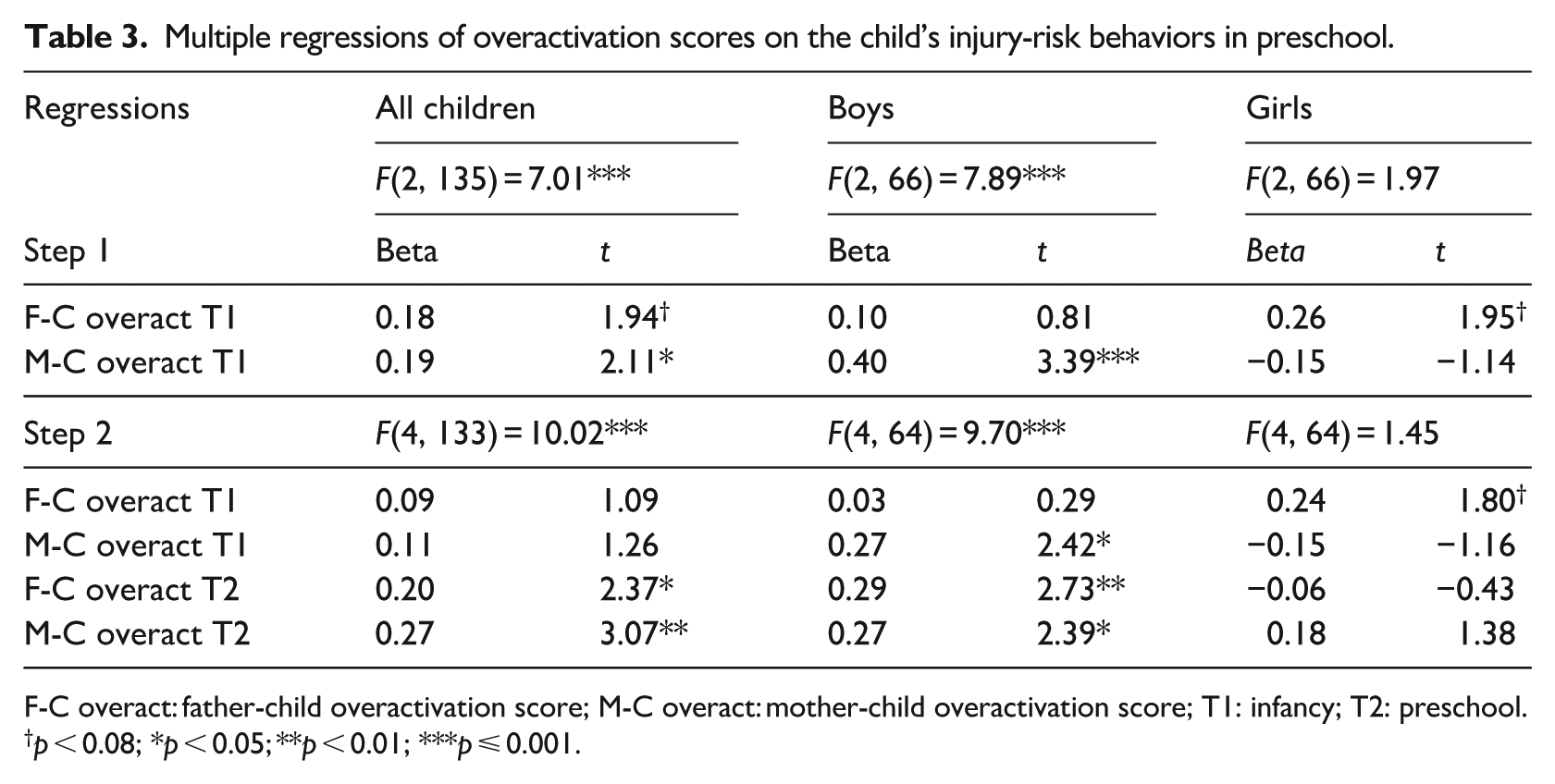
F-C overact: father-child overactivation score; M-C overact: mother-child overactivation score; T1: infancy; T2: preschool.
p < 0.08; *p < 0.05; **p < 0.01; ***p ⩽ 0.001.
Table 4 presents the results of three linear regressions of father-child and mother-child underactivation to predict preschool children’s risk-taking: one for all children, one for boys and one for girls. Z-score variables were used in the regressions. By controlling for mother-child and father-child underactivation at T1, Step 2 shows that mother-child underactivation at T1 and T2 predicted boys’ risk taking, but not girls’ risk-taking. The model’s explained variance is 18.7% for all children, 26.9% for boys, and 2.1% for girls. In summary, preschool-aged boys engaged in more risk-taking, when they had been underactivated with the mother since infancy.
Multiple regressions of underactivation scores on the child’s injury-risk behaviors in preschool.
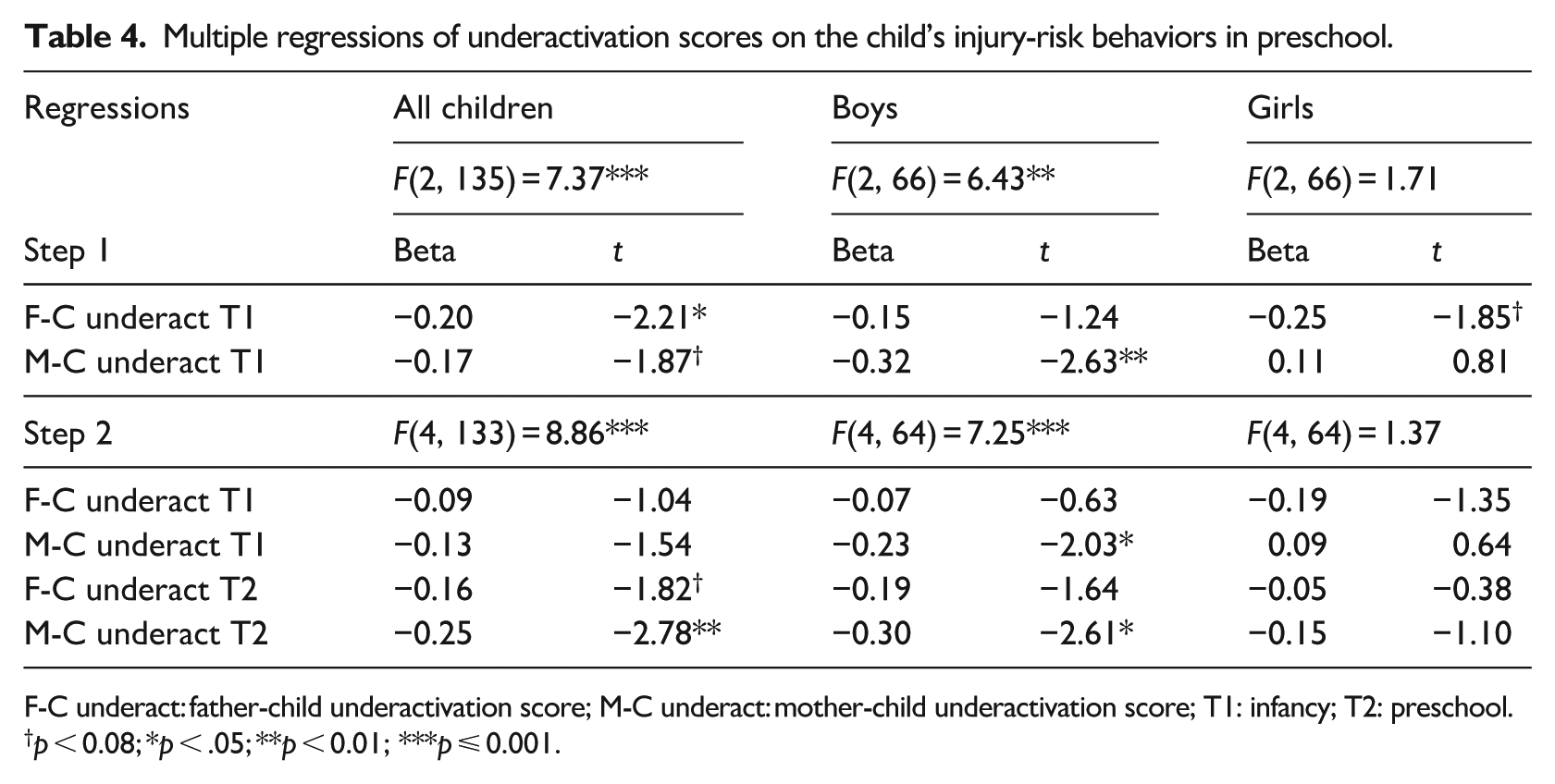
F-C underact: father-child underactivation score; M-C underact: mother-child underactivation score; T1: infancy; T2: preschool.
p < 0.08; *p < .05; **p < 0.01; ***p ⩽ 0.001.
Discussion
The first hypothesis was supported, namely that the father-child activation relationship during preschool had a greater effect on children’s risk-taking than the father-child activation relationship during infancy and the mother-child activation relationship during preschool. While the effect size was relatively stable between infancy and preschool among mother-child dyads (0.058 and 0.075, respectively), it increases among father-child dyads (0.036 and 0.120, respectively). However, it cannot be determined whether this is because children are more sensitive to the relationship with their father during preschool or because fathers stimulate their child’s openness to the world more during preschool years than during infancy.
This important role of fathers supports the findings of a qualitative study by Brussoni et al. (2013) with 16 fathers of children (aged 2–7). These researchers analyzed the father’s narrative relating to photos concerning activities they enjoyed with their children and concerns regarding child safety. Their results showed that most men viewed encouraging risk-taking and providing protection as key to their children’s development. Many of the fathers reported that the presence of an emotional connection to their children allowed them to gage optimal levels of risk and protection (Brussoni et al., 2013). Some studies have also shown that infants whose fathers are highly involved at home sustain fewer injuries than infants whose fathers are less involved (Fujiwara et al., 2010; Schwebel and Brezausek, 2004). According to some other authors (Kromelow et al., 1990; Paquette, 2004), fathers act as catalysts for risk-taking, in the sense that when the infant encounters novelty, the father encourages initiative, exploration, venturing into the unknown, testing themselves against obstacles, being bold in the presence of others, and being assertive with others.
In this study, the effect size (0.12) of the father-preschooler activation relationship on preschoolers’ injury-risk behaviors in the current study is larger than the effect size (0.04) of the father-infant activation relationship on toddlers’ injury-risk behaviors, as found by Paquette et al. (2023a), suggesting a greater activation role for fathers over time. The effect of the mother-child activation relationship seems to persist throughout childhood, but not to the detriment of the father’s increasingly important role.
The results of our current longitudinal study indicate that the mother-child activation relationship during both infancy and preschool predicts children’s risk-taking during preschool, while only the father-child activation relationship during preschool predicts risk-taking at the same age (after controlling for parent-child activation relationships during infancy). It could be that the mother is the primary activating figure during the child’s first years of life—a role that may be gradually assumed by the father later on. In most primate species, mothers raise their young by themselves, and children are mainly socialized through interactions with the mother first, and then with peers, especially during RTP. Mothers are therefore both the primary attachment and the primary activation figure for infants. Like many primate mothers, human mothers serve as their newborns’ first playmate (activation function) during the first year of life, engaging in mild touch, such as tickling (Palagi, 2018).
The second hypothesis was also supported: Both the father-child and mother-child activation relationships during preschool were greater predictors of boys’ risk-taking than of girls’ risk-taking. The higher the mother-child or father-child overactivation scores in preschool, the greater the risk-taking behavior of boys (after controlling for overactivation scores in infancy). Moreover, the preschool activation relationship had no significant effect on girls’ risk-taking. Given that overactivation is associated with a lack of discipline (Paquette and Bigras, 2010), the results suggest that when mothers or fathers neglect to exert control during exploration, boys tend to take greater risks. The more difficulty a parent has in controlling a boy’s behavior, the more the boy will engage in risk-taking. However, as is the case with RTP (see Feldman and Shaw, 2021), the quality of the activation relationship depends on the parent balancing their encouragement of risk-taking with moderate levels of control in an approach that supports children’s exploration while protecting them from harm.
The father-child activation relationship at T1 had marginal effects on girls’ risk-taking. On the one hand, the father-daughter overactivation scores at T1 predicted slightly more risk-taking in girls. On the other hand, the father-daughter underactivation scores at T1 predicted slightly less risk-taking among girls. However, there are significant associations between mother-child underactivation at T1 and T2 and risk-taking in boys: the higher the underactivation scores at T1 and T2, the lower the risk-taking in boys. All in all, the mother-child activation relationship during infancy had a greater effect on boys than on girls, while the father-child activation relationship during infancy tended to have a greater effect on girls. Given that underactivation is associated with parental overprotection (Paquette and Bigras, 2010), the results suggest that during infancy mothers overprotect boys, while fathers overprotect girls.
Our most important finding is that mother-son and father-son overactivation explains the link with preschool risk-taking. Overactivation develops between a child and their parent when the latter fails to intervene or intervenes inappropriately (e.g. by providing too much stimulation), or neglects to supervise the child and set limits on their exploration. Paquette et al. (2023a) had found that mother-infant overactivation, rather than father-infant overactivation, was associated with greater risk-taking in boys during toddlerhood. Our study shows that both mother-preschooler and father-preschooler overactivation predict greater risk-taking in boys during the preschool years. Boys are known to be more active than girls (Campbell and Eaton, 1999). They also tend to approach unfamiliar objects more frequently (see Geary, 2010), and engage in physical competition more often and more vigorously (physical aggression and RTP: see Geary, 2010). However, they are also more non-compliant with authority (Morrongiello and Dawber, 1998). The meta-analysis by Else-Quest et al. (2006) showed significant sex differences in temperament in young children, namely a higher average effect size in boys for the “surgency” factor (activity level, impulsivity, and pleasure associated with high-intensity stimuli), and a higher effect size in girls for the “effortful control” factor (sustained attention, inhibitory control, and pleasure associated with low-intensity stimuli).
Our study highlights that a child’s emotional bond with their parent plays a significant role in the child’s acceptance of the parental limits. In this convenience sample, the parent-child overactivated relationship (reflecting an imbalance between risk-taking stimulation and limit-setting by the parent) was prevalent in only 7%–8% of the preschool children (15%–20% in infancy). This means that the vast majority of parents (70% exhibited a parent-child activated relationship) succeeded in effectively supervising their preschooler’s exploration, not by forbidding risk-taking but by allowing it within certain limits, most likely depending on their child’s characteristics. In our opinion, to be effective, parenting practices (supervision, discipline, etc.) must be supported by an affective bond with the parent. Children feel secure and develop this relationship of trust with their parents when the latter encourage them to explore their environment while setting appropriate limits. In our view, parents should invest time in exploration starting in infancy, as soon as the child is able to get around on all fours. Of course, infants cannot be expected to obey instructions the first time a parent is unable to provide supervision and forbids the child from approaching something risky. The infant will repeatedly return to a risky situation, but if the parent consistently enforces the interdiction by removing the infant, the child will gradually come to accept parental authority. During the RS with children aged 12–18 months, in episode 6 (in which the parent forbids their child to climb a staircase for 3 minutes), it was easy to identify parents who had already begun to discipline their child at home: Their children were increasingly reluctant to return to the staircase, and a progression toward obedience could be observed.
Like attachment, the parent-child activation relationship is considered by evolutionary perspectives as a proximate mechanism (Paquette, 2015). The result of natural selection, a proximate mechanism promotes the survival and reproduction of individuals. This mechanism allows biologically predisposed risk-taking variations in children to change in response to their environment (Paquette et al., 2020; Paquette and StGeorge, 2023). It is essential that children take risks to develop skills and build their confidence to explore (Murray and Williams, 2020). According to the activation relationship theory (Paquette, 2015), fathers help boys learn to regulate risk-taking and develop territory exploration skills so they can obtain resources and develop skills for intrasexual competition. A child’s overactivation becomes adaptive in a setting fraught with competition over immediate access to unpredictable resources; this child will be inclined to take greater risks to capture as many resources as possible in the short term (Paquette, 2015). According to this theory, overactivated children will tend to use aggression and engage in other antisocial behaviors regardless of the context, and will strive for high social dominance status to maximize immediate access to resources (Paquette et al., 2020). Thus, this profile will mostly manifest in boys (Paquette et al., 2020): in our sample, boys made up 75% of the children overactivated with the mother and 82% of the children overactivated with the father.
While the activated profile is adaptive in the context of sufficient and stable resources, the underactivation profile is adaptive in a dangerous social or physical environment (Paquette et al., 2020). This danger may be real or merely perceived by the parents. For example, an underactivated profile resulting from parent overprotection could be due to the interaction dynamics particular to smaller families, which are common in contemporary Western societies and to the media’s overrepresentation of various dangers (Paquette et al., 2020).
Strengths and limitations
This study benefited from a relatively large sample size, with roughly equal numbers of fathers and mothers from intact families. Its innovation lies in its use of a longitudinal design to assess the effect of mother-child and father-child activation relationships on preschool children’s injury-related risk-taking, rather than focusing on the role of parenting practices.
Our study’s main limitation is that its results cannot be generalized, as the parents in our sample have higher incomes and education levels than the general population’s average; lower socioeconomic status is known to increase the risk of unintentional injury (Kim et al., 2007; Schwebel and Brezausek, 2004). Greater sociodemographic variability could reveal a stronger association between the parent-child activation relationship and the risk-taking behavior of children. The lack of variability in our study could explain why sociodemographic variables were not associated with preschoolers’ risk-taking (including the children’s sex, which is generally associated with risk-taking). However, it is worth noting that Paquette et al. (2023a) found significantly more risk-taking in boys than in girls in toddlerhood (24–30 months) with the same sample. The closing of the gap between boys and girls over time could be explained by the significant decrease in mother-child and father-child overactivation scores between infancy and preschool. This decrease in overactivation could indicate that while boys typically require more supervision, parents have less difficulty controlling their children over time.
Given that aggressive behaviors and unintentional injuries are positively correlated and share common risk factors (see van Aken et al., 2007), it will be crucial to include families living in resource-poor or dangerous environments in future studies examining the association between the activation relationship and physical and social risk-taking. In addition, it would be interesting to investigate whether fathers assume a greater role as their children grow older and increasingly explore their physical and social environment during primary school and into adolescence, when they become exposed to other forms of risk-taking such as delinquency, violence, drug use, extreme sports and sexual activity.
Children who are overactivated with their parents should have access to intervention programs to help them avoid serious and even fatal injuries resulting from risky explorations of their physical environment. However, it is also important to intervene with children who are underactivated with their parents, as they outnumber overactivated children by a ratio of 3 to 1 (21%–23% of underactivated infants and preschoolers). Our results indicate that boys’ risk-taking during preschool is linked to high mother-child overactivation scores and to low mother-child underactivation scores beginning in infancy, but only to high father-child overactivation scores during preschool. Therefore, boys take more risks during exploration in the presence of a mother who is not overprotective or who does not set limits. Overprotected children end up exploring very little, exhibit a high level of insecurity about their environment, and are at greater risk of developing anxiety issues (Gaumon et al., 2016).
Footnotes
Acknowledgements
We thank the parents and children for their participation, the students for collecting and coding the data, and the three coordinators who successively planned the entire project, namely Jessica Vaillancourt, Jessica Vandystadt and Nathalie Dumas.

Ethical considerations
The project was approved by the university’s ethics committee (CERAS-2014-15-121-P).
Consent to participate
All the participants signed a consent form for their participation and that of their child.
Consent for publication
Consent for publication is not applicable to this article as it does not contain any identifiable data.
Author contributions
Daniel Paquette supervised the data collection, carried out the analyzes and wrote the article. Julio Macario de Medeiros participated in the data analysis and writing of the article. Sophie Couture, Marc Bigras and Jean-Pascal Lemelin participated in data collection and revised the article.
Funding
The authors disclosed receipt of the following financial support for the research, authorship, and/or publication of this article: This study was supported by a grant from the Social Sciences and Humanities Research Council of Canada, number 435-2014-0448.
Declaration of conflicting interests
The authors declared no potential conflicts of interest with respect to the research, authorship, and/or publication of this article.
Data availability statement
The datasets generated during and/or analyzed during the current study are available from the corresponding author on reasonable request.