



Abstract
Women in midlife (ages 40–60) experience unique risk for cardiovascular disease, in part due to insufficient physical activity (PA). Although social comparison can motivate PA, how best to harness this process is unclear. The Identification/Contrast Model proposes a useful framework but has not been tested in real time. We tested this model among 88 women (mean age = 51.6 years, mean BMI = 31.9 kg/m2) who viewed comparison targets via personalized and adaptive peer profiles, once per day for 7 days. They also wore PA monitors, responded to profiles in real time, and completed subsequent qualitative interviews. Results from multilevel models support the Identification/Contrast Model for upward comparison, though responses to downward comparison were complex; narrative feedback highlighted the benefits of affiliative responses. Findings demonstrate within-person variability in comparison response that is often overlooked and support the utility of the Identification/Contrast Model for improving the use of comparison processes to promote PA.
Keywords
Introduction
Cardiovascular disease (CVD) remains the leading cause of death worldwide, and risk for CVD is uniquely elevated for women in midlife (ages 40–60; Barinas-Mitchell et al., 2020; Kase et al., 2020). Women decrease physical activity (PA) during midlife whereas men maintain their PA (Finkel et al., 2018), which contributes to women’s unique risk; consequently, PA is a key focus of health promotion for this group (Arigo et al., 2022c). Women face competing priorities such as child and elder care, work, and managing symptoms of menopause (Infurna et al., 2020; Maffei et al., 2019). Many women also receive minimal support for PA during midlife (Walsh and Simpson, 2020) and rarely have positive role models for PA, who could provide a sense of affiliation, motivation, confidence, or inspiration via processes such as social comparison (Rowland et al., 2018). For these reasons, social comparison is often used as an intervention technique to promote PA, both among women in midlife and more broadly (Williams and French, 2011; Zhang et al., 2016).
Social comparison, or self-evaluation relative to others, is a drive to understand ourselves in the context of our social environments (Festinger, 1954). It is an instinctive process that allows us to (1) determine whether we’re meeting valued social standards, and (2) adjust our behavior to achieve individual and shared goals (Gilbert et al., 1995). Comparison occurs on a range of dimensions such as status, performance, and health behaviors (Lakerveld et al., 2018; Wheeler and Miyake, 1992). Among women in midlife, comparisons occur in the midst of daily activities; comparisons of health status and behaviors (such as PA), abilities, wealth, and emotional responses to stress are common (Arigo et al., 2021; Terol Cantero et al., 2021), and the frequency of comparisons in women’s daily lives showed little change from before to during COVID-19 stay-at-home orders (Arigo, 2023). Thus, even when women had less face-to-face social interaction than usual during an unprecedented public health emergency, they continued to compare with others, via information communicated through social media, telephone and text message, and previous experiences (e.g. thoughts or memories about known others; Suls et al., 2002; Yue et al., 2022). The persistence of comparison under highly unusual and limited social conditions speaks to its importance and potential utility for women in midlife.
Yet, our scientific and public understanding of comparison is muddled by lack of nuance and contradictory messaging. Common sayings such as “comparison is the thief of joy” underlie suggestions to avoid or stop making comparisons. This is an impossible task, as comparisons are automatic (Gilbert et al., 1995) and are engineered into many aspects of daily life (e.g. social media, video games, professional performance evaluations), because they are known to affect behavior (Gerber et al., 2018). Comparison is neither inherently positive nor negative (Buunk et al., 1990; Gibbons and Buunk, 1999), including for women in midlife with CVD risk factors such as hypertension (Arigo et al., 2021). Evidence consistently shows that comparison is a source of information that can be useful or not, depending on the specific features of a comparison and its immediate context (Gerber et al., 2018). But the key determinants of a comparison’s consequences are not yet clear, limiting our ability to effectively address stigma against comparison or provide useful guidance for experiencing its benefits or minimizing its detriments. Additional investigation to identify the determinants of comparison response—particularly responses as they occur in real time (vs retrospective accounts)—are critical to these efforts.
The direction of a comparison is one factor that can influence response. Upward comparison (i.e. to someone perceived as doing better than the self) can offer inspiration and guidance for how to achieve a similar outcome. This is one reason that during midlife, highly active women are more likely to have a friend who is highly active (relative to less active women; Janssen et al., 2014). Conversely, downward comparison (i.e. to someone perceived as doing worse) highlights one’s own achievements, which can promote self-efficacy and motivation for continuing positive behaviors. Indeed, downward PA-based comparisons are positively associated with motivation to achieve PA goals (Diel and Hofmann, 2019). Among women in midlife with CVD risk factors and other groups with health concerns, however, comparisons are not always beneficial for PA (Arigo et al., 2015; Bennenbroek et al., 2002). Upward comparisons can highlight the comparer’s inferiority and thereby prompt discouragement (Van der Zee et al., 2000), which could decrease PA. For example, adults who make upward PA comparisons feel less need to be active and are less motivated to engage in PA than those who do not (Caltabiano and Ghafari, 2011). Downward comparison can also highlight the comparer’s current or future negative state, prompting discouragement about the possibility of improvement (Buunk et al., 1990). Thus, comparisons may be interpreted in ways that have positive or negative consequences for affective states, though little is known about the consistency of these responses or their proximal associations with health behaviors.
Buunk and Ybema (1997) introduced the Identification/Contrast Model to help explain heterogeneity in responses to comparisons. Upward identification, or focusing on similarities between the self and someone doing well, makes a better-off status seem achievable and should promote positive emotions such as hope and inspiration. Upward contrast involves focusing on differences between the self and someone doing well, creating distance from a positive outcome that should lead to negative emotions such as frustration and discouragement. Downward contrast involves focusing on differences between the self and someone doing poorly; this should promote positive emotions such as relief and satisfaction, and may activate empathy. Downward identification, or focusing on similarities with someone doing worse, makes a worse-off status seem likely and elicits negative emotions such as anxiety (see Van der Zee et al., 1998). These immediate cognitive and affective responses may represent the missing links between comparison experiences and PA outcomes.
The Identification/Contrast Model appears to accurately describe health comparisons among women with chronic illnesses (Corcoran et al., 2020; Terol Cantero et al., 2020). To date, however, this model has only been tested between-person, describing how people differ from each other (Arigo et al., 2020b). This approach assumes that comparison tendencies are stable, rather than experiences that vary with context: the use of global, retrospective self-report to assess identification and contrast requires respondents to aggregate over multiple comparison experiences (e.g. Van der Zee et al., 2000). Although this provides important information, using it in isolation introduces retrospective recall biases and likely masks important distinctions between comparison contexts. It also does little to reveal how people respond to comparison in real time, which could be useful for understanding whether the Identification/Contrast Model explains what happens when people make comparisons.
One recent study used ecological momentary assessment among women in midlife with CVD risk factors, capturing reports of women’s comparison experiences every 3–4 hours (Baga et al., 2024). Findings showed that, across comparison dimensions (e.g. abilities, health behaviors), women can differentiate their own identification and contrast and that these cognitive experiences vary within-person. Further, reports of recent comparison experiences (i.e. in the past few hours) follow the Identification/Contrast Model, with the exception of downward identification: women were likely to experience both negative and positive affect after these comparisons. As noted, comparison processes are already activated as behavior change techniques in many health promotion interventions for women midlife, including those to increase PA (Arigo et al., 2022c; Terol Cantero et al., 2021). In particular, forming PA partnerships between women in this population is a promising avenue for intervention (Arigo, 2015). In addition to providing social support, partners serve as relevant comparison targets who can motivate each other through identification and contrast, outside of intervention sessions with a trained facilitator. To date, however, it is not clear how women in this population might respond to comparisons in the context of a PA intervention that provides ample opportunity for social comparison with a relevant target.
For these reasons, information about real-time responses (in addition to that of recent responses; cf. Baga et al., 2024) is critical to the effective deployment of comparisons and avoiding those that may have iatrogenic effects—in the context of PA partnerships and more broadly. Further, it is not clear whether experiencing positive or negative affect in response to comparison is associated with PA behavior. Progress toward clarifying the potential pathway(s) linking comparisons to PA behavior (e.g. via identification/contrast and affective responses) is essential to improving PA promotion efforts. A useful test of Identification/Contrast Model in real time would also constrain the comparison dimension (PA) and target options (to those highly relevant to the population of interest), to enable equitable evaluation across comparison directions and responses. In the present study, we promoted these conditions with a proprietary web application (app) that allowed users to select and receive information about PA-based comparison targets, presented as profiles of peers who represented potential PA partners. Targets were personalized (to match women’s self-identified age and racial/ethnic background) and adaptive (to be within a range of the participant’s own PA from the previous day; Arigo et al., 2023b). Participants viewed one comparison target each day for seven consecutive days and responded in real time to each target; they also wore a PA monitor on these days. Finally, they completed an exit interview to reflect on their experiences. Our first aim was to determine the extent to which identification, contrast, and affective responses (positive and negative) varied within-person across days of target selection and exposure. We expected considerable within-person variability in each aspect of comparison, but minimal within-person association between identification and contrast and between positive and negative affect.
Our second and primary aim was to test the predictions of the Identification/Contrast Model for explaining affective responses to comparisons, in real time. As the model does not make predictions about lateral targets (i.e. to those perceived as at the same level as the self), responses to these targets are not included. We expected positive affect to be stronger (and negative affect to be weaker) at times when participants (1) identified more (vs less) with upward targets, and (2) identified less (vs more) against downward targets. Similarly, we expected negative affect to be stronger (and positive affect to be weaker) at times when participants (1) identified more (vs less) with downward targets, and (2) contrasted less (vs more) against upward targets. To offer context for real-time responses, we provide quotations from end-of-study exit interviews that reflect identification and contrast. As this study is an initial step toward understanding how the Identification/Contrast Model works in real time, we conducted content analysis on data from this retrospective interview (rather than more in-depth analysis) and did not engage in integration (which is a unique feature of mixed methods work and was not the design of the present study; Creswell and Clark, 2017). Finally, we tested identification, contrast, and affective responses to comparison targets as predictors of PA behavior (i.e. steps per day) in an exploratory manner.
Methods
Participants
Women ages 40–60 were eligible if they had at least one CVD risk factor (i.e. currently smoking or quit within the last 3 months, physician diagnosis of prediabetes/type 2 diabetes, prehypertension/hypertension, high cholesterol, or metabolic syndrome), were fluent in English, and had an internet-connected device (i.e. computer, smartphone, or tablet for using the web application each day). Women were recruited from a database of previous participants, via email announcements to the supporting institution, and via social media. A CONSORT flowchart of recruitment and enrollment appears in Supplemental Materials. A total of 89 women were screened as eligible and enrolled. One withdrew before completing any daily tasks and is not included in analyses. An additional participant withdrew after 2 days of completing web app use and her completed days are included in qualitative analyses (N = 88, mean age = 51.6, mean BMI = 31.9 kg/m2). The largest subsets identified as white (66.7%) and postmenopausal (39.8%); 54.6% reported regularly providing childcare and 13.8% reported providing other care (e.g. to a partner, parent, etc.). See Table 1 for additional demographic information.
Participant demographics (N = 88).
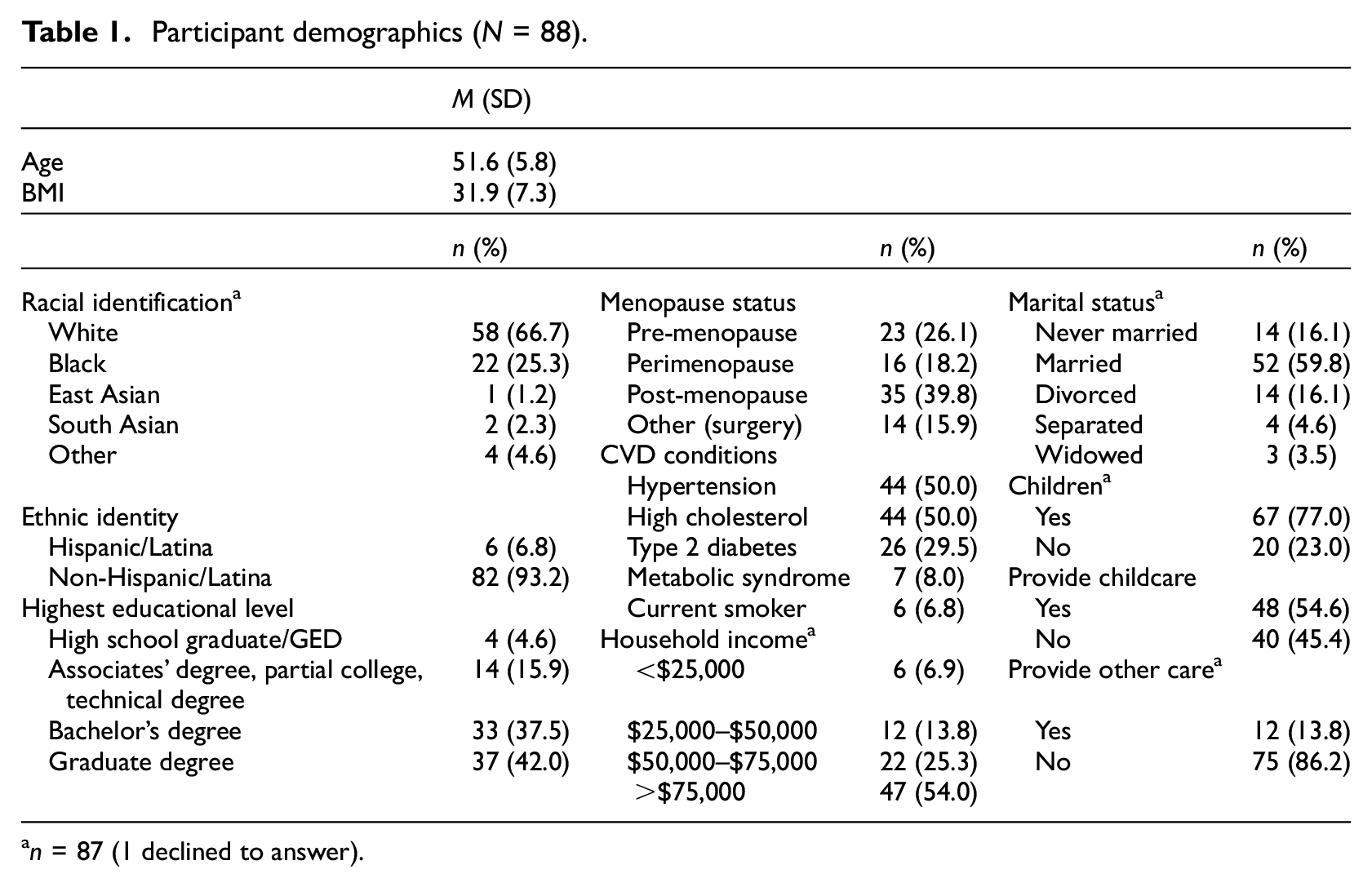
n = 87 (1 declined to answer).
Measures
Participants used a study-issued pedometer with an embedded accelerometer (Accusplit AX2720MV; 46/88, 52%) or their own personal PA monitor (e.g. Fitbit, Apple Watch; 42/88, 48%) to record their PA behavior in steps per day. Their use of our proprietary web app occurred at the start of each day and involved selecting a peer profile to view (Arigo et al., 2022b). Profiles were described as opportunities to learn more about how other women manage PA and to consider potential PA partners, to inform future intervention efforts. Specifically, participants chose to view a profile of another woman in midlife with elevated CVD risk; they selected from the options Very active (upward comparison targets), Somewhat active (lateral targets), or Not very active (downward targets; see Supplemental Materials). A fourth option, No preference—choose for me, generated a peer profile from the category they viewed least recently. Profiles were personalized for each participant, to be similar to them in age and racial/ethnic background. Peers’ typical PA was also adapted to display steps per day based on the participant’s own PA from the previous day. Participants who selected Very active (upward) profiles saw a peer whose steps were 130% of the participant’s from the previous day, Somewhat active (lateral) profiles showed 95%–105% of the participant’s steps from the previous day, and Not very active (downward) profiles showed 68% of the participant’s steps from the previous day. Participants were not informed that peer profiles were personalized or adaptive; their profile selections were recorded by the web app in real time.
After viewing the profile, participants chose the perceived direction of comparison (i.e. how the peer was doing with PA relative to them), with the stem Seemed to be doing: Much worse than I am, A little worse than I am (both downward at different scales, or distances from the user), About the same as I am (lateral), A little better than I am, Much better than I am (both upward at different scales). Identification, contrast, and positive and negative affect were then assessed with individual items, which were based on a validated measure of the Identification/Contrast Model (Van der Zee et al., 2000). Participants rated the extent to which they focused on similarities with the peer as they read the profile (identification), the extent to which they focused on differences from this peer (contrast), to what extent they “feel inspired, confident, or hopeful about (their) own physical activity” (positive affect) and “feel disappointed, anxious, or upset about (their) own physical activity” (negative affect). Each item used a 5-point response scale: Not at all (0), A little bit (1), Somewhat (2), Quite a bit (3), or Very much (4).
Procedures
Procedures were approved by the relevant Institutional Review Board and all participants provided written documentation of consent. Women who expressed interest were asked to complete a brief survey and subsequent phone call to assess eligibility; those who were eligible and remained interested scheduled an orientation session. Women who requested a study-issued pedometer (n = 46, 52%) were sent a device via U.S. mail. Research staff conducted orientation sessions via Zoom, where they introduced study requirements and invited questions. Participants received a written list of instructions and scheduled exit interviews to follow their daily participation. For the next seven consecutive days, participants used the web app in the morning before starting their daily activities. They wore the study-issued pedometer or their own activity monitor to capture their step count; end-of-day step totals were entered into the web app by research staff prior to the participant’s next use, to inform activity totals presented in peer profiles (i.e. adapted to align with participants’ recent PA behavior). Participants completed a subsequent semi-structured exit interview. For the first 27 participants, this interview was 60 minutes long and was recorded and transcribed verbatim. For the remaining 61 participants, the interview was abbreviated to 15 minutes and interviewers took detailed notes that included direct quotations. Interviews were designed to understand women’s responses to potential PA partners and both interviewers and coders were trained to identify PA-based social comparisons with profiled peers. Finally, participants were invited to ask questions and were compensated up to $50 via electronic debit cards.
Data analysis
Participants (N = 88) completed 532 days of web app use, affording 532 quantitative observations. Analyses were conducted in SAS 9.4 using multilevel modeling with days nested in participants. Models employed PROC MIXED with restricted maximum likelihood estimation. We first calculated descriptives for peer profile selections and exposures (intended comparison direction; categorical), perceived comparison direction, extent of identification and contrast, and intensity of positive and negative affect. We were particularly interested in differentiating between-person stability from within-person variability in these experiences, estimated using empty models to calculate intraclass correlation coefficients (ICCs; Aim 1). Next, we examined between- and within-person associations between identification, contrast, and affective responses (all treated as continuous).
Our primary aim was to test predictions based on the Identification/Contrast Model in real time (Aim 2). We tested hypotheses predicting positive and negative affect by each direction of comparison (viewed), with identification and contrast as continuous predictors. These separate models controlled for phase of data collection (i.e. full vs abbreviated interview), peer profile category (target direction) selected, and person-level average of the predictor of interest. Unlike many studies of within-person associations, we did not person-mean center predictors (cf. Curran and Bauer, 2011). Consistent with the Identification/Contrast Model, we were interested in within-person variability relative to the scale provided, rather than to a person’s own average. Use of person-mean centering in an exploratory manner did not provide meaningfully different results or conclusions from those reported below. Similarly, treating identification, contrast, and affective responses as binary predictors and outcomes (cf. Baga et al., 2024) did not generate meaningfully different results or conclusions. For these reasons, we present only the results of our hypothesis tests treating identification, contrast, and affective responses as continuous and using daily responses on the scale provided.
We conducted exploratory analyses to determine (1) whether the perceived (vs actual) direction of comparison showed different association with affect, and (2) whether any combination of identification, contrast, and affective response (captured in the morning each day) was associated with that day’s overall PA behavior. Findings did not differ between perceived and actual direction of comparison and are not reported here. Separately for upward and downward targets, we tested whether (1) the interaction between identification/contrast and affective response predicted steps, or (2) the interaction between positive and negative affective response predicted steps. These models controlled for phase of data collection, peer profile category (target direction) selected, and person averages of the cognitive and affective predictor(s) included. For all quantitative analyses, we report p-values but focus on effect sizes (expressed as semipartial correlation coefficients), with a threshold of sr > 0.10 indicating potential for meaningful patterns. For exploratory analyses, we also report differences in steps per day.
To supplement quantitative findings, we provide quotations from exit interviews that illustrate participants’ experiences with social comparisons on the web app. We conducted content-based coding and analysis to identify quotations that illustrate identification and contract processes (Prasad, 2008; Stemler, 2015). For 60-minute interviews, full transcripts were coded independently by two research assistants for comparisons and responses to the peers presented in web app profiles. For abbreviated interviews, this process was applied to interviewers’ detailed notes (which included quotations). All coding discrepancies were resolved by consensus. The authors each reviewed coded responses independently and nominated exemplar quotations; those included in this report were selected by consensus among the authors and are presented with quantitative findings, to provide additional context.
Results
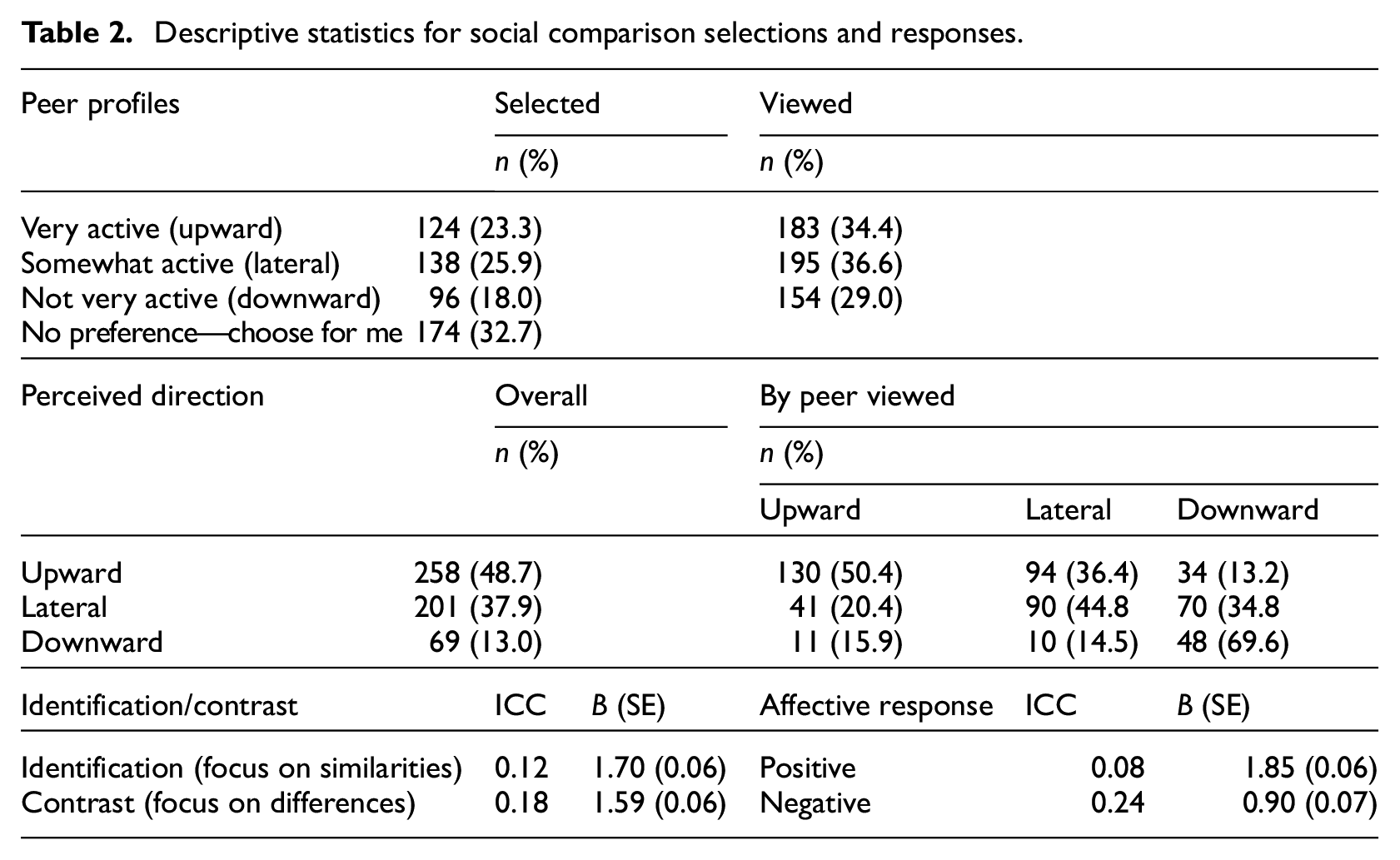
Across participants and days, the most popular comparison target (peer profile) selection was No preference—choose for me (32.7% of selections; see Table 2). The proportion of selections was similar for lateral and upward targets (25.9% and 23.3%, respectively), whereas downward comparisons were chosen less frequently (18.0%). As intended, however, the proportions of target directions for profiles viewed were more balanced (36.6%, 34.4%, 29.0%, respectively, reflecting distribution of No preference selections). Relative standing with respect to PA showed an interesting pattern: “very active” peers were perceived as upward targets 71% of the times they were viewed, “somewhat active” peers were perceived as lateral targets 46% of the times they were viewed, and “not very active” peers were perceived as downward targets 32% of the times they were viewed. Overall, peers were perceived as representing the intended direction of PA comparison on only 51% of the days they were viewed.
Descriptive statistics for social comparison selections and responses.
Exit interview responses offered explanations for this discrepancy. For upward targets (i.e. very active peers), some participants expected these peers to achieve or exceed recommended PA benchmarks:
• “I put one that was very active and I think the steps was only 9000. Was that considered very active? I was thinking someone that did 11,000 steps or more.” Black woman, age 52
As noted, the web app was designed to anchor peers’ PA to the user participant’s own PA from the previous day, to maximize potential relevance of the peer as a comparison target and minimize discouragement in response to upward targets. This design feature appeared to work as intended, as participants also reported:
• “Only one of them got in way more steps on an average day than I would have … It made me feel better. Because my perception was that … they weren’t doing significantly better than I was.” White woman, age 51
• “Seeing those people who were ‘very active’ and that [I was] similar to them with physical activity, that was a good feeling … I was like, wow, I’m not doing too bad.” Hispanic/Latina woman, age 58
Other participants demonstrated noteworthy insight into their cognitive processes. For instance, one participant explained that the details of the peers’ work and family life affected their perceptions of the peer’s PA achievement:
• “Their steps might have been low, but because they were working and/or caregiving, I perceived them as still being fairly active. So, it didn’t make me feel like they were so far beneath me.” White woman, age 44
In another instance, a participant reflected on her motivation for choosing lateral or upward targets, and linked her choice to judgments of how she might communicate with the target peer:
• “Most often I selected people that were close to where I was or a little bit above. I felt like I could make more comments, like I could give them more [than I could for less active peers].” Black woman, age 51
Aim 1: Comparison target responses
Across comparison target directions, ratings of identification, contrast, and positive affect showed less than 18% between-person stability across days (respective ICCs = 0.12, 0.17, 0.08). Although ratings of negative affect showed slightly more stability (ICC = 0.23), all ratings showed that the majority of variability was attributable to within-person fluctuation (and error). One woman described variability in response to upward targets as:
• “Some days I might have been motivated by it and some days I would have been discouraged by it. Some days I would probably be … a little more conscious about being active. And other days … I’ll be like I’m just gonna sit here.” Black woman, age 57
Controlling for the direction of the peer profile selected and the direction of the peer viewed, identification and contrast were positively associated between-person (F(1, 85) = 19.27, p < 0.0001, sr = 0.24). As expected, however, at the day level (controlling for between-person associations), the extent to which participants endorsed identification on the scale of 0–4 was not associated with the extent to which they endorsed contrast (F(1, 436) = 0.06, p = 0.81, sr = 0.14). Associations between positive and negative affect were not associated between- or within-person (ps > 0.50).
Of note, controlling for both the direction of the peer profile selected and the direction of the peer viewed, the only person-level association was between identification and negative affect: participants who endorsed greater identification across days also experienced stronger negative affect (F(1, 85) = 4.39, p = 0.04, sr = 0.15). However, identification was not associated with negative affect within-person, and contrast was not associated with positive affect within-person (ps > 0.30). Moreover, at times when participants endorsed greater identification (vs lesser on the scale provided), they experienced stronger positive affect (controlling for the opposite between-person association; F(1, 436) = 39.17, p < 0.0001, sr = 0.27). At times when they endorsed greater contrast (vs lesser on the scale provided), they experienced stronger negative affect (F(1, 436) = 29.27, p < 0.0001, sr = 0.25).
Aim 2: Testing the identification/contrast model in real time
Controlling for the peer profile category selected (as well as phase of data collection and the person-level average for identification), on days when participants viewed upward targets, the more they identified with the target (vs less), the more they experienced positive affect (F(1, 102) = 24.30, p < 0.0001, sr = 0.24). Conversely, the more they contrasted against upward targets (vs less), the more they experienced negative affect (F(1, 102) = 20.44, p < 0.0001, sr = 0.23) and the less they experienced positive affect (F(1, 102) = 2.17, p = 0.14, sr = 0.13; see Figure 1a and b as well as tables in Supplemental Materials). On days when participants viewed downward targets, the more they contrasted against the target, the more they experienced positive affect (F(1, 79) = 4.14, p = 0.05, sr = 0.15). These findings were consistent with predictions from the Identification/Contrast Model and participants’ narrative reflections provided additional support:
• “If they were a little bit ahead, that would help me [want to] catch up.” Black woman, age 55 (upward identification—positive affect)
• “Somebody who’s much more physically active would probably make me feel like I’m not doing well, like I would start looking at myself like okay, this really sucks.” White woman, age 50 (upward contrast—negative affect)
• “Somebody who is maybe very inactive … it’s a perception that they would not give me the encouragement that I needed.” White woman, age 48 (downward contrast—negative affect)
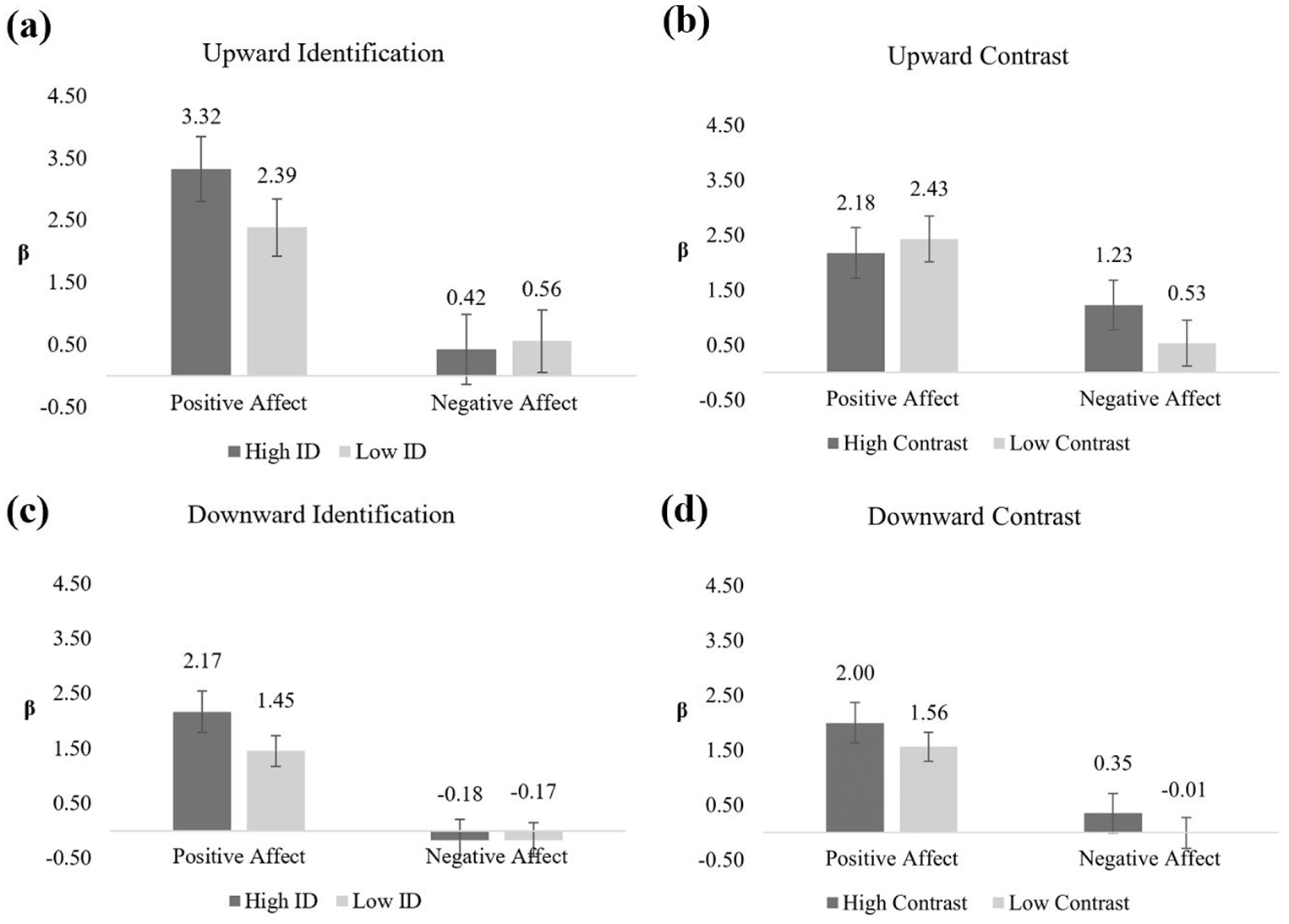
Difference in affect by identification (a, c) and contrast (b, d).
Some participants also described a change trend in their response to upward targets across days, which might indicate benefits of repeated exposure:
• “Someone who has way more steps [than] me might not have been very motivating for me in the beginning, but it was kind of cool to see that [later].” White woman, age 51 (shift from upward contrast to upward identification)
We also observed patterns that diverged from the Identification/Contrast Model. On days when participants viewed downward targets, the more they identified with the target, the more strongly they experienced positive affect (F(1, 79) = 13.24, p = 0.0005, sr = 0.21). The more they contrasted against a downward target, the more strongly they experienced both positive and negative affect (ps < 0.05, srs = 0.15; Figure 1c and d). The extent of identification with upward and downward targets was not associated with negative affect (ps > 0.48, srs < 0.10; see Supplemental Materials for a summary). During exit interviews, participants provided context for these experiences by indicating that they wanted to or did feel close to downward targets; in particular, they wanted to help these potential PA partners (which might also be helpful for motivating themselves). For example, participants stated:
• “I wanted to encourage them or help [people who were not very active], instead of them helping me … I want to hug everybody and say ‘oh it’s okay, come on.’” Black woman, age 57
• “I felt like I could be slightly better than them and I could still encourage them.” White woman, age 40
• “We could partner, and by pushing her I’d be pushing myself.” Black woman, age 51
Exploratory: Predicting physical activity behavior
Controlling for the direction of the peer profile selected, phase of data collection, and person-level averages of identification and positive affect (assessed at the start of the day), on days when participants viewed upward targets, they engaged in the most steps (at the end of the day) on days when they experienced greater identification and weaker positive affect (F(1, 85) = 4.88, p = 0.03, sr = 0.24; Figure 2a as well as tables in Supplemental Materials). Although no other combinations of identification, contrast, and affective response significantly predicted steps per day (for upward or downward targets; ps > 0.09), participants frequently achieved the most steps on days when they endorsed greater (vs lesser) cognitive engagement with the target (i.e. identification or contrast) and stronger (vs weaker) affective response (Figure 2). These distinctions corresponded to standardized effect sizes (srs) of 0.01–0.18, or within-person differences of 200–900 steps per day.

Difference in steps per day by identification (a–d)/contrast (e–h) and affect ratings.
Discussion
In this study, we used a proprietary web application to test predictions of the Identification/Contrast Model of social comparison, in real time during women’s daily lives. We also used women’s narrative descriptions of their experiences to understand how they processed comparison information that was individually personalized and adapted for them. This led to valuable insights and critical next steps for future work. First, the peers who represented comparison targets were perceived as intended only half of the times they were viewed. This could be because the web app did not remind users of their own steps from the previous day and did not rank their own PA against the peer target’s PA, which can increase the salience of PA-based comparisons (Arigo et al., 2020a). Participants may have used a comparison benchmark other than their most recent PA behavior, such as their personal PA goals or recommended levels of PA for health (e.g. 10,000 steps; U.S. Department of Health and Human Services, 2018), or could have adjusted their expectations in the context of selecting and responding to a potential PA partner. However, as intended, adaptation to the user’s own PA from the previous day appeared to avoid some (upward) comparisons that could be discouraging. For example, participants expressed surprise to see the “very active” peer’s PA as lower (and closer to their own) than expected, which they found encouraging.
Further, many misperceptions occurred for downward targets, which may reflect women minimizing their accomplishments relative to others (Baião et al., 2015), and/or overestimating the amount of PA necessary for cardiovascular health (Knox et al., 2013). Recent evidence shows that clinically meaningful cardiovascular benefits occur at 7500 steps per day (Hajna et al., 2018) and that increases in overall movement (vs structured exercise) can significantly improve health (Hamaya et al., 2024). Beliefs that more modest PA changes are insignificant may contribute to psychological rigidity (e.g. “all or nothing” thinking) and consequent failure to follow through on PA intentions when unexpected commitments arise, which occurs frequently for women in midlife with elevated CVD risk (Arigo et al., 2022a; Hendry et al., 2010). Interventions that promote psychological flexibility may be particularly powerful for supporting small but meaningful and sustainable changes in PA in this at-risk group (Jenkins et al., 2019; Pears and Sutton, 2021).
To date, few studies have examined identification and contrast processes within-person. Exceptions have examined related concepts such as assimilation (vs contrast) and perceived similarity (Arigo et al., 2020b), which were used as outcomes rather than predictors (cf. Locke and Nekich, 2000). One study showed that a related cognitive experience—the perceived attainability of a target’s status—mediates associations between upward appearance comparisons and body satisfaction among women (Fardouly et al., 2021). To our knowledge, the present study is one of only two that demonstrate within-person variability in identification, contrast, and affective responses to comparisons as outlined by the Identification/Contrast Model, and is the first to do so in real time. Positive and negative affect were not associated within-person and identification and contrast were positively associated, though weakly. This lends further support to the well-documented independence of positive and negative affect (Goldstein and Strube, 1994), and to the notion that identification and contrast are independent (Buunk and Ybema, 1997).
Global, between-person self-report measures based on the Identification/Contrast Model capture these processes using only affective response, and infer the cognitive components (i.e. identification and contrast). For example, the Identification/Contrast Scale (Van der Zee et al., 2000) uses items such as “When I see or think about others who are doing better than I am, I feel frustrated about my own situation,” where greater upward contrast is inferred from stronger (vs weaker) agreement. The current findings advance a growing body of evidence that people can report on the cognitive components of their comparison experience separately from affective responses, and that the cognitive components predict affective response (Arigo et al., 2015; Baga et al., 2024). Further, the observed day-to-day variability within-person in identification, contrast, and affective responses shows that responses to comparisons are highly variable for the same person across time, even when they consciously select their comparison target (vs cases where only one target is available; cf. Arigo et al., 2023a). With respect to measurement, this strongly suggests that identification and contrast are not (or not always) stable traits, and intensive assessment of how people process comparisons in the moment could reveal important contributors to the immediate and longer-term consequences of comparisons.
For example, although the between-person association between identification and negative affect was positive in the present study, the within-person association was negative. Thus, the person-level association suggests that identification is linked to negative outcomes (and should be avoided), whereas the within-person association suggests that identification has benefits (and should be encouraged; cf. Gentile et al., 2020). This distinction has valuable implications for intervention, as understanding the contributors and consequences when comparison opportunities are available could identify opportunities to improve the use of comparison as a behavior change technique (e.g. for matching PA partners or fostering beneficial comparisons in the context of a partnership). Future studies could test the effects of prompting identification to determine whether this addition improves positive affect (and/or minimizes negative affect) in response to PA-based comparisons. If effective, such efforts would promote a shift from negative to positive interpretations of comparisons (as participants’ narrative descriptions illustrate) and thereby reduce problematic disengagement from interventions in response to aversive experiences (Meyerowitz-Katz et al., 2020).
The present findings also confirm predictions from the Identification/Contrast model for upward comparisons: positive affect was stronger on days with more (vs less) identification and negative affect was stronger on days with more (vs less) contrast, with small to medium effect sizes. The picture for downward comparisons was more complex. Positive affect was stronger on days with more (vs less) contrast and days with more (vs less) identification, whereas negative affect was stronger on days with more (vs less) contrast. Thus, focusing on similarities with worse-off peers (or closeness to the target) was a positive experience, whereas focusing on differences from these peers (or distancing from the target) was mixed. Participants in the present study were asked to consider profiles of other women like them as opportunities to inform their own PA behavior and as potential partners in a PA promotion program. These contextual cues may have prompted both self-improvement and affiliation goals, respectively (Park and Park, 2017), though affiliation may have been more powerful. Yet, the associations between downward contrast and negative affect and between downward identification and positive affect are consistent with prior work among women in midlife with elevated CVD risk (Baga et al., 2024), which did not focus on comparisons to potential PA partners.
Thus, the overarching pattern is not unique to the present study’s partner-based framing, though it may be specific to the population of interest. These women are often overburdened by professional, financial, medical, and caregiving stressors and cite lack of positive peer influence as a challenge, including specific lack of role models for PA as a barrier to engagement (Hendry et al., 2010). They may seek opportunities for comparison or use available comparison opportunities in ways that promote a sense of closeness with others, rather than distance (Cohen and Lansing, 2022), more so than other groups. Of note, even in the context of a study that encouraged self-evaluations relative to similar others, women in midlife with elevated CVD risk showed no evidence of using comparison to denigrate others; on the contrary, they expressed empathy and attributed low PA engagement to peers’ circumstances (e.g. caregiving burden), rather than to personal choice or character. This tendency underscores that comparisons are not inherently negative or judgmental (cf. Gibbons and Buunk, 1999). Given that not all comparison opportunities in this and previous studies resulted in positive outcomes for affect, however, further encouraging affiliative responses to comparison among women in midlife could have immediate and longer-term benefits for women’s physical and mental health (Uchino et al., 2018).
Findings also suggest that identification and contrast processes have implications for PA behavior. It is not yet clear whether experiencing positive versus negative affect as a result of comparisons leads to behavior change. For example, the Identification/Contrast Model proposes that upward identification should inspire and motivate goal-directed behavior, in part due to promoting self-efficacy for achieving a similar outcome. Yet, the positive affect associated with seeing oneself as capable of achieving improvements may not be enough; often, people are most motivated to make changes when they are dissatisfied with their current status (i.e. when they experience negative affect; Meier and Schäfer, 2018). Exploratory findings from the present study align with this idea: in response to upward targets, PA was greatest on days with higher (vs lower) identification and lower (vs higher) positive affect. An optimal combination of desire for change and confidence in one’s ability to enact behavioral modifications might be most effective for change promotion, and the comparison experiences most likely to achieve this balance are likely to vary for the same person over time (and/or differ between people). Ongoing work to determine the pathway(s) activated for a given person and context will provide critical insights into both basic psychological processes and opportunities for effective PA intervention.
Personalized and adaptive digital interventions are uniquely suited to tailoring and adjusting over time, respectively, to address sources of variability and change in users’ comparison needs (Zhu et al., 2021). The web application used in the present study is a useful model, though it was not intended as a standalone intervention. Digital tools take time to learn a user’s patterns and a longer observation period is needed to determine the web app’s benefit for PA behavior, alone or in conjunction with other intervention techniques. The current study shows that this tool is useful for understanding women’s responses to personalized, adaptive, self-selected comparisons in the context of evaluating a potential PA partner. Yet, people choose targets for a variety of reasons, including those that seem self-defeating (e.g. confirming that their current situation is bad; Arigo et al., 2018), and not all self-selected comparisons lead to increased PA (Arigo et al., 2023a). Thus, self-selection of comparison targets may not result in maximum benefit for PA behavior; incorporating experimental methods to understand causal associations is an important next step.
To our knowledge, this study is the first to test the Identification/Contrast Model in real time and had several strengths. Assessment over multiple days allowed for examining within-person processes; these indicate what happens when users make comparisons and are more informative for tailoring digital and multi-session interventions than single observations. By treating identification, contrast, positive affect, and negative affect as unique, we were able to examine several distinct combinations of comparison selection and response. This afforded opportunities to determine deviations from predictions of the Identification/Contrast Model. Notably, women experienced more positive affect when they were more engaged with the target: stronger (vs weaker) identification and contrast were associated with greater positive and less negative affect, suggesting that women in midlife with elevated CVD risk may benefit emotionally from engaging with information about women like them.
Our use of qualitative interviews also provided supplementary context for women’s responses to comparisons, in their own words. However, our primary purpose was to understand real-time responses to comparison opportunities. Our qualitative data were collected after a delay (i.e. not in real time) and represent an aggregate of participants’ experiences. Thus, our approach to analyzing qualitative data was limited to identifying content that aligned with the Identification/Contrast Model. As a result, there is considerable opportunity to use qualitative methods to better understand experiences of identification and contrast in the context of social comparison, among women in midlife with CVD risk and more broadly. Similarly, our use of device-assessed PA behavior provides preliminary evidence that identification and contrast processes are associated with behavioral outcomes for this population. Participants used a variety of PA monitoring devices, which has the potential to introduce significant noise. We did this to maximize familiarity with the device and minimize burden on participants, and we examined PA behavior in an exploratory manner. As our primary analyses were within-person, this feature of the study was unlikely to affect results or conclusions. In future work, however, using the same assessment tool across participants will be useful for increasing internal validity.
All participants were naive to the web application that showed peer profiles, though a subset were familiar with our research team from previous studies. This approach allowed us to demonstrate our commitment to the community of interest and purposively identify women with a range of experiences to contribute to the present study. And although our sample represented women with a range of backgrounds, our recruitment efforts attracted predominantly well-educated, affluent, white women, and the role of prior experience with a research team in this context is unclear. Future research to ensure broader representation among women in midlife with CVD risk is needed to investigate potential heterogeneity in experiences of identification and contrast within this group. Our approach also focused only on upward and downward comparisons, as only these are highlighted in the Identification/Contrast Model (Buunk and Ybema, 1997). Given the popularity of peer profiles that represent lateral targets among women in this study, it will be important to understand the affective consequences of these comparisons and their potential associations with PA behavior. The present study included only women ages 40–60 with one or more risk factors for CVD and focused on comparisons of PA behavior with potential PA partners. This maximized the feasibility of designing personalized comparison targets and allowed us to draw conclusions about a large, at-risk group for whom comparisons are common (Arigo, 2023). As these women may use comparisons differently than other groups, it is critical to understand to what extent the Identification/Contrast Model describes comparison experiences as they occur, in a much broader population and range of settings. Finally, understanding the mechanistic pathway(s) using formal tests of mediation (as well as experimental methods) will be paramount for improving interventions that activate social comparison processes, among women in midlife with elevated CVD and other populations.
Conclusions
The present study demonstrates that identification and contrast processes are indeed relevant to the immediate affective consequences of social comparisons in the context of PA in an at-risk group of women. For these women, upward comparison opportunities follow predictions from the Identification/Contrast Model. However, stronger (vs weaker) psychological engagement with comparison targets is linked to positive affect overall and may override negative responses to downward comparison opportunities. Additional work is needed to determine optimal pathway(s) for activating comparison processes to promote PA, among women in midlife with elevated CVD risk and more broadly.
Supplemental Material
sj-docx-1-hpq-10.1177_13591053251326629 – Supplemental material for Personalized and adaptive physical activity-based social comparison opportunities for women with health risks: Insights from a real-time test of the identification/contrast model
Supplemental material, sj-docx-1-hpq-10.1177_13591053251326629 for Personalized and adaptive physical activity-based social comparison opportunities for women with health risks: Insights from a real-time test of the identification/contrast model by Danielle Arigo, Iris Bercovitz, Anisha Satish, Emmanuel Lapitan, Amanda L Folk and Andrea F Lobo in Journal of Health Psychology
Footnotes
Data sharing statement
Data are available upon reasonable request to the corresponding author.
Declaration of conflicting interests
The authors declared no potential conflicts of interest with respect to the research, authorship, and/or publication of this article.
Funding
The authors disclosed receipt of the following financial support for the research, authorship, and/or publication of this article: This work was supported by the U.S. National Institutes of Health under award numbers K23 HL136657 and DP2 HL173837 (PI: Arigo).
Ethics approval
Studies included in the present report were approved by the Institutional Review Board at Rowan University under protocol PRO-422-2021.
Informed consent
All participants provided written documentation of consent to participate.

References
Supplementary Material
Please find the following supplemental material available below.
For Open Access articles published under a Creative Commons License, all supplemental material carries the same license as the article it is associated with.
For non-Open Access articles published, all supplemental material carries a non-exclusive license, and permission requests for re-use of supplemental material or any part of supplemental material shall be sent directly to the copyright owner as specified in the copyright notice associated with the article.
