



Abstract
The present study examined gender differences in attentional bias of body images. Using an experimental design, 58 young adults aged 18–29 years (mean age = 20.53) completed self-report measures of body satisfaction, eating pathology and trait appearance comparison before viewing whole body images of thin/muscular and large men/women through an eye tracker. After viewing the images, participants completed self-report measures of body satisfaction and state appearance comparison, BMI was also recorded. Results revealed that higher BMI was associated with reduced body satisfaction. Problematic eating attitudes were associated with greater engagement in appearance comparison, which was linked to lower levels of body satisfaction. Exposure to idealised body images negatively impacted individuals with lower body satisfaction leading to lower levels of body satisfaction post-experiment. Findings provide support for the positive association between body dissatisfaction and attentional bias to idealised bodies in both women and men in a Chinese context.
Body dissatisfaction is defined as a subjective, negative evaluation of an individual’s own body. Body image disturbance has been identified as a diagnostic feature of eating disorders (American Psychiatric Association [APA], 2013), and is a known risk factor in the development of eating disorders (Barakat et al., 2023). The prevalence of eating disorders around the globe has doubled in the space of less than two decades (Galmiche et al., 2019). Body dissatisfaction is associated with emotional eating, abnormal attitudes towards eating and weight, dieting and unhealthy weight control strategies (Bauer et al., 2017). One of the main factors attributed to this rise in body dissatisfaction and eating disorders is the explosion of social media over the last two decades. Modern ideals of beauty are reinforced through the media with depictions of unrealistic and digitally-altered images of narrow and rigid beauty ideals (Tiggemann et al., 2019). When exposed to media and social media, social comparisons in appearance can occur involuntarily. Thus, social comparison serves as a link between media exposure and body dissatisfaction, which can lead to negative outcomes (Gao et al., 2014; Jiotsa et al., 2021). The prevalence of eating disorders and body image concerns among Chinese populations is a growing health concern. The limited research conducted suggests comparable prevalence of eating disorders to other regions around the globe (Pike and Dunne, 2015; Thomas et al., 2016). However, much less is known about body image concerns in Chinese contexts. As such, the aim of the present study is to examine gender differences in attentional bias in a sample of young men and women in Hong Kong.
Body image concerns have long been considered an issue for women (Frederick et al., 2022). However, emerging research has demonstrated that body image concerns are a common issue in men (Campaign Against Living Miserably [CALM], 2021; Fasoli and Constantinou, 2024). Sociocultural factors are vital to understanding the rise in body dissatisfaction and eating disorders. Social interaction plays an important role in individual development; body dissatisfaction and eating disorders are a result of internalisation of the ever-increasing pressures placed on individuals to achieve contemporary body and beauty ideals. According to social comparison theory, individuals determine their own value and worth by comparing themselves to others in order to self-evaluate. Social comparisons often occur involuntarily with individuals comparing themselves to others along a variety of dimensions. Studies have shown that women who report body dissatisfaction tend to engage in upward social comparisons (Gao et al., 2014; Misener and Libben, 2020). However, much of the social comparison literature has focused on women and girls, with comparatively little research examining the issue in men and boys.
Increasing awareness of the negative impact of unrealistic body ideals has led to the emergence of the body positivity movement over the last decade. The body positivity movement aims to challenge idealised and unrealistic body image ideals by promoting a broader, more diverse and more inclusive appearance and body shape in the public eye and in social media (Cohen et al., 2021). However, the movement been criticised for what has been perceived as a paradox between the focus on body improvement and transformation versus the body positivity message of acceptance regardless of size and appearance (Griffin et al., 2022).
Adolescent girls are shown to have poorer body image than boys, with this body dissatisfaction developing across adolescence into adulthood (Wang et al., 2019). Visual attentional bias has been shown to play an important role during upward appearance comparisons (Cho and Lee, 2013; Gao et al., 2014). The way individuals pay attention to their own body and the bodies of others may impact the social comparison process. When engaging in an upward comparison, contrast effects may occur when individuals pay more attention to the thin ideal or muscular ideal images with parts of their own body they are dissatisfied with, this heightens the perceived attractiveness of the comparison target against the perceived unattractiveness of the individual’s own body. Thus, leading to increases in body dissatisfaction (Misener and Libben, 2020).
Previous research has observed gender differences in body image and body dissatisfaction (Kwag et al., 2021). Gender differences have been attributed to stronger sociocultural emphasis on thinness and greater significance of body image for women compared to men, emerging in childhood and adolescence (Frisén et al., 2015). A recent review of men and muscularity research revealed that studies are predominantly conducted in the West (Lennon and Johnson, 2021), and have found that exposure to muscular bodies is associated with lower body satisfaction among young men (Tiggemann and Anderberg, 2020). These findings are echoed in research conducted outside of Western contexts (Cho and Lee, 2013). Studies have observed an indirect relationship between frequency of viewing fitspiration posts on social media and impaired body satisfaction (Fatt et al., 2019). While recent experimental research has revealed a protective effect of intrinsic life goals on men’s body image (Ku et al., 2022).
Much of the literature on body image and body dissatisfaction has focused on female samples, and while much research has been conducted in Western contexts, there is a dearth of studies conducted outside of the West. Research has established that body image concerns are a global issue (Cho and Lee, 2013; Gao et al., 2014; Pike and Dunne, 2015; Rochelle and Wu, 2017). The prevalence of eating disorders and body image concerns among Chinese populations is a growing health concern (Ku et al., 2022; Pike and Dunne, 2015). While much literature exists examining the impact of upward comparison (Gao et al., 2014; Misener and Libben, 2020), there is little research examining the impact of downward comparison, the process of comparing oneself to someone perceived ‘lesser’ than oneself in some way (Shawcroft et al., 2023), and much less so in a Chinese context using a mixed gender sample.
The aim of the present study was to examine attentional bias in a sample of young adults in Hong Kong when exposed to different body types using an eye-tracker. Four types of body image were presented: female thin, female large, male muscular, male large. Attentional bias can be characterised by examining participants’ fixation times and fixation frequencies for each image presented (Cho and Lee, 2013; Eizenman et al., 2003). In line with previous studies, it was hypothesised that:
- H1: Lower body satisfaction will be associated with greater attentional bias (longer gaze duration and frequency) towards idealised bodies relative to other body image types presented, compared to those with higher levels of body satisfaction.
- H2: Exposure to idealised body images will negatively impact those individuals with lower body satisfaction, leading to lower levels of body satisfaction post-experiment, compared to pre-experiment.
Methods
Participants
A total of 58 participants, comprising 41 women aged 18–29 years (mean age = 20.09, SD = 2.96, mean BMI = 20.09, SD = 2.06) and 17 men aged 18–27 years (mean age = 21.38, SD = 2.89, mean BMI = 22.08, SD = 3.72) were recruited to the study. Following ethics approval, participants were recruited through adverts posted on a university campus in Hong Kong during a 3-month period in early 2022.
Materials
Eating pathology: The Eating Attitudes Test-26 (EAT-26; Garner et al., 1982) was used to measure eating pathology. The EAT-26 is a commonly used scale measuring eating behaviours and attitudes on a 6-point scale (0 = Never to 5 = Always). Example items include: ‘Am terrified of being overweight’. Higher scores indicate greater level of pathology, specifically, a score of 20 or above indicates a high level of concern about dieting, weight or problematic eating.
Trait appearance comparison (TAC): The revised Physical Appearance Comparison Scale (PACS-R; Schaefer and Thompson, 2014) was used to measure participants’ levels of social comparison of appearance. The PACS-R contains 11 items rated on a 5-point scale (0 = Never to 4 = Always). Example items include: ‘When I’m out in public, I compare my physical appearance to the appearance of others’. Higher scores indicate greater engagement in appearance comparison.
Social media comparison (SMC): Three items from the Physical Appearance Comparison Scale (PACS; Thompson et al., 1991), adapted by Fardouly and Vartanian (2015) were used to measure social media comparison tendencies. Example items include: ‘When using social media, I compare my appearance to the appearance of others’. Items are measured on a 5-point scale (0 = Never to 4 = Always). Higher scores indicate greater engagement in social media comparisons.
State appearance comparison (SAC): The State Appearance Comparison Scale (Tiggemann and McGill, 2004) was used to measure participants’ state appearance comparison levels. The scale consists of three items measured on a 7-point scale (1 = None to 7 = A lot). Example items include: ‘Extent to which you have thought about your own appearance since viewing the images on the eye-tracker’. Higher scores indicate greater engagement in state appearance comparison.
Body satisfaction (BS): A visual analogue scale (VAS) was used to examine participants’ state body satisfaction pre- and post-experiment. The scale consists of 100 mm horizontal lines with ends labelled ‘None to Very Much’. Participants were instructed to indicate how they felt ‘right now’ on two body satisfaction measures (weight satisfaction and appearance satisfaction, respectively). Responses are measured and the two dimensions averaged to produce a score ranging from 0 to 100, with higher scores demonstrative of greater body dissatisfaction. Cut-off score for greater body dissatisfaction was 50–100, with a score of 0–49 indicating greater body satisfaction for the purpose of the present study.
Visual attention: Eye gaze data were recorded using a Tobii Pro X3-120 eye tracker (Tobii Technology AB, Danferyd, Sweden). The Tobii Pro X3-120 eye tracker captures eye movement data at a sampling rate of 120 Hz. It achieves an accuracy level of 0.4° and a precision of 0.24° when measuring eye gaze data with both eyes.
Experimental manipulation and procedure: Visual stimuli in the experiment consisted of 10 female large, 10 female thin, 10 male large and 10 male muscular body images (see Figure 1 for examples). All images used were black and white images of a similar size featuring the whole body with the faces of each image completely blurred. The images were presented on a display with dimensions of 476 pixels (width) × 724 pixels (height). Prior to the main recruitment, a pilot study was conducted whereby 20 participants (10 male, 10 female) completed a total of 20 practice trials on the eye tracker and completed the full battery of measures. Participants took part in the experiment in a private room in a psychology laboratory within the institution. Following the provision of informed consent, participants completed a short survey via QuestionPro prior to participation in the experiment, which consisted of measures of eating pathology, trait appearance comparison and body satisfaction. Participants were then positioned in the laboratory, seated around 60 cm distance from the computer screen before participants’ eye movements were individually calibrated at 9 calibration points on the Tobii Pro X3-120 eye tracker.
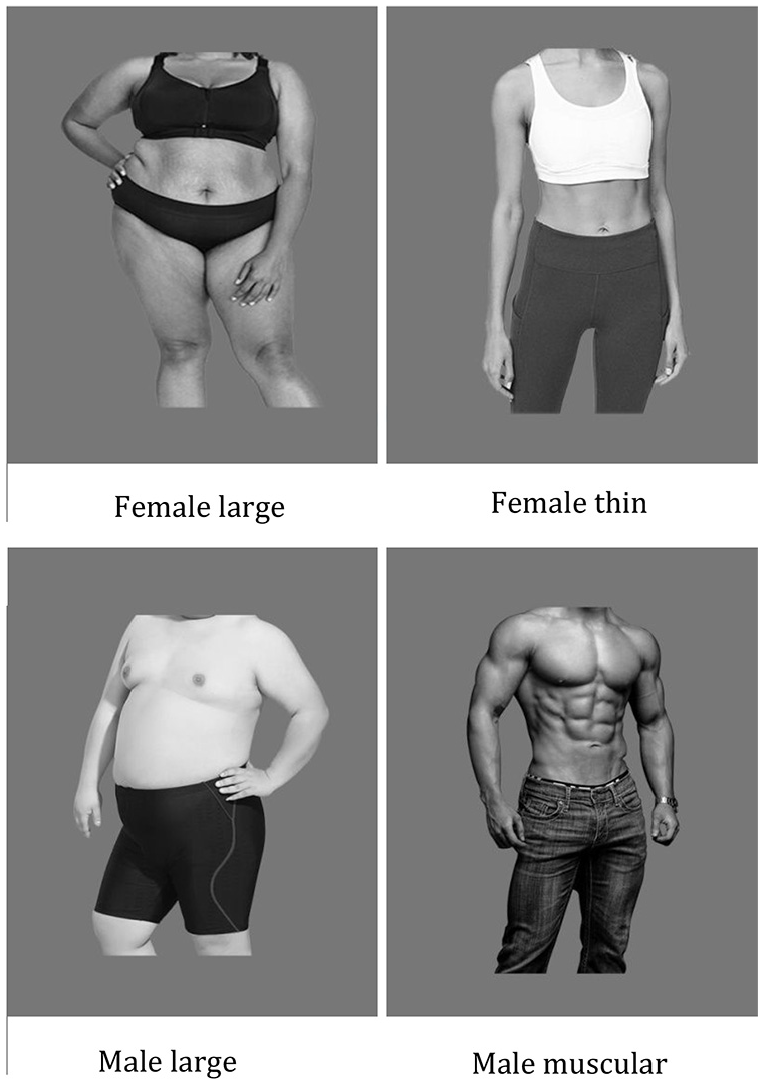
Eye-tracking stimuli for large and thin female, and large and muscular male.
Following the calibration procedure, participants proceeded to the main experiment. They were presented with instructions on the screen and viewed a series of images while their spontaneous eye movements were recorded. During the experiment, a fixation cross ‘+’ sign appeared on the screen for 1000 ms, and participants were instructed to focus their attention on it. After the fixation cross, images were presented in a randomised order, ensuring that no specific pattern or sequence was followed. Each image was displayed for a fixed duration of 10 seconds. Participants were instructed to freely look at the screen, adopting a naturalistic viewing approach akin to watching TV/Social media platforms or browsing through a magazine. They were not provided with any specific guidance or instructions regarding the purpose or focus of their attention on the images. After the experiment, participants completed the post-exposure measures of body satisfaction and state appearance comparison; participants’ height and weight were collected to calculate BMI. BMI was calculated using the Department of Health (2022) BMI calculator, specific for Asian populations.
Analysis
Data analysis was conducted using IBM SPSS 29. Descriptive analysis was conducted to examine relationships of significance among all key variables. Following on from this a 2 (gender: male/female) × 2 (higher/lower body satisfaction) × 4 (image type: female large, female thin, male muscular, male large) mixed-design ANOVA was conducted to analyse the eye-tracking data, including total fixation duration and number of fixations. Finally, a 2 (gender: male/female) × 2 (body satisfaction: higher/lower) × 2 (time: pre/post-experiment) mixed-design ANOVA was conducted to examine changes in body satisfaction after viewing the images in the experiment. Outliers and missing data in the eye tracking data were addressed by replacement with mean imputation. The final total number of participants in the sample was 58 (male: higher BS = 9; lower BS = 8; female: higher BS = 28; lower BS = 13).
Results
Descriptive statistics
Table 1 displays results from the preliminary analysis, including means and reliability. Preliminary findings suggest that higher BMI was significantly linked to lower body satisfaction. Problematic eating attitudes and behaviours was associated with engagement in appearance comparison behaviour; participants engaging in more appearance-related comparison behaviours possessed lower levels of body satisfaction (see Table 1).
Descriptive statistics of study variables (n = 58).
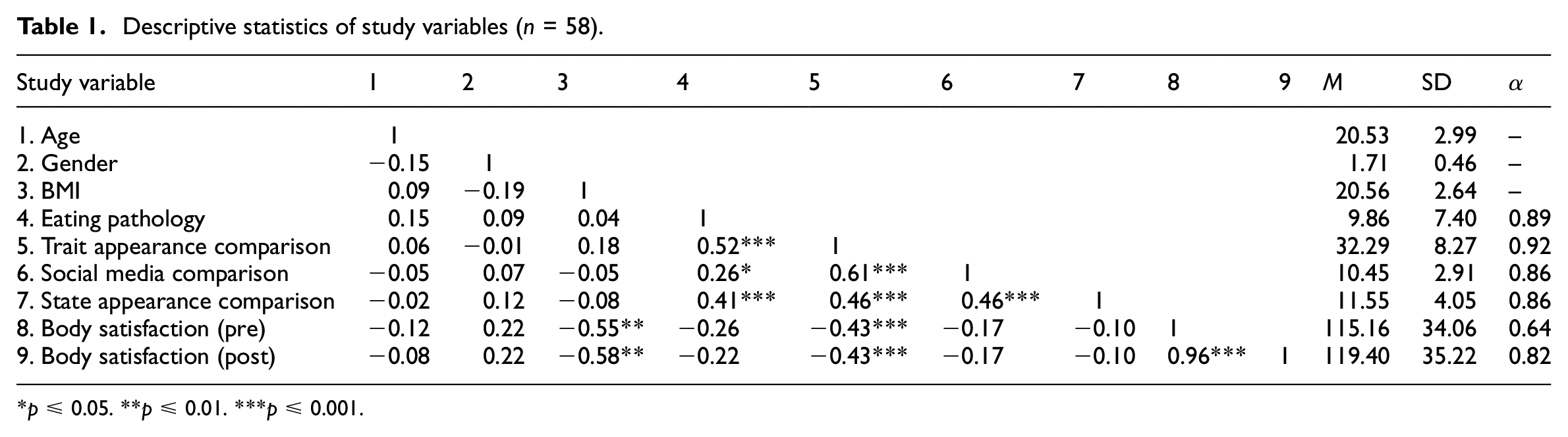
p ≤ 0.05. **p ≤ 0.01. ***p ≤ 0.001.
Eye movement results
Total fixation duration
A 2 (gender) × 2 (body satisfaction) × 4 (image type) mixed-design ANOVA was conducted to examine the eye-tracking data (see Table 2). A main effect was observed for stimulus type, F(3, 162) = 10.70, p ≤ 0.001, ηp2 = 0.165, suggesting significant differences in total fixation duration of the four image types. As indicated by the significant main effect for gender, F(1, 54) = 7.87, p = 0.007, ηp2 = 0.127, women displayed longer total fixation duration than men in the present sample. A significant interaction was also observed between body satisfaction and image type, F(3, 162) = 3.55, p = 0.016, ηp2 = 0.062, indicating that those with lower body satisfaction spent longer fixating on idealised body images more frequently than larger body images, compared to the higher body satisfaction group. This supports H1, which hypothesised that lower body satisfaction would be associated with greater attentional bias towards idealised bodies. However, the main effect of body satisfaction (F(1, 54) = 1.55, p = 0.218, ηp2 = 0.028), image type × gender (F(3, 162) = 1.77, p = 0.154, ηp2 = 0.032), gender × body satisfaction (F(1, 54) = 2.02, p = 0.161, ηp2 = 0.036) and image type × gender × body satisfaction (F(3, 162) = 1.12, p = 0.343, ηp2 = 0.020) interactions were not significant.
Three-way 2 (gender) × 2 (body satisfaction) × 4 (image type) mixed-design ANOVA on eye-movement measures.
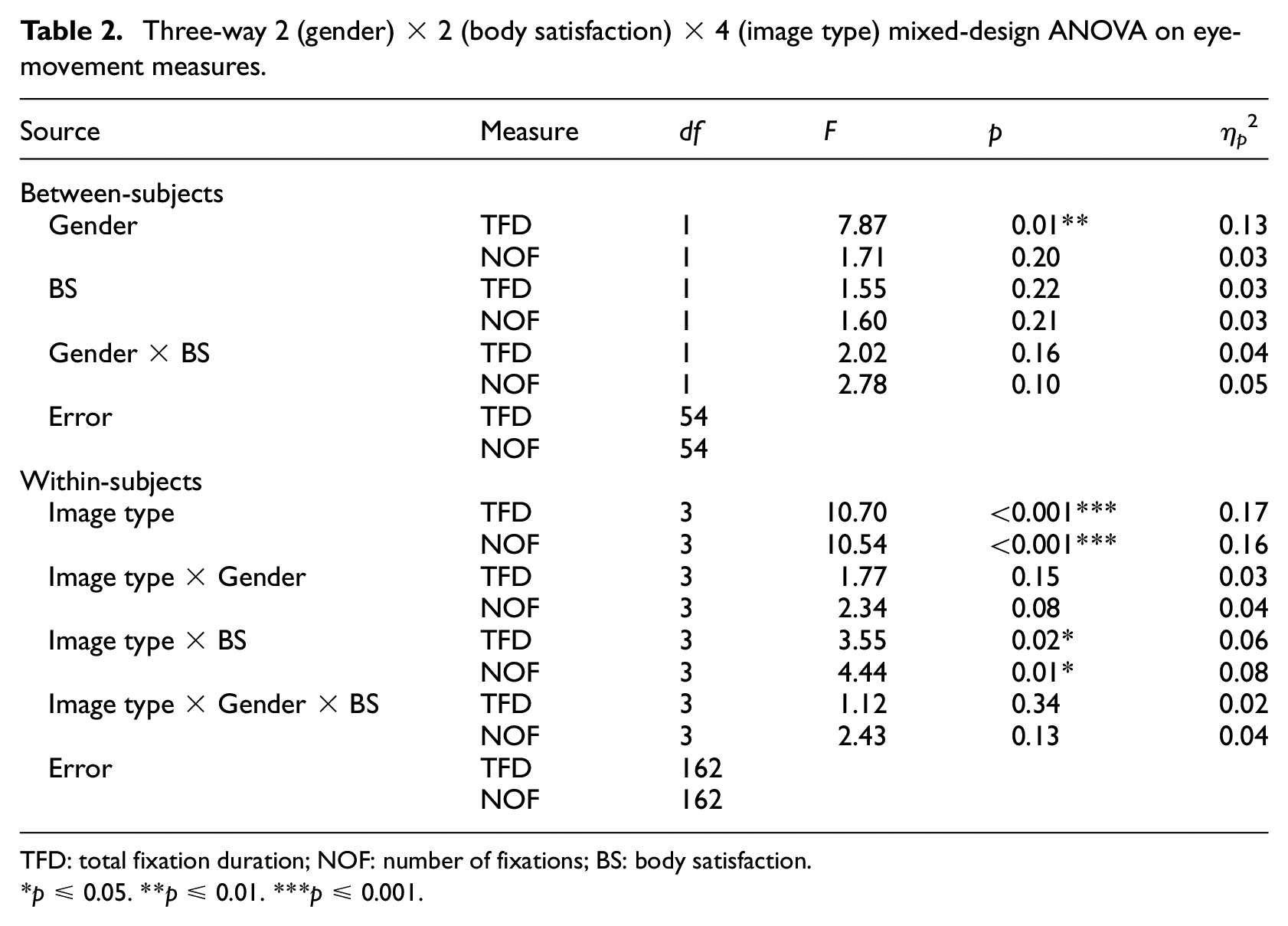
TFD: total fixation duration; NOF: number of fixations; BS: body satisfaction.
p ≤ 0.05. **p ≤ 0.01. ***p ≤ 0.001.
Simple effect analyses were conducted to further examine the main effects of gender and image type on total duration fixation (see Figure 2). Findings revealed a shorter total fixation duration when men viewed female large (p < 0.001), male large (p < 0.001) and male muscular (p < 0.05) images, implying that male participants in the present sample were more inclined to gaze longer at female thin body images. Findings also revealed a shorter total fixation duration when women viewed female large (p < 0.05), and male large (p < 0.001) images, but not for male muscular (p = 0.13). Thus, findings indicate that among female participants, female thin and male muscular body images were more popular images, demonstrated by the longer total fixation duration on images of these specific body types.
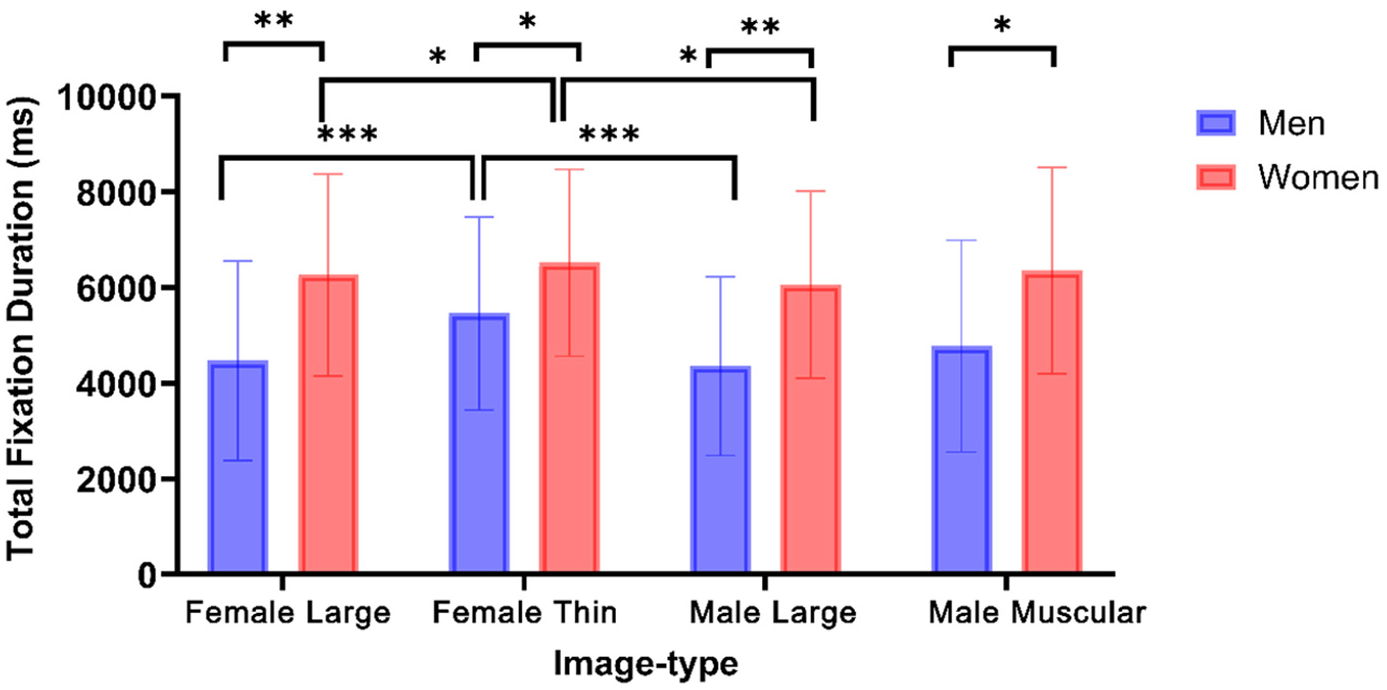
Total fixation duration across image type by gender.
The interaction effect of image type × body satisfaction was significant, indicating that the effect of image type on total duration fixation differs depending on body satisfaction. Pairwise comparisons were conducted to examine the effects of body satisfaction across the four body types. Males with lower body satisfaction displayed significantly shorter total fixation duration for the female thin images compared to men reporting higher body satisfaction (p < 0.05), although no significant differences were observed between groups for the remaining three body image types (i.e. female large, male large, male muscular). No significant differences were observed among women in the sample regarding total fixation duration across image types according to higher and lower body satisfaction (see Figure 3).
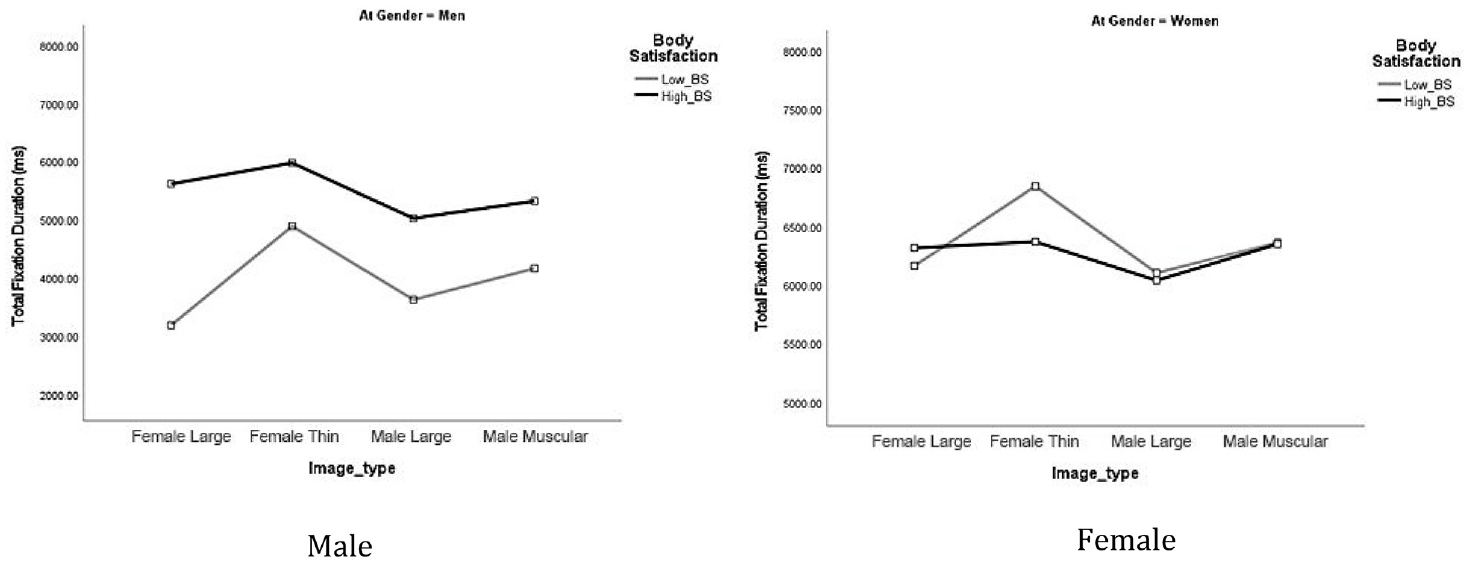
Total fixation duration (in milliseconds) across image type (female large, female thin, male large, male muscular) and body satisfaction.
Number of fixations
A three-way mixed-design ANOVA examined number of fixations (NOF) with gender (male/female) and body satisfaction (higher/lower) as between-subjects factors, and image type (female large, female thin, male large, male muscular) as within-subjects factor. A significant main effect was observed on image type, F(3, 162) = 10.54, p < 0.001, ηp2 = 0.16 (see Table 2), indicating significant differences in NOF across the four images. The body satisfaction × image type interaction was also significant, F(3, 162) = 4.44, p = 0.01, ηp2 = 0.08. However, the main effects of gender, F(1, 54) = 1.71, p = 0.20, ηp2 = 0.03, and body satisfaction, F(1, 54) = 1.60, p = 0.21, ηp2 = 0.03 were not significant. The interactions of gender × body satisfaction, F(1, 54) = 2.78, p = 0.10, ηp2 = 0.05, image type × gender, F(3, 162) = 2.34, p = 0.08, ηp2 = 0.04 and image type × gender × body satisfaction, F(3, 162) = 2.43, p = 0.07, η2 = 0.04, were not significant. Thus, no overall differences in number of fixations according to gender and body satisfaction were observed.
Body satisfaction changes
To examine changes in body satisfaction pre- and post-experiment, a 2 (gender: male/female) × 2 (body satisfaction: higher/lower) × 2 (time: pre/post-experiment) mixed-design ANOVA was conducted. Results revealed significant main effects for body satisfaction, F(1, 54) = 70.24, p < 0.001, ηp2 = 0.57, and for time, F(1, 54) = 8.55, p < 0.005, ηp2 = 0.14, indicating that those participants in the lower body satisfaction group reported significantly lower body satisfaction levels than the higher body satisfaction group at both pre- and post-experiment time points, suggesting that participants’ body satisfaction decreased after exposure to the images. No main effects were observed for other variables including gender, meaning that no significant gender differences were observed in levels of body satisfaction in the present sample.
Discussion
The present study examined the influence of gender and body satisfaction on attentional bias among young Hong Kong adults. Findings revealed that higher BMI was associated with lower levels of body satisfaction, echoing previous findings (Gruszka et al., 2022). Problematic eating attitudes and behaviours were associated with significantly greater engagement in appearance comparison, which was linked to lower levels of body satisfaction; this is in line with previous research (Turel et al., 2018; Wang et al., 2022). Levels of body satisfaction reduced on exposure to body images, and findings indicated that lower body satisfaction groups spent longer and more frequent attention with holistic gaze behaviour towards idealised bodies, consistent with H1. Analysis of gaze duration and fixation frequency revealed that men with lower levels of body satisfaction paid more attention to images of muscular bodies while women with lower body satisfaction paid more attention to the thin ideal female body images. This suggests that young adults with lower levels of body satisfaction observed the same gender’s idealised bodies more frequently and for longer periods of time.
Previous research has suggested that exposure to idealised body images can lead to reductions in self-esteem and body satisfaction and increases in depression (Cho and Lee, 2013). The present study echoes these findings and suggest that an attentional bias towards idealised bodies can lead to reductions in body satisfaction, and changes in body satisfaction levels between the pre- and post-experiment intervals seem to confirm this was indeed the case in the present sample, supporting H2. Attentional bias towards idealised body images has also been associated with eating disorder symptomology, eating disorders and body dissatisfaction (House et al., 2023); studies have also shown a greater immediate impact of exposure to thin-ideal media on drive for thinness, body dissatisfaction and problematic eating attitudes on women in Hong Kong compared to China (Rochelle and Wu, 2017). The present findings provide support for the positive association between body dissatisfaction and attentional bias to idealised bodies in both women and men in a Chinese context.
While much research has been conducted examining attentional bias in women, much less has been conducted on men and less so outside of the Western context. The present findings suggest that while drive for thinness is important for women, drive for muscularity is also important for men. Previous research has argued that identifying an attentional bias towards idealised bodies provides indirect evidence of body satisfaction using social comparison theory. The present findings revealed that exposure to idealised body images resulted in reductions in body satisfaction. Previous research has shown the benefits of attention retraining in reducing threat bias and anxiety symptoms in a clinical setting with eating disorder patients (Rowlands et al., 2022).
The present findings lend support to the literature. The examination of gender differences in attentional bias to idealised and larger body images through eye movements was a strength of the present study, as was the use of pictorial stimuli, which has been found to increase the ecological validity of studies (Cho and Lee, 2013). However, despite its contributions, there are also limitations which must be acknowledged. The small sample size and lack of gender parity were not ideal, nor was the cross-sectional nature of the study. Future studies should consider larger samples with greater parity across genders. Another limitation is that participants were informed that BMI would be collected at the start of the study. This information was included to ensure transparency and ethical considerations. Participants’ anticipation about being weighed at the end of the session could potentially have impacted participants’ behaviour by influencing their responses or actions during the experiment. The incorporation of a control condition would have been able to assess this issue and the potential effects of anticipation and should be considered for future studies.
The present study only considered male and female gender identities, as such attentional bias across other gender identities remain unknown; future studies could consider greater gender inclusion. In addition, the impact of exposure to ideal versus large body images were not clear as state body satisfaction was not measured after exposure to each image. Future research should aim to examine the separate effects of engagement and disengagement during attention tasks. Although the reductions in body satisfaction before and after exposure to the images does imply that exposure to the images, both idealised and large images, did influence body satisfaction in the present sample. Some research has also noted limitations in failure to observe early attentional bias in eye tracking experiments (Armstrong and Olatunji, 2012). Finally, the present sample consisted primarily of young adults, as such it is not possible to generalise the present findings to younger children or older adults. The sample also consisted predominantly of individuals with a mostly low to normal range BMI. Inclusion of a wider age and BMI range to explore age and BMI differences in attentional bias is warranted.
Conclusions
The current study examined attentional bias in a sample of Hong Kong Chinese young men and women employing an eye-tracking methodology. Findings are in line with social comparison theory, which suggests that to facilitate upward comparison, individuals with lower body satisfaction will allocate more attention to idealised body images (Rodgers and DuBois, 2016; Tiggemann and McGill, 2004). The present findings provide support for the positive association between body dissatisfaction and attentional bias to idealised bodies in both women and men in a Chinese context. In the present study, body satisfaction reduced on exposure to body images, and lower body satisfaction groups spent longer and more frequent attention towards idealised bodies in both men and women. Problematic eating attitudes and behaviours were associated with significantly greater engagement in appearance comparison, which was linked to lower levels of body satisfaction. The lack of significance for attentional bias to larger figures in the present sample also supports previous research on attentional bias (Misener and Libben, 2020). The present findings provide evidence of the relationship between body satisfaction and appearance comparison through attentional bias in the Chinese context. Reports of the growing problem of eating disorders in the Chinese context (Stebbings and Lan, 2021), and the stigma attached to eating disorders in the Chinese context (Milhaud, 2020), emphasise that further investigation with a broader gender spectrum, BMI range and larger sample size in a Chinese context is warranted.
Footnotes
Author contributions
The corresponding author was responsible for study conception and design. Material preparation and data collection was performed by the second author, data analysis was performed by both authors. The first draft of the manuscript was written by the corresponding author, both authors contributed to and commented on previous versions of the manuscript and approved the final manuscript.
Data sharing statement
The current article includes complete raw dataset collected in the study; data files will be automatically uploaded to the Figshare repository.
Declaration of conflicting interests
The authors declared no potential conflicts of interest with respect to the research, authorship, and/or publication of this article.
Funding
The authors disclosed receipt of the following financial support for the research, authorship, and/or publication of this article: The work described in this paper was fully supported by a Teaching Development Grant from City University of Hong Kong (Ref: 6000722).
Ethics approval
Ethics approval was obtained from the College of Liberal Arts and Social Sciences Ethics Committee.
Informed consent
All participants provided informed consent before taking part in the study.
