




Abstract
Inflammatory Bowel Disease often causes abdominal pain, faecal urgency and a range of other symptoms, and is a common chronic disease among young people. Stoma surgery seeks to alleviate these symptoms, though complications often arise from surgery and many stoma patients experience various stigmas. Young people with chronic conditions are increasingly gathering online to share their experiences of illness. Given the rise in popularity of TikTok and its appeal to young people, this study explored how young ostomates with Inflammatory Bowel Disease and a stoma portray themselves on TikTok. Using thematic analysis, three themes were identified in which ostomates portrayed themselves as educators, warriors and reformers, providing education, support and guidance to the wider stoma community. These findings show that TikTok offers an innovative platform for ostomates’ self-presentations and a novel space health professionals should harness to better support ostomates.
Introduction
It is estimated that 1 in 335 people in the UK (Colostomy UK, 2022), and 1 in 500 in the USA have a stoma (Crohn’s and Colitis Foundation [CCF], 2020). A stoma (also referred to as an ostomy) is a surgically created opening on the surface of the abdomen where the bowel is brought through and sewn to the outside skin. The stoma diverts the flow of faeces into a collecting device such as a pouch or bag. Inflammatory Bowel Disease (IBD) 1 describes a group of diseases that cause chronic inflammation of the gut, often requiring lifelong treatment in the form of medication and surgery. IBD is an umbrella term for the two main inflammatory conditions of Ulcerative Colitis and Crohn’s Disease and is a leading cause of stoma formation.
Prevalence of IBD is increasing worldwide, with incidence highest in older adolescents and young adults (Cooney et al., 2024). Diagnosis typically occurs between 15 and 35 years old (CCF, 2023). Yet there is a paucity of research focusing specifically on young people with stomas caused by IBD. Common symptoms of IBD include abdominal pain, diarrhoea, faecal urgency, fatigue, weight loss and rectal bleeding. Such symptoms cause considerable disruption to daily activities and negatively impacts patients’ quality of life (Mitropoulou et al., 2022). Stoma surgery aims to alleviate these symptoms, often leading to life improvements, and in some cases can be lifesaving (CCF, 2020).
Whilst there are benefits of stoma surgery, ostomates (individuals with a stoma) experience an array of subsequent challenges. These include dealing with wider social stigma, and lack of knowledge and understanding about IBD and stomas. The impact of stoma surgery is well-documented, including physical, psychological and social challenges such as leakage, skin irritation, wound and healing difficulties, impaired body image, reduced sexual satisfaction and social anxiety (Bahayi et al., 2018). In addition, health-related stigma has profound impacts on individuals with IBD (Taft et al., 2013). For example, Trindade et al. (2020) demonstrated the detrimental impact of chronic-illness related shame on the psychosocial functioning of individuals with IBD. Taft et al. (2009) noted that 84% of individuals with IBD perceive stigma for their condition, whether they had a stoma or not. And Dibley et al. (2018) showed individuals with IBD awaiting stoma surgery perceived several stoma related stigmas. This in turn led to the prospect of having a stoma being viewed negatively. Cultural beliefs regarding the excretion of bodily fluids also evoke feelings of disgust, and living with a stoma can result in feelings of shame (Diebold, 2016). As such, some ostomates report hiding their stomas and stoma bags to feel ‘normal’ (Hubbard et al., 2019). In addition, Persson and Hellström (2002) discussed how some ostomates in their interview study limited social contact due to fears people would smell or hear the noises their stoma bags made. These stigmas and fears frequently lead to ostomates being misunderstood and unaccepted by those around them (Lim et al., 2015).
Ostomates on social media
One of the most significant developments associated with the internet is the ability to upload and share parts of one’s daily life. Social media platforms provide opportunities for people to create, edit and share digital materials and present themselves online (Jenkins, 2006). In turn, social media offers individuals with chronic diseases more control and flexibility over how they present themselves (Merolli et al., 2013).
While literature exploring ostomate use of social media is relatively undeveloped, notable exceptions include Frohlich and Zmyslinski-Seelig’s (2016) findings that users of the Uncover Ostomy website and its Facebook page challenged stoma stigma through sharing photos and supportive comments. Rademacher (2018) also examined social media comments on a stoma selfie that went viral, and demonstrated the selfie was effective in challenging stoma stigma. Such findings are important as they demonstrate ostomates are not merely passive individuals at the mercy of their stomas. Rather, this small body of research suggests that ostomates are portraying themselves online in ways that actively challenge stoma stigma. The current study contributes to this emerging field of research by analysing video content posted on TikTok to explore IBD ostomates’ online self-presentations, adding new insights into how ostomates use social media.
TikTok users create and share videos using a range of creative features and use hashtags to search for content of their choice. In 2022 TikTok was the most downloaded app worldwide (Statista, 2023) and had 1 billion active monthly users across 154 countries (Ruby, 2023). With nearly 70% of users aged between 13 and 24 years old (Influencer Marketing Hub, 2023), TikTok is a popular platform for young adults and a pertinent site for exploring ostomates’ use of social media.
Numerous studies have explored the various ways in which individuals with a health condition use TikTok (Herrick et al., 2021; Kong et al., 2021). These studies demonstrate that TikTok videos offer a powerful method of communication, particularly in health communities. However, few studies have focused on the IBD and stoma community. As such, we conducted a thematic analysis of ostomate-produced TikTok videos to analyse how young IBD ostomates portray themselves and what messages they offer about stomas. To our knowledge, this is the first study to explore ostomates’ self-presentations on TikTok. The current study therefore asks the question: ‘How do young IBD ostomates portray themselves on TikTok?’
Method
Data collection
We employed a qualitative methodology using thematic analysis to explore how young IBD ostomates portrayed themselves on TikTok. To collect relevant videos to analyse, the first author created a new profile on TikTok. TikTok uses a complex algorithm that considers author popularity, user region and type of videos already viewed by the user to determine what content to display to the users (Al-Megren et al., 2021). As a new user, the first author had no previous engagement with the content, and thus, when searching for relevant videos, the content she viewed would be the same as what other new users would see.
As is common in TikTok research (Literat, 2021), we used hashtags as a means of finding and collecting relevant TikTok videos. Using the discovery function, as of 4th January 2023, the most popular hashtags relating to stomas and IBD were #ostomy (691.7m views), #IBD (552.4m views), #stoma (348.3m views), #crohns (387.7m views) and #ulcerativecolitis (338.9m views). We choose to focus our data collection and analysis on videos from the two most popular hashtags (#ostomy and #IBD) because almost all these videos included multiple hashtags, and videos with #ostomy and #IBD also typically included the other hashtags. Initially, the first author collated, downloaded, watched and coded the top 55 videos related to #ostomy and #IBD. One video was removed from the dataset due to the creator not speaking English. After coding the data and identifying potential themes, a further 10 videos were downloaded on 18th January 2023 to determine if other meanings relevant to the research question could be identified in the data. Our analysis of the additional videos provided further support for the potential themes. Hence, we decided that 64 videos offered a rich and detailed data set that enabled us to answer the research question.
The videos in our dataset were uploaded by 27 different users, 23 of whom were female and 4 were male. Whilst demographic data was unavailable, from gauging accents and content, creators were typically from the USA and UK. Twenty-three of the users posted a single video, and four users posted between 2 and 14 videos each. The videos lasted from 5 seconds to 2 minutes 50 seconds, with the average length being 56 seconds. The total duration of video footage analysed was 59 minutes and 40 seconds. The TikTok videos took a variety of formats and styles including creators talking directly to the camera, documenting daily activities and video demonstrations with captions and music.
The research was conducted in line with British Psychological Society (2021) guidelines for internet mediated research and ethical approval was obtained from our department’s ethics committee. We assumed that video producers had no expectation for privacy given that the videos are in an open and public domain that is accessible by the wider public. Moreover, TikTok’s (2022) privacy policy states third parties may be able to access and share individual user data content. TikTok users can also set their account to public or private and choose whether their videos are downloadable. The videos used in this study came from users who chose to have public profiles and allowed their videos to be downloaded.
Analytic strategy
To analyse the videos, we followed Braun and Clarke’s (2006) six stages of thematic analysis. To gain familiarity with the data, the first author initially watched each video twice without taking notes. On the third viewing she logged initial ideas and inductive codes in a Word document. Codes that coalesced and spoke to each other were colour-coded and moved into groups with a view to identifying potential themes. Word documents for each potential theme were created, outlining the final iterations of codes and their supporting quotes. The above steps were then repeated for the additional 10 videos. We then worked collaboratively to discuss how the potential themes fitted together, how they answered the research question and we re-phrased the theme names to sharpen the analysis and the story it tells. The first author then identified relevant exemplar quotes and images in the data that most clearly and evocatively illustrated the central tenants of each theme. The first author has a familiarity with IBD and stomas due to being close to an ostomate. This sparked her initial interest in this topic. However, she had no previous engagement with TikTok, and kept a reflexive journal to maintain awareness of her positionality. She worked collaboratively with the second author, who had no personal experience with the topic and took the roles of research supervisor and critical colleague. In the following section we offer our analysis which answers our research question.
Analysis
In the analysis that follows, we identify three prominent and inter-connected themes – ‘demonstrations, discussions and stoma education’, ‘a battle to acceptance and embracing a new life’ and ‘reforming the stoma stigma and promoting body positivity’. The themes demonstrate how ostomates portray themselves as educators, warriors and reformers. As educators, video creators educate audiences to help other ostomates deal with everyday stoma challenges, whilst also seeking to educate wider audiences. As warriors, creators highlight the fight ostomates endure against IBD and stoma difficulties. As reformers, creators challenge stoma misconceptions and stigma, and help normalise stomas and encourage others to see the positive side of having a stoma.
Theme 1: Demonstrations, discussions and stoma education
This theme explores how video creators portrayed themselves as educators and were viewed as such by the audience. Creators were keen to educate and engage with viewers about life with a stoma, for example by encouraging questions when signing off videos: ‘let me know if you have any questions’ (video 7). Others created videos that directly responded to questions from viewers on their previously uploaded videos, such as ‘do you wash the bag and reuse it or do you put on a fresh one?’ (video 11). Issues discussed involved bag changes, using the toilet, farting, whether the stoma itself is painful, intimacy and relationships with a stoma, diet modifications after stoma surgery and what stoma surgery involves.
Eight videos from different creators demonstrated how to change a stoma bag. Some involved creators talking through the various stages as they changed their bag: ‘this adheres to the body. My intestine goes through here. It’s sewn to the outside of my body and this clips on to here’ (video 7). The education provided here not only pertained to how to change a stoma bag, but showed assorted products involved in bag changes as well as talking about the stoma itself. In other videos, information was provided using captions. See Figure 1 for an example.
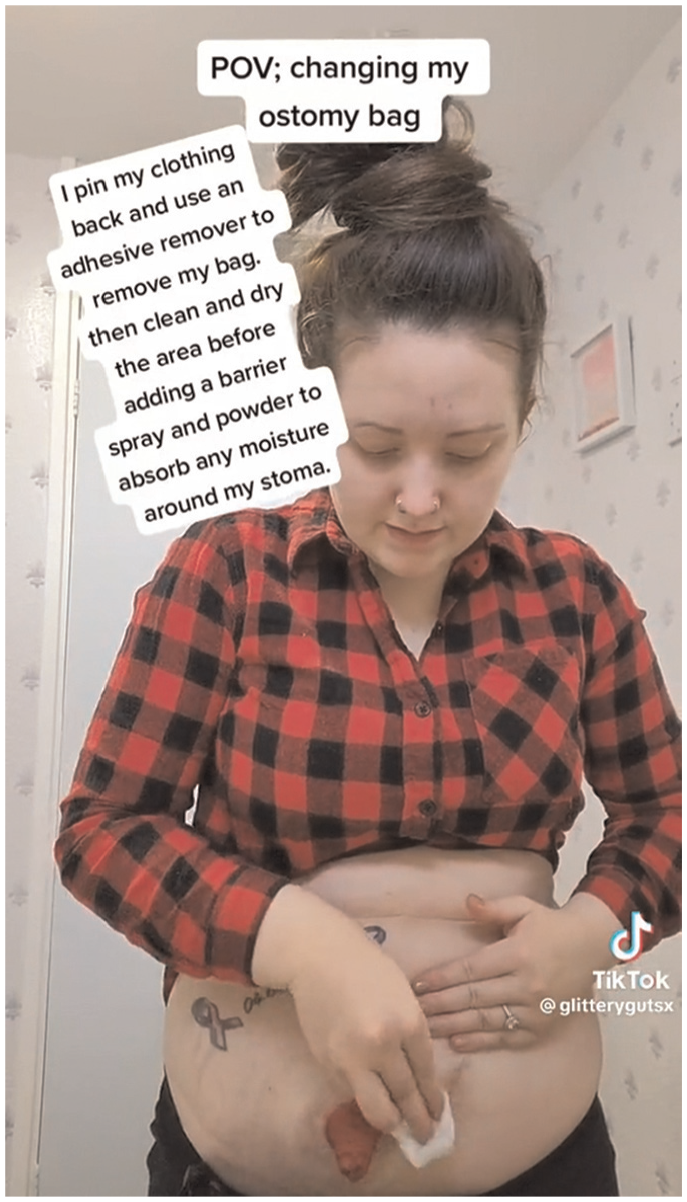
Bag change demonstration with caption (screenshot from video 57).
This caption explains some of the stages involved in a bag change, while the accompanying video image shows how the creator cleaned the skin around her stoma with her stoma clearly visible, thus educating the audience on what a stoma can look like.
Across the dataset, creators made it clear each stoma is unique – they look different, can be positioned differently on the body depending on type, and frequency of bag changes differs between individuals. One creator, when demonstrating how she changed her bag, was keen to point out this uniqueness in several videos: ‘of course, every patient is different. They may have a different technique’ (video 11). Similar demonstrations were provided for emptying bags and dealing with leaks. Videos involving the creator speaking directly to the camera were often more in-depth, providing more information compared to videos with just captions. For example, one creator described how since having a stoma, she does not have to push anymore: Going to the bathroom with an ostomy is a lot different than, erm, how a normal person with a colon would go to the restroom …. for me, it’s just comin’ through my intestine, so I have no power over that feeling. I’m not pushing through my intestine to go to the bathroom. It kind of just comes out my intestine. It’s collected in my ostomy bag and then I empty the bag … I don’t have to push. (Video 27)
Here, the video creator shows the physicality of bag changes, while also educating viewers on how the sensation of going to the toilet differs from that of a ‘normal’ person. In a different video, the same creator responds to a viewer’s question about farting with a bag, educating viewers on how this differs when you have a stoma: I pass gas through my bag as well … Sometimes when I wake up in the morning, my bag is like, parachuted … but yes, I don’t fart, I pass gas through my bag and erm, it’s weird when people talk about farts because it’s not something that I have done in nine years. (Video 6)
Here, the creator is educating viewers on physiological differences between individuals with and without stomas.
In turn, four videos outlined diet modifications after stoma surgery. One creator noted that seeds, popcorn, raw vegetables and fruit peels should not be eaten due to the ‘possibility of it getting stuck in the stoma’ (video 29). Another creator highlighted how after surgery, ‘your intestines get really swollen. So you have to be really careful with what you eat so that it’s easier to digest. So, I’m on a very soft foods only diet’ (video 9). References to stoma surgery also came from eight other videos from four creators. Most commonly, creators talked about how some of their intestines had been removed, and they educated viewers on what stoma surgery involves. For example, one creator stated: My entire large intestine was removed from my body, so for me, when I eat, it goes through my oesophagus, it goes through my stomach, my whole small intestine and then it comes to the outside of my body. For a normal person, it would then go through their whole large intestine and then they go poop. (Video 27)
Creators portrayed this education as important due to the general public’s perceived lack of understanding of IBD, stomas and the severity of symptoms. As such, this lack of understanding is likely underpinned by the historical notion that discussing bowel habits is taboo (Fahs, 2017). In sharing their lived experiences on social media, creators addressed these misconceptions, and in doing so helped increase awareness and understanding of IBD and stomas.
Theme 2: A physical and psychological battle to embrace a new life
This theme captures how video creators often portrayed themselves as warriors battling IBD, enduring multiple surgeries, painful symptoms and everyday fears and worries about living with a chronic condition. In turn, stoma surgery presents new challenges, such as wound healing issues. However, it also offers improvements in ostomates’ lives, with creators asserting that life with a stoma is better than without one.
Physical and psychological battles
In several videos, creators explained that a stoma does not cure IBD, it improves the symptoms. Ostomates can still experience IBD flare ups and other physical problems related to having a stoma. One creator vividly conveyed many of these challenges in a video entitled ‘Everything I wish I knew before I got my butthole removed’: It’s been six months since my surgery and I still experience some days where its 10 out of 10 pain. The pain pretty much feels like you have glass shards where your asshole used to be and whenever you sit it feels like a baby’s head is gonna come out of your butt. Complications. Okay, like, my surgeon … didn’t tell me the extent of the complications that there could be. This can range from, like, skin issues to wound healing issues to infections in the wound. Literally the list goes on and on and they are not pretty to deal with and they are so stubborn to heal. (Video 2)
Using a series of expressive similes, the creator paints an evocative picture of the bouts of excruciating pain she still experiences post-surgery. She also notes other physical tolls including dealing with wounds, infections and the slow healing process. Another creator echoed these challenges, detailing how they developed adult acne, arthritis and experienced hair loss due to taking post-surgery medication (video 40).
In many videos, photo montages were used to visually represent the physical severity of stoma surgery. Figure 2 offers one such example, depicting the creator’s abdomen post-surgery.
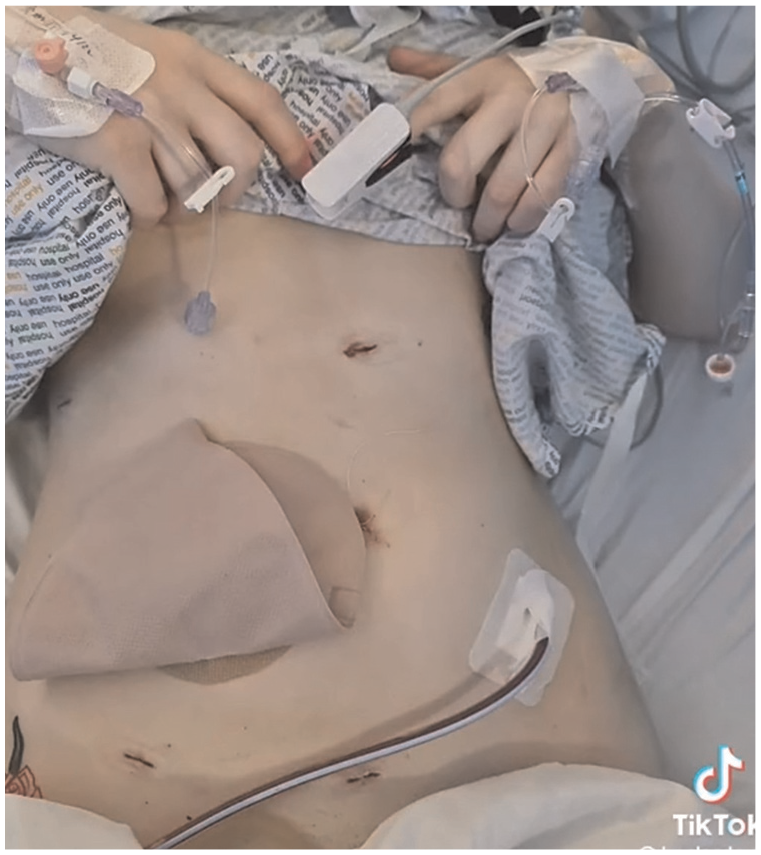
Abdomen post-surgery (screenshot from video 5).
In addition to the multiple incision marks, intravenous lines and cannulas visible in Figure 2, numerous other powerful post-surgery images depicting, for example, a drainage bag filled with blood, flashed up throughout the video. Three other creators shared similar post-surgery photos of themselves recovering in hospital (videos 10, 38 and 40). Such images further enhance the self-portrayal of ostomates as warriors, courageously showing off their scars as testament to the physical battles fought against IBD.
A battle of a different nature is depicted in video 32, where a creator discusses how good days come at a price: Although I had a good day today, I’m now suffering because of it. Just because you see someone with a chronic illness out there doing normal things, doesn’t mean those normal things don’t take a massive toll on their body. (Video 32)
The notion of a warrior is captured using language such as ‘suffering’ and ‘massive toll’, with the creator emphasising ongoing challenges she faces with her IBD and stoma. Furthermore, she demonstrates a fight to balance making the most of a good day without suffering at the end because of it.
Creators also alluded to psychological battles they fight due to their IBD and stomas. In an emotional video titled ‘spend a flare day with me :(’ (video 13), a creator is seen crying throughout, using captions to describe the things she does to seek comfort when experiencing a flare. 2 For example, ‘Step 2: Locate Fave Snacks. Step 3: Smell something calm. … Step 5: locate Milo for cuddles … Step 6: watch fave comfort show’. Battling a ‘massive fear of tablets since being young’ (video 45) was detailed by another creator, who endured an 8-week course of steroids due to her IBD. At the start of the video, she is seen retching when taking one, but at the end has overcome her fear and is smiling and laughing when taking them. A song with the lyric ‘it’s okay to be afraid’ can also be heard playing in the background, acknowledging this fear. Taken together, creators portray an array of psychological struggles that pervade their lives. These are closely intertwined with physical challenges detailed previously, leading to creators’ self-portrayals as warriors who fight a range of major and ongoing challenges due to their stomas and IBD.
Embracing a new life
Despite experiencing physical symptoms of IBD, and physical and psychological challenges of having a stoma, creators demonstrated how they eventually adjusted to their stomas and embraced an improved life. Comments such as, ‘things are not gonna be easy but things will progressively get better eventually, it’s just a long road’ (video 2) and ‘if you are new to having an ostomy, it does get easier over time’ (video 11) suggest there is not a pre-defined adjustment period for all ostomates and that challenges are to be expected. Such challenges however become easier, offering hope and support to new ostomates.
Faecal urgency and tenesmus 3 are common in individuals with IBD (Petryszyn and Paradowski, 2018). Creators detailed how stoma surgery had removed years of ‘straining and straining’ (video 59), ‘pushing and crying’ (video 27) and ‘the urgency to go number 2’ (video 55) caused by their IBD, leading to an improved quality of life. Several creators also posted videos and photo montages of themselves resuming ‘normal’ activities (such as ‘clubbing’ and going to the beach) they had previously struggled to engage with due to the nature of their IBD symptoms. Captions alongside the photos highlighted gratitude to the stoma for allowing them to enjoy these activities again.
The ability to resume these everyday activities led creators to portray profound feelings towards their stomas indicating just how substantial these life changes have been. One creator aptly summed up how her stoma has changed her life for the better: Overall I’m just really freakin’ happy that this is where I am and how things kinda ended up and the freedom that I felt with my ostomy is absolutely incredible and I feel like I’ve finally gotten my life back. It’s a huge change, it takes a lot of getting used to. But once you get used to it, it’s truly a blessing in disguise. (video 55)
Such sentiment was shared by other creators. Several reflected on the differences between their lives pre- and post-surgery, expressing gratitude towards their stomas for allowing them to ‘feel more like myself’ (video 35). Others went further, with one creator showing his stoma with the caption ‘this lil thing saved my life’ (video 20). Another creator detailed how ‘after 10 years of suffering, I was finally diagnosed with IBD. I was extremely poorly. And only 3 weeks later I needed emergency surgery to save my life’ (video 40). Ultimately, despite the physical and psychological challenges creators faced due to having IBD and a stoma, they explicitly acknowledged their stomas did not just improve their lives but saved them.
Theme 3: Reforming stoma stigma and promoting body positivity
This theme captures how creators portrayed themselves as reformers of stoma stigma. The creators challenged stigmas around displaying stomas and stoma bags in public and managing faeces. Creators also encouraged viewers to change their negative perceptions by promoting better understandings of the realities of dealing with stomas. Many creators also took up a body positive approach to their changed bodies and encouraged ostomates and others to follow suit.
Several creators offered direct challenges to stigmas associated with the public display of stomas and stoma bags and encouraged a reformation of such negative attitudes. One important challenge came from a creator’s response to a comment they received from a viewer of a previous video. The viewer stated, ‘I have Crohns but I think I’d die if I had to have bag’. The creator responded by encouraging the viewer to reform their way of thinking: Comments like these are why there’s such a big stigma around having an ostomy bag and why it’s looked down upon as something that’s gross. Okay, it’s not gross. You get used to it …. so let’s think twice before we comment stuff like this. (video 15)
Historically, a range of bodily functions and fluids have been perceived as gross and disgusting, and thus required to be hidden from public view (Fahs, 2017). In the example above, the creator dismisses the interpretation that ostomy bags are gross and claims ostomy bags can be normalised over time. Similarly, another creator discusses and opposes ‘the shit stigma’ (video 8): Everyone does it … They all shit regularly and if you just cringed thinking about one of those people in your life, check yourself. If society keeps pushing this idea that taking a shit or passing gas is gross, it’s actually gonna cause a lot of harm. (video 8)
This creator challenges the notion that expelling faeces and gas from the body is gross and normalises the experience, and thus ultimately questions the logic for stigmatising it. She notes the harm this stigma causes and calls for reflection and reform of such attitudes.
Several creators challenged TikTok’s terms of service for contributing to stoma stigma by restricting what aspects of stomas could be shown in videos. For example, in some bag changing demonstrations, creators blurred, covered up or edited out aspects of the bag change due to concerns the videos would be removed by TikTok. One creator explicitly noted ‘I’m going to show you as much as I can without breaking terms of service’ (video 7). Another creator demonstrated how she empties her stoma bag, then directly addressed TikTok to keep her video from being removed: ‘I put water in here TikTok, don’t take this down. It is water and it’s a demonstration’ (video 11). These examples evidence how TikTok restrictions inadvertently position some aspects of having a stoma (such as showing faeces and bag changes) as inappropriate for public viewing. Whilst some creators tactically accommodated to the restrictions, others actively defied them, with five different creators (videos 3, 20, 30, 50 and 57) clearly showing the details of their stoma. Most videos in the dataset also involved creators showing their stoma bags, thus challenging presumptions stomas and bags should be hidden.
Challenges to stoma stigma also came in the form of song choices added to videos. For example, one video showed a man demonstrating how to change a stoma bag, with a song by Gayle playing that heavily featured the line ‘fuck you’ (video 22). The video finishes with the man offering a defiant head held high stance. Another video depicted a woman with her stoma visible, who mimes along to the lyrics ‘you’re amazing’ from a Bruno Mars song whilst pointing to her stoma (video 30). Taken together, the demonstration, lyrics and body posturing in these videos work to legitimate stoma visibility and deride anyone perpetuating stoma stigma.
Alongside challenging stoma stigma, the creators also promoted body positivity. Body positivity captures the idea that all bodies are good bodies (Griffin et al., 2022) and challenges dominant appearance ideals (Cohen et al., 2019). Several videos depicted ostomates in various outfits, with or without their stoma bag visible. For outfits where the bag was noticeable, creators sent messages of defiance to potential critics: ‘not that it matters if your ostomy does show, because like, literally who gives a shit?’ (video 17). Many ostomates report clothing concerns after creation of a stoma (Davis et al., 2020), so videos where creators portray a more care-free perspective towards clothing choice invited viewers to reform their attitudes around clothing. Similarly, both female and male creators discussed the use of ‘support garments to help keep your bag tight’ (video 44) and stealth belts that can ‘reduce leaks and make you feel more comfortable’ (video 48). Ostomates often report feeling less attractive due to having a stoma (Bullen et al., 2012), yet these creators encouraged other ostomates to reform such perceptions and recognise they ‘can still look and feel great’ (video 44).
Challenges to dominant appearance ideals also came from one female creator dressed in lingerie, promoting a new range of stoma covers designed to be worn with lingerie: It gives me such confidence to wear lingerie and especially for other people who have stomas as well, erm, a lot of the time they’re very worried about intimate situations and the bag and everything, so if you’ve got a really nice bag cover, that’s gonna give you that security and that confidence. (video 46)
Here, the creator offers female ostomates a means to positively reform how they view their bodies in intimate situations. Figure 3 also shows a screenshot of a woman in a bikini on the beach with her stoma bag clearly visible. Such body positive videos are important as female ostomates often report feeling uncomfortable with being seen naked (Manderson, 2005).
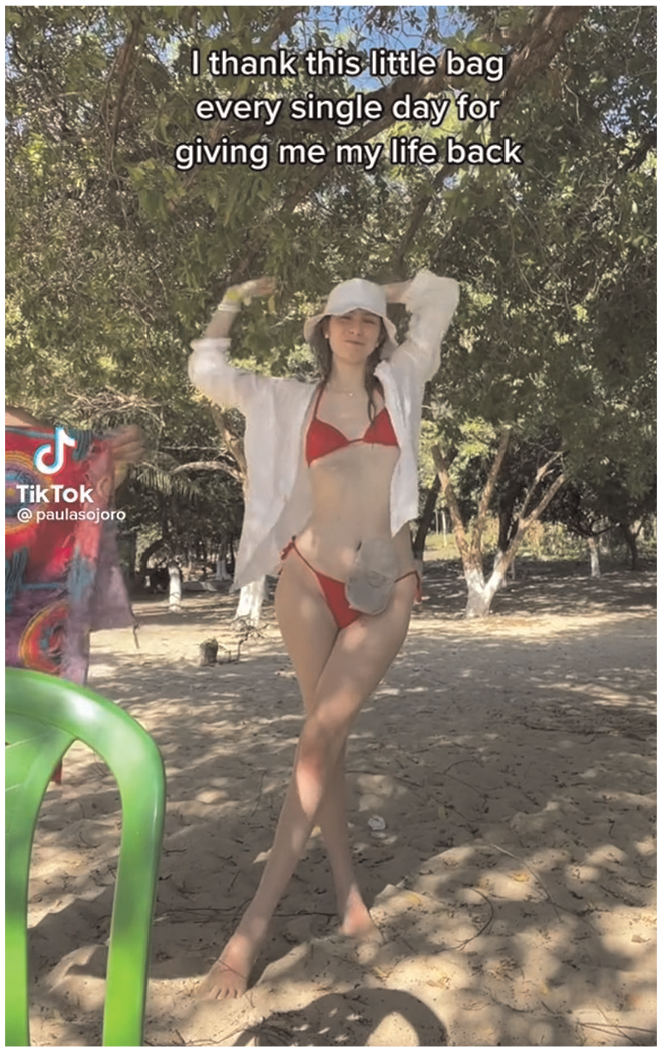
Woman in bikini with stoma bag visible (screenshot from video 56).
Other creators were keen to dispel the myth that ostomates cannot exercise properly due to restrictions placed by the stoma. One creator posted images of herself performing challenging pole-dancing and yoga poses with her stoma bag fully visible, stating she wanted to ‘defy all the odds and prove the doctors wrong by returning back to dance’ (video 40). Within these images, the creator evokes a sense of pride in her body and its achievements, despite the challenges she faced. Another creator posted a video of herself swimming (video 56) and a male creator posted several videos showing a toned physique, demonstrating that he clearly works out (videos 1, 22 and 50). Taken together, these videos demonstrate that stoma bags can handle physical exercise, as well as portray the creators as body positive, not hiding from others or allowing the stoma to limit them.
Discussion
Millions of ostomates are living worldwide, and despite IBD typically being diagnosed during adolescence and young adulthood (CCF, 2022), little research attention has been afforded to young adult ostomates with IBD. Most young adults frequently use various social media platforms to obtain health information (Lim et al., 2022), with many often choosing to consume content in the format of rich videos (Muliadi, 2020). To our knowledge, the current study provides the first qualitative analysis of young adult ostomates’ self-presentations on TikTok. Within the three themes of ‘demonstrations, discussions and stoma education’, ‘a physical and psychological battle to embrace a new life’ and ‘reforming stoma stigma and promoting body positivity’, creators portrayed themselves as educators, warriors and reformers, respectively. Creators offered education, guidance and support to other ostomates, and sought to challenge and reform negative stoma stigmas. They redefined what life with a stoma is like, highlighting both positive and negative aspects, but ultimately portraying that life with a stoma is worth living.
Educating audiences about stomas
The first theme, ‘demonstrations, discussions and stoma education’ demonstrated how creators portrayed themselves as educators, offering advice, knowledge and experience about a range of issues including bag changes and dietary modifications. This is an important finding because previous research notes a range of challenges that compound recovery from and adjustment to stoma surgery. These challenges include a lack of knowledge regarding stoma care (Bare et al., 2017), limited access to support from health care teams for young ostomates experiencing psychological difficulties following surgery (Polidano et al., 2021), and a need for additional education and support beyond that offered by health care providers (Cengiz and Bahar, 2017). The online creators in this study provided explicit education and advice that addressed these areas, including education on stoma and bag management, types of stoma supplies and accessories, nutrition advice and stoma complications. Such education was provided using demonstrations, as well as general discussion on stoma care and management.
The benefits provided by such stoma education on TikTok should not be underestimated. Stoma care is complex, and many of the topics discussed by creators on TikTok are considered best practice for new ostomates (Prinz et al., 2015). In addition, fostering vital stoma care skills early on in a patient’s journey can improve psychological adjustment (O’Connor, 2005; Prinz et al., 2015). The value of education provided on TikTok lies not only in the image and video-based multimedia format that is popular with young adults, but in allowing users to connect with other ostomates. Many ostomates fear stigmatisation because of their stomas, and TikTok provides the opportunity for ostomates to effectively educate themselves from the privacy of their own homes without fear of negative judgement from those around them.
Battling to embrace a new life
Within theme two, ‘a physical and psychological battle to embrace a new life’, creators portrayed stoma formation as a positive life change whilst also highlighting struggles they continue to face. Previous research has shown ostomates campaigned on behalf of other ostomates to raise awareness of stomas and IBD (Smith et al., 2017). In the current study, similar battles were presented to educate and reform negative stoma attitudes. In addition, creators in this study also portrayed themselves as warriors battling against physical and psychological difficulties associated with IBD and stomas. Creators celebrated being a warrior, wherein they successfully fought battles against their IBD and stomas and some proudly showed off their battle scars.
For many individuals with IBD, fear of having a stoma is one of their main concerns (Abdalla et al., 2016). The creators in the current study acknowledge this fear yet also tell a story of transformation by comparing life pre- and post-surgery. Reflecting on this journey, creators offer valuable insights into how stoma surgery alleviated a multitude of symptoms and ultimately enabled them to live a better life.
Reforming stoma stigma and promoting body positivity
The final theme saw creators challenging IBD and stoma stigma and encouraging viewers to reform any negative views they may hold about stomas, alongside promoting body positivity. Examining IBD stigma, Groshek et al. (2017) reported negative perceptions of IBD from the general population, as well as the perception that having a stoma was the most embarrassing aspect of IBD. These stigmas were also apparent in the creators’ videos in the current study. However, the creators went further by challenging these negative perceptions and improving representations of ostomates, showing that stomas do not have to interfere with everyday activities and are nothing to be ashamed of. In this way, creators portrayed themselves as reformers, offering portrayals to help normalise stomas and encourage others to see the positive side of having a stoma. This is especially important for ostomates who are often conscious of negative social perceptions proffered by the media and misunderstood by those around them (Lim et al., 2015).
Many ostomates report concerns related to intimacy and being naked (Davis et al., 2020; Manderson, 2005). In this study, ostomates addressed these issues by celebrating their appearance and clothing choices and depicting themselves engaging in exercise. These representations clearly embodied a body positivity approach, unashamedly showing off bodies with stomas and encouraging empowerment by demonstrating themselves and others can still look and feel good.
Limitations and future research
Our analysis focused on video content created by a selective range of creators on one specific website. As such, TikTok has a mantra of ‘inspire creativity and bring joy’ (Creative Review, 2023), and so ostomates wishing to portray themselves in a positive light may choose this platform over others (such as Facebook or Instagram). The creators of the videos included in the dataset were also primarily British and North American young adults. Future research is therefore needed to explore the applicability of our findings to other demographics, online platforms and stoma communities. In addition, future research could explore the effectiveness of other social media platforms in circulating health education, increasing awareness of health conditions and reducing illness stigma.
To explore the extent to which the representations documented in the current study have a positive impact on audiences, future research could include an analysis of the online comments associated with the TikTok videos, or interviews and focus groups with members of the stoma community. Health professionals working in the IBD and stoma field would also benefit from awareness of the education, support and positive representations ostomates offer on TikTok to further their own knowledge and direct patients to these sources of support.
Conclusion
This study sought to explore how young adult ostomates portray themselves on TikTok, and in doing so found that these self-representations offer substantial benefits to the larger stoma community. The video creators’ self-portrayals provide audiences with much needed education about stomas, insights into ostomates’ battles to embrace a better life with a stoma, and challenges and reformations to stoma stigma. The findings also evidence how TikTok offers an innovative platform for ostomates to represent themselves to audiences in a manner of their own choosing. Health professionals working with ostomates would surely benefit from awareness of the educative, insightful and activist practices undertaken by this online community.
Supplemental Material
sj-docx-1-hpq-10.1177_13591053241272205 – Supplemental material for Educators, warriors and reformers: A thematic analysis of how ostomates portray themselves on TikTok
Supplemental material, sj-docx-1-hpq-10.1177_13591053241272205 for Educators, warriors and reformers: A thematic analysis of how ostomates portray themselves on TikTok by Emma Butel and Craig Owen in Journal of Health Psychology
Footnotes
Data sharing statement
Data is available from the authors upon request.
Declaration of conflicting interests
The authors declared no potential conflicts of interest with respect to the research, authorship, and/or publication of this article.
Funding
The authors received no financial support for the research, authorship, and/or publication of this article.
Ethics approval
Ethical permission for the study granted from the School of Psychology ethics committee at Anglia Ruskin University.
Informed consent
There are no participants in the manuscript and informed consent is not applicable.
