



Abstract
Wales has been committed to receiving asylum seekers and resettling refugees in towns and cities, and these numbers are increasing on a yearly basis. However, many people seeking asylum feel disempowered by the disabling policies of the Home Office, leading to social and economic hardship for this population. This qualitative study aimed to capture the voices of this under-served group through in-depth, semi structured interviews to gain contextual understanding of the social and psychological challenges experienced by people seeking asylum in Wales. The findings suggest that many asylum seekers and refugees relied on their social support networks to compensate for the limited welfare offered to them by the asylum system. Changes to the asylum process and policies are needed for Wales to achieve its goal of ensuring that people seeking asylum are supported to rebuild their lives and make a full contribution to the Welsh society.
Introduction
Global trend in forced migration has fuelled an increase in the number of people seeking asylum in the United Kingdom (UK). In the year ending June 2023, there were 78,768 asylum applications, a 19% increase from the previous year (Refugee Council, 2023). Many of the people seeking asylum in the UK come from countries that are engaged in armed conflict, war, human rights abuses, religious, ethnic or political persecutions (Allsopp et al., 2014; James, 2021). In 1999 the Home Office established the National Asylum Support Service (NASS) to manage the dispersal of asylum seekers across the UK. NASS is a section of the UK Visas and Immigration division of the Home Office and is responsible for supporting and accommodating people seeking asylum while waiting for the processing of their applications (UK Visas and Immigration [UKVI], 2022). The 1951 Geneva convention defines a refuge as a person forced to leave his or her home country due to ‘fear of being persecuted for reasons of race, religion, nationality, membership of a particular social group or political opinion’ (United Nations High Commissioner for Refugees, 1951). The current process to stay in the UK as a refugee is as follows: on arrival in the UK, an individual applies for asylum to be granted refugee status and wait for their claim to be processed (UKVI, 2022).
Wales is one of the UK’s four dispersal nations; the Welsh Government is committed to receiving asylum seekers and resettling refugees across Wales and aspires to be a ‘Nation of Sanctuary’. This term depicts ‘a movement of welcome’ that encourages social inclusion, compassion and celebration of the contributions that asylum seekers and refugees make to life in Wales (Welsh Government, 2019). In 2019, the Welsh Government published it’s ‘Nation of Sanctuary – Refugee and Asylum Seeker Plan’ which outlined actions aimed to ensure that refugee and asylum seekers housed in Wales have access to appropriate accommodation, healthcare and advocacy services (Welsh Government, 2019). Yet, despite their ambitious asylum framework, Wales is still confined to the terms and conditions of the asylum and immigration policy of the UK Home Office.
Asylum seekers in Wales are a vulnerable group as the experience of forced migration is one that is marked by hardship and psychological trauma. Many individuals seeking asylum are escaping persecution and violence (Ekoh et al., 2023; Wachter et al., 2022) and have experienced traumatic loss and bereavement (Taylor et al., 2020; Tribe et al., 2019). As a result of such adverse life experiences, the early stages of settlement within host communities are often preoccupied with helping people find safety, stability and to regain a sense of control over their lives (Ekoh et al., 2023; Sengoelge et al., 2020; Wachter et al., 2022). Whilst waiting for asylum claims to be processed, the vast majority of asylum seekers are not permitted to work. In the absence of right to work, asylum seekers receive meagre welfare support from the Home Office. They are offered Home Office accommodation on no-choice basis and a small weekly allowance to cover the cost of food and clothing (Mayblin and James, 2019; UKVI, 2022). Restrictions placed by the Home Office on work and welfare support results in deprivation of basic needs and necessities for asylum seekers and their families (James, 2021; Mayblin and James, 2019). Recent work by Shobiye and Parker (2023) signifies that even within a ‘nation of sanctuary’ financial and psychosocial stability can be difficult to achieve. For example, the narratives of mothers seeking asylum in Welsh communities depict the UK asylum system as oppressive with dispersal policies leading to fracturing of family units. These difficulties are echoed in other studies of the lived experience of asylum seekers housed in Welsh communities, these reveal that the UK asylum system and the restrictions it enforces create a hostile environment for those seeking sanctuary (Parker, 2018, 2020).
Asylum seekers often have complex health and social needs compared to local populations. They are at greater risk of developing chronic physical illness and experience poor mental health (Aspinall and Watters, 2010; Khanom et al., 2021; Tribe, 2002). The health and social outcomes of this group reflect the complex interplay between pre-migration experiences and difficult post migration environments. People seeking asylum also have a high risk of poverty and destitution due to limited access to welfare benefits and work-related restrictions by the Home Office (Allsopp et al., 2014; Mayblin and James, 2019). These experiences, alongside racism (Parker, 2018) and limited social support networks, can lead to isolation and loneliness (Ekoh et al., 2023; Refugee Action, 2019; Wachter et al., 2022). For those whose claims for asylum have been denied the social and psychological consequences are profound. This group is referred to as refused asylum seekers because their applications have been rejected and they have no further appeal rights (Allsopp et al., 2014; Crawley et al., 2011). Although refused asylum seekers are required to leave the country, many of them do not because of concerns for their safety. To avoid any risk of being deported, many of them remain hidden and adopt survival strategies that are devoid of dignity and human rights (Crawley et al., 2011). Refused asylum seekers have no recourse to public funds which means that they will no longer receive accommodation and financial support from the Home Office for basic living costs. Many are pushed into prolonged periods of homelessness, destitution and poverty, and would rather live in these dire conditions and in constant fear of deportation than return to their country of origin. Existing evidence suggest that the period following denied claim and refusal results in sharp decline in the physical and mental health of asylum seekers, as well as feelings of rejection, exclusion, isolation and abandonment in a country where they had hoped to find safety and sanctuary (Allsopp et al., 2014; Crawley et al., 2011).
Policy makers and service providers across Wales are engaged in developing systems to support the health and social needs of asylum seekers. The Welsh Government (WG) publication of the ‘Nation of Sanctuary-Refugee and Asylum Seeker Plan’ sets out the strategy that aims to support the integration of asylum seekers and refugees in Wales and make full contribution to Welsh society (Welsh Government, 2019). The actions in the document align to the themes and priorities of National Strategy for Wales and the goals of the well-being of Future Generations (Wales) Act 2015, which collectively underpin the approach of WG to tackling inequality and ensuring a fairer Wales. To ensure that it can be realised, Wales’ ambition to become a Nation of Sanctuary will need the support and engagement of key stakeholders, such as Welsh local authorities, refugee community support organisations, charities, Welsh communities, refugees and asylum seekers. This study aimed to add to the growing body of literature on the lived experiences of asylum seekers and refugees in Wales. The study captures the voices of this under-served group through in-depth, semi structured interviews to gain contextual understanding of the social and psychological challenges experienced by those seeking sanctuary in Wales.
Methods
Design, sample, recruitment and ethics
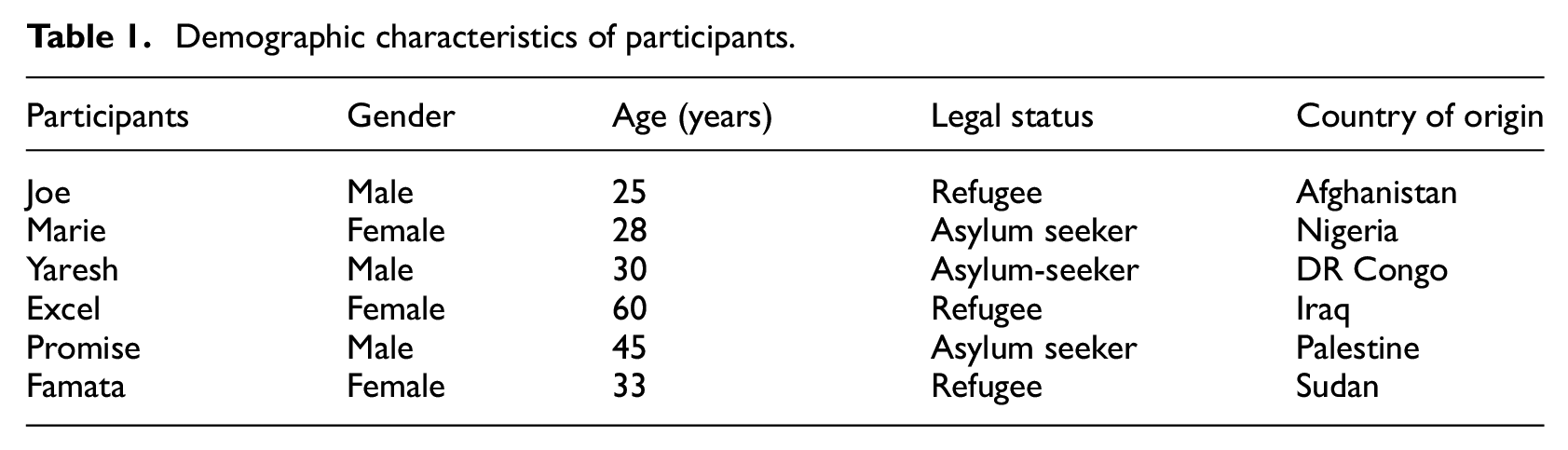
The researchers of this study gained ethical approval from their home Higher Education Institution’s ethics committee. As a qualitative approach was employed, purposive sampling was used to recruit a total of six participants (three males and three females) identified through a Welsh refugee community-based organisation (RCO). The eligibility criteria stated that participants needed to be asylum seekers or refugees, aged 18 years and above and live in Wales for at least 6 months while claiming asylum. As interviews would be conducted in English, recruitment materials outlined that participants would need to have sufficient English language skills to enable them to discuss their experiences during the interview. Table 1 outlines key characteristics of participants; individuals originated from six different countries (i.e. Middle East (n = 3) and Africa (n = 3)). The age of participants ranged from 27 to 60 years. All the participants had lived in Wales for more than 6 months and spoke conversational English. Participants were given the option to receive study information in their first language, however all participants choose to provide consent in English.
Demographic characteristics of participants.
Data collection and analysis
Data was collected using in-depth, semi-structured interviews. The topic guide was informed by current literature on the experiences of asylum seekers and refugees in the UK, and WG policy documents on refuge integration in Wales. Open-ended interview questions focused on the experiences of the participants since they were dispersed to Wales, livelihood opportunities, including access to work, education, training, health and social care and access to social support networks. It also covered strategies adopted to cope with the challenges of resettlement (social and economic hardships) in Welsh communities. Interviews were conducted in a quiet room on the premises of the RCO. Prior to the interview the researcher explained the purpose of the study to the participant and ethical issues of confidentiality, anonymity, data storage and the right to withdraw. Written consent was obtained from all participants and discussions were recorded using digital voice recorder. Pseudonyms were assigned to participants to remain anonymous.
Interviews were transcribed verbatim (MW) and analysed using a thematic analysis (MW) as outlined in Clarke and Braun (2017). Secondary coding was completed by the research team (MW, CHS, CG). Any discrepancies were discussed and resolved by consensus to reach the final themes.
Results
The analysis of interviews illustrated three main themes related to the lived experience of seeking asylum in Wales (Figure 1); each of these themes will be discussed below.
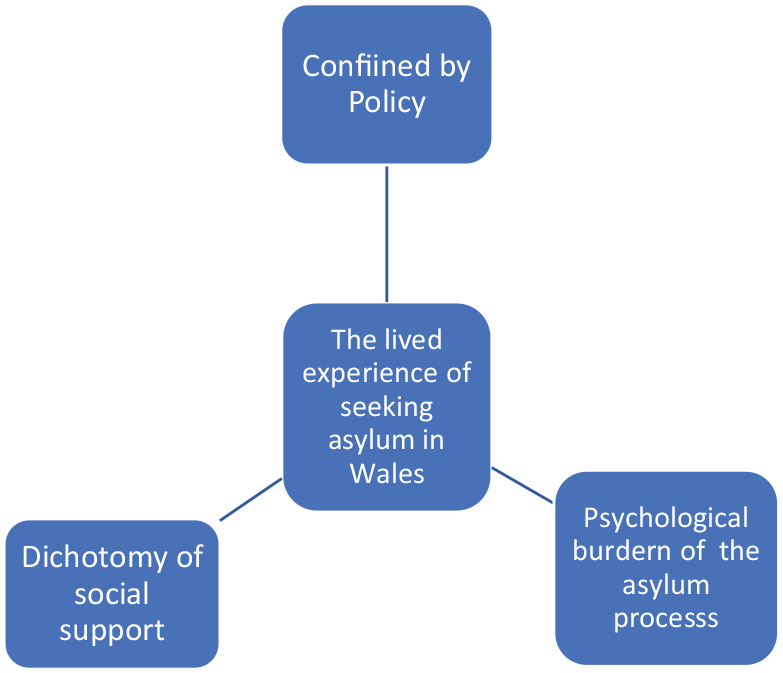
Thematic map.
Confined by policy
Words such as ‘rejection’, ‘restriction’ and ‘control’ were used to depict experiences of seeking asylum in Wales. These descriptions of navigating the asylum system are a stark contrast to the vision of a ‘movement of welcome’ proposed by the Welsh Government (2019). The legal processes involved with claiming asylum were perceived to be overly stringent and harsh. Most individuals interviewed had experienced initial rejection of their claim and had navigated the appeals process several times:
So, you have to come back again, try to go for an appeal and appeal it. Political decisions, you have to face trying to come back to go to court again, for the tribunal So, you have been through it., I can say myself, it’s a difficult situation to be an asylum seeker in the UK. It’s not easy at all. (Yaresh, male, 30 years)
When waiting for an asylum claim to be granted individuals do not have permission to work. Being unable to provide an income for themselves and their families was viewed as disabling. The following quote illustrates the impact that work-related restrictions had on the self-worth of Joe who considered unemployment to be a maker of low social value. He feared that being unable to work would lead to him being rejected by the host community:
I cannot work and I cannot do this, and I cannot do that. These people will think, what can I do? (Joe, male, 25 years)
Asylum seekers are dependent on support and financial handouts from the Home Office. Participants thought that the financial support received from the UK government was grossly inadequate and did not cover the cost of daily living in Wales. Constrained sustenance and housing insecurity were common; the following quote from Marie illustrates how restricted welfare support can lead to feelings of instability and a loss of autotomy over daily living: The government decides how your life should go. So, it’s not like I have the full things about my life. It’s like I’ve given control of my life to the government. Food was really tough for me. In order to eat. Sometimes I have to neglect myself, my clothes…. Anything for me to get food. …, yeah, like everything in my life is that you think I’m vulnerable right now. So they get to decide what you wear, what you eat, because you can’t eat, won’t eat… the food you really, really want to eat. You have to eat the food that’s your income can provides. (Marie, female, 28 years)
The perception that the asylum system created vulnerability was also reflected in how participants discussed settlement within Wales. Participants described the accommodation provided by NASS to be chaotic and transient:
In their eyes you are homeless, and you will take anything so they can move you and say, that’s the only available house we’ve got. That’s what you’ve got to take. So, again, any materials, any links, any support that you have, your kind of leaving that behind and you’re constantly starting afresh (Joe, male, 25 years).
At the time of interview three participants had been successful in their claims for refugee status; however, once this is awarded it is mandatory for individuals to vacate Home Office funded accommodation within 28 days. Participants were expected to source their own accommodation, and the immense difficulty in achieving this means created risk of homelessness. The following quote reflects on the ongoing challenges faced in finding stability even after refugee status has been granted:
The landlord asked for documents. I cannot provide a passport. I cannot provide a guarantor. And then they ask you for a guarantor. So, I mean, it’s difficult …. then you cannot rent a flat. (Joe, male, 25 years)
The experiences outlined above illustrate how immigration and asylum policies designed to enable asylum seekers to gain sanctuary in Wales were often viewed as disabling, hindering individual’s ability to fulfil their basic needs.
Psychological burden of the asylum-seeking process
In the following quote, a female participant described the psychological impact of the asylum claim process. As a pregnant, unaccompanied woman in a foreign country with no source of social support, the unpredictability of the situation and the expectation that Home Office officials could come at any time of the day or night to deport her was traumatic:
I’ll be at home 5:00 in the morning. Immigration officer will just go and knock up my door. How are you? Your tickets…. have been booked. You need to go back. So that happened to me twice … I cried the whole day I mean, me being pregnant, there’s no partner there. There was no one. … So, I just was following them alone. (Famata, female, 33 years)
Amongst those interviewed, the ongoing threat of deportation and the likelihood of being relocated during the asylum process was perceived as a barrier to forming meaningful social connections in Welsh communities. The Psychological impact of this is demonstrated by Marie’s quote: It wasn’t easy to deal with the rejection (denied asylum claim) at all. I was so devastated. I don’t even know where to start with my life. . …so I, I had to pack and then I googled it. I saw Cardiff, you know, I was a kid. I came here, I was living in a hotel, and I think I got lucky…moving and moving and moving. And right now, I think I’m move like nine times… …. It wasn’t permitted to become friends because they keep moving you. So, the moments that connect with someone, they move you, they switch with other people. And so it’s psychologically draining. (Marie, female, 28 years).
These experiences contributed to the feeling of living in an often traumatised and uncertain stage likened to a ‘limbo’. The psychological impact of this trauma was described by two participants:
Well, sometimes I feel bad. I umm really feel very bad. I am waiting a very long time, say more than 10 years. I think I am silly for this waiting long time. Some things empty, leaving me to feel bad and no sleep for past days. Everything missing me a little is probably for me. Just sleep a little and come back for interview and they would ask me every day. I google tablets for sleep. Sleep for me. This is very, very difficult. (Yaresh, male, 30 years).
Yeah, I’ve heard of people that ended their lives, just because they’re tired of waiting. Just because the government doesn’t believe cases or because people are miserable. People are miserable. People are just. I feel like crying now. (Excel, female, 60 years).
Dichotomy of social relationships
Despite the perceived challenges to integration some participants described how they had established a network of social support within their new host communities. Such relationships were often based on proximity, reciprocity and exigent circumstances: …. like fortunately, I’ve grown many friends and I found places really helpful in terms of finding many good friends
She was the only one I used to interact with, you know, she was the only friend I can make at that time. (Famata, female, 33 years)
Individuals described how they shared resources such as food, shelter and material provisions in their social networks. Social networks were formed with ‘local people’ in the host community; these relationships were valued as demonstrated in the following quotes:
These people who are really kind and helpful. (Joe, male, 25 years)
They do everything for me, by saying we treat people very good. So that for me is a good thing. (Promise, male, 45 years).
However, in contrast some participants described a dichotomy in terms of social support. Whilst there were apparent positive aspects participants also drew attention to negative elements to the support given. For Yaresh support gained from his local community made him feel like a burden, which fuelled a sense of shame:
You are seen in the society like somebody who is not good enough to look after himself. (Yaresh male, 30 years)
In addition, Marie described negative aspects of social relationships that had led to physical and psychological exploitation:
My initial accommodation, I lived with a Cameroonian person she bullied me constantly… So there were times where I was just always crying, you know, I was just always crying. So, imagine being in that situation coming from a lot and then you find yourself in situations like that. (Marie, female, 28 years)
Support networks also included refugee community-based organisations (RCOs), faith-based organisations, charities and non-governmental organisations (NGOs). These organisations were often the first port of call when individuals needed support with daily living. One participant talked about how he valued the practical support received:
To be honest, charities, churches ran a very positive end to my solution. They helped me out a lot. They were doing things that I didn’t expect. So they’re positively giving me hope. … Provide things like groceries So, they used to help me a lot. (Yaresh, male, 30 years)
Some of the organisations provide English for Speakers of Other Languages (ESOL) classes, offer voluntary workplaces and skills development courses. All the organisations provide physical spaces for social and cultural gatherings that facilitate social network creation:
I’ve grown many friends and I found (NGO) really helpful in terms of finding many good friends …. I’m doing voluntary work; through these things I was able to make friends. My new network. (Joe, male, 25 years)
The above describes the dichotomous nature of social support experienced by asylum seekers. The lived experiences of the participants of this study provide evidence of the convoluted and restrictive control of the UK asylum system which traps people for protracted period during which they are denied the right to work and given minimal access to welfare support. The informal networks of asylum seekers and refugees such as other asylum seekers, local people and third sector organisations supplemented the welfare support from the Home Office which is delivered independently of the income support payments made to unemployed UK citizens.
Discussion
This exploratory study provides insight into the experiences of people seeking asylum in the UK and dispersed to Wales, a devolved Nation of Sanctuary. Participants in this study were asylum seekers or refugees who had been residing in Wales for at last 6 months whilst claiming asylum. The social support networks of these participants supplemented the shortfalls between welfare provided and personal needs and were made up of friends, local people and third sector organisations. These experiences are consistent with findings from a recent systematic review which highlighted the important role of supportive relationships with peers, and local friends have in mitigating poverty risk during the asylum process (Wells and Seage, 2023).
Although the social support networks in this study were valued by participants, over reliance on welfare support from such networks can contribute to feelings of disempowerment, and the transactional nature of relationships can put people at risk of exploitation (Allsopp et al., 2014; Crawley et al., 2011; James, 2021; James and Forrester-Jones, 2022). Within the interviews, there were several examples where participants described their hesitancy about receiving support from ‘others’ or had experience of negative relationships within the host community. This suggests that it may be challenging to develop secure relationships within their networks despite such relationships being integral to social inclusion and enabling them to meet their basic needs.
Semi-formal networks of NGOs, RCOs and faith-based organisations were another important source of welfare support for participants in this study. These networks were set up to support asylum seekers in local communities across Wales and responded to the social and welfare needs of participant by providing informational support and access to food and household necessities. These organisations were often significant in developing people’s language skills, as they provided access to volunteering opportunities, education but also provided a physical space for social gatherings. Engagement with such organisations can promote psychological wellbeing and help to establish integration within local communities, by providing meaningful opportunities and agency over daily activities (Cheung and Phillimore, 2014; Gericke et al., 2018; Lindsay et al., 2010; Sengoelge et al., 2020).
These positive social experiences with the third sector organisations in Wales formed a stark contrast to the deterrence nature of the immigration and asylum policies of the Home Office. Participants had experienced a lengthy waiting period for decision on their asylum claim where they faced an ongoing threat of detention and deportation. The experiences documented within this study depict the process of seeking asylum in the UK as one which constrained daily living, placing restrictions on work activities and geographical movement. Living under ongoing restrictions led to feelings of loss of control and agency. Across the UK, the waiting time for decision on asylum applications has increased substantially; the Refugee Council (2020) reported a 68% increase in the number of decisions on asylum claims that had lasted more than 6 months. Some participants in this study had experienced a wait of more than 7 years for a decision on their asylum claim. During this waiting period individuals found themselves in a legal and social limbo as they endured the ongoing threat of deportation. Research has shown that lengthy asylum claim processes can compound trauma and further disadvantage individuals who are already psychologically vulnerable (Gericke et al., 2018; James, 2021; Tribe et al., 2019).
In this study, participants had struggled with the impact of work-related restrictions. Not being able to gain employment within their new host community was a shared source of stress and worry. Prior research has demonstrated that the prohibition of employment during the asylum process can negatively impact confidence and self-esteem and also inhibits social integration (Hainmueller et al., 2016; Sengoelge et al., 2020). The United Nations Development Program (2009) argues that the removal of restrictions on work for people seeking asylum in developed economies ‘is the single most important reform for improving human development outcomes for…poorer and more vulnerable migrant’ (p. 104). Asylum seekers and refugees occupy a relatively marginal position in society, are poor and often destitute, they therefore lack the social and financial capital to access affordable accommodation. Recent data from the British Red Cross Refugee Servicers shows that 50,000 refugees are at risk of homelessness by the end of the year 2023 (British Red Cross, 2023). Adequate housing is an essential factor for the successful reception, resettlement and integration of asylum seekers and refugees in the host community. As findings from the current study illustrate, it is also a crucial factor for establishing social networks. This supports the existing literature on the wider value of habitat for inclusion of asylum seekers in Wales (Parker, 2023).
Conclusions
The qualitative approach to data collection and analysis used in this study elicited rich accounts of the lived experiences of seeking asylum in Wales and adds to the existing research in this area. All participants spoke conversational English to a good standard and were able to reflect on their asylum journeys without assistance of a translator. It is important to recognise that this approach to data collection will have limited the accessibility of the study to non-English speakers. Although all participants in this study had sought asylum in a large city which had several organisations set up to support the asylum process, it is important to recognise that the experience of seeking asylum is nuanced with individual having diverse reasons for fleeing their country of origin, varied resources on arrival in the host country and will be housed in different post migration environments.
The research provides insight into the lived experiences of an underserved group and highlights the social and psychological challenges that arise whilst navigating the asylum process. These findings, complement existing research highlighting the multifaceted and complex situations that many people seeking asylum experience. A contribution of this research are the findings that illuminate the dichotomous nature of social relationships. Social support networks of the participants often compensated for the limited social welfare offered to this group. However, reliance on social networks could be unsustainable as the resources provided by these networks can be unevenly distributed and are subject to flux (Devereux, 2019; James, 2021; James and Forrester-Jones, 2022). Arguably, state social protection, which is defined as the set of public policies and actions deemed necessary to empower poor and vulnerable people to escape poverty and ensure social justice for all (Organisation for Economic Cooperation and Development, 2009; Roelen and Devereux, 2013), remain elusive for this group of asylum seekers. Changes to the asylum process and policies are needed for Wales to achieve its goal of ensuring that people seeking asylum ‘are supported to rebuild their lives and make a full contribution to Welsh society’ (Welsh Government, 2019: 2).
Footnotes
Acknowledgements
The authors would like to acknowledge the British Academy for providing funding for this project.
Author contributions
MW and CHS: conceptualisation and fund acquisition. MW: investigation and formal analysis. MW, CG and CHS: review and define emerging themes; review and edit draft manuscript.
Data sharing statement
The data generated during and/or analysed during the current study are not publicly available due to the sensitivity of the interviews but are available from the corresponding author on reasonable request.
Declaration of conflicting interests
The authors declared no potential conflicts of interest with respect to the research, authorship, and/or publication of this article.
Funding
The authors disclosed receipt of the following financial support for the research, authorship, and/or publication of this article: This project is supported by the British Academy Postdoctoral Fellowship [PF21/210064].
Ethics approval
The study received full ethical approval from the Ethics Committee of Cardiff Metropolitan University on 4th February 2022 (Ethics Reference Number: Sta. 5277).
Informed consent
Written consent was obtained from all participants
