




Abstract
Previous research on health information seeking has primarily focused on individuals’intentions to seek or avoid information. However, limited empirical evidence exists regarding the actual behavioral patterns of information-seeking and non-seeking. To address this, we conducted a survey experiment manipulating cognitive load with mostly Belgian participants (N = 359). By integrating self-report and behavioral data, we investigated motivations and conditions associated with information (non)-seeking behaviors on a healthy diet. Guided by the risk information seeking and processing (RISP) model, we examined the roles of informational subjective norms and information insufficiency, as well as the moderating role of cognitive capacity. Neither informational subjective norms nor information insufficiency significantly correlated with information-seeking behaviors. However, a significant interaction between the predictors and cognitive capacity in predicting non-seeking behaviors was observed. These findings underscore the intricate nature of individuals’ behavioral patterns in seeking or not seeking information about healthy eating.
Keywords
Unhealthy food consumption poses significant risks to human health (Chamberlain, 2004; Darling et al., 2017; Fuhrman, 2018). Fortunately, the promotion of healthy eating as a public health goal has gained widespread acceptance. Institutions, corporations, and scholars actively advocate for better dietary choices and research effective ways to disseminate information on a healthy diet (Balcetis et al., 2020; Gorski and Roberto, 2015; WHO, 2020). Despite these collective efforts, health messages encounter challenges in achieving adequate exposure, which is considered a prerequisite for adopting health-related lifestyles (Hornik, 2002; Knobloch-Westerwick and Sarge, 2015; Moldovan-Johnson et al., 2014). This difficulty often stems from individuals lacking the motivation or capacity to engage with such information. Consequently, a more in-depth investigation is essential to understand how and under what conditions individuals seek or do not seek health-related messages (Kessels et al., 2010; Lewis et al., 2021).
The exploration of health information seeking has received significant attention from researchers in recent decades (Anker et al., 2011; Jacobs et al., 2017; Wang et al., 2021). One key conceptual framework is the Risk Information Seeking and Processing (RISP) model (Griffin et al., 1999, 2013) which aims to explain how individuals seek and process risk information. The RISP model has been applied across different health-related topics including the use of antibiotics (Zhou et al., 2020), the COVID-19 pandemic (Zhou et al., 2023), clinical trial enrollment (Yang et al., 2010), and obesity (Choi and Noh, 2021). In the RISP model, information-seeking behavior is conceptualized as the deliberate, intentional pursuit of further knowledge, as well as the more casual skimming of messages and accidental observations and encounters (Griffin et al., 2013).
Despite the considerable attention given to health information seeking within the RISP model and the broader health literature, two noteworthy gaps persist. Firstly, current research heavily relies on self-reported data, predominantly focusing on information-seeking intentions rather than actual behaviors (Hovick et al., 2014; Reifegerste et al., 2020; Yang et al., 2014). Typically, this variable is measured using self-reported Likert scales including statements like “When it comes to [this topic], I am likely to go out of my way to get more information” (Kahlor, 2007). However, it is essential to recognize that the presence of intentions does not guarantee their translation into actions, as highlighted by the intention-behavior gap (Faries, 2016; Sheeran and Webb, 2016). Thus, there is a pressing need for more behavioral data in the study of information-seeking.
Secondly, only limited research has delved into non-seeking behaviors as a counter to information-seeking (Kim et al., 2020; Link et al., 2022; Manheim, 2014). While information avoidance has received increasing attention (Chae, 2016; Deline and Kahlor, 2019; Soroya et al., 2021; Yang and Kahlor, 2013), our study emphasizes information non-seeking—a broader concept encompassing avoidance, along with unintentional behaviors such as ignoring and disregarding. It encompasses various additional strategies like satisficing, terminating, narrowing, or filtering information seeking, all leading to the same outcome as avoidance: the decision not to actively seek information (Manheim, 2014; Miller, 1960). For instance, premature satisficing often leads to the premature termination of information seeking, resulting in incomplete knowledge about the topic (Prabha et al., 2007). These broader and less deliberate behaviors can also contribute to a lack of awareness about unhealthy lifestyles (Buchanan and Nicol, 2019).
To address these gaps, our study gathered behavioral data to simultaneously examine both information-seeking and non-seeking behaviors. Guided by the RISP model (Griffin et al., 1999, 2013), we conducted a survey experiment (N = 359) to assess the motivations and conditions linked to information (non-)seeking behaviors regarding a healthy diet. Instead of relying on self-reported ratings to measure behavioral intentions, we unobtrusively captured actual information (non-)seeking behaviors to ensure a more objective measurement approach.
The motivations in health information (non-)seeking behaviors
Previous research has identified various antecedents that influence information-seeking (Afifi et al., 2006; Johnson and Meischke, 1993; Kahlor, 2010), including two critical motivators highlighted in the amended RISP model: informational subjective norms and information insufficiency (Griffin et al., 2013; Yang and Liu, 2021).
Informational subjective norms refer to an individual’s inclination to seek information based on the expectations of significant others (Yang and Liu, 2021). Similar to how individuals’ choices regarding healthy food, such as green and organic options, are influenced by subjective norms (Al-Swidi et al., 2014; Bai et al., 2019; Ham et al., 2015; Tarkiainen and Sundqvist, 2005), informational subjective norms act as a driving force for information-seeking behavior (Liu et al., 2022). This motivation arises from the human tendency to conform to social norms and secure social acceptance, resonating with the concept of impression motivation in earlier research (Eagly and Chaiken, 1993). Multiple studies showed that people are more likely to actively seek information when they perceive strong informational subjective norms within their social circles (Kahlor, 2007; Lu, 2015; Lu et al., 2020; Zhou et al., 2020). For instance, Chinese international students are likely to seek information about potential health risks associated with American-style food, influenced by the prevailing norms in their social networks (Lu, 2015). Similarly, a nationally representative survey of U.S. adults showed a positive link between informational subjective norms and the intention to seek information about the influenza vaccine during the 2018–2019 influenza season (Lu et al., 2020). Another study, involving randomly selected members of a U.S. national panel, demonstrated an increased inclination to seek information about global warming when participants felt an expectation to do so (Kahlor, 2007). Conversely, lower expectations from peers or influential individuals about how much one should know about a topic reduces pressure coming from such informational social norms. This, in turn, can lead to a decreased motivation to actively seek information on the issue for some individuals, and others might even choose to avoid the topic entirely. For example, greater informational subjective norms were found to be positively related to information-seeking intentions and negatively related to information avoidance regarding antibiotic use and climate change (Kahlor, 2007; Zhou et al., 2020).
In addition to informational subjective norms, information insufficiency plays a significant role in motivating information-seeking behaviors (Griffin et al., 2013; Yang and Liu, 2021). Information insufficiency refers to an individual’s subjective sense that one’s current knowledge is not sufficient to cope with a given risk (Griffin et al., 2004, 2008, 2013). Several studies showed that when individuals experience a heightened level of information insufficiency, they tend to actively seek more information and at the same time, are less likely to avoid information about the topic. For instance, in two South Korean online panel surveys, one concentrated on smoking cessation (Noh et al., 2016) and the other on obesity (Choi and Noh, 2021), along with a study involving Chinese adults examining COVID-19 (Li and Zheng, 2022), a consistent finding was the positive correlation between information insufficiency and the intention to actively seek more information. This correlation was identified through self-reported scales in these studies. On the flip side, a lack of information can be linked to a decreased likelihood of not seeking it. Research indicates that the more someone perceives a lack of information, the less likely they are to avoid information (Deline and Kahlor, 2019; Dunwoody and Griffin, 2015).
Cognitive capacity in health information (non-)seeking behaviors
Whether and how people seek information is closely tied to individuals’ existing capabilities (Griffin et al., 2004, 2013). Prior research on the RISP model has suggested that information-seeking behavior could be influenced by an individual’s perceived information gathering capacity (Griffin et al., 2013; Yang and Zhuang, 2020). This capacity reflects an individual’s belief in their ability to perform the information-seeking and processing steps necessary for achieving their desired outcome (Griffin et al., 2013). Despite its significance, prior research has not thoroughly explored its role in these behavioral patterns, and the measures of this variable require further development and refinement (Bullock, 2023; Griffin et al., 2013).
Notably, there is a growing interest in understanding capacities related to information behavior, extending beyond communication research to disciplines such as psychology and information science (Kruglanski et al., 1993; Lang, 2006; Manheim, 2014; Reinhard and Sporer, 2008). Cognitive load manipulation, especially its influence on the residual cognitive capacity of an individual, has garnered significant attention across diverse domains, such as consumer psychology, learning sciences, and government research (Deck and Jahedi, 2015; Gawronski et al., 2017; Kirschner et al., 2011; Shaffer, 2017). Importantly, cognitive capacity is closely intertwined with an individual’s decision-making tendencies. For example, empirical research on consumer behavior revealed that when individuals are faced with limited processing resources, they tend to prefer indulgent options, such as chocolate cake, over healthier alternatives like fruit salad (Shiv and Fedorikhin, 1999). The challenge of sticking to healthier dietary intentions becomes more prominent when cognitive capacity is constrained. Similarly, Gawronski et al. (2017) found that cognitive load manipulations influence judgments on moral dilemmas by increasing participants’ general preference for inaction. Specifically, in conditions of high cognitive load, participants were less inclined to take action in moral dilemmas where a proscriptive norm prohibits action, even if taking action would lead to better consequences for a larger number of people. In such situations, individuals in high cognitive load conditions tend to rely on shortcuts rather than deeply considering what is good for them or the specific situation. Consequently, cognitive capacity plays a significant role in shaping choices and decisions.
Particularly in today’s high-choice information environment, larger sets of informational choices prompt users to only quickly scan their information environment instead of carefully weighing in all available options (Panek, 2016). Moreover, individuals also tend to remain rather inactive and avoid making, for example, moral decisions when their cognitive load is high (Gawronski et al., 2017). However, it remains unclear how this finding translates into the context of information-seeking about a healthy diet. In light of these considerations, our objective is to connect the literature on the RISP model with research on the available cognitive capacity from related fields, specifically how low cognitive capacity (i.e. under the condition of high cognitive load) translates into information-(non-)seeking behaviors.
Investigating interaction effects: Motivations, cognitive capacity, and health information (non-)seeking behaviors
Previous research on the RISP model has emphasized the situational aspect of information-seeking behavior and highlighted the potential moderating role of information-related capacity (Griffin et al., 2013). While some empirical studies have explored the moderating effects of perceived information gathering capacity on motivations in information-seeking behaviors, consistent confirmation of this hypothesis has remained elusive (Clarke and McComas, 2012; Hwang and Jeong, 2020; Zhou et al., 2020). Nevertheless, this does not conclusively negate this theoretical possibility, as measures of this variable require further development (Griffin et al., 2013).
Cognitive capacity, a crucial information-related capability, plays a moderating role in navigating the influence of motivations and their associated outcomes (Bar-Tal et al., 1999; Kruglanski and Webster, 1996; Pelham and Neter, 1995; Roets et al., 2008). For example, Pelham and Neter (1995) observed that heightened levels of motivation enhance the accuracy of simple judgments but diminish the accuracy of complex ones, with the perceived difficulty of judgments intricately linked to an individual’s cognitive capacity.
Social norms, as a source of motivation, can impact decision-making, especially considering differences in individual cognitive capacities. An empirical study on adolescent drinking revealed that varying cognitive capacities influence how individuals perceive and respond to social norms (Meisel et al., 2015). This connection may stem from the fact that social norms require reflective deliberation on behavior’s social acceptability, a process that can be constrained by cognitive capacities (Cialdini, 2003; Melnyk et al., 2011).
Applying these insights to information-seeking behaviors, individuals with higher cognitive capacity may navigate social pressures related to information-seeking more adeptly, seamlessly integrating these norms into their decision-making processes. This assumption finds support in numerous empirical studies indicating a positive correlation between informational subjective norms and information seeking (Kahlor, 2007; Lu, 2015; Lu et al., 2020; Yang and Kahlor, 2013). On the flip side, when an individual has lower cognitive capacity, they may struggle with social expectations, perceiving them as overwhelming pressures (Ozaki and Nakayachi, 2020; Richter et al., 2018). The fear of falling short of meeting expectations can induce reluctance, ultimately hindering desired information-seeking behaviors. Previous studies implicitly support this notion by revealing a positive association between informational subjective norms and the avoidance of climate change information (Yang and Kahlor, 2013). Consequently, the impact of informational subjective norms on behavior manifests as a complex interplay that extends beyond initial expectations (Kahlor et al., 2006).
Similarly, the relationship between information insufficiency and information-seeking behaviors can be complex. People with varying cognitive capacities may react differently to their information insufficiency. When individuals have higher cognitive capacity, they show greater adaptability and curiosity when faced with a lack of information (Kidd and Hayden, 2015; Schutte and Malouff, 2023). They view it as an opportunity for intellectual growth, proactively seeking additional information to bridge knowledge gaps (Kakar, 1976). Conversely, when an individual has lower cognitive capacity, they may struggle to integrate new information into their existing knowledge, leading to a preference for seeking less or avoiding it due to the perceived mental demands and achievability concerns (Loewenstein, 1994; McCall and McGhee, 1977: 193).
Reflecting all the evidence presented in the literature review, we propose the following hypotheses:
H1: Informational subjective norms regarding healthy eating will (a) positively correlate with information-seeking behaviors and (b) negatively correlate with information non-seeking behaviors.
H2: Information insufficiency regarding healthy eating will (a) positively correlate with information-seeking behaviors and (b) negatively correlate with information non-seeking behaviors.
H3: Low available cognitive capacity will (a) negatively correlate with information-seeking behaviors and (b) positively correlate with information non-seeking behaviors.
H4: Cognitive capacity moderates the relationship between informational subjective norms and (a) information-seeking behaviors and (b) information non-seeking behaviors.
H5: Cognitive capacity moderates the relationship between information insufficiency and (a) information-seeking behaviors and (b) information non-seeking behaviors.
Method
Participants
Our online survey experiment employed a snowball sampling approach, which began with initial recruitment within credited university classwork and subsequently expanded to include participation from the public. A total of N = 392 participants 18 and older were recruited to participate in this study. Excluding n = 33 participants who failed the manipulation check (typing in a specific number; n = 22), reported unrealistic information (n = 2), or exceeded the maximum time of 300 seconds (5 minutes) during the information-seeking task (n = 9), 1 the final sample was N = 359. Of the final sample, 199 self-reported as female (55%) and 160 as male (45%), with an average age of M = 29.04 years (SD = 13.02; range: 18–77 years). Based on their self-reports, more than half the participants (57.1%) had college or university degrees. Most of the participants were Belgian (92.8%), but 2.5% self-reported as Italian, and 4.8% as “other.” The detailed demographic characteristics of the sample have been attached to the online supplemental Appendix A. The local university IRB board approved this study under approval number G-2018031185.
Procedure
Our study combined each individual’s self-reported data with behavioral data from browsing patterns to model actual information (non-)seeking behaviors. Specifically, first, the participants were informed that they would be participating in an academic study on food and healthy eating that required filling out a survey on their computers, not a smartphone or tablet. They were also instructed to do their best to complete the questionnaire without any interruptions. After obtaining informed consent from the participants, they were directed to complete the first section of the questionnaire. This section aimed to gather baseline information, encompassing demographics and variables related to healthy eating and food, including information insufficiency. We assessed information insufficiency before the information-seeking task as we considered it a context-dependent variable in our study, which might be alleviated by the subsequent information-seeking process. This is also in line with conceptualizations and empirical investigations of the RISP model where insufficiency is typically measured before the information-seeking intentions (Liu et al., 2022).
Subsequently, they were guided to our information-seeking task. This task is structured following the design principles of selective exposure research (Jang, 2014; Knobloch-Westerwick and Meng, 2009; Knobloch-Westerwick and Sarge, 2015), employing an unobtrusive approach to observe patterns in information-seeking and non-seeking behaviors. Specifically, after presenting the numbers for both groups of participants (see the paragraph on Manipulation: Cognitive Load below), they were guided to the following instructions:
By clicking on the link below, a new window will open, in which you can see the news website. This window will close automatically after 5 minutes and you will automatically reach the second part of the survey questionnaire. If you want to leave the news website before the reading time of 5 minutes has elapsed, simply close the browser window with the website and return to this page. You will then find a ‘Continue’ button here on this website that leads you to the second part of the questionnaire.
Read on the news website just like you would normally do, but remember, you only have 5 minutes and will not be able to read all the articles.
Please open the link below now.
After clicking on the link at the bottom of the instructions, they were guided to a web magazine titled Foody. This website comprised an overview landing page, which led to a total of eight news articles related to healthy eating (see online supplemental Appendix B). On this landing page, participants were shown eight similar article images, each accompanied by a concise headline and teaser of standardized length, accessible through clicking. The order in which these eight articles were presented on the landing page was randomized to eliminate any potential order-of-presentation effects on article selections (Eisenberg and Barry, 1988). Furthermore, the images were made as similar as possible to prevent bias based on visual preferences in article selection (van Beusekom et al., 2016). Additionally, these news articles were sourced from various news outlets and were edited to ensure a consistent length of around 800 words.
During the information-seeking task, the participants were free to explore the landing page, select any article for reading, and move between the landing page containing all eight articles and the complete article of their choosing. Upon clicking on either the image, headline, or teaser text of any of the eight articles, participants were directed to the full article. We utilized the “mock website” approach (Unkel, 2021) including an open-source tool (Matomo) to unobtrusively record two indicators of participant interaction with the news articles on a separate website (Leiner et al., 2016): how long each news article was viewed (in seconds) and how many news articles were selected. Notably, in line with other selective exposure studies (e.g. Knobloch-Westerwick et al., 2020), participants were given a maximum of 5 minutes to browse the web magazine but were also allowed to stop reading at any time before the time limit expired. However, it was made clear to them that they may not be able to read all the material within the 5-minute timeframe. Regardless of whether participants exceeded the given time limit or chose to stop reading earlier, they were automatically directed to the second part of the survey.
In the second section, participants answered questions on attention and manipulation checks, as well as some other variables related to healthy eating including informational subjective norms. To mitigate potential priming effects or unintentional manipulation, we strategically placed the measurements of this variable after the information-seeking task. Research has shown that subjective norms, often overestimated in their subjective relevance by individuals, are powerful predictors of information-seeking intentions (Hovick et al., 2014; Liu et al., 2022). Their impact is substantial, extending even to risks that individuals are not directly affected by Kahlor et al. (2006). Thus, to minimize the priming effects of informational subjective norms on our new measure of actual information-seeking, we captured norms after the information-seeking task. After completing the second part of the survey, participants received a debriefing and exited the study.
The answers from the two-part survey were linked with the digital trace data from the browsing patterns of each individual, allowing us to model information (non-)seeking patterns using self-reported and behavioral data.
Measures
Manipulation: Cognitive load
After completing the first section of the questionnaire, participants were randomly assigned to one of two conditions (high vs low cognitive load) to manipulate their cognitive load through task difficulty. We used a digit-memorization task similar to Gawronski et al. (2017) that had to be performed during the information-seeking task. This manipulation allowed us to investigate the effects of available cognitive capacity on information-seeking. In particular, we adopted a slightly modified version of the procedure outlined by Gawronski et al. (2017), presenting participants with either a high cognitive load condition (memorization of a 7-digit number “4768329”; n = 177) or a low cognitive load condition (memorization of a two-digit number “37”; n = 182). Participants were shown the number for 30 seconds and were instructed to remember it until the end of the survey. The manipulation of the cognitive load was intended to result in participants with different levels of residual cognitive capacity available for information seeking. The complexity of memorizing a longer number was thought to result in a lower remaining cognitive capacity for the subsequent information-seeking task as shown by Gawronski et al. (2017).
Before completing the study, participants were asked to type the memorized number—a prerequisite for inclusion in the final data analysis. To facilitate this, an open text field was employed to allow participants to input their memorized numbers. This approach differed from Gawronski et al.’s (2017) study, where they calculated a ratio of correct and incorrect answers based on a sequence of digit strings provided. In our approach, participants were asked to recall a single-digit string. Non-compliance, indicated by leaving the input field blank, also led to exclusion from the dataset (total: n = 22; high cognitive load condition: n = 19; low cognitive load condition: n = 3).
Information (non-)seeking behaviors
We utilized the “mock website” approach (Unkel, 2021) which included an open-source tool (Matomo) to unobtrusively record two indicators of participant interaction with the news articles on a separate website (Leiner et al., 2016): how long each news article was viewed (in seconds) and how many news articles were selected. A similar methodology was employed by Jang (2014) and Knobloch-Westerwick and Meng (2009) to capture selective-seeking behaviors.
Browsing time
We aggregated the browsing time for news articles (M = 86.77 seconds, SD = 80.72), excluding the time spent on the landing page. 25.3% of participants (n = 91) spent no time reading news articles.
News selections
Additionally, we aggregated the number of news selections (M = 1.48, SD = 1.32). 25.3% of participants (n = 91) did not select any news articles.
These two metrics served as indicators of information-seeking behavior. Longer browsing times for news articles and a greater number of news selections suggested a higher degree of information-seeking behavior. Conversely, a value of 0 was assigned if a participant neither selected any news articles nor spent any time on them (i.e., 0 = information non-seeking behavior). This approach, aligned with Song (2017), allows us to integrate a zero-inflated component to account for the absence of exposure to specific information. This component represents the probability (P0) of the dependent variable being zero, indicating the lack of exposure to certain information, which we refer to as information non-seeking behavior.
Information insufficiency
We assessed information insufficiency about healthy eating through the utilization of a self-report slider scale, adapted from the study conducted by Hubner and Hovick (2020). Participants were asked the single item, “How much more information would you need to reach an adequate level of knowledge about healthy eating and food?”, with responses ranging from 1 = no more information needed to 100 = a lot more information (M = 49.61, SD = 22.69).
Informational subjective norms
Four items were utilized to measure informational subjective norms, using Kahlor’s (2007) scale. These items included “People whose opinion I value would like me to be informed about healthy eating and food,”“I am expected to be informed about healthy eating and food,”“The search for information on healthy eating and food will provide me with material for discussion with others,” and “The people I spend most of my time with are probably also looking for information about healthy eating and food.” Responses ranged from 1 = totally disagree to 7 = totally agree. All items were transformed into a composite measure (M = 4.16, SD = 1.08; Cronbach’s α = 0.77).
Covariates
All models were controlled for gender (0 = male, 1 = female), education (0 = no college, 1 = any college), age (in years), cognitive load (0 = low, 1 = high), and body mass index (BMI). BMI was calculated using separate self-reported questions about the participant’s height and weight (formula: weight in kg/height in m2; M = 23.16 kg/m2, SD = 3.79).
Data analysis
We used zero-inflated negative binomial (ZINB) regression models in Stata to simultaneously analyze information-seeking and non-seeking behaviors. Digital trace data on information-seeking behavior often contain many zeroes for articles not selected or read within a specific time frame. Data on information-seeking behavior is described as over-dispersed, non-negative count data, while information-(non-)seeking behavior is reflected as an abundance of zeros. This makes Zero-Inflated Negative Binomial (ZINB) models suitable for modeling this type of data. Specifically, the ZINB models were employed to concurrently estimate a negative binomial model for information-seeking behavior and a logit model for information non-seeking behavior, using the same predictors. These predictors encompassed informational subjective norms, information insufficiency, and cognitive capacity, as well as the separate interactions of cognitive capacity with both informational subjective norms and information insufficiency. Collinearity diagnostics yielded no indication for multicollinearity among key predictors (VIFinformational subjective norms = 0.991; VIFinformation insufficiency = 0.991; VIFcognitive capacity = 1.000). All models were controlled for gender, education, age, cognitive capacity, and BMI.
Results
Manipulation check
We utilized the approach outlined in Gawronski et al.’s (2017) study to conduct a manipulation check. Specifically, to assess the effectiveness of our manipulation in differentially taxing participants’ cognitive load, we coded each digit string in the cognitive load task to determine if participants accurately reproduced it following the information-seeking task. Correct reproductions were assigned a code of 1, while deviations from the original digit string were coded as 0. Consistent with the assumption that the cognitive load task was more challenging in the high load condition compared to the low load condition, participants in the high load condition demonstrated lower accuracy scores (Mhigh = 0.712, SDhigh = 0.454) than those in the low load condition (Mlow = 1.000, SDlow = 0.000; t[357] = 8.559, p < 0.001, Cohen’s d = 0.904). This indicated a successful manipulation of cognitive load.
Descriptive statistics
Regarding information-seeking behavior, the mean time spent browsing news articles on healthy eating was 1 minute and 27 seconds (M = 86.77, SD = 80.72; range: 0–282). The interquartile range for this duration is 2 minutes and 32.5 seconds, indicating that the central 50% of participants spent between 0 and 152.50 seconds on this task. On average, participants selected 1.48 news articles to read (SD = 1.32). The interquartile range for the number of selected articles is 2, suggesting that the middle 50% of participants chose between 0 and 2 articles for reading. Notably, 25.3% of participants (n = 91) did not select any news articles and did not spend any time reading them. Few correlations were found between predictors (see Table 1).
Zero-order correlations between predictors.
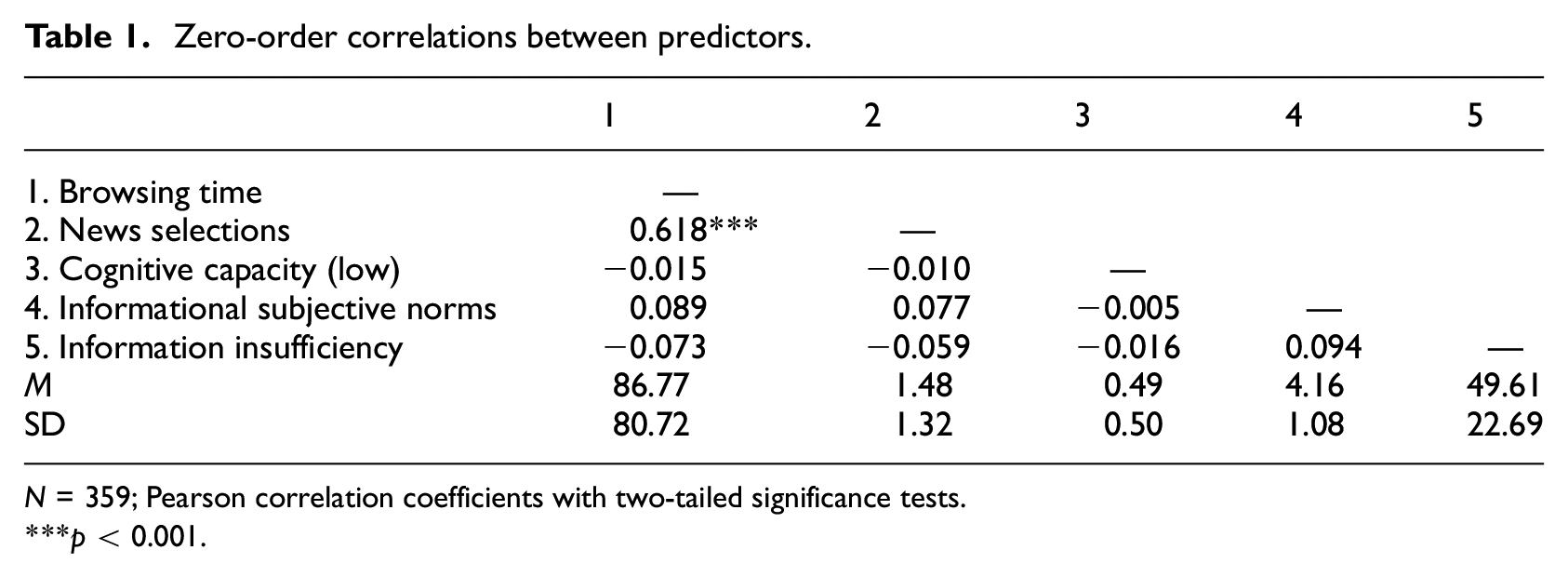
N = 359; Pearson correlation coefficients with two-tailed significance tests.
p < 0.001.
Additionally, no significant differences were found between the low and high cognitive capacity groups regarding their perceived information insufficiency (Mhigh = 49.978, SDhigh = 21.642; Mlow = 49.237, SDlow = 23.775; t[357] = 0.033, p = 0.758) and informational subjective norms (Mhigh = 4.169, SDhigh = 1.098; Mlow = 4.158, SDlow = 1.067; t[357] = 0.010, p = 0.925).
Hypotheses testing
The ZINB models indicated that informational subjective norms did not have an effect on the likelihood of browsing time (B = 0.111, SE = 0.061, p = 0.069), news selections (B = 0.083, SE = 0.110, p = 0.449), and non-selection (B = −0.632, SE = 0.836, p = 0.449). However, informational subjective norms decreased the likelihood of non-browsing (B = −0.433, SE = 0.166, p = 0.009). Put differently, for a 10% increase in informational subjective norms, non-browsing would decrease by approximately 4.3%. Therefore, H1(a) was rejected, but H1(b) received partial support. Moreover, information insufficiency exhibited no association with the browsing time (B = −0.002, SE = 0.002, p = 0.403) and news selections (B = −0.002, SE = 0.003, p = 0.566). However, information insufficiency positively increased the likelihood of non-browsing (B = 0.035, SE = 0.008, p = 0.000) and non-selection (B = 0.068, SE = 0.030, p = 0.021). Therefore, H2(a) and H2(b) were rejected.
Testing both H3(a) and H3(b), there were no significant associations found between cognitive capacity and the likelihood of browsing time (B = −0.346, SE = 0.387, p = 0.371), news selections (B = −0.015, SE = 0.811, p = 0.985), non-browsing (B = −0.440, SE = 1.110, p = 0.692), and non-selection (B = 0.649, SE = 11.894, p = 0.956). Thus, there is no evidence to support either H3(a) or H3(b).
Regarding H4(a) and H4(b), cognitive capacity did not moderate the association between informational subjective norms and three specific outcomes: browsing time (B = −0.105, SE = 0.080, p = 0.190), news selections (B = −0.002, SE = 0.146, p = 0.987), and non-selection (B = 1.466, SE = 2.372, p = 0.536). However, cognitive capacity did moderate the association between informational subjective norms and non-browsing (B = 0.526, SE = 0.236, p = 0.026). This indicates that, when cognitive capacity is low, greater informational subjective norms result in a higher likelihood of not browsing news articles on healthy eating. To elaborate, under the condition of low cognitive capacity, a 10% increase in informational subjective norms corresponds to an approximately 5.3% increase in non-browsing. Consequently, H4(a) was rejected, but H4(b) received partial support.
Moreover, cognitive capacity did not moderate the association between information insufficiency and browsing time (B = 0.003, SE = 0.003, p = 0.422) and news selections (B = 0.000, SE = 0.005, p = 0.980). Nevertheless, cognitive capacity did moderate the relationship between information insufficiency and non-browsing (B = −0.049, SE = 0.012, p = 0.000) as well as non-selection (B = −0.111, SE = 0.034, p = 0.001). Specifically, when cognitive capacity is low, increased information insufficiency results in a decreased likelihood of not browsing and not selecting news articles on healthy eating. That is, under the condition of high cognitive load, a 10% increase in informational subjective norms corresponds to an approximately 0.5% increase in non-browsing and a 1.1% increase in non-selection. Thus, H5(a) was rejected, but H5(b) received support (Table 2).
Zero-inflated negative binomial regression model predicting browsing time and news selections on healthy eating.
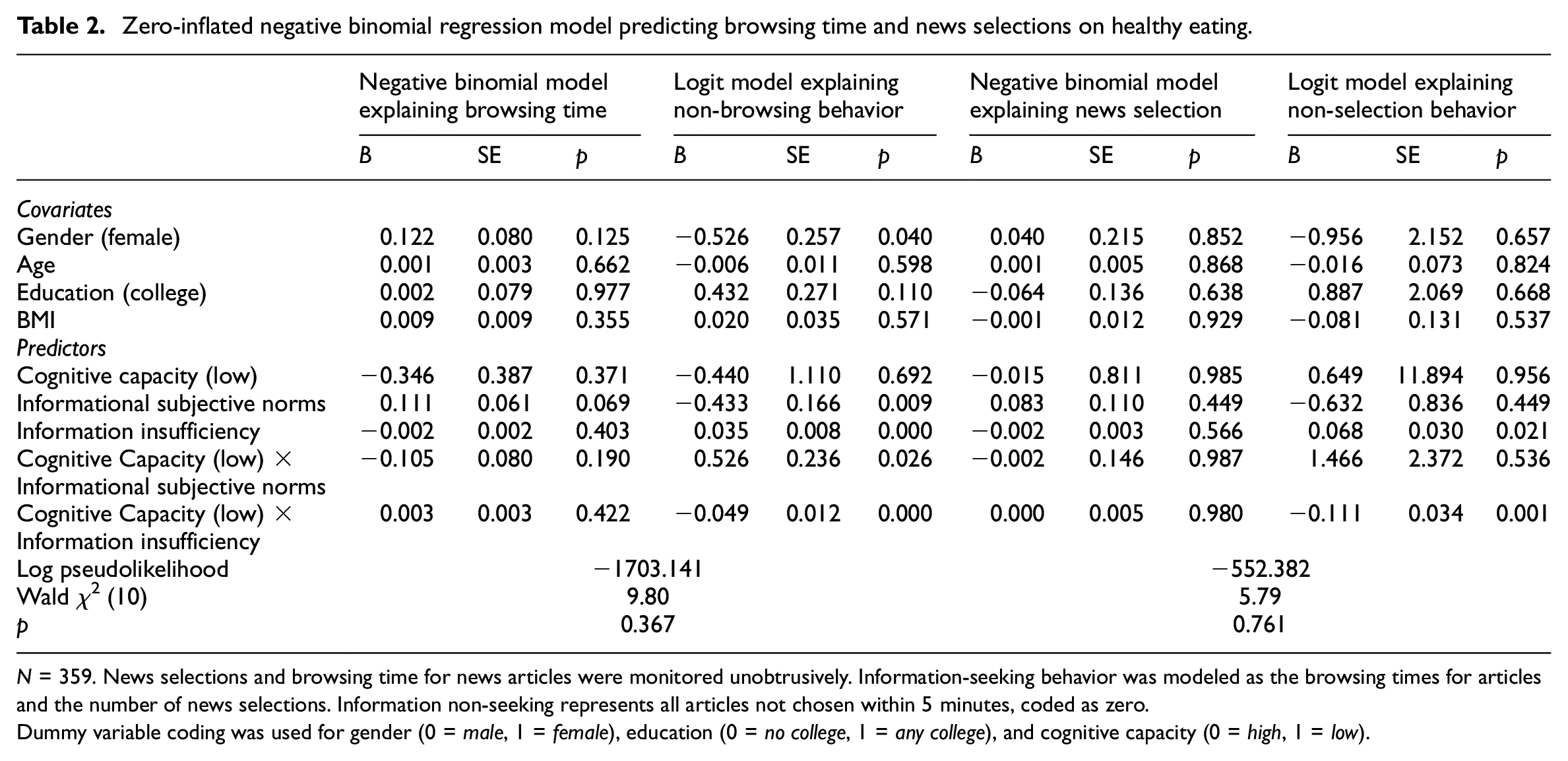
N = 359. News selections and browsing time for news articles were monitored unobtrusively. Information-seeking behavior was modeled as the browsing times for articles and the number of news selections. Information non-seeking represents all articles not chosen within 5 minutes, coded as zero.
Dummy variable coding was used for gender (0 = male, 1 = female), education (0 = no college, 1 = any college), and cognitive capacity (0 = high, 1 = low).
Furthermore, we conducted supplementary analyses using additional ZINB models that confirm the robustness of our findings (see details in online supplemental Appendix C). First, no significant changes could be observed when ZINB models were controlled for eating behaviors (online supplemental Appendix C, Table 1); second, a ZINB model that included only the two main motivations—information insufficiency and informational subjective norms also yielded the same results (online supplemental Appendix C, Table 2). Overall, the supplementary analyses support the reliability of our findings.
Additionally, to address concerns regarding potential biases stemming from participant exclusions, we conducted a t-test comparing the total sample (N = 392) with the cleaned sample (n = 359) across key and control variables. The results indicated no significant differences in these variables, suggesting that individuals excluded from the analyses did not diverge significantly. This information has been included in the online supplemental Appendix D).
Discussion
Promoting a healthy diet is a critical public health concern (Chamberlain, 2004; de Ridder et al., 2017; Guh et al., 2009; WHO, 2020). While the effects of forced exposure to health messages and individual intentions regarding seeking or intentionally avoiding them have been extensively studied, empirical evidence on actual behavioral patterns of health information seeking and non-seeking remains limited. Following the RISP model (Griffin et al., 1999, 2013), our research investigated whether information insufficiency and informational subjective norms are linked to information-seeking or non-seeking behaviors, considering the moderating role of cognitive capacity.
Our study yielded an unexpected result: neither of the two motivators we examined, namely informational subjective norms and information insufficiency, showed a significant correlation with information-seeking behaviors. This lack of association applies to both the time individuals spent browsing news articles and the number of news articles they selected, which contradicts prior research on information-seeking intentions (Griffin et al., 2008; Lu, 2015; Yang and Kahlor, 2013). Furthermore, our data uncovered an intriguing relationship between informational subjective norms and non-browsing behavior: While these two variables were in general negatively correlated, the opposite relationship was observed when participants had low cognitive capacity. This hints at the moderating role of cognitive capacity in the effects of motivation (Bar-Tal et al., 1999; Kruglanski and Webster, 1996; Pelham and Neter, 1995; Roets et al., 2008). Essentially, it suggests that informational subjective norms, essentially a form of social pressure motivating individuals to seek information, generally discourage information non-seeking behavior. However, this effect is context-dependent and can backfire when individuals face cognitive limitations, similar to the findings of Pelham and Neter (1995). One plausible explanation for our findings revolves around how individuals respond to social pressure in different cognitive states. When cognitive capacity is high, individuals may be more adept at internalizing informational subjective norms, thereby reducing their inclination to refrain from seeking information. Conversely, when cognitive capacity is compromised, individuals may struggle to process these social cues effectively, potentially leading them to opt for information non-seeking behavior as a means of coping with or compensating for their cognitive limitations. This finding aligns with Gawronski et al.’s (2017) study, where participants exhibited a stronger general preference for inaction under the condition of high cognitive load compared to low load. This implies that individual decision-making is intricately linked to their cognitive states.
In addition, a positive correlation was observed between information insufficiency and information non-seeking behaviors, including both non-browsing and non-selection behaviors. This finding challenges the notion, as discussed in our literature review, that individuals would perceive a lack of information as an opportunity for intellectual growth, prompting them to proactively seek additional information to fill knowledge gaps. On the contrary, an overestimation of information insufficiency may erode individuals’ confidence in their ability to acquire and comprehend necessary information (Loewenstein, 1994; McCall and McGhee, 1977: 193). Consequently, this reduced self-affirmation may lead to an increase in information non-seeking behaviors, a phenomenon often referred to as the ostrich effect (Howell and Shepperd, 2017; Karlsson et al., 2009). In this scenario, higher levels of information insufficiency were associated with reduced information non-seeking behaviors. A plausible explanation for this reversal is that when individuals have limited cognitive resources, they may prioritize risk management over concerns about the perceived difficulty of achieving their goals. This finding aligns with the notion of small-thinking proposed by Gallagher (2017), which involves breaking down complex plans into more manageable steps to enhance effective goal achievement.
Our research makes several significant contributions that warrant discussion. First, we extended beyond the traditional forced-exposure experimental procedure by collecting self-reported and self-selective behavioral data. This endeavor not only enhanced the ecological validity of our research but also enriched the variety of data types available in the current RISP literature (e.g. Kahlor, 2007; Lu, 2015; Yang and Kahlor, 2013). Second, our study bridges the RISP model literature with the body of work related to information (non-)seeking in allied fields, such as information science and psychology (Manheim, 2014; Miller, 1960). This integration enables a deeper exploration of non-deliberate avoidance behaviors within established frameworks, shedding light on often overlooked aspects. This insight holds significance for both researchers and policymakers because these less intentional behaviors can also play a role in fostering unawareness of unhealthy lifestyles (Buchanan and Nicol, 2019). Third, we considered cognitive capacity, recognizing its growing significance within complex and diverse information environments (Angell et al., 2016), with the goal of offering insights into healthcare practices. In an information-rich environment, what was traditionally perceived as “common sense,” specifically informational subjective norms discouraging non-seeking behavior, can unexpectedly result in unintended and contrary outcomes—much like our unconscious preference for chocolate cake over fruit salad when we are really hungry (Shiv and Fedorikhin, 1999). Health instructors should carefully assess the context when advocating for health information-seeking and employ effective strategies to promote healthy behaviors. Additionally, if health instructors anticipate that people already have high expectations of their health-related knowledge (i.e. information insufficiency), they could encourage them to “act first”—that is, do more, think less—to create a state of low cognitive capacity on their own, so that they may not consciously or unconsciously resist information and take the first step toward a healthy lifestyle.
Limitations
Our study also has some limitations. Firstly, we utilized a snowball sampling approach for recruitment, which limits the generalizability of our findings due to the well-documented influence of social relationships (Vesnaver and Keller, 2011) and norms (Higgs, 2015) on eating behaviors. Cultural differences between our sample and other global regions may limit the generalizability of our findings, especially given that healthy eating norms and motivations often stem from concerns about social rejection or disapproval (Hoshino-Browne, 2004). Notably, most of our participants were Belgians, residing in a country known for its consumption of foods such as beer, chocolate, and French fries (Paulus et al., 2001; Scholliers, 2008). Thus, our results may not accurately represent regions where different dietary norms prevail. For instance, in Japan, traditional meals focus on fish, rice, and vegetables (Ashkenazi and Jacob, 2003), while vegetarianism is widespread in India (Alsdorf, 2010), leading to significant variations in dietary choices due to cultural preferences and resource availability. Although additional analyses (see online supplemental Appendix C) did not yield any effects of people’s self-reported dietary behaviors on information seeking or non-seeking in our sample, we cannot rule out that this could be different in other samples. This emphasizes the need for future research to include more diverse samples to explore cross-cultural differences. Secondly, we did not investigate self-reported intentions related to seeking or non-seeking information, which restricts our ability to provide direct evidence of an “intention-behavior gap” (Faries, 2016; Sheeran and Webb, 2016). Future studies might want to also include self-reported behavioral intentions about information seeking as well as individual dietary behaviors. Thirdly, we measured information insufficiency before the information-seeking task which might create the priming effects on participants’ behaviors. We suggest that future studies develop improved solutions to minimize these effects. Additionally, there is a need for further investigation into the downstream effects of information-seeking or non-seeking on individuals’ attitudes and behaviors related to healthy diets. Exposure to news articles can trigger complex processes involving beliefs and cognitions, leading to evolving attitudes and behaviors (Lewis and Martinez, 2020; Slater, 2007). Future research using longitudinal studies and panel data is essential to uncover these dynamic causal relationships.
Conclusion
Guided by the RISP model (Griffin et al., 1999, 2013), our study delves into the motivations and conditions that drive or deter individuals from seeking information on healthy eating through self-reported and behavioral data. Zero-inflated negative binomial (ZINB) models revealed that neither informational subjective norms nor information insufficiency exhibited significant correlations with information-seeking behaviors. However, we found that informational subjective norms were negatively associated with non-browsing behavior. Interestingly, when cognitive capacity is limited, informational subjective norms showed a positive association with non-browsing behavior. Conversely, information insufficiency initially exhibited a positive association with information non-seeking behaviors, but this association reversed into a negative one when individuals had only low cognitive capacity available to them. These findings underscore the intricate nature of individuals’ decision-making processes when it comes to seeking or not seeking information about healthy eating.
Supplemental Material
sj-docx-1-hpq-10.1177_13591053241245263 – Supplemental material for What motivates information (non-)seeking behaviors about a healthy diet?
Supplemental material, sj-docx-1-hpq-10.1177_13591053241245263 for What motivates information (non-)seeking behaviors about a healthy diet? by Yijia Zhu, Nour Zeid, Dominik J Leiner and Sebastian Scherr in Journal of Health Psychology
Supplemental Material
sj-docx-2-hpq-10.1177_13591053241245263 – Supplemental material for What motivates information (non-)seeking behaviors about a healthy diet?
Supplemental material, sj-docx-2-hpq-10.1177_13591053241245263 for What motivates information (non-)seeking behaviors about a healthy diet? by Yijia Zhu, Nour Zeid, Dominik J Leiner and Sebastian Scherr in Journal of Health Psychology
Supplemental Material
sj-docx-3-hpq-10.1177_13591053241245263 – Supplemental material for What motivates information (non-)seeking behaviors about a healthy diet?
Supplemental material, sj-docx-3-hpq-10.1177_13591053241245263 for What motivates information (non-)seeking behaviors about a healthy diet? by Yijia Zhu, Nour Zeid, Dominik J Leiner and Sebastian Scherr in Journal of Health Psychology
Supplemental Material
sj-docx-4-hpq-10.1177_13591053241245263 – Supplemental material for What motivates information (non-)seeking behaviors about a healthy diet?
Supplemental material, sj-docx-4-hpq-10.1177_13591053241245263 for What motivates information (non-)seeking behaviors about a healthy diet? by Yijia Zhu, Nour Zeid, Dominik J Leiner and Sebastian Scherr in Journal of Health Psychology
Footnotes
Acknowledgements
We express our sincere gratitude and appreciation to Dr. Richard L. Street, Jr. (Texas A&M University, USA) for his invaluable contribution to the revision of the manuscript and for his wonderful qualities as a colleague and friend.
Author contributions
Conceptualization: Yijia Zhu, Nour Zeid, Sebastian Scherr, Dominik J Leiner; Methodology: Yijia Zhu, Sebastian Scherr; Data collection: Sebastian Scherr, Dominik J Leiner; Data analysis: Yijia Zhu, Sebastian Scherr; Writing—original draft: Yijia Zhu, Sebastian Scherr; Writing—Review & editing: Yijia Zhu, Nour Zeid, Sebastian Scherr, Dominik J. Leiner.
Data sharing statement
The data underlying this article will be shared on reasonable request to the corresponding author.
Declaration of conflicting interests
The authors declared no potential conflicts of interest with respect to the research, authorship, and/or publication of this article.
Funding
The authors received no financial support for the research, authorship, and/or publication of this article.
Ethics approval
This research was approved as G-2018031185.

Supplemental material
Notes
References
Supplementary Material
Please find the following supplemental material available below.
For Open Access articles published under a Creative Commons License, all supplemental material carries the same license as the article it is associated with.
For non-Open Access articles published, all supplemental material carries a non-exclusive license, and permission requests for re-use of supplemental material or any part of supplemental material shall be sent directly to the copyright owner as specified in the copyright notice associated with the article.
