



Abstract
Many young women turned to digital fitness technologies (DFT) to support their health and wellbeing during the covid-19 pandemic. The present study explores young student women’s retrospective perceptions of their cumulative engagement with DFT, across periods of restriction and easing (March 2020–2021). Seventeen UK-based women (Age M = 20.29, SD = 1.72); Ethnicity White = 94.12% participated in one-on-one interviews using an adapted scroll-back technique. Data was analysed using narrative-informed reflexive thematic analysis. Three themes were developed: My lockdown #fitnesstransformation: DFT as information and inspiration, My unrealistic expectations: DFT as a source of comparison and concern and My new body positive and resilient self: DFT as a catalyst to self-development. Themes highlight how perceptions of DFT changed over time as a consequence of repeat engagement, sociocultural context and psychological meaning-making. Crucially, findings underscore the importance of examining the collective and cumulative effects of DFT engagement on health and wellbeing, both positive and negative.
Young women across the globe engage with a multitude of technologies to support their physical fitness, including social media, diet and exercise apps, exergames and wearables (Lupton, 2021). This trend was intensified by the covid-19 pandemic wherein restrictions imposed by governments mandated the closure of offline fitness spaces (e.g. gyms) for prolonged time periods. Using these digital fitness technologies (DFT) has been linked to positive outcomes including increased physical activity, healthful eating and improved wellbeing pre-covid (Goodyear et al., 2021; Lupton, 2021) and may have buffered against declines in physical activity during covid-19 lockdowns (Parker et al., 2021; Yang and Koenigstorfer, 2020). Most research documenting the positive impact of digital fitness technologies focused on the initial lockdown period and less is known about how women’s experiences of DFT unfolded over time, across the course of the pandemic during periods of restriction and easing, nor how they make sense of these cumulative experiences in retrospect. Such understandings are important; other studies have linked DFT use to negative outcomes among young women, such as negative body image and maladaptive body-shaping strategies (e.g. Honary et al., 2019). In light of this, the present study explored young student women’s perceptions of using DFT across the covid-19 pandemic using retrospective interviewing.
Literature review
Digital media and technologies that ostensibly aim to promote physical activity were already increasing in popularity prior to the covid-19 pandemic (Kalgotra et al., 2022), especially among women (Elavsky et al., 2017; Honary et al., 2019). DFT tend to be used in overlapping and complementary ways with one another, and also within offline fitness spaces (Lupton, 2021). For example, a woman may use an app to identify a workout while in the gym, a Fitbit to assess heart rate and calories burned during the workout, then social media to post details of the workout once completed. Studies conducted prior to the pandemic, highlight how DFT are valued as a (1) source of information and inspiration for physical activity and other health behaviours (e.g. diet, sleep), (2) means of sharing experiences with others and (3) facilitator of accurate self-tracking and self-monitoring (e.g. step-counting; Radovic et al., 2018; Vaterlaus et al., 2015).
Usage of DFT intensified during the Covid-19 pandemic, when government mandated lockdowns dramatically altered citizens’ daily life and physical activity, including through restricted movement and the closure of leisure facilities (Goodyear et al., 2021; Parker et al., 2021; Salman et al., 2021). In the UK, government-mandated lockdowns meant that indoor leisure facilities, such as gyms and pools, were closed for a minimum of 23 weeks during 2020 (UK Active, 2021). Restrictions on movement were coupled with an increased societal discourse surrounding health and fitness; exercise and grocery shopping were part of a small list of permitted reasons to leave the home during lockdowns, and government public health messaging emphasised the importance of healthful behaviours (e.g. Talbot and Branley-Bell, 2022). Within this context, citizens across the globe turned to technology to support physical activity (Constandt et al., 2020; Parker et al., 2021; Yang and Koenigstorfer, 2020). Studies estimate that as many as 39.5% of adults used DFT during lockdowns (Parker et al., 2021). In parallel, DFT began to adapt to meet the changed realities of users. For example, popular UK-based Youtuber Joe Wicks launched daily family-friendly physical education classes that were viewed by almost 1 million households (Bakare, 2020) and the number of health and fitness apps made available on the IOS app market exceeded expected growth by 29% (Kalgotra et al., 2022).
Research shows DFT engagement increased physical activity during lockdown: DFT use was associated with an increased likelihood of meeting governmental guidelines for physical activity (Marchant et al., 2021; Parker et al., 2021) and also mitigated against declines in physical activity (Constandt et al., 2020; Yang and Koenigstorfer, 2020). In qualitative studies, users described how DFT supported physical activity, healthful diet and wellbeing, in ways consistent with pre-lockdown research, that is, by providing information and inspiration, opportunities for interaction and self-tracking (Clark and Lupton, 2021; Goodyear et al., 2021). However, much of the research examining DFT use during the pandemic was conducted at the start, during the first lockdown (Goodyear et al., 2021; Parker et al., 2021; Yang and Koenigstorfer, 2020). It is possible that individuals may have engaged with their health and healthcare technology in different ways at different points, for example, in periods of lockdown versus eased restrictions. In support of this, a general decline in physical activity and DFT use over the course of the covid-19 pandemic has been observed in longitudinal research (Janssen et al., 2020; Mitchell et al., 2022). Understanding how young women’s experiences of DFT changed and evolved over time, as well as how these experiences are perceived in retrospect may provide useful new insight.
Increased usage of DFT during the pandemic may also have had unintended negative consequences for young women’s wellbeing. Past research has highlighted the pervasiveness of unrealistic muscular yet lean sexualised ‘body perfect’ appearance ideals and problematic messaging surrounding diet and exercise across some DFT (Ahrens et al., 2022; Deighton-Smith and Bell, 2018; Honary et al., 2019). Both qualitative and quantitative research studies have linked engagement with this problematic content to negative mental health outcomes including body image, disordered eating and maladaptive exercise (Cataldo et al., 2021; Honary et al., 2019; Vaterlaus et al., 2015). Other features of DFT, including self-tracking capabilities (e.g. Fitbit) and prompts for continuous engagement, have also been associated with negative wellbeing outcomes, including increased feelings of anxiety and guilt (Honary et al., 2019). These problematic consequences of DFT use may have been exacerbated by the unique conditions of the pandemic, as product of the intensified sociocultural focus on health, social isolation and increased time online. For example, Lucibello et al. (2021) documented the ‘quarantine 15’ trend on social media, where users posted content reflecting their fear of weight gain during lockdowns. However, few studies that have examined the link between DFT engagement and negative outcomes during the pandemic. Cataldo et al. (2022) found a correlation between negative body image and engagement with fitness-related social media content across five different countries, consistent with studies linking negative body image to increased social media use more broadly (Schneider et al., 2023). There are also some studies linking increased physical activity in lockdown to negative body image and disordered eating (Schneider et al., 2023), but the mechanisms underpinning this are not clear.
The present study: Aims and research questions
The present study aims to understand young student women’s retrospective perceptions of their cumulative engagement with fitness-related media and technologies between March 2020 and 2021, over repeated periods of lockdown restrictions and easing. The study focuses on young student women, since they are more likely to use digital platforms to support physical activity (Elavsky et al., 2017; Parker et al., 2021), and report increased body dissatisfaction and disordered eating (Lipson and Sonneville, 2017; Robertson et al., 2021) – both pre- and during the pandemic. As students, they may have faced more disruption in their living circumstances than most as many moved back and forth between their hometown and campus accommodation, which may have impacted more on their health behaviour routines (Lee et al., 2023). More specifically, the research aims to answer the following questions:
RQ1. What are young student women’s perceptions of their engagement with DFT across the covid-19 pandemic?
RQ2. How did DFT contribute to their health and wellbeing during this time?
Method
Participants
Seventeen young adult women (Age M = 20.29, SD = 1.72, Range = 18–25 years old) who self-identified as having used DFTs to support their physical and mental health during the covid-19 lockdowns of 2020 and 2021 took part in interviews. Participants were purposefully recruited in three ways; social media adverts, word of mouth and the York St John University participant recruitment scheme (in return for course credit). Participants were mainly White British (94.12%), with the rest identifying as mixed White-Asian (5.88%). Participants reported engaging with a wide range of fitness-related digital technologies including social media (e.g. Youtube, Pinterest, Instagram), websites (e.g. Chloe Ting, Live Like Louise), diet and exercise apps (e.g. MyFitnessPal, Courtney Black Fitness, Strava), wearables (e.g. Fitbit, Apple Watch) and exergaming technologies (e.g. wii fit, Run Zombie Run). In addition, some reported using communicative technologies, such as Zoom, to participate in online exercise classes or nutritional webinars, and some reported buying physical items linked to DFT, such as books, nutritional supplements and exercise equipment. Table 1 provides a summary of participant information including an overview of their DFT engagement, derived from the interviews.
Participant demographic information, interview length and overview of the types of digital fitness technologies they reported engaging with across the covid-19 pandemic.
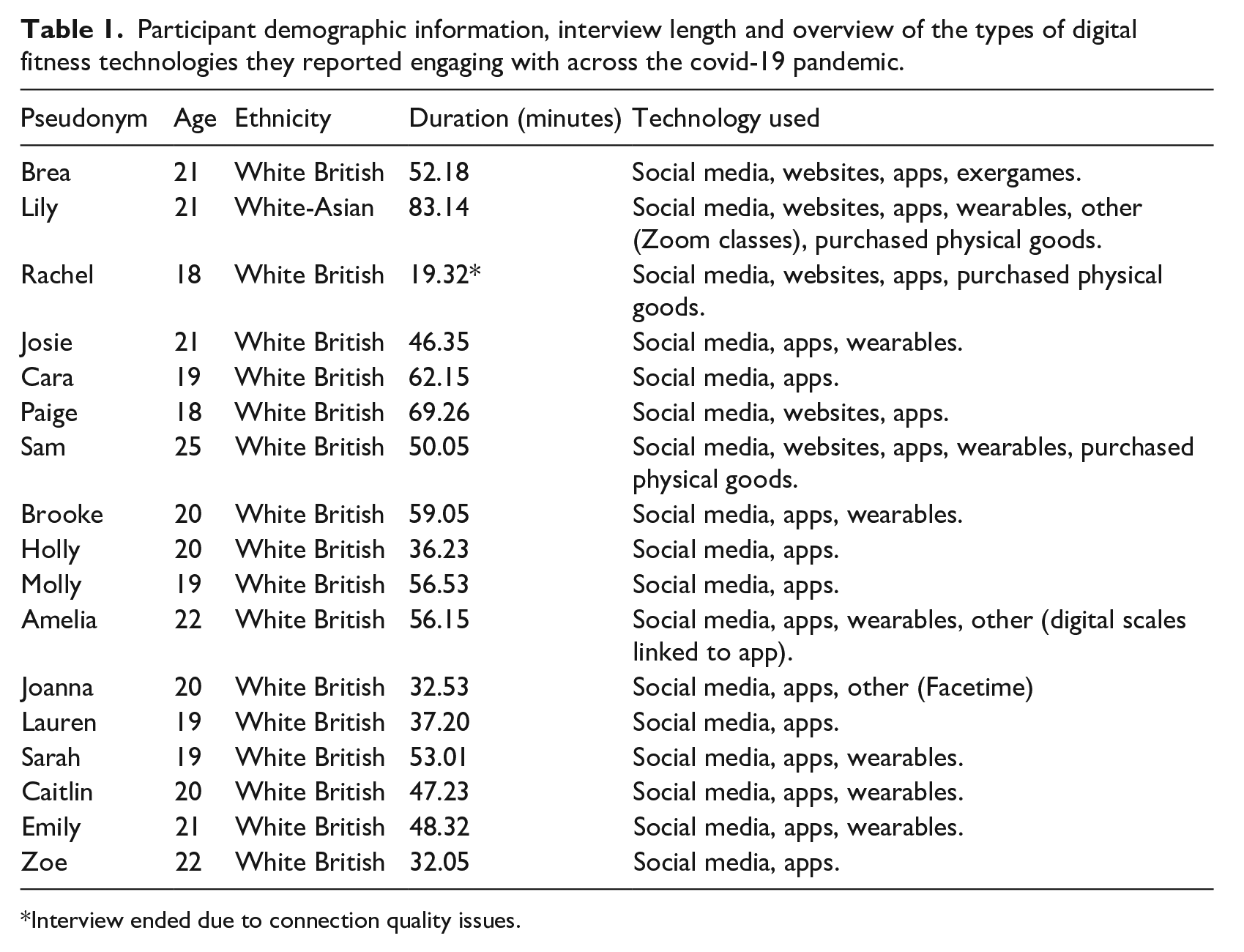
Interview ended due to connection quality issues.
Interview design
Interviews were semi-structured to allow for flexible participant-directed discussion relevant to the research questions. Authors 1 and 2 developed the interview questioning schedule collaboratively. The schedule included questions that explored how the participants had engaged with DFT to support their physical and mental health at several key time points; before lockdown (Jan–Mar 2020), during national lockdowns (Mar–June/July 2020, November 2020, Jan–March 2021) and also between lockdowns when restrictions were eased and leisure facilities were mostly open (July–October 2020, December 2020). Interviews were designed to probe participants’ changing engagement with DFT over time, focusing not just on the temporality of behaviour, attitudes, thoughts and feelings, but also how the interviewee made sense of these changes. To facilitate participants’ recall, we instructed participants to bring any digital devices that they had used to support their fitness (usually a smartphone) to the interview. Interviewees were encouraged to use these devices during interview to show examples of the types of DFT they had used; a method similar to both the social media scroll-back technique (Robards and Lincoln, 2017) and photo-elicitation (Harper, 2002). In allowing users to effectively determine their own prompts, participants were able to personalise and control interviews, and as a consequence, their stories of their own cumulative experiences (Harper, 2002). The interview schedule is available on the Open Science Framework (see https://osf.io/pye9q/).
Interview procedure
Interviewees completed participant consent and a short demographic survey prior to the interview. Interviews took place remotely, via Microsoft Teams, and were conducted by Author 2 and Author 3, who were students at York St John University and had been trained in interviewing skills by Author 1, an experienced qualitative researcher. To ensure interview quality, each interviewer met separately with Author 1 following their first interview to listen to the audio recording of the interview, and collaboratively review their interview technique. Though interviews involved video calling, only audio was recorded. Interviews were conducted between March and June 2021, lasted 19:32–83:14 minutes and were transcribed verbatim. All three authors contributed to the transcription of interviews. The duration of individual interviews is indicated in Table 1.
Analytic procedure
Author 1 performed a reflexive narrative thematic analysis of the data from a critical realist epistemological position. Narrative thematic analysis differs from other forms of thematic analysis in that participants’ stories are the unit of analysis, rather than crosscutting themes (Riessman, 2008). As such, participants’ engagement with digital fitness culture before, during and after lockdown was conceived as a process throughout the analysis, rather than a series of snapshot events. Following the six-step process specified by Braun and Clarke (2022), Author 1 first familiarised herself with the data by listening to audio recordings and double-checking all transcripts for accuracy (Step 1). Next, she coded the data, employing a combination of both semantic and latent coding (Step 2), paying particular attention to codes that reflected changes in perceptions over time and meaning making (Riessman, 2008).
Numerous strategies were employed to ensure rigour and trustworthiness within the analysis, including Author 1 engaging in reflexivity throughout, discussion of themes with Author 2 and 3 who, as young student women who had both used DFT in lockdown, represented insider perspectives of the population studied (e.g. Mullings, 1999), and making anonymised transcripts available to other researchers to ensure transparency (see https://osf.io/pye9q/).
Results
Through the process of reflexive thematic analysis, three themes were developed that encapsulate participant’s changing perceptions of DFT across the course of the pandemic; (1) My lockdown #fitnesstransformation: DFT as information and inspiration, (2) My unrealistic expectations: DFT as a source of comparison and concern, (3) My new body positive and resilient self: DFT as a catalyst to self-development.
My lockdown #fitnesstransformation: DFT as information and inspiration
Theme 1 encapsulates how participants constructed lockdowns as an opportunity to focus on their health – at least initially, with DFT providing both information and inspiration in support of this. Participants commonly described their lives pre-lockdown as busy and demanding, with little time for exercise and other health behaviour: ‘before lockdown I was just sort of going about daily life, stressed with uni work like and fitting exercise into that was a chore that I was having to try and make time to stay healthy’ (‘Brea’). Lockdowns stilled these busy daily routines, creating time to focus on health, and as such were described positively in retrospect by some: I think when the lockdown hit, I was like ‘right I can use this time to really make a difference and make my physical and mental well-being feel a lot better [. . .] I've now got the time with no distractions. Let's just crack on with it’ (‘Holly’).
Participants described engaging with a variety of different digital media and technologies in a ‘pick and mix’ approach in order to find content that they deemed useful in supporting their goals: ‘I started following people [on social media] who do home workouts, although I always try to do home work-outs, I hate it, because I’m just like, “this doesn’t feel right.” So, from June I mainly started healthy eating’ (‘Lily’). Through the experience-sharing elements of DFT, participants were able to glimpse into the lives of others who were also seizing the opportunity of lockdown to focus on fitness: ‘It would make me feel more motivated to go on like a fitness journey myself because I saw all these people who were in this exact same position’ (‘Paige’). DFT afforded the opportunity to connect with others, providing social support: ‘There’s a massive Facebook community of people using this app. And you could just see everyone supporting each other - it’s quite nice’ (‘Sarah’). Focusing on health behaviour while locked down, with the support of DFT, provided a sense of purpose during a difficult time that was described as life-changing by some: Honestly, Courtney Black has changed my life in terms of fitness [. . .] and just my own mental sanity, and when I live on my own, it’s been difficult, being locked down. But yeah, I just think it’s given me a purpose, I feel like it’s given me something to do every day, and the way you feel once you’ve done a work-out, it’s so good (‘Amelia’).
For many participants, the desire to focus on health behaviours like exercise and diet was motivated, at least in part, by physical appearance goals: ‘I thought “Right OK, so this is a period of time that no one’s going to see me. It would be really great if after this time [. . .] when they can eventually see me [. . .] I could have lost the weight and reached my goal”’ (‘Brooke’). Intertwined with these appearance motivations was a fear of gaining weight in lockdown, due to restricted movement, which peaked when periods of restrictions were ending, and social interaction could be resumed: ‘At that point [end of lockdown 1] I remember that was probably the most self-conscious I felt in the whole year because I knew I was carrying more weight and I didn’t want people to look at me [. . .] like she’s a complete different person’ (Paige). These appearance concerns were again reflected in, and reinforced by DFT, where many women were similarly grappling with appearance concerns against the backdrop of the pandemic: Coming more out of lockdown [. . .] things like TikTok, most of the videos were showing people’s glow ups from before lockdown and after lockdown. And I felt really like “oh my god, I’ve wasted all this time when I could have been really working on myself” and I could have been looking so much better than I was before. I just wasted it sat around enjoying myself. [Laughs] And now everyone’s had a glow up and I haven’t. That’s how I felt honestly it wasn’t very nice (‘Cara’).
The desire to transform the self, using DFT as support, waxed and waned across the course of the pandemic. When restrictions eased, exercise became low priority again, and DFT use declined accordingly: ‘Well, I started getting back into work [post lockdown]. So it [exercise and DFT use] did decrease. . . just because I had more commitments. I think I did truthfully get a little bit more lazy as well’ (‘Molly’). For some, the focus on fitness resumed again in subsequent lockdowns, for others it did not. Just three participants (Amelia, Sarah and ‘Zoe’) described developing exercise patterns linked to DFT use that were long-lasting and consistent. For many, the periods of uncertainty between lockdowns were particularly difficult to navigate in terms of health behaviour: You were living a pandemic and you were in it and you were petrified of what might happen and what is happening and what could happen. And then the more and more that went on [. . .] it started becoming more and more apparent that more mini lockdowns were going to happen. So, it was like “well what are you going to do?” You couldn’t join a gym. You couldn’t do anything. All motivation just stopped (‘Sam’).
My unrealistic expectations: DFT as a source of comparison and concern
Participants constructed DFT as a source of unrealistic expectations that were experienced as social pressure and perpetuated negative self-views. DFT was described as being filled with women that conform to ‘body perfect’ sociocultural ideals (i.e. thin and toned) that served as a source of social comparison. While these comparisons could sometimes motivate health behaviour (Theme 1), they could also exert a negative impact, making participants feel bad about themselves and their bodies: ‘It just makes you compare yourself [. . .] I would look at that [image of Instagram fitness influencer on phone] and be like, “Oh, well, I should maybe start thinking about losing weight”’ (‘Caitlin’). Even those who recognised that models represented unrealistic and artificial body types still described feeling bad about themselves: They don’t seem to have the stretch marks and the cellulite, and then you’d question why your body looks different and why you have those, and why they don’t have those. Then obviously you’d look at them and see them getting all the attention [. . .] a lot of them tend to be photoshopped and stuff but obviously when you’re in that headset, when you’re like ‘oh. . . I don’t look like that maybe there’s something wrong with me I need to lose weight’ - you don’t tend to think that they’re photoshopped or that’s not natural and not everybody looks like that (Brooke).
Participants described how ideal bodies were constructed as the product of strict and challenging diet and exercise regimes across DFT: ‘Because she’s got such a good physique and like sporty physique [. . .] it makes you feel like it’s manageable - if you follow her, it’s achievable’ (‘Rachel’). These challenging exercise routines could be motivational: ‘It can keep pushing me a little bit further, like, I wouldn’t quit as easily [. . .] being on YouTube, and they’re like telling you to “keep going, keep doing it,” it’s definitely motivates me, it pushes me to do more’ (‘Joanna’). However, they were also experienced as too difficult, and participants described becoming disillusioned, demotivated and disengaged, as a consequence.
Seeing them doing it so easily, and then I would struggle with it, made me feel worse. And then, I might have not done a workout for a couple of days or I might have not looked at their [content] for a period of time [. . .] because it just made me feel rubbish about myself. So, although when I first looked at it, I might have thought it influenced me to work-out a bit more. It actually made me feel more worse about myself (‘Emily’).
These negative experiences of DFT were constructed as both short-lived (‘You get that random “oh my God I look so bad, I don’t look like these people, I’m going to change my life.” And then you wake up in the morning, you’ve forgotten about the post, you’ve forgotten about how you felt’ (Cara)) and as gradually building up over time, as a consequence of repeated use over time (‘You’re a bit more bombarded with it, so it does give you a bit of motivation, but when you get too much of it gives you more pressure rather than motivation’ (Cara)). However, DFT was not described as inherently negative. Instead, participants constructed their experiences of DFT as dependent on contextual factors: ‘I don’t think it’s like black and white. I think it depends like how you’re feeling at that time’ (Cara). In particular, participants described how DFT use could exacerbate current mood states in both positive and negative ways, with both positive and negative impacts on health behaviour.
I do have that love-hate relationship with apps. I think they’re good for a set amount of time when you’re in that groove. But obviously everyone has that plateau where you’re not really bothered anymore and I feel like people do go in waves. And when you’re at the bottom of them waves, the apps are so detrimental to your mental health – especially, because it makes you feel like you’re comparing yourself to other people – and I feel like as women, we’re getting enough of that looking at Instagram anyway, let alone tying fitness into it - it’s such a toxic thing to do’ (Molly).
My new body positive and resilient self: DFT as a catalyst to self-development
The final theme focuses on participants’ descriptions of how they developed new ways of orientating towards their body and health, as well as DFT, over the course of the pandemic. Participants described how the increased time they had spent engaging with DFT during lockdown restrictions, led them to uncover content they hadn’t experienced before. This included content that promoted body appreciation and acceptance, challenged weight stigma and fat phobia, represented diverse bodies (e.g. disabled bodies, larger bodies) and promoted non-appearance related motives for exercise and eating behaviour: Over the lockdowns [. . .] obviously being on your phone more often, I feel like there might not have been an increase in them, but I’ve become more aware of activist accounts, including accounts about body positivity and a lot of things tackling fatphobia, accounts with fat people being ‘I’m fat that’s okay’ [. . .].which has then made me feel better about not necessarily doing exercise all the time [. . .]I think its a positive thing that’s come out of lockdown, like more self-awareness of negative thinking habits and stuff [. . .] I used to have the calorie tracking stuff, but I would never think to use that now (Brea).
Participants described how engagement with body positive content made them feel better about their own bodies. They described how viewing diverse bodies acted as ‘reassurance’ that others had similar bodies – and similar insecurities – to their own: ‘It’s quite reassuring that I’m not like the only person who’s not got like airbrushed skin and the little tiny waist’ (‘Josie’). It served to remind them that the thin toned bodies that dominate DFT and had potential to make them feel bad, were unrealistic and not the norm in the real world; a message that was described as especially important during periods of social restriction.
. . . These body positive people that are trying to spread this message that I think actually has helped a lot of people during lockdown because you tend to overthink when you spend a lot of time with yourself or in the same space without seeing people and socialising. You can often get in your head, so I think these body positive people are definitely helping. They’ve certainly helped me and I think they’re continuing to help a lot of people (Brooke)
These shifts in attitudes over the course of the pandemic were not just attributed to increased viewing of body positive content, but also to learning through experience. Across the course of the pandemic, participants reported trying out new exercise and diet regimes at different times to see what made them feel bad or good. Thus, positive body image was not the only thing learned through DFT engagement during the pandemic. Rather, participants also described changed attitudes towards exercise and diet, and the self, more broadly: I realised like how important it [exercise] is in the sense of how it makes me feel like and not even necessarily an intense workout - but just [. . .] walking or running or anything. I need it to like feel better in myself, because I used to look at workouts as fixing the outside of me but now I look at workouts as fixing the inside of me. I know, how cute is that? (Cara). I’ve adopted a bit more of a- healthier mentality, because I don’t think it is, like good for you to constantly track what you eat all the time. Because, I was tracking every single meal, and I know I was really cautious of what I was putting in my body, but I don’t really want to be that restrictive anymore (Caitlin).
Some young women drew comparisons between their DFT engagement and attitudes towards their body, eating and exercise now versus the start of the pandemic. Current engagement and attitudes were constructed as positive and healthy, whereas the past was constructed as problematic and unhealthy. In this context, the pandemic was constructed positively, as a period of learning, self-growth and self-reflection: I’ve learnt a lot about myself this year and this has come from lockdown [. . .] because we’ve been chucked into working out at home or whatever, it’s made me realise that you have to love your body at whatever point you are in your life (Paige)
Part of this enlightenment process involved becoming resilient to the problematic elements of DFT. Participants described how they were now more critical of body perfect and weight-loss content: ‘You’ve got to be careful. Be careful what you watch. Be careful what you listen to- who you follow because you can be influenced quite easily. But social media is not a true reflection of what people are. I think that’s what I’ve learnt through lockdown’ (Sam). They also described developing strategies to engage with DFT in a more positive way, such as avoiding content that had potential to make them feel bad: ‘I don’t really use apps anymore [. . .] it’s caused me more harm than good, so I might as well do what I want’ (‘Lauren’) or developing their own patterns of health behaviour that could be performed in the absence of DFT: ‘I felt like I was at a point where - from doing her workouts - I [. . .] knew what a good routine is for my body and what I personally actually enjoy doing. So from there I would end up just doing circuits in my garden’ (Paige). This increased digital resilience and literacy was not only intertwined with the effects of living in a pandemic, but also with their identity as an emerging adult: ‘As I’m becoming an adult, [I’m] trying to like mute out those sort of like tendencies [to compare the self to social media]’ (Brea).
That said, it is important to emphasise that the majority of participants who perceived themselves as being more resilient to the problematic elements of DFT at the end of the pandemic, still had moments where they experienced negativity. However, they now felt they had the ability to challenge these negative thought processes. Thus, being resilient to DFT was described as an ongoing and imperfect process that could sometimes be a struggle: I think it’s like looking at two different mindset. [. . .] I’m still definitely battling against the mindset of following the Instagramers who have like the perfect bodies who I want to be like. But you have to look back at it [. . .] “That isn’t my body. That’s someone else’s body. If that’s what their body does, then great, but I don’t think that’s what my body does.” Stop trying to push your body into something that it doesn’t want to do. I’m eating healthy, I’m moderately active (Lily).
Discussion
The present study aimed to examine young student women’s perceptions of their engagement with fitness-related media and technologies during the covid-19 pandemic, including how it contributed to their health and wellbeing. Participants had changing perceptions of DFT; perceiving it as vital information and support in their pursuit of health and appearance goals (Theme 1), as a source of unrealistic expectations, comparison and – depending on mood – negative emotions (Theme 2), and as contributing to the development of a more body positive and resilient self (Theme 3). These themes highlight how women’s experiences of DFT changed over time throughout the pandemic, as the product of their sociocultural context, past use and experiences, and psychological meaning-making.
Reflecting on their cumulative pandemic experiences, participants constructed DFT as a valuable pedagogical tool for learning about oneself and one’s body, through the exploration of, and experimentation with, diet, exercise and wellbeing practices. Such constructions are consistent with past research, wherein DFT was positioned as a useful source of health and fitness information that enhances users’ knowledge, skills and self-efficacy in those domains (Goodyear et al., 2021; Lupton, 2021; Radovic et al., 2018). In addition, DFT was perceived as inspirational and motivational; a source of ideas, comparison, connectedness and accountability (Lupton, 2021; Radovic et al., 2018). Moreover, as many participants constructed lockdowns as opportunities to focus on their health, fitness, wellbeing or appearance goals, DFT contributed to a broader psychological sense of meaning, purpose and productivity, when their usual means of deriving this had been removed. Thus, DFT helped participants derive meaning from their lockdown experiences and was valued as a consequence.
Valuing DFT did not always translate into consistent use. Participants described using different elements of DFT for different reasons at different times across the pandemic, with varying levels of intensity and consistency. While consistent long-term use is often the aim of DFT providers, as evidenced in this study and others, consistent use of specific content, products or services over time is rare (Honary et al., 2019; Parker et al., 2022). Participants cited multiple intersecting reasons for disengaging with DFT – both in general and from specific types – including feeling bad about oneself and one’s body because of their DFT use, goals being met (e.g. increased health knowledge), reduced motivation and contextual factors (e.g. eased restrictions). These reasons bear similarities to research conducted outside of the pandemic (e.g. Honary et al., 2019) and emphasise the stability and complexity of disengagement motives across contexts. Crucially, disengagement from DFT was not always coupled with declines in health behaviour. Instead, some participants described behaviours that persisted in the absence of DFT (e.g. developing own exercise routine based on what they learned).
DFT was positioned as playing a complex, bidirectional and reciprocal role in participants’ body image concerns. While studies have linked engagement with fitness-related social media, as well as social media use more broadly, to body image concerns during and post-lockdowns (Cataldo et al., 2021, 2022; Fioravanti et al., 2022; Schneider et al., 2023), this study is the first to highlight the collective role of engagement with multiple DFTs. In the present study, participants described engaging with DFT (usually in earlier lockdowns) to alleviate body image concerns, for example, in pursuit of a lockdown ‘glow-up’ or to reduce fears of letting oneself ‘go’. However, consistent with past research, DFT use often made participants feel bad about their own bodies due to its highly appearance-focused and weight-stigmatising content, perpetuation of unrealistic body ideals, and proliferation of extreme diet and exercise advice (Cataldo et al., 2022; Honary et al., 2019; Raggatt et al., 2018; Vaterlaus et al., 2015). Further complicating the DFT use and body image relationship, participants described developing better awareness of, and resilience towards, the negative elements of DFT over time, and so felt less affected by it. Taken together, these findings emphasise the need for adopting more nuanced approaches to understanding how DFT functions as a cause and consequence of negative body image, as well as the complex effects of cumulative engagement.
DFT was also described as contributing to the development of body positive attitudes, resilience to problematic appearance-focused messaging and critical digital literacy over the pandemic. Participants noted how incidental exposure to body positive content (e.g. algorithms that pushed content into their feed, fitness influencers sharing information, increased time spent on social media) changed their ways of thinking about their body. Integrating body positive messaging into digital fitness media and technology may be a cheap and effective means of improving women’s body image and reducing problematic attitudes towards exercise and diet. This is supported by a growing body of research demonstrating how exposure to body positive social media can improve young women’s body image (Fardouly et al., 2023; Parcell et al., 2023), including over time (Fardouly et al., 2023). As much of this research has focused on social media, future research should consider how body positive messaging may be incorporated into other aspects of DFT, including apps, wearables and exergames.
Limitations
The present study provides useful insight into the experiences of predominantly white student women; an economically privileged and educated population who were more likely to engage with DFT during the lockdown (e.g. Parker et al., 2021). Their experiences of the pandemic are likely to be very different to other groups of DFT users, including men, minoritised groups, individuals with caring responsibilities and older populations. By adopting retrospective interviewing that probed participants’ changing engagement with digital fitness culture over time, we were able to understand women’s perceptions of their cumulative use of DFT. While this approach has strengths, including that it allows us to understand how they made sense of their experiences, future studies should use longitudinal approaches that track changes in perception as they unfold (e.g. Kim et al., 2023). This could include studies that use Ecological Momentary Assessment techniques and/or objective mobile-sensing data to supplement interviews (e.g. Vega et al., 2022).
Conclusions
For most young women in our sample, DFT engagement across the pandemic constituted a continuous learning process that contributed to an enhanced understanding of the self, body and health behaviour. Yet participants still described negative experiences, especially in relation to body image, and few had established long-term consistent patterns. Instead, they used DFT in messy and overlapping ways, and experimented with different elements at different times, in line with their shifting priorities. Disengagement with elements of DFT, for both short- and long-periods, was also common across participants’ stories. Our findings demonstrate the importance of examining women’s cumulative and combined use of digital fitness media and technologies, in order to develop a more holistic and nuanced understanding of the role they play in supporting women’s health and wellbeing.
Footnotes

Declaration of conflicting interests
The authors declared no potential conflicts of interest with respect to the research, authorship, and/or publication of this article.
Funding
The authors received no financial support for the research, authorship, and/or publication of this article.
Ethics approval
This study was approved by the York St John University Psychology Ethics Committee (reference 3PY400_189086615_version2).
Informed Consent
All participants provided written electronic informed consent.