



Abstract
Media coverage of large-scale violence can result in interfering thoughts and depression. This research investigates the relationship between interfering thoughts and depression when watching the Russo-Ukrainian war. In the theoretical model, the more the war is watched, the more it is related to interfering thoughts, which are related to depression. With the ongoing pandemic, depression, when watching the war, was related to coronavirus threat. Data was collected online from April to June, 2022, with university students in Germany, Finland, and Canada (N = 865). Path analysis results in each sample showed that the model fit the data with sample-specific modification indices. There was full mediation of watching the war by interference on depression, indicating that it is not watching the war, per se, but rather its relationship to cognitive interference, that is associated with depression. Denial and coronavirus threat were positively related to depression. Implications for research and student support are considered.
Introduction
On February 24, 2022 Russia began an unprovoked and highly aggressive attack against Ukraine. Civilian casualties both in terms of deaths and injuries, have been estimated in the thousands. Millions of people around the world are not only watching the war on their TV and newspapers, but they are also keeping track of the war on social media (Makhortykh and Bastian, 2022). While individuals watching the war may not be in danger themselves, there should be psychological reactions to it given the extent of violence that they are watching (Riad et al., 2022). Watching the war can result in negative psychological effects such as anger, anxiety, and feelings of depression (Surzykiewicz et al., 2022) and social media bridges a person’s physical distance to the war by allowing people to witness the violence and destruction of the war immediately. Thus, whether being far away as, for example, in Canada or physically closer to the war as, in Finland or Germany, should not extinguish people’s thoughts or feelings about the war. One of the goals of this study is to investigate the effect of time watching the Russo-Ukrainian war on depression, mediated by cognitive interference in national samples from three countries: Germany, Finland, and Canada. From a theoretical perspective, stress appraisal can explain the relationship between a stressor (e.g. watching the war) and a negative psychological outcome (e.g. depression). According to Lazarus and Folkman (1984) with primary appraisal, a stressor (e.g. watching the war), is evaluated with regard to its significance, and whether it can cause threat or danger, or whether it already has caused some harm. If so, options for coping are evaluated in secondary appraisal by evaluating one’s resources. In line with Transactional Stress Theory, coping can be differentiated between problem-focused and emotion-focused coping styles. While the former aims at altering the stressor, the latter is focused on managing the internal emotional states. Emotion-based coping strategies such as denial, that is, when one refuses to believe that the problem (e.g. the war) is real, are predominantly used in situations, which cannot be altered (Lazarus and Folkman, 1984). Moreover, research shows that denial is considered a maladaptive coping strategy (Teufel et al., 2021).
Previous research has shown that constant thoughts and worries can lead to depression or cognitive interference with one’s work or studies (Pfefferbaum et al., 2014). In addition, there can be somatic effects of worry, including headaches, stomach pains, and a racing heart. For example, when under stress, people may find it hard to de-escalate their thoughts, interfering with their ability to sleep (Hall et al., 1997). Extending this line of reasoning to the present research, it is expected that, the more time individuals spent watching the war, the more likely watching the war would interfere with their studies or employment. With greater study interference, feelings of depression, when watching the war, should be higher. Specifically, it was hypothesized that the time spent watching the war would be related to interference of watching the war with one’s work or studies. Interference, in turn, should be related to depression when watching the war. A model is put forth here where full mediation of time spent watching the war by interference was anticipated, and interference was expected to be associated with depression when watching the war (see Figure 1). Importantly, in this study, depression refers to feelings’ participants had when watching the war. It was expected that denial, a maladaptive coping strategy, would be associated with depression when watching the war (Burker et al., 2005). Given the ongoing pandemic which began in 2020, depression associated with watching the war may be an exacerbation of the psychological distress people were already experiencing as a result of COVID-19, which continues to present a threat to people (Begic et al., 2022; Greenglass et al., 2021). Therefore, it was expected that depression when watching the war would be positively associated with threat from COVID-19.
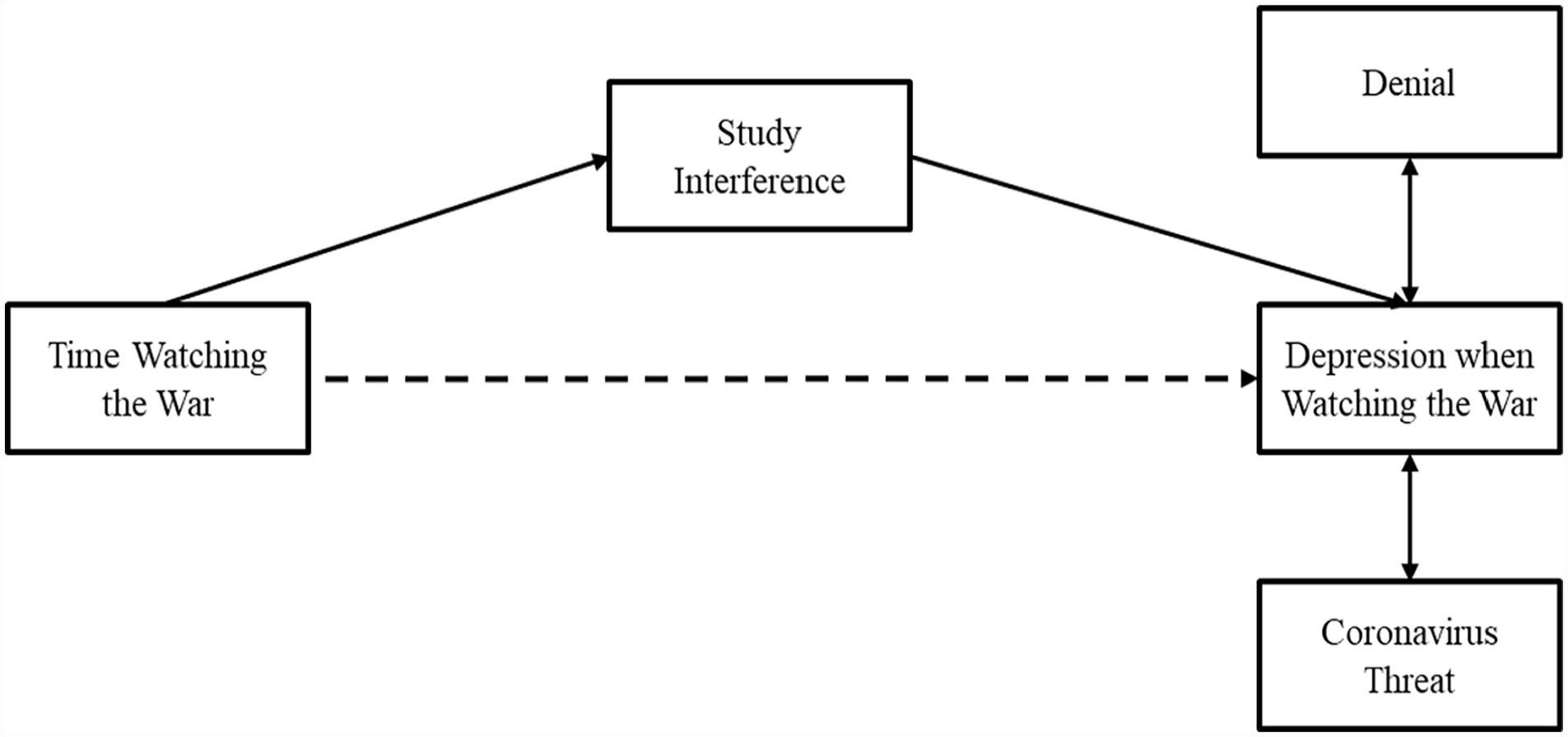
Theoretical model: Mediation# of study interference on depression when watching the war.
Method
Participants and procedure
Data was collected from April to June, 2022. Participants were university students from three countries: Germany, Finland, and Canada. University’s Ethics Committees provided approval for the conduct of this study and informed consent was obtained from participants in the three samples. Webropol was used for the Finnish sample, Qualtrics for the Canadian sample, and Soscisurvey for the German sample. Participants were recruited through online platforms and university lectures. No incentives were offered for participation. The data from this project has been placed on the Open Science Framework (https://osf.io/whk48/).
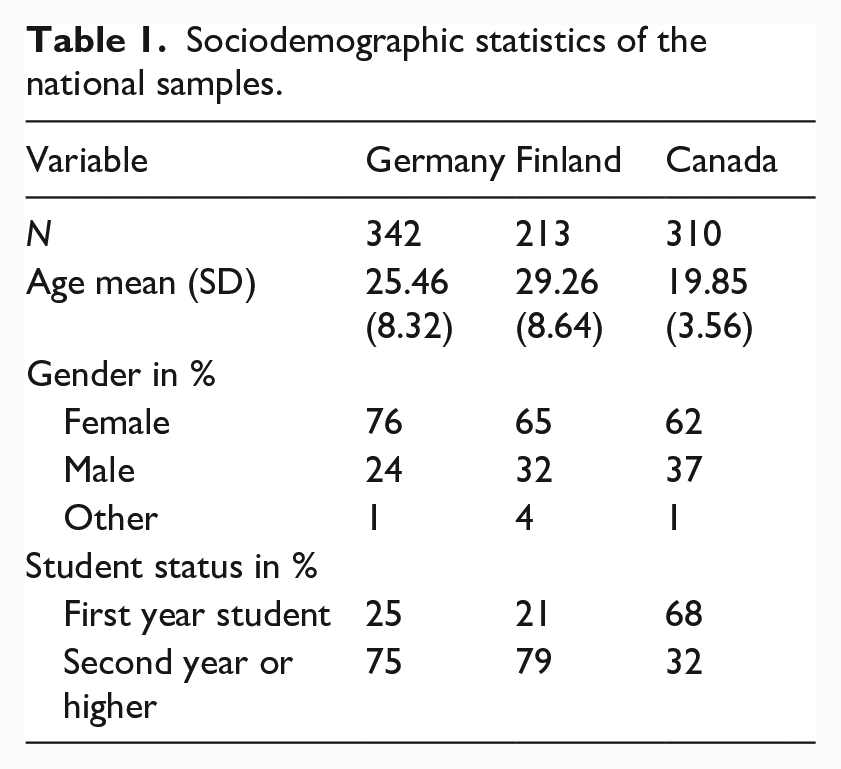
The minimum required size of each national sample n = 258 was determined on à priori power calculations (Moshagen and Erdfelder, 2016). Prior to examining the data identical criteria-based deletion was used for all three samples: Participants with incomplete data, responses on less than two pages, less than 3 minutes or more than 50 minutes completion time, and participants with the same numeric responses consecutively for more than 10 times were deleted. Statistical analyses were performed on cleaned data in all three samples. In the German sample (n = 342), 76% were female, 24% male. One-quarter of the German sample were first year students, the remaining participants were in second year or higher. Mean age of participants was 25.46 years (SD = 8.32). In the Finnish sample (n = 213), most of the participants were female (65%) and 32% were male. One fifth of the Finnish sample were first year students, the remaining participants were second year or higher. Mean age of participants was 29.26 years (SD = 8.64). In the Canadian sample (n = 310), 62% were female and 37% were male. Most of the participants (68%) were first year students, the remaining were second year or higher. Mean age of participants was 19.85 years (SD = 3.56). See Table 1 for demographics of participants in the three national samples.
Sociodemographic statistics of the national samples.
Measures
Table 2 presents a summary of all measures, authors, numbers of items, descriptive statistics, and Cronbach’s Alphas in all three samples. All composite measures, except for denial in Germany and Finland, had acceptable levels of reliability with Cronbach’s Alphas greater than 0.79.
Psychometrics of study variables.
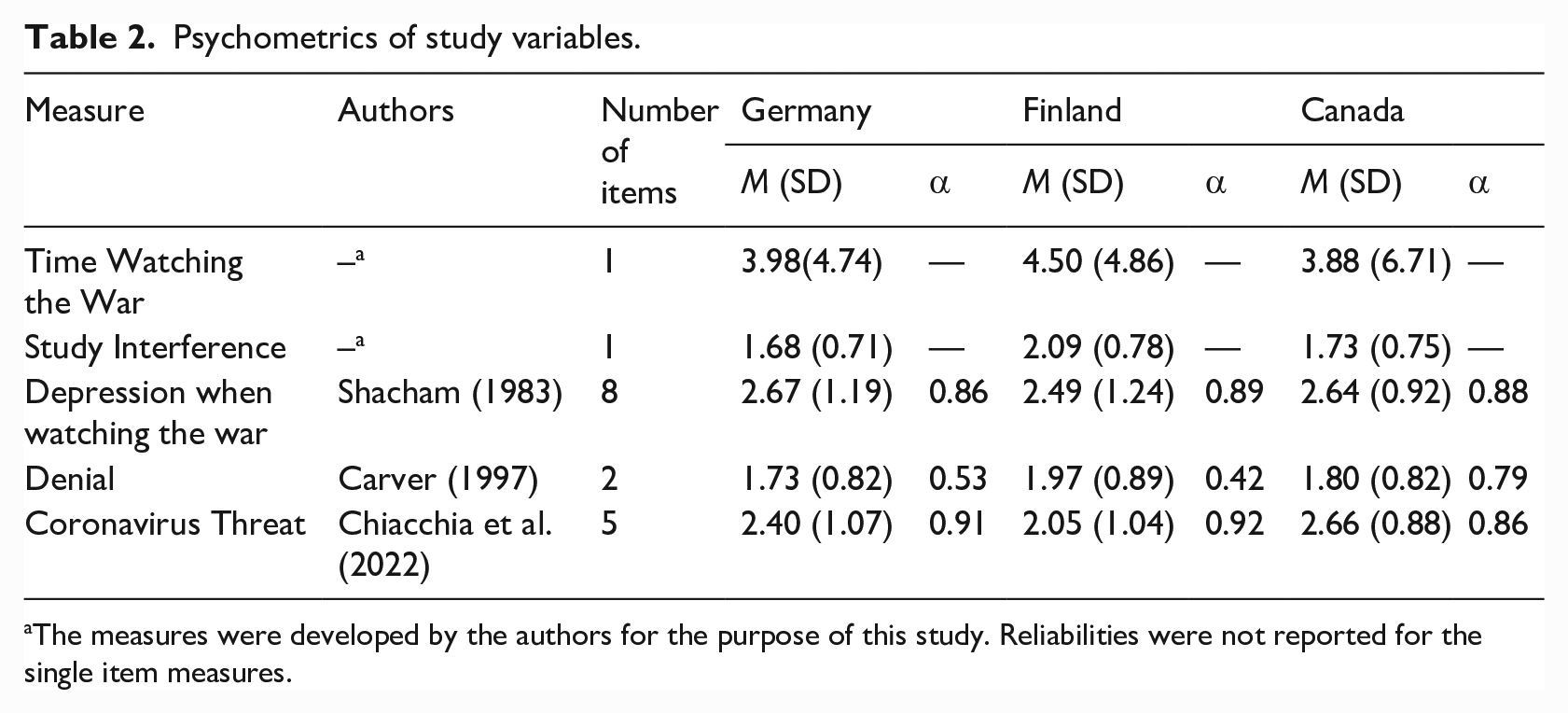
The measures were developed by the authors for the purpose of this study. Reliabilities were not reported for the single item measures.
Time Watching the War was measured with a single item developed by the authors to assess the extent of time spent watching the war. Participants respond with a number to the item “In general, how many hours/per week do you spend watching or reading about the war on TV and/or the Internet, your phone, etc.?”
Study Interference is a single item developed by the researchers to measure the extent to which watching or reading about the war had interfered with the participant’s studies or employment. Response options range from 1 = Not at all to 4 = A lot.
Depression, when watching or reading about the war, was assessed with a modified version of the Profile of Mood States (POMS; Shacham, 1983) consisting of eight items with responses on a five-point scale ranging from 1 = Not at all to 5 = Extremely. Participants were given the following instructions “Using the scale below, indicate your feelings when you watch the Russo-Ukrainian war or read about it by selecting the response that corresponds best to your feelings.”
Denial, a two-item subscale of the Brief Cope by Carver (1997), was used to assess coping when thinking about the war. A sample item is, “I’ve been refusing to believe that it has happened.” Responses are on a four-point scale ranging from 1 = I haven’t been doing this at all to 4 = I’ve been doing this a lot.
The Brief Coronavirus Threat Scale (BCTS; Chiacchia et al., 2022), composed of five items, was used to measure how participants felt about coronavirus. A sample item is, “How much do you feel threatened by Coronavirus?” All five items are endorsed along a five-point scale, ranging from 1 = Not at all to for example 5 = Extremely/A great deal.
Results
Correlational analysis
Table 3 reports correlations among study variables in each national sample. Significant positive correlations were found between time watching the war, study interference, and depression in all three samples. Further, time watching the war was positively related to coronavirus threat only in the German sample. Findings show that study interference correlated positively with depression and coronavirus threat in all three samples. Study interference was related to denial only in the Finnish and Canadian samples. While depression was positively related to denial and coronavirus threat in all three samples, denial was positively related to coronavirus threat only in the German and Canadian samples. Although not all associations between variables were statistically different among the samples, their direction was the same.
Intercorrelation matrix of study variables by national sample.
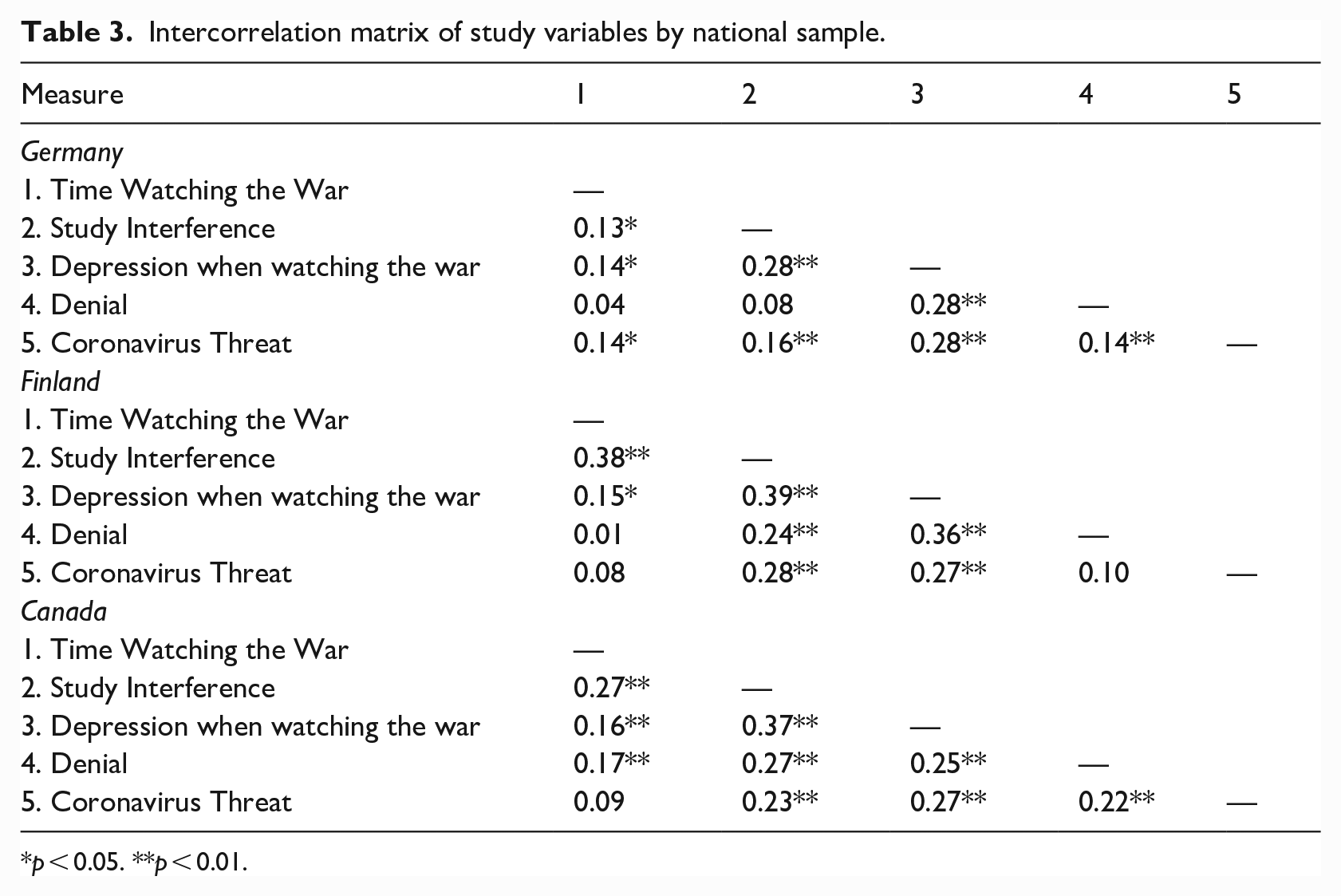
p < 0.05. **p < 0.01.
Testing the theoretical model
The theoretical model was tested with structural equation analysis (SEM) using maximum likelihood estimation (MLE) in AMOS version 28 (Arbuckle, 2022). Cases with missing data were excluded from the analysis, hence structural equation modeling was performed on 865 participants in total, in which 342 were from the German sample, 213 from the Finnish sample, and 310 from the Canadian sample. Several fit indices were used to evaluate the model. A non-significant χ² statistic was considered a good fit to the data. Further, the Tucker-Lewis Index (TLI), and Comparative Fit Index (CFI) should be greater than 0.95, and the Root Mean Square Error of Approximation (RMSEA) as well as the Standardized Root Mean Square Residual (SRMR) should be less than 0.08 (Hu and Bentler, 1999; Kenny et al., 2015).
German data
When testing the theoretical model in the German sample, the chi-square was significant (χ2(5) = 22.14, p < 0.001). Further, CFI = 0.806, TLI = 0.613, RMSEA = 0.100, and SRMR = 0.075 indicating that the hypothesized model was not a satisfactory fit with the German data. Two modification indices were indicated for the revised path analysis: A correlation between study interference and coronavirus threat, and a correlation between time watching the war and coronavirus threat. The model was rerun with the two modification indices (see Figure 2) and the obtained fit indices indicated a better fit of the model to the data. Even though the Chi-square test was significant (χ2(3) = 8.03, p < 0.05), further fit indices such as TLI (0.810), CFI (0.943), RMSEA (0.070), and SRMR (0.046) were all satisfactory indicating an acceptable fit of the revised model with the data. Examination of the standardized path coefficients showed that there was full mediation of time watching the war by study interference on depression; the path from time watching the war to depression was non-significant while time watching the war was directly related to study interference, and study interference was directly related to depression. Further, study interference was positively correlated with coronavirus threat, and time watching the war was positively related to coronavirus threat. Also, depression when watching the war was positively related to denial, and to coronavirus threat.
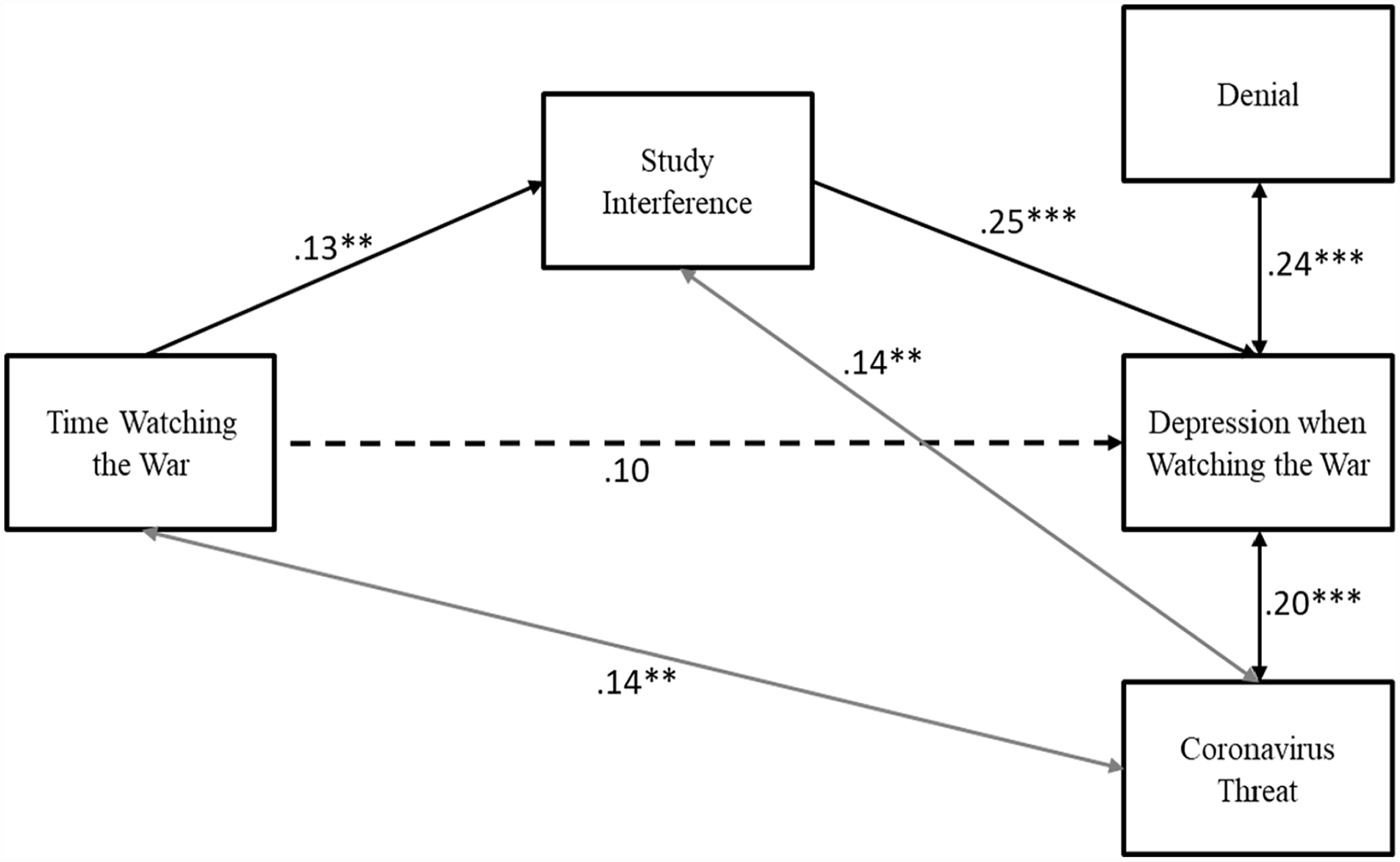
Mediation of study interference on depression when watching the war in the German sample.
Finnish data
In the Finnish sample, a significant chi-square (χ2(5) = 32.58, p < 0.001) resulted when testing the fit of the data to the theoretical model. Other fit indices such as the CFI = 0.761, TLI = 0.523, RMSEA = 0.161, and SRMR = 0.110 indicated that the model was not an acceptable fit with the Finnish data. However, two modification indices were indicated: A correlation between study interference and coronavirus threat, and a correlation between denial and study interference. When the model was rerun with the Finnish data, the fit indices indicated a better fit of the model to the data. The Chi-square was non-significant (χ2(3) = 3.56, p > 0.05) and TLI (0.983), CFI (0.995), RMSEA (0.030), and SRMR (0.039) were all satisfactory, indicating a satisfactory fit of the model with the data (see Figure 3). Examination of the standardized regression coefficients showed that time watching the war was directly related to study interference, and study interference was directly related to depression while watching the war. The path from time watching the war to depression was non-significant, thereby showing full mediation of time watching the war by study interference on depression. Depression when watching the war was positively related to denial and to coronavirus threat. Study interference was positively correlated with denial and with coronavirus threat.
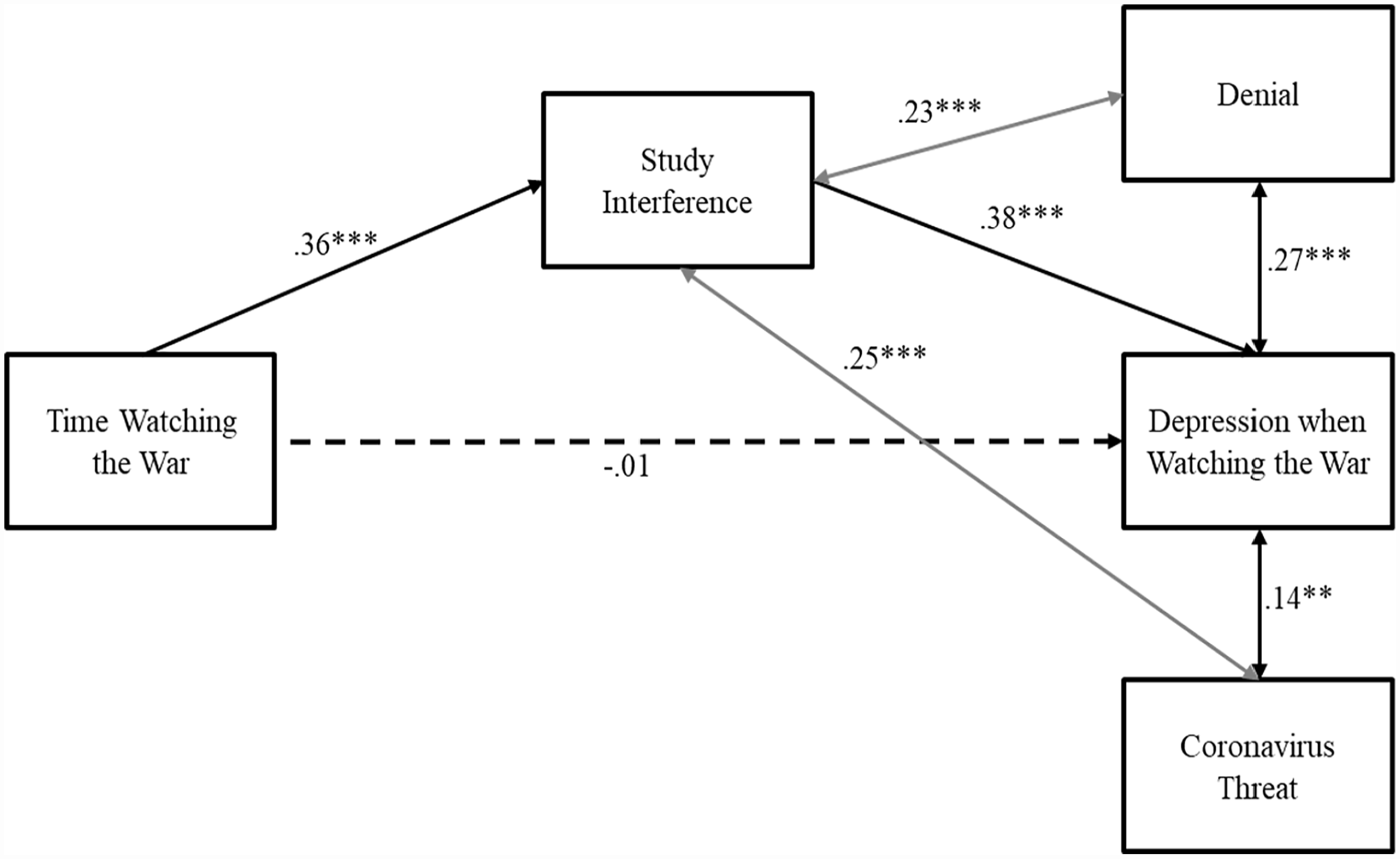
Mediation of study interference on depression when watching the war in the Finnish sample.
Canadian data
In the empirical model with the Canadian sample a significant chi-square (χ2(5) = 52.64, p < 0.001) resulted when testing the fit. Other fit indices, such as the CFI = 0.641, TLI = 0.283, RMSEA = 0.176, and SRMR = 0.126 indicated that the model was not a good fit with the Canadian data. Results of the path analysis with the Canadian data indicated four modification indices: These were, a correlation between study interference and coronavirus threat, a correlation between time watching the war and denial, and correlations between denial and coronavirus threat, and between denial and study interference. Notably, three of the four modification indices involved denial. The revised model with the MIs (see Figure 4) was rerun with the Canadian data and the model was a better fit to the data. The chi-square was non-significant (χ2(1) = 2.23, p > 0.05) and TLI (0.908), CFI (0.991), RMSEA (0.063), and SRMR (0.025) were all satisfactory. Examination of the standardized regression paths revealed full mediation of time watching the war by study interference on depression, since the path from time watching the war to study interference and the path from study interference to depression while watching the war, were significant but the path from time watching the war to depression was non-significant. Among all paths, four were related to denial including positive correlations of denial with, study interference, time watching the war, depression when watching the war, and coronavirus threat. Further, study interference was positively related to coronavirus threat, and depression when watching the war correlated positively with coronavirus threat.
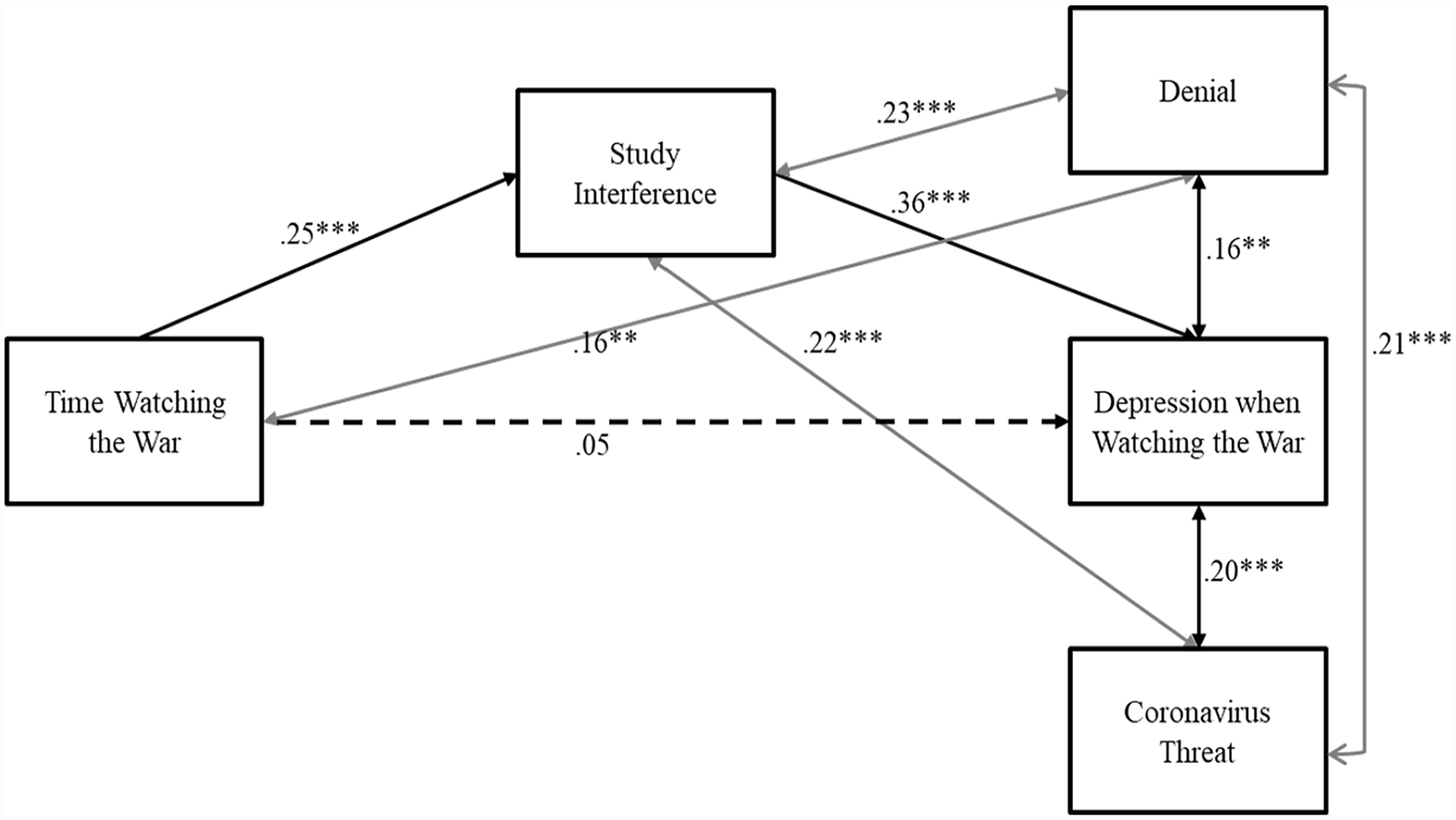
Mediation of study interference on depression when watching the war in the Canadian sample.
Discussion
The goal of this research was to examine factors related to depression when watching the war in Ukraine in three national samples of university students. As predicted, there was full mediation of time spent watching the war by interference with one’s work or studies on depression when watching the war in all three national samples, since there was a non-significant path from time watching the war to depression in each sample. This robust finding across three national samples indicates that it is not the amount of time spent watching the war per se that is related to greater depression, rather, it is the interference with one’s studies or work that is related to depression when watching the war. These results parallel previous findings reporting that trauma can trigger intruding thoughts that can interfere with one’s day-to-day life (Clark and Rhyno, 2005). However, findings are limited due to the parsimonious, single-item measure of study interference and its ordinal scale which may be a source of significant measurement error in the models. But it is worth noting that our results reporting the relationship between cognitive interference and depression in the context of the Russo-Ukrainian war are one of the first to be reported. Moreover, future studies could draw upon this research, but should also consider testing study interference using broader multi-item scales to obtain more differentiated and sophisticated results (Allen et al., 2022). At the same time, our findings parallel other research on the war reporting that continued exposure to information about the war has contributed to an overall increase in mental health problems (Surzykiewicz et al., 2022). Since there is no self-reported data on past mental health issues in this study, it is possible that some individuals are more vulnerable to media, particularly those who were previously traumatized. Thus, future research should include a measure of past mental health issues. Taken together, the research shows that media exposure to disasters and large-scale violence is related to negative psychological outcomes (Hopwood and Schutte, 2017). Hence, social media creators and journalists should consider reporting content about ways to alleviate distress, raise awareness on potential mental health effects, and include information on helplines. Universities as well might consider addressing this topic and helping students develop a healthy relationship with social media through education, mental health campaigns, and providing student support services.
Findings in the present study also showed that in all three samples, threat from coronavirus correlated positively with depression while watching the war. It should be pointed out that depression in this study refers to feelings participants had when watching the war. Therefore, present findings suggest that threat from coronavirus spilled over to depression associated with watching the war. Hence, negative mood states associated with two very different social upheavals not only can coexist but are interrelated. These results are consistent with theoretical and empirical conceptions of emotions where negative emotions are seen to co-occur simultaneously (Greenglass and Fiksenbaum, 2009), particularly negative emotions such as depression, anxiety, and threat (Begic et al., 2022). Moreover, the data from all three samples indicates that greater threat from the pandemic was related to greater reported cognitive interference of the war with one’s studies. Thus, stress associated with the war and with the pandemic may result in a cascading effect. This suggests that future studies investigating psychological factors and the war should incorporate factors associated with the context, in this case, stress resulting from COVID-19.
Further findings were that denial correlated positively with depression when watching the war in all three samples. Since denial is commonly seen as a maladaptive coping strategy (Burker et al., 2005), it is not surprising that it is associated with greater depression. In this case, denial can be regarded as a symptom of distress rather than a way of alleviating distress. Similarly, in Nielsen and Knardahl’s (2014) prospective study, baseline coping did not predict subsequent distress, but baseline distress predicted use of coping strategies. Particularly, some sample characteristics that is, the predominantly female and young participants, which is a common sample in psychological research due its low recruitment costs (Arnett, 2016), could add to this effect. At the same time, in a meta-analytic review, Tamres et al. (2002) report no sex differences in the use of denial, and age differences regarding denial are heterogeneous in the literature, depending on the specific developmental stage (Cramer, 2012). Taken together, these findings might be an exacerbation of pre-war results with cofounding effects of common sample characteristics in psychological research that is, showing that women are more prone to depression than men (Bromet et al., 2011). Thus, in order to increase external validity of the results future studies should incorporate larger and broader samples. Moreover, in the Canadian sample, denial was also positively associated with time watching the war, interference, and with coronavirus threat. This indicates that denial, as a coping strategy, was significantly related to more study variables in the Canadian sample than in the other two samples. It is possible that since Canada was physically farther away from the location of the war than Germany or Finland, Canadian participants may have been more able to use denial as a coping strategy in dealing with stressors when watching the war. Additionally, Finland and Germany have had more direct confrontations with Russian or Soviet armed forces in recent history, thus making use of denial less plausible for them during these challenging times. Nevertheless, findings regarding denial should be interpreted cautiously due to the low reliability of denial for the German and Finnish samples which might lead to significant measurement error. However, even though the Brief Cope is a well-established measure (Solberg et al., 2022), Carver (1997) also reported low Cronbach’s Alphas for denial, which might be due to the fact that the scale consists of only two items. For such cases Eisinga et al. (2013) suggest reporting the Spearman-Brown reliability instead, which was 0.53 for the German sample, 0.42 for the Finnish sample, and 0.79 for the Canadian sample in the present research. Nevertheless, future research should incorporate more reliable measures of denial. Another limitation of the present research is the reliance on cross-sectional and self-report data, which limits the attribution of causality.
Findings in this research indicate that watching the war was associated with distress, particularly, depression. There was full mediation of watching the war by study interference on depression in all three samples from Germany, Finland, and Canada indicating that it is not watching the war but rather its relationship to cognitive interference which is related to distress. Also, denial was positively correlated with depression when watching the war, thus suggesting that denial may be a symptom of distress. Moreover, coronavirus threat was positively correlated with depression when watching the war attesting to a cumulative relationship between depression associated with the war and with the pandemic. Given that cognitive interference correlated with coronavirus threat, there may have been a spillover effect of the threat of coronavirus to distress due to watching the Russo-Ukrainian war.
Lastly, given the complexity of the variables involved in the war as well as its duration, over a year, more studies are needed in the future to increase understanding of its psychological impact.
Research Data
sj-csv-7-hpq-10.1177_13591053231184065 – Supplemental material for Mediation of cognitive interference on depression during the Russo-Ukrainian war in three national samples
Supplemental material, sj-csv-7-hpq-10.1177_13591053231184065 for Mediation of cognitive interference on depression during the Russo-Ukrainian war in three national samples by Petra Begic, Esther Greenglass, Taina Hintsa, Petri Karkkola and Petra Buchwald in Journal of Health Psychology
Research Data
sj-csv-8-hpq-10.1177_13591053231184065 – Supplemental material for Mediation of cognitive interference on depression during the Russo-Ukrainian war in three national samples
Supplemental material, sj-csv-8-hpq-10.1177_13591053231184065 for Mediation of cognitive interference on depression during the Russo-Ukrainian war in three national samples by Petra Begic, Esther Greenglass, Taina Hintsa, Petri Karkkola and Petra Buchwald in Journal of Health Psychology
Research Data
sj-csv-9-hpq-10.1177_13591053231184065 – Supplemental material for Mediation of cognitive interference on depression during the Russo-Ukrainian war in three national samples
Supplemental material, sj-csv-9-hpq-10.1177_13591053231184065 for Mediation of cognitive interference on depression during the Russo-Ukrainian war in three national samples by Petra Begic, Esther Greenglass, Taina Hintsa, Petri Karkkola and Petra Buchwald in Journal of Health Psychology
Supplemental Material
sj-docx-1-hpq-10.1177_13591053231184065 – Supplemental material for Mediation of cognitive interference on depression during the Russo-Ukrainian war in three national samples
Supplemental material, sj-docx-1-hpq-10.1177_13591053231184065 for Mediation of cognitive interference on depression during the Russo-Ukrainian war in three national samples by Petra Begic, Esther Greenglass, Taina Hintsa, Petri Karkkola and Petra Buchwald in Journal of Health Psychology
Supplemental Material
sj-docx-2-hpq-10.1177_13591053231184065 – Supplemental material for Mediation of cognitive interference on depression during the Russo-Ukrainian war in three national samples
Supplemental material, sj-docx-2-hpq-10.1177_13591053231184065 for Mediation of cognitive interference on depression during the Russo-Ukrainian war in three national samples by Petra Begic, Esther Greenglass, Taina Hintsa, Petri Karkkola and Petra Buchwald in Journal of Health Psychology
Supplemental Material
sj-pdf-3-hpq-10.1177_13591053231184065 – Supplemental material for Mediation of cognitive interference on depression during the Russo-Ukrainian war in three national samples
Supplemental material, sj-pdf-3-hpq-10.1177_13591053231184065 for Mediation of cognitive interference on depression during the Russo-Ukrainian war in three national samples by Petra Begic, Esther Greenglass, Taina Hintsa, Petri Karkkola and Petra Buchwald in Journal of Health Psychology
Supplemental Material
sj-pdf-4-hpq-10.1177_13591053231184065 – Supplemental material for Mediation of cognitive interference on depression during the Russo-Ukrainian war in three national samples
Supplemental material, sj-pdf-4-hpq-10.1177_13591053231184065 for Mediation of cognitive interference on depression during the Russo-Ukrainian war in three national samples by Petra Begic, Esther Greenglass, Taina Hintsa, Petri Karkkola and Petra Buchwald in Journal of Health Psychology
Supplemental Material
sj-pdf-5-hpq-10.1177_13591053231184065 – Supplemental material for Mediation of cognitive interference on depression during the Russo-Ukrainian war in three national samples
Supplemental material, sj-pdf-5-hpq-10.1177_13591053231184065 for Mediation of cognitive interference on depression during the Russo-Ukrainian war in three national samples by Petra Begic, Esther Greenglass, Taina Hintsa, Petri Karkkola and Petra Buchwald in Journal of Health Psychology
Supplemental Material
sj-pdf-6-hpq-10.1177_13591053231184065 – Supplemental material for Mediation of cognitive interference on depression during the Russo-Ukrainian war in three national samples
Supplemental material, sj-pdf-6-hpq-10.1177_13591053231184065 for Mediation of cognitive interference on depression during the Russo-Ukrainian war in three national samples by Petra Begic, Esther Greenglass, Taina Hintsa, Petri Karkkola and Petra Buchwald in Journal of Health Psychology
Footnotes
Acknowledgements
Grateful acknowledgment is due to the Faculty of Health, York University, for supporting this research. Thanks are due to Shelby Prokop-Millar for her assistance in preparation of this manuscript. Acknowledgment to Juhani Julkunen for his contributions to this research.
Author contributions
Petra Begic: software, formal analysis, data curation, writing—original draft, visualization, writing—review & editing, investigation. Esther Greenglass: conceptualization, project administration, methodology, writing—review & editing, investigation. Taina Hintsa: writing—review & editing, investigation. Petri Karkkola: writing—review & editing, investigation. Petra Buchwald: writing—review & editing, investigation.
Data sharing statement
The current article is accompanied by the relevant raw data generated during and/or analysed during the study, including files detailing the analyses and either the complete database or other relevant raw data. These files are available in the Figshare repository and accessible as Supplemental Material via the Sage Journals platform. Ethics approval, participant permissions, and all other relevant approvals were granted for this data sharing. The data files from the current study are also available in the OSF repository at  .
.
Declaration of conflicting interests
The authors declared no potential conflicts of interest with respect to the research, authorship, and/or publication of this article.
Funding
The author(s) disclosed receipt of the following financial support for the research, authorship, and/or publication of this article: This research received funding from the Faculty of Health, York University.
Ethics approval
The authors confirm that this research adheres to the ethical guidelines specified in the APA Ethical Code of Standard for the treatment of human subjects as well as to the authors’ national ethics guidelines.
Informed consent
The authors have obtained written informed consent from the participants.
Pre-registration
The authors indicate that the conducted research was not preregistered with an analysis plan in an independent, institutional registry of studies.
References
Supplementary Material
Please find the following supplemental material available below.
For Open Access articles published under a Creative Commons License, all supplemental material carries the same license as the article it is associated with.
For non-Open Access articles published, all supplemental material carries a non-exclusive license, and permission requests for re-use of supplemental material or any part of supplemental material shall be sent directly to the copyright owner as specified in the copyright notice associated with the article.
