



Abstract
The scarcity of tampons in China has attracted scholarly attention. Extending the theory of planned behavior with social network structure, this cross-sectional online survey (N = 763) found that exposure to tampon-related information on social media was positively related to Chinese women’s tampon use intentions. This association was mediated through attitudes, descriptive norms, and self-efficacy toward using tampons. Furthermore, the effects of social media exposure differed among people with different network structures. Our findings shed light on the promotion of nonconventional feminine hygiene products, which, in turn, may enhance Chinese women’s well-being and gender equity across the globe.
In recent years, menstrual health has been recognized as part of an expanded definition of women’s sexual health, with increased communication around menstruation being important for improving well-being and gender equity across the globe (Wilson et al., 2021). The menstrual health field aims to address challenges with respect to information and education on menstruation, as well as access to period products (Sommer and Sahin, 2013). As such, it is important for women to learn about the availability and characteristics of period products, so that they can make the best choice for their menstruation. However, not all women are knowledgeable about this area. For instance, research revealed that amongst Chinese women, one-third of them had never heard of tampons and approximately 40% did not know how to use one (Cotton Incorporated, 2015). Furthermore, only 2% of Chinese women use tampons with the majority using pads (Ren et al., 2018). Although improper tampon usage (e.g. wearing the same tampon longer than 8 hours) might lead to toxic shock syndrome (Billon et al., 2020), the advantages of using tampons should not be underestimated. For instance, tampons are less likely to cause rashes than pads (Warashinta et al., 2021). Additionally, tampons can better satisfy women’s needs for physical exercise (e.g. swimming) when menstruating (Singer et al., 2020). As such, tampons may benefit many Chinese women’s health, well-being, and quality of life during menstruation.
However, a number of factors hinder Chinese women’s intentions to use or try tampons. In addition to lacking pertinent knowledge, Chinese women who do know about tampons report having concerns about health risks and their (lack of) comfort (Cotton Incorporated, 2015). Furthermore, culture plays a crucial role in the absence of tampon usage amongst Chinese women. Specifically, some people think of using tampons as shameful because they associate tampons with sexual activity, another taboo topic in China (Ren et al., 2018). Chinese girls may worry that tampons will break the hymen, a symbol of virginity and purity valued in a Confucian society (Ren et al., 2018). Additionally, media regulations in China prevent feminine hygiene products from being advertised on television during primetime and lunchtime (Yang, 2016). As such, audience members rarely see tampon-related information on traditional mass media.
Social media, however, appear to have shifted the narrative of tampons in China by highlighting their health benefits and depicting tampon usage as a trend (Mou et al., 2019). Due to the large number of social media users in China—more than 900 million (Lu, 2021), this type of tampon-related information may have a crucial impact on the Chinese population. Yet, little is known about how social media information about tampons affects women’s tampon use intentions in China. To fill this void, the current study employs the theory of planned behavior (Ajzen, 2012) to examine the potential mechanisms between social media exposure and Chinese women’s intentions to use tampons. Moreover, the effects of media exposure likely vary depending on individual differences (Oliver, 2002). This research incorporates the impact of a specific individual difference (i.e. network structure) because it affects both media influence strength and tampon use intention (Sohn, 2022; Yang and Kim, 2021). Findings from this study bear implications for social media-based interventions to promote tampons in China.
Social media exposure and the theory of planned behavior
Although prior research has revealed several barriers to tampon usage in China (Cotton Incorporated, 2015; Ren et al., 2018), it remains understudied what factors may enhance Chinese women’s tampon use intentions to help further gender equity and women’s well-being. A recent study found that consuming media information was positively related to tampon use intention in Chinese women (Yang and Kim, 2021). Notably, social media serve as the main source for tampon-related information in China, with little tampon-related information disseminated through traditional media (Mou et al., 2019). However, previous research has not explicated how or why social media information affects tampon use intention. This information is crucial for developing future interventions to take advantage of this newer channel for disseminating menstruation-related information.
To fill this lacuna, Ajzen’s (2012) theory of planned behavior (TPB) provides a helpful framework. When an individual holds a positive attitude toward a behavior, perceives the behavior as a norm, and believes that they have the ability to perform that behavior, this person will likely have a strong intention to perform the behavior. Additionally, Fishbein and Cappella (2006) underscored the role of media exposure in shaping individuals’ attitudes, norms, and self-efficacy related to health behaviors. Such relationships between media exposure, cognitions, and behavioral outcomes are also corroborated by social cognitive theory (SCT). According to SCT, media may result in behavior changes by representing and expressing attitudes, shaping norms, and instilling a sense of self-efficacy, often through vicarious learning (Bandura, 2003).
When it comes to tampon-related information on Chinese social media, Mou et al. (2019) found that tampons were portrayed positively, as part of a healthy and trendy lifestyle. Therefore, exposure to this type of information is likely to be associated with positive perceptions of tampon usage. In general, positive perceptions of a behavior are related to positive attitudes, greater perceived norms, and greater self-efficacy of that behavior, which in turn, predict a stronger behavioral intention (Yang and Wu, 2021; Zhang et al., 2015).
The role of interpersonal network structure
Effects of media exposure differ depending on many individual difference factors (Oliver, 2002). This study focuses on a particular individual difference—interpersonal network structure—because it can influence both Chinese women’s tampon use intentions (Yang and Kim, 2021) and the strength of media influence (Morgan, 2009). An individual’s network structure refers to the relationships among the people with whom the individual communicates (Burt, 2005). For instance, imagine that Person A talks to Persons B, C, and D about one event. Then, the degree to which B, C, and D communicate with each other determines A’s network structure. If B, C, and D do not communicate with each other, A’s network is loose and open, which is defined as network brokerage. In contrast, if B, C, and D talk to each other as well as to A, A’s network is dense and closed, which is termed network closure. Yang and Kim (2021) found that network closure, as opposed to network brokerage, positively predicted Chinese women’s tampon use intentions. This relationship corroborated the fact that Chinese women’s tampon usage was heavily influenced by their close connections (e.g. female family members), which are often embedded in dense networks (Ren et al., 2018).
Network structure not only has an impact on tampon use intention, but may affect the strength of media effects on Chinese women’s intentions to use tampons. Network brokerage enables more diverse information and heterogeneous points of view, whereas network closure often provides trust and intimacy (Meng et al., 2016). As a result, a person with network brokerage is relatively more receptive to media information, while a person with network closure is less reliant on media information due to their greater trust in others’ opinions. Put simply, where an individual’s network structure is situated on the brokerage-closure continuum influences their degree of media dependency and reception (Sohn, 2022), therefore affecting the intensity of media effects. The present research tests this understudied argument in the context of tampon usage in China.
Research objectives
Based on the aforementioned literature, this study has two main purposes: (1) examine the mediating roles of TPB constructs (attitudes, norms, and self-efficacy) between social media exposure and Chinese women’s tampon use intentions and (2) test if interpersonal network structure strengthens or dampens the influence of social media exposure on tampon use intention through attitudes, norms, and self-efficacy. Due to the insufficient literature linking network structure and the influence of health-related media on behavioral intentions, the second purpose has an exploratory nature. It is possible that network structure affects any of the paths linking social media exposure and tampon use intention. Correspondingly, we employ multigroup structural equation modeling (described below) to address this research question. The proposed interplay of our concepts of interest is illustrated in Figure 1.
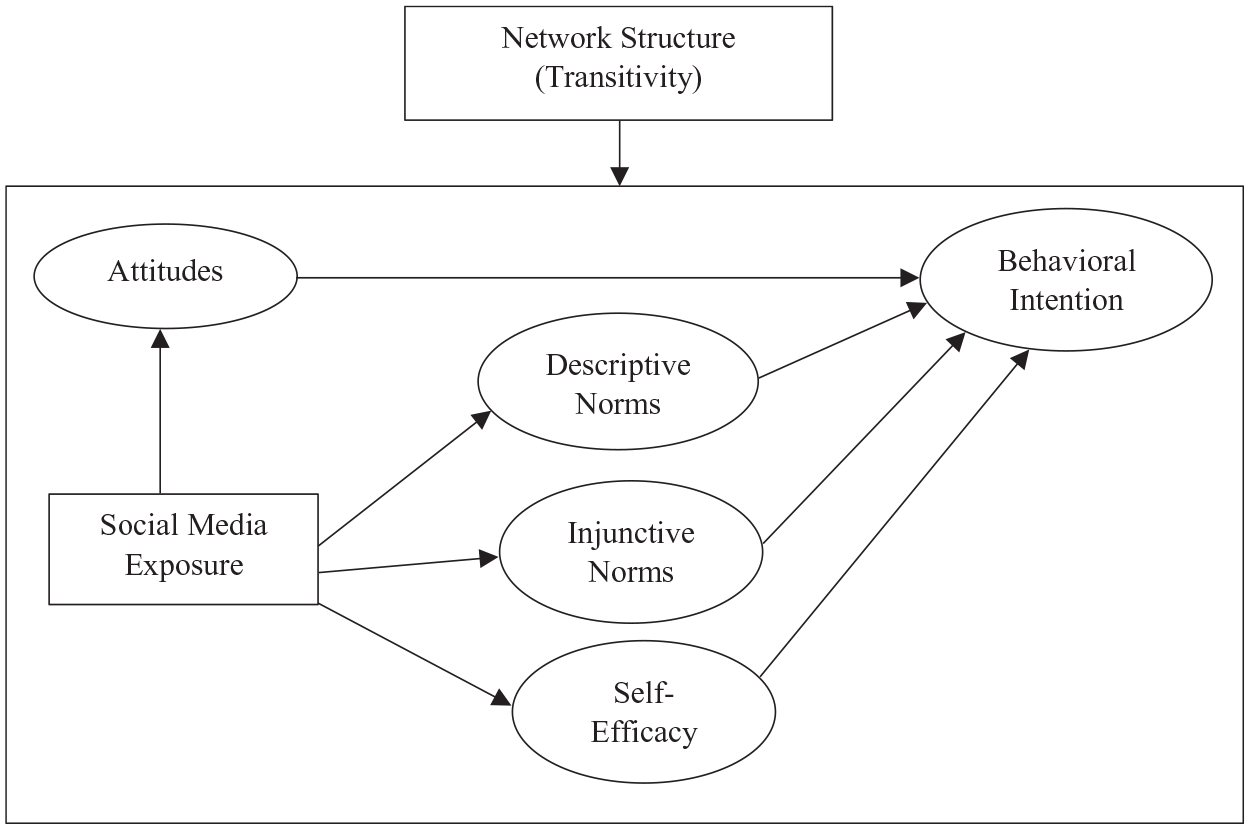
The hypothesized model.
Method
Participants and sample
This online survey recruited a non-probability sample of adults who lived in China and self-identified as women through Credamo. Credamo has the same functionality as Amazon’s Mechanical Turk but includes respondents mainly from grocery stores and shopping malls across age groups (Ma et al., 2021). To make the sample more representative, we purposefully recruited respondents from various regions of China, approximating the geographical distribution of China’s population (i.e. proportions of people living in northeast, southeast, southwest, and northwest China, respectively), as revealed in the 2010 National Population Census. Among the 763 respondents in the sample, 361 (47.3%) were living in northeast China, 319 (41.8%) in southeast China, 70 (9.2%) in southwest China, and 13 (1.7%) in northwest China. The average age of the participants was 28.20 years (SD = 6.11), with a range of 18–55 years. The majority of the participants (72.7%, n = 555) had a completed bachelor’s (62.6%, n = 478) or post-graduate (10.1%, n = 77) education, followed by those who had high school education (10.3%, n = 79) and some yet incomplete college education (9.2%, n = 70).
Measures
Social media exposure
Respondents were asked how often they had seen tampon-related information on social media platforms in the past 6 months. They chose from five items: 1 = less than 1 time a month, 2 = 1–3 times a month, 3 = 1–3 times a week, 4 = daily or almost daily, and 5 = more than 1 time a day. This has been a common means to measure social media exposure in both communication and health psychology fields (Lee et al., 2008; Ren et al., 2022).
Attitudes, norms, and self-efficacy
These TPB constructs were measured using the scales modified from previous research (Fishbein and Ajzen, 2010; Walter et al., 2019). Attitudes toward tampon usage were measured with six items using a 7-point differential scale. Participants were asked how much they thought using tampons was (1) beneficial or harmful, (2) pleasant or unpleasant, (3) good or bad, (4) helpful or not helpful, (5) enjoyable or unenjoyable, and (6) convenient or inconvenient. Norms of using tampons included descriptive norms and injunctive norms, which were measured using a 7-point Likert scale (1 = strongly disagree to 7 = strongly agree). Descriptive norms were measured with three items: (1) “Most people who are important to me use tampons sometimes”; (2) “The people in my life whose opinions I value use tampons for their periods”; (3) “Many people like me use tampons sometimes.” Injunctive norms were measured with three items: (1) “Most people who are important to me think that I should use tampons for my period”; (2) “It is expected of me that I use tampons for my period”; (3) “The people in my life whose opinions I value would approve of my using tampons for my period.” Self-efficacy was measured with two items: (1) “I am confident that I can use tampons for my period”; (2) “I am confident that I can deal with it if I encounter any problem when using tampons.”
Tampon use intention
Items for measuring Chinese women’s tampon use intentions included: (1) “I intend to use tampons in the near future”; (2) “I will try to use tampons soon”; (3) “I plan to use tampons for my following menstrual periods.” Respondents indicated how much they agreed with each of these items on a 7-point Likert scale (1 = strongly disagree to 7 = strongly agree), which was adapted from Fishbein and Ajzen (2010).
Network structure
Network structure was operationalized as transitivity (also known as clustering coefficient), referring to the number of actual ties to the number of all possible ties (Burt, 2005; Walter et al., 2019). Respondents were asked to: (1) recall three–five people with whom they had talked about menstrual issues, (2) write down the initials/first names of the people they recalled, and (3) indicate whether the people they recalled communicated with each other. The first information suggested all possible ties among a respondent’s contacts. Specifically, the number of all possible ties among three people is 3, among four people is 6, and among five people is 10. Then, the third information directly indicated the number of actual ties among a respondent’s contacts. Using the information that respondents provided, we calculated their transitivity levels (actual ties divided by all possible ties). Based on its definition, the transitivity level ranged from 0 (people around a focal person are entirely unconnected) to 1 (people around a focal person are entirely connected). A lower level of transitivity corresponds to a loose network, thereby a higher level of network brokerage. In contrast, a higher level of transitivity represents a dense network, meaning a higher level of network closure.
While network structure could be measured using multiple approaches, we chose transitivity to be our measurement given the following considerations. First, social network researchers have suggested that the transitivity level perfectly matches with the conceptualization of network brokerage and closure (Burt, 2005; Hanneman and Riddle, 2011). Furthermore, recent research has adopted this approach to studying women’s health (Walter et al., 2019), indicating the applicability of this measure in health-related research.
Demographic information
Respondents reported their age, province where they lived, and education.
Procedure
The current study received IRB approval (approval number: XXXX) from the Institutional Review Board at a university in the U.S. The survey was created in English and translated into Chinese by native speakers. This self-administered online survey was launched on the Credamo platform in January 2020 to recruit 100 qualified respondents for the pre-test. Two of these pre-test respondents provided open-ended comments about the survey layout and design. These comments were used to modify the survey for the main study. From January 18 through February 16 in 2020, the revised survey was distributed to collect data for the main study.
Eligible Credamo users could access the survey and read a written consent form with detailed information about the research. Those who agreed to participate in this study then read the instructions and completed the questionnaire. They first provided information with respect to their interpersonal networks (in order to calculate transitivity, representing network structure). Then, they answered questions regarding tampon-related social media exposure, attitudes, norms, self-efficacy, and behavioral intention in turn. Finally, they reported demographic information. An attention-check question was included in the middle part of the questionnaire; no one chose an incorrect answer for this question. Those respondents who completed the survey received ¥10 (around $1.50) in online cash points through their WeChat Pay accounts, a popular tool for online payment in China. The average time to complete the survey was 25 minutes.
Data analysis strategy
Prior to testing our model, we first analyzed descriptive statistics using SPSS 27. Then, confirmatory factor analysis (CFA) was performed with AMOS 26 to assess whether the measured variables were consistent with the constructs of interest (Hair et al., 2010). To address the first research objective, structural equation modeling (SEM) was performed with AMOS 26 to validate measures and assess mediation effects. The model fit was compared to established criteria for good fit: CFI ⩾ 0.95 and SRMR ⩽ 0.09 or RMSEA ⩽ 0.09 and SRMR ⩽ 0.09 (Hu and Bentler, 1999). We used the bias-corrected bootstrapping procedure with 95% confidence interval in the SEM (Byrne, 2016).
The second research aim was to examine how network structure affected the strength of the paths in our research model. To do so, multigroup structural equation modeling (multigroup-SEM) was conducted to investigate which paths differed between people with different network structures. Multigroup-SEM is an effective technique to evaluate moderation across multiple latent relationships as opposed to standard moderation. In other words, it tests and compares the effect of every possible structural path in the model across groups (Matthews, 2017; Memon et al., 2019). The simple moderation analysis, in contrast, is appropriate when the moderator is expected to exert its effect on the specific structural path(s) with the support of relevant theory. Relatively, multigroup-SEM effectively improves the likelihood of finding significant and meaningful differences in various relationships across group-specific results (Matthews, 2017; Memon et al., 2019).
In our research, we are introducing a new moderating variable, network structure, which is likely to exert moderating effects on multiple relationships. As such, multigroup-SEM was employed. We divided the respondents into two groups according to the transitivity mean (i.e. a low level of transitivity/high network brokerage: n = 302; a high level of transitivity/high network closure: n = 461). Next, we ran an unconstrained multigroup model comparing those with a low level of transitivity (high network brokerage) versus those with a high level of transitivity (high network closure). Then, we ran a similar multigroup model but constrained all paths to be equal. The unconstrained multigroup model and constrained multigroup model were compared via a chi-square test, which showed a statistically significant difference between the models. Consequently, additional multigroup models were conducted to identify which specific paths differed between the groups. For each model, only one particular path was constrained to be the same as the corresponding path in the unconstrained model.
Results
The descriptive statistics of and correlations among the main variables are shown in Supplemental Table 1.
Measurement model
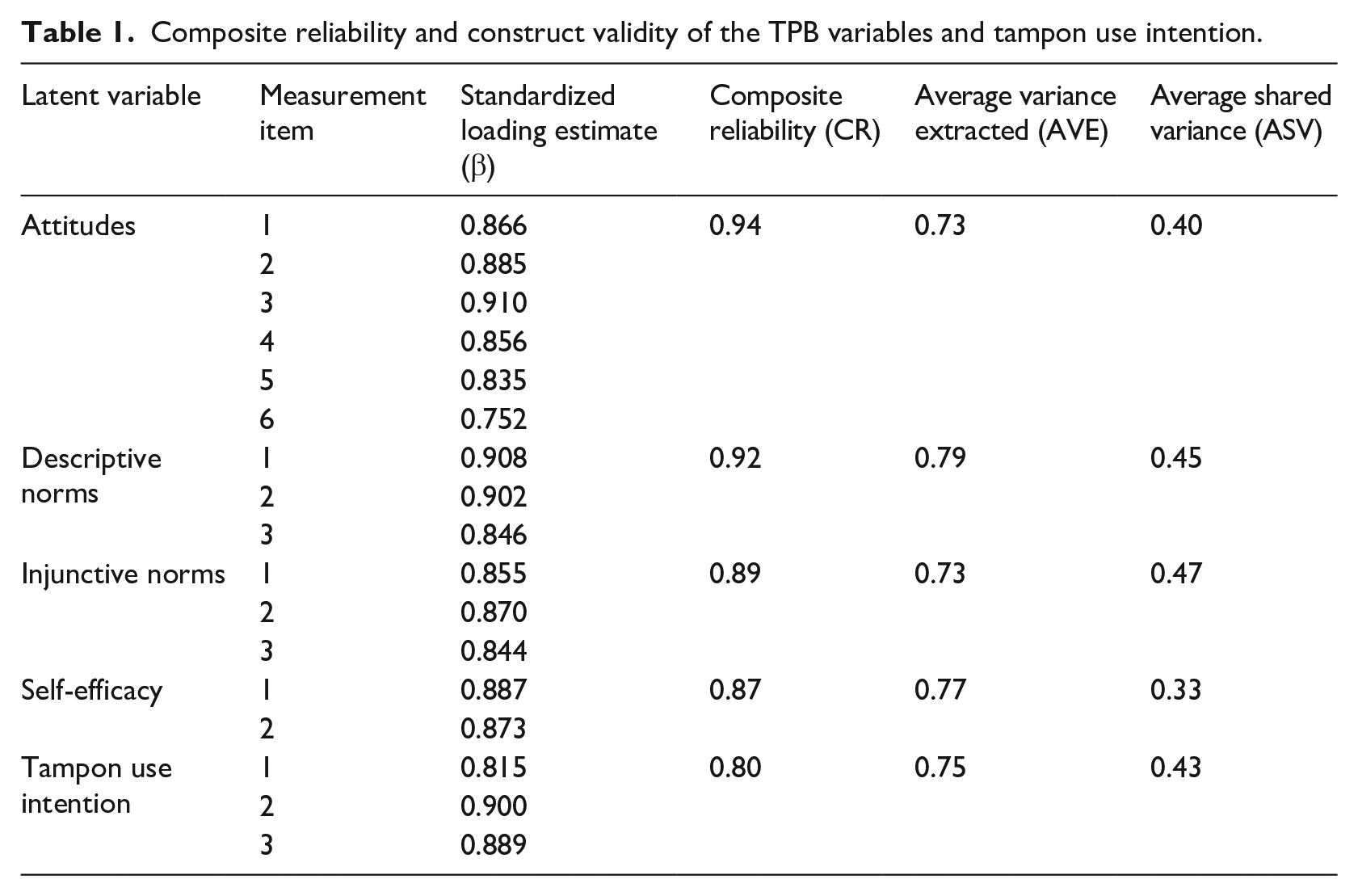
The original CFA model had an excellent fit (χ2(119) = 379.311, RMSEA = 0.054, CFI = 0.978, TLI = 0.972, SRMR = 0.03) based on Hu and Bentler (1999). Therefore, no modifications were necessary. This model suggested composite reliability and construct validity of main variables according to Hair et al. (2010) (see Table 1).
Composite reliability and construct validity of the TPB variables and tampon use intention.
Structural model
The original SEM had an unacceptable fit (χ2(126) = 1880, RMSEA = 0.135, CFI = 0.85, TLI = 0.82, SRMR = 0.30) and accounted for 61.2% of the variance in tampon use intention. Therefore, modifications were necessary to improve this model. Based on the modification indices and relevant literature (Eriksson et al., 2015; Han et al., 2010; Paul et al., 2016), we formed a modified model by adding two paths from injunctive norms to attitudes and self-efficacy, as well as a path from descriptive norms to injunctive norms. Compared with the original model, the modified model had an acceptable fit (χ2(123) = 494, RMSEA = 0.058, CFI = 0.97, TLI = 0.97, SRMR = 0.05), accounting for 71.5% of the variance in tampon use intention.
Our first research objective was to examine whether attitudes, norms, and self-efficacy mediated the effects of social media exposure on tampon use intention. The SEM results showed that media exposure was positively associated with respondents’ attitudes (β = 0.08, p = 0.005), descriptive norms (β = 0.42, p < 0.001), and self-efficacy (β = 0.10, p = 0.005) toward using tampons. However, media exposure did not significantly predict injunctive norms (β = −0.02, p = 0.398). Moreover, participants’ attitudes (β = 0.26, p < 0.001), descriptive norms (β = 0.21, p = 0.033), and self-efficacy (β = 0.54, p < 0.001) were positively related to their tampon use intentions. Yet injunctive norms were not significantly related to tampon use intention (β = 0.02, p = 0.894). In terms of the indirect effects, attitudes (β = 0.03, p = 0.013,and 95% CI [0.007, 0.056]), descriptive norms (β = 0.11, p = 0.047,and 95% CI [0.006, 0.242]), and self-efficacy (β = 0.06, p = 0.008,and 95% CI [0.017, 0.119]) significantly mediated the relationship between social media exposure and tampon use intention. Nonetheless, injunctive norms were not a significant mediator (β = 0.00, p = 0.662,and 95% CI [−0.012, 0.008]).
Results of multigroup structural equation modeling (multigroup-SEM)
Our second research goal was to test the impact of network structure on the strength of the paths in the conceptual model. The multigroup-SEM results are shown in Supplemental Table 2. The chi-square difference test revealed that model fits of the two groups (low transitivity/network brokerage group versus high transitivity/network closure group) differed significantly (∆χ2(1) = 31.71, p < 0.001). This means that the proposed model differed among people with different network structures.
The subsequent chi-square difference tests for each individual path indicated that the group difference was located at the path between injunctive norms and attitudes (∆χ2(1) = 13.503, p < 0.001). Additionally, as shown in Figures 2 and 3, the path between social media exposure and self-efficacy was statistically significant in the network closure (high transitivity) group model (β = 0.15, p < 0.001), yet nonsignificant in the network brokerage (low transitivity) group model (β = 0.02, p = 0.788). Thus, the relationship between social media exposure and self-efficacy also significantly differed between participants with different network structures. Also, the path between media exposure and attitudes was significant in the network closure (high transitivity) group model (β = 0.08, p < 0.05), but not significant in the network brokerage (low transitivity) group model (β = 0.08, p = 0.144). However, given that their standardized coefficients were the same, we suspect that the significance test difference was due to the sample size difference between these two models (closure/high transitivity group: n = 461; brokerage/low transitivity group: n = 302). The thick paths in Figures 2 and 3 show where the group differences were located.
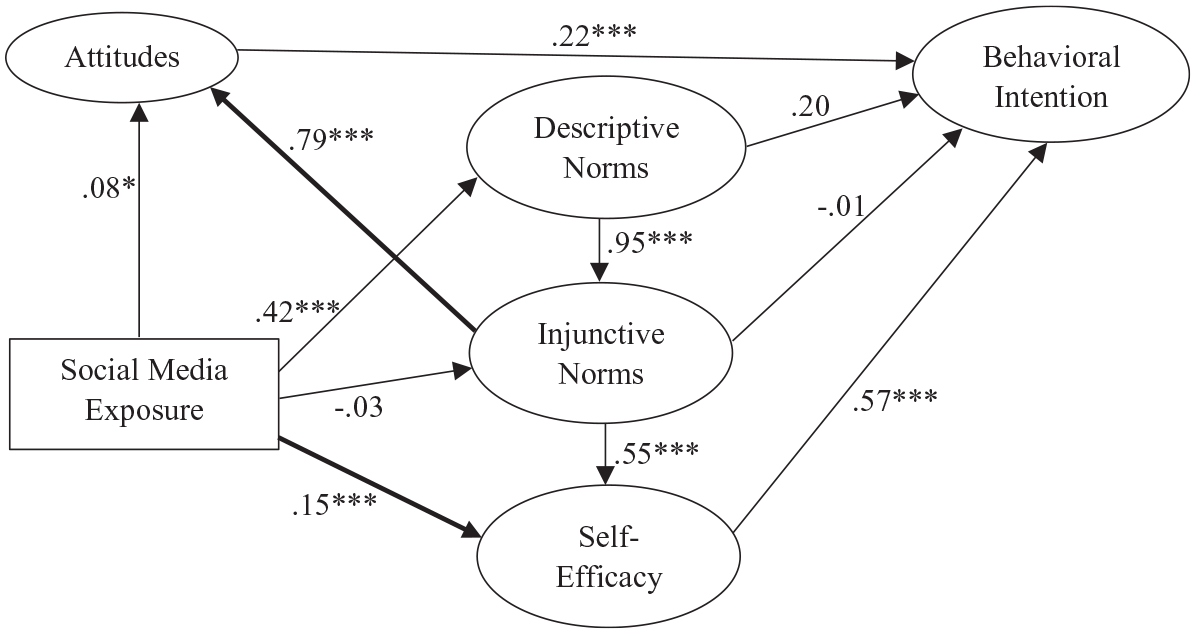
Multi-group analysis results for participants with the high Level of transitivity (N = 461).
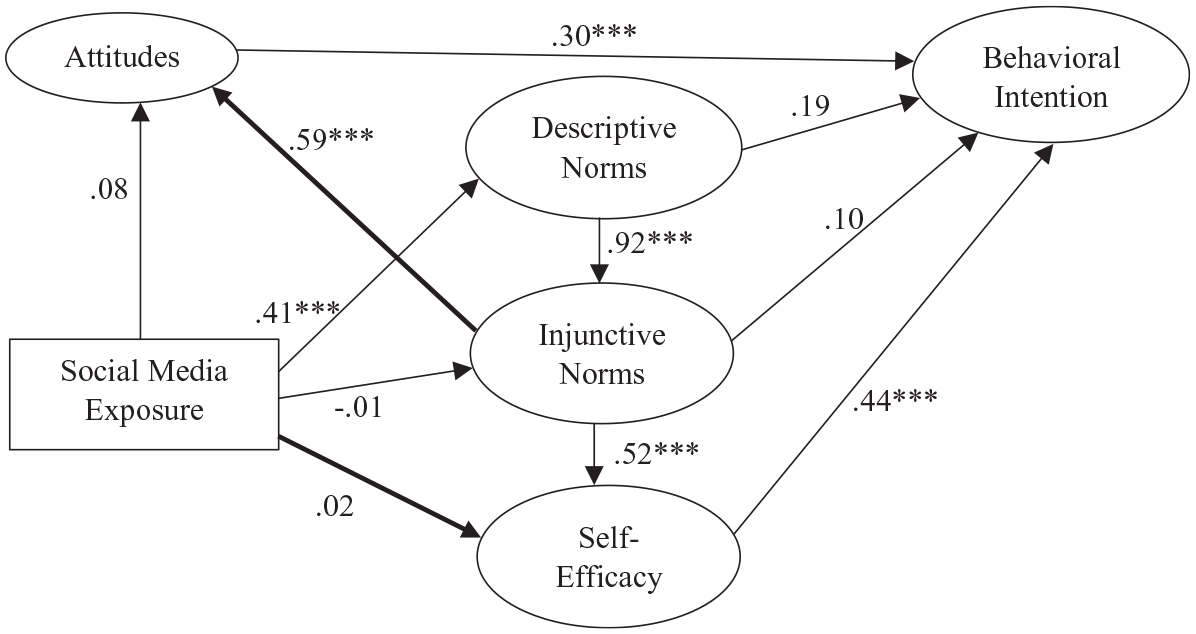
Multi-group analysis results for participants with the low level of transitivity (N = 302).
Discussion
Grounded in the theory of planned behavior (TPB) and research on the connections between media use and women’s health-related outcomes, this study examines the relationship between social media exposure and Chinese women’s tampon use intentions. This relationship is, at least in part, shaped by the ways in which social media influence attitudes, descriptive norms, and self-efficacy related to tampon use. Additionally, these data revealed that the potential effects of social media exposure on tampon use intentions differed based on individuals’ network structure. These findings built upon existing work to help explain why and for whom social media use may shape tampon use intentions. The findings, therefore, are essential for continuing to improve women’s health in countries like China where tampon-related information is rarely found on mass media channels.
Notably, the mediating roles of attitudes, descriptive norms, and self-efficacy were mostly consistent with previous studies in this area (Namkoong et al., 2017; Yang and Wu, 2021). To be specific, exposure to tampon-related information on social media affected how Chinese women perceived tampon usage, which was reflected in their positive attitudes, greater descriptive norms, and higher self-efficacy. These cognitions, in turn, were positively related to stronger tampon use intention. However, injunctive norms were not a significant mediator. One explanation could be that those encountering tampon-related information on social media might not perceive many people to have access to the same information. Therefore, exposure to the information would not likely shift what people think is the socially acceptable behavior. It has been acknowledged that algorithms largely determine what people view on social media. Knowing this, Chinese women’s perceived social approval (i.e. injunctive norms) of tampon usage might not be affected by their general social media exposure, alone. Rather, descriptive norms may matter more since descriptive norms concern a narrower group of people (i.e. referent others). Chinese women might perceive these referent others to have more similarity and proximity to them, including social media exposure and its effects. Another explanation for the nonsignificant mediation effect of injunctive norms may relate to the fact that tampon use is a private behavior. People are not able to tell whether a menstruating individual uses tampons or not. Correspondingly, social media exposure alone may not shift perceptions of who else approves or disapproves of their use of feminine hygiene products, including tampons.
Further, through the multigroup analysis, we found that the effects of social media exposure significantly differed between the group with network brokerage (low levels of transitivity) and the one with network closure (high levels of transitivity). Specifically, two paths were significantly different between the two groups. The first was between injunctive norms and attitudes. While injunctive norms and attitudes were significantly associated with each other in both groups, consistent with prior literature (Han et al., 2010), this positive relationship was much stronger among those with network closure (higher levels of transitivity). The strengthened effect of injunctive norms on attitudes could be explained by the perceived social capital from network closure (Walter et al., 2019). An increase in perceived social capital in dense networks, such as emotional and esteem support (Meng et al., 2016), may enhance the effect of injunctive norms on a favorable attitude. In other words, the perception that using tampons was beneficial or pleasant in the function of social approval for tampon usage could be boosted by social support from close connections.
The other difference between the two groups was the relationship between social media exposure and self-efficacy. There was a significantly positive association between social media exposure and self-efficacy among the participants with network closure (high levels of transitivity). However, the same relationship was not statistically significant among those with network brokerage (low levels of transitivity). It is possible that social capital generated by a dense network facilitates the impact of social media exposure on self-efficacy. Although our study did not test what specific social capital embedded in network closure came into play, our finding provided a direction to further explore the mixed results of the relationship between media exposure and self-efficacy in previous scholarship (Namkoong et al., 2017; Yang and Wu, 2021).
Theoretical and practical implications
At the theoretical level, this study shed light on theories of health psychology and behavior (e.g. TPB). First, this line of theories should consider specific contexts (Willoughby and Myrick, 2016), especially non-Western contexts (Yang and Wu, 2021). This is necessary to modify and develop the theories. Along this line, the current study advances the literature by examining the adoption of a nontraditional feminine hygiene product in China. Second, existing theories have not shown us clear paths from social media exposure to the key health-related cognitions (attitudes, norms, self-efficacy, and behavioral intention). By incorporating social media exposure, our model predicted Chinese women’s tampon use intentions through attitudes, descriptive norms, and self-efficacy. Third, our model suggested significant relationships between injunctive norms and attitudes, between descriptive norms and injunctive norms, and between injunctive norms and self-efficacy. Scholars, together with the present study, have found empirical yet inconclusive support to these links (Eriksson et al., 2015; Han et al., 2010; Paul et al., 2016). As such, they need to be examined for further advancement. Another theoretical contribution concerns the role of network structure in media effects. As revealed in this study, varying network structures may facilitate, decrease, or even suppress the effects of media exposure on health-related cognitions. In this sense, the network structure perspective could provide a theoretical explanation for the contradictory results from the studies that applied classic psychology theories, such as the inconclusive relationship between media exposure and self-efficacy.
Practically, the study highlighted the necessity to consider target audiences’ network structures when promoting tampons. For instance, it would be more effective if tampon promotion campaigns were launched amongst people with denser networks. Given the positive association between strong ties and dense networks (Pan and Saramäki, 2012), the social media platforms where strong ties frequently occur (e.g. WeChat) would be the better options for tampon promotion than those platforms where people are connected loosely (e.g. Douban.com). To enhance the network density on social media, strategies strengthening social ties could be employed, such as encouraging social media users to interact more often with their online contacts (Valkenburg and Peter, 2007). Furthermore, our findings inform health educators that the relationship between media exposure and self-efficacy may depend on the type of user and the type of content that they view. To better achieve their goals, effective educators should consider network structures when using media to increase self-efficacy. Moreover, interventions may need to include content specifically aimed at increasing vicarious learning (e.g. using attractive models, showing challenging steps of the target behavior being successfully performed) in order to strengthen the connection between message exposure and self-efficacy.
Limitations and suggestions for future research
Several limitations should be noted. First, the cross-sectional data precluded any potential of causality. Future researchers should consider conducting experimental or longitudinal studies to test causal relationships among the variables of interest. Second, the non-probability sample hindered the generalizability of the findings. Most participants in the sample were well-educated. We encourage future studies to recruit a more representative sample to represent the general population. Third, we measured social media exposure using one single item. Although this practice could be found in previous studies (Lee et al., 2008; Wu and Shen, 2022), future research should use multiple items to improve the construct validity of this measure. Lastly, given limited resources, we collected self-report data from respondents, including tampon use intention rather than actual tampon usage as the behavioral outcome. Accordingly, the further use of this data and interpretation of the study results should take the nature of self-report data into consideration. Additionally, although intention could be a proximate indicator of behavior (Reimann et al., 2020), future studies that measure actual tampon use may strengthen the findings.
Supplemental Material
sj-amosoutput-4-hpq-10.1177_13591053221120332 – Supplemental material for Social media exposure, interpersonal network, and tampon use intention: A multigroup comparison based on network structure
Supplemental material, sj-amosoutput-4-hpq-10.1177_13591053221120332 for Social media exposure, interpersonal network, and tampon use intention: A multigroup comparison based on network structure by Yin Yang, Xin Ma and Jessica Gall Myrick in Journal of Health Psychology
Supplemental Material
sj-amosoutput-7-hpq-10.1177_13591053221120332 – Supplemental material for Social media exposure, interpersonal network, and tampon use intention: A multigroup comparison based on network structure
Supplemental material, sj-amosoutput-7-hpq-10.1177_13591053221120332 for Social media exposure, interpersonal network, and tampon use intention: A multigroup comparison based on network structure by Yin Yang, Xin Ma and Jessica Gall Myrick in Journal of Health Psychology
Supplemental Material
sj-amw-2-hpq-10.1177_13591053221120332 – Supplemental material for Social media exposure, interpersonal network, and tampon use intention: A multigroup comparison based on network structure
Supplemental material, sj-amw-2-hpq-10.1177_13591053221120332 for Social media exposure, interpersonal network, and tampon use intention: A multigroup comparison based on network structure by Yin Yang, Xin Ma and Jessica Gall Myrick in Journal of Health Psychology
Supplemental Material
sj-amw-5-hpq-10.1177_13591053221120332 – Supplemental material for Social media exposure, interpersonal network, and tampon use intention: A multigroup comparison based on network structure
Supplemental material, sj-amw-5-hpq-10.1177_13591053221120332 for Social media exposure, interpersonal network, and tampon use intention: A multigroup comparison based on network structure by Yin Yang, Xin Ma and Jessica Gall Myrick in Journal of Health Psychology
Supplemental Material
sj-amw-8-hpq-10.1177_13591053221120332 – Supplemental material for Social media exposure, interpersonal network, and tampon use intention: A multigroup comparison based on network structure
Supplemental material, sj-amw-8-hpq-10.1177_13591053221120332 for Social media exposure, interpersonal network, and tampon use intention: A multigroup comparison based on network structure by Yin Yang, Xin Ma and Jessica Gall Myrick in Journal of Health Psychology
Supplemental Material
sj-docx-11-hpq-10.1177_13591053221120332 – Supplemental material for Social media exposure, interpersonal network, and tampon use intention: A multigroup comparison based on network structure
Supplemental material, sj-docx-11-hpq-10.1177_13591053221120332 for Social media exposure, interpersonal network, and tampon use intention: A multigroup comparison based on network structure by Yin Yang, Xin Ma and Jessica Gall Myrick in Journal of Health Psychology
Supplemental Material
sj-docx-3-hpq-10.1177_13591053221120332 – Supplemental material for Social media exposure, interpersonal network, and tampon use intention: A multigroup comparison based on network structure
Supplemental material, sj-docx-3-hpq-10.1177_13591053221120332 for Social media exposure, interpersonal network, and tampon use intention: A multigroup comparison based on network structure by Yin Yang, Xin Ma and Jessica Gall Myrick in Journal of Health Psychology
Supplemental Material
sj-pdf-6-hpq-10.1177_13591053221120332 – Supplemental material for Social media exposure, interpersonal network, and tampon use intention: A multigroup comparison based on network structure
Supplemental material, sj-pdf-6-hpq-10.1177_13591053221120332 for Social media exposure, interpersonal network, and tampon use intention: A multigroup comparison based on network structure by Yin Yang, Xin Ma and Jessica Gall Myrick in Journal of Health Psychology
Research Data
sj-sav-1-hpq-10.1177_13591053221120332 – for Social media exposure, interpersonal network, and tampon use intention: A multigroup comparison based on network structure
sj-sav-1-hpq-10.1177_13591053221120332 for Social media exposure, interpersonal network, and tampon use intention: A multigroup comparison based on network structure by Yin Yang, Xin Ma and Jessica Gall Myrick in Journal of Health Psychology
Supplemental Material
sj-sps-10-hpq-10.1177_13591053221120332 – Supplemental material for Social media exposure, interpersonal network, and tampon use intention: A multigroup comparison based on network structure
Supplemental material, sj-sps-10-hpq-10.1177_13591053221120332 for Social media exposure, interpersonal network, and tampon use intention: A multigroup comparison based on network structure by Yin Yang, Xin Ma and Jessica Gall Myrick in Journal of Health Psychology
Supplemental Material
sj-spv-9-hpq-10.1177_13591053221120332 – Supplemental material for Social media exposure, interpersonal network, and tampon use intention: A multigroup comparison based on network structure
Supplemental material, sj-spv-9-hpq-10.1177_13591053221120332 for Social media exposure, interpersonal network, and tampon use intention: A multigroup comparison based on network structure by Yin Yang, Xin Ma and Jessica Gall Myrick in Journal of Health Psychology
Footnotes
Data sharing statement
The current article is accompanied by the relevant raw data generated during and/or analysed during the study, including files detailing the analyses and either the complete database or other relevant raw data. These files are available in the Figshare repository and accessible as Supplemental Material via the SAGE Journals platform. Ethics approval, participant permissions, and all other relevant approvals were granted for this data sharing.
Declaration of conflicting interests
The author(s) declared no potential conflicts of interest with respect to the research, authorship, and/or publication of this article.
Funding
The author(s) disclosed receipt of the following financial support for the research, authorship, and/or publication of this article: The authors disclosed receipt of the funding for this research by the College of Communication at Marquette University where the first author obtained her master’s degree.

References
Supplementary Material
Please find the following supplemental material available below.
For Open Access articles published under a Creative Commons License, all supplemental material carries the same license as the article it is associated with.
For non-Open Access articles published, all supplemental material carries a non-exclusive license, and permission requests for re-use of supplemental material or any part of supplemental material shall be sent directly to the copyright owner as specified in the copyright notice associated with the article.
