




Abstract
Before the COVID-19 pandemic, the prevalence and severity of psychiatric disorders among sexual and gender diverse (SGD) young people was greater than in their heterosexual/cisgender peers. We systematically reviewed literature examining the prevalence, severity, and risk factors for psychiatric disorders among SGD young people aged 25 and under during the pandemic. Four databases (MEDLINE, PsycInfo, Scopus and Web of Science) were searched. Eligibility criteria were studies assessing prevalence rates, mean symptomology scores and risk factors of psychiatric disorders using contemporaneous screening measures or diagnosis. Thirteen studies of mixed quality were identified. Most studies indicated SGD young people were at high risk of experiencing several psychiatric disorders including depressive and generalised anxiety disorder compared to the general population. This group also experienced more severe symptomology of various psychiatric disorders compared to their heterosexual/cisgender peers. Risk factors included those specific to the pandemic along with factors that led to greater risk before the pandemic. This systematic review has indicated evidence of heightened risk of psychiatric disorders among SGD young people during the COVID-19 pandemic. It is important for clinicians to acknowledge the needs of SGD young people, working with them to co-develop more inclusive care as they deal with the pandemic’s fallout.
Plain language summary
Why was the study done?
Before the COVID-19 pandemic, the prevalence and severity of psychiatric disorders in sexual and gender diverse (SGD) young people was greater than in their heterosexual/cisgender peers, based on several risk factors. Research using validated screening measures assessed whether this continued during the pandemic. Yet, these studies have not been brought together in an organised fashion to provide a comprehensive summary of this evidence.
What did the researchers do?
We reviewed literature examining the prevalence, severity, and risk factors for psychiatric disorders among SGD young people aged 25 and under during the pandemic. Eligibility criteria were studies assessing prevalence rates, mean symptomology scores or risk factors of psychiatric disorders using contemporaneous screening measures or diagnosis.
What did the researchers find?
Thirteen studies of mixed quality were identified. Most studies indicated SGD young people were more likely to report experiencing several psychiatric disorders including depressive and generalised anxiety disorders compared to the general population. SGD young people also experienced more severe symptomology of various psychiatric disorders compared to their heterosexual/cisgender peers. Risk factors included those specific to the pandemic along with factors that existed before the pandemic.
What do the findings mean?
This review suggests SGD young people were at greater risk of psychiatric disorders during the COVID-19 pandemic. Clinicians should acknowledge the needs of SGD young people, working with them to co-develop more inclusive care as they deal with the pandemic's fallout.
Keywords
Introduction
Sexually diverse (SD) young people have sexual, romantic and/or emotional attractions that are not exclusively heterosexual, whilst gender diverse (GD) young people do not exclusively identify with the sex they were assigned at birth (Suen et al., 2020). Prior to the COVID-19 pandemic, research consistently found that adolescents and young adults identifying as sexual and/or gender diverse (SGD) are at greater risk of experiencing psychiatric disorders; further, those that do tend to develop more severe symptoms compared to their heterosexual/cisgender peers (Gilbey et al., 2020; Lucassen et al., 2017; Mezzalira et al., 2022; Pinna et al., 2022; Plöderl & Tremblay, 2015), with GD young people being at particular risk (Ferlatte et al., 2020; Fox et al., 2020; Su et al., 2016). The Minority Stress Model (Meyer, 2003), which highlights the role of internal and external stressors unique to this group, is a long-standing theoretical foundation of many studies within this field to explain these disparities. The model has since been expanded to include GD alongside SD groups (Hendricks & Testa, 2012).
The COVID-19 pandemic
Through the mitigation measures imposed including quarantine and social distancing, the COVID-19 pandemic led to the disruption of day-to-day life worldwide. Over the three or more years that have passed since the pandemic began, the now sizeable but still developing literature has suggested it has led to an increase in prevalence of psychiatric disorders in the short and long term among young people (Ahmed et al., 2023; Benatov et al., 2022; Elharake et al., 2022; Newlove-Delgado et al., 2022; Viner et al., 2022). Given that most lifetime psychiatric disorders develop before the age of 25 (Solmi et al., 2022), this group represents a key demographic to focus upon.
The pandemic has been referred to as a syndemic, where its consequences are determined by one’s privilege within society and are unlikely to affect the population homogenously (Bambra et al., 2020; Horton, 2020; Mezzina et al., 2022). This is highlighted by research indicating the pandemic further exacerbated the inequalities in mental health problems experienced by some sociodemographic subgroups (Ellwardt & Präg, 2021; Nguyen et al., 2022). Thus, it is possible that SGD young people who may have experienced systemic oppression alongside heightened psychiatric disorder symptomology before the pandemic may be more vulnerable to the development and exacerbation of psychiatric disorders compared to heterosexual/cisgender young people during this period.
The current review
To date, there has been a single systematic review that focused upon SGD young people during the pandemic, however the focus of this was exclusively on Latinx young people, and moreover included research not using either a validated psychiatric disorder screening measure or contemporaneous clinical diagnoses (Abreu et al., 2023). It is important for stakeholders including clinicians and policy makers to be aware of the impact of the COVID-19 pandemic on SGD young people, particularly as the long-term impacts on this group are still being understood. Furthermore, due to pre-pandemic evidence indicating heightened prevalence and severity of psychiatric disorders among GD groups and the unique stressors that are associated with psychiatric disorders among SD and GD groups individually (Argyriou et al., 2021; Hall, 2018; Mezzalira et al., 2022; Tankersley et al., 2021), it is important to gain a comprehensive understanding of both groups’ unique experiences of the pandemic. By doing so, clinicians can provide appropriate care that acknowledges the specific challenges SD and GD young people individually faced.
The purpose of this systematic review was to understand the prevalence, severity and risk factors of psychiatric disorders among SGD young people during the COVID-19 pandemic, the reasons for this were threefold: (1) to give an indication of whether prevalence differed among SGD young people compared to the general population; (2) to give an indication of whether the severity of psychiatric disorders differed among SGD young people compared to their heterosexual/cisgender peers respectively; and (3) to clarify the factors involved in the development, exacerbation and/or protection of psychiatric disorders among SGD young people during this time.
Method
Search strategy
We conducted a systematic review examining prevalence, severity and risk factors of psychiatric disorders among SGD young people aged 25 and under during the pandemic. We searched MEDLINE, PsycInfo, Scopus and Web of Science between September 2022 and August 2023. Searches were conducted independently against the inclusion criteria by JO and RJ, with the final studies being agreed upon through discussion with LH as adjudicator. The full search strategy for each database, developed alongside a university librarian, can be found in Table S1. PRISMA guidelines were followed in the development and conduct of this review. Our research team included a researcher who guided our design with their lived experience of both being SGD and personal experience of psychiatric disorders. This systematic review was registered with PROSPERO (ID: CRD42022376193).
Inclusion and exclusion criteria
Inclusion criteria were: (1) studies and systematic reviews reporting on prevalence rates of psychiatric disorders within any group of SD or GD young people, with specific reference to the COVID-19 pandemic in design and/or interpretation, using validated screening measures and/or contemporaneous diagnosis (prevalence defined as the percentage or odds ratio of SD or GD participants scoring at or above threshold on screening measures or meeting diagnostic criteria); (2) studies comparing mean scores between SD/GD young people and heterosexual/cisgender young people, with specific reference to the COVID-19 pandemic, using validated screening measures; (3) studies which reported risk factors for a psychiatric disorder and/or its symptomology in SD/GD young people, with specific reference to the COVID-19 pandemic (risk factors defined as moderators, mediators, and associated variables involved in the relationship between SD/GD identity and contemporaneous psychiatric disorder symptomology and/or diagnosis assessed using validated screening measures).
Exclusion criteria were (1) studies that combined SGD data, with no attempted separation of SD or GD participants; (2) studies which included participants over 25 throughout their data analysis; (3) studies that did not collect data during the pandemic (which we broadly categorise as 2020 onwards) nor did they refer to the pandemic in the design or the interpretation of the results.
Study quality
We used the Newcastle-Ottawa Scale (NOS), adapted for use with cross-sectional studies (Williams et al., 2021), to assess the quality of synthesised studies. Each study was assessed on three main areas: selection of the sample and methodology, comparability of outcome groups, and assessment of the outcome. All quality checks were completed by JO.
Results
Study characteristics
Results of the screening process are outlined in Figure 1. Our initial search resulted in 287 papers. We subsequently screened 185 papers culminating in 13 papers that met our inclusion and exclusion criteria. Summaries of study characteristics are reported in Table 1. Of the thirteen studies reviewed, five were conducted in the USA, two each in the UK and Canada, and one each in Austria, the Philippines, Thailand, and Turkey. Nine studies collected data in 2020, three in 2021 and two in 2022. Three studies focused upon SD young people, five upon GD young people and five included both. Two studies only included young people under 18 years old, five studies only included young people aged 18 and above, and the remaining six were mixed; the youngest participants were 12 years old, and the oldest were 25. All studies scored between three and eight on the NOS (see Table S2 for full NOS scoring). study selection flowchart. Details of included studies (n = 13).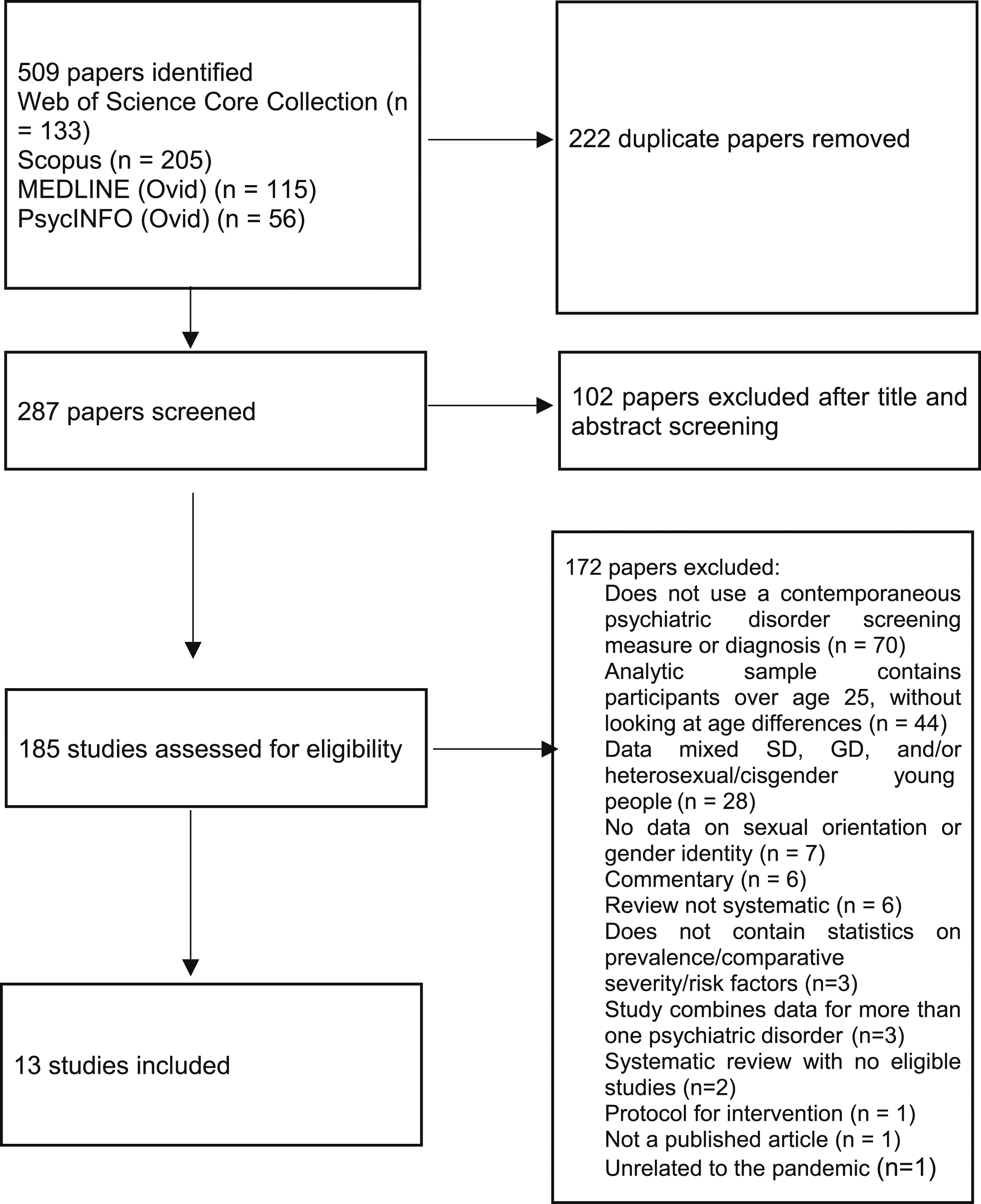
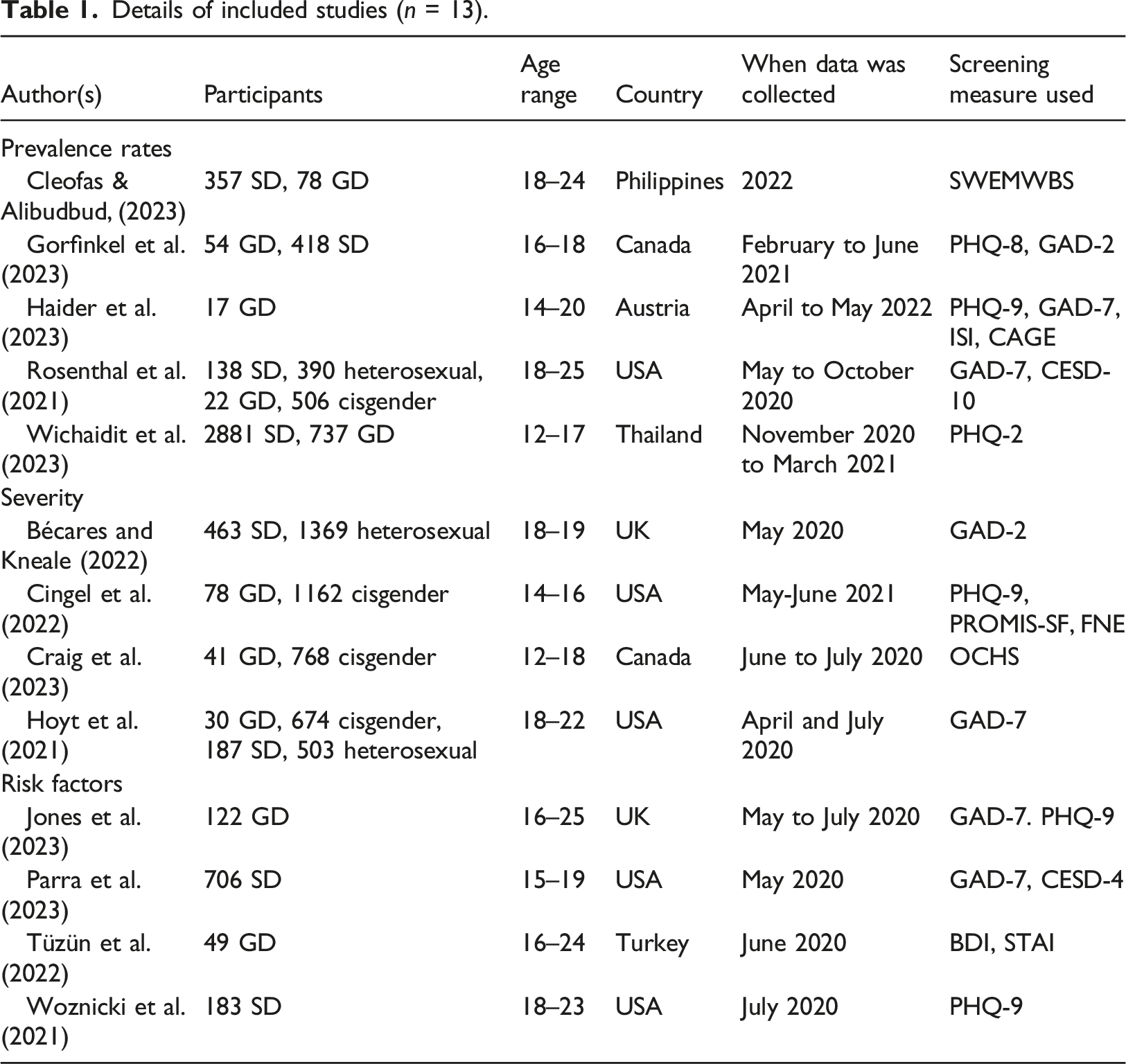
Eleven of the thirteen studies assessed depression. Ten studies assessed generalised anxiety disorder. Social anxiety disorder/social phobia were assessed by two studies. Separation anxiety disorder, insomnia disorder, alcohol use disorder, conduct disorder, oppositional defiant disorder and post-traumatic stress disorder (PTSD) were assessed by one study each. All included studies used screening measures. Screening tools for depression included the Patient Health Questionnaire (PHQ), the Shorter Warwick-Edinburgh Mental Wellbeing Scale (SWEMWBS), the Ontario Child Health Study scales (OCHS), the Center for Epidemiologic Studies Depression Scale (CES-D) and the Beck Depression Inventory (BDI). Generalised anxiety disorder was assessed by the Generalised Anxiety Disorder scales (GAD), Patient Reported Outcome Measurement Information System Short Form (PROMIS-SF), the State-Trait Anxiety Inventory (STAI) and the OCHS, with social anxiety disorder/social phobia symptoms being measured by the Fear of Negative Evaluation scale (FNE) and the OCHS. Other disorders assessed include insomnia disorder using the Insomnia Severity Index (ISI), alcohol use disorder using the CAGE questionnaire, and separation anxiety disorder, conduct disorder, oppositional defiant disorder and PTSD using the OCHS.
Prevalence rates of psychiatric disorders among sexually diverse young people
Two studies reported unweighted depression prevalence rates of 26.9% and 65.1% respectively among SD young people (Cleofas & Alibudbud, 2023; Gorfinkel et al., 2023). One study conducted in late 2020 to early 2021 reported weighted depression prevalence rates among adolescents of between 9.2% (gay males) and 26.8% (bi and polysexual females) (Wichaidit et al., 2023). A generalised anxiety prevalence rate of 68.4% was also identified (Gorfinkel et al., 2023). One study reported heightened prevalence of both depression and generalised anxiety among SD compared to heterosexual young people, with odds ratios of 4.42 (95% CI 2.90, 6.73) and 3.34 (95% CI 2.22, 5.01) respectively (Rosenthal et al., 2021).
Comparisons of mean psychiatric disorder scores in sexually diverse versus heterosexual young people
Two studies indicated greater average generalised anxiety symptomology among SD compared to heterosexual young people on both the GAD-2 (M [SD] sexually diverse = 10.22 [5.54]; heterosexual = 7.04 [4.60]) (Bécares & Kneale, 2022) and GAD-7 (April 2020: M [SD] sexually diverse = 12.94 [5.33]; heterosexual = 9.49 [5.90]; July 2020: sexually diverse = 12.28 [5.87)]; heterosexual = 8.85 [5.83]) (Hoyt et al., 2021), with the latter study reporting significant differences between the mean scores in each group at both timepoints (p < .001).
Risk factors for psychiatric disorders among sexually diverse young people
Sociodemographics
One study indicated depression prevalence was higher among bi/pan (21–27%) and queer/questioning (18.5–29%), along with asexuals assigned female at birth (20.9%), compared to gay/lesbian young people (9.2–14.5%); females of all identities had greater weighted prevalence of depression (14.5–29%) compared to males (9.2–21%) (Wichaidit et al., 2023). Furthermore, Parra et al. (2023) indicated SD young people who do not identify as gay/lesbian scored on average significantly higher on scales assessing generalised anxiety (M = 12.00, SD = 5.46) and depression (M = 6.46, SD = 3.23) compared to those who do (Ms = 10.89, 5.89, SDs = 5.89, 3.17, all p < .05).
Pandemic specific factors
SD adolescents who lived in households which experienced job loss related to the pandemic reported significantly more severe symptoms of generalised anxiety (M = 12.28, SD = 5.62) and depression (M = 6.45, SD = 3.23) compared to SD peers who did not (Ms = 10.88, 5.90, SDs = 5.70, 3.10) (both p < .05); the same study found hours of social distancing was associated with depression symptom severity (r = .09, p < .05) (Parra et al., 2023).
Family support/rejection
Parra et al. (2023) identified positive associations between family rejection and both generalised anxiety (r = .28, p < .01) and depression symptoms (r = .26, p < .01). Additionally, family rejection mediated the relationship between household job loss and both anxious and depressive symptoms. Conversely, one study indicated a negative association between perceived family support and depressive symptomology among adolescents and young adults (r = −.30, p < .01) (Woznicki et al., 2021).
Loneliness
Woznicki et al. (2021) reported loneliness was associated with depression (r = .46. p < .01) and mediated the relationship between family support and depressive symptoms.
Parasocial relationships
The strength of parasocial relationships, which involve a one-sided connection to a media figure (Hoffner & Bond, 2022), moderated the relationship between loneliness and depression, with higher parasocial support mitigating depressive symptoms among young people reporting high loneliness whilst heightening symptoms among those reporting low loneliness (Woznicki et al., 2021).
Prevalence rates of psychiatric disorders among gender diverse young people
Three studies reported unweighted depression prevalence rates of between 26.9% and 94.1% among GD young people (Cleofas & Alibudbud, 2023; Gorfinkel et al., 2023; Haider et al., 2023), with one study reporting weighted prevalence rates of 18.8% among GD adolescents assigned male at birth, and 39.8% among GD adolescents assigned female at birth (Wichaidit et al., 2023). Two studies reported an unweighted generalised anxiety prevalence rate of 70.6% (Haider et al., 2023) and 79.6% (Gorfinkel et al., 2023). Haider et al. (2023) also indicated an insomnia disorder prevalence rate of 41.2% and an alcohol use disorder prevalence rate of 11.8%. One study reported a greater likelihood of clinically significant depression and generalised anxiety symptoms among GD compared to cisgender young people, with odds ratios of 3.27 (95% CI 1.25, 8.54) and 3.02 (95% CI 1.26, 7.26) respectively; however, these became non-significant when adjusting for other risk factors (see Table S3) (Rosenthal et al., 2021).
Comparisons of mean psychiatric disorder scores between gender diverse and cisgender young people
Three studies reported greater average scores on various scales assessing generalised anxiety disorder among GD compared to cisgender young people, including the PROMIS-SF (M GD = 3.64. Cisgender males = 2.50 [p < .0001], cisgender females = 3.15 [p < .0001]), the OCHS (M GD [SD] = 69.39 [8.2], cisgender males = 58.25 [11.58], cisgender females = 64.36 [10.48]) and the GAD-7 (April 2020: M [SD] GD = 13.88 [6.00]; cisgender males = 7.90 [5.74], cisgender females = 11.68 [5.54]; July 2020: GD = 13.16 [6.75)]; cisgender males = 6.46 [5.16], cisgender females = 11.21 [5.68]) (Cingel et al., 2022; Craig et al., 2023; Hoyt et al., 2021). At both timepoints, Hoyt et al. (2021) found significant differences between GD and cisgender males (p < .001) but not females (p ≥ .05). Cingel et al. (2022) and Craig et al. (2023) reported similar disparities in depression using the PHQ-9 (M GD = 2.84. Cisgender males = 2.00 [p < .0001], cisgender females = 2.47 [p = .001]) and OCHS (M GD [SD] = 78.20 [10.74], cisgender males = 64.26 [15.10], cisgender females = 68.70 [13.82]). The same studies found disparities in social anxiety disorder/social phobia using the FNE (M GD = 3.53, cisgender males = 3.01 [p < .0001], cisgender females = 3.37 [NS]) and the OCHS (M GD [SD] = 67.34 [7.94], cisgender males = 57.56 [10.30], cisgender females = 60.05 [10.05]. Craig et al. (2023) also found significant disparities in conduct disorder, oppositional defiant disorder, separation anxiety disorder and PTSD (see Table S3).
Risk factors of psychiatric disorder symptomology among gender diverse young people
Social connectedness and support
Tüzün et al. (2022) identified negative associations between social connectedness and both depression (r = −.64, p < .001) and generalised anxiety severity (r = −.64, p < .001). Additionally, negative associations were identified between overall social support, along with specific support from friends and family, with depression (r [overall] = −.50, r [friend] = −.38, r [family] = −.62, all p < .01) and generalised anxiety severity (r [overall] = −.63, r [friend] = −.49, r [family] = −.70, all p < .001).
Pandemic related factors
Jones et al. (2023) identified reported level of pandemic impact (assessed though measuring social support, living situation and access to gender-specific and mental health services) was positively associated with severity of depression (R 2 = .19, p ≤ .001) and generalised anxiety disorder symptoms (R 2 = .20, p ≤ .001). Additionally, GD young people who experienced discomfort over their living situation during the pandemic reported more severe depression (U = 119, p = .009) and generalised anxiety disorder symptoms (U = 97.5, p = .002) compared to those who did not (Tüzün et al., 2022).
Discussion
This systematic review focused on both the prevalence and severity of psychiatric disorders among SGD young people during the COVID-19 pandemic using validated screening measures. Prevalence rates of both depression and generalised anxiety during the COVID-19 pandemic among both groups were mostly higher compared to those found among young people during this time, which were 25.2% and 20.5% respectively (Racine et al., 2021). SGD young people also experienced high prevalence of several other psychiatric disorders, although these were examined within fewer studies. Studies also indicated significantly more severe symptoms of various psychiatric disorders compared to their heterosexual/cisgender peers. Studies also indicated factors associated with psychiatric disorders amongst SGD young people: some were specific to the pandemic, but most were consistent with factors reported prior to the pandemic, including social support (McConnell et al., 2016), loneliness (Mereish & Poteat, 2015), and family rejection (Klein & Golub, 2016). Overall, further research is required with SGD young people to understand which of the factors outlined, along with factors that have not been covered thus far, should be prioritised by stakeholders.
Our systematic review is limited in focusing primarily on generalised anxiety and depression: further research is needed to understand how prevalence and risk factors of other psychiatric disorders were affected by the pandemic. The use of differing scales to assess psychiatric disorders means comparison between studies should be interpreted with caution. Furthermore, most of these studies were cross-sectional and did not control for previous psychiatric disorder symptomology or diagnoses, therefore the effects of previous or ongoing psychiatric disorders may have confounded the found effects of the pandemic. Additionally, it is likely that the impacts of the pandemic on mental health were not static, and an absence of longitudinal data focusing upon this group limits study (Sun et al., 2023).
Research has indicated sexual and gender identity can be fluid for some young people (Katz-Wise et al., 2023; Stewart et al., 2019), thus the studies reviewed will not have included young people who may identify as SGD in the future and may have included young people who will not. We also recognise that we can only report prevalence and severity of psychiatric disorders among young people who identify as SGD within the studies synthesised. There may be SGD young people who do not necessarily identify as such, or they may not feel able to disclose their identity. With research indicating a lack of disclosure to others about SGD identity being associated with heightened risk of psychiatric disorders (Feinstein et al., 2019; McKay & Watson, 2020), it is likely this group are at particular risk of psychiatric disorders but are not being covered by the literature.
Conclusions and recommendations
Previous evidence is clear regarding the difference in the prevalence and severity of psychiatric disorder symptomology among SGD young people compared to their heterosexual/cisgender peers pre-pandemic. This systematic review suggests that this continued during the pandemic, with several factors associated with these disparities. This systematic review therefore has implications for further research along with service provision as clinicians deal with the pandemic’s fallout among this at-risk group of young people. Although SGD young people were more likely to seek out mental health services during the pandemic, they were more likely to indicate unmet mental health needs and to report suicidality compared to heterosexual/cisgender groups (Chen et al., 2022; Gorfinkel et al., 2023; Liu et al., 2023). Research has also indicated SGD young people can experience issues with mental health services, including a lack of care that is responsive to their specific needs, and even discrimination based on SGD identity by clinicians (Rees et al., 2021).
Various stakeholders including clinicians and policy makers should acknowledge the risk factors of psychiatric disorders indicated by this systematic review to deliver more effective and responsive care. To do this, efforts should be made to collaborate with SGD young people directly in coproducing the services that will have the most benefit to this group. By putting the needs of SGD young people at the forefront, this has the potential to facilitate a greater level of trust in mental health services. Along with longitudinal research, the inclusion of SGD young people within population level health research, which has typically excluded SGD people through absent and inappropriate demographic measurement (Cahill et al., 2020), can elucidate the impact of the pandemic amongst this group in more detail, through the collection of data from a greater number of SGD young people. This can then clarify areas of research development, again assisting stakeholders.
Supplemental Material
Supplemental Material - Prevalence, severity and risk factors of psychiatric disorders amongst sexual and gender diverse young people during the COVID-19 pandemic: A systematic review
Supplemental Material for Prevalence, severity and risk factors of psychiatric disorders amongst sexual and gender diverse young people during the COVID-19 pandemic: A systematic review by Jonathan O’Shea, Rachel James, Dasha Nicholls, James Downs and Lee D Hudson in Clinical Child Psychology and Psychiatry.
Footnotes
Declaration of conflicting interests
The author(s) declared no potential conflicts of interest with respect to the research, authorship, and/or publication of this article.
Funding
The author(s) received no financial support for the research, authorship, and/or publication of this article.

Supplemental Material
Supplemental material for this article is available online.
Author biographies
References
Supplementary Material
Please find the following supplemental material available below.
For Open Access articles published under a Creative Commons License, all supplemental material carries the same license as the article it is associated with.
For non-Open Access articles published, all supplemental material carries a non-exclusive license, and permission requests for re-use of supplemental material or any part of supplemental material shall be sent directly to the copyright owner as specified in the copyright notice associated with the article.
