




Abstract
Despite the importance of consultation in early intervention of mental health difficulties, there has been little consideration of the specific competencies needed nor a model underpinning this intervention. Eleven schools- and children’s centre-based child and adolescent mental health services clinicians were interviewed with semi-structured interviews before and after a systemic consultation training. Four main themes emerged; participants gained: (1) a better understanding of organisational and multi-agency contexts, (2) a clear theoretical basis for practice, consistent with a destigmatising understanding of mental wellbeing, (3) clarity on the role, remit, and process of consultation, and (4) confidence and skills to carry out the role. The skills gained were in line with systems-level competencies. These findings suggest that the systemic consultation training increased the confidence of clinicians to work with complex networked systems in schools and communities. Future research can further understand the impact of this approach on other stakeholders, such as schools and families.
Keywords
Introduction
The guidance published to inform child and adolescent mental health services (CAMHS) emphasised the importance of integrated working across children’s services as well as early intervention (Future in Mind, 2015). This followed concerns that services had high thresholds for support and were resource-limited by primarily providing direct casework. The nation-wide Mental Health in Schools Teams (MHST) UK initiative was launched to improve early access to mental health support through schools and to provide schools themselves with support and training to support vulnerable children.
As a first step, MHST practitioners offer school-based consultation, where schools discuss children who might need further mental health support. Consultation in this context is defined as ‘a service delivery model in which a clinician, serving as a consultant, uses problem-solving strategies to address the needs of a consultee and a client’ (Crothers et al., 2020). Evidence suggests that consultation can form an effective feature of school-based interventions. One study reported that teachers were better able to support children’s socio-emotional development due to consultation, highlighting the potential for consultation to improve wider understanding of mental health (Green et al., 2006). Gardner-Elahi (2011) interviewed school staff and parents on their experience of consultation. The data suggested that consultation led to whole-school changes and improved the ability of the school staff to support pupil mental health. However, research into the implementation of the MHST initiatives in the UK found that there are currently no clear approaches used for consultation and that the impact of this upon their success is unknown (Ellins et al., 2021). It is important that research outlines the characteristics of these interventions alongside their efficacy.
Several models of mental health consultation are proposed, including Social Cognitive Theory Consultation and Solution-focused Consultation (Brown & Schulte, 1987; Kahn, 2000). These models consider how behaviour, cognitions, and the environment can promote positive changes in schools and address behavioural concerns or create a cognitive shift. However, with these models consider the role of the environment within the context of reinforcing the child as being ‘the problem’ rather than how the environment can change to improve the child’s mental health. This is significant in the context of how problems can be viewed in schools, moving away from the concept of ‘disruptive’ and ‘naughty’ children into an understanding of how the difficulties can develop in the context of the child living in a family, community, school, and the wider social determinants impacting on their wellbeing. The focus should arguably be on improving the quality of relationships between children and their community rather than on the individual.
van Roosmalen (2018) proposed a community partnership approach to child mental health teams working with schools, families and relevant wider stakeholders to address the health of children and the systems they live in. In this model, children’s mental health is viewed and understood within the context that they live in. This implies a shared responsibility between stakeholders, where responsibility for change is not attributed to only one part of the system, that is the child. Consequently, an individual, such as a consultant, can influence the system through supporting relationships to conceptualise the problem together (Knoff, 2000; Nastasi, 2006). A school-based support programme based upon the systems of care framework found that the origin of children’s difficulties and needs are often complex and require a systems approach (Fette & Estes, 2009; Swick & Powers, 2018). Ingraham (2015) proposed a systemic model, the Mental Health Consultation in Child Care model, summarising four system-focused consultation studies and highlighted seven areas that are key to providing effective consultation. All seven facets focused on relationships and could benefit from a model of consultation that explicitly promotes partnerships between the groups of stakeholders involved with the child. A recent national study evaluating the MHST initiative found that whole school approaches provided by the MHST, such as consultation, have been poorly characterised. Their success may be dependent upon systemic factors, such as an understanding of the local context and partnership working (Ellins et al., 2023). A systemic delivery of consultation could be an effective way to improve the reported efficacy of these whole-school approaches.
This aim of this paper is to evaluate the impact of a systemic training for school-based consultation, which focuses on partnership working with the systems children live in. This will contribute to the development of an approach to school consultation by examining the perceived usefulness of the systemic consultation training on consultants’ everyday practice.
Method
The two local researchers were an Assistant Psychologist and a Consultant Clinical Psychologist. A Consultant Clinical Psychologist and Systemic Psychotherapist co-designed the training with the first author and guided the development of the training audit protocol and interview schedule. External validation of the analysis was undertaken by a Systemic Psychotherapist external to the local service.
Participants
Participants’ designations and years of experience in Community CAMHS.
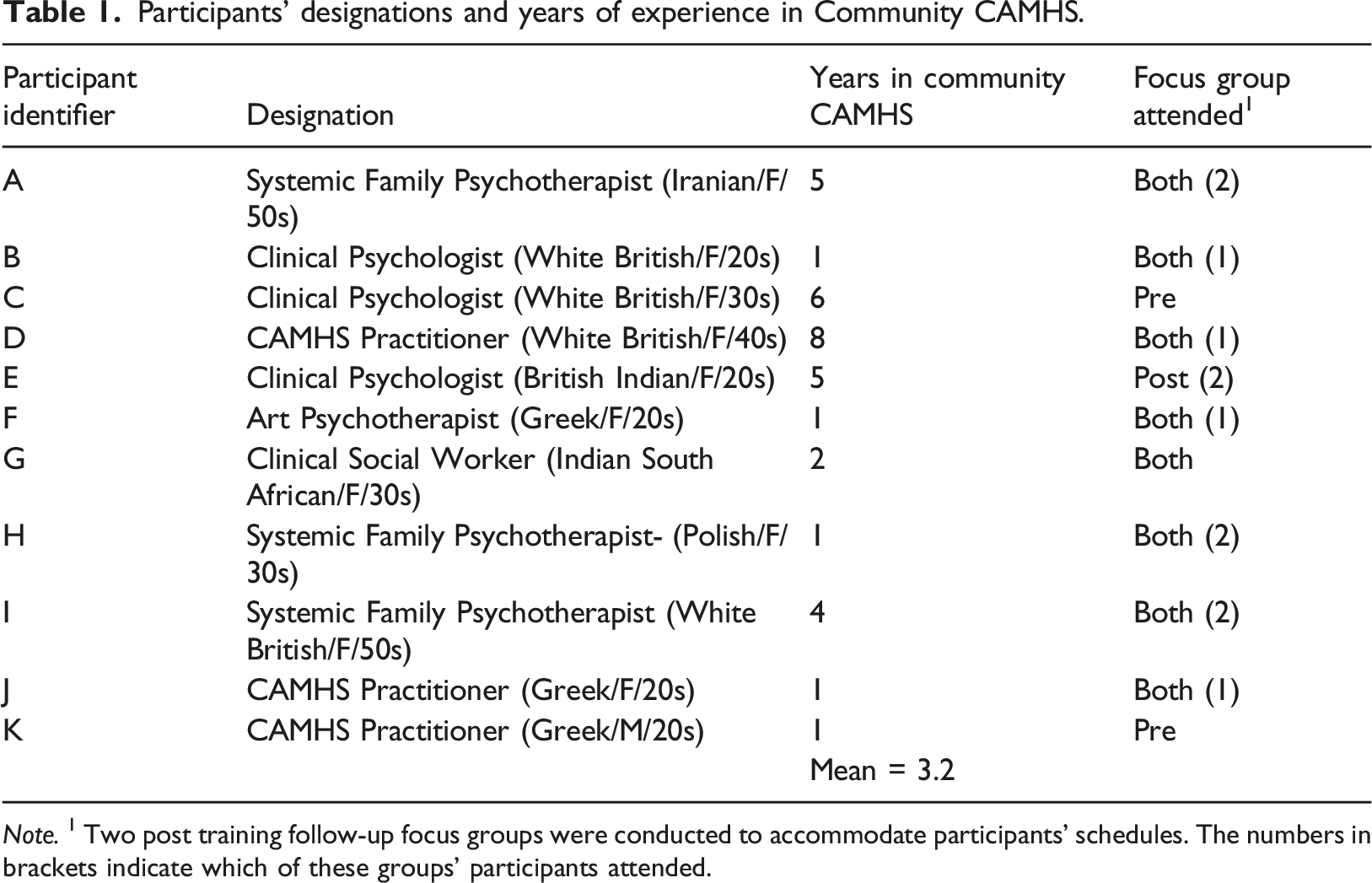
Note. 1 Two post training follow-up focus groups were conducted to accommodate participants’ schedules. The numbers in brackets indicate which of these groups’ participants attended.
Systemic consultation training
The training was divided into two phases. Phase one consisted of two half day workshops, where participants were familiarised with the organisational context of schools and through shadowing an education colleague. Phase two consisted of seven whole day training sessions over ten months. The training considered the role of consultation in context, adopting systemic concepts into practice and interpersonal skills for change. The content of the course is given in Supplementary Appendix A.
Interviews and procedure
Semi-structured focus groups were conducted before and following the training to gather feedback from participants and explore changes in perception over time.
Semi-structured focus group interview schedules.
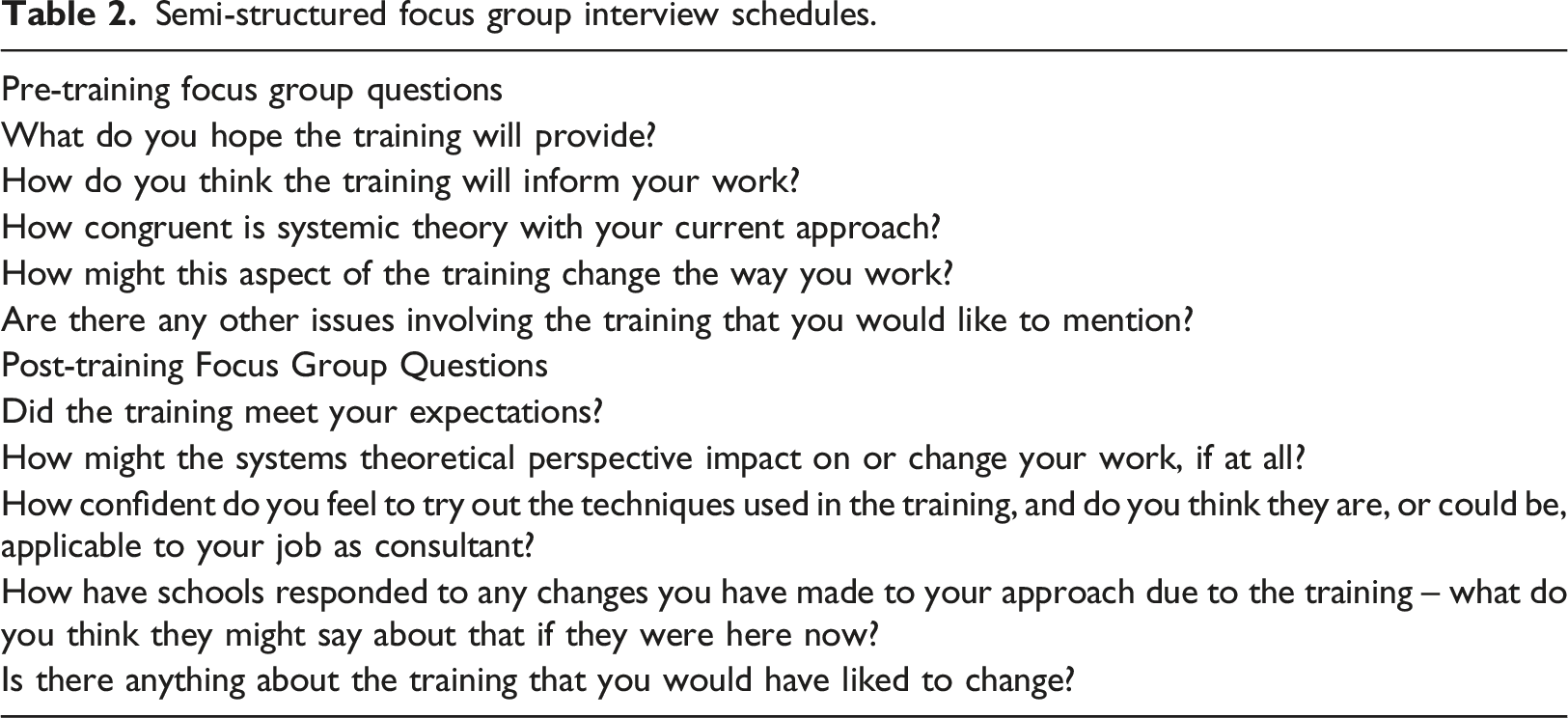
Each semi-structured focus group lasted approximately 60 min and included five questions about the training (the focus group included a further three questions about an earlier phase of the training, which were not relevant to the present analysis and therefore not included). The initial focus group was held before the start of the training. Following the training, ten months after the initial group and on completion of the training, two follow-up (post-training) focus groups were held. A thematic map of pre- and post-training focus group themes.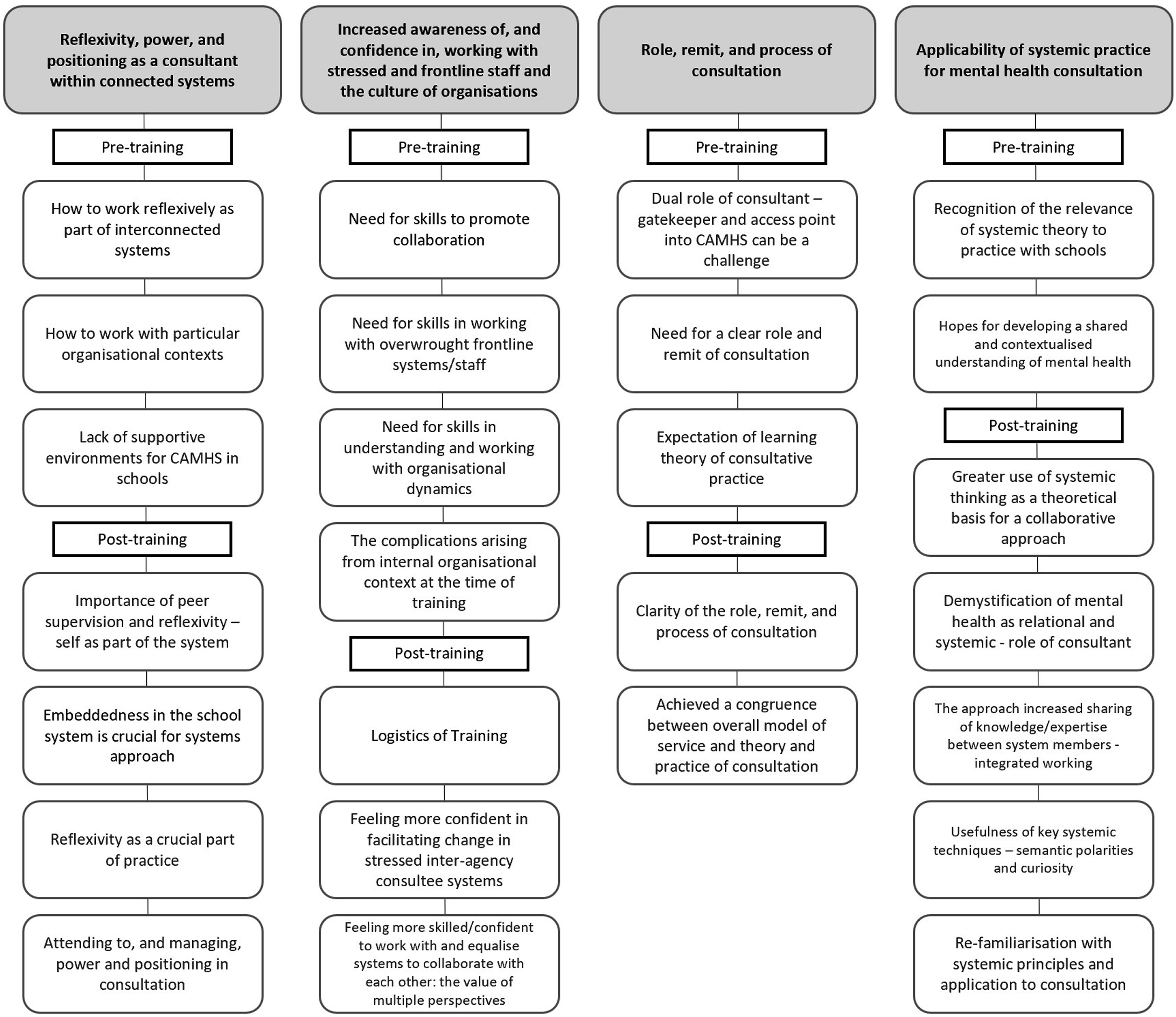
Analysis
A thematic analysis approach was adopted to analyse the data (Braun & Clarke, 2006). NVivo 8 (QSR International, 2008) was used to sort and code the data for initial themes. Pre- and post-training focus groups were analysed independently of each other so that thematic structures derived from before and after the training could be compared. Following moderation of the groups and the transcription of resultant audio recordings, the second author familiarised themselves with the data. Through an iterative process of independent and cross-researcher examination of the data, further analyses took place in parallel, with the first two authors examining the data and generating lower order codes and subsequent sub- and overarching themes independently of one another. This aimed to reduce researcher bias (Redfern & Norman, 1994). The lower order codes, sub-, overarching themes, and focus group transcripts were reviewed for validation by the external reviewer and revised accordingly. The initial codes are provided in Supplementary Appendix B.
Results
Reflexivity, power, and positioning as a consultant within the connected systems
Prior to training
How to work reflexively as part of interconnected systems
Four main themes were identified, both pre- and post- the systemic consultation training (Figure 1). Whilst acknowledging their interconnectedness to the systems, participants expressed needs for skills in, and opportunities for, reflexivity as an essential tool when working with systems: “it’s about exploring ourselves and our own context and what we’re bringing to the work as much as … understanding the context of others and how that influences the ideas that we develop with others.” (Participant A)
How to work with particular organisational contexts
Clinicians described how spending time within challenging organisational circumstances during the shadowing exercise led them to be mindful of the challenges that these organisations can face and how this insight might inform how they set up consultations: “I was so struck by the constant interruptions, never finishing a task, constantly moving from thing to thing, getting to the end of the day not having done the things you set out to do… It’s making me think much more carefully about how I will structure that time [during consultations] because it’s going to be a very rare experience for them and a very precious experience and I have a responsibility to make it as useful as possible.” (Participant D).
Lack of supportive environments for CAMHS in schools
Participants commented on the need for schools to have the space, both mental and physical, to support their sometimes challenging work. They observed this support to be necessary at all levels of these organisations, namely, management, teaching staff, pastoral care, and support staff: “I shadowed a [Children’s Centre] manager. I found it very helpful to understand how cut off she is in her work, in her space, with the door shut and it has to be shut because if she opens it the children will come in…how poor it was really, how un-conducive it was to what we are trying to do in Children’s Centres and how we are trying to work.” (Participant J)
Post training
Importance of peer supervision and reflexivity – self as part of the system
Participants described the training as an opportunity for peer support and supervision, which felt both helpful for sharing ideas and encouraged reflective practice: “Provided us, me, space to sit down and listen to other clinicians’ experiences. I think this was very valuable because I thought that things are happening only in my school; or these are the kind of struggles that only I have and it’s not just about fixing them or getting through them.” (Participant F)
Embeddedness in the school system is crucial for systems approach
By participating, the training led to a reported increased embeddedness within the school system by providing participants with a greater connection to the community: “They really valued that I spent some time there, that I talked to people, that I kind of connected with people and the feedback from school is really positive.” (Participant B)
Reflexivity as a crucial part of practice
Participants’ overall experience of the training was that it provided them the opportunity for greater reflexivity as a result of several systemic challenges: “Having, actually, a forum to think about what we do in consultation meetings, I think that was very useful.” (Participant H)
Attending to, and managing, power and positioning in consultation
Within the school context, participants displayed an awareness of power and difference between consultants and the system. Comments focused on the dilemma of how they can become aware of their positioning and respond in a useful way: “I think there was something quite helpful as well … about getting to know the system and showing that you’re interested in knowing the system … it helps them to feel understood because I think … sometimes there’s a sense especially when things like Ofsted and things have been in … they’re constantly under pressure to show something … but I can sense that once you do more in the school they pay you back by being more patient as well.” (Participant E)
Increased awareness of, and confidence in, working with stressed frontline staff and the culture of organisations
Prior to training
Need for skills to promote collaboration
Participants felt they required further training in and experience of, the dynamics of organisations and systems, individual and systemic causality, and skills in how to mobilise interconnecting systems to corroborate with each other: “I hope that you give us the skills to be able to invite the whole system around the child in a discussion about what is happening for the child and what the solutions might be.” (Participant B)
Need for skills in working with overwrought frontline systems/staff
Participants hoped the SCT would help them to deal with consultations with schools that felt ‘stuck’ and in which they were struggling to come to a mutual understanding: “I think one of the things we find quite often with schools is … sometimes it’s quite easy to get stuck because schools have a particular agenda and we have a slightly different perspective. So for me one of the hopes of the training is to think about how we can use systemic ideas to understand that stuckness and also then to work with it”. (Participant C)
Need for skills in understanding and working with organisational dynamics
They also hoped the SCT would provide a space for self-reflection, reflexivity and support, and to feel able to model this in the organisations to which they were consulting: “I guess it’s about context and being more mindful perhaps of the layers of context and language aside … to look at the relationships and thinking beyond that into the context of perhaps where I am and the organization of where I am is perhaps a shift.” (Participant C)
The complications arising from internal organisational context at the time of training
Participants expressed that the timing of the SCT was received differently depending on their experience within the team. Participants who had been in the service for longer felt that the ‘business’ of their current role meant it had come at a bad time. However, these participants acknowledged that, for newer employees, this would have been ideal: “And for some of us who have been in the service for longer, it’s in a way, I would have loved this training much earlier I think we just started so we learnt by doing…” (Participant A)
Post training
Feeling more confident in facilitating change in stressed inter-agency consultee systems
Participants described greater confidence following the SCT in working with ‘stuck’ or overwrought systems and facilitating change using a therapeutic skills and processes: “It’s helpful to them [schools] to be aware … of how the trauma spreads around from the child and the family and the school systems and vice versa and … the anxiety level really becomes higher and higher and to be able to manage that better…which isn’t always easy.” (Participant I)
Feeling more skilled/confident to work with and equalise systems to collaborate with each other: the value of multiple perspectives
Participants reported that the training itself (as a process) gave them skills to help partnerships within schools, and that in return, school staff felt more engaged with and supported by consultants: “I found [shadowing] really useful in terms of … getting to know the school and the system better …actually I found that that was very welcomed by the school staff, that the person I shadowed was the SENCO, that she said it was a fantastic idea and that it makes her very valued and it makes her feel that we actually really interested.” (Participant H)
Logistics of training
Participants displayed increased awareness by being reflective on the strengths and difficulties of the training itself, sharing feedback and reflections on the trainer, comments on ethical and practice dilemmas, and sharing structural difficulties: “what I actually found most useful was the exercise that we were asked to do for the ultimate for the last session which was to think about how you’ve applied the ideas and I wonder whether if, we would have had more work to do but you know, this idea of maybe doing something structured.” (Participant E)
Role, remit, and process of consultation
Prior to training
Dual role of consultant – gatekeeper and access point into CAMHS can be a challenge
Participants considered their relationship to CAMHS as consultants to be a challenge, with pressures to consider appropriate referrals across the system: “how we are being positioned by the Core team and I’m kind of thinking we need to be quite good at doing consultation that at the consultation level we would kind of tease out that this is a case for us, put a referral, rather than saying ‘I’m not sure, let’s make a plan in it’…help me to think about the appropriateness of referral for that without even having the first clinical contact with the family.” (Participant E)
Need for a clear role and remit of consultation
Participants described feeling unsure of the explicit nature of their roles as consultants to education, with a discrepancy between the expectations of their service, community CAMHS, and those of the organisations to which they aimed to consult (i.e. schools): “What we’re actually contracted to do and what people want us to do and how they all match up because I think quite a lot of us get exposed to dilemmas around should we do this work or should we not do this work? And are we contracted to do this?” (Participant D).
Expectation of learning theory of consultative practice
Participants appeared to have an expectation that the training would help them to think about the theory behind the practice: “Yes, I mean for me I don’t think there’s only one thing that I personally apply to. I would say psychodynamic or systemic. I’d like to think that it’s useful to just change within different contexts, different theories, different you know to situation I think.” (Participant F)
Post training
Clarity of the role, remit, and process of consultation
Participants found that the SCT provided them the necessary tools to establish and renegotiate clear roles for themselves as consultants – for example, to develop agreements with schools outlining the remit of the consultation service: “Some of us were either engaging new schools or were struggling to think about how we would rebuild relationships or perhaps take over the relationships that other people have had and so on…so I did find that [ideas around contractual arrangements] really helpful.” (Participant I)
Achieved a congruence between overall model of service and theory and practice of consultation
In addition, participants suggested that the training facilitated theory-practice links that felt pragmatically useful and relevant to working with schools: “…relate theory and practice… I thought that was very very helpful, the way that it felt linked to the work that we do rather than just being seen on its own and then us go off and try some way to put these [theories] in practice.” (Participant E)
Applicability of systemic practice for mental health consultation
Prior to training
Recognition of the relevance of systemic theory to practice with schools
Participants hoped that the SCT might facilitate engaging schools in systemic thinking. They hoped it would encourage working collaboratively and become more aware of each other’s roles and the mutual impact on one another: “I hope that [the SCT] gives us the skills to be able to invite the whole system around the child in a discussion about what is happening for the child and what the solutions might be.” (Participant B)
Hopes for developing a shared and contextualised understanding of mental health
Participants expressed that systemic theory might help them develop a more nuanced and contextualised understanding of children’s mental health as relational and systemic: “it’s useful to have the capacity to help people think from multiple perspectives because that’s sometimes something that school’s in particular find difficult to do with the motion that the problem’s located within the child and be helped to think from multiple perspectives is really helpful…..” (Participant D)
Post training
Greater use of systemic thinking as a theoretical basis for a collaborative approach
Participants described a shift from schools’ systems being perceived as wanting to eschew responsibility to a collaborative approach to children’s mental health, moving towards an understanding of shared responsibility: “With quite a few schools I’ve noticed they don’t take it as much as information giving about the family as maybe they did when we first started, they just treated it, our questions as information they were giving to us you know then all the responsibility for the work was on us and they were just providing information whereas now it feels more like … a shared discussion of the responsibility so uh it’s shared.” (Participant H)
Demystification of mental health as relational and systemic - role of consultant
Participants felt that the SCT helped to demystify mental health from a medical model to a relational one. A systemic approach was found to help consultees re-examine the concept of ‘mental health’ and accompanying expectations placed on consultants to be experts who might acquire sole responsibility for change: “The sense of pragmatic attitude … you’re not miracle workers, you can’t change the world.” (Participant B) “They’re not insisting that you take on cases quite as much as they used to, that it’s okay to talk and share ideas and that it’s rather than ‘you must take this off us and do something with this child’.” (Participant I)
The approach increased sharing of knowledge/expertise between system members - integrated working
Participants shared the ways in which they were able to use this understanding in their consultative roles. Participants spoke about how the demystification of mental health changed the way information was shared and discussed, with each party bringing their own expertise: “Helping schools think about moving away from asking us to come up with explanations for them. Helping them to think about what else might be going on rather than just thinking about [and] taking a linear perspective.” (Participant E)
Usefulness of key systemic techniques – semantic polarities and curiosity
Participants reported that using theory-based systemic concepts was useful to help shift positions of consultants and consultees. The systemic concepts which participants found most valuable to their work were semantic polarities
1
and curiosity
2
: “I would think very often about semantic polarities and thinking about it on a spectrum of possibilities rather than maybe just having ‘yes’ and ‘no’ and a ‘good’ and ‘bad’ answer but try to actually think about what else is possible.” (Participant H).
Re-familiarisation with systemic principles and application to consultation
Participants cited the relevance of systemic theory to support their consultative and daily practice within the service, leading to beliefs around it being an essential part of consultative practice: “The way it’s delivered I think was useful because you could straight away apply it in your work and think about things. I think it’s helped me learn more about…systemic ideas generally, not just in the consultations, but generally.” (Participant E)
Discussion
The aim of this paper was to examine the usefulness of a systemic consultation training for practitioners working with schools. This study is part of the development of a community partnership approach for children and families (van Roosmalen, 2018) and national push towards early intervention and partnership working (Future in Mind, 2015).
Following the training, participants reported an increased confidence in their effectiveness in working with stressed school staff and complex organisational cultures. Ingraham’s (2015) study found that systems-level consultants need increased sharing of knowledge and skills s to work successfully with (a) the number of participants in the consultation process, (b) the complexity of the dynamics that arise around consultation, and (c) the issues of rapport, communication, and credibility with multiple stakeholders. The systemic model of consultation gave participants skills to manage complex contexts in line with these established systems-level competencies.
Gardner-Elahi (2011) mirrored these findings in her study in the same locality. She found that school staff reported increased competencies in supporting children with their mental health following the systemic consultation training. Previous research found that supporting children with their mental health requires agencies to move past individualistic service provisions and to take an inter-agency systems partnership approach (Owen, 2010). These findings were similar to a national evaluation of MHST interventions, which suggested intervention efficacy was a function of partnership working (Ellins et al., 2023). This suggests that a training in a systemic approach to consultation can help clinicians develop confidence and competence in working effectively with networks of professionals and families and promote partnership working.
This paper adds to the literature by providing support for a distinct systemic model of consultation. Recent research found that consultation fulfilled the need to move skilled mental health providers and therapeutic interventions into community resources, rather than reserving them for specialist services (Draper et al., 2022). The findings of the study align a model of consultation within the development of a broader relationship focused way of working with children, families, schools and other partners to improve children’s mental health as part of a broader community partnership approach (explained in van Roosmalen, 2018). Participants found that they began to develop a shared understanding of, and responsibility for, mental health together with the school and family; this is a key feature of the model whereby agencies reconceptualise mental health as relational and ‘everyone’s responsibility’. This was evident in the increased reported partnerships.
A limitation of the study is that the research teams were part of the service (Durka & Hacker, 2015). The researchers’ roles within this Community CAMHS service could have had an influence on both participants’ responses and the interpretation of them during analysis. However, the third author conducted the literature review after the thematic analysis. This meant that the analysis was construed independently from pre-existing literature and more likely to be a reflection of the data collected (Draper et al., 2022).
This paper only considered the perspectives of consultants, although Gardner-Elahi’s study in the same service found that a systemic consultation training was effective for both school and parent consultees and led to meaningful positive outcomes (2011). Whilst there may be a limited degree of triangulation from these findings, this study did not determine the value of this training concurrently with other key stakeholders, such as school staff and families.
The findings of this study imply that learning skills in how to work with complex and stressed organisational contexts using a systemic approach helped to develop partnership working with schools and brought families in as partners rather than subjects of support. Future research could study the impact of the training on wider stakeholders. Additionally, research could consider how this training is translated into greater capacity of schools to support vulnerable children successfully, reduced referrals and measurable population health changes.
The aim of this study was to examine the perceived efficacy of a systemic model of consultation for clinicians working with schools following a systemic consultation training. Clinicians reported improvements to their practice through (1) a better understanding of organisational and multi-agency contexts, (2) development of a clear theoretical basis to practice consistent with a destigmatising understanding of mental wellbeing, (3) clarity and confidence to carry out the role, remit and process of consultation. These findings suggest that systemic consultation may be a distinct component of community mental health practice with families, schools, and other partners.
Supplemental Material
Supplemental Material - Clarifying an approach to consultation: The impact of a systemic consultation training for schools-based child and adolescent mental health services clinicians
Supplemental Material for Clarifying an approach to consultation: The impact of a systemic consultation training for schools-based child and adolescent mental health services clinicians by Marc Van Roosmalen, Michelle Daniels and Helena Lawrence in Clinical Child Psychology and Psychiatry
Supplemental Material
Supplemental Material - Clarifying an approach to consultation: The impact of a systemic consultation training for schools-based child and adolescent mental health services clinicians
Supplemental Material for Clarifying an approach to consultation: The impact of a systemic consultation training for schools-based child and adolescent mental health services clinicians by Marc Van Roosmalen, Michelle Daniels and Helena Lawrence in Clinical Child Psychology and Psychiatry
Supplemental Material
Supplemental Material - Clarifying an approach to consultation: The impact of a systemic consultation training for schools-based child and adolescent mental health services clinicians
Supplemental Material for Clarifying an approach to consultation: The impact of a systemic consultation training for schools-based child and adolescent mental health services clinicians by Marc Van Roosmalen, Michelle Daniels and Helena Lawrence in Clinical Child Psychology and Psychiatry
Footnotes
Acknowledgements
The authors would like to thank David Campbell, without whose wisdom the course would have not stood, and to Emilia Dowling, who stepped in so generously when David passed away.
Declaration of conflicting interests
The author(s) declared no potential conflicts of interest with respect to the research, authorship, and/or publication of this article.
Funding
The author(s) received no financial support for the research, authorship, and/or publication of this article.

Supplemental Material
Supplemental material for this article is available online.
Notes
Author biographies
References
Supplementary Material
Please find the following supplemental material available below.
For Open Access articles published under a Creative Commons License, all supplemental material carries the same license as the article it is associated with.
For non-Open Access articles published, all supplemental material carries a non-exclusive license, and permission requests for re-use of supplemental material or any part of supplemental material shall be sent directly to the copyright owner as specified in the copyright notice associated with the article.
