



Abstract
Background
Children with autism spectrum disorders (ASD) struggle with impaired theory of mind. We aimed to evaluate the effect of remediation of theory of mind on theory of mind, face perception, and behavioral symptoms in children with ASD.
Methods
Thirty children with ASD were randomly assigned to two equal groups of theory of mind training and active control group. Attentive remediation of theory of mind (ARTOM) and story-telling sessions were used for intervention in the groups. Theory of mind and facial emotion recognition tests as well as Gilliam autism rating scale (GARS) were used for assessment in three baseline, post-intervention, and follow-up sessions. Repeated measures ANOVAs were used for analysis.
Results
The results showed improvement in facial emotion recognition and theory of mind in intervention group. The behavioral symptoms, measured by GARS, were ameliorated in the intervention group. The training effects lasted until follow-up session.
Conclusions
The results suggest remediation of basic components of theory of mind, without direct intervention on theory of mind, improves theory of mind skill. The results also suggest that the remediation of basic components of theory of mind improves social and communicational performance and ameliorates stereotypes symptoms in children with ASD.
Keywords
Lay summary
Theory of mind is a cognitive skill which could be trained through cognitive remediation. The remediation of basic components of theory of mind improves social and communicational performance and ameliorates stereotypes symptoms in children with autism spectrum disorders.
Introduction
Autism spectrum disorders (ASD) as a neurodevelopmental disorder is characterized by two main behavioral symptoms: impaired social communication/interactions and restricted/repetitive patterns of interests and behaviors (American Psychiatric Association, 2013). The diagnosis of ASD is strongly associated with impairments in various fundamental cognitive functions, including spatial abilities (Robertson & Baron-Cohen, 2017), joint attention (Mundy, 2018), imitation (Van Etten & Carver, 2015), and emotion recognition (Song & Hakoda, 2018). Moreover, higher cognitive skills such as theory of mind are also significantly affected in individuals with ASD (Andreou & Skrimpa, 2020). Theory of mind refers to the ability to attribute a mental state to self/others. This ability is crucial to discover intention and goal of behaviors and mastering of social situations (Baron-Cohen et al., 2013).
Cognitive rehabilitation defined as “the process of remediation or compensation of cognitive deficits and related outcomes through the well-established program(s) by the therapist” (Nejati, 2022). It refers to the amplification or extension of a cognitive process through two main approaches: graded progressive tasks or environmental modification. The former, known as remediation, involves targeting a basic cognitive function and improving cognitive processes through graded tasks with increasing cognitive demand (Sohlberg & Mateer, 2001). On the other hand, the latter approach, known as compensation, focuses on teaching strategies to manage existing cognitive assets without directly targeting the basic cognitive underpinnings. Compensation serves as a functional approach, aiming to enhance specific skills rather than fundamental cognitive functions.
There are several studies focused on the effectiveness of theory of mind training in individuals with ASD. Fisher and Happé (2005) performed theory of mind training on children with ASD based on Swettenham (1996) pictures and found improved theory of mind, which remained stable at follow-up, 6–12 weeks later. However, this training did not include emotion recognition training and did not improve emotion recognition skills and daily use of theory of mind based on teachers’ reports. Begeer et al. (2011) used theory of mind training and described improved conceptual theory of mind skills in children with ASD. However, null effects were found for daily life mind reading ability, self-reported empathic skills, or parent-reported social behaviors. Golan and Baron-Cohen (2006) used computerized emotion and theory of mind training in adults with high-functioning ASD and found improvement in the same training tasks but not in the untrained emotion recognition and theory of mind tasks. Turner-Brown et al. (2008) trained adults with high-functioning ASD with ‘social cognition and interaction training’ and described improved theory of mind skills but not social communication. Another study used theory of mind training through storybook interactions focused on characters’ mental states in typically developing preschool children and found improved false belief understanding, but not emotion understanding or social competence (Tompkins, 2015). Finally, Holopainen et al. (2019) described the efficacy of Theory of Mind training on empathic responsiveness in children with ASD. With respect to cognitive training approaches, the majority of the above-mentioned training programs fall into the compensation approach. These programs target theory of mind as a skill and attempt to improve it through education or theory of mind tasks. For instance, ‘Theory of Mind’ (Ozonoff & Miller, 1995), ‘social cognition’ (Turner-Brown et al., 2008), ‘mental state- or mind reading’(Golan & Baron-Cohen, 2006), ‘picture-in-the-head teaching’ (Swettenham, 1996), or ‘thought-bubble training’(Wellman et al., 2002) focused on the internal/subjective representation of self/other mental states without considering the underpinnings of theory of mind. It is proposed that TOM may possibly be related to several cognitive abilities including attention to social relevant information to detect relevant information (Chevallier et al., 2012; Nejati et al., 2015a), visuo-spatial ability to represent different perspectives of others (Nejati et al., 2021) inhibiting reality/own mental states to represent others’ mental states (Baillargeon et al., 2010), emotion recognition as a basic social cognitive function (Mier et al., 2010), self-perception to represent the interaction between self-other (Nejati et al., 2012), and verbal ability to formulate and explain mentalizing (Nejati et al., 2011; Ronald et al., 2006; Scheeren et al., 2013). Several studies found improved theory of mind through training of these components. For instance, Yaghini et al. (2020) employed attentive remediation of recognition of emotional faces (AREF) and reported enhanced theory of mind and behavioral improvement in children with ASD. Similarly, another study by Tian (2019) revealed improved theory of mind in typically developing children after spatial training. Abadi et al. (2016) observed improved theory of mind following training of direct and indirect imitation in children with ASD. On the other hand, Hale and Tager-Flusberg (2003) found that language training in children with ASD enhanced theory of mind, while false belief training only improved theory of mind and did not have any impact on language skills. In summary, theory of mind as a skill can be improved through compensatory cognitive training, but this improvement may not necessarily generalize to behavioral symptoms. However, based on earlier-mentioned studies, the basic cognitive components of theory of mind are malleable, and training them in a remediation approach could lead to transferability to theory of mind as a higher cognitive skill. Transferability from trained tasks to untrained tasks is a crucial aspect of training effectiveness. Considering the three levels of brain, cognition, and behavior, as well as their respective assessments and interventions, a model of transferability describes two types of transfer: horizontal and vertical (Nejati, 2020). Horizontal transfer occurs when there is improvement in theory of mind after face perception training, involving similar test and intervention levels. On the other hand, different test and intervention levels lead to horizontal transfer, such as an improvement in communication skills after theory of mind training. The concepts of near and far transfers fall under vertical transfer within the same level of intervention (Nejati, 2020). For example, the improvement of theory of mind after false belief training is a form of near transfer, while the improvement of theory of mind after inhibitory control training refers to far transfer. In the context of psychiatric disorders, the ultimate goal of cognitive training is often the amelioration of behavioral symptoms, representing a vertical transfer. Without such transferability to daily life, any improvement in cognitive measures remains restricted to the clinical or laboratory setting. In this study, we hypothesized the trainability for the remediation of basic cognitive components of theory of mind, leading to improvements in the skill and respective behavioral symptoms in children with ASD. By focusing on the trainability of basic cognitive components of theory of mind and their potential transferability to higher cognitive skills, this project aims to bridge this critical gap in intervention research for children with ASD. If successful, the findings from this study could significantly contribute to the development of more targeted and comprehensive cognitive training programs, ultimately leading to improved theory of mind skills and enhanced behavioral outcomes in children with ASD. Our aim was to evaluate the impact of attentive remediation of theory of mind (ARTOM) on different levels of theory of mind, including non-mentalistic, mentalistic, and reciprocal levels, and the amelioration of behavioral symptoms in children with ASD.
Method
Participants
Mean (Standard deviation) of demographic characteristics of participants.

Assessments and measures
Gilliam autism rating scale
The GARS consists of 42 items to rate autistic behaviors of children by their parents (Gilliam, 1995). This test has been validated for Iranian children (Ahmadi et al., 2011). Three subscales of GARS, social interaction, communication, and stereotype behaviors, were used for rating of behavioral symptoms in the present study. As the fourth subscale, developmental delay, screen a longer duration of child development, it was not applicable for the aim of our study. The validity of the three used subscales has been documented for rating of behavioral symptoms (Ahmadi et al., 2011). In this study, we utilized the raw scores from this scale to assess the respective behavioral symptoms in our participants. The score ranged from 15 to 60.
Theory of mind test
The TOMT consists of 38 items to evaluate theory of mind at three levels (I: emotion recognition, pretense, II: first order-belief, understanding of false belief, and III: second order-belief, understanding of humor) in children aged between 5 and 12 years. (Muris et al., 1999). The concurrent validity of the test in Iranian population was estimated .89 according to test’s correlation with the dolls’ house task, a task where participants should attribute some mental states to some dolls in a furnished home. The test score ranged 0–38. The correlation coefficients of the subtests with the test’s total score were significant in all subscales and varied between .82 and .96 (Ghamrani et al., 2006).
Eckman facial emotion recognition test
This test uses a range of photographs from the Ekman and Friesen series of Pictures of Facial Affect (Ekman, 1976), which has been developed to study of facial expression. In the present study, a new short form version with 12 pictures of 6 basic emotional skill (happy, sad, anger, fear, disgust, and surprise) which was validated earlier in Iranian children was used (Nejati et al., 2015b). The test score ranged 0–12.
NimStim facial emotion recognition test
This test uses 48 photographs of basic emotions from the NimStim (Tottenham et al., 2009). This test has been developed and validated in children (Soltaninejad & Nejati, 2019). The test score ranged 0–48.
Children facial emotion recognition test
This test uses 12 photographs of basic emotions of children faces (Nejati et al., 2015b). The test score ranged 0–12.
In each assessment session, Gilliam autism rating scale (GARS) was completed by parents and theory of mind test (TOMT), Eckman facial emotion recognition test (EFERT), Nim stim facial emotion recognition test (NFERT), Children facial emotion recognition test (CFERT) were performed by children. Attentive remediation of theory of mind (ARTOM) was used for training in the intervention group. All participants were assessed in 3 sessions, before and after the intervention, and one-month follow-up.
Intervention
Attentive remediation of theory of mind
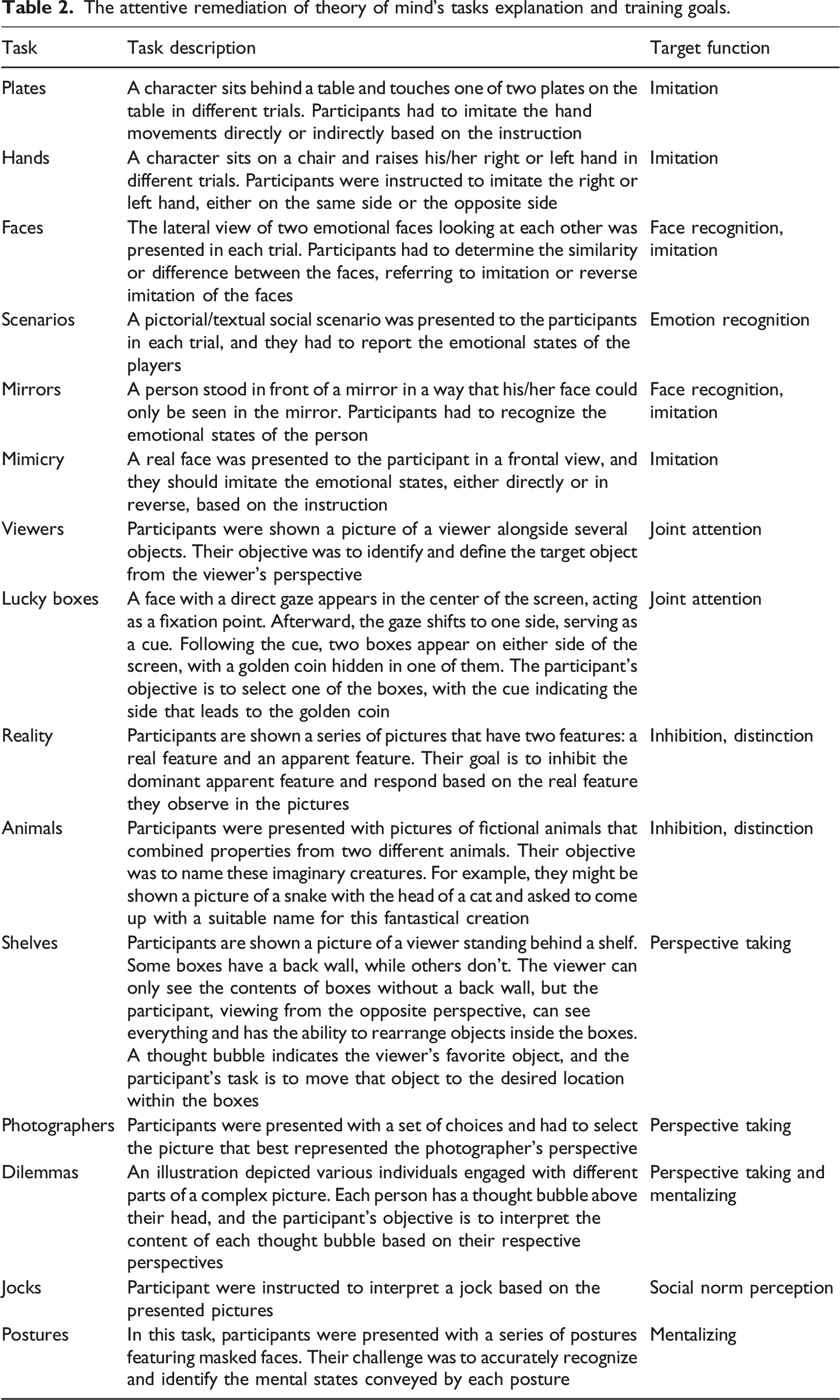
The attentive remediation of theory of mind’s tasks explanation and training goals.
Procedure
After obtaining a written consent form the parents of participants, the parents completed the behavioral checklist. Subsequently, the children were introduced to the study’s tasks and procedures by NK, a qualified clinical psychologist who also served as the researcher and author of the study. Then the participant randomly assigned in experimental or control groups. In both groups, assessment tests were performed in a random order in three assessment sessions with the same time schedule. In a random clinical trial design, participants were allocated randomly into two equal intervention and active control groups. The intervention group and control group (n = 15 in each group) received 10–12 session of attentive remediation of theory of mind (ARTOM) and story-telling session in order, about 60 minutes, 2 session per week, 5 weeks. The interventions were administered by the researcher, who was qualified and experienced in utilizing the intervention techniques. The researcher was not blinded to the group allocations during the study. However, both the patients and their parents were kept blind to the group allocation throughout the intervention period. During each session, the participant was presented with three or four tasks, and they were given the flexibility to take breaks between these tasks. At the beginning of each session, a list of tasks was provided, allowing the participant to choose the order in which they preferred to tackle them. Within each task, the participant’s progress was determined by their performance in the previous attempt. If the participant’s performance exceeded 80%, they would advance to a higher level of difficulty. Conversely, if their performance fell below 50%, the therapist would adjust the task to a lower level to ensure an appropriate challenge. Throughout the sessions, the therapist closely monitored the participant’s performance, providing valuable guidance and support when needed. This dynamic approach allowed for personalized and adaptive intervention, tailoring the tasks to the individual’s abilities and progress. The procedures were in accordance with the ethical standards of the Helsinki Declaration of 1975, as revised in 1983. The procedures were approved by ethical committee of Shahid Beheshti University.
Data analysis
Data were analyzed using the statistical package Statistical Package for the Social Sciences (SPSS) for Windows (IBM), version 21. The baseline assessments of groups were compared through independent T-tests. A series of 2 × 3 repeated measures multivariate analyses of variance (MANOVAs) were performed to investigate the effect of intervention, group, and respective intervention The group (intervention vs. control) included as a between-subject factor, time (pre-test, post-test and follow-up) considered as a within-subjects factor. The interaction is the primary effect of interest, as a significant effect would support the effectiveness of the intervention. Univariate repeated measures were used to evaluate the interaction effect separately for each dependent variable. Shapiro-Wilk, Leven, Mauchly, and Bonferroni tests were used to examine normality, homogeneity of variance sphericity of the data, and post-hoc analysis in order. A significance level of p < .05 was used for all statistical comparisons.
Results
Overview
All participants actively engaged in the interventions as instructed. Table 2 illustrated the mean and standard deviation of measures in three assessment sessions. Independent t-tests revealed significant differences between the experimental and active control groups for none of the measures in the baseline assessment.
Effectiveness analyses
Mean and standard deviation of measures in pre-post-follow up times.
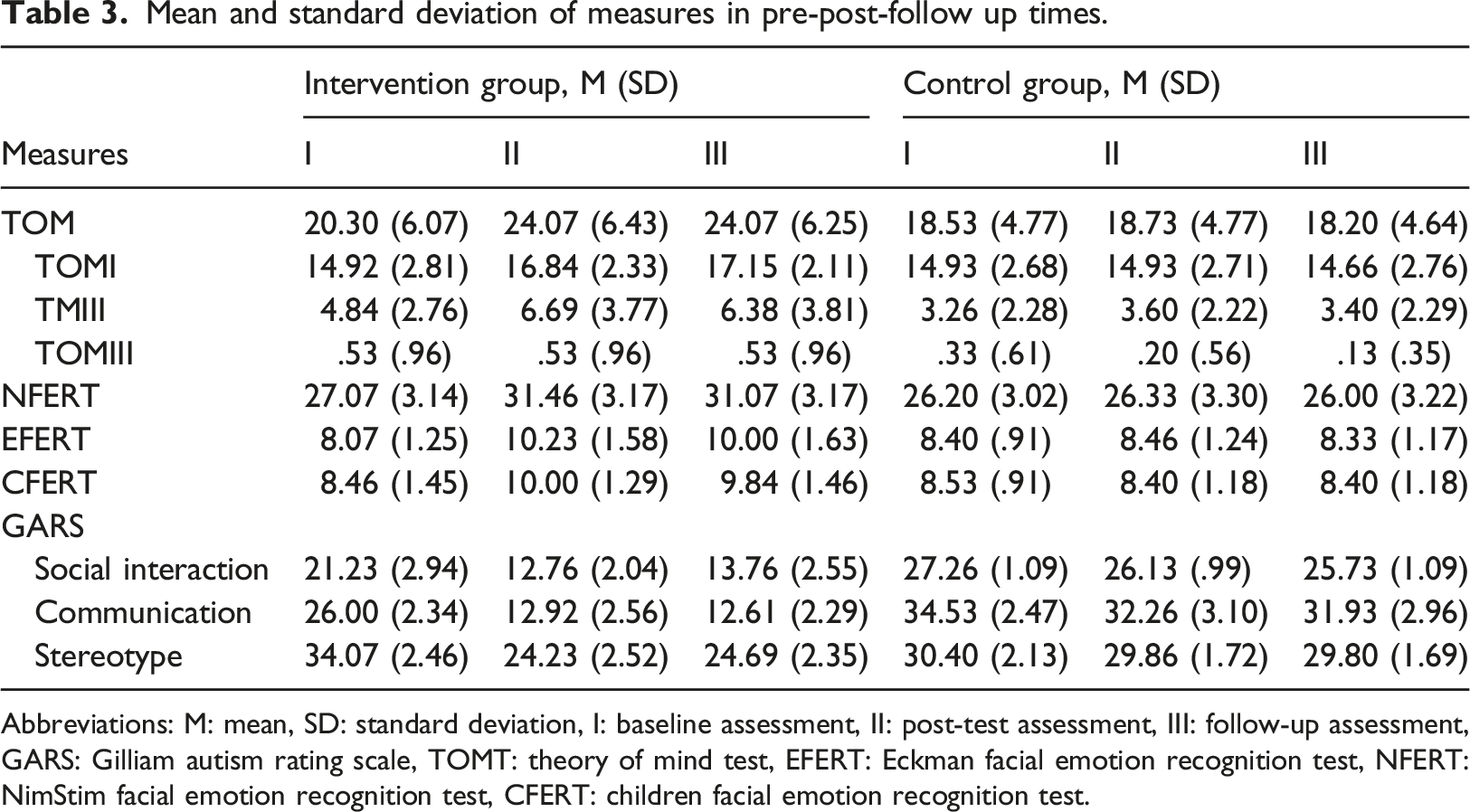
Abbreviations: M: mean, SD: standard deviation, I: baseline assessment, II: post-test assessment, III: follow-up assessment, GARS: Gilliam autism rating scale, TOMT: theory of mind test, EFERT: Eckman facial emotion recognition test, NFERT: NimStim facial emotion recognition test, CFERT: children facial emotion recognition test.
In the NFERT, significant main effects of time (F2,56 = 29.427, p < .001, ηp2 = .53), group (F1,28 = 29.718, p < .001, ηp2 = .53), and the interaction (F2,56 = 10.349, p < .001, ηp2 = .28) were found. In the EFERT, significant main effects of time (F2,56 = 33.120, p < .001, ηp2 = .56), group (F1,28 = 32.401, p < .001, ηp2 = .55), and the interaction (F2,56 = 4.924, p = 03, ηp2 = .15) were found. In the CFERT, significant main effects of time (F2,56 = 23.494, p < .001, ηp2 = .47), group (F1,28 = 33.771, p < .001, ηp2 = .56), and the interaction (F2,56 = 4.738, p = .03, ηp2 = .15) were found.
Discussion
The present study aimed to improve theory of mind and behavioral problems of children with ASD through training of basic components of theory of mind. The results described an improvement in facial emotion recognition and theory of mind as well as an improved communication and social interaction and reduction in stereotype behaviors in children with ASD after training with ARTOM.
Improvement of theory of mind
The results revealed an improvement in the total score of TOMT after ARTOM intervention, which remained at least 1 month after intervention. All subscales of TOMT, which refers to three different levels of theory of mind, including non-mentalistic, mentalistic, and reciprocal levels, improved after intervention and the impact of intervention remained until follow-up assessment. These results are in line with earlier studies in the field which found the trainability of theory of mind in individuals with ASD (Begeer et al., 2011; Fisher & Happé, 2005; Golan & Baron-Cohen, 2006; Ozonoff & Miller, 1995; Turner-Brown et al., 2008). Therefore, based on the results of the present study, theory of mind as a cognitive skill could be improved through the training of basic components.
Improvement of facial emotion recognition
Facial emotion recognition is a basic social skill which support social interaction (Borhani & Nejati, 2018; Nejati et al., 2022). The impaired emotion recognition as a perceptual capability in children with autism influences on performance of other higher cognitive functions (Nejati, 2019) and social interaction (Williams & Gray, 2013). The present study showed that training of the basic components of theory of mind improved facial emotion recognition. This improvement has been showed in different tests with the faces of children, adolescents and adults, CFERT, EFERT, and NFERT, in order. The improvement of facial emotion recognition in children with ASD after imitation training has been described earlier (Abadi et al., 2016). However, some theory of mind training programs found a null effect of training on facial emotion recognition (Fisher & Happé, 2005; Tompkins, 2015). The trainability of facial emotion recognition with facial recognition tasks has been described earlier in both typically developing children (Nejati et al., 2014) and children with ASD (Yaghini et al., 2020). A study of emotion training in children with ASD described an improvement in facial emotion recognition in the training tasks and not untrained tasks (Golan & Baron-Cohen, 2006), indicates lack of training transfer effect. Another theory of mind training study found improved theory of mind skill after training, without alteration in executive functions (Lecce et al., 2014). In the present study, we trained emotion recognition through imitation and emotion recognition from scenarios and not labeling emotional faces. Therefore, the improvement of facial emotion recognition after intervention could be considered as a near transfer.
Amelioration of behavioral symptoms
The ultimate goal of cognitive training is amelioration of behavioral symptoms. Although cognitive rehabilitation programs usually confirmed by cognitive tests, without behavioral improvement it remains as a game of numbers. As cognitive training is used to ameliorate the behavioral problems, the improved behavior should be taken into account in the evaluation of effectiveness. In the present study, we found reduction in impaired communication, social interaction and stereotype behaviors based on GARS. This improvement could be attributed to a vertical transfer from cognitive level to behavioral level. Earlier theory of mind reading training studies in children with ASD described a null effect of theory of mind training on daily use of theory of mind based on teachers’ report (Fisher & Happé, 2005), daily life mind reading ability, self-reported empathic skill or parent-reported social behaviors (Begeer et al., 2011), social communication (Turner-Brown et al., 2008), and social competence (Ozonoff & Miller, 1995).
The main difference between the intervention of these studies and ARTOM lies in their approach to cognitive training. The above-mentioned studies focused on compensation, while ARTOM emphasizes remediation. In these studies, theory of mind was trained as a skill through similar tasks. However, theory of mind is a complex skill that relies on several basic cognitive components, and it’s training often results in compensation, where one impaired function is compensated for by another intact one (Nejati, 2022). As a result, while the performance of theory of mind improved after intervention, the impaired component(s) remained disordered. ARTOM, on the other hand, targets the basic components of theory of mind, such as imitation, joint attention, emotion recognition, social norm perception, inhibition, and perspective-taking. By intervening at the level of the cognitive underpinnings of theory of mind, ARTOM inhibits compensation and facilitates the transferability of training from the trained tasks to untrained tasks and real-life situations. This approach leads to more comprehensive improvements and fosters the ability to apply theory of mind skills effectively in various contexts.
Accordingly, another study in children with ASD utilized theory of mind and social skill training programs with a compensation approach, as described in "Social Competence and Theory of Mind"(Feng et al., 2008). With respect to the behavioral assessment and intervention, the results of this study did not show transferability. It is worth mentioning that behavioral skills rely on basic cognitive functions rather than higher cognitive skills. The independence of social skills from theory of mind has been observed in adolescents with ASD (Livingston et al., 2019), whereas basic cognitive functions such as spatial ability (Nejati et al., 2021) and executive functions (Magiati et al., 2014; Pugliese et al., 2015; Shiri et al., 2015a, 2015b) predicts ASD symptoms In line with this finding, earlier study found improved behavioral performance through training of basic cognitive functions such as working memory (Nejati, 2020) and attention (Nejati, 2021).
In summary, we can propose a tentative model for the results of the aforementioned theory of mind training studies in autism, as illustrated in Figure 1. In this model, the basic components of theory of mind serve as foundational elements, influencing both higher cognitive skills, including theory of mind, and behavioral skills such as communication, social interaction, and flexible behaviors. The lack of direct interaction between theory of mind training and behavioral outcomes could explain the null effect on behavior. Instead, their interaction occurs indirectly through basic cognitive functions. The two cognitive rehabilitation approaches target different levels of intervention in this model. The remediation programs target the basic cognitive functions and improves both behavior and theory of mind. The result of the present study and some other studies in the field which target other basic components such as facial emotion recognition (Yaghini et al., 2020), imitation (Abadi et al., 2016), and language (Hale & Tager-Flusberg, 2003) confirm this statement. The compensation programs target theory of mind as an skill and improve it without transfer to the behavioral problems, ASD symptoms (Begeer et al., 2011; Fisher & Happé, 2005; Ozonoff & Miller, 1995; Turner-Brown et al., 2008). Thus, we propose remediation programs rather than compensation programs in cognitive rehabilitation of children with ASD. Model of theory of mind components and respective behavioral skills. Basic components of theory of mind feeds theory of mind as a higher cognitive skill in one side and underpins behavioral skills.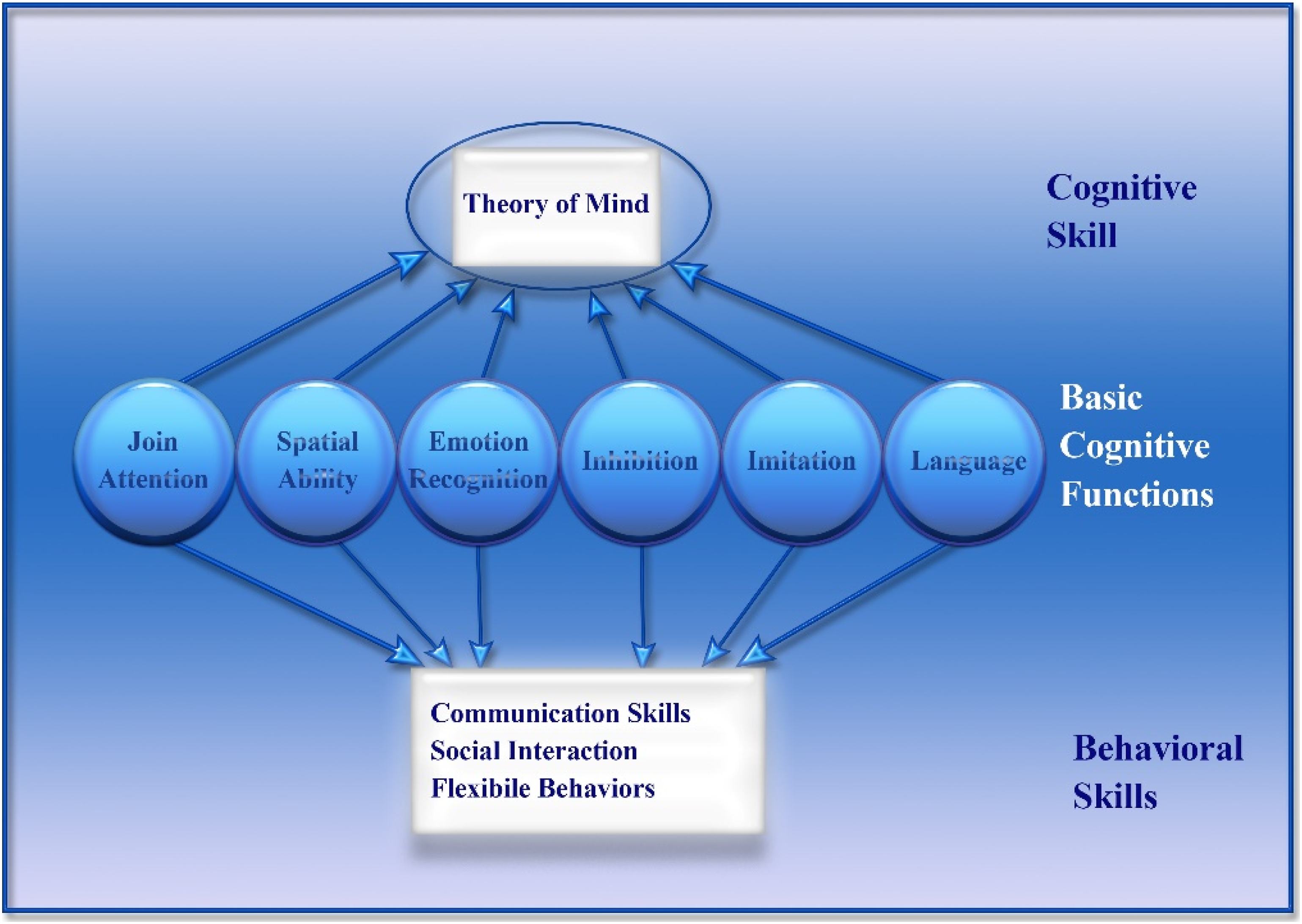
Conclusion and limitations
The present study highlights an improvement in facial recognition and theory of mind following the training of basic components of theory of mind in the treated participants. This intervention effectively ameliorated social and communicational impairments, as well as stereotypic behaviors, leading to enhanced behavioral performance. However, certain limitations need to be considered while interpreting the results of this study. First, there was a single-blind study with a relatively small sample size and short time 1-month follow-up, which limits clinical application of the intervention, which limits the interpretation of intervention durability. The second limitation of this study is that the intervention and control groups were matched solely based on age and education, rather than considering additional measures of general baseline performance, such as IQ. We proposed a tentative model to explain the impact of cognitive remediation and compensation approaches on theory of mind. Caution should be exercised while interpreting our conclusion based on the proposed model, as it warrants further investigation and validation through more extensive research, by more randomized controlled trials comparing the effects of these interventions.
Footnotes
Declaration of conflicting interests
The author(s) declared no potential conflicts of interest with respect to the research, authorship, and/or publication of this article.
Funding
The author(s) received no financial support for the research, authorship, and/or publication of this article.
