




Abstract
Introduction
Resilience and quality of life (QOL) can involve a positive approach in group interventions for parents of children with autism spectrum disorders (ASD). This study aims to evaluate resilience and family QOL at the start of a psychoeducational group.
Methods
Cross-sectional assessment of resilience and family QOL used the Family Quality of Life Scale (ECVF) and 14-item Resilience Scale (RS-14).
Results
The study group showed high levels of resilience. Parents considered the resources/support domain crucial, although satisfaction in this area was comparatively lower. Concerns about low satisfaction with available resources and support were notable. Gender differences were observed but not statistically significant.
Discussion
The study’s findings support prior research on parental resilience in families of children with ASD. The literature on the QOL for these families presents mixed findings. The importance of parental involvement in service planning is highlighted.
Conclusions
This study emphasizes the importance of resilience in parents of children with ASD, suggesting it as a potential therapeutic target. The findings underscore the need to address the perceived low quality of available resources and support. Further investigation is needed.
Keywords
Highlights
- Resilience and quality-of-life (QOL) can involve a positive approach for parents of children with autism spectrum disorders - Parental resilience shown to be high in a cross-sectional evaluation - Quality of resources/support perceived as low by parents - Needs could be addressed by mental health nursing.
Introduction
Autism spectrum disorders (ASD) encompass a diverse group of developmental disorders characterized by impairments in social communication, restricted interests, and repetitive behaviors (Hervás Zúñiga & Maraver García, 2020). The prevalence of ASD has significantly increased in recent decades, with current estimates ranging from 1% to 2% globally, compared to .04% in the 1970s (Fuentes et al., 2021).
Resilience, as a dynamic process, involves both individual capacity and the surrounding environment, emphasizing the importance of adapting the environment and improving person-environment fit rather than solely focusing on skills training (Lai & Szatmari, 2019). Despite the high and rising prevalence of ASD, there is a scarcity of studies focusing on the resilience of families, even though individuals and families with ASD encounter barriers in obtaining a diagnosis and accessing resources. Accumulated knowledge about resilience can contribute to improving the well-being of individuals and families affected by ASD by shifting from an individual-based approach to a social-ecological perspective.
It is essential to develop services that provide support to families experiencing stress due to factors such as having a family member with ASD, changes in residence, or job loss (Merino Martínez et al., 2012). Periodic complementary support should be established to promote the mental and physical health of all family members, as it directly impacts the quality of life (QOL) of individuals with ASD and their immediate environment. To identify the needs and implement appropriate services, collaboration within the mental health network and interagency coordination are necessary.
Unlike studies that primarily focus on family stress in parents of children with ASD (Merino Martínez et al., 2012), research on resilience emphasizes highlighting the strengths of family functioning and adopting a positive perspective (Hayes & Watson, 2013). Shifting towards a strength-based perspective in research and practice encourages family members to listen to one another, express their views and needs, seek community support, and employ problem-solving strategies (Gardiner et al., 2019). In fact, a considerable number of families with children with ASD exhibit high levels of resilience, with approximately 40% of parents describing increased emotional strength due to living together with less judgment, increased patience, and compassion (Bayat, 2007). Resilient parents are better equipped to cope with the challenges of parenting children with ASD (Bekhet et al., 2012). Interventions specifically targeting resilience have been proposed (Bayat & Schuntermann, 2013). Additionally, sleep problems in children with ASD have a specific impact on resilience (Roberts et al., 2017).
The assessment of family QOL in families of children with ASD has gained prominence in recent years, with studies focusing on family-teacher partnerships (Hsiao et al., 2017), perceived social support (Kuru & Piyal, 2018), and the status of families while waiting for intervention services (Jones et al., 2017). Furthermore, studies have examined the QOL of families with adult members on the autism spectrum, differentiating between compound and noncompound caregivers using mixed survey instruments (Marsack-Topolewski, 2020). A review on family QOL research highlighted that it is still in its early stages, with a predominant use of individual constructs of life quality and a scarcity of specific measurement instruments. The review emphasized the need to study family well-being by investigating family adaptability, strengths, positive aspects, as well as the influence of context, environment, and required resources and support (Nunes et al., 2021).
The relationship between gender and resilience in parents of children with ASD is an understudied area. It is essential to consider gender factors, particularly in the context of parenthood, when examining resilience. Specific interventions to support mothers of children with ASD have been identified as important (Nahar et al., 2022). A study exploring the QOL of mothers of adolescents with high-functioning ASD identified certain domains that could improve resilience (Mohamad Aun et al., 2022). By considering mothers' QOL, clinicians and researchers can gain a better understanding of their challenges and experiences.
Short-term parent-mediated interventions have shown efficacy in reducing impairment in toddlers with ASD (Bekhet et al., 2012). Nursing interventions that enhance parental resilience are essential. Psychoeducational groups for parents of children with ASD are a primary intervention option (Morsa et al., 2022). These groups are typically initiated after an initial diagnosis and provide ongoing support to families. Mental health nurses, as part of a multidisciplinary team, can deliver these interventions, which encompass explaining and elaborating on the diagnosis, discussing therapeutic options, identifying available resources, and facilitating the sharing of experiences with other families in similar situations. These interventions provide an opportunity to evaluate resilience and QOL in a clinical sample and identify additional targets for therapeutic interventions in real-world situations. The therapeutic role of mental health nurse practitioners with children with ASD, involving listening, educating, acknowledging, and guiding families through their challenges to improve outcomes and well-being, has been recognized (Frye, 2016). Nurses, doctors, and other health professionals can positively influence health outcomes by providing support and understanding to families of children with ASD (Kuru & Piyal, 2018).
This study aims to conduct a cross-sectional evaluation of family QOL and resilience to assess their status, considering the potential contributions of mental health nursing and adopting a gender perspective. The investigation commenced from a clinical perspective, focusing on the implementation of a psychoeducational group for parents of children with ASD within the Child and Adolescent Program of the Mental Health Center of Cartagena, a public resource from the Servicio Murciano de Salud. Can the examination of resilience and quality of life during a real-life clinical intervention facilitate the identification of specific therapeutic targets for children with autism spectrum disorders?
Methods
Sample
A cross-sectional evaluation of family quality of life (QOL) and resilience was conducted within the Child and Adolescent Program of the Mental Health Center of Cartagena, focusing on the implementation of a psychoeducational group for parents of children with autism spectrum disorder (ASD). The study population consisted of individuals residing in Health Area II, which had a total of 289,512 individuals according to the 2021 census, of whom 65,180 were 19 years of age or younger (Regional Statistical Center, 2021).
The psychoeducational group comprised six consecutive sessions, each lasting one and a half hours. The sessions were delivered by a multidisciplinary team consisting of Mental Health Nursing Specialists, Clinical Psychologists, Social Workers, and Psychiatrists. Inclusion in the group was offered to all parents of children attending outpatient consultations who had received a first diagnosis of ASD. As an exclusion criterion, parents who had already attended or were currently attending psychoeducational groups on first diagnosis, either within the same center or externally (e.g., specific associations), were considered ineligible. To ensure effective interaction and participation during sessions, a large group size was avoided. Some parents ultimately declined to attend the group, resulting in a final inclusion of 25 participants. Variables such as the time elapsed from diagnosis to group participation and the age of the parents were not collected. All participating parents were fluent in Spanish and had no difficulty completing the questionnaires, indicating they were not affected by low levels of literacy. A total of 25 parents (10 fathers and 15 mothers) completed the resilience scale, while 23 parents (6 fathers and 17 mothers) completed the family QOL scale. Two parents completed the resilience scale but did not complete the QOL scale.
Compliance with ethical standards
The study obtained informed consent from all participants, and it was presented and approved by the Clinical Research Ethics Committee of Hospital Universitario Sta. Ma del Rosell (Cartagena). The study design adhered to the STROBE Statement checklist for cross-sectional studies.
Instruments
Resilience was assessed using the Spanish version of the 14-item Resilience Scale (RS) developed by Wagnild (Wagnild, 2009). The scale has been previously used and validated in Spanish-speaking populations, making it suitable for the current study. The RS-14 measures Personal Competence (self-confidence, independence, decisiveness, resourcefulness, and perseverance) and Acceptance of Self and Life (adaptability, balance, flexibility, and a stable life outlook). The scale provides cut-off points for different levels of resilience: Very high (98–82), High (81–64), Normal (63–49), Low (31–48), Very Low (14–30). The internal consistency of the scale has been shown to be adequate (α = .79), and its criterion validity has been established through correlations with other measures of general resilience (CD-RISC) (r = .87; p < .01) (Sánchez-Teruel & Robles-Bello, 2015)
Family quality of life (QOL) was assessed using the Family Quality of Life Scale (Escala de Calidad de Vida Familiar, ECVF), which is an adaptation of the Family Quality of Life Survey originally developed at the Beach Center on Disability (Park et al., 2003). The ECVF scale has undergone validation in the Spanish context by the University Institute of Community Integration (Verdugo et al., 2009). It encompasses five distinct subdomains that include family interaction, parenting, emotional well-being, material/physical well-being, and disability-related support (Schlebusch et al., 2017). The ECVF scale has been employed as a standard reference among families of children with autism spectrum disorder, serving to compare the convergent validity of the Family Resilience Assessment Scale (FRAS) (Gardiner et al., 2019). Additionally, the ECVF scale has been utilized alongside the Strengths and Difficulties Questionnaire (SDQ) in a study that revealed prosocial behavior patterns and group as the primary predictors of family satisfaction (Garrido del Águila et al., 2020).
Procedure
Data collection took place during the first psychoeducational group session for parents of children with ASD at the Mental Health Center of Cartagena. Prior to the session, participating family members completed the scales and provided informed consent. Any questions or doubts were addressed at that time. The responses provided by the families were converted into tables for further interpretation by two members of the research team to minimize transcription errors.
Data analysis
The collected data were analyzed using SPSS, which involved descriptive statistics and the comparison of means using t-tests. The results were shared and discussed by the research team, and the interpretation was carried out according to a significance level of p < .05.
Results
Resilience
Resilience.

The assessment of personal competence yielded a mean score of 60.33, indicating a “High” level of competence. Among the items in this category, the highest scoring items were item 9 (“I keep interested in things”) and item 12 (“In an emergency, I’m someone people can generally rely on”). The lowest scoring item was item 5 (“I feel that I can handle many things at a time”), with an average score of 4.
Regarding acceptance of self and life, the mean score was 14.92, indicating a “High” level of acceptance. In this category, the item with the highest average score was item 8 (“I have self-discipline”), followed by item 4 (“I am friends with myself”). The item with the lowest mean score was item 3 (“I usually take things in stride”).
Quality of life
In terms of family interaction, the mean scores for importance and satisfaction were 28.10 and 24.65, respectively (SD 2.654 and 4.069). For emotional well-being, the mean scores for importance and satisfaction were 16.63 and 11.71, respectively (SD 4.095 and 4.118). Regarding resources/supports, the mean scores for importance and satisfaction were 18.65 and 15.35, respectively (SD 2.346 and 3.683). In the case of the role of parents, the mean scores for importance and satisfaction were 27.41 and 21.44, respectively (SD 2.683 and 4.097). Lastly, for physical and material well-being, the mean scores for importance and satisfaction were 22.65 and 18.89, respectively (SD 2.889 and 3.692). Figure 1 and Figure 2 illustrate the importance and satisfaction levels of family QOL. Family quality of life scale -importance. Family quality of life scale -satisfaction.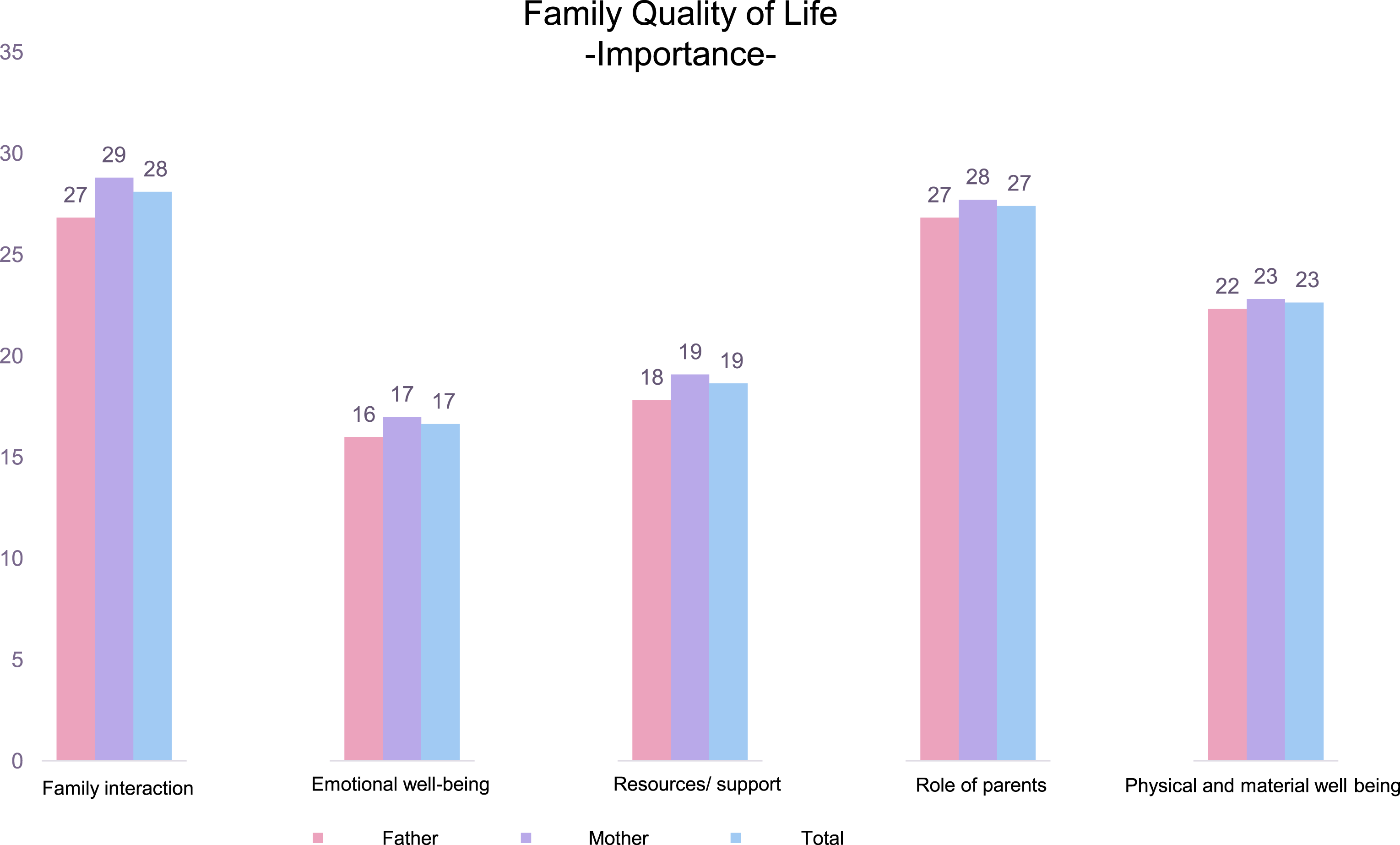
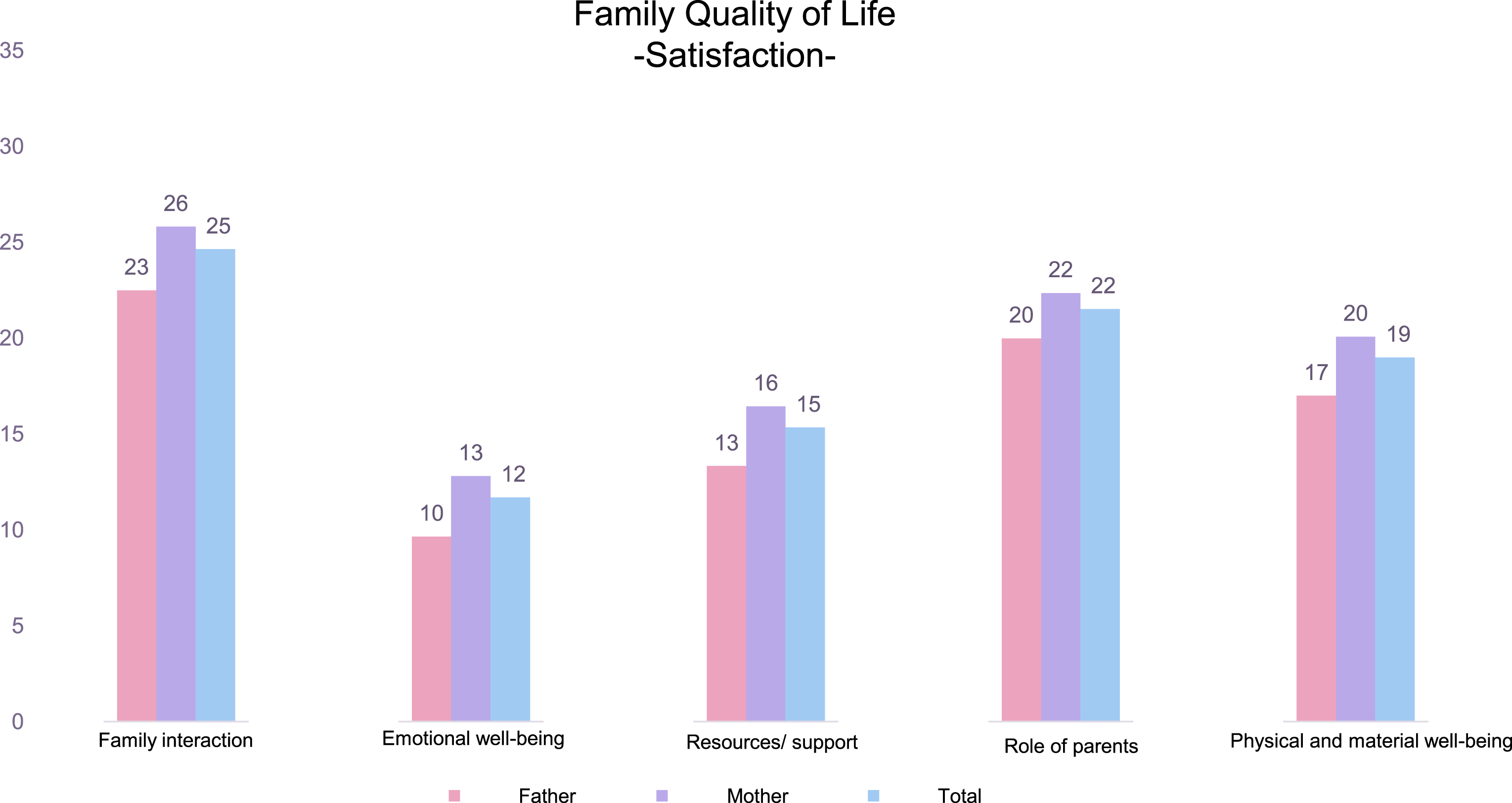
From these findings, it can be observed that the highest importance and satisfaction levels were associated with family interaction, followed by the role of parents. On the other hand, the lowest satisfaction was related to emotional well-being, followed by dissatisfaction with available resources. In all categories, the overall importance score exceeded the perceived satisfaction level among parents, providing a potential key linked to the study objectives.
Gender perspective
In terms of resilience, when comparing the means related to gender, a t-value of .3 was found for the average of Factor II (Mothers: 5.02, Fathers: 4.90), with a p-value of .76. This suggests a slightly higher resilience value in mothers, but it is not statistically significant. The p-values for Factor I and the Total score were even further from statistical significance (.96 and .95).
When examining each individual response, it was observed that item 5 (“I feel that I can handle many things at a time”) had a t-value greater than unity (−1.715) with a p-value of .1, indicating that fathers perceived themselves as superior to mothers in this aspect, without statistical significance. Similarly, item 7 (“I can get through difficult times because I have experienced difficulty before”) had a t-value of 1.011 with a p-value of .32, suggesting that mothers perceived themselves as superior to fathers in this regard. Lastly, item 8 (“I have self-discipline”) had a t-value of 1.574 with a p-value of .129, indicating that mothers perceived themselves as superior, without statistical significance.
In terms of QOL, the comparison of means related to gender showed a t-value of 1.4 for the importance of family interaction (mean difference 1.985, favoring mothers) with a p-value of .18. Regarding satisfaction with family interaction, a t-value of 1.549 was found (mean difference 3.318), once again indicating higher scores for mothers. Additionally, a t-value of 1.44 was observed for satisfaction with emotional well-being (mean difference 3.152, favoring mothers), with a p-value of .124. Similarly, a t-value of 1.628 was found for satisfaction with resources/supports (mean difference 3.121, favoring mothers), with a p-value of .124. Lastly, a t-value of 1.602 was observed for satisfaction with physical and material well-being (mean difference 3.091, favoring mothers), with a p-value of .13.
Discussion
Resilience
The findings of our study regarding parental resilience in families of children with autism spectrum disorder (ASD) are consistent with previous research. As mentioned in the previous section, our sample showed a high level of resilience, both in Personal Competence and Acceptance of oneself and life.
In a separate study conducted in our country, parents of children with ASD also exhibited high resilience scores (Flores-Buils & Andrés-Roqueta, 2022). The authors of this study worked with a clinical sample that also included parents of children with attention-deficit/hyperactivity disorder (ADHD) and developmental language disorder (DLD), as well as a sample of typical development (TD). Within the clinical sample, parents of children with ASD demonstrated higher parental resilience scores. Furthermore, parental resilience was higher in cases where children had lower levels of receptive grammar and emotional comprehension. The authors considered that the development of higher levels of resilience in parents of children with ASD was likely due to these skills enabling them to cope with the new complex situation and the difficulties they had to overcome on a daily basis.
In comparison to the Spanish validation sample, which consisted of university students, our study participants demonstrated better resilience scores. The mean total scale score in our sample was 75.24 (SD = 8.98), whereas it was 71 (SD = 32.81) in the university student sample. Similarly, for Factor I (Personal Competence), our sample scored 60.32 (SD = 7.28) compared to 56 (SD = 19.29) in the university student sample. For Factor II (Acceptance of oneself and life), our sample scored 14.92 (SD = 2.72) while the university student sample scored 15.08 (SD = 7.84) (Sánchez-Teruel & Robles-Bello, 2015). We must indicate that the marital status of 93% of the university sample was single. Once again, parental resilience was higher in our clinical sample of parents with children with ASD compared to a non-clinical sample, and the explanation could be similar to what the authors of the previous study suggested: difficult situations push parents to develop new adaptive skills in the face of the challenges they encounter.
On the other hand, a study conducted in Boston reported lower resilience levels in 32% of families of children with ASD, which was higher than the prevalence of low resilience in families of children without ASD (19%) (Al-Jadiri et al., 2021). Interestingly, child-related variables such as moderate ASD were more likely to be associated with low resilience (42%) compared to mild or severe ASD (24% and 28%, respectively). Regarding future study designs, it is important to consider including the level of impairment of the children of the participating parents within the autism spectrum.
A narrative study conducted in China explored resilience in families of children with ASD and found that cultivating positive family beliefs, adjusting the family’s organizational pattern, actively expanding external resources, and optimizing family communication enhanced family resilience and coping with adversity (Gao et al., 2023). Acceptance of the diagnosis was identified as a crucial step for families to develop resilience and adapt to the changes they face together (Frye, 2016). Based on this rationale, psychoeducational programs and support groups for parents following a new ASD diagnosis could be highly beneficial.
An Australian study investigated a novel resilience intervention called the 8-week AMOR parent group (Acceptance, Mindfulness, Optimism, Resilience). The findings revealed significant improvements in stress management, reduction in mental health symptoms, and enhanced marital, family, and child functioning among participating parents (Schwartzman et al., 2022). Moreover, a study examining predictors of family resilience in households with ASD children found that neighborhood support significantly predicted family resilience (Menezes et al., 2023). Overall, these findings highlight the importance of supporting parents and families of children with ASD, fostering resilience, and providing resources and interventions to enhance their coping mechanisms and well-being. Mental health nursing can play a pivotal role in meeting these needs within a multidisciplinary team, as it has been the case in our study.
All of these findings lead us to question the extent to if psychoeducational interventions, as described in this study, can directly influence resilience, both in its improvement and maintenance, and whether the continuation of such groups with additional emotional content could be beneficial in this regard. Furthermore, the perspectives of parents should be taken into consideration in the structuring of services. This could be initiated in a modest manner by assessing the level of satisfaction of parents regarding the interventions themselves.
Quality-of-life (QOL)
In the studied sample, there was a mismatch between the perceived satisfaction, which was lower compared to the perceived importance in all categories of quality of life. Specifically, concerning satisfaction, parents reported lower scores in emotional well-being and satisfaction with available resources, aspects that should be addressed by mental health services.
The literature on the quality of life (QOL) of families with children with autism spectrum disorder (ASD) indeed shows diverse findings. Some studies have reported average QOL for these families (Kuru & Piyal, 2018), while others have found low family QOL (Ljubičić et al., 2022). One study reported an encouraging overall QOL rating of 3.83 on a 1-to-5 Likert scale (Schlebusch et al., 2017). However, in that study, South African families expressed the least satisfaction with their emotional well-being, which aligns with previous findings from older studies cited in their discussion. Similarly, psychological well-being and social relationships were found to be lowest in parents of children with ASD in the Croatian sample (Ljubičić et al., 2022). Our study replicated these findings, particularly regarding the lowest satisfaction in the emotional well-being domain, followed by a lower level of satisfaction in other subdomains. These results reinforce the existing recommendations to focus on the emotional well-being of families with children with ASD in therapeutic interventions and support programs, as outlined in the objectives of our study.
The extent to which a family’s needs are met by disability-related services in their area significantly influences overall family QOL (Jones et al., 2017). In our sample, family interaction was rated highest in terms of satisfaction, followed by the role of parents. It is worth noting that physical and material well-being ranked higher than resources/support, which was in fourth position. The importance parents placed on resources/supports was evident, although satisfaction in this area remained lower compared to other subdomains. In the South African study, families reported the highest satisfaction with disability-related support they received, closely followed by family interaction (Schlebusch et al., 2017). Cultural, social, economic factors, and the availability of specific mental health resources in different countries may contribute to these differences. The authors of the South African study suggested that their findings may be attributed to the limited availability of specialized care and the families' gratitude for early intervention, emphasizing the unique nature of their study where this subdomain ranked highest.
The issue of support is closely related to resilience. Factors such as acceptance of the diagnosis, perceived availability of support for child care, and effective utilization of available supports have been associated with greater resilience in families (Tijera Iborra, 2017). A study conducted in Türkiye found that the perception of social support levels among families with ASD children was above average, indicating a sensitive environment that supports these families (Kuru & Piyal, 2018). This highlights the relationship between QOL and perceived social support. However, they also cited a previous study in the United States that reported low perceived support (Hall & Graff, 2011). In a more recent study in Croatia, parents of children with ASD reported having the fewest confidants among friends (Ljubičić et al., 2022). We can theorize again about cultural differences as well as varying levels of development of public services in different countries, taking into account these divergences in the results.
A study conducted in our country compared QOL results between a group of parents of neurotypical children and parents of children with ASD (Garrido del Águila et al., 2020). Notably, the study had a limitation in that the majority of participants were mothers (95% in the ASD parents' group). The results were interesting when directly comparing the groups, considering it was conducted in our country. The study included parents of children with neurotypical development (ND), and the sample size was practically identical (ND group = 25, ASD group = 24). Our study found that satisfaction with family interaction was closer to that of the typically developing group than to parents of children with ASD (25 vs. ND = 26, ASD = 21). Regarding the role of parents, both importance and satisfaction scores were similar among all three groups. In terms of emotional well-being, no major differences were observed in terms of importance, but there were clear differences in satisfaction (12 vs. ND = 16, ASD = 9), with parents of children with ASD perceiving low satisfaction in this area, although it was better in our sample compared to the counterpart. This trend aligns with the rest of the literature. Similar patterns were observed in satisfaction with physical well-being (19 vs. ND = 23, ASD = 18). Lastly, in terms of the importance of resources, a higher score was obtained compared to the control group and was similar to the group of parents with children with ASD (19 vs. ND = 16, ASD = 18). This underscores the significance that parents of children with ASD attribute to therapeutic and assistive resources.
It is important to note that some studies only included children with specific ASD diagnoses (ICD-10 codes F84.0 and F84.1), excluding those with higher functioning ASD (e.g., F84.5/F84.9). This may impact the reported QOL since lower adaptive functioning in children with ASD is associated with increased parental stress, the need for additional family support, and effective coping strategies (Hall & Graff, 2011) Therefore, it is crucial to consider the inclusion criteria regarding ASD diagnosis when interpreting the literature on QOL.
Overall, the literature on the quality of life (QOL) of families with children with autism spectrum disorder (ASD) reveals mixed findings. While some studies report average QOL, others highlight lower levels of satisfaction, particularly in the emotional well-being domain. It is crucial to consider the specific ASD diagnoses included in studies and the associated impact on QOL. The availability of disability-related services, as well as the perception of social support, play important roles in shaping QOL outcomes. It is evident that the emotional well-being of families with ASD children requires special attention in therapeutic interventions and support programs. Further research is needed to better understand the cultural and contextual factors that contribute to differences in QOL outcomes among families across countries.
Parents of children with ASD possess firsthand expert knowledge that can inform family-centered models of care and help researchers identify gaps in programs and available services (Salleh et al., 2022). These families have expressed their needs, including funding, teamwork, information, taking action, and time (Frye, 2016). Opportunities for family members to engage in leisure and recreation activities have also been found to significantly affect overall family QOL (Jones et al., 2017). By addressing the identified gaps in programs and services, incorporating parents' expertise, and providing resources that cater to their needs, we can strive to enhance the overall QOL of families with children on the autism spectrum.
Gender perspective
In examining the QOL from a gender perspective, mothers placed a high importance on family interaction but reported lower satisfaction in three aspects of QOL: emotional well-being, physical and material well-being, and resources. This discrepancy could indicate a greater effort or involvement on the part of mothers compared to fathers, or a higher level of concern regarding their satisfaction. Previous studies have also found lower QOL among women compared to men, suggesting that the impact of stressful life events may affect women more, especially considering that the majority of caregivers for children with ASD are mothers (Frye, 2016; Kuru & Piyal, 2018).
Regarding family interaction, there appears to be a greater emphasis on supporting familial relationships at the highest possible level. The challenges of balancing work and family life, as well as the traditional roles of motherhood and fatherhood, may influence these findings. Notably, mothers expressed a sense of being unable to handle multiple tasks simultaneously (item 5), although the significance of this difference remains unclear. It is uncertain whether this reflects an overload of daily responsibilities or a higher level of concern and involvement. Mothers also exhibited a slightly stronger association with perceiving greater self-discipline in themselves (item 7), but the significance of this finding is also limited. Additional experimental studies with a gender perspective are needed to confirm or refute these preliminary findings.
We also explored the possibility of greater resilience among mothers compared to fathers. However, the results did not show a significant difference in absolute numbers, although there was a slightly higher mean perceived resilience among mothers in Factor II (Acceptance, p = .76). This finding aligns with previous research that has reported gender associations with the subscale of Acceptance of Self and Life (Portzky et al., 2010). However, these associations have not reached statistical significance in our study. Other studies in different contexts have reported mixed results, highlighting the need for further research to draw conclusive assertions regarding the relationship between gender and resilience (Abiola & Udofia, 2011; Losoi et al., 2013; Yuan et al., 2022).
In summary, our findings suggest that it could be gender-related differences in the perception of QOL among parents of children with ASD. Mothers appear to place a greater emphasis on family interaction but experience lower satisfaction in certain aspects of QOL. However, additional research is necessary to gain a deeper understanding of these gender differences, their underlying factors, and their implications for intervention and support programs.
Strengths and limitations
The study focusses on a Spanish-speaking community, using tools that are validated in Spanish language, and measuring both resilience and QOL simultaneously. To our knowledge it is the first study carried out in our country with these characteristics.
From a cross-sectional study we could not assume and cause-and-effect relationship. We must remain cautious in interpretating the findings. It is a first time attendance, heterogeneous group, cross-sectional evaluation, small single-center sample with no control group, and other external factors that could be influencing in this regard in each case (such as children´s age and gender, time since diagnosis, level of severity, comorbidity, cognitive level, type of support received, interventions such as ABA and pharmacological treatment among others, characteristics of the parents -type of employment, members working, incomes, educational level, age, one or two parent family-) were not considered. One previous study found no statistically significant differences in QOL between families who have boys with ASD and those who have girls with ASD (p > .05) (Schlebusch et al., 2017), the child’s level of severity showed statistically significant, negative associations with the overall but indicating a small effect. Internal validity is compromised by the sample size. The generalisability or external validity of our study would be affected by the fact that it is based on a specific sample from a population in the southeast of Spain.
Conclusion
The study of resilience remains to be a fundamental field in the therapeutic approach to autism spectrum disorders. In the present study parental resilience was shown to be high which could be a good prognostic factor if maintained over time, and therefore, a therapeutic target. The areas of resources/supports, emotional and physical/material well-being should be given special consideration for therapeutic interventions, including the gender impact on parents.
Mental health nursing specialist could lead psychoeducational and emotional groups among other interventions directed at these targets. We should ask about the specific impact that a mental health nursing intervention would have on resilience and QOL, both at the group and individual level. It would be necessary to define it in a standardized way, implement it, and evaluate the results obtained. Further investigation is needed.
Footnotes
Acknowledgements
We would like to acknowledge the contributions of María Cristina Laiz-Reverte and Lourdes Bolívar-Romero to the design and implementation of the intervention program for parents of children with autism spectrum disorders. Of course, our foremost appreciation goes to the participants of the group, without whom this study would not have been possible.
Declaration of conflicting interests
The author(s) declared no potential conflicts of interest with respect to the research, authorship, and/or publication of this article.
Funding
The author(s) received no financial support for the research, authorship, and/or publication of this article.
