




Abstract
Many children around the globe suffer from spider phobia. Virtual reality exposure therapy is an effective phobia treatment, but so far predominantly tailored for adults. A gamified approach utilizing gaze interaction would allow for a more child-friendly and engaging experience, and provide the possibility to foster working mechanisms of exposure therapy. We developed an application in which children make spiders change in positively connoted ways (e.g., make them dance or shrink) if sufficient visual attention towards them is captured via eye tracking. Thereby, motivation for and positive affects during exposure towards spiders are aspired. In this pilot study on 21 children without (n = 11) and with fear of spiders (n = 10), we examined positive and negative affect during exposure to a virtual spider and to different gaze-related transformations of the spider within a quasi-experimental design. Within a one-group design, we additionally examined fear of spiders in spider fearful children before and one week after the intervention. We found that significantly more positive than negative affect was induced by the spiders’ transformations in children without and with fear of spiders. Fear of spiders was furthermore significantly reduced in spider-fearful children, showing large effect sizes (d > .80). Findings indicate eligibility for future clinical use and evaluation in children with spider phobia.
Keywords
Background
Although fears are a developmentally appropriate phenomenon during childhood, they become problematic if they do not subside with time and impair children’s functioning (Connolly & Bernstein, 2007). Specific phobias are characterized by an excessive fear or anxiety occurring consistently when being exposed to or anticipating exposure to a specific object or situation, and not being proportionate to the actual danger (World Health Organization, 2022). With a 1-year prevalence of 8% (Kim et al., 2010), specific phobias are a frequent mental health problem in childhood and adolescence. Moreover, specific phobias in childhood and adolescence are associated with a subsequent onset of other mental disorders (Lieb et al., 2016). The estimated mean age of onset was found to be 11 years (Lijster et al., 2017) and the most frequently reported specific phobia are animal phobias (Kim et al., 2010).
The first line treatment for anxiety disorders like phobias is exposure therapy (Steinman et al., 2015; Wolitzky-Taylor et al., 2008). During this treatment, patients are confronted with the feared object or situation until distress has decreased significantly and/or until a violation of dysfunctional expectancies about the feared object or situation is reached (Craske et al., 2008). Also for children, there is strong evidence for the effectiveness of exposure therapy in anxiety disorders, including specific phobias (Schneider et al., 2022). Regarding spider phobia specifically, even 1-session exposure has shown to be an efficacious treatment approach in adults and children (Ollendick & Davis, 2013; Zlomke & Davis, 2008; Öst, 1996). Although exposure therapy is proven and recommended as treatment of choice, its use in routine care is still rare (Neudeck & Einsle, 2012). This is even more pronounced in the treatment of children (e.g. for Posttraumatic Stress Disorder, see Jensen-Doss et al., 2008). As one potential solution, virtual reality (VR) facilitates an ecologically valid and highly controlled presentation of phobic stimuli directly in the therapists’ office (Diemer et al., 2015). In adults, virtual reality exposure therapy (VRET) for specific phobias has already been proven to be safe (Fernández-Álvarez et al., 2019), practical, and not significantly different in efficacy compared to in vivo exposure (Carl et al., 2019; Wechsler et al., 2019). First studies showed that VRET is a promising option also in the treatment of phobias in children, e.g., for school, spider, or dog phobia (Bouchard, 2011).
The most approved mechanisms underlying exposure treatment are fear extinction, correction of negative beliefs, and emotional processing (Foa & Kozak, 1986). Above that, inhibitory learning is recognized to be a central process (Craske et al., 2008), and in this context especially expectancy violation, expectancy change and learning efficiency (Pittig et al., 2023). Moreover, there are specific models concerning the role of attention and affect for fear extinction during exposure therapy, which contribute to the theoretical background of our newly developed exposure therapy approach for children with fear of spiders. Relating to a model on attention and extinction by Pearce and Mackintosh (2010), narrowly focused attention on the fear associated stimulus and minimized attention towards other stimuli are proposed to maximize learning of new associations (Zbozinek & Craske, 2017). Additionally, the model by Huntsinger et al. (2014) claims that positive affect facilitates the current scope of attention (e.g., a narrowly focused attention), while negative affect like fear inhibits it. Consequently, goal-oriented positive affect might be helpful to induce or maintain narrowed attention toward a fear associated stimulus during exposure therapy and might therefore reinforce extinction learning (Zbozinek & Craske, 2017). The induction of positive mood before extinction was furthermore found to increase the valence of a fear associated stimulus and to decrease reinstatement of fear one week after (Zbozinek et al., 2015). This indicates an additional advantage of positive affect during exposure therapy for inhibitory learning (Zbozinek & Craske, 2017). Moreover, positive affect can promote willingness to participate in exposure therapy and can foster approaching behavior towards the feared stimulus (Clore & Huntsinger, 2007).
Gamified VR Exposure Therapy (VRET) does not only provide the possibility to offer an engaging experience for children especially, but also to implement playful mechanisms fostering working mechanisms of exposure therapy. There are already approaches integrating playful elements into VRET for adults with spider phobia (Go et al., 2020; Lindner et al., 2020; McMaster, 2020; Miloff et al., 2016). However, none of those is specifically developed for children. To fill this gap, Wechsler et al. (2021) created a first gamified VRET application for school-aged children with fear of spiders, called SpEYEders. It integrates an eye tracking-based feedback for the children’s visual attention towards spiders. The implemented gaze interaction mechanism induces positively associated transformations of a virtual spider when children continuously gaze at it for several seconds (e.g., shrinking or changing the color). In promoting focused attention towards the spider via eye tracking-based feedback, and by inducing positive affect during exposure via transformations of the spider, our application aims at fostering fear extinction and inhibitory learning (see above the role of attention and affect during exposure therapy). No previous approach used eye tracking-based human-computer interaction as innovative complement to VRET. Two pilot studies testing SpEYEders in adults and children without fear of spiders already identified transformations of the spider inducing mainly positive affect (Wechsler et al., 2021). However, SpEYEders has not yet been tested in spider fearful children until this study.
Objectives
As the first research question (RQ1), we examined school-aged children’s affective responses during the gamified VRET application SpEYEders. For ethical and safety reasons, we first tested SpEYEders in a sample of non-spider fearful children, then in a second sample of spider fearful children. Since we aim at inducing positive affect by the implemented feedback variants, we test the hypothesis whether there is a significant difference in the degree of positive and negative affect elicited by a virtual spider without transformation, and by a spider transforming into a smileyball, shrinking, changing its color into rainbow colors, or dancing to music when being gazed for several seconds (RQ1a). As additional research questions, we also examine potential differences in the affective reactions between children with and without fear of spiders (RQ1b), between the spider without transformations and the different spider transformations (RQ1c), as well as interaction effects (RQ1d). Transformations inducing significantly more positive than negative affect, and transformations eliciting significantly more positive or significantly less negative affect than other transformation seem eligible for further use within the SpEYEders application. As a second research question (RQ2), we evaluate the effectiveness of SpEYEders in children with a fear of spiders. We test the hypothesis whether there is a significant reduction in fear of spiders in spider-fearful children from before to after completing SpEYEders. As additional analysis, we examine the children’s sense of agency concerning the gaze interaction feedback. We test if most children (≥95.0%) experience that they induced the transformations of virtual spiders via their gaze.
Method
The study was conducted according to the principles expressed in the Declaration of Helsinki, and we obtained ethical and legal approval from the ethics committee of the University of Regensburg (Reference numbers: 19-1633-101 and 22-2843-101).
Study design
RQ1a and RQ1c were examined separately for children without and with fear of spiders in a within-subject design with positive and/or negative affect as dependent variable/s. RQ1b was investigated in a quasi-experimental between-subject design with fear of spiders as independent variable, and positive and negative affect as dependent variable. In a within-between-subject design, we investigated RQ1d. Within a longitudinal one-group design with the time point of measurement as independent variable and fear of spiders as dependent variable, we examined RQ2 in spider fearful children.
Participants
We recruited 21 children between 8–11 years of age with and without fear of spiders through small advertisements and media reports. Exclusion criteria covered mental and behavioral disorders other than spider phobia, severe somatic or neurological disorders (e.g., epilepsy), medication or psychotherapeutic treatment, and excessive travel sickness (due to the risk of cybersickness in VR). The first sample included 11 children (two girls; age in years M = 10.27, SD = 1.10, range: 8–11) without fear of spiders, indicated by a score of zero within the spider phobia item of the German Bochumer Angstverfahren für Kinder im Vorschul- und Grundschulalter [English: Bochum Anxiety Procedure for Children in Preschool and Primary School] (BAV 3–11) (Mackowiak & Lengning, 2010) in the children’s rating and the parents’ rating concerning their children’s fear of spiders. The second sample included ten children (eight girls; age in years M = 9.40, SD = 1.17, range: 8–11) with a fear of spiders indicated by BAV 3–11 item scores of children and parents of ≥1. The spider-fearful children reported a mean fear of spiders of 1.65 (SD = 0.82) on BAV 3–11, while their parents rated their children’s fear even slightly higher (M = 2.10, SD = 0.39). The spider fearful children furthermore showed a mean score of 7.15 (SD = 1.03) in the German Spinnenphobie-Fragebogen für Kinder und Jugendliche [English: Spider Phobia Questionnaire for Children and Adolescents] (SPF-KJ) (Leutgeb et al., 2013). Three of the children fulfilled the diagnosis of spider phobia according to the Diagnostic Interview for Mental Disorders (DIPS) for children in its German version (Schneider et al., 2018). All participants and their parents received detailed information on the study and gave written informed consent.
SpEYEders intervention
SpEYEders is a gamified VRET intervention for children using eye tracking-based gaze interaction to transform virtual spiders in a positively connotated way when being gazed for several seconds. The stimuli applied in the 3rd and current version of SpEYEders are displayed in Figure 1. As spider, we used a virtual hairy brown tarantula (VT + GmbH, Würzburg) placed on a table (Figures 1(a)–1(b)). For eye tracking-based feedback of visual attention, a light cone below the spider indicated when it was fixated (Figure 1(c)). After a measured dwell time of looking at the spider for 10 seconds, one out of four transformations of the spider started and lasted for 17 seconds. For the shrinking transformation (Figure 1(d)), we reduced the size of the spider, resulting in a diameter of approximately 5 cm. For the rainbow colors transformation (Figure 1(e)), we changed its color using a multicolored diffuse map. For the smiley ball transformation (Figure 1(f)), we implemented violet glitter that appeared around the spider, merging into violet fog hiding the spider. Finally, the object of a smiley ball appeared out of the fog, which replaced the spider. For the dancing transformation (Figure 1(g)), the spider moved its legs at increasing speed while a piano version of the “Flea Waltz” (Baumann, 1996) was played as sound. All feedback variants are realized as continuous transformations enduring over 17 seconds. The light cone and the transformations were stopped if the users directed their gaze elsewhere and started over if the users looked back at the spider. As a finishing point of all transformations, yellow stars spinning around the transformed spider appeared and were accompanied by a gambling machine sound (Figure 1(h)). For rating affect, the spider or its transformation disappeared and a rating scale appeared at the wall of the virtual room (Figure 1(i)). For children with fear of spiders only, we additionally implemented a non-fear associated object to practice the gaze interaction prior to transforming spiders. Here, we used a bowl containing different small objects which started to spin in increasing speed when being gazed upon (Figure 1(j)). Illustration of stimuli used in the SpEYEders intervention. (a): Virtual environment with spider placed on a table. (b): Virtual (base) spider. (c): Cone of light appearing immediatelly if the user’s gaze is directed at the virtual spider, measured via eye tracking. (d–g): Via gaze interaction mechanism supported by eye tracking, the virtual spider starts to transform in differents ways if the user fixates it for 10 seconds. Transformations of the virtual spider enduring over 17 seconds: (d): shrinking, (e): change into rainbow colors, (f): morphing into smiley ball, (g): dancing to music. (h): Stars appearing after successful transformation of the virtual spider. (i): Rating scale appearing at the wall of the virtual room. (j): Bowl starting to turn for 17 seconds after being gazed for ten seconds to practice the gaze interaction in spider-fearful children before transforming the virtual spider. 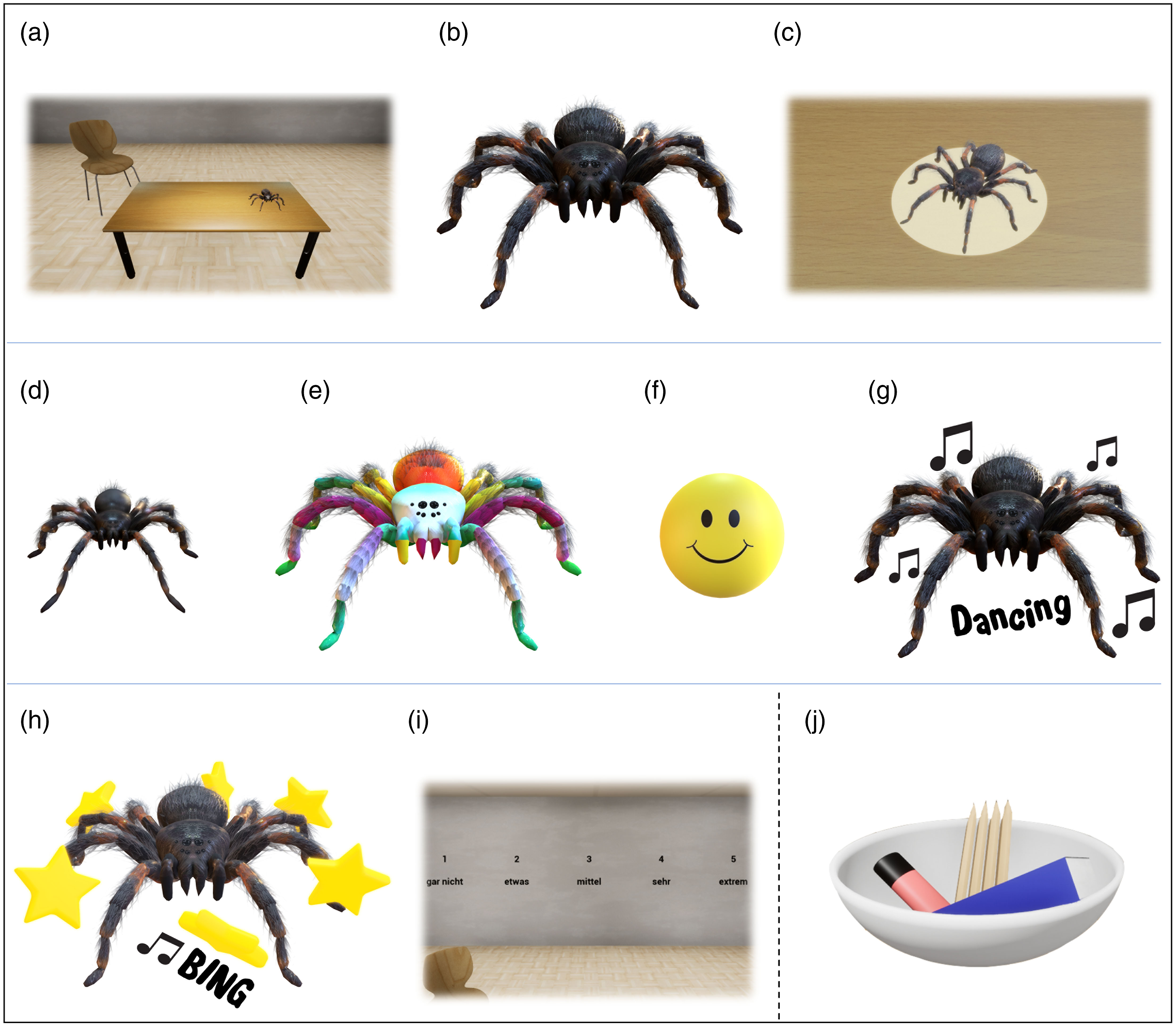
Regarding the treatment rationale of SpEYEders, our approach enhances standard VR exposure therapy with eye tracking-based feedback for visual attention, induction of positive affect, and gamification. Within standard in vivo or virtual reality exposure for spider phobia, patients confront themselves with real or virtual spiders until their fear has decreased significantly (habituation) and/or their central dysfunctional beliefs have been proven wrong (expectancy violation) (see Background). Within SpEYEders, patients confront themselves with a virtual spider and when the eye tracker registers a certain time of attentional focus on it, the spider transforms in a positively associated way, constituting the end of one task. The task is repeated several times, using the same or different transformations of the virtual spider. As first supplement to standard exposure, the eye tracking-based feedback of overt attention is implemented to promote visual attention towards the virtual spider. This component of SpEYEders is based on previous work indicating that a narrowed focus of attention on the fear associated stimulus can enhance the learning of new associations (see Background). As second supplement, the feedback is designed to induce positive affect during the exposure. This component is based on previous work indicating that positive affect during exposure can increase the valence of the fear associated stimulus, and promote approaching behavior towards it as well as the willingness to participate in exposure therapy (see Background). Overall, SpEYEders targets a change of the patients’ negative expectancies concerning spiders. Shrinking, dancing, or changing color and shape provide unexpected positive experiences with spiders and therefore are implemented to promote expectancy violation and expectancy change as important mechanisms of inhibitory learning. Lastly, gamification is used as a strategy to enhance motivation for exposure and further contribute to a high acceptance of the exposure therapy approach in children as well as in parents and therapists.
Apparatus
The virtual environment was generated using the Unreal Engine 4 (Epic Games, Raleigh, USA). We used a HTC VIVE Pro Eye head-mounted display (HMD) (HTC Corporation, Taoyuan, Taiwan) and the integrated eye tracker. Gaze data was recorded and interpreted with a custom-built Unreal Engine plugin developed at our department using the SRanipal SDK (HTC Vive). Gaze-related feedback mechanisms were triggered dependent on the real-time detection of virtual rays colliding with a hitbox (ROI) surrounding the virtual spider or the virtual bowl as practice object. A small light with touch-sensitive switch was affixed on the control box of the HMD to visualize the activation of the gaze interaction mechanism.
Measures
To assess positive (joy, interest, fun) and negative (scare, fear, disgust) affects, we used modified items from the Positive and Negative Affect Scale for Children (PANAS-C) (Laurent et al., 1999), translated into German. Children were instructed to rate the affects on a five-point Likert scale (1 = gar nicht; 5 = extrem [English: 1 = not at all; 5 = extremely]) which was displayed at the wall of the virtual room (see Figure 1(i)). The rating was given verbally and documented in the questionnaire form by the investigator. A sum score for positive and negative affect (range 3–15 each) was calculated. Affects were measured for the virtual spider without transformation and for all spider transformations.
To assess the fear of spiders in spider fearful children, we used the spider phobia item of the German BAV 3–11 (Mackowiak & Lengning, 2010) in its version for children’s self-rating and the parents’ rating of their children’s fear. Furthermore, we used the German SPF-KJ (Leutgeb et al., 2013) to assess spider phobic cognitions. Both questionnaires were applied before and one week after the intervention. The BAV 3-11 spider phobia item was also assessed directly after the intervention to ensure that children did not leave with increased levels of fear of spiders. Furthermore, we used a documentation form for exposure exercises conducted as homework after the intervention.
To measure the sense of agency regarding gaze interaction, we employed an open question in German language, assessing the children’s experience of what they reflect on what made the spider change. Only answers including that the children’s own gaze changed the appearance of the spider were rated as successfully implemented sense of agency (1: sense of agency; 0: no sense of agency). Sense of agency was assessed directly after the intervention.
Procedure
Participants and their parents completed a sociodemographic questionnaire and the BAV 3–11 spider phobia item, and spider fearful children also the SPF-KJ and DIPS. After putting on the HMD, the virtual spider sitting on the table was shown to the children and their affects towards it were assessed. After taken off the HMD, the spider fearful children and their parents received a psychoeducation on pathological fear of spiders and the exposure therapy rationale of facing spiders instead of avoiding them. All children received the information that they will be able to perform magic within the following task, concretely that they will be able to transform the spider when fixating it for a few seconds. The investigator switched on the light affixed on the HMD control box, telling the cover story that this indicates the activation of the magic power. After putting on the HMD again, the intervention was started. The spider-fearful children first practiced the gaze-related feedback with a bowl as neutral stimulus, the non-spider fearful children directly started with the transformations of the spider, presented in random order. After each successful transformation of the spider, the children’s affective reactions were assessed. During the whole intervention, parents were present in the same room with their children. After finishing the intervention, the HMD was taken off and the light on the HMD control box was switched off. All children then answered the open question on sense of agency. The spider fearful children also answered the BAV 3–11 spider phobia item to ensure that no child left the experiment with increased fear of spider compared to the beginning. They were furthermore instructed to gaze at three real spiders at home. In the end of the appointment, children and parents were split up in different rooms to have the opportunity to give feedback and ask questions separately from each other. The VR task including affective ratings took approximately 20 minutes, the total intervention including psychoeducation, preparation and explanation of the homework took approximately 50 minutes. The total duration of the experiment including pre and post test measures was approximately 90 minutes. As follow-up measure one week after the intervention, BAV 3–11 spider phobia item and SPF-KJ were sent to the spider fearful children and their parents via mail. The families returned the completed questionnaires together with a documentation of the homework.
Statistical analyses
All analyses were performed using SPSS 28 (IBM). The α-level was set to .050. We calculated descriptive statistics for positive and negative affect and sense of agency. Dependent sample t-tests were conducted to compare positive and negative affect within each of the five conditions (virtual spider without transformation, smiley ball, shrinking, rainbow colors, dancing), separately for both samples. Third, we conducted repeated measures ANOVAs with positive and negative affect as dependent variables, and the five conditions as well as the group (children with vs. without fear of spiders) as independent variables. We examined main effects of condition and group, and condition*group interaction effects. Greenhouse-Geisser correction was applied in cases of non-sphericity. As effect size measure, μp2 was calculated. In case of significant effects, pairwise comparisons were calculated. The α-level for five pairwise comparisons per sample was Bonferroni-corrected and set to .010, for ten pairwise comparisons to .005. Fourth, to analyze the effectiveness of the intervention in children with fear of spiders, we conducted dependent sample t-tests with BAV 3–11 spider phobia item and SPF-KJ scores as dependent variables and the time point of measurement as independent variable. Cohen’s d was calculated as effect size.
Results
Main results
Affective reactions
Dependent sample t-tests showed that during viewing the virtual spider without transformation, positive affect was significantly higher than negative affect in children without fear of spiders (t = 10.14, p < .001), and negative affect was significantly higher than positive affect in children with fear of spiders (t = −3.24, p = .005). During viewing the different transformations of the virtual spider, in contrast, dependent sample t-tests showed significantly higher levels of positive than negative affect towards all transformations in children without fear of spiders (ts = 10.80 to 15.35, ps < .001), as well as in children with fear of spiders (ts = 1.99 to 3.54, ps = .003 to .039) (Figure 2 and Supplementary Material 1). Mean positive and negative affect towards the base spider and the transformation variants in children without and with fear of spiders. Error bars indicate standard deviations. Brackets with asterisks indicate significant differences in the level of positive and negative affect within one single condition: *p ≤ .050, **p ≤ .010, ***p ≤ .001. Brackets with crosses indicate significant differences in the level of positive and negative affect between different conditions (post-hoc t-tests corrected for multiple comparison, p < .005): ##p ≤ .005, ###p ≤ .001.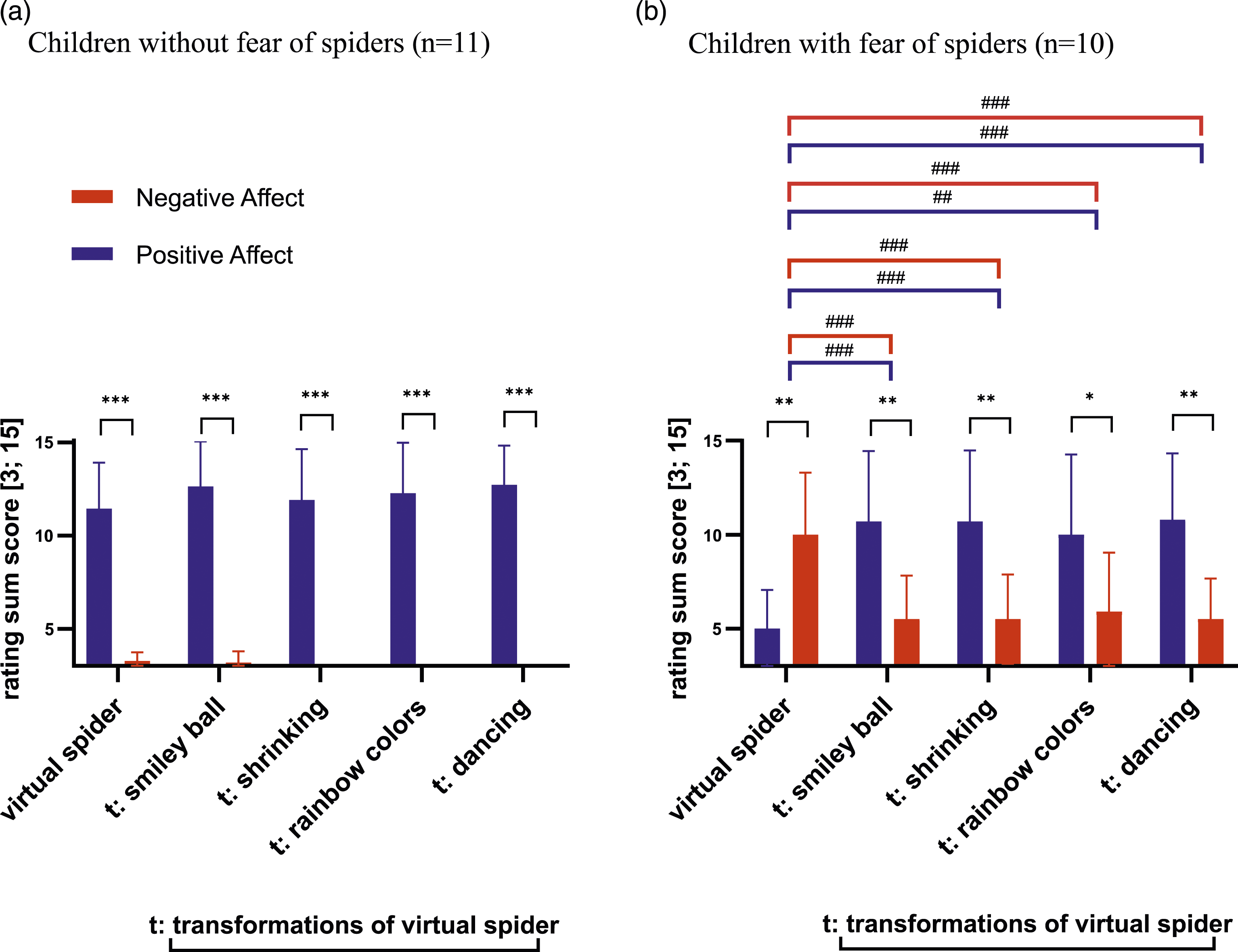
Focusing on positive affect, a repeated-measures ANOVA showed a significant main effect of condition (F = 18.79, p < .001, μp2 = .50), a significant main effect of group (F = 5.44, p = .031, μp2 = .22), and a significant condition*group interaction effect (F = 9.57, p < .001, μp2 = .34). Pairwise comparisons of positive affect between groups analyzed separately for conditions showed that there only was a significant group difference for positive affect towards the base spider, with spider fearful children showing significantly lower positive affect while viewing the virtual spider without transformation than children without fear of spiders (t = 6.48, p < .001; see Supplementary Material 2). Pairwise comparisons between the conditions separately for children with and without fear of spiders showed that children with fear of spiders reported significantly less positive affect during viewing the virtual spider without transformation compared to all transformation conditions (ts = −3.87 to −5.57, ps < .001 to .004), which among each other did not show significant differences. In children without fear of spiders, no significant differences in positive affect were found between all five conditions (see Figure 2 and Supplementary Material 3).
Focusing on negative affect, an ANOVA showed significant main effects of condition (F = 23.06, p < .001, μp2 = .55), and group (F = 22.00, p < .001, μp2 = .54), and a significant condition*group interaction (F = 18.88, p < .001, μp2 = .50). Pairwise comparisons between groups separately for the single conditions showed a significant group difference for negative affect towards the virtual spider without transformation (t = −6.39, p < .001), and towards the shrinking and dancing transformation (ts = −3.34 to −3.64, ps = .005 to .009; see Supplementary Material 2), with children with fear of spiders reporting higher levels of negative affect than children without fear of spiders. Pairwise comparisons between the conditions separately for children with and without fear of spiders showed that there were only significant differences between conditions in children with fear of spiders, with significantly higher levels of negative affect towards the virtual spider without transformation compared to all transformation conditions (ts = 4.98 to 7.73, ps ≤ .001), which among each other did not show significant differences concerning the measured level of negative affect. In children without fear of spiders, no significant differences in negative affect were found between all five conditions (see Figure 2 and Supplementary Material 3).
Effectiveness in children with fear of spiders
Dependent sample t-tests showed a significant reduction in the children’s BAV 3–11 spider phobia item ratings from pre test to follow-up test one week after the intervention (t = 3.07, p = .007, d = .97). Also in the parents’ BAV 3–11 spider phobia item rating of their children’s fear, a significant reduction was found from pre test to follow-up test (t = 6.27, p < .001, d = 1.98). The children’s SPF-KJ scores also significantly decreased from pre test to follow-up test (t = 4.39, p < .001, d = 1.39) (see Figure 3 and Supplementary Material 4). An auxiliary analysis on the children’s BAV 3–11 spider phobia item ratings directly after the intervention showed a large, significant decrease in fear of spiders also from pre to post test (d = 2.58; see Supplementary Material 4). The documentation of the homework furthermore showed that all children were able to gaze at real spiders after the VR intervention. Nine of ten children were able to fully complete the agreed homework and gazed at three real spiders at home, one child only gazed at one spider, since the family did not find more than one (see Supplementary Material 5 for method and further results concerning the homework). Mean fear of spiders before and one week after the intervention in children with fear of spiders (n = 10). Significant differences between time points are indicated by brackets with asterisks: **p ≤ .010, ***p ≤ .001.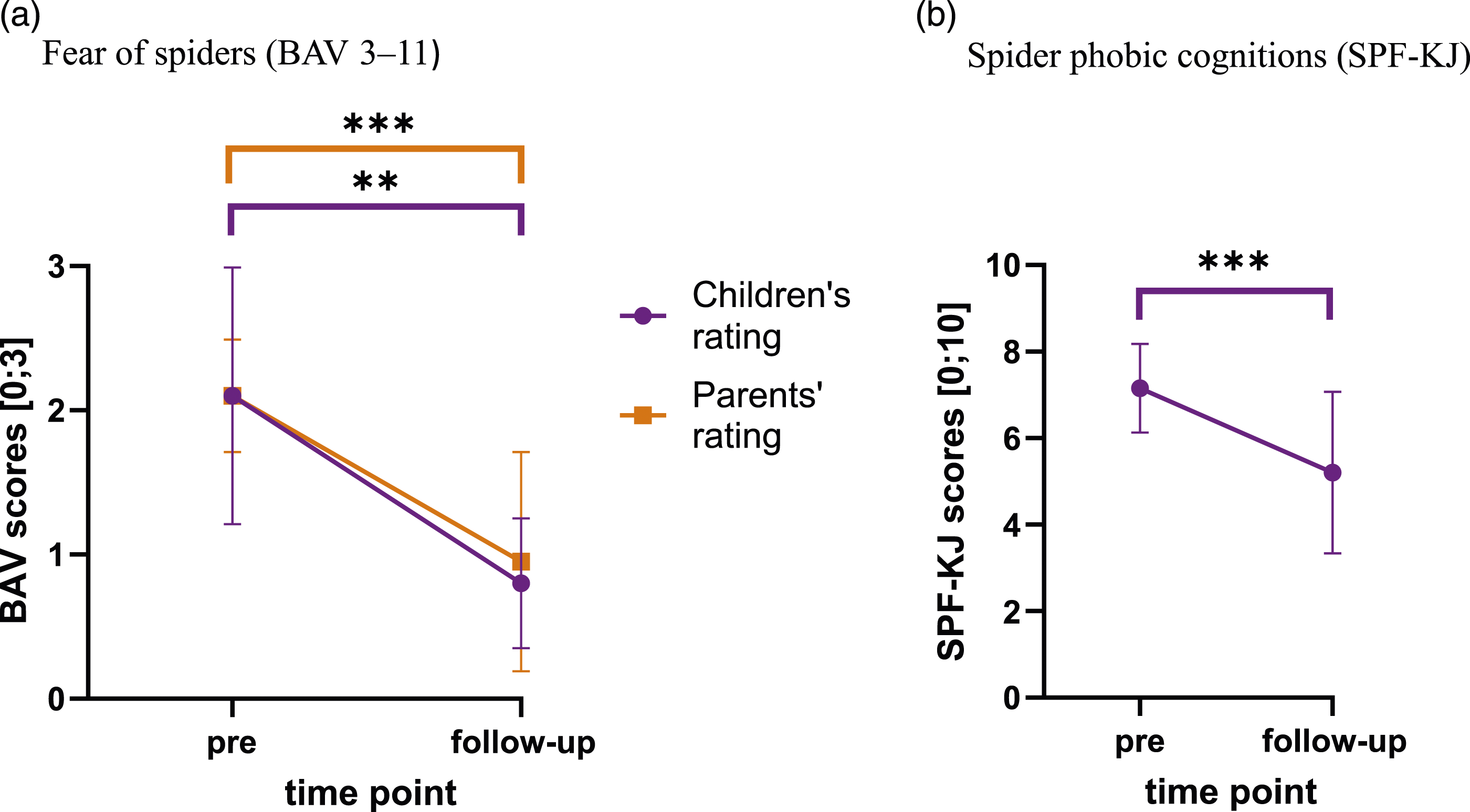
Additional analyses
Regarding the children’s sense of agency concerning the eye tracking-based gaze interaction mechanism, ten of 11 children without fear of spiders (90.9.%) and ten of ten children with fear of spiders (100%) attributed the transformations of the spiders to their gaze. One non-spider fearful child (9.1%) thought that the HMD and the computer changed the spider. In sum, a sense of agency concerning the gaze interaction was successfully reached in 20 of 21 children (95.2%).
Discussion
This study examined school-aged children’s affective responses during the gamified VRET intervention for fear of spiders called SpEYEders. A virtual spider morphs into a smiley ball, shrinks, changes into rainbow colors, or dances to music after constant visual attention towards it is measured via eye tracking. Furthermore, the current study tested the effectiveness of SpEYEders in children with fear of spiders for the first time.
Preceding the intervention, our sample of children with a fear of spiders showed significantly higher negative and significantly lower positive affect towards a virtual spider than children without fear of spiders. When experiencing the attention-related transformations of the spider, the level of negative affect in spider fearful children was significantly lower compared to their level when facing the virtual spider without transformations at baseline. Compared to the children without fear of spiders, the spider fearful children’s level of negative affect during the transformations was still higher towards the shrinking and dancing transformation, while there was no significant difference to children without fear of spiders when viewing the smiley ball and rainbow colors transformation. The spider fearful children’s level of positive affect was not only significantly higher while viewing the transformations compared to the virtual spider without transformation, it also did not differ significantly from children without fear of spiders during all transformations. This indicates that negative affect was reduced and positive affect was increased during viewing the spider transformations compared to viewing the spider without transformation in children with fear of spiders. Furthermore, the level of positive affect was significantly higher than the level of negative affect during all transformations and in both samples. The findings propose that the gaze-related transformations of a virtual spider were able to induce positive affect during exposure towards spiders in children with fear of spiders. Since there was no significant difference in the induced level of positive affect or negative affect between the four different transformations of the spider, all transformations variants seem similarly eligible for a further use within SpEYEders. Theories and empirical evidences claim that positive affect during exposure therapy might be advantageous for extinction learning (Zbozinek & Craske, 2017). Therefore, we can speculate about an advantage of SpEYEders compared to standard VRET since an induction of positive affect seems to be fostered by the gaze-related transformations of the virtual spiders. In this regard, the relevance of the kind of positive affect induced by the spiders’ transformations seems of interest also. Previous work specifically suggested an advantage of approach-motivated positive affect to promote narrowed attention towards a stimulus and therefore to improve fear extinction (Gable & Harmon-Jones, 2008; Zbozinek & Craske, 2017). Future studies could compare spider transformations inducing predominantly goal-oriented affect (e.g., excitement or desire) to spider transformation focusing on the induction of non-goal-oriented positive affect (e.g., amusement).
Concerning the effectiveness of SpEYEders, we found that in spider-fearful children fear of spiders and spider phobic cognitions could be significantly reduced from before to one week after the intervention. Since the follow-up test was conducted after an exposure to living spiders accomplished as homework by all children, the transferability of the results to real life is indicated. Furthermore, we used a virtual tarantula within the VR intervention which is not a native species in Germany. Therefore, gazing successfully at living spiders at home points to a generalization of the treatment effects to different types of spiders. Importantly, a solely attribution of the large treatment effect to exposure as homework can be excluded since auxiliary analyses showed a significant reduction in fear of spiders already between pre test and post test directly after the VR intervention (see Supplementary Material 4). All effects sizes from before to directly after and one week after the intervention indicated a large effect (d ≥ .80). This significant decrease in fear of spiders shows the feasibility of the SpEYEders application in children with fear of spiders and its eligibility to reduce fear of spiders. The next step will be to conduct a randomized-controlled trial (RCT) examining the efficacy of SpEYEders in spider phobic children compared to a waitlist control group and compared to standard VR exposure treatment. To further improve generalization, we plan to implement different types of arachnids (cross-spider, daddy-long-legs, etc.) into the VR intervention. Since context also plays an important role for the stability of treatment effects (Shiban et al., 2013), we moreover want to use different virtual environments for the SpEYEders intervention (classroom, cellar, etc.) in future. Presuming a further positive evaluation within a RCT, the SpEYEders software can be made available for clinical use in routine care. For application, virtual reality glasses with an integrated eye tracker are needed to present the stimuli and register the children’s attentional focus. The VR intervention should be combined with psychoeducation on pathological fear and the rationale of exposure therapy, and with homework to gaze at real spiders. After an evaluation of improvements after one session of SpEYEders and one homework exposure, the treatment can be finished successfully, or – if needed – the therapist can continue with further sessions of SpEYEders, additional in vivo exposure, and/or cognitive interventions until the desired treatment success is reached.
Limitations
The main methodological limitations of the study cover the small sample size, the quasi-experimental design, as well as the pre-post one-group design. Concerning the results on the effectiveness of the intervention, the reduction of fear of spiders in spider fearful children cannot be unambiguously attributed to the intervention due to the lack of a control group. However, specific phobias are known to be relatively stable even in children (Beesdo-Baum & Knappe, 2014) and therefore a naturally occurring improvement within one week would not be expected. The generalizability of the results is furthermore limited due to the small sample size, and the transferability to different sexes might be reduced due to the fact that mainly boys were examined in the non-spider fearful sample, and primarily girls in the spider fearful sample. However, animal phobias are naturally more prevalent in girls than boys (Lichtenstein & Annas, 2000), therefore the results are ecologically valid. Furthermore, the spider without transformations was presented before all transformation of the spider. Therefore, habituation must be considered when interpreting the findings on differences between the baseline spider and its transformations, what however was not the main research question of the study. Either way, the differences between the baseline spider and all transformation (independent from their position of presentation) were larger than between the different transformations. Lastly, the changes from pre-exposure to one week after the SpEYEders intervention is most likely a combination of the exposure session and the homework completed during the week after the VR intervention. However, the successful completion of homework is most likely enabled by the virtual exposure. Further research should try to disentangle the contribution of the single treatment components.
Conclusion
This study could show the eligibility and feasibility of eye tracking-based gaze interaction transforming virtual spiders within a gamified VRET for children with fear of spiders. Since the gaze-related transformations of a virtual spider induced positive affect during exposure in spider fearful children, there could be an advantage of VRET plus additional gaze interaction in comparison to standard VRET which should be further examined. In this context, also different working mechanisms behind the effectiveness of the gaze-related feedback should be investigated, e.g., changes in attention scope due to positive affect, changes in the valence of spiders, expectancy violation through unexpected, positive experiences with spiders, positive reinforcement of approaching behavior towards spiders, and an increase in general willingness and motivation for exposure therapy. Since a satisfactory sense of agency concerning the gaze interaction was reached, related effects concerning the children’s sense of control or self-efficacy could also be investigated more deeply. Most importantly, the results on the effectivity show very large effect sizes for the very short intervention. As a next step towards a dissemination of SpEYEders in clinical use, randomized-controlled studies are needed to evaluate the efficacy of SpEYEders in clinical samples of children with the diagnosis of spider phobia, e.g. in psychotherapy outpatient units. Future technical developments within SpEYEders could aim to refine the virtual surrounding to better match the children’s living environment, e.g., by using a virtual classroom, and to implement different environments to further enhance extinction learning through the use of different contexts (Shiban et al., 2013). Moreover, different species of spiders could be implemented to improve the generalizability of the results.
Supplemental Material
Supplemental Material - Looking fear in the eye: Gamified virtual reality exposure towards spiders for children using attention based feedback
Supplemental Material for Looking fear in the eye: Gamified virtual reality exposure towards spiders for children using attention based feedback by Theresa F. Wechsler, Martin Kocur, Sandra Schumacher, Mirjam Rubenbauer, Andreas Ruider, Martin Brockelmann, Michael Lankes, Christian Wolff and Andreas Mühlberger in Clinical Child Psychology and Psychiatry.
Footnotes
Declaration of conflicting interests
The author(s) declared the following potential conflicts of interest with respect to the research, authorship, and/or publication of this article: State: - Andreas Mühlberger is stakeholder of a commercial company that develops virtual environment research systems. All other authors declare that there is no conflict of interest.
Funding
The author(s) received no financial support for the research, authorship, and/or publication of this article.

Supplemental Material
Supplemental material for this article is available online.
Author biographies
References
Supplementary Material
Please find the following supplemental material available below.
For Open Access articles published under a Creative Commons License, all supplemental material carries the same license as the article it is associated with.
For non-Open Access articles published, all supplemental material carries a non-exclusive license, and permission requests for re-use of supplemental material or any part of supplemental material shall be sent directly to the copyright owner as specified in the copyright notice associated with the article.
