




Abstract
Prison-based dog training programs (DTPs) aim to improve successful rehabilitation after detention. However, empirical evidence for their effectiveness is lacking. To evaluate the effectiveness of a DTP—Dutch Cell Dogs (DCD)—on externalizing behavior, stress, self-esteem, empathy, and treatment motivation, a pilot study with a Multiple Case Experimental Design in six adolescents residing in a juvenile justice center (JJC) was conducted. Results did not provide convincing evidence for DCD’s effectiveness. Further research is needed to determine whether and for whom DCD could be a useful addition to regular JJC programming.
Keywords
One way to improve rehabilitation of adolescents in juvenile justice centers (JJCs), might be to implement prison-based dog training programs (DTPs), a type of animal- assisted intervention (AAI). Such programs, in which inmates train shelter dogs that are subsequently adopted into the community, aim to increase inmates’ and dogs’ well-being by harvesting the benefits of the human-animal bond, and to provide both with skills to facilitate reintegration into society (Fine, 2015; Furst, 2006). Although positive effects of DTPs on externalizing and internalizing behavior have been found, the limited available research in this area has major methodological flaws, that is, only few studies used a treatment-control/pre-post (-follow-up) design (Cooke & Farrington, 2016; Duindam et al., 2020). Furthermore, studies on client characteristics that may moderate DTP effectiveness, needed to fine-tune interventions, are lacking (Serpell et al., 2017). To increase knowledge in this area, we examined the effects of Dutch Cell Dogs (DCD), a prison-based DTP where detainees train, take care of, and play with a matched asylum dog biweekly in 15 two-hour sessions.
The first aim of this study was to examine the effects of DCD on primary outcome externalizing behavior. Immediate behavioral feedback provided by the dog during the training may improve self-awareness, thereby reducing externalizing behavior (Kruger & Serpell, 2006). The second aim was to examine the effects of DCD on secondary outcomes stress, self-esteem, empathy, and treatment motivation. DCD is assumed to reduce adolescents’ stress levels, as the presence of a friendly animal (Beetz, 2017; Kellert & Wilson, 1995) and support in combination with physical contact (e.g., Ditzen et al., 2007) may help individuals relax. DCD may also improve adolescents’ self-esteem, because unconditional positive regard provided by dogs (Kruger & Serpell, 2006) and empowerment resulting from successful dog training might boost their self-esteem (Davis, 2007). Furthermore, DCD may increase empathy. Many shelter dogs have experienced rejection and isolation (Furst, 2006), which makes it easy for detainees to empathize with them. This may generalize to empathy towards humans (Mills & Hall, 2014). Finally, DCD may improve treatment motivation. Interaction with animals is assumed to activate implicit-experiential information processing rather than verbal information processing, thereby promoting implicit motivation (Beetz, 2017). Furthermore, active goal setting in DTPs might translate to doing so in treatments (Furst, 2006). In addition, achieving goals may enable detainees to give back to society, which can increase their motivation for attending reintegration programs (Britton & Button, 2005).
To address these aims, we conducted a pilot study with a Multiple Case Experimental Design (MCED) in six adolescents residing in a JJC. Case Experimental Designs (CEDs) can provide a strong basis for establishing causal inference (Kratochwill et al., 2010). In CEDs, participants function as their own controls, as multiple assessments prior to the start of an intervention are compared to assessments during and after that intervention. Series of single CED studies can provide insight into the effectiveness of an intervention and into client characteristics that modify effectiveness (Kratochwill et al., 2010). Because of the small sample sizes required and relatively low costs made, CED studies are increasingly conducted in practice-based intervention research (Borckardt et al., 2008). Also, CEDs have been recommended to improve the evidence base of AAIs (Kazdin, 2017).
Method
Design
This study followed an ABA’-design (Kratochwill et al., 2010) with two measurements 1 week pre-DCD (A; baseline), 15 measurements during the DCD program (B; intervention phase), and four measurements in the 2 weeks post-DCD (A’; follow-up).
Intervention
The DCD program is provided within the detention center by two dog trainers who bring and return the shelter dogs for each session. Each detainee, with a maximum of six detainees per group, is matched to a dog by the dog trainers, based on the detainees’ abilities and characteristics observed during an intake.
During the semi-structured training sessions, detainees perform caring tasks, offer recreation through play, and teach their dogs basic commands through operant conditioning, meaning that they are taught to reward their dogs’ desirable behavior and ignore undesirable behavior. Through this process, detainees are ought to learn how to recognize, interpret, and anticipate their dogs’ emotions, body language, and behavior. Extra attention is paid to learning how to understand and handle dog aggression. The training ends with a celebratory demonstration in the presence of JJC staff, family members, and staff of the asylum centers.
To ensure safety, the dog trainers, who are experts in reading the dogs’ signals to safeguard the dogs’ well-being, are present during the entire training-sessions, constantly observing whether the dogs are treated appropriately. For a more elaborate description of DCD, see Schenk et al. (2018).
Subjects and procedures
Participants were five boys and one girl (aged 18–24 years) who were convicted for violent crimes and resided in a long-stay department of a Dutch JJC. They voluntarily applied for participation in DCD and were selected by JJC staff based on their motivation letter, mental and physical capacity to train a dog, and residence in the JJC for at least the duration of the training.
Prior to study participation, the candidates were informed and signed a consent form. During the research period, they individually completed a questionnaire, including the measures below, every Tuesday (non-training day) and Thursday (after that day’s training session) in the presence of a research-assistant. The Ethical Committee of the University of Amsterdam approved the research project (number: 2017-CDE-7633).
Instruments
For all measures, validated self-report scales were shortened to keep adolescents motivated to participate. Selection of core items was based on face validity. To increase sensitivity to change (Smith, 2012), items were rephrased so they referred to the last couple of days, and instead of using the original Likert scaling, participants were asked to report their answers on a more fine-grained ‘slider’ (i.e., 0–100).
Externalizing behavior was measured with six items of the Externalizing subscale of the Youth Self Report (YSR; Achenbach, 1991), asking how many times (0–10) during the last couple of days participants physically hurt someone, disobeyed, lied, stole, used drugs, and destroyed something. Sum-scores for each participant on each time point were calculated.
For the secondary outcomes, participants indicated on a slider (0–100) how much the items applied to them. Stress was measured with three items of the Perceived Stress Scale (Cohen et al., 1997), that is, everything went the way I wanted (recoded); I encountered so many problems that I didn’t know what to do; I was nervous/stressed. Self-esteem was measured with two items of the Rosenberg Self-Esteem Scale (Rosenberg, 1965), that is, I was satisfied with myself; I felt like I was a failure (recoded). Empathy was assessed with two items of the Basic Empathy Scale (Jolliffe & Farrington, 2006), that is, I was indifferent to the feelings of others around me (recoded); I understood the feelings of others around me. Treatment motivation was measured with two items of Van Binsbergen’s (2003) Treatment motivation questionnaire, that is, I tried to change my behavior; I felt like it was useless to be here (recoded). For all secondary outcomes, mean-scores for each participant on each time point were calculated.
Analyses
To analyze the case series data, we used simulation modeling analysis (SMA; SMA software version 8.3.3), which is suitable when each phase consists of a relatively small number of observations (i.e., n < 30; Borckardt, 2006). In SMA, a bootstrapping method enables the analysis of variable changes across phases, while accounting for autocorrelation, which is the dependence of a value on the value of one or more of the immediately preceding measurements. Across phases, Pearson correlations were calculated per variable and per participant for 1) changes in mean levels (i.e., level changes) and 2) changes in data patterns (i.e., slope changes). For clinically relevant level changes (i.e., > 80%; Scotti et al., 1991), the Percentage of Non-overlapping Data (PND) was provided. To adjust for multiple comparisons, a Bonferroni correction was applied. Associations were considered significant at p ⩽ .017.
Results
Participants completed all training sessions. Participants 3 and 6 were absent for one measurement occasion. In this section, only significant results are reported. Slope changes are only reported when significant level changes are absent, since they provide additional insight into changes within phases. Full results are provided in the Appendix.
Externalizing behavior
From baseline to intervention, participants 1 (r = –.713, p = .006, PND = 86.67%) and 3 (r = –.814, p < .001, PND = 100%) showed reduced externalizing behavior. Participant 6 (r = –.752, p = .013) showed a further decline in slope of externalizing behavior during intervention. For participants 1 (level change: r = .764, p = .002, PND = 75%) and 6 (slope change: r = –.799, p = .004), positive effects were reversed at follow-up (Figure 1).
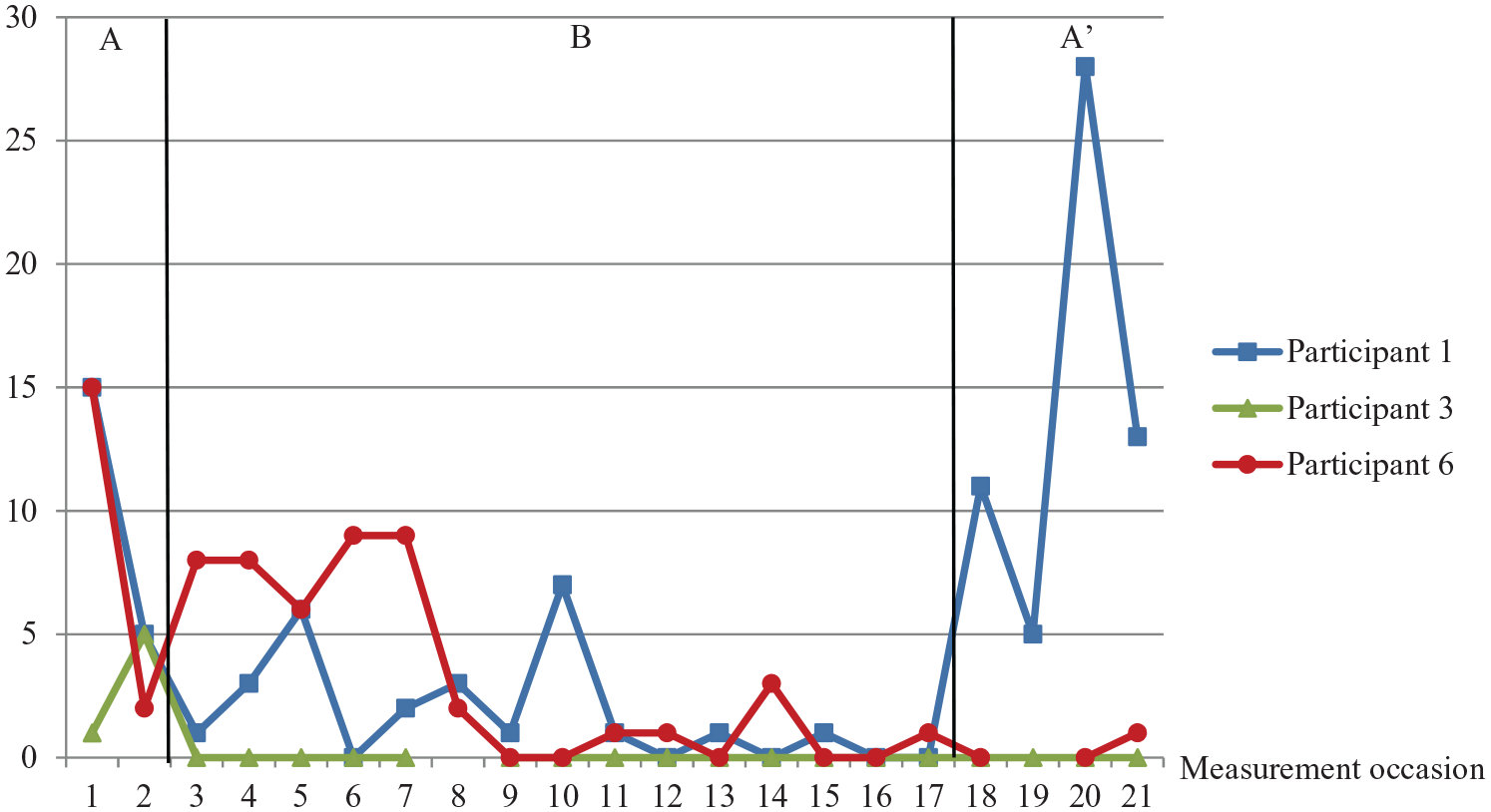
Externalizing behavior (number of incidents).
Secondary outcomes
From baseline to intervention, stress decreased in participants 1 (r = –.644, p = .010, PND = 93.33%) and 2 (r = –.682, p = .006, PND = 93.33%), but increased in participant 6 (r = .592, p = .016, PND = 93.33%). For participant 1, the decrease was reversed at follow-up (r = .691, p = .004).
Decreased self-esteem was observed in participant 3 from baseline to follow-up (r = –.971, p = .004, PND = 100%) and in participant 5 from intervention to follow-up (r = –.785, p = .002, PND = 100%).
Decreases in empathy were observed from baseline to follow-up in participants 3 (r = –.997, p < .001, PND = 100%) and 5 (r = –.956, p = .004, PND = 100%). For participant 1, the decreasing slope of empathy during baseline increased during intervention (r = –.641, p = .014), sharply dropped after the completion of DCD, and then gradually increased during follow-up (r = .720, p =.001).
For participant 1, the slope of treatment motivation sharply dropped after the completion of DCD and then gradually increased during follow-up (r = .701, p = .002).
Discussion
Two out of six participants showed reduced levels of externalizing behavior during DCD. However, in only one participant this effect remained at follow-up. Effects on secondary outcomes were either absent or in opposing directions. Therefore, our results did not provide evidence for DCD’s effectiveness in reducing externalizing behavior and improving stress, self-esteem, empathy, and treatment motivation. This is in contrast with previous research showing mostly positive results of DTP’s. Yet, most of these studies did not use a robust design (Cooke & Farrington, 2016; Duindam et al., 2020). In addition, publication bias (i.e., the tendency not to publish non-significant results) seems to be apparent in the research field of animal-assisted interventions (Beetz, 2017). As such, expectations based on previous research may be inflated.
The variation in effects across participants in the current study suggests that some participants (1, 3, and 6) were more responsive to DCD than others, albeit temporarily and not overall in the desired direction. Other than having a larger number of clinical diagnoses, these participants could not be distinguished from the other participants, for instance in terms of age, previous dog ownership, attachment problems, and time already served. Serpell and colleagues (2017) already argued that more research is needed to identify characteristics affecting receptiveness to AAIs, as the beneficial effects of human-animal interactions do not seem to be universal. From the perspective of personalized treatment, this information is important to improve intervention effectiveness (Ng & Weisz, 2016).
The present study has some methodological limitations that should be acknowledged. First, due to DCD’s “last minute” selection of participants and the strict schedules in the JJC, the baseline and follow-up phases were relatively short (n < 6) and the baseline periods were not randomized. More assessments improve the stability of mean-levels per phase and randomization of baseline periods helps to rule out alternative explanations for intervention effects (Borckardt et al., 2008; Onghena & Edgington, 2005). Second, because no validated questionnaires for MCED research exist with reference to our variables, we adjusted validated instruments. This may have negatively affected the reliability and validity of our measures. We urge for the development and validation of instruments for CED research, as well as for the inclusion of multiple informants and psychophysiological measures next to questionnaires (Smith, 2012).
In sum, there was variety in how incarcerated adolescents responded to DCD. Overall, we did not find convincing evidence for the effectiveness of DCD. More (randomized) controlled studies and MCED studies are needed to gain more insight in the effectiveness of DTPs and DCD in particular, and to determine for whom such program could be a useful addition to regular JJC programming.
Supplemental Material
CCPP-19-0190.R1_Appendix – Supplemental material for Brief report: The effectiveness of Dutch Cell Dogs: A multiple case experimental study
Supplemental material, CCPP-19-0190.R1_Appendix for Brief report: The effectiveness of Dutch Cell Dogs: A multiple case experimental study by Julia E Offermans, Hanne M Duindam, Jessica J Asscher, Geert Jan JM Stams and Hanneke E Creemers in Clinical Child Psychology and Psychiatry
Footnotes
Declaration of conflicting interests
The author(s) declared no potential conflicts of interest with respect to the research, authorship, and/or publication of this article.
Funding
The author(s) received no financial support for the research, authorship, and/or publication of this article.

Supplemental material
Supplemental material for this article is available online.
Author biographies
References
Supplementary Material
Please find the following supplemental material available below.
For Open Access articles published under a Creative Commons License, all supplemental material carries the same license as the article it is associated with.
For non-Open Access articles published, all supplemental material carries a non-exclusive license, and permission requests for re-use of supplemental material or any part of supplemental material shall be sent directly to the copyright owner as specified in the copyright notice associated with the article.
