




Abstract

Introduction
Support groups and online communities can be invaluable for patients. Support organizations facilitate their members by sharing valuable social and emotional support, advice, and resources. 1 They also work to disseminate research opportunities and the newest management guidelines to both patients and physicians. Directing patients to support organizations helps them become empowered advocates and partners in their healthcare. However, patients should be advised that every patient’s medical experience and social situation are unique and, thus, the patient stories they encounter do not predict their own future outcomes.
In this edition of the SVM Communication pages, we highlight resources, advocacy, and awareness initiatives that can be shared with patients with aortic disease (i.e., aortic aneurysm and aortic dissection) to supplement education received from the medical team and to reduce feelings of isolation.
Patients will do their own research, so guiding them towards reputable support organizations can build trust in the physician–patient relationship. 2 Support organizations with medical and administrative oversight (typically a professional or medical advisory board that reviews education, answers questions, and reviews research proposals), helps to minimize exposure to anecdotal and false information. 3 As well, within these communities, it is advised that patients discuss specific medical plans and questions with their own care providers to develop a safe and personalized plan of care.
Support organizations for patients with aortic disease
In 1980, Dr Reed Pyeritz, along with other healthcare professionals, met with patients and families in Baltimore for the first peer support meeting for people impacted by Marfan syndrome. 4 Dr Pyeritz’s early research focused on Marfan syndrome and improving medical care, including leading the first trial that demonstrated the benefit of using beta-adrenergic blockers, and documenting the natural and clinical history of Marfan syndrome, which showed that by 2010 the average lifespan improved to over 70 years. 5 Over the 40 years that have passed since these early efforts, opportunities have increased dramatically for patients with aortic disease to find information and support.
Select advocacy organizations for aortic conditions and an outline of their services are listed in Table 1. This is not a comprehensive list as aortic disease can be associated with many other syndromic conditions (such as Turner syndrome) or more common congenital heart disease (e.g., bicuspid aortic valve).
Select support organizations for aortic disease.
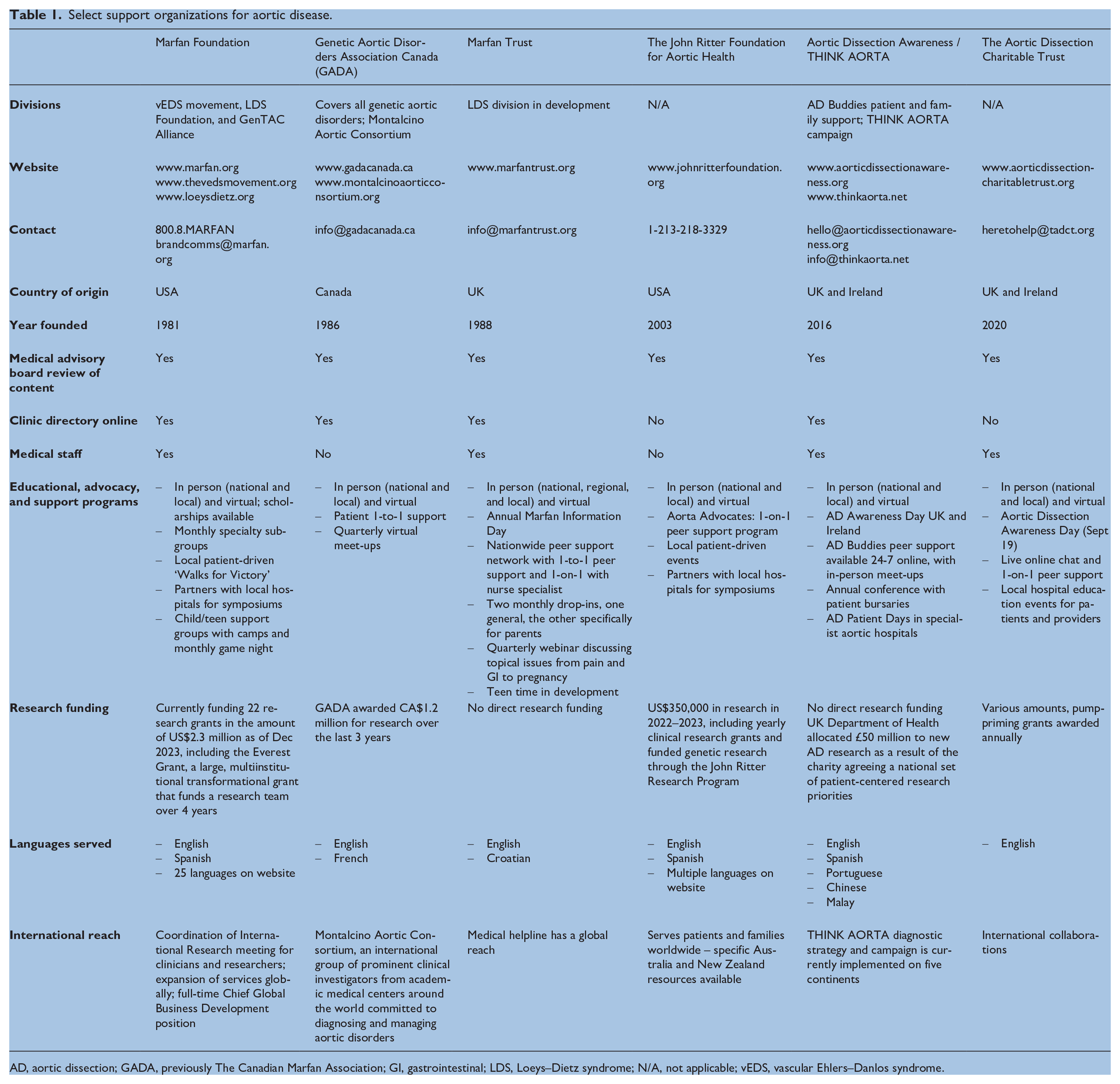
AD, aortic dissection; GADA, previously The Canadian Marfan Association; GI, gastrointestinal; LDS, Loeys–Dietz syndrome; N/A, not applicable; vEDS, vascular Ehlers–Danlos syndrome.
Individual institutions, cardiac rehabilitation programs, or local groups may also have specific aortic disease support groups. These allow for local connections and/or peer referrals to local experts. One example is the Mended Hearts program (www.mendedhearts.org), which is not specific to aortic disease, but offers support, education, and programing for individuals with all types of heart disease, including congenital heart disease.
Clinical research initiatives
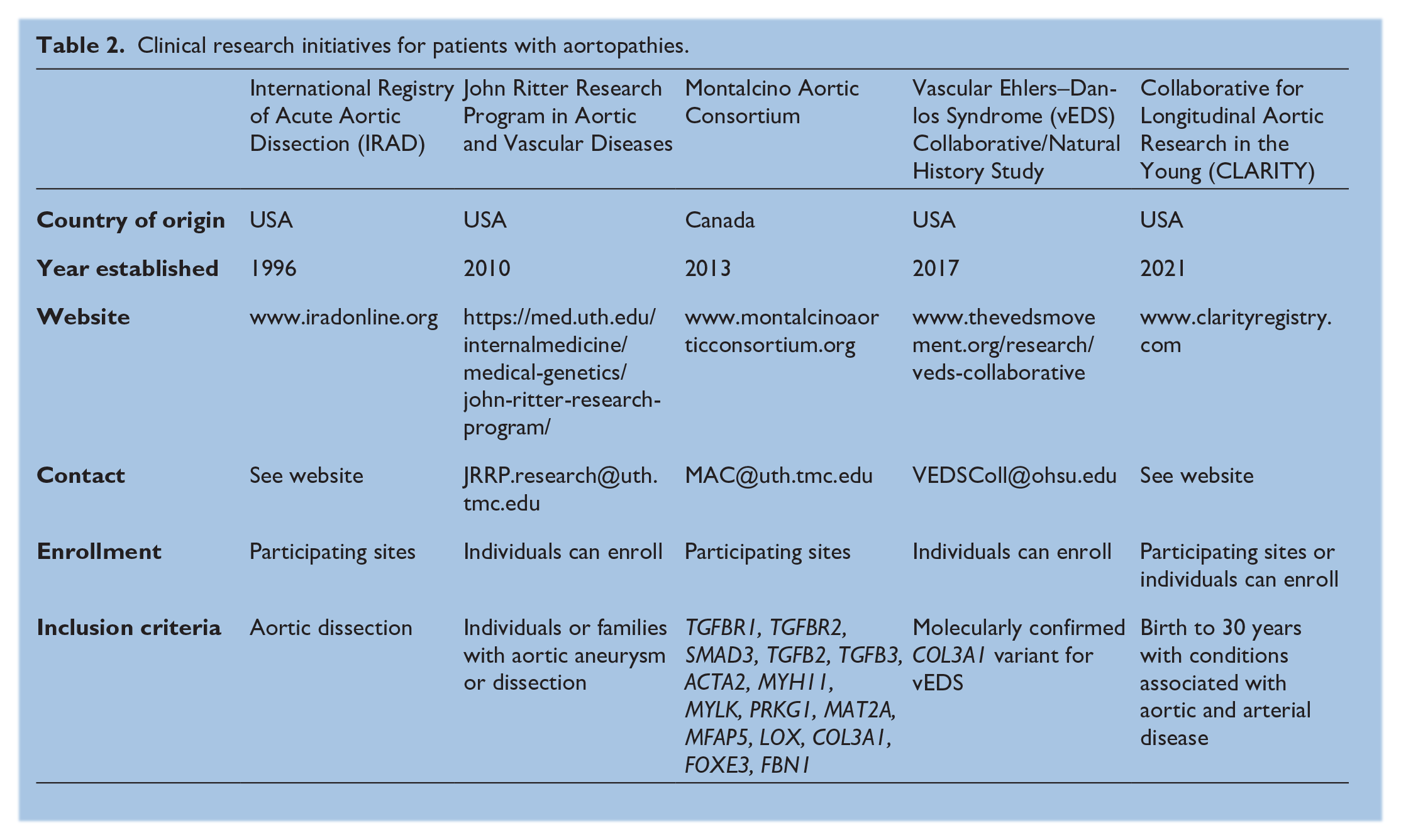
Many support organizations have opportunities for patients to enroll in surveys, genetic studies, or other clinical research trials. Additionally, there are several registries that collect patient data for research purposes (Table 2). These research initiatives are geared towards understanding the natural history of these conditions and/or identification of new genes associated with aortopathy.
Clinical research initiatives for patients with aortopathies.
Other educational resources
Individuals with aortic aneurysms, aortic dissections, and those at risk, including those with genetic aortopathies such as Marfan, Loeys–Dietz, and vascular Ehlers–Danlos syndrome, often experience diverse emotional reactions due to their health status. Studies have reported that up to about one-third of patients experience isolation, anxiety, depression, and posttraumatic stress disorder during their journey with aortic disease.6,7
In 2023, the John Ritter Foundation for Aortic Health supported the development of an educational resource addressing mental health topics entitled Life with Aortic Disease: Caring for Your Mental Health. 8 This electronic publication has been professionally and patient-reviewed and is an important resource to help patients feel validated in their feelings, avoid feelings of isolation, and help them access mental health support if they need it. In addition, the John Ritter Rules were created to educate on how to recognize, treat, and prevent thoracic aortic dissection.
The Aortic Dissection Charitable Trust has developed Could It Be Aortic Dissection?, which is an online tool for individuals seeking to better understand acute aortic dissection. Subtitles can be chosen in French, Dutch, Italian, Spanish, and Portuguese.
Another new resource in 2023 is Aortic Dissection: The Patient Guide, 9 which covers what patients and families need to know. This online publication includes topics geared toward the early days, returning home, and information for family and caregivers.
The Vascular Disease Patient Information Page is a regular feature of Vascular Medicine. All articles in this collection are available online for free. The Patient Pages provide up-to-date and concise information for patients and cover a variety of cardiovascular health issues, including factsheets on aortic aneurysm and dissection and genetic testing.7,10–12
Advocacy campaigns
Advocacy campaigns are another way to support patients with aortic disease. Healthcare institutions and providers can engage with advocacy campaigns to help increase awareness and provide support for other caregivers as well as patients and their families. Several organizations have focused campaigns throughout the year.
Summary
Support organizations are valuable resources, providing community, education, and research opportunities to pa-tients. By referring patients to appropriate, vetted reso-urces, they can access mental health resources and peer advice to reduce isolation. They can also access education to empower themselves to become more active participants and advocates in their healthcare. The support organizations and other initiatives outlined here can serve as powerful tools to both patients and providers in the aortic disease space.
Footnotes
Correction (April 2024):
In Table 2, the Montalcino Aortic Consortium information has been updated.
Declaration of conflicting interests
The authors declared no potential conflicts of interest with respect to the research, authorship, and/or publication of this article.
Funding
The authors received no financial support for the research, authorship, and/or publication of this article.
