




Abstract
Introduction to advanced practice providers (APPs)
Over the past several years, Advanced Practice Providers (APPs) have transformed the practice of vascular medicine. Through tailored training and effective integration into vascular medicine programs, APPs have enhanced the ability to deliver care around the nation. APPs include nurse practitioners (NPs) and physician assistants (PAs) who participate in independent and collaborative medical care. Over the last decade, APP employment has skyrocketed, with current estimates of nearly 400,000 in practice in the US.1,2 However, incorporation of APPs into medical practices has been heterogenous and roles are varied. Vascular medicine is a growing specialty area where APPs have been increasingly integrating into the medical team in a variety of roles and settings, including inpatient, outpatient, specialty clinics, and research. This article serves as a follow-up to our 2019 publication in Vascular Medicine 3 and provides additional insight into the incorporation of APPs into vascular medicine programs.
APP educational background
The initial education programs for NPs and PAs vary slightly. NPs are practicing registered nurses (RNs) that complete further medical education to advance their practice. This is done through formal programs requiring a variable number of years and clinical hours, resulting in a Master of Science in Nursing (MSN) and/or Doctor of Nursing Practice (DNP). Before NPs can practice, they must also obtain certification from an accredited certifying body, such as American Nurses Credentialing Center (ANCC). 4 Certifications for NPs working in a vascular care setting may include Family (FNP), Adult-Gerontology (AGNP), or Acute Care NP (ACNP), which vary in education and training.
Alternately, PAs come from a wide variety of backgrounds prior to entering PA school. Programs are dedicated 24–36-month curriculums with interval testing throughout. After completion of the formal training program, board certification is obtained through the National Commission on Certification of Physician Assistants, and successful students are designated as a PA-C with various Master or Doctorate degrees. 5
Vascular specialty training for APPs
APPs have the opportunity to attend fellowship courses across the US, including specialties such as emergency medicine, cardiology, orthopedics, and oncology. 6 Specialty certifications are available in many disciplines, but the only current overlap with vascular medicine is a cardiology certification through the American College of Cardiology (ACC). 7 Notably, only 6% of this certification is related to vascular topics. Therefore, when entering the field of vascular medicine, many APPs will need to bridge knowledge and practice gaps.
Recruiting experienced APPs or those with transferable skills can aid in a more rapid path to independent practice. APP students who have completed a rotation with a vascular program are often considered good applicants for vascular medicine programs. For outside candidates, prospective APPs can shadow current APPs or vascular medicine physicians during their interview process to allow both parties to better assess their fit with the program.
Once hired, onboarding should ensure a minimum viable skillset and knowledge is held by all members of the team. Training can then be customized to meet the needs of the APP, or the exposure broadened as needed. For example, newly graduated APPs may require a prolonged orientation period compared to an experienced APP. Certain institutions with regular onboarding processes for APPs may have competencies already outlined for their vascular practice and much of the training is through on-the-job experience under direct supervision with collaborating physicians or peer APPs. The APP should be provided with observation time in areas where patients are routinely referred, including the angiography suite and vascular laboratory, as well as observation of vascular procedures and wound care. APPs may be recruited into specialty vascular medicine settings depending on the patient population, with special focus on wound care, venous thromboembolism (VTE), and arteriopathies. Thus, the APP may require an orientation tailored to the needs of a specific patient population.
To keep APP providers up to date, the importance of evidence-based practice must be stressed along with the methodology to apply it to their own practice. This can be disseminated through journal clubs or grand rounds, but APPs should be encouraged to read clinical trials, become comfortable understanding research studies, and applying the data to everyday practice. In addition, the APP must study educational materials from professional societies, book chapters, and journal articles. Finally, support should be provided for APPs to attend vascular conferences. Examples of such meetings include Society for Vascular Medicine (SVM) annual meetings and its separate APP-specific course.
The evolving role of APPs in vascular medicine
The incorporation of APPs in medicine is evolving. Initially, designated practice agreements and identification of a specified supervisory physician was necessary for PAs, and NPs were afforded more autonomy. This has transitioned over time to increasing independence in evaluation and management of patients for all APPs. APPs can participate in outpatient and inpatient settings by independently completing patient evaluations, note writing, and treatment planning. Both consultative and follow-up roles are regularly filled by APPs. The specifics of a vascular practice setting will dictate the degree of access to supervision versus independent evaluation. APPs are increasingly used to maintain or expand timely access in critical situations such as limb-threatening ischemia, acute VTE, or newly identified aortic aneurysms and/or dissections. APPs also spend a significant amount of time in patient education, follow up, and administrative management. Billing has become independent of physicians, and APP visits are reimbursable.
APPs have also expanded their role beyond clinical duties to participate in quality improvement and research initiatives. They are actively involved in advancing the field of vascular medicine through lectures, publications, and grassroot efforts to improve their programs and patient experiences. The vascular medicine APP may serve as a site principal or sub-investigator for clinical research studies, assisting with data collection, conducting follow-up studies, and writing manuscripts. A growing number of APPs are achieving academic rank within educational institutions.
Another advance in the vascular realm lies in education. APPs are increasingly serving as preceptors and mentors to APP students as well as residents and fellows. They participate in educational development programs and are faculty in NP and PA schools across the nation.
Challenges faced by vascular APPs
Despite national advancement of APP practice, certain challenges persist in the realm of vascular medicine. These challenges underscore the need for targeted support and resources to help vascular APPs effectively navigate their unique professional landscape.
Diverse practice settings and team dynamics
Vascular APPs practice in diverse environments, including inpatient and outpatient settings, operating rooms, and vein procedure clinics. Adapting to and excelling in a wide range of practice environments can be challenging.
Limited specific vascular medicine clinics and attending physicians
There is a scarcity of vascular medicine physician specialists. This scarcity can make it difficult for vascular APPs to find specialized environments for focused learning and practice, particularly in the field of vascular medicine.
Vascular APPs in a surgical practice
Frequently collaborating with vascular surgeons, vascular APPs have a role in medically managing complex vascular patients. This can present challenges in having mentorship or physician guidance in challenging medical therapy situations, especially when the group does not have a vascular medicine physician specialist.
Expertise in complex areas
The need for vascular APPs to be experts in evaluating multiple imaging modalities, making diagnoses, managing risk factors, and treating challenging vascular diseases can be, especially given the complex nature of these tasks and the high level of expertise required. This again can be challenging if there is a lack of vascular medicine specialist mentorship or oversight. Specialized certifications within vascular diseases would allow for vascular APP advancement, competency, and standardization.
Limited resources for networking and professional development
Historically, vascular APPs have had limited resources to engage in networking, mentorship, speaking opportunities, and research. There is a growing need for more specialized support and opportunities explicitly geared towards APPs in vascular specialties. This limitation hampers their ability to grow professionally and stay up to date in their field.
Dispersal across various conferences and societies
Participation of vascular APPs is spread across multiple conferences and societies, often alongside fellows, physicians, surgeons, and vascular technologists. This dispersal can lead to a lack of focused learning and networking opportunities specifically tailored for vascular APPs.
Societal involvement for collaboration
Although societal involvement offers a platform for collaboration and enhancement of practices, initiating and maintaining such involvement can be challenging, especially in finding relevant societies and engaging effectively with them.
Society for Vascular Medicine: A home for vascular APPs
An increasing number of APPs are finding that the SVM provides the support, education, and opportunities that are required to advance their vascular medicine practice. Indeed, SVM can be a natural home for any APP who cares for patients within the gamut of vascular disease. The following are a few of the benefits that SVM offers APPs.
APP-specific membership and physician sponsorship program
SVM offers a dedicated membership category for APPs. Each year, SVM offers physicians the chance to sponsor an APP during registration. This sponsorship significantly lowers the membership costs for APPs, facilitating easier participation and reflecting the community’s commitment to mentorship and partnership.
APP course by SVM
SVM also hosts an annual course designed explicitly for vascular APPs. This course includes lectures on various aspects of vascular medicine, such as understanding the etiology and workup, imaging surveillance, medical management, and the range of procedural and surgical options available for vascular patients. This year’s program was held in Atlanta, Georgia in 16-17th of March 2024.
Vascular Scientific Sessions (VSS)
These sessions are held annually and are attended jointly by vascular medicine physicians, APPs, and other vascular specialists. APPs are particularly encouraged to submit research or case study posters and participate in these scientific sessions.
Opportunities for involvement and leadership
SVM encourages APPs to take active roles, such as speaking opportunities and participating in a special panel to discuss different provider roles within the specialty.
Growth in APP membership and establishment of the APP committee
Recently there has been a notable increase in APP membership within SVM. Consequently, the SVM Board of Trustees established an APP-specific committee to enhance the professional growth of vascular APPs within the Society and in their roles. The committee focuses on increasing the societal presence of APPs, increasing APP involvement with SVM and vascular medicine, ensuring APP-relevant programming, boosting the presence of APP speakers in vascular societies, and working towards establishing an accreditation process.
Additional participation opportunities for APPs in SVM
APPs engage in other SVM activities such as journal clubs, accessing the Vascular Medicine journal, social media engagement, and participating in mentoring opportunities, further contributing to their professional development and integration into the vascular medicine community.
What SVM means to APP members
As we explored the impact of SVM on its members, particularly APPs, we have heard directly from those who have experienced this journey. Their testimonials highlight the transformative role of SVM in their professional lives (Figure 1).
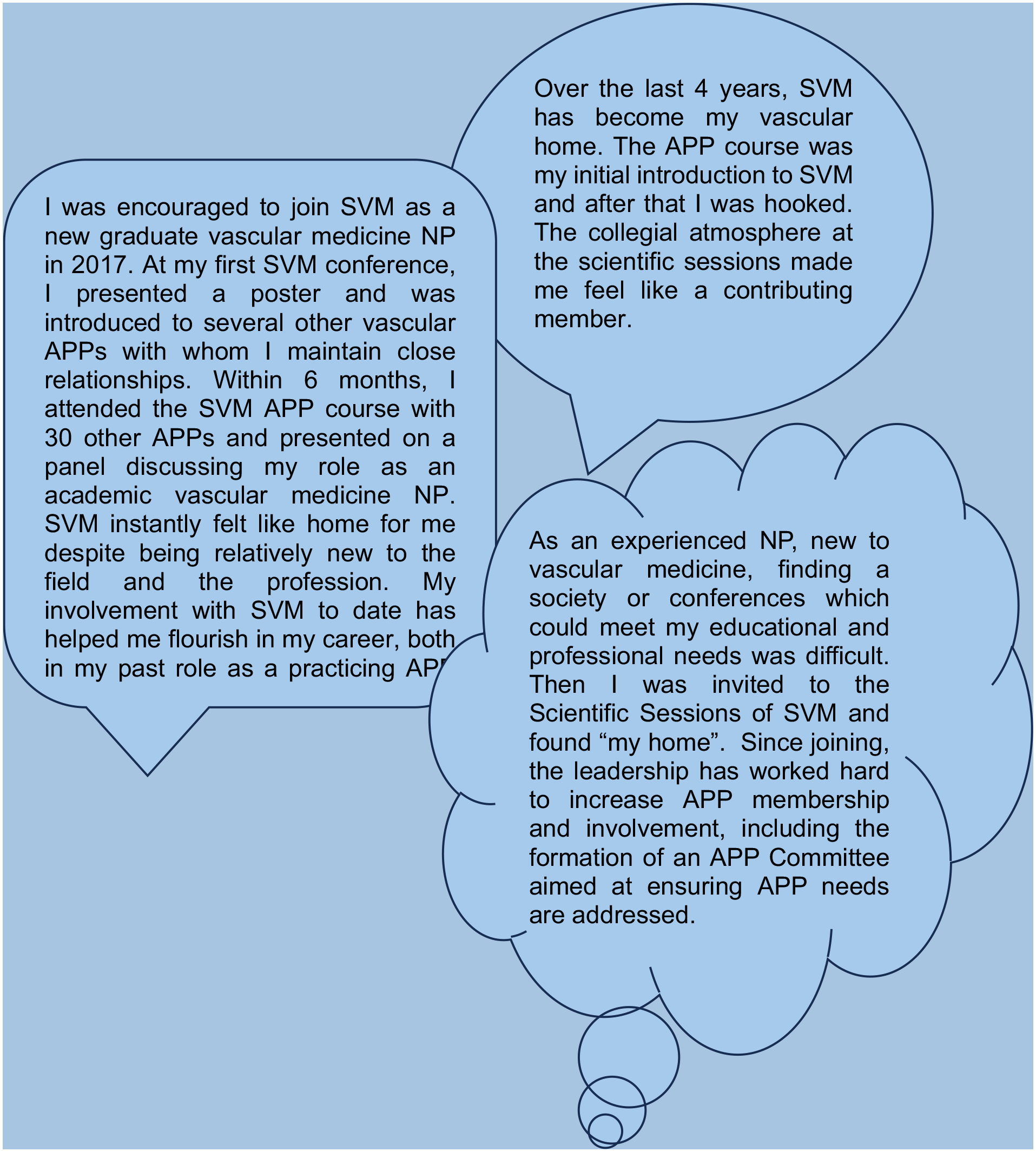
Testimonials from APP members of the SVM.
Future directions and opportunities
Patients with vascular disease are in dire need of excellent care. Unfortunately, there is a growing gap in the ability of physician-led practices to offer this care in many parts of the United States. Thus, the future for vascular APPs is bright. We believe that the role for APPs in vascular care will continue to evolve. Paradigm shifts in the physician–APP co-management of patients with vascular disease and trends towards more independent APP patient management have the potential to alleviate strain on the current shortage of a vascular specialist workforce. Future expansions of APP roles in vascular care include screening clinics, coordinated surveillance clinics, including for complex vascular disease, and vascular procedure clinics.
In conclusion, SVM remains steadfast in its commitment to integrating APPs into the fabric of vascular practices and societies. Through specialized courses, tailored memberships, and the dedicated efforts of the APP committee, SVM is laying a solid foundation for the future. APPs are not just participants in this field; they are vital contributors, enriching vascular practices with their expertise in evidence-based medical management, support of specialized practices, and proficiency in independent evaluations and procedures. As we look ahead, the potential for APPs to transform the landscape of vascular medicine is limitless. Their expanding role promises to enhance patient care and propel the specialty into new horizons of excellence and innovation.
