



Abstract

A 59-year-old man presented with a 6-year history of increasingly uncomfortable, slowly progressive swelling within his upper arms and torso. His medical history was remarkable for long-standing excessive alcohol consumption (abstinent for 2 years), alcoholic hepatic steatosis, hypertension, gout, obesity, and peripheral neuropathy. Physical examination was most remarkable for a ‘pseudo-athletic’ somatotype with a striking discordance between the size of his torso and lower extremities, with marked symmetrical confluent fat deposition within the arms. Although there was modest fat deposition around the anterolateral neck, it did not manifest a prominent ‘horse-collar’ appearance. Other findings included a body mass index of 38 kg/m2, gynecomastia, and fat deposition throughout the torso, dorsocervical, and abdominal regions (Panels A and (B). The patient gave permission to publish his photographs.
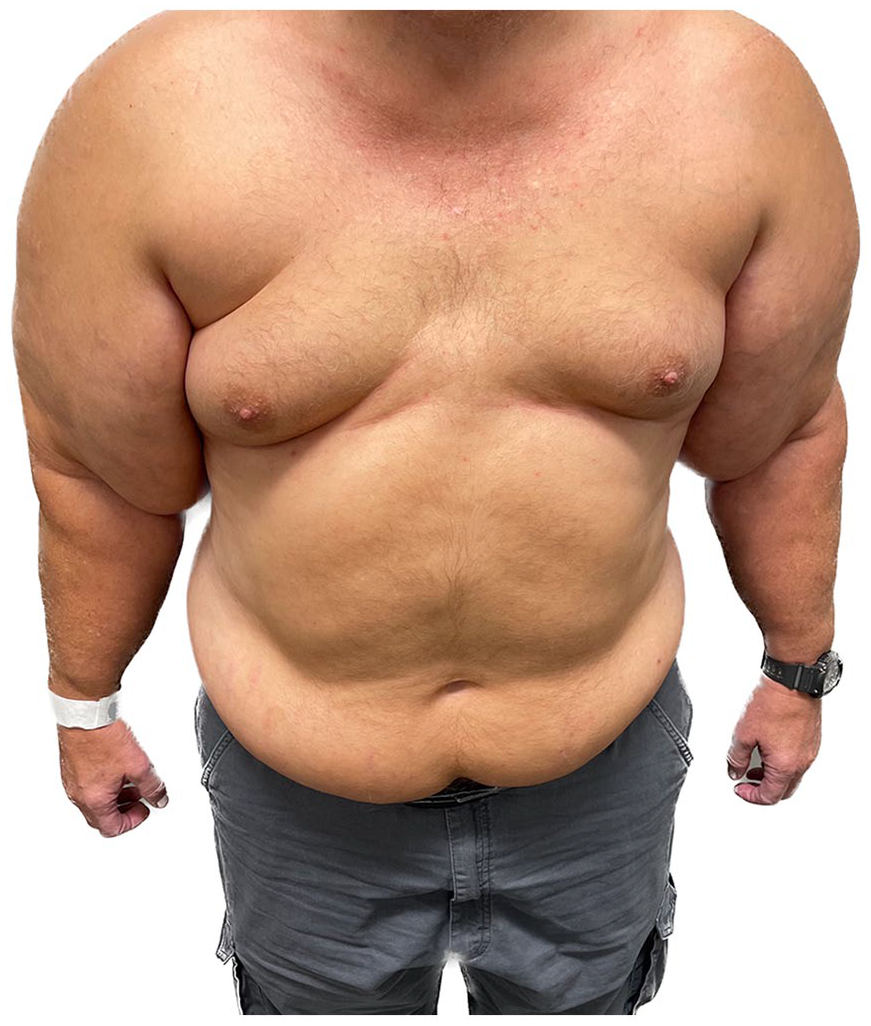
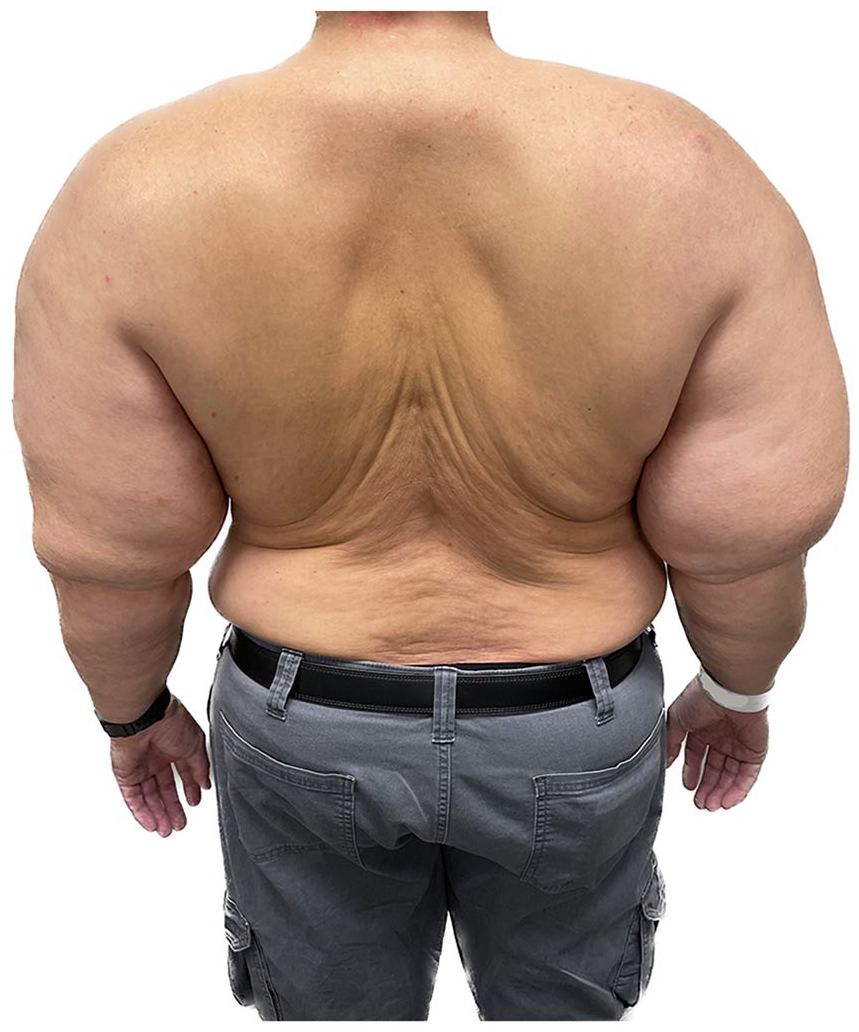
These unique clinical manifestations in the setting of risk factors yielded a diagnosis of Madelung disease (MD), also known as benign symmetric lipomatosis or Launois–Bensaude syndrome. MD is a rare disorder (prevalence 1:25,000) that is closely linked to chronic alcoholism in up to 90% of patients and has a strong male predominance. 1 In a 2021 large database review, the average patient age was between 45 and 65 years old. 2 It is characterized by the presence of prominent fat deposition and lipomas within the aforementioned distribution. Although absent in this subject, the disorder can provoke copious fat deposition around the neck referred to as a ‘horse-collar’ deformity. The face and lower extremities are typically, although not invariably, unaffected. Three differing classification schemes exist that categorize MD into three or four subtypes based on fat distribution; however, none of these has been universally adopted or standardized. 3 Comorbidities such as liver disease, hyperuricemia, hypertension, peripheral neuropathy, diabetes mellitus, and hypothyroidism have been reported, the first four being germane in this patient. 1 The definitive pathogenesis of MD is unclear, but may involve mitochondrial dysfunction and/or enzyme and membrane receptor activity that inhibits adrenergic-mediated lipolysis. 1 The diagnosis of MD can usually be rendered via an accurate history and physical exam. If needed, supplemental imaging with ultrasound, computerized tomography scanning, and/or magnetic resonance imaging (MRI) can confirm the diagnosis, assess for locoregional nerve and vessel compression, and exclude other soft-tissue diseases. Extensive lipectomy and/or liposuction remain the only effective treatments for MD. 4 Alcohol abstinence will not induce spontaneous regression but can potentially reduce the rate of recurrence.
Footnotes
Note – Panels are in color online.
Declaration of conflicting interests
The author declared no potential conflicts of interest with respect to the research, authorship, and/or publication of this article.
Funding
The author received no financial support for the research, authorship, and/or publication of this article.
