



Abstract

Colleagues and friends, welcome to the Society for Vascular Medicine’s 33rd annual scientific sessions, rebranded this year under a new name as the 2022 Vascular Scientific Sessions (VSS), presented by SVM. I want to begin by acknowledging the tremendous work by President-Elect and Program Chair, Dr Ido Weinberg, the Program Committee, and the entire Veritas meeting planning team, including our Managing Director Sue O’Sullivan, Executive Director Matt Helms, Associate Director Sandy Addison, Meeting Manager Jennifer Fitzgerald, as well as Jennifer Manthei, Ryan O’Sullivan, Donna Kelly, and Kerim Oz. Creating and executing a successful scientific meeting is a team sport and there is no doubt we have an all-star lineup and a very deep bench!
It is humbling to stand before you today, in my first Presidential Address. In our 33-year history, we have been led by luminaries – strong leaders who have molded our Society into a vehicle for positive change and advanced our field. Looking back at where we were yesterday, acknowledging where we are today, and imagining where we might be tomorrow is a daunting task. There are very big shoes to fill, and I am thankful to be surrounded by creative, intelligent, highly motivated, and energetic individuals who together ensure our collective success as a Society and as a specialty. I’d like to thank our Executive Committee and Board of Trustees (Drs Raghu Kolluri, Ido Weinberg, Elizabeth Ratchford, Esther Kim, Mitch Silver, Mehdi Shishehbor, Mitch Weinberg, Yogen Kanthi, Aditya Sharma, Scott Kinlay, and Vascular Medicine journal Editor-in-Chief and ex officio member Heather Gornik). And, while time will not allow me to recognize each by name, I thank our committee and task force chairs and co-chairs.
This past year has been a whirlwind for me and my family. Over the summer, I left Brown University and the Lifespan Health System in Providence, RI, to become medical director of the heart and vascular service line at Henry Ford Health in Detroit, MI. Juggling this and my presidential responsibilities has been challenging. On that note, I’d like to thank my wife Stefanie, and my children, Hannah and Josh, who have always been there to support me, and allowed me the time necessary to serve as a leader at SVM and in the cardiovascular community at large. I could not do this without them.
At Henry Ford, I joined two vascular medicine physicians and more than a dozen each of vascular interventional cardiologists and vascular surgeons. I believe we are uniquely positioned to integrate our vascular specialties and transform ourselves into a truly multidisciplinary, multispecialty, team-based environment. Doing so would be the culmination of my life’s work. I am proud to share that two members of my local vascular medicine team, Drs Syed Ahsan and Segun Osinbowale, are active members and SVM leaders in their own right. Segun just finished his term as chair of our DEI Task Force and was instrumental in formulating its strategic plan; Syed became Co-Chair of our Venous Task Force as of today’s annual business meeting. I hope to make our Secretary, Dr Elizabeth Ratchford, proud as I work to recruit additional members from my Henry Ford home team to join the SVM team. I would encourage each of you to act as SVM ambassadors and do the same.
As I prepared for my address, like some of my predecessors, I read each of the Presidential Addresses published in our Society’s crown jewel, our Vascular Medicine journal. As an aside, this was an incredibly educational experience for me, and I only wish I had done so sooner. In fact, I believe this exercise would be useful for any SVM member. The perspective gained was invaluable. In reviewing these addresses, each of my predecessors outlined a few of SVM’s key goals on which they planned to focus during their term. Although there was some variation from year to year, the overarching themes were amazingly congruent, and collectively, these goals are well-embodied in our Society’s Mission Statement. For those who haven’t read it, you can find our complete Mission Statement on the SVM website (vascularmed.org) (Figure 1).
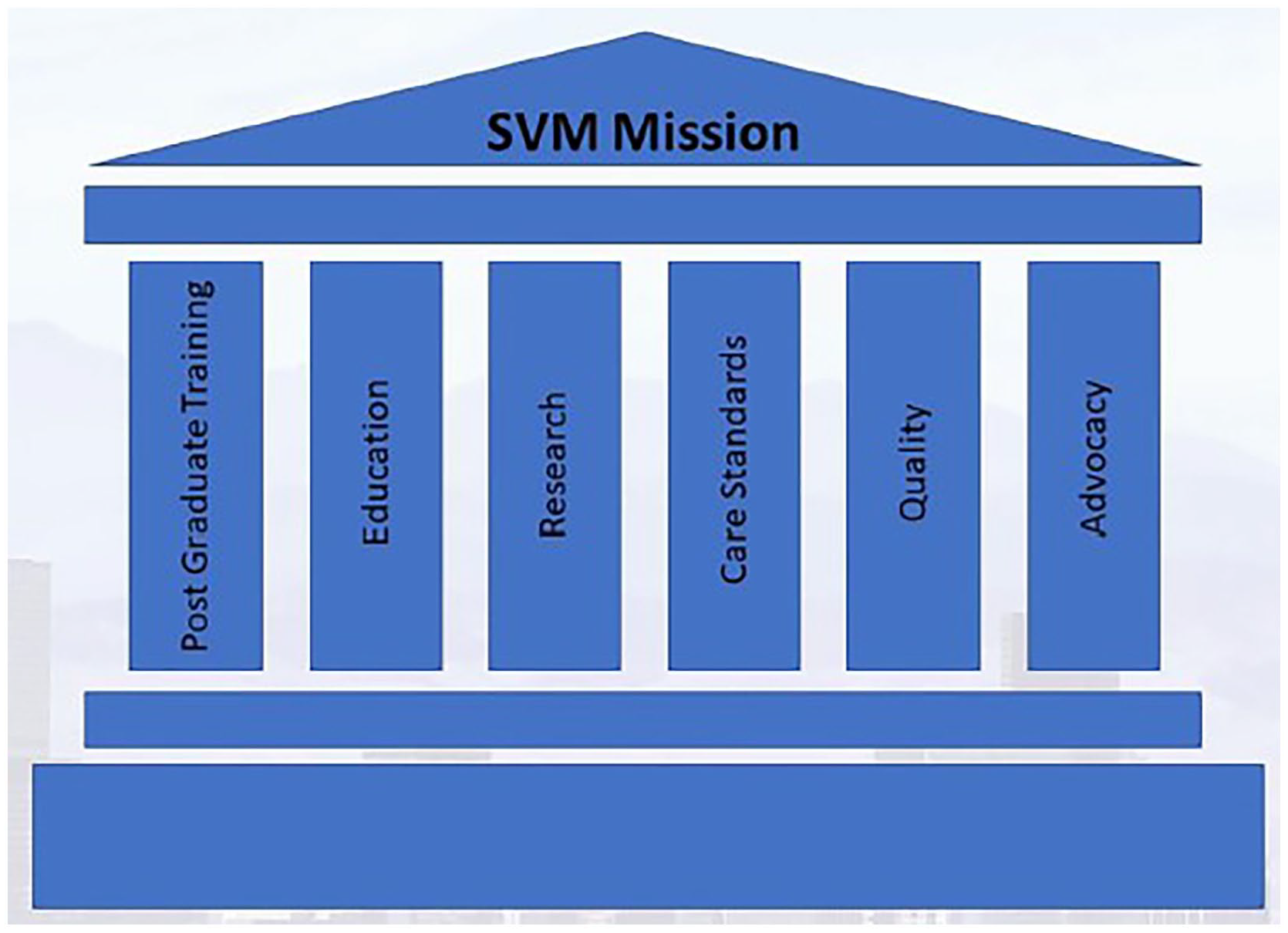
Society for Vascular Medicine: mission and pillars.
It is easy to lose sight of one’s mission. After all, there is a lot going on from one day to the next at SVM, and one must be careful not to lose the forest for the trees. For my first Board of Trustees meeting as President, I created a new agenda template that included icons representing each of our Mission Statement pillars in the header, a constant reminder of where we are headed – a beacon to keep us on track. For me, and I hope for others, these beacons have kept us oriented, and mission-driven.
If we were to use our Mission Statement and its pillars as a compass, I would hope that year over year we continue to make significant progress toward our North Star and have much to celebrate. Our Mission Statement reads as follows: The purpose of the Society shall be to promote and advance the discipline of Vascular Medicine and the care of patients with vascular disease by:
No contemporary document establishes standards for Before we pat ourselves on the back, I remind you there is much more work to do. The vascular medicine specialist community remains small, too small to meet our patients’ collective needs for vascular medicine expertise. We need to make the task of launching a vascular medicine fellowship training program easy for our colleagues, many of whom may be the only individuals with vascular medicine expertise at their respective institutions. To that end, we must develop and share core curriculum materials and standardized methods for assessing progress toward mutually agreed upon learner milestones. We need to identify innovative means for funding these fellowships, whether they be 1-year postcardiovascular medicine or 2-year postinternal medicine training programs. This coming year, we aspire to convene SVM leadership, industry partners, and other vascular stakeholders at a Vascular Medicine Training Summit, in hopes of launching a program even larger than ACF’s, one that would pick up where the ACF leaves off, providing support over multiple years for an even greater number of institutions and serving as a catalyst until institutions can support these fellowships on their own. Simply put, our vascular family tree needs more branches. On the heels of these Vascular Scientific Sessions, under the leadership of Drs Aditya Sharma and Rob Eberhardt, we will be re-launching the vascular medicine fellowship training committee to oversee these and other related efforts. This committee’s work will be mission-critical over the next year and the many years that follow. Growing the number and size of postgraduate vascular medicine training programs will be a long-term endeavor. We cannot meet the need for vascular medicine providers overnight. In the short-term, we will need to employ educational strategies that address the knowledge and competency gaps that exist in the vascular space today. SVM may be best known for its highly successful vascular educational portfolio and renowned educators. Our leaders and members serve as faculty at nearly every major national and international cardiovascular meeting. We have developed joint educational sessions with the International Symposium on Endovascular Therapy (ISET), American Venous Forum (AVF), European Independent Foundation in Angiology/Vascular Medicine (VAS), and the European Society of Vascular Medicine (ESVM) to name a few. The SVM Fellows and Advanced Practice Providers Course and Vascular Scientific Sessions have been wildly successful. These showcase educational events are punctuated throughout the year by a wealth of educational content, some new and some updated, including the: SVM Journal Club, launched this year and hosted by Dr Andrew Dicks; Vascular Medicine Twitter Journal Club, hosted by the Journal’s Social Media Editor, Dr Alec Schmaier; SVM-ACC joint vascular webinars, also new this year and co-developed with our Education Committee; Oakstone RPVI course, overseen by Past President Dr Heather Gornik; SVM Online Board Review Course, updated this year under the direction of Drs Ido Weinberg and Aditya Sharma, with new endovascular content designed by Drs Kamal Gupta, Gaurav Parmar, and the Education Committee forthcoming; and SVM-Medscape Educational Collaborative, aimed at identifying and closing vascular knowledge, competency, and confidence gaps among vascular and primary care providers alike. The SVM-Medscape initiative is overseen by a Steering Committee that includes Drs Daniella Kadian-Dodov, Esther Kim, Jun Li, Marc Bonaca, Deepak Bhatt, and myself as Chair. The reach of this project has been nothing short of spectacular. As of its second year, more than 100K learners have participated in 13 SVM-Medscape joint educational sessions, including approximately 15K cardiovascular medicine specialists, 10K vascular surgeons, 20K Primary Care Providers (PCPs), 8K Advanced Practice Providers (APPs), and 30K nurses. Also new this year, and the brainchild of VSS Program Committee Chair Dr Ido Weinberg, a dedicated track for primary care and hospital physicians was offered at the annual meeting. Finally, Dr Jay Bishop and the Vascular Medicine Practice Taskforce have gone to great lengths through their RAMP-VM initiative to incorporate vascular medicine content into ACP national and regional meetings, and our presence there has been well received. As much as we have enjoyed success on the educational front, there is more work to be done. We must continue to educate the primary care community. Our outreach to date has been effective but minimal. We need to be present at more national and regional internal medicine scientific conferences. We need to invite ourselves to give vascular grand rounds at institutions where there is little vascular medicine presence. We need to market the SVM Fellows Course more effectively to trainees in cardiovascular medicine, interventional cardiology, interventional radiology, and vascular surgery, to internal medicine residents, and even to undifferentiated medical students. We must build a community of vascular experts from the ground up while we await the impact of our top-down vascular medicine fellowship training initiatives. We simply cannot do one without the other. In the early years of our Society, our leaders worried about integrating vascular biologists and clinicians. Today, we have excelled at all things clinical, but this success may have come at the expense of fostering vascular research. Recently our Research, Quality, and Publications Committee, chaired by Dr Daniella Kadian-Dodov, began to outline an SVM Statement on research gaps in vascular medicine, an effort that will be led by Drs Mary McDermott and Marc Bonaca. We hope that identifying these gaps will provide the vascular medicine research community with a path forward. At the same time, we will need to advocate for greater government, industry, and private funding opportunities to support the important work undertaken by our members. Today, there is rarely a vascular care standard created without our input. We consistently partner with vascular community stakeholders, serving on the writing committees and endorsing multidisciplinary documents that set these standards. In the past year alone, SVM members have served on writing committees for the ACC advanced training statement on cardiovascular imaging, the ACC/AHA guidelines for perioperative cardiovascular evaluation and management of patients undergoing noncardiac surgery, the SCAI chronic venous disease clinical practice guidelines, and the SCAI Competencies for Endovascular Specialists Providing CLTI Care.
3
We have endorsed the forthcoming AHA/ACC aortic guideline and Dr Heather Gornik is serving as writing committee chair while I serve as vice-chair for the 2022 AHA/ACC guideline on lower-extremity peripheral artery disease (PAD). Although we have excelled in setting care standards, there remains tremendous opportunity to promote and support our 5th pillar, quality improvement. In a collaborative effort with the AHA, Past President Dr Josh Beckman helped design the Vascular Quality Initiative’s (VQI) Vascular Medicine Consult (VMC) registry, which follows ambulatory patients with vascular disease irrespective of whether they ultimately undergo a vascular procedure. The VMC registry adds tremendous value to the portfolio of available VQI registry modules, including carotid artery stent, carotid endarterectomy, endovascular abdominal aortic aneurysm (AAA) repair, open AAA repair, hemodialysis access, inferior vena cava filter, infra-inguinal bypass, supra-inguinal bypass, lower-extremity amputation, peripheral vascular intervention, thoracic and complex aortic repair, venous stent, and varicose veins. Collectively, these modules provide an incredible opportunity for SVM members who practice at participating institutions to engage in meaningful research and quality improvement initiatives. We consistently join with our vascular colleagues to advocate on behalf of our patients to governmental institutions like the Centers for Medicare and Medicaid and Food and Drug Administration as well as to our industry partners. This past year, we were again approached by the American Board of Internal Medicine’s (ABIM) Choosing Wisely Campaign. With input from Dr Jay Bishop and the Vascular Medicine Practice Taskforce, we submitted a list of recommendations around vascular diagnostic and therapeutic procedures that patients should avoid. Could we do more? We could and we should be more proactive around issues that affect patients with vascular disease and their providers. Collectively, you are our eyes and ears, and we are counting on you to let us know how we can advocate on behalf of you and your patients.
It is challenging to get one’s arms around everything in our broad Mission. Doing so could be a full-time job for each of us, and most of us already have day jobs. That is where strategic planning comes into play. As a Society, we have met over the years to prioritize our goals. In 2019, Past President Raghu Kolluri convened the SVM Executive Committee (EC) for this purpose, and last year I brought together the EC, Board of Trustees, and leadership from every committee and task force to revisit these priorities.
Three themes emerged from that crowdsourcing exercise, each dependent upon the next for success, and these themes help to focus our efforts within the broader SVM mission: (1)
Our VM Specialty Recognition Task Force, under the leadership of Past President Raghu Kolluri, has been hard at work on existential issues like vascular medicine board certification. Years ago, we established an independent board certification process under the American Board of Vascular Medicine, and we are working hard to do the same under the ABIM.
A moment ago, I spoke to SVM’s current and future efforts in regards to fellowship training; there is a LOT going on.
After a period of stasis for many years, SVM membership has grown to levels not seen in over a decade. Interest in SVM is growing, as evidenced by the increased number of membership applications. Engagement remains high, as reflected by diminishing member turnover and the tremendous and unprecedented response to our call for volunteers. As an example, last year more than 130 members volunteered to serve on our committees and task forces; this year an additional 70+ asked to serve. This is no accident: we are providing value and our members recognize this. Much credit is owed to our Secretary, Dr Elizabeth Ratchford and her Membership Committee, who have launched multiple innovative initiatives like the mentorship program that pairs fellows-in-training and early career faculty with more seasoned vascular medicine mentors, the newly launched SVM Pulse – a closed forum for discussing clinical conundrums, career challenges, care standards, and more. Stay tuned for the anticipated launch of SVM Shepherds, who will make new member transition into our Society even smoother.
From where I stand, it is clear we have much to accomplish, but at the same time I am confident that we are strategically aligned around our Society’s Mission and well positioned to succeed. That success would not be possible without each one of you, and we are counting on you to remember why you are here and to remain mission-driven.
Thank you for your support of SVM.
Footnotes
Declaration of conflicting interests
The author declared no potential conflicts of interest with respect to the research, authorship, and/or publication of this article.
Funding
The author received no financial support for the research, authorship, and/or publication of this article.
