




Abstract

What are leg cramps?
People who have had leg cramps at night will never forget their ‘charley horses’. Nocturnal or night leg cramps have been called many names – muscle spasm, muscle contraction, kink, crick, knot, stitch, and more. The term ‘charley horse’ is thought to have originated from an old horse who pulled a roller across the Chicago White Sox baseball park in the 1890s. Charley’s muscles would stiffen and he had difficulty walking, which led spectators and players to call these cramps a charley horse. 1
Nocturnal leg cramps are sudden, jerky, involuntary muscle contractions that occur at night, often involving the calf or foot muscles. The cramps can be quite painful and cause the muscle to ache over the next few days. 2 In one survey on leg cramps, people described their cramps as being unbearable, unmanageable, and cruel. 3 One participant lamented that ‘sometimes I just wish I could cut my legs open’, while another was getting ‘about 2 hours sleep a night’ due to the cramps. 3
The painful cramps may suddenly awaken one from sleep. Although the cramps usually affect the calf or foot, they may also occur in the thighs or arms. During a leg cramp, the involved muscle can be firm or hard and may be tender. The joints or limbs may be forced into unusual positions. The foot may forcefully point downwards with the toes curled. It may last for a few seconds or up to several minutes before spontaneously going away on its own or with forceful stretching. The muscle may feel tender, making it hard to go back to sleep, and the soreness may last for a few hours or even a few days.
How common are leg cramps?
Most adults have experienced at least one episode of leg cramps. About one-third of people over age 50 have nocturnal leg cramps, but they may also occur during the day. 4 Nocturnal leg cramps may affect around 7% of children and could be slightly more common in women, especially during pregnancy. 2 Some people report a family history of leg cramps. 3 The cramps may occur occasionally, but 40% of those who have nocturnal leg cramps have them three times per week and 6% have them daily and experience significant distress. 5
Although leg cramps themselves are not harmful, they can lead to disruption of sleep and insomnia, which then can lead to health problems.
How are nocturnal leg cramps diagnosed?
Strictly speaking, according to the American Academy of Sleep Medicine’s 2014 criteria, 6 the diagnosis of sleep-related leg cramps requires all of the following:
A painful sensation in the leg or foot associated with sudden, involuntary muscle hardness or tightness, indicating a strong muscle contraction.
The painful muscle contractions occur during the time in bed, although they may arise during either wakefulness or sleep.
The pain is relieved by forceful stretching of the affected muscles, thus releasing the contraction.
What can cause leg cramps?
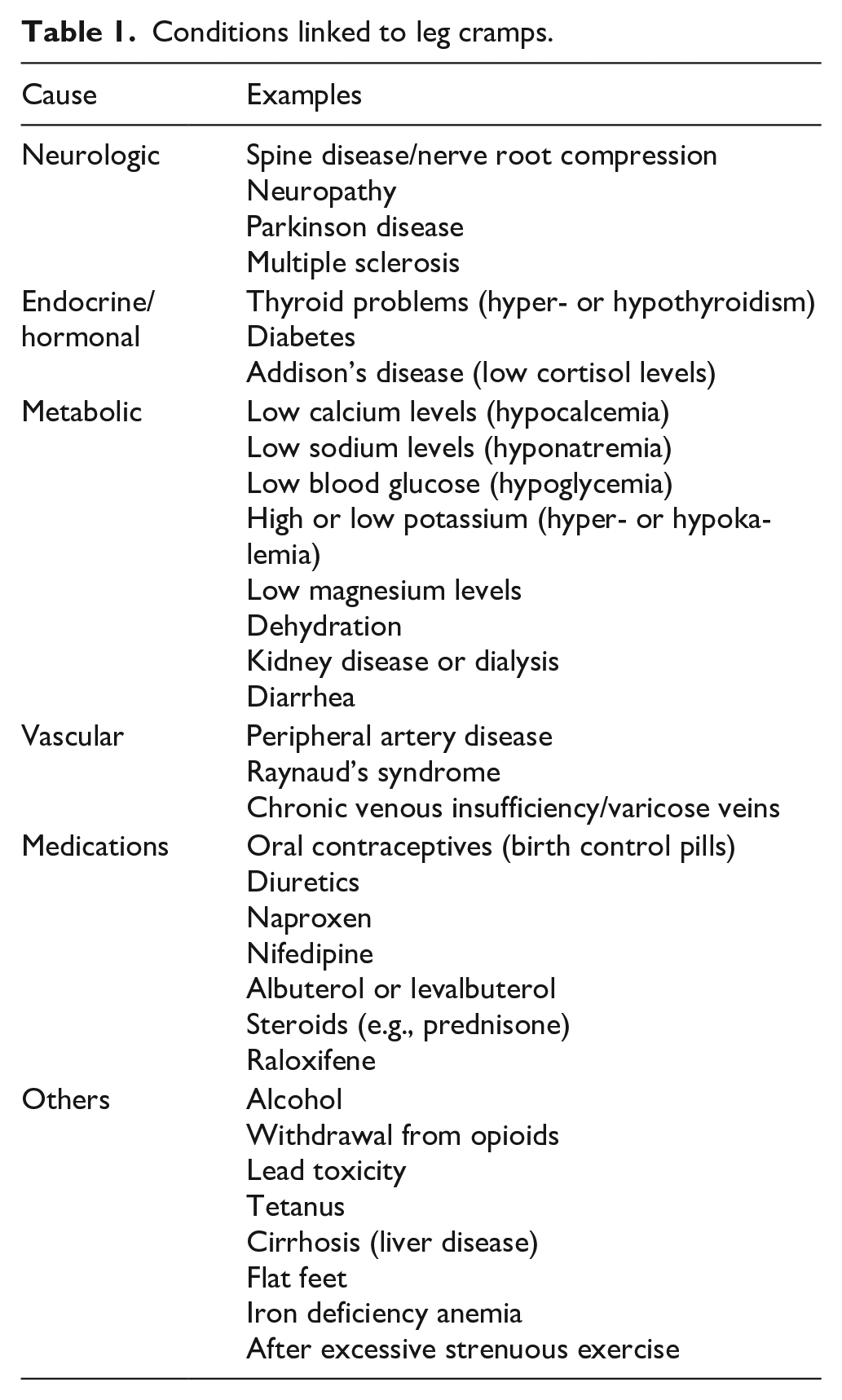
Most cases of leg cramps occur randomly and have no clear cause, but certain conditions can increase the chances of leg cramps (Table 1). Sometimes the cramps may be due to genetic disorders or conditions that affect the nerves or blood vessels. Hormone or electrolyte levels may play a role, or they may be caused by certain medications or toxins. When leg cramps occur, these other conditions should be ruled out because they may require specific treatments. Diuretics (water pills often used to treat high blood pressure or heart failure) are a particularly common cause of leg cramps. Dehydration, diabetes, Parkinson disease, iron deficiency, varicose veins, chronic venous insufficiency, and kidney disease are also common culprits. Cramps are common in patients who are on dialysis. Sitting in an awkward position or standing or walking for long periods on concrete floors may also cause cramping.
Conditions linked to leg cramps.
What other conditions may be confused with nocturnal leg cramps?
Other conditions that have similar sleep-related leg symptoms include restless legs syndrome (RLS), periodic limb movements, peripheral artery disease (PAD), and neuropathy. RLS may also cause pain, but the discomfort is more continuous and is an unpleasant or uncomfortable deep sensation with a strong need to move the legs during periods of inactivity. Many patients with RLS have periodic limb movements during sleep, which are episodes of repetitive, jerking limb movements. However, RLS does not cause hardening of the muscle or forceful stretching of the foot. RLS is often associated with low iron levels. In contrast to RLS, nocturnal leg cramps are sudden in onset and short in duration with a strong muscle contraction.
Leg discomfort or cramps may also be caused by decreased blood flow to the legs due to blood vessel blockage with PAD (see Vascular Disease Patient Information Page on PAD 7 ). This leg pain usually comes on after walking a certain distance and is relieved with rest. Pulses in the foot are diminished. When PAD is severe, foot or leg pain may occur at night due to decreased blood flow when lying flat; this pain may be relieved with dangling the leg or foot over the edge of the bed. Immediate medical attention is required if a leg cramp becomes particularly severe, is persistent (lasting well beyond a few minutes), or is accompanied by a sudden numbness or weakness of the limb, skin color changes, or change in temperature such that the limb is cold to the touch. Though rare, these symptoms may indicate a sudden loss of arterial blood flow.
Leg cramps may also be caused by peripheral neuropathy due to nerve damage leading to abnormal muscle function. This problem is commonly associated with changes in sensation, like numbness.
What tests may be needed with leg cramps?
The first step in the evaluation of leg cramps includes a detailed medical history and physical examination, with a review of symptoms and risk factors, as well as medications that may be contributing. Blood tests are only needed in certain cases and may include blood glucose or hemoglobin A1c, a complete blood count, sodium, potassium, calcium, iron, magnesium, creatinine (to check kidney function), and thyroid-stimulating hormone to check thyroid function. Other tests that evaluate nerves, muscle function, or blood flow may also be requested depending on the scenario.
How are leg cramps prevented and treated?
If a medication could be contributing to the leg cramps, then an alternative medication may be substituted. Several other suggestions for preventing leg cramps are listed below:
Stay hydrated by drinking plenty of fluids.
Stretch the legs (especially the calves and hamstrings) prior to sleep.
Increase potassium and magnesium-rich foods in the diet (e.g., broccoli, bananas, citrus fruit, leafy greens, nuts, or avocado).
Try magnesium and/or vitamin B12 supplements over the counter.
Avoid alcohol and stimulants such as nicotine, pseudoephedrine (decongestants), and caffeine.
Keep the bed sheets loose and not tucked in at the foot of the bed.
Note that patients with heart failure, liver disease, or kidney disease should consult a physician prior to making any changes in diet or fluid intake.
When a cramp occurs, getting out of bed to walk around may help relieve it. Some people find relief with using heat (such as a warm shower or warm compresses) and/or massage. For severe pain, stretching the cramped muscle may relieve the pain. If the cramp is in the foot, the toes may curl; they can be stretched by bending them in the opposite direction. The calf is a common site for a cramp. To relieve a calf cramp, pointing the foot upward toward the knee (with the knee straightened) can help to stretch it out. If the cramp is in the thigh, bending or straightening the knee and hip can help.
Calf stretching exercises before bedtime may prevent the cramps from occurring. It is also important to stay hydrated, to maintain a normal body weight, and to achieve at least 30 min/day of moderate-intensity exercise.
Several medications have been tried and tested but none have proven effective and safe. Quinine has been shown to help relieve cramps but is no longer recommended because of the potential adverse effects on the heart and blood. Other medications that have been tried include multivitamins, vitamin B12, magnesium, diltiazem, verapamil, gabapentin, and orphenadrine, but supporting evidence is lacking.
Summary
Leg cramps, often referred to as a charley horse, are sudden painful muscle contractions that are more common at night and often occur in the calf. The symptoms are usually relieved with stretching the muscle or walking around. Medications or other medical conditions may increase the risk of leg cramps. Depending on the situation, blood vessel problems such as PAD or venous disease may need to be ruled out.
The `Vascular Disease Patient Information Page’ is a regular feature of Vascular Medicine. All articles in the collection are available for free online at http://journals.sagepub.com/vmjpatientpage.
The Vascular Disease Patient Information Page is provided for educational purposes only and is not a substitute for medical advice.
Footnotes
Declaration of conflicting interests
The authors declared no potential conflicts of interest with respect to the research, authorship, and/or publication of this article.
Funding
Dr Elizabeth Ratchford’s work was supported in part by the generosity of David Kotick (1926–2021).
