



Abstract

Introduction
Exercise and physical activity are effective ways to improve cardiovascular and overall health, and they can provide valuable benefits beyond medications. Physical activity is any kind of movement that burns calories. The more physically active you are each day, the better. Exercise is planned, purposeful, structured, and repetitive movement with the goal of improving fitness. Being physically active (avoiding a sedentary lifestyle) and engaging in dedicated exercise are both important for overall health.
What are the benefits of exercise?
Regular exercise is extremely important for cardiovascular (heart and blood vessel) health. It improves blood pressure, helps manage cholesterol and weight over time, and prevents some of the problems caused by diabetes. All of these improvements serve to reduce the risk of cardiovascular disease, such as heart attack and stroke, and reduce the risk of early death from these problems. Exercise may reduce the number of medications needed to treat conditions such as diabetes and high blood pressure.
Regular exercise can also dramatically improve leg symptoms related to peripheral artery disease (PAD, or blockages in the leg arteries). 1 Exercise can help alleviate chronic pain and stiffness to improve overall mobility. Maintaining a healthy weight further reduces the burden of these conditions in the long term. In addition, exercise can trigger the release of endorphins (natural hormones that improve mood), which can improve mental health and reduce the effects of depression. Quality of sleep and quality of life tend to improve with regular exercise. 2
How does exercise affect blood pressure?
Maintaining a healthy blood pressure is key to good cardiovascular health. 3 When maintained over time, regular exercise tends to improve the blood pressure. 4 Blood pressure increases temporarily during exercise, so if the blood pressure is already very high, it is a good idea to avoid over-exertion. If blood pressure is monitored at home, it should be checked before exercising each day. Blood pressure tends to go back down after exercise. If you have high blood pressure or other chronic health conditions, it is important to check with a physician as you plan to start your exercise regimen.
What should I know before starting an exercise regimen?
The majority of people do not need to consult a healthcare provider to start a light- or moderate-intensity exercise regimen, such as a regular walking program.
A medical evaluation is suggested for people with known cardiovascular disease or multiple medical problems or symptoms, especially prior to engaging in vigorous-intensity exercise. Vital signs including blood pressure and heart rate should be checked. For high-risk patients or patients with symptoms such as shortness of breath or chest discomfort, an electrocardiogram (EKG) may be ordered. In some cases, a stress test may be checked. This noninvasive outpatient test checks aspects of heart rhythm and function and watches for symptoms while you walk on a treadmill. Some stress tests also involve ultrasound imaging of the heart after exercise to determine if all areas of the heart are receiving adequate blood flow with exertion.
What are the risks of exercise? What symptoms should I look for?
For most people, the benefits of exercise far outweigh any risks. When starting a new exercise regimen, it is important to start slowly and gradually increase the exercise intensity and duration. Staying hydrated by drinking water before and after exercise is helpful. Pay attention to how you feel, and rest when needed.
With orthopedic (bone or joint) disorders, choosing appropriate exercises is key to avoiding injury. Physical therapy can be a good place to start if you are recovering from injury and need help planning a home exercise program. Mild, temporary muscle soreness is common after exercise; however, any unusual swelling or pain should be discussed with a healthcare provider.
Exercise increases demand on the heart and lungs. Therefore, other symptoms that should prompt medical attention include pain, tightness, or pressure in the chest, shortness of breath, and dizziness or lightheadedness.
How much aerobic exercise (‘cardio’) do I need?
Regular aerobic activity improves cardiovascular health, though medical organizations vary slightly in their recommendations of the ideal amount of exercise per week. In general, adults need at least 30 minutes of exercise per day, on most days of the week.
As a guide, the goal is 150 minutes (2.5 hours) per week of moderate-intensity aerobic activity, OR 75 minutes of vigorous aerobic activity, OR a combination of the two. For more intensive benefits, 45 minutes or more per day (or about 300 minutes per week) of moderate-intensity exercise can be beneficial.2,5
Table 1 shows examples of moderate and vigorous aerobic activities, and Table 2 shows a sample exercise plan, which can be tailored to individual interests. During moderate-intensity activities, you should still be able to talk, but not sing. You would perceive your exertion to be about 5–6 on a scale of 1–10. Vigorous-intensity activities require more effort; you may not be able to say more than a few words without getting out of breath, and you would perceive your exertion at about 7–8 out of 10. Two minutes of a moderate-intensity activity is about equal to 1 minute of a vigorous activity.
Examples of moderate- and vigorous-intensity activities.
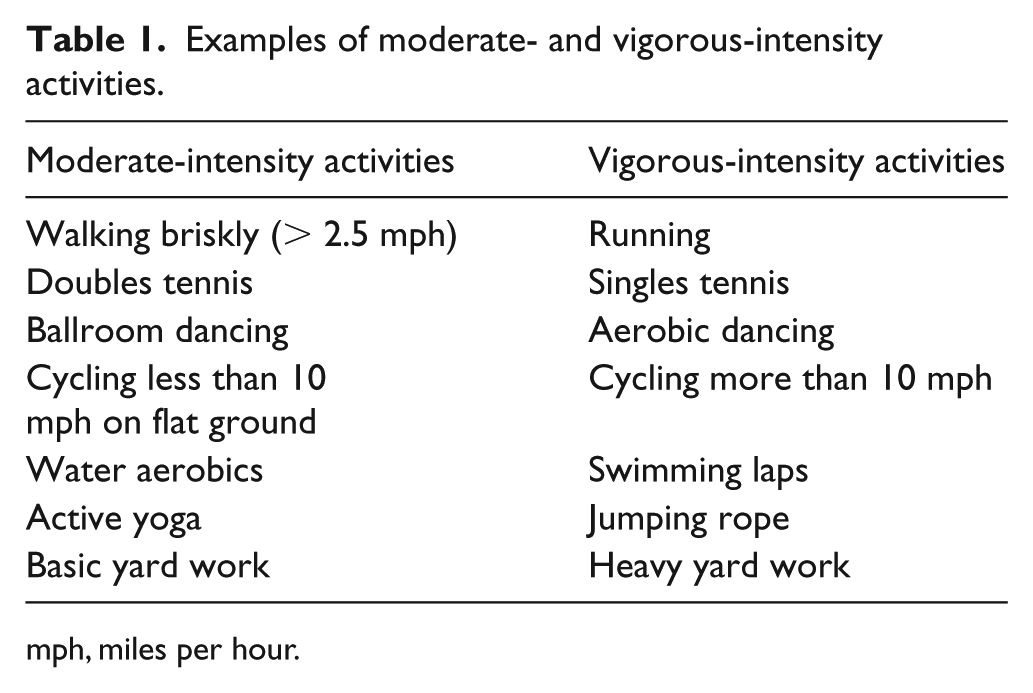
mph, miles per hour.
Sample weekly exercise plan.

For health benefits, the amount of time spent exercising in total is more important than the length of each individual exercise session. In other words, walking briskly for 15 minutes twice a day would meet the goal; it does not have to be achieved in 30 consecutive minutes.
What is my target heart rate?
The heart rate is the number of times the heart beats per minute. A typical heart rate at rest is about 60–90 beats per minute.
For an estimate of your maximum heart rate, subtract age in years from 220.

For example, a 65-year-old’s estimated maximum heart rate would be:

Certain medications, such as beta-blockers (e.g. metoprolol), can lower the resting and maximum heart rate.
The goal or target heart rate during moderate-intensity exercise is about 50–75% of the maximum heart rate. The goal or target heart rate during vigorous exercise is about 70–85% of the maximum heart rate.
What about strength or resistance training?
In addition to aerobic activity, strength training should be included in an exercise regimen for cardiovascular health. Strength training uses free weights or other means of resistance such as stretch bands, body weight, and weight machines to strengthen muscles. Strength training can improve balance and metabolism as well as blood pressure. 4 Examples of strength training include body-weight exercises, such as sit-ups, push-ups, or yoga, or simple chair exercises with free weights.
Adults benefit from at least two sessions per week of strength training – even a 10-minute session can be beneficial. Working with a personal trainer or exercise physiologist at a gym may be helpful initially to learn about equipment and appropriate exercise options. As always, patients with health issues should discuss their plans for strength training with a healthcare provider.
Where do I start?
The benefits of exercise on physical and mental health are numerous, but starting a routine and sticking with it can be challenging. The simplest way to get started with a new exercise program is to walk, even for 5–10 minutes initially. The duration can be gradually increased for each session, with an overall goal of at least 30 minutes daily. If walking around the neighborhood is not feasible, then try walking at work, at a park, or on the track at a local school. Local recreation centers, senior centers, or YMCAs are other low-cost options if you do not have exercise equipment at home or access to a gym. Walking around a mall, especially in the early morning, is also an option.
Ten tips to start and stick with a daily exercise regimen
Are activity trackers helpful?
Activity trackers can be helpful as you start and maintain an exercise regimen. These devices vary from basic step-counters to wristbands and more advanced smart watches. Activity trackers can measure activity more accurately than simple recall, and they can provide motivation and feedback on your progress. Some trackers offer a reminder when you have been sitting or sedentary for too long. Some also allow you to track nutritional intake and weight.
A common goal is to aim for at least 10,000 steps per day. This goal may be personalized based on age and overall health status. Some activity trackers enable group participation (or friendly competition) toward reaching this or other activity goals. Keeping a daily exercise log or fitness journal can be helpful to set goals and track your progress. This log can be on paper or electronic (through an app or on your phone). You can record the date, the type of activity, and the duration. Other information to track could include blood pressure and weight. Sample logs can be downloaded free online.
What if I already stand or walk frequently at work or at home?
Daily physical activity (avoiding a sedentary lifestyle) is very important and beneficial to overall health. Some activity is definitely better than none. Even if you are already physically active at work or at home, look for ways to increase activity each day, such as parking farther away and walking briskly to the store or taking the stairs instead of the elevator daily. If you have to sit for work, aim to stand and stretch or take a short walk at least every 1–2 hours. Consider a regular ‘walking meeting’ with coworkers to get fresh air and walk together. Keep in mind that it is important to maintain this physical activity along with moderate- or vigorous-intensity exercise for cardiovascular health.
Summary
Regular exercise and avoiding a sedentary lifestyle are important ways to prevent and manage cardiovascular disease. By starting with achievable goals, choosing activities that work for you, and staying consistent and motivated, exercise becomes great medicine.
The ‘Vascular Disease Patient Information Page’ is a regular feature of Vascular Medicine. All articles in the collection are available for free online at http://journals.sagepub.com/vmjpatientpage.
The Vascular Disease Patient Information page is provided for educational purposes only and is not a substitute for medical advice.
Footnotes
Declaration of conflicting interests
The authors declared no potential conflicts of interest with respect to the research, authorship, and/or publication of this article.
Funding
The authors received no financial support for the research, authorship, and/or publication of this article.