



Abstract

A 63-year-old woman without past medical history was admitted with asthenia, recurrent chills and dysphagia. She reported a dental infection present in the left inferior premolar for a month, which was treated with amoxicillin/clavulanic acid for 3 days, but it had been discontinued due to a rash.
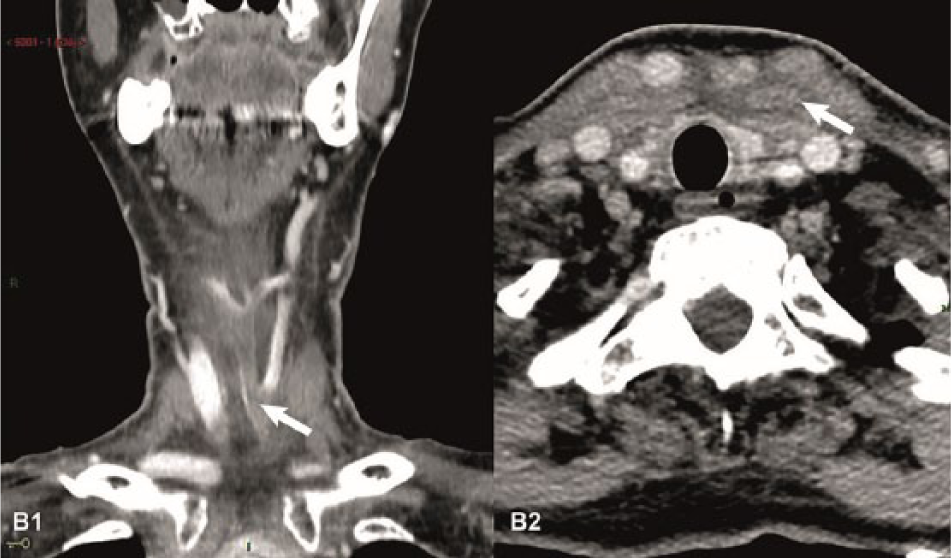
Clinical examination revealed a painful anterior swelling of the neck (Panels A1 and A2), which progressively increased in size. Laboratory investigations showed: C-reactive protein at 406 mg/L (normal < 5 mg/L), white cell count at 10,600/mm3 with neutrophils at 10,000/mm3, creatinine level at 1.91 mg/dL (normal 0.6–1.3 mg/dL), lactate dehydrogenase (LDH) at 587 U/L (normal < 250 U/L), thyroid hormones were normal. A CT scan of the neck with bi-phasic perfusion of iodinated contrast agent displayed acute thrombus within the left-sided anterior jugular vein (Panel B1, white arrow) and a juxtaposed focal collection (Panel B2, white arrow). An oropharyngeal abscess complicated with internal jugular vein thrombosis, so-called Lemierre’s syndrome, was diagnosed. Intravenous antibiotherapy with ceftriaxone and metronidazole was started and changed to oral moxifloxacin after 72 hours, which was continued for a total of 21 days. Anticoagulation with low molecular weight heparin (1 mg/kg every 12 hours) was prescribed for a duration of 6 weeks. Clinical evolution after completion of the treatment was good.

Lemierre’s syndrome is characterized by internal jugular vein thrombosis as a complication of an oropharyngeal infection, or less frequently of mastoiditis or a dental infection. Mortality was up to 90% before antibiotic treatments were available. 1 Patients generally present with fever, dysphagia, trismus and intense pain. A history of oropharyngeal infection within 4 weeks prior to the thrombosis is essential to the diagnosis. The most frequent complication is septic embolism to the brain or lung with secondary abscesses, or to the heart causing septic pericarditis and sometimes even tamponade. 2 In young subjects, cultures usually identify Fusobacterium necrophorum or F. species, an anaerobe germ of the oropharyngeal sphere. In older patients with poorly managed diabetes, it is more common to find Klebsiella pneumoniae. 3 Early initiation of broad spectrum antibiotic therapy that includes anaerobic coverage greatly improves survival. In case of abscess formation, necrotizing fasciitis or mediastinitis, surgical drainage and debridement are indicated. 2 The duration of anticoagulation therapy is controversial due to the lack of randomized clinical trials, probably because Lemierre’s syndrome is a rare condition.2,3 However, 6–12 weeks of anticoagulation is the accepted treatment.
‘Images in vascular medicine’ is a regular feature of Vascular Medicine. Readers may submit original, unpublished images related to clinical vascular medicine. Submissions may be sent to: Heather Gornik, Editor in Chief, Vascular Medicine, via the web-based submission system at http://mc.manuscriptcentral.com/vascular-medicine
Footnotes
Declaration of conflicting interests
The authors declared no potential conflicts of interest with respect to the research, authorship, and/or publication of this article.
Funding
The authors received no financial support for the research, authorship, and/or publication of this article.