



Abstract

A 43-year-old female amateur marathon runner presented with a 3-year history of debilitating left calf pain and paraesthesia, which had gradually progressed to affect the anterior thigh and lumbar region. This was particularly apparent on running and was relieved entirely by rest. She had no relevant past medical history and no identifiable risk factors for vascular disease. A neurological opinion was sought; however, nerve conduction studies and spinal magnetic resonance imaging were unremarkable, so she was referred for a vascular opinion.
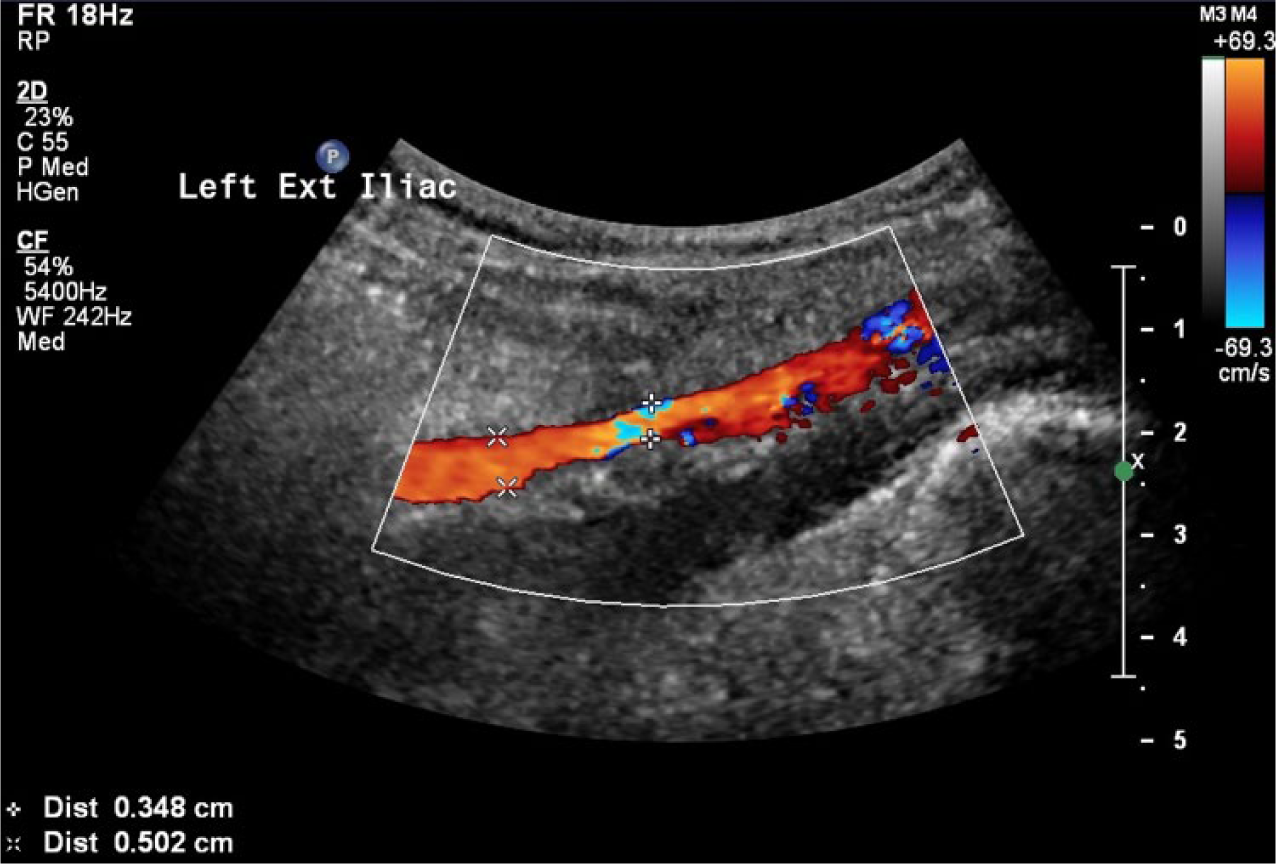
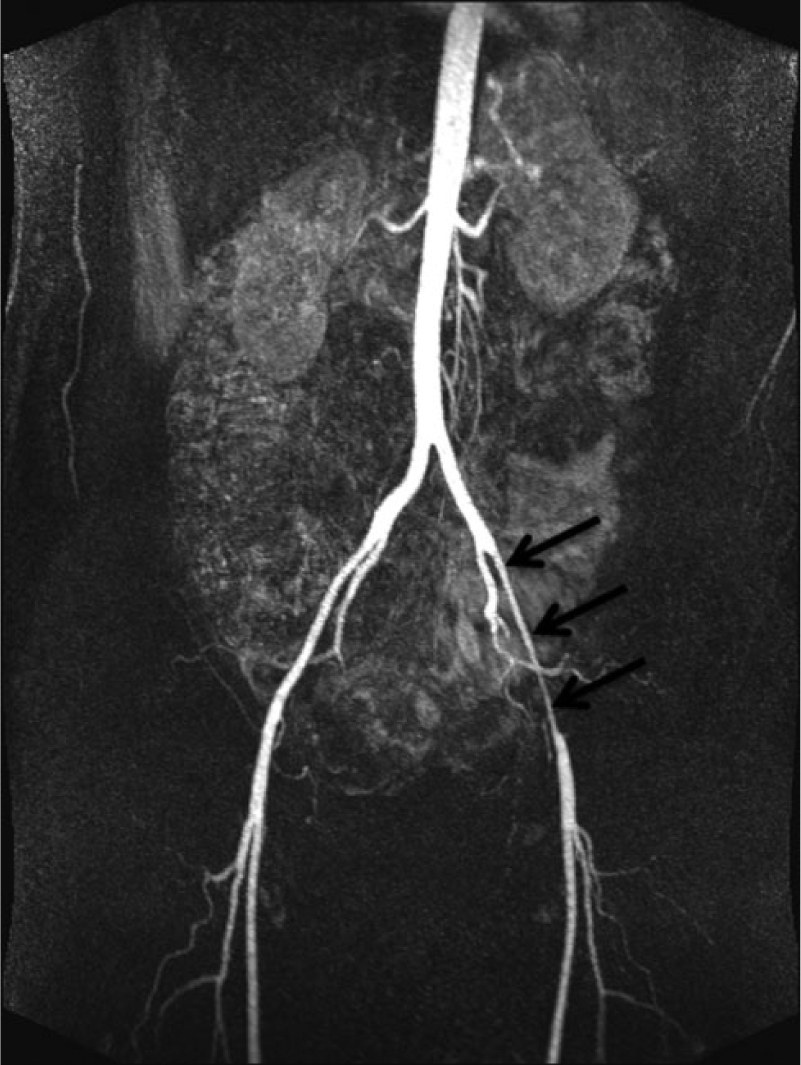
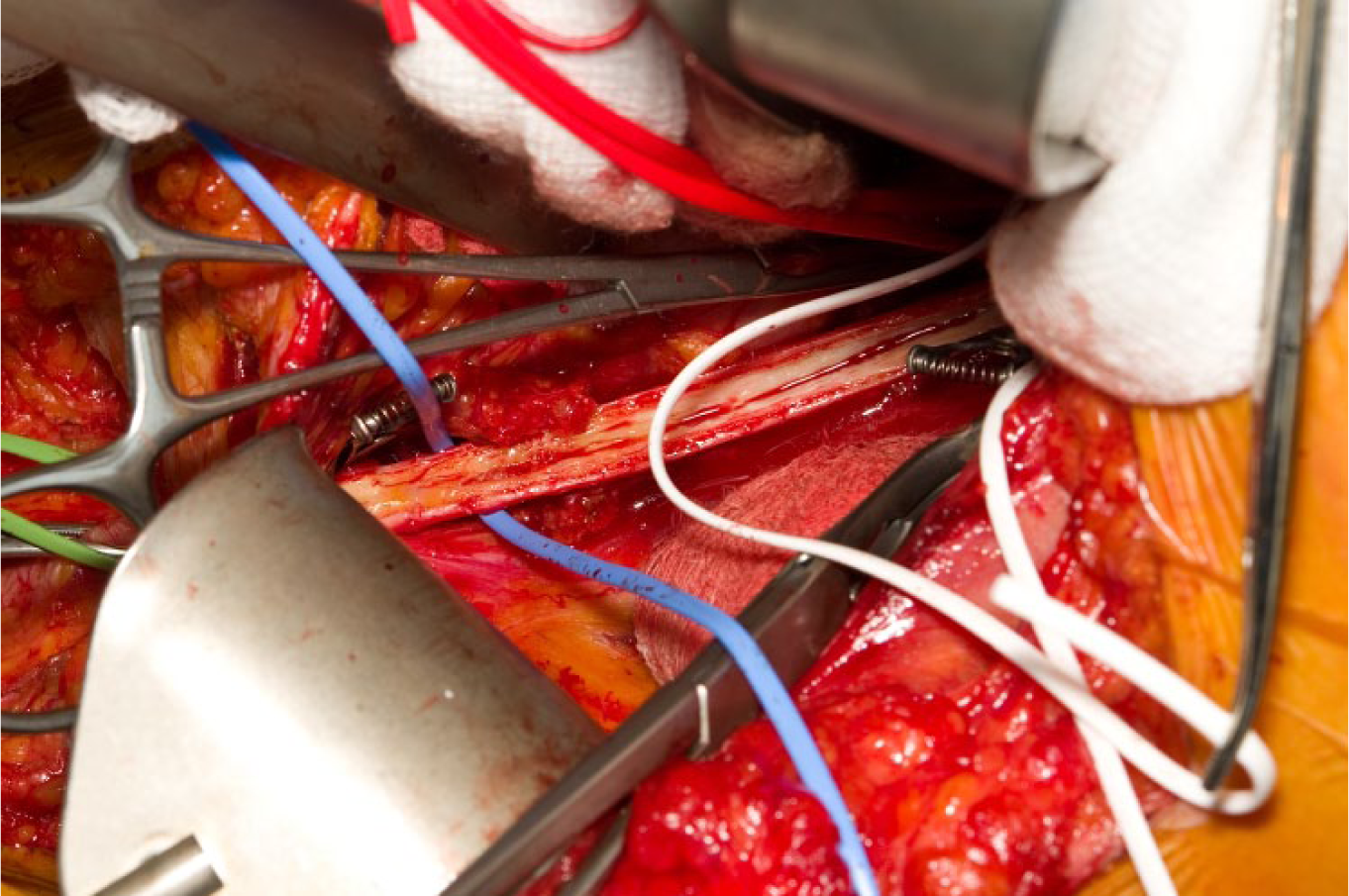
Upon referral, examination revealed a full complement of peripheral pulses with a resting ankle–brachial pressure index of 0.6 on the left. Duplex ultrasound demonstrated turbulent flow associated with narrowing of the left external iliac artery (EIA) to 3.5 mm (Panel A; narrowing indicated by white crosses), compared to 5.5 mm on the right. Subsequent magnetic resonance angiography confirmed significant stenosis of the left EIA (Panel B; black arrows), in addition to hypertrophy of the left psoas muscle. The patient subsequently underwent a left EIA endarterectomy and vein patch angioplasty under general anaesthesia (Panel C; the longitudinally transected external iliac artery is supported by a blue sling). The patient was discharged on day 5 postoperatively, with ultrasound surveillance showing no evidence of residual stenosis at her 1-year follow-up. Histological analysis confirmed variably cellular, fibrous expansion of the intimal layer of the EIA, consistent with endofibrosis.
EIA endofibrosis or cyclist iliac syndrome is a rare condition causing symptoms of claudication and, whilst typically described in cyclists, 1 has been previously reported in an amateur runner. 2 Suggested aetiological mechanisms of EIA endofibrosis include psoas muscle hypertrophy, as well as hyperflexion of the hip joint combined with excessive vessel length resulting in arterial fixation and mechanical stress leading to fibrotic change.3–5 Histological findings may include luminal thrombus, intimal hyperplasia and smooth muscle proliferation. 6 Although rare, EIA endofibrosis should be considered early in athletes presenting with symptoms of claudication and not seen as a syndrome exclusive to cyclists.
‘Images in vascular medicine’ is a regular feature of Vascular Medicine. Readers may submit original, unpublished images related to clinical vascular medicine. Submissions may be sent to: Heather L Gornik, Editor in Chief, Vascular Medicine, via the web-based submission system at http://mc.manuscriptcentral.com/vascular-medicine
Footnotes
Declaration of conflicting interest
No authors have any conflict of interest to declare.
Funding
No specific funding was received in relation to this article and the authors declare no relationship with industry. There has been no previous publication or dual submission of the manuscript.