




Abstract

A 29-year-old Hispanic male with a history of hypertension and mitral valve replacement presented with an acute coronary syndrome. He underwent diagnostic coronary angiography through the right radial approach using a 6 Fr 25-cm long Terumo hydrophilic-coated Glidesheath™. Two weeks later, he presented with a violaceous, non-pulsatile, papulonodular lesion at the radial access site (Panel A). Radial pulses were normal and symmetric with normal capillary refill. The lesion spontaneously resolved in 3 weeks after local wound care and warm compresses (Panel B).
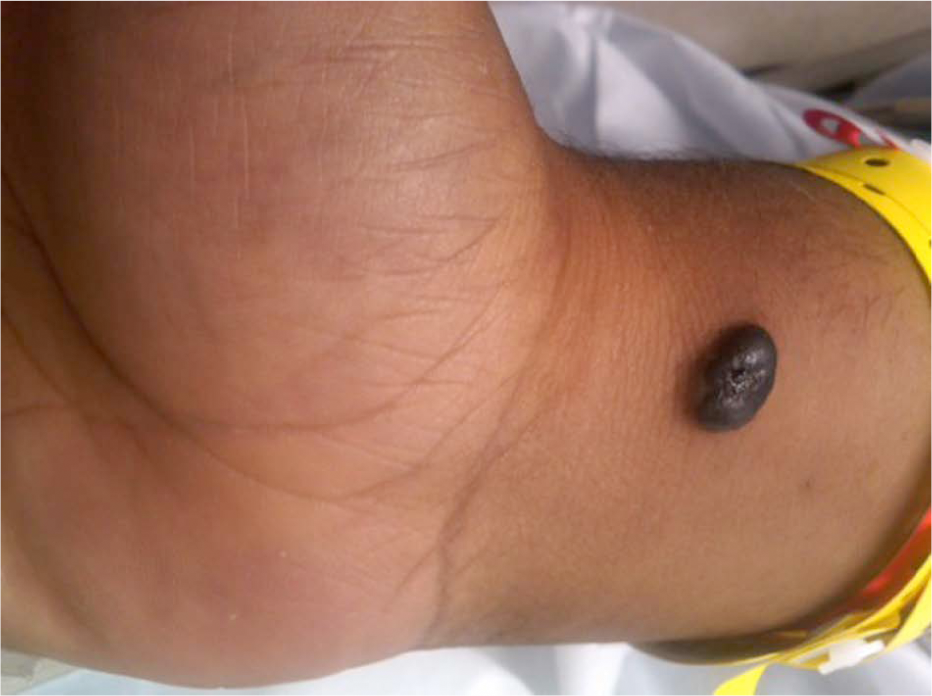
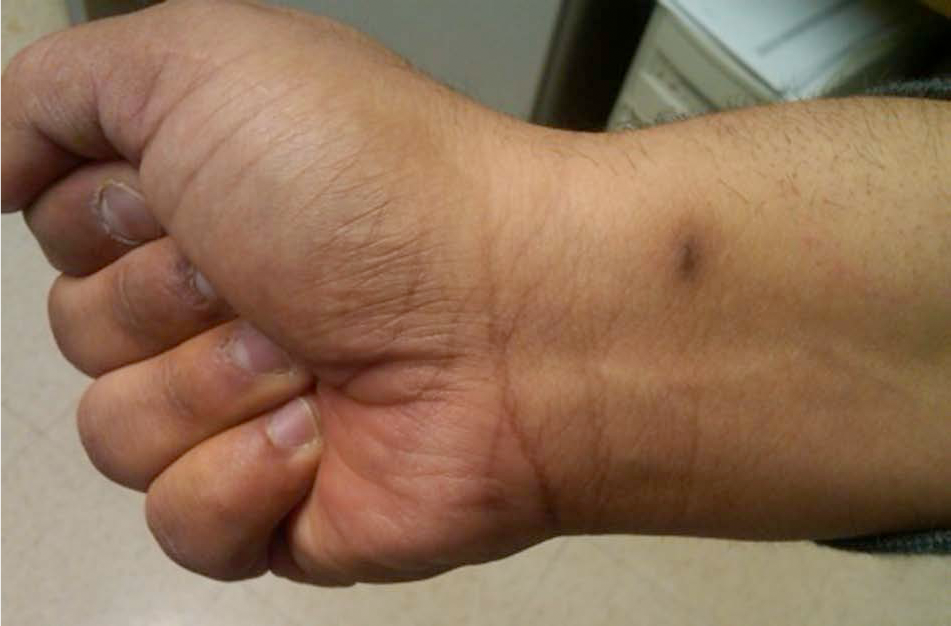
Sterile granulomas at the radial access site have been reported mostly with hydrophilic-coated Cook radial sheaths; however, this complication is very rare with the use of hydrophilic-coated Terumo Glidesheaths. 1 It typically presents 2–3 weeks after catheterization and is most likely due to a local reaction to an intrinsic component of the hydrophilic coating. Sterile granulomas commonly respond to conservative management, with spontaneous resolution, and rarely require surgical excision and drainage. 2
‘Images in vascular medicine’ is a regular feature of Vascular Medicine. Readers may submit original, unpublished images related to clinical vascular medicine. Submissions may be sent to: Heather L Gornik, Editor in Chief, Vascular Medicine, via the web-based submission system at http://mc.manuscriptcentral.com/vascular-medicine
Footnotes
Declaration of conflicting interest
The authors declare that there is no conflict of interest.
Funding
This research received no specific grant from any funding agency in the public, commercial, or not-for-profit sectors.