



Abstract
It is no exaggeration to say that if a person believing themselves the victim of discrimination were to bear the full burden of proof for that claim in court, the right to equal treatment would be largely illusory. Recognising this, EU law stipulates that the claimant in discrimination cases need only to establish a prima facie case, whereafter the burden of proof shifts to the respondent. Yet, the implications of this rule remains unclear in several key aspects, including what constitutes a prima facie case. Conceptually grounded in civil procedure and specifically evidence law doctrine, this article seeks to establish the precise allocation of the burden of proof between the parties under EU law. It argues that the claimant’s prima facie case must contain evidence for three out of the four basic components of discrimination, but does not need to include positive indications of a causal relationship between the discrimination ground and the discriminatory treatment. This interpretation is compatible with the Court of Justice’s jurisprudence and consistent with evidence law debate in several European legal traditions. It also promotes effective enforcement by offering a higher level of protection to the discrimination victim than the most credible alternative.
Introduction
The problem of burden of proof in equality law is as old as the field itself. The reason for its continuous relevance is, in a nutshell, that which characterises most issues of evidence: there all too often isn’t any. Demanding that the person (allegedly) subject to unequal treatment should demonstrate not only the disadvantage at which they have been put but also that the unfavourable treatment was wholly or in part connected to their race, gender, age, sexual orientation, or other protected characteristic would render any anti-discrimination legislation little more than a paper tiger. For this reason, the EU Court of Justice (hereinafter the CJEU or the Court) and subsequently the Union legislature has established a burden of proof rule specific to discrimination cases, according to which Member States are obliged to take necessary measures to ensure that, when an individual claiming to be the victim of discrimination establishes facts from which it may be presumed that there has been direct or indirect discrimination (a so called prima facie case), the burden of proof is shifted to the respondent, who has to demonstrate that the principle of equal treatment has not been breached.
The fundamentals of this rule, which is found in virtually identical formulations in several of the directives governing EU equality law, 1 were laid down in CJEU case law already in the late 1980s and early 1990s. Since then and particularly since the codification of the burden of proof rule, the allocation of the burden of proof has received relatively little attention and even less critical analysis in scholarship. 2 While the Court continues to periodically receive and answer preliminary references concerning matters of evidence of discrimination and in that context has provided guidance in particular on the effect of certain facts or pieces of evidence available to a claimant in casu, 3 no major developments of even clarifications of the distribution of the burden of proof have been forthcoming.
However, the recently adopted Pay Transparency Directive contains a new burden of proof rule complementing the ‘old’ one. Borrowing heavily from the Court’s seminal ruling in Danfoss, 4 which when it was delivered in 1989 constituted the starting point for the development of the burden of proof as we know it today, Article 18(2) establishes that the burden of proof shifts to the employer as soon as they have failed to implement the pay transparency obligations set out in the Directive. Exception is made only for cases where the non-implementation has been manifestly unintentional or minor in character. Thus, the rule expands the protection of the victim of discrimination by shifting the burden of proof even without the need for establishing a prima facie case for discrimination, underlining the Union legislature’s commitment to the judicial protection of discrimination victims. 5
Besides being (markedly) more victim-friendly, the new pay transparency burden of proof rule has the advantage of defining clearly the circumstances under which the burden of proof falls to the respondent. The same cannot be said about the general equality burden of proof rule, which leaves several key issues undefined. What is the difference and possible overlap between the facts from which discrimination may be presumed, that make up the claimant’s prima facie case, and those that demonstrate non-breach of the principle of equal treatment, which are the object of the respondent’s counter-evidence? Does a prima facie case have to include evidence for all criteria making up discrimination in the meaning of the law? Do all criteria have to be demonstrated to the same level of conviction of the court (standard of proof)? If so, which level is that? And what is required for the respondent party to exculpate themselves? Depending on the answer to these questions, the relief provided to an individual having (allegedly) 6 suffered an unequal treatment will vary significantly.
This article analyses the burden of proof in EU equality law with an aim to establish, as far as possible, the precise allocation of the burden of proof between the parties and in particular the conditions that the claimant has to fulfil in order for the burden to shift to the respondent. Seeking to provide conceptual clarity, it is theoretically grounded in procedural law doctrine, drawing in particular on concepts from the law of evidence as developed in both Anglo-Saxon and continental legal traditions. The article argues that, contrary to what has often been assumed, a prima facie case does not need to contain any positive indications of a causal relationship between the discrimination ground and the discriminatory treatment. Instead, upon demonstration of the unfavourable treatment accorded to the claimant (fact A), who possesses a protected characteristic (discrimination ground) (fact B), despite their being in a situation comparable to another person without that characteristic (fact C), the burden should shift to the respondent who alone carries the burden of proving the non-existence of a connection between the discrimination ground and the unfavourable treatment (fact D).
One stipulation is required already at this preliminary stage of the analysis. The term ‘burden of proof’ might refer to two different burdens, commonly known as the burden of production (evidentiary burden) and the burden of persuasion (legal burden), respectively. The former denotes the lighter burden of merely adducing evidence in support of all disputed facts, whereas the latter burden entails that the party bearing it must persuade the court that their version of the facts is correct, or else lose the case. Neither the Court nor the Union legislature has clearly specified which burden the rule under analysis here is meant to regulate. 7 However, the burden of production is mainly – albeit not exclusively – a common law concept, designated for jury trials, and therefore of lesser importance in the majority of national jurisdictions in the Union. 8 Furthermore, the burden of persuasion is the one that typically constitutes the main stumbling block for equality law claimants; indeed, a reversal only of the burden of production would severely limit the effectiveness of the provision and its ability to offer meaningful protection to victims of discrimination. 9 For these reasons, the term ‘burden of proof’ in the Directives and in CJEU equality case law must be assumed to at least include the burden of persuasion, 10 and it is in this meaning that the term will be used in the remainder of this article.
The argument proceeds as follows. First, the article reexamines the early case law of the CJEU as regards the burden of proof for breaches of the principle of equal treatment, in light of legislative developments ranging from the now abolished Burden of Proof Directive to the Pay Transparency Directive. It demonstrates that, as the reversed burden of proof developed from a narrow exception to a broadly applicable rule, the conditions for reversal, broadly referred to as a prima facie case, have not been adequately defined. It then proceeds to explore the roots of the prima facie concept as understood in the two European legal traditions where it is broadly used, namely Germanic and Anglo-Saxon law, revealing two related but distinct meanings from which a more precise interpretation of the EU law provision may draw inspiration. Against this backgrund, the article analyses the conditions for reversing the burden of proof under the EU burden of proof rule, arguing that the prima facie case necessary to trigger the reversal does not have to include evidence as to the discriminatory reason for the behaviour and that the standard of proof must, in the absence of articulated requirements based on EU law, be considered a matter of national procedural autonomy.
Establishing a reversed burden of proof
It is not a coincidence that the new and more far-reaching burden of proof rule is introduced specifically in the field of equal pay. Indeed, it was precisely in these issues that the burden of proof rule was originally developed. Although the Court had on a few previous occasions allocated the burden of proving discrimination (or rather the lack thereof) to the respondent, 11 the ruling in Danfoss marks the starting point for the development of an actual rule to that effect. Recalling that general statistics are often the only evidence a claimant can be expected to produce in cases of intransparent wage systems, the Court in that case held that an individual would be ‘deprived of any effective means of enforcing the principle of equal pay before the national courts if the effect of adducing such evidence was not to impose upon the employer the burden of proving that his practice in the matter of wages is not in fact discriminatory.’ 12 While the legislation in force at the time did not contain any provisions on proof, the Court relied on a general ‘concern for effectiveness’ which in its opinion implied that Member States must ‘adjust’ their burden of proof rules in ‘special cases where such adjustments are necessary for the effective implementation of the principle of equality’. 13
The ruling in Danfoss was followed four years later by Enderby, which also concerned wage discrimination. In that case, which unlike Danfoss concerned indirect discrimination, the Court referred to a general rule according to which the person bringing a claim bears the burden of proving the facts upon which the claim is based. 14 This principle, known to evidence law as actori incumbit probatio, can be traced to antiquity and is widely recognised in both national and international legal orders. 15 Danfoss was described as an exception to that rule, justified by the necessity of providing effective judicial protection to individuals subjected to a ‘system of pay wholly lacking in transparency’ and applicable in those situations. 16 The exception entailed, the Court further explained, that the burden of proof shifted to the respondent if the claimant could prove that women on average received less pay than men. On this basis, the Court ruled that if the salary level of a female-dominated profession is significantly lower than that of another, predominantly male one and the two professions in question are to be considered of equal value, there is a prima facie case of discrimination. 17 And where there is a prima facie case of discrimination, it continued, the burden of proof falls upon the respondent. 18
The subsequent ruling in Royal Copenhagen, while broadly confirming the previous approach, appeared to introduce a distinction between the burden of proof rules – or perhaps more accurately, the burden of proof exceptions – created by Danfoss and Enderby. Unlike in Enderby, the Court in Royal Copenhagen did not accept that a statistically demonstrated difference in wages in itself amounted to a prima facie case, seemingly because of the piece-work scheme at issue in the dispute. Nevertheless, Court held that ‘the objective of not depriving workers of any effective means of enforcing the principle of equal pay may require the employer to bear the burden of proving that the differences found are not due to sex discrimination.’ 19 Thus, as in Danfoss (where the Court did not use the prima facie term at all), the reversal of the burden of proof was triggered not by the establishment of a prima facie case but by effectiveness concerns, which seemingly required reversal even though the claimant’s evidence did not reach the prima facie treshold. In this sense, Danfoss and Royal Copenhagen appear as predecessors for the burden of proof rule only now codified in Article 18(2) of the Pay Transparency Directive, which makes reversal conditional on intransparency rather than on a prima facie case. In the codification and subsequent case law concerning the ‘old’ equality burden of proof rule, on the other hand, the language of Enderby has prevailed.
Danfoss, Enderby and Royal Copenhagen all suggested that the reversal of the burden of proof was an exception from a main rule corresponding to the actori incumbit probatio principle. This approach was at least partially unsettled by the adoption of the Burden of Proof Directive, which made the reversal of the burden of proof universal in the field of sex discrimination (as far as harmonised at the time) and was rapidly followed by the Framework Directive and the Racial Equality Directive. Echoing the Court’s case law particularly in Enderby, the preamble of the Burden of Proof Directive made clear that the burden of proof under the Directive should be reversed upon the claimant’s presentation of an ‘apparent discrimination’ or a ‘prima facie case’, while also citing the effectiveness concerns voiced by the Court most prominently in Danfoss and Royal Copenhagen. 20 In subsequent directives, the effectiveness considerations have been toned down, whereas the prima facie concept has been sustained. 21
The Court responded to these legislative interventions in the 2001 ruling in Brunnhofer (which, it should be noted, concerned circumstances preceding the adoption of the Directives and therefore technically outside their scope). Citing Danfoss and Enderby, the Court again held that the burden of proof for discrimination lays in principle on the claimant, unless the principle of effectiveness necessitated exceptions.
22
Unlike in Enderby, however, the Court held that the circumstances of Brunnhofer did not possess any special traits which could trigger the application of the exception, i.e. the reversal of the burden of proof, and consequently that the ‘normal rules of evidence’ applied.
23
Thees ’normal rules of evidence’ did however not, as one would expect following the rulings in Enderby and Royal Copenhagen and indeed from the initial statement in Brunnhofer itself, correspond to the general actori incumbit probatio principle. According to the latter principle, the claimant would have to provide full proof (i.e., proof meeting the applicable standard of evidence) for facts fulfilling all conditions for the claim. The main rule applied
24
by the Court in Brunnhofer placed a lesser burden on the claimant, requiring them to establish only – and in a clear nod to the Directives – a ‘presumption’ of discrimination. The crucial passage of the reasoning reads as follows:
25
It is accordingly for the plaintiff to prove by any form of allowable evidence that the pay she receives from the [employer] is less than that of her chosen comparator, and that she does the same work or work of equal value, comparable to that performed by him, so that prima facie she is the victim of discrimination which can be explained only by the difference in sex.
The ‘normal’ rule as applied in Brunnhofer thus appears to overlap significantly with what previous case law had termed an exception. Both rules require the claimant to establish a prima facie case before the burden of proof is reversed, and in both cases it appears the prima facie case should include facts corresponding to the criteria of less favourable treatment in a comparable situation. Furthermore, while the Directive provision was explicitly considered a codification of the previously established exceptions, the latter (also) appears to coincide with the ‘normal rule’ as described in Brunnhofer. More recent case law has further contributed to conflating the distinction. In Nikoloudi, the Court observed that the Burden of Proof Directive had codified previous case law, citing both Enderby and Brunnhofer. 26 In Kenny, the Court initially referred to the main rule described in Brunnhofer without finding it necessary to even mention the possibility of exceptions, and later in the judgment referred to Enderby for authority on the qualities of a prima facie case. 27 Through these legislative and jurisprudential developments, what originated as an effectiveness-driven exception in Danfoss has gradually developed into a general rule for discrimination cases.
On this basis, we can distinguish between three levels of burden of proof rules. On the most general level, the actori incumbit probatio principle prevalent in private law places the burden of proof for all criteria necessary for the claim to succeed on the claimant. Brunnhofer, as well as the Directives, make it clear that this rule has no place in EU equal treatment law. Instead, secondly, the main rule in the field of equality law – which can perhaps be considered the (new) ‘normal’ one – is the classical burden of proof rule of the Equality Directives, according to which the burden is reversed upon the claimant’s establishing a prima facie case of discrimination. Third, it can not be excluded that the requirements of effective judicial protection may under specific circumstances require more far-reaching reallocations of the burden of proof, as suggested by Danfoss and Royal Copenhagen. The new Article 18(2) of the Pay Transparency Directive – which goes further than the two last-mentioned rulings, where the intransparency of the wage calculation systems was in itself not sufficient for reversing the burden of proof but could take on this effect only when combined with statistical evidence – might be seen as an example of this.
Tracing the roots of the burden of proof rule
Despite the EU’s sui generis character and the ‘autonomy’ of its legal order, Union legal concepts are rarely, if ever, conceived in a vacuum. 28 Indeed, the Court has often acknowledged that it looks to Member State legal traditions for inspiration. Thus, it is reasonable to assume that preexisting national understandings have informed expressions such as ‘prima facie’ and ‘presumption’, which both figure prominently in legal discourse about the burden of proof rule. The prima facie term was used by the Court of Justice in Enderby, Royal Copenhagen and Brunnhofer as well as in subsequent case law, 29 and has been widely adopted in literature. 30 It also figures in the preambles of several Directives, 31 whereas the actual legislative text instead uses the term facts from which it may be presumed that discrimination has occurred.
The latter formulation bears a strong resemblance with the now abolished section 611a(1)3 of the German Bürgerliches Gezetsbuch (BGB), which regulated discrimination on the grounds of sex in the field of labour law and upon which the EU provision was supposedly modelled. 32 According to that provision, the reversal of the burden of proof was triggered by the claimant’s making probable (glaubhaft machen) facts that gave rise to a presumption (vermuten lassen) of adverse treatment on grounds of sex. In literature, it was emphasised that the relaxation of the burden of proof provided by the rule concerned only the allegation that an unfavourable treatment had been motivated by the individual’s sex. 33 Thus, the initial burden of proof under this rule rested on the individual employee or job seeker and could be divided into two parts: first, they had to demonstrate, according to the general rules of evidence, that they had actually been subject to an unfavourable treatment; secondly, they had to make it credible, on the balance of probabilities, that this unfavourable treatment could be traced to their sex. 34 The main relief granted to the individual under this rule thus appears to have been a lowering of the standard of proof, from the general standard (Überzeugung des Gerichts, i.e. conviction of the court) to the balance of probabilities (überwiegende Wahrscheinlichkeit). 35 Once both burdens had been fulfilled, the burden of proof would pass to the employer, who would have to provide full proof – i.e. convince the court – either that sex had played no part in the motivation for the treatment in question, that the treatment could be justified by objective reasons unrelated to sex, or that sex was an indispensable prerequisite for the position. 36
Interestingly, the German rule was subject to heavy criticism in domestic doctrine, particularly for its use of ‘less than fortunate terminology’ 37 which rendered it ‘liable to be misunderstood’. 38 In particular, German commentators observed that despite the rule’s reference to a presumption – a term that, as we have seen, reoccurs in the EU burden of proof rule as well as in the CJEU’s case law 39 – the rule did not actually establish a presumption in the ordinary meaning of the word, but should be understood merely as lowering the standard of proof. 40 This, of course, begs the question what the ordinary meaning of a presumption is. While the term has several connnotations, 41 the most relevant one in matters concerning burden of proof is rebuttable presumptions of law (legal presumption or presumtio iuris). 42 The effect of these presumptions, which are laid down in legal (whether legislative or judge-made) rules, is that proof of a certain fact (the basic or primary fact) is taken to entail that another fact (the presumed fact) should be treated as established unless rebutted by the other party. 43 The effect of the presumtion is thus to shift the burden of proof for the presumed fact to the opposing party, with the important implication that the establishment of the basic fact(s) is, in principle, sufficient for a judgment in favour of the party establishing it.
Presumtions of this kind carry a strong connection to the notion of prima facie evidence as established in the common law jurisdictions, where it is used to describe the evidence required to give rise to a rebuttable presumption. 44 The concept is similar to what in German law is known as Anscheinsbeweis or, underscoring the kinship, Prima facie-Beweis, 45 which differs from the legal construction of section 611a(1)3 BGB discussed above. Like the common law prima facie evidence, Anscheinsbeweis is used to alleviate the burden of proof especially in cases of evidentiary difficulties by ‘inducing missing facts from proven basic facts through the employment of empirical judgments.’ 46 Unlike the prima facie evidence in common law, however, the Anscheinsbeweis does not create mandatory legal effects, but functions as a presumtion of fact, 47 i.e. an heuristic in an ordinary process of reasoning, 48 meaning that the judge themselves decide the basic fact’s probative value for the presumed fact (unlike in legal presumptions, where the basic fact is always accepted as sufficient proof unless rebutted).
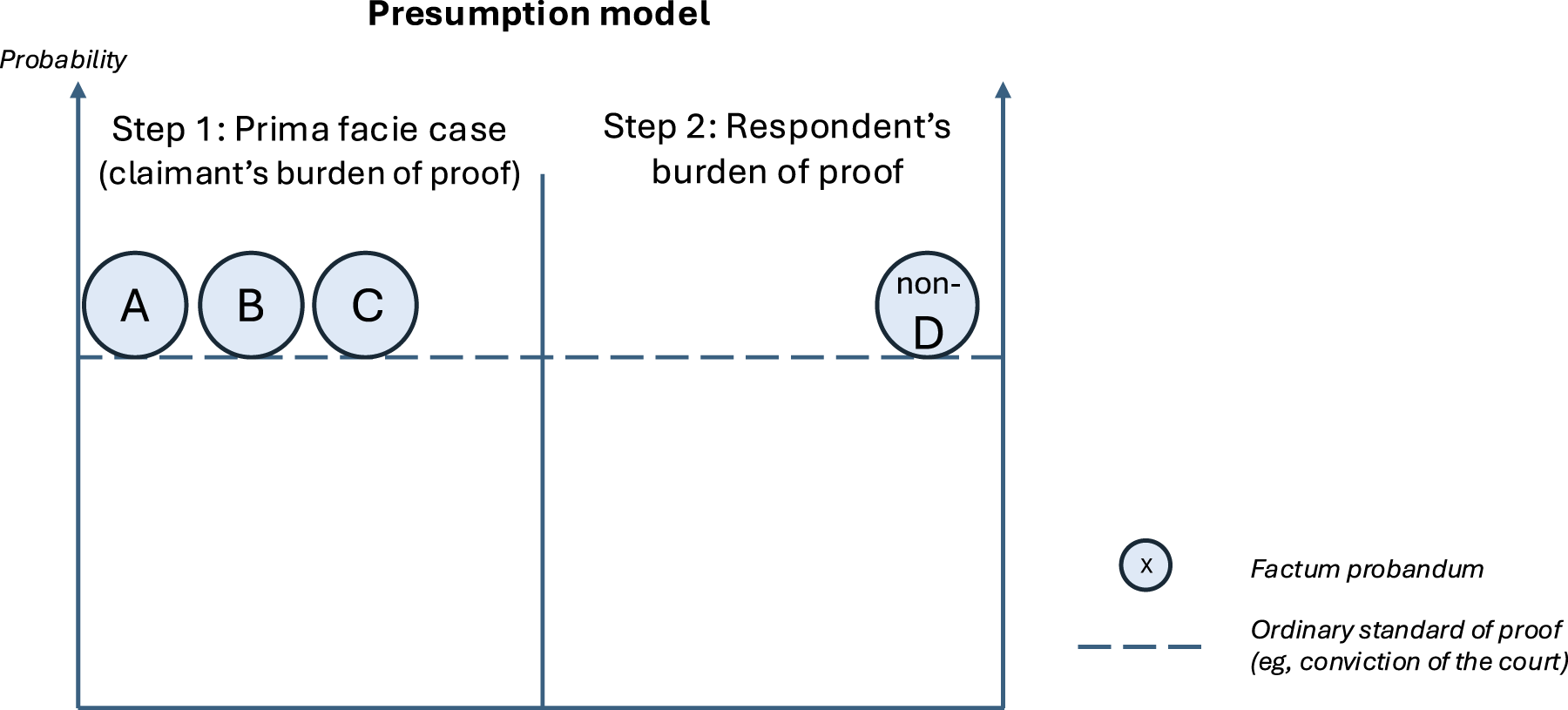
All of the concepts examined above, which likely have at least to some extent provided inspiration for the EU burden of proof rule, offer a more nuanced allocation of the burden of proof compared to the wording of the Directive provisions, which only vaguely refer to ‘direct or indirect discrimination’ and non-violation of the equal treatment principle as the factum probandum. They do however differ in one important respect. On the one hand, a comparison with section 611a(1)3 BGB would suggest that, at least if one goes beyond the wording of the provision to its actual interpretation in German literature, the individual alleging discrimination would have to provide evidence for all elements of discrimination, including the causal connection between the discrimination ground and the unfavourable treatment. The relief would consist in a lowering of the standard of proof, i.e. the level of persuasion required for the court to accept a fact as established, in combination with the higher standard required by the respondent once the burden of proof has been shifted. This is illustrated by Figure 1. On the other hand, the Court’s reference to prima facie evidence, which is related to the concept of presumptions, suggests that the relief on the evidentiary requirements placed on the claimant should be brought about not by reducing the standard of proof but by allowing or indeed requiring the court to infer the existence of one fact – reasonably, the connection between the claimant’s protected characteristic and the repondent’s unfavourable treatment of them – from that of another.
49
Rather than requiring less-than-full proof of the existence of all components of discrimination, a prima facie case would according to this logic consist of (full, i.e. fulfilling the applicable standard of evidence) proof for parts of the criteria for discrimination, as illustrated by Figure 2. As the next subsection will demonstrate, the latter interpretation is more convincing. Standard of proof model. Presumption model.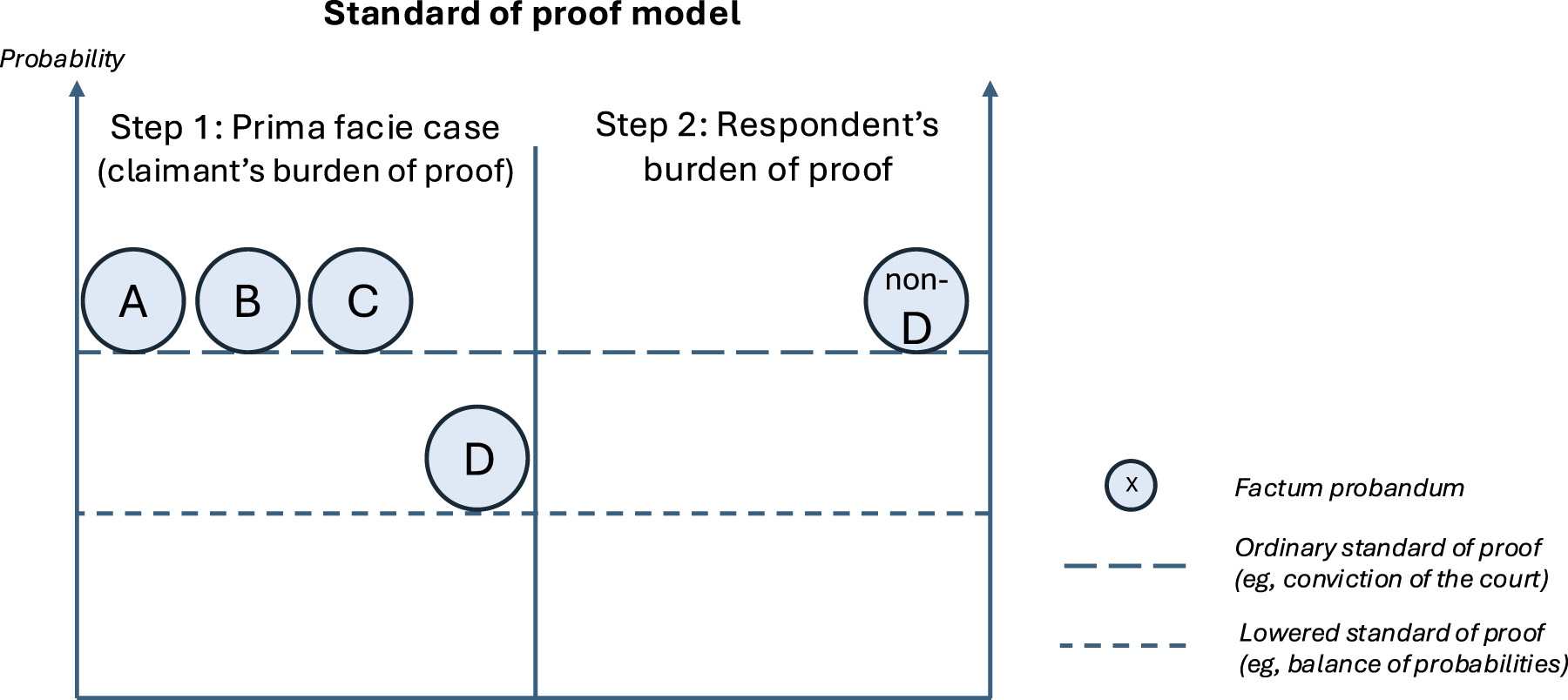
The meaning of a prima facie case under the EU burden of proof rule
The facts to be proven (facta probanda)
In order to meaningfully discuss the allocation of the burden of proof, it is necessary to first establish clearly the facts that must be proven (facta probanda) or, differently put, what criteria are necessary and sufficient for the claimant to succeed. 50 The constituent parts of direct discrimination, and consequently the criteria for an award of compensation for violation of the claimant’s right to equal treatment, are the following: The claimant has suffered an unfavourable treatment compared to another person, who may be factual or hypothetical (fact A); the presence of a discrimination ground, i.e., that the claimant but not the comparator possesses a protected characteristic (fact B); that the claimant is in a situation comparable to that of the other factual or hypothetical person (fact C); and that the unfavourable treatment is attributable to the discrimination ground (fact D). For the purposes of illustration, the analysis in this section will primarily relate to direct discrimination. However, the argument applies in all essential parts also to other forms of discrimination, with the prerequisite adaptation of the basic components depending on the kind of discrimination at issue. To give but a few examples: For indirect discrimination it is not the claimant personally but the affected class that must possess the protected characteristic (fact B), 51 and fact D might more adequately be rendered as the absence of objective justification. 52 In wage discrimination cases, being in a comparable situation (fact C) can be specified as carrying out work of equal value. Common to all cases is however that the criteria are cumulative and thus must all be present in order for a claim to succeed.
An interpretation along the lines of the German legislation examined above would entail that the claimant has the burden of proving, at least to some extent, all four facts (A–D), the relief consisting instead in a lower standard of proof for one of these facts (specifically, fact D). This interpretation has been adopted in a report on the burden of proof rule commissioned by the Commission, whose authors assert that the claimant must adduce evidence for all necessary components of discrimination – i.e., including the causal link between the discrimination ground and the respondent’s actions – whereas the respondent can escape responsibility by disproving only one of them. 53 As has been pointed out in German literature, such a construct is not a presumption properly speaking; 54 if the claimant has offered proof for all relevant criteria, no fact remains to be presumed. In this sense, the interpretation deviates from the precise wording of the provision, which holds that discrimination should be presumed on the basis of the claimant’s prima facie case. This interpretation nevertheless gains some support from the Court’s ruling in CHEZ, where the Court discussed what evidence would be required to constitute a prima facie case specifically in relation to the criterion of the connection between the unfavourable treatment and the discrimination ground. 55 This appears to be analogous to the evidence required under section 611a(1)3 BGB, suggesting that the claimant’s evidence must cover also the motivation criterion. Unlike the German provision, however, the Court of Justice did not (explicitly) establish a lower burden of proof.
The CHEZ ruling, and the previous one in Meister, however also highlight a problem with this interpretation of the rule. In these cases, the Court held that the respondent’s position as well as refusal to provide evidence may be taken into account when determining whether a prima facie case has been established. 56 This suggests that both parties’ evidence must be both produced and evaluated at the stage where the court determines whether a prima facie case has been established. In itself, this is not a strange proposition; indeed, it likely corresponds with how trials are conducted in most Member States, by taking all evidence concomitantly and evaluating it in a subsequent deliberation phase. 57 This approach is however impracticable in a situation where both parties bear the burden of proof for the same fact, as is the case if the EU burden of proof rule is interpreted in analogy with former Section 611a(1)3 BGB. Under this interpretation, the claimant bears the burden of proving, albeit only to a lower degree of persuasion, that an action was predicated on a discrimination ground, and the respondent bears the burden of proving the exactly opposing assertation, i.e. that it was not. This construction can work only if there is strict separation between the evidence provided by each party, so that each party’s evidence is evaluated against the standard of proof applicable specifically to them. With a joint evaluation of the evidence produced by both parties, as required by CHEZ and Meister, the court will be persuaded (or not, as the case may be) only once and the point of measuring this level of persuasion with two standards of proof is lost.
On the other hand, a joint evaluation of evidence does not necessarily exclude a two-step approach to the burden of proof along the lines of a (true) presumption. Having access to all evidence adduced, the court would in these situations first determine whether the basic facts (i.e., the facts giving rise to the presumption) had been established to the applicable standard of proof, and subsequently – if they had – move on to consider the evidence against the presumed fact, ruling in favour of the claimant if the latter had not been sufficiently rebutted. 58
An interpretation of the burden of proof rule as a legal presumption, consistent with the understanding of the prima facie concept in the common law tradition, also gains support from the Court’s case law, especially in the early cases discussed above. In Enderby, the Court held that a prima facie case exists where the pay of one group of workers is significantly lower than that of another (fact A; unfavourable treatment) and the former group consists almost exclusively of women whereas the latter is predominantly male (fact B, discrimination ground), at least 59 where the work carried out by the two groups is of equal value (fact C, comparable situation). 60 It did not, however, require the claimant to prove the last criterion, namely that there were no objective reasons unrelated to sex for the unequal treatment (fact D, causal link); instead, where that prima facie case had been established, the Court observed that the burden of proof would shift to the defendant, who would have to show the existence of objective reasons for the difference in pay (i.e., facts excluding the existence of fact D). Similarly, in Brunnhofer, the Court held that a prima facie case would exist where the claimant demonstrated A) a difference in pay between a woman and a man and C) that their work are comparable. 61 The respondent, the Court added, can defend themselves either by offering counterevidence against the facts constituting the prima facie case – thus preventing the claimant from establishing the basic facts giving rise to the presumption – or by justifying the difference in pay by proving D) its basis in reasons unrelated to sex. 62 Both understandings of the prima facie concept were repeated by the Court in Kenny. 63
What the Court did in these rulings was to presume that the discrimination ground had been the cause of the unfavourable treatment (fact D) on the basis of proof for the other criteria (facts A–C), rather than requiring positive proof for this fact. The effect is that a claim can in principle be successful without any positive proof for the causal link, for instance in a situation where the respondent remains passive. This can be contrasted with the examples of evidence capable of triggering the reversal of the burden of proof under former section 611a(1)3 BGB, which include statements from the employer and evidence of previous occurrances of discrimination; i.e., evidence clearly aimed at uncovering the mindset of the respondent (fact D). 64 In the CJEU’s case law, discriminatory statements by the respondent appears instead to have been accepted as constituting a prima facie case in lieu of evidence of actual unfavourable treatment. 65
An interpretation along these lines also appears to offer a higher level of protection to the claimant than a standard-of-proof-based interpretation analogous to the former German provision would. Some commentators might object that it is unfair on the respondent to presume a violation of the principle of equal treatment discrimination merely on the basis that, for instance, a male job seeker has been selected over a female, without any specific indications of discriminatory reasons underlying the selection. Two observations may be made in this regard. First, the prima facie cases described in Enderby, Brunnhofer and Kenny included not only the disadvantageous treatment of a person with a protected characteristic (facts A and B) but also that the person is in a comparable situation to the one more favourably treated (fact C). 66 While these facts do not directly speak to the reasons underlying the differential treatment, their existence entails that discrimination is only presumed where like cases have been treated demonstrably unalike. Second, a systematic interpretation – bearing in mind not only the original effectiveness-oriented rationale underlying the reversal of the burden of proof but also the new burden of proof rule in the Pay Transparency Directive – suggests that the Union legislature takes the protection of the individual discrimination victim, at least as far as burden of proof is concerned, very seriously. Indeed, as observed in the introduction, a prima facie case under the new burden of proof rule does not even have to contain evidence of an unfavourable treatment, let alone of a discriminatory reason for said treatment. This has the far-reaching effect that an employer may, at least theoretically, be held responsible for discrimination without any evidence of an inequality in the wages paid. From this perspective, it does not appear far-fetched to assume that discrimination can be presumed on the evidence of a mistreatment of a person with a protected characteristic; indeed, one might argue that it would be anomalously strict to require the claimant to also produce evidence relative to the reasons for the unfavourable treatment. Why, one might ask, should all the components of discrimination be required for a prima facie case under one rule, and none of them be required under the other?
In sum, there are strong reasons for favouring the persumption-based interpretation over the standard-of-proof one, i.e., for understanding the prima facie case required for shifting the burden of proof as not necessarily comprising evidence for the connection between the discrimination ground and the differential treatment. First, this approach is supported by the Court’s foundational case law, upon which the secondary rules currently in force are based. Second, it is largely consistent with how the prima facie concept, which is used both by the CJEU and the Union legislature in their descriptions of the rule, is understood in the two major European legal orders that recognises it, namely the German and common law legal orders. Third, and relatedly, this interpretation renders meaningful the references to a ‘presumption’ found in both secondary legislation and CJEU case law on the matter. Fourth, it avoids the problem of creating a shared burden of proof for the same facts, which places requirements on the assessment of evidence that departs from common practice in the Member States and possibly also from the CJEU’s requirements. Fifth and finally, it accords a higher level of procedural protection to the victim of discrimination, thereby contributing to the effective enforcement of Union law.
The standard of proof
The previous subsection rejected an interpretation of the burden of proof rule according to which the relief it accords to the claimant consists only in a lowering of the standard of proof. Nevertheless, the allocation of the burden of proof is closely related to the required standard; once the party bearing the burden of persuading the court has been identified, a reasonable next question is what level of persuasion is required. On this question, however, Union law remains silent. Neither the Union legislature nor the CJEU has indicated a standard of proof. Quite on the contrary, issues concerning the sufficiency of proof have been repeatedly deferred to national law. When asked, in Firma Feryn, how ‘strict’ a national court must be in assessing evidence establishing as well as rebutting a prima facie case of discrimination, the Court merely explained that it ‘is for the national court to verify that the facts alleged against that employer are established and to assess the sufficiency of the evidence which the employer adduces’. 67 In the preamble of the Equal Treatment Directive, the legislature found it ‘necessary to clarify that the appreciation of the facts from which it may be presumed that there has been direct or indirect discrimination remains a matter for the relevant national body in accordance with national law or practice.’ 68 Citing that same recital, the CJEU has added that such national law or practices ‘may provide, in particular, that indirect discrimination may be established by any means’. 69
Strictly speaking, none of these statements necessarily refer to the standard of proof. The reference to the appreciation of facts in recital 30 of the Equal Treatment Drective may be taken to describe only to the evaluation of evidence in a specific case; such assessment of fact should be distinguished from the applicable standard of proof, which is a matter of law that does not vary from case to case. The clarification by the Court that national law may allow claimants to rely on any means of proof seems to be most directly concerned with rules on the admissibility of evidence. The statement in Firma Feryn comes closest; while the ‘verification that facts are established’ may belong to the evaluation of evidence, the question of the sufficiency of the evidence seems to necessitate a deliberation on the standard of proof. At the very least, that statement must be considered a missed opportunity, if the Court had considered either a low or a high standard of proof a prerequisite for the effective enforcement of EU equality rights.
Whether these statements are understood as explicit deference to national law on the standard of proof or as referring to some other questions of evidence, the resulting absence of Union norms suggests that the issue must be determined as a matter of national procedural autonomy, meaning that it is to be resolved with reference to the legal orders of the Member States. As a result, the standard will vary between Member States. In German law, as we have seen, the normal standard of proof is the ‘conviction’ of the court, which is a high standard approaching that applicable in criminal proceedings. 70 In common law jurisdictions such as Ireland, the standard is typically the balance of probabilities, 71 whereas in the Nordic Member States, the standard of proof varies between different case types but is typically higher than the preponderance of probabilities but lower than the standard applied in criminal proceedings. 72 The evidence that suffices for establishing a prima facie case before an Irish court may therefore prove insufficient to achieve the same before a Swedish or German one. On the other hand, the same standard likely applies for the respondent’s evidence, meaning that the more strenuously established prima facie case will also be more difficult to rebut. In such circumstances, the balance between the parties may ultimately be the same; in some Member States, the claimant faces a higher initial treshold, whereas in others the difficulty may lay less in the establishment of the prima facie case than in the ease with the respondent is allowed to negate it.
The principle of national procedural autonomy is however limited by the principles of effectiveness and equivalence. 73 From the perspective of effectiveness, the balance between the parties is less important than the claimant’s prospects of successfully enforcing their right. A high standard of proof for facts A–C might render it excessively difficult for the claimant to enforce their rights; as might a low standard for proof for the rebuttal of fact D. This might suggest that the ‘right’ balance is one where different standards of proof apply for the claimant and the respondent; a lower standard of proof in order to establish the prima facie case, and a higher one in order to rebut the presumption for discrimination. Advocate General Kokott’s Opinion in Belov is suggestive of a solution to that effect. In that case, she discussed the ‘level of certainty’ with which discrimination (the AG unfortunately did not distinguish between the facts making up a breach of the principle of equal treatment) should be demonstrated by the claimant, favouring a lower rather than a higher level in order to avoid jeopardy to the practical effectiveness of the burden of proof rule. 74 Unfortunately, the matter was not ruled upon by the Court, which found itself lacking jurisdiction to hear the reference. 75 In consequence, this differentiation of the standard of proof applicable for each party gains no firm support in the CJEU’s case law. Indeed, the Court has overall been remarkably reluctant to invoke the principles of effectiveness and equivalence in discrimination cases. 76
Nevertheless, CJEU case law indicates limitations on the national autonomy (also) in this regard. In particular, the Danfoss and Royal Copenhagen cases examined above appear to relate the requirements placed on a prima facie case to the availability of evidence, suggesting that qualified difficulties connected not only to the causal link but also other relevant facts may necessitate a more lenient approach. 77 This can perhaps be conceptualised along the lines proposed by the ELI/Unidroit Model Rules of Civil Procedure, whose drafters advocate a ‘flexible’ approach to the standard of evidence recognising ‘a need to adapt to the individual circumstances of each set of proceedings in the approach to the standard of truth for a court to be “reasonably convinced”.’ 78 The Court’s case law suggests that this type of ‘adaptations’ would be required at least in cases a) which concern wage discrimination and the wage calculation system is not transparent (although Article 18(2) of the Pay Transparency Directive makes this largely obsolete), 79 b) where the respondent has exclusive access to relevant information and does not share it, 80 and c) of indirect discrimination where the relevant statistical information is not available or accessible. 81 This list can however not be treated as exhaustive; the decisive test is presumably whether the application of a stricter standard of proof would jeopardise the effectiveness of the judicial protection enjoyed by discrimination victims. 82
Conclusion
There are good reasons for departing from the actori incumbit probatio rule – according to which it is for the claimant to demonstrate all facts supporting their claim – in equality law. Evidence is often scarce, and especially when it comes to the reasons underlying a particular treatment, what evidence exists is often within the respondent’s exclusive control sphere. Some Member States may provide for various forms of discovery or disclosure of evidence such as for instance the sekundäre Darlegungslast developed in German jurisprudence, which requires the party not bearing the burden of proof to produce such information as may otherwise be inaccessible. 83 The Court of Justice has however consistently held that no such right can be based on EU law. 84 In consequence, a reversal of the burden of proof is necessary to render the principle of equal treatment effectively enforceable by the individuals it is meant to protect.
The reversal of the burden of proof under the EU equal treatment Directives is drafted in terms so broad that it borders on laissez-faire. To some extent, this is in the character of the directive; a form of legislation meant to allow Member States to obtain the prescribed result through the means best suited to each domestic legal order. Still, the EU rule does not identify the facts to be proven by either the claimant or the respondent, nor does it define the standard to which they are to be proven. This renders the prospects for a clear and uniform implementation of the rule to the effect desired by the Union legislature rather weak. The similarly formulated rule previously in force in Germany was broadly criticised for its unclear or even misleading formulation – and unlike that rule, the EU burden of proof rule does not have the benefit of being embedded in a national legal order where decades, if not centuries, of scholarly debate and theory-building on evidentiary matters can fill the gaps. 85 In order to ensure not only the uniform implementation and application of the burden of proof rule throughout the Member States but also the adequate level of judicial protection for victims of discrimination, it is therefore necessary to develop a more specific understanding of what the EU burden of proof rule actually requires.
Drawing on theory and terminology of the law of evidence in two consequential European legal traditions, this article has examined two main alternative interpretations: one that provides relief not primarily through the allocation of the burden of proof but through a lowering of the standard of proof for the claimant; and another in which the burden of proof for one of the four basic components of discrimination is placed exclusively on the respondent. It has argued in favour of the latter alternative. This interpretation, it has argued, is more consistent with the Court’s case law as well as with the key concepts of presumptions and prima facie evidence as traditionally understood in legal doctrine. Additionally, it ensures a more effective enforcement of the principle of equal treatment by offering a higher level of protection to the individual, in conformity with legislative intent evidenced not least by the new burden of proof rule in Article 18(2) of the Pay Transparency Directive. On the other hand, and at least partially in consequence, the article has argued that the burden of proof rule should not be interpreted as having any implications for the standard of proof. The standard of proof must therefore, in the absence of legislative or jurisprudential developments to the contrary, be considered a matter of national procedural autonomy, meaning that higher standards of proof such as the ‘conviction’ standard prescribed by German law must in principle be considered compatible with Union law, even when applied to the claimant. Nevertheless, the article has advised that effectiveness concerns may exceptionally require a lowered standard of proof for the facts for which the claimant bears the burden of proof, or a higher standard for the evidence mounted to rebut the presumption of discrimination.
Some might protest that the interpretation proposed here is too intricate, rendering a rule that is ‘rather simple at its core’ 86 unnecessarily technical and complex. Others may consider it regressive, by forcing traditional constructs that are unsuited for a modern policy area. Both objections are, in the view of this author, misguided. Procedures and remedies remain a predominantly national competence. Apart from the burden of proof rule, the harmonisation of procedural law in the Directives is mostly limited to a broadly formulated article on the ‘Defence of rights’, which does little more than codify the right to effective judicial protection. 87 In consequence, the judges applying the burden of proof rules will do so in a process of adjudication governed by national procedural rules, including on adjacent issues such as the admissibility and evaluation of evidence and the required standard of proof. They will interpret these provisions drawing upon an often both deeply rooted and painstakingly debated body of norms and theories on the law of evidence.
Procedural rules dictated solely by the need for effective enforcement of substantive provisions risk coming on a collision course with these long-established procedural orders within the Member States. This not only means that they are less likely to be understood and (correctly) applied by national judges, but also that whatever is gained by improving judicial protection in one regard risks being lost by unforeseen consequences at another stage of the proceedings or merely by the inconsequences and unclarities produced. If the burden of proof rule is too different from the prevailing logic of the domestic setting it is air-lifted into, it will be difficult for national judges to make it fit. If it is too undefined, it will be tempting to supply its meaning from national traditions, to the detriment of uniformity and quite possibly also derailing its intended function. Both concerns are answered by a detailed interpretation grounded in the general scheme of civil procedure. A rule that is simple to read is not necessarily simple to apply. While procedural dogmas may doubtlessly constitute obstacles for the effective enjoyment of EU legal rights, adapting the existing principles may be a more effective solution than replacing them – at least as long as EU law has no more comprehensive procedural law doctrine to offer in their place.
Footnotes
Acknowledgments
I am grateful to Vibeke Blaker Strand, Maria Astrup Hjort, Anna Waldenström, and the two anonymous reviwers as well as to the participants at the seminars in Oslo and Lund for their comments on earlier drafts.

Ethical considerations
This research has been approved by the Swedish Ethical Review Authority, decision number 2023-05377-01.
Funding
The author disclosed receipt of the following financial support for the research, authorship, and/or publication of this article: This work was supported by Riksbankens Jubileumsfond [grant number P22-0313].
Declaration of conflicting interests
The author declared no potential conflicts of interest with respect to the research, authorship, and/or publication of this article.