



Abstract
The role of commodities including clothing in realising equality in practice is well established in developmental economy literature, via the Commodities and Capabilities Approach advanced by Sen and Nussbaum. However, disability is under-considered in the current literature. Whilst it is possible for people with disabilities to purchase clothing, garments that fit their particular bodies and/or access needs are missing from the high street. This highlights a fundamental disconnect in the disability equality framework in Britain. Although service providers must make reasonable adjustments to ensure access to services, there is no such requirement for physical products to be accessible. Lack of access to a variety of clothing inhibits the ability of people with disabilities to present themselves and their capabilities to others, which in turn limits their ability to challenge stereotypes and negative attitudes. Consequently, this limits their ability to engage with a number of their wider social, cultural and economic rights in practice. This article proposes applying a Commodities and Capabilities Approach lens in the context of disability to demonstrate the importance of commodities beyond their mere existence in revealing, maintaining, or challenging barriers to access and equality beyond the pages of legislation.
Fashioning equality: Why clothing retailers must wear the duty to include people with disabilities in the UK
Section 20 of the Equality Act 2010 (EQA) requires goods and service providers to ensure accessibility for people with disabilities. Despite this, barriers remain. On the 19th of March 2024, the Women and Equalities Committee of the House of Commons of the United Kingdom (UK) published a report investigating barriers to accessing products and services for people with disabilities as an extension of the National Disability Strategy published in August 2021. 1 The report concluded that there are several barriers to accessing products and services for people with disabilities, with specific areas including inaccessibility of bank cards and automatic teller machines (ATMs), and food packaging for people living with visual impairment, highlighting the spending power of people with disabilities within the British economy as worth approximately £274 billion per year, but that this was under-realised due to a lack of accessibility from the outset and an underestimation by service providers of the potential market. 2 The link between access to commodities and personal, social, and economic development is well recognised by political economists. 3 For people with disabilities, accessing and using ‘things’ can be difficult due to a lack of inclusive design and barriers to acquisition. Given that the purpose of disability equality legislation is to advance social and economic development by providing equality of access by removing physical and attitudinal barriers, it is odd that the products and commodities that are fundamental to accessing and participating in society are not covered by the legislative framework, even though they present many of the same barriers. Clothing is a particularly pertinent example of this paradox. In 2022, the Office for National Statistics found that ‘12.9% of disabled people had found clothes and accessories difficult to access in person, compared with 3.1% of those without disabilities.’ 4 Yet in 2018, there were more specifically designed clothing lines available on the high street for dogs than for people with disabilities. 5 Whilst Universal Design has been considered in the digital realm, its application to physical products remains limited. 6 The EQA has no provision relating to Universal Design or physical product access. However, it is recognised in the United Nations Convention on the Rights of Persons with Disabilities 2006 (CRPD), which was ratified by the UK Government in 2009. Clothing is fundamental to the practical enjoyment of equality and human rights across multiple levels: it enables participation in public life and influences attitudes, which is a key element of challenging discrimination and implementing equality in practice. Consequently, this article poses the following questions: why is it important for equality, inclusion, and participation that people with disabilities can access a range of clothing? Is this an issue that law can address, and how might this work? This article will demonstrate the link between access to clothing and the fundamental aims and purpose of disability equality legislation, then it will demonstrate how clothing can either maintain or challenge the societal view of disability and how this can limit or increase the impact of disability equality legislation.
Doctrinal analysis of the EQA 2010 and the CRPD will demonstrate that it would be both coherent and possible to include a requirement to provide accessible tangible products to people with disabilities under this legislative framework. Clothing is a hermeneutic to demonstrate both the importance of addressing this issue, but also the real-world impact of the issues discussed in this paper, namely the translation of the promises of the legislative framework into practice. The work of Sen, Nussbaum, Hahn, and Archer demonstrates the specific relationships between clothes and equality. By assessing existing approaches to bringing disability inclusivity into the fashion industry, it highlights examples of both positive and negative practice, before constructing a pattern for what both legislative and practical realisation of mainstream disability inclusive clothing might look like in the future.
Tailoring history: Disability, dress codes, and the UK’s regulatory threads
The rationale for this article is my lived experience as a lifelong wheelchair user and academic working in the field of Disability Equality Law. I have spent my professional life teaching and writing about the development of the Disability Equality Framework in the UK. It has enabled me to do much in my life: it has protected my right to an education, enabled me to access the support and care I need to attend university and gain a PhD, and given me rights and protection in the context of my employment. However, these elements of my life require me to embody different personas and to challenge preconceptions. For this, like everyone else, I need access to a variety of clothes, yet for me and many others with disabilities, clothes shopping is a trial. In 2021, fashion industry analyst Sara Bullock published on her website that the fashion industry was losing around £420 million per week due to a lack of accessibility for people with disabilities in terms of available products. 7 High street clothing can present difficulties in terms of fit, particularly if the shopper needs to accommodate incontinence cover or medical devices, such as insulin pumps, prostheses, stoma, or feeding tubes.8,9,10 For wheelchair users, hemlines can be too long or sit incorrectly when the wearer is seated, rather than standing and walking. Buttons and zips can be uncomfortable during prolonged sitting, and for those with dexterity impairments they can pose a barrier to dressing, undressing, and toileting. 11 Certain fabrics can prove uncomfortable for those with sensory difficulties, and seams can cause irritation and distress. 12 For those with lymphoedema, the sizes of clothes that fit the limbs may prove too large elsewhere on the body. 13 However, figures from We Are Purple in 2015 suggest that appetite for a coordinated and supported approach to disability inclusive, accessible fashion would be supported. 14
These barriers are even more striking in the context of a general shift towards inclusivity on the high street, with an increasing number of retailers offering plus size and gender-neutral ranges alongside the established petite and tall cuts. 15 Furthermore, research conducted in 2024 by Primark and the Research Institute of Disabled Consumers (RiDC) ahead of the release of the stores’ adaptive range found that of more than 800 members of the institute’s consumer panel, 62% of shoppers with disabilities have difficulty finding clothes that they feel happy and comfortable in, and 55% regularly avoid shopping in store due to a lack of accessibility. 16 Despite this finding, the initial rollout of the range offered more click and collect to store, rather than in-store access, which arguably continues the trends of invisibility.
Disability and clothing have received much greater scholarly attention in North American research than in the UK. As early as the 1920s, the role and importance of clothing in both physical rehabilitation and social inclusion for people with disabilities was recognised. 17 For example, Dr Helen Cookman was appointed to investigate issues of clothing for people with disabilities through the Clothing Research Project, whereby she focused on creating a commercial ready to wear clothing line to enable ‘… A handicapped person [to] look as well dressed as anyone else … to me, that meant functional cut with a maximum of eye appeal, classic clothes that would be timeless and economical to manufacture.’ 18 Cookman created the Functional Fashions label through which she coordinated efforts of many designers to create a variety of clothing. The Functional Fashions label continued through the 1960s, but no sales figures remain for the brand. 15 In 2022, Forbes contributor Caroline Casey highlighted the tendency of the fashion industry to view disability as a ‘niche’ area, rather than a fact of life, and called for brands and designers to have the ‘difficult discussions’ necessary to enable people with disabilities to engage with fashion and to use it as a tool for inclusion and integration. She emphasised that the Americans with Disabilities Act 1990 fails to include products in its access to goods and services requirement, creating a gap in equality protection. 19 The same can be said for the UK framework of the Disability Discrimination Act 1995, as incorporated into the Equality Act 2010. This emphasises the importance of addressing the issue of accessibility to products across markets and legislative frameworks, which requires both a local and responsive approach regarding product design, but also demonstrates how the global fashion industry could close cross-legislative gaps in accessible product provision, because they are accustomed to addressing cultural needs across markets. 20 The impact of this could be observed and researched, making the argument for widening legislative provision in future.
Regulating through dress: Disability, clothing, and social control in the UK
Historically in the UK, clothing has played a significant role in the legal and social regulation of people with disabilities. Soiled, shabby clothing was viewed as a marker of an inability to care for oneself, or ‘slovenly habits’ which needed to be rectified by admission to an institution. 21 In institutional settings, clothing was used to regulate behaviour and suppress expression of identity and choice. Generic shared clothing was common until it was prohibited under the Mental Health Act 1983 Code of Practice. 22 Design and manufacture of clothes was based on staff rather than patient need, focusing on ease of laundering, toileting and preventing easy removal by patients with ‘exposure impulse.’23,24 Purchase of clothing items was limited to those available in hospital stores, and institutional currencies were commonly used. 25
The impact of inaccessible societal structures in excluding people with disabilities is fundamental to understanding the genesis of disability equality legislation. Until the 1970s, disability was conceptualised both legally and socially as a medical issue or misfortune, leading to a personal deficit within an individual’s body or mind that led to an inability to participate in society. This was known as the Medical Model of Disability and was apparent in legislation such as the Mental Deficiency Acts of 1913 and 1927, which gave people diagnostic labels and created medical responses focused on treatment and separation from society. This remained the dominant model until the 1970s, when a group of people with disabilities living in the Le Court Leonard Cheshire home began to challenge the dominant medical narrative. Instead, they made a distinction between the impairments, or bodily and mental differences, that they lived with as a result of medical conditions, and disabilities. 26 They argued that disabilities were not an inevitable consequence of their impairments, but rather the result of society’s failure to design spaces and procedures in a way that enabled them to be part of mainstream society. 27 This approach informed legislation with the passing of the Chronically Sick and Disabled Persons Act 1970, which focused on removing barriers to key services such as housing, transport, and public sanitation, as well as providing key social services for people with disabilities. In 1981, this understanding was termed as the Social Model of Disability by theorist and activist Mike Oliver. 28 It had a significant impact on the discourses of disability studies from then on, focusing on the need for a critical review of the societal structures (physical, administrative, and social) to remove disabling barriers which excluded those with disabilities in interaction with their impairment. This development led to a broader societal shift in challenging Medical Model thinking and approaches to disability. Legislatively, in 1995, the Disability Discrimination Act (DDA) required for the first time that service providers and employers make reasonable adjustments to remove barriers and practices that place people with disabilities at a substantial disadvantage compared to those without. Unfortunately, the definition of disability retained the Medical Model focus on impairment, with the focus on a person’s ability to carry out ‘normal’ day to day activities. This was incorporated into the EQA 2010.
Guidance around the implementation of reasonable adjustments from the Equality and Human Rights Commission (EHRC) 2021 states that: “The policy of the Act is not a minimalist policy of simply ensuring that some access is available to disabled people; it is, so far as is reasonably practicable, to approximate the access enjoyed by disabled people to that enjoyed by the rest of the public. The purpose of the duty to make reasonable adjustments is to provide access to a service as close as it is reasonably possible to get to the standard normally offered to the public at large (and their equivalents in relation to associations or the exercise of public functions).”
However, there was a limitation to these requirements: any adjustments must be reasonable. ‘Reasonableness’ is assessed based on the cost of the adjustments in the context of the size and nature of the business, i.e., adjustments must not fundamentally alter the nature of the business and the cost must be proportionate with available resources. In terms of case law, there is no set point at which an adjustment will be considered too costly. However, the case of Cordell v the Foreign and Commonwealth Office EAT 2011 found that the yearly cost of £250,000 for an English lipspeaker to enable the claimant to take up a post was unreasonable. This case provides indicative precedent for retailers when determining what adjustments will be considered reasonable. In 2025, a visually impaired wheelchair user alerted Marks and Spencer (M&S) to a failure to make reasonable adjustments to ensure access to the chiller cabinets, after a refurbishment had seen them fitted with energy saving doors, which became misty, obscuring the product, and with handles too high for the customer to open. In response, M&S informed the customer that if they were to call the store in advance of their visits, they would ensure that a member of staff was available to assist them. However, the customer countered that this could not be considered a reasonable adjustment, as having to do so placed an additional disadvantage on them compared to customers without a disability. The customer then informed M&S of their intention to bring a claim under the Equality Act 2010. As a result, the customer was given a small out of court settlement and the store pledged to remove the doors in that particular store. 29
Beyond cost, reasonable adjustments can be divided into two categories. Firstly, anticipatory adjustments are adjustments/provisions made to generally assist those with disabilities in accessing goods and services, such as the provision of ramps, hearing loops, and accessible bathrooms. The second category is individual reasonable adjustments, which are required when a service provider is alerted to the specific needs of an individual. Lawson and Orchard have recognised that the anticipatory element of the duty has received relatively scant attention academically, and its practical impact has been reduced by certain factors, including lack of visibility and understanding, lack of clarity regarding the bounds of reasonableness, limited guidance beyond that of the code of practice referenced above, and difficulties with enforcement. 30 Their work recognises widespread criticism of the concept of reasonable adjustment, as beginning with, and in some cases legitimising, ableist standards of accessibility, where decisions are made by those with limited understanding of the impact of disability from a social or human rights model perspective. However, they argue that reasonable adjustment maintains its utility because it has sufficient flexibility to facilitate addressing the needs of a broad range of impairments and contexts in comparison with alternatives offered. However, they further acknowledge that increased support and guidance is needed on its implementation. 31
Paradoxically, the legislative framework recognises the impact of constructed barriers to accessing the processes of acquiring goods and services, but not physical products from those services, even though they play a role in being able to engage with society. This presents an illogical inconsistency within the legislative framework. A person with a disability can access a shop, but cannot find any accessible products, thereby rendering the service (to provide clothing) inaccessible. This fundamentally undermines Section 21 of the EQA 2010 and the role of reasonable adjustments.
Whilst people with disabilities do not experience the regimes and clothing restrictions outlined above today, it is important to recognise this history to explain why mainstream access to disability inclusive clothing is important. It allows us to change and is a shorthand for our past, present, and future. A continual and common thread that unites us as members of our society but allowing us to show our individual needs and preferences, 32 it allows us into our society or can exclude us from it. An inability to access such discreet markers through access to a variety of clothing as commodities fundamentally limits the ability of people with disabilities to demonstrate their capabilities and challenge social assumptions and constructions of disability.
The UNCRPD: A new model for a new century
The next major development came in 2009, when the UK Government ratified the United Nations Convention on the Rights of Persons with Disabilities (CRPD), pledging to remove any domestic inconsistencies with the aim and spirit of the Convention. Adopted by the UN in 2006, the CRPD recognises that failure to ensure access to goods and services, social, political, and cultural participation, and equality for people with disabilities is a human rights violation.
33
It covers a broader range of rights than the Equality Act 2010, and specifically recognises the right to access commodities such as transport and clothing, as well as recognising barriers to doing so in a holistic manner. The Convention has a broad definition of disability which explicitly recognises the impact of social barriers: Persons with disabilities include those who have long-term physical, mental, intellectual or sensory impairments which in interaction with various barriers may hinder their full and effective participation in society on an equal basis with others. (Art. 1)
Disappointingly, Article 2 of the Convention retains the limitations of reasonable adjustments and the concept of ‘undue burden’, which appears counterintuitive to its aims and purpose. ‘Undue’ is defined as ‘unwarranted or inappropriate because it is excessive or disproportionate,’ and ‘burden’ is defined as ‘a heavy load to be carried.’ This presents people with disabilities as passive users of resources, running counter to the shift towards participation and recognition promised by the Convention, which focuses on the vibrancy and capability of people with disabilities.
Though General Comment 6 of the CRPD Committee stated that the term should be read only as a limit on entities to provide reasonable adjustments in relation to resources available, 34 this language in such a rights-forward and ground-breaking document appears archaic and incongruous. The limitation of what is reasonable could have been achieved in a more nuanced and coherent manner, with specific guidance given in the latter articles of the Convention. Moreover, this continued focus on the need to limit the expectations of people with disabilities when it comes to provision of access highlights the power disparity between those with and without disabilities in decision making processes, and a continued need to justify one’s right to inclusion, as highlighted by Pearson in 2014. 35
Conversely, Article 2 of the Convention also highlights the importance of Universal Design, in order to minimise the need for retroactive access measures moving forward. The Article defines Universal Design as “the design of products, environments, programmes, and services to be usable by all people, to the greatest extent possible, without the need for adaptation or specialised design” 36 Universal Design emerged in response to social changes throughout the 20th Century which increased the prevalence of disability in society, meaning that society needed to be more inclusive proactively rather than retroactively. 37 Focusing on architecture and other products, the following seven principles of Universal Design were created: 1. Equitable use; 2. Flexible use; 3. Simple and intuitive use; 4. Perceptible information; 5. Tolerance for error; 6. Low physical effort; 7. Size and space appropriate for use. 38 Each of these principles is applicable to an element of service provisions as well as product design, meaning that it can provide retailers with an appropriate and responsive framework. It can be used by fashion educators to support changes, and adapted for specific contexts as they see fit. This paper argues that this concept needs to be embedded more securely into the domestic framework and to focus on physical consumer products such as clothing, and that it is an under-considered element in achieving the broader aims of disability equality legislation in practice.
By ratifying the Convention, the UK Government pledged to act in its spirit and remove any incompatibilities in domestic law, but this is not directly enforceable in domestic courts. 39 Waddington and Lawson undertook an analysis of the implementation of the CRPD by the domestic courts, finding that its use was generally predicated on either fulfilling the requirements of public sector bodies meeting their obligations, 40 or cases where action would be taken in conjunction with a third sector organisation or equality commission. 41 They also highlight a reluctance to read Article 4(2) regarding the realisation of socioeconomic and cultural rights as imposing liability on governments, and this has been classified as ‘aspirational only, and cannot qualify the clear language of primary legislation.’ 42 However, as the present article is concerned with private enterprise and the provision of clothing, such resource-based concerns have a reduced impact, as costs will be borne and measured against consumer spending rather than public funds.
Having introduced the legislative and theoretical understanding of the link between disability exclusion and societally created barriers, the next section will explore why clothing is an important but under-considered element of disability equality in terms of translating the aims and purpose of the legislative framework from paper to practice.
Fashioning function: Capabilities, commodities, and inclusive clothing
The role of everyday commodities in being able to access opportunities and participate in society has long been recognised in developmental economy research. However, this has focused primarily on access to basic commodities. In the seminal work Commodities and Capabilities, Sen distinguished the interrelationship between commodities, capabilities, and functionings. 5 Sen asks us to imagine a bicycle, which is both a commodity and a means of achieving certain capabilities, such as personal transportation, to seek employment. The commodity is only useful if that person can ride that bicycle, for which they require an adequate sense of balance, situational awareness, cardiovascular capacity, and caloric intake; and skills particular to the employment they seek. 5 Functionings are states of ‘being and doing’ that proceed from access to commodities and the necessary capabilities to utilise and acquire those commodities.
Marxist scholars critique the failure of the traditional capabilities approach to account for the impact of commodity fetishism. In his 1997 essay “Marx’s Coat,” Stallybrass highlights the importance of engaging with and understanding an object’s value beyond the purely economic. Focusing on Marx’s coat shifting from being a commodity to keep him warm, to a marker of his respectability, translating in times of need to an object of value to be pawned, Stallybrass reminds us that we are alienated from these aspects of commodities, just as we are alienated from the fact that they are designed, manufactured, marketed and sold, and that these processes belie discreet messages about the structure of our society that those in positions of power would rather we forget. 43 Until we bring these matters to the fore of our consciousness, we will remain complicit in the belief that any commodity, once secured and combined with the right mix of capabilities and functionings, will enable us to take charge over our development. The role of specific commodities as markers of one’s status is well recognised by Veblen, where the ability to dress in specific ways can progress or limit our social, political, or economic ambitions. 44 Clothes are critical to our performing and constructing of identities, as well as those ascribed to us. 25 The semiotic role of fashion in both communicating and constructing social messages is well established.45,46
Nussbaum developed the field, focusing on a range of both commodities and capabilities, and defining a list of 10 core capabilities: life; bodily health; bodily integrity; senses, imagination and thought, emotions; practical reason; affiliation; other species; play; and control over one’s environment. Applying these ideas to clothes, a basic pair of shoes can protect the feet from the elements, but a pair of high heels makes a broader social statement. Secondly, she argues that sole economic focus on the provision and division of resources is an inappropriate measure for achieving social justice and equality; arguing that it is vital to contextualise the experiences of the marginalised individual and their society’s response and attitudes to them to be able to identify what measures need to be implemented for them to be able to exercise their functionings in practice. Thirdly, Nussbaum defines the difference between capabilities and functionings: the functioning is the action or state achieved by the dual possession of a commodity and a capability, whereas the capability is the possibility that a person can achieve a particular functioning. 47 Nussbaum makes a further distinction between basic capabilities, ‘the innate equipment of individuals that is necessary for developing the more advanced capabilities’ and internal capabilities, which are distinguished as ‘the matured conditions of readiness’ to use basic capabilities. 48 If the social, legal, and political structures exist to enable the use of these matured capabilities – for example, if women are permitted to work within a given society – then combined capabilities are achieved. 39 The existence of an extensive legislative framework governing disability equality, as in the UK, ought to create the readiness for combined capabilities that Nussbaum identifies. However, if the commodities are absent from the equation of creating capabilities and functionings, then the possibility for the practical impact of development is limited.
In 1977, Johnson-Hunt, Nagasawa and Peters found that college students perceived peers who wore more fashionable clothing to be more sociable than those who wore out-of-fashion clothing. 49 In 1990, Lennon found that “attractively dressed individuals were judged to be more competent and sociable than unattractively dressed individuals.” 50 Respondents indicated greater comfort with working with attractively dressed individuals.51,90 Lennon argues that these findings lend support to the assumption of the existence of a ‘clothing stereotype.’90,91 A 2013 study supported this further, finding that minor clothing manipulations can give rise to significantly different inferences: ‘[…] it appears men may be advised to purchase well-tailored clothing, as it can positively enhance the image they communicate to others.’ 52
Mitra makes a case for capabilities-informed policy, which goes some way to assisting in the ordering of Nussbaum’s capabilities. Mitra recognises the importance of the standard of living available to people with disabilities, highlighting the need for further work to evaluate the consumption habits of people with disabilities to demonstrate the links between personal resources, disabling barriers, and the ‘cycle of poverty.’ 53 Mitra’s economic justification approach to disability-inclusive measures is, however, problematic, as it predicates access to equality and dignity for people with disabilities on economic productivity, either to ‘purchase’ their rights or to have them gifted by the beneficent society.
For the legislative framework to address capabilities deprivation for people with disabilities, it must engage with what this article terms the ‘ephemera’ of rights, or the seemingly inconsequential consumables of existence, which mediate the relationships between people and their environment, helping to transform the esoteric notion of dignity into the concrete realities of inclusion and equality. It is also important to recognise the limits of the legislative framework as an agent for change in and of itself.
Mirror, mirror behind the seams: Disability and the quiet persistence of aesthetic discrimination
Hahn argues that failure to acknowledge ‘aesthetic discrimination’ and the effect of ‘existential anxiety’ will always limit the effectiveness of any antidiscrimination measures. Existential anxiety occurs when people without disabilities are confronted by fears about the possibility of losing function and dominance themselves when presented with images of disability. 54 Aesthetic anxiety can be characterised as the active response to existential anxiety, whereby people without disabilities may respond negatively to those with visible disabilities to reassert their sense of superiority. 55 This can manifest either as hostility or patronisation. The interactions seek to subordinate the person with a disability to the position of the weak, helpless individual who needs assistance from those who are stronger in order to survive, thus reasserting the power and dominance of the able-bodied person, lessening their own existential anxiety about becoming weakened by age or infirmity themselves in the future. 41 Hahn contends that aesthetic anxiety is less susceptible to change by appeals to reason than existential anxiety, and as such, policy plays a crucial role in addressing it and its impact. He highlights the potential of the “suspect class” within the equal protection clause of the 14th Amendment to the U.S. Constitution. 41 It requires that decisions made purely on the basis of assumption of characteristic be overturned or tested for their validity. Hahn argues that the relationship between laws, policies, and the environment in which people with disabilities are required to function is often under-considered, limiting the impact of equality legislation. 52 Harris argues that contact with people with disabilities alone cannot change attitudes that result from visceral emotions; she argues that simply increasing ‘exposure’ to disability will not change attitudes. 56
Archer offers a way to address the barriers created by aesthetic and existential anxiety for people with disabilities, without requiring concealment or shame around their disability. The ability to critically engage with one’s internal monologue enables individuals to recognise their susceptibility to stereotypes and challenge their thinking and alter their behaviour. This process of meta-reflexivity is a critical element of addressing attitudinal barriers to disability equality. ‘Meta-reflexives’ are reflexive about their reflexivity; it is easiest to understand this concept through an example. A person thinks: I think X is pretty stupid, but they made a smart remark just now. Why do I think they’re stupid? Because they’re obese, and I’m prejudiced about fat people. I shouldn’t be taken in by stereotypes.
57
This then leads to a consideration of the relationship between the structure and the culture which emerges from it, thus creating our shared understanding of the world. 43 The structures that present access difficulties for people with disabilities are formed in cultures that value certain traits such as independence, strength, health, and arguably beauty. The divergence from these cultural values by the presence and interaction with people with disabilities creates anxiety. 41 People respond to the structures based on these cultural values, and as such, the cultural values gain increased representation and importance in the social structure. 43 This means that there is an element of symbiosis between the structure and the culture and that the agents influence the culture in response to the forces exerted by the structure, but the structure is incapable of self-reflexivity and change. 43 Agents are capable of this. The structure contains stimuli for this reflection, and the agent has the awareness to see how the structure has influenced their views. 43 The ubiquity of clothing within society means that advertising and availability of accessible clothing in the mainstream could encourage meta-reflexivity in the public. Refocusing attention onto accessibility, rather than availability, of clothing for people with disabilities, reveals not only the incongruity in the lack of coverage of products in achieving access to goods and services, but also continuing discrete limitations and assumptions about how and to what extent people with disabilities can engage in society. Applying the theoretical lenses discussed here to the legislative framework will assist in addressing these barriers and increasing its impact.
Unpicking the gaps: Clothing access and the limits of UK disability law
The thread of inclusivity of products in the supranational framework
Beginning with the supra-national framework of the CRPD, there are numerous Articles supporting the argument for product accessibility to be covered in the domestic framework in order to achieve equality in practice. Article 28 of the CRPD states that parties have a duty to ensure that people with disabilities have access to ‘adequate clothing’ without discrimination on the basis of disability. Whilst the Article appears to focus on the basic provision of clothing, when read in conjunction with the Convention’s overall focus on participation in society and clothing’s role in achieving this in practical terms, then an argument can be formed for clothing being necessary for a specific purpose, rather than simply the bare minimum. Nizar
58
highlights the approach taken by the Supreme Court of India in the case of Francis Coralie Mullin v Administrator, Union Territory of Delhi and Ors, AIR 1981 SC 746: ‘The Court held that ‘the right to life includes the right to live with human dignity and all that goes along with it, namely, the bare necessities of life such as adequate nutrition, clothing, shelter over the head, and facilities for reading, writing, and expressing oneself in diverse forms, freely moving about and mixing and commingling with fellow human beings’ (at 753).
This would also be coherent with the Article 9 recognition to ensure that accessibility measures are implemented to facilitate access to goods and services. Lawson underscores the role of the Article in relation to accessible products: ‘Accessibility’ means the measure or condition of things and services that can readily be reached or used by people including those with disabilities, which could be achieved, through inclusive and universal design or adaptation and by legal and programmatic means, in order to promote their access to the physical environment,[…]’
This is also reiterated by General Comment 14 of the CESCR: ‘Accessibility has in general four overlapping dimensions: Non-discrimination: health facilities, goods and services must be accessible to all, especially the most vulnerable or marginalized sections of the population, in law and in fact, without discrimination on any of the prohibited grounds.’
This approach focuses on physical, economic and information accessibility; although the comment is focused on health-related systems, the same approach can be applied to consumer goods and services more broadly, especially in conjunction with General Comment No. 2: ‘As long as goods, products and services are open or provided to the public, they must be accessible to all, regardless of whether they are owned and/or provided by a public authority or a private enterprise. Persons with disabilities should have equal access to all goods, products and services that are open or provided to the public in a manner that ensures their effective and equal access and respects their dignity.’
59
Lawson rightly highlights the lack of a definition of ‘goods’ or products in Article 9. 60 However, even the broader conception within the Convention is problematic, as this focuses on larger scale infrastructural elements of accessibility, whilst seeming to ignore the impact of failing to consider the role of day to day accessible products such as clothing in achieving the broader aims of the Convention.
Moreover, Article 4 requires research and focus on Universal Design to ensure full and equal enjoyment of the fundamental rights and freedoms laid out in the Convention. Article 2 of the Convention has a wide definition of discrimination as: ‘any distinction or exclusion on the basis of disability which has the purpose or effect of impairing the enjoyment or exercise of the fundamental rights and freedoms in the social, political, or economic spheres.’ Additionally, reasonable adjustments include necessary modifications (which do not impose disproportionate or undue burden), to ensure that people with disabilities have the enjoyment and exercise of fundamental rights and freedoms on an equal basis with others. Finally, the definition of Universal Design specifically includes products that are useable by all people to the greatest extent possible, without the need for adaptation or specialised design, which strengthens the case for mainstreaming availability. Nilssen highlights that: ‘The principle of equitable use, for example, implies that the design should be useful to people with diverse abilities. The composition of environments and products should be identical whenever possible; equivalent when not. It must avoid segregating or stigmatizing its users.’
61
Arguably, the provision of only small-scale and separately presented disability inclusive clothing in stores could be seen as discriminatory and stigmatising. Furthermore, Arduin underscores the interrelationship between accessibility and participation in the CRPD and the focus on the ability to operate within mainstream structures of society. 62
Cutting a legal pattern: Pathways to inclusive clothing design in the UK framework
The contemporary legal framework surrounding disability in the UK has the necessary elements to place accessibility duties onto the fashion industry, although this approach would require a unification of different pieces of legislation to achieve their common aims. The EQA 2010 requires goods and services providers to remove barriers which substantially disadvantage those with disabilities compared to those without. Barriers are defined as ‘physical features,’ which could be applied to the layout of physical shopping stores; fixtures and fittings are included in the definition of a physical barrier under the EQA 2010. There is a requirement that ‘where provision, criterion or practice [PCP] of [a service provider] puts a disabled person at a substantial disadvantage in relation to a relevant matter in comparison with persons who are not disabled, to take such steps as it is reasonable to have to take to avoid the disadvantage.’ 63 However, a provision, criterion, or practice is not defined in the Act, and the approach of the courts and tribunals, as well as supplementary guidance, has been to apply the definition broadly, to situations where there is an element of repetition. 64 The third step of implementing the duty requires that where an auxiliary aid or service could reasonably be provided to remove the substantial disadvantage to the person with a disability, it should be provided. 44 Auxiliary aids and services are not defined by the Act but, traditionally, have included retroactive assistance such as ramps and hearing loops. 65 However, accessible clothing should not be considered as an auxiliary measure, but rather as a means of meeting customer requirements.
In the context of service provision, section 29(1)(a) of the EQA 2010 states that: ‘a person (a “service-provider”) concerned with the provision of a service to the public or a section of the public (for payment or not) must not discriminate against a person requiring the service by not providing the person with that service.’ Section 29(1)c of the EQA 2010 takes a broad approach by arguing that discrimination in service provision can occur on the basis of a person being subjected to any other detriment in the provision of a service. With such a broad definition, clothing as a product could be drawn under the anti-discrimination framework concerning service provision. For clothing retailers, the product is part of the service provision because it exists to enable customers to access the product; failing to provide people with disabilities with accessible clothing is putting them at a detriment to non-disabled customers. These physical barriers to accessing the product put users with impairments at a ‘substantial disadvantage’ compared to those without disabilities, due to a physical feature of the product potentially triggering the duty to make ‘reasonable adjustments.’ Section 20 of the EQA 2010 makes failure to provide ‘reasonable adjustment’ an act of discrimination. Figures from We Are Purple, an organisation examining the economic and social exclusion of people with disabilities in the UK, estimate that the high street loses £267,000,000 per month in revenue due to a lack of accessibility for people with disabilities. As discussed above, a large proportion of these losses occur in the fashion sector. Consequently, large scale retailers are unlikely to be able to claim that providing adjusted products would be unreasonable, whilst protecting smaller retailers and producers from unfair financial outlay or claims of discrimination under Section 20 of the EQA 2010. The repeated nature of the sale of clothing means that continuing to provide inaccessibly designed clothing could constitute a PCP. Using the literal rule of statutory interpretation, the provision element can be interpreted as: “the act of supplying somebody with something that they need or want; something that is supplied” 66 ; failure to provide clothing options which meet the needs of customers with disabilities could be viewed as a discriminatory PCP. This potentially falls under Section 19(78) of the EQA 2010, which prohibits indirect discrimination. Indirect discrimination occurs when a seemingly neutral PCP places people with disabilities at a disadvantage and cannot be economically justified.
The financial benefits to businesses and the fact that many major retailers have recently developed lines catering to bodily differences, such as plus-sized and gender-neutral ranges, demonstrate an industry willingness to mainstream varying customer needs across products.67,68 For example, maternity clothes are readily available in a variety of retailers69,70,71,72 for 591,072 live births per year. 73 This makes the continued failure to address product accessibility for customers with disabilities within mainstream stores all the more difficult to justify, especially in comparison to figures concerning the prevalence of disability in the UK. 74 Manufacturers are not covered by the duty to make reasonable adjustments unless they sell directly to consumers, and there is no requirement on either manufacturers or retailers to provide specifically accessible products, unless it can be proven that they take custom orders from others and refuse to do so from people with disabilities. 75 The majority of high street retailers do not offer such bespoke services or supply chains, which renders protection in this regard immaterial. Online spaces can be key in finding and purchasing adaptive clothing, which is often only available from specialist websites. 76 However, these are not without barriers to physical access; people with visual impairments can face difficulties in accessing websites that are not compatible with assistive reading software, while others can find websites physically difficult to navigate. 77 Though online shopping is increasing in popularity regardless of disability status, 78 if online shopping is used as a business justification for failing to make instore mainstream clothing more accessible for people with disabilities, we could see a return to a time when access to shops was segregated, as demonstrated by the 1969 BFI film Disabled Shoppers. 79 The narrator cheerfully proclaims: ‘[…] for 2 h after normal closing time, the handicapped folk had the stores to themselves and did their Christmas shopping in comfort […],’ which is reflected somewhat uncomfortably in the idea that online shopping enables disabled people to have ‘the independence of shopping in the comfort of their own homes.’ 80 Though some may relish this independence on occasion, the notion of independence should not be used either as a salve to lessen the injustice of not being able to take part in shopping as a leisure activity, nor to justify a failure to implement accessibility. Additionally, the work of Varney, 81 Parr et al., 82 and the development of the European Accessibility Act 2019 (EAA) demonstrates the folly of relying on the internet as an automatic route to inclusion; indeed, statistics show that £17 billion per year is lost due to inaccessible online stores. 83 This again highlights the disconnect between the legislative approach to access to service provision and the products sold by the service. The EQA’s coverage of both direct and indirect discrimination addresses this, to enable people to seek redress when inadvertent decisions are made which substantially disadvantage people with disabilities or other protected characteristics. Just as people with disabilities cannot be directly discriminated against by shops refusing them service or to facilitate physical access, they cannot be indirectly discriminated against either. So, whilst the design of clothing might seem ‘neutral’ regarding disability, the failure to consider the barriers highlighted here could constitute indirect discrimination and, as such, falls within the scope of the existing framework.
Fitting in: Lessons from global access legislation to close the UK’s clothing access gap
Having identified the incongruity and weakness in the current legislative approach to access to physical products for those with disabilities, the article will now consider what measures have attempted to address these issues previously, and what could be brought forward in the new approach it seeks to outline.
The 2021 UK Disability Strategy 84 attempted to incorporate the aims and purpose of the CRPD into domestic policy, including access to retail. However, this was predominantly focused on access to the infrastructure of retail, such as websites, stores, accessible transport, and the built environment, rather than individual tangible product lines, which would have little impact on the need for accessible clothing in practice. Moreover, the strategy spoke of creating disability accessible retail champions, or individuals who would work with businesses to embed accessibility into practice and strategy. Whilst this is a positive step forward in some ways, it continues to ‘other’ the experiences and needs of shoppers with disabilities, and gives the impression that accessibility is only the province of the selected champions, rather than the sector as a whole. Additionally, the European Accessibility Act (EAA) came into effect in 2025. As this was after the UK’s exit from the European Union, it does not apply to the UK. However, in terms of the content of the Act, its impact in the areas of accessible product provision is somewhat limited, as it is focused primarily on access to digital platforms such as point-of-sale devices, self-service technologies, and kiosks. A recent project by the Research Institute for Disabled Consumers (RIDC), Reimagining Retail, highlighted that people with disabilities still experience significant barriers in retail environments in terms of accessing both stores and products, and that increasing the number of specifically adapted products could assist in increasing consumers’ wellbeing and engagement. 85
In response to their findings, the Institute has produced a number of accessibility guidelines for retailers in order to reduce the negative impacts on shoppers with disabilities. These include a focus on accessible displays and wayfinding in the store, elements of sensory input such as lighting, sound, temperatures, places to sit and rest, and changing facilities, but interestingly, accessibility of the products themselves is not covered. 66
In her investigation into how a cohesive accessibility approach could be embedded into the EQA, Lawson argues that a top-down approach is necessary to ensure that accessibility considerations are proactive rather than reactive. However, the legislation she cites as an example, such as the Accessible Canada Act, and the European Accessibility Act, are not focused on the accessibility of tangible consumer products such as clothing, meaning that the barriers highlighted and explored in this article will remain until this view is addressed. 86
Lawson also highlights the Norwegian Equality and Anti-Discrimination Act 2017 as focusing directly on the importance of Universal Design, imposing a duty to achieve this (breach of which constitutes unlawful discrimination), and specifying that this duty requires that ‘the general functions of the [organisation] can be used by as many people as possible, regardless of disability.’ Again, the Act does not impose any requirement concerning the accessibility of products at the point of design. This would repeat the existing pattern identified under the Equality Act 2010. 68
An attempt was made by the European Union to apply equality and anti-discrimination measures to the design and manufacture of products in 2008 with the Draft European Union Equal Treatment Directive in the Context of the Provision of Goods and Services (2008 Draft Directive). However, this was not implemented due to difficulties with harmonising its provisions across EU state competencies. The 2008 proposal extended the duty to making reasonable adjustments for people with disabilities to access products, goods, and services. 87 Goods were defined in line with the Court of Justice of the European Union (CJEU) precedent of ‘products which can be valued in money, and which are capable, as such, of forming the subject of commercial transactions.’ 88
Unlike the digital focus of recent legislative attempts, this definition could include clothing. The proposed directive stated that any of the costs of incorporating access to goods and services should consider profits generated by these measures before claiming undue burden, which given the various figures quoted in the We Are Purple report and others in relation to profits lost to high-street retailers due to inaccessibility, would likely be a high threshold. This business case approach would also challenge the previous tokenistic, charity, and tragedy driven narratives seen in previous attempts at inclusion, as highlighted above. Positioning people with disabilities as members of a profitable consumer-base places the acknowledgement of their needs on an equal footing with others. The proposed directive also referred to the importance of Universal Design, which emphasises the importance of accessibility, focusing on ease of use and low physical effort at the point of design, rather than making retroactive changes. Such a change to the EQA would increase consistency and achieve the aims of the National Disability Strategy (NDS). It would assist designers and manufacturers in identifying and understanding the issues that need to be considered at the point of design. In terms of stakeholder engagement, the proposed directive requires consultation with consumers and representative organisations, and that any changes should be ‘effective’ in removing barriers. This is something that could be easily implemented at the domestic level.
The principal reasons for the lack of adoption of the proposed directive by the EU were concerns of some states regarding increased EU regulation, lack of compatibility with state law, and a lack of clarity about enforcement and definitions of ‘reasonable adjustments’ and ‘undue burden.’ 89
Brexit means that the UK could implement a standalone provision on these matters. However, cross-market buy in would need to be negotiated. This could be achieved by including limitations on liability for small scale businesses, as included in the proposed EU directive, to negate the concerns around disproportionate burden for small scale or personal enterprises. 90 There could be exemptions where design features are required to achieve a ‘legitimate aim,’ as in the context of Personal Protection Equipment (PPE). Existing stock would also be exempt. 91 If the UK successfully adopted accessibility measures concerning clothing, it could form partnerships with transnational retailers by demonstrating profitability. The ever-changing nature of fashion would make a coherent system of sanctions, as suggested in the EU’s proposed directive in 2008, impossible to enforce in practice; many states questioned the proportionality and practicality of the directive, and the conception of sanctions was altered to penalties in line with Union drafting practices. These would be likely to increase stakeholder, and consequentially, society’s anxiety around disability. This could be negated by focusing on encouraging rather than punitive approaches to industry, such as Business Innovation Grants 92 and tax incentives for companies focusing on accessibility to support the implementation of legislative changes in practice.
Commodities and capabilities: From bicycles to business suits and the sociolegal fabric of inclusion
When considering the sociolegal impact of a lack of accessible clothing, it is important to link this impact to areas that are separately covered by the Equality Act 2010; this demonstrates how failure to consider access to commodities undermines the practical enjoyment of capabilities and functionings. Having demonstrated the doctrinal scope for including products under Section 20 of the EQA, the next section will demonstrate the link between the commodity and the broader capabilities and functionings identified by Sen and Nussbaum as being particularly difficult for people with disabilities to access in practice, as highlighted by Mitra. At the everyday level, this is most apparent in the context of employment.
Sen highlights the role of commodities such as clothing in the practical realisation of rights. For our purposes, imagine a business suit. The jacket and trousers are commodities – things purchased. However, the business suit is only useful as such if the wearer has the necessary capabilities to work in a business environment: access to education, appropriate qualifications and experience, and the possibility of employment. Functionings in relation to the business suit would be the job, financial security, and attendant well-being that comes from the combination of having the necessary capabilities to do the job and the commodity of the suit, which allows a person to present themselves as somebody who is appropriate in the work environment. Additionally, clothing is a key element in expressing many of Nussbaum’s capabilities: imagination, play, affiliation with others, and control over one’s body and environment.11,93,94,95,96,97
The focus on functionings in the context of the EQA can be seen in Government guidance, which states that the EQA protects people with disabilities in the areas of employment, education, access to goods and services, and the buying or renting of land and property, 98 – particularly in the development of schemes such as Access To Work, which provides support in employment.99,100 and in comments from Government ministers urging people with disabilities into employment, framed with the idea of doing one’s duty and contributing to society. 101 This rhetoric appeared in a 2025 Green Paper focusing on getting more people with disabilities into employment. 102 Despite schemes to increase employment rates, latest statistics found that in the UK 10.21 million people, or 24% of the working age population, had a disability. Of these, 5.53 million were in employment, 329,000 were unemployed, and 4.35 million were economically inactive, which was an increase of 150,000 on the previous dataset. 103 An explanation for these findings was that people with disabilities were more likely to face barriers in relation to accessing key services such as education and qualifications, as well as accessing sufficiently flexible work. However, interestingly, the report made no mention of negative attitudes towards people with disabilities in employment, even though research by the charity Scope found that negative attitudes significantly affected access to employment. 104
Clothing links these barriers together. It intersects with procedural and attitudinal barriers at multiple points, not least in employment, where a lack of access to ‘professional’ styles of clothing serves to reinforce stereotypical attitudes at the interview stage that are based largely on appearance, thus perpetuating a procedural barrier to access. In 2022, Samsung UK found ‘45% of the population admitting to not feeling comfortable saying the word ‘disabled’ or ‘disability’ in everyday conversations, creating a feeling of taboo […] and 43% of people with disability have avoided sharing their disability due to the belief it would stall their progression at work or affect promotion.’ Additionally, 41% felt that they were being judged and made to feel like an outsider by colleagues. 105 This directly links the need for legislators to combine the possibility of rights in abstract and the need to access certain commodities to make the job a reality in practice. It is not enough to say that ‘jobs are available’; they must also be attainable for people with disabilities. Both Archer and Hahn highlight the role of appearance in both creating and challenging preconceptions and stereotypes. Mainstreaming access to suitable clothing in stores would assist people to create images of themselves which could challenge society’s assumptions and fear of disability. In marketing these images to the public, businesses and retailers could challenge these preconceptions in a way that could engender serious social change through continuous meta-reflexivity, as identified by Archer. Hahn stressed the importance of recognising discrimination based on appearance at the legislative level, and this has been recognised to some extent in relation to disability, but a commodities approach is needed to transform promise into practice. 41 Inappropriate clothing may create an impression about a candidate’s choices and their suitability for the role, which may have been outside the candidate’s control due to circumstance if their choices were limited. Whilst employees with disabilities can request adjustments to dress codes for access purposes once they are employed, there is no requirement for prospective employers to do this. 106 This disjointedness highlights a more discreet form of attitudinal barrier: the attitudinal barriers of legislators and stakeholders. Until these attitudes are challenged and engaged with directly, they will continue to limit the commodities, and consequently capabilities, available to people with disabilities, and the roots of discrimination and its legal antidotes will be locked in a continual cycle of failure. The current appetite for diversity within both the fashion industry and wider society presents an opportunity to innovate, critique, and break the cycle.
In the case of employment, access to the appropriate clothing can have particular importance, as interviewers often have preconceptions about applicants based on clothing: ‘It is very important to create the right impression with your interviewer. Before you even have chance to say hello, they will make dozens of conscious and unconscious decisions about you based on your appearance. If the interviewer forms an instant negative opinion about you, you will find it hard to overcome this during the interview.’
107
From catwalk to critical consciousness: Clothing, disability, and the law’s role in meta-reflexive change
Beyond the functionings and capabilities of employment, fashion as an industry is centred around creating both the self-image and social image of those with a disability within society. The importance of this is recognised in the CRPD, Article 8 of which requires signatories to challenge negative stereotypes of people with disabilities through all organs of media and advertisement. In the UK, the Advertising Standards Authority regulations also implement similar requirements in terms of adverts. In 2024, Wang and Wei reviewed the literature examining the impact of various fashion marketing campaigns, including for those with disabilities. They found that disability representation in marketing is a powerful tool, particularly when implemented genuinely and proactively. They also highlighted its unique benefits compared to other forms of representation. Using models with disabilities is more effective than using plus-size models in terms of enhancing marketing effectiveness and the perception of the brand as more caring, compassionate, approachable, innovative, trendy, and desirable. 108
However, there is still a tendency for the broader fashion industry and niche retailers to fall back on stereotypical tropes around disability. Almost annually, there is some reference to disability in the context of high or premium fashion. Most recently, the May 2023 issue of the ‘fashion bible’ 109 Vogue UK led with a letter by Editor in Chief, Edward Enninful, optimistically proclaiming that it is crucial for the fashion industry to engage with the needs of people with disabilities. This ultimately fell back on tired tropes: there was talk of ‘dynamism of spirit, of talent, of imagination,’ and of ‘tenacity and charisma.’ 110 The ability of the fashion industry to embed these stereotypes demonstrates the importance of their role in challenging them and in changing attitudes towards people with disabilities.
Whilst this high fashion context might seem inconsequential for the vast majority of consumers, these tropes continue in the limited high street representation of accessible clothing. Though there are increasing examples from various brands, access to these remains limited due to a lack of stock in stores, expense, or a failure to cater to the needs of people with disabilities across the whole life course. 111 Marks and Spencer has created an adaptive clothing range which is available on their website. However, this is only available for children, which speaks to a discreet implication that adults with disabilities will ‘age out’ of either disability or of social recognition and the need for a variety of clothing. 112 Though it is positive that a high street retailer is considering the needs of people with disabilities at accessible price points, the descriptions on the website – including ‘hip dysplasia clothes,’ ‘feeding tube clothing’ and ‘zip-up bodysuits’ – often place the medical device before the person wearing the clothes. Furthermore, the overall rhetoric of the collection – ‘practical fastenings and gentle materials ensure our selection is all about comfort’ 101 – echoes a paternalistic approach and a lack of appreciation that teenagers, regardless of disability status, will have different clothing and aesthetic needs to babies and infants. Indeed, examples of nightwear on the site are closer in terms of patterns and colours to baby clothes than designs popular with children and young people in nonadaptive ranges. It is vital that stakeholders are trained in designing for accessibility and that they understand the legal duty to provide accessible goods and services, and as a result increase access to commodities, capabilities, and functionings for people with disabilities. This children’s-only range is problematic in terms of the presentation of disability, because it continues the trope and idea of the poster child; 113 that disability is worthy of attention and inclusion when it relates to children as they are non-threatening to the dominance of able-bodied adults, and there is hope that they may still be cured and the existential threat of disability therefore neutralised. The fact that the Marks and Spencer range ends abruptly at the age of 16 demonstrates a distaste around disability in adulthood, and a lack of understanding that the design barriers that people face continue into adulthood, which fundamentally ignores the societal creation of disability. In 2024, Primark introduced a capsule adaptive collection for adults with disabilities. 114 Whilst this represented a positive step forward, limitations remained. For example, the marketing materials focused on the fact that the designer, Victoria Jenkins, became disabled in adulthood due to illness. This again reinforced an ‘acceptable’ social image of disability: the person who was able bodied and then suffered a misfortune, rendering the issue of accessibility important to them. Additionally, the design of many of the pieces in the Primark collection still catered to a standard body type which may simply need to sit down in a wheelchair. Moreover, many of the design features were focused on medical treatment needs, such as IV or feeding tube access, which once again presents disability as a medical rather than a societal issue, in opposition to both the Social and Human Rights models of disability. Additionally, in 2025, George at Asda introduced their own adaptive clothing range. However, this was limited to pyjamas and loungewear, rather than fashion. 115 The narrative was predicated on the designer’s experience of chemotherapy for, and eventual death from, cancer before the range launched. 116 This again underlined the wider social collocation between disability, illness, and reduced participation in society, rather than challenging these stereotypes.
Whilst these developments are a forward step in the right direction, they do not offer the opportunities for meta-reflexivity on discriminatory attitudes, which can be initiated by being confronted with imagery and encounters which challenge stereotypical thinking, something which Archer highlights is crucial for initiating attitudinal change. Hahn also underlined that this social context working together with anti-discrimination legislation is what will bring about change in practice. Below is a conceptual map of the symbiotic relationship between disability legislation, inclusion, clothing, and societal responses to disability.
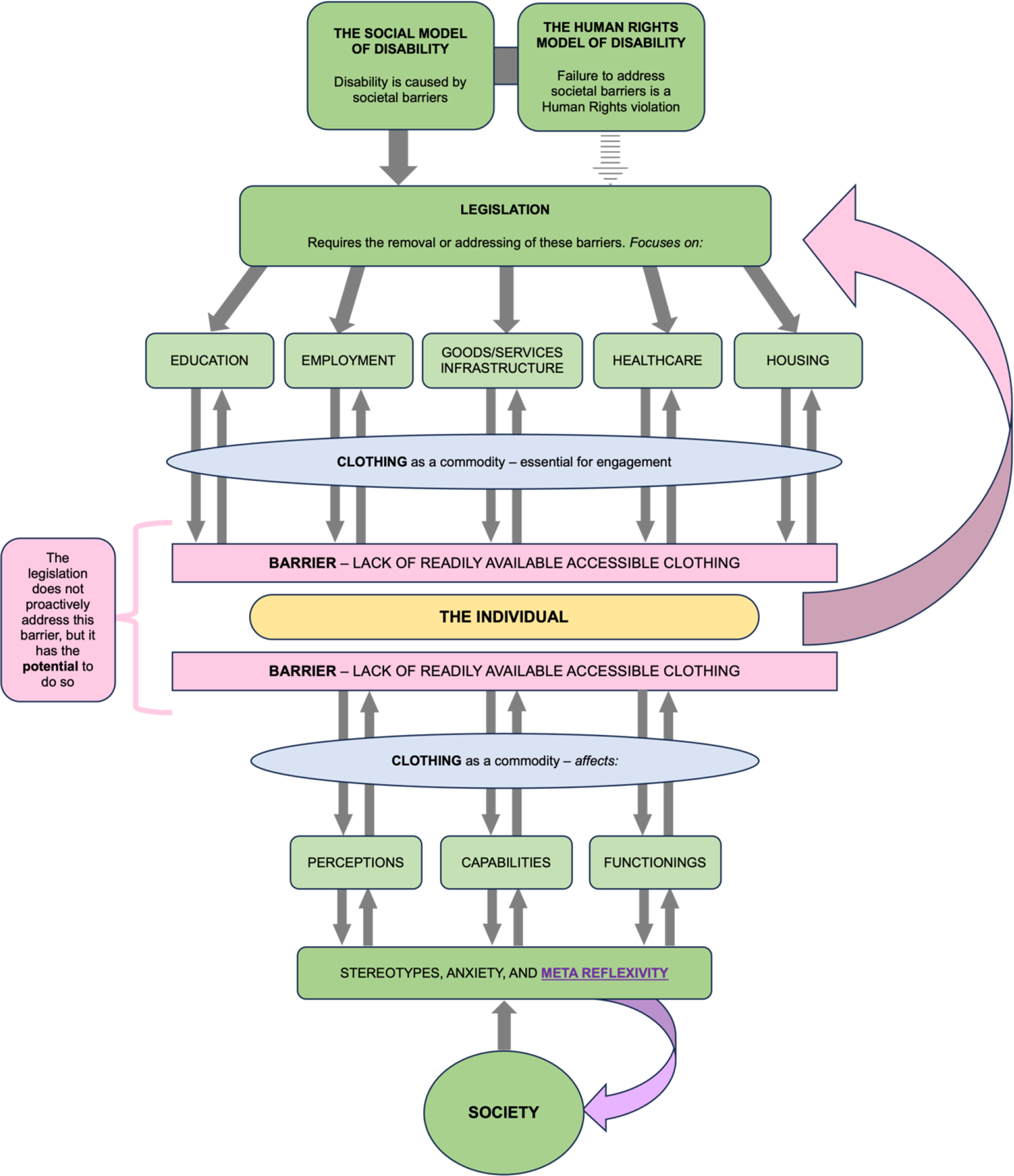
Cutting the pattern for change: Translating theory into practice
In response to the issues identified in the preceding sections, this article proposes that stakeholders need a coordinated approach to address these shortcomings. This requires law makers and enforcers to address the ideological dilemma that equality will be achieved fully for people with disabilities, by recognising the importance of the missing discourse around accessible and usable commodities. The ability to do this already exists in the case law and the legislation but is not explicitly drawn together across service provision. Until this discreet discourse is recognised in the legislation and brought into practice, progress will remain limited.
To address the lack of readily available disability-inclusive clothing, and thus increase the practical equality and inclusion of people with disabilities, it is necessary to look at how product accessibility might be included in the Equality Act 2010. The Act does not reference accessibility, rather it talks about removal of barriers which place people with a disability at a ‘substantial disadvantage.’
47
This language is reactive, and despite the requirement of anticipatory reasonable adjustments, fails to underline the consequences of a lack of access to goods and services. Any definition of access should mirror Article 9 of the CRPD and always apply to all areas of society. It should be anticipatory, removing the reactive approach to ‘reasonable adjustments’ for new products, while maintaining the possibility of reactive corrections in appropriate circumstances.
117
This change would signify and cement actualising rights by virtue of dignity and personhood, as per Article 3 of the CRPD, thus removing the contingency inherent in the charitable approach to disability rights. Article 9 mandates ‘the identification and elimination of obstacles and barriers to accessibility.’ Moreover, the concept of ‘reasonable adjustment’ should be reconsidered. Pearson argues that the duty should be reimagined as ‘Assurance of Rightful Access.’33,118 This would increase consistency within the legislative framework by emphasising that people with disabilities are valid and equal rights holders, as espoused by the CRPD. ‘Rightful’ dispels the imputation that disability access is an act of charity by a benevolent society, centring it instead in the context of rights rather than choice. Secondly, it creates a definite and objective standard, removing the plasticity of reasonable adjustment identified by Lawson in 2008.
119
It presents accessibility as something that cannot and should not be denied to people with disabilities on economic grounds, in the same way other rights cannot be limited or violated through economic justification.33,120,121 The costs of facilitating access to goods and services should factor in profits generated by these measures before claiming undue economic burden. This is consistent with the finding in Roads v Central Trains [2004] EWCA Civ 1541, in which the court confirmed that: …the policy of the [Disability Discrimination Act 1995 now enshrined in the Equality Act 2010] is not a minimalist policy of simply ensuring that some access is available to the disabled: it is, so far as reasonably practicable to approximate the access enjoyed by disabled persons to that enjoyed by the rest of the public.
122
Therefore, there is no reason to presuppose that people with disabilities will make unreasonable demands to access provision. Moreover, people with disabilities will fund and justify these changes by virtue of increased revenue as customers. We must remove the idea of accessible clothing as a niche product. The focus needs to shift to concurrent rather than ‘separate but equal’ accommodations, as permitted in the context of historical racial segregation in the North American ruling of Plessy v Ferguson in 1896. 123 Arguably, with the continuing absence of the needs of people with disabilities in an increasingly diverse mainstream retail clothing landscape, which accommodates particular embodiments such as plus-sized, pregnancy and gender inclusive ranges,49,124,125 the ‘otherness’ of people with disabilities is compounded rather than addressed. Universal Design should be incorporated into guidance around accessible product and service provision. This would supplement a more expansive and capabilities-based focus on accessibility, by providing concrete and actionable points for service providers to focus on as a means of delivering accessible services and products. User Centred Design (UCD) focuses on consumer needs and usability problems, with a particular focus on personalised and customisable approaches, allowing designers to address the needs of those with various disabilities and impairments. 126 It has gained increased traction within the fashion education establishment, receiving particular focus in the United States, with the development of Open Style Lab., a non-profit focused on increasing accessibility to fashion by increasing awareness of barriers, with the support of MIT, to provide education to various stakeholders about UCD and various technologies and techniques to develop understanding of inclusive design. 127
In terms of product design, guidance could include an exemption for existing product lines and a quota for inclusively designed products, subject to upscaling based on demand. Test products could be made available via mainstream websites, which would increase visibility and access, allowing businesses to track demand, price point and returns before upscaling production. 128 Major retailers could also consult with key organisations offering large scale consumer bases for research, such as the Research Institute of Disabled Consumers. In addition to legislative and economic change, we must consider stakeholder engagement. The British Fashion Council recently launched the Institute of Positive Fashion as a forum to encourage collaboration and consideration of environmental and social issues and to provide resources to better achieve inclusion and diversity within the industry. 129 The Institute acts as a hub to raise awareness of potential research and partnership opportunities. 130 The steering committee has partnered with the UN Office of Partnerships to promote the Sustainable Development Goals within the fashion industry; a similar partnership could assist with incorporating the central goals of the CRPD into industry practices. 131 Goals 8 and 10 make specific reference to the inclusion of people with disabilities in terms of inclusion and consideration in economic growth and in social and political participation, both of which could be assisted by developing an inclusive fashion industry. 132 Having a centre to focus on inclusion issues could be invaluable when considering how to implement accessibility in fashion design and production. Like the steering committee, the institute could house review committees for action plans and community engagement initiatives, cultivate contact between stakeholders, and disseminate information about innovative approaches. Designing for difference and diversity could shape essential industry skills, such as tailoring and pattern cutting. It could become viewed as art, by creating beautiful but inclusive silhouettes like those of Alexander McQueen, who was praised for using traditionally masculine tailoring techniques in women’s fashion. 133
Lastly, as Sinéad Buerke identified, designers and manufacturers should ‘[…] move from awareness to action by creating more accessible practices, policies, products […] by asking ‘Is this accessible?.’’ 134 This focus on conversation and collaboration, rather than simply relying on edicts and mandates, is fundamental in engaging businesses with seeing customers with disabilities as worthy of access, rather than reducing them to positive public relations stories and campaigns.
Hemmed in no more: Clothing access and the future of disability equality
This article has proposed that to translate the promise of UK disability equality law into practice, both academics and wider stakeholders need to engage with access to commodities at the individual as well as the institutional and systematic levels. Whilst service provision is currently covered by the legislative framework, the physical products sold by those services are not. If the products are not accessible and useable to those who purchase them, then how far can the service be said to be accessible? Beyond these functional elements, the role of certain products such as clothing is fundamental in enabling people with disabilities to engage with and participate in society. It enables the wearer to communicate much about their tastes and capabilities, and to challenge stereotypes. It is this communication that is crucial in challenging barriers that cannot be directly affected by the legal framework alone, but the legal framework has the capacity to create the context to challenge these thoughts and address the barriers. Therefore, if people with disabilities have access to a reduced wardrobe of clothing, their ability to counter discriminatory attitudes will be limited, and as such, this will impact the overall success of the disability equality legislation in practice. This absence intersects with the treatment of attitudinal barriers in the current framework. Just as people with disabilities cannot be directly discriminated against, by shops refusing them service or to facilitate physical access, they cannot indirectly discriminate either. In the words of Miuccia Prada, ‘What you wear is how you present yourself to the world, especially today, when human contacts are so quick. Fashion is instant language.” 135 So, whilst the design of clothing might seem ‘neutral’ regarding disability, the failure to consider the barriers highlighted here could constitute indirect discrimination and as such, falls within the scope of the existing framework.
Footnotes
Acknowledgements
The author would like to thank Professor Fiona Cownie, Dr Fabienne Emmerich, Dr Ezgi Taşcıoğlu and Dr Ezgi Şeref for their feedback and encouragement in relation to this article, and the reviewers for their very helpful and encouraging comments. The author would also like to thank their Access to Work Support Worker for their physical assistance with the production of this article.

Funding
The author received no financial support for the research, authorship, and/or publication of this article.
Declaration of conflicting interests
The author declared no potential conflicts of interest with respect to the research, authorship, and/or publication of this article.