



Abstract
This paper presents the development of a cohesive set of scientifically grounded recommendations aimed at harmonizing anti-discrimination protections. These recommendations, rooted in multidisciplinary knowledge, address the complexities of sequential, additive, and intersectional multiple discrimination. Through a multidisciplinary approach that combines Law, Social Anthropology, and Economics, this work uses qualitative data to formulate empirically grounded proposals. One of the key recommendations is the adoption of a single law and the establishment of a single entity—the Equality Agency—to eliminate the fragmentation and other institutional challenges identified during fieldwork. By integrating social and legal analysis, the paper proposes a redesign of legal and institutional frameworks to better protect against various forms of discrimination. It acknowledges the structural nature of discrimination and recognizes the need for an integrated response to the complexities of the experiences of those affected. While Portugal serves as the primary context for this research, we believe that the principles, methodologies, and overarching logic of this approach have broader applicability, offering valuable insights for addressing multiple and intersectional discrimination in other contexts.
Keywords
Introduction
Project Multiversity – White Paper on Multiple and Intersectional Discrimination was carried out by the authors of this paper between September 2022 and February 2024 1 . Its main goal was to build a set of cohesive and scientifically grounded recommendations to level and harmonize anti-discrimination protections in Portugal, based on multidisciplinary knowledge, with consideration for sequential, additive, and intersectional multiple discrimination. Its main deliverable was a White Paper proposing a new conceptual anti-discrimination framework, including new legislation and institutional reform. Central to this proposal is a draft Anti-Discrimination Act—a unified Equality and Non-Discrimination Law encompassing all grounds of discrimination and explicitly addressing multiple and intersectional discrimination— based on our research findings 2 . We have also presented this proposal to parliamentary parties and anticipate that the positive feedback received will lead to meaningful changes in the near future.
Even though our analysis and recommendations were country-specific, the need to address multiple and intersectional discrimination is not. After publishing the White Paper, we therefore tried to distill some of the features that may inform similar attempts in other countries, both in terms of process and outcomes. That is the main purpose of this paper: detailing our most challenging choices and the reasoning behind them. These include a baseline choice regarding the methodology, the final choices of both discrimination grounds and scope of the (single) law that we drafted to promote equality and prevent discrimination, and the design of an equality body that can address multiple and intersectional discrimination.
Our choices will undoubtedly require adjustment to specific national contexts; but we hope they can also offer a useful structure for similar processes in other settings.
In summary, this paper combines social and legal analysis to propose a comprehensive redesign of legal and institutional frameworks. The aim is to improve protections against different forms of discrimination by recognizing its structural roots and highlighting the need for a cohesive and integrated approach to addressing the diverse experiences of those impacted.
In the first section, multiple and intersectional discrimination is briefly explained and analyzed. The second section addresses the methodological choices which supported our research. The third section goes into the grounds and scope of discrimination specifically addressed by our research. In the fourth section we explain the choice to advocate for a new equality body. In the fifth and final section, we briefly outline our additional policy recommendations. We conclude by summarizing and bringing together all of our policy recommendations.
Multiple and intersectional discrimination
Legal and institutional protection against discrimination is often based on separate instruments for separate grounds, such as sex, racial/ethnic origin, sexual orientation and gender identity, and disability. However, many individuals experience several forms of discrimination, the combination of which can amplify their vulnerability.
In 1977, the Combahee River Collective (a black, feminist and lesbian collective based in Boston) declared in its manifesto that “the major systems of oppression are interconnected,” pledging to fight against racial, sexual, heterosexual and class oppression 3 . Years later, in 1989, the concept of intersectionality was materialized through the work of Kimberlé Crenshaw 4 , who explained how the prohibition of racism and sexism, while protecting black men and white women respectively (the most privileged people within these groups), might leave out black women. Crenshaw argued that the fact that anti-discrimination legislation was based on the protection of a single characteristic made people who found themselves at intersections of identity invisible.
Intersectionality thus allows for a more comprehensive approach and is a suitable tool for combating discrimination beyond traditional categories: it challenges both monolithic constructions of specific groups and their homogenization and stigmatization. 5
Discrimination based on a combination of factors can take different forms. In her study on intersectionality in the European Union 6 , Sandra Fredman proposes three main ways of conceptualizing discrimination based on more than one characteristic: sequential multiple discrimination, additive multiple discrimination and intersectional discrimination.
Sequential multiple discrimination 7 occurs when a person is discriminated against for different characteristics on different occasions. For example, a black woman with a disability may be discriminated against at one point because of her sex, at another because of her disability, and on yet another occasion because of her racial/ethnic origin. This type of discrimination is one that may be easier to address on the basis of instruments aimed separately at each factor of discrimination, since each incident can be individually assessed and judged accordingly.
Multiple additive discrimination 8 happens when a person is discriminated against on the same occasion for two or more characteristics: a couple of black gay men might not be able to rent an apartment precisely because they accumulate identities that are the target of discrimination and which, together, increase the likelihood of a refusal.
The third manifestation, however, is of a different order, in that it does not simply consist of the addition of two or more forms of discrimination, but rather their overlapping. If a court perceives an older woman as devoid of sexuality (as will be discussed in more detail below), the discrimination stems from the intersection of gender and age. These are cases of intersectional discrimination, 9 which take place when two or more characteristics operate simultaneously and interact inseparably, producing distinct and specific forms of discrimination.
Although relatively recent, and despite widespread acceptance, the concepts of multiple discrimination and intersectional discrimination are not really reflected in the law or in legal practice. On the contrary, the usual practice in relation to the application of anti-discrimination laws is to adopt a single-axis perspective, identifying and dealing only with isolated characteristics in discrimination cases.
Since the list of grounds provided for under the ECHR (in Article 14 and Additional Protocol 12) is not exhaustive, the ECtHR can extend it to cover characteristics that are not expressly protected. Yet, the Court has shown resistance to using the concepts of “multiple discrimination” or “intersectional discrimination”. 10
Still, the reluctance to explicitly reference these concepts does not necessarily imply that the corresponding approaches are entirely dismissed by courts. In the case of B.S. v. Spain, 11 a Nigerian woman, legally resident in Spain and engaged in prostitution, claimed that the Spanish police physically and verbally mistreated her because of her sex, race and profession. Unlike her colleagues of European origin, the applicant was constantly subjected to police checks and was the target of both sexist and racist comments. Having been asked by third parties to recognize her situation as intersectional discrimination, the Court took the initiative of examining “whether there was also a failure to investigate a possible causal link between the alleged racist attitudes and the violent acts of the police.” 12 The ECtHR ultimately found a violation of Article 14, considering that “the domestic courts failed to take into account the applicant’s particular vulnerability inherent in her position as an African woman working as a prostitute”. 13 The Court thus adopted an intersectional approach, without ever characterizing it as such.
In the case of Carvalho Pinto de Sousa Morais v Portugal 14 , the plaintiff brought a civil action against a hospital for medical negligence during gynecological surgery, the consequences of which included intense pain, urinary incontinence, difficulty sitting and walking, and inability to have sexual intercourse; the administrative court ruled in her favor, ordering the other party to pay compensation, but, at the appeal, the Supreme Administrative Court reduced the amount of compensation on the grounds that, at the time of the surgery, the plaintiff was 50 years old and had two adult children, which meant that sexuality was no longer so important, and she “probably only needed to take care of her husband”. The European Court of Human Rights agreed that the Supreme Court’s decision reflects discriminatory treatment based on the applicant’s age and gender. But this case could in fact be identified as a form of intersectional discrimination, arising precisely from the combination of those two factors.
The resistance to including the concept of “multiple discrimination” is also reflected in the decisions of the Court of Justice of the European Union 15 . However, in contrast to the previous examples, when faced with complex forms of discrimination, the Court has forced cases to be framed within a single discriminatory characteristic 16 , even though intersectional discrimination is now covered in EU anti-discrimination Directives 17 .
There are, of course, many possible intersections of grounds of discrimination. The theoretical discussion 18 on the impact of the concept of intersectionality, while warning of the risks of identitarianism and loss of attention to socio-economic structures, also highlights the risks of a unisectional approach to discrimination that excludes people who will be more vulnerable precisely because of these structures. In fact, the vulnerability of people who are at the intersection of identities, such as racialized women or immigrant women, can even be aggravated by the unisectional approach and the asymmetry of protection that is generated by existing anti-discrimination mechanisms. Notions of social justice, from Rawls 19 to Dworkin 20 , would instead recommend paying attention to the people who live at these intersections - and to the structures that weaken them.
The challenge is therefore to design a system of legal protection that considers multiple and intersectional discrimination, and that is effective in both achieving redress for individual victims and promoting structural change, guaranteeing substantive equality, in Fredman’s 21 assertion. This is what we attempted in our draft for an overarching Equality and Non-Discrimination Law, included in the White Paper: to allow victims of multiple and intersectional discrimination to have access to justice and redress; but also to recognize that legal protection goes beyond redress, and that promoting substantive equality requires data collection on multiple and intersectional discrimination, adding an intersectionality lens in public policy design, engaging both the public and the private sectors in the pursuit of equality, and creating comprehensive training and awareness-raising programs that explicitly include multiple and intersectional discrimination.
Methodology
Law should be data-driven, but it is a particular challenge to try to address multiple and intersectional discrimination. Data collection is incipient, at best – and most experiences are still to be recorded and shared (and sometimes identified). The Multiversity Project therefore relied on qualitative data collection and an analysis anchored in methodologies of Social Anthropology.
The social analysis fieldwork was carried out starting with an exploratory phase, involving meetings with key informants. This was followed by the conduction of semi-structured interviews, focus groups, collective interviews and moments of consultation with international entities. The processing of the collected material was carried out using qualitative analysis tools, specifically Content Analysis 22 and Thematic Networks 23 , using MAXQDA software. There were three main groups of stakeholders: a selection of non-governmental organizations (NGOs) representing different grounds of discrimination (including NGOs that specifically address multiple and intersectional discrimination); unisectional equality bodies; and trade union confederations and employers. In total, more than three dozen organizations, in all their diversity, contributed to the social and legal analysis.
The social analysis allowed us to systematize the main difficulties identified by stakeholders in the current equality and anti-discrimination framework: (a) the lack of equality training for various key sectors of society; (b) the low effectiveness of law enforcement; (c) the excessive fragmentation and dispersion of legislation; (d) weak monitoring of the application of laws; (e) the lack of coordination between the different departments in the area of equality and anti-discrimination; (f) the worrying job insecurity and lack of resources in the relevant agencies; (g) the fragmented collection, processing and forwarding of data on discrimination; (h) and, last but not least, the absence of a holistic and intersectional reading of the different forms of discrimination.
The analysis of empirically based data was therefore a necessary condition for the effectiveness of the recommendations on the equality and non-discrimination legal and institutional architecture. However, these also required an understanding of the socio-economic causes and consequences of the various forms of discrimination, since economic inequality is inevitably intertwined with discrimination. The project therefore aimed to recommend complete and up-to-date legal protections, based on data collection and an analysis anchored in methodologies of Social Anthropology, but also bearing in mind the socio-economic implications of various forms of discrimination, and using a detailed analysis of both the anti-discrimination legal framework in Portugal and its application.
The Multiversity Project integrates Law, Social Anthropology, and Economics, embodying the idea that multidisciplinarity enhances scientific inquiry. Its name also underscores the belief that a university thrives through multidisciplinary collaboration and a commitment to diversity.
This is an important choice that could possibly be replicated by similar projects in other countries; and it becomes particularly relevant in the absence of reliable data.
Grounds and scope of discrimination
Grounds of discrimination
People aged 18 to 74 who have suffered discrimination, by number of discrimination factors identified.
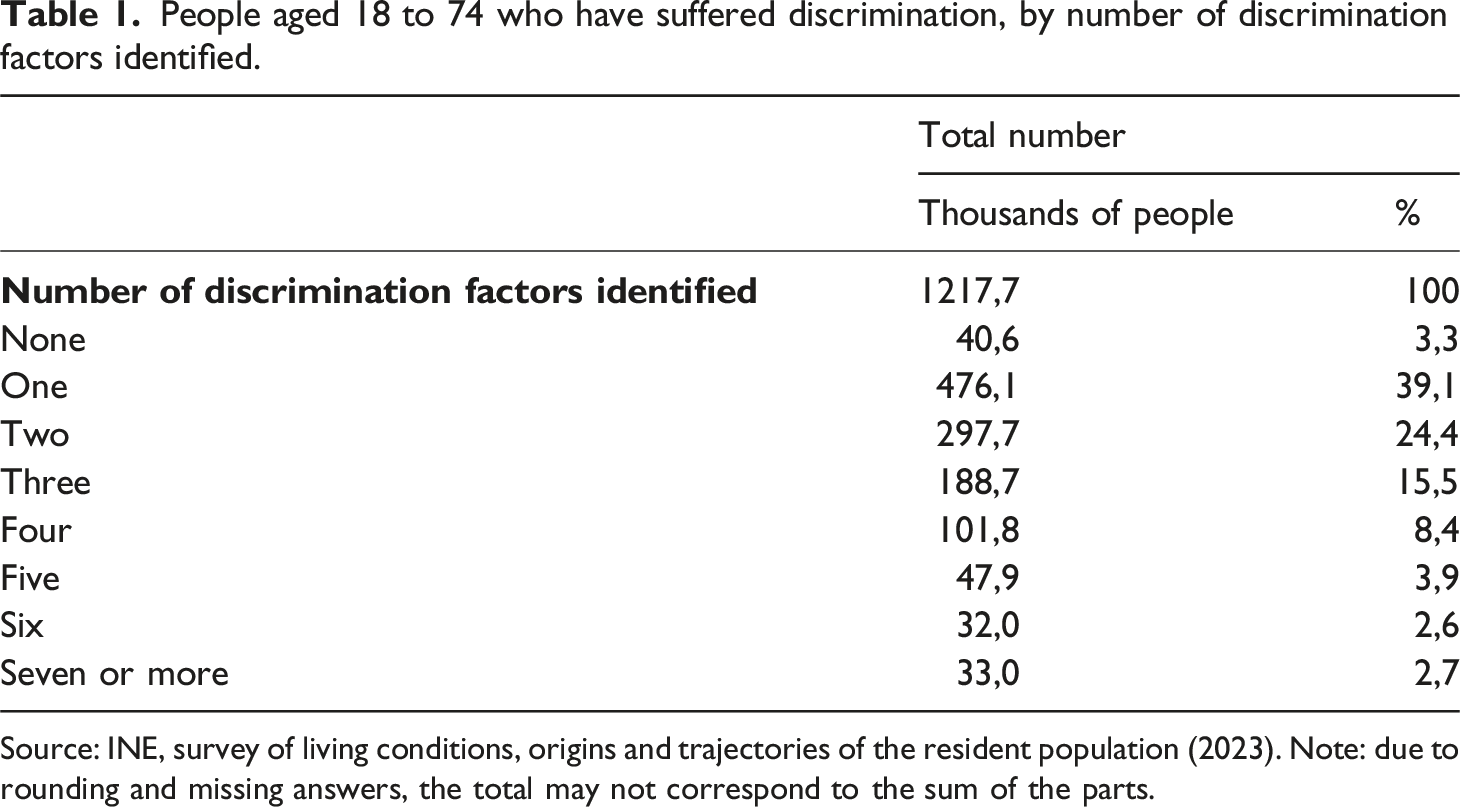
Source: INE, survey of living conditions, origins and trajectories of the resident population (2023). Note: due to rounding and missing answers, the total may not correspond to the sum of the parts.
The initial focus of the project was to analyze existing legal and institutional protection against discrimination based on sex, racial/ethnic origin, sexual orientation and gender identity, and disability (always considering their socio-economic implications), looking for ways to level and harmonize these protections, and proposing ways to also protect against multiple and intersectional discrimination.
But one of the first consequences of the fieldwork and the analysis of existing legislation was the need to expand the grounds that should be covered by anti-discrimination law and institutions.
Discrimination is always based on the salience of certain differences, a salience that stems from our socio-economic organization and our history. In this sense, discrimination is inseparable from socio-economic inequality, affecting structures - and emanating from structures.
This study started from categories of discrimination whose structural nature had already given them protection under Portuguese law, namely sex, ethnic-racial origin, sexual orientation and gender identity, and disability.
However, a guiding principle of our work was to never reduce existing protections. Therefore, in order for the law to be as comprehensive and guaranteeing as possible, we chose to include in the list of grounds all those contained in existing laws, namely gender expression, sex characteristics (contained in Law no. 38/2018, of August 7), color, nationality, ancestry and territory of origin (contained in Law no. 93/2017, of August 23). With regard to the expression “aggravated health risk”, from Law 46/2006, of August 28, as a complement to the category “disability”, it is a challenging concept that is disconnected from identity, and we therefore opted for the alternative complementary wording in Article 23 of the Labor Code: chronic illness.
We also chose to add two categories that are also present in the Labor Code, as well as in the Charter of Fundamental Rights of the European Union: age and religion. Demographic change justifies their consideration (already recommended by Parliament with regard to age). In addition, they are fundamental categories for considering multiple and intersectional discrimination: not just to address the case law in Portugal and at the ECHR regarding the crossing of the factors ‘sex’ and ‘age’ (Carvalho Pinto de Sousa Morais v Portugal 24 ) but also policy discussions regarding, for example, the hijab.
Finally, we opted to include the category of language, which is absent from Law 93/2017, although it is once again included in the Charter of Fundamental Rights of the European Union. One of the reasons for this decision is that language is also relevant to disability. Fragmentation by discrimination factors often prevents the identification of common problems - and the idea of reasonable accommodation should extend from discrimination on the basis of disability to other discrimination factors, including nationality. The other main reason for this choice came from the fieldwork and the prominence that this factor has shown to assume in multiple and intersectional discrimination: from the outset, in access to information about rights; and, of course, in the possibility of exercising them.
A central dimension of the list of categories we propose is, of course, the inclusion of multiple and intersectional discrimination. This is one of the main reasons that led us to propose a single Equality and Non-Discrimination Law, allowing all possible combinations of discrimination grounds to be covered. The example of the recent Norwegian Equality and Anti-Discrimination Act 25 and its positive impact 26 led us to choose to add to the list of grounds the expression “any combination of these factors”. It’s a simple formulation, but a fundamental one - and one that allows for an equally simple interpretation. This will also be the wording we recommend for all other anti-discrimination legislation, so that multiple and intersectional discrimination is always covered.
The debate on whether to include a category of discrimination based on socio-economic status is still ongoing in human rights law. The structural socio-economic impact of different forms of discrimination is undeniable, from the wage gap (and capital ownership disparities) based on gender, to the geographical distribution of housing based on racial/ethnic origin. It is also clear that socio-economic vulnerability affects access to rights and access to justice - and can lead to further instances of multiple discrimination. Endorsing the argument that poverty or socio-economic precariousness are both a consequence and a cause of discrimination 27 , we have opted, for the time being, for the view that legislation prohibiting multiple discrimination will have a socio-economic impact (and should be applied with this socio-economic impact in mind, namely with regard to the sanctioning regime and policy recommendations), but that it will be complementary to anti-poverty and anti-inequality policies and measures, from a mutually reinforcing perspective.
Clarity and simplicity were another guiding principle in our analysis: the effectiveness of the law depends on its application; the social analysis results also emphasized the need to ensure applicability and access to justice. We therefore opted not to include an “open” category similar to the one in the Norwegian law, “or other significant characteristics of a person” 28 . This was due to the difficulty in applying the law that defining an open category would generate, combined with the lack of training on discrimination in Portuguese courts identified in the legal and social analyses. Still, and because the process of identifying categories of discrimination is dynamic (which is also clear from the discussion on socio-economic status), we recommend revising the law to explicitly include any new grounds identified as socially relevant, avoiding any doubts in its application.
Adjusting the choice of grounds to different countries will therefore depend on existing protections, but also on the consideration of grounds that social analysis identifies as relevant. In any case, the simple addition of the expression “any combination of these factors” in every law that addresses discrimination based on multiple grounds is a key recommendation that can be universally applied.
Scope
The goal of never reducing existing protections led us to maintain the areas already provided for in unisectional laws: social protection (including social security and healthcare), social benefits, education, access to goods and services (including housing), culture, media content and advertising.
We only guarantee its extension to all the factors of discrimination we have listed, as well as to multiple and intersectional discrimination. As is already the case in Law 93/2017 of August 23, and also justified by the results of the fieldwork, we have also included hate speech as a form of discrimination.
The absence of reasonable accommodation is also considered a discriminatory practice: the set of modifications, adjustments or supports that are necessary and appropriate, without imposing a disproportionate or undue burden, to guarantee the enjoyment or exercise, on equal terms, of fundamental rights and freedoms, as well as equal participation in any area of life regulated by law. Once again, this is a fundamental instrument in the area of disability and chronic illness, but it can also be extended to other categories of discrimination.
In any case, we chose to have two explicit exceptions to the protection against discrimination. One relates to the provision of financial services, where proportionate differences are allowed whenever the use of age, disability or chronic illness criteria is a crucial factor in assessing risk on the basis of relevant and accurate actuarial or statistical data, similar to the provision included in the proposal for an Anti-Discrimination Directive by the European Commission 29 , and explaining what might not be considered reasonable accommodation. And, since the law provides for the impossibility of discrimination based on nationality, we also explain the possibility of differentiated treatment based on nationality in matters of migration and asylum, namely with regard to entry and stay and the reception and integration of people of foreign nationality in national territory.
A single equality body
A key proposal in the Equality and Non-Discrimination Law is for a single entity to enforce it. The name “Equality Agency” makes it clear that its mission is to promote substantive equality.
The Equality Agency, which will monitor the law we are proposing, will eliminate the current fragmentation and problems of institutional articulation that have been widely identified in the fieldwork, making it possible, for the first time, to respond to multiple and intersectional discrimination.
There are therefore three sets of arguments that justify this need for integration and reinforcement:
“Unity is strength”: faced with intersecting factors of discrimination, the best response will be unity. Union will make it possible to achieve the scale necessary for greater effectiveness, not only in remedying but also in preventing discrimination. It will also be the union in a single equality body that will allow the sharing of information and collaboration between those who deal with different categories of discrimination, and also the promotion of a comprehensive training plan that includes all categories of discrimination and the entire territory - once again taking advantage of economies of scale, and also avoiding ranking factors of discrimination.
Clarity and simplicity: the existence of different institutions (and different laws) associated with different factors of discrimination makes it difficult to know rights and obligations, apply them and monitor them. Clarifying and simplifying, concentrating the work for equality and against discrimination in a single institution, is fundamental to allow victims of discrimination effective access to their rights and to justice; to allow those who have to comply with the law (including companies) to know their duties; and for those who have to enforce the law (in the case of the courts) to be able and know how to do so, also based on the technical knowledge associated with the area of non-discrimination. The cost of discrimination, which, once again, is both a cause and a consequence of socio-economic exclusion, cannot be compounded by the cost of access to information and the cost of seeking a response to a situation of discrimination. In this sense, a single door is the appropriate response.
Inclusion of multiple and intersectional discrimination: the increased vulnerability of people who experience multiple discrimination means that the legal and institutional system must be designed to give them additional protection, as opposed to the current system, which excludes them. It is therefore essential to put an end to fragmentation, inconsistencies and artificial hierarchies, finally giving centrality to the notion of equality, with an Equality Agency that enables its structures to deal with all categories of discrimination and multiple and intersectional discrimination - and that can also ensure that this concern extends to the public and private sectors.
Independence and resources
According to Articles 3 and 4 of the proposal for a Directive on equality bodies presented by the European Commission at the end of 2022, endorsed in 2023 by the Council 30 and the Parliament 31 , it is essential that this body be endowed with independence and resources.
We therefore propose that the Equality Agency should operate by appointment of the Parliament, the legislative branch of the Republic 32 . This would enable it to carry out its duties and powers independently and free from any external pressures, particularly with regard to its internal structure, accountability, management of human and financial resources and other organizational issues, with transparent procedures for the selection, appointment, revocation and/or identification of potential conflicts of interest of the people who will make up its staff, guaranteeing their competence and independence. It is also essential that the Equality Agency has sufficient and appropriate human, technical and financial resources to carry out its duties.
Even though the union of all grounds in a single entity will make it possible to benefit from economies of scale, a clear recommendation is that the budget of the Equality Agency should never be less than the sum of the resources of the entities whose duties it incorporates. In fact, given INE's diagnosis of experiences of discrimination, and the need for a broad training and awareness plan identified in our fieldwork, it is recommended that this budget be substantially increased, allowing for the resources mentioned in the proposal for a Directive on equality bodies.
Duties
Redress
Among the duties of the Equality Agency, and similarly to what happens in Norway, is to provide information to victims of discrimination about rights, as well as receiving complaints and opening administrative offense proceedings, referring the parties to mediation, requesting the necessary information from public authorities and entities for the investigation of proceedings, and subsequently deciding and imposing fines 33 and accessory sanctions, making public the information about discriminatory practices and the respective sanctions.
Since the area of work and employment is not included in the Equality and Non-Discrimination Act, another task is to follow up and monitor complaints relating to this area after they have been referred to the Working Conditions Authority, namely to ensure appropriate identification of cases of multiple and intersectional discrimination. Below we recommend other legal changes that could enhance the effectiveness of this monitoring.
Also with a view to promoting effective access to justice, the competencies include supporting victims and issuing technical opinions to courts and other decision-making bodies, spontaneously and/or at the request of victims and/or courts, ensuring that multiple and intersectional discrimination is recognized; and exercising the right of popular participation in administrative procedures and the right of popular action in main and precautionary proceedings aimed at defending equality and non-discrimination. The latter is of particular importance with regard to the collective nature of experiences of discrimination (which go beyond individual situations), allowing intervention on behalf of discriminated groups.
Information and recommendations to policymakers
In addition to reactive measures against discrimination, the Equality Agency also has proactive duties. Ensuring non-discrimination means, above all, preventive work, which also involves producing and gathering knowledge, as well as adopting or recommending policies that contribute to substantive equality.
This would also include collecting, processing and disseminating statistical information on discrimination, as well as promoting studies that also encompass multiple and intersectional discrimination.
In addition, the Equality Agency should recommend either the abolition of legislative, regulatory and administrative provisions contrary to the principle of equality and non-discrimination, or the adoption of legislative, regulatory and administrative measures to promote equality, also making recommendations to the Government, and also issuing opinions on legislative initiatives by the Portuguese Parliament or the Government in the same field.
In this context, it is crucial to highlight the structural nature of discrimination, as well as its socio-economic causes and consequences, namely for those who are at the intersection of discriminated identities. The non-inclusion of the category “socio-economic status” in the law we are proposing means that the work of the Equality Agency must necessarily include, in a clear and unequivocal way, the socio-economic dimension in its analysis and in any policy recommendations or legislation. We therefore envisage an Equality Body that can make recommendations on, for example, tax policy or social support policy.
Monitoring of the public sector and creation of an incentive mechanism for the private sector
To promote substantive equality, another of the Equality Agency’s functions will be to create codes of good practice, applicable to the various sectors.
On the one hand, we propose making it compulsory for public bodies to report on their duty to promote equality, through an annual report on both the actions carried out in the previous year and the subsequent annual action plan, with the Agency being responsible for analyzing this report.
Moreover, we propose an Equality Agency that also has a major role to play in relation to the private sector. To limit the prevention of discrimination to initiatives related to the public sector is to limit the scope and day-to-day impact of the work for substantive equality. We also propose, however, and following on from the drafting of codes of good practice for companies and the media, that the Equality Agency be given the task of constructing and disseminating diversity indices, combining good practices against discrimination based on the various factors and also against multiple discrimination. By analyzing the reporting by companies and the media, the Agency will also be responsible for evaluating the respective diversity indices and recommending appropriate incentive mechanisms
Training and awareness-raising
The last task of the Equality Agency that we have listed will be the one that will require the greatest investment in budgetary terms: the design and implementation of a training and awareness-raising plan on human rights, equality and non-discrimination in several key sectors. First and foremost, with a focus on professions related to law and access to security and justice: the judiciary, the Public Prosecutor’s Office, the legal profession, the police force, and the National Commission for the Protection of Children and Young People at Risk. In addition, there should be a focus on those directly involved in the collection and processing of complaints or who have direct contact with victims of discrimination, including the Working Conditions Authority. Finally, there should be a focus on other areas identified as priorities in the fieldwork: Health, Education, Social Security and the Media. The aim is for this work to be territorial in scope, exploiting synergies and working simultaneously on the different factors of discrimination, as well as multiple and intersectional discrimination.
Structure
Given its duties, this is, therefore, an agency with a broad remit, which can bring centrality to the work for Equality and Non-Discrimination. In its organization, however, we consider it very important to guarantee the non-hierarchical nature of discrimination factors, as well as compliance with the international obligations assumed by the Portuguese state, namely in the areas of discrimination based on sex, ethnic-racial origin and disability.
We therefore propose to guarantee attention to multiple and intersectional discrimination from within the Presidency of the Equality Agency, establishing three Vice-Presidencies with specific focuses and competencies in specific areas:
The Presidency will be responsible for coordination, particularly in relation to the areas of activity of the vice-presidents, centralizing protection against multiple discrimination and delegating sectoral responsibilities to each vice-presidency. Each vice-presidency will have specific competencies, either in the investigation of cases in their respective area, as delegated by the Presidency, or in the establishment of priorities for action and representation in national and international forums in their respective area. Decisions on administrative offenses and their enforcement are made by the Board of Directors, which includes the Presidency and the three Vice-Presidencies, with the Presidency having the casting vote. The Presidency is also responsible for coordinating the education, training and awareness-raising program for human rights and for preventing and combating discrimination, as well as approving how the diversity index is calculated and recommending incentive mechanisms.
Given the current organization of anti-discrimination bodies, the current Commission for Equality and Against Racial Discrimination would see all of its powers included in the Equality Agency, especially in the Vice-Presidency on racial and ethnic origin, color, nationality, ancestry, territory of origin, language and religion. The National Institute for Rehabilitation (the Portuguese equality body dealing with disability) would see its competences connected to discrimination on the basis of disability included in the Agency, mainly in the Vice-Presidency on age, disability and chronic illness. And finally, the Commission for Citizenship and Gender Equality would see its competences connected to discrimination based on gender, sexual orientation, and gender identity included in the Agency, mainly in the Vice-Presidency relating to sex, sexual orientation, gender identity and expression, and sex characteristics.
It is therefore a substantial reformulation, that builds upon the existing structures, but one that allows for future work, meeting various international recommendations and also responding to the concerns identified by different entities in the fieldwork. It is, however, essential to expand - and never reduce - the work in each specific area, reinforcing investment in each area alongside attention to multiple and intersectional discrimination. This is one of the concerns that came from the social analysis work and it is also what the European Commission advocates for equality bodies, and it is a sine qua non of our proposal. The structure we propose therefore presupposes this guarantee.
Given the scope of the Equality Agency’s remit, it seems particularly important to liaise closely with both justice administration bodies and authorities from different sectors. Likewise, in order for experience and social analysis to inform decisions and the construction of strategies, the role of non-governmental organizations is crucial, as well as the contributions of academia. Therefore, and also from a perspective of unity and dialogue underlying the work for equality and non-discrimination, we propose the creation of the
In addition to six-monthly plenary meetings, chaired by the Chair of the Equality Agency, we also propose meetings of sections of the Council. We have identified four sections of the Equality Council: • The Administration of Justice section will include representatives from the Superior Council of the Judiciary, the Superior Council of the Public Prosecutor’s Office, the Ministry of Justice, the Ministry of Internal Affairs, and the Bar Association, allowing for the discussion of issues related to complaints and access to justice, as well as issues related to the implementation of the training and awareness-raising plan. • The Sectoral Authorities section will include representatives from various entities with supervisory and regulatory functions in sectors related to the Equality Agency’s remit (and, specifically, to the areas established in the Equality and Non-Discrimination Law), boosting its effectiveness: Banco de Portugal, the Working Conditions Authority, the Food and Economic Safety Authority, the Health Authority, the Insurance and Pension Funds Supervisory Authority, the Media Regulatory Authority, the Mobility and Transport Authority. • The Non-Governmental Organizations section is key to sharing experiences of discrimination and informing the Equality Agency’s strategy, including up to 40 organizations that promote equality and non-discrimination, at the invitation of the Presidency, 30 of which are national and 10 regional or local. • Finally, the Technical-Scientific section is made up of 10 personalities with recognized scientific competence in the areas of equality and non-discrimination, enabling them to identify strategic challenges and collaborate in the design of responses.
Additional policy recommendations
The Equality and Non-Discrimination Act and the creation of the Equality Agency are a fundamental first step in tackling multiple and intersectional discrimination. Still, it is a necessary but not a sufficient condition.
The legal and institutional architecture has failed to consider multiple and intersectional discrimination in the past. Identifying the need for policy changes is one of the goals of the Equality Agency and it will inevitably become a process. In any case, we can already identify some additional, complementary recommendations that will be decisive for an integrated and intersectional vision of the legal system and institutional design: - Since work and employment are absent from the scope of the Law we are presenting, it is essential to revise the Labor Code to introduce an explicit reference to multiple and intersectional discrimination, as well as to establish the duty of reporting and close collaboration of the Authority for Working Conditions; also in the field of work and employment, it is recommended that consideration be given to the possibility of requesting a report on the actions of private sector entities in the field of equality and non-discrimination, in the transposition of the Corporate Sustainability Reporting Directive (EU Directive 2022/2464), which replaced the previous Non-Financial Reporting Directive (Directive 2014/95/EU), transposed into national legislation by Decree-Law no. 89/2017.º 89/2017. - It is also important to consider introducing explicit references to multiple and intersectional discrimination in the various anti-discrimination provisions, including the Constitution of the Portuguese Republic, the Penal Code and other individual legislation. - The work against discrimination, including multiple and intersectional discrimination, will continue to require a government strategy, as well as action plans that are informed by the Equality Agency; we recommend that the area of Equality and Non-Discrimination be central in the government, allowing both a capacity for effective communication and implementation of measures in the different areas of government intervention, and the necessary collection of data that allows reporting to the Equality Agency. - In this sense, adequate funding for equality NGOs (namely for projects involving multiple and intersectional discrimination) is also essential, enabling them to inform and collaborate in the implementation of public policies. - Finally, laws that establish minimum thresholds for minorities of power
37
and focus on gender (Organic Law no. 1/2019, of March 29, Law no. 62/2017, of August 1) or disability (Law no. 4/2019, of January 10) should be revisited, reflecting on the need for reparation and inclusion of other minorities of power, understanding discrimination (according to the factors listed, as well as multiple discrimination) as structural.
While the alignment of these specific recommendations with each country’s unique needs may vary, the commitment to applying an intersectionality lens to existing laws and institutions should remain constant. A unified Equality Act and a central Equality Agency could significantly address multiple and intersectional forms of discrimination, yet every country must, to varying degrees, confront their legacy of neglecting this issue.
Conclusion
By combining social and legal analysis, we have come to propose a redesign of the legal and institutional system of protection against the various forms of discrimination, including multiple and intersectional discrimination.
We have proposed a coherent and integrated system that promotes universalism, recognizes the structural nature of discrimination and the underlying power asymmetries, and is able to respond with unity to the multiplicity of intersecting identities and experiences of discrimination.
In particular, and in view of the disparity of protections afforded by the current one-sided anti-discrimination laws, we have recommended the approval of a new Equality and Non-Discrimination Law covering all the categories of discrimination that were initially considered in the project (including some additional categories, such as age, religion and language), levelling and harmonizing the existing protections, and also providing explicit protection against multiple and intersectional discrimination.
We have also recommended the creation of a single institution for the promotion of equality and the prevention of discrimination, the Equality Agency, endowed with independence and also with a budget and resources appropriate to its duties. This Agency will concentrate different functions, first and foremost promoting redress against specific situations of discrimination (based on any of the factors listed and also on multiple discrimination), providing a single door to receive complaints that guarantees procedural clarity and simplicity. But another fundamental focus will also be on promoting substantive equality. Among the tasks envisaged, we highlight the possibility of making public policy recommendations that also take into account the socio-economic causes and consequences of discrimination, in other words, recommendations that take into account the structural nature of discrimination; the design and implementation of a broad training and awareness-raising program to guarantee effective universal access to key sectors, from security to justice, including education and health; and the construction of diversity indices, both for companies of different sizes and for the media, which reward good practices, so that the work of promoting equality is not limited to the public sector and can have an impact on everyone’s daily lives.
Finally, we have also, therefore, proposed, on the basis of work based on the union of fields of knowledge, that the union should also be the answer to the intersections of categories of discrimination: reinforcing the role of the state in the pursuit of equality, but also combining it with the role of the private sector; and, above all, combining categories, pooling resources, and finally creating space in the legal and institutional architecture to address multiple and intersectional discrimination in Portugal.
Even though many of our policy recommendations are country-specific, since they are also based on existing legislation and institutions (and focused on reform), we believe that the underlying principles and methodology, as well as the overarching logic can be applied to other countries. The problem of multiple and intersectional discrimination deserves attention and the appropriate legal and institutional response; this is our contribution.
Footnotes
Acknowledgements

Declaration of conflicting interests
The author(s) declared no potential conflicts of interest with respect to the research, authorship, and/or publication of this article.
Funding
The author(s) disclosed receipt of the following financial support for the research, authorship, and/or publication of this article: This paper is a result of Project Multiversity – White Paper on Multiple and Intersectional Discrimination (EEAGRANTS/2022/SGS3-C1), funded by the EEA Grants, within the Conciliation and Gender Equality Programme, with the Commission for Citizenship and Gender Equality as Programme Operator. This Project was also supported by national funds through the FCT – Portuguese Foundation for Science and Technology under the project (UID/00714/2020). It was promoted by NOVA School of Law and CEDIS (R&D Centre on Law and Society), within the activity of NOVA Knowledge Centre for Data-Driven Law (Portugal), in a partnership with EGALIA: center against discrimination (Norway).