



Abstract
In Canada, access to post-secondary education is guaranteed by a number of domestic instruments. These instruments are: statutory human rights legislation, constitutional law, and accessibility legislation. These guarantees are further bolstered by Article 24 of the United Nations Convention on the Rights of Persons with Disabilities (CRPD). Statutory human rights legislation (or anti-discrimination law) plays the most extensive role in controlling the discretionary power that colleges and universities exercise with respect to the admission of prospective students and the reasonable accommodation of matriculated students with disabilities. This article presents the findings of a review of decisions by human rights tribunals in Canada over the 7-year period of 2014–2021. With respect to both admissions cases and in-program reasonable accommodations cases, it identifies the main types of barriers experienced by persons with disabilities. It also examines the ways in which accessibility legislation, a proactive standard-setting form of legislation in Canada, has sought to improve access to post-secondary students with disabilities, focusing on Ontario’s post-secondary education accessibility standards as an example. Finally, it argues that changes to policies and practices on the ground that draw more inspiration from Article 24 of the CRPD will help to ensure that the equality right to post-secondary education for students with disabilities is fulfilled in letter and spirit.
Keywords
Introduction
Martha Nussbaum has noted that education assists one’s ability to achieve their fullest set of capabilities. 1 Disability studies scholars such as Jay Dolmage, note, similarly, that education can be a path to social justice, but recognize that it can also serve as a means to uphold power imbalance. 2 This tension exists because the post-secondary education system has generally been designed according to an ethic that seeks to valorize perfection and ability and which was not created with students with disabilities in mind. 3 For students with disabilities, the idea of education as a path to developing human potential is entrenched in the right to education guaranteed under Article 24 of the United Nations Convention on the Rights of Persons with Disabilities (CRPD). 4 Article 24(1) of the CRPD provides a commitment to the full development of human potential and of the student’s sense of dignity and self-worth, as well as a commitment to develop the student’s personality, talents, and creativity, (along with their mental and physical abilities), to their fullest potential. 5 Article 24(5) builds on this commitment by guaranteeing persons with disabilities access to general tertiary (or post-secondary) education, vocational training, adult education and lifelong learning without discrimination and on an equal basis with others. Nevertheless, on the ground, within educational institutions, disabled post-secondary students 6 continue to face barriers to education every day. 7
In Canada, the right to post-secondary education for persons with disabilities is protected through various domestic human rights instruments and supplemented by the CRPD. At the same time, obstacles for disabled students exist at different stages of the experience of post-secondary education. This article uses a case study to identify the barriers experienced by students with disabilities on the ground despite the long-standing legal frameworks that ensure post-secondary education for persons with disabilities in Canada. It further examines how law and policy may be improved to ensure access to post-secondary education for students with disabilities.
This article begins with a discussion of the legal frameworks that exist in Canada to protect the right to post-secondary education. Part II provides an overview of the types of barriers that students with a variety of disabilities have faced during the course of completing post-secondary studies. The barriers are identified through an examination of decisions of human rights tribunals and courts in Canada rendered between 2014 and 2021. These barriers to pursuing post-secondary education are identified in relation to the admissions process, in-program learning, and the pursuit of remedies. In Part III, I draw from an analysis of these decisions and barriers to argue that the right to post-secondary education for disabled students in Canada would be strengthened if more inspiration were drawn from Article 24 of the CRPD in contexts such as the development of educational policies and processes surrounding admissions, funding, and in-program accommodations. Moreover, proactive regulatory approaches such as accessibility standards for post-secondary education are a new innovation that could implement the goals of the CRPD effectively and counteract the inadequacies of reactive models of anti-discrimination regulation. These steps should not only be anchored in Article 24 of the CRPD but should also draw upon human capabilities and intersectional approaches.
Canadian equality rights instruments and post-secondary education
While there is no explicitly legislated right to post-secondary education for persons with disabilities in Canada, everyone is entitled to pursue an education. Moreover, every person has the right to pursue an education with equality, and free from discrimination based on disability. 8 In this section, I provide an overview of the four principal legal frameworks available for students with disabilities to seek redress if their rights to equality and non-discrimination have been infringed in the process of pursuing post-secondary education.
With respect to each equality rights instrument, I describe the purpose of the instrument, and key aspects of the legal framework including, if applicable, the basic elements of the doctrinal analysis used in its judicial or quasi-judicial interpretation. Where relevant, I discuss issues of procedure and remedies.
Human rights legislation
In Canada, the majority of disability discrimination cases are brought forward under human rights legislation. 9 Human rights legislation has been enacted in every province, territory and at the federal level in Canada. Human rights statutes provide for equal treatment and protect against discrimination and harassment in both the public and private sectors. The statutes identify prohibited grounds of discrimination, including disability, and the social areas where the legislation applies. 10 Across the country, these social areas typically include services, goods and facilities, rental accommodation, contracts and employment. Through jurisprudential interpretation, education has been identified as a service to which human rights legislation applies. 11
Human rights complaints are usually brought to human rights commissions which attempt to resolve them through mediation. If unsuccessful in doing so, the matter may move forward to the human rights tribunal of the jurisdiction where it is adjudicated by a quasi-judicial panel of decision-makers. Exceptionally, in some provinces, the commission does not play this preliminary role, and matters are brought directly to the human rights tribunal. 12
Whether before the commission or tribunal, a human rights complaint will be examined according to the discrimination analysis. This analysis has been developed over time by the human rights system and confirmed by the Supreme Court of Canada, rendering it binding on courts and tribunals across the country. It requires the person bringing the complaint to show a prima facie case of discrimination. In order to establish a prima facie case, the applicant must demonstrate three things: a) that they have a characteristic that is protected from discrimination under the applicable human rights legislation, b) that they experienced an adverse impact while receiving services from the respondent and c) that their protected characteristic was “a factor” in the resulting adverse impact. 13 The onus then shifts to the respondent to show that they have a good faith reason for providing the service to the person with disability in the manner adopted or that they are unable to accommodate the requests of the person with a disability due to undue hardship. 14 Reasonable accommodation and undue hardship are therefore central concepts in the discrimination analysis as discussed below.
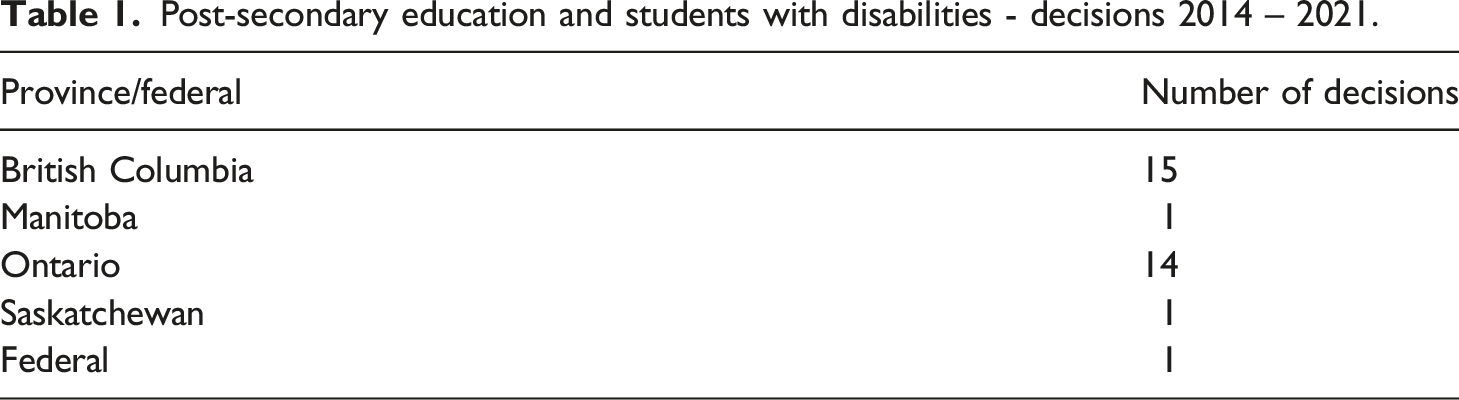
The discrimination analysis incorporates several challenging conceptual and practical dimensions. Most notably, the jurisprudence is unclear as to what it means for a protected characteristic to factor into an adverse impact. 15 The Supreme Court of Canada has indicated that both causal and non-causal elements may be used to show that the protected characteristic has played a role. However, the law is unsettled as to what is necessary, 16 rendering the preparation of evidence challenging on the ground, especially for self-represented litigants, a group that comprised almost half of the disability discrimination claimants in the sample of post-secondary education cases drawn from 2014 to 2021. 17 Moreover, it can be difficult for students to obtain proof of whether their disability factored into the institutional decision(s) leading to the adverse impact that they experienced.
The notion of undue hardship has been interpreted to be a high threshold but one which, if met, will excuse a respondent from making accommodations (as the accommodations will no longer be deemed reasonable). In the context of educational services, a respondent can demonstrate undue hardship in one of three ways: by showing that the cost of the requested accommodations is too high, that they cannot receive outside sources of funding to cover the cost, or that there are health and safety concerns associated with the proposed accommodation. 18 Outside of the doctrine of undue hardship, tribunals and courts may also determine that an accommodation will not be warranted if it will clearly not serve the purpose of supporting a student to fulfill bona fide academic requirements. 19 This may be because the accommodation has already been attempted without success.
Moreover, statutory language in the human rights legislation of a couple of provinces has raised a question of whether post-secondary educational programs should be structured around essential criteria that every student must meet. The statutory language in Ontario is the most explicit. It states that a respondent will be exempted from providing an accommodation if the person with the disability would nevertheless be “incapable of performing or fulfilling the essential duties or requirements attending the exercise of the right because of disability”. 20 This language has traditionally been used in the context of employment where an employee may be dismissed for not being able to complete the essential functions of a position even with the accommodation. Shifting these principles to the context of education raises many questions. There are ongoing debates as to the appropriateness of this shift, what constitutes the essential criteria of any given post-secondary educational program, and how to determine them. One may wonder, for example, whether the approach is in keeping with the disability rights of dignity and capacity under the CRPD. There is a further issue of when the essential criteria, once established, can be said to have been altered (or lowered) by the adoption of a particular accommodation. The sparse guidance that is available indicates only that the essential criteria of primary and secondary educational programs are quite broad in nature and would include academic performance as well as physical and social development. By contrast, the essential criteria of post-secondary educational programs should focus on academic performance. 21 Nonetheless, the central questions of whether this shift is appropriate and, if so, how to determine the essential criteria of a post-secondary educational program require more thorough examination.
Finally, one of the most important principles to emerge from the human rights jurisprudence of the Supreme Court of Canada is that students must be meaningfully supported in their educational pursuits. Reasonable accommodation is not designed with the purpose of having all students with disabilities receive the same level or type of support. Rather, every student should have the support that they need to have meaningful access to the education that is promised to all. The Moore decision which established these principles, 22 was rendered in the context of special education services in primary and secondary schools, but the general principle of envisioning education around the concepts of meaningful access to education through individualized support is helpful for advancing disability rights law.
The Canadian Charter of Rights and Freedoms
Section 15 of the Canadian Charter of Rights and Freedoms, which forms part of Canada’s Constitution, guarantees that everyone is equal before and under the law, and provides for equal protection and benefit of the law. 23 The Charter specifies further that the right to equality comes with freedom from discrimination on a number of enumerated grounds including “mental or physical disability”. 24
Although higher in the hierarchy of laws, the equality rights guarantee of the Charter has been used less frequently than human rights legislation in challenges relating to disabled students in the context of post-secondary education. A significant reason for this is that the Charter applies only to government entities but several colleges and universities do not fit into this category. Moreover, human rights legislation and adjudication form part of the administrative justice system, which in Canada is intended to have processes that are more flexible and easier to use than those of the courts. 25 Recourse under the Charter normally requires application to a superior or provincial court.
The Supreme Court of Canada has developed a two-part analytical framework for determining whether discrimination has occurred. A claimant must first show that the law or policy in question creates a distinction based on a protected ground, and, second, that the law or policy perpetuates, reinforces or exacerbates disadvantage for members of the protected group. Satisfying this two-part test is enough to establish a prima facie violation of the equality rights provision of the Charter. It is then up to the government, as respondent, to demonstrate, if it can, that the violation was rational, proportionate and therefore justified under the saving clause (Section 1) of the Charter. 26
Accessibility legislation
The key purpose of accessibility legislation is to develop standards that recognize and eradicate barriers to inclusion in society, for persons with disabilities, before they emerge. 27 In this way, accessibility legislation is proactive. Unlike the human rights regime, which relies on complaints by persons with disabilities who have been affected by discriminatory circumstances, accessibility legislation provides a framework to bring together persons with disabilities, industry and government representatives to work together on committees in order to establish draft accessibility standards or recommendations for draft standards. The draft standards are reviewed by the public and usually revised by the committee before being submitted to the responsible minister. After ministerial review, the accessibility standards are finalized and enacted as binding regulations. 28 Accessibility legislation applies in both public and private sectors. A date by which an accessibility statute is to render its jurisdiction accessible is usually provided in the statute.
Accessibility legislation has been enacted in five Canadian provinces and at the federal level. 29 It has quickly been embraced across the country since the first statute was enacted in Ontario. 30 At the same time, a common concern is that the development and implementation of the standards take a considerable amount of time, making the timelines almost impossible to meet. There have also been concerns about the enforcement of the standards.
Ontario is the only province to date that has developed recommendations for a post-secondary education standard. The final recommendations for the post-secondary education standard were released in April 2022. In its report, the Postsecondary Education Standards Development Committee stated that through its 185 recommendations, it defined “the long-term objective of the proposed Post secondary Education Standards and each of the measures, policies, practices and requirements to be implemented …, as well as the timeframe for their implementation”. 31 With respect to the long-term objective, the Committee recommended that post-secondary institutions create an ongoing overall strategy. This strategy would put in motion several activities that identify and remove barriers, recognize and respond to the interaction of environmental elements and the features of individuals with visible and invisible disabilities, apply an intersectional accessibility lens to policies and procedures and recognize disability as a critical aspect of the education sector’s commitment to human rights, equity, diversity, and inclusion. As regards the measures, policies, practices and requirements to be implemented, the Committee identified and addressed nine main barriers. These barriers include: attitudes, behaviours, perceptions and assumptions; awareness and training; digital learning; social realms and financial barriers. 32
While the concrete recommendations are numerous and wide-ranging, some of the most innovative recommendations involve instituting metrics to measure progress on accessibility, measuring and improving campus climate, and making inclusive and accessible pedagogy/andragogy an evaluative criterion for teaching awards and research grants. Others include requiring student unions to “support student access and participation in non-academic campus life activities by funding accessibility supports, such as sign language interpreters and attendant services” and providing funding and training in this respect. 33 Educators, librarians, and members of administration/leadership at post-secondary institutions are also to receive training every 3 years on their obligations under human rights law, the standards and best practices for developing curricula based on universal design, and on accommodations. 34
Particularly innovative is the explicit recognition of intersectionality. The Committee members placed “the needs and lived experience of students with disabilities and intersecting identities” at the forefront of its work. 35 In their foundational principles, they emphasized that disability is part of diversity and intersectionality and that it is important to recognize the compounded impact of intersecting identities. They require that every post-secondary institution set up an accessibility advisory committee, with a chair who has knowledge of intersectionality and disability, and who preferably has lived experience of disability. The Committee also recommended that career counsellors and co-op advisors receive training that addresses the effect of intersectionality on post-secondary students with disabilities. The Committee considered intersectionality in its examination of the financial barriers experienced by post-secondary students with disabilities as well.
Finally, the post-secondary committee was mandated to work with a separate education committee for the primary and secondary school levels (grades K – 12). The two committees focused on issues of commonality and on transition between secondary and post-secondary education. 36 Before being adopted into binding regulations, the recommendations will undergo ministerial review and may be modified. Overall, accessibility legislation offers an opportunity for Canadian provincial governments and post-secondary institutions to ensure that students with disabilities receive an educational experience that fulfils students’ needs in a holistic way and also fulfils the requirements of inclusive education under domestic disability rights law and the CRPD.
The UN Convention on the Rights of Persons with Disabilities
In Canada, the CRPD generally serves to buttress the domestic constitutional and statutory law protecting the rights of persons with disabilities. This is no different for the equality rights of disabled students in post-secondary education. Article 24 of the CRPD guarantees education for persons with disabilities. It places several obligations on states parties. States parties are required to provide “an inclusive education system at all levels”. 37 They must also provide “lifelong learning”. 38
At primary and secondary school levels, the CRPD stipulates that certain criteria must be met. For example, students with disabilities must be able to access any free and compulsory general education systems. Moreover, persons with disabilities should be able to “access an inclusive, quality and free primary education and secondary education on an equal basis with others in the communities in which they live”, 39 with reasonable accommodations and supports. 40 There are also specific measures that must be taken for students who are blind, deaf or deafblind. 41
When it comes to tertiary and vocational education, Article 24 (5) does not offer as many precise requirements. It requires only that persons with disabilities have access to “general tertiary education, vocational training, adult education and lifelong learning without discrimination and on an equal basis with others” and with reasonable accommodations. It is clear, however from the structure of Article 24 that the underlying aims of the right to education still apply. These aims are to ensure that persons with disabilities receive an inclusive education system at all levels and lifelong learning directed both to the “full development of human potential,…sense of dignity and self-worth” and to “the strengthening of respect for human rights, fundamental freedoms and human diversity.” States parties are also committed to provide educational systems that enable students with disabilities to participate effectively in a free society and to develop their “personality, talents and creativity, as well as their mental and physical abilities, to their fullest potential” (24(1)). The requirements for teacher training (24(4)) would also still apply.
General Comment No. 4 on the Right to Inclusive Education highlights an additional purpose of the right to education by noting that “[e]ducation is integral to the full and effective realization of other rights.” 42 Finally, a 2022 study noted that 17% of the Concluding Observations issued by the CRPD Committee between 2011–2018 identify limited access to tertiary education as an issue to be rectified. 43
Canada ratified the CRPD in 2010 and signed the Optional Protocol in 2018. 44 Canada has asserted that its domestic laws including the Charter and human rights legislation provide many protections of the rights of persons with disabilities that are found in the CRPD. 45 At the same time, recent statutory drafting has shown efforts to connect statutes relating to persons with disabilities, such as accessibility legislation and national disability benefits legislation, to Canada’s obligations under the CRPD. 46
As well, the Supreme Court of Canada has indicated that Canadian courts should interpret domestic law so that it is in line with Canada’s commitments under international treaties and conventions. 47 In this way, a significant space has already been created for the CRPD to be applied in all relevant decision-making by the Canadian judiciary and administrative justice decision-makers.
However, more could be made of the CRPD, especially when it comes to legal decision-making in Canada. In the policy sphere, one sees reference to the CRPD and to some of its central concepts such as accessibility and inclusion but, even in the policy sphere, there is room for improvement. Reference to the CRPD and its underlying concepts on legal decision-making and policymaking could prove to be helpful for disabled members of the community. As discussed below, when it comes to Canada and post-secondary education, one of the most useful aspects of Article 24 is found in the underlying aims of the right to education.
Empirical Findings
Post-secondary education and students with disabilities - decisions 2014 – 2021.
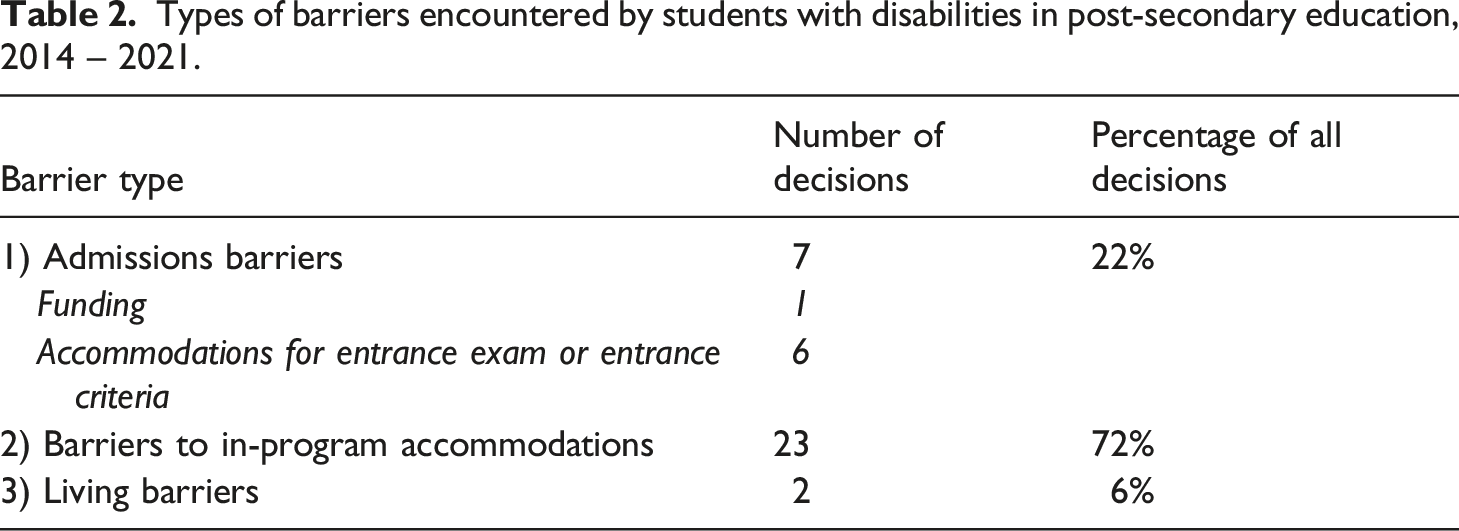
Types of barriers encountered by students with disabilities in post-secondary education, 2014 – 2021.
Admissions barriers
Admissions barrier decisions deal with requests for accommodation in the taking of entrance exams or in the way admission criteria are analyzed. One case in the study concerned funding. 52
With respect to accommodation requests, individuals with disabilities have experienced difficulties regarding the nature and extent of the evidence required by those administering standardized entrance exams. For example, an issue in Cohen was whether the Law School Admission Council (LSAC) would be amenable to accepting substitute evidence to prove his learning disability in place of a medical evaluation that was difficult to obtain. 53
In some fields, such as law, alternatives to the principal entrance exam are sometimes unavailable because of the profession’s belief in the accuracy of the comparisons that standardized testing can provide. For example, in Yashcheshen, Ms Yashcheshen, a woman experiencing Crohn’s disease, hypothyroidism and iritis, applied to the University of Saskatchewan’s College of Law without an LSAT score. In her application package, she explained that her “test taking abilities [were] greatly hindered by the manifestations of Crohn’s Disease”. 54 She therefore asked the law school to consider her application without an LSAT score, as she did not believe she had a fair chance at writing the test. The College informed her that they could not accept her application without an LSAT score. They testified further during the hearing of her Charter challenge that they value the LSAT because it provides an objective measure of the applicant’s ability to succeed at law school. 55
Cases about accommodations within standardized entrance examinations are just emerging. The following year, Ms Yashcheshen contacted LSAC to ask for accommodations while she wrote the LSAT. The LSAC provided Ms Yashcheshen with accommodations in the form of extended time to write each section of the test and extended break times. They were not precisely the accommodations that she had required and notably, did not include her request for the use of medicinal marijuana. 56 This case ultimately was dismissed at an early stage due to a jurisdictional issue. The applicant brought her claim under the equality provision of the Canadian Charter and it was found that the University was not subject to Charter scrutiny due to lack of government control. Unfortunately, the outcome of the case means that there was little analysis of the factors used to determine the appropriateness of the accommodations.
Moreover, while we know that cases of accommodation must be determined on an individualized basis, there are so few decisions that it is difficult to extract general guiding principles regarding accommodations in the context of LSAT admissions or other standardized testing. For example, at what point could a testing centre be successfully challenged for having requested a surplus of diagnostic assessments or be deemed to have relied on an incorrect opinion by its experts regarding the sufficiency of an accommodation? 57
Some decisions have been more illuminating, providing us with more guidance with respect to the ways in which admissions criteria outside of standardized testing should be handled. For example, in Longueépée, 58 Mr Longueépée applied to the University of Waterloo after dropping out of Dalhousie University. While at Dalhousie, he had undiagnosed and unaccommodated disabilities and he did not realize that he had these disabilities until after he had left Dalhousie. In his application to the University of Waterloo, he explained this situation and that it led to the extremely poor grades that he had received. The matter was sent to a special admissions committee. However, the special admissions committee did not grapple with the question of how to evaluate the unaccommodated grades. Mr Longueépée was then denied admission to the University of Waterloo.
The Ontario Court of Appeal held that the special admissions committee did not make any effort to understand how Mr Longueépée’s disabilities may have affected his ability to obtain the minimum grades required for admission to Waterloo, that it would not have caused undue hardship for it to have done so, and sent the matter back to the University for redetermination. Equally importantly, the Court of Appeal held that reviewing admissions was an appropriate use of human rights legislation. Historically, universities have been considered places where there should be little judicial scrutiny and considerable deference to their core processes and procedures. 59 This decision therefore lays a foundation for the adoption of future reviews of university admissions processes where there are issues relating to disability accommodation. At the same time, although the Court held that it would not have caused undue hardship for the committee to examine the other material in Mr Longueépée’s file (such as the reference letters and examples of work experience that the applicant had submitted to show his ability to succeed in the program), the Court did not clarify when the threshold of undue hardship would be met. This will have to be determined in the future on a case-by-case basis. Moreover, because admissions decisions are private, there will be no public information about how the University ultimately examined the issues in the Longueépée case unless the applicant and/or University take it upon themselves to publicize the outcomes. More generally, this means that if lessons from changes in admissions processes come to light, they may not do so quickly.
Finally, although cases about funding do not make up a large proportion of the admissions decisions that emerged in the sample, they have significant qualitative import. Decisions about what aspects of the educational journey of students with disabilities should be funded at the post-secondary level and why, generally reflect society’s ideas about how youth with disabilities should play a role in society. For example, in Zimmer, 60 Mr Zimmer wished to attend college at Gallaudet University. Attending Gallaudet University had been a lifelong dream. Mr Zimmer was a member of the Deaf community and his family lineage included at least a century of deafness. His mother had attended Gallaudet University and both his parents were educators. He was contacted by the Manitoba Vocational Rehabilitation Program, a provincial government-funded initiative (later called the MarketAbilities program), that provides funding to students with disabilities after high school. However, the program would not provide full funding to attend Gallaudet University and indicated that Mr Zimmer should have explored the possibilities of attending a local university (such as the University of Manitoba). Mr Zimmer indicated that he was not aware that he needed to explore the options in Manitoba but emphasized the important unique opportunities of attending University entirely in sign language where he would be able to communicate in extracurricular activities such as sports, and could more easily communicate in the classroom as well. The Manitoba Human Rights Adjudication Board analyzed the issue as one concerning a request for reasonable accommodation and dismissed the complaint upon the finding that there was insufficient evidence to prove that Mr Zimmer required an unmediated sign language educational environment. 61
The Zimmer decision is important because it illustrates how funding programs may be disconnected from broader aims of fostering the development of dignity and self-worth of disabled students seeking to obtain education at the post-secondary level. In Zimmer, many of the funding eligibility questions related to identifying Mr Zimmer’s specific vocational goals. By contrast, while Mr Zimmer did indicate some vocational goals he also stated that he liked “working with people and working with ideas” and that Gallaudet was “perfect for [him] to develop [his] personal growth, skills and interact with Deaf people from all over the world.” 62 The Zimmer decision also highlights the limited power of the human rights regulatory regime to address broader concerns about disability discrimination in funding policies. This limitation exists because individualized reasonable accommodation as opposed to universal first order equality is at the heart of legal responses to claims of disability inequality in this regulatory system. 63
In sum, admissions cases show some movement towards setting out principles for the review of accommodations in admissions tests and criteria. At the same time, significant room for development exists in this area of the law. Finally, with respect to funding for disabled students to attend post-secondary educational institutions, cases such as Zimmer show that a significant disconnect can exist between the aims of funding programs for students with disabilities and the personal self-development goals of the student. This disconnect is particularly acute when funding programs for students with disabilities narrowly envisage disabled students pursuing vocational skills and are ill-equipped to support students to develop their talents and creativity to the fullest potential. Moreover, as Zimmer shows, remedial anti-discrimination complaint models in Canada cannot easily be engaged to modify funding policies in general. A policy may only be modified if it can be shown that it had a discriminatory impact on the complainant. More emphasis should therefore be placed on how students with disabilities will grow personally in addition to their vocational or work-related plans in developing funding policies for disabled students.
Barriers to in-program accommodations
In the cases of in-program accommodations, students with disabilities have asked for accommodations that include rewriting assignments, permission to redo modules, extensions of time and various kinds of support. The types of accommodations are therefore wide-ranging. 64 Moreover, accommodations are necessary not only in the context of traditional in-class learning but also with respect to experiential practicums such as internships, externships and other work experience placements. 65 Disputes over in-program accommodation requests make up the largest proportion of the decisions in this study. They comprised 72% of the disputes brought by disabled post-secondary students between 2014 and 2021, or 23 of the 32 decisions (Table 2). Most students who pursue disability-related legal disputes in the post-secondary context do so because they are discontent with the accommodations that they received or because they are unable to receive accommodations. Unfortunately, many of these decisions have been blocked by procedural obstacles when they were brought to human rights commissions and tribunals. A large proportion (58%) of the cases concerning in-program accommodations in the sample were dismissed at a preliminary stage for issues such as lack of jurisdiction, timeliness or for having no reasonable prospect of success. A high proportion of the cases were brought by self-represented students who presumably did not have legal training and have not presented the best assembled legal cases. Consequently, it is challenging to find decisions that provide fully developed and clear guidance about the many elements of the discrimination analysis. However, the guidance that is available emphasizes the importance of students connecting their disability firmly to the supports requested. 66
The jurisprudence also identifies the difficulties that can be experienced by students who do not ask for accommodations at the earliest opportunity, 67 while at the same time demonstrating the concerns that some students have about safeguarding their privacy and avoiding stigma. 68 For example, in Kaiser, 69 a student with mental disabilities brought a complaint against Okanagan College in which she alleged that the College had discriminated against her in assigning hospital placement practicums. The student was involved in an ongoing, stressful life incident in one of the cities where work placements were available. This incident was a trigger for her mental disability. In order to avoid a work placement in the city in which the incident was taking place, she simply placed it as her last choice when she submitted her placement preference form. She did not think that she needed to reveal her disability and was concerned that doing so would attract stigma. Ms Kaiser was ultimately placed in the city that she wanted to avoid. Upon providing proof of her disability to the College, Ms Kaiser was assigned an alternative placement but one that would cause her to graduate at a later date and without her cohort. Her human rights complaint was dismissed at a preliminary stage for having no reasonable prospect of success. The Tribunal held that the College could only work to provide an accommodation once it knew of the disability, and that due to Ms Kaiser’s delay in engaging with the campus accessibility services to determine the supports she needed, the placement with the later start date was reasonable.
In conclusion, the doctrine of reasonable accommodation in the context of inclusive post-secondary education is developing very incrementally through anti-discrimination law in Canada. Lessons that are important to the success of disabled post-secondary students such as how to ensure that requests for accommodation result in supports that are both reasonable and sufficient, and that balance privacy against the consequences of revealing disability are neither easily forthcoming from the jurisprudence, nor well known to students.
Legal barriers
When attempts to obtain adequate educational support become difficult and contentious, students turn to seek institutional and legal remedies. This section deals with the challenges faced by disabled post-secondary students in engaging with law and process to ensure their post-secondary education. Many decisions in the sample revealed that students with disabilities encountered barriers related to lack of information about the relevant law and process. This problem was clearest in the cases relating to the doctrine of timeliness, and in those establishing a lack of connection between disability and the accommodation request.
Under Canadian human rights law, the doctrine of timeliness (also known as the doctrine of delay) requires applicants to file their complaints within a time frame set by various eventualities. The most relevant of these eventualities is that no more than 1 year should have elapsed since the last of a series of allegedly discriminatory events. 70 Moreover, the statutory provisions relating to timeliness have been interpreted in some jurisdictions such as Ontario to mean that the complainant must act quickly on their rights in order to file their human rights complaint under the law, and must do so even if there are other internal university or college appeals in progress. 71 Of the procedural barriers that affected in-program accommodations cases, the doctrine of timeliness was one of the most frequent, comprising 31% of the procedural barrier cases. Applicants were often late because they were waiting for the outcomes of other offices on campus and did not realize that this was not considered a good faith delay under the law. They were also often unaware that the outcome of an internal appeal would not count as part of the series of allegedly discriminatory events.
Knowing the mandates of University offices and how to navigate the system is an essential element to demonstrating legal inequality or the absence of appropriate accommodation. When a student does not know the mandates of campus offices related to disability, accommodations, accessibility and/or human rights (which may also include related offices such as ombuds offices), this can greatly affect their ability to show effectively their accessibility requirements. 72 The largest number of cases that were dismissed at a preliminary hearing were dismissed because the educational institution was able to establish that there was no reasonable prospect of the student showing discrimination under the relevant human rights statute. Disabled students could be empowered for a better chance of success if they knew what legal steps must be taken to pursue accommodations and when facts show a breach of the human rights legislation.
In conclusion, the decisions on legal barriers reveal a need to support disabled students on the ground so that they are better able to navigate campus offices, legal processes and substantive law to acquire accommodations and pursue redress, when necessary.
Conclusion: Reimagining Post-secondary education for disabled students
Overall, to fulfil the letter and spirit of the CRPD and domestic equality rights law, and to empower post-secondary students with disabilities in their right to education, several steps must be taken in policy and practice by post-secondary educational institutions and government.
Development to the fullest potential is important in educational policy for post-secondary students with disabilities. The right to post-secondary education for disabled students in Canada would be strengthened if more inspiration were drawn from Article 24 of the CRPD. There are four places where greater inspiration would be particularly helpful. First, the CRPD outlines the aims of the right to education. These aims include ensuring the full development of human potential, dignity and self-worth and each student’s personality, talents, creativity, and mental and physical abilities. Incorporating these goals into policies and programs will set a tone for their interpretation and implementation that is more in keeping with upholding the rights of students with disabilities in the post-secondary education context. This study has shown a need for centring disabled students’ aspirations, potential for full development, dignity, self-worth and concern about stigma in all policies and processes, including those relating to admissions, funding in-program accommodations, and the seeking of remedies. It is crucial that policymakers and educators contemplate the different avenues for development that post-secondary education provides to disabled students, including students with intersecting identities.
Second, within the implementation processes of the policies and other systems of support for students with disabilities in post-secondary institutions, time needs to be dedicated to explaining relevant legal concepts to students. This study has shown that several cases have been dismissed at a preliminary stage due to procedural and legal doctrinal barriers. A better understanding of concepts such as timeliness and of how to connect accommodation requests to challenges faced will assist by making complaints easier. It may also assist to avoid complaints altogether by proactively fostering a more equal playing field.
Third, government funding to support test case litigation with disability rights interveners should be made available. As discussed above, one of the findings of this study which cuts across different barriers was that a large proportion of the cases were dismissed at a preliminary stage. In those cases, educational institutions were able to argue that the case was not strong enough to proceed because it lacked fundamental elements necessary to show discrimination or failed to meet required deadlines (i.e. timeliness). As a result, the jurisprudential guidance on elements of the required discrimination analysis has become impoverished. Well-organized legal cases will assist to clarify the doctrines surrounding anti-discrimination and equality law in the context of post-secondary education. This will assist students, all litigants and decision-makers. To have stronger legal doctrines, we need to have complete cases. Test cases will allow for fuller testing of facts and law.
Fourth, and most notably, proactive accessibility legislation that establishes binding standards to guide the development of educational policies and processes have the potential to be demonstrably beneficial in implementing the aims of Article 24 of the CRPD in the post-secondary context. As discussed in the section on legal frameworks, this method has been used in Ontario. While it is too early to assess the impact of the standards on disabled student experiences, the final recommended standards in Ontario definitely show innovative approaches to ensuring and measuring the implementation of accessibility in ways that comply with the aims of the CRPD, including by respecting intersectionality and developing human capabilities. The use of accessibility legislation also avoids the many inadequacies of the reactive anti-discrimination regulatory system such as those outlined in this article.
In conclusion, ensuring meaningful access to post-secondary education for students with disabilities requires a concerted effort which, at the very least, synchronizes these four steps. All these steps should be anchored in Article 24 of the CRPD and should also draw upon a human capabilities and an intersectional approach. In the final perspective, this means valuing the aspirations and dreams of post-secondary students with disabilities in legal, policy and practical frameworks.
Footnotes
Acknowledgements
This paper was presented at Inclusive Post-secondary Education and Persons with Disabilities, the Berkeley Center on Comparative Equality & Anti-Discrimination Law, Disability Rights Working Group Conference (5-6 May 2022). The author wishes to thank the following individuals for their research assistance: Dalal Hjjih, Roxana Jahani Aval, Florence Kwok, Lucia Limanni and Ariel Minott. They were students with the Law, Disability & Social Change Project at the University of Windsor, Faculty of Law in 2021-22. Thanks also to the anonymous reviewers for their helpful comments.
Declaration of conflicting interests
The author(s) declared no potential conflicts of interest with respect to the research, authorship, and/or publication of this article.
Funding
The author(s) received no financial support for the research, authorship, and/or publication of this article.
