



Abstract
South African legislation is viewed as progressive in relation to persons with disabilities. Policies addressing socio-economic inequality include a focus on promoting skills development and employment for persons with disabilities. A predominant instrument for providing post-school training and work opportunities to disadvantaged youth, including persons with disabilities, is learnership programmes funded through the Sector Education and Training Authorities (SETAs). Despite enabling policies and investment in learnerships, persons with disabilities comprise only 1.3% of the workforce, while an estimated 15% of the population are disabled. This situation opens up the skills development strategy, and supporting legislation, for some critical review. Using Critical Disability Studies as a lens, this paper offers three critiques concerning the operation of learnerships for disability inclusion in South Africa; (1) neglecting to align skills development and market needs holds persons with disabilities in a cycle of training and poverty; (2) focusing exclusively on providing hard skills fails to account for complex challenges faced by persons with disabilities; and (3) viewing skills development and inclusive employment as a charitable endeavour fails to achieve social justice. This paper argues that the planning and implementation of learnerships should respond to current debates concerning holistic approaches to inclusive development.
Introduction
South Africa’s post-apartheid legislative framework is often viewed as progressive. It is based on policies that were designed to address the historical inequality in the country through a focus on fairness and social justice. However, 25+ years after the end of apartheid, South Africa remains one of the most unequal societies in the world (Diaz Pabon et al., 2021). It has been argued that persons with disabilities remain the most marginalised group in this context, adversely impacted by failing infrastructure and poor service delivery, and struggling to access and participate in the open labour market (Watermeyer et al., 2006). South African companies, private and public, reported in 2021 that persons with disabilities comprised 1.3% of their workforce (Commission for Employment Equity, 2021), despite the disability inclusive employment target of 2% set in legislation (Department of Trade and Industry, 2014), and while persons with disabilities are estimated to comprise 15% of the population (World Health Organization, 2011). According to international findings, when persons with disabilities are employed, they are less likely to be in full-time jobs and more likely to be in low-paying jobs with poor working conditions, and poor prospects for career progression as compared to their non-disabled peers. Consequently, persons with disabilities have lower relative income levels and a higher likelihood of living in poverty (Bredgaard and Salado-Rasmussen, 2021).
Contributing to the low levels of formal employment amongst persons with disabilities is the state of post-secondary education for persons with disabilities in South Africa. Entrance into degree-level programmes at universities or colleges is extremely low for persons with disabilities due to lack of quality basic education, lack of funding and persistent access barriers to the physical environment and learning materials (Howell 2006; Lourens 2015). It has been suggested that, through providing learnership programmes, the Sector Education and Training Authorities (SETAs) offer a solution to the challenge of post-secondary education for persons with disabilities in South Africa, and have potential to increase employment for this group. The SETAs are the South African government’s main vehicle for transforming the labour market. Figures 1 and 2 offer an overview of how SETAs function and aim to influence the labour market. They are industry-specific bodies, established in the National Skills Development Strategy of 1998. The SETAs were established to: (1) address the skills shortage in the South African workforce through skills development programmes in order to improve the productivity and competitiveness of the economy; (2) address the challenges of social development and the eradication of poverty and; (3) expand the post-school landscape for young people (Department of Labour, 1998). The main target groups of the SETAs are people regarded as “previously disadvantaged” i.e., Black South Africans (The term “Black” refers to Coloured, Indian and Black South Africans in the South African legislation.)
1
, women and persons with disabilities. There is very little research on SETA learnerships in terms of their long-term impact on the South African workforce and the transformation of the labour market. Table 1 offers an overview of the number of SETA learnerships registered and certificated in 2011–2017, however this data is not disability dissagregated. Regarding persons with disabilities, fluctuating disability employment statistics open up South Africa’s skills development legislation and implementation for some critical review. The flow diagram illustrates how learners move through the SETA programmes supported by the Skills Development Act. The flow diagram illustrates how learners move through the SETA programmes supported by the Skills Development Act. It also provides commentary on some of the challenges learners experience when they are ready to exit the learner.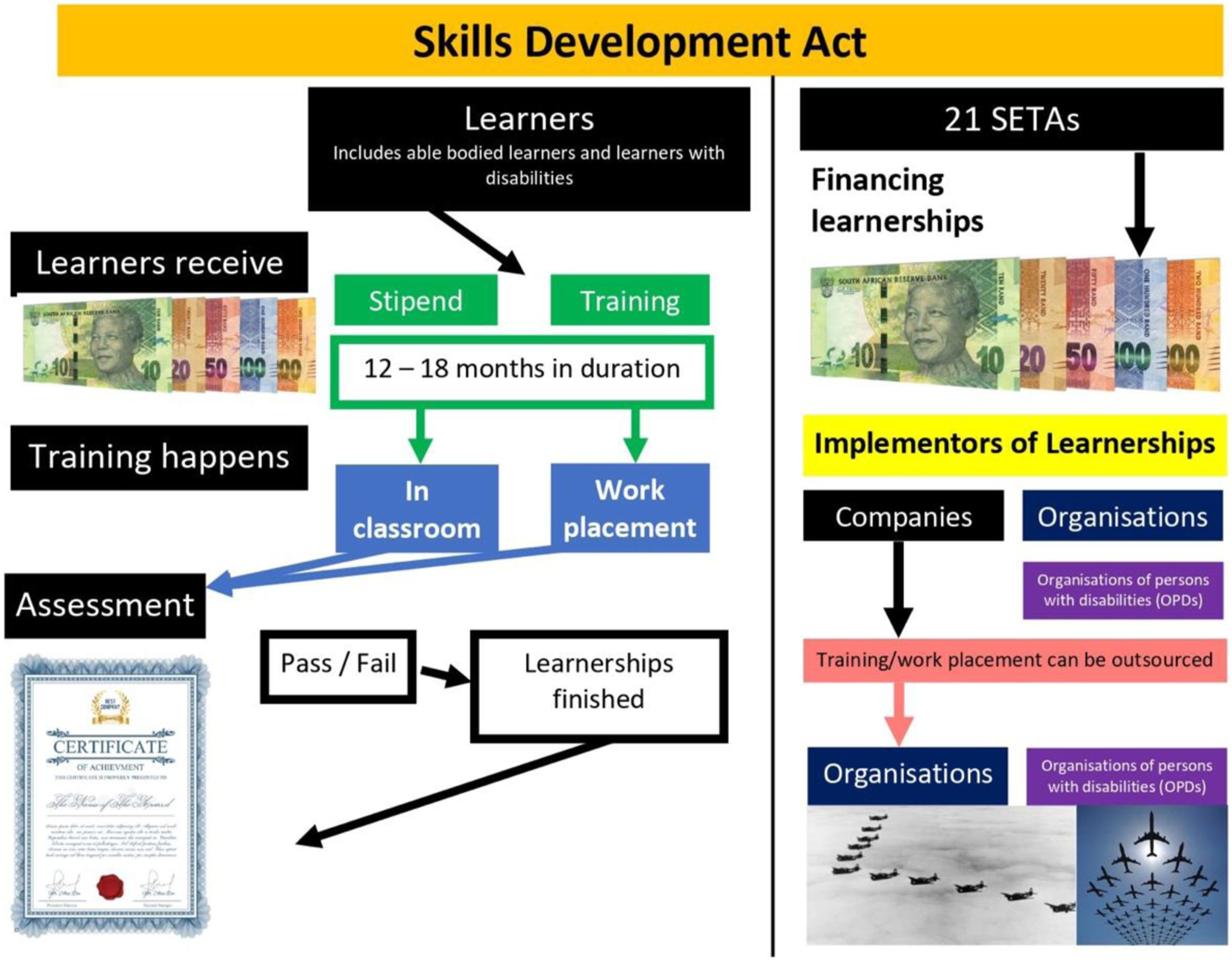
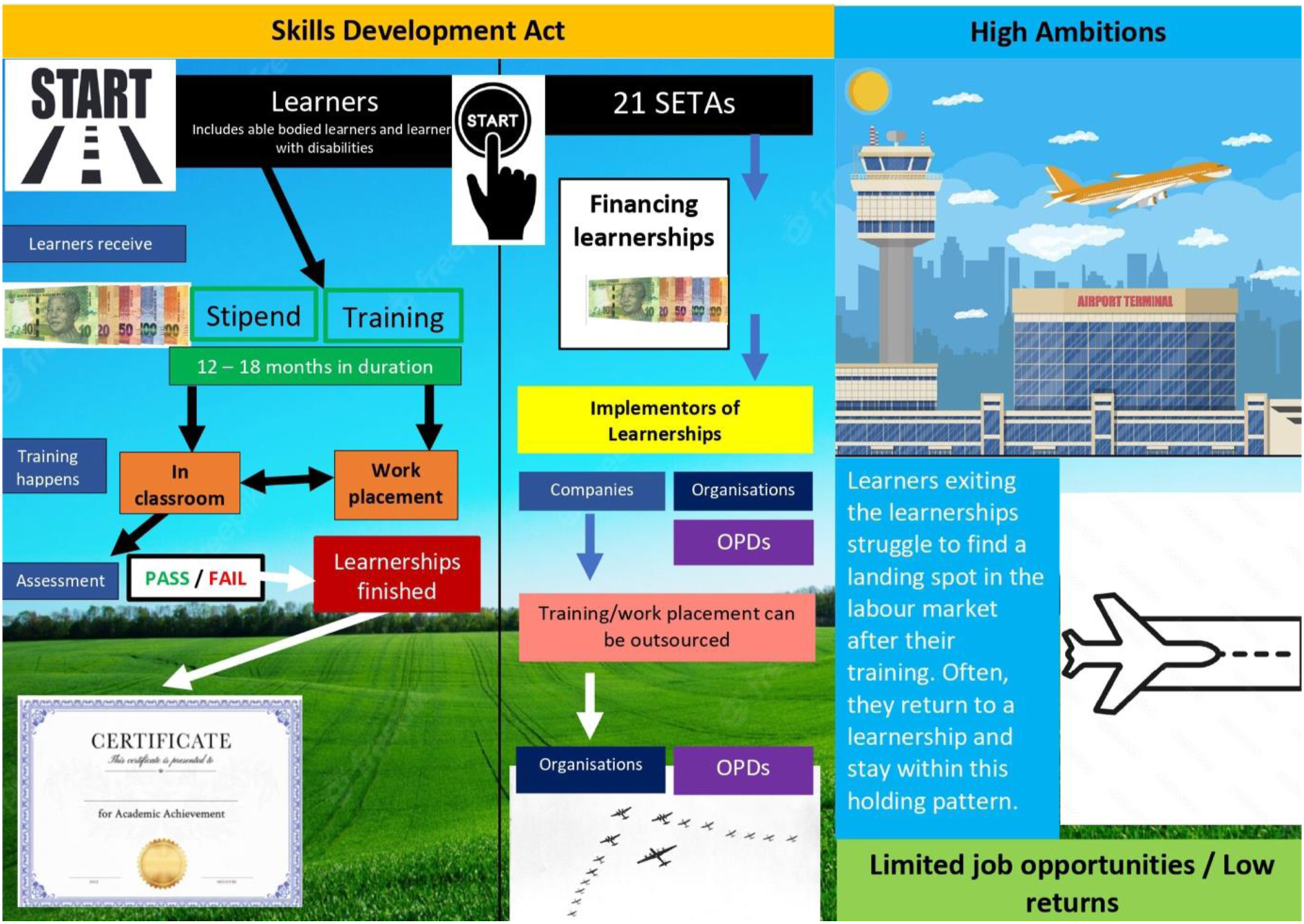
Number of SETA learnerships registered and certificated in 2011–2017.
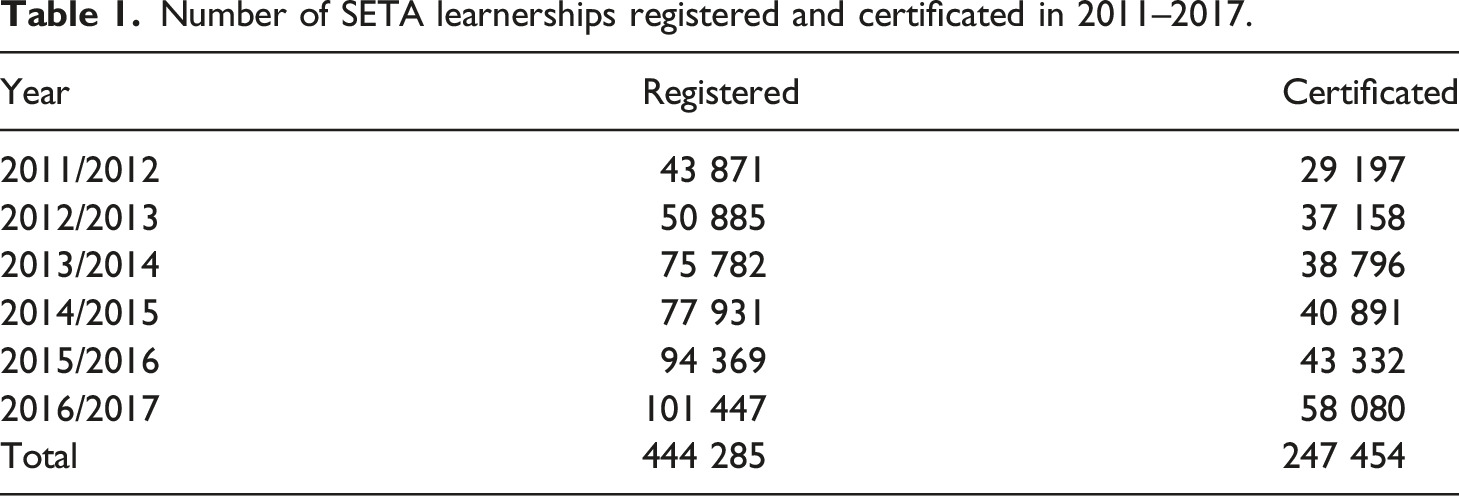
The World Health Organization (WHO) adopts a twin-track approach to inclusive development which focuses on (1) working with persons with disabilities to develop their capacity, address their specific needs, ensure equal opportunities and rights, and facilitate them to become self-advocates; and (2) working with the community and society at large to remove barriers that exclude persons with disabilities, and ensuring the full and effective participation of all persons with disabilities in all development areas, on an equal basis with others (World Health Organization, 2010). This paper suggests that SETA learnerships predominately focus on the first track, however, they fail to holistically develop the capacities of persons with disabilities, and to address their specific needs outside of hard skills development. Further, we argue that if the structural and systemic barriers of access to the world of work are not addressed and if the legislative mandates are not properly understood or implemented, the perpetual uptake and re-uptake of persons with disabilities into learnerships can be described as just a holding pattern for people that have no place to land.
This paper draws together the limited research on learnerships for persons with disabilities in South Africa and the experiences of the authors in the design, delivery, monitoring and evaluation of skills training and employment interventions for persons with disabilities, and in accessing the labour market as a person with a disability. The authors are also located within the academic discipline of Disability Studies as lecturers, programme and course convenors and post-doctoral researchers, seeing ourselves as pracademics who are firmly rooted in the Global South.
Disability in the South African context
In South Africa, policies such as the Employment Equity (EE) Act (1998), the Broad-Based Black Economic Empowerment (B-BBEE) Act (2003) and the National Skills Development Strategy III (2011) promote inclusive practices in skills development and employment towards transforming the labour market (Department of Higher Education and Training, 2011, Department of Labour, 1998; Republic of South Africa, 2004). Still, the general unemployment rate in South Africa is high – recorded at 32,5% in the last quarter of 20,20 2 (Statistics South Africa, 2021). Despite affirmative and progressive legislation on disability, unemployment rates for persons with disabilities in the formal sector are still considerably higher than those of non-disabled persons (Commission for Employment Equity, 2021). Research has identified a number of barriers which hinder the full inclusion of persons with disabilities in the open labour market. These include lack of knowledge of and access to reasonable accommodation, lack of accessible infrastructure and information, and attitudinal barriers in society including a narrow belief that equates disability with inability to work (South African Human Rights Commission, 2015). Persons with disabilities are faced with disadvantages early in their lives as they often do not benefit from good quality education and health care. Among the barriers to accessing education are the lack of accessible learning material, the fact that teachers, particularly in the post-secondary space are not adequately equipped to teach learners with disabilities, and a common attitude that persons with disabilities will not be able to enter the job market so there is no need to focus on career development (Engelbrecht et al., 2017).
To address inequality in education, the South African government published the Education White Paper 6 (EWP6) (Department of Education, 2001) as the South African inclusive education policy. However, research shows that there are still significant challenges to the implementation of an inclusive education system (McKinney et al., 2020). Despite its intentions, the EWP6 is merely a White Paper which has not been adopted as a legislative Act and thereby only serves as guidelines which are not enforceable by law. Likewise, South Africa’s disability-specific policy, developed in response to the ratification of the UN Convention on the Rights of Persons with Disabilities, the White Paper on the Rights of Persons with Disabilities (WPRPD, 2015) is not enforceable by law.
The sector education and training authorities
The SETAs were developed to address the low skills level and employment challenges in South Africa, and to improve productivity and competitiveness of industry, business, commerce and services. There are currently 21 industry-specific SETAs. The larger SETAs include the ServicesSETA, Wholesale and RetailSETA, AgriSETA and FinanceSETA. The SETAs offer skills development through learnerships, internships, unit-based skills programmes and apprenticeships, with learnerships having the highest number of enrolments. Learnerships involve a combination of classroom teaching and workplace experience spanning a period of 12–18 months.
There are several role players involved in the implementation of learnership programmes. The SETAs may fund employers to implement all aspects of the learnership in-house, meaning that all training and work placement activities take place at the employer. Employers can also outsource the training component to external training providers. Equally, training providers can access SETA funding to implement learnerships. In this case, the training provider partners with employers to offer the work experience component.
Learnerships give participants, provided they meet the requirements, a qualification within the National Qualifications Framework (NQF) on Level 1–10. Level 1 is equivalent to grade 9 in the South African education system and Level 4 equivalent to grade 12 and the National Senior Certificate, which is the entry point to higher education. 3 The learners are paid a stipend to cover transport and basic needs. The stipend ranges from USD100 to USD300 a month depending on whether the learnership is being implemented by a non-profit organisation or private company, and under which SETA the learnership falls. Employers or training providers receive tax rebates of R80,000 (approximately USD4700) per year per able-bodied learner, and R120,000 (approximately USD7000) per learner with a disability. Learnerships for persons with disabilities are implemented using either a mainstream approach where persons with disabilities are included in learnerships with non-disabled learners, or by implementing learnerships specifically for persons with disabilities. The latter approach is the most common.
The number of learnerships offered through the SETAs has increased over recent years. As an example, in 2014/2015 the ServicesSETA had 3693 learners enrolled in learnerships and this number increased significantly in the following years to 23 227 learners in 2017/2018. In the period 2016–2018 7% of the enrolled learners were persons with disabilities (Department of Higher Education and, 2018: pp. 37–38). The figure below provides an illustration that shows the learnership pathway.
Establishing the impact of learnerships
There is limited research on the long-term impact of learnerships. The SETAs’ mandate is to provide up-skilling opportunities for employability. Therefore, they tend not to track the transition of learners into employment. This is concerning as learnerships have been positioned as the most appropriate space for the inclusion of people with disabilities in the post-secondary education domain.
A few qualitative studies have investigated the outcomes and impact of learnerships. One example is the Human Sciences Research Council (HSRC) which undertook research to assess and evaluate the progress made in skills development since the implementation of National Skills Development Strategy II in 2005. A survey was conducted with people who had enrolled in a learnership or apprenticeship in 2005, and they were interviewed again in 2007 and 2010. Based on the positive findings of this research, the HSRC developed a policy brief proposing interventions for further expansion of enrolment and access to learnerships (Kruss et al., 2014). The policy brief states: “In general, it is evident that these skills development systems are producing employable individuals – or at least, equipping individuals to enter employment” (Kruss et al., 2014: p. 2). The number of learnerships offered through the SETAs has increased over recent years with the number of participants enrolled more than doubling from 2011 to 2017. In the same period the percentage of enrolled persons getting certified has decreased (Department of Higher Education and, 2018).
As the HSRC research ended in 2010, it does not include the significant increase in people registered in the following years in SETA learnerships and the decrease in the percentage of people getting NQF certifications. This trend of increased enrolment but decreased completion and certification must be considered.
Despite the apparent positive outcomes of equipping individuals with skills, the HSRC policy brief also states that the socio-economic status of participants in learnerships was found to be a strong predictor of employment and labour market success. It was found that positive employment outcomes are least likely, and more complex trajectories are most likely for women, those with low socio-economic status, those who are African (black), those with low educational levels and those in low-status occupations and sectors (Kruss et al., 2014: pp. 3–6). Although the policy brief does not include a focus on persons with disabilities (which is perhaps telling in itself), these findings are highly relevant to people with disabilities. The majority of persons with disabilities in South Africa will be found in the demographic groups identified to have a less likelihood of a positive employment outcome and a more complex career trajectory. These factors compounded with the specific challenges faced by persons with disabilities in terms of health, accessibility and negative perceptions put persons with disabilities further back in the queue to access the labour market.
Another study on SETA learnerships followed young people aged 20–24 years from 2009 to 2012, some enrolled in learnerships, others not. This study found that learnerships tend to focus on people with at least grade 12, which is the usual entry requirement for post-secondary education, while young people with lower education levels are left out. Another significant finding was that the learnerships do seem to facilitate a transition into work for people as compared to people not in learnerships. This advantage, however, seems to fade with time, and completing a learnership is not associated with better jobs in terms of income or promotion as compared to those who were not in a learnership (Rankin et al., 2014). Again, these findings do not bode well for the prospects of persons with disabilities, as they often have lower levels of education and therefore may be left entirely out of the opportunity for skills development.
Overall, we found that limited research has been done on the SETA learnerships and their impact, and especially a dearth of recent research. This is important as learnership programmes have continued to expand considerably in terms of enrolments, and the resources spent on these programmes. The literature revealed further that research on the impact and outcomes of learnerships for persons with disabilities is almost non-existent.
One example of a skills development programme implemented by a disability sector non-profit organisation (NPO) is described in the Disability Catalyst 5 published by Disability Innovation Africa at the University of Cape Town where Ariefdien (2016) outlines how Epilepsy South Africa, Western Cape Branch (ESA WCB) facilitates employment through the Epilepsy Disability Employment Support Service (eDESS) programme. According to the paper, the eDESS programme provides persons across all disabilities access to skills development and supports them into gainful employment. This is done through working with employers to prepare the workplace for the employment of persons with disabilities and providing support to the employer and employee (or learner) at the workplace. This work is facilitated in large part through SETA funded learnerships. The paper identifies several challenges that impact persons with disabilities’ participation in Skills development and entrance into employment. Arifdien argues that the monthly disability grant of maximum ZAR1980 (approximately USD135) provided by government to persons with disabilities may deter some individuals from participating in skills development and employment. People may fear that they will lose their disability grant if they start earning an income.
Arifdien identifies another challenge as “learnership hopping.” This phrase is used to describe the common situation where participants complete one programme only to move onto another one if employment is not secured. “Learnership hopping” refers not to a structured progression where learners move to a higher NQF level, but a haphazard process where learners may move to programmes at lower levels and in different sectors in order to retain access to a learnership stipend. Often, employers view learnerships as a once-off intervention, rather than one spanning over several years with a focus on an upwards trajectory. Ariefdien (2016: pp. 78–79) finds that this “learnership hopping” becomes counterproductive and a waste of resources if learners jump to alternate learning pathways or to a lower NQF level than they have previously completed.
According to Ariefdien (2016: p. 79), skills development programmes are clearly an enabler for persons with disabilities to enter into the workplace and be economically empowered. However, the literature review did not identify to what extent the skills development programme in general, and SETA learnerships specifically, provide access to sustainable decent work for participants and, let alone, for persons with disabilities. Data and statistics from these programmes focus on registration and completion but lack information on dropouts and the trajectories of participants across all demographics and especially for participants with disabilities. Though the official employment rate for persons with disabilities provided by the Department of Labour is only one indicator, it does suggest that persons with disabilities are not increasingly being included in the formal labour market. Therefore, there is a need to look critically at learnership programmes to determine how structure and delivery might enable or inhibit disability inclusion in skills development and employment.
Taking a critical look at the SETA learnerships
Apartheid has been identified as an instrument that prevented social cohesion, hindered development and supported discrimination in all spheres, including disability (Letseka, 2009). There have been gains, post-apartheid, in terms of the promotion of human dignity, the promotion of non-racialism, decreased discrimination, increased access to education and increased freedom. Yet we continue to struggle with disability inclusion. It has been argued that this is because disability remains viewed as a problem of the individual body rather than as an issue of social oppression in South Africa (Watermeyer et al., 2006). Therefore, the critical perspective on skills development provided below is founded in a framework that critically evaluates “disability” as a construct.
Critical disability theory, as a member of the critical theory family, is a theoretical approach to the concept of disability that is concurrently explanatory, practical and normative (Hosking, 2008). This approach balances the contributions of impairment, personal responses to impairment and the barriers imposed by the social environment to the concept of disability. Critical disability theory interrogates the ways in which deep-rooted meanings about disability support the social positioning and material circumstances of disabled persons. Ableism pervades multiple environments, not least the education environment, disadvantaging persons with disabilities and creating the endless treadmill of under-education, unemployment, hardship, poverty and isolation that many persons with disability face (Procknow, 2017). With this critical framework in mind, the below sections consider three interrelated critiques of learnership programmes for persons with disabilities.
Misalignment between skills development and market needs
As established, little is known about the impact of learnerships in advancing persons with disabilities into the labour market. However, the low skills levels of persons with disabilities are continuously identified as a challenge for employment, and employers argue that they cannot find persons with disabilities who have the needed skills (Gida and Ortlepp, 2007; Soeker et al., 2018). This suggests that the skills being provided in learnerships are not aligned with market needs, or that persons with disabilities are not exiting learnerships with the requisite skills. Fischer Mogensen (2021), in a qualitative study on the impact of disability learnerships, found that out of an initial group of 75 learners with disabilities, as the learnership was coming to an end, only 15 (29%) were expected to complete the learnership with an accreditation of their skills. Another 36 would complete the learnership programme, but would not be deemed competent in the final assessment and would not receive the accreditation. In the experience of the training provider for this learnership, these numbers were relatively high for a learnership for persons with disabilities. This means that, after having completed a SETA learnership, very few of the learners with disabilities would have accredited proof of their skills acquired. Similarly, Soeker et al. (2018) conducted research with persons with disabilities in sheltered and protective workshops focusing on their experiences and perceptions of work skills development for transition into the open labour market. A main challenge identified by the participants with disabilities in transitioning into open labour market employment was that they had no official documentation to certify their skills.
Like Arifdien (2016), Fischer Mogensen (2021) identified “learnership hopping” as a challenge as none of the eight people with disabilities interviewed in her study had any employment prospects after ending a SETA funded business administration learnership. Rather, most expected to apply and join another learnership or other training opportunities. We agree that “learnership hopping” is counterproductive for the career development of persons with disabilities and wastes resources. However, we argue that the fault for “learnership hopping” does not rest with persons with disabilities, but rather with the inability of the SETAs and training providers to provide access to the open labour market through carefully aligning their skills offerings with the needs of the labour market and the unique abilities of disabled persons. If the alternative to joining another learnership is unemployment and isolation at home, it is understandable that many choose to join a programme which provides opportunities for further skills development, some income and social interaction. The figure below provides an illustration of how learners move through learnerships and provides some commentary on the current challenges within the learnership structures.
Indications are that persons with disabilities are not receiving the accredited hard skills needed to break through into the open labour market. The skills that they do receive are not at the level demanded by employers, and these skills do not meet the demands for technical proficiency in the current labour market. We suggest that in failing to acknowledge this skills gap in labour supply and demand, learnerships contribute to keeping persons with disabilities held in a cycle of training and poverty.
Hard skills development fails to account for complex challenges faced by persons with disabilities
While we strongly support the need to close the skills gap between labour supply and demand, we argue that the tendency to focus exclusively on the provision of hard skills in learnership programmes fails to account for the complex challenges faced by persons with disabilities. Santilli et al. (2018) focus on the employment of persons with disabilities, and especially on the role of soft skills in accessing decent work. They find that, historically, hard skills were considered the only needed skills to access the labour market. This view is no longer the case. In a complex, globalised labour market with rapid technological advances, emphasis is placed on a series of skills – soft skills useful in facing planned or accidental transitions.
Soft skills are generally conceptualised as a broad range of skills which empower the individual to effectively handle their work context, collaborate with colleagues, perform adequately and realise career goals. Comparing studies on soft skills in the workplace, Santilli et al. (2018) identify five key soft skills: (a) social skills; (b) higher-order thinking such as problem-solving and decision-making; (c) communication skills; (d) self-control including regulating feelings and behaviours; and (e) positive self-concept.
Santilli et al. (2018) show that limited soft skills, or the perception of low soft skills, in persons with disabilities is one of the main factors in finding and maintaining permanent and paid jobs. This perception appears to be associated with high discrimination levels in the job market that can be seen in employers’ attitudes towards persons with disabilities. Employers often think that persons with disabilities have fewer soft skills than other workers, especially when it comes to social and communication skills. On the other hand, interventions targeting persons with disabilities often do not develop soft skills adequately as attention tends to be focused on special contexts, high levels of contact with educational or socio-medical staff and low social contact with peers, as well as low quality of training as discussed in the above section. This focus means that skills development in communication, problem solving, higher-thinking, as well as social skills is limited (Santilli et al., 2018: pp. 307–308).
SETA learnerships do not include sufficient focus on the development of soft skills. Fischer Mogensen (2021), in a study focused on a learnership programme provided by a disability sector organisation and funded by the SETA, found that the organisation did include aspects of soft skills development in addition to the hard skills stipulated by the SETA. This was done to support the learners to finalise the learnership programme and to build their capacity for employability. The study did find that these learners had increased levels of social skills, communication skills and a positive self-concept. These skills were developed in their engagements with peers, training facilitators and mentors, and co-workers at the workplaces. However, the learners did not show high levels of higher-order thinking as they struggled to independently make decisions, think critically and solve problems to enhance their access to the labour market.
Further, the tendency in learnership programmes to view disability as a separate or special concern may overlook issues of intersectionality related to how factors such as gender, race and poverty impact an individual’s experience and engagement on a programme. Drawing individuals into programmes without an understanding of how their specific circumstances will impact their participation might mean that drop-out is not sufficiently understood and that barriers that impact further employment are not addressed. The importance of intersectionality and attention to multifaceted factors are confirmed by Trainor et al. (2008). They argue that youth experience different educational and employment outcomes influenced by gender, race and ethnicity, socioeconomic status, and disability classifications. Therefore, social, political, economic, educational and cultural contexts need to be considered in developing effective intervention for transitioning from education to the labour market.
The socio-economic barriers and challenges that persons with disabilities face from childhood, through education, and into adolescence and adulthood influence not only their levels of education and skills, but also their agency. We argue that in order to facilitate transition into the labour market, persons with disabilities need support to build their capacity to negotiate contexts and challenge societal barriers, to be resilient, to have self-determination and to exercise agency, alongside the development of hard skills (Duffy et al., 2016; Lindstrom et al., 2011; Soresi et al., 2008).
Charity fails to achieve social justice
Current research in South Africa supports the suggestion that deeply embedded beliefs concerning the limited capabilities of persons with disabilities hinder the implementation of otherwise progressive inclusive employment legislation (Bam and Ronnie, 2020). A dominant view has positioned persons with disabilities as non-productive and passive recipients of charitable goodwill (Botha, 2020; Botha and Watermeyer, 2022). Consequently, skills development and employment of persons with disabilities is often viewed as a charitable endeavour, a view which fails to achieve social justice.
In recent decades, deeply embedded charitable discourse has been increasingly disrupted in no small part due to the activism of persons with disabilities (Ebrahim et al., 2020). However, the residue of paternalism persists even in policies and practices framed by concerns related to the human rights of persons with disabilities. Abidi (2010) argues that the strategies applied across the globe to increase the numbers of persons with disabilities in waged employment – such as stipulating quotas, offering incentives and/or imposing fines – involve patronage, sympathy and “a sense of protectionism.” This has implications in terms of, among other things, the roles deemed appropriate for persons with disabilities and how disabled persons experience the workplace (Abidi, 2010; Bam and Ronnie, 2020).
Considering the ways in which disabled persons are positioned within the policies and practices of skills development in South Africa may shed light on the efficacy of these programmes, in particular, related to whether persons with disabilities are taken up into employment. We must consider how skills development strategies, including quotas and incentives, might be shadowed by subtle paternalism which, rather than disrupting narrow beliefs about disabled persons, further entrenches a societal view of persons with disabilities as passive welfare recipients. Of course, these quotas and incentives apply not only to disabled persons but, in line with South African EE and B-BBEE legislation, to designated groups including Black women and youth. However, unlike with other groups, the inclusion of disabled persons tends to be framed by language and culture suggestive of a moral imperative, in other words, the notion that employing people with disabilities is “the right thing” or “a good thing” to do (Botha, 2020; Botha and Watermeyer, 2022). In this way, skills development aimed at persons with disabilities seems more closely connected to the realm of corporate social responsibility (CSR) than it does to investment in talent development and acquisition.
Further, unlike with other designated groups, persons with disabilities tend to be separated from the mainstream into specified programmes. Not only does this go against the principles of inclusive development (McClain-Nhlapo, 2010), it strengthens a deep-rooted societal belief in the inherent difference of disability and supports the notion that the needs of persons with disabilities pose insurmountable difficulties. In short, this approach offers little to the drive towards persons with disabilities being able to integrate into all spheres of society as full and equal citizens.
In addition, it has been argued that South Africans with disabilities have to navigate a social welfare system that holds them hostage. Persons with disabilities may be reluctant to enter employment due to fear of losing the security of the disability grant (Arifdien, 2016; Engelbrecht and Lorenzo, 2010). A view of persons with disabilities as State dependents with little likelihood of moving into self-sufficiency means that there are no clear pathways from receiving a government grant towards entering formal employment, and very little support for those making this transition. This perpetuates the segregation of people with disabilities, reinforces barriers to inclusion and fails to achieve social justice for persons with disabilities.
Inclusive employment in the open labour market
As mentioned earlier, SETA learnerships appear to be situated within the first track of inclusive development as outlined by the WHO, which focuses on up-skilling persons with disabilities. However, the above critique has highlighted the need for a more holistic approach to building the capacities of persons with disabilities to enter the open labour market. We do acknowledge that the SETAs operate within a complex context where historical, political, economic and social factors influence the labour market. This is compounded by how persons with disabilities are viewed in both the post-school education and employment sectors. This section will therefore offer a broader discussion about the approach to inclusive development within which skills development and inclusive employment practices are situated, and what this means for persons with disabilities accessing the open labour market.
The SETAs’ reformative mandate is clear – to create an inclusive labour market with skills that are amenable to the needs of the current market. It is evident, given the dilemmas raised above, that there are many unanswered questions about the efficacy of these reforms. Reviewing the current labour market statistics raises questions about why the employment of persons with disabilities appears stagnant. Why does it appear that these statistics are unresponsive to the mammoth effort made, and resources invested in the SETA programmes over the last 20+ years? In order to efficiently respond to these hazy issues, we have to ensure that our current methodologies for investigating evolving concepts within employment are sensitive. It is in light of this that our discussion here considers the accepted method for how the efficacy of development programmes for disability inclusion are investigated and reviewed, and the problematic definitions of “inclusion” and “exclusion” that frame these processes.
Spandler (2007) asserts that there is a problem with how social inclusion and exclusion are understood within development and reform environments, suggesting that a conceptual slippage has occurred that has serious consequences for the effectiveness of reform programmes. Similarly, Haudenhuyse (2017) argues that “social inclusion” is often defined as the binary opposite of “social exclusion.” Consequently, both concepts remain undefined and, therefore, difficult to monitor, and open to conceptual manipulation. Spandler (2007) asserts that if inclusion is viewed as the binary opposite to exclusion, the solution to exclusion is argued to be inclusion. As a result, ill-defined social exclusion leads to the weaponisation of social inclusion as the antidote to any and all exclusionary practices. The danger in this approach, especially in the development environment, is that overly simple reform programmes to include marginalised persons, with manageable and measurable targets, are deemed a fit solution to social exclusion.
Haudenhuyse (2017: p. 86) argues that ignoring the influence of power dynamics leads to the generation and regeneration of exclusionary practices. An assumption that “mainstream” interventions are inherently and indisputably “good” for everyone is supported by the approach of current policymakers which, in order to address key development issues, focuses on inclusion, but neglects to understand the complexity of why exclusion happens, and how programme design can be responsive to address multiple barriers. Haudenhuyse (2017) argues that when inclusion is used as the response to exclusion, while it appears to be a clean-cut, manageable exercise, it cannot truly address complex, layered, and difficult issues.
This argument is applicable to SETA learnerships as a reform programme focused on inclusion. The SETAs primarily focus on numbers of enrolled and certified participants but fail to adequately engage with the complexity of disability as discussed earlier, which influences persons with disabilities’ access to and inclusion in training and employment. As a result, we suggest that there needs to be a re-evaluation of what is currently being delivered in terms of whether this is aligned to what is needed to affect real change in persons with disabilities’ lives.
In order to truly acknowledge that social exclusion is “real,” the role of power dynamics, structural and systemic ableism, and marginalisation and discrimination of groups in society must be acknowledged. This recognises social exclusion as a much more dynamic problem, and that effectively addressing it is likely not to be achievable within one programme across a single project cycle, but would require a much larger, concerted effort from systemic partners. It can be argued that a simple inclusion approach ignores the messy topics, and relies on an assumption that what is good for the average person will be good for everyone. Arguably, the SETAs have followed a similar approach, designing a programme that does not appear to be responsive enough to how the market is receiving persons with disabilities. After 20 years, might it not be time to review the approach adopted by the SETAs and the mandate from the Skills Development Act to focus not only on (hard) skills development but to include a mandate that ensures a transition from learnerships into work and employment. This means that legislation (and implementation) would focus on long-term impact, accounting for changes in the lives of people. Evidence suggests that to transform the South African labour market, policy-makers and programme designers have to delve into the complexities of what causes the exclusion of persons with disabilities from the current labour market. By promoting reform that caters only for inclusion, we ignore the complexities that keep exclusion suspended in the lives of persons with disabilities. In taking account of these complexities, we would be directly referring to issues of structural and environmental disablism, with an approach to design reform that responds to these barriers in an appropriate manner.
Conclusion
This paper has offered a critical view of an ecosystem of actors in the South African skills development landscape, particularly in the realm of learnership planning and delivery, who are collectively failing to adequately address systemic barriers to post-secondary education that leads to inclusive employment for persons with disabilities. Taking a view of SETA learnerships through a critical disability theory lens has enabled us to interrogate key gaps in service delivery, as well as the ableist assumptions that may frame these programmes and construct persons with disabilities as problematic subjects – non-productive, passive, dependent and difficult to integrate. We suggest that critical disability theory can offer much to the further critique, disruption and re-imagining of the SETA learnerships and other reform programmes targeting persons with disabilities. We have also located our critique within a broader discussion of dominant, arguably problematic, approaches to the concepts of inclusion and exclusion in development. This is important as we cannot view SETA learnerships as an isolated case, but rather as subject to accepted concepts and practices, and influenced by debates, in inclusive development. In this, we hope to have contributed to a broader discussion beyond concerns specific to the South African development sector.
We should not lose sight of the very real implications of the issues raised in this critique in the lives of persons with disabilities in South Africa. Ultimately, the status quo of SETA learnerships draws individuals into a cycle of perpetual training and poverty where there is no landing place. We must, therefore, recognise the ways in which the design of our programmes, and the beliefs about disability that underpin them, support this holding pattern for persons with disabilities.
Footnotes
Declaration of conflicting interests
The author(s) declared no potential conflicts of interest with respect to the research, authorship, and/or publication of this article.
Funding
The author(s) received no financial support for the research, authorship, and/or publication of this article.
