



Abstract
This article revisits the filmic work of German visual artist Annegret Soltau as a means for analysing the depiction of pregnant bodies within a culture that sees pregnancy both as threatening and as under threat. By presenting her own pregnant body as an embodiment of various contradictions enmeshed in complex gendered linages, Soltau contributes to our understanding of how pregnant bodies perform and narrate interconnected multiplicities. Soltau’s work ultimately breaks down binary understandings of subjectivity and dichotomies between the pregnant person and the foetus. Examining Soltau’s work today means being mindful of the fact that there is always also a threat embedded in bodies labelled as threatened, and that as much as the pregnant body links us to the future, it can also be a useful site for reconsidering our corporeal relationship to the past and the present.
When Karen Barad describes ultrasound technology, she illustrates a process that involves complex intra-actions between apparatuses and human bodies. She writes that ‘the transducer does not allow us to peer innocently at the fetus, nor does it simply offer constraints on what we can see; rather it helps produce and is part of the body it images’ (Barad, 2006: 202). In other words, an ultrasound image is not actually an unmediated picture of the foetus (as it is often colloquially understood). More accurately, it is a collection of sonic diffraction patterns translated onto a screen and then interpreted by a trained professional. Despite these complex and interwoven layers of bodymind and technology, the ultrasound image has still become a powerful symbol of pregnancy. In response to this representational power, Barad (2006) warns us that ‘mistaking the object of observation for the objective referent can be used to certain political advantages, which may then have consequences for how scientific practices, among others, are reiterated’ (p. 203). In her performance art films from the 1980s, German visual artist Annegret Soltau (1946 –) highlights a slippage between scientific observation and subjective experience by placing her own pregnant body in front of the camera. In what follows, I will bring Soltau’s work into dialogue with ontological and affective turns in 21st century feminist theory (developed by scholars such as Barad and Elizabeth Grosz) to reconsider the political potentials and liabilities of the staged pregnant body.
During her first pregnancy in 1977–8, Soltau filmed four sequences of herself, which she titled simply schwanger-sein (being-pregnant). Produced in the middle of the night at the Electronic Center GmbH (ECG) TV studio in Frankfurt, Soltau expanded the video installation with five additional sequences during a subsequent pregnancy in 1981, thereby generating the nine segments that now make up schwanger-sein II (being-pregnant II). This film project was originally displayed in gallery settings on video monitors embedded within large photos of a naked, pregnant Soltau. The nine phases, as they are known in the context of the project, mirror the 9 months of a typical human pregnancy. The names of the phases – Panik (panic), Zweispalt (disunion), Hoffnung (hope), Alleinsein (being alone), Trennung (separation), Beengung (oppression), Erinnerung (memory), Ansprache (address), and ‘geboren-Werden’ (‘being born’) – represent a wide array of affective experiences surrounding pregnancy. In my analysis, I will focus on what I consider to be the five core phases of the project (panic, hope, being alone, memory, and address). The other phases, while adding to the overall aesthetic, serve primarily as shorter moments of visual transition. For example, the second phase (disunion) visually links foetal imagery from the first phase (panic) with medical instruments that will be relevant in phase 3 (hope).
The title of this article, ‘Threatening Pregnant Bodies’, is intentionally ambivalent. Over the course of these nine phases, Soltau presents her pregnant body as simultaneously subject and object, threat and threatened. As she does so, Soltau depicts connections between the pregnant body, subjectivity, and artistic performance that resonate well into the present. Pregnant bodies can threaten established social orders and understandings of the self as an independent subject. Pregnant people have two bodies instead of one, or as Lisa Mitchell (2001) puts it, ‘pregnant women, in contrast [to the not-pregnant], are divisible: simultaneously one and two, self and other’ (p. 13). 1 In conjunction with the increased medicalization and technologization of the process of giving birth, pregnant bodies are also contrastingly characterized as under threat, vulnerable, and in need of intervention. Lealle Ruhl (1999) further argues that ‘handling fear and insecurity becomes an essential cultural qualification’ for dealing with pregnancy (p. 102). By representing pregnancy as both threatening and as a threat, Soltau continues to speak to our contemporary context in which reproductive justice remains a controversial political issue.
In schwanger-sein II, Soltau interrogates her ambivalent relationship to her body by staging provocative and aggressive confrontations with the emotional and physical struggles of pregnancy. Writing about a decade after Soltau produced her films, theorist Elizabeth Grosz (1994) influentially argued that feminism needed to move beyond the binary between the mind and the body (p. 3). In Soltau’s work, we see an artistic precursor to Grosz’s call to rethink the body and its relationship to subjectivity. Grosz (1994) encourages us to recognize the body as more than an object or a blank stage on which identity can be performed because ‘unlike my perspectival access to all other objects, my own body is not accessible to me in its entirety’ (p. 92). For Grosz (1994), the body is not a fixed material object, but ‘a discontinuous non-totalizable series of processes, organs, flows, energies, corporeal substances and incorporeal events, speeds and durations’ (p. 164). In the 21st century, Shelly Budgeon (2003) continues this line of thinking in her description of the embodied identities of young women through whom we can ‘envision a body beyond the binary of materiality and representation – the body not as an object but as an event’ (p. 36). In her video series, Soltau depicts her pregnant body as an object (through, for example, depersonalizing and defamiliarizing camera angles) while, at the same time, experiencing it as an event (an experiential process of formation and reformation based on a network of intra-relations). Soltau’s pregnant self is both threatened and threatening: threatened by the violent loss of her perceived autonomy, as well as by the weight of matrilineal histories, and threatening in the way that her body openly reveals its own perpetual state of becoming and its permeability to technologies, social pressures, and other internal and external forces.
In a 2015 interview for European Women’s Video Art 2 about her interest in film as a medium, Soltau says that her goal in creating these films was ‘the integration of body processes [. . .] to connect body and spirit as equal parts’ (Leuzzi, 2015: n.p.). Through my close readings of schwanger-sein II, I highlight Soltau’s relentless intertwining of body and mind, object and subject, pregnant person and foetus, threatened and threatening. Thinking about what Soltau’s work has to teach us today, I am struck by the argument of Michele Zappavigna and Sumin Zhao (2017) that, ‘what distinguishes the selfie from other types of photography is ultimately not “the self ” but the possibility for differences in perspectives to be created, and this difference to be shared between the image creator and the viewer’ (p. 245). My analysis of Soltau’s performance art interrogates how Soltau’s ‘selfie’ (or self-representation) of her own pregnancy reveals the threatening and the threatened nature of this corporeal state.
Phase 1: Panik (Panic)
From the very beginning, schwanger-sein II foregrounds tensions between the bodily experiences of pregnant people and medically-mediated diagnostics. The first phase of schwanger-sein II is called Panik (Panic). The audience hears a foetal heartbeat (which plays ominously in the background throughout every phase) as a naked Soltau paces back and forth in a white room, occasionally examining an image of a foetus attached to the far wall. More recent feminist scholarship draws attention to how foetal imaging technology pulls focus away from the body of the person carrying said foetus, thereby normalizing maternal sacrifice on the part of the pregnant person (Burton-Jeangros, 2011: 42; Lupton, 2014: 107; Nash, 2014: 5). It is only through the medicalization and technologization of pregnancy starting in the 20th century, they remind us, that the foetus becomes an object of concern, viewed as an independent entity with needs and wants that might contrast with those of the pregnant person (Duden, 1993: 94; Lupton, 2014: 108; Mitchell, 2001: 26). As Siân M. Beynon-Jones (2015) succinctly puts it, an ultrasound image ‘generates a particular visualization of pregnancy from which pregnant women are erased’ (p. 696).
In other words, Soltau cannot see herself in the image on the wall, an erasure that is especially relevant in Soltau’s German context. Eva Sänger (2015) writes about ultrasound technology as especially common to the experience of pregnancy for contemporary German women, articulating how ‘in Germany ultrasound is now routinely used three times in the course of pregnancy without any clinical indication [that it is necessary]’ (p. 109). Medical intervention into pregnancy is predicated largely on anxiety over the well-being of the foetus, without much interest in the potential invasiveness of procedures to the person who is pregnant, or even any direct medical need. This is not to say that the information revealed in this testing and imaging is not something that the pregnant person wants to know. However, when the monitoring process itself focuses only on the foetus, it inevitably forces the person carrying it into the background, both literally and figuratively. 3 With her own pregnant body naked and fully exposed to the camera alongside a foetal image that remains small and two-dimensional on the wall, Soltau recentres the pregnant body, rather than the foetal one. She pushes back against the notion that the foetal body is the only relevant body, insisting that her pregnant body matters too.
Soltau goes on to simultaneously affirm and question this binary of medical versus experiential epistemologies. While some people joyfully share sonogram images and feel a connection to the foetus through them, this is far from a universal experience. Beynon-Jones (2015) reminds us that in the case of some pregnant people, viewing ultrasound images further alienates them from a foetus, which appears as ‘a separate and alien presence’ and ‘an invading, and removeable, biological object’ (p. 707). Soltau references similar feelings by labelling this phase ‘panic’, rather than a more optimistic descriptor. Soltau deepens these contradictions by invoking abortion, rather than motherhood, as the first possible telos of pregnancy. In voiceover narration, Soltau delivers a matter-of-fact report detailing the experiences of women who regret getting an abortion. Just as she invokes the possibility of abortion, Soltau also undermines it through the remorse of the women she describes. The pregnant Soltau gathers information, both medical and emotional, before deciding how to proceed. Whether or not Soltau intends to get an abortion is irrelevant, because the possibility of abortion is presented as a part of her experience of pregnancy regardless. The histories of pregnant people before her become manifest on the uncertain and changeable surface of her own body.
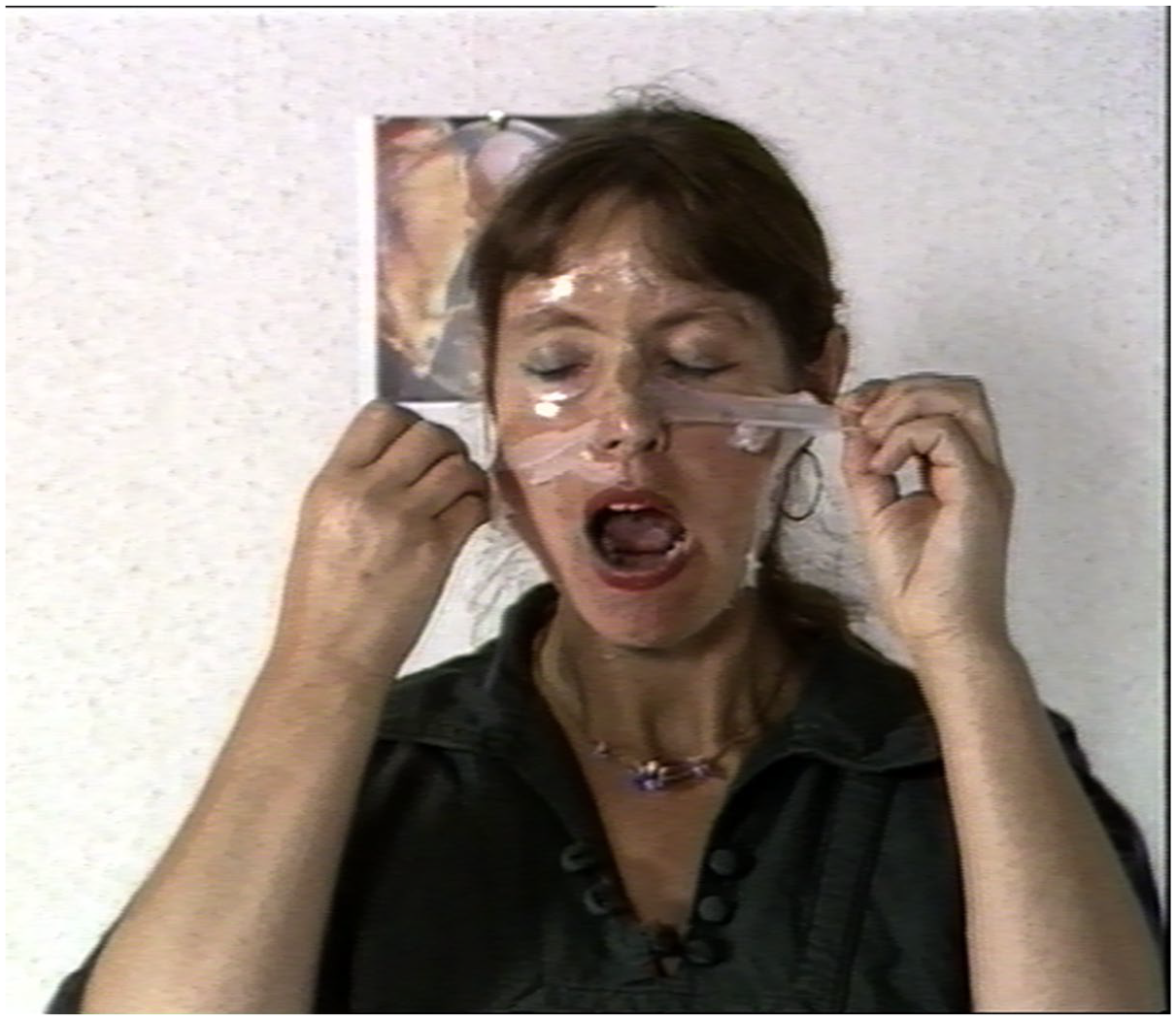
By defamiliarizing and simultaneously displaying her body, Soltau visually recreates the feeling of being trapped in a body that is not recognizable to itself. As her disembodied voice speaks, the camera zooms in and Soltau removes a clear wax mask from her face (see Figure 1).
Annegret Soltau, phase 1, schwanger-sein II, 1981.
The distortion of her features as she pulls the wax away gives her an inhuman, almost ghoulish visage. The combination of voiceover and mask confuses the viewer’s understanding of the location and composition of Soltau’s actual body within this space. Soltau’s experience of pregnancy is just as alienated from her own body as her detached language alienates her from the women who had abortions. There is nothing comfortable about Soltau’s corporeal performance of her pregnant state. Viewers witness Soltau becoming unrecognizable to herself as she fights for the acknowledgement of her physical and spiritual presence alongside the foetus that resides within her.
Phase 3: Hoffnung (Hope)
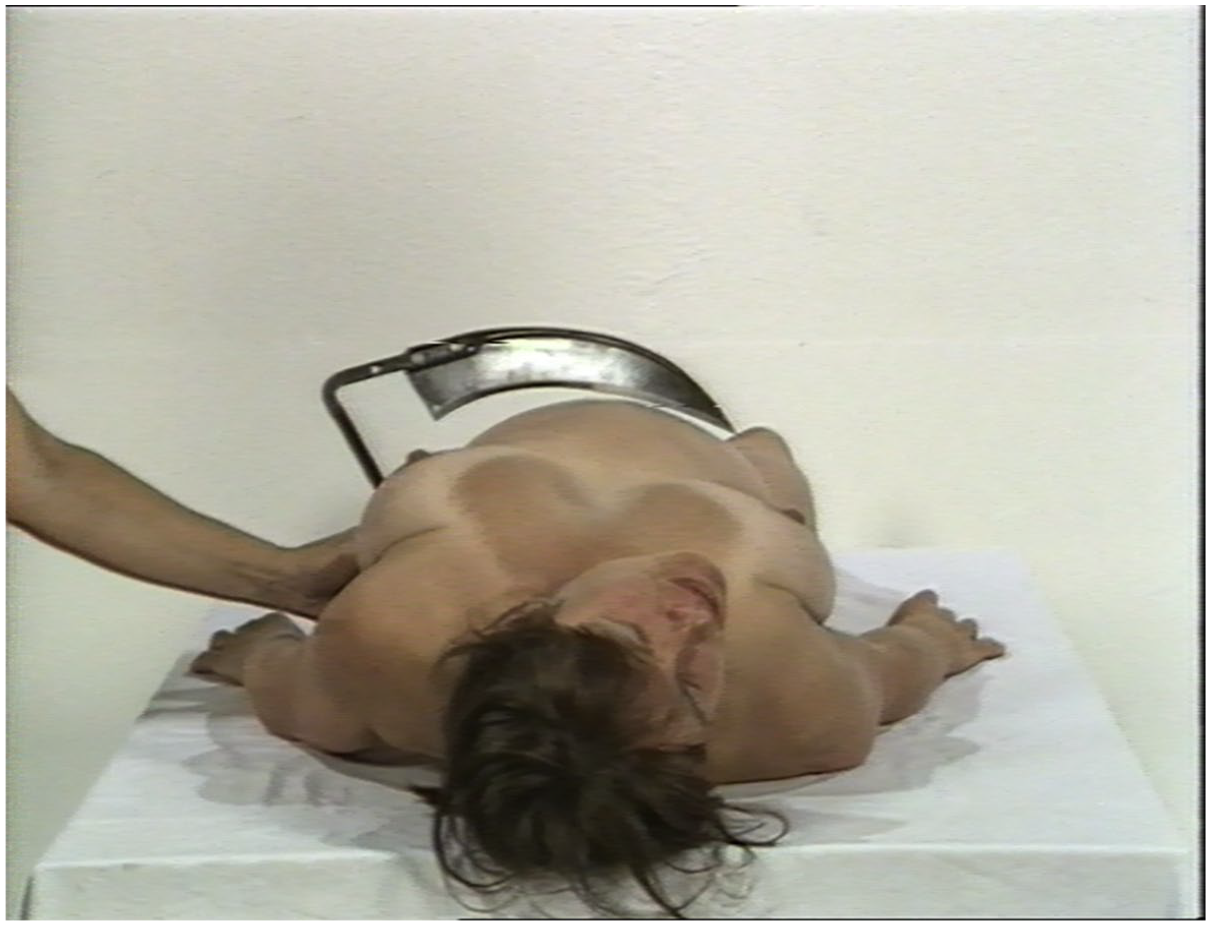
The third phase of Soltau’s series is the ironically titled Hoffnung (Hope). In this phase, Soltau further complicates the tenuous connection between pregnancy and motherhood. She lies naked on a table with the camera positioned behind her head (see Figure 2). This angle emphasizes the size of her pregnant belly and diminishes the viewer’s ability to register her facial features. From this angle, Soltau barely appears human. Iris Marion Young (1984), a feminist theorist and contemporary of Soltau, writes that when pregnancy is culturally separated from sexuality, it can have the positive consequence of liberating a pregnant person ‘from the sexually objectifying gaze which alienates and instrumentalizes her’ (p. 53). Soltau takes this idea to the extreme by using this unusual camera angle to further defamiliarize (and potentially dehumanize) her own body. My first thought on viewing this phase was that Soltau looks more like a mountain range, than a woman.
Annegret Soltau, phase 3 zoomed out, schwanger-sein II, 1981.
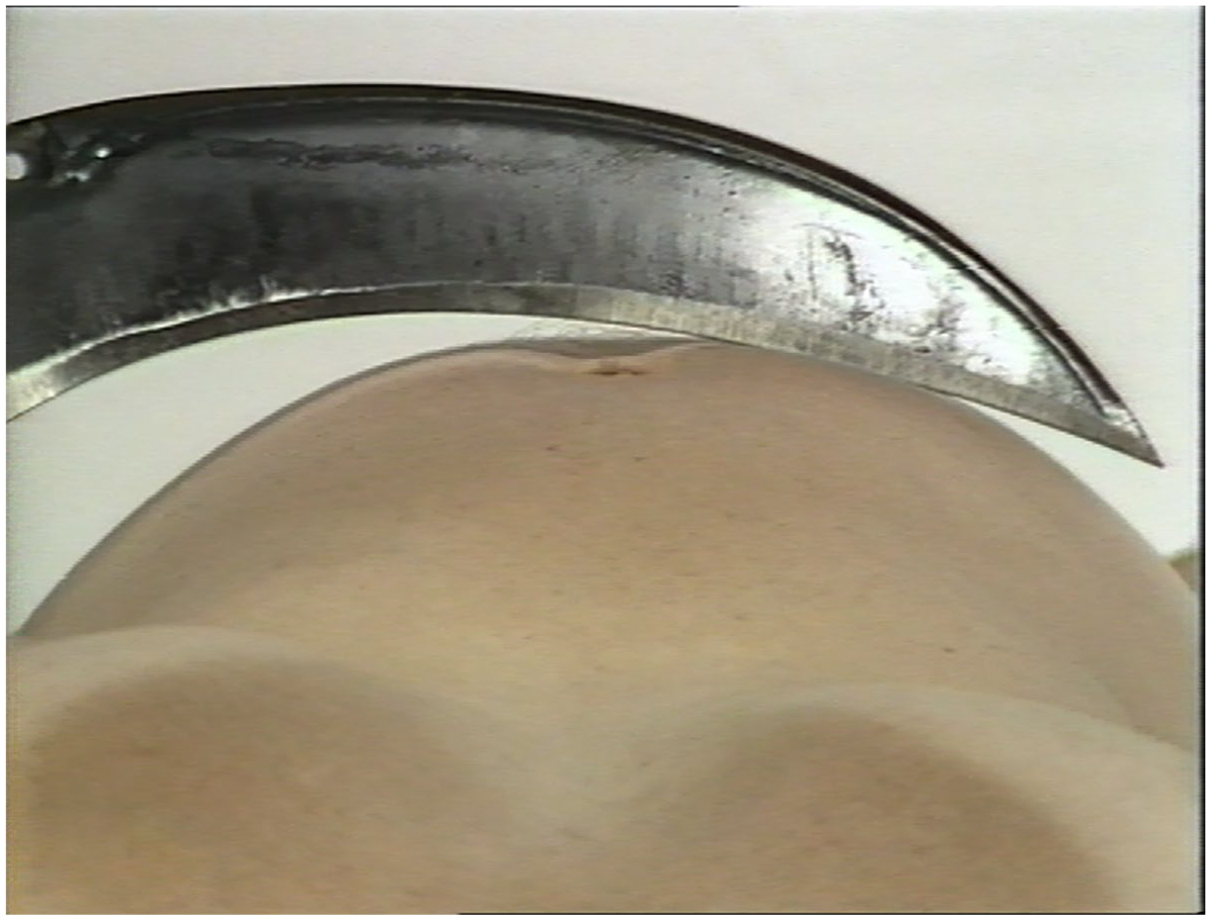
We then hear Soltau’s voice (again from off-screen) saying ‘schwanger werden [becoming pregnant]’ three times, each time lifting her hands over her torso in a kind of self-embrace. She continues this rhythmic progression, first by emphasizing her choice to stay pregnant, saying ‘schwanger bleiben [staying pregnant]’ and then ‘schwanger sein [being pregnant]’. The final two stages are ‘Mutter werden [becoming a mother]’ and ‘Mutter sein [being a mother]’. As she shifts from language of pregnancy to language of motherhood, a hand holding a sickle appears from off-screen left and Soltau stretches her neck back so that the camera captures a pained expression on her face. She is rehumanized only through expressions of maternal suffering. Art and life meet uncomfortably as Soltau literalizes the feeling that her pregnant body is threatened, while also confronting some of the consequences of the medicalization of reproduction. The hand from off-screen lowers the sickle so that Soltau’s pregnant belly brushes against the blade each time she inhales (see Figure 3).
Annegret Soltau, phase 3 zoomed in, schwanger-sein II, 1981.
Although Soltau’s flesh never makes enough contact to draw blood, the viewer must believe that it might. This fear only intensifies as the camera slowly zooms in on the contact point between belly and blade. Both Soltau and the viewer experience her body as marked by vulnerability, fear, and threat. It is nearly impossible to watch this phase without feeling anxious on Soltau’s behalf.
Meredith Nash (2014) describes how ‘medical discourses have constructed female reproductive bodies as intrinsically pathological’ and therefore always in need of outside intervention (p. 4). The sickle literalizes the threat that is culturally ascribed to Soltau’s pregnant body through the instance on medicalized ‘solutions’ to natural, corporeal experiences. Sänger (2015) elaborates that ‘the notion of prevention is prominent in obstetrical care in Germany which is extremely medicalized and risk-oriented compared with other countries’ (p. 107). According to Sänger (2015), German women, in particular, regard pregnancy as an experience in which potential futures become part of the present through the intervention of medicalized tests (p. 106). In fact, Germany (West Germany) was the first country to establish a national guideline for two prenatal ultrasounds, even in low-risk pregnancies that were progressing normally (Duden, 1993: 76). I understand the blade in phase 3 as a deferred/future threat similar to the kind Sänger characterizes as typical of the experience of pregnancy in Germany.
With the sickle symbolizing the threatened nature of the medicalized pregnant body, one might question why Soltau names this phase ‘hope’. Is this hope the desire to become a mother, or is it the desire for the blade to violently end all possibility thereof? Soltau forces her viewers to consider the numerous hopes that might be created and all of the hopes that might also be lost through the experience of pregnancy. Pregnancy changes bodies forever in ways difficult to fully anticipate for those who become pregnant. Miscarriage, abortion, pre-eclampsia, pre-/postpartum depression, or even Caesarean section (another possible reading of the blade across Soltau’s abdomen) are just a few of the potential ways in which ‘childbearing enacts profound bodily changes, both physical and emotional’ (Nash, 2014: 122). Soltau represents the alienation of having another being inside of her as threatening and potentially self-destructive, as both something to be embraced, her hands raising in a kind of self-hug, and something to be feared and possibly eradicated, as represented by the sickle.
Claudine Burton-Jeangros (2011) articulates further consequences of this medicalization, writing that for pregnant women ‘anxiety was indeed associated with their feeling that they are personally responsible for ensuring the best conditions for the child they carry’ (p. 429). Notably absent from Soltau’s artistic performance, however, are the commercial trappings of pregnancy and motherhood, which have become contemporary markers of responsible motherhood on social media. As Nash (2014) describes, contemporary pregnancy is ‘an experience that is now deeply embedded within market forces, involving a wide variety of consumer choices’ (p. 11). By staging her body in a white, nearly empty space, Soltau becomes a kind of anti-mommy blogger. Rather than some expensive, fully stocked nursery to be used as ‘an indication of the future mothers’ limitless love for the fetus’ (Tiidenberg and Baym, 2017: 6), Soltau once again centres the ambivalence she feels towards her pregnant body. Soltau’s anti-materialist depiction of her pregnancy contrasts with her own white German culture; however, her perspective is importantly not representative of a global, universalizable experience of pregnancy. There are certainly other contexts in which pregnancy is less medicalized and, therefore, the potential threats, or lack thereof, that people experience while pregnant manifest in different ways. Although Soltau leaves her national and cultural positionality largely unexamined, it is crucial as spectators of these films to acknowledge that Soltau’s perspective on these corporeal changes is driven (at least in part) by her privilege as a white, (West) German woman living in the 20th and 21st centuries.
In her visual art, Soltau is known for tearing things apart, but more importantly, she always sews them back together again, leading critics to suggest that her work represents ‘an antidote to, rather than a depiction of violence’ (Ganis, 2009: 11). Contrastingly, I argue that these scars of violence, or in the case of this filmic work, the threat of violence, helps us understand the ways our bodies can be physically and emotionally marked. Just because we sew the picture back together again does not mean we can ignore that it was torn. In his interrogation of the concept of masculine domination, Pierre Bourdieu (2001 [1998]) employs a notion of ‘symbolic violence’, which he argues is ‘gentle violence, imperceptible and invisible even to its victims’ (p. 1). If we agree with Bourdieu about the power of this symbolic (or structural) violence, then the threat of violence can be just as limiting or instructive as direct interpersonal violence. In a personal email exchange, Soltau highlighted the distinction between cutting up photographs and tearing them apart, emphasizing the white border that is revealed through the process of tearing by hand. When Soltau breaks an image apart, she is intentional about the fact that it can never be seamlessly put back together again. There are always signs of what has been ripped asunder. Just because the blade never actually cuts Soltau’s belly does not mean that we can ignore its threatening presence. The contact point between blade and flesh is like that precarious line of white in Soltau’s photocollages, a reminder of how violence and the threat of violence mark us and reveal something about our tenuous subjectivity. These fault lines, where belly meets blade, represent the larger traumas, as well as the hopeful anticipations surrounding pregnancy and motherhood, conditions rife with uncertainties and contradictions that refuse to be ignored.
Phase 4: Alleinsein (Being Alone)
The threat of violence depicted in phase 3 transitions into staged physical violence in phase 4. In Alleinsein (being alone), Soltau stands naked in front of a white wall, and a naked man’s head and arms come into the frame. He pushes her against the wall. Her body collapses with the force of the shove. Afterwards, she stands up and repeats the process herself, throwing her own body against the wall, sliding further and further down it each time. As she does so, she rotates slowly, providing the viewer with various angles of these acts of staged self-harm. As a viewer, this rotation highlights the performative aspect of these jarring actions and makes me hyper aware that I am watching a staged representation of Soltau’s vulnerable body.
Nonetheless, each time I watch this sequence I feel compelled to reach into the screen and stop Soltau from engaging in this behaviour. Her display of aggression, particularly when it transitions into self-aggression, is clearly controlled, yet it is also believable enough to provoke a moralizing impulse in me as a viewer. When the first version of this film project was shown on German television in February 1980, Soltau describes a similar response from one pregnant female viewer who wrote:
I, too, had – like possibly every pregnant woman – fear and doubts. However, it is implausible to express these feelings by getting oneself slapped from one wall to another for nearly two minutes, because every woman knows that this may be dangerous for the unborn child. (Leuzzi, 2015: n.p.)
This viewer’s objection hinges on her desire to separate the physical body of the artist from her art. In other words, the viewer feels that by engaging her actual pregnant body in this artistic process, Soltau transgresses an ethical boundary and breaks taboos for how pregnant women should behave. The accusation becomes even more acute with the suggestion that Soltau is doing something that ‘all’ women know to be wrong, and worst of all she is doing it selfishly, in order to express her own ambivalent feelings about her pregnancy, instead of centring the well-being of the foetus in everything that she does. Claudine Burton-Jeangros (2011) describes women who feel the need to justify behaviour deemed unorthodox or unhealthy while pregnant, couching their pushing of medically dictated boundaries by insisting that ‘a strict adhesion to rules was considered to make life unpleasant and incompatible with well-being’ (p. 427). In other words, living one’s normal life and ‘taking risks seems incompatible with being a good mother’ (Burton-Jeangros, 2011: 430). In a social environment in which pregnant people feel increasingly pressured to adopt specific habits to preserve the always uncertain health of their foetus, pushing back against these restrictions (of diet, for example) represents an assertion of self. By provoking such social controversy, Soltau’s work also confronts the relationship of pregnant women to the (neo)liberal state. Lealle Ruhl (1999) writes that:
in projecting all responsibility for health (and the control of all ‘risk factors’) onto individual pregnant women, the model fails to capture the realities of pregnancy accurately. Like crime prevention and education, pregnancy is both collective and individual in nature. (p. 98)
The woman who writes to Soltau after seeing schwanger-sein on television clearly feels that she has an obligation to comment on Soltau’s personal risk management, thereby articulating an understanding of pregnancy as a situation that requires individual discipline on the part of the pregnant person with little to no larger public health accountability.
Soltau’s critic touches on another central aspect of Soltau’s work when she laments the lack of separation between Soltau’s body and her art. Reflecting on why her filmic works received so little praise, even in the art world, at the time of their initial presentation, Soltau describes how ‘the pregnant body in art was considered too intimate and embarrassing, especially if it was used by a woman artist as an embodiment of herself’ (Leuzzi, 2015: n.p.). There is still something taboo about the corporeal self-reflexivity of Soltau’s art films. Presenting not just any body but her own body in this threatened and vulnerable state becomes threatening to the viewer and their understanding of how women, and especially pregnant women, should behave. The fact that viewers may feel a protective instinct to intervene and prevent Soltau from throwing her body around in this manner also reflects an exaggerated cultural interest in the health and well-being of foetuses and, by extension, pregnant bodies. I very much doubt that viewers (including myself) would be quite so concerned if Soltau were not pregnant and not exhibiting a bodily state thought to be fragile or in need of rigorous monitoring. By manipulating her pregnant body in this way, Soltau pushes her viewers outside of their comfort zones and places them in the position of a policing force, ready to tell Soltau what she should or should not do while pregnant.
I also read this phase as a response to the numerous books (and later, blogs or social media posts) that try to give women advice about how to be the best mother, both while pregnant and afterwards. Lisa Mitchell (2001) writes of such materials that ‘women read that risks are everywhere and that there are no guarantees of a healthy baby, and then, reading on, learn that many of the dangers in pregnancy are located in the bodies, histories, and activities of pregnant women’ (p. 91). Instead of presenting pregnant people with realistic and feasible options for lifestyle changes to increase comfort during their pregnancies, Lealle Ruhl (1999) claims that ‘pregnant women are presented with a series of “choices” during their pregnancy which, upon closer scrutiny, turn out not to be free choices after all, but are really highly circumscribed by a language of risk’ (p. 104). In such a context, Soltau’s acts of staged self-harm are defiant and threatening to her community’s understanding of the pregnant body as something that individual people must discipline themselves to care for in specific ways, especially if they want to maintain their moral and social standing. 4
When Soltau absorbs the aggression first expressed by the male figure and goes on to engage in this aggression herself, she visualizes the process of internalizing anxiety from external forces. Soltau has taken his violence, absorbed it into her body, and made it a part of how she interacts with the world. Barbara Duden (1993) describes this position as one in which pregnant people learn to mistrust themselves and their bodies, writing that, ‘long before she actually becomes a mother she is habituated to the idea that others know better and that she is dependent on being told [what to do]’ (p. 29). As Josie Hamper (2020) describes more recently in the digital sphere of social media, these conditions only become more acute in that ‘digital regimes of discipline and normalization intensify opportunities for individuals to actively position themselves [. . .] against normative ideas of health and femininity’ (p. 6). Even from Soltau’s vantage point in the late 20th century, her physical and emotional self is never strictly hers alone, nor is it isolated from the world around her. Particularly as a pregnant woman, she never acts as just herself, as an individual subject. Instead, she demonstrates how her identity, and her body can be shaped by others, whether to her benefit or to her detriment. The pregnant body is threatening because it is a reminder that we are never really one, never truly whole to begin with. Yet, in this phase and the one preceding it, the simultaneous vulnerability of Soltau’s body to violence is also on full, uncomfortable display. Placing a moral (and increasingly in the United States a legal) onus on pregnant people to preserve the health of the foetus at all costs can easily lead to deliberate self-harm, much like what Soltau depicts in phase 4.
Phase 7: Erinnerung (Memory)
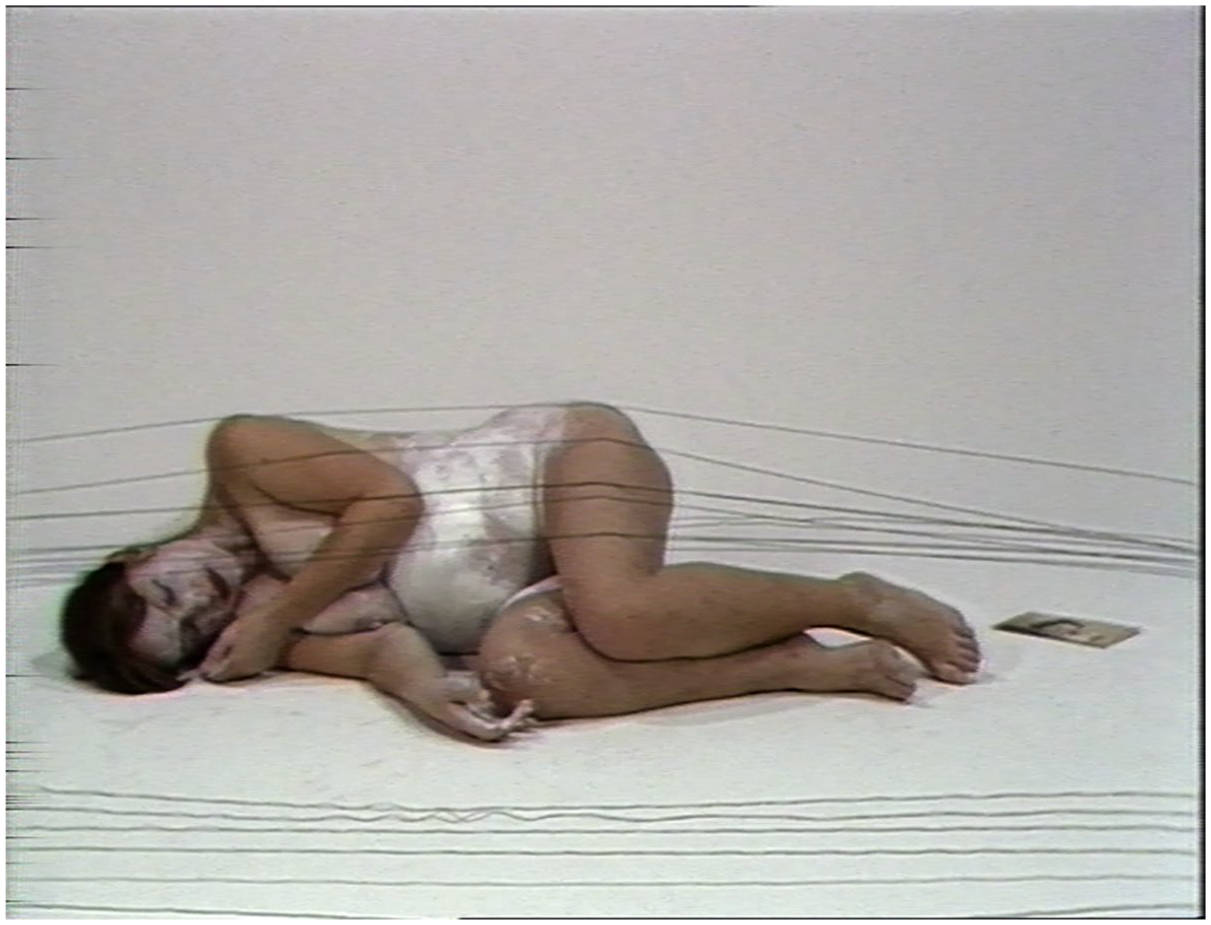
In phases 5 and 6, Soltau continues exploring her defamiliarized body, as well as the simultaneous threat and comfort of her male partner. Then, in the seventh phase, titled Erinnerung [memory], the focus shifts from Soltau’s uncomfortable present to a traumatic past. This phase tells the story of her mother’s failed attempts to abort Soltau amid a scarcity of healthcare options at the conclusion of World War II. As this story is narrated via voiceover in the form of a letter from her mother, Soltau covers herself in long black threads, similar to the ones used in her photocollage work (see Figure 4).
Annegret Soltau, phase 7, schwanger-sein II, 1981.
These strings highlight how knowledge of the intergenerational experience of ambivalence surrounding pregnancy both unites and divides the two women. Soltau adds an intergenerational component to the tension between the needs and desires of the pregnant person versus those of their foetus. When the history of the mother is juxtaposed with the pregnant daughter on the precipice of becoming a mother herself, the firmness of the boundary between vulnerable pregnancy and strength through motherhood is broken down. These women are both supported by and literally tied down by the weight of this transgenerational, corporeal intimacy and its ramifications.
Through her mother’s story, Soltau links her pregnant body to a difficult wartime past, one that exacerbates many of the same contradictions depicted in earlier phases of Soltau’s project. The mother’s story begins with the panic of discovering that she was pregnant during a time when nearly all doctors’ offices were closed. Soltau’s mother then lists a variety of ways that she tried to get rid of her foetus, including jumping off tables and benches, bathing her feet in both hot and cold water, stretching her body in various uncomfortable ways, and drinking a variety of herbal teas, all to no avail. Eventually, when she is 5–6 months pregnant, the mother does find a doctor, but he is unable to help her abort the foetus. As the mother describes these events, Soltau lies down on the ground, her body submitting to letting the story of her almost non-existence wash over her.
In this phase, Soltau also challenges traditional understandings of narrative as that which builds up identity, and performance as that which breaks it down. When articulating the interconnectedness of narrative and performance, Claudia Breger (2012) writes that ‘performance is a mode of (variously more or less) critical refiguration rather than simply a break with available figures of sociosymbolic articulation’ (p. 38). In other words, bodily performance is not about breaking out of, but rather, about reframing and refiguring cultural discourses. By linking bodily performance and narrative, Soltau creates a model for meaning-making in which (as Breger argues of transnational theatre) performance and narrative are intimately connected. As in the first phase, which also contains abortion-related storytelling, phase 7 begins with a photograph. The camera zooms out from this picture, presumably of an infant Soltau and her mother, to reveal Soltau examining the image, the camera intruding over her shoulder. She sets down the photo and stands, slowly turning to face the camera, which zooms in on her pregnant belly. At one point there is only her belly and a tuft of pubic hair in the frame. As Soltau rubs white paint over her abdomen, the camera pans back out to reveal her full body and the letter from her mother is read aloud via voiceover. This performative preparation for the mother’s storytelling transforms Soltau into a ghostly spectre in her mother’s narrative. After all, this story is about a time when Soltau almost ceased to exist. Yet the narrative is also performatively tied to her own pregnancy. The act of touching her skin as she covers herself in white appears as both an act of self-erasure, in that she starts to blend in with the white room around her, and an act of reassurance that she is indeed physically present, she is touchable, and not erased, as her mother initially intended. Soltau both solidifies and decentres herself before hearing a story that will simultaneously uplift her and hold her down.
Soltau understands and represents her own pregnancy not just as an event that connects her with her foetus, but as one that links her to her own mother and grandmother. She visualizes these matrilineal ties that bind when she covers her pregnant body with strings. As the mother describes how her initial panic turns to resolve, various strings stretched out along the floor are lifted up to cover Soltau, now lying on her side in a foetal position, face towards the camera. Soltau embodies both pregnancy and the foetus, mother and daughter. Gender also matters here because it is important to Soltau’s mother that Soltau is a girl. After hearing her baby’s assigned sex, Soltau’s mother loses consciousness, a marker of the intense physical stress of the labour and delivery. She lies to the nurses about being engaged, marvelling at how much Soltau looks like her father (who remains nameless), and then rejoices that Soltau is a girl saying, ‘Gott sei dank, dass es ein Mädchen ist’ (Thank God, that it is a girl). Soltau’s mother does not elaborate further on why she prefers a child assigned female at birth and it is clear that Soltau’s other artistic projects complicate an understanding of physical inheritance as linked to either sex or gender. However, emotional inheritance is a different matter, at least in schwanger-sein II. While bodies might resemble one another, when affects (emotions as expressed and passed down through bodies) are involved, biological sex (if not also gender) matters a great deal both to Soltau and to her mother.
In addition to gender, Soltau seeks to expand and interrogate considerations of generation and time. Once released from the hospital, the mother describes a difficult summer with Soltau always by her side before relinquishing her into the care of Soltau’s grandmother, which is where the story abruptly ends. The letter, which is given the opening ‘Liebe Tochter’ (Dear daughter), is not closed but rather left open, unended. With this final invocation of a fourth generation in Soltau’s maternal lineage, viewers come to understand the experience of pregnancy not just as one body becoming two, but as one of multiple generations of maternal bodies interacting with each other in complex and fraught ways. Soltau clearly understands her mother’s doubts about pregnancy, which mirror her own initial concerns in ‘panic’, but this knowledge of her almost not-being also understandably troubles Soltau. The threads layered over her body bind her to this family history, while also becoming a trap from which Soltau cannot escape. The strings represent the burden of those already existing physical and emotional connections, that cannot be removed or controlled, even as a new generation prepares for motherhood. Being tied down in this way is also a relief in that Soltau’s body contains a history from which she can also draw support. Her mother’s story serves to contextualize, and therefore to affirm, Soltau’s own ambivalent stance towards her pregnancy, with the two women embracing a shared corporeal past and future.
Eva Sänger highlights temporality as another key area of tension between the pregnant person and the foetus. She writes that although ‘pregnancy time and foetal age are indefinite’ (i.e. we cannot measure with absolute accuracy when conception occurred), ‘the temporal needs of the pregnant woman are seen as antagonistic to the temporal needs of the foetus, which has to reach a certain age or maturity’ (Sänger, 2015: 114, 116). In other words, the pregnant body might want to or might benefit from being rid of the foetus before it has reached a stage in its development where it would be viable outside of the pregnant body. The story of Soltau’s mother is an extreme example of this dynamic, due to the historical conditions during which she was pregnant. Therefore, Soltau’s work expands this temporal landscape of threat to include not just the present and the future, but also the past. The tension here not only comes from a pregnant body strained by the effort required to support a growing foetus, but also from the interaction of generations of mothers and daughters. In pregnant body-time, Soltau insists, there is also a past in addition to the much talked about future.
Phase 8: Ansprache (Address)
Immediately after this staged interaction with her mother’s story, Soltau depicts another ‘conversation’, this time with her unborn child. (I use conversation very loosely here, as neither scene allows for any real dialogue.) Instead of a foetus with an implied womb, in phase 8 we see a pregnant woman with an implied foetus. As Andrea Wuerth and Janice Monger (1997) attest, Soltau ‘seeks to refamiliarize viewers with the woman’s pregnant body and forces the eye to see only the skin, inviting the tension this elicits’ (p. 70). Felt, but not heard and rarely seen, the being inside of her complicates Soltau’s role as an explaining, articulating subject. Yet by focusing on her own physical body, Soltau regains some sense of individual agency. Katrin Tiidenberg and Nancy Baym (2017) argue that ‘pregnancy is simultaneously one of the most embodied of human experiences and one of the most discursively regulated’ (p. 2). We have already seen that this combination of embodiment and narrative is foundational to Soltau’s work. However, I argue that the relationship between embodied performance and linguistic narrative is even more pronounced in the latter phases of schwanger-sein II.
As in all previous phases, Soltau’s voice remains disembodied and her mouth on the screen does not move. The foetus only ‘speaks’ through the heartbeat that plays both ominously and soothingly in the background. However, this does not detract from the intimacy of this moment as Soltau forcefully feels around for the foetus in her womb and speaks directly to it, asking questions such as ‘Spürst du das? (Do you feel that?)’ and ‘Schläfst du? (Are you sleeping?)’. Rayna Rapp (2011) writes that pregnant people, who must make numerous complicated decisions about the relationship between their bodies, the medical establishment, and social expectations, are ‘moral pioneers’ because ‘by using comfortable resources to decipher uncomfortable situations’ they generate ‘a form of constrained but real agency’ (p. 703). In the phase in which she throws her own body against the wall, for example, Soltau’s corporeal performances have already suggested some forms of limited agency through artistic practice. However, in this penultimate phase, Rapp’s understanding of constrained, but yet very real, agency fully comes into focus. As Soltau prods, squeezes, and folds the flesh of her abdomen and breasts, Soltau exerts ownership and control over her own body (see Figure 5).
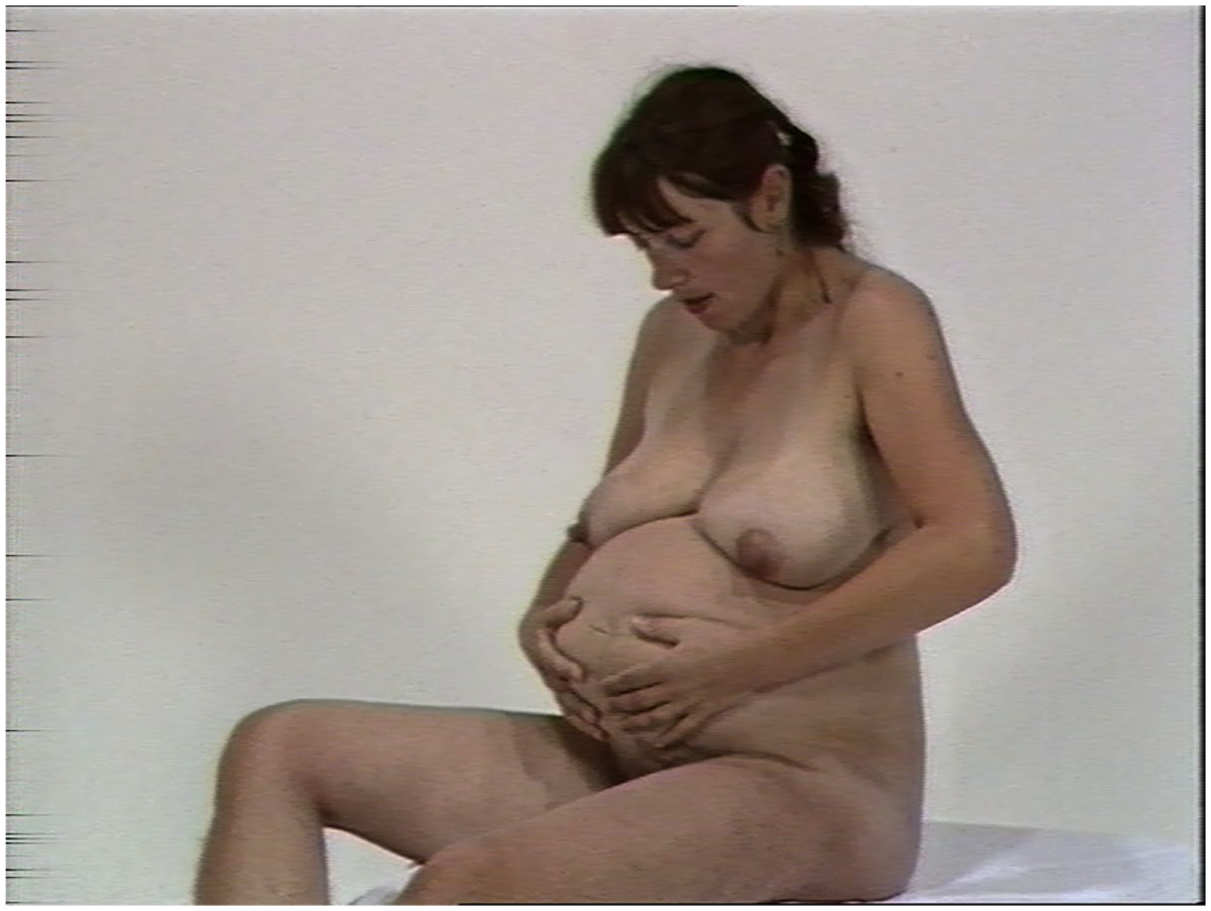
Annegret Soltau, phase 8, schwanger-sein II, 1981.
This flesh is hers to manipulate, uncovering the foetus’s body, even as she is in ‘dialogue’ with the being inside of her and also narrating the foetus’s activities. Embodiment generates narrative and vice versa. Soltau is in control, and yet she also knows that she can never gain full access to the foetus.
In her work on pregnancy in the United States, Sallie Han (2013) writes that ‘talk to the baby makes the unseen, unknown, and uncertain “baby” in the belly real and present to the pregnant women, other adults, and children who engage it through talk’ (p. 69). 5 Similarly, Soltau reveals herself and her baby as more knowable through this act of ‘belly talk’ (Han, 2013). Through her experience of her pregnant body, Soltau becomes the narrator of both herself and of her foetus. Instead of seeing the foetus, as in the sonogram image in phase 1, Soltau presents us only with her own skin in phase 8. Han (2013) elaborates on the intimacy created through talking to pregnant bellies as a process ‘through which babies and mothers and fathers become imagined and embodied’ (p. 60). In one sense, Soltau’s willingness to engage in belly talk indicates a sense of stability and stable identity formation. She is confident that her foetus will survive and she exists in a world in which ‘adult attachment and accommodation to even very young infants is seen as only natural’ (Han, 2013: 63). This context, as articulated by Han, is relevant because it suggests that, rather than losing herself because of the foetus, Soltau is finally able to reach an equilibrium through this belly talk in which both she and the foetus can coexist as intertwined subjects, rather than as competitors, pitted against each other by medical or legal discourses. The affect surrounding Soltau’s belly talk is reminiscent of the generational conflict articulated by feminist theorist Luce Irigaray (1981) in her contemporaneous article ‘And the One Does Not Stir Without the Other’. Irigaray’s essay, in which a daughter laments an inevitable power struggle with her mother, concludes with a provocative call: ‘When the one carries life, the other dies. And what I wanted from you, Mother, was this: that in giving me life, you still remain alive’ (Irigaray, 1981: 67). Instead of focusing on the perspective of the daughter, however, Soltau again returns attention back to the pregnant body, to a time when mother and child are still attached, and therefore their lives are physically (and mentally) intertwined. The difference in Soltau’s work is that the pregnant person and the foetus no longer need to be forced into conflict with one another. Soltau’s art recognizes that the mother too longs to be alive and does not desire the sacrifice of her own life or her own body for her child’s. However, maternal sacrifices by women (whether they are actually mothers or not) are still what androcentrism requires, at least according to Irigaray. Through her physical and emotional attachment to and control over the body of her foetus, Soltau creates a situation where recognising the foetus comes not at the expense of but rather as an addition to the recognition of the agency of the pregnant person.
Mutter-da-sein (Mother Being)
Schwanger-sein II is not the only filmic work by Soltau in which she engages her body to highlight personal ambiguities and societal inconsistencies. In Mutter-da-sein (Mother Being, 1984), she introduces us to her (now two) children, bringing them into her performance art as representatives of the phase that sometimes comes after pregnancy, namely motherhood. Soltau presents this audio-visual art in another series of phases, several of which are connected to parental tasks, such as changing diapers or breast feeding. Much like the images in schwanger-sein II, these corporeal stagings are provocative. For example, Soltau’s film contains close-up shots of breastfeeding, which may strike even the contemporary viewer as subversive for their frank portrayal of something that is often censored or sequestered out of public view. In addition to these images of intimacy, Soltau also portrays motherhood as a physical yoke. In a sequence titled Kreislauf [circulation], she crawls around her baby with a large piece of wood strapped to her back and in another, titled Gleichgewicht [balance], she carries a long pole across her back as her children play, running around, grasping after the pole and laughing. Just as she sought to make the contradictions of pregnancy clear through her performances in schwanger-sein II, Soltau uses these props to visualize the pressures of subsequent parenthood.
Soltau’s films are visual representations of the balancing act involved in pregnancy and motherhood: how to contend with one’s own needs and to balance them with the needs of children who make moving as one might wish to move a constant, but sometimes joyful, challenge. Through the combination of these two filmic works, Soltau reverses an understanding of pregnancy as a burdensome but laudable bodily state. There is clearly deep affection between mothers and children in Soltau’s work, but the children still represent challenges to Soltau’s artistic practice, challenges which she then integrates into that process itself. Life truly cannot be separated from art. In schwanger-sein II, Soltau presents us with a pregnant body that represents a complex connection between the past, the present, and the future. By framing her pregnant body as something both threatened and threatening, something that in its own becoming reveals just as much as it obscures, Soltau unmasks many of the societal and medical discourses that make reproductive justice so difficult to achieve. Engaging with Soltau’s work in the 21st century reminds me how much work still needs to be done in terms of breaking down the binary systems that alienate marginalized bodies from themselves and divide them from their larger communities.
Footnotes
