



Abstract
This article grapples with the making of habit and the dynamics of knowledge ‘in the hands’ among outdoor adventurers. Especially in early phases of learning, budding adventurers orient their movement and sense of the environment off the body positions and perceptual judgments of experienced others. The ultimate reference point for action is the mountains themselves, and so a major lesson is one of quiet humility, inhabiting a world that others may have a weaker sense of. They adopt the term ‘listening’ metaphorically to express how they always organise their bodies in relation to what is happening beyond them. The degree of connectedness to the world is variable. The silence above the snowline heightens focus and expands the bounds of what can be safely achieved, providing a climber’s stress and state of health do not get in the way.
Introduction
Most adventurers have a story of an early trip gone wrong that serves as a cautionary tale. Luke, an experienced tramper (bushwalker), told me about one of his early trips that ended in a helicopter extraction. The trip in question was seven days in the Kawekas in New Zealand with two equally inexperienced mates. They made navigation errors. They packed the wrong gear, the most disastrous of which were cheap shoes that disintegrated in a couple of days. This should have been a signal to go home, but he continued, wearing only his socks. They were in snow, so his socks froze, and in the end, he had to walk to the hut barefoot. When they reached the hut, there was a pair of spare shoes the right size, almost unheard of. The shoes would have allowed him to continue, but they were a day late, so search and rescue pulled them out. For Luke, this story is about learning from experience and its perils. He said the outcome was embarrassing. They had ‘accelerated’ their learning by making mistakes and suffering the consequences, but the risk was too great. ‘Obviously you don’t want people to go and kill themselves or get seriously injured’, he said.
Experience is often given as an explanation for skill acquisition in fields with a ‘practical’ component like firefighting (Klein, 1998) or cooking (Leschziner and Brett, 2019), although it is also valued in archetypally conceptual domains like science (Almklov and Hepsø, 2011) and engineering (Maslen and Hayes, 2022). As an explanation for learning, it leaves the details largely unanalyzed. Among those concerned with cognition, especially the cognitive processes of ‘experts’, it is what this experience affords that comes into focus: the reasoning processes we can observe among those who have experience and what experience makes possible (in professional work, see Klein, 1998; among lay people, see Wynne, 1996). Analyses typically skip over the process through which the experience is gained.
This glossing of experiential ways of knowing also plagues research on habit or habitus (on the use of terminology, see Crossley, 2013). Across multiple traditions of philosophy and social theory, scholars have acknowledged that we acquire dispositions mostly beyond our reflective awareness that are a resource in social action. Mauss (1973) showed how different ‘techniques of the body’, often rhythmic patterns used in the dynamic production of conduct, are learned in different cultures and taken for granted as the ‘natural’ way of performing familiar activities. Under the banner of tacit knowledge, Polanyi (1966) put forward that we attend ‘to’ the world ‘from’ our internal processes that we disattend to. Bourdieu’s (1977: 94) articulation of habitus has probably been the most influential in sociological circles, but his perspective was that it is ‘beyond the grasp of consciousness’ and so cannot be deliberately transformed. Researchers who have taken up Bourdieu’s theory of practice show how people draw on a distinctive habitus in different domains, but they mostly leave the cultivation of this embodied competence unexamined (Desmond, 2007; Wacquant, 2004).
We must look for the specific strategies and devices that ‘experience’ involves more precisely to turn attention to the body at the level of knowing, skills, and sensation, as a project (Shilling, 2017). This approach acknowledges that the body is not already ‘there’, nor does it pre-discursively appear following the passing of time in a context or culture. Novices are often coached first to turn towards their body so as, ultimately, to turn away from it. Communities have particular strategies for supporting this turn including breaking it down (Downey, 2008), exploiting synaesthesia (Maslen, 2022b), and using tools to bring self-consciousness (Kleiner, 2009).
Work that addresses the cultivation of embodied selves typically focuses on educational settings in which students pay for lessons and are taught by named teachers. The case in this article is taken out of the classroom and into the wild, so to speak, where people with more experience informally guide those who are starting out through the doing of the activity. Experienced others share as they go, not only the meaning of specific cues and techniques such as map reading, but also patterns of movement and a philosophy of adventure based on humble attention to place.
Merleau-Ponty on Perception and Turning to the Embodied Self
Much of the work that has taken seriously the task of tracing the embodiment of conduct has taken up Merleau-Ponty’s phenomenology of perception. Merleau-Ponty presents a notion of the body as at the edge of the world, reaching out. His view is that conscious reasoning does not dominate experience. Instead, thought and action are grounded in our pre-reflective engagement with the world. He expresses this being-in-the-world in relation to our perception of the sky:
As I contemplate the blue of the sky I am not set over against it as an acosmic subject; I do not possess it in thought . . . I abandon myself to it and plunge into this mystery, it ‘thinks itself within me’. (Merleau-Ponty, 1962: 249)
Perception involves ‘intertwining’ of senses usually designated as separate. He was often drawn to the work of artists in developing his philosophy. In the work of Cézanne, he found an artist who painted ‘the lived perspective’, where eyes move around/touch objects (Merleau-Ponty, 1964). Cézanne’s painting House in Provence presents both the walls almost as if they are viewed head-on, the idea being that the perceiving subject engages with the painting as if there, in place, moving their gaze around the boundaries of the object. Moving one’s body is changing one’s orientation (see also Gibson, 1986).
Merleau-Ponty (1962: 95) distinguished between the ‘habit-body’ and the body in the moment. It is the body in the moment that contemplates the sky. Yet we have ways of being in the world, resources for action that, once acquired, take their place in our unconscious. He takes the example of typing. Knowledge of typing is neither an ability to say where the keys are nor an involuntary action: ‘It is knowledge in the hands, which is forthcoming only when bodily effort is made, and cannot be formulated in detachment from that effort’ (Merleau-Ponty, 1962: 166). When sitting at the keyboard, a pattern of motility ‘opens up’ as a ‘perpetual movement towards a world’ (Merleau-Ponty, 1962: 167). Just as we know how to perform seemingly simple motor actions, like touching one’s hand to one’s knee, we can also cultivate other patterns of motility, some of which are highly specialised.
The making of the habit-body is not beyond consciousness. We can come into touch with both our inner lining and our relation to the world. Our embodied exploration can be with our own bodies as we use one sense or part of our body to explore another. We have a sense of our hands from within, or at least we do at those times in which we shift attention to our sense of body position and self-movement, as well as the feel of that which we touch. Our hands are also available for self-exploration as we use one hand to touch the other, becoming an object to ourselves (Merleau-Ponty, 1968: 133). Our sensory sensitivities are also cultivated intersubjectively. Taking again the case of vision, Merleau-Ponty (1968: 142) wrote about how, when we see together, our perspective shifts from seeing an object to becoming aware of how we are doing seeing: ‘through the concordant operation of his body and my own, what I see passes into him, this individual green of the meadow under my eyes invades his vision without quitting my own, I recognize in my green his green’.
For the most part, it was not Merleau-Ponty’s contribution to show the social processes involved in the cultivation of the habit-body, although others have taken up this project. In many domains, we see how turning to the embodied self is both synaesthetic and collective. For example, Harris showed how medical percussion is not haptic or aural but a practice of listening-touch. Medical students are coached to explore their bodies to become sensitive to categories of sensation. Students tap against their chest cavity to discover what lies beneath their skin, in the process getting a sense of what their clinical skills educators mean by terms like resonant and dull in relation to the human body. As Harris (2016: 49) puts it, they ‘turn themselves anatomically inside out’.
Katz took up the case of developing a shared sense of humour in response to a visual gag. When family members interact with distorting mirrors, they adopt tactics for intersubjective seeing so that all parties might ‘get it’, like positioning their head/eyes close to the other so ‘gazes overlap’ (Katz, 1999: 98). Pointing, so in the reflection a finger touches the distorted body of the other, serves to emphasise where an image should be seen as distorted. Doing funny movements for another accompanied by mock laughing is an invitation to ‘see my seeing’ (Katz, 1999: 103).
Related to the case discussed in this article, Ingold examined the cultivation of skill in the context of perception of the environment. In one of his discussions, he reflected on the experience of moving together on a trail, where group members point out features in the environment that they register as important. Words become the ‘tools’ for drawing attention, and ultimately honing the perception of novices: ‘Every word, spoken in context, condenses a history of past usage into a focus that illuminates some aspect of the world’ (Ingold, 2000: 146). Following Merleau-Ponty, he makes the point that novices do not lack a conceptual schema for organising ‘data’ from an experience as if it can be abstracted from their bodies. They lack ‘the perceptual sensitivity that enables [them] to discern, and continually to respond to, those subtle variations in the environment whose detection is essential to the accomplishment of ongoing activity’ (Ingold, 2000: 147). The following analysis contributes to these ongoing investigations.
Adventuring Embodiment
However interesting questions of risk-taking (Hardie-Bick and Bonner, 2016; West and Allin, 2010) and identity (Dilley and Scraton, 2010; Donnelly and Young, 1999) are in the study of dangerous pursuits, the physical and psychological work looms large. The nature of the activity and its techniques produce different bodies (Barratt, 2011; Rickly, 2017). The heightened frequency in which adventurers confront their mortality (Breton, 2000; Lewis, 2000) highlights the physical harm that can come to climbing bodies (Allen-Collinson et al., 2018; Rickly, 2017).
The corporeal nature of adventuring is always in relation to the places that adventurers move through. Lewis (2000) put forward the notion of the climbing body as ‘of the ground’, always orienting off and connected to the physical environment. The climbing body is set against the metropolitan body, which is ‘groundless’, as well as ‘ocular’ as opposed to ‘tactile’, and ‘inorganic’ as opposed to ‘organic’. Bodies feel for and orient off space, but they can also ‘deface’ a given environment (Rickly, 2017), as do rock climbers when they remove rock or add bolt holds – a decision that is intertwined with the meaning of the activity as much as speaking to this relation between the body and the world (Bogardus, 2011). In sport climbing, a climber can ‘learn’ the route, meaning study and practise it, attentive to the specific foot and hand placement that they will need to use and the challenges that they will encounter along the way (Heywood, 1994). In mountaineering, there is a much greater focus on the journey through mixed terrain, with mountaineers meeting and working off a given environment this time through (Vervoorn, 2000).
Adventurers also must become sensitive to the weather conditions if they are to survive. This challenge is of heightened importance in alpine environments. As Allen-Collinson and colleagues (2019) detail, this ‘weather work’ involves not only the decision about when to head out but also includes strategies to manage the potential for change. For instance, high-altitude climbers pay attention to geographical features that they can use to aid in route-finding should the light fade or to judge avalanche risk on a given slope.
The body is also in relation to and extended by tools. Irrespective of discipline or tradition, people typically use various technical equipment to increase their purchase on a surface, as in the case of crampons, or to provide protection, as with anchors and ropes. Indeed, the climber’s shoes are an extension of the climbing body, with the sticky rubber expanding the bounds of what is safe to climb (Barratt, 2011). In bushwalking, there are fewer tools involved, and yet those that are used, like specialised shoes, are a great preoccupation.
There is a sense in Lewis’s writing that, as Merleau-Ponty would say, knowledge needs to be ‘in the hands’. Climbers cannot necessarily see where they will place their toes/feet or fingers/hands, and so they need to develop tactile sensitivity. As Lewis (2000: 71) put it, it is ‘a corporeal knowing rather than a cognitive knowing’. Rickly (2017: 75) added that as they touch, they know whether the feature in the rock that they feel for is:
a ‘mono-pocket’ (a hole in the rock just large enough for a single finger), a ‘crimper’ (a small, narrow hold which allows only for the ends of one’s fingertips to grip the rock), or a ‘jug’ (a large hold that requires the use of the whole hand).
There has been a building analysis of the strategies involved in learning climbing and bushcraft. One approach has the character of an exercise. Climbers can move through difficult passages repeatedly, and once the choreography is learned, this segment of a climb can be reintegrated into the whole. Bunn (2016) captured this training technique in the context of alpine climbing, where a climber used a top-rope system to repeatedly move over the same terrain. Such a technique enriches bodily skills when in use, but competency can ‘decay’ when the body ceases to climb for an extended period. While exercises can be outdoors, indoor facilities are designed for repeated climbing, disconnected from the challenges of real rock. Climbers need to transition into the outdoors, where the grit of the rock and nature that does not follow the careful arrangement of holds transforms the experience of climbing (Barratt, 2011).
The function of these exercises is not only to grasp body positions and movements but also to learn timing. Climbers work through where to pause to rest their bodies, and where to move more quickly over ground. While some climbers say they do not evaluate their performance using speed as a metric (Hardie-Bick and Bonner, 2016: 378), it is nonetheless a domain in which the activity has the character of ‘action’ (Goffman, 1967), meaning a pause can be fatally consequential. Rock climbers who move into mountaineering can get a rude shock in this respect, where they find that the time of day, weather conditions, and the duration of the exposure to cold or lack of oxygen make the practice a race against the clock (Allen-Collinson et al., 2019).
The embodiment of adventuring is also bound to narrative. Stories shared between adventurers around a campfire work on embodied competency by directing attention to significant cues that may be experienced later (Maslen, 2022a). Narrative is not only discursive. Vocabularies of climbing are linked to systems of gesture which represent the physical performance on the narrated route. Gesture can communicate beyond spoken language, as well as demonstrate those details that have words, like the specific handholds a climber may use. As Rickly (2017: 79) detailed: ‘wide open hands for a “jug”, a tight-fingered gesture for a “crimper”, or an outstretched finger for a “mono-pocket”’. Climbing guidebooks are yet another resource for climbers, with Heywood (1994: 137) going so far as to write that a guidebook is as important as a rope. Authors are challenged with balancing the need for information without ‘giving so much information that they undermine the sense of adventure’ (Taylor, 2006: 191). Guidebooks work to not only provide visual and textual representations of terrain but also to inculcate norms regarding patterns of movement, relation to technological aids, and ways of being in the outdoors (Fuller, 2003; Taylor, 2006).
The notion that learning in the outdoors is an apprenticeship has been acknowledged elsewhere (Fenton et al., 2022) but the details warrant attention. My analysis looks at some of the strategies involved in learning in the outdoors beyond exercises and narrative, including orienting off the bodies of others, coaching that encourages adventurers-in-training to orient off the landscape, and concluding with turning inward. These are some of the strategies that make up what adventurers term ‘learning from experience’.
Methods
My research into the cultivation of the body has examined how musicians, doctors, Morse code operators, and adventurers cultivate their ways of hearing necessary for competent performance in their given domain (Maslen, 2025). While my interest was in hearing, my research shows how what we call hearing is synesthetic in character, and for a variety of reasons, we both cultivate and do hearing via other senses. The fieldwork encounters reported on here reflect this synesthetic experience and focus on motility rather than hearing.
The research involved participant observation and interviews with 92 people, 31 of whom were adventurers, including mountaineers, walkers, canyoners, kayakers, rock climbers, and cross-country skiers. Many worked professionally in roles that used their adventuring knowledge, such as guiding, search and rescue, journalism, photography, and environmental management. Some had sponsorships to undertake trips. The research with the adventurers took place across Australia and New Zealand.
Over an 18-month period, I went into the field both solo and in groups as a process of understanding adventurer ways of perceiving. I am based in Australia, and locally I went on many bushwalks, skiing trips, and a guided canyoning trip. I also travelled twice to the South Island of New Zealand for a total of six weeks. During my first trip to New Zealand, I relied mainly on tramping (bushwalking) books and some instructions and mud maps that an experienced friend had given me, except for a guided glacier walk. Like Luke, I met the challenge of these trips with varying success. The first walks were on marked trails, giving early confidence. Where tracks were unmarked and the ground was unstable, I found myself in trouble, unable to navigate or move on a steep and shifting surface. On the second visit to New Zealand, I went tramping with my interlocutors, skiing, and on a few drives through the landscape. A four-day mountaineering trip was planned but cancelled due to poor weather.
Observational methods tend to be preferred by researchers, who aim to theorise from lived bodies (Wacquant, 2015), and yet observation alone can get in the way of grasping the perspective of research participants. The ‘go along’ method (Kusenbach, 2003), a hybrid of participant observation and interview, offers an antidote. It allows the researcher to ‘witness in situ the filtering and shaping of their subjects’ perceptions’ while also ‘de-emphasiz[ing] the researchers’ own perceptual presuppositions and biases’ (Kusenbach, 2003: 469).
The framing for our conversations was the cultivation of competency in the outdoors. The adventurers were generally in agreement that experience under the guidance of skilled others was vital to skill development. When I asked them to account for this learning, conversations appeared to mostly skirt the specific mechanisms. Instead, they told me about going to different places, the challenges that they encounter, and what they can sense when they are there. The adventurers were then keen to take me places so I might better understand their world, and they explained their experience and pointed things out as we went. Over time, I came to understand that they were showing that imitation and naming-cum-pointing are the learning strategies.
In developing the analysis in this article, I draw on my fieldnotes and conversations with my interlocutors that demonstrate these practices. I also draw from my participants’ accounts of experiences and trips that I was not involved in, especially concerning silence and its cognitive and corporeal effects which come into play for ‘expert’ adventurers attempting journeys that carry with them the greatest difficulty.
Moving Off Others’ Bodies
In adventuring, groups are almost always moving in lines, with a leader at the front, a ‘tail-end Charlie’ who is an experienced group member tasked with bringing up the rear, and the other members of the group in the middle. Moving in a line means that an adventurer is mostly aware of where and how the person directly in front of them is moving: where they are directing their gaze, where they reach for hand holds and the surfaces that they touch, and the placement of feet, including the path and length of stride (Figure 1). There are various challenges in moving over surfaces that this strategy of moving one behind the other meets. First is the challenge of moving over unstable ground, which is uncommon in urban life and a regular feature in the outdoors. Another challenge relates to the visual-to-motor translations involved in assessing, planning, moving, and navigating. Last is the matter of pacing, where an adventurer needs to find a rhythm of movement that can be sustained.
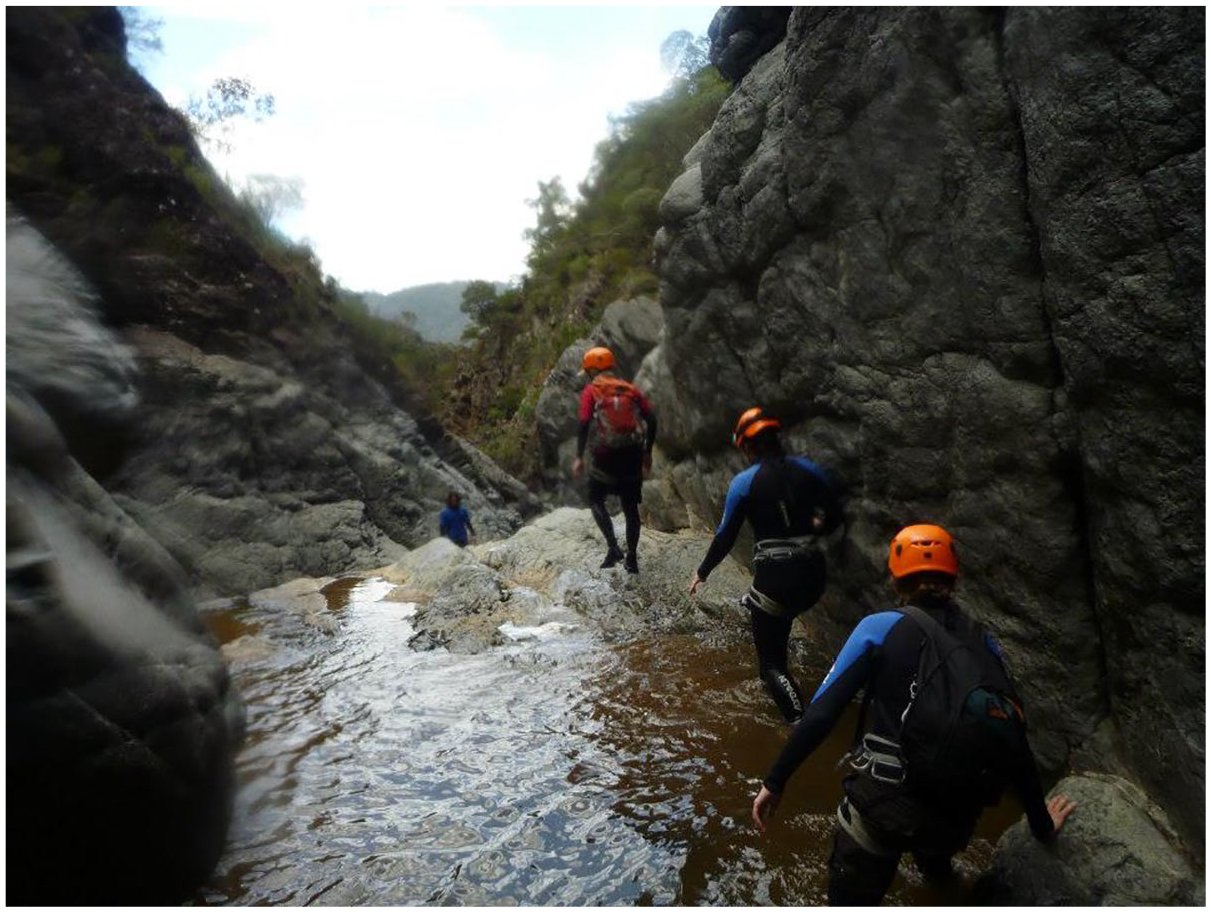
Moving through canyon, one behind the other, in Bungonia National Park, Australia. Photo taken by the author.
In looking to the other, novices find ways of working their bodies mimetically in this line-based interaction. They orient their attention to more experienced others and how they are meeting the world, taking this as a ground for their own internal adjustments. Invitations to move as the other often progress wordlessly, especially on readily traversable ground, but they can also be called into line. I recorded an experience of tramping with a group on the West Coast that revealed how the ‘pacing’ of efficient movement through the hills is not already there but must be learned. Breaching the tacit rules of the walk, once we found the well-worn trail, I focused on my own movement, quickly leaving the others in my party behind. I walked in fits and starts, in a manner akin to the movement of novices that Veronica described:
You’ve got to move, you want to move at a pace where you can keep breathing normally . . . not normally, but you don’t want to be sweating, otherwise because you’re just going to burn out and you’re going to get tired . . . I know exactly how to move, but explaining that to other people and saying to them ‘well if you rush for 200 metres and then stop and sit down and pant for the next half an hour and then rush and then pant, that’s not efficient’.
This pattern of movement that the adventurers adopt is like the tortoise in Aesop’s fable: slow and steady. I am afraid I am the hare.
I steamed ahead on moderately steep terrain, ‘pausing’ to look at the view and back to my party. No one called me out on this pattern of movement, although I eventually became conscious of the difference in my movement and theirs. As I reached various points that seemed a good place to ‘look’, I noticed their pattern of movement relative to my own. At first, I was confused by their pacing. ‘Why are they well behind me? I am not the fittest here, they should be faster, no?’ Attending to my breath, I was conscious that it was quickened by the effort, where I could not see this same labour among my fellow travellers. I was also conscious that my speed was earning me no praise.
After a few rounds of this, I slowed down towards their pace. What followed from this commitment was a realisation that to walk with the party, I needed to walk behind. The track was not wide enough for us to walk abreast of one another. I could also not see how they were walking when I was in front, perhaps part of the reason that I kept ‘losing’ them. On a steep incline, as we were on, I was not looking at the back of their head but at their feet and hips. My attention focused in on their pace, the length of their gait, and the placement of their feet. I found myself matching my movement to theirs, stepping together. There were no explicit instructions; no one said to me, ‘Why don’t you try sticking with us?’ It was a quiet invitation that I took up as they continued to move their way, not pushed forward by the pace I was setting, and so I moved to join them.
In moving over ice, the novelty of the movement is greater, and so moving off the bodies of others can involve heightened narration to break down the pattern of movement. Here, we also move in a line. The walk in through the bush involved no direction. When we reached the edge of the ice, we were instructed to put on the crampons we had been carrying. The kit itself is awkward, bewildering even. ‘How on earth am I to move with these metal spikes bound to my shoes? Surely walking on ice is hard enough without these crummy things strapped to my feet?’ Those familiar only with walking on non-frozen surfaces might understand this thought process.
In stepping onto the ice, crampons make more sense, but my steps are awkward and small. I walked directly behind the leader, again, watching his feet not only in terms of gait but placement. ‘Can I place my foot here? How many steps might I use between this point and that?’ The leader would pause, explicitly guiding me and others over what he acknowledged as trickier sections. ‘Watch here, there is a small crevasse. Stick to the right’. There are steps cut into these novice tracks. The guide touched them up as we moved, the act of cutting in with an ice axe also directing attention to foot placement (Figure 2).
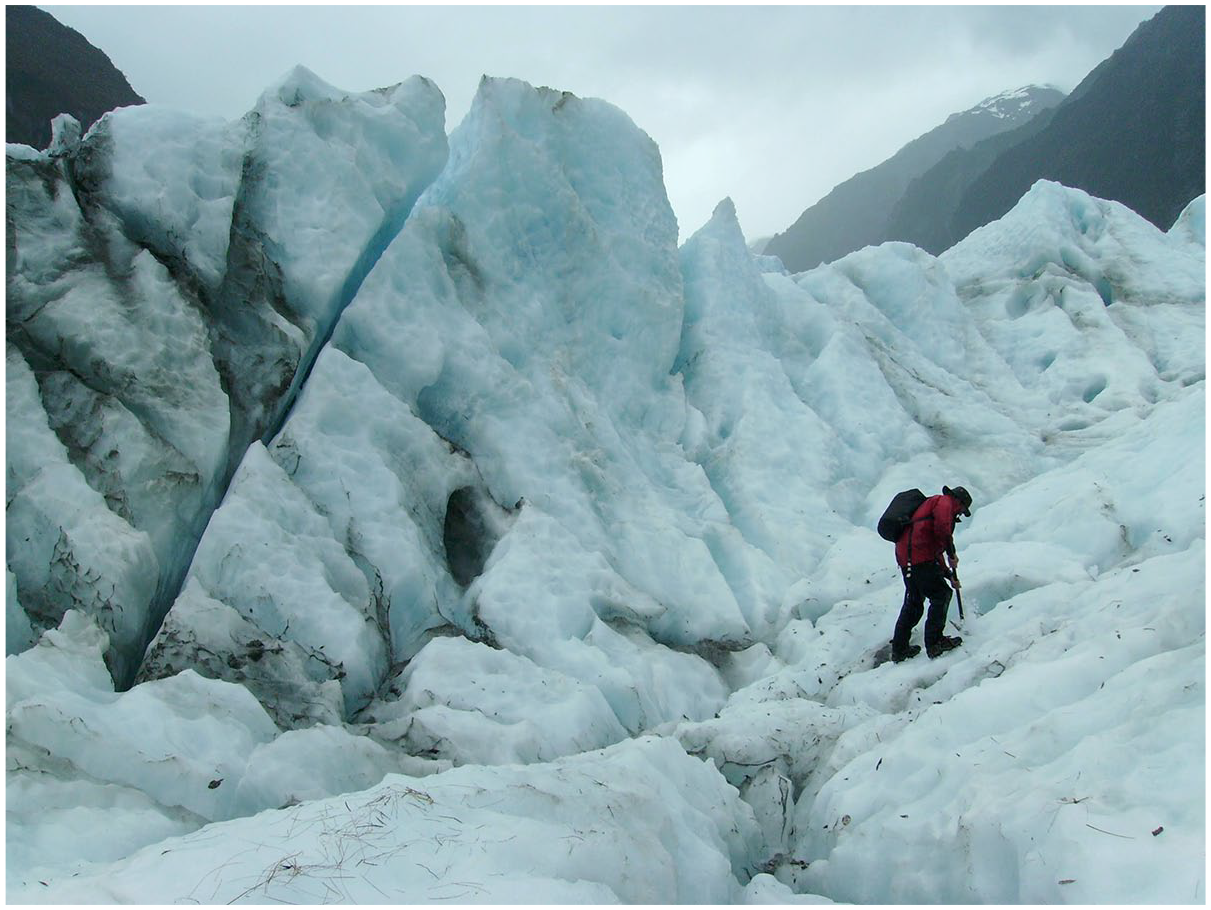
Guide cutting in steps to aid the placement of the feet of the group, Franz Josef Glacier, New Zealand. Photo taken by the author.
This method of learning to move over ground by going out with others, watching how others move, and having guides narrate the nature of a surface was recounted by other adventurers I spoke with too. Veronica explained how her skills developed in these terms through an account of being taught about scree slopes. Scree slopes are a common feature in the New Zealand mountains due to the nature of the greywacke, a variety of sedimentary rock. The freeze-thaw processes cause expanses of ground, especially on the eastern sides of the Canterbury and Marlborough valleys, to be covered by shattered rock that is gradually moving downwards. The resulting unstable ground requires some technical training to navigate:
There was a lot of – yeah, he did draw things to our attention. Like, he’d say ‘Okay here’s a scree slope. Now that’s going to be hard to get up because for every step up it’s going to slide you back down again’. So you know, as a beginner and looking at that you didn’t know.
The narration here draws the attention of novices so they might first ‘see’ the slope, just as my guide pointed out features in the glacier-like crevasses (see also Ingold, 2000). The narration alerts Veronica to the difficulty, not the specific movement involved in navigating the slope. The movement itself is left to a demonstration, which is not in a single moment, but over a whole trip, or sequence of trips, where scree slopes are encountered and navigated in an embodied sense following the line. They work at taking what they see of the pattern of motility of the other as a ground from which to find the proprioception that generates that movement in themselves.
Relation to Landscape
My pacing faux pas points not only to the pattern of movement and breath of a tramper/bushwalker as not already ‘there’ but also the absence of a broader pattern of attention. In walking, my attention narrowed to the ground that met my feet, later also to the body of the person in front. I had to stop to look at other features in the environment, which for me involved pleasure in the distant views. This pattern of attending to landscape is not what adventurers do. They lift their eyes from the ground to the surroundings. For adventurers, a central aspect of what they call learning from experience is spending time in an environment, in different places, slowly developing understanding and comfort with the peculiarities and variables of different contexts. In Lucy’s words, learning is ‘an apprenticeship with the mountains’ themselves. It is about learning to attend to the subtleties.
The adventurers are folk phenomenologists, reminding those novices who come to adventuring having lost touch with how knowing is inseparable from being-in-the-world that they need to attend. They say that attending to the subtleties in the conditions in this place, this time, is about quietening down and ‘listening’. Listening here is used to refer to a synesthetic mode of receptiveness to what the environment is saying/doing. Ears can always receive information if the listener chooses to be receptive and aware. This suggests continuous attention to all perceptual resources at an adventurer’s disposal, rather than narrowing to the sight or feel of the dirt and rocks in which feet are in immediate contact. The metaphor also implies humility. Adventurers should go in quietly, attending and responding to the world as they meet it.
Experienced others call on novices to be aware of the combinations of cues that are there for registration. The adventurer Simon talked about and demonstrated how ‘listening’ is acquired through spending extended periods in a landscape with someone who offers repeated calls to attend. He gave an example of attending to the sounds of rivers:
I was probably with people who did know, and they would have said ‘Hear the boulders’ and I would have said ‘Yeah’ and ever after I know . . . If you’re in the hills for a week with someone, you have a whole week of coming across a river with someone and talking about this stuff all the time.
These are invitations for the novice to perceive as the more experienced adventurer does. Simon tried to teach me to be attentive to the environment through a similar method. He was telling me a story about river crossing deaths when he suddenly stopped and said ‘Did you observe that change? The southerly has reached us’. I was listening to the story and so I missed the change in the weather: ‘I didn’t notice but I am freezing, and now I look, it is quite clearly not sunny anymore’. He joked that I had missed the change because I am an Australian, which is generously a comment on my lack of familiarity with local weather and likely also reflective of national rivalry. He then quickly moved to point out the aural and other sensory cues of the change in the weather so I could be drawn into his perspective:
Back to noticing wind changes, sometimes I can suddenly hear things that I couldn’t hear before, and that will be a southerly change, because out here where I am out on the beach, I can suddenly hear the waves, and although the temperature and sky have not changed, I know at that point that the wind direction has changed and I now have a southerly on me, and there will be cloud coming up on me shortly.
This lesson in attending is not only about the meaning of specific cues. Simon is articulating a philosophy of adventure based on continuous orientation off the environment. He explained that sensory awareness and attending to the subtleties of place is the foundation of bushcraft:
It is observation, observation, observation . . . You’re travelling through the land and you develop a way of assessing the implications of things everywhere. You’re looking at a river and as you’re keeping your eye on it you’re noticing what sort of volume of water there is in the river, whether it is up, whether it is not, what the rocks are like in the river, whether they are going to be greasy or not . . . You might be travelling in mist, and you might not be sure whether the day is going to work out as one when you can travel reasonably safely or whether the weather is going to fall to bits, so if an airplane flies over [as it does in this moment, he is directing my attention] I would be listening to whether there was any variation in the sound of that, because if there is a lot of pulsing, it is highly likely that there is a whole lot of wind. Whereas if it is all calm air, there will just be a steady drone. Little things all the time that add up, none of them particularly important. You can tell people a few things, but it is like taking a horse to water.
While there is a clear flavour in what Simon is saying about novices choosing whether to ‘take up’ the invitation, there are also techniques that insiders pass on to aid in how outsiders are working their senses. One technique involves doing hearing comparatively, as in the suggestion of attending to pulsing in the sound of the aircraft indicative of wind. Another technique involves guides to interrelated sensing. The southerly change provides an example of this, where the audible sound relates to wind direction, visible changes in the sky, and the temperature as felt.
Silence, Turning Inward
While we typically concentrate our attentions on that which is beyond us, we also need a certain amount of space to turn to our backgrounded bodies. This turn to those aspects of our embodied selves that take their place in our unconscious have been expressed in different ways. In the context of meditation, Pagis (2019) uses the language of turning inward, as meditators learn to mostly disattend to the others that surround them as they come into touch with their breath and sensations within. Mol and Law (2004) describe how people living with diabetes cultivate ‘innersensitivity’ as they ‘do’ their bodies. Whether with respect to the practice of vipassana or self-management of disease, the notion here is that we can orient towards our inner lining.
For adventurers, this heightened state of self-awareness and conscious attention towards the backgrounded body is facilitated by silence during the ongoing activity. The significance of silence is especially evident in written accounts, where authors note the character of silence in the mountains, and what it does for their knowing and action. While not universally the case, silence can be a property of the place. It dominates above the snowline, becoming a refrain throughout Vervoorn’s (1981) account of climbing in New Zealand. In one line, he described Mount Cook as ‘ice-carved rock, water, storm and silence’ (p. 148). This is not only a property of environments in constant cold. In a forest, moss can have an effect akin to acoustic batting absorbing sound (Vervoorn, 2000: 107). Silence here does not exactly mean soundlessness; it is more a reduction of sound and other calls on attention.
Silence is generally revered and fiercely protected. Many of the adventurers mentioned experiences of hearing helicopters flying overhead, typically with tourists, as ‘breaking’ the stillness and silence and the states of being that it makes possible. The reduction in calls on attention turns adventurers within themselves. It focuses the mind. The adventurer Emil explained that this silence generates a state of hyperawareness and so expands what he can do. For Emil, the need for sensitivity attracted him to climbing solo, as climbing partners ‘break’ the silence:
[Going solo] does enable you to retain a consciousness or keep your attention focused . . . Just the fact that you have a responsibility for somebody else, and there is a lot of toing and froing of conversation as well, whether it is encouraging the other person or saying ‘for god’s sake hurry up, I’m getting scared here’. You are so concerned about the other person that you’re not listening to what is happening around you.
While silence can have the effect of turning an adventurer inward, this is still in relation to that which is beyond them. Turning inward is not becoming an object to self so much as dwelling in the interface of how we meet the world. As they attend more closely to those sensations that do occur, whether the tactile qualities of a surface or otherwise, they can also pay more attention to their own proprioceptive organising in relation to the surface, allowing them to climb with greater efficiency.
The focus on the self-meeting-the-world is not always a joy. In reducing the ‘noise’ around them, what an adventurer can be left with is their own roaming thoughts, which can be unsettling. For some people, the meaning of silence as death dominates. In many accounts, the awareness that someone has died is based on the silence. The critical moment in Touching the Void where Simpson fell to the base of the cliff is described as a sharp cracking followed by stillness and silence. The meaning of the silence could only be that Joe had died, although readers familiar with the story will know that he survived. In this context, not everyone could manage the silence, and so they stepped back from the ways of being that it affords. Someone like Emil would say that you need to make peace with the silence, to feel it as ‘friendly’.
Conclusion
This analysis adds to the building number of cases that shows the turn towards the bodily organising that mostly sits in our unconscious and yet can be deliberately transformed. There are various ways that novices get ‘the feel’ of a given activity by working off others’ bodies. Imitation as part of a process of intertwining is one such strategy (see also Lande, 2007; Pagis, 2019). Formal training based on imitation often includes narrated demonstrations. Downey (2008) gave such a case in the breaking down of complex movements in capoeira, where the instructor pauses at various points, describing the different body positions that make up the complete movement to place it in students’ grasp. The methods shown in this article come from an informal learning environment where explicit instructions and demonstrations typically do not feature. Yet walking in lines has a similar mimetic character to the approach that Downey described. Novices take seen cues from the person in front, which echoes down the line from the group leader.
These interactions often progress wordlessly, but when they do, they rely on people interpreting the situation the same way. People do not always and ‘naturally’ fall into line; they may need to be called to attend to others. In my experience tramping, this ‘call’ was non-verbal, as the insiders continued to demonstrate their pattern of movement until our bodies entered dialogue. That this was a low-stakes environment is part of the reason for the silent leadership. Where the consequences of divergent patterns of behaviour are too high, calls need to be verbal, sometimes going as far as explicit ‘rules’, as in traversing of frozen surfaces with crevasses.
Calls to attend are not only towards more experienced others in a party but also to the environment itself. How our relation to the material realm transforms sensation is the subject of a growing literature (Maslen and Harris, 2021; Mol and Law, 2004). My concern here is not so much the extension of the body through tools but how the environment itself is part of the transformation of sensation. Adventurers position and know through their bodies first and foremost in relation to the spaces that they move through, as well as the tools that they use as part of the practice. It is this relation to the world that is dominant, they say vital, and they work their perception cognisant of how they are always in this relation.
Merleau-Ponty put forward that this relation is always how we know and work our bodies. It is the existence of the body towards objects and tasks that offers the ‘co-ordinates’ of our being in the world (Merleau-Ponty, 1962: 115). And yet, orienting off place is a social process. The adventurers are coached in how to do perceiving in place, what it means to be in touch with the snowpack, what to attend to when moving through the bush. We see this in my novice experiences where I am not attending broadly enough; I am not seeing enough, hearing enough, to know through the relation between my body and the world as adventurers do. When in a place with a novice, experienced adventurers make a point of saying what they are attending to, not as part of including the novice in an immediate decision-making process, but more generally to coach the novice in the things that they must continually notice.
This observation about perceiving as an interactional achievement adds to the work of Goodwin (1994), who showed how archaeologists ‘see’ dirt with the Munsell colour chart and students’ collaborative tracing of the ground with their professors. Or Katz’s (1999) work on the collective experience of humour, where parents work to align their child’s way of seeing with their own by pointing, aligning gaze, and exaggerated expressions. While implicit in these other studies, the case of the adventurers brings into focus how attending to the world is synesthetic in character. It is not about seeing a river or hearing a river as isolated modalities, even if used in combination, but a seeing-hearing-feeling-moving-smelling-tasting in the world. Our perception is almost always synesthetic and we exploit this synaesthesia in altering our conduct.
The third orientation that adventurers take involves shifting awareness inward. In the case of meditation described by Pagis (2019), the nature of the inner experience is immaterial; it is not so much work to change it as to dwell in it. Turning inward to a person’s proprioceptive organising typically happens in practice phases, as in the cases of singing (Maslen, 2022b) or ballet dancing (Kleiner, 2009). The case in this article offers us something different. This is not about practice, or about dwelling in the body and disattending to the world, but pulling back awareness from the world to the-body-meeting-world. To use the language of painting, as Merleau-Ponty did, it is about a widening of gaze from the canvas to hand-holding-brush-meeting-canvas. This awareness of the self meeting the world is uncommon during an ongoing activity, where typically people orient to that which is beyond them (Polanyi, 1966). It was also not reported by all adventurers, all the time. It happened only where the draws on their attention from others and the environment were reduced. This perceptual orientation can weaken in times of stress and exhaustion and is strengthened where the silence is sought out and embraced.
The notion of moving into this space is also not discovered anew by individual practitioners. It was something that they were collectively aware of and discussed. They talk about the virtues of going solo; they even tell one another to be quiet in instances in which they need the silence to have the necessary focus to perform a manoeuvre that would be interrupted by the social context of a trip. Despite its orientation towards a more personal form of experience, this variety of attending is also an interactional achievement.
