




Abstract
This article examines naked protests as efforts to advocate for social justice, particularly against patriarchal oppression and state violence. It explores ways in which women use naked body protests as a form of resistance, thereby negating dominant narratives of its impropriety. Naked protests are examined for how they might be mobilised against patriarchy and institutional oppression. This is done through the use of three data sources, namely a radio podcast interview of two women student protestors who staged a naked body protest during the #FeesMustFall violence in 2016; a video recording of a protest staged by working class women against the destruction of their homes in Dobsonville, Soweto on 12 July 1990; and interviews conducted with 14 women who participated in naked body protests. The article employs critical discourse analysis to understand women’s role in advocating for social change and decoloniality. In addition, it delves into different affective registers experienced by women protesters during protests and interviews. Findings suggest that politics of protests are saturated with affective registers that range from anger to rage, fear, sadness, pain, joy and a sense of power. African women’s naked bodies in protest are a link to generational power that creates a rupture, which interrupts violence and coloniality. Moreover, the analysis suggests that naked protest is a powerful form of protest that transforms a woman’s body from social constructions of vulnerability and consumption to a site of militancy, defiance and one that speaks back from a position of solidarity and strength. These protests demonstrate a grounded African feminism, which enables African women to speak from their location and reality.
Introduction
In this article, I explore the role of naked body protests by women in resisting social issues like inequality, patriarchy, sexism, colonialism and injustice. It is part of a larger study on affective dimensions of naked body protests in South Africa. I engage the ways in which naked protests might be conceived as decolonial praxis. I illustrate that naked body protests are not just desperate outpourings of women at their wits’ end. The central contention is that women’s naked bodies in protest are a link to generational power – young women, mothers, grandmothers. They may be understood as Fanonian protest – a rupture of and protest against sexual violence, and a powerful way of interrupting coloniality. As Fanon argues, ‘decolonisation, which sets out to change the order of the world, is, obviously, a programme of complete disorder’ (Fanon, 1963: 27). In addition, I illustrate that disruption is saturated with affect. Affect is a generative lens through which the body and its actions are theorised. Psychosocially, the expression of transgressive affects such as rage, anger and self-love during naked body protests enables women protesters to work towards collective decolonisation.
I begin with the theorisation of affect, followed by meanings of decolonial praxis before outlining the feminist framework within which the study is located. This is followed by a focus on the body. The last part discusses the findings.
Affect – When Events Hit the Protesting Body
I begin by outlining the article’s orientation to affect as traversing the conceptual distance between the preconscious to the representational or discursive. The term affect has many different definitions depending on methods, disciplines, traditions and approaches (Blackman, 2021: 49). An early affect theorist, Baruch Spinoza, defines affect as an affection that lowers or increases one’s power of acting. Spinoza (1677) explains that affection is the state of a body being affected by another body. Invoking Spinoza, Deleuze (1988) explicates affect as affections of the body such that the body’s power of acting is increased or diminished. Massumi (2002) asserts that the world affects and has effects on the body first. Affect is only subsequently, after a time lag of about half a second, picked up by the speaking, thinking, conscious, cognising and representing subject. Massumi (2002, 2009) maintains that affect is a kind of intensity. He explains that affect is the ability to affect and be affected. Affects are understood to be fluctuations of the body’s autonomic response system; they are precognitive, asignifying and different from meaningful stages of emotional response (Massumi, 2002). Following Deleuze and Massumi, Gregg and Seigworth (2010) define affect as that which arises in the midst of, or in-between-ness, in the capacities to act and to be acted upon. However, Wetherell (2012) differs from Massumi, by asserting that while affect is preconscious, it is also discursive. She introduces the concept of affective practice and contends that affects are always embedded in acts and practices. They constitute an essential part of the practical activities with which bodies relate to other subjects and objects (Zembylas, 2018).
In their conception of affect, Blackman and Venn (2010: 8) advise that a more cautious response might be to consider what different versions of affect do in our theorising. Following Latour (2004), Blackman and Venn (2010) explain that affect can be linked to a reformulation of bodies as processes rather than entities. This way, one can consider not ‘What is a body?’ but rather ‘What can a body do?’ This shifts the focus to consider how bodies are always thoroughly entangled processes, and importantly defined by their abilities to affect and be affected (Blackman and Venn, 2010: 9). Blackman (2021) asserts that bodies are considered open, defined primarily by their capacities to affect and be affected. Movement, vitalities and indeterminate assemblages are thus central to bloodily affectations. Affective practices like road rage or naked body protests require recruitment, assemblage and entanglement of huge social, cultural and material infrastructures (Wetherell, 2012). In this article, I am guided by this set of theorisations. I rely on assemblage thinking and provide an audience by witnessing affects and women’s bodies in protest.
Decolonial Praxis
The protesting women advocate for social justice against forms of oppression such as patriarchal domination and state violence. However, naked body protests do not always have to be purposeful. They can be viewed as performances of defiant unhappiness and therefore as undesirable affects (Glover, 2021). In this article, I focus on more purposeful protests. By theorising decolonial praxis, I illustrate how naked body protests might be viewed as strivings for decolonial praxis. Ndlovu-Gatsheni asserts that: Africans must be vigilant against [...] the trap of ending up normalising and universalising coloniality as a natural state of the world. It must be unmasked, resisted and destroyed because it produced a world order that can only be sustained through a combination of violence, deceit, hypocrisy and lies. (Ndlovu-Gatsheni, 2013: 10)
Following Fanon (1963), Canham (2018) adds that a central feature of decolonisation is complete disorder so as to disrupt colonialism. Invoking Mignolo (2011), Tamale (2020) asserts that decoloniality is a specific form of decolonisation, which advocates for the disturbance of legacies of gender, geopolitical and racial inequalities and control or power. Decoloniality is a way to re-learn the knowledge of one’s forebearers that has been neglected, buried or discredited by the forces of modernity. Decoloniality uncovers the dark side of modernity and shows how it is built on the backs of others. The others that it erases, racialises and objectifies are generally black women. Decoloniality is about restoration and reparation (Mignolo, 2011).
The continuity of forms of oppression that were mastered in the colonial period has been termed coloniality (Maldonado-Torres, 2007). The post-colonial African state and its institutions have retained the patriarchal and violent character of their colonial predecessors. Black women bear the brunt of coloniality and they resist it through protest. A central concern is the rejection of Euro-American ideologies and a resistance against elements of western feminism, which do not speak to the African experience (Akin-Aina, 2011; Bakare-Yusuf, 2003; Oyèwùmí, 2002; Tamale, 2016). Naked body protest is African women’s way of reclaiming their agency and disrupting patriarchy and state oppression. Through naked body protests, the women illustrate that the naked body, in its vulnerability, can be powerful because it can be a form of resistance against those assumed to possess power. In this vein, Tamale (2016) asserts that ‘naked bodies have the capacity to disrupt and, in a spectacular way, turn vulnerability into empowerment’ (p. 31). Society often expects women to cover their bodies, particularly breasts, hips and butts. Unless they are stripping their bodies for male consumption, they are not allowed to expose their bodies (Bakare-Yusuf, 2006; Tamale, 2016). With the act of naked body protests, women reject this objectification and reclaim their agency.
African Feminism
I draw on the work of African feminists because of the decolonial tenets that underpin the African feminist ethic. This is to suggest that a false bifurcation between decolonial and feminist theory is not useful for understanding African life and struggle. African feminism is contextual and rooted ‘in constant negotiation with elements of custom and tradition and the goal of emancipating women’ (Akin-Aina, 2011: 69). Lewis (2001: 5) asserts that African feminism welcomes the work of thinkers located in the United States and Africa, but is committed to the gender analysis of African contexts. The oppressions faced by African feminists are different from those faced by western ones, though there is an intersection of overarching feminist concerns across the world (Tamale, 2020: 40). For Tamale (2020: 1), African feminism has always been between the hard rock of western influence and control and African relativism and criticism. As such, it is essential to enter the next stage of Afro-feminist activism by stripping off debris of western feminism that was adopted without scrutiny. It is time to reconceptualise the African feminist movement as a socially relevant and efficient tool against the marginalisation of women.
There is a lineage of African women scholars who have sought to illuminate the historical distortions of feminism. Among these are women who have sought to dislodge the binary thinking that has come to define gender. These include Oyèwùmí (2002) and Nnaemeka (2003). Invoking Amadiume (1985), Davids and Matebeni (2017: 165) posit that before colonialism, households were led by women and that children were not gendered. Oyèwùmí offers a post-colonial critique of Euro-American scholars and explains that before colonialism, Yorùbá societies were not ordered according to gender roles. Instead of the biological sex difference, Oyèwùmí (2002: 3) argues for seniority. She argues for chronological age difference and asserts that in the Yorùbá language, gender distinctions are not coded. Bakare-Yusuf (2003: 2) asserts that for Oyèwùmí, the absence of gender in the Yorùbá language means that the word woman, as theorised in much western feminist thought in terms of subordination and limitation, has no equivalent. As a result, Oyèwùmí contends that, historically, biology and social practice did not influence access to power, social relations or participation in institutions. However, Bakare-Yusuf is critical of Oyèwùmí’s reading of power and she observes that ‘as an ordering power in the Yoruba context, seniority operates in terms of a patrilineal system, a fact which remains problematically under-theorised in Oyèwùmí’s account’ (Bakare-Yusuf, 2003: 1). Oyèwùmí’s account of power dynamics in Yorùbá culture is based on context (being an insider or outsider in different contexts) and relativism (being senior or junior to certain members in the lineage). Bakare-Yusuf (2003) asserts that this account remains simplistic. Bakare-Yusuf argues that Oyèwùmí is wrong to conclude that seniority is the only form of power relationship and that it operates outside of or in relation to other forms of hierarchy. Other forms of power are always at play. For Bakare-Yusuf, Oyèwùmí only looks at power as enabling and not as constraining also.
Given our colonial legacies, many Africans have come to internalise the patriarchal dictates inculcated through missionary sensibilities. While recognising the precolonial gender order, it is not productive to ignore the misogyny that has come to define African masculinity (Gqola, 2015). African theorists like Tamale (2020) and McFadden (2005) warn that gender hierarchies have long existed in African societies and that the subsequent power inequities were exacerbated by colonialism. African women have, however, always resisted patriarchy and control over their bodies (Mama, 2011; Salo and Mama, 2001). Therefore, women have always found creative ways of resisting patriarchal and political domination. Several prominent women helped transform their societies even before colonialism. These include Queen Eyleuka (Dalukah) of Ethiopia, Queen Lobamba of Kuba (Congo), Princess Nang’oma of Bululi (Uganda), Queen Rangita of Madagascar, Queen Nzinga of Angola and Queen Nyabingi (northern Tanzania and western Uganda; Tamale, 2020). Echoing Tamale’s (2020: 42) contention that women have always found creative ways of resisting oppression and domination, Lewis and Baderoon (2021) introduce the concept of surfacing – one of its immediate meanings is that those who have not spoken publicly in the past now do so. They point out that black South African feminists have always expressed themselves through words, creativity, imagination and action. Surfacing is a generative grounded feminist theorisation for thinking about naked protests, particularly in relation to its emphasis on actions seeking to unmake the ways of cognition and meaning making that are often at the root of so much that does not work in our societies and our lives. Protesting women join a long lineage of women who resisted forms of gendering that oppress them. Naked protestors surface to the extent that they claim their agency through their bodies and resurgently assert their equality.
Theorising the Naked Body
In the history of western knowledge, the mind has always been privileged over the body. Greek philosopher Plato described the body as ‘a betrayal of and a prisoner for the soul, reason or mind’ (Grosz, 1994: 5). For Plato, reason had to rule over the body. In comments ridiculing naked women’s protests, women are often implored to be reasonable and to find less embodied forms of protest. They are asked to discipline their unruly bodies. In continuing Plato’s work, Descartes distinguished between the thinking substance (the mind) and the extended substance (the body). This has been known as Cartesian dualism. Grosz (1994) suggests that the mind or reason has mostly been coupled with maleness while the body and emotion have been coupled with femaleness. I suggest that this theorisation of the body helps to explicate the reactions of the public against the stripping women protesters.
In addition to Cartesian dualism, it is useful to consider how African women’s naked bodies came to be sexualised and shamed as excessive. Writing about nudity and women’s bodies in Nigeria, Bakare-Yusuf (2011) explains that historically and in the present, minimal clothing or exposure of the torso is a common feature among many Nigerians, especially in rural areas where most Nigerians still live (p. 121). She explains that the unclothed body, which in many Nigerian cultures was previously read in a non-sexual manner, is now sexualised and is mainly associated with sexual intercourse. This new meaning of associating the naked body with sexual intercourse and shame has been inherited from the two colonising religions of Christianity and Islam. These religions view the woman’s body as a site of sin, moral corruption and a source of distraction from thoughts that are Godly (Entwistle, 2000; Hansen, 2004). ‘Just like the primordial heterosexual couple – Adam and Eve – nudity signals a fall from grace, an invitation to illicit desire and yearning which should inspire shame and disgust in the fallen, who is always a woman’ (Tseelon, 1997 in Bakare-Yusuf, 2006: 122). Coly’s (2015) important contribution to this argument points to how post-colonial nation states used women’s bodies to signal advancement and respectability politics by insisting that being fully clothed indexed African modernity.
Since the naked body is seen as irrational, uncontainable and outside of normative constructions of reason and African modernity, I posit that women who stage naked body protests subvert this binarism and illuminate the power vested in a naked body. Tamale (2016) contends that the naked body speaks the language of spectacle, rebellion and subversion. Nakedness may be used to express vulnerability, as a method of confrontational resistance and as a conflict resolution method between fighting factions. With reference to the documentary of the Dobsonville women’s naked body protest of 1990, Naminata Diabate (2020) states that ‘unlike in racist colonial and neo-colonial voyeuristic images, what is not in this documentary is passive nakedness. The women’s self-exposure is active resistance against humiliation and dispossession’ (p. 44). Agential naked body protests disrupt coloniality and religious tropes of shameful and sinful bodies. Since, coloniality portrays black women’s bodies as grotesque, uncivilised and crudely sexual, even when they are formally dressed (Lewis, 2011), naked protest turns these crude stereotypes into a mockery and subverts the lens. The observer is forced to confront their own complicity in colonial constructions of the body. Affect radiates from the naked body in ways that implicate the protestor and her protagonists. I engage with this after the brief methods section.
Methods
I assume a poststructuralist African feminist reading of black women’s bodies. In this regard, I see the body as invested in its own theorisation at the confluence of multiple intersecting identities, temporalities and geographies. Since black women’s bodies have historically been appropriated for colonising and patriarchal missions, I use critical discourse analysis (CDA) to make meaning of how their bodies speak for themselves and back at society. CDA is appropriate in this study as it deals with the discourse dimensions of surfacing ideology, power abuse and the inequalities as well as injustices (Van Dijk, 1993). This coheres with Wetherell’s (2012) contention that affect can be read discursively. Consequently, through the use of CDA, I read the protesting body as affecting the world and as being affected by the social systems within which it moves. I read interview data, bodies and their affects as texts that exist in the social world.
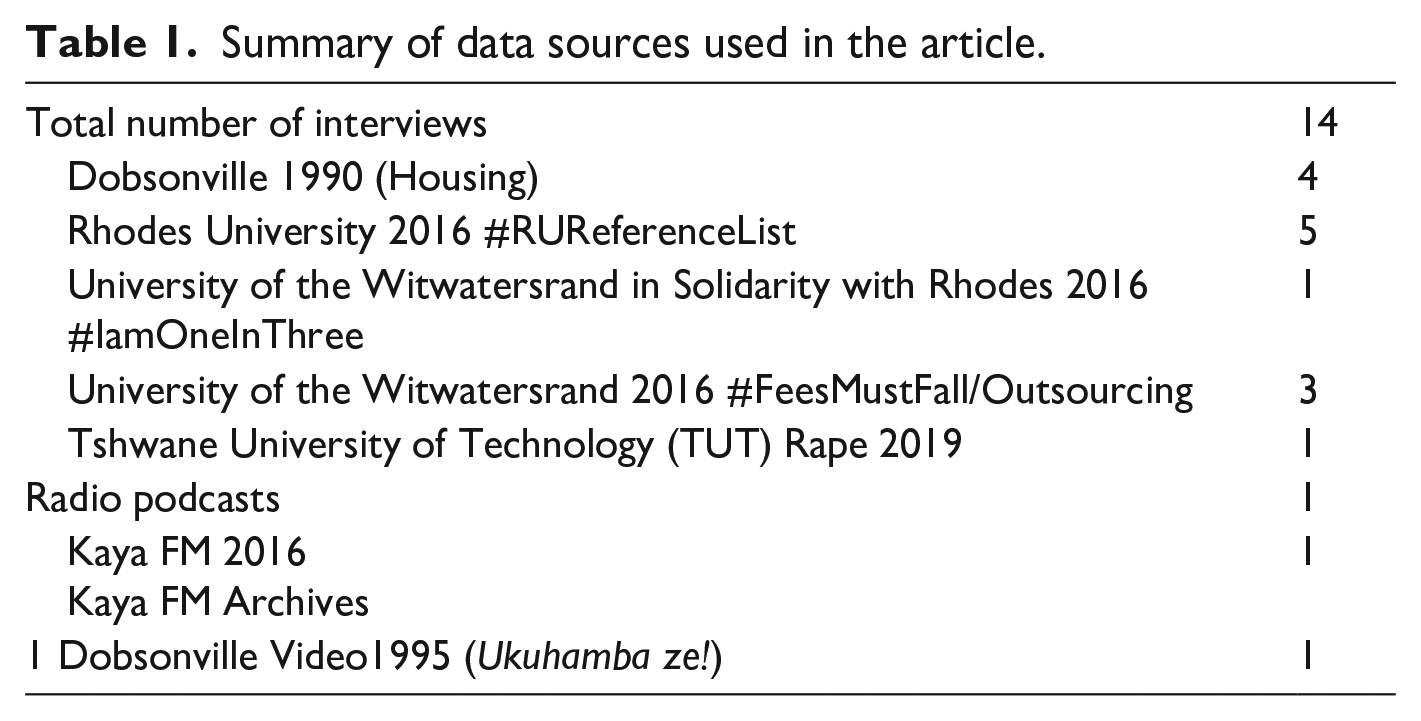
I utilise purposive and snowball sampling methodologies since the sample depended on the referrals that I was able to secure. Data sampling ended when the data reached a point of saturation. Saturation means that on the basis of the data that have been collected, further data collection is unnecessary as it yields the same results (Saunders et al., 2018). After 14 participants were interviewed, my sense was that the study had reached saturation. The participants were women who had participated in naked body protests. The sample was sought in communities where there had been a reported history of naked protests such as Dobsonville and university campuses such as the University of the Witwatersrand and Rhodes University. Participants who engaged in naked body protests participated in one-on-one interviews of a duration of approximately one hour to one and a half hours. In addition, I analysed a radio podcast of interviews with two naked body protestors. The podcast provided rich interactive data based on the interviewer, interviewees and callers. The documentary video – Ukuhamba ze! (to walk naked) of the 1990 housing protest is also analysed. I use pseudonyms to protect the women’s identities.
Table 1 summarises the data used in the study.
Summary of data sources used in the article.
Findings and Discussion
I organise the findings of this work into three subheadings; namely, anger, joy, empowered and powerful. These are the dominant affects that I identified across the various data sources. Practical considerations, however, mean that a range of other affective registers are omitted from this discussion. It is important to note that affects and emotions cannot be neatly identified, parsed, universalised or homogenised, and/or that affect could be both universal pre-cognitive feeling but also often socially constructed and not discursively represented. I discuss the dominant affects in relation to the broad theoretical investments of decolonial praxis, intergenerational enactments of resistance through the body and its affective registers. I read decolonial praxis as the practice of re-learning the forgotten knowledge of our African women ancestors. Drawing on these knowledges, naked protesters resisted the prejudice and suppression that was directed at them by some of the radio listeners, institutions and the state. I discuss these below.
I begin by exploring the ways in which women who protested naked talk back at and rebuff criticisms of their naked protests through body shaming, patriarchal censorship and attempts to control the narrative associated with protest action. The analysis explores how naked protests can be deployed against patriarchy and institutional oppression. This is done through the use or the lens of affects such as anger, joy and empowerment. Other affects included self-love, fear and rage, but due to length restrictions, they have not been discussed.
Anger and Transgressive Confrontation
Here, I illustrate how the women’s anger enabled them to challenge the ideology that nakedness in public is inappropriate. Naked women protestors received a censoring backlash to their protests. Their protests were often discussed on talk radio shows, in newspaper articles and social media commentary. The women protestors sometimes took up opportunities to talk back to their detractors. In challenging the ideologies of patriarchy, women often relayed similar affective energy as that conveyed during protests. The excerpts below are the women’s responses to the radio host’s question, which asked whether or not naked protests were necessary. Two of the women who had participated in the #FeesMustFall protest agreed to be interviewed. Tumi was in the studio and Busi participated over the phone: I find those questions so annoying ... I mean whose body is necessary? What questions are we asking when we say that? Whose body is necessary? Whose body is ‘inappropriate?’ Who is deemed ‘appropriate?’ Men piss on the street all the time, and nothing is said about that.
Throughout the interview, Tumi was filled with an anger that penetrated the radio, the type of anger that one could feel sitting at home. For Wetherell (2012: 81), Tumi’s anger is ‘not a random, irrational outpouring’. It comes from a shared social experience with other women who seek to decolonise constructions of the body. In this excerpt Tumi rejects constructions of the body and compares this policing to the lack of public censure of men’s bodies. During the #FeesMustFall naked body protests, Ndlovu (2017: 74) notes that masculinities always had to be negotiated at the picket line (i.e. in the form of police men and the male leaders of the #FeesMustFall movement). Ndlovu asserts that women’s names are usually not remembered or written about in history. She contends that their work and their bodies matter. Women’s anger is fed by constantly having to negotiate their space and importance at the picket line.
The excerpt illustrates Foucault’s (1978) assertion that where there is power there is resistance. Because the body is vested with power, stripping protesters use it to bring attention to their oppression. Society ideologically constructs women’s naked bodies as profane, indecent, shameful and sexual, never to be displayed in public (Gqola, 2015). Oppressive dictates require that women must cover their bodies, particularly their breasts, buttocks and vaginal areas (Tamale, 2016). The effect of the hegemonic disciplining of the body is that it should remain covered and hidden. Tumi rejected this hegemonic disciplining. Bakare-Yusuf (2011) critiques the idea that women’s bodies are not allowed to be exposed in public unless for the satisfaction of men. Like Bakare-Yusuf, we see Tumi critiquing this idea when she asks ‘whose body is appropriate?’ Tumi also displayed the character of the undutiful daughter referred to by Braidotti (2010a) by evincing a disobedient attitude.
Kgomotso, the radio presenter who interviewed the two women protesters, indicated that in their formative years, women are taught to cover up, but that the women protesters were challenging this ideology through naked body protests: We all grew up with this idea that one’s body must be covered, especially when you are a woman ... uum and obviously that it’s inappropriate to be naked in public. But the black women at #FeesMustFall challenge this. (Radio podcast 2016, Kgomotso, Radio presenter)
The emphasis of covering up ‘especially when you are a woman’ confirms the success of patriarchal ideologies of representing women’s bodies as profane, repulsive and in need of disciplining. It is interesting that Kgomotso uses the word ‘obviously’ as a presupposition that it is something normal and acceptable to expect women to ‘obviously’ cover up. This way of viewing women’s bodies has been naturalised and become the norm. However, we see the women in #FeesMustFall subverting this idea and challenging patriarchal normative values.
Joy in Struggle
Here, I explore the joy experienced by the women protesters when they assembled in protest and when they achieved the outcomes they wanted their naked protests to yield. Liz, Thabisa and Lucy were gripped by joy. Liz was a janitor at the University of the Witwatersrand (Wits) and had protested in solidarity with the students during #FeesMustFall and against outsourcing in 2016. Thabisa had protested for housing in Dobsonville, in 1990. Lucy had protested in the #IamOneInThree naked body protest in 2016 as well as the #FeesMustFall 2016 naked body protest. I interviewed Liz in her home in the presence of her daughter and grandson. The daughter was eagerly awaiting my arrival and was happy when I got there. She wanted to be present when I interviewed her mother: So, for me, hai! I am happy. I am happy ... Errr, I can say I am happy but also not happy ... Because we work very hard, we work under difficult conditions with a mop! And now they have even put cameras, you have to clock with your fingerprints at 7 o’clock. I don’t use my own transport. (#FeesMustFall protest interview 2019, Liz, protester)
Liz was happy that her salary improved, but she noted that the working conditions were unsatisfactory. As a result, she experienced joy and sadness simultaneously. The structural conditions have remained in place and her working-class position in the university means that she is under extra surveillance since the addition of cameras and biometric access systems that have come to be a feature of the neoliberal university.
Thabisa’s joy came about when she was finally given a piece of land that she had been fighting for. When she was called to sign for her site, she was filled with joy. ‘I was then shown my site. The way I was so happy that day!!!’ (Dobsonville protest interview 2019). I met Thabisa at the creche that she runs in her community. We conducted the interview in Sesotho and isiZulu. She decided to give me her life story first, before we could talk about her naked protest. To think through the meaning of insisting on telling one’s life story and not following the interview questions, I draw on Canham’s (2014) interview with a woman who expressed herself through tears for most of the interview. He was forced to read the woman’s tears differently by working with the materiality of the body. This requires one to follow Ahmed’s advice of listening out for an absent presence of history. Ahmed (2004) asserts that history provides useful supporting information for understanding narratives and experiences. In a similar vein, I learnt that one has to let participants express themselves in any way they feel comfortable, including telling their life story first. This disrupts narrative and temporal distinctions between ostensibly different topics. Following a feminist ethic, it is also important to let black women tell their truth in whatever manner they choose (Collins, 1991; Lewis and Baderoon, 2021).
Lucy and I met in a restaurant in her suburb. Lucy had a smile that warmed one’s heart and made me feel at ease. In the excerpt below, Lucy relates how during the #IamOneInThree naked body protest in solidarity with Rhodes University students, she and other women protesters at Wits put bloody pads on police cars in a bid to get them to move from campus: There’s a time they were threatening us with violation of state whatever. We were like ‘you are actually going to have egg on your faces when this thing comes to the media to say you arrested students that were protesting against militarisation and sexual harassment for them placing pads, bloody pads on your cars.’ Whether the blood is real or not is a conversation for another day. So, nothing ever happened, but what makes me happy is really what we achieved, is we got them to remove the nyalas [police armoured vehicles] from the piazza. (#IamOneInThree protest interview 2019, Lucy, protester)
Lucy and her fellow women protesters experienced joy when they saw police moving their armoured vehicles from campus. From the excerpt above, we observe how language can operate to convey affect. It courses through and between bodies (Mulcahy and Witcomb, 2018). This is evident in Lucy’s account when she relates how they spoke to police on campus. Affect is anchored in words and in already available subject positions of perpetrator and victim of sexual harassment and police brutality on the women protesters on campus (Mulcahy and Witcomb, 2018). These women are enlisted to the practice of calling out sexual harassment and police brutality towards women protesters on campus. They engage affectively/discursively towards a new configuration of social relations and they challenge the status quo (Mulcahy and Witcomb, 2018; Wetherell, 2012). As Butler (1988) argues, gender is not natural, it is merely generated by repeated performances. This means that performing gender creates the space for gendered beings to resist any prior characterisation of their gender. They use gender to undo the work of gendering. These women disrupt the expected performance of their gender identity by staging naked body protests to bring about change. The women disrupt their expected habitus (Bourdieu, 1984) that requires them to be submissive and obedient. The use of ‘bloody’ pads by the protesting students signals the menstrual curse, which originates in Cote d’ Ivoire. The women in Cote d’ Ivoire wear a red cloth called the kojdo for menstruation. Zéka Togui asserts that the kodjo is believed to symbolise the woman’s power to curse, to give life and whose word is sacred when she takes off and waves the kodjo to curse her oppressors (Togui, 2011 in Diabate, 2020: 159).
Since affect is generated in interaction between bodies (Blackman, 2012; Mulcahy and Witcomb, 2018) and is a state of in-between-ness that pulses with the capacity to act and be acted upon, we might read the police officers’ bodies in relation to those of the women protesters. We observe this in how the naked women protesters were angered by the militarisation of their campus represented by the presence of the police and their vehicles on campus. The women were moved to place bloody pads on the vehicles. This compelled the police officers to remove their cars and leave. The protesting women were consequently happy as they achieved what they wanted: ‘but what makes me happy is really what we achieved, is we got them to remove the nyalas [police armoured vehicles] from the piazza’.
In the quote by Sihle, who protested against the sexual harassment of women at Rhodes University, she indicates how proud she was of herself and other women. She talks about the fact that she was not alone and that the support from other women made her feel proud. Here we might consider the value of solidarity but also the positive affects that circulate and stick to assembled bodies (Ahmed, 2014). Sihle sounded happy and smiled warmly as she related this part of the interview: [smiles] I was ... I was proud, and I was happy, that it was not just me alone. There were so many other students, there were so many staff members, who were with us, who were supporting us. And I felt that ‘You know what, if the entire university could do this, it would mean so much, so, so much to so many women and victims of sexual violence’. (#RUReference list protest interview 2019, Sihle, protester)
Affects are always embedded in acts and practices and these include naked body protests. They constitute an essential part of the practical activities with which bodies relate to other subjects and objects (Zembylas, 2018). Miklošević and Babić’s (2018) study on a heritage exhibition found that participants reported that they felt good and consoled that there were other people like them. This is similar to Sihle’s assertion where she notes [smiles] ‘I was... I was proud, and I was happy, that it was not just me alone’. She is happy that naked body protest was an affirmation that there were women protesters who empathised with her and with one another. The congregation of oppressed bodies as an act of revolt affirms the existence of the problem, signals the shared nature of the oppression and demonstrates that those assembled will not tolerate their continued violation. Solidarity is a central tenet of African feminism (Mohanty, 2003).
Here, while joy was a common affect both during the protests and afterwards, it is useful to consider other affects that lie beneath or alongside the happy affect. This is because most of the gains of the protests were fleeting and very often were related to the de-escalation of the violence of state agents such as police. The institutional discrimination such as the surveillance of janitors, elimination of gender-based harm, or the provision of free quality and decolonised education are more intractable. The Dobsonville protesters appear to have made the most significant material gains as they eventually obtained the rights to the land. This should, however, be read in relation to the political moment of the transition from apartheid to democracy. Therefore, while joy is an important affect, it is important to understand it alongside negative or low affects.
One of the affects that were evoked by participation in the naked body protests was the feeling of power. I turn to this discussion next.
Empowered and Powerful – Acting on the World
In this theme, the focus is on the feeling of empowerment that the women experienced during the naked body protests: ... One patriarch ten sjamboks. And so I also had the sjambok [a heavy leather whip] in my hand, and there were also the struggle songs, the speaking, the singing, and so for me that moment was affirming. I felt affirmed, I felt empowered, I felt powerful somehow. Because when you ... when you have been raped and when you experience rape, it makes you feel, for me it made me feel weak ... Uuuh it made me feel very vulnerable. Uuum, it made me feel like an object and not a person. And so I remember that moment feeling empowered ... right ... I have my sjambok, I have my sisters around me ... (#IamOneInThree protest interview 2019, Sibu, protester)
It is possible for a woman to simultaneously experience empowerment on one level and disempowerment on another level. This coheres with Peterson’s (2010) assertion that empowerment can be multi-dimensional. Sibu explains that the rape experience made ‘me feel weak ... it made me feel very vulnerable’, while the naked body protest made her feel ‘affirmed and empowered’. Although the experience of rape had removed her power and agency, Sibu reclaims these during the naked body protest and refuses to be a victim. This can be seen as a decolonial resistance against patriarchy and the control of women through acts such as rape. The solidarity of other women and the sjambok represent feminist armour and protection against perpetrators.
From a psychosocial point of view, as human beings in society, we are always both subject and object. We are shaped by our environment but at the same time we can act on the environment (Woodward, 2015). The rape made Sibu feel weak and vulnerable, but she chose to act and do something about this by taking part in the naked body protest as a way of resisting the suppression imposed on her by the man who raped her. As objects for another, we are not necessarily victims of derogation and suppression (Cahill, 2009). As subjects, we are not necessarily autonomous and free, since the social is interwoven with the psychological and performative enactments. For Butler (1993), the subject does not exist prior to discourse. Instead, it is through the iteration of societal norms, practices and conventions that the subject is constituted in what is not a singular act or incident but a ritualised production. In other words, the subject is not naturalised, but it is repeated performance. In repeated performances lie the possibilities for one to resist prior subject characterisations, hence the ability for Sibu to move out of the victimhood state after the rape incident, into the state of feeling empowered and claiming back her power during the naked body protests. It is, however, important to note that even after the protest, one can have moments of feeling helpless as the protest does not suddenly make one an overcomer. In the moment of the protest though, Sibu experienced a sense of power and affirmation: For me I remember like watching the night the RU reference list happened, coz it happened when they took the rapists from their residences. So, I was watching it happen online. We were watching it on Twitter and on Facebook. I remember joining groups on Facebook. And seeing what was happening, being triggered but also empowered because these women were literally taking these rapists out of ... their rooms. They were ... they took them ... so there’s this street... They made them walk down the street ... right ... and they made them sit in a circle ... They umm, and they removed their power. I remember feeling so affirmed umm by their actions and I remember just being so proud of them. But I was so deeply, deeply triggered. And then there was the naked protest ... and because I had also not dealt with my own rape ... right, it umm .... I had gone to therapy and stuff, but I had never completely dealt with it. Umm so I remember feeling very triggered but also very affirmed. (#IamOneInThree protest interview 2019, Sibu, protester)
Since affect is the power to affect and to be affected, Hardt (2015) argues that it is important to recognise our power to be affected as not a weakness but a strength and to realise that we are non-sovereign subjects. This suggests that we are affected by outside forces. This is illustrated by Sibu’s preceding narrative. With reference to the women’s actions towards the rapists, Sibu narrates that, ‘the women protesters removed their power. I remember feeling so affirmed umm by their actions and I remember just being so proud of them, but I was so deeply, deeply triggered’. We can only proceed on a path to liberation and joy by working through affects (Hardt, 2015). This can be likened to Sibu, who had to work through the affective vulnerability caused by the rape she had experienced in the past. Hardt (2015) explains that we should think of the power to be affected as a gauge of our capacity to really exist in the world. From the preceding excerpt, we also observe that social media such as Twitter and Facebook have the capacity to move one affectively. Sibu was moved in ways that she describes as triggering and empowering. Here, the word ‘triggered’ is illuminating for its reference to being affected. To trigger is to build tension or intensity in the emotional or physical registers and to set into motion. Therefore, one can read both the social media engagement and the protests as triggering. With reference to both, Sibu contends that she was ‘so deeply, deeply triggered’. She was affectively moved.
After watching the 1990 Dobsonville protest video (Ukuhamba ze!) with me, I asked Siviwe from the TUT protests how she felt. She responded by asserting: I felt empowered, that was one! Coz ... I feel like ... like the protest we are doing is nothing compared to that. (#TUT 2019 Rape protest interview 2019, Siviwe, protester)
She elaborated as follows: I am talking about the naked protest ... because thina [us] we still want to be dressed. Those women are walking with their panties, literally with their panties. Thina I think we’re still scared. I don’t think we’ve reached that point that ... I understand we are angry, but I don’t think we’ve reached that point where we are .... They are ... they pour petrol [laughs]. (#TUT 2019 Rape protest interview 2019, Siviwe, protester)
Affects such as anger and rage can be used as a form of resistance and to disrupt the status quo. Siviwe’s anger is encouraged by Audre Lorde (1981), who urged women to use their anger and rage to disrupt oppression. She argues that every woman has a well-stocked store of anger potentially useful against oppressions, personal and institutional, which brought that anger into being and that, when focused with precision, can become a powerful source of energy serving progress and change. Lorde’s reference to energy signals an affective charge to be moved. This is echoed by Cooper’s (2018) assertion that rage is a powerful affect for change. For the participants watching the video of the Dobsonville naked body protest, it was apparent that their stock of anger moved as a powerful energy. It had the capacity to move a younger generation of women. In my own observations of the interviewees as they watched the Dobsonville protest video, I witnessed their rage reignited. The rage of 1990 moved the young women of 2019 in an intergenerational interaction of affects and commitment to decolonial praxis.
In the excerpt below, Beauty recalls the fearlessness that they experienced in the midst of threatening police presence: So, we definitely felt powerful. We felt powerful the most when we were on the ground, or on the streets and were protesting through the streets or through the campus. Because then there would be all of this police presence, and their guns would not scare us as much as they would if we were protesting for anything else. (#IamOneInThree protest interview 2019, Beauty, protester)
The moment of protest was not pleasant, and some of the affects experienced by the women were not always positive. However, as Beauty explains, it was empowering for them to protest even in the presence of police; especially because they were protesting against the rape culture on campus. As Braidotti (2010b) argues, opposition, or naked protesting in this case, is not about negativity but about the transformation of negative into positive passions. Like Beauty, in the excerpts below, Mercy and Thabisa recall their fearlessness and killing rage. Among other things, hooks (1995) asserts that killing rage has to do with black women gaining strength to confront sexist, racist, patriarchal restrictions by sharing knowledge and resources with one another, as opposed to uniting on the basis of being victims: Hey! We were fighting that day ... When the police approached a man, we the women would rush there to protect that man and stop him from being arrested. And I was not afraid of anything, especially [mentions name of fellow woman protester] also had so much power and cheekiness. I was not afraid of anything, I did not fear a boer [white Afrikaner] man ... I was not afraid, I never had any regrets. I just told myself we would also kill them. (Dobsonville protest interview 2019, Mercy, protester)
Thabisa, a protagonist from the 1990 Dobsonville protest, comments, ‘At the time when I was naked, I felt so powerful ... the power to even hit a policeman’.
Mercy, Thabisa and the other women dared to be undutiful daughters who speak and fight back (Braidotti, 2010b; Foucault, 2001). They both assert that they were not afraid of anything, including the police. For instance, articulating a killing rage, Mercy adds that, ‘I told myself I would also kill them’. When I spoke to her 29 years after the 1990 protest, Thabisa could still relay the power she felt as she remembered that she fought until the policeman had to scoop her off the ground with the forklift of a bulldozer. However, despite the power and strength she felt during the protest, she still felt some shame as she mentions that she had not removed all her clothes, while her friend had removed everything. This points to the complexity and simultaneity of affects. This is illustrated in the quote below: When the bulldozer approached my shack, I took off my clothes. [Name of a fellow woman protester] had started first and removed everything, even the panty. At least I was still wearing my bra, panty and boots. I fought with the bulldozer until they scooped me up and put me inside the bulldozer. (Dobsonville protest interview 2019, Thabisa, protester)
Invoking Spinoza, Gatens (1996: 110) asserts that the human body is totally open to its surroundings and can be composed, recomposed and decomposed by other bodies. Blackman (2021: 48) also asserts that bodies are considered open, defined primarily by their capacities to affect and be affected. Once we open up and expand our power to be affected, however, then begins the work of selecting among the affects and discovering the ways to repeat or prolong those that are beneficial and prevent the detrimental. As the preceding excerpts suggest, the naked protests resulted in the women feeling affectively empowered and affirmed. They engaged in nomadic becoming, which is a process of expression, composition, selection and incorporation of forces aimed at positive transformation of the subject (Braidotti, 2010a). Thabisa and her fellow protesters stepped up to the challenge of something affirmative and looking for new and better possibilities through naked body protests. She asserts, ‘when the bulldozer approached my shack, I took off my clothes’. Thabisa was ready for anything and was not cowed when she was scooped off the ground in a bulldozer. Her power to be affected was enlarged and she found herself engaging in actions that were not pre-meditated. Writing about the Ukuhamba ‘ze video, Diabate (2020) observes that the women had an expression that called out, ‘come down and let’s fight’ (p. 44). The Dobsonville video indexes the empowerment the women get from their naked body protest.
Conclusion
In this study, I sought to explore the ways in which naked body protests might be conceived as decolonial praxis. I explored the role of women in fighting for social change and decoloniality. The discussion demonstrated the exclusion of black women from feminist imaginaries and centred African feminist epistemologies. These African centred theorisations enabled the surfacing of distortions, misrepresentations and silences that occur in teachings, history and theorising about African women, both in Africa and the West. The study reveals that naked protests demonstrate a grounded African feminism, which enables African women to speak from their location and reality. Because society often expects women to cover their bodies except for when they are stripping their bodies for male pleasure, with the act of naked body protests, I contended that the women reject this objectification. In addition, naked body protests enable women to resist coloniality, reclaim their agency and disrupt patriarchy and state oppression. The naked body protesters can, therefore, be said to be engaged in forms of grounded feminist resistance and this can even encourage more women to see that resistance is possible.
Because protests are always saturated in affect, I explored the different affective registers experienced by the women protesters during the protests and during the actual interviews and in their accounts of their protests. Through the use of a critical discursive lens that reads the body in its social, political, economic and historical setting, I have illustrated that the protesting body speaks in relation to its context and moves in concert with other bodies towards the direction of social justice. While recognising the limits and artificial nature of parsing out affects, in this article, I focused on dominant affects including anger, joy and power. I argued that these affects theorise the experiences of African women who insist themselves into being in a patriarchal world. By being open to move and be moved by other bodies and circulating affects, the women embrace solidarity. Theoretically then, I sought to invest the protesting body with intent that is always freedom bound.
