




Abstract
Recombinant DNA technology is an essential area of life engineering. The main aim of research in this field is to experimentally explore the possibilities of repairing damaged human DNA, healing or enhancing future human bodies. Based on ethnographic research in a Czech biochemical laboratory, the article explores biotechnological corporealities and their specific ontology through dealings with bio-objects, the bodywork of scientists. Using the complementary concepts of utopia and heterotopia, the text addresses the situation of bodies and bio-objects in a laboratory. Embodied utopias are analyzed as material semiotic phenomena that are embodied by scientists in their visions and emotions and that are related to potential bodies and to future, not-yet-actualized embodiments. As a counterpart to this, the text explores embodied heterotopias, which are always the other spaces, like biotechnological bio-objects that are simulated in computers or stored in special solutions.
In any case, one thing is certain: that the human body is the principal actor in all utopias…if not one of the oldest utopias. For me to be a utopia, it is enough that I be a body. Utopia is a place outside all places, but it is a place where I will have a body without body.
Miscellaneous technologies for human genome editing and recombinant DNA have been used over the last 50 years. The technology itself is well established with a long and rich history, both in scientific fields and in the public space. It is a result of the enormous progress made in analysing the structure of genes and the mechanisms of their replication and expression since the 1960s (Berg, 2002). Recombinant DNA today embraces a huge area: variable genetic engineering approaches, overlapping with bioinformatics, mathematic modelling, structural biology and synthetic biology. Recombinant DNA technology is understood here as the induced mutation, reconfiguration and exchange of DNA strands to produce and design new nucleotide sequence arrangements (Glick et al., [1994] 2010). Currently, particular techniques such as clustered regularly interspaced short palindromic repeat (CRISPR/Cas9), transcription activator-like effector nucleases and zinc finger nucleases have been employed significantly in human genome editing and DNA repair. The nucleases immensely facilitate the wide application of genome editing in various biological research fields (Ma and Liu, 2015). These technologies, especially CRISPR/Cas9 as used on human genomes, have attracted tremendous media hype, controversial reactions and large business and commercial interest as well (Jasanoff et al., 2015; Kirksey, 2016). Within recombinant DNA technology, attention is paid to molecular life in terms of technologized tissues, bodies, cells, genes and proteins in the laboratory.
The main aim of such technologies is to explore the possibilities of repairing damage to human DNA and of healing or enhancing human bodies and health in the future, in not-yet-realized, future bodies. At the core of these technologies dealing with not-yet-materialized bodies lies the intersection between biology and informatics, ‘an intersection that is replicated specifically in the relationships between genetic “codes” and computer “codes”’ (Thacker, 2003: 48). The virtual, potential bodies are then in-formed, to be materialized in the context of recombinant DNA, bioinformatics, protein modelling, simulations and future predictions. Eugene Thacker, inspired by the recombinant DNA technologies and bioinformatics, wrote about their influence on ‘our views of having bodies and being bodies (and becoming bodies)’. He suggested analysing the biological entities produced by genome editing and recombinant DNA technologies as biomedia (Thacker, 2003: 47). He stressed the simple instrumentation of our bodies and defined biology as a perfect technology that is already informatic, in-formed with life. In thinking about embodiment in the laboratory as a process, a continuum, I then consider Thacker’s concept of biomedia, where ‘the biological “informs” the digital, just as the digital “corporealizes” the biological’ (Thacker, 2004: 7).
This text is based on the ethnographic research I conducted at a biochemical laboratory from 2017 to 2019, mainly in a lab focusing on human DNA recombination and repair, at a university research centre in the Czech Republic. The fieldwork relates to the context in which the various technologies of recombining and repairing DNA and editing genomes are employed (Davies, 1981; Jackson at al., 1972; Lear, 1978). Using biochemical, computing, single molecule and genetic approaches, 1 the main aim of the laboratory is to experimentally explore DNA double-strand breaks (DSBs) as the most lethal forms of DNA damage. Lab workers study the conditions in which DSB can be properly repaired, restoring genomic integrity or mis-repaired, resulting in cell death, genomic instability, infertility, cancer and aging. In the lab, I followed and interviewed scientists, molecular biologists, biochemists and lab technicians. I later added a group of MPs and members of two ethics boards. I attended many meetings and was part of the everyday laboratory rhythm (Stephens and Lewis, 2017), which in general means pipetting, analysing bioinformatics data sets on computers, preparing material and participating in discussions, lectures, talks, lunches and team-building trips. Extensive field notes were taken in the laboratory, and I took photos and analysed documents as well.
Using examples from ethnographic research, the text analyses various forms of embodiments and corporealities, past and future, in the context of recombinant DNA technologies. These corporealities are analytically separable into (1) bio-objects or biomedia such as body parts, tissues, genes, proteins, bioinformatics models, predictive protein simulations and bio-devices and (2) the scientists’ own bodies and embodied emotional engagement. This dynamic is analysed as a continuum between corporeality as a social actant and embodiment as a vehicle of social agency (Haraway, 1997). I chose four people for this analysis, here called Kristin, Louis, Jan and Fred, all scientists, biochemists and molecular biologists working at the same laboratory. Kristin is now a 21-year-old woman; she was studying molecular biology during my stay in the lab. Louis is the head of the lab, a biochemist, nearly 46 years old, Jan is a PhD student of molecular biology working in the lab, 25 years old, and Fred is a 31-year-old biochemist and molecular biologist working on a post-doc position. I have chosen the four figures to represent the variety of perspectives, views and motivations of scientists in the laboratory. These people also illustrate the diverse shapes and forms of relationships and the configurations of corporealities in the laboratory. In particular, (1) the utopian traits of biotechnological embodiments analysed through the work with laboratory bio-objects and scientists’ own bodies and (2) the heterotopian character of bio-objects as invisible non-bodies and as other spaces mirroring the utopian visions of scientists. To analyse the data and the situation of biotechnological corporealities, I use mainly two complementary concepts elaborated by Michel Foucault: utopian bodies and heterotopias as other spaces. Utopian Bodies is also the title of the text based on a transcript of a radio interview with Foucault in 1966, in which he contemplates the utopian, virtual and phantasmatic character of human embodiment. The concept of heterotopia, originally a medical term defining the displacement of an organ from its normal position, was adopted by Michel Foucault and developed in his classic text entitled Of Other Spaces. Foucault here speaks about spaces that are always other, referring, displacing and often mirroring utopian visions within material reality. Additionally, I employ Foucault’s concept of the body as a heterotopian ‘other space’, referring to the ‘real immateriality’ of the potential and immanent not-yet-emerged future bodies. Following the work of Brian Massumi, who was inspired by Foucault’s concept of ‘the real incorporeality of the concrete’, I analyse the body in the lab as being simultaneously ‘as immediately abstract as it is concrete’ (Massumi 2002, in Bryant and Knight, 2019: 107).
In connection with my research, Foucault offers unique and inspiring analytical complexity linking biopolitics, dispositive practices and knowledge/power production of embodiments and utopian bodies in the laboratory. The complexity also includes ambiguities and discontinuities. Despite Foucault’s description of utopias as absolutely unreal and useless forms of existence in his text On Other Spaces, the text Utopian Bodies gives another impression. As a utopian, phantasmatic sphere of the body, it is for him synonymous with imagination, joy and the pleasure of dreaming about possible experiments and potentialities of human bodies. The individual pleasure of an imaginative, utopian, individually embodied self is then complemented by thwarted hopes for an unreal and non-existent utopian reality with the utter displacement of a social or political context. This also describes the dynamics of the main argument of the following text. In this context, I understand the body and biotechnological laboratory embodiments as specific spaces existing at the same time in the utopian spheres of individual scientists’ imaginations and in materialized heterotopias placed in virtual, bioinformatic, computing or frozen ‘other spaces’.
In the first part of the text, I analyse ethnographic data via the concept of utopian bodies as they are imagined by scientists and as they are related to their bodies, emotionally connected with technologies. This imaginative body work of scientists creates specific visions of future healthy bodies and incorporeal ontologies of laboratory bio-objects as well. They work with bio-objects like immortal cell lines, bioinformatics life simulations and bio-computing devices. In the second part, I consider the biotechnologized corporealities in the context of their invisibility, represented via imaging technologies, as specific heterotopias, bodies fragmented and existing as other spaces. In the third part, I connect these two lines with the idea of the futurity of human embodiment as an example of a specific utopian project of the human body. In exploring this and using concepts of utopia and heterotopia, I hope to contribute to the contemporary debate and texts on biotechnological embodiments and on the dynamics of corporeality in the context of recombinant DNA, particularly genome-editing technologies (Haraway, 1997; Siebers, 1994; Stapleton and Byers, 2015; Thacker, 2003, 2004).
Recombinant Utopian Bodies: Future Bodies as Non-spaces
When I met Kristin, 2 I was fascinated by her world. Spending 10 or 12 h daily in the lab, she was very open, easy-going and always willing to discuss things. Despite her very young age, she had achieved astonishing scientific success, including publications in Nature and Science and many others. I was often surprised that someone could speak so seriously about immortality and bodily enhancements without any hesitation or doubt. As an anthropologist, I was also surprised by my own surprise. Kristin and her colleagues Fred, Louis, Jan and others were my partners during the ethnographic research I conducted at a biochemical laboratory focusing on human recombinant DNA and genome editing. As a molecular biologist, Kristin had performed experiments specifically with the proteins RAD51 and SAMHD1 and their mutations since she was 17 years old. Her strong beliefs and enthusiasm about techno-optimistic progress sometimes reminded me of the classical modernistic ideas of the human body as a sort of sophisticated organic machine. Kristin passionately believed in the technologies that can solve humanity’s greatest problem – aging and death. One evening, as the lab fell into the silent rhythms of the night, she told me: ‘The body is a machine working properly or poorly. All problems are possible to solve rationally, even death. The body is ill, so we will heal it, repair it. The body is getting old – we will make it immortal, prolong its life. How can we do it?…It’s not magic’.
Kristin’s vision and immersion largely calls to mind trans-humanistic and techno-optimistic worldviews, a flood of miscellaneous perspectives and activities that share a faith in the power of technology and hope for the abundant technological enhancement of post-human bodies (see, e.g. Kurzweil, 2005; Moravec, 1988; More, 2003). 3 Kristin was simultaneously intrigued by the impact of hi-tech science and by the consequences of visions about immortal bodies and prolonged life. She expressed quite idealistic and romantic visions of science and motivations for bodily enhancement. Her views were not unique in my research. Kristin and most of the other scientists showed the significance of the role that sociotechnical fictions and techno-fantasies generated by utopian (modernistic) impulses play in scientific work and its popularization (Ihde, 2001; Jasanoff and Kim, 2015; Latour, 1993). All of the scientists were convinced about the positive role of science and they were techno-optimistic. Kristin, Fred and Louis understood biotechnologies as a pure truth, as neutral information about human bodies, and they all echoed a value-neutral conception of technological imagination. As Thacker writes, the detachment of technologies from their cultural and political background nourishes a huge sphere of posthuman utopias (Thacker, 2003). According to Marita Sturken, it is essential to better understand how our visions and imagination, both optimistic and anxious, have shaped the meaning and use of technology (Sturken et al., 2004). Studies of technology are always imbued with analyses of visions of the future, ‘those creatures of the future tense’, when exploring the expectations, speculations, visions, hopes, prophecies, promises and potentials as well as pessimism, fear and concerns in connection with embodiment, medicine and biotechnologies (Selin, 2008, in Tutton 2011: 412; Taussig et al., 2013).
With Kristin as an example and a main representative of the field in this text, I pose a question about DNA recombinant technology dispositif, the network and connections among biotechnological embodiments, various devices, living things, documents, the scientists’ own bodies, their embodied emotions and visions about future bodies as well. Human bodies and biological tissues are intimately involved and live in close relationships with technologies or techno-others in the context of recombinant DNA and genome-editing technology.
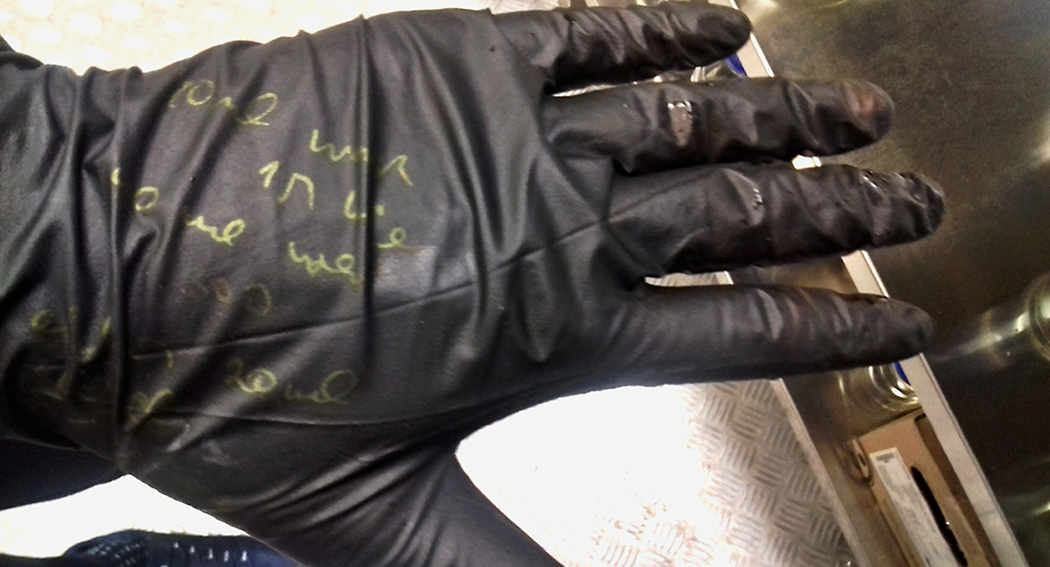
Many texts have shown that human bodies and technologies cannot be understood separately from each other (Feenberg, 1999, 2002; Michelfelder et al., 2013; Verbeek, 2005). As Myers wrote, ‘…protein molecules come to be figured in, through and as bodies’ of scientists (Myers, 2008: 191). The intimate, symbiotic and embodied relationships of humans and technologies, in which being-in-the-world bodies are technologized, were closely expressed in my research as well. Scientists use their own bodies and emotional investments, biotechnological corporeality and techniques to create embodied technology and technological embodiments (see, e.g. Haraway, 1997; Merleau-Ponty, 1962; Myers, 2008). Most scientists in the laboratory expressed their involvement with and dependence on technological devices, computer imaging technologies, bioinformatics modelling and pre-analysed data sets. They sometimes expressed this involvement very emotionally, with passion, frustration or even boredom. Fred and the others often mumbled or sometimes yelled: ‘My God, three hours of pipetting again! I hate this!’ Kristin literally embodied the laboratory, as expressed in terms of being in the special lab rhythm: ‘I like it here very much in the evenings, when everything is silent, and most people are at home. I feel like a part of this environment, when I can hear only the ventilators and fridge noises’. Often she also used her body within the environment, specifically her hands for making notes (see Figure 1).
Many scientists – Kristin among them – have been using their present material bodies to attain their visions of future healthy bodies. They strive to make their bodies like tools. Starving themselves or more accurately not enjoying food or forgetting to drink, they render their present bodies obsolete to achieve healthy bodies in the future. Kristin sometimes told me about her intimate motivations: ‘It is so hard to be here, so hard, and I am so lonely in the lab. I do not want my loved ones to die. I do not believe in anything after death – I want to prolong life for my family and people…for my granny’. Scientists literally embodied the laboratory with their own material, mortal and limited bodies, with their hopes as well as with their images of not-aging bodies. They worked with immortal cell lines, simulations of eternally living entities and with predictions of future healthy and utopian embodiments. In addition to the idealistic, utopian visions, after hours of ignoring their own bodily needs when tired, some scientists occasionally seemed to be on some kind of ego trip. Fred told me one evening: ‘I believe the biotechnologies will produce a revolution for healthy and not-aging bodies, and I will be the first, I want to be among the first to influence it’. Always, all of them very intimately embodied the laboratory and were interconnected with devices, computers and technologies.
Such a relationship or kin symbiosis of humans and technologies is not new, but it does provoke rethinking the situation of human embodiment. Recombinant DNA is an essential technology that inspired and materialized the classical concepts of embodiment, for example, as biomedia (Thacker, 2004) and cybernetic organisms (Haraway, [1984] 1991). In a broader context, many authors have written about embodiment being no longer conceptually considered simply as a consistent dual counterpart to the mind, as only biological entities, but also as post-biological, digital, trans-corporeal, incorporeal, semi-artificial, plastic, post-genomic, multispecies, telematic and more-than-human, as an interface of technology and biology, unstable and as synthetic, cybernetic and other beings (see, e.g. Alaimo, 2010; Deleuze and Guattari, [1980] 1987; Foucault, [1976] 2010; Grosz, 2017; Haraway, 1991, 2008; Hayles, 1999, 2012; Kirksey and Helmreich, 2010; Meloni, 2018; Merleau-Ponty, 1970; O’Riordian, 2017; Thacker, 2003). Ethnography shows the broad, rich and variable nature of time–space situatedness and multiple merging of embodiments with technologies (Lock, 2001, 2013; Mol, 2002; Strathern, 1992) and how the molecular embodiment of proteins plays a role in defining molecular life and the embodied techniques of scientists today (Myers, 2008). This applies from a phenomenological point of view, in the sense of the body as being in the world and technologies as tools for extending human bodies and also from an anthropological perspective. It means in the variability of becoming embodied humans, in symmetrical networks of kin relations with techno-others, living entities and biosocial and biotechnological embodiments (Haraway, 1997; Thacker, 2004) and in unstable relations, epigenetic landscapes and microbiome vehicles (Meloni, 2018; Pálsson, 2013, 2017).
In this context, biotechnological, engineered embodiments can be viewed as utopian projects or heterotopian placements. The dispositif of recombinant DNA technology makes present the non-visible, non-tangible genes and proteins and materializes the scientists’ emotions, engagement and their expectations about proteins and future experiment results. The bodies without the body, specifically the visions of future healthy bodies, simultaneously conflate the materiality and the imagination of healthy longevity, immortality and human enhancement. In his text Utopian Bodies, Michel Foucault considers the human body as a privileged placement for the utopian non-place imagination which is both: visible and invisible, transparent and opaque, material thing and life. Foucault considers the human body as an essential utopian project, writing that the ‘human body is the principal actor in all utopias…if not one of the oldest utopias…for me to be utopia, it is enough that I be a body’ (Foucault, [1966] 2006: 231). In Utopian Bodies, Foucault writes about the complexity of embodiment, consisting of real, material bodies and incorporeal bodies of fantasy. Biotechnological embodiments and bio-objects have potential autonomy and immortality but are fully dependent on their kinship relationship with technological devices and scientists’ visions. These complex configurations could be seen in Kristin’s and Louis’s own bodies and their devotion to their visions of future embodiments. They actually live in the future, a bit disembodied themselves; neither of them eats or drinks much – for Kristin, it is a waste of time, Louis simply forgets to. Kristin lives in a state of being constantly oriented to the future, in permanent desire and hope for non-aging bodies. She has spent her time completely devoted to prolonging life in the future, to a body that never breaks down or expires (Foucault, [1966] 2006). Her day was divided into 20-minute slots, with time for nothing other than science. Food was a burden for her, a ‘necessary evil’. Kristin wanted to enhance future bodies and make them healthy through her own body work with biotechnological bio-objects and her imagination. Here the utopian body is some non-place and non-space, transgressing in its potentiality the borders between physical embodiments and phantasmatic bodies, virtual ones as Foucault wrote about. Their virtual potentiality and the possible incorporation of future bodies and organs work like potential protein configurations or bioinformatics predictive life simulations, where body parts are always virtual before they are actual: the organized organism (Deleuze and Guattari, [1980] 1987). The body then ‘in its materiality, in its flesh, would be like the product of its own phantasms’ (Foucault, [1966] 2006: 232).
Invisible Bio-objects: Bodies as Heterotopias and Other Spaces
Recombinant DNA technology produces, reproduces and addresses various bio-objects and biomedia (Thacker, 2003; Vermeulen et al., 2012) with specific incorporeal and seemingly immaterial ontology. These bio-objects are specific life forms, existing at the blurring boundaries of matter and information, at heterotopian spaces between living and non-living, human and non-human, organic and non-organic. These hybrids, chimeras, genetically modified organisms and transgenic entities are trapped in the process of bio-objectification and bio-identification and ‘are often questioned and destabilized, and their identities have to be negotiated and (temporarily) stabilized, and so given an identity’ (Holmberg et al., 2011). During my stay in the laboratory, visualizing non-tangible and invisible bio-objects, non-bodies, materializing them and working imaginatively with them, drawing diagrams and analysing digital simulations, were among the most important parts of the scientists’ work. ‘I can see the stains only! I must make it clearer, visualize it, and transform into a graph…we are not working with tangible things, this is protein, imagined in a medium with jelly and fluorescent tags’, Fred told me one morning when I was following him. These activities and experiences echo the approach of science and technology studies (STS) that pay significant attention to inscriptions and visualizations (Lynch and Woolgar, 1990) as essential tools for displaying scientific work and for understanding how scientists use their bodies as well (Van Den Eede, 2015). Kristin expressed this exactly when she told me that in her imagination, fantasy and mental visualization of genes, she is thinking about what they are doing and what they will do. Once, she told me: ‘Look, I am drawing these chicken legs all the time, 4 we are dependent on computer visualizations and our own graphs – it is sci-fi’.
Working in a recombinant DNA laboratory, Kristin, Fred, Jan and Louis engineer bio-objects using hi-tech technologies and their own emotions and visions as well. In combination with bio-objects, computers and other devices, they embody the spaces that are utopian and heterotopian, that are simultaneously physical and mental, both outside and inside the body. Foucault uses the example of a mirror when writing about the link between utopia and heterotopia, asserting that a mirror is utopia and heterotopia simultaneously. It is utopia reflecting ‘placeless place’, our body, an unreal and virtual space of our own visibility. And it is heterotopia as well because it is real object, relating to the real space and time mirroring the real space through virtual image. It is thanks to ‘…the mirror and to the corpse, that our body is not pure and simple utopia’ (Foucault, [1966] 2006: 233). Heterotopia is a physical representation and materialization or approximation of the utopian spaces, virtual embodiments. Instead of a mirror, it could also be applied to computer screens and computers themselves while imaging bioinformatics life simulations, visualizations of proteins as specific heterotopia, simulacra and reality in its own right. According to Foucault, in heterotopias, we ‘have the curious property of being connected to other places via a complex network of relations, but in such a way that they either suspend, cancel out, or reverse those relations designated, reflected, or represented by them’ (Foucault, [1967] 1984: 3). The biotechnological embodiments of proteins, genes and cells are heterotopian other places which are material and invisible but very present in everyday lab activities. These relationships, the utopian visions of scientists and their dealings with embodiments as a type of counter-sites, are examples of Foucauldian other spaces. Spaces ‘that have the curious property of being in relation with all the other sites, but in such a way as to suspect, neutralize, or invent the set of relations that they happen to designate, mirror, or reflect. These spaces, as it were, which are linked with all the others, which however contradict all the other sites, are of two main types’ – utopias and heterotopias (Foucault, [1967] 1984: 3). Bio-object storage and scientists’ visions of future bodies are places ‘outside of all places, even though it may be possible to indicate their location in reality’ (Foucault, [1967] 1984: 3–4). This displacement is also described by Eugene Thacker in the context of recombinant DNA technology and bioinformatics prediction modelling (Thacker, 2004). Analysing the biomedia associated with disembodiment and immateriality, Thacker wrote about non-dichotomic and non-linear embodiments, beyond the instrumental character of technology as a tool or extension of human bodies: ‘biomedia depend upon an understanding of biological as informational but not immaterial’ (Thacker, 2004: 123). Such in-formed bodies can be also placed not only in other spaces but also in other times as time and space are indivisible. Kristin has lived in her time slots and utterly has embodied devotion to the future healthy bodies materializing and embodying heterotopias that ‘are most often linked to slices of time – which is to say that they open onto what might be termed, for the sake of symmetry, heterochronies’ (Foucault, [1967] 1984: 6).
In the DNA recombinant lab, scientists specifically referred to bio-objects as lifelike entities, bio-informatics life models, immortal cell lines, genetic tools/genes as tools, edited DNA sequences, living things, material, things and an archipelago of cells. Bio-objects were defined or treated here as repairable machines, divided into various dividuals 5 and parties. Kristin, Louis, Jan and Fred informally referred to these bio-objects mainly as material, proteins, genes, penguins, chicken legs, replication forks, blossoms, stains and little bastards or monsters. The process of bio-objectivization or bio-identification of various edited forms of life, as well as references to their potentiality, immortality, possible future developments and the results of experiments were essential parts of the daily activities of Kristin, Louis, Jan and Fred, all scientists working in the lab. Sometimes they spoke about immortal cell lines, proteins which are reproduced again and again, with a sort of uncertainty about the boundaries of human bodies or bio-objects, biomaterials. Fred told me: ‘I don’t understand it, I didn’t get the grant because the commission doubted that I had approval from this person, but I am working with immortalized cell lines. This person has been dead about sixty years already’. Types of endlessness and immortality were very vital topics for many of the scientists I spoke with, even when speaking of embodied humans, not only bio-objects. Discussing her motivations, Kristin told me: ‘I’d like people to be immortal…or dying at three hundred years old when they voluntarily decide to die…don’t laugh, it is possible…in the future…I will do everything for it’. It is a fact that immortality is real in bio-objects out of bodies, biotechnological embodiments and living things. Life here becomes technological when biology was technologized, and molecular bodies have become immortal and radically cultured (Landecker, 2007). However, some lab members and other partners did not share Kristin’s vision and passion about ageless bodies. The older the scientists were, the less they wanted to be immortal. This desire also depended on their other demographic characteristics, such as religion, which in the Czech context includes people who may not be registered with official churches but still believe in ‘something’ (in nature, humanity, rationality, transcendental something, pasta or God/s). As a member of a bioethics commission, Fred told me, when speaking about prolonging life and the consequences, ‘Well, I don’t want to be immortal’. I asked: ‘And what about your Catholic doctrine about the immortal soul?’ He nodded and answered with a smile, ‘Sure, I am immortal already, well yes, I forgot my immortal soul, oh my God! But in any case, I don’t want to live in my body immortally or for a long time’.
The current immortal status of living tissues demands their disembodiment from actual time–space situatedness in aging bodies so that they reach some utopian or heterotopian status. It also requires a future time orientation and close relationships with technologies. Hannah Landecker described the cultural process of the disembodiment and redistribution of living matter from bodies to laboratories as a condition of immortality. She noted that ‘the fundamental separation of the body of the organism from the excised tissue culture was achieved most powerfully by the effort to make life in vitro “permanent”, a quality that cells did not possess in the body’ (Landecker, 2007: 74). She wrote about ‘life outside the body, which was defined not as survival but as growth and reproduction of tissues’ (Landecker, 2007: 72). Cells have the potential to be autonomous and immortal; this potential is totally dependent on technological devices (Landecker, 2007). Immortalized cell lines and proteins, as well as bioinformatics life simulations, can then become some other spaces, non-places or heterotopian spaces of bodies without organs, merging information, biological matter and visions of the future. With recombinant DNA, ‘we can call this the domain of the “bio-virtual”, a specific form of life which exists as information, data and informational flows that mobilizes bio-objects through data networks as a form of aggregative life’ (Holmberg et al., 2011). Eugene Thacker, writing about recombinant DNA technology and biomedia, stressed the technical recontextualization of biological components and processes. The biological, biomolecular body is compiled through modes of visualization, modelling, data extraction and silico simulation in this context (Thacker, 2004: 11–14). Technology is thus invisible yet immanent (Thacker, 2004: 267).
The scientists working with recombinant DNA technology often literally and materially embodied intimate associations with computers, pipettes, chemicals and various devices. We often discussed the specific work with these biotechnological embodiments that had to be presented and materially mediated via computer imaging technologies, miscellaneous graphs and X-ray images. Fred once told me: ‘Today it is great, it is so clearly visible, so well visualized…I am happy, I’m having a good day’. In this sense, Natasha Myers writes about the bodywork of incorporation, communication and reasoning ‘in order to foreground the role of the body in learning, relaying, and interpreting the specificities of protein forms and functions’ (Myers, 2008: 166). A vivid description and representation of molecular embodiments and their visualizing technologies ‘requires attending to the corporeal and affective entanglements of researchers with available concepts and modelling data’ (Myers, 2008: 169). This kind of heterotopian not-so-tangible presence of embodiments and processes of molecular embodiment was very important in the affective entanglements of my research.
We Don’t Live in a Vacuum, Do We? The Utopian Future of the Human Body
Louis was one of the scientists who was very aware of and emotionally involved in the social background of his work. Once during lunch, he told me: ‘We don’t live in vacuum, do we? I make some little step in my research and the media is full of “scientists say this and that, scientists save us”, are we messiahs?…Or all the stuff about dangerous biotechnologies, it is not true. It’s post-true’. His case exemplifies how the concrete dispositif of recombinant DNA technologies has mobilized utopian and dystopian expectations and hope, as well as fear and panic, since it was established. Louis periodically reflected on his engagement with the social consequences, politics or media exposure of their work. But still their biotechnological utopian visions of enhanced human bodies remained without reflection of any ‘political touch’. Sometimes they viewed it with great interest as something very important; sometimes they were annoyed, disappointed or overwhelmed by public presentations of genome editing, the hype surrounding this theme and the expectations for their work.
Miscellaneous futurities and utopian and dystopian visions are very present in the topics of genome editing. They emerge in the form of economies of hope, hype, expectations, innovation politics and the poetics of false promises and better or worse predictions. They are extensively analysed from the points of view of sociology, anthropology and STS. As Nik Brown writes: ‘actants like immortal stem lines, genes, species, viral vectors,…all have a certain future-orientation though of course not in quite the same cognitive sense as human expectations. Futures are deeply embedded in technical processes, species continuities, cyclical routines and other temporalities which may turn out to resist enrolment into human aspirations articulated in language, metaphor and discourse’ (Brown, 2003: 1). Brown distinguishes between hope and hype when writing about the knowledge economy of expectations in the context of emerging hype. He also explores the relations between imagination and materiality in this context. ‘That is, what are the routes of transmission between expectations, embodiment and materiality, and specifically the way and by what means promissory abstractions about the future take on substance, becoming materially embedded in structures, routines, systems, matters, etc.?’ (Brown, 2003: 292). Writing about expectations and futurity in connection with genetic determinism in the 20th century and with the notion of the ‘gene’, Maurizio Esposito cites technocratic dreams, biopolitical concerns, socialist ideals and neoliberal expectations that all used genomes and genetics in their political dreaming. He wrote that this unavoidable ‘rhetoric of futurity’ is rooted in the rhetoric of genes and genomics because of these technocratic visions, very often clothed in a messianic symbolism of human salvation acting like ideological underpinning of bioscience in the 20th century (Esposito, 2017). This rhetoric also echoes the panic surrounding the boundaries of the human condition, including media hype, especially the moral panic about genome editing in connection with human germline editing. Specifically, CRISPR/Cas9 technology has received huge attention and exposure in the last four years. Broad media and public exposure increased with their applications for heritable human cells. This hype/hope situation around CRISPR/Cas9 was frequently discussed with the scientists in the lab. Speaking about CRISPR/Cas9 and the media frenzy, anthropologist Kirksey (2016) referred to ‘emergent 21st century biotechnology dreams’, noting that ‘science fictions and fantasies are quickly becoming facts with CRISPR’, which he described as ‘a gene editing technology that is opening up new horizons for the human species’. The scientists in the lab were very modest in expressing the visions for the possible developments of this particular technology. Some, on the other hand, were optimistic and engaged in ideas of improvement and enhancement. But almost all of them (except the head of the lab) were convinced that the problems with body enhancement and healing future bodies have biochemical resolutions which can be solved in molecular biology laboratories with endless effort during endless numbers of experiments.
Futurities and dreams about immortality, as well as about enhancements and threats to the authenticity of the human species, can be analysed as biotechnological utopias that are part of a broader modern utopian project related to embodied humanness, embodied human subjects. In this project, scientific and technological developments play essential roles that give ultimate solutions to long-standing political dilemmas and debates. These visions are nothing new, despite what media hype tries to convince us; they are part of very classic and very modern thinking about enhancement, including eugenic visions of enhanced Anthropos (Gudding, 1996; Lemke, 2000, 2017; Meloni, 2019; Morrison, 2015). There is also a huge forum and plethora of discussions and reflections of utopian thinking on human body enhancement and eugenics (Adams, 2000; Bloomfield, 1949; Meloni, 2016). 6
These ideas are related to the Foucauldian figure of ‘Anthropos’, embodied not only in the flesh but also in phantasmatic and in-formed bodies. When commenting on Foucault’s utopian bodies, Alice Leroy made an intriguing connection between embodied topos and utopos (utopia), and phantasmagoric body resources: ‘…if the biological fragility of the human body has generated so many myths of eternal life and incommensurable strength, then it cannot be comprehended in a topological way as a place where one would be prisoner, but rather in a utopian way, as a medium which constantly projects the subject into other worlds’ (Leroy, 2016: 151). As Leroy writes, bodily anatomy is connected with the big utopian modern project. According to her, when Foucault argued that the body is the first utopia and the ‘zero point of the world’, it is not so much from a phenomenological perspective but an anthropological one. Indeed, Foucault is not interested in the presence of the subject to the world, mediated through his or her body but for the process of subjectivation. He aims at discovering how the body techniques create the human subject and how they register it in phantasmatic spaces (Leroy, 2016: 151).
The process of subjectification, the path through which individuals become subjects, has much to do with a tension between two poles. The first pole is the self, dependent on interactions with others, on the capacity to communicate and share myself via the body and ‘the self I might, I may, I wish to become in the future, and which I cannot know in advance’ (Hildebrandt and Rouvroy, 2011: 134). The second pole is biopolitical context and consequences. For Foucault, the positive utopian space of embodiment is connected with ‘I’, and this subjectivity is defined and materialized through a utopian kernel – the body. He wrote: The body is the zero point of the world. There, where paths and spaces come to meet, the body is nowhere. It is at the heart of the world, this small utopian kernel from which I dream, I speak, I proceed, I imagine, I perceive things in their place, and I negate them also by the indefinite power of the utopias I imagine. My body is like the City of the Sun. It has no place, but it is from it that all possible places, real or utopian, emerge and radiate. (Foucault, [1966] 2006: 233)
Conclusion
This article shows biotechnological corporealities and their utopian potentiality and heterotopian displacements in the context of recombinant DNA technology. Based on my ethnographic research, I analysed the mutual relationships among scientists’ bodywork, assorted bio-objects, their specific disembodied ontology and the DNA recombinant technology. This showed the significance of ideas of future life or immortal life and their mobilizations within contemporary editing genome technologies and scientists’ visions. I analysed embodied utopias as semantic-material phenomena visualized or imagined by scientists and related to potential bodies and to future, virtual, not-yet-actualized and idealized embodiments. As a counterpart to this, I explored embodied heterotopias, the other spaces and biotechnological bio-objects that are not embodied, simulated in computers, stored in special solutions, in jelly or in special deposits and biobanks. I understand the biotechnological embodiments and laboratory corporealities as being simultaneously part of the fluid and unstable category of ‘human body’ and part of the utopian project called ‘Anthropos’. This text presents several findings, which are summarized as: Scientists and other actants live together in multiple biopolitical potentialities, exploring futures and materializing ideas of potential life. The embodied figure of Anthropos, quasi-human living entities and biotech embodiments appear to have become the materialization of various biotechnological utopias. In particular, the biotechnological utopias take the form of imagination focused on healthy long-living human bodies and the enhancement of future bodies. Recombinant DNA has produced a broad spread of techno-fantasies, imagination and visions in this context (Ihde, 2001; Jasanoff and Kim, 2015; Sturken et al., 2004). The idea of ‘emancipation’ and imagining better societies, political communities, has replaced the idea of bodily ‘enhancements’ and biotechnological utopias. Compared to socialistic doctrine/ideology and its historical echoes, post-communist neoliberal context of utopian bodies seems to be something that is dreamed of in terms of individual immortality and a better individual life, rather than social/political transformations and solidarity. Scientists are not oblivious or indifferent to the political and social contexts of their life. But they do not connect their own political beliefs with a political dimension of the scientific truth and knowledge about utopian future bodies. Most of them do not even ponder the future social and political consequences of their research. They are very conscious about the political situation in the Czech Republic
7
and the politics of science in general (mainly in terms of administrative burdens and gender inequality), but they do not consider the impact of their work as political or socially relevant. Beyond the utopian simulacra of fragmented and displaced bodies, bio-objects and biomedia, there are heterotopies that merge the informational, biological and material character of the human body and embodiment. They are then involved in the process of dematerialization and rematerialization. This process affects our views of having, being, and becoming bodies, as described by O’Riordan (2010: 47). In some liminal spaces between living entities, information and visions, the ideas and emotions of scientists, and graphs, in the spaces of unknown and liminal potentialities (Turner, 1969), there are spaces for visions of immortal, healthy, ageless bodies and for the embodiment of the utopian ‘human’ figure, Anthropos, in a state of incessant becoming, as a never-finished project. The rhetoric of potentiality uses vocabulary here ‘that may produce a new imaginary space for rethinking humanness’ (Taussig et al., 2013: 9). As Cavalieri (2017) wrote about human genome editing, panic around the application of CRISPR/Cas9 to human cells has been mobilized by references to the idea of an authentic human genetic pool. In such utopian spaces, where authentic humanity is utterly and definitively purified and defined, there is space for Foucauldian anthropological sleep and potential for mobilizing the politics of truth, risk and expectations. Biotechnological corporealities are grasped within recombinant DNA technologies as part of a classic modernistic project in which a political economy of hope (Novas, 2006), expectations and the rhetoric of technological enhancement distribute and reflect utopian impulses (Bloch, [1954] 1986) while dreaming about biotechnologies without political backgrounds and consequences and imaging future human bodies without connection to any social issues or problems.
Footnotes
Acknowledgements
Here I would like to thank anonymous reviewers for their careful reading, essential notes to the text and their positive feedback. I also thank Thomas Lemke for his kind reading. I thank Alan Connor for his positive motivation, Anne Johnson for her reading and enormous and kind support. My warmest and great thanks belong to all my partners in the field who were willing to share their pieces of life and embodied experiences during my stay in the laboratory.
The author(s) disclosed receipt of the following financial support for the research, authorship, and/or publication of this article: The research on which this article is based was supported by the Marie-Curie Skłodowska project ARTENGINE, Artificial Life/Sociological and Anthropological Analysis of Life Engineering (granted within H2020, European Commission), realized at Goethe University, Frankfurt am Main, Germany. The text was also supported by Department of Sociology, Faculty of Social Sciences, Masaryk University in Brno, Czech Republic, Specific Research MUNI/A/1359/2019.
