



Abstract
This essay interrogates the common assumption that good care is necessarily human care. It looks to disruptive fictional representations of robot care to assist its development of a theory of posthuman care that jettisons the implied anthropocentrism of ethics of care philosophy but retains care’s foregrounding of entanglement, embodiment and obligation. The essay reads speculative representations of robot care, particularly the Swedish television programme Äkta människor (Real Humans), alongside ethics of care philosophy and critical posthumanism to highlight their synergetic critiques of neoliberal affective economies and humanist hierarchies that treat some bodies and affects as more real than others. These texts and discourses assist me in proposing a theory of care that regards vulnerability as the normative effect of posthuman vital embodiment, as opposed to an anomalous state that can be overcome or corrected via neoliberal practice.
Care robots designed to engage users’ embodied affects – to touch, and be touched, in the various tactile and affective meanings of the term 1 – often provoke concern, even anxiety in academics, journalists and activists who worry that robot care could easily exacerbate, rather than mitigate human isolation, marginalization, even obsolescence, a perspective formulated on the assumption that ‘real’ or ‘legitimate’ social, embodied caring contact is definitively human (Borenstein and Pearson, 2010, 2012; Broekens et al., 2009; Dakers, 2015; Knapton, 2016; Salge, 2017; Sharkey and Sharkey, 2012, 2012; Turkle, 2011; van Wynsberghe, 2013; Whipple, 2017). Definitions of ‘care robot’ vary but generally verge on the tautological: Care robots are robots designed and/or used for care (Vallor, 2011; van Wynsberghe, 2015). 2 Discussions of robot futures often veer into fantasies, or nightmares, of human/machine intimacies that transgress species boundaries, conjuring unseemly attachments that parody the love and care typically reserved for human relationships. Care robots are often recruited as evidence of the dangers of robots and accompanying developments in artificial intelligence, the looming ‘robot revolution’ (Johnson, 2018) 3 or ‘robot apocalypse’ (Salge, 2017) that, according to some, poses an existential threat to the human species (Bostrom, 2002, 2014). 4 These phrases have formidable affective power, especially when yoked to iconic images drawn from fictional representations. It’s not surprising, for example, that tabloids like the Daily Mail use images of the Terminator or Robocop to illustrate their jeremiads against robots, depending on familiar robot villains to trigger apprehension in readers (Al-Othman, 2017).
Fiction does not only influence the reception of robots. As Teresa Heffernan (2003) demonstrates, science and speculative fiction have played a crucial role in shaping the development of robots and it is commonplace for engineers and designers to cite particular fictional entities, from C-3PO and R2-D2 to Rosie the Robot and Johnny Five as inspiration (p. 74). 5 However, as Heffernan makes clear, developers are often disinclined to attend to the nuance of the fictional representations that inspire them, conveniently overlooking the dystopic outcomes and ethical transgressions that typically characterize the robot fictions of Isaac Asimov, Philip K. Dick and others (Heffernan, 2018). Heffernan claims a more complex role for fiction, arguing ‘that fiction provocatively reminds science that it does not passively serve “evolution” or an “idea”, it also creates and shapes worlds; and, in doing so, fiction also disrupts the linear, instrumental thrust of these fields’ (2003: 67). My approach similarly emphasizes the significance of representation for interpreting and evaluating robot care, regarding care robots as at once representations of caregivers and caregivers themselves.
In this essay, I explore the disruptive potential of robot fictions, not only for scientific discourses devoted to fantasies of linear progress but also to the larger debates circulating both inside and outside of academia around the ethics of social robots designed for care. Many of the positions taken by participants in these debates depend on the assumed transparency of care as an ethical concept, which belies its complexity, and the myriad conditions, behaviours and affects it can denote. Such assumptions about care repeatedly correspond to a wilfully anthropocentric perspective that makes ‘real’ or ‘authentic’ care the exclusive domain of human animals. Again and again, care and the human are bound together in an obfuscating circular equation in which real care = human care and human care = real care. These polysemantic terms, ‘care’ and ‘human’, whose ethical and ontological significance are subject to ongoing debate, are too often treated as singular and allied. As critical posthumanists have demonstrated, human exceptionalism, that cordoning off of the human from other forms of life, is a futile gesture. Following their lead, I propose reconsidering the exceptionalism of human care, asking, what happens if one uncouples ‘care’ from ‘human’ and takes seriously the possibility of posthuman care?
Whose Care?
Care is a vexing concept, largely because of its ubiquity as a term, feeling and behaviour. ‘Care’ is both a verb and a noun. We give care, take care, care for, care about, have cares and don’t care. In its broadest sense, care is affection, devotion, responsibility, even obligation; it is action, behaviour, motivation and practice: care feels and care does. Its familiarity and ubiquity can make it mercurial: care is everyday and rarefied, professional and private, public and personal. It’s a slippery term – ethics of care philosophers spend volumes working to define it (Collins, 2015; Held, 2006; Kittay and Feder, 2002; Slote, 2007) – and yet commonplace. Indeed, the one thing care scholars seem to agree on is the term’s slipperiness. 6 Care is inevitably personal, frequently amorphous, anomalous, leaky and curious, a productively fluid, context-specific quality that has made it a fertile concept for feminist ethical philosophy. It treats moral agents as ‘embedded’, ‘encumbered’ and embodied and rejects the myth of the independent, ‘self-made man’ (Held, 2006: 47). As prominent ethics of care philosophers Eva Kittay and Ellen Feder (2002) insist, vulnerability and the dependency that results ‘must function in our very conception of ourselves as subjects and moral agents’ (p. 3).
For feminist philosophers frustrated by exclusive, androcentric and universalizing ethical philosophy, ‘ethics of care’ or ‘care ethics’ philosophy has many advantages. Most notably, the perspective privileges particularity, context and emotion and highlights vulnerability and interdependence as inevitable, rather than anomalous states. In the introduction to their collection on the ethics, practice and politics of caregiving, Patricia Benner et al. argue, ‘The product of care is embedded in the person who is cared for and cannot be segregated from that human life. Caring is not dependent on what I do to you, but on what I do and how you receive or respond to it’ (emphasis on `human' added; all others in original, 1996: xiii). Throughout ethics of care theory one finds these humanist frameworks, the assumption that care arises in interactions between humans, most often familiar humans (friends and family members). 7 Care is, according to its proponents, a ‘a set of relational practices that foster mutual recognition and realization, growth, development, protection, empowerment, and human community, culture, and possibility…[nurturing] relationships that are devoted…[to] assisting others to cope with their weaknesses while affirming their strengths’ (Benner et al., 1996: xiii). It is ‘an approach to morality that is basic to human existence—so basic…that our bodies are built for care—and therefore can be woven into traditional theories. Care is a way of being in the world that the habits and behaviors of our body facilitate’ (Hamington 2004: 2). Throughout care theory, one discovers the exclusive attention to the human treated as a given, as in Benner et al. (1996), and a reliance on universalizing humanist assumptions, signalled by the frequent, unreflexive use of the first-person plural, as in Hamington (2004). Care ethics is preoccupied with human selves, with ‘our’ human dependencies and interconnections; as much as it is a philosophy intent on addressing the needs of others, those ‘others’ are most often, as Kittay and Feder’s quotation suggests, familiar others: they are like ‘ourselves’ – human (2002). I do not want to suggest that these foci and pronouns are misplaced – care often concerns the human sphere and the universality of human vulnerability is a central tenet of care that marks its provocative challenge to moralities built on autonomy. Nonetheless, in their laudable eagerness to stress the universality of dependency and care, the destructively spurious myth of autonomy and independence, care philosophers sometimes risk ignoring the complexity of vulnerability as both ‘universal’ and ‘particular’, that is, both biologically and socially produced (Casalini, 2016: 21–22). Similarly, in their consistent focus on the human, 8 care scholarship has typically excluded the rich posthuman potential of care as a capacious concept flexible enough to theorize the incredible range of human/non-human interdependencies and ontologies that produce and sustain life.
In other words, theorizing about care is, more often than not, theorizing about the human. By claiming that good care is human care, one is tacitly assuming the transparency of the category human. Who counts as human, who deserves to give and receive care and how are not only ethical questions but political, economical and ontological questions as well. The evaluation of care is connected to its valuation and the irony of lauding (the idea of) care as ethically invaluable concurrent with devaluing (the labour of) care as economically unproductive produces a doubleness in care: at once essential and disposable. Care (or ‘dependency’ work) is predominantly the domain of society’s minoritized populations: women, immigrants, people of colour, migrants. It is, on average, poorly paid (nannies, personal aids, caretakers, personal support workers etc.) or unpaid (familial carers). It is this denigration of care work, the lip service paid to its ethical value notwithstanding, which makes it an ideal candidate for roboticization. Recalling the etymology of ‘robot’, its connection to slave labour, it is no surprise that robotic (and non-human animal) care is poised to step into the minoritized breach of contemporary care work.
Imagining Robot Care
Speculative representations that imagine robot care are helpful guides for thinking with and about the ethics, aesthetics and politics of posthuman care. The Swedish television programme Äkta människor (translated into English as Real Humans), produced by Swedish public television broadcaster Sveriges Television (2012–2014), 9 explores the ambiguous role of the essential yet devalued carer in its speculative vision of posthuman care. Äkta människor addresses the ethics, aesthetics and politics of care in its representation of a world in which humanoid robots, or hubots, have become ordinary and ubiquitous, performing as care workers, manual labourers and companions of all kinds. Although conventional in many ways, the series provokes compelling questions about care in posthuman worlds, representing and invoking fears of a ‘robot revolution’ and the collapse of human exceptionalism. It treats the ‘rise of the robots’ as a catalyst for political, legal and social debate, conjuring the hubot as one of Haraway’s ‘odd boundary creatures’ (1991: 2) 10 that destabilizes humanism and liberal democracy and inflames the populist right. The programme’s exploration of mechanical bodies as desirable, often unseemly or uncanny animated, yet disposable affective things offers insights into contemporary onto-political discourses of personhood, thingness and legitimacy that render illegitimate bodies into waste, into offensive (even dangerous) things in need of disposal.
One of the central questions the program poses is, what happens when we treat machines like people, and people like machines, and perhaps most importantly, what happens when we can’t tell the difference? Äkta människor reveals how (humanoid) caregiving machines perpetuate rather than minimize the exploitation and marginalization central to affective economies built on the undervaluation of care, the denigration of dependency and the distinction between valuable and disposable bodies. 11 The programme attempts to broach the questions of equality raised by hubots by including a transhumanist organization that insists on hubot/human parity. As a member of the group explains, a human is ‘no better than a hubot. You could say that all are hubots. You are a biohub. Your brain is a chemical computer’. The image of human beings as biological machines is nothing new; the fantasy of humans as computer brains and uploadable consciousnesses longing to be liberated from the ‘wetware’ of embodiment is a hallmark of transhumanists, whose desire to transcend the inconvenient vulnerability of embodiment N. Katherine Hayles dismantles in How We Became Posthuman (1999). However, transhumanists rarely linger on the ethical and political dimensions of their objectives. 12 The drive towards human perfection is an all-encompassing goal that tends to overshadow questions of access, equality and the political and ethical demands of non-human others, machine, animal or otherwise. Transhumanism takes for granted the notion of an identifiable universal version of human perfection. In this sense, transhumanism is an extension of, rather than a destabilization or interrogation of, humanism. The overemphasis on cognition and rationality as somehow independent of embodiment is at the heart of Hayles’s critique of transhumanist, cybernetic subjects (1999). Robot/human relationships in Äkta människor, which are distinctly embodied and embedded, can help us theorize how posthuman care can and might put the flesh – the racialized, gendered, sexualized body – back into the picture. 13 The visuality, tactility, audibility of humanoid robots reminds viewers of the centrality of flesh and skin, of embodiment, not only for agency and care but for the identity politics that determine embodied subject positions, carbon and silicon alike. Just as ‘we’ as care scholars, activists, journalists and participants need to remember that agency and materiality are inseparable, we need to remain vigilantly critical in assessing the symbolic functions of embodiment within a liberal humanist political framework. The bodies ‘we’ (engineers, roboticists, designers, venture capitalists) choose to create are just as important as those we are endowed and encumbered with by genetic coincidence.
In Äkta människor, humanoid robots are used for a variety of menial tasks, including factory work, sex work, housekeeping, childcare and eldercare. Such usage is widely accepted by society, whereas emotional attachment is taboo: women who wish to have romantic relationships with their hubots are dismissed as ‘hubbies’ and the elderly character Lennart hides his tremendous affection for his outdated and malfunctioning bot, Odi, whom he sequesters in the basement rather than facing its inevitable disposal. The very title of the program, translated into English as Real Humans, points to the show’s underlying investigation into the repercussions of what is real: who or what counts as real humans has significant legal and ethical repercussions, as two ‘hubbies’ discover when they attempt to sue a club owner for discriminating against their beloved hubots, Bo and Rick. In addition, the program’s second season concludes with a legal battle as the courts attempt to determine whether so-called liberated hubots are in fact legal persons. 14
The program’s Swedish title, Äkta människor, refers to the name of an anti-hubot organization, often translated into English as ‘100% Human’, who oppose the expanding roles played by hubots in society, wishing to limit hubots to the drudgery work that is the historical domain of robots, namely, ‘the “three Ds”,’: ‘jobs that are dull, dirty, or dangerous’ (2012: 4). Hubots, so limited, are more object than subject. They are machines that can break down, to be repaired or discarded, rather than cared for – literal disposable bodies. The group’s ‘100% Human’ logo – praying hands with droplets of blood (see Figure 1) – visually captures their central ideology, which unites biology, spirituality and humanity, an image that invokes the cruel legacies of previous (and increasingly revitalized) political ideologies centred on blood claims for legitimacy. The group’s quasi-fascist ideology is further emphasized in Season 2’s development of the youth group faction of Äkta människor, whose costumes – collared shirts, skinny suspenders and jack boots – are an obvious reference to neo-Nazis. The celebration of blood truths, biological purity and ancestral claims is particularly striking at our own political moment when political discourses touting biological purity are alarmingly ascendant, perhaps even more so than in 2012 when the series first aired. While a detailed discussion of the programme’s allegorical connections with contemporary politics is beyond the scope of my inquiry, I want to highlight its engagement with its larger sociopolitical milieu. In many ways, the series is an (albeit often muddled) allegorical grappling with the political, ethical and economic discourses circulating in response to the so-called migrant crisis in Western Europe, reconfiguring the xenophobic hostility and rage ignited by the influx of non-Christian, non-White refugees fleeing violence and persecution into predominantly White, Christian European nations like Sweden. 15 In 2012, when the show first aired, millions of Syrians were fleeing civil war, initiating a migration ‘crisis’ across Europe that continues to shape Western European (and North American) politics in 2020. In a time of populist politics in which an overtly ‘us versus them’ political discourse frames racialized others as dangerous and disposable, Äkta människor’s interrogation of literal disposable bodies is unnervingly pertinent.
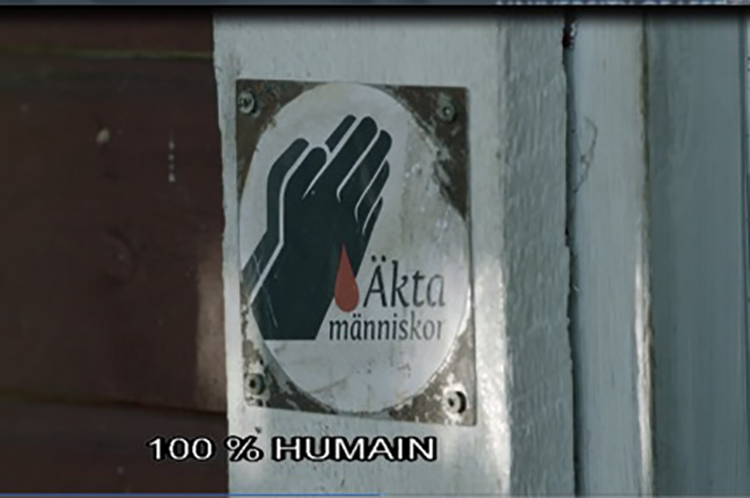
The Äkta människor (Real Humans) logo and its subtitled English translation (Sveriges Television (SVT)).
Disposable Bodies
In her elaboration of the destructive history of the Eurocentric humanist paradigm, Braidotti describes how ‘the binary logic of identity and otherness as respectively the motor for and the cultural logic of universal Humanism’ have produced humanist citizens, on the one hand, and ‘disposable bodies’, on the other (2013: 15). Rather than interrupting the market economy, human affective capacity is absorbed into it, facilitating affective economies that trade in ‘affective labour’ (Hardt, 1999: 96). By ‘affective labour’, Michael Hardt refers to labour that is immaterial and at the same time ‘corporeal and affective, in the sense that its products are intangible: a feeling of ease, well-being, satisfaction, excitement, passion–even a sense of connectedness or community’ (1999: 96). Patricia Clough explains the gross inequalities intrinsic to affective economies: ‘Some bodies or bodily capacities are derogated, making their affectivity superexploitable or exhaustible unto death, while other bodies or body capacities collect the value produced through this derogation and exploitation’ (2007: 25–26). Hubots are particularly adept at supplying this intangible affective labour, and their non-human status produces a guilt-free, clean-hands version of the kind of ‘superexploitability’ Clough describes. Äkta människor exposes the affective economy in its depiction of enormous populations of disposable, affective bodies. As such, the program is a portrait of human relations and working conditions in our late capitalist, neoliberal, posthuman context in which people marginalized by structural and geographic inequality (poor women, people of colour, people with disabilities, migrant workers) are treated like objects, machines, disposable bodies, valuable only if capable of labour, affective or otherwise. The affective capacities of such disposable bodies are entirely disregarded beyond their ability to enhance the emotions of their ‘real’ human counterparts. 16 Their own potential capacity 17 for fear, anxiety, love or rage is rendered illegitimate or simply redundant. In other words, the series depicts the friction of posthuman entities operating within humanist care frameworks.
For critical posthumanists, this selective denial of affective capacity, which is simultaneously a denial of agency, and ethical and ontological status is intrinsic to the humanist paradigm. Critical posthumanists refuse this selectivity; instead, they affirm the human animal system as a complex assemblage inextricably embedded in a dense network of intersecting organic and technological structures and systems.
18
Like ethics of care philosophy, which regards humans as embedded and embodied, as always relational and interdependent, posthumanism goes further to expose the complex, rhizomatic networks that embrace and bind individual subjects not only to their species but to the dynamic micro- and macro-biomes that envelop and connect all living things. As Pramod Nayar explains, Critical posthumanism sees the human as a congeries, whose origins are multispecies and whose very survival is founded on symbiotic relations with numerous forms of life on earth. Critical posthumanism thus favours co-evolution, symbiosis, feedback and responses as determining conditions rather than autonomy, competition and self-contained isolation of the human (2013: 9).
The liberal humanist subject is one produced by market relations, but claiming to be autonomous and independent, distinct from others and ‘owing nothing to society’. The posthuman subject, on the other hand, ‘is an amalgam, a collection of heterogeneous components, a material-informational entity whose boundaries undergo continuous construction and reconstruction’ (Hayles, 1999: 3). Technology and machine life are integral to, rather than separate from, the human ‘congeries’, and Rosi Braidotti celebrates technological entities for their ‘normatively neutral structure’ – ‘they are not’, she explains, ‘endowed with intrinsic humanistic agency’ (Braidotti, 2013: 45). While this is certainly the case, one cannot ignore the fact that these normatively neutral technologies are always designed and engineered by distinctly non-neutral human beings. Although they may have no ‘intrinsic humanistic agency’, their emergence from and embeddedness within humanistic structures makes emerging technologies, particularly caregiving or sociable robots, likely repositories for humanist hierarchies and biases. Technologies such as Paro, Miro, Care-O-bot or the imagined hubots from Äkta människor, for that matter, do not simply appear or evolve; they are engineered and manufactured, programmed and promoted. Care robots occupy an uncanny position as animated tools and affective machines, at once representations of caregivers and caregivers themselves, a dizzying confluence of imagination, market economics, technological capacities, narrative and visual cultures. These objects manifest the meaning, function and repercussions of care and affective economies in posthuman worlds, such as the fictional world of Äkta människor.
Äkta människor and Posthuman Care
Äkta människor explores the gendered and racialized affective economies that structure care work in the developed world, economies that depend on the emotional and physical labour of marginalized workers. In its depictions of humanlike machines tasked with giving care, the programme addresses the cultural denigration of care work, the dismissal of particular bodies (elderly, racialized, gendered) as peripheral and disposable. 19 The robots distributed for care, along with the humans they care for, most often children, the elderly or ‘needy women’, suggest a provocative affinity between diverse vulnerable bodies – old, young, female and mechanical. The humans who get overly attached to their robots, ‘hubbies’, are often marginalized in their own right, due to their age, gender or sexuality. These disempowered subjects are particularly receptive to the prospect of the respectful, reciprocal, typically subservient care offered by non-humans.
Therese is a working-class, middle-aged woman whose brutish, abusive husband Roger provides no affection or care. Therese’s deferential, supportive athletic trainer hubot, Rick, eventually usurps Roger’s spousal role, offering not only companionship but an opportunity for authority rarely afforded Therese by her family or society. Roger is incensed by the displacement, seeking to regain his patriarchal authority through increasingly violent means. Not only is his familial authority threatened by a Therese’s attachment to Rick, his managerial role at a warehouse is gradually eroded by the influx of hubot workers. In the first season, he serves as the program’s angry, working-class humanist who feels his humanity – that is, his masculine authority–has been trivialized and made redundant by machines. He regards machine outsourcing and companionship as affronts and longs for the humanist boundaries and hierarchies that secured his patriarchal power prior to the appearance of hubots.
Like Therese, the elderly Lennart has limited power and autonomy; however, his disenfranchisement is more recent since his masculine, able-bodied authority has been compromised by illness and disability in later life. Lennart’s caregiving hubot, Odi, is his best friend and as a result, Odi’s malfunction sets off a series of crises for Lennart. Lennart’s son-in-law, Hans, replaces Odi with Vera, a heavy-set matron hubot with giant spectacles and a frilly apron (see Figure 2). Part domineering mother, part shrewish wife, smiling a humourless smile as she irons, Vera is the opposite of her male predecessor, the handsome, charmingly naive Odi, who deferred to Lennart’s authority. Vera is shrewder, older looking, and unfashionable, exuding a malevolent power, often seeming to lurk, connive and surveil. If Lennart’s first robot was a loyal friend, his second robot is a nursemaid cum prison guard. Like their human counterparts, hubots’s roles and identities are distinctly signalled by gender, age and sexuality.
The show explores inappropriate, even unseemly attachments with a sympathetic eye, taking a liberal humanist perspective that stresses the pathos of the outcast whose independence and autonomy have been unfairly compromised, focusing on individual suffering, both human and hubot. The program explores affective machines according to humanist paradigms, focusing on autonomy and rights – the right to love whomever one chooses, the right to pursue personal goals, the right to autonomy and personal dignity. The pathos of Lennart’s situation is tied to his no-fun, emasculating nanny robot, rather than structural systems and inequalities that have resulted in his isolation and vulnerability as an older adult with fragile health. Lennart’s single act of rebellion is an assertion of independence and (masculine) autonomy that fails horribly. He and Odi set off on a raucous, drunken road trip, ostensibly to go fishing. The malfunctioning Odi crashes the car and must go into exile to escape the hubot recycling centre where broken down hubots travel along a conveyer belt towards the mouth of an industrial compactor, humanoid bodies treated as trash. Mourning Odi, Lennart lies in bed reading a book entitled Image Matters for Men before having a heart attack, a mortal crisis averted by Vera’s quick application of CPR. The book title is telling; it underscores Lennart as an emasculated, bereft, disabled patriarch seeking to improve his masculine image. Image does indeed matter, not only to ensure social standing and emotional connections, but for survival. Lennart’s fragile health, his ageing into old age, his isolation and loneliness, his overall vulnerability and dependence are depicted as failures of masculinity that jeopardize his humanitiy since, as Braidotti reminds us, ‘The human of Humanism is neither an ideal nor an objective statistical average or middle ground. It rather spells out a systematized standard of recognizability – of Sameness – by which all others can be assessed, regulated and allotted to a designated social location’ (Braidotti, 2013: 26). That standard, ‘the human norm’ (Braidotti, 2013: 26), is masculine, not to mention, youthful and able-bodied. Lennart’s overt vulnerability exiles him from the powerful prerogative of transcendent masculine independence and authority, a loss of capacity that proves mortal. Despite Vera’s care, another heart attack finally kills him.
The programme’s hubots, Odi, Vera, Rick and Mimi, adhere to multiple, intersecting stereotypes that signal their meaning and function within the programme’s humanist society. Vera’s imposing presence, her ability to be at once laughable and menacing, is the result of her age, gender, physique, clothing and eyewear, hairstyle, posture and expression (Figure 2). Vera’s persona is legible based on the way her aesthetics blend tropes from kind nannies – she is dressed like Mary Poppins – malevolent matrons – her sinister expression evokes Rebecca’s Mrs. Danvers – and ridiculous imposters – her face and eyewear bear resemblance to Mrs. Doubtfire. The intertextual resonances of Vera’s visuality are a reminder of robot representations as always operating in a complex web of cultural discourses. Similarly, Mimi, one of the programme’s only racialized bodies and its only Asian body, human or hubot, is a domestic slave who must go to court to prove her personhood.
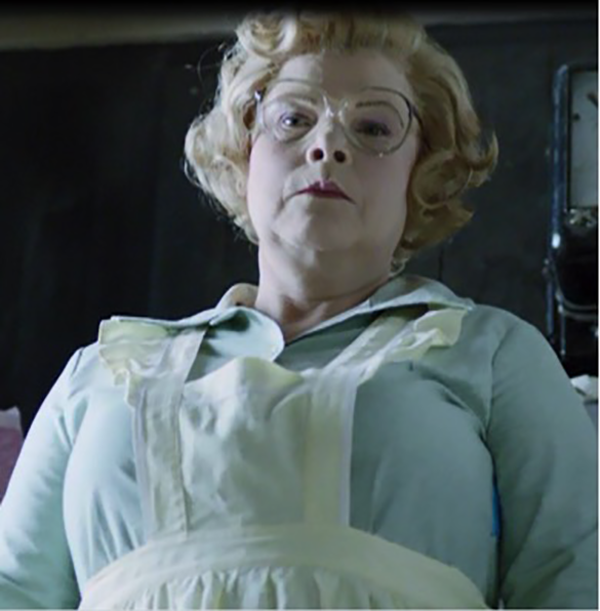
Vera in Äkta människor (Sveriges Television (SVT)).
Äkta människor, I argue, imagines how posthuman caregivers might reinscribe, rather than destabilize or even dissolve the primacy of a narrowly conceived version of the human. Moreover, the series’ robot caregivers expose anthropocentric humanist frameworks and hierarchies that naturalize the association of care with subservience and figure dependency as a regrettable anomaly. As a result, the series shows viewers the risks, not of posthuman bodies themselves, but of the ways they might expose the discrimination latent in humanism, forcing viewers to reckon with the violence of anthropocentric disposability produced by the narrow confines of the category human.
Towards a Theory of Posthuman Care: Or, What’s So Great about Humans Anyway?
Imaginary images and narratives of robot care convey not only a warning of what could be but provide a distorted view of what is. 20 This is one of the special capacities of speculative fiction: it simultaneously portrays and anticipates, critiques and warns. 21 Robot fictions like Äkta människor 22 formatively engage public apprehension about the prospect of robots adopting traditionally human caregiving roles, complicating the association between so-called humane care and the human. 23 Imaginative speculations draw our attention to the ethical and ontological implications of robot/human care, encouraging us to consider how these technologies will influence the meaning and function of care and relationality, as well as how such relationships might transform the meaning and function of the human as an onto-political category.
Äkta människor demonstrates the degree to which artificial life might or might not alter the meanings and operations of care. Indeed, in the programme, (humanoid) caregiving machines perpetuate rather than minimize the exploitation and marginalization central to affective economies built on the undervaluation of care, the denigration of dependency and the distinction between valuable and disposable bodies. The programme is a stark reminder of the importance of form: reproducing gendered, racialized, sexualized humanoid forms reproduces the (humanist) inequalities structurally associated with difference. Philosophers and cultural critics like Mark Coeckelbergh (2011) and Ann Cranny-Francis (2016) argue that humanoid robots produce particular affects and effects, raising different ethical questions and concerns from machine-looking machines. Studies demonstrate that how a robot appears will determine human relations with that robot, regardless of what it objectively ‘is’, what kind of mechanical life it can claim to have (Coeckelbergh, 2011: 199). Visual, aural and haptic cues suggestive of gender, age, sexuality, race, class and ability are powerful determinants of how humans will interpret, use and relate to their silicon counterparts. In Äkta människor, I would argue, it is not merely a lack of imagination on the part of the show’s creators that underlies the hubots’ struggles with the same structural and cultural barriers and biases that confront the so-called real humans. Robots designed to look like pretty, young women, such as ‘Aiko Chihira’, receptionist at Mitsukoshi Nihombashi department store (Figure 3), will, and do, occupy different social and occupational roles than those designed to look like a cuddly seal (Paro [Figure 4a]) or cartoon character (Pepper, MiRo [Figure 4b]). The relative paucity of male humanoid robots, beyond the kind of narcissistic self-reproduction indulged by Hiroshi Ishiguro and others at his Advanced Telecommunications Research Institute International (ATR) laboratory (Figure 5), speaks volumes regarding the way social expectations around gendered servitude, submission and plasticity both determine and are reproduced by robot others. However, there are other options, argues Cranny-Francis:’the production of robots and the attempt to make them more lifelike could be the source and site of transformational studies of genders, sexualities and the processes of gendering. It will almost inevitably change who we are as human beings as we learn new ways of understanding and being in the world; our challenge is to make this a positive, ethical experience that changes us and our world in positive ways’ (2016: 5). Lucy Suchman expresses similar concerns about robots as ‘retrenching’ representations: For me, however, the fear is less that robotic visions will be realised…than that the discourses and imaginaries that inspire them will retrench received conceptions both of humanness and of desirable robot potentialities, rather than challenge and hold open the space of possibilities (2011: 130).
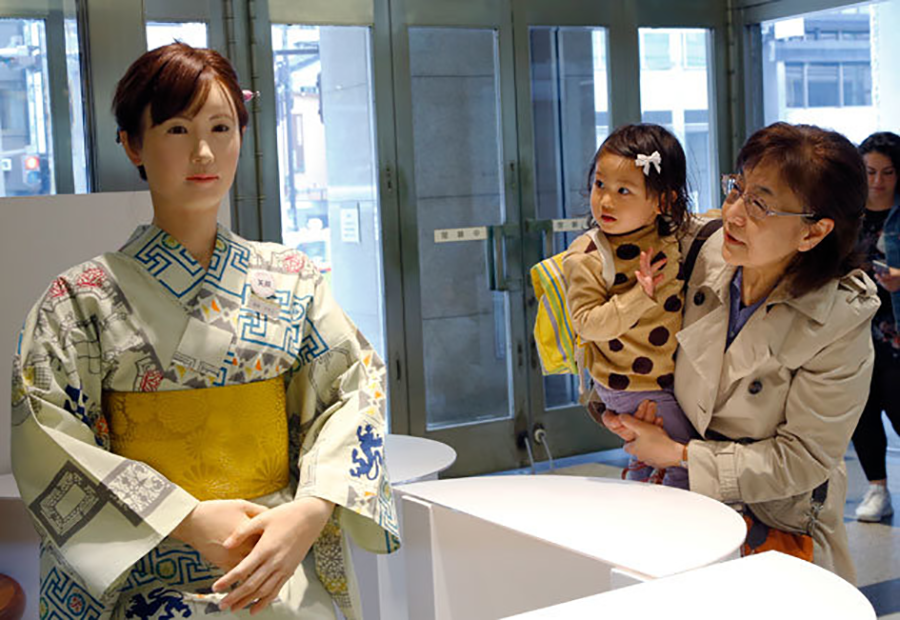
Aiko Chihira (Photo by/Shizuo Kambayashi/Associated Press).
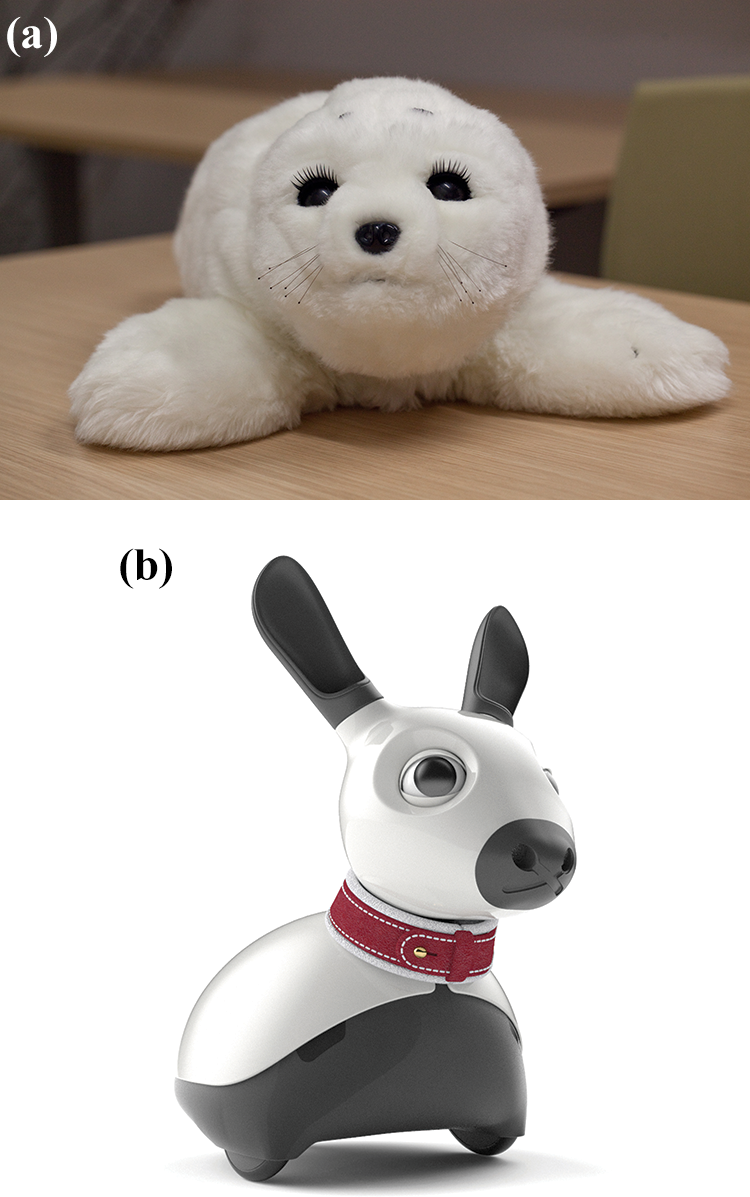
a) Paro (image courtesy of Sheffield Robotics) b) Miro (image courtesy of Consequential Robotis).
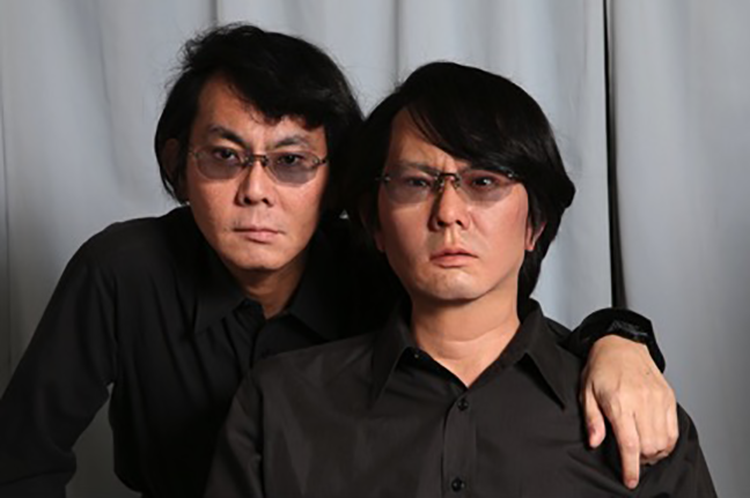
Ishiguro with Geminoid HI-4 (2013) by Hiroshi Ishiguro Laboratory, Osaka University.
Representation, whether in film, television, literature or other mimetic media or materials, including actual robots themselves, is at once a mirror and a producer of everyday life, at once reproducing and directing intricate relations of power, the delicate minutiae of everyday politics. As W. J. T. Mitchell reminds readers in the preface to his book What Do Pictures Want?, pictures are not only ‘world mirroring’, but ‘world making’ (p. xv). He urges readers to go beyond asking what pictures mean or do, to consider ‘what they want—what claim they make upon us, and how we are to respond’ (2004: xv). And so, following Mitchell, we might ask, what do care robots want? What claim do they make upon us, and how are we to respond?
Unsurprisingly, the robots in Äkta människor want what liberal humanists want: freedom, autonomy, independence and power. But might there be more creative, even radical options? Why not gender non-conforming robots seeking collaboration and care? Why not machine/animal hybrids that evoke non-hierarchical symbiotic ontologies? Social robots might create posthumanist scenarios in multiple ways, not only engendering relationships and intimacy between humans and non-humans but also demonstrating the false boundaries between a multitude of human/non-human ontologies. In this way, robot care could embody the posthuman subject as becoming, as continuum, as ‘congeries’, (Nayar, 2013). But more often than not, robot carers embody all too human problems.
The problem with care robots, from hubots to Paro, is not necessarily the robots themselves; the problem is the social, political, economic structures that produce (human) care in its current iteration: as devalued, gendered, racialized labour; as a resource; as a demographic ‘crisis’. As a result, robots, real or imagined, become illuminating material manifestations of the latent inequalities and dangerous fantasies that currently structure human care work. Care robots demonstrate not the dangers of ‘the rise of the robots’, but the dangers of the neoliberal, atomistic societies that produce them. As long as we (governments, corporations, healthcare and social services, engineers, economists, academics) persist in treating care as a private exchange between individuals, rather than as the defining feature of posthuman, trans-corporeal animal life, care robots will continue to appear as a straightforward solution to a particular social problem. And why shouldn’t they? Robots are, like all representations, both mirrors and producers of social life. Care robots and their representations (like Äkta människor) show us care as it exists now: as a set of mechanical tasks and behaviours, as devalued labour, as resource, as liability, responsibility, burden.
If there is any consistency to the surveys and evaluations of caregiving machines conducted by philosophers, robot ethicists, sociologists and others, it’s a tacit agreement that there is something special, even ineffable, about human caregiving, particularly the quasi-mystical powers ascribed to ‘the human touch’.
24
Concerned investigators often stress robot care’s potential for reducing human contact, increasing isolation in the elderly, perpetuating the marginalization and ghettoization of people with disabilities, particularly cognitive impairments like dementia (Sharkey and Sharkey, 2012; Sparrow and Sparrow, 2006; Turkle, 2011). Arguments both for and against robot care tend to take it as a given that human care is preferable, but since it is not always safe, available or affordable, robots might help fill the care deficit, if not today, then perhaps tomorrow. It may seem like I am stating the obvious by pointing out that human caregiving functions as an implicit gold standard for machines to emulate in one way or another and that in an ideal world human care would be available to all. However, the insights offered by critical posthumanism provoke one to think about species, ontologies and relationality differently. In its scepticism towards human exceptionalism, critical posthumanism demands a re-examination of the privileging of the human as the unequivocal standard for care. Could care robots open up opportunities for posthumanist posthuman care, that is, care that works with and from a non-anthropocentric vision of human/non-human relations, a vision of care based instead on difference, hybridity and perpetual becoming? As Jack Halberstam and Ira Livingston explain, The posthuman does not necessitate the obsolescence of the human; it does not represent an evolution or devolution of the human. Rather it participates in re-distributions of difference and identity. The human functions to domesticate and hierarchize difference within the human (whether according to race, class, gender) and to absolutize difference between the human and nonhuman. The posthuman does not reduce difference-from-others to difference-from-self, but rather emerges in the pattern of resonance and interference between the two. (1995: 10)
Posthuman care, then, is a capacious concept that attempts to encapsulate the incredible range of affects, energies, behaviours, attachments, dependencies, both visible and invisible, that produce and sustain life in more-than-human worlds. It is trans-corporeal and transdisciplinary; it is a way of conceptualizing contact zones that are ubiquitous and ongoing, sustaining, formative and transformative. The appeal of feminist ethics of care lies in its reckoning with conventional moral philosophy and its insistence on dependency as the common experience of human life. Ethics of care philosophy is a perspective well positioned for a posthuman turn, or tweak, since ethics of care has always, to my mind, been turning towards posthumanism, even as it has sometimes perpetuated anthropocentrism. The figure central to ethics of care – the embodied, embedded and encumbered subject – is ripe for posthumanist expansion. I propose, following Karen Barad, ‘a posthumanist account’ of care, which necessarily ‘calls into question the givenness of the differential categories of “human” and “nonhuman”, examining the practices through which these differential boundaries are stabilized and destabilized’ (2003: 808). Robot care provides a fecund boundary for such inquiry, inviting as it does, fervent protestors seeking to shore up the exceptionalism of human, that is, good, humane, caring as authentic, legitimate care.
From this perspective, the visions of posthuman care offered by Hollywood, Silicon Valley, Sveriges Television, or Channel 4 are not inevitable or adequate, but rather reminders that we can refuse the either-or fallacy of human versus robot care and become engaged, demanding participants in the construction of our posthuman care futures. The care robot revolution won’t be happening anytime soon. This means there is still time. Time to think critically about the implications of affective machines and silicon subjects as posthuman representations before they are ubiquitous, entrenched, unavoidable tools for everyday life much the way smartphones have become. We need sustained interdisciplinary collaboration between engineers, designers, elderly and disabled stakeholders, human caregivers, critical medical humanities, posthumanist and ethics of care scholars accustomed to addressing material culture as profoundly determining, as both matter and mattering. We need to see care robots as affective things that are always already entangled in a snarl of social, cultural, political, economic discourses from the moment of their inception. Giving up on the myth of amoral or neutral technology is not enough; we must also move beyond the assumption that human care is the gold standard. Designers, engineers, scholars and journalists need to acknowledge that like ‘us’ humans, care has always been posthuman, a vital, vibrant relationality produced by and through the constant flux of tools and technologies, behaviours, embodiments, economies and ecologies.
