




Abstract
This study compares and contrasts the motives and information search patterns of domestic and international tourists visiting a popular tropical destination area in northern Australia. The study is framed within Pearce's Travel Career Pattern model that considers the role of a basket of core, middle tier extrinsic, middle tier intrinsic and outer tier motives in making trip decisions. Core motives of novelty, escape and relaxation were important to both groups but were more important to the domestic market. Middle tier extrinsic motives associated with nature influenced the international market, while domestic tourists were more likely to identify middle tier intrinsic motives as influencing their visit decision. Additionally, information sources used by domestic and international tourists in pre-destination and in-destination searches varied based on geographic origin and previous visit histories. Interestingly, while people shopped online, many preferred to buy only after face-to-face communications with suppliers. This study provides deeper insights into visitors’ destination selection and information search, highlighting the practical implications for destinations to more effectively utilise limited resources to target their marketing, both pre-visit and in-destination.
Keywords
Introduction
The same destination plays different roles for domestic and international tourists (Mechinda et al., 2009). Many domestic tourists visit as a form of modal travel, which Graburn (1983, 2018) defines as a type of mundane, regular holiday taken primarily for pleasure and relaxation. By contrast, many international tourists are driven by wanderlust and travel to exotic places. It is often a form of aspirational holiday that is a rare, once-in-a-lifetime experience (Yeoman and Lederer, 2005). Domestic tourists, therefore, are far more likely to be repeat visitors, while international tourists are first-time visitors. Their behaviours also differ. International tourists tend to explore a destination's offerings widely, while repeat domestic tourists engage in more hedonic activities (Lau and McKercher, 2004). Axiomatically, then, one would expect their motives to differ, as would their information search behaviours, suggesting different marketing tactics could be applied to each segment. Although some research (Kim, 2007; Kozak, 2002; Mody et al., 2014) have compared and contrasted the motives and search behaviours of domestic and international tourists in the same study, there is a dearth of more current research.
This study compares and contrasts the motives and information search patterns of domestic and international tourists who visited the tropical destination of Port Douglas in Far North Queensland, Australia. It is framed within Pearce's Travel Career Pattern model (Pearce, 2011, 2022). Data were collected via self-completion style questionnaire between July 2022 and December 2023, and represent market conditions in a COVID-adapted world.
Port Douglas is a renowned dual-purpose destination. According to the local Destination Marketing Organisation (VDS, 2024), it is a ‘chic, yet relaxed seaside village, perfect for couples, families and solo travellers alike, with a range of accommodations to suit all budgets, a plethora of restaurants and bars, not to mention fantastic boutique shopping’. Port Douglas is promoted as an ideal location to explore the World Heritage-listed Great Barrier Reef and Daintree Rainforest. The village itself is small with a population of about 5000. It is one of the most tourism-dependent areas in Australia, as about 80% of its economic activity is driven by this sector (Douglas Shire, 2024). The area attracted some 443,000 overnight visitors and 264,000 day visitors annually pre-COVID-19. They generated about A$611 million in revenue and supported over 2500 direct and indirect jobs (Douglas Shire, 2024). Domestic day and overnight visitors constitute 81% of all arrivals, while the international market generates 19% of arrivals. The typical length of stay is about five nights, with domestic overnight visitors spending about A$1400 and international overnight visitors A$950 per trip (TPDD, 2024).
Literature review
The literature review begins with an overview of Pearce's Travel Career Pattern model before discussing the different motives of domestic and international tourists who visit the same location. An overview of information search follows.
Pearce's travel career pattern
This study adopts Pearce's Travel Career Pattern model (Pearce, 2011, 2022) as the framework to compare motives of these two groups of visitors. The model was developed over a period of 30 years and has undergone a number of iterations since then (Pearce, 2022). It began as a ‘Travel Career Ladder’ based on Maslow's hierarchy of needs (Maslow, 1943). Pearce posited that people evolved through travel careers in much the same way they evolved through work careers. They could start at one level, and as they gained experience might rise to another level. Alternatively, their ‘career’ could plateau or perhaps even decline. This model was subjected to a great deal of criticism (Ryan, 1998), primarily because of the lack of empirical evidence to support it. Moreover, research examining travel by residents of emerging markets found that they often started their careers at the peak of the proposed ladder as the novelty of travel represented fulfilment of a lifelong dream. By contrast, tourists from source markets that had a longer history of pleasure travel saw it as more of a normal part of their lives and were positioned at lower levels on the career ladder (McKercher and du Cros, 2008).
The breakthrough to the current Travel Career Pattern model occurred in the early 2000s when research by Pearce and Lee (2005) led to the abandonment of the metaphorical ladder and instead found that a basket of motives influenced all pleasure travel to varying degrees, depending on the nature of the trip, the person's level of travel experience (Pearce, 2011) and perhaps even by the cultural background of the tourist (Oktadiana et al., 2017).
Three inter-related tiers exist (Figure 1). Core motives represent the skeleton or backbone of all pleasure travel (Pearce, 2022; Pearce and Lee, 2005). They include novelty, the desire to escape their current routine, relaxation and the desire to spend meaningful time with family. Second tier or middle level motives are generally less influential. Pearce divided them into two subgroups. On the one hand, extrinsic factors, such as self-development through host-site involvement, the desire to appreciate nature and to be with and be respectful of others come into play. On the other hand, intrinsic factors, including self-actualisation, gaining new life perspectives, and self-enhancement through skill development and mastery, represent the other aspect of the middle tier. Finally, outer layer motives tend to be least influential for experienced tourists. They include things such as isolation and escaping from crowds, stimulation, gaining status from visiting places, nostalgia, romance and autonomy.
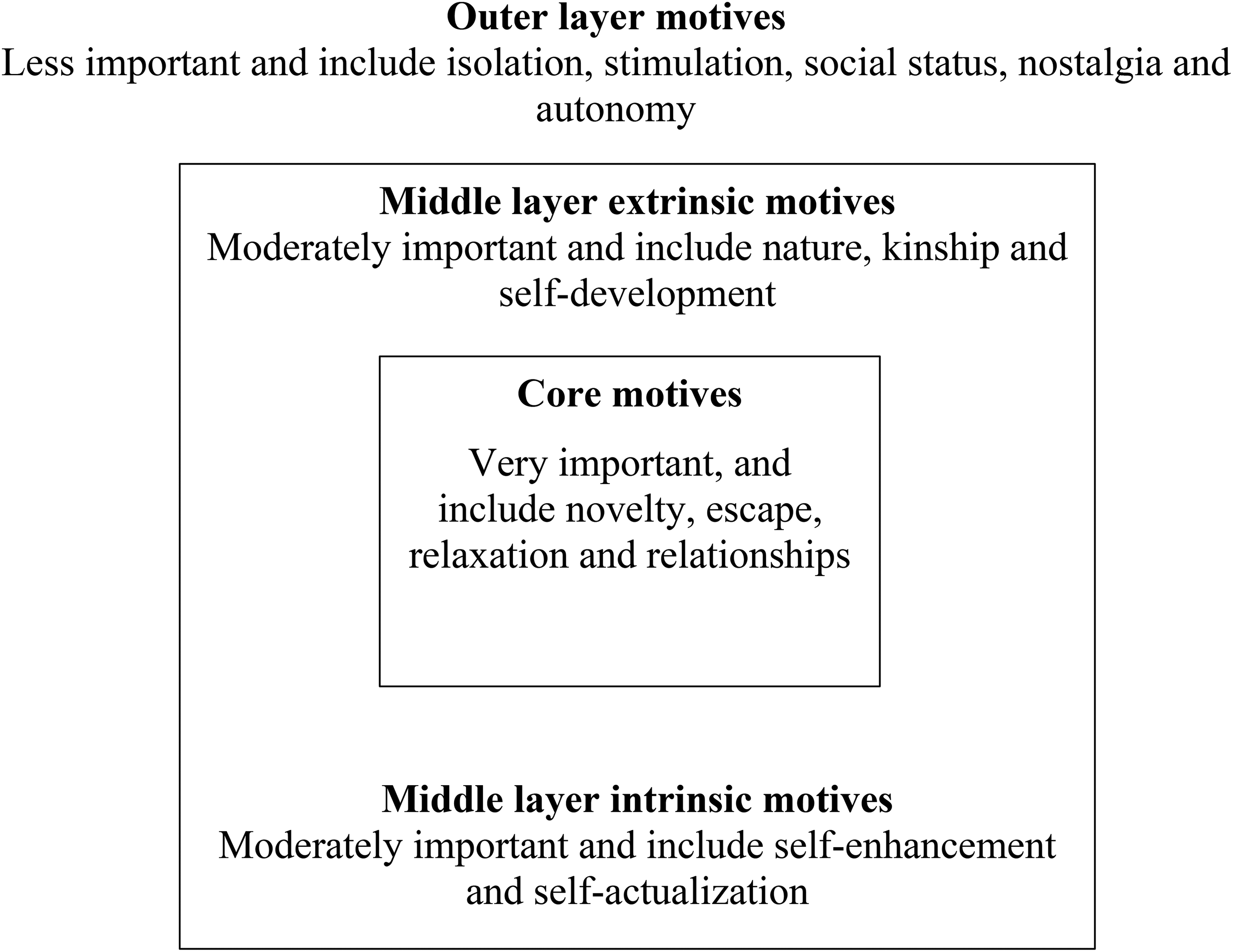
Pearce's travel career pattern.
In total, Pearce and his team identified 14 motive categories that could influence pleasure travel. Two key insights emerged from his work. First, travel is driven by a basket of motives and rarely by a single motive. Thus, one must adopt a holistic approach to fully understand why people travel. Second, and equally important, the relative influence of each motive and each motive tier is trip-dependent. Some trips may be driven more by the suite of core motives, whereas middle and outer tier motives play only a limited role. Other trips taken by the same individual may involve a different combination and weighting of each motive and each motive layer.
The benefit of using Pearce's Travel Career Pattern model over the older and yet popular Push/Pull model (Dann, 1977) is that it enables like with like comparisons of two markets, which can offer insights into what influences people to visit and how the local destination management organisation can better position the destination for different segments. Moreover, while push factors may be readily identifiable, pull features are both destination dependent and highly individualistic, necessitating the development of a large array of possible responses that could cover a range of options available in a destination.
Motives of domestic and international tourists
While a great deal of research has examined the motives of either domestic or international tourists, relatively little has compared the two segments in the same study. The work that has been done adopts either an economy-wide perspective, rather than focussing on individual destinations (Mahadevan, 2018; Mechinda et al., 2009; Stone and Nyaupane, 2019) or a specific protected area focus (Jones and Nguyen, 2021; McNamara et al., 2008; Mehmetoglu and Normann, 2013; Yuksel, 2004). The following discussion summarises the key findings from these comparative studies in order to place this study into a broader context.
Relaxation, escape and spending quality time with family members seem to be ubiquitous motives for both domestic and international tourists (Kim, 2007; Stone and Nyaupane, 2019), although some research suggests it is more important to the domestic market (Matiza and Kruger, 2022). These motives are complemented by other influential factors, depending on the origin of the market. Wanderlust, coupled with the desire to explore exotic ways of life (Stone and Nyaupane, 2019) represent additional influential factors for international tourists, while sunlust and the quest for a more hedonic experience plays a bigger role in satisfying the need for relaxation and escape among domestic tourists (Graburn, 2018). Geographic novelty is also appealing to international tourists (Kim, 2007; Mechinda et al., 2009). Kim's (2007) study of the university student market determined that thrill seeking was important for international travel, while family togetherness played a key role in domestic travel. Mody et al. (2014) add the importance of socialising as a key difference between domestic and international tourists.
Price acts as an exogenous motive for the cost-conscious domestic tourist (Pearce, 1989) as does familiarity (Mechinda et al., 2009). Being familiar with a destination is correlated strongly to perceptions of its attractiveness, destination image and the likelihood of returning. As a result, domestic tourists show greater attachment and attitudinal loyalty (Mechinda et al., 2009) while international tourists have far less attachment to places they may only visit once. Ironically, though, domestic tourists tend to be less satisfied than international visitors with a range of features including perceptions of value for money, service quality, personal attention and ease of communication (Mechinda et al., 2009; Yuksel, 2004). These differences are a function of familiarity where the first-time international visitor is excited about the novelty of visiting a new and exotic destination and also does not have an equivalent point of reference to compare it to. The familiar domestic visitor is less in awe, sees the destination in a more realistic light and can compare it to their home community or other domestic places they have visited.
The motives to visit nature-based destinations vary, as international tourists are far more interested in active engagement with natural areas than domestic tourists (Mehmetoglu and Normann, 2013; Mody et al., 2014; Su et al., 2016). For example, the domestic visitor to a national park in Japan has an equal interest in passively driving through natural areas or hiking, while international visitors are far more motivated to hike than drive (Jones and Nguyen, 2021). A similar situation occurs in the level of interest in and engagement with World Heritage Areas and other peak natural attractions (McNamara et al., 2008).
Interest in Australian Aboriginal tourism produces a somewhat confounding situation (Mahadevan, 2018). The domestic Indigenous tourism visitor tends to be middle aged (between 45 and 64), while the international market is dominated either by young people (15–24) or older, retired individuals. While the international market participates in Aboriginal tourism at a proportionately higher rate than domestic visitors, it plays only a small role in the overall motive to visit Australia. Instead, its appeal lies predominantly as a complementary activity when it is woven into a more mainstream visit to the natural environment and having encounters with local wildlife.
To summarise, these studies suggest Pearce's (2011, 2022) core motives relating to escape, relaxation and spending quality time with family members are important to both domestic and international tourists. However, differences are noted in the effect of wanderlust and sunlust as drivers of holidays, while international tourists seem more interested in experiencing a destination's unique flora and fauna.
Information search
Technology has fundamentally transformed the information search process (Zarezadeh et al., 2023). Whereas once searches involved a limited set of internal and external sources (Fodness and Murray, 1997), today tourists are deluged with an almost unlimited array of online platforms, commercial websites, social media outlets and review sites (Choi et al., 2018). The range of options is growing at an exponential rate (Zarezadeh et al., 2023), as traditional sources are thought to be becoming obsolete (Xiang and Fesenmaier, 2022). As a result, what was once thought to be a fairly simple process is now incredibly complex, as people constantly shift to and from different sources (Gretzel et al., 2020) and as new sources emerge while others fall out of favour. In the end, Gursoy (2019) feels that the chaotic nature of the range of sources leads to information overload where the number of options exceeds the tourist's ability to process information.
Nonetheless, searches still play a vital role in both pre-trip and in-destination decision making. Their role may be mundane to satisfy basic functional needs to reduce uncertainty and risk associated with travel, or more complex, such as enhancing product knowledge (Xiang and Fesenmaier, 2022), validating choices (Choi et al., 2018) and identifying previously unknown alternatives (Chorus et al., 2010).
Research into this topic has been conducted in a variety of disciplines (Xiang and Fesenmaier, 2022). The psychological perspective is of particular relevance to this paper for a link has been made between the style of search and motivations to travel. Zarezadeh et al. (2023), reviewing the literature, indicate that the search process is shaped by the benefits people seek to satisfy their vacation needs. Thus, both the style of the search and the content sought is highly personal. Its role is especially important when considering the various pull features of destinations that complement the push drivers of travel. Ultimately, the extent of the search and the variety of the media used depend on the cost/benefit of the perceived value of the information found and how convincingly it can satisfy one's needs (Chorus et al., 2010).
Traditional offline sources, such as brochures, visitor centres, brick and mortar travel agents (Gretzel et al., 2020) friends and family, fellow travellers and the mass media (Zarezadeh et al., 2023) still have a role to play, but seem to be of less importance than online sources. Offline sources in general, are thought to be more credible. Indeed, Mieli and Zillinger (2020) argue that traditional tourist guidebooks continue to play a vital role in this digital age. They are written by credible, independent authors whose advice is trustworthy. Thus, they can help the person gain knowledge while reducing uncertainty. Somewhat ironically, their physical tangibility adds a degree of reliability not found online, even if they are not totally up to date.
Friends and relatives who have visited places in the past are seen to provide better and more trusted information than commercial or social media sites developed by strangers and perhaps written with an agenda in mind (Gursoy, 2019; Xiang and Fesenmaier, 2022). In a similar manner, repeat travellers rely on their past visit experiences, and instead feel they need to gather less information than first-time visitors. As a consequence, these visitors may be less likely to learn new things about a place (Xiang and Fesenmaier, 2022).
Online sources offer a number of benefits, especially once the person arrives in the destination. Sun et al. (2022) found that online travel agents were a valuable source of information on international hotels, while social media was particularly relevant when searching for travel information, including destination selection. Importantly, the immediacy of real-time access through mobile apps enables people to make or change decisions instantaneously (Kang et al., 2020; Liu et al., 2022). They also allow users to check consumer reviews of food and beverage outlets, attractions and activities prior to purchase, adding an extra layer of confidence in their decisions (Choi et al., 2018).
In the end, though, the type and extent of information search conducted is highly individualistic and fit for purpose. People who are destination aware, and especially those with prior visitation history, feel far less of a need to engage in a deep search, and instead, may rely almost exclusively on their prior knowledge. Those who are new to a destination, and in particular, those whose travel involves a high level of psychological risk, will engage in a much more complex search process to assuage their concerns. Long haul tourists who may be making a once in a lifetime visit, therefore, may be likely to seek a wider variety of sources prior to arrival and may also engage in more intense in-destination searches while on site.
Method
This study compares and contrasts the motives and information search patterns of domestic and international tourists visiting a popular tropical destination area in northern Australia. Data were collected from visitors to Port Douglas between July 2022 and December 2023. A convenience sampling approach was adopted, using a 4-page self-completion questionnaire to survey visitors. Surveys were distributed at two main locations – Four Mile Beach and through a local transport operator. Volunteers approached potential participants and informed them about the aim of the study. They asked a filter question to exclude local residents, before inviting potential participants to participate. The questionnaires took 10–15 min to complete and were analysed using the SPSS 28 statistical programme. The sample comprises 781 valid survey responses. Ethical approval for the research was granted by the investigator's university.
Survey questions were developed in consultation with the local tourism association to specifically identify key topics of concern for the region, and informed by previous research (Pabel and Prideaux, 2016). Closed and open-ended questions were used to ask respondents about a range of information. The key variables focused on in this research include socio-demographics, travel motives, and pre-trip and in-destination information sources utilised.
Socio-demographic data were collected using categorical variables to build a profile of respondents in the sample and compare domestic and international tourists’ behaviour. Travel motives were measured on a five-point Likert scale (ranging from 1 – Not at all important to 5 – Very important), and applied to Pearce's Travel Career Pattern (see Table 1). Data on information sources were collected from respondents by selecting those information sources used in their pre-trip planning and while at the destination.
Mapping survey variables onto Pearce's travel career pattern variables.
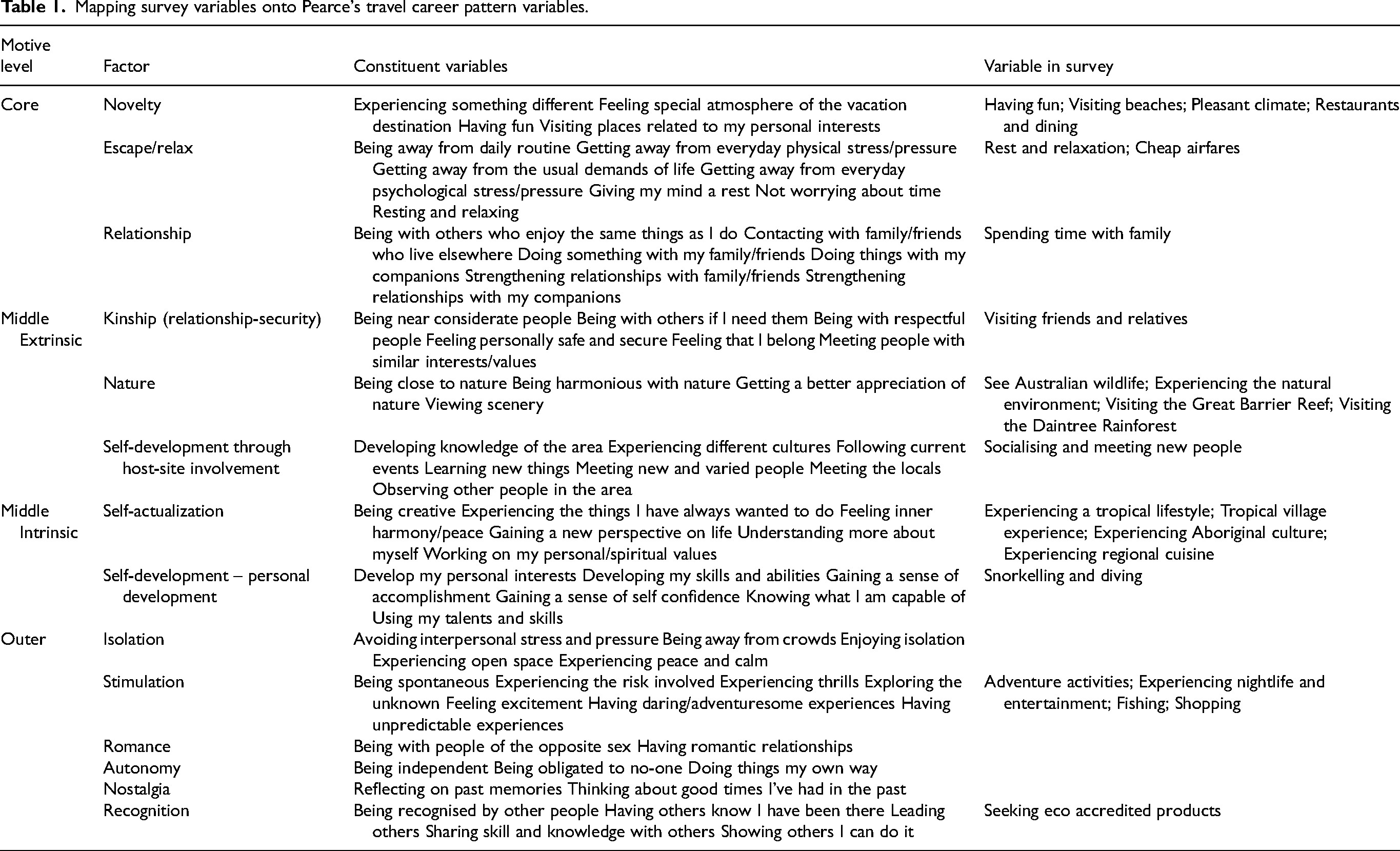
Research limitations are acknowledged which may impact generalising the results beyond the study population. The questionnaire was written in English only, which may lead to an under-representation of non-English speaking visitors. The use of convenience sampling across two locations has the potential to skew the data, but comparisons with regional statistical data available do not indicate any bias. Not all of Pearce's Travel Career Pattern variables could be mapped to variables in the survey.
Findings
The findings section is divided into three parts. It begins with a profile of the respondents and then continues to analyse their motives. The findings section concludes with an analysis of their information search behaviours.
Profile of respondents
A total of 781 people participated in the survey (Table 2), of which almost three-quarters (73.6%) were domestic tourists and about one-quarter (26.4%) international tourists. This figure roughly equates to the distribution of the origin of tourists noted previously. Given that the survey was conducted in English, most of the international respondents came from English-speaking countries of the UK and Ireland (49%), Canada or the US (16%) or New Zealand (8%), with the vast majority of the rest originating in Europe (28%). Less than 1% came from Asia. The mean age of respondents was in the early 50s. Just over one-quarter of domestic tourists were no longer in the workforce, while one in three international tourists was not working.
Profile of respondents.
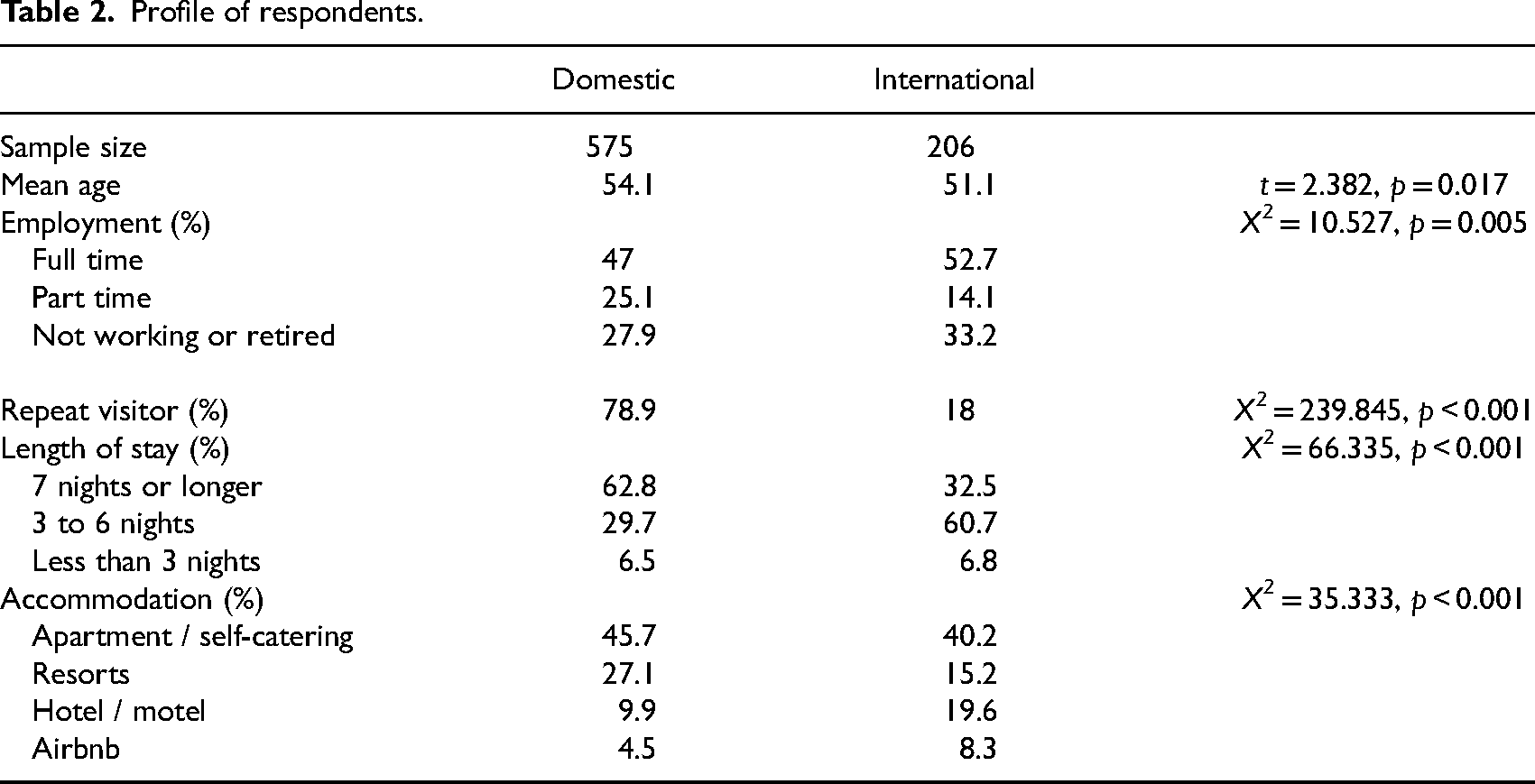
Most domestic tourists were repeat visitors, with repeaters having been to Port Douglas a median of five times. As such, they are very destination aware. By contrast, four in five international tourists were first-timers. Their length of stay in the region differed. The majority of domestic tourists stayed one week or more and typically identified Port Douglas as their main and only destination. International tourists tended to be on multi-destination trips of which three to six nights were spent in the region. Some differences were also observed in the type of accommodation chosen. While self-catering places (such as apartments with cooking facilities) were the most popular with both groups, domestic tourists displayed a preference for resorts, while internationals were more likely to choose hotels, motels or Airbnbs.
Motives
The motives to visit Port Douglas were mapped across 23 variables that corresponded to Pearce's Travel Career Pattern dimensions (Table 1). Each variable was measured on a five-point Likert scale ranging from 1 ‘Not at all important’ to 5 ‘Very important’. The mid-point of 3 represented a ‘Neutral’ score. Table 3 is organised in descending order by motive tier. The first four rows show the mean score for all motives in each tier. Significant differences between domestic and international visitors were noted in the mean score for the sets of core and middle tier extrinsic motives, as well as in 17 of the 23 individual motive statements assessed.
Motives.
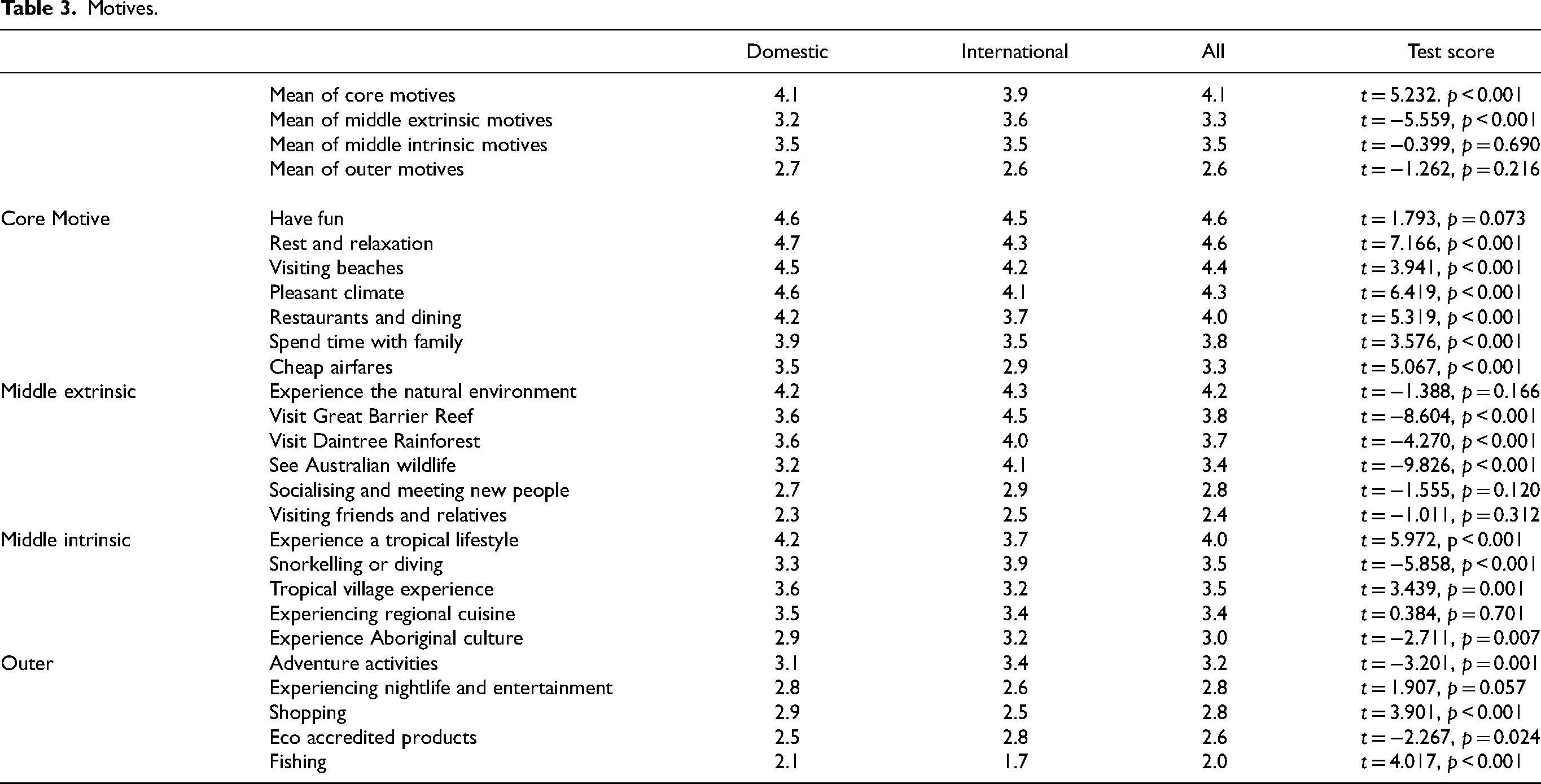
Core motives relating to rest and relaxation, having fun, enjoying a pleasant climate and visiting beaches, plus the middle tier extrinsic motive of experiencing the natural environment played an important to very important role in both cohorts’ visit decisions, as each statement generated a mean score in excess of 4.0. This finding confirms Pearce and Lee's (2005) assertion that core motives form the backbone of all travel, regardless of the origin of the visitor. It also adds the dimension of nature as playing a vital role in nature-based destinations. Notably, though, domestic tourists rated all core motives more highly than international tourists. Domestic tourists also rated hedonistic-oriented motives of restaurant and dining opportunities and the middle tier intrinsic motive of experiencing a tropical lifestyle as playing an important role. This observation lends partial support for Graburn's (1983 and 2018) assertion that hedonic experiences influence much modal tourism.
By contrast, middle tier extrinsic motives, especially those relating to the opportunity to experience Australia's land and water-based natural resources and its unique fauna, played a far greater role in the visit decision of international visitors than they did for domestic tourists. In particular, the opportunity to visit the region's two World Heritage Areas played an influential role, along with the chance to experience Australian wildlife. Indeed, a visit to the Great Barrier Reef rated as the second most influential motive after the chance to have fun. This finding, combined with the previous observation of the domestic tourist's interest in less active experiences lends support to the Lau and McKercher (2004) observation that first-time visitors want to explore a destination, while repeaters tend to do less.
Outer tier motives consistently played a lesser role and were often rated on the not important side of the Likert scale. Outer tier motives are more important to inexperienced tourists (Oktadiana et al., 2017; Pearce, 2011) while they become increasingly unimportant as one's travel experiences grow. One can surmise that most of the domestic tourists surveyed were experienced travellers, given their long history of visiting Port Douglas, while the high mean age of international tourists suggests they too are experienced travellers.
Two anomalies stand out. The first is the high level of importance international visitors gave to seeing Australian wildlife, compared to the neutral score it received from the domestic market. Australian wildlife is unique to this continent and is tied in closely with overseas marketing campaigns. As such it represents a powerful drawcard. At the same time, though, Australian fauna are ubiquitous and, therefore, hold little appeal to the domestic market. The second is the moderate importance cheap airfares played for domestic tourists, while the international market rated it as being on the unimportant side of neutral. Cheap airfares enable the core motive of escape for domestic tourists to be actualised, while long-haul tourists will have to pay a price premium to reach Australia, even if they search for the lowest airfare options.
Indeed, it appears that all things being equal, middle tier motives, especially relating to the extrinsic appeal of a destination play an increasingly important role in the visit decision of international visitors, while core motives influence domestic travel. Not all middle tier motives are influential, though, as both groups rated the chance to socialise and meet new people and visiting friends and relatives as ‘unimportant’. In a similar manner, middle tier intrinsic variables relating to self-actualisation and self-enhancement received only modest support. In particular, the chance to experience Aboriginal culture received neutral support at best from each group, supporting Mahadevan's (2018) assertion that Aboriginal tourism is hardly a motivator for travel.
These findings are largely consistent with the small number of other comparative studies identified previously. Core motives drive all travel, while wanderlust and the opportunity to engage more fully with nature are important to international tourists. Conversely, hedonic sunlust features play a more influential role for the repeat domestic tourist who likely had the opportunity to experience Port Douglas's natural attractions in earlier visits and see little benefit in doing so again.
Information sources
Domestic and international tourists engage in quite different search behaviours prior to arrival as well as in the destination. Table 4 rank orders the pre-departure sources of information used to find out about Port Douglas, as well as the in-destination sources of information used to find out about activities available in the region.
Information sources searched (% yes unless otherwise stated).
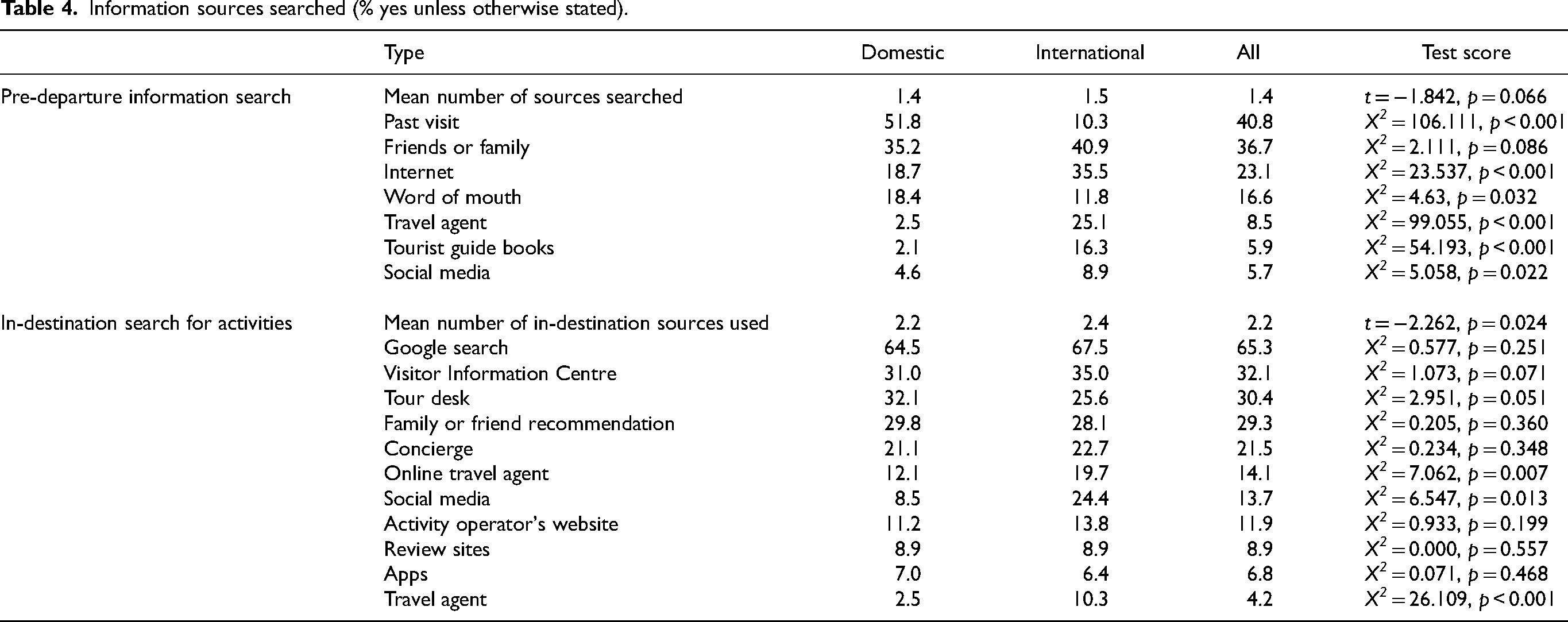
On average, each group sought information from between one and two types of sources prior to their arrival. Domestic tourists, being frequent repeat visitors relied heavily on their past experiences to inform their decisions, as more than half identified past knowledge as their main source of information. In addition, recommendations from friends and family were mentioned as the second most frequent source of information, while word-of-mouth advice ranked fourth. This observation creates challenges for destination marketing organisations (DMOs), as this market is highly destination aware and/or relies heavily on advice from others who are destination aware. As such, domestic tourists likely arrive with pre-determined ideas of what they like and intend to do. This level of familiarity may preclude them from sampling new experiences as they are less likely to want to explore the region widely. Indeed, research on the cultural tourism market indicates that half of all visitors to destinations have made their decision about what to see prior to departure (Richards, 2002), while Shoval and Raveh (2004) found those on relatively short stays usually pre-determine their actions before leaving and rarely deviate from their plans.
It is also interesting to note that more than four in 10 international tourists also relied on advice from friends and family members about what to do while visiting. Others, though relied much more heavily on internet sources, travel agents, guidebooks and to a lesser extent social media to learn about Port Douglas.
In-destination search patterns also varied significantly. Here the typical visitor accessed about two different types of sources, with the international visitor somewhat more likely to look at more sources. Google's search engines were used by about two-thirds of all visitors, regardless of where they originated, while about one-third used the services of visitor information centres and tour desks. International visitors were also more likely to access social media sites or rely on either brick and mortar travel agents or online travel agents.
The importance of face-to-face communications in influencing in-destination behaviour is highlighted by these findings. While online sources can provide a great deal of information, tourists still rely on personal recommendations from industry professionals or the local DMO before making their final decisions. Visitor centre staff, concierges and tour desk operators are key knowledge brokers who direct tourists to places and experiences that might satisfy their needs. However, none of these stakeholders is value free. Staff working at tour desks and as concierges have a self-interest to sell commissionable products and, therefore, tend to direct people away from low commission or free activities. In addition, as Wong and McKercher (2011) noted, the product knowledge of visitor centre staff is often limited to icon attractions at the cost of knowing little about secondary or tertiary attractions that may provide unique experiences. As a result, they may also direct people to certain places, even if they do not necessarily meet their needs. In short, people may shop online but prefer to buy in person.
Discussion
This paper compared the motivations and information search behaviours of domestic and international visitors to Port Douglas, a tropical destination located in Far North Queensland, Australia. The study applied Pearce's Travel Career Pattern model to assess motives.
The findings largely corroborate the scant literature that has compared and contrasted the motives of domestic and international tourists in the same study. However, while most previous studies adopted an economy-wide perspective, this study focussed on a resort destination. In doing so, it offers deeper insights into the practical decisions that influence destination selection, and, therefore, provides important insights into managerial and marketing implications.
It is worth noting that core motives play the most important role in driving the visit decision of both domestic and international tourists. They play an even more influential role for domestic tourists, whose market is comprised primarily of destination aware repeat visitors who are driven primarily by the desire to rest, relax, escape and enjoy the pleasant climate offered by this region. The natural assets of the region, including the Great Barrier Reef, the Daintree Rainforest and the chance to see local wildlife play a limited, secondary role in the visit decision. Outer tier motives play little or no role in their decisions. By contrast, the opportunity to experience the region's land and water-based natural assets, as well as the chance to see Australian wildlife play a far more important role in the visit decision of international tourists. Other motives, other than the opportunity to go snorkelling on the Reef seem to play little or no role in the visit decision.
The reasons for the differences can be explained in part by their past destination experience, and in part by the range of alternative destinations available to them. The domestic market is dominated by repeaters. They are experienced visitors, have likely participated in a range of activities during earlier visits and come now for a relaxing break. Likewise, the tropical feel of this region is appealing to domestic tourists, especially for those who are escaping the southern winter, yet plays only a modest role in driving visits by international visitors. Mechinda et al. (2009) determined that domestic repeat tourists show greater attachment and attitudinal loyalty to familiar places while international tourists have far less attachment to places they may only visit once. Here, the domestic tourist has found a place that can satisfy their needs and, based on their high repeat levels, is loyal to it. The international tourist, on the other hand, is driven to visit for its extrinsic rather than intrinsic appeal, in part because this person has a range of other destination options within and outside of Australia that can provide a tropical feel if they so wish. For destination managers, understanding the underlying motivations of target markets has important managerial implications, ensuring the effective use of limited resources in targeted marketing campaigns.
It is interesting to note the role that personal selling plays either directly by commercial enterprises or indirectly through family and friends and positive word of mouth in both pre-departure awareness building and on-site activity selection. This finding has important marketing implications, as it highlights the risk associated with the shift to a near-total online marketing presence and the potential move to AI-dominated information searches in the near future. Tourists may seek information from a variety of sources but still rely on the personal touch when making a range of travel decisions. In doing so, it can help resolve the challenge of information overload identified by Gursoy (2019). For destination marketers, these findings indicate the importance of more traditional information sources, such as personal referrals and WOM, despite the growth in online marketing and searches.
Conceptually, this study demonstrates the validity of adopting Pearce's (2011, 2022) model to understand different reasons why people select destinations, and moreover, highlights its preference to the more common Dann (1977) push-pull model. Pearce's model demonstrates unequivocally the need to consider a basket of motives when examining destination choice, as the identification of a single motive, or even a suite of core motives cannot explain the inherent subtleties involved in understanding why people travel. Importantly, this model highlights the importance of considering middle tier motives, especially when delineating between geographically diverse markets.
The study also demonstrates the utility of using this model in comparative studies for it enables like with like comparisons. More importantly, when compared to Dann's (1977) model, pull and push features may be the obverse of the same motive. A person may be pushed by the desire to experience nature and pulled by the chance to visit, say, the Great Barrier Reef. Making an artificial distinction between the two sides of the same coin may prove to be counter-productive, especially since people engage in many activities in a destination that may or may not relate to their reasons to visit. Identifying a wide array of pull features may obfuscate the real push reasons to visit. Pearce's (2011, 2022) model obviates that need and instead provides a true comparative tool to examine the complex reasons different segments visit.
Managerially, the study also highlights three key issues. The first is to position the same destination in different ways depending on the origin of the market. The use of social media targeting different messages to respond to different baskets of motives can utilise scarce marketing resources more efficiently. Such messages can occur both prior to arrival to influence the visit decision and after arrival to influence in-destination behaviour. It is important to appreciate that core motives drive all visits, but when the basket of motives is considered, sunlust motives play a more important role for domestic tourists, while wanderlust influences international visitors.
One challenge is that the length of stay in the international market is quite short. Based on our observations and discussions with the local destination marketing organisations, the typical international visitor samples the Reef and Rainforest during a four-day, three-night stay. They do little on the arrival and departure days, thus leaving only two full days to experience the region. One marketing challenge, therefore, is to encourage them to use Port Douglas as a base to explore the region's other tourist attractions more widely, and to use the destination as the base for other day trips to the north and south of the area. In doing so, the length of stay can be increased. Understanding the underlying motives of visitors, and how these vary between domestic and international markets, may assist in the destination's ability to change in-destination behaviour, by increasing length of stay.
Second, the role of the traditional media, such as the travel trade and tourism guidebooks, cannot be under-estimated, as 36% of international tourists consulted one or both information sources. While social media now informs many decisions, traditional information outlets still have a significant role to play (Mieli and Zillinger, 2020). In particular, personal selling and using trusted media play a critical role in final decision making (Gursoy, 2019; Xiang and Fesenmaier, 2022), and can be utilised by destination marketing to more effectively target domestic and international visitors.
Finally, the role key informants play in both the visit decision and activities pursued remains relevant even in this day of social media and ubiquitous internet presence. Family and friends and positive word of mouth are important sources of pre-departure information, while visitor centre staff, tour desk staff, local travel agents and concierges play a vital role in validating decisions. Indeed, some 75% of respondents sought one or more face-to-face encounters when trying to decide on what activities to pursue while in Port Douglas.
Conclusion
Domestic and international tourists do treat the same destination differently. They are motivated to visit for somewhat different reasons and engage in different information search patterns. While core motives form the skeleton of all visits, substantial differences emerge when middle tier motives are considered. Understanding these differences can help destination management organisations better market their experiences and in doing so, spend their scarce resources most effectively. Moreover, domestic and international tourists engage in different types of information searches. However, both still rely heavily on personal advice to assuage risks of visiting. Whatever tactics are adopted, though, the role of the traditional travel trade as well as the personal, face-to-face touch cannot be underestimated in influencing both why people come to a destination and what they do there.
Footnotes
Declaration of conflicting interests
The authors declared no potential conflicts of interest with respect to the research, authorship, and/or publication of this article.
Funding
The authors disclosed receipt of the following financial support for the research, authorship, and/or publication of this article: This work was supported by the Tourism Port Douglas and Daintree.
