






Abstract
This research aims to investigate the effect of international tourists’ perceived risk factors on (n = 257) overall risk perceptions and consequently on their behavioural intention (i.e. intention to revisit, to recommend destination and repeat same activities) from the lens of prospect theory. An online survey was circulated to the onsite international tourists who were visiting Bali. We found that human-induced and financial risk have significant effect on overall risk perception, while overall risk perception mediates the relationship between human-induced risk and behavioural intention. Financial risk has significant negative effect on behavioural intention, however, human-induced risk interestingly has significant positive effect on behavioural intention. While international tourists were concerned about the environmental issues in Bali, it does not affect their intention to revisit Bali. This study extends prospect theory in tourism literature and attempt to provide insights for destination marketers to mitigate and manage growing risk perceptions associated with international tourists’ behavioural intention.
Introduction
The G-20 meeting held in Bali in 2022 was marked as a significant milestone for the island's recovery to regain its reputation as a top global tourism destination following the pandemic (Tjiptono et al., 2022). The Indonesian Ministry of Tourism reported that Bali received 5.5 million international visitors in 2022, and is expected to make a full recovery by 2024 (Subandi et al., 2022). However, negative tourists perception on Bali may pose to be a major issue that can hinder the tourism recovery (Dolezal and Novelli, 2022).
Bali has been renowned for its beautiful nature and unique natural biodiversity and is often referred as the ‘Island of the Gods’. Beyond its natural beauty, Bali faces concerns regarding unpredictable weather and natural disasters due to its geographical location. Natural hazards cases such as landslides, floods, volcanic activity, cyclones, storms, and monsoon are prone to occur around the area (Gurtner, 2016). This environmental condition is made worst by human activities where Bali is currently having waste management crisis that caused garbage to pile up on the coasts, these garbage may have destroy the local ecosystem, reduce Bali's natural aesthetic and trigger health issues (Guido et al., 2021). Previous research found that Bali has been experiencing significant environmental degradation in the area which may affect international tourists’ intention to visit the area, however, there is a significant gap in tourism research on how this may affect tourism (Ahmad et al., 2019). Bali's proximity to the equator makes the island vulnerable to the effects of global warming and climate issues which lead to environmental and health issues. On top of having to cope with heat stroke, mosquitos are rampant in Bali which triggers the spread of dengue fever and caused significant health concerns among international travellers (Masyeni et al., 2018). Maulana et al. (2023) argue that international visitors may further contribute to the worsening transmission of dengue virus, similar to the impact observed in the recent foot and mouth disease (FMD) outbreak. Further on health aspect, tourists coined the term ‘Bali Belly’, where tourists had to experience acute diarrhoea due to food hygiene and safety issues, this issue was also experienced by visitors at luxurious five-star hotels (Philpott, 2022).
According to Pandey and Kumar (2023), global tourism is being negatively affected by the economic uncertainty stemming from the Russia-Ukraine war. Pappas and Glyptou (2021) further argued that the economic recession in America and Europe has also sparked tourists’ awareness of potential risks, leading to doubts in making travel plans. Additionally, the rising cost of travel, including flight tickets and accommodations, creates financial risks for international tourists who may not be prepared for these increases expenses (Liew, 2022). Wilson et al. (2020) suggested this rise in living and travel costs may have positive correlation to human-induced risks such as scam, robbery and political unrest.
The combination of findings from previous research, media report, and word-of-mouth suggests that these risk concerns may impede Bali's effort to recover its tourism industry. However, to the best of the authors’ knowledge, there are currently limited studies on how these various risk perceptions impact the overall risk perception of international tourists that are visiting Bali and consequently affect their behavioural intention. Aiming to address these gaps, this study investigates how perception of several risk factors (i.e., human induced, financial, food safety and travel, and environmental risk) affect the overall risk perception of a destination and consequently the behavioural intention of international tourists from the case of Bali using the lens of prospect theory (PT). PT has been outlined to explore individual decision-making process relying on reference point rather than an absolute value (Kahneman and Tversky, 1979). While this theory has been employed to examine the perceived risk (e.g. Williams and Baláž, 2015), limited discussion is offered to explore how the theory fits to the different outcomes in behavioural intention as decision making, particularly in tourism context.
This research offers several contributions. First, it uses the lens of PT and assess which risk factors contribute the most on a destination's overall risk perception and consequently on international tourists’ behavioural intention (i.e. intention to revisit the destination and recommending the destination to others or positive word of mouth). This study utilises the momentum and provides practical insights to the policy makers and destination marketers for the global tourism recovery efforts following the pandemic and energy crisis, by assessing international tourists’ behaviour to revisit and recommend a popular destination despite growing risk concerns from the case of Bali (Darma Putra et al., 2021).
Literature review and hypotheses development
PT on the relationship between risk and behavioural intention
PT is centred on the idea of reference dependence, where individual decision-making process depends on the potential gains or losses to a reference point rather than an absolute value (Kahneman and Tversky, 1979). According to the authors, the limitation of this study is that the gains and losses were defined by wealth only. The authors further argued that reference point is susceptible to the individual social norms, surroundings, expectation and experience (Tversky and Kahneman, 1981). An example of this is when a tourist spent more money than the market price to book for a hotel (while other conditions such as service quality and location stay the same) which means a loss for the tourist. Overtime, this theory has been used several times in tourism research with travel experience, satisfaction and intention to revisit used as the indicators of gains and reference point to assist in decision-making and to assess whether a destination would expose various risks to the travellers (Williams and Baláž, 2015). Kreeger et al. (2023), for example, evaluated how AirBnB guests preferences are being influenced by PT characteristics such as price, personal safety, location, amenities, cleanliness, financial security, with an additional dimension of empathy. PT is circled around five principles which are reference dependence, loss aversion, diminishing sensitivity, certainty effect and possibility effect (Lin et al., 2024).
Bauer (1960) first introduced the concept of perceived risk by arguing that taking risk is the intrinsic nature of consumer behaviour. Bae and Chang (2021) conceptualised perceived risk as the potential for loss. Another definition suggests risk as an individual's perception about uncertainty and the negative consequence when buying a product or service, or when performing a certain activity (Khan et al., 2019).
Early literature discussed most relevant perceived risk dimensions for tourism. These dimensions have been frequently used in the tourism literature and consist of: (1) financial; (2) performance; (3) physical; (4) psychological and; (5) social risk (Jacoby and Kaplan, 1972). Roselius (1971) introduced several risk reduction strategies such as reading the product review, gathering information from word-of-mouth conversations and assessing the brand reputation. Along with these strategies, the concept of time risk was also introduced which suggests how consumer time will be wasted if the product or service fail to deliver (i.e. for getting the product repaired). Between early 90s to the end of 2000, the dimensions of risks expanded into satisfaction, equipment, situational and risk of opportunity loss (Roehl and Fesenmaier, 1992; Yang and Nair, 2014). Simpson and Siguaw (2008) categorised risks into manageable (i.e. criminal harm, provider performance, local environment, crime and concern on others) and unmanageable risks from tourism managers’ perspective (i.e. well-being, transportation performance, generalised fears, monetary and also concern for others).
Perceived risks are multidimensional in nature and the dimensions will keep on expanding. The main issue on the literature between perceived risks and behavioural intention is that the findings tend to be inconsistent since different risk may produce different dynamics (i.e. tourists with high safety concerns on Zika virus on a particular destination still intend to visit the destination (Choe and Kim, 2021). This limitation is addressed in this study by utilising the theory of PT, as a combination of the use of theory and effective use of statistics (i.e. measurement and structural model analysis) can improve generalisation in tourism research (Nunkoo et al., 2013). Following this argument, risk literature in tourism context has been heavily criticised for the lack of theoretical frameworks which resulted in inconsistent, fragmented, and superficial understandings of tourist risk experience (Yang et al., 2017).
Past research has proven the significance of perceived risks on intention to visit in tourism context, mainly on how perception of risks is an important factor that determines the decision-making process on destination choice (Sönmez and Graefe, 1998). Higher level of perceived risks on the destination often leads to an avoidance of a destination (Carballo et al., 2021; Carvalho, 2022).
As mentioned earlier, the present research focuses on specific risk factors (human-induced, financial, food safety and weather, and environmental) due to the findings from the previous research, growing word-of-mouth and media reports on these risk categories in the context of Bali. The environmental risk in particular is still under researched in tourism literature and will be discussed in detail in this study.
The use of PT is seen to be fit with the aim of the present research, as we surveyed the international tourists on the spot in Bali to assess the effect of several growing risk dimensions in Bali on their behavioural intention to revisit, spread positive word-of-mouth and redo the same activities, which in this case may develop to a reference point for other tourists.
Perceived human-induced risks
Human-induced risks stem from human interaction and include factors such as cultural differences, socio-political instability, and past negative events (e.g. Bali bombing and the 911 in the US) (Eid et al., 2019; Jørgensen and Reichenberger, 2023). Salvatierra and Walters (2017) suggested that human-induced risks have positive relationship with negative behaviours from the locals toward the tourists. Recent findings highlight misbehaving and disrespectful tourist behaviour as a specific concern that may jeopardise the sustainability of many destinations (Im and Kim, 2023).
Eid et al. (2019) argued that political instability can increase perceived risk and reduce tourists’ motivation to visit a specific destination. Terrorism, especially if the destination has experienced previous incidents, can also amplify the perceptions of human-induced risks (Fuchs and Reichel, 2006). Unlike natural risks, human-induced risks are direct consequences of human behaviours, actions, or interventions with potentially adverse effects on the communities and the environment (Fuchs and Reichel, 2011).
Several studies have documented the influence of human-induced risks on safety and security and how these can be significantly affected by negative news coverage or misleading information (Im and Kim, 2023; Kim and Hwang, 2020). Additionally, research suggests that such risks have the potential to directly impact tourists’ behavioural intention to visit or avoid any particular destination (Jørgensen and Reichenberger, 2023). Negative perceptions of a destination due to human-induced risks can further damage its overall image, leading to a decline in tourist interest and their travel intention (Fuchs and Reichel, 2011). In essence, the presence of human-induced risks highlights the relationship between human behaviours and the tourist environment, emphasising the necessity of responsible decision-making to mitigate negative impacts. Thus, we propose the following hypotheses:
Perceived financial risks
Failure to manage finance during travel has proven to be a significant risk for tourist (Fuchs and Reichel, 2006). Moreno-Izquierdo et al. (2020) proposed that tourists’ always find a balance between value propositions from travelling and affordability, this indicates that there will always be financial risk during travelling. From the PT perspective, the prospect made from travelling incurs a loss from the financial aspect, however, at the same time, tourist expect an overall good and memorable experience from the destination. While tourists may plan their travel itineraries in advance, unforeseen factors, such as inflation, economic downturn, currency fluctuations, and financial security can contribute to financial risks (Hassan and Saleh, 2023; Khalid et al., 2020). Consequently, effective financial management strategies become crucial during travel.
Several factors influence financial risks and subsequent tourists’ behavioural intention necessitating considerations by destinations in their pricing strategies, these factors include budget constraints and price sensitivity (Hassan and Saleh, 2023). Alegre et al. (2010) argued that budget constraints arise when tourists perceive limitations in their ability to spend on travel-related expenses, such as accommodation, transportation, or activities at the destination. This can stem from saving capacity and employment stability, leading to reluctance to engage in activities, ultimately impacting travel intentions (Alegre et al., 2010). Furthermore, tourists often exhibit price-sensitivity and seek value for money when making travel decisions, which is mostly affected by their demographics and length of stay (Masiero and Nicolau, 2012). Price sensitivity involves the potential opportunity cost associated with the decision and the potential benefits that could be obtained elsewhere with similar financial resources (Masiero and Nicolau, 2012). Heightened financial uncertainty can lead to the cancellation or postponement of travel itineraries, affecting behavioural intentions, a topic that has been rarely explored in the past decade of tourism literature (Hassan and Saleh, 2023). Hence, we propose the following hypotheses:
Perceived food safety and weather risks
When exploring destinations with unfamiliar weather conditions and culinary practices, tourists often experience heightened health concerns, particularly regarding food safety and weather-related risks (Fuchs and Reichel, 2006). Food safety risks are associated with tourists’ perception about the potential health incidents arising from poor hygiene and sanitation standards in food preparation (Yeung and Yee, 2019). Given the significant impact of risks from food choices, getting information about food hygiene practices and safety standards from restaurant reviews before making dining decisions have become increasingly important (Yeung and Yee, 2019). Research in Indonesia and Malaysia suggest that the pandemic has shaped tourists’ prioritisation of health and well-being, prompting precautionary measures against potential hazards like foodborne illnesses (Soon et al., 2021). To minimise this risk, tourists may actively monitor reports or news regarding food safety incidents that can deter their dining choices (Soon, 2020). Therefore, food safety risks affect tourists’ behavioural intentions to choose specific culinary establishments.
Similarly, tourists often consult weather forecasts to access potential health impacts (Liu et al., 2017). This focus on weather stems from concerns about personal well-being, as extreme weather conditions can pose safety risks, including the risks of injuries or hazardous conditions, particularly when tourists engage in outdoor activities (Kim et al., 2017). Adverse weather changes, such as extreme heat or heavy rainfall, can also disrupt travel plans, leading to dissatisfaction (Kim et al., 2017). Therefore, both weather considerations and food safety concerns impact tourists’ risk perceptions and attitudes towards activities and destination choices (Liu et al., 2017). This influence extends to overall behavioural intentions, impacting choices to purchase travel plans to specific destinations. Hence, we propose the following hypotheses:
Perceived environmental risk
Perceived environmental risk refers to tourists’ concerns about potential hazards or threats posed to the natural environment, with a potential to adversely impact the ecosystem (Xu et al., 2018). The 2019 Global Risk Report (GRR) by World Economic Forum suggests five major global environmental risks including (1) failure of climate-change mitigation and adaptation; (2) major biodiversity loss; (3) ecosystem collapse; (4) extreme weather events; (5) and human-made environmental damage and disasters (Asgary and Ozdemir, 2020). However, due to the novelty of this report, there are insufficient research in tourism that investigate the impact of these environmental risks on tourists’ behaviour except by Charfeddine and Dawd (2024). This leaves a wide gap in the tourism literature as a concerted effort between stakeholders is needed to mitigate environmental risks for the purpose of sustainable development, considering how tourism has done considerable damage on the environment (McKercher, 1993).
Tourists often express worry about the inadequate climate change mitigation efforts at a destination, which could negatively affect their overall travel experiences (Batool et al., 2022). Climate change leads to extreme weather events, significant biodiversity loss, and ecosystem collapse within destinations (Hindley and Font, 2017). Furthermore, some tourists perceive that environmental damage and disasters are caused by massive human exploitation of nature (Batool et al., 2022; Hindley and Font, 2017).
The past decade has witnessed a growing concern over the potential hazards arising from environmental risks driven by increased travel volumes and associated carbon emissions (Batool et al., 2022). These risks often manifest as a phenomena such as pollution and ecological degradation, raising concerns about tourists’ personal health and safety during their travel experience (Batool et al., 2022; Xu et al., 2018). Considering personal well-being, negative perceptions of environmental risks in a particular destination can deter tourists’ behavioural intention to explore its attractions (Hindley and Font, 2017). Xu et al. (2018) suggested that tourists prioritise destinations that focus on ecological regeneration and resilience against environmental risks. Therefore, destinations are encouraged to implement strategies that mitigate environmental risks while promoting sustainable practices. By doing so, they can enhance tourists’ confidence and positive behavioural intention to visit, ultimately attracting more visitors (Batool et al., 2022). Therefore, based on the existing findings, we propose the following hypotheses:
The mediating effect of overall risk perceptions
In the tourism context, risk presents a tourist's subjective assessment of potential uncertainties, threats, and hazards that may arise in a destination (Quintal et al., 2010). This multidimensional perception of risk encompasses security concerns, environmental hazards, financial uncertainties, health and safety considerations, amenities issues, and cultural differences (Gstaettner et al., 2017). The COVID-19 pandemic has further highlighted the dynamic nature of perceived risk in tourism. Rahmafitria et al. (2021) argued that these risks can stem from objective measures of danger, and from individuals’ subjective interpretations, social concerns, beliefs, and experiences. This subjective component often focuses on the severity and likelihood of negative outcomes associated with visiting a destination or engaging in specific travel-related activities (Cui et al., 2016).
Perceived risk plays a crucial role in shaping tourists’ attitudes and behavioural intentions to visit a destination (Rahmafitria et al., 2021). Risk also represents tourists’ perceptions of negative consequences, which can affect their travel planning decisions, destination selection, and overall travel experiences (Schroeder et al., 2016). Post-pandemic tourism research (Rather, 2021) highlight the significance of addressing perceived risks for destination management for tourism recovery in order to reattract international tourists.
Existing literature reveals that tourists’ ORP acts as a significant mediator in the relationship between these risk factors and tourists’ behavioural intentions (Rahmafitria et al., 2021). Godovykh et al. (2021) argued that tourists carefully assess various risk factors that might affect their journey, with security, environmental, health and safety, finances, food culture, and social factors all play a role in shaping their perceptions. ORP plays a critical role in how tourists appraise specific risks. This appraisal process determines whether a risk exists and evaluates its salience within the context of a destination or planned journey (Prince and Kim, 2021). This article further argues that destinations with higher levels of overall risk perception are more likely to be avoided by tourists.
Recent studies underscore the significant role of ORP in shaping tourists’ intentions and overall travel experiences (Neuburger and Egger, 2021; Schroeder et al., 2016). This underlines the importance for destination operators to regularly assess tourists’ risk perceptions to address concerns related to specific factors effectively (Soliman, 2021; Yuzhanin and Fisher, 2016). Understanding these dynamics allows destination operators to develop and implement specific strategies that leverage social capital to enhance tourists’ experiences and emphasise the destination's resilience (Guo et al., 2018). In the context of our research, a gap exists on how ORP plays a mediating role in the relationship between the four types of risks (human-induced, environmental, food and weather, and financial) and tourists’ behavioural intentions. Hence, we propose the following hypotheses:
Figure 1 depicts the model of this study.
Data collection and analysis
Design and procedure
The present study utilised an online survey for data collection. The target population was limited to international tourists who were visiting Bali (onsite) over the age of 18 years. Purposive sampling was utilised to ensure participants met these criteria (Etikan et al., 2016). The initial data collection method involved hiring four survey assistants in February 2023. These assistants directly approached international tourists in Bali and provided them with QR codes linking to the online questionnaire. However, this approach was not effective. In September and October 2023, the research team partnered with one of the restaurants in Bali which regularly frequented by around 100 international per day. As an incentive for completing the survey, participants received a light refreshment such as ginger or mint tea valued about USD 1. All participant responses were anonymous, and the survey completion time was ∼ 10 min.
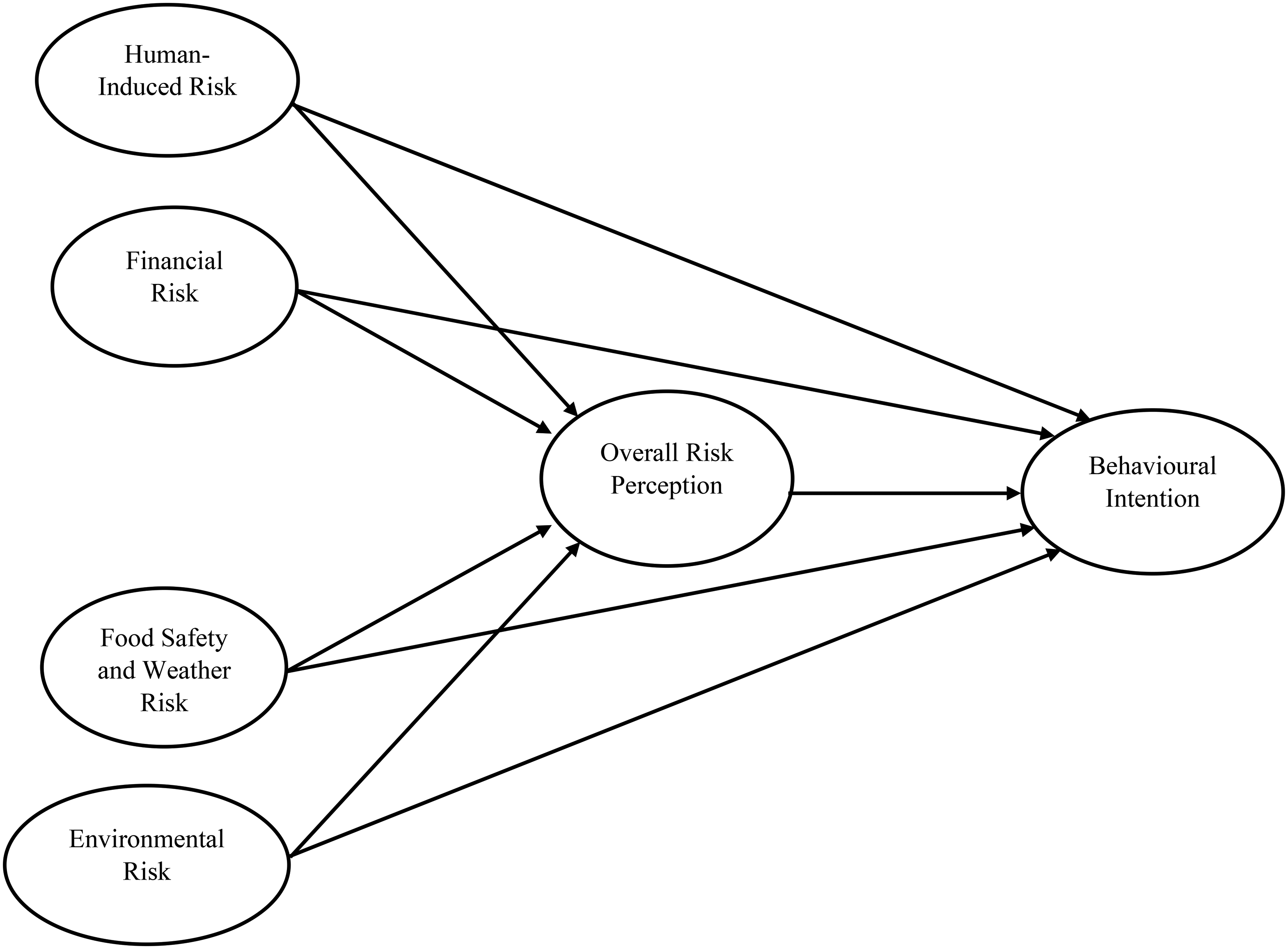
Research model.
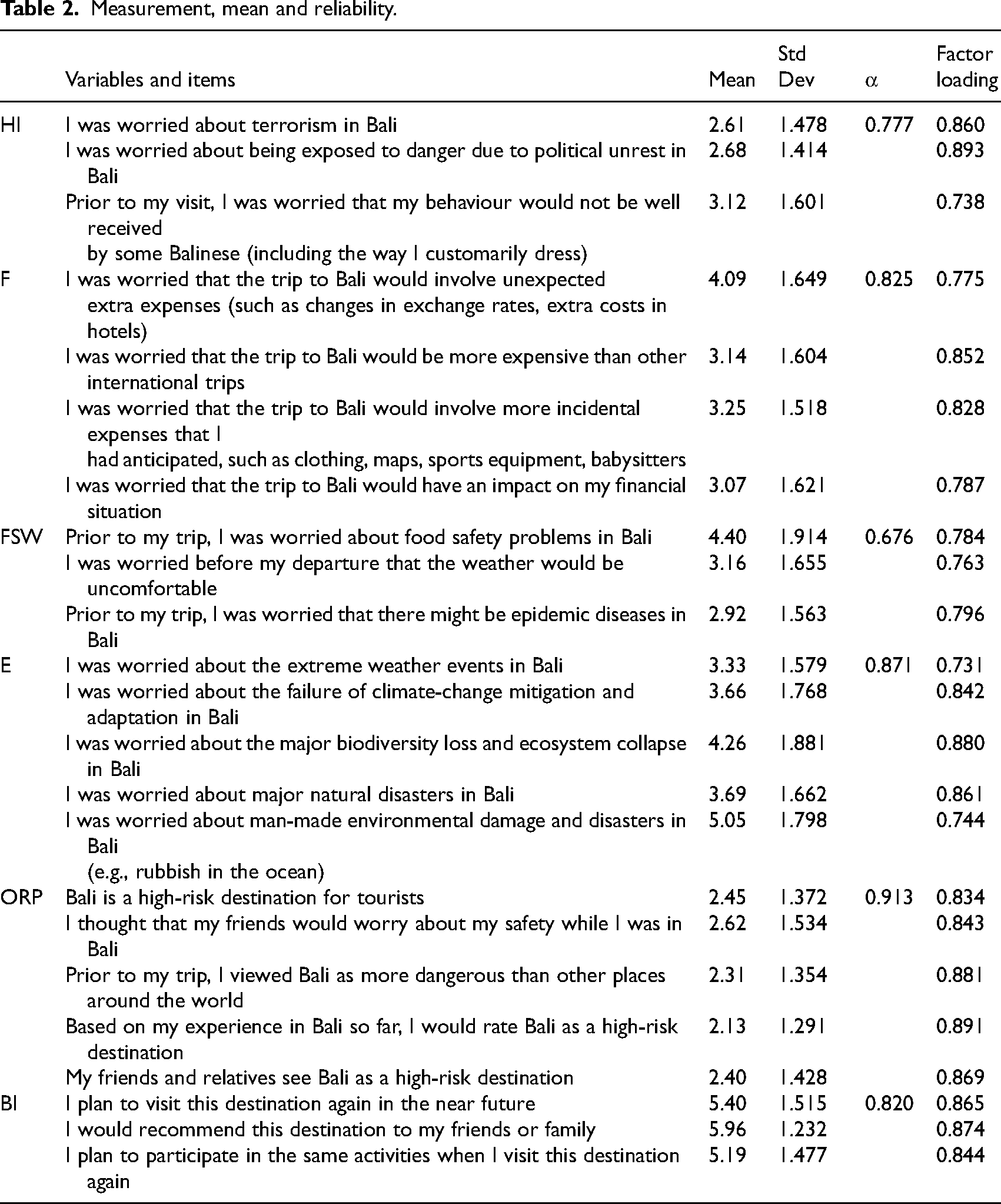
The scale used in this study was mainly derived from Fuchs and Reichel (2006), which includes overall risk perception (ORP); human-induced risks (HI); financial risk (F); and food safety and weather risks (FSW). The behavioural intention (BI) scale was incorporated from Coudonaris and Sthapit (2017). The environmental risk (E) scale was adopted from Asgary and Ozdemir (2020). The FSW dimension covers the weather risk item which may be similar to environmental risk dimension. However, the main difference from both scale lies on its severity and context. The FSW item on weather refer to the inconvenience by the tourist on having to experience different weather from the weather that they normally experience, while the weather in environmental risk scale refers to extreme weather caused by climate change (i.e. flash flood and monsoon). Table 2 presents all of the measurements.
Confirmatory factor analysis
A confirmatory factor analysis was conducted to measure the model fit using several indicators (Schreiber et al., 2006). The risk dimensions including human induced, financial, food safety and weather and environmental hazard, along with overall risk perception and behavioural intention were included. Initially, the human-induced risk comprised five items, however, the factor loading scores from both human-induced risk items 1 and 5 were removed since the values were lower than 0.50 as recommended (Hair and Black, 2010).
The indicators used and results of the test are as follows: x2/df (2.220), comparative fit index (CFI = 0.917), non-normed fit index (TLI = 0.902), incremental fit index (IFI = 0.918), root mean square error of approximation (RMSEA = 0.069) and standard root mean square residual (SRMR = 0.0735). Therefore, the results indicated a good model fit (Kenny et al., 2015; Little, 2013).
Testing common method bias (CMB) and discriminant validity
CMB was tested using Harman's single factor test. All items were loaded on a single factor and the results suggest that 33.2% of the total variance is, explained which is less than the 50% threshold. Therefore, this finding indicates there is no issue with the CMB (Fuller et al., 2016).
Discriminant validity was assessed by comparing the model fit of the six-factor model (all six constructs utilised in the research model) with a five-factor model where the two factors with the highest correlation (human-induced risk and overall-risk perception) were combined into one factor (He et al., 2019; Wu et al., 2015). The five-factor model demonstrated much lower values of model fit (CFI: 0.825; RMSEA: 0.220) which empirically indicates that there are no issues with discriminant validity.
Results
The survey was returned by a total of 364 participants. However, 107 responses were incomplete and were, therefore, excluded from the analysis. The final number of sample (n = 257) was determined by the complete responses given by the participants. The total sample was dominated by females (60%), with 70% being Europeans and 84% comprising young people between 18 and 35 years old. Furthermore, 43% of the total sample have an income below $45k per annum, and 43% of them hold a bachelor's degree. Table 1 highlights the participants’ demography.
Demographic information.
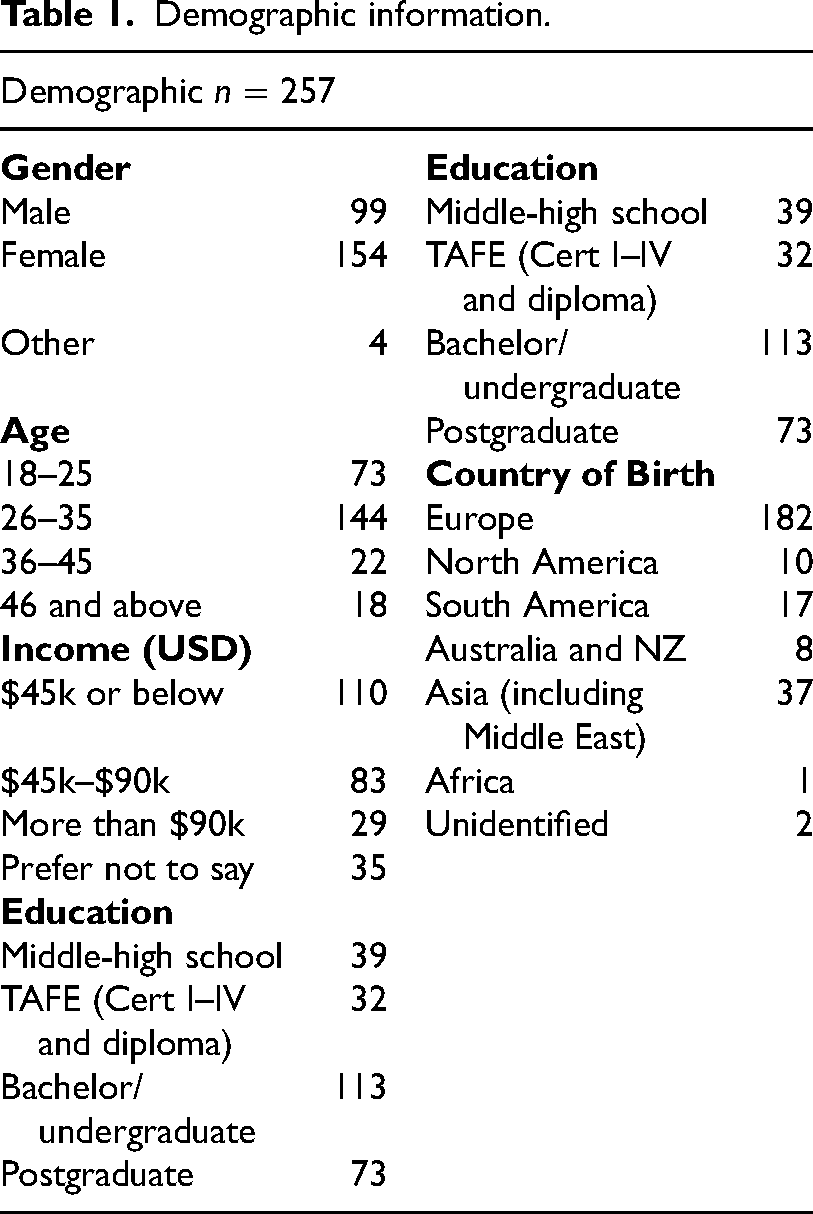
Demographic information.
Based on the mean value, participants were most concerned about the environmental damage (e.g. trash management issue) in Bali as this item had the highest mean value (5.0). The other highest mean value among the risk factors were from food safety (4.4), major biodiversity loss and ecosystem collapse (4.26), and unexpected extra expenditure (4.1). A notable finding here suggest that the tourists were highly concerned about the environmental issues in Bali. The rest of the items from different risk factors showed mean results around 2 to 3, suggesting that the international tourists were not particularly concerned about these risks (i.e. HI and ORP). The average mean score for behavioural intention items was the highest as all of the items scored above 5, suggesting that they are likely to revisit Bali, recommend Bali to their social networks, and engage in the same activities despite concerns about issues such as environmental damage, food safety, and unexpected expenditures. All constructs have been proven to have adequate reliability scores except with the food safety and weather which was slightly below 0.700 (Bagozzi and Yi, 2012). Table 2 describes the items’ mean values, standard deviation, factor analysis and reliability scores, and Table 3 highlights the correlation scores.
Measurement, mean and reliability.
Correlations score.
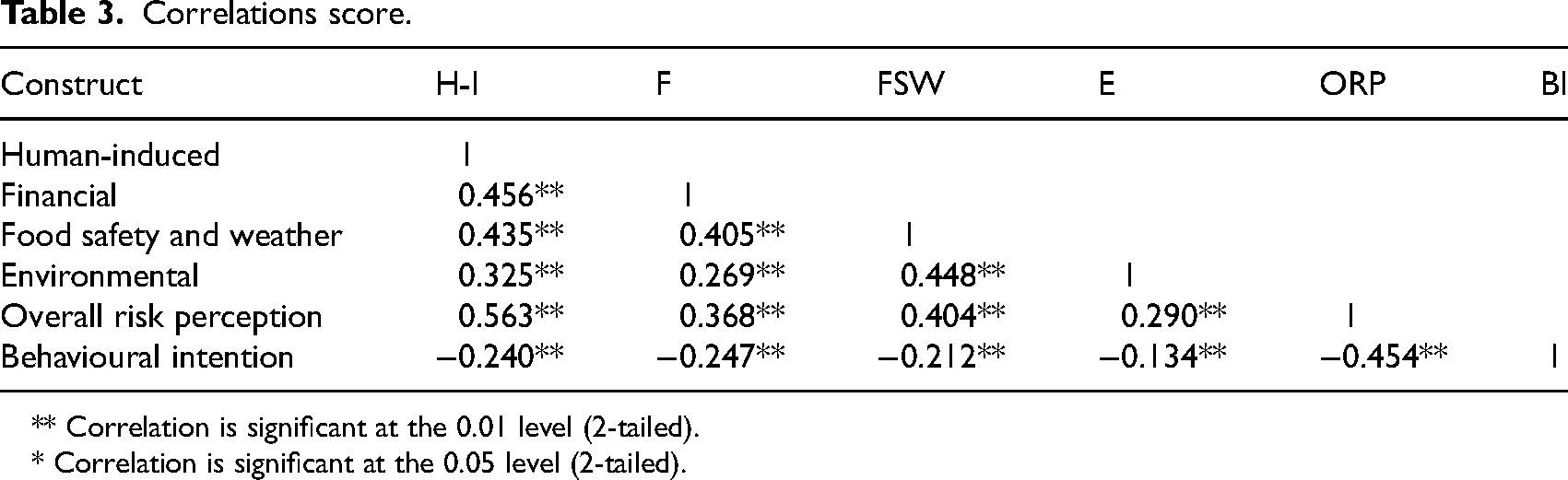
** Correlation is significant at the 0.01 level (2-tailed).
* Correlation is significant at the 0.05 level (2-tailed).
In term of the direct effect on the overall risk perception, human-induced risk (β = 0.413; p < 0.05) and food safety and weather risk (β = 0.250; p = 0.023) were proven to have significant effect. Therefore, H1 and H3 are supported, while H2 and H4 are not supported.
For the direct effect on the behavioural intention, notable finding comes from the significant effect of human induced risk (β = 0.278; p = 0.14), which suggests that the higher value of this risk element would lead to higher behavioural intention. Another significant value comes from the effect of financial risk (β = −0.188; p = 0.047). Therefore, H5 and H6 are supported, and H7 and H8 are not supported.
The mediation analysis was determined by assessing the value of LLCI (lower limit confidence interval) and ULCI (upper limit confidence interval); if the value from these indicators does not cross 0, then a mediation occurs (Hayes, 2009). Findings suggest that overall risk perception mediates the relationship between human induced risk and behaviour intention (β = −0.291; LLCI = −0.485; ULCI = −0.145; p = 0.003) and is the only relationship that has significant effect. Therefore, H9 is supported, while H10, H11 and H12 are not supported. Table 4 presents the path and mediation analysis.
Direct and mediation effect.
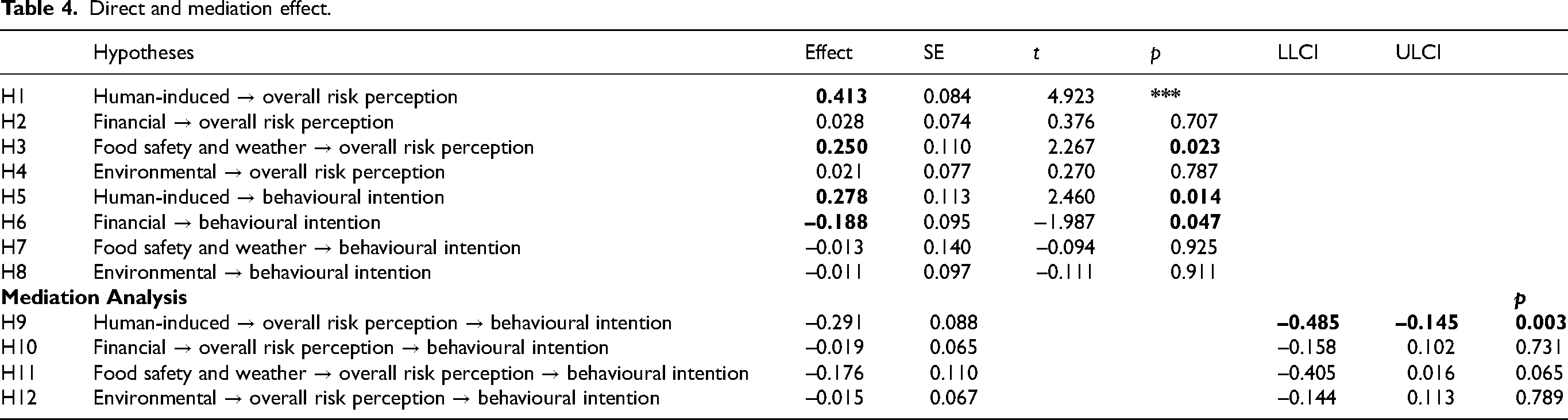
Direct and mediation effect.
Theoretical implications
The present study contributes on the prospect theory in the context of the impact of various risk categories on behavioural intention in international tourism context. The results demonstrate HI risks play a significant role in shaping ORP. This aligns with previous studies suggesting that tourists’ perceptions of risk are shaped by perceived human attitudes, such as tourist misbehaviour and socio-political instability (Eid et al., 2019; Fuchs and Reichel, 2011). Instances of tourist misbehaviours were reported in local Balinese newspapers in Bali where tourists had intense arguments that led to violence not just with the locals, but between tourists suggest that HI risk can contribute to the increase of perceived human-induced risk which affects behavioural intentions (Im and Kim, 2023; Jørgensen and Reichenberger, 2023). Most of these cases in Bali were caused by cultural differences and are not new such as inappropriate dressing, disrespect behaviours toward sacred sites (Iverson, 2010). From the prospect theory perspective, this highlights the importance of cultural education on the destination culture to reduce the probability of conflict, prevent loss from HI risks, and maximise gain from interaction with the locals and with fellow tourists in regard of cultural difference. On top of potential risks (Coudonaris and Sthapit, 2017), previous research suggest that cultural difference have positive effect on memorable tourism experience (Seyfi et al., 2020).
Overall, findings suggest that the international tourists are not concerned with the terrorism and political unrest in Bali despite HI risks proven to have significant effect on ORP. From the prospect theory point of view, this might be because tourists believe that the probability of these two are unlikely in Bali, which support the findings that the local government has succeeded in winning back the trust of the international tourists from its security dimension (Pitanatri et al., 2022). Interestingly, the results show a positive impact by HI risks on tourists’ behavioural intention. This finding seems illogical as it means terrorism, political unrest and cultural difference made tourists keen to revisit Bali while at the same time it contributes on the increase of ORP of Bali. Following this, ORP mediates the relationship between HI and behavioural intention, and is the only significant mediation found from this study.
This finding contradicts Reisinger and Mavondo (2005) who argued the opposite, while at the same time support Choe and Kim (2021) on how tourists would still intend to travel to the destination despite high level of risks perception on the respective destination. An initial argument could be that the socio-cultural dynamics from HI risks play an important role in attracting international tourists to Bali, highlighting the appeal of its unique culture and social interactions (Mayuzumi, 2022). An assumption that can be developed here is that the Bali bombing that occurred in the past may attract international tourists to visit Bali as they may have sympathy to Bali from this tragic incident. However, more research is needed to understand this irregular finding.
Financial risk was found to have a significant negative impact on behavioural intention, while not having significant effect on ORP. The findings confirm previous literature, which suggests that financial concerns affect leisure travel (Hassan and Saleh, 2023; Khalid et al., 2020). Economic instability often leads to changes in pricing strategies by local tourism business owners, which can affect tourists’ travel decision-making process (Khalid et al., 2020). This can be understood from prospect theory that tourists will always find a way not to minimise spending while maximising their pleasant tourism experience, or at least to find a balance between travel affordability and the experience they will get (Moreno-Izquierdo et al., 2020). Financial management strategies remain crucial while travelling, especially when there are differences in currency exchange rates or a sudden spike on the exchange rate (Alegre et al., 2010; Ritchie et al., 2010).
Food safety and weather significantly impacts ORP in Bali, a destination known for the term 'Bali Belly,' which describes the digestive illness some tourists experienced after consuming local foods. This phenomenon extends previous literature that observes food safety as aligned with tourists’ health concerns when travelling to destinations with different culinary cultures and experiences (Fuchs and Reichel, 2006; Yeung and Yee, 2019). Concerns about food safety risk are often associated with general perceptions of poor hygiene and sanitation in local food processing (Yeung and Yee, 2019). This finding supports Soon et al. (2021) which argues that health and well-being are top priorities for international tourists travelling to countries with hygiene problem, leading to preventive actions being taken to address potential hazards such as foodborne illnesses. At the same time, it may suggest that the food safety risk is connected with HI risk and performance risk as argued by Fuchs and Reichel (2006). In regard to the weather, international tourists overall were not concerned with the weather condition in Bali despite this dimension having significant effect on behavioural intention. Similar finding was also generated from the epidemic diseases in Bali, where the low mean value suggest that tourists were not concerned with this issue. Although this dimension is not significant on the ORP, these findings interconnect and expand literature that elaborates on tourists’ concerns about the impact of food safety, weather conditions and a destination's preparedness to contain epidemic diseases in the area (Godovykh et al., 2021; Kim et al., 2017; Liu et al., 2017). The mean result for food safety is relatively high compared to other items. From the PT theory, this suggests a significant risk as food is an important element of tourism. Tourists that are affected by illness or disease from food will lead to other risk factors such as time, financial, performance and satisfaction to cure this illness during their holiday.
On the other hand, environmental risks have proven to have insignificant effect on both the ORP and behavioural intention. Previous research, by Kim et al. (2017) and other findings suggest tourists have high concerns on climate change and environmental preservation activities (Batool et al., 2022; Hindley and Font, 2017), our research extend this finding by proving that the environmental risk are not significant to tourists behavioural intention. However, this finding is time-bound and may change in the future considering that Bali and Indonesia in particular are falling behind on its environmental preservation activities (Yodha, 2018). It is important to note that long-term damage from environmental risks may affect international tourists’ perception of risk in the future, and negatively affect Bali tourism development (Xie et al., 2014). From the theoretical perspective, the prospect theory can be used to take into account of the long-term prospect where the gain or loss will not occur immediately. Destination managers therefore need to possess the ability to foresee the consequences from each risk factor should they are not able to manage these risks.
Managerial contributions
This research has presented unique findings on the effect of risks on international tourists’ behavioural intention from the lens of prospect theory. Our findings suggest that overall, international tourists do not see Bali as a high-risk destination based on the low mean score of ORP dimension. However, understanding risks that may impact tourists’ behavioural intentions is crucial to enable policy makers to respond to these risks and enhance the resilience of destinations (Guo et al., 2018). Building on this foundation, we recommend destination marketers to convey a clear and transparent message about the potential risks on the destination site to the international tourists. Tourists are increasingly seeking critical information about potential risks at a destination, including safety and security aspects (Im and Kim, 2023; Kim and Hwang, 2020).
The first information that needs to be conveyed to the international tourists is about cultural values and social norms that are being practiced by the locals in order to prevent HI risks driven by culture. A quick guide about these factors, especially what behaviours are considered to be disrespectful by the locals would be essential to reduce the human-induced risk factor perhaps by spreading leaflets in the airlines before arriving in Bali or by employing social media influencers. Bali's past terror attacks can be utilised to build the brand image of how the Bali communities, including locals, tourists and migrants are resilient to maintain Bali as one of the favourite destinations in the world. Regardless, this means that HI risk can be utilised for the benefit of the destination manager and marketers. There are couple of contextual arguments for this such as to attract sympathy given by the international tourists on the Bali bombing incident decades ago. Another assumption is that the media news could have overemphasised on the negative aspects of the human-induced risks, when in reality Bali is a good place to live according to the international tourists. Further research is needed to find the answers.
From the financial perspective, given that Bali remains popular among low-cost budget travellers (Arismayanti and Rahyuda, 2020), it is essential to provide updates about the current pricing structure and other relevant financial information, such as currency and taxes, to help tourists manage their travel budget and itinerary. Local destination operators should engage in transparent communication about how this rule and upcoming regulations (i.e. additional tax) may affect the future travel budget to Bali. They can regularly outline an approximate budget that tourists will need to spend according to their demographics and buying behaviour. Moreover, collaborating with travel influencers can assist destination operators in keeping tourists informed about the cost and spending behaviour in Bali. This approach aligns with the need for clear and transparent messaging to manage tourists’ risk perceptions and maintain their confidence in choosing Bali as a destination.
From the food safety and weather perspective, Bali first needs to improve its regulation for food providers. It is important for the local government to work together with the local communities and industries. The local government needs to provide free food handling training for the food provider and vendors and providing participants with a certificate upon the completion of this training. This will help tourists assess the hygiene standard of the food vendors and assist in decision-making, while at the same time prevent or reduce the ‘Bali Belly’ from happening. In regard to the weather discomfort, destination provider needs to work together with online vendors (i.e. Traveloka, Booking.com) to inform the tourists on possible negative impact from the weather during the date of their visit. This can be a warning of dehydration or sunburn during dry season and inform tourists how to cope with the weather and prevent the negative effect beforehand.
Finally, as international tourists have high concern on the environmental risks in Bali particularly on the waste crisis issue (i.e. garbage on the coasts), destination managers may utilise this concern to provide special tours which involve environmental preservation learning and activities to particular segments (e.g. environmentalists, international students exchange) to further boost tourism in Bali. Findings suggest that tourists are not so much concerned with the extreme weather, natural disaster, failure of climate change adaptation, major biodiversity loss and ecosystem collapse in Bali. However, this finding must not be taken lightly, as there are other factors that may affect these results such as tourists having little knowledge on the environmental conditions in Bali, low environmental awareness and perhaps ignorance, especially as tourists generally visit Bali for leisure. As previously discussed, in the long run environmental risks may disrupt or even destroy a destination if climate mitigation and disaster efforts are ignored.
Destination managers would benefit from responding to these risks factors with several measurement recommended above as it will make tourists feel that they are important and appreciated. These attempts may create a positive impact on the destination brand, and at the same time make Bali a better destination with less perception of risks. Conducting attempts to reduce these risks will also send signals to other destinations that all stakeholders need to work collaboratively to mitigate the risks and make their destinations a safe place for tourists and the locals to learn from each other and improve social cohesion.
Limitations and future research
While this study offers valuable insights, it also has limitations that suggest avenues for future research. Firstly, the study relies on cross-sectional data. For a more comprehensive understanding, research that employs longitudinal data collection would be relevant to gain more understanding on the effect of risks in Bali.
From the PT perspective, future research would benefit to investigate what gain factors would offset high risk categories and would still attract tourists to visit the destination. Finally, there needs to be a more in-depth analysis using qualitative method to further investigate the reasons why human-induced risk in Bali attracts more international tourists into the destination instead of deterring the tourists’ intention to revisit. This finding will benefit researchers to learn how risks from human dynamics can actually be cultivated to benefit the destination management and policy makers.
Footnotes
Declaration of conflicting interests
The author(s) declared no potential conflicts of interest with respect to the research, authorship, and/or publication of this article.
Funding
The author(s) disclosed receipt of the following financial support for the research, authorship, and/or publication of this article: This work was supported by the Griffith Asia Institute, Griffith University. The authors would like to thank Mrs Liza Rae as the Director at Penida Colada Beach Bar at Nusa Penida, Bali for the data assistance support. We would not make it without your help.
