




Abstract
The presented article focuses on the issue of customer segmentation in the hospitality industry and its use for price optimisation. To identify the market segments article uses the Two-Step cluster analysis. The analysis was based on the seven variables (length of stay, average room rate, distribution channel, reservation day, day of arrival, lead time and payment conditions). Six clusters were identified as following segments: Corporates, Early Bird Bookers, Last Minute Bookers, Product Seekers, Values Seekers and Last Minute Bookers. To optimise the price for these segments, article works with the coefficient of price elasticity of demand for the presented market segments. The price elasticity of demand is measured by the log-log regression analysis. Data were colected from the four-star hotel in Prague, Czech Republic and analysis is based on more than 9000 transactions. Last minute bookers segment was the only one with the positive coefficient of price elasticity and has the lowest value of lead time (9,27 in average). Product seekers have the highest coefficient of price elasticity (−3,413) and highest average room rate (3573 CZK in average). Early bird bookers, Long time stayers, Corporates and Value seekers was identified as pricely inelastic.
Keywords
Introduction
Hospitality revenue management is commonly described as allocating the right product to the right clients at the right time for the right room rate using the right communication and distribution channels. (Kimes, 1989; Vives et al., 2018)
This broad definition shows the need for comprehensive research in this field and solutions that would help revenue managers make the pricing and allocation decisions (Baker et al., 2019). However, the current focus of the researchers is mainly on dynamic pricing (Abrate et al., 2019; Anderson et al., 2016; Guizzardi et al., 2020), and other concepts like market segmentation are commonly omitted or over-simplified. The need for a comprehensive perception of revenue management is supported by Viglia and Abrate (2019), who call for a more holistic approach in this field while taking into account reputation management, the changes in customer behaviour, big data-based analysis and forecasting (Choi et al., 2018) or dynamic co-creation strategies using modern technologies and available big data (Buhalis and Sinarta, 2019).
Big data is still the field where there is not much hospitality-oriented research, and practitioners commonly perceive this as a future trend (Demirciftci et al., 2020; Wang et al., 2015). While focusing on the available research, we can find articles focusing on big data, mainly in demand forecasting (Guizzardi et al., 2020; Saito et al., 2019; Sánchez-Medina and C-Sánchez, 2020; Vinod, 2016; Weatherford, 2016; Yang et al., 2014) and market segmentation (Sánchez-Medina and C-Sánchez, 2020; Yadegaridehkordi et al., 2021), closely connected to the customer's behaviour in the time. Some authors are using the big data analysis to identify the possible cancellations and their drivers to improve the revenue management strategy and demand forecasting using an active overbooking strategy (Antonio et al., 2019; Sánchez-Medina and C-Sánchez, 2020) or the customer evaluation within the customer relationship management strategy to identify the most valuable groups of customers (Talón-Ballestero et al., 2018). The big data analysis can be directly found in the segmentation study, which focuses on the market segmentation based on the text mining techniques applied to the TripAdvisor.com reviews (Yadegaridehkordi et al., 2021).
The application of big data analysis is not only connected with the positive business effects like finding new ways how to market the business or how to improve the current marketing strategy but as well with the need for more qualified employees involved in the data analysis processes, which can lead to workplace instability (Weaver, 2021) or increase in the difference between the researchers and practitioners perception of the revenue management in its perspectives (Ivanov et al., 2021; Studnička and Plzáková, 2017). As proposed by Ivanov et al. (2021), the research-practice gap is caused by the low transferability of the knowledge within the revenue management research and the lack of detailed and understandable methodology description.
This article aims to provide a comprehensive solution for the online market segmentation based on the customer big data and evaluate the price sensitivity of these customers segment using the price demand elasticity coefficient estimate using the log-log regression model. The study uses empirical data from four-star hotel to build a stable posterior online market segment based on several variables reflecting the customer behaviour in connection to travel motive, the timing of the purchase and rate acceptance. The empirical analysis reflects the standardised data mining approach CRIPS-DM (Cross Industry Process for Data Mining) (Putra et al., 2019), closely connected to business understanding and used methods and results evaluation from the individual business perspective. This approach respects the essential characteristics of the data-driven market segmentation stated by Dolnicar (2019).
Literature review
Buhalis and Sinarta (2019) mentioned that hoteliers must build their data-based and technology-driven strategies to understand their customers. Modern technologies allow them to dynamically market their products and focus on the offers’ personalisation (Viglia and Abrate, 2019). On the other hand, we need to accept that even the e-commerce in hospitality is still growing and gaining more power (Hua et al., 2019), the offline or contracted business is still significant. Lee et al. (2011) use common-sense segmentation (the term is used by Hajibaba et al. (2019)) to distinguish between corporate and leisure segments, where the corporate groups and individuals are commonly contracted and non-yieldable as they are using private (opaque) rates. The leisure segment consists of groups and individuals (transient segment or Frequent Individual Travellers), where dynamic revenue management strategies influence only the transient segment. These results narrow down the scope of the literature reviews, where only the approaches toward online transient and business segments are discussed.
Hotel market segmentation – revenue management perspective
Market segmentation can be perceived as a process of grouping hotel quests or customers into naturally existing or artificially created groups based on the segment members’ homogeneous behaviour or characteristics (Dolnicar et al., 2018). Market segmentation aims to create stable, accessible, profitable, measurable, discrete and mutually exclusive customers influenced by a specific marketing mix or marketing program (Ivanov, 2014). As mentioned in the previous section by Lee et al. (2011), the most used approach to market segmentation reflects the motive of quest stay and uses the corporate and leisure segments. This approach does not reflect the data availability and shows the high internal heterogeneity, which calls for a more analytical perception of the market segmentation.
The majority of the market segmentation studies are done ‘a priori’ (Hajibaba et al., 2019), based on the demographics, sociographic or company-unspecific intentions. Only a minority of the studies use a ‘posterior’ approach based on the empirical data that reflect the intentions and behaviour of the customer under the specific marketing program and customer-oriented activities. (Dolnicar, 2004)
In connection to revenue management, we can adapt the concept of market segmentation created by Vives et al. (2018), where the internal and external segmentation is described. These two approaches differ mainly by their actionability, where the internal segmentation focuses on the factors that can be changed or affected in the short term, and the external segmentation consists of the factors that can be changed only in the long term. A similar perception of the aspects affecting the revenue management strategy based on dig data is highlighted by Sánchez-Lozano et al. (2021), who describe contextual, hotel-based and offer-based variables directly linked to the pricing strategy creation. The data-driven market segmentation needs high-quality uncorrelated data and their processing (not using factor-cluster analysis) while taking into account the exploratory purpose of this approach. (Dolnicar, 2019).
One of the critical aspects of online customer behaviour is Time. Jang et al. (2019) found that the last-minute reservations are connected with lower customer involvement and lower Time spent on information research. The closer is the date of arrival; some revenue managers tend to decrease the visible rates and offer a discount (Abrate and Viglia, 2016), which might not be the best strategy, as they can stimulate the customers by providing them with a better product (Yang and Leung, 2018). Other studies comply with Jang et al. (2019) while showcasing price progression (Choi and Mattila, 2004; Schamel, 2012). While the price is mostly perceived from the entrepreneurs’ point of view, there are studies focusing on the tourist's expenditures while trying to group them and describe the common characteristics of the expenditure-based segments (Vinnciombe and Sou, 2014).
The concept of time is well developed in connection to demand seasonality (Moro et al., 2018), where the authors are focusing on the prices and capacities of the market (Lozano et al., 2020), the connection of hedonic characteristics of accommodation facility and the prices (Juaneda et al., 2011) while focusing on one specific segment omitting the fact that the revenue managers are trying to find the optimal balance between various segments (Abrate et al., 2012). For the operational changes and dynamic pricing, the revenue managers need a more detailed description of customer behaviour, which is provided, for example, by Guo et al. (2013), Abrate et al. (2012) and Ivanov and Piddubna (2016), who focused as well on the day of the week, precise date or holidays and other ‘non-working’ days.
Another concept connected to the domain of Time is the length of stay (LOS). LOS is connected with the active revenue management focusing on the demand limitation (Lee et al., 2020; Riasi et al., 2017), but a lack of research was done to understand the booking intentions towards longer stays. Riasi et al. (Riasi et al., 2017) stated that the customers tend to book longer stays when they expect a lower average daily rate (Thrane and Farstad, 2011), while the practice might be the opposite and the customers are making the decisions based on their false beliefs. The length of stay is affected by many other factors, such as a travel motive (Scanlan and McPhail, 2000), traveller's income (Mak et al., 1977) or the opportunistic behaviour where the clients book more for less in long booking horizon (Riasi et al., 2017). According to the study by Bavik et al. (2021), these travellers spend less, travel in a group and as repeatable quests tend to stay longer. A longer stay can be expected by the customers who travel long distances to the target destination (Jackman et al., 2020).
The use of various distribution channels and rate disparity might be crucial stimuli for the customers (Yang and Leung, 2018). This is as well proved by Bigne et al. (2021), who evaluated the rate strategy on various distribution channels, finding that approximately three months before arrival, the OTAs offer the lowest rates, within the month before arrival, the distribution channels are mainly in the rate parity, and last-minute booking are stimulated by decreasing the rates on hotel websites. Contrary to the findings of this study, Sun et al. (2016) analysed offered rates on various OTAs finding that these portals use various ‘last minute offers’ to attract the customers and commonly fail in the promised ‘best rates guarantee’ condition of reservation.
Other factors that affect customer behaviour are the rate fences that directly limit the demand for a specific product type (Ivanov, 2014). One of them is the minimum length of stay (MLOS) which can be used to combine the high-priced and low-priced days to improve the overall performance of the accommodation facility by reducing the number of customers demanding the particular day stays (Choi and Mattila, 2004). While there are restrictions that are used as stimuli to attract the customer by providing them with better conditions for booking (Abrate et al., 2012; Latinopoulos, 2018), the practitioners are combining the MLOS with forecasted higher demand which results in the growth of the room rates (Riasi et al., 2017). Some of the authors are stating that length of stay control is one of the most critical non-pricing parts of revenue management (Lee et al., 2020).
Price elasticity of hotel demand
While the researchers mentioned in the previous section mainly focus on the limited number of variables and describe the mainly static state of the art, the revenue managers need to address who their customer is and how they will react to prepared revenue management programs. One of the concepts connected to the clients’ reactivity on the dynamic pricing is the price elasticity of demand (sometimes described as a price sensitivity or sensitivity to price changes (Scanlan and McPhail, 2000). Price demand elasticity reflects the changes in demanded quantity in connection to price changes (Ivanov, 2014; Petricek et al., 2020; Petricek and Chalupa, 2020) and can be affected by various factors (mainly hedonic and social) where the high-income people tend to be more price-insensitive (Wakefield and Inman, 2003) and vice versa (Weatherford, 1995).
Based on the findings of several studies (Ivanov and Piddubna, 2016; Scanlan and McPhail, 2000; Vives et al., 2018), corporate clients are price-insensitive – which is mainly caused by the selected strategy towards the distribution within these segments. In most cases, the pricing strategies within this segment are more hedonic and product-oriented (Scanlan and McPhail, 2000; Xue and Cox, 2008).
Several approaches were used within the previous research to estimate the price demand elasticity coefficient values when focusing on the transient segment. For example, estimation based on the room rate segments (Pekgün et al., 2013), log-log regression model adopted within this study (Petricek et al., 2020), autoregressive lag model based on the economic factors (Tran, 2015), demand function estimate using linear and non-linear techniques (Lee et al., 2011), logistic regression (Balaguer and Pernías, 2013) and multiple logistic regression (Ratliff et al., 2008).
When focusing on these studies’ results, which were mainly oriented on the individual online demand for the accommodation service, we can find high variability. Tran (2015) evaluated the price demand elasticity in short and long terms finding the demand inelastic (from −0,02 to −0,03). Roselló et al. (2005) identified the values ranging from −0, 4 to −0, 51 and Hiemstra and Ismail (1993) the value of price demand elasticity −0, 44, which complies with the finding of Bayoumi et al. (2013).
Materials and methods
This study focuses on the online demand for accommodation facilities proposed by many previous studies (Gao and Bi, 2021; Saito et al., 2019; Vives et al., 2019). This focus is connected to dynamic revenue management, which works mainly with the dynamic non-contracted demand. The study used the transaction data of four-star hotels located in Prague's city centre with 210 rooms in four categories (Standard Double, Superior Double, Executive Double and Suite), restaurant and bar, wellness and fitness facilities and meeting rooms with a maximum capacity for 160 rooms.
The dataset is represented by the final count of 9485 transactions (reservation logs mined from the Opera PMS solution). Before the data were processed by the IBM SPSS Statistics 23, these were pre-processed, and missing values were analysed. In total, 5% of the cases were excluded due to missing values in selected variables or their uniqueness based on identifying unusual cases.
Based on the literature review oriented on the customer behaviour of online customers, the study adopts the approach of several pieces of research toward market segmentation and understanding. It uses the below-mentioned methodology to create the segment profiles based on the following variables.
Length of Stay (in nights) Average Room Rate (in CZK) Type of Online Distribution Channel (as the rate parity strategy is adopted by the accommodation facility, the distribution channels were treated on the aggregated level) Day of Reservation Creation (day of the week category) Day of Arrival (day of the week category) Lead Time (or Booking Horizon) (in days before arrival) Type of Offer (payment conditions – BAR or Non-refundable)
As the data set contained continuous and categorical variables, the Two-Step Clustering method was used. Many previous studies adopted this methodology in market segmentation (Borges Tiago et al., 2016; Hadjikakou et al., 2014; Nurjannah et al., 2019). The same method was used to pre-process the data and identify the unusual cases that were not identified separately for single variables but for the whole dataset to secure the high quality of used data and acceptable dataset variability.
To avoid the single-method bias, we have as well adopted the K-means cluster analysis, which was recommended by previous researchers (Putra et al., 2019, Vinnciombe and Sou, 2014). The results of these methods were compared concerning hotel market segmentation recommendations stated by Dolnicar (2019), Pons-Vives et al. (2022) and Ivanov (2014). These authors point out that the market segmentation is explanatory in nature, and for better adoption by the hoteliers, the whole procedure should not be over complicated. Dolnicar (2019) also states that using complex statistical tools and methods and their combination does not secure the high quality of the final market segment, where the easily adoptable and used segments are preferred.
Two-Step cluster methodology is used to reveal non-visible natural clusters/groups, whereas the clusters can be based on the categorical and continuous variables thanks to the likelihood distance measure and the assumption of variables independency. For continuous variables, the procedure assumes normal distribution and multinomial distribution for the categorical variables. The whole procedure sets automatically the number of clusters and allows the incorporation of a higher number of variables. The procedure of the Two-Step clustering consists of two interconnected steps. Within the first step, the Cluster Features (CF) Tree is created and the cases are subsequently added to the structure based on their distance to existing clusters/nodes. The best solution is selected using Schwarz's Bayesian Criterion. Further details and equations can be found in Appendix 1.
Contrary to Two-Step clustering, the K-means uses only the continuous variables and needs proper setup (number of clusters, distance measure, irritation steps). From this perspective, the Two-Step is more complex and simpler to adopt.
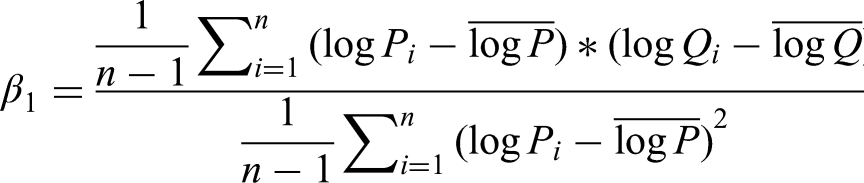
The log-log regression model of Petricek et al. (2020) is adopted to estimate the price demand elasticity. The model is based on the theoretical regression function represented by the following equation,

Results
To avoid the mono-methodology bias, the results consist of the final clusters provided by the K-Means clustering and Two-Step cluster analysis. With respect to the characteristics and procedures of these methods, the number of clusters was set up by the Two-Step cluster automatically with the highest possible number of iterations to secure a high level of final cluster quality. Table 1 showcase the results for K-means clustering using the LOS, lead time and Average Gross Rate characteristics.
Clusters of online hotel customers using K-means clustering.

From the perspective of market segment heterogeneity, the inter-cluster variability in only visible for the Average Gross Rate, while the other centroids are closely located with low inter-cluster variability.
Contrary to K-means, the Two-Step consist of categorical variables. Table 2 shows the six identified market segments of online hotel customers. The categorical variables day of the reservation, day of arrival and offer type were excluded from the description as for the cluster 1-5, most of the reservations were created during the weekends and the arrivals of these stays. For cluster six, the highest number of reservations was identified on Tuesday with the arrival day of Monday. There was a significant difference in distribution on Best Available and Non-refundable rates for the type of the offer.
Clusters of online hotel customers using two-step cluster analysis.
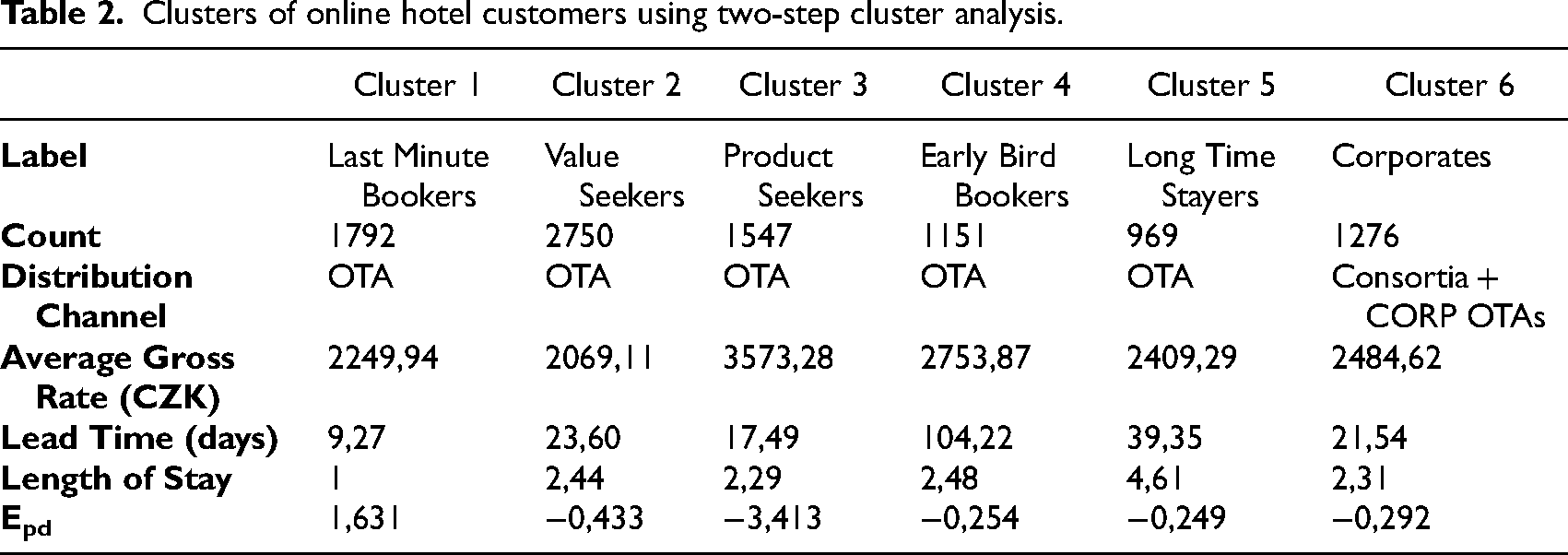
Even though the motive of stay was not included, based on the customers’ behaviour, the Corporates segment was created and grouped the reservations from Consortia sites and corporate-oriented OTAs. Other segments (clusters 1-5) were leisure-oriented.
The final segments can be described as follows.
From the perspective of revenue management and dynamic pricing, it is crucial to understand the values of the coefficient of price demand elasticity. Several interesting findings in the study need to be clarified and put into overall business performance.
Event thought the corporate segment is commonly described as price insensitivity. The development of the new online distribution channels directly orienting on B2B or corporate clients caused a shift in the behaviour within this segment, and we can expand the decrease in the demanded number of rooms while increasing the selling rates. As online sales are still more relevant, revenue managers should include these into the dynamic pricing strategies not to lose these business clients.
The price demand elasticity coefficient value within the segment of Last-minute Bookers shows that the segment should be positively elastic to price unusual changes. However, a closer look at the development of the coefficient values within the different seasons and periods shows that the yearly coefficient differs from the partial ones. The partial coefficient is in the context of the seasons in the range from −0, 12 to 0, 2. These partial results show that this segment is not elastic, and the changes in the rates would not cause many changes in the demanded number of rooms.
Another surprising finding is connected to the coefficient value for the product seekers. The value of −3, 413 shows a massive impact of the rate changes on the demanded rooms while maintaining the highest average room rates within the identified segments. Again, a closer, the more analytical look must be taken to understand the value. In most cases, the reservation is allocated within the top season (or even top terms) where there is a significant impact of other factors like low availability of specific products on the market, reduced time frame for the decision-making and high impact of the competitive strategies. We can expect negative price demand elasticity within this market segment with a value of −1, 54 on the dates excluding the top terms. For the top terms, we can expect that the decrease in rates would attract a considerable number of reservations as the offer is limited, and the online customers still have the right to choose from various offers on the market.
From the competition point of view, this might cause a huge price drop in market rates and decrease overall market performance. That is why it is crucial to stick with the value of −1, 45, representing better Product Seekers’ behaviour in typical situations.
Discussion
The study combines posterior data-based market segmentation using hotel big data and data mining techniques with an econometric approach toward price demand elasticity coefficient calculation. The results of this study extend and deepen the findings of previous studies and showcase the need for a proper understanding of online hotel demand to improve hotel performance. Similarly to Guo et al. (2013), this study used behavioural factors to propose a novel approach toward online market segmentation related to big data availability. On the other hand, the proposed approach combines more of the factors used by other authors like the type of the distribution channel (Bigne et al., 2021; Sun et al., 2016), rate fences or type of the offer (Abrate et al., 2012; Latinopoulos, 2018) or their combination (Arenoe and van der Rest, 2020). From this perspective, it is clear that this study reflects the need for a comprehensive understanding of the customer's behaviour and extends the number of used variables, both continuous and categorical, and their analysis through data mining techniques. This unique approach based on the empirical data showcases the possibility of building competitive strategies using big data analysis and improving the decision-making process by these results.
Another finding shows that even though corporate clients are commonly considered an inelastic market segment, growing corporates react to price changes. As the demand shifts online, not only in leisure segments, there is a need for changing these paradigms and reflecting the current market characteristics. The resulting coefficient of the price demand elasticity complies with the results of previous studies (Bayoumi et al., 2013; Hiemstra and Ismail, 1993) but extends the need for a more detailed understanding of the behaviour that might vary not only in time but also under different market situations.
The study uses two approaches toward market segmenting, the K-means clustering based on the Keynesian Distance Measure and the continuous variables and Two-Step Cluster Analysis based on the likelihood distance using both categorical and continuous variables. Dolnicar (2019) proposed that the data-driven clustering is exploratory in nature and the results must be discussed in the context of their use. For K-means, the low level of inter-cluster variability sticks with the expenditure-based segmentation proposed by Vinnciombe and Sou (2014), where the market segments are mainly distinguished by the level of their expenditures and the other variables are used to describe these segments closely. This assumes the creation of natural segments based on the accepted room rate, where no other characteristics are affecting the final decision, which is not compliant with the previous research. More actionability might be derived from the results of the Two-Step Cluster Analysis, where the customer characteristic directly leads to the creation of the marketing programmes that are used to capture the right customers at the right time.
Practical implications
The results of this study directly lead as well to several practical implications. Data-based online market segmentation can be used to identify the segments for targeting or avoiding by using the combination of several variables that provide more action ability to marketers and revenue managers. The hoteliers can better time their offers while focusing on the most valuable market segments willing to accept the dynamically set price, availability and other booking conditions.
The coefficient of price elasticity of demand can help to understand how consumers react to changes in price. Using a different approach to the different segments can lead to increased revenues in the hotel. The core of this optimisation process can be based on the relation between the total revenue curve of a hotel and its link to the different coefficients of price elasticity. Revenue managers are able to use this knowledge to manage prices in accordance with the current situation in the market. In the case of inelastic demand, the revenue managers can increase the price of the service to increase the revenue. If the segment is price elastic, decreasing the price will lead to an increase in the price elasticity. We can also see the situation of Giffen's paradox with positive price elasticity of demand. In that case, it would be important to know the highest price level that the segment is able and willing to pay. The attribute of willingness to pay would be necessary to compute (Heo and Hyun, 2015; Kang and Nicholls, 2021). The whole problem can be used in the complex optimisation model as a base of the revenue management system (for more information, see Petricek et al., 2021).
Theoretical implications
Another implication should be made by using the big data and their analysis through the data mining techniques that can bring out new, non-visible facts and behavioural patterns that might be business-specific. The application of the transaction data can be beneficial while understanding the customers’ booking behaviour and changing preferences. Another benefit of this approach is the tracking of the changes in the behaviour to reduce the inefficiencies in the marketing strategies, which can also improve the business's overall performance. Lastly, the knowledge of different segments and their behaviour can also be used to implement those characteristics into the prediction models. To predict the behaviour of consumers using modern tools and approaches, the neural network can be used for the more advanced models. Chen et al. (2021) and Yang (2021) mention the importance of the price in models using a neural network to make a prediction. Those models can be used to make a new way of prediction in revenue management that is not based on the time series.
Limitations of the study
The proposed approach toward data-driven market segmentation is connected with the benefits presented in previous parts of the study and several limitations that need to be stated and discussed. Firstly, the presentation of the procedures and their results on the case of single property might not be generalised to the whole hospitality industry but can be the starting point for further research which respect the need for updated market knowledge and exploratory purpose of the market segmentation (Dolnicar, 2019).
Another limit lies in using advanced statistical methods for market segmentation and price demand elasticity coefficient estimate. As stated by Ivanov et al. (2021) the hotel revenue managers are using only a small part of the revenue management practices provided and described by researchers. In most cases, the revenue managers use more time and cost-effective approaches while using the revenue management systems and their suggestions within proper knowledge of the methodology. The application of these methods assumes a higher-than-standard understanding of statistics and econometrics, which creates the need for further education and long-life learning.
Lastly, from the practical point of view, the study uses only the room rates (precisely the average room rates) that do not reflect the revenue generated in other outlets or other departments. These revenues can change the proportion of the market segments and their overall importance for accommodation facilities.
Ethical considerations
Respecting the sensitivity of the dynamic pricing and price fairness perception by the customers, it is important to address the ethical issues and concerns connected with the application of stated methods in revenue management and dynamic pricing. Van der Rest et al. (2020) argue that legislators and regulators in Europe do not expect to take any action to limit the use of personalised pricing and set up a minimum standard of behaviour in this context. The authors as well state that the researchers should examine the field beyond the legal limits and discuss the pricing strategies connected with segment self-selection, neuromarketing and psychological pricing.
Priester et al. (2020) conducted the experiments to evaluate the fairness perception of dynamic pricing on personalised and segment levels, where the perception of room rates for the market segment is better than for the personalised ones. The authors discussed as well the location and history-based pricing, where the customers perceive the location-based prices as less fair than the history-based ones. Major concerns are connected with the customer's privacy. Similar results can be derived from the study Gerlick and Liozu (2020) who focused on the big data, artificial intelligence and automised decision-making in pricing, where the major concerns are connected with customer privacy and data protection respecting the legislation.
From the perspective of the previously mentioned highlights, we can conclude that the ethical considerations and issues are only eligible in the situation where the customers feel affected by these strategies and are losing the feeling of security.
Conclusions
The presented article focuses on the issue of using big data for identifying the market segments and using knowledge of the coefficient of price elasticity to optimise price. For the research, the market data were collected and analysed to find the following results. Using two-step cluster analysis, six segments were identified. The name of these segments was used as Last-minute bookers, Value Seekers, Product Seekers, Early bird bookers, Long time stayers and Corporates. This segmentation was based on the seven variables. One of these variables was also the coefficient of price elasticity (measure with log-log regression analysis) which is important for the possible price optimisation. This optimisation can be based on the basic knowledge of the link between the change in total revenue of the company and the coefficient of price elasticity of demand. One of the segments (last-minute bookers) also has a positive coefficient of price elasticity which leads to Giffen's paradox and the unusual positive slope of the demand curve.
Based on the discussion, the researchers should include more variables that directly affect customer behaviour in particular situations as the range of used variables is not finite, and the researchers should combine this approach with, for example, online review analysis (Lee et al., 2020; Yadegaridehkordi et al., 2021). The addition of other variables to market segmentation is only possible concerning ethical issues raised in the section on ethical consideration, where the marketing programs should be based on the market segment knowledge and historical data.
Further research should address the case of external validity, where more data should be implemented reflecting the customer behaviour of more accommodation facilities. This broader reach will lead to better generalisation of the output. Contrary to the call for a high level of external validity, the practitioners are always focusing on the specific market segments and their sub-segments, where the general knowledge might be biased or unspecific. The results can be as well used within the revenue management optimisation models that, in most cases, do not reflect the dynamic behaviour of the online leisure demand, or for example, hotel revenue management education based on the simulations (Mariello et al., 2020; Poulova et al., 2019). The knowledge of price elasticity is one of the key determinants for revenue management in general.
Footnotes
Declaration of conflicting interests
The author(s) declared no potential conflicts of interest with respect to the research, authorship, and/or publication of this article.
Funding
The author(s) received no financial support for the research, authorship, and/or publication of this article.

Appendix 1
The selected method is based on the inter-cluster variability of clusters Ch and Ch’, where the variability of the artificial cluster created by summing the previously mentioned cluster is subtracted by the sum of the variability of individual clusters. This inter-cluster variability is described by the following equation.