




Abstract
This study develops a robust theoretical framework in order to explain the effect of destination brand experiences in armchair tourism on the brands’ authenticity and the consumers’ loyalty. The study proposes sensory, behavioral, intellectual, and affective subfactors as the four subfactors of the destination brand experience in armchair tourism. The analytical outcome confirmed that the study’s eight hypotheses were supported. Specifically, destination brand experiences in armchair tourism have a meaningful effect on a brand’s authenticity, which in turn has a significant effect on the tourists’ loyalty. The study’s results successfully demonstrated the importance of the destination brand experience in armchair tourism, and it provides meaningful insights into its positive effect on tourists.
Introduction
Can tourists freely travel to all the tourist destinations that they want to visit? It is very likely that most tourists would answer that they cannot for various reasons. For example, tourists cannot freely travel to countries, such as North Korea and Afghanistan due to international disputes or ideological conflicts. Also, they can’t freely travel to many countries in Africa where their safety cannot be guaranteed and where there is a lack of accessibility and tourist infrastructure, such as airports, hotels, and restaurants (Musavengane et al., 2020). In addition, the unexpected occurrence of infectious diseases, such as COVID-19 could prompt governments to limit travel to tourist destinations, and the related travel bans and border closures that are imposed by tourist destination countries could also prevent tourists from traveling freely (Chica et al., 2021). On the other hand, there are cases where individuals may become hesitant to visit a particular destination that attracts many tourists due to concerns about the costs that could be incurred and the time that is needed. In other words, various factors limit tourists from freely traveling to tourist destinations (Kim et al., 2021). Tourists cannot resolve their desires to travel and their curiosity about tourist destinations if they are limited from freely traveling to them. This could in turn trigger various issues, such as stress, dissatisfaction, mental health problems, and deteriorating a persons’ well-being. Therefore, there is a need for products that could replace visiting tourist destinations when certain factors arise that limit free movement.
The development of information and communication technology has made what used to be unimaginable a reality (Chang, 2021; Hobson & Williams, 1995). Specifically, online tourism, which is enabled by these technological developments, now offers tourists a simulation of tourist destinations that allow them to decide what places to visit (Mura et al., 2017). Online tourism also creates an environment where tourists can use online platforms, such as websites and social media in order to communicate and interact with various tourist destination contents (Zhang et al., 2018). Moreover, the development of online tourism has made it possible for tourists to see the major landmarks of famous tourist destinations, such as New York, Paris, and London from their screens and smart devices at home without using much time or incurring the costs that are involved with regular travel. In other words, through the development of information and communication technology, tourists have been able to overcome various limitations, which include the travel time that is required to reach tourist destinations, costs, and differences in political ideologies. The advantages of online tourism have resulted in the use of various terminology that is often employed interchangeably with online tourism. Specifically, online tourism, armchair tourism, and LAN tours are different expressions that all have a similar meaning. This study uses armchair tourism from these terms for consistency.
Many studies examined online tourism, which armchair tourism continues to develop thanks to the advancements in information and communication technology (Hunter, 2016; Lojo et al., 2020; Mura et al., 2017; Zhang et al., 2018). Most of the prior studies about armchair tourism have either investigated the consumers’ emotional responses, for example, one study investigated the overall image of online tourist destinations and the users’ satisfaction with their experiences using online platforms (Lojo et al., 2020; Zhang et al., 2018), or they analyzed the consumers’ actions when purchasing online tourist products and attempted to predict their consumption patterns (Chen et al., 2021; Majeed et al., 2020). However, few studies explored the experience of destination brands with armchair tourism. Despite the argument made by the existing studies that there is a significant correlation between the experiences of tourist destinations and the formation of their authenticity, there is a dire lack of studies that tested the effect of the relationship between these two factors (Jimenez-Barreto et al., 2020a; Mura et al., 2017). Furthermore, there is little research that examined the tourists’ behavioral intentions toward tourist destination brands that result from the experiences they offer and their authenticity. Consequently, this study investigates the experience and authenticity of armchair tourist destinations.
In order to resolve the gaps in the research and the lack of previous relevant studies, the present study investigates the brand experience and authenticity of the tourist destinations as well as the tourists’ behavioral intentions toward tourism destination brands. Specifically, the purpose of the study includes a) presenting the subfactors of the armchair tourism destination brand experience, b) defining the subfactors of the brand authenticity of the armchair tourism destinations, c) testing the effect of the armchair tourism destination brand experience on the brand authenticity of the armchair tourism destinations, and d) testing the effect of the brand authenticity of the armchair tourism destinations on the tourists’ brand loyalty in regards to these destinations. The present study helps confirm the findings of the existing research about the armchair tourism destination brand experience and develops a new theoretical framework. In addition, the results of the study’s empirical analysis offer meaningful implications by suggesting new methods and strategies for armchair tourism.
Literature review
Features of armchair tourism
Armchair tourism involves an indirect traveler who sits on a chair or sofa and watches travel programs or reads other people’s travel stories, or a traveler who enjoys traveling while sitting in a chair. Armchair tourism is a new form of tourism that allows individuals to visit various tourist destinations around the world without physically visiting them (Boxter & Pieszek, 2011). Armchair tourism can be experienced anywhere and anytime through television programs, YouTube, and social media as long as an individual has access to a television and a smart device. Armchair tourism would appeal to tourists since information technology allows tourists to visit various tourist destinations anytime without actually visiting them (Moon et al., 2022). Armchair tourism can provide tourists an opportunity to experience virtual reality, including psychological and behavioral responses, through a smart device. In addition, Armchair tourism will allow people to experience a new world and society that they have yet to experience through simulations that emulate reality or create imaginary environments (Flavian et al., 2019). In the past, armchair tourism was a tourism product that focused on people with limited mobility due to a lack of physical ability or old age. However, it has now become a tourist product for all tourists who want to experience the world’s many tourist destinations without having to leave home.
Armchair tourism allows tourists to visit tourist destinations without traveling and helps them feel as if they are actually at those tourist destinations (Cooper & MacNeil, 2005; Spielmann & Mantonakis, 2018). Specifically, with the development of science and technology, three-dimensional surreal scenes can be experienced through various visualization technologies such as virtual reality and augmented reality. In addition, virtual reality and virtual environment can interact with each other, and the virtual and real environment can coexist and increase the user’s sense of reality (Huang, 2021; Jung et al., 2021). Essentially, technologies like these can provide tourists with a new experience and a new sense of reality (Zhang et al., 2017). Armchair tourism can also greatly assist in order to facilitate learning and knowledge about tourist destinations through easier and more convenient experiences, and the diverse knowledge that is formed this way can increase the interest in and the attractiveness of tourist destinations (Burigat & Chittaro, 2016; Marasco et al., 2018). As such, armchair tourism is a professional way to provide tourists with the opportunity to experience tourist destinations effectively and efficiently. This characteristic of armchair tourism allows tourists to immerse themselves in the tourist destinations that are displayed on a screen or smart device (Spielmann & Mantonakis, 2018). Armchair tourism experiences can also positively affect the tourists’ cognitive and emotional responses, and it can induce behavioral responses, such as visits and repurchases (Kim et al., 2021). Ultimately, considering the characteristics and advantages of armchair tourism, it can be considered a new tourism product that allows tourists to overcome the previous physical limitations of tourism.
Brand experience
Brand experience has received a lot of attention from marketing practitioners, because it is important to understand how consumers experience a brand when marketing strategies are developed for products and services (Brakus et al., 2009). In addition, a marketing approach that is based on brand experience is useful in order to build a more differentiated position as well as a solidly competitive position in today’s hyper-competitive environment (Das et al., 2019). It is vital for consumers to participate and experience the brand actively, thereby forming an extensive network between consumers and brands (Buhalis & Park, 2021). Therefore, marketing practitioners aim to stimulate the senses and emotions in various ways in order to attract more customers, and they try to sell a unique brand experience through this process (Han et al., 2019). Considering the importance of brand experience, brand experience management is a key concern for the brands. Brand experience comprises of the consumers’ subjective internal and behavioral responses, such as their perceptions, emotions, and cognition, and it is induced by brand-related stimuli, such as a brand’s design and identity, packaging, communication, and environment (Brakus, et al., 2009; Yu et al., 2021). From a branding perspective, the brand experience represents takeaway impressions that are created in a customers’ mind through their interaction with the brand (Klaus & Maklan, 2007; Iglesias et al., 2019). This interaction between the brand and the customer can be direct or indirect. Specifically, direct interactions occur when a customer purchases, consumes, or uses the brand’s goods or services. On the other hand, indirect interactions occur when customers experience brand advertisements, word of mouth recommendations, and marketing communications (Brakus, et al., 2009; Iglesias et al., 2019).
The previous studies about brand experience demonstrated that brand experience is composed of various subfactors. In particular, many studies commonly classified brand experience into sensory, behavioral, intellectual, and affective subfactors (Brakus et al., 2009; Das et al., 2019; Jimenez-Barreto et al., 2020a; Yu et al., 2021). Thus, brand experience is measured through a multi-dimensional approach that is composed of four sensory, behavioral, intellectual, and affective subfactors, and the present study also used these subfactors. According to Barnes et al. (2014), the sensory subfactor is defined as brand-related stimuli that consumers can perceive through their senses. The intellectual subfactor is the creativity and imagination that occurs when consumers come into contact with the brand. The behavioral subfactor comprises of the physical experience and the motor behaviors that are derived from contact with the brand. Finally, the affective subfactor represents the consumers’ emotions about the brand. Schmitt (2013) argued that positive sensory and affective brand experiences can attract customers to a specific brand by appealing to the self-stimulatory dimension, which a positive behavior brand experience can attract customers by appealing to the self-efficacy dimension, and an intellectual brand experience can attract customers by appealing to their self-identities and social identities. Therefore, brand experience is induced by stimuli, and it affects the customers’ self-identities, which thereby satisfy their needs.
This characteristic of brand experience is observed in many of the previous studies, which highlights its importance. Specifically, Jimenez-Barreto et al. (2020a) showed that the brand experience of online destinations has a positive effect on their perceived brand credibility. Furthermore, Das et al. (2019) analyzed the effect of brand experience on brand passion and brand commitment, which reveals that brand experience has a positive effect on both of these factors. These research results demonstrate that when a customer experiences a specific brand, a positive emotional relationship is formed through positive interactions between the customer and the brand. The research findings also confirmed the relationship between brand experience and brand authenticity. Specifically, Jimenez-Barreto et al. (2020b) analyzed the effect of the sensory, intellectual, behavioral, and affective subfactors of brand experience on the consistency, credibility, and originality subfactors of the destination brand authenticity. The study confirmed that brand experience has a statistically significant effect on brand authenticity. A synthesis of the previous studies on brand experience reveals that when customers have a positive brand experience, their perception of brand authenticity is formed. Therefore, the present study proposed the following hypotheses, which are based on the previous research regarding brand experience.
Brand authenticity and loyalty
The success of a brand strategy is determined by its ability to meet or exceed consumer expectations, and the success of a brand strategy has a very significant effect on consumer satisfaction and choice (Teixeira et al., 2019; Tran et al., 2020). Thus, for a brand as part of the marketing force, various concepts have been created, and among them, the role of brand authenticity and loyalty was particularly emphasized. Brand authenticity means expressing all information about a brand that is true, pure, unhypocritical, and honest in terms of both the superficial and in-depth characteristics (Relph, 1976; Manthiou et al., 2018). In addition, brand authenticity is often explained in terms of purity, uniqueness, and diligence, and it is identified using concepts, such as naturalness, honesty, and simplicity (Fine, 2003). Furthermore, brand authenticity is analyzed through an existential approach that stems from an individual’s inner reaction while experiencing a physical or symbolic element, which is said to be a psychological factor based on a subjective interpretation of personal experience (Jiménez-Barreto et al., 2020a). There are many different definitions of brand authenticity, which share some common characteristics. Moulard et al. (2016) argued that authenticity is motivated by the consumers’ actual thoughts and emotions, whereas Gundlach & Neville (2012) explained that it is a subjective concept that exists in the consumers’ minds. In other words, a synthesis of the characteristics of brand authenticity defined by the previous studies shows that the relationship between the consumers and brands can be formed through brand authenticity.
A lot of effort is exerted in order to manage brand authenticity in each situation, and the studies conceptualized brand authenticity in a broader context (Morhart et al., 2015; Napoli et al., 2014; Schallehn et al., 2014). For example, according to Napoli et al. (2014), consumers perceive brand authenticity through specific brand signals, and brand authenticity can be divided into heritage, quality commitment, and sincerity. Specifically, heritage means transmitting tradition, quality commitment means maintaining the brand’s quality standards, and sincerity means staying true to the values that the brand supports (Napoli et al., 2014). Furthermore, Morhart et al. (2015) classified brand authenticity into four dimensions, which include continuity, credibility, integrity, and symbolism. Specifically, continuity is the ability to transcend the brand’s history and trends. Credibility is the brand’s transparency and honesty with consumers, and its ability and will to keep its promises. Integrity is the brand’s respect for responsibility and morality, and symbolism is the potential in order to build the brand’s identity (Kumar & Kaushik, 2022). In addition, according to the study of Wang (1999), authenticity can be divided into three dimensions: objective, constructive, and existential authenticity. These three dimensions were explained as a holistic concept that can explain the process of tourism as a whole.
Brand loyalty is generally regarded as the key to marketing strategies in the service industry where the market is relatively rough and undifferentiated (Han et al., 2018). If more customers are loyal to a brand, this loyalty can be advantageous to secure market share in order to derive a higher profit margin, secure a variety of distribution channels, and obtain positive word-of-mouth effects (Nawaz & Usman, 2011). In other words, brand loyalty plays a key role in order to improve the corporate performance, so the development of various strategies is required to induce brand loyalty. Many of the previous studies emphasized the importance and necessity of brand loyalty. Specifically, Han et al. (2021) argued that brand loyalty can be divided into behavioral and attitudinal approaches. A behavioral approach can appear as an actual action, such as purchase or repurchase, whereas an attitudinal approach can appear as a repurchase/revisit intention or recommendation intention. In addition, So et al. (2016) posited that brand loyalty is an unspoken promise that involves customers continuing to purchase from their preferred brand, so a psychological connection is necessary for the interaction between the customers and brands. The prior research about brand loyalty emphasized the importance and necessity of forming brand loyalty, which demonstrated that brand loyalty plays a key role in order to create various positive effects.
The hospitality and tourism literature explained that authentic experiences can be a driving force for consumers to travel to distant places (Cohen, 1988; Jimenez-Barreto et al., 2020a; Manthiou et al., 2018). In other words, consumers can experience the authenticity of a destination brand through a genuine experience at the tourist destination, which thereby form a strong will to visit this tourist destination again. Many of the previous studies also observed that brand authenticity has a positive effect on the service industry and tourism destinations. Specifically, Jimenez-Barreto et al. (2020a) classified brand authenticity into the aspects of consistency, credibility, and originality, and they verified its effect on the customer behaviors that are related to a destination. As a result, it was discovered that the brand authenticity of a destination induces positive behaviors among consumers, which include positive word of mouth, revisits, and the formation of recommendation intentions. Manthiou et al. (2018) investigated brand authenticity in the hotel sector, and they confirmed that when the hotel customers experience brand authenticity, a positive feeling of brand love is formed. In addition, Kumar and Kaushik (2022) categorized the perceived brand authenticity into credibility, continuity, integrity, and symbolism, and they investigated the effect of these four subfactors on brand engagement. The study confirmed that brand authenticity has a positive effect on the customer brand engagement. Through the verification of the indirect effects, it was discovered that brand authenticity has a significant indirect effect on the brand usage intent and the willingness to pay premium prices. In sum, the results of the previous studies about brand authenticity show that it has a meaningful effect on a positive brand formation. Therefore, the following hypotheses are proposed in the present study, which are based on the previous studies about brand authenticity.
Research model
This study developed the research model, which is shown in Figure 1, in order to achieve its purpose. The research model included the brand experience and brand authenticity of armchair tourism destinations and the consumers’ brand loyalty to them. The armchair tourism destination brand experience is comprised of the sensory, behavioral, intellectual, and affective subfactors as the higher-order factors. In addition, the study proposed the eight hypotheses that are listed above, which are included in the theoretical framework.
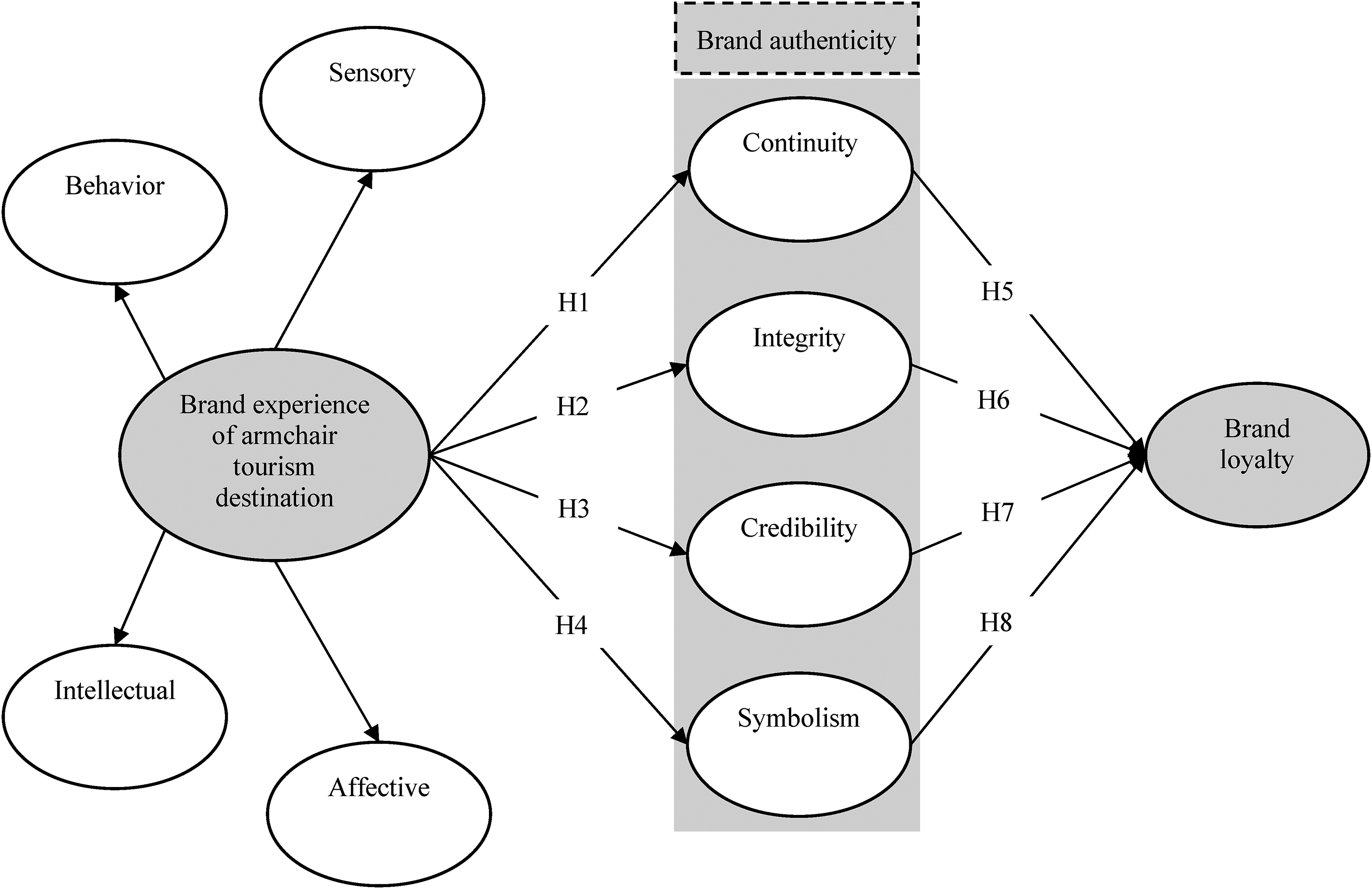
The proposed conceptual model.
Methods
Measurement instruments
The questionnaire items, which are proven to have validity and reliability in the previous studies, were modified in order to meet the purpose of the present study and used to measure the study variables. The questionnaire is comprised of a description of the study, the study variables, and questions about the demographic characteristics. For all the questionnaire items, a 7-point Likert’s scale, which ranges from (1) strongly disagree to (7) strongly agree, was used, and the most commonly used multi-item was employed in order to evaluate the structure. Specifically, 12 questions about the brand experience of armchair tourism destinations, which were borrowed from Brakus et al. (2009), and 15 questions about the authenticity of armchair tourism destination brands, which were derived from Morhart et al. (2015), were adapted. Finally, in order to measure the consumers’ loyalty to armchair tourism destination brands, a total of three questions, which were based on the research of Kim et al. (2018) and Nam et al. (2011), were included. The first iteration of the questionnaire was pretested on researchers and practitioners in the tourism field in order to ensure that the respondents could clearly and accurately understand the contents. The questionnaire items were thoroughly reviewed during the pretest, and modifications and supplementations were made, which improved the completeness of the questionnaire.
Data collection and sample characteristics
This study used a quantitative approach to present the research results, and it used an empirical analysis to secure its objectivity. A survey method was adopted in order to collect the data for the empirical analysis, which was gathered through the web-based system of an online research institute that professionally collects data. The respondents who participated in this study are panelists associated with an Internet research institute specializing in surveys. In order to achieve the purpose of this study, among the many panelists registered with Internet research institutes, the selection was limited to those who travel frequently and have experience in watching TV travel programs. The purpose of the study was clearly explained to the participating respondents, and they were assured that their personal information would be kept confidential. In addition, in order to collect more robust data, the respondents were limited to people who had experienced at least one armchair tour, which included watching a travel program on television, reading travel books/magazines, or participating in an online tour via a smart device, in the past year. As a result, a total sample of 436 meaningful responses was obtained, and the survey period lasted 10 days. An empirical analysis was conducted that was based on the 436 significant responses.
In terms of the respondents’ demographic characteristics, there were 218 male and 218 female respondents. 218 respondents were in their 20s or 30s (50%), 199 were in their 30s to 50s (45.6%), and 19 were in their 60s (4.4%). In terms of the respondents’ educational backgrounds, six were high school graduates (1.4%), 52 were junior college graduates (11.9%), 337 were university graduates (77.3%), and 41 were graduates of a graduate school or had a higher degree (9.4%). Finally, in terms of the respondents’ annual income, 66 (15.1%) earned less than $30,000, 238 (54.6%) earned between $30,000 and $70,000, and 133 (30.3%) earned more than $70,000.
Results
Measurement model results
According to Anderson & Gerbing (1988), it is appropriate to perform a confirmatory factor analysis (CFA) in order to verify the reliability and validity of a scale. Therefore, the present study conducted a CFA using the maximum likelihood estimation method in order to verify the reliability and validity of the scale that was used. The analysis results revealed that the model fit was χ2 = 884.475, df = 639, p < 0.001, χ2 / df = 2.397, RMSEA = .057, CFI = .958, and TLI = .950, which confirmed that the measurement model's fit was statistically appropriate. Next, the standardized regression weight was tested in order to evaluate the reliability of the measured items. The results of the analysis showed that all the measured items were between.767 and.914, which was higher than the standardized regression weight of.5, so the reliability of all the items measured in the study was therefore secured.
Fornell and Larcker (1981) explained that the most appropriate method to verify the internal consistency and the central validity of the measured variables is to analyze the average variance extracted (AVE) and the composite reliability (CR). The AVE values that are more than .5 and the CR values that are more than .7 represent an appropriate level. In the present study, the AVE values ranged from .549 to .755, and the CR values ranged from .785 to .902, which therefore confirm that there were no problems with the internal consistency and the central validity of the measurement variables that are presented in this study. Finally, in order to verify the discrimination among the constructs, the discriminant validity test suggested by Fornell & Larcker (1981) was performed. An AVE value that is larger than the square of the correlation coefficient between the latent variables demonstrates that there is no problem with the discriminant validity (Fornell & Larcker, 1981). The analysis revealed that there was no problem with the discriminant validity between the variables that are presented in this study. The analysis results are detailed in Table 1.
Measurement model assessment and correlations.
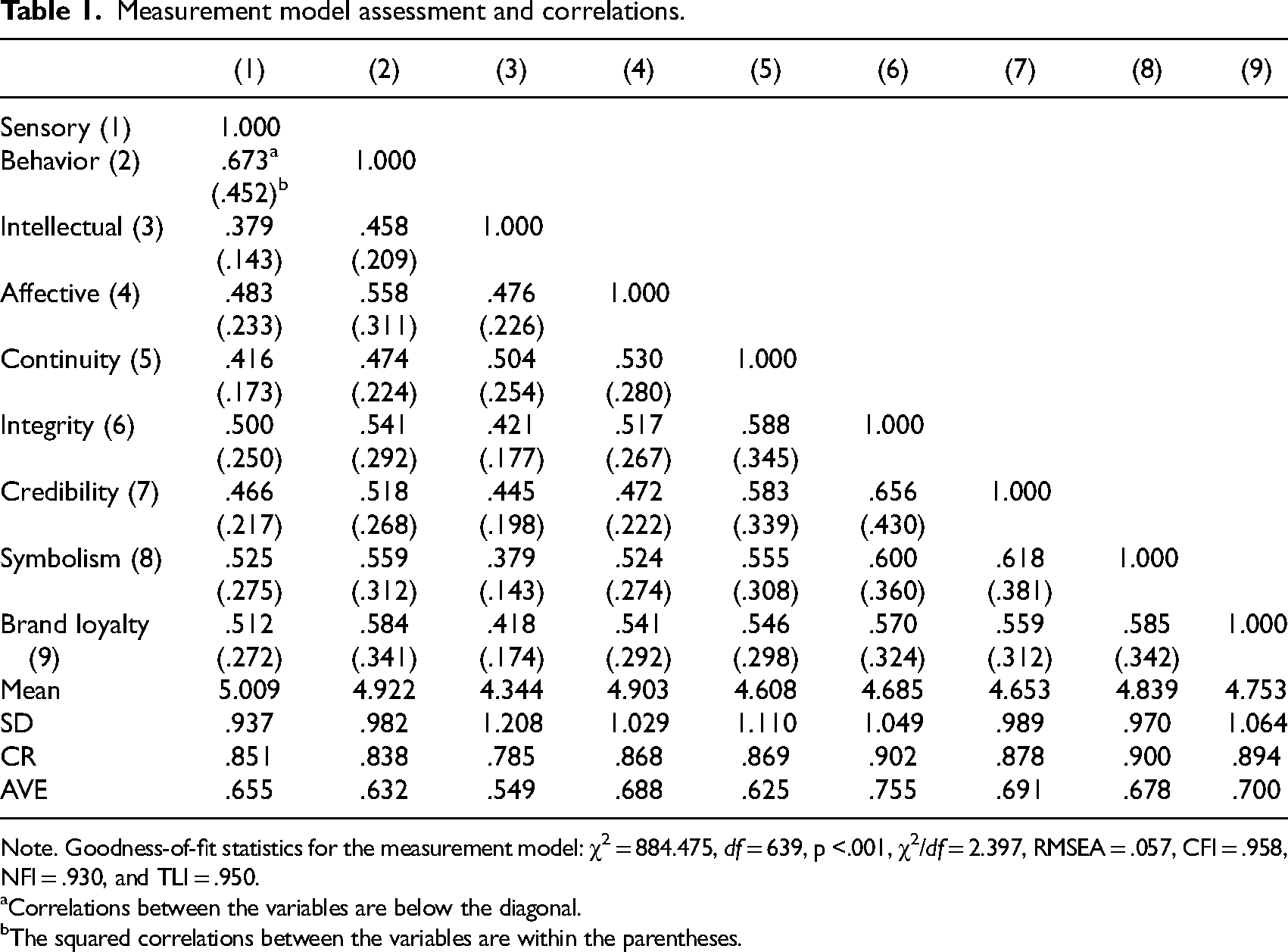
Note. Goodness-of-fit statistics for the measurement model: χ2 = 884.475, df = 639, p <.001, χ2/df = 2.397, RMSEA = .057, CFI = .958, NFI = .930, and TLI = .950.
Correlations between the variables are below the diagonal.
The squared correlations between the variables are within the parentheses.
Structural equation modeling
The study's conceptual framework and hypotheses were tested through structural equation modeling using the maximum likelihood method. First, the fit of the study's structural model was χ2 = 1154.742, df = 393, p <.001, χ2 / df = 2.938, RMSEA = .067, CFI = .937, and TLI = .930, which was an appropriate level. Next, the results of analysis of the second-order factor structure of the armchair tourism destination brand experience showed that the standardized coefficients of the four first-order factors were 1) sensory (β = .834), 2) behavioral (β = .886), 3) intellectual (β = .765), and 4) affective (β = .854), which were all found to be statistically significant at the p <.01 level. Moreover, the R2 values included 1) sensory (R2 = .696), 2) behavioral (R2 = .784), 3) intellectual (R2 = .586), and 4) affective (R2 = .729), so each higher structure was well explained.
The study's eight hypotheses were then tested. First, the relationship between the armchair tourism destination brand experiences and the armchair tourism destination brand authenticity was examined. The results showed that the armchair tourism destination brand experience had the following relationships with the subfactors of the armchair tourism destinations’ brand authenticity: continuity (β = .886 and p <.01), integrity (β = .930 and p <.01), credibility (β = .920 and p <.01), and symbolism (β = .917 and p <.01). Therefore, Hypotheses 1, 2, 3, and 4 were all supported. Next, the relationship between the brand authenticity of the armchair tourism destinations and the tourists’ loyalty toward these brands were analyzed. The results showed that among the subfactors of the loyalty to armchair tourist destination brands, continuity (β = .209 and p <.01), integrity (β = .225 and p <.01), credibility (β = .215 and p <.05), and symbolism (β = .338 and p <.01) all had a statistically significant effect on the respondents’ loyalty to armchair tourist destination brands. Therefore, Hypotheses 5, 6, 7, and 8 were all supported.
Finally, the indirect effect of the study's research model was verified using the bootstrap method. It is appropriate to use the mediating framework in order to understand the complex relationships of the research models (Han & Ryu, 2009). As a result of indirect effect testing, it was found that the armchair tourism destination brand experiences had a statistically significant indirect effect on the loyalty to armchair tourism destination brands Figure 2. Therefore, the mediating role of the brand authenticity of the armchair tourism destinations was successfully confirmed within the study's theoretical framework Table 2.
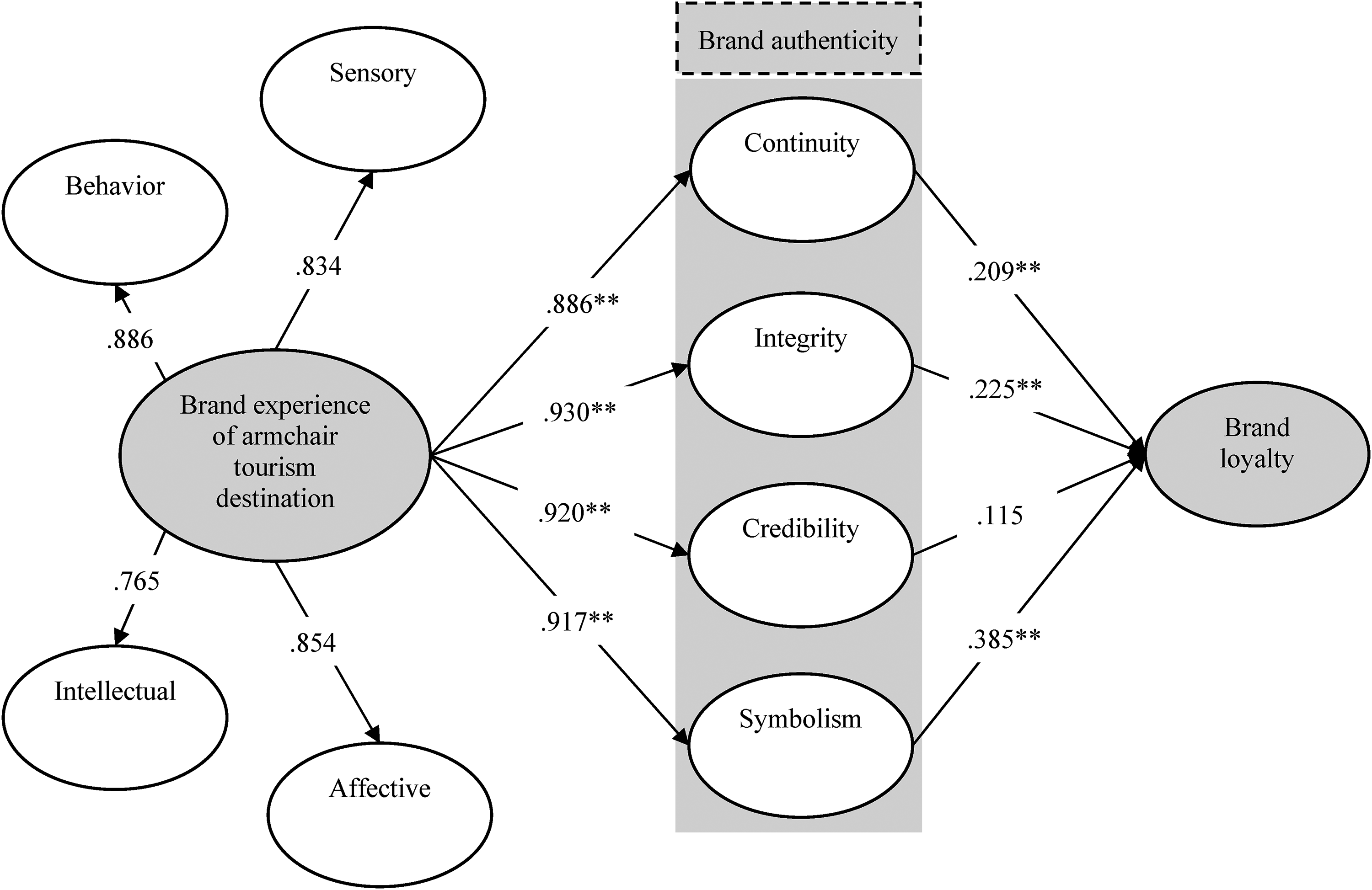
The structural model results.
The structural model estimation.
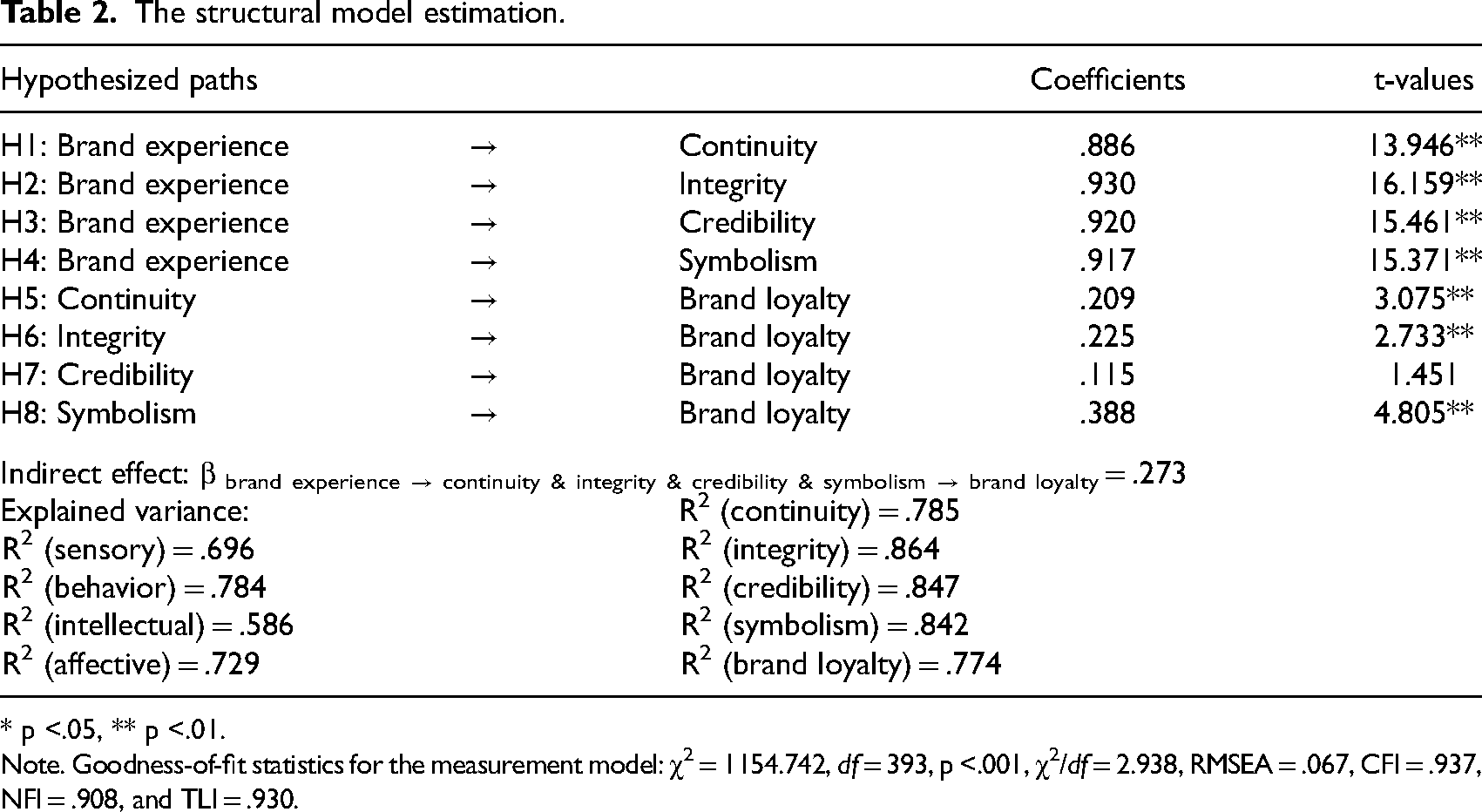
* p <.05, ** p <.01.
Note. Goodness-of-fit statistics for the measurement model: χ2 = 1154.742, df = 393, p <.001, χ2/df = 2.938, RMSEA = .067, CFI = .937, NFI = .908, and TLI = .930.
Discussion
This study aimed to examine the relationship between the armchair tourism destination experience, armchair tourism destination brand authenticity, and brand loyalty. Specifically, the armchair tourism destination brand experience was divided into sensory, behavioral, intellectual, and affective subfactors, and the authenticity of the armchair tourism destination brands was divided into the four subfactors of continuity, integrity, credibility, and symbolism. The reliability and validity of the measured items were confirmed using the measurement model verification, and both reliability and validity were confirmed to be at a statistically significant level. Through the structural equation modeling verification, the study's suggested conceptual framework satisfactorily explained the positive effect of the armchair tourism destination experiences on brand authenticity and the consumers’ loyalty to armchair tourism destinations. In addition, the armchair tourism destination experience was satisfactorily reflected in the higher-order framework, and the meaningful mediating role of the armchair tourism destination brands’ authenticity was successfully confirmed. Therefore, the results of this study confirm that the armchair tourism destination experiences have a positive effect on brand authenticity and the consumers’ loyalty toward armchair tourism destinations, and the results reveal the necessity and importance of actively developing armchair tourism as a valuable new tourism product in the future.
The study's empirical analysis results confirmed that the armchair tourism destination experience has a positive effect on the brand authenticity of the armchair tourism destinations (continuity: β = .886 and p <.01, integrity: β = .930 and p <.01, credibility: β = .920 and p <.01, symbolism: β = .917 and p <.01). These results highlight that a new marketing approach that is focused on brand experience can help the tourists form a positive perception of an armchair tourism destination and form a trustworthy relationship between the tourists and an armchair tourism destination brand. Many of the previous studies also suggested that brand experience has a positive effect on brand authenticity, which is consistent with the results of this study (Das et al., 2019; Jimenez-Barreto et al., 2020a, 2020b). Therefore, when considering the present study's results in regards to an armchair tourism destination brand experience in conjunction with the prior research on brand experience, it can be said that the tourists’ perceptions of the positive experiences of an armchair tourism destination brand are important and meaningful for the formation of its brand authenticity.
Next, among the subfactors of the brand authenticity of armchair tourism destinations, continuity (β = .209 and p <.01), integrity (β = .225 and p <.01), credibility (β = .215 and p <.01), and symbolism (β = .388 and p <.01) were found to have a positive effect on the tourists’ loyalty to armchair tourist destination brands. These results are consistent with the results from the previous studies about brand authenticity, which revealed that when tourists experience a brand's authenticity, a strong will to revisit the tourism destination is formed and positive behavioral intentions toward the tourism destination brand, which include positive word of mouth, revisits, and recommendation intention, are triggered (Cohen, 1988; Jimenez-Barreto et al., 2020a; Kumar & Kaushik, 2022; Manthiou et al., 2018). Therefore, the present study's results and in conjunction with the results from the previous research about brand authenticity confirm that when the consumers recognize the brand authenticity of armchair tourism destinations, brand loyalty toward these destinations is formed.
The existing tourism research emphasized the importance of the customer experience (Brakus et al., 2009; Das et al., 2019; Klaus & Maklan, 2007; Han et al., 2019; Iglesias et al., 2019). In particular, since the brand experience of tourist site has a complex structure that is easily affected by external environmental factors, there is a need to understand how the brand is perceived and evaluated through the customer's brand experience (Buhalis & Park, 2021). However, few studies focused on the experience of the tourism destination brands or emphasized the importance and necessity of the armchair tourism destination brand experience. Therefore, the results of testing the relationship between the armchair tourism destination brand experiences, armchair tourism destination brand authenticity, and brand loyalty presented in this study represent meaningful theoretical findings. In particular, this study presented the four subfactors of the armchair tourism destination brand experience and successfully confirmed the suggested higher-order structure. Specifically, this study shows that the most powerful first-order subfactor of the armchair tourism destination brand experience was behavior (β = .886 and p <.01). This meaningful theoretical discovery highlights that tourists can form a strong attachment to and an emotional sympathy with a brand through their perception of a positive brand experience. The second strongest first-order dimension was the affective subfactor (β = .854 and p <.01). This result confirms that positive thoughts about a brand and the desire to indulge curiosity about it can be formed through an affective experience. Finally, the third and fourth strongest first-order dimensions were the sensory (β = .834 and p <.01) and intellectual (β = .765 and p <.01) subfactors. These results indicate that the interest and the strong impression that are formed through the experience of a tourist destination increase the possibility of more active participation and actual experiences. The specific theorization of the second-order typology of the armchair tourism destination brand experience presented in this study offers insights for the researchers that are studying the tourism industry.
Next, the study found that the brand authenticity of armchair tourism destinations is an excellent predictor of the consumers’ brand loyalty. These results confirm the positive role of brand authenticity in order to induce positive intentions and actions among the consumers through the armchair tourism destination brand experiences. In other words, positive experiences about the armchair tourism destination brands can be more strongly facilitated through brand authenticity. This is a meaningful discovery that successfully expands the existing research on the tourism industry. The theoretical and academic implications presented in this study suggest an extension as well as a new direction for the future research about armchair tourism.
The analysis results provide meaningful implications for the practitioners related to armchair tourism. In today's context where armchair tourism is attracting a lot of attention as an alternative tourism product, the practitioners must provide positive and impressive experiences in order for the interested tourists. For example, the armchair tourism destination brand experience should be able to arouse the tourists’ interest and attention. Also, technology is required that can create a closer and clearer vision when tourists visit the armchair tourism destinations. Next, it is also necessary to stimulate the tourists’ emotions in order to encourage them to form an attachment relationship with the armchair tourism destinations and generate their desire to continue to experience armchair tourism. In other words, it is necessary to secure the travel content from destinations where it is generally difficult to travel, such as war zones, politically unstable locations, and regions where infectious diseases are prevalent. In addition, the armchair tourism practitioners should try to make tourists aware of the authenticity of the armchair tourism destination brand. Specifically, the various content and technology that is provided by the armchair tourism destination brand must be trusted, and a lot of meaningful value must be provided for the tourists. Furthermore, the tourists’ quality of life should be enhanced by visiting the armchair tourism destinations. As a result, the armchair tourism destination brands should actively develop technology and conduct tourist trend research in order to develop various content. They should also offer products at reasonable prices that tourists find acceptable, and there should be a variety of options regarding choosing a tourist destination. These practical implications can be used as strategies in order to revitalize the armchair tourism destination brands.
This study highlights the meaningful findings and implications, but it has several limitations. First, the data that is used in the study was collected from Korean citizens, so it may be therefore difficult to generalize the results to other countries, cultures, and regions, which is necessary in order to expand the findings in the future studies. Second, the study only examined the armchair tourism destination brands. The research should be expanded in the future, so it can be applied across the entire tourism industry and not just the armchair tourism destinations. Third, in future research, there is a need to develop a new concept that can integrate various expressions used with the same meaning as armchair tourism (e.g. virtual tourism, online tourism, and lane tour). Specifically, there is a need to expand research on virtual tourism using virtual reality or augmented reality. Finally, the demographic characteristics of the consumers experiencing armchair tourism destination brands were not considered. Considering the tourists’ demographic characteristics in the future studies would render the findings more meaningful.
Conclusion
Developing new tourism products is critical at the present time considering that various factors are limiting free travel. These factors could develop into a major threat to the tourism industry in the future. There has been limited research about tourism products that can offer a new paradigm for the tourism industry despite these problems. Therefore, this study explored a new tourism product that is called armchair tourism. This study specifically tested the relationship between the armchair tourism destination brand experiences and brand authenticity and loyalty. In particular, the study categorized the armchair tourism destination brand experience and brand authenticity into four subfactors. The analysis results demonstrated that the armchair tourism destination brand experiences have a positive effect on the brand authenticity of the armchair tourism destinations, which in turn forms positive brand loyalty. Moreover, the mediating role of the brand authenticity of armchair tourism destinations was successfully confirmed, which is within the theoretical framework that is proposed in the study. The study's findings provide meaningful insights and strategic implications for the researchers and practitioners in the tourism industry.
Footnotes
Declaration of conflicting interests
The author(s) declared no potential conflicts of interest with respect to the research, authorship, and/or publication of this article.
Funding
The author(s) received no financial support for the research, authorship, and/or publication of this article.
